







Abstract
Despite an increase in climate-driven natural disasters, Australia has been slow to adopt pro-climate policy, partially due to resistance on the political right. Measures of ideology beyond the left-right continuum, including conventionalism, dominance and anti-egalitarianism, predict climate change-related attitudes in several Anglophone nations. A consistent additional predictor is partisan affiliation with specific political parties. The aim of this study (N = 390) was to compare the associations of right-wing ideological beliefs and identification with major political parties (Liberal, Labor and Greens parties) with climate mitigation and adaptation policy support, to determine whether either or both underpin support for climate policy in the Australian context. Path analysis revealed that anti-egalitarianism (negatively) and Greens partisan identity (positively) predicted both forms of climate policy support, whereas Liberal partisan identity and conventionalism only (negatively) predicted support for mitigation but not adaptation policy. Neither dominance nor Labor partisan identity predicted either type of policy support. Results indicate that some partisan identifications sit alongside ideological beliefs as unique drivers of climate policy support. Applying a social identity framework, we suggest that climate policy shifts within political parties could lead some partisans to alter their support in line with these changes.
Support for climate change policy is politically polarized (Hornsey & Fielding, 2020), especially among citizens in countries with the highest greenhouse emissions (Hornsey, 2021; Hornsey et al., 2018). Australia continues to be one of the largest per capita contributors to greenhouse gas emissions, and at the time of data collection stood out globally as a laggard in adopting climate change mitigation and adaptation policies (Zhongming et al., 2021). Despite some recent improvement due to a change in government from 2022, even the latest policies fall far short of what is required to limit warming to the global target of 1.5°C (Burck et al., 2024). Climate change mitigation policy involves tackling the root causes of warming (e.g., reducing carbon emissions), and climate change adaptation policy involves preparation for living with its inevitable incoming effects (e.g., building sea walls to address rising tides; Bateman & O’Connor, 2016). Both forms of action are required to address the climate emergency (Clayton et al., 2015), as even if ample mitigation measures are adopted immediately to slow the rise in global temperature beyond pre-industrial levels, scientific modeling predicts devastating environmental damage requiring adaptation measures to ensure human safety (Pörtner et al., 2022). Self-identified conservative and right-wing political orientations are stronger predictors of opposition to climate mitigation policies than of opposition to adaptation policies (Bateman & O’Connor, 2016; Klas et al., 2022), suggesting different climate policies may be differentially politically polarized. We require urgent understanding of what drives support for these policies in order to pass effective legislation protecting us from the worst impacts of climate change.
While research traditionally divides political opinion into a one-dimensional structure with left and right (or liberal and conservative) poles, particularly for economic and social policies, new cultural issues have also risen to importance in recent decades, such as immigration, climate, and the role of women in society (Kurella & Rapp, 2025). While some of these issues, such as support for stronger foreign and security policies, show a curvilinear relationship with the traditional left-right spectrum and find their greatest support in the center of the political divide (Haesebrouck & Mello, 2020), many of these new issues - including climate policy - are typically linearly related to the one-dimensional spectrum (Kurella & Rapp, 2025). An attempt to account for differences in party preferences on these modern political issues led to the development of what is coined the “New Politics Dimension”, or GAL-TAN framework (green, alternative, liberal versus traditional, authoritarian, nationalist; coined by Hooghe et al., 2002). The GAL end of the spectrum tends to be associated with socially liberal positions and pro-environmentalism, and the TAN end is associated with traditionalist and culturally conservative beliefs. European party systems are organized along both the GAL-TAN dimension and a left-right economic dimension, and party framing of a given issue along these dimensions can influence party supporters (Kurella & Rapp, 2025).
Conservative and right-wing ideological beliefs are both negatively associated with acceptance of anthropogenic climate change (Hornsey et al., 2016) and support for climate change action (Mayer et al., 2017; Stanley et al., 2017b). Radical right-wing endorsement in particular can foster anti-establishment attitudes and institutional distrust that are coupled with climate change denial (Jylhä et al., 2020). Right-wing ideologies are associated with climate attitudes over and above demographic variables such as age, gender, education, and subjective knowledge (see meta-analysis examining data from 56 nations; Hornsey et al., 2016), particularly in Anglophone countries such as Australia (Smith & Mayer, 2019). However, the last decade has seen increasing social acceptance of the imminent risk of the climate emergency, and by 2017 even most politically conservative Australians believed that climate change posed an acute threat to the next generation (Tranter, 2017). As those who believe in anthropogenic climate change tend to also support climate policy (Bateman & O’Connor, 2016), it is important to understand why this increase in climate change belief, even among right-wing adherents, has not been accompanied by the necessary level of policy support and reform in Australia.
Partisanship (that is, psychological attachment to a specific political party; Campbell et al., 1960) could also serve as an important driver of climate attitudes and policy support (Doell et al., 2021). As identification with a group typically results in one aligning themselves with the norms and beliefs of this group (Tajfel, 1978), if a political party espouses weak climate policy positions, strong partisans are likely to also adopt these beliefs. Indeed, a US-based study examining data from 74 surveys over an 8-year period found cues from elite partisan figures were the single most important factor affecting one’s concern over climate change (Brulle et al., 2012). In an experimental context, Cohen (2003) found that the policy preferences of participants were congruent with their liberal or conservative worldviews, until the policies were said to be endorsed by a certain political party, where participants then mirrored the preference of their party, regardless of the policy’s content. This policy preference influence on party supporters is also consistent with the GAL-TAN conceptualization of party position mapping, where partisans of GAL parties are more likely to support environmental policy, and the opposite being the case for TAN parties (Hooghe et al., 2002).
Australia is considered a multi-party system, and supporters of left-wing political parties including the Greens, and to a lesser extent the center-left Labor party, express greater support for climate action than the more right-wing Liberal-National Coalition supporters (Colvin & Jotzo, 2021; Tranter, 2017). Given the apparent political polarization of the issue of climate change in Australia, it is important to understand the political and social psychological underpinnings of citizens’ support – or lack thereof – for climate policies. We suggest that directly comparing specific ideological beliefs and partisan identities as potential drivers of support for mitigation and adaptation climate policy allows for a nuanced understanding of the barriers Australia faces in implementing climate legislation. For example, after accounting for the role of different ideological beliefs in support for climate policy, psychological attachment to a political party may further explain levels of support that cannot be explained by ideology. People with a strong partisan identity may either support or reject climate policy because they are sensitive to the policy positions of the party that they identify with, irrespective of their own ideological beliefs. Put simply, we wish to answer the following question - does ideology, partisan identity, or some combination of the two, drive the climate divide?
Right-Wing Ideological Subdimensions and Climate Change Outcomes
The traditional method of one assigning themselves a position on a left-right continuum as a broad measure of their political ideology has been criticized as an oversimplified approach (Castles & Mair, 1984), where points on this spectrum may trigger incongruent associations and issue-related positions among respondents (Bauer et al., 2017). Furthermore, these self-placement items do not directly measure content-based ideology. Conservative ideology is widely conceptualized in the psychology literature as comprising two core aspects - resistance to change and acceptance of inequality (Jost et al., 2003). Resistance to change has been operationalized in previous research using Right-Wing Authoritarianism (RWA), with the conventionalism subdimension being perhaps the most conceptually representative of this core aspect (White et al., 2020). The conventionalism subdimension refers to a preference for maintaining traditions and norms within society, and corresponds to political science definitions of conservatism as an ideology (Festenstein & Kenny, 2005). Nonetheless, right-wing authoritarian political parties often combine exclusionary politics and institutional distrust with conventionalist beliefs that more traditional conservative parties may not (Jylhä et al., 2019). Although conservatism and radical right ideologies are different, they often hold conventionalism in common. In the context of climate change, the conventionalism subdimension appears the most relevant given that it more consistently correlates with climate change denial types than the two authoritarianism subdimensions of RWA (Clarke et al., 2019).
Social Dominance Orientation (SDO) has been employed as a measure of acceptance of inequality (e.g. Brandt & Reyna, 2017). Pro-environmental attitudes and climate beliefs are consistently associated with SDO (Choma et al., 2020; Häkkinen & Akrami, 2014; Hoffarth & Hodson, 2016; Kerr & Wilson, 2021; Milfont et al., 2013), RWA (Choma et al., 2020; Devine-Wright et al., 2015; Hoffarth & Hodson, 2016; Kerr & Wilson, 2021; Stanley et al., 2017b), and more specifically, the anti-egalitarian and dominance subdimensions of SDO and the conventionalism subdimension of RWA (Clarke et al., 2019, 2024). We discuss how this conceptualization of conservative ideology, as two core aspects, is relevant for improving our understanding of the possible motivators of resistance to climate action and policy below.
Social Dominance Orientation
SDO can be conceptualized as a fundamental motivation to create and maintain inequitable social hierarchies (Pratto et al., 1994). In the context of environmentalism, high SDO scores represent a desire for hierarchical interactions between humans and their natural environment that do not value preserving nature (Milfont et al., 2013), which may account for evidence that those high in SDO are more likely to deny climate change and its impacts (Stanley et al., 2017a), due to the personal costs or restricted individual freedoms associated with pro-climate policy implementation (Kahan et al., 2015).
The SDO subdimensions, anti-egalitarianism (favoring subtle reinforcement of hierarchical ideology, Ho et al., 2015) and dominance (favoring active suppression and control of minority groups, Ho et al., 2015), differentially predict climate attitudes. Anti-egalitarianism is consistently negatively associated with pro-environmental attitudes and climate beliefs (Clarke et al., 2019; Stanley et al., 2017a, 2021), possibly due to alignment with a preference for hierarchical allocation of natural resources (as suggested by Stanley et al., 2017a). Alternatively, dominance is inconsistently related to pro-environmental attitudes, including weak negative or non-significant effects (Stanley et al., 2017a). However, Stanley et al. (2021) found through qualitative measures that while anti-egalitarianism may be a barrier to individual environmental action, dominance might drive hesitation to support government level action, through a link between dominance and support for industry. Therefore, the link between both SDO subdimensions and climate-related outcomes may extend to policy support variables, where dominance and anti-egalitarianism uniquely and negatively predict climate policy support in an Australian sample.
Right-Wing Authoritarianism
RWA is an ideological attitudinal construct which reflects a tendency to submit to authority (relating to the submission subdimension), as well as a preference for maintaining conventions in society (conventionalism subdimension), and support for punishing those who challenge these norms (aggression subdimension; Altemeyer & Altemeyer, 1996). Although RWA was initially conceptualized as a unidimensional construct, multidimensional measures of RWA have since been developed that measure the three underlying authoritarian tendencies (e.g., Dunwoody & Funke, 2016).
Although there is limited research linking the RWA subdimensions with climate outcomes, research demonstrates that conventionalism appears to uniquely (positively) predict climate change denial when these three RWA subdimensions are measured and compared (Clarke et al., 2019). It is possible that because climate mitigation policy efforts challenge the social norm of economic growth (Schultz & Stone, 1994) and the socioeconomic status quo (Clarke et al., 2019), climate action may threaten these norms and systems that conventionalists are concerned with. While failing to find experimental evidence for this socioeconomic threat argument, Clarke et al. (2024) found that conventionalism uniquely predicts opposition to climate change mitigation policy, in an Australian sample.
The conventionalism subdimension theoretically and empirically appears the most relevant to climate change outcomes given that it more consistently correlates with climate change denial types than the two authoritarianism subdimensions of RWA (Clarke et al., 2019). This appears consistent with the literature on GAL-TAN, which places environmental attitudes on the same dimension as conventionalist and traditionalist attitudes, but at opposite poles. Furthermore, the conventionalism subdimension of RWA specifically refers to a preference for maintaining traditions and norms within society, and therefore corresponds to political science definitions of conservatism as a political ideology (Festenstein & Kenny, 2005). It may be the underlying right-wing ideological dimension that drives resistance to climate change mitigation policy, given that radical right-wing endorsers also tend to value traditions and conventions, and also tend to deny climate change (Jylhä et al., 2020).
Partisan Identity and Climate Change Outcomes
Partisanship is often considered to function as an identity, deriving from the Social Identity Approach (Bankert et al., 2017; Greene, 1999). This theoretical framework proposes that a person’s self-concept that relates to their membership of a group, as well as the value they attach to this membership, assists in explaining their attitudes and perceptions (Miller, 2010; Tajfel, 1978). A partisan identity can then influence attitudes to political issues - including towards climate change - and related behavior (Greene, 2004), potentially independent of one’s ideological beliefs (such as the subdimensions of SDO and RWA).
According to Miller (2010; p. 23), partisan identity is seen as a ‘simplifying function’ for complicated or nuanced political issues, where the leaders of political parties guide beliefs for party identifiers. One longitudinal study demonstrated that voting behavior influenced climate skepticism rather than being influenced by climate skepticism (McCrea et al., 2016), meaning it is likely that some people’s partisan identity influences their opinion of the importance of climate action. Persuasive framing research that used Social Identity Theory principles also demonstrated that when right-wing Australians were primed with their political identity, they tended to exhibit a reduction in support for climate policy when compared with right-wing Australians whose political identity was not made salient (Unsworth & Fielding, 2014). Further still, the meta-analysis of determinants and outcomes referred to above (Hornsey et al., 2016) demonstrated that not only was political affiliation a predictor of climate beliefs, but its effect size was even larger than the broad measure of political ideology (although they do not examine the SDO and RWA subdimensions specifically in this meta-analysis). Therefore, political affiliation seems to sit alongside ideology as one of the strongest correlates of beliefs surrounding climate change, where those who identify with conservative political parties are more likely to deny anthropogenic climate change (Hornsey et al., 2016).
When examining party-specific findings in Australia, supporters of right-wing political parties (the Liberal-National coalition) are more likely to deny the risks and even existence of anthropogenic climate change (Tranter, 2017) and show a lack of support for climate action policy (Colvin & Jotzo, 2021; Fielding et al., 2012) than supporters of center-left political parties (Labor and Greens parties). This is consistent with the GAL-TAN framework, in that right-wing parties are more likely to place at the TAN end of the spectrum and away from the GAL end. Although polls have suggested climate change is an increasing priority in the Australian population (Hornsey & Fielding, 2020), politicization of climate change in Australia has made the road to policy implementation fraught in past attempts. For example, the introduction of both a mining tax and a carbon tax by a Labor Party government in 2012 garnered enough criticism to be quickly revoked and is considered the cause of the demise of two separate Australian Prime Ministers (Hornsey & Fielding, 2020). Further, despite belief in anthropogenic climate change having a positive correlation with policy support (Bateman & O’Connor, 2016), when Australians attitudes towards climate science are controlled for, the orientation of their partisan identity remains influential in their climate attitudes (Tranter, 2017). Given these considerations concerning partisan identity, we argue that both ideological beliefs (conventionalism, dominance, and anti-egalitarianism) and partisan identity (Liberal, Labor and Greens party identities) are associated with support for climate policy in Australia.
The Present Research
As outlined above, no research to our knowledge has compared the influence of ideological and partisan identity predictors on climate policy within the Australian context. Therefore, this study examines the unique contributions of the ideological subdimensions of conventionalism, dominance and anti-egalitarianism, alongside partisan identities (for Liberal, Labor and Greens parties), to understand how these variables differentially predict both mitigation and adaptation policy support, as two separate outcome variables. If partisan identity is uniquely associated with policy support, a future climate policy shift by party leaders could influence partisans and lead to a shift in their own policy support. Given the mixed findings concerning the influence of partisan identity and political ideologies on climate policy support, and that little research has directly compared the two, we did not make any hypotheses to this effect. Instead, the aim of this research is to compare, in an Australian context, the associations of known ideological predictors (e.g., conventionalism, dominance and anti-egalitarianism) and people’s partisan identification on support for climate change mitigation and adaptation policy. Our hypotheses were as follows:
Conventionalism, dominance and anti-egalitarianism would be negatively associated with support for (a) climate change mitigation and (b) adaptation policies.
Liberal partisan identity would be negatively associated with support for (a) climate change mitigation and (b) adaptation policies, whereas Labor and Greens partisan identity would be positively associated with support for these policies.
Method
Participants
We obtained approval for this study from the Human Research and Ethics Committee at Federation University. To be eligible to complete this online study participants were required to be Australian citizens of voting age (18+) and give informed consent before commencing the questionnaire. Participants were recruited from mid-July to the end of August 2021, where the Liberal-National Coalition had held power in the federal government since 2013 (the Labor party then gained power in the 2022 election and was re-elected in 2025). We utilized a convenience sample, recruiting participants via social media, including posts on the personal pages of researchers’ Facebook and Instagram pages, and several Facebook groups such as local community pages. There were no incentives for completing this study.
After 10 participants were removed due to missing data, and 14 removed due to scores on key variables being severely leveraged, the final sample included 390 participants (269 Female, 111 Male, 10 Non-binary; M age = 35.86, SD age = 15.48). The mean political orientation score (7-point Likert scale; 1 = very left-wing to 7 = very right-wing) in our sample was 3.04 (SD = 1.23). When compared with M = 4.98 (scale range 0–10) in a representative Australian sample (Cameron & McAllister, 2019), our sample was on average slightly more left-leaning.
We conducted a power sensitivity analysis with 5000 simulations and alphas set at .05 for a power level of 80% using the pwrSEM shiny app (Wang & Rhemtulla, 2021). This determined the minimum detectable significant standardized effect for each path between our predictors and outcomes. Minimum detectable effects ranged from β = .14 to .19 (see Table S1 of the supplementary materials for the specific standardized value for each path).
Materials
Demographics
We asked for participants’ age in years, gender, level of education, Australian state of residence, and political orientation using a seven-point self-placement item.
Ideological Beliefs
Ideological beliefs were represented by three ideological dimensions: conventionalism (RWA subdimension), anti-egalitarianism and dominance (SDO subdimensions). All variables were measured on a 7-point Likert scale (1 = strongly disagree to 7 = strongly agree).
Conventionalism
The six-item conventionalism subscale (α = .82; ω = .90) of the 18-item Aggression-Submission-Conventionalism Scale (Dunwoody & Funke, 2016) was used to measure conventionalism. Higher scores indicated greater preference for maintaining conventions and norms in society, and the scale includes items such as “[t]raditions are the foundation of a healthy society and should be respected”.
Dominance
The four-item dominance subscale (α = .74; ω = .76) of the Social Dominance Orientation (SDO7) short form scale (Ho et al., 2015) was used to measure dominance. Higher scores indicated greater preference for the active suppression and control of minority groups, and the scale includes items such as “[s]ome groups of people are simply inferior to others”.
Anti-Egalitarianism
The four-item anti-egalitarianism subscale (α = .77; ω = .83) of the Social Dominance Orientation (SDO7) short form scale (Ho et al., 2015) was used to measure anti-egalitarianism. Higher scores indicated greater preference for subtle reinforcement of hierarchical ideology, and this scale includes items such as “[g]roup equality should not be our primary goal”.
Partisan Social Identities
A short four-item version of the eight-item scale to measure partisan identity designed by Bankert et al. (2017) was used for each major political party in Australia (i.e., Greens, Labor, Liberal) (1 = strongly disagree to 7 = strongly agree). The four items were summed to create a total partisan identity score for each political party, where higher scores indicated higher levels of social identification with the political party. All participants completed all three versions of the partisan identity scales; Greens (α = .90; ω = .92), Labor (α = .88; ω = .90) and Liberal parties (α = .91; ω = .93). The scale included items such as “[w]hen people criticize the [Liberal/Labor/Greens] party, it feels like a personal insult”.
Mitigation and Adaptation Policy Support
Participants were asked to what extent they believed a range of climate policies (taken from Bateman & O’Connor [2016]) should be implemented as soon as possible (1 = strongly disagree to 7 = strongly agree). Mitigation support (α = .85; ω = .92) was measured with six proposed mitigation strategies (e.g. “[c]leaner energy sources such as wind and solar power, and other renewable sources”) and adaptation support (α = .83; ω = .86) was measured with five proposed adaptation strategies (e.g. “setting aside land corridors to help species migrate”). The scores representing each proposed mitigation strategy were then summed to indicate a total mitigation policy support score, where higher scores indicated higher levels of support. The same was done for the adaptation policy items.
Study Design and Analytic Strategy
This study was a correlational, cross-sectional design, and all analyses were conducted in RStudio version 2021.09.2 using the R-packages car (3.0.12; Fox & Weisberg, 2019), dplyr (1.0.8; Wickham et al., 2022a), foreign (0.8.82; R Core Team, 2022), lavaan (0.6.11; Rosseel, 2012), lm.beta (1.5.1; Behrendt, 2014), psych (2.1.9; Revelle, 2021), readr (2.1.2; Wickham et al., 2022b), and tableone (0.13.0; Yoshida & Bartel, 2021).
All hypotheses were tested using path analysis, with climate change mitigation policy support and climate change adaptation policy support simultaneously regressed on to the ideological belief subtypes (anti-egalitarianism, dominance, and conventionalism) and partisan identity variables (as measured by identification with the Greens, Labor, and Liberal Australian political parties). All predictor variables were covaried, and the outcome residuals were covaried. To control for age and gender we conducted the same analysis with the two variables included as covariates (see Table S2 of the supplementary materials). These variables were not significantly associated with the policy support outcomes and did not substantially change the pattern of results. Although not theorized to predict climate change policy support, we checked whether the aggression and submission subdimensions of RWA were associated with our outcomes by conducting the same analysis including these variables (see Table S3 of the supplementary materials). They were not significantly associated with the policy support outcomes and they did not have a substantial effect on the overall results of the original analysis.
Results
Descriptive Statistics
Means, Standard Deviations, Ranges and Correlations for the Major Variables of the Study
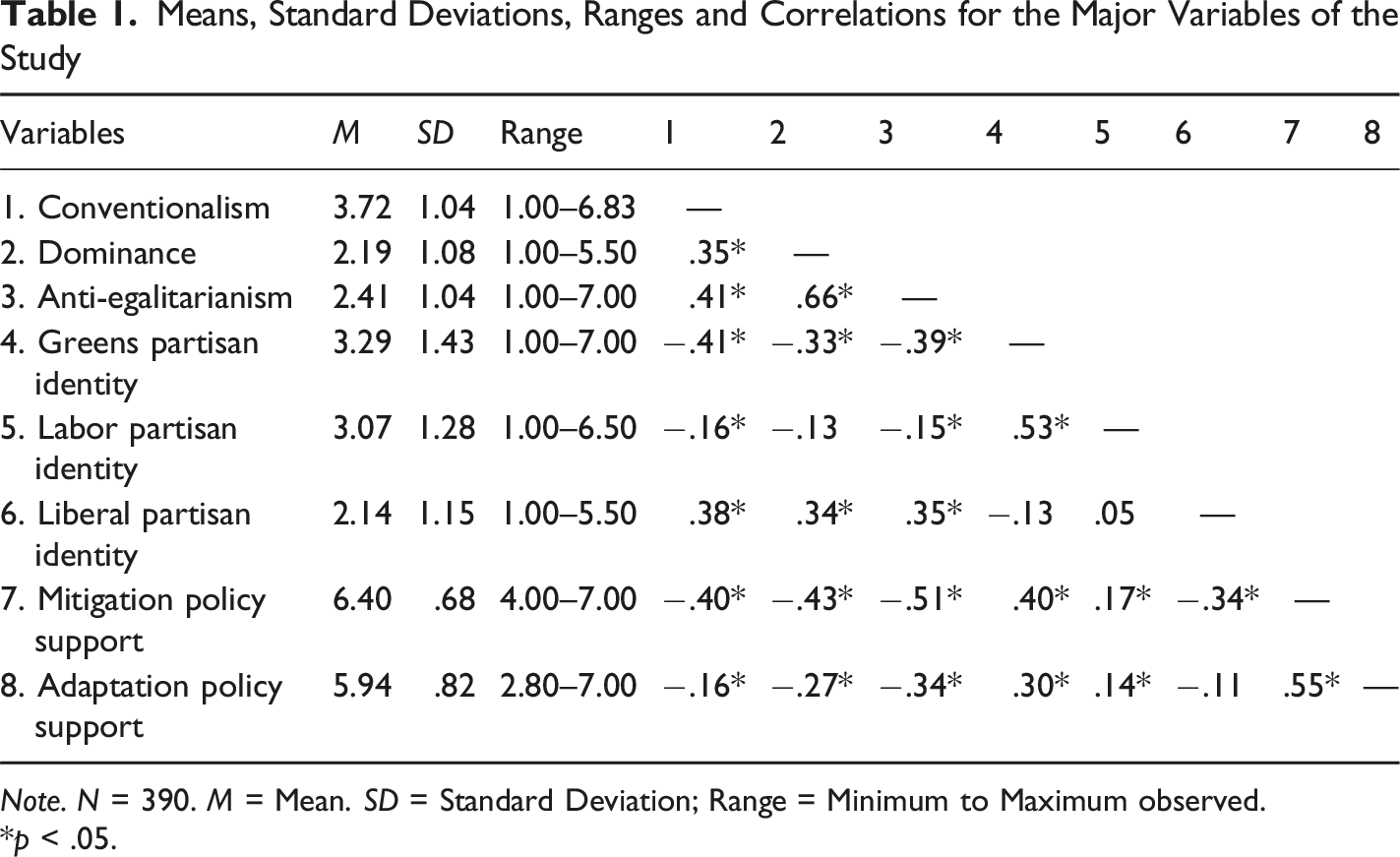
Note. N = 390. M = Mean. SD = Standard Deviation; Range = Minimum to Maximum observed.
*p < .05.
Main Analysis
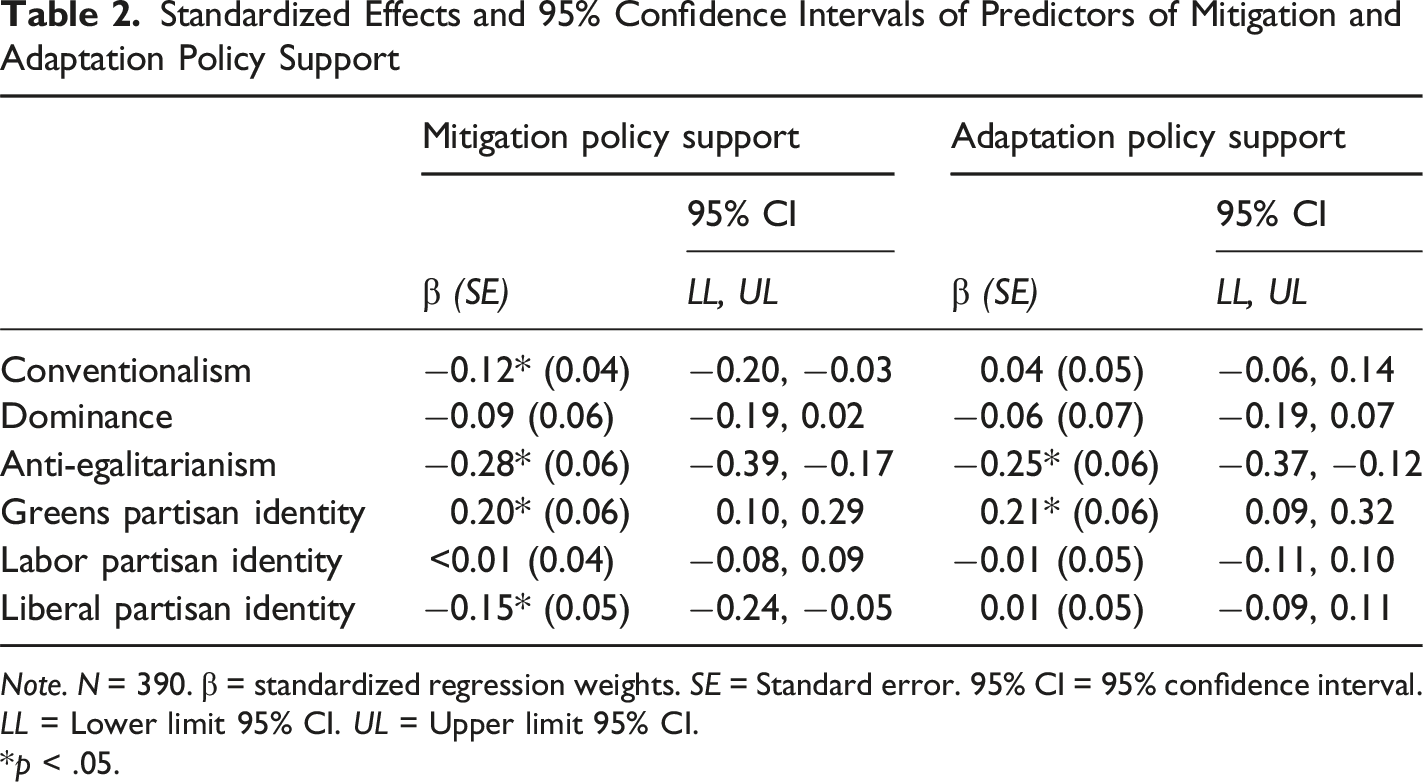
Results of the path analysis (see Figure 1), including the standardized regression weights and their standard errors and confidence intervals, can be found in Table 2. The residuals of the outcome variables correlated at 0.46, and the results for each are described below. Path model with standardized effects predicting outcome measures. Standardized Effects and 95% Confidence Intervals of Predictors of Mitigation and Adaptation Policy Support Note. N = 390. β = standardized regression weights. SE = Standard error. 95% CI = 95% confidence interval. LL = Lower limit 95% CI. UL = Upper limit 95% CI. *p < .05.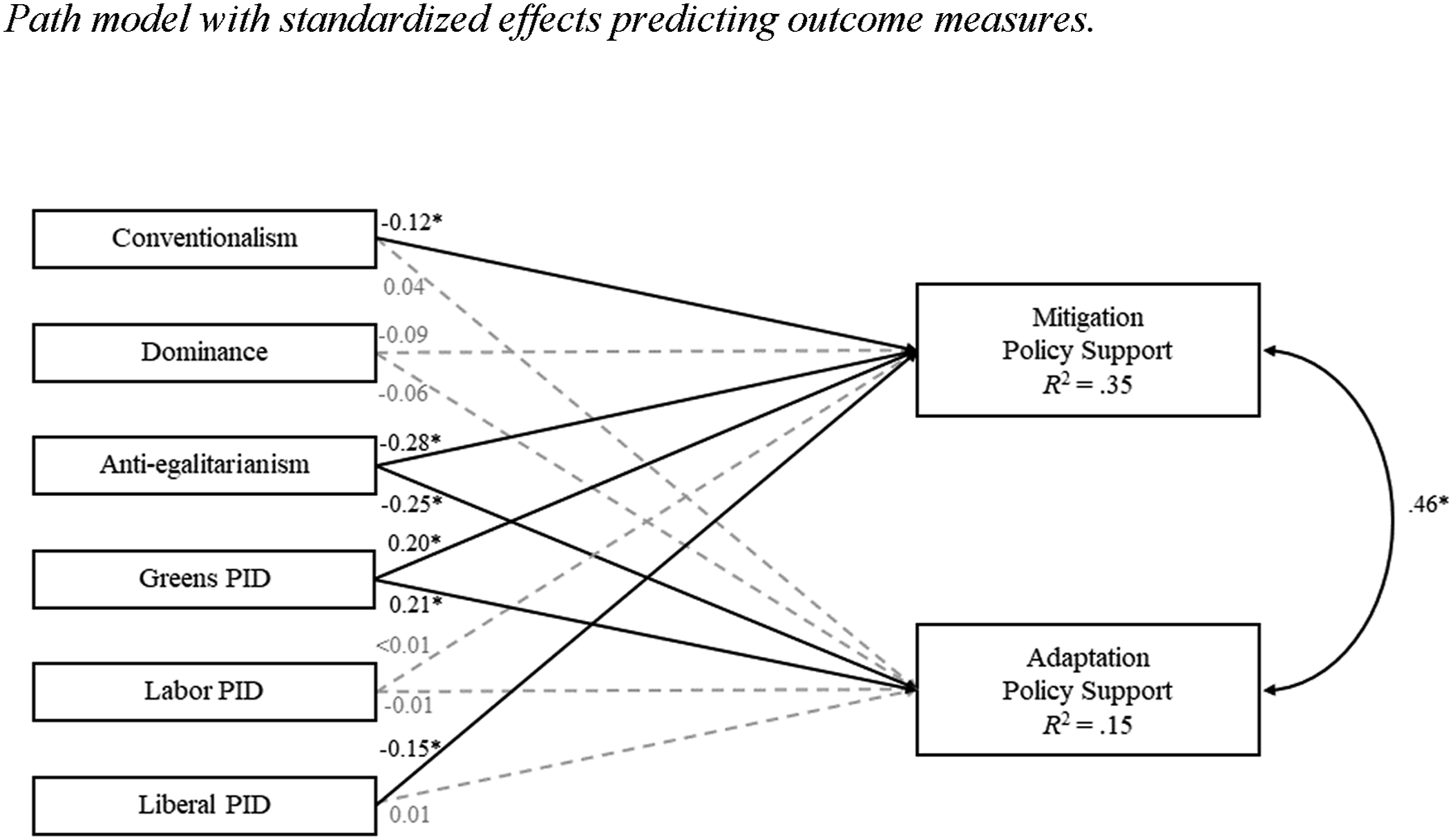
Mitigation Policy Support
As shown in Table 2, conventionalism, anti-egalitarianism and Liberal partisan identity were all associated with lower support for climate change mitigation policies, whereas Greens partisan identity was associated with greater policy support. Both dominance and Labor partisan identity were not significantly associated with this outcome. The estimated standardized effect of conventionalism on mitigation policy support fell below the minimum detectable effect of β = .14, based on our power sensitivity analysis. The predictor variables accounted for 35% variance explained in mitigation policy support.
Adaptation Policy Support
Table 2 shows that anti-egalitarianism was associated with lower support for adaptation policies, whereas Greens partisan identity was associated with higher support. Unlike for mitigation support however, conventionalism and Liberal partisan identity were not significantly associated in our model. Additionally, as with mitigation support, dominance and Labor partisan identity were also not significantly associated. The predictor variables accounted for 15% of variance in adaptation policy support.
Discussion
The aim of this research was to explore the role of one’s partisan identity alongside their ideological beliefs in their support for two types of climate change policy – mitigation and adaptation – in the Australian context. Understanding the role played by ideology and partisan identity in predicting support for climate policy allows us to discern whether political parties may influence identifiers’ policy support, independent of their ideological beliefs. Conventionalism and anti-egalitarianism negatively predicted mitigation policy support, but dominance was not a significant predictor, partially supporting hypothesis 1a. Only anti-egalitarianism negatively predicted adaptation policy support, with dominance and conventionalism not contributing unique variance, partially supporting H1b. Regarding partisan social identities, Liberal partisan identity was negatively associated and Greens partisan identity was positively associated with mitigation policy support. Yet, Labor partisan identity was not a significant predictor of mitigation policy support, meaning hypothesis 2a was also partially supported. Furthermore, Greens partisan identity positively predicted adaptation policy support, but Labor and Liberal partisan identity did not contribute significant variance, partially supporting H2b.
Right-Wing Ideology Subdimensions as Predictors of Climate Policy Support
The negative associations between anti-egalitarianism and support for both types of climate policy found in our study are consistent with literature indicating its role in climate denial and environmental attitudes (Clarke et al., 2019; Stanley et al., 2017a, 2021) as well as climate policy support in an Australian sample (Clarke et al., 2024). This aligns with the theory that anti-egalitarianism may drive an unwillingness to make personal sacrifices for environmental protection (Stanley et al., 2017a), and indicates that Australians who report a preference for the subtle maintenance of intergroup hierarchies may be less likely to endorse climate policy generally. Therefore, those high in anti-egalitarianism may believe that the introduction of climate policy would lead to a loss of privilege for high-status groups in society. Given that the effects of the climate crisis are and will continue to be experienced most by the least privileged members of society, including exacerbating mental health inequalities (Zhang et al., 2021) and poverty (Leichenko & Silva, 2014), an anti-egalitarian attitude may be primarily embodied by those who benefit from social inequality. Alternatively, as those who score low on measures of anti-egalitarianism do not endorse inequality between groups, they appear to be more supportive of policies (e.g., carbon taxation schemes) that will prevent these climate change driven inequalities from worsening.
The non-significant association of dominance with both forms of climate policy support found in this study is among a general inconsistency of findings for this variable in predicting environmental outcomes; including significant (Clarke et al., 2019, 2024; Stanley et al., 2021) and non-significant (Stanley et al., 2017a) relationships. Our non-significant findings for dominance are specifically at odds with the theory posited by Stanley et al. (2021) that anti-egalitarianism may be more relevant in predicting individual climate action, whereas dominance may be more relevant in predicting support for business or government-level action. Our findings were indeed the opposite, given that anti-egalitarianism negatively predicted support for government climate action, and dominance did not. This outcome further counters the findings of Clarke et al. (2024), who also found dominance predicts opposition to climate policy. Therefore, while some previous research suggests that dominance may be more relevant in predicting opposition to climate policy than anti-egalitarianism, our findings fall among the inconsistent or non-significant findings of other research (e.g., Stanley et al., 2017a).
A novel finding in this study was the non-significant association of conventionalism with adaptation policy support, and the unreliable significant association with mitigation policy support given that we only obtained enough power to detect an effect of β = 0.14 or greater for the conventionalism to mitigation policy support path. However, Clarke et al. (2024) found a consistent relationship between conventionalism and climate policy support. Conventionalism negatively relating to mitigation policy support but not adaptation policy support would suggest is that those with a general attachment to the traditions and social norms within society (Altemeyer & Altemeyer, 1996) are more likely to feel as though mitigation policy will pose a threat to this societal status quo, whereas adaptation policy may not be perceived to do the same. Conceptually this aligns with the fundamental purpose of each type of policy – where adaptation strives to keep living conditions as close to their current form as possible, mitigation requires some restructuring of systems to combat climate change (Bateman & O’Connor, 2016). However, further research would be required to determine the stability of these relationships and under what circumstances they may be most obvious.
Partisan Identity as a Predictor of Climate Policy Support
Greens partisan identity showed a consistent and positive association with climate policy support, which was unsurprising given this type of reform is the very platform on which this party has built their following (Barber & Klassen, 2021). Contrastingly, Labor partisan identity was not a significant predictor in either model in our study, suggesting that the Labor partisan identity may not contain strong normative environmental beliefs. This aligns with the notion that Labor politicians have historically engaged in inconsistent discussion surrounding climate policy (Barber & Klassen, 2021), representing an apparent divide among Labor supporters, between both climate conscious individuals and those who feel reliant on the coal or mining industries (Lucas, 2021). However, it must be noted that the self-concept can contain multiple social identities which may incorporate multiple political parties (Bankert et al., 2017). This may help to explain the strong correlation in our data between Labor and Greens partisan identity (r = .52), and subsequently that the variance in our outcome variables contributed by Labor partisan identity may have been partially eliminated by Greens partisan identity. This aligns with the finding that although Labor identifiers have been historically concerned about climate change, this concern is somewhat less than that of Greens supporters (Tranter, 2017).
The finding that Liberal partisan identity was only a significant negative predictor of mitigation (but not adaptation) policy compliments the previously established finding that right-wing Australians are concerned with the economic impacts (i.e., financial costs and job losses) of climate action (Leviston, 2013). This is due to the economically-focused Liberal Government positioning climate mitigation as a threat to the Australian economy, given this form of policy (as opposed to adaptation policy) is associated with more radical economic reform, such as the implementation of a carbon tax. Climate mitigation is more likely to disrupt employment in fossil fuel industries than adaptation policy, which aims to reduce the danger of climate change to people (Bateman & O’Connor, 2016). Furthermore, the mitigation strategies posed by our study included a “carbon tax” and the use of alternative fuel sources (e.g., electric cars). Opposition to these policies may be considered a strong facet of the Liberal party identity, who have a history of criticising ambitious electric vehicle policy (Remeikis, 2019) and whose resistance to a carbon tax was platformed to secure an election victory in 2013 (Hornsey & Fielding, 2020).
Comparing the Unique Contributions of Ideological Subdimensions and Partisan Identities
Directly comparing the contributions of ideological subdimensions and partisan identity in explaining support for climate policy was an exploratory aim in our study, and this has yet to be examined in an Australian sample. What our results suggest is that Australian voters’ ideological beliefs and their partisan identities can both contribute to their level of climate policy support. In the case of mitigation policy, high rates of conventionalism, anti-egalitarianism and Liberal partisan identity predicted lower policy support, whereas high Greens partisan identity (which is on the opposite side of the political ideology spectrum) predicted higher policy support. However, for adaptation policy support, the only significant contributions of variance were from anti-egalitarianism and Greens partisan identity, predicting less than half of the overall variance in adaptation support compared to mitigation support. Therefore, it may be wise to interpret these findings specifically as Greens partisan identity predicting variance in adaptation measures above and beyond ideology, rather than partisan identity more generally, as the two primary Australian political parties (Liberal and Labor parties) did not contribute unique variance to adaptation policy support. This is likely due to the lack of discourse in either the Liberal or Labor parties surrounding adaptation measures, unlike the politicization of several mitigation measures such as a carbon tax, and a shift towards clean energy and electric vehicles.
Theoretical and Practical Implications
Through the lens of the Social Identity Approach, this study aimed to explore whether Australians’ partisan identity and ideological beliefs may differentially influence their support for climate mitigation and adaptation policies. This is particularly important in the face of governmental politicization of certain climate-related agendas, especially in the Australian context (Hornsey & Fielding, 2020; Remeikis, 2019). Our findings suggest that when accounting for ideology, and Liberal and Greens partisan identities, Labor partisan identity does not appear to have a recognizable relationship with support for climate-related policy, potentially due to Labor politicians’ inconsistent climate policy discourse (Barber & Klassen, 2021). This contrasted with Greens partisan identity, whose positive association with climate policy support beyond ideology aligns with their reputation for platforming climate-related concerns (Barber & Klassen, 2021). Finally, our finding that Liberal partisan identity was associated with lower support for mitigation policy (but not adaptation), beyond ideology, is somewhat unsurprising given the Liberal Party’s public endorsement of economic growth and the perceived threats that specifically mitigation policies might pose to this (especially the Liberals loud opposition to any form of carbon tax or emissions trading scheme). These findings are also broadly consistent with a GAL-TAN perspective (Hooghe et al., 2002), assuming that the Liberal Party would place at the TAN end, and the Greens at the GAL end.
Most importantly, given that some partisan identities were able to predict climate policy support alongside the ideological subdimensions often examined in prior literature (see Choma et al., 2020), our results broadly suggest that a shift within political parties on this issue could cause partisans to mirror and therefore alter their stance on climate policy. Of course, in the case of the Greens party, given that climate action is such an integral part of their platform, it is possible that a shift away from this focus may encourage high disidentification. However, characteristics of the Social Identity Approach suggest that the perceived importance of one’s membership to a particular group outlines how likely the beliefs of this group will influence their own attitudes (Tajfel, 1978), and that they may use their partisanship as a guide for complex issues (Miller, 2010). This is driven by politicians, where the climate messaging of in-group members guides supporter attitudes (Fielding et al., 2020; Van Boven & Sherman, 2021). Therefore, if Liberal politicians were to shift their stance on climate policy to demonstrate realistic support for net zero emissions by 2050, we could expect at least some strong Liberal partisan identifiers to support this target who did not previously endorse climate policy. It is important to note that although the Liberal Party was in power during the time of data collection (2021) the Labor party then won the subsequent 2022 and 2025 elections, meaning they currently form government. However, at the time of writing, the policy standings of each party on climate policy have not shifted dramatically. According to scores issued by the Australian Conservation Foundation to each political party based on their climate policy, The Greens, the Labor Party and The Liberal-National Coalition score very similarly from 2019 to 2025, with the Coalition even going backwards in their climate support (Meadows, 2025).
Finally, the comparison of significant predictors and amount of variance explained for either policy type suggests that mitigation policy is far more politically and ideologically polarized than adaptation policy within the Australian context, replicating emerging research that has also demonstrated this to be the case (see Colvin & Jotzo, 2021; Klas et al., 2022). A major political party demonstrating strong opposition to these measures highlights a key barrier to passing essential legislation that Australia faces in implementing climate-related system change.
Limitations and Future Directions
Despite the contributions of this paper, there were several limitations in the methodology that future research could aspire to amend. The convenience sample used in this research resulted in several demographic skews which may have affected the applicability of our results to a wider Australian population. The most noticeable of these were a state skew, where 84% of our sample resided in the state of Victoria, and partisanship, where our sample showed a high average partisan identity for the Greens party despite this party holding very few seats in the Australian Federal Parliament. Further, we oversampled women and those with left-leaning political ideology, and likely as a result, scores on RWA and SDO subdimensions were low, meaning those with high scores on these variables were underrepresented. The timeframe in which the data was collected also included periods of statewide lockdowns in Australia due to the COVID-19 pandemic, and it is possible that the pandemic influenced participant responding, as research found that the pandemic caused the deprioritization of the issue of climate change for those in the UK (Beiser-McGrath, 2022).
Attention checks were not included in data collection, and despite participants having no incentive to complete the survey, we cannot rule out the risk of some amount of inattentive responding. Due to sampling limitations we did not measure partisan identity for the National Party, who typically form a Coalition alongside the Liberal Party and are a smaller, regionally-based political party. Supporters of this party typically represent people who are considered more right-wing than the Liberal Party (Colvin & Jotzo, 2021), meaning the inclusion of National partisan identity may have provided greater representation of the ideological spectrum in this study. Future research may gain greater insight into the relationships between the variables of this study by extending the measurement of partisan identity to a broader political spectrum, including other minor parties and independents. Further, the correlational nature of this research means causal inferences cannot be drawn. Testing these variables longitudinally in future studies could suggest whether shifts in ideological beliefs or party identifications do in fact result in changes in climate policy support over time.
Overall, our limitations resulted in gender, ideological, geographic, and partisan skews, a lack of attention checks, and the omission of several variables that may have added value to the model. Using a large and nationally representative sample to longitudinally measure these variables (and the addition of more partisan identity scales measuring identification with a broader spectrum of minor political parties) would amend these issues in future research and make the results more accurately generalizable to the population.
Conclusion
The results of this study extend the scope of previous research that predicts climate attitudes and acceptance, by comparing known ideological predictors of climate change outcomes with partisan identities to determine the role that partisan politics plays in preventing climate action, relative to people’s ideological beliefs. Although Liberal and Greens partisan identities may drive levels of support for mitigation policy (and adaptation policy in the latter), we have also demonstrated that the SDO subdimension of anti-egalitarianism meaningfully contributes to climate-related attitudes and policy support, even in the Australian context.
Further, we suggest that the predictive power of anti-egalitarianism and partisan identity is stronger for mitigation policy than for adaptation policy, supporting literature that demonstrates mitigation policy is more ideologically and politically polarized, especially in Australia. Finally, our unique findings regarding the differential ability of Australian partisan identities to predict policy support over and above ideology suggest that Liberal partisan identity poses a potential roadblock for climate mitigation policy support, and it would likely require a shift in discourse by Liberal politicians or the party itself to convince high identifiers that mitigation policy is necessary. Practically, these findings build on previous literature that suggests encouraging support for climate policy (particularly in the case of mitigation policy), including in message framing (Klas & Clarke, 2020), along non-partisan lines. This will allow messages to appeal to a broad spectrum of voters without minimising the scientific basis of climate concerns. Finally, we suggest that these messages attempt to appeal to anti-egalitarian and conventionalist core beliefs and motivations to achieve the greatest level of support among Australian citizens and thereby increasing the likelihood that meaningful climate policy will be enacted.
Supplemental Material
Supplemental Material - Ideological and Partisan Predictors of Support for Climate Change Policy
Supplemental Material for Ideological and Partisan Predictors of Support for Climate Change Policy by Francesca Aarons, Edward J. R. Clarke and Anna Klas in Psychological Reports
Footnotes

Ethical Considerations
Approval was obtained for this study from the Human Research and Ethics Committee at Federation University (code: B21-059).
Consent to Participate
All participants gave written informed consent prior to participating in the study.
Funding
The authors received no financial support for the research, authorship, and/or publication of this article.
Declaration of Conflicting Interests
The authors declared no potential conflicts of interest with respect to the research, authorship, and/or publication of this article.
Data Availability Statement
Supplemental Material
Supplemental material for this article is available online.
Author Biographies
References
Supplementary Material
Please find the following supplemental material available below.
For Open Access articles published under a Creative Commons License, all supplemental material carries the same license as the article it is associated with.
For non-Open Access articles published, all supplemental material carries a non-exclusive license, and permission requests for re-use of supplemental material or any part of supplemental material shall be sent directly to the copyright owner as specified in the copyright notice associated with the article.
