






Abstract
Keywords
Introduction
Physical activity deficiency among adolescents represents a global public health concern, particularly salient in China. According to the World Health Organization, 81% of adolescents globally fail to meet the recommended daily criterion of 60 min of moderate-to-vigorous physical activity (Guthold et al., 2020). Physical activity encompasses all bodily movements produced by skeletal muscles that result in energy expenditure above basal level, including exercise, sports, and activities of daily living (Piggin, 2020). Home physical activity, as a distinct domain, refers to physical activities performed within the domestic environment (Denton et al., 2021). Empirical evidence suggests that home physical activity not only enhances adolescents’ physical health outcomes (Chaabene et al., 2021; Dzhambov et al., 2023) but also facilitates parent-child interactions and family cohesion (Rhodes & Lim, 2018). However, the prevalence of home physical activity among Chinese adolescents remains markedly insufficient, empirical evidence indicates that only approximately 30% of Chinese adolescents meet the recommended moderate-to-vigorous physical activity (MVPA) guidelines, and when applying consistent measurement criteria, the 2022 China Report Card on Physical Activity for Children and Adolescents revealed that only 14% of adolescents meet the 60-min daily physical activity recommendation (Liu et al., 2023). This substantial gap necessitates an investigation into determinants and potential intervention strategies, with particular attention to the home environment where adolescents spend considerable time.
Understanding home physical activity as a distinct behavioral domain is crucial for several reasons. First, unlike school-based or organized sports settings, the home environment provides a psychologically safe space where adolescents, particularly those experiencing weight-related concerns, may feel less exposed to social evaluation and stigma during physical activity (Ha et al., 2022). Second, home physical activity facilitates intergenerational transmission of exercise habits, as parents serve as role models and create shared physical activity opportunities (Petersen et al., 2020; Yao & Rhodes, 2015). Third, family-based physical activity patterns established during adolescence demonstrate greater sustainability for long-term behavioral maintenance compared to school-mandated exercise (Li et al., 2025). While physical activity in school settings addresses immediate guideline compliance, home physical activity addresses the formation of autonomous, intrinsically motivated exercise behaviors within the family system, the context where weight self-stigma often originates and where intervention may be most effective.
Weight self-stigma, conceptualized as the internalization of negative societal weight-related evaluations resulting in self-deprecation, manifests more prominently among individuals with overweight or obesity (Puhl & Heuer, 2009). Extant literature has documented significant associations between weight self-stigma and various psychological and behavioral outcomes, including body image disturbance, disordered eating behaviors, and psychological well-being (Jung et al., 2017). Nevertheless, there exists a notable paucity of research examining the mechanisms through which weight self-stigma influences adolescents’ home physical activity. Particularly within the Chinese cultural context, family members’ weight-related evaluations and appearance-focused discussions may exacerbate adolescents’ experience of weight self-stigma, subsequently affecting their engagement in home physical activity (Westbury et al., 2023).
Basic Psychological Needs Theory posits that autonomy, competence, and relatedness constitute the fundamental psychological needs underlying human behavior (Vansteenkiste et al., 2020). In the physical activity domain, the satisfaction of these needs directly influences individuals’ motivational processes and behavioral persistence. Prior research has indicated that weight self-stigma may impair physical activity participation through diminishing individuals’ perceived autonomy, competence, and social connectedness in exercise contexts (Pearl et al., 2021). However, there remains a significant gap in understanding the mediating role of psychological needs satisfaction in the relationship between weight self-stigma and home physical activity, particularly within the unique context of the family environment.
Theoretical Basis and Study Hypotheses
Weight Self-Stigma and Home Physical Activity
There is a close relationship between weight self-stigma and physical activity. Weight self-stigma can trigger low perception experience of individual physical activity ability, enhance physical activity avoidance motivation, and stimulate avoidance of exercise behavior (Pearl et al., 2021). Furthermore, due to the drastic changes in body appearance, increased concern about physical appearance, and the rapid development of physical self-concept, the adolescents’ negative body image emotions will reach the peak during this period of their lives (Bodega et al., 2023). After questioned by the mainstream societal values such as “fat people are lazier than thin people”, this would directly trigger adolescents form a consensus with social public (such as, peers, teachers even parents and so on) regarding pessimistic weight stereotypes, prejudices and discrimination. Leading to the production of self-deprecation thought or belief and the formation of weight-self stigma. In this scenario, on one hand, because the weight self-stigma has surpassed the adolescents’ ability to cope with it, it has led to the generation of negative “Individual Responsibility” attribution model among adolescents (Ashdown-Franks et al., 2022). This attribution model has led adolescents to criticize their weight more, rather than significant others’ negative weight evaluation and pessimistic attitude. In order to avoid damaging their social self-esteem in exercise scenarios, adolescents will show a low willingness to engage in physical activity and transfer this reluctance to the family (Himmelstein & Puhl, 2019), thereby reducing the home physical activity level. On the other hand, after experiencing weight stigma, adolescents will internalize others’ negative weight evaluations, and accept themselves as they are, leading to self-doubt and self-deprecation regarding physical appearance of themselves. Treating their appearance with a harsh and punitive attitude and becoming agitated by the negative and dismissive evaluations of their body appearance from others (Bevan et al., 2021), resulting in triggering adolescents’ negative psychological stress and defense reactions. This reaction causes adolescents to avoid home physical activity to cope with the threats or damages conveyed by parents and family members’ intended or unintended physical appearances talk and familial appearance–related messages (Ashdown-Franks et al., 2022; Barnes, 2020; Himmelstein & Puhl, 2019; Roberts et al., 2021). Based on the above analysis, the following hypothesis is proposed:
Weight self-stigma negatively affects adolescents’ home physical activity.
The Mediating Effects of Psychological Needs Satisfaction in Exercise
“Psychological Needs Satisfaction in Exercise” refers to the degree to which external environment satisfies one’s psychological needs related to exercise. It is an essential psychological nutrient for sustaining one’s exercise psychology of development, internalization, and happiness (Mack & Wilson, 2021; Ryan & Deci, 2020; Wilson et al., 2006). In today’s era, the mainstream societal aesthetic standard “thin is beautiful” has resulted in “fat/thin” become an important criterion for evaluating one’s appearance. Additionally, “pursue advantages and avoid disadvantages” is the ultimate motivation of individual’s behavior. Adolescents with weight self-stigma have a positive goal of enhancing body shaping (Lin et al., 2020; Mensinger et al., 2018; Vartanian & Novak, 2011). Whereas weight self-stigma experience results in individuals developing negative phobia of appearance evaluation, leading them to redeem that the exercise choices do not gain respect, and damage their autonomy exercise motivation. Moreover, weight self-stigma may trigger individuals’ physical activity avoidance motivation, resulting in limited opportunities for individuals to develop exercise skills and learn exercise ability, thereby, influence their competence. In the meanwhile, suffering from weight stigma experience may influence individuals’ exercise self-esteem, resulting in social withdrawal in exercise scenarios and leading to inadequate satisfaction of relationship needs in exercise (McDonough, 2018). For adolescents, weight self-stigma is also serves as a source of stress and obstruction for satisfying three types of psychological needs in satisfaction exercise. Physical activity avoidance psychological defense mechanism may also extend to family context, resulting in impaired motivation for home physical activity (Ashdown-Franks et al., 2022; Himmelstein & Puhl, 2019; Roberts et al., 2021).
Basic psychological needs theory posits that any event resulting in unfulfilled satisfaction of basic psychological needs would create negative effects and lead to the decrease in the intrinsic motivation of one’s behavior, as well as lower behavioral autonomy (Deci & Ryan, 2012). According to basic psychological needs theory, adolescents are in middle of the puberty stage, where drastic changes in physiological functions lead them to pay special attention to their body shape and appearance. Whereas the psychological volatility and sensitivity have led adolescents with weight self-stigma to be sensitive to negative physical evaluations made by the external environment and reckon themselves in disadvantage position while socially interacting with peers, teachers even family members and other significant others (including exercise interaction). Evidence from systematic reviews confirms that weight stigma undermines perceived autonomy through internalized self-blame (Pearl et al., 2021), diminishes competence through impaired physical self-perception and exercise avoidance (Bevan et al., 2021; Schmalz, 2010; Vartanian & Novak, 2011), and damages relatedness through social withdrawal in physical activity contexts (Bevan et al., 2021). Their appearance, body shape and behaviors are exposed to others’ vision, easily receiving negative evaluation and leading to self-deprecation. This exposure even often leads to emergence of “imaginary audience” resulting in producing of alienation, deprivation, and inferiority exercise psychology (Pearl et al., 2021; Warnick et al., 2022). The three types of exercise psychology needs—competence, autonomy, and relationship—cannot be satisfied, further enhancing physical activity avoidance motivation (McDonough, 2018) and generalizing this sad, despondent attitude into family contexts. This reduces self-control over home physical activity (Niermann et al., 2015), leading to a decrease in adolescents’ home physical activity level. Based on the above analysis, the following hypothesis is proposed:
Psychological needs satisfaction in exercise mediates the relationship between weight self-stigma and adolescents’ home physical activity.
The Moderating Effect of Family Physical Activity Climate
Compared with the compulsory nature of school sports, family physical activity has an intergenerational transmission attribute and requires the climate, demonstration effect to support (McDonough, 2018; Niermann et al., 2015). Family physical activity climate refers to family members’ cognition and shared opinions about physical activity. It reflects the values, behavior habits and interaction model of family physical activity (Niermann et al., 2014). Research shows that the physical activity climate built by parents, teachers, and friends, can significantly enhance the positive relationship between adolescents’ psychological needs satisfaction in exercise and their exercise behavior (Fathirezaie et al., 2024). Therefore, it can be inferred that, in the family context, under the benign family physical activity climate, it is easier for adolescents to fulfill their psychological needs satisfaction in exercise. Fulfilled psychological needs will further propel adolescents actively engage in home physical activity, consequently forming a reciprocal loop. Moreover, basic psychological needs theory posits that external environment can play an incentive or obstructive role in fulfilling one’s psychological needs satisfaction, therefore implying effects on individual’s level of commitment to the behavior (Ryan & Deci, 2020). According to the basic psychological needs theory, when family physical activity climate reaches a comparatively high level, the benign family exercise humanistic concern is beneficial in enhancing the home physical activity’s perceived competence of adolescents with weight self-stigma, stimulating them actively participate in home physical activity. Meanwhile, benevolent family interpersonal support is also the emotional propulsion for enhancing physical activity. It helps activate weight self-stigma adolescents’ sense of identification with and enthusiasm for physical activity, rising autonomy for physical activity and infusing home physical activity with more vigor. Moreover, benevolent family interaction model can help weight self-stigma adolescents experience positive parent-child interaction, fulfilling relationship needs of home physical activity and thus forming a sense of assimilation physical activity with family members. On the contrary, when the family physical activity climate reaches a comparatively low level, parents and family members providing limited role modeling, motivating, inspiring, and educating effects for weight self-stigma adolescents’ home physical activity. It is not benevolent for realizing the weight self-stigma adolescents’ psychological needs satisfaction in exercise, leading to decrease the level of home physical activity. Based on the above analysis, the following hypothesis is proposed:
Family physical activity climate positively moderates relationship between psychological needs satisfaction in exercise and adolescents’ home physical activity.
Family is an important emotional field for adolescents’ exercise social growth. The family physical activity climate affects the formation of adolescents’ sports health concepts and the development of home physical activity habits. It plays an important moderating role between exercise psychology traits and home physical activity (Barnes, 2020; Niermann et al., 2014; Niermann et al., 2015). The basic psychological needs theory posits that when social scenarios meet the individuals’ psychological needs, individuals can release their innate nature, triggering their inner motivation and producing positive behavior (Ryan et al., 2011). According to the basic psychological needs theory, in a high level of family physical activity climate, parents and family members leading by example, offering support and care, and engaging in positive interactions can reduce adolescents’ experiences of weight self-stigma, mitigating the low levels of identity sense caused by weight self-stigma in exercise (Meadows & Higgs, 2022; Myre et al., 2021). It helps adolescents quickly separate from weight self-stigma setbacks, pressure scenarios (Rojas-Sánchez et al., 2022), and grasp the home physical activity freedom choices, experience the control sense over home physical activity, and gain satisfaction from fulfilling their relational needs. What’s more, “loving what parents love”, psychological needs satisfaction in exercise would motivate adolescents engaging in positive home physical activity expectation and choices (McDonough, 2018). The intention for home physical activity will be clearer and more specific, making it easier to maintain long-term, regular home physical activity routines. On the contrary, in the low level of the family physical activity climate, adolescents facing the exercise identity threats which brought on by weight self-stigma, lack the family emotional support to engage in home physical activity. The psychological needs satisfaction in exercise can’t be fulfilled, resulting in adolescents taking more negative coping methods to avoid physical activity. Thereby, reducing the level of adolescents’ home physical activity. Based on the above analysis, the following hypothesis is proposed:
Family physical activity climate moderates’ weight self-stigma, playing a mediating role with moderating effects, by the mediating process of psychological needs satisfaction in exercise influencing adolescents’ home physical activity.
Based on the analysis of aforementioned four hypotheses, this study proposes a theoretical framework model (Figure 1). Conceptual model of the hypothesized relationships. Dashed line indicates direct effect; solid lines indicate mediated pathways
Methods
Participants and Procedure
This study employed a stratified random sampling approach based on the socioeconomic development levels of 14 prefecture-level cities in Hunan Province, China. Three cities were selected to represent different development levels: Changsha (high), Shaoyang (middle), and Xiangxi prefecture (low). In each city, one junior high school and one high school were randomly selected, followed by random sampling of two classes from each grade within these schools.
The recruitment process involved several steps: (1) obtaining approval from school administrators, (2) conducting information sessions for potential participants and their parents, (3) distributing consent forms, and (4) scheduling data collection sessions. All participants and their legal guardians provided written informed consent before participation.
The recruitment of participants and data collection for this study were conducted from October 18, 2021 to November 8, 2021. Data collection occurred at two time points to minimize common method bias. At Time 1, participants completed measures of demographic variables, weight self-stigma, and psychological needs satisfaction in exercise (N = 1,898; valid responses = 1,734). Two weeks later (Time 2), participants completed measures of family physical activity climate and home physical activity (N = 1,718; valid responses = 1,559). After matching questionnaires from both time points, the final sample comprised 1,328 adolescents.
Demographics of Survey Participants
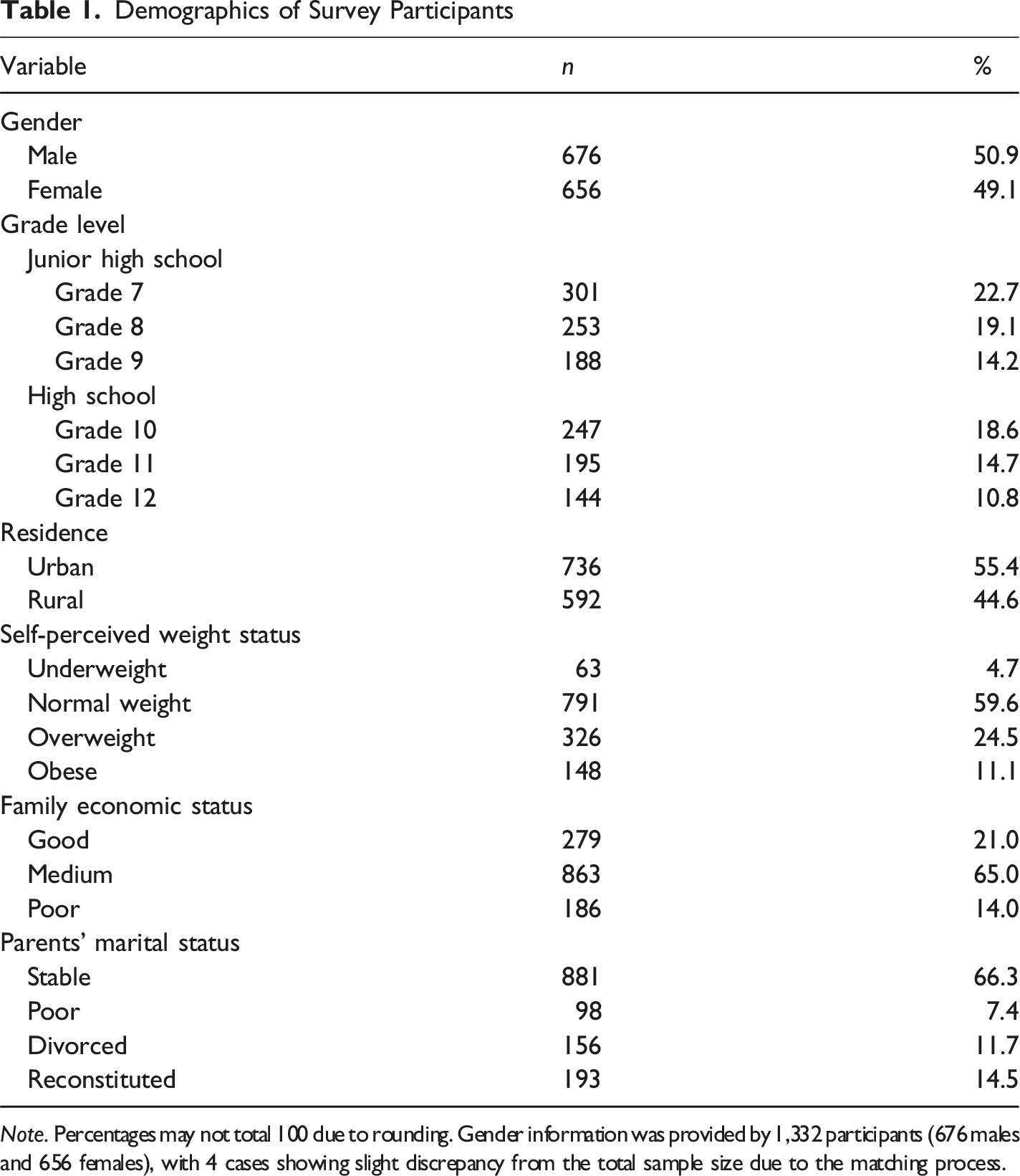
Note. Percentages may not total 100 due to rounding. Gender information was provided by 1,332 participants (676 males and 656 females), with 4 cases showing slight discrepancy from the total sample size due to the matching process.
Measures
Weight Self-Stigma was assessed using the Weight Self-Stigma Questionnaire (WSSQ; Lillis et al., 2010), which evaluates the degree to which individuals internalize negative weight-related evaluations. The WSSQ consists of 12 items rated on a 5-point Likert scale (1 = strongly disagree to 5 = strongly agree), with higher scores indicating greater weight self-stigma. The Chinese version has demonstrated good psychometric properties among adolescents (Pakpour et al., 2019). In the current sample, the internal consistency was excellent (α = 0.873).
Psychological Needs Satisfaction in Exercise was measured using the Psychological Need Satisfaction in Exercise Scale (PNSES; Wilson et al., 2006). This 18-item instrument assesses satisfaction of three basic psychological needs in exercise contexts: autonomy, competence, and relatedness. Items are rated on a 5-point Likert scale (1 = completely disagree to 5 = completely agree). Higher scores indicate greater psychological needs satisfaction. The scale has been validated for use with Chinese adolescents (Fathirezaie et al., 2024). The current sample showed excellent internal consistency (α = 0.912).
Family Physical Activity Climate was evaluated using the Family Health Climate for Physical Activity Scale (FHC-PA; Niermann et al., 2014). This 14-item measure assesses family members’ shared perceptions and values regarding physical activity, using a 4-point Likert scale (0 = completely wrong to 3 = completely right). Higher scores indicate a more positive family physical activity climate. The scale demonstrated good internal consistency in the current sample (α = 0.886).
Home Physical Activity was assessed using a modified version of the International Physical Activity Questionnaire-Short Form (IPAQ-SF; Craig et al., 2003). Following Huang et al.'s (2023) modification procedure, items were adapted to specifically address physical activity in the home context. The questionnaire’s stability was evaluated through test-retest reliability analysis with a subsample of 42 participants over a one-week interval, yielding acceptable coefficients ranging from 0.676 to 0.789.
Data Analysis
The analysis proceeded in several steps. First, we conducted reliability analyses to assess the internal consistency of all measurement instruments. Second, we examined correlations among the main study variables: weight self-stigma, psychological needs satisfaction in exercise, family physical activity climate, and home physical activity. Finally, we employed stepwise regression analysis and the PROCESS macro (version 4.2) for SPSS to test our hypothesized model. Specifically, Model 4 was used to examine the simple mediation effect (H2), and Model 14 was employed to test the second-stage moderated mediation model (H3 and H4), examining the mediating effect of psychological needs satisfaction in exercise and the moderating effect of family physical activity climate on the M→Y path.
To address potential common method bias, we implemented both procedural and statistical controls. Procedurally, we (1) collected data at two time points, (2) assured participants of response anonymity, and (3) counterbalanced questionnaire items. Statistically, we conducted Harman’s single-factor test, which revealed no single factor accounting for the majority of variance (first factor explained 29.45% of total variance).
While Structural Equation Modeling (SEM) is often used for analyzing complex mediation-moderation relationships, we chose the PROCESS macro for several methodologically sound reasons. First, PROCESS directly computes conditional indirect effects and the index of moderated mediation, which are central to testing our hypotheses, capabilities that require additional specification in SEM (Hayes, 2013). Second, our model involves observed variables without latent constructs, making the regression-based PROCESS approach particularly appropriate (Hayes & Rockwood, 2020). Third, PROCESS provides bootstrapped confidence intervals (5,000 resamples) for indirect effects without requiring distributional assumptions. Fourth, PROCESS has become the methodological standard in psychological research for testing conditional process models, endorsed by Hayes’ authoritative work on mediation and moderation analysis (Hayes, 2013). We acknowledge that SEM could provide comparable results; however, given our observed-variable model and research questions focused on conditional indirect effects, PROCESS offers a more parsimonious and interpretable approach. It is important to note that while we present the mediation (H2) and moderated mediation (H3, H4) analyses in separate sections for clarity of exposition, PROCESS Model 14 tests all pathways simultaneously within a single integrated model (Hayes, 2013).
All analyses controlled for demographic variables that have been shown to influence adolescents’ home physical activity, including gender, grade, place of origin, self-perceived weight status, family economic status, and parental marital status (Guo & Liang, 2023).
Results
The Control and Test of Common Method Bias
Because the four main variables—weight self-stigma, psychological needs satisfaction in exercise, family physical activity climate, and home physical activity—were measured using questionnaires. It is necessary to apply procedural control and conduct statistical tests for common method bias. (1) In terms of procedural control: firstly, the using of measurement technique is one of the main procedural control methods to decrease common method bias (Doty & Glick, 1998). While administering the questionnaire, a face-to-face conversation was conducted to help students understand the content of the research—its goal, meaning, specific content of the questionnaire, the anonymity of responses, and the absolute security of the results—in order to reduce students’ speculation about the measurement items. In the meanwhile, by means of questionnaire designing to balance the order effect and decreasing common method bias. Secondly, using the measurement at different time points is also the usual way to control common method bias (Wingate et al., 2018). Collecting data at intervals ranging from 1 day to 2 months, the predictive results of exercise psychological variables on exercise outcome variables have relative stability (Chen & Yang, 2022; Podsakoff et al., 2003; Wu et al., 2024; Zhang et al., 2022). This study commenced surveys at two time points spanning two weeks and using method of matching questionnaire IDs to collect survey data. By doing this, mitigated the influence of common method bias to some extent which brought by using method of questionnaire to survey four main variables. (2) In terms of statistical tests, using exploratory factor analysis to the collected data, and the analysis results indicate that the model has nine factors with eigenvalues greater than 1. Among them, the first factor explains 29.45% of the total variance, suggesting that the factors explaining most of the variance in the model do not exist.
Correlation Analysis of Main Variables
Correlation Analysis Results of Main Variables
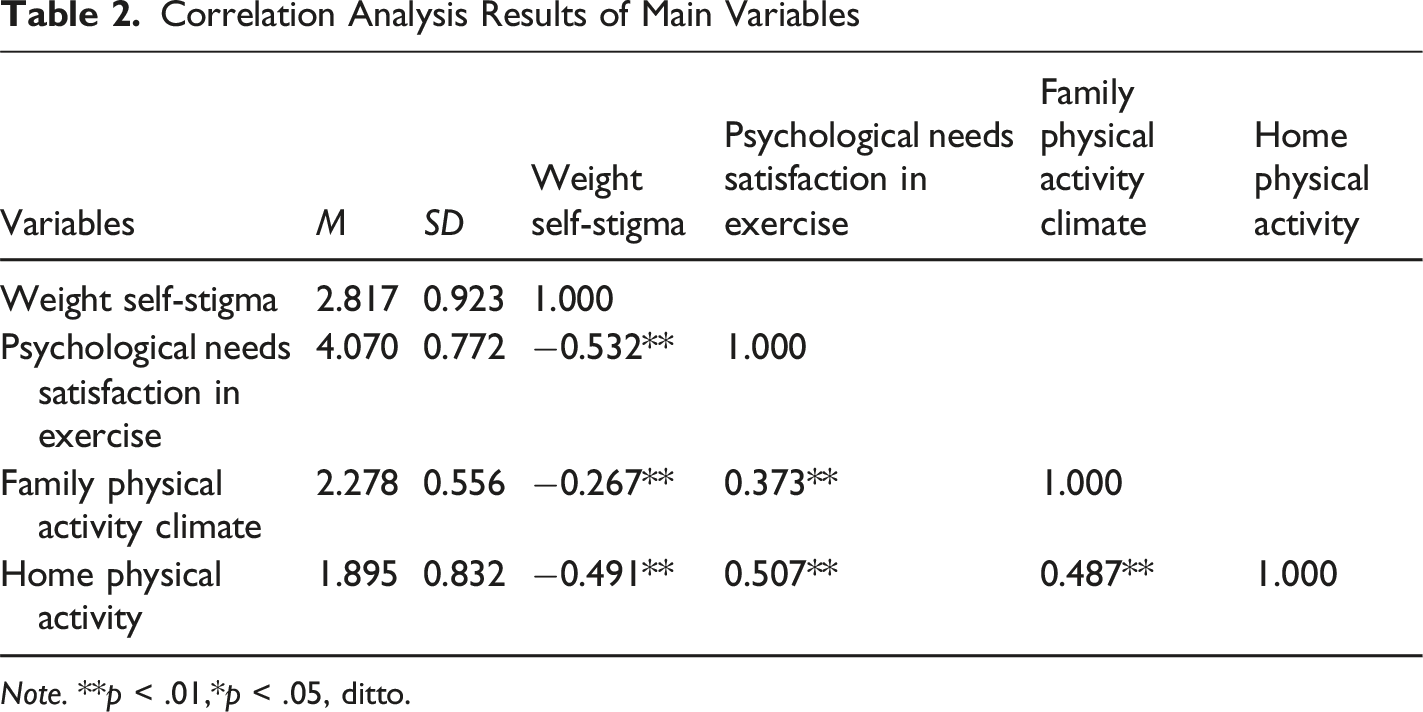
Note. **p < .01,*p < .05, ditto.
Mediating Effect Test of Exercise Psychological Needs Satisfaction
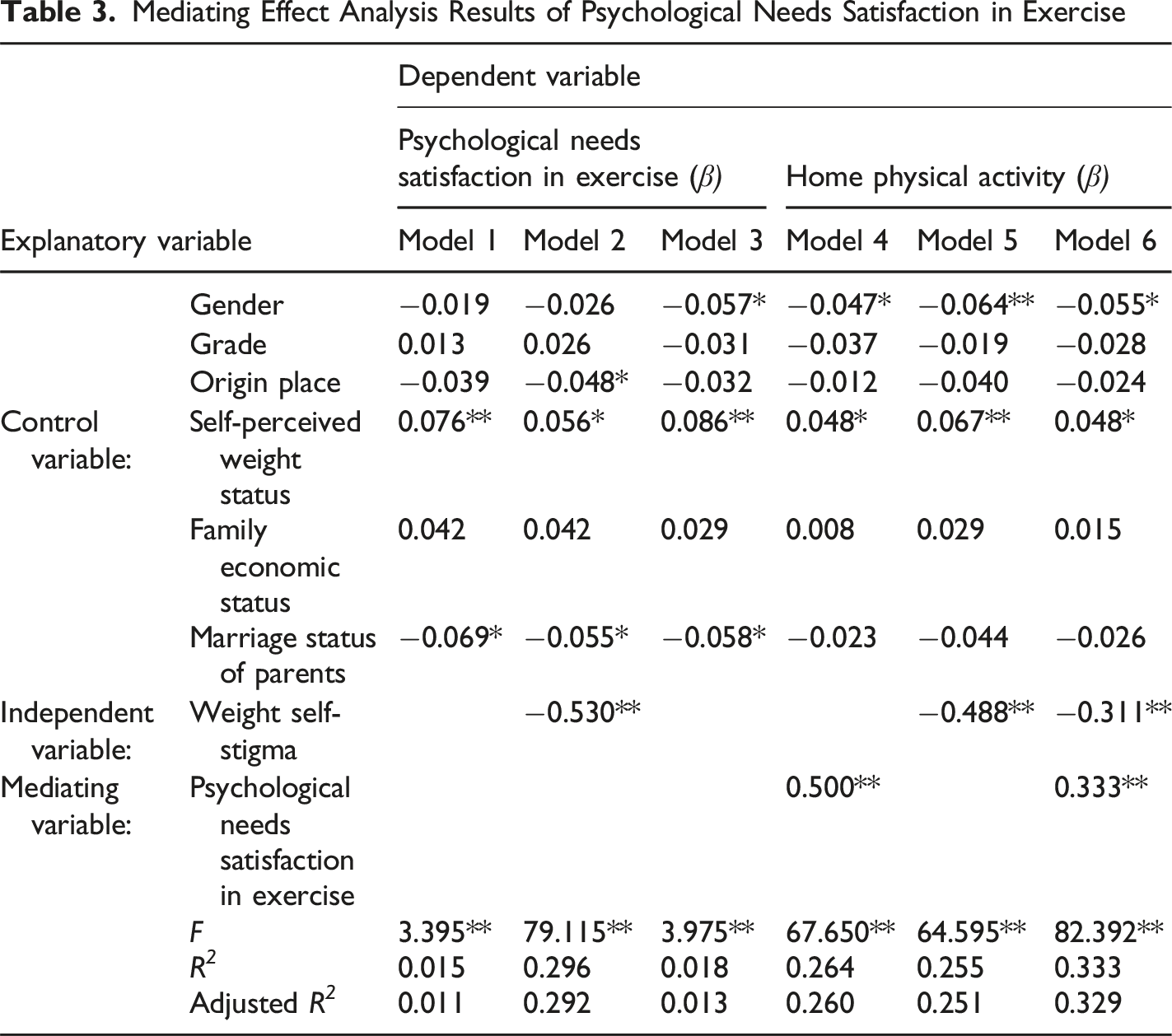
For the first, adopting stepwise regression analysis method (Baron & Kenny, 1986), constructing six analyzing models to the mediating effect of psychological needs satisfaction in exercise. Analysis results are presented in table three. Table three indicates that in model five, before adding psychological needs satisfaction in exercise (mediating variable), and after excluding the influence of adolescents’ gender, grade, origin place, self-perceived weight status, family economic status, marriage status of parents (control variable), the regression coefficient of weight self-stigma (independent variable) on home physical activity is −0.488. It reaches a significant level (p < 0.01), and hypothesis 1 has been supported.
For the second, it is also represented in table three, in model two, weight self-stigma significantly influences psychological needs satisfaction in exercise (β = −0.530, p < 0.01). In the model 4, psychological needs satisfaction in exercise significantly influences home physical activity (β = 0.500, p < 0.01). Then, after adding the mediating variable (psychological needs satisfaction in exercise), the regression coefficient of psychological needs satisfaction in exercise on home physical activity reduced from −0.488 (model 5) to −0.311 (model 6), but still significantly (p < 0.01). Whereas, regression coefficient of independent variable (Weight self-stigma) on home physical activity reduced from −0.488 (model 5) to −0.311 (model 6), while the regression coefficient of psychological needs satisfaction in exercise reduced from 0.500 (model 4) to 0.333 (model 6), both effects remaining significant (p < 0.01).
Mediating Effect Analysis Results of Psychological Needs Satisfaction in Exercise
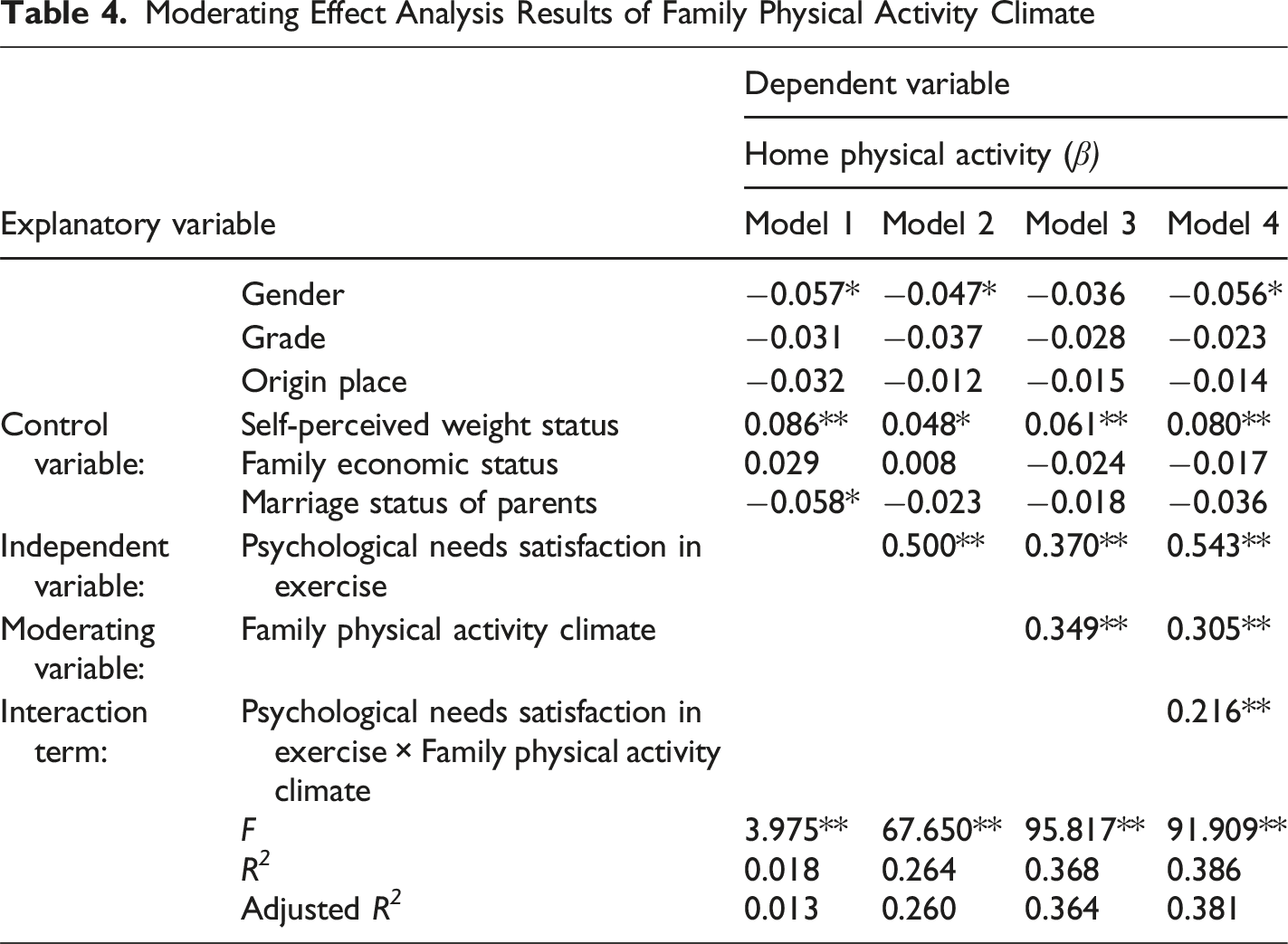
Moderating Effect Test of Family Physical Activity Climate
Moderating Effect Analysis Results of Family Physical Activity Climate
The Moderated–Mediator Analysis Results of Family Physical Activity Climate
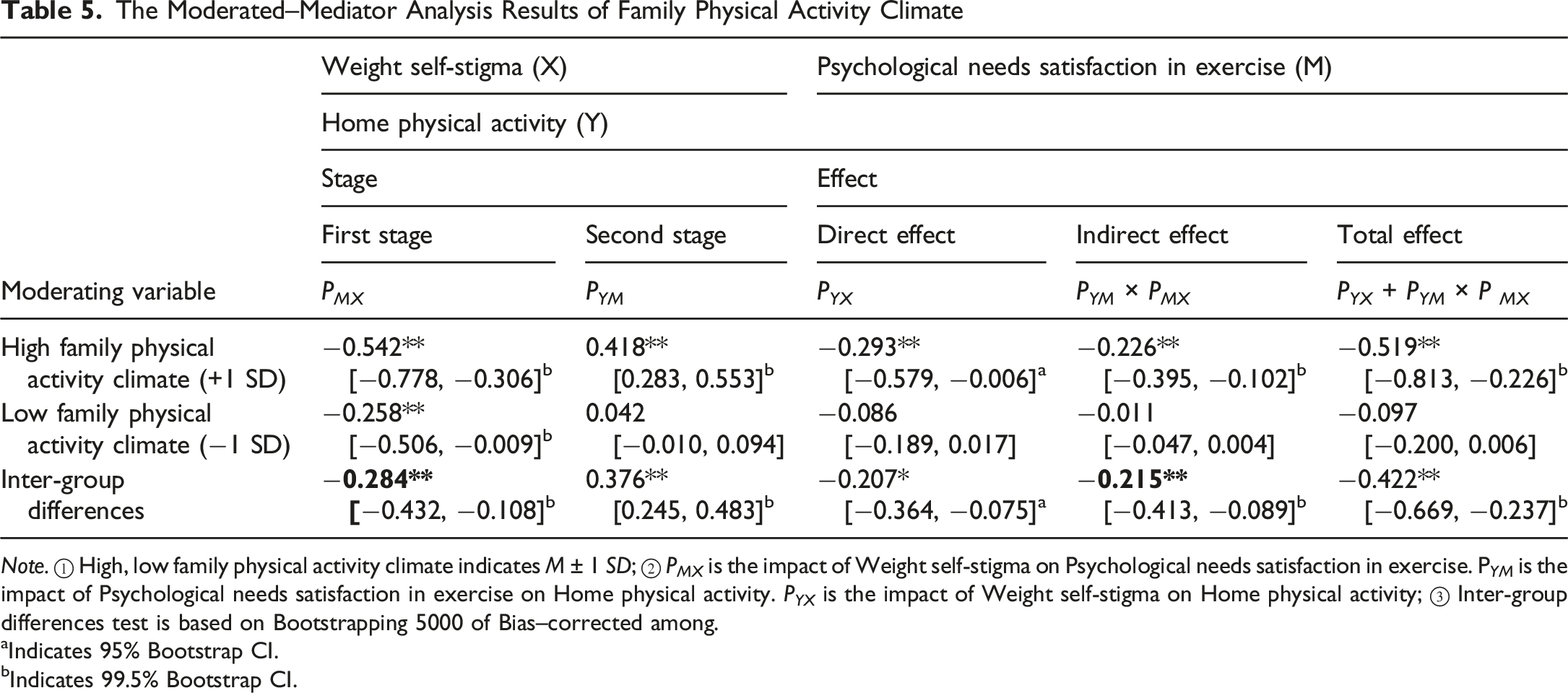
Note. ① High, low family physical activity climate indicates M ± 1 SD; ② P MX is the impact of Weight self-stigma on Psychological needs satisfaction in exercise. P YM is the impact of Psychological needs satisfaction in exercise on Home physical activity. P YX is the impact of Weight self-stigma on Home physical activity; ③ Inter-group differences test is based on Bootstrapping 5000 of Bias–corrected among.
aIndicates 95% Bootstrap CI.
bIndicates 99.5% Bootstrap CI.
Discussion
Influences of Weight Self-Stigma on Adolescents’ Home Physical Activity
This study demonstrates that weight self-stigma significantly negative influence adolescents’ home physical activity. According to the children cognitive development theory (Piaget, 2013, p. 7), even though the adolescents at “Formal operational stage (above 12 years)” have already separated from heteronomous stage. Interests in interpersonal communication and emotional attachments also shift from parents to peers. Family still the main activity place for adolescents. Parents’ and family members’ discussions about physical appearance, as well as the transmission of appearance-related information within the family, are also influencing factors in the internalization of weight stigma into weight self-stigma among adolescents (Ashdown-Franks et al., 2022; Himmelstein & Puhl, 2019; Roberts et al., 2021). Furthermore, in today’s era, it is popular that people think “thin is beautiful”, and weight has become a sensitive attacking topic for verbal attacks among people. Especially for adolescents whose self-concept is rapidly developing, the experience of this type of verbal attack is stronger. Due to the attribute characteristics of physical deformity or social deviation (Nutter et al., 2021), adolescents with weight self-stigma would accept and agree with the societal cultural attitude of the ‘ideal appearance,’ which means being very thin for females and muscular for males. Therefore, after encountering weight self-stigma, under the pressure of societal appearance culture and parents’ comparisons of their children’s physical appearance with more attractive or idealized ‘neighbor’s children,’ all of these factors enhance the physical activity avoidance motivation in adolescents with weight self-stigma (Anić et al., 2022; Bevan et al., 2021). And make them avoid home physical activities, especially for decisions of participating in family group exercise physical activity, thereby reducing the level of home physical activity.
Mediating Effect of Psychological Needs Satisfaction in Exercise
This study shows that psychological needs satisfaction in exercise partially mediates relationship between weight self-stigma and adolescents’ home physical activity. This chords with the research result of “Weight stigma influences exercise motivation partially through psychological needs satisfaction in exercise” (McDonough, 2018). The stigma coping model, stress–coping model, contends that social stigma is a daily life stressor that stigmatized individuals have to face. It triggers individuals’ primary evaluation (Is it a danger/threat to myself?) and secondary evaluation (Can I handle it on my own?), resulting in benevolent, neutral, or stressful (harm, threat, challenge) evaluations. This process leads individuals to change their cognitions and behaviors to meet internal and external needs, forming a problem-focused coping mechanism for dealing with stress (Miller, 2006). According to the stigma coping model—stress-coping model, due to the social stigma surpasses adolescents’ coping abilities, adolescents perceive weight self-stigma, which is internalized from weight stigma, as an important inner life stressor in their daily lives (Nutter et al., 2021). Thereby, it activates primary and secondary evaluations, forming harmful and threatening evaluation results. Resulting in adolescents forming a comparatively stable negative physical cognition structure in the form of ideas in their minds and developing a negative identity that is divergent from the socially requested active engagement in physical exercise. In addition, in order to avoid comments of self-physical or appearance made by others, adolescents would develop negative avoidance coping strategies, resulting in insufficient of their psychological needs satisfaction in exercise (McDonough, 2018). Thereby, adolescents initiate problem-focused coping strategies, transferring their physical activity avoidance behavior to the home environment, leading to a decrease in their level of home physical activity.
The Moderating Effect of Family Physical Activity Climate
This study indicates that, family physical activity climate positively moderates the relationship between psychological needs satisfaction in exercise and adolescents’ home physical activity. This chords with related research’s opinions. Such as “The degree of family interaction will affect adolescents’ coping with weight stigma, as well as their weight management strategies such as diet and physical activity and other related factors” (Roberts et al., 2021), and “Compare to peers and friends, family support is more likely to increase the level of weight stigma adolescents’ coping strategies and reducing their tendency to avoid physical activity.” (Himmelstein & Puhl, 2019). This is due to differences in the family physical activity climate, particular in the degree of care, support, and motivation that parents provide for their children’s home physical activity, as well as differences in the autonomy for exercise that adolescents gain within the family and other related aspects. Resulting in varying levels of satisfaction of autonomy needs, competence needs, and relatedness needs in adolescents’ physical activity. Thus, there are differences in home physical activity among adolescents with weight self-stigma as well. This study also indicates that family physical activity climate moderates’ weight self-stigma, through the mediating process of psychological needs satisfaction in exercise influencing adolescents’ home physical activity, thus playing a moderated–mediator role. The Self-Regulation Model for coping with stigma posits that the comparison process driven by core societal goals results in motivations for achieving these goals. This motivation further triggers individuals’ evaluative experiences, thereby influencing the coping reactions of stigmatized individuals. In the meanwhile, individual’s coping reactions would produce intrapersonal and interpersonal outcomes. Additionally, the relationship between coping reactions and intrapersonal and interpersonal outcomes is moderated by others’ reactions (Swim & Thomas, 2006). According to the Self-Regulation Model for coping with stigma, the family physical activity climate can be understood as the reaction of significant others which brought by family exercise humanitarian care and family interpersonal support and other related factors. When family physical activity climate reaches a comparatively high level, the high-level family physical activity climate can mitigate Appearance–related Social Comparison which originated from family members. Thus, reducing adolescents’ weight self-stigma experience (Nutter et al., 2021), increasing the weight self-stigma adolescents’ ability of evaluating on psychological needs satisfaction in exercise. This helps them develop coping strategies that promote active participation in home physical activitiy of family group-focused, leading to active engagement in home exercise and resulting in high levels of home physical activity outcomes. On the contrary, when the family physical activity climate reaches a comparatively low level, due to adolescents with weight self-stigma lose objectives to learn, imitate, and follow. Additionally, the physical activity avoidance psychological coping mechanism, which is brought about by weight stigma, causes adolescents with weight self-stigma to set negative physical activity goals in family exercises. They adopt negative physical activity methods to cope with psychological needs satisfaction in exercise. Therefore, home physical activity avoidance is thus reinforced.
Theoretical Contributions, Practical Insights and Research Limitations
The theoretical contributions of this research are as follows. (1) At present, most research are focused on the influence of weight self-stigma on total physical activity, the discussions about home physical activity are rare (Prunty et al., 2023). Whereas the family physical appearance discussion and the communication about appearance related information are also the sources of adolescents’ weight self-stigma (Ashdown-Franks et al., 2022; Barnes, 2020; Himmelstein & Puhl, 2019; Roberts et al., 2021). This study discusses the relationship between weight self-stigma and adolescents’ home physical activity. It not only expands the research scope of weight self-stigma but also provides theoretical insights for the government in constructing a long-term mechanism to reduce public stigma. (2) At present, existing studies are limited to cognitive perspectives such as weight identity threat (Vartanian & Novak, 2011), internalized social attitudes, and avoidance motivation (Cheng et al., 2019) to interpret the influencing mechanism of weight self-stigma on the physical activity of college students and adults. This study takes a novel approach, from the perspective of exercise intrinsic motivation, discussing the mediating effect of psychological needs satisfaction in exercise between weight self-stigma and adolescents’ home physical activity. This research not only enriches the theoretical space of psychological needs satisfaction in exercise, but also provides theoretical guidance of adolescent sports health promotion, psychological and social adaptation indicators amelioration. (3) Although family promotion strategies have received attention in previous studies (Ashdown-Franks et al., 2022; Himmelstein & Puhl, 2019; Roberts et al., 2021), whereas the related studies mainly focus on theoretical discussions. This study discusses the moderated–mediator role of family physical activity climate. The results not only contribute positively to understanding the ‘black box’ of weight self-stigma and adolescents’ home physical activity but also provide a theoretical foundation for family exercise policy making.
The findings of this research provide substantive practical implications for policy development and intervention strategies. Our findings regarding the relationship between weight self-stigma and adolescents’ home physical activity suggest the necessity of constructing a comprehensive anti-weight stigma network, comprising media outlets, families, schools, communities, healthcare institutions, academic organizations, and youth sports associations. This network should actively promote anti-weight stigma education to “facilitate correct understanding of childhood overweight and obesity while preventing discrimination against obese children” (American Health Organization, 2014). Additionally, our results on the mediating effect of psychological needs satisfaction in exercise indicate that psychological need fulfillment serves as a crucial mechanism for promoting home physical activity among adolescents with weight self-stigma. While current Adolescent Sports Health Promotion policies predominantly focus on physical fitness metrics, our findings suggest the necessity of incorporating psychological and social adaptation indicators to enhance the effectiveness of family-based physical activity interventions. Furthermore, our validation of the moderated-mediator role of family physical activity climate provides empirical support for enhancing family-centered physical activity practices. These practices should emphasize “subtle influence, combining oral transmission and leading by example” (Family Education Promotion Law of the People’s Republic of China, 2021) while encouraging schools to “integrate family education guidance into their core responsibilities and leverage their professional expertise” (Ministry of Education, 2022). Such initiatives align with the broader goal of “fostering a positive family physical activity climate and actively encouraging children’s participation in outdoor activities and physical exercises” (Healthy China Action Plan, 2019–2030).
The limitations of this research are as follows. (1) While our use of PROCESS macro provided robust results for testing our hypotheses, we acknowledge that alternative analytical approaches such as Structural Equation Modeling (SEM) might offer additional insights into the complex relationships among variables. SEM could potentially provide a more comprehensive understanding of the measurement model and structural relationships simultaneously. Future research could employ PLS-SEM to further validate our findings and potentially uncover additional pathway relationships. Additionally, this study only utilized the procedural control of measurement techniques and measurement time. Future research can adopt the adolescents-parents paired survey method, using different data sources, to reduce the influence of common method bias. (2) This study only discussed the relationship between weight self-stigma and adolescents’ home physical activity, whereas weight stigma is a multi-component concept (Lillis et al., 2010). Future research can discuss about the influence of other types weight stigma, such as actual stigma, stigma awareness on adolescents’ home physical activity. (3) This study only discussed the mediating effect of psychological needs satisfaction in exercise, whereas the exercise psychology cognition which brought by weight self-stigma has diversity and complexity. Future research can be based on the Sociocognitive Model of Internalized Stigma to discuss mediating conditions of weight control beliefs, Weight–Related Psychological Inflexibility, and other exercise cognitive variables on relationship between weight self-stigma and adolescents’ home physical activity. (4) This study only discussed the moderated–mediator role of family physical activity climate. Whereas according to basic psychological needs theory, family physical activity climate may also mitigate negative influences of weight self-stigma on psychological needs satisfaction in exercise. Thereby, allowing adolescents to gain a more positive home physical activity experience. Future research can discuss the mediated-moderator role of family physical activity climate. (5) This study only discussed the moderated–mediator role of family physical activity climate. But school is also an important scenario for promoting adolescents’ home physical activity. Future research can be based on Social Cognitive Theory to discuss marginal effects of school scenario elements such as interpersonal support on campus and the motivational climate created by physical education teachers and other factors. (6) The present study focused exclusively on home physical activity without controlling for physical activity in other settings (e.g., school-based physical education, organized sports). While this focused approach was theoretically driven, given that weight self-stigma often originates within the family context and family physical activity climate is inherently a family-level variable, future research should examine whether the observed relationships hold when accounting for physical activity across multiple settings. Understanding whether home physical activity represents compensatory, complementary, or independent behavioral patterns relative to other-setting physical activity would provide a more comprehensive picture of adolescents’ overall physical activity profiles.
Conclusion
Research conclusion: weight self-stigma has a significant negative influence on adolescents’ home physical activity; weight self-stigma indirectly influences adolescents’ home physical activity partially through psychological needs satisfaction in exercise; the higher the level of family physical activity climate, the stronger the positive relationship between adolescents’ psychological needs satisfaction in exercise and home physical activity, conversely, the influence is weaker when the family physical activity climate level is lower; in the mediating process where weight self-stigma influences adolescents’ home physical activity through the psychological needs satisfaction in exercise, family physical activity climate acts a significant role of moderated–mediator.
Footnotes
Acknowledgements
The authors gratefully acknowledge the participants and schools in Hunan Province for their valuable cooperation in this research. We thank all the adolescents and their families who participated in this study, as well as the school administrators and teachers who facilitated data collection.

Ethical Considerations
This study was approved by the Institutional Review Board of Hunan Normal University as part of a larger research project (Approval No. Lun Shen Ke (2022) No. 309). All procedures were conducted in accordance with the ethical standards of the institutional and national research committee and with the 1964 Helsinki Declaration and its later amendments or comparable ethical standards.
Consent to Participate
Written informed consent was obtained from all adolescent participants and their legal guardians prior to their inclusion in the study.
Authors Contributions
Q.Z. and B.S. contributed equally to this work as co-first authors. Q.Z.: Conceptualization, Formal analysis, Methodology, Writing – original draft, Writing – review & editing. B.S.: Conceptualization, Methodology, Writing – original draft, Writing – review & editing. W.G.: Data curation, Software. Q.F.Z.: Funding acquisition, Project administration, Resources, Supervision, Writing – review & editing. All authors read and approved the final manuscript.
Funding
This research was funded by the National Social Science Fund of China, grant number 24BTY079. The funders had no role in study design, data collection and analysis, decision to publish, or preparation of the manuscript.
Declaration of Conflicting Interests
During the preparation of this manuscript, the authors used DeepSeek V3.1 for the purpose of language polishing and editing, as all authors are non-native English speakers. After using this tool, the authors reviewed and edited the content as needed and take full responsibility for the content of the published article.
Data Availability Statement
Data cannot be shared publicly because of ethical restrictions related to participant confidentiality and privacy protections for minors. Data are available from the Hunan Normal University Institutional Data Access/Ethics Committee for researchers who meet the criteria for access to confidential data. Interested researchers may contact the corresponding author, Prof. Qiangfeng Zhang (