






Abstract
Personality dysfunction is increasingly conceptualised dimensionally, yet evidence for the occupational validity of contemporary personality disorder models in military settings remains limited. This study examined psychometric validity and applied utility of the PID-5-BF+M in a naval sample (N = 1874) using archival occupational health data. Structural validity was evaluated using confirmatory factor analysis and gender-based measurement invariance testing, while internal consistency, construct validity, and associations with resilience, borderline personality indicators, and real-world adjustment outcomes were also examined. The six-domain structure of the PID-5-BF+M was supported, with acceptable internal consistency for the total score and most domains. Negative affectivity and disinhibition showed expected associations with borderline personality indicators, while higher personality dysfunction was moderately associated with lower resilience. Notably, negative affectivity and detachment independently predicted probable ICD-11 Adjustment Disorder, explaining approximately 30% of variance. Algorithm-based identification of possible personality disorder yielded markedly different prevalence estimates depending on facet- versus domain-level thresholds, highlighting risks of false-positive classification in occupational samples. Elevated anankastia traits were common but largely unrelated to maladjustment, suggesting contextual adaptiveness in structured naval environments. Findings support the PID-5-BF+M total score as a pragmatic global index of personality dysfunction severity for use in occupational health screening, while underlining the necessity of context-sensitive, multi-method interpretation. Personality assessment in military settings should prioritise functional impairment over trait elevation per se.
Keywords
Introduction
Personality Functioning in Military Contexts
The assessment of personality functioning has a long history in the armed forces, driven by assumptions about person-role fit and operational effectiveness (Gunderson & Nelson, 1966; Sohail et al., 2023; Vickers et al., 1996). Certain personality configurations may align more closely with military norms, performance expectations, and operational demands (DeVries & Wijnans, 2015). Personality characteristics also shape responses to traumatic experiences (Caska & Renshaw, 2013), making their assessment of particular interest to military mental health providers.
Personality refers to relatively enduring patterns of thoughts, feelings, and behaviour that distinguish individuals from one another. These patterns are associated to a broad range of life outcomes, including occupational performance and adjustment in civil and military occupations (Roberts et al., 2007; Salgado, 1998). Personality disorders (PD) refer to pervasive and inflexible patterns of behaviour and inner experience that deviate markedly from cultural expectations and lead to clinically significant distress or functional impairment (American Psychiatric Association, 2022).
In occupational contexts, and particularly within the military, the distinction between trait expression and functional impairment is critical. Elevated personality traits may be compatible with, or even advantageous for, specific operational demands, whereas dysfunction is more appropriately defined by persistent impairment in self-regulation, interpersonal functioning, or stress tolerance.
Military environments pose particular challenges for individuals with personality dysfunction (Malone & Benedek, 2021). These include strict hierarchies and rule adherence, constrained autonomy, prolonged separations from customary support systems, communal living under conditions of limited privacy, and repeated exposure to threat and uncertainty. Traits often associated with PDs – such as impulsivity, poor affect regulation, antagonism, limited empathy, or disregard for safety – may compromise operational effectiveness and unit cohesion. Similarly, enduring difficulties in forming and maintaining supportive interpersonal relationships may have heightened emotional and behavioural consequences in confined and socially intensive military settings (Malone & Benedek, 2021).
At the same time, the adaptability of certain personality configurations in military contexts remains contested. While PDs are generally regarded as undesirable due to their association with impaired functioning, some personality features typically viewed as maladaptive in civilian life may confer context-specific advantages in particular military roles. For example, psychopathic traits such as fearlessness, low trait anxiety, and emotional detachment may support risk tolerance in certain combat functions (Preston et al., 2020). Similarly, emotional detachment associated with schizoid traits may facilitate tolerance of extreme stress during sustained combat exposure (O’Reilly, 2014), while mild obsessive-compulsive traits may align with military values of conscientiousness, precision, and rule adherence (Fiedler et al., 2004). Nevertheless, although certain traits may be situationally adaptive, they remain maladaptive across broader occupational, interpersonal, and post-service contexts (Fiedler et al., 2004; O’Reilly, 2014; Preston et al., 2020).
Specific personality configurations have been described within naval specialisations. Submarine personnel have been characterised by traits associated with antisocial, obsessive-compulsive, and avoidant personality patterns, alongside exacting and compulsive personality styles (Moes et al., 1996; Van Wijk & Waters, 2000). Navy divers have been described as self-serving and socially aggressive, with tendencies toward inflated self-esteem, poor impulse control, impulsivity, and over-activity (Beckman et al., 1996; Biersner & Cameron, 1970; Dembert et al., 1983; Van Wijk & Meintjes, 2017). Naval ship-based personnel have also been found to score higher than civilian norms on the MMPI-2 Overcontrolled Hostility scale; such elevations – reflecting unconscious inhibition of hostile expression rather than overt pathology – have been interpreted as an adaptive pattern of personality dynamics supporting cohesion and discipline aboard ships (Van Wijk & Meintjes, 2017). These findings illustrate that personality configurations often associated with PD traits may be contextually appropriate and adaptive when viewed from an environmental demand perspective.
The close interpersonal demands inherent to naval service (living/working in close quarters in isolated and/or confined settings) – particularly aboard warships and submarines – may render individuals with significant personality dysfunction especially vulnerable to distress and impaired functioning. These considerations intersect with the construct of psychological readiness for military duty, defined as a composite set of mental attributes enabling personnel to meet environmental, interpersonal, and operational demands under conditions of stress and uncertainty (Van Wijk, 2025). Core components of readiness include good clinical mental health, adaptability, and access to responsive support systems (Van Wijk, 2025), domains in which individuals with PDs typically experience difficulties. Accordingly, brief and flexible screening measures of personality dysfunction may contribute meaningfully to the identification of candidates suitable for specialised naval utilisation.
Contemporary Models of Personality Disorder
Two specific dimensional models of PDs are particularly relevant: the DSM-5 Alternative Model for Personality Disorders (AMPD) and the ICD-11 Model of Personality Disorders. The DSM-5 AMPD is a hybrid dimensional-categorical framework presented in Section III of the DSM-5 (Krueger & Hobbs, 2020; Sharp & Wall, 2021). It distinguishes (1) level of personality functioning (Criterion A - severity/impairment) from (2) pathological personality traits (Criterion B – maladaptive trait profile). Criterion A assesses impairment across four domains – identity, self-direction, empathy, and intimacy – rated on a scale from 0 (no impairment) to 4 (extreme impairment). A PD diagnosis requires clinically significant impairment in at least two of these domains.
Criterion B comprises 25 maladaptive trait facets – patterns of thoughts, feelings, and behaviours that deviate from cultural expectations – organised into five higher-order domains: Negative Affectivity, Detachment, Antagonism, Disinhibition, and Psychoticism. A PD diagnosis requires at least one elevated trait domain contributing to distress or functional impairment. While the AMPD allows optional mapping to traditional PD types, it prioritises dimensional severity and trait configuration for research and clinical formulation (Sharp & Wall, 2021; Waugh et al., 2017).
The ICD-11 adopts a fully dimensional approach, replacing multiple categorical PD diagnoses with a single PD diagnosis, specified by severity (mild, moderate, severe) and further use trait domain qualifiers that describe stylistic features: Negative affectivity, Detachment, Dissociality, Disinhibition, and Anankastia (Gutiérrez et al., 2023; Swales, 2022). An optional Borderline Pattern qualifier is retained. Despite differences in structure and coding, both systems converge on dimensional severity and trait-based description as central organising principles, prioritising functional impairment over trait elevation. Both models share broadly overlapping trait domains, i.e., negative affectivity, detachment, disinhibition, antagonism/dissociality (Gutiérrez et al., 2023; Krueger & Hobbs, 2020), while the AMPD includes Psychoticism as a unique trait domain and the ICD-11 includes Anankastia (compulsivity/rigid perfectionism) as a separate domain (Krueger & Hobbs, 2020). Lastly, the ICD-11 intentionally simplifies to a single PD code plus severity qualifiers for global use by WHO member states, where the AMPD provides more trait-facet granularity that many prefer for case formulation and research (Bach et al., 2021; Waugh et al., 2017).
While these dimensional models have clear clinical advantages, their application in military occupational settings raises unique interpretive challenges, particularly where elevated traits may reflect environmental adaptation rather than dysfunction.
Measurement and Model Harmonisation
A range of instruments operationalise these models. The APA’s Personality Inventory for DSM-5 (PID-5) is a 220-item self-report measure assessing 25 facets and five domains aligned with DSM-5 Criterion B (Krueger et al., 2013). Brief forms, such as the 25-item PID-5-BF, improve feasibility. Instruments such as the Personality Inventory for ICD-11 captures the five ICD-11 trait domains (Sellbom et al., 2023).
The PID-5-BF+M (Personality Inventory for DSM-5 – Brief Form plus Modified scales) bridges AMPD and ICD-11 models by supplementing the PID-5-BF with scales capturing Anankastia, producing six domain scores: Negative Affectivity, Detachment, Antagonism, Disinhibition, Psychoticism, and Anankastia (Bach et al., 2020; Kerber et al., 2022). This brief measure represents both nosological systems and facilitates assessment of overall severity, which is closely aligned with functional impairment – the construct most relevant to occupational readiness.
The PID-5-BF+M has demonstrated factorial robustness, internal consistency, construct validity, and discriminant validity across multiple international samples (Bach et al., 2020; Facon et al., 2023; Pires et al., 2021, 2023; Riegel et al., 2021). Its total score functions as a global index of personality dysfunction severity (Pires et al., 2021, 2023), offering a pragmatic alternative to domain-level interpretation in applied contexts.
In summary, numerous studies corroborated the ability of the PID-5-BF+M to capture both severity of personality dysfunction (Pires et al., 2021; Zimmerman et al., 2020), and stylistic trait expression consistent with contemporary dimensional models (Bach et al., 2017, 2020; Pires et al., 2021).
Occupational and Ethical Considerations
The operational and ethical sensitivities associated with PDs in naval contexts require careful consideration of measurement fairness, proportionality, and contextual validity, particularly where assessment outcomes may influence utilisation or career trajectories. It furthermore necessitates evidence of local validity before implementation, in line with employment legislation (e.g. Employment Equity Act, 1998, § 8). Assessment tools must prioritise functional impairment over trait elevation, incorporate multi-method evaluation, and be interpreted within environmental and cultural contexts. In naval occupational settings, this is particularly important, as trait elevations may reflect adaptive styles rather than dysfunction.
Aims
Taken together, contemporary dimensional models and harmonised instruments such as the PID-5-BF+M offer promising tools for assessing personality dysfunction in applied settings. However, evidence remains limited regarding their validity, interpretability, and ethical utility within military occupational contexts, particularly in non-Western, multilingual samples and when linked to functional outcomes rather than diagnostic proxies. The study therefore aimed to examine validity of the PID-5-BF+M in an occupational context by replicating established analyses and extending them to indicators of adjustment in work and personal domains within a South African naval sample. Specifically, the objectives were to: (1) Describe response patterns by reporting mean facet and domain scores. (2) Examine structural validity through confirmatory factor analysis (CFA), measurement invariance testing (for gender) and internal consistency estimation. (3) Assess limited construct validity through associations with indicators of Borderline Personality Disorder (B-PD). (4) Examine associations between PID-5-BF+M domains and psychological resilience. (5) Apply a proposed algorithm for detecting possible cases of PD. (6) Extend previous work by examining associations between PID-5-BF+M facet, domain, and total scores, and indicators of adjustment across mental health, work, and family/social domains.
Methods
Participants and Procedures
This cross-sectional study used medical records of naval personnel who participated in routine biennial occupational health assessments. Consecutive eligible records across a 12-month period were extracted from the archives and included in the analysis (N = 1874).
The sample ranged in age from 20 to 64 years (M = 32.6, SD = 9.1) and comprised 586 women (31.32%) and 1,288 men (68.7%). %). English was the first language for 323 individuals (17.2%), while the remaining 1,551 (82.8%) reported one of the other ten official South African spoken languages as their mother tongue. All participants self-reported as proficient in English, and all had completed at least a Grade 12 education along with vocational training. They represented diverse vocational backgrounds, including technical-engineering, clerical-administrative, catering, and combat specialisations, and came from various geographical locations across South Africa. IRB approval for the extraction and analysis of de-identified data was obtained.
Measurements
The PID-5-BF+M (Bach et al., 2020) is a self-report tool designed to merge AMPD and ICD-11 personality traits in six domains (negative affectivity, detachment, antagonism/dissociality, disinhibition, anankastia and psychoticism). It consists of 36 items (two items per facet) that collates into 18 facets. The facets in turn characterise the six trait domains (three facets for each domain). The items are rated on a 4-point Likert scale (0 = very untrue or often untrue; 1 = sometimes or somewhat untrue; 2 = sometimes or somewhat true; and 3 = very true or often true).
The six domains are calculated based on the average scores of the three primary facets of each particular domain: Negative affectivity has been calculated from the average scores of the facets of emotional lability, anxiousness, separation insecurity; Detachment from the facets of withdrawal, anhedonia, intimacy avoidance; Antagonism from the facets of manipulativeness, deceitfulness, grandiosity; Disinhibition from the facets of irresponsibility, impulsivity, distractibility; Anankastia from the facets of perfectionism, rigidity, orderliness; and Psychoticism from the facets of unusual beliefs and experiences, eccentricity, and perceptual dysregulation.
The greater the dysfunction in a specific trait facet or domain, the higher the score (Bach et al., 2020). In line with the procedure of Zimmermann et al. (2020), a PID-5-BF+M total composite score can also be calculated as a global index of severity of personality dysfunction (Pires et al., 2023).
The Connor–Davidson Resilience Scale-10 (CD-RISC-10; Campbell-Sills & Stein, 2007; Pretorius & Padmanabhanunni, 2022) was completed by a subsample (N = 1464, McDonald’s ω = .875) to replicate the analysis of Facon et al. (2023).
The Screening Instrument for Borderline Personality Disorder (SI-BORD) is a very brief self-report tool designed to identify individuals at risk for B-PD (Godfrey et al., 2022; Lohanan et al., 2020). Five descriptive statements are scored by endorsing options on a 4-point Likert scale (0-not at all, 3-to a great extent).
The Structured Clinical Interview for DSM-IV Personality Questionnaire, Borderline Personality Disorder subscale (SCID-II-PQ-BPD) is a brief 15-item self-report screening questionnaire for B-PD (Ryder et al., 2007). It consists of yes/no items that correspond to the DSM-IV borderline personality disorder criteria and is designed for screening and case identification, not diagnosis.
The International Adjustment Disorder Questionnaire (IADQ) reflects the updated ICD-11 diagnostic criteria for Adjustment Disorder (AjD) and use an algorithm to establish probable diagnosis of AjD (Shevlin et al., 2020). Algorithm determined diagnostic probability was used as the dependant variable in the binomial logistic regression (BLR). Data was available for a subsample of 1546.
Data were also available from a Personal History Questionnaire, were participants provided dichotomous answers (YES/NO) to questions on adjustment across mental health, work, and family/social settings. The questions related to: • Previous formal diagnoses or hospital admissions for psychiatric reasons; • Difficulties in personal adjustment during previous deployments; • Difficulties with interpersonal relationships at work; • Difficulties in near relationships (e.g., partner or immediate family); • Availability of family member or friend to count on for help and support.
Analysis of Data
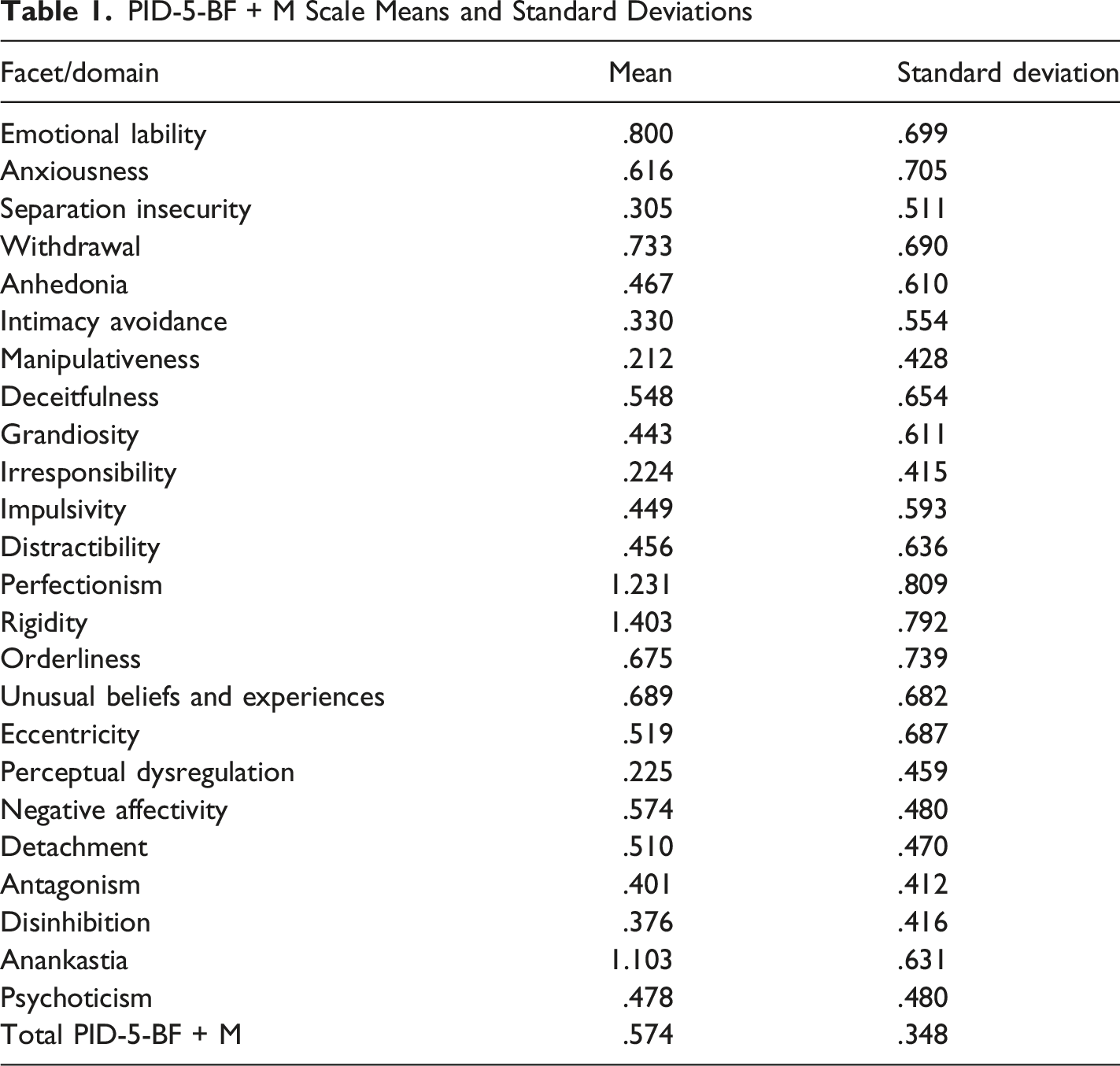
Structural analyses were conducted using R, while all other analyses were performed using IBM SPSS for Windows, Version 29. To ensure the validity of the data, this study followed the guide of Riegel et al. (2021) whereby respondents who answered 90% or more of the PID-5-BF+M items with the same value (i.e., the same value in >32 items) were excluded from the final dataset. Mean scores were then calculated to replicate description of Pires et al. (2021), and reported for the 18 facets and six domains (Objective 1).
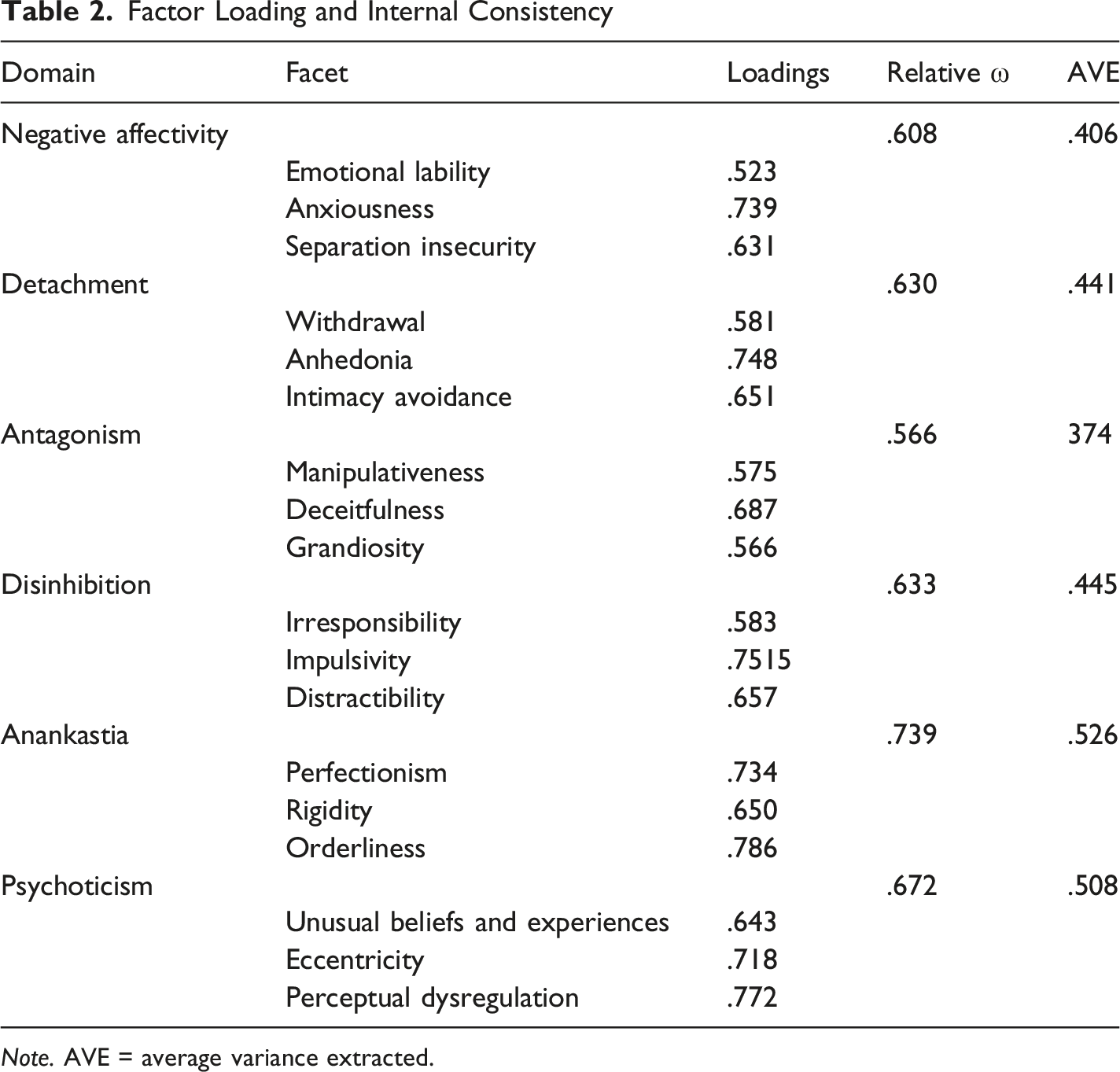
Structural analyses (objective 2) were conducted in R version 4.5.2, where confirmatory factor analysis (CFA) models were fitted using the package lavaan (v0.6-21), to examine dimensionality. CFA is used to test whether the data fit a hypothesised measurement model. In the current study, the model consisted of the 18 facets (as variables) that loaded onto six domains (three facets per domain), to replicate earlier analyses (Bach et al., 2020; Facon et al., 2023; Riegel et al., 2021). The model was estimated using Diagonally Weighted Least Squares. Facet variables were treated as ordinal.
In CFA, an ideal model fit is indicated by a small, non-significant chi-square (χ2) and a χ2/df ratio of 2–3. Due to large sample sizes, additional fit indices are typically considered: a root mean square error of approximation (RMSEA) between 0.05 and 0.08 suggests a reasonable approximate fit, the comparative fit index (CFI) should be > 0.90, the Tucker-Lewis index (TLI) > .95, and the standardised root mean square residual (SRMR) should be < 0.08.(Hu & Bentler, 1999; Kline, 2016).
Against the potential drawback of Cronbach’s α, internal consistency was examined with McDonald’s ω (replicating Riegel et al., 2021). Results ≥.80 indicate good reliability (Dunn et al., 2014; Hayes & Coutts, 2020; Kelley & Pornprasertmanit, 2016). McDonald’s ω (categorical ω) was calculated using the package MBESS (v4.9.42).
Earlier research encouraged the measurement of invariance across gender and other demographic markers (Bach et al., 2019). Measurement invariance assesses whether a psychological construct is interpreted consistently across groups, such as gender (Putnick & Bornstein, 2016). It involves a stepwise process: configural invariance tests if the same factor structure holds; metric invariance checks if item loadings are similar; and scalar invariance assesses whether item intercepts are equivalent. Progression through these steps requires adequate model fit at each level, and invariance is supported when changes in chi-square (χ2) between models are not significant. In this study, the PID-5-BF+M 6-dimensinal model was tested for measurement invariance across gender (women and men). Invariance testing was also planned for language (English vs. not-English as first language), but was not performed due to insufficient representation of some groups across the variables that resulted in empty cells in the data matrix.
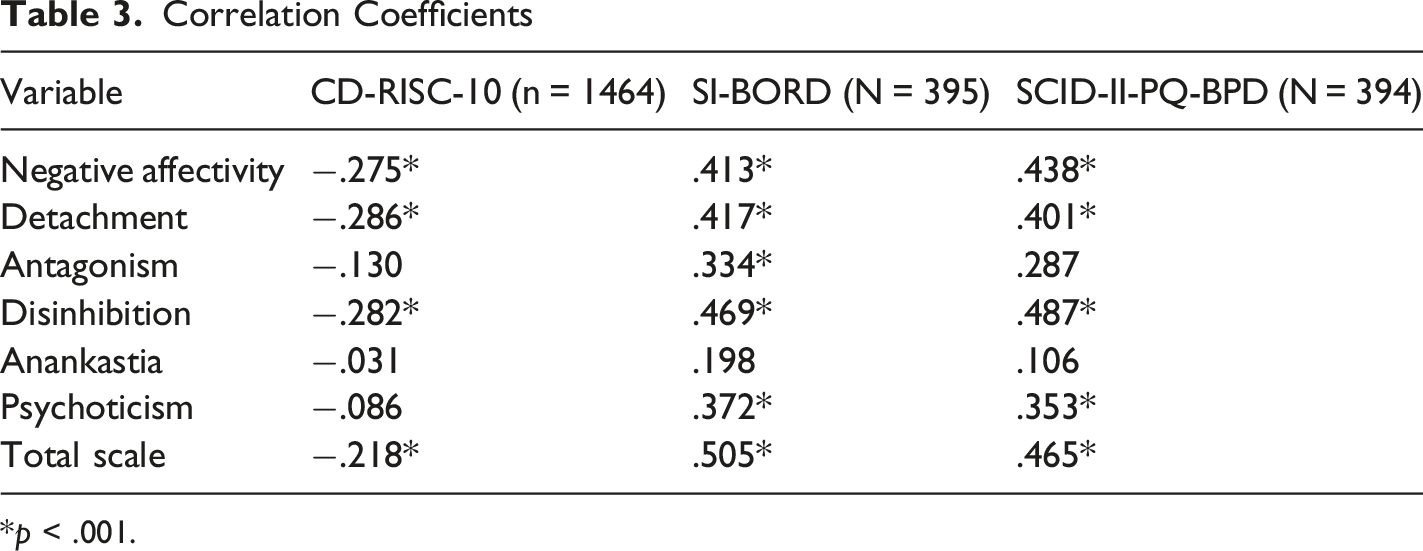
Limited construct validity was examined by correlating facet and domain scores with scores of the SI-BORD and SCID-II-PQ-BPD (Objective 3), replicating Riegel et al. (2021) but using different indicators of B-PD. The association of facet and domain scores with scores on the CD-RISC-10 was also reported using Pearson’s correlation coefficient (Objective 4), replicating Facon et al. (2023).
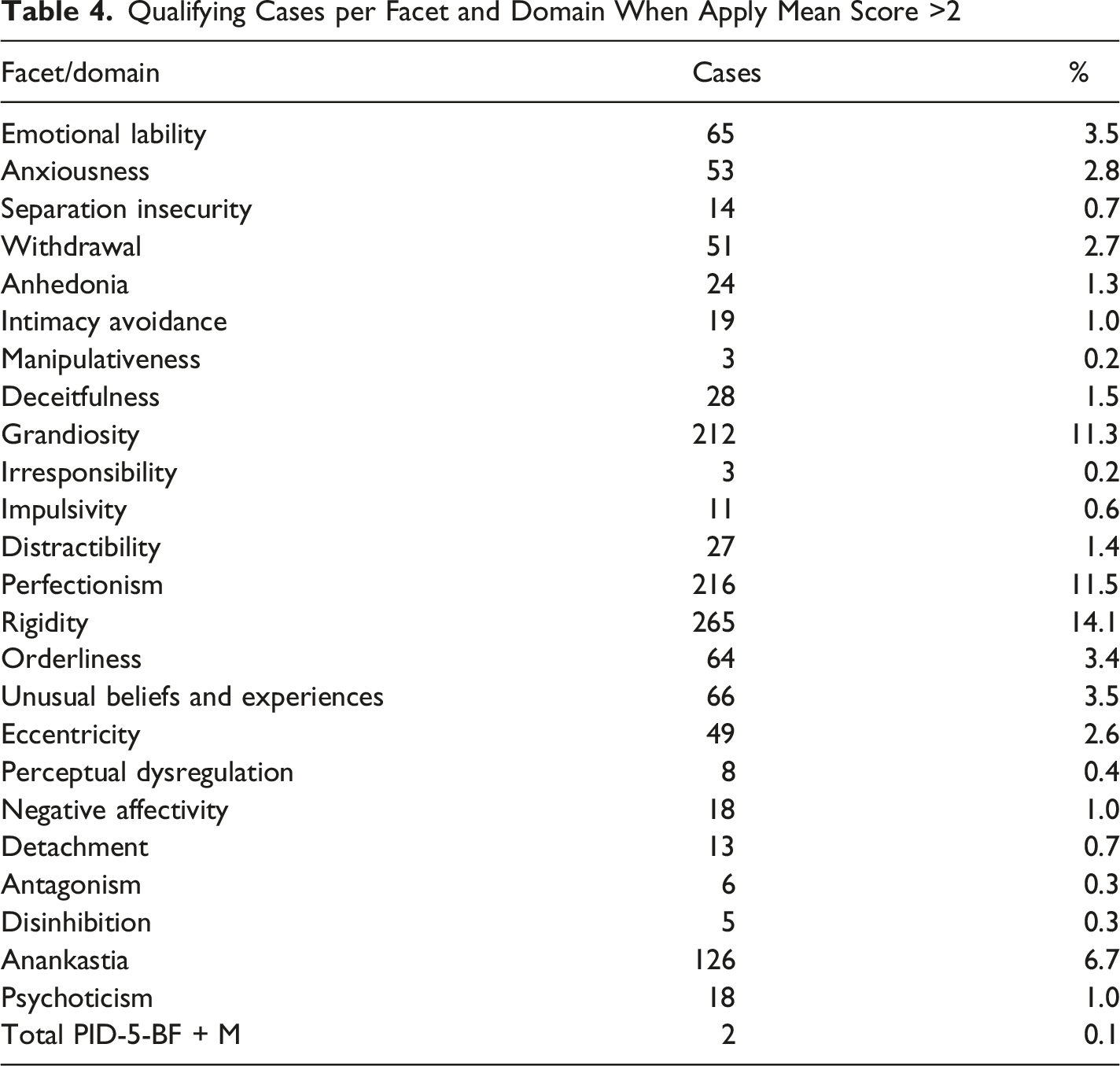
Pires et al. (2021) proposed an algorithm for detecting possible cases of PD, in which high scores (i.e., >2) in three or more of the 18 facets, or two or more of the six trait domains, are suggestive of possible presence of a PD diagnosis. Frequencies of facet- and domain-level elevations were reported to identify which traits contributed most strongly to algorithm-based case identification, to allow contextual interpretation of trait distributions in this occupational sample (Objective 5).
Associations between PID-5-BF+M scores and indicators of adjustment (Objective 6) were examined through BLR with odds ratios. The contribution of personality dysfunction to risk for occurrence of an AjD was calculated as follows: probable AjD as determined by the IADQ algorithm was entered as dependant variable in a BLR, and odds ratios based on PID-5-BF+M total and domain scores then reported. The same was done for the five dichotomous questions on adjustment across mental health, work, and family/social settings.
Results
Descriptive Statistics
PID-5-BF + M Scale Means and Standard Deviations
Confirmatory Factor Analysis
Factor Loading and Internal Consistency
Note. AVE = average variance extracted.
Measurement Invariance
The 6-dimension model showed acceptable configural invariance for gender, but did not achieve metric invariance (Δχ2 = 31.923, Δdf = 12, p = 0.0014).
Internal Consistency
The total scale rendered a McDonald’s ω = .885 when using the 36-items, and a ω = .892 when using the 18 facets. Internal consistency for each domain is also presented in Table 2, and range from borderline acceptable (negative affectivity, detachment, disinhibition, psychoticism) to acceptable (anankastia, total scale). Antagonism remained problematic.
Construct Validity
Correlation Coefficients
*p < .001.
Resilience was significantly and negatively correlation with the total score, and negative affectivity, detachment, and disinhibition, with modest effect sizes.
Algorithm for Detecting Possible Cases of PD
Qualifying Cases per Facet and Domain When Apply Mean Score >2
Adjustment Across Mental Health, Work, and Family/Social Settings
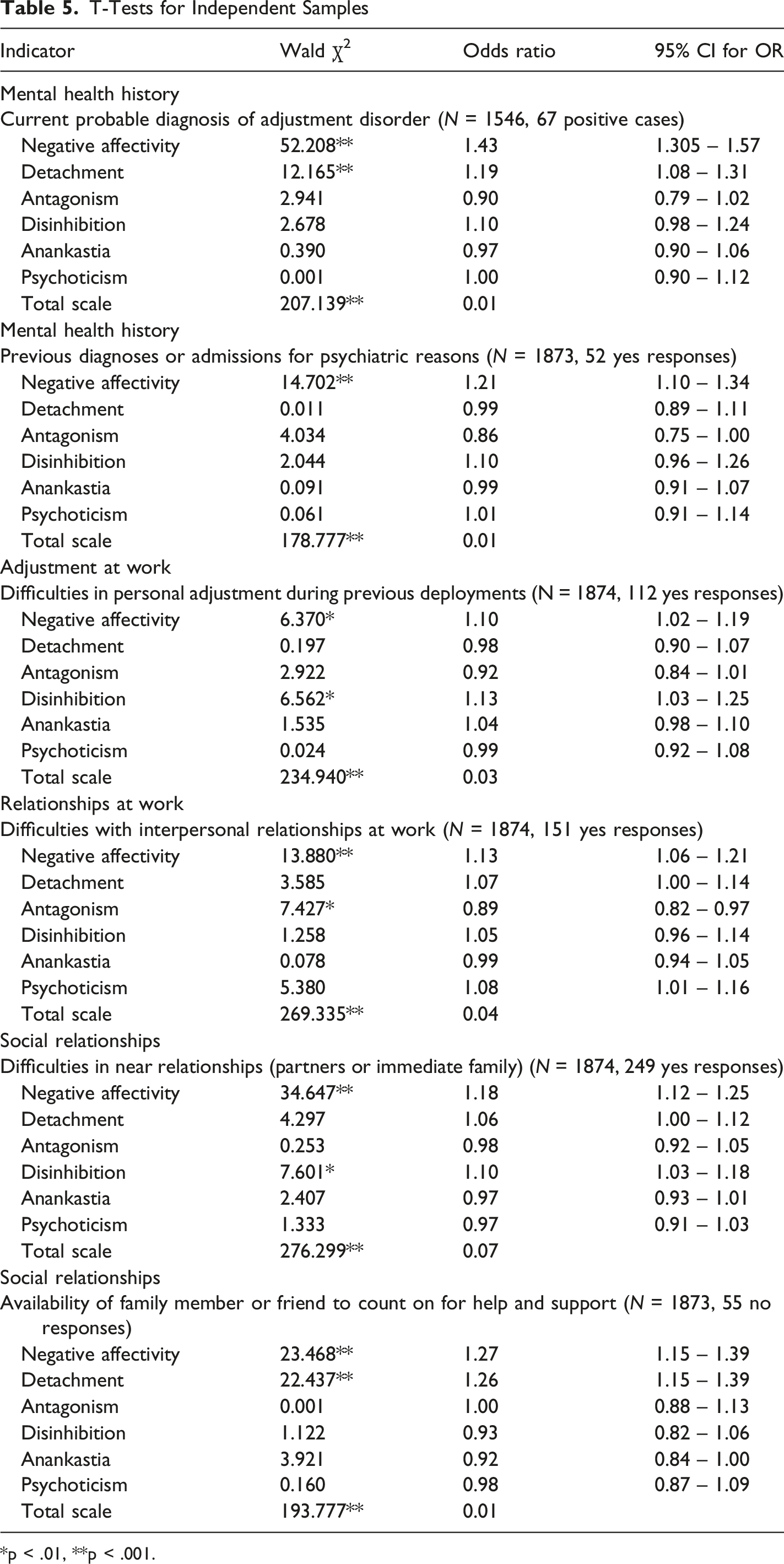
There were significant differences (ps < .001) in all facet, domain and total scores between individuals with a probable diagnosis of AjD (N = 67) and those without (N = 1479; data not shown here). Two trait domains contributed significantly to the risk for the presence of AjD, namely negative affectivity (OR:1.43) and detachment (OR:1.19), that together explained 30% of the variance in the model (Nagelkerke R2 = .302).
T-Tests for Independent Samples
*p < .01, **p < .001.
Discussion
The aim of the study was to examine the validity and applied utility of the PID-5-BF+M in an occupational context using a South African naval sample. In summary, the study achieved three outcomes: Firstly, it provided evidence of local psychometric validity of the PID-5-BF+M in a multilingual military sample from a middle-income country. Secondly, it extended validation work beyond personality pathology proxies (e.g., B-PD) to include ecologically meaningful adjustment outcomes across mental health, occupational, and family/social domains. Thirdly, it interrogated the interpretation of elevated maladaptive personality traits in a naval environment, demonstrating that maladaptivity is often contingent on environmental demands rather than trait elevation per se.
Taken together, the findings support a dimensional, function-focused understanding of personality dysfunction in military settings, aligned with contemporary nosological models, while underlining the need for context-sensitive interpretation when personality measures are used in occupational health and readiness assessments.
Validity of the PID-5-BF+M in a Naval Occupational Context
The CFA replicated the six-domain structure reported in international civilian and clinical samples, supporting structural validity of the PID-5-BF+M in a naval population from a middle-income country. Measurement invariance testing demonstrated configural invariance across gender, indicating that the underlying construct structure was interpreted similarly by women and men. However, the absence of full metric invariance suggests that the strength of relationships between facets and domains may differ across gender groups. This finding does not invalidate the measure but cautions against uncritical comparison of raw scores between genders, particularly in military environments where socialisation, role expectations, and norms around emotional expression may differ. From an ethical and legal perspective, this reinforces that PID-5-BF+M results should not be used mechanistically for comparative or exclusionary decisions.
Internal consistency estimates were acceptable for the total score and most domains, consistent with prior findings that reliability improves when domains are aggregated into a global severity index. Lower internal consistency for antagonism mirrors earlier studies and may reflect restricted variance in occupational samples where overt antagonistic behaviour is socially and institutionally constrained, and/or socially desirable responding in a military assessment context. Despite these limitations, antagonism still demonstrated meaningful associations with interpersonal adjustment, supporting its construct relevance despite modest reliability.
Personality Dysfunction as a Context-Contingent Vulnerability
The pattern of findings supports conceptualising personality dysfunction as a context-contingent vulnerability rather than a static risk factor. Traits reflecting emotional instability, interpersonal withdrawal, and behavioural dysregulation appear to amplify vulnerability in naval environments characterised by confinement, high interpersonal density, reduced autonomy, and sustained stress exposure. In contrast, traits reflecting rigidity, orderliness, and perfectionism appear largely neutral or adaptive under the same conditions.
This person-environment correspondence helps explain why the PID-5-BF+M total score, representing overall severity of dysfunction, demonstrated broader and more consistent associations with maladjustment than individual stylistic domains. Dimensional severity captures the extent to which personality dysfunction compromises self-regulation, interpersonal effectiveness, and stress tolerance across situations, rather than simply describing stylistic expression.
Construct Validity: Associations With Borderline Pathology and Resilience
The pattern of correlations with B-PD indicators and resilience aligns with theoretical expectations, offering preliminary evidence of construct validity in line with prior validation work (e.g., Facon et al., 2023; Riegel et al., 2021). Negative affectivity and disinhibition showed moderate correlations with both borderline screening measures, supporting convergent validity. It was noteworthy that a previous study reported significant correlation between psychological resilience and negative affectivity only (Facon et al., 2023), where the current study additionally observed significant – but modest – negative correlations with detachment, disinhibition, and the total score. This pattern supports the interpretation of personality dysfunction as undermining adaptive coping capacity under stress. The broader pattern observed here, compared to some prior studies, could be hypothesised to reflect the cumulative impact of interpersonal disengagement and behavioural dysregulation on access to social and psychological buffering resources in the naval context.
Association With Adjustment Disorder
The associations between PID-5-BF+M scores and probable AjD provide compelling criterion-related validity for personality dysfunction as a vulnerability factor for psychosocial stress related psychopathology. This association – personality dysfunction as risk factor for AjD – has also previously been observed (Vallejo‐Sánchez & Pérez‐García, 2017). Negative affectivity emerged as the strongest predictor of AjD, consistent with ICD-11 conceptualisations of AjD that emphases heightened emotional reactivity, difficulty regulating distress, and persistent preoccupation with stressors (World Health Organisation, 2024). Additionally, detachment independently predicted AjD risk, suggesting that interpersonal disengagement may compromise access to social resources during periods of stress. The combined model explained a substantial proportion of variance (±30%), which is notable given both the multifactorial nature of stress-related psychopathology and the brevity of the PID-5-BF+M. These findings position personality dysfunction not simply as comorbid with AjD, but as a meaningful predisposing factor that may shape how naval personnel respond to operational and interpersonal stressors.
As a methodological caution, the indicators of problematic adjustment and personality dysfunction are both derived from self-report, and the observed associations between AjD and maladaptive traits may in part reflect general symptom burden and shared method variance. Common method bias includes the risks of overestimating the validity of the scales, and of influencing the estimation of relationships, such as between problematic adjustment and personality dysfunction (Podsakoff et al., 2024).
Algorithm-Based Identification of Problematic Personality Functioning
The algorithm suggested by Pires et al. (2021) was applied in this study as an exploratory indicator of elevated personality dysfunction rather than a diagnostic proxy for personality disorder. Markedly different prevalence estimates were obtained depending on whether facet- or domain-based thresholds were used, underscoring the context sensitivity and interpretive limitations of algorithmic case identification in occupational samples. Facet-level thresholds (mean score >2 on ≥3 facets) identified a relatively large proportion of personnel, driven primarily by elevations in perfectionism, rigidity, and grandiosity. Examination of the distribution of qualifying elevations (Table 4) clarified the trait-specific drivers of algorithm-based identification in this sample. Although no external diagnostic criterion for PD was available, the distributional pattern offers descriptive insight into how algorithm thresholds operate in an occupational population. The clustering of elevations within perfectionism, rigidity, and grandiosity suggests that algorithm-based flags may reflect contextually reinforced behavioural styles rather than clinically meaningful dysfunction. In a naval environment characterised by high structure, clear hierarchies, and performance demands that emphasises precision and decisiveness, such traits are plausibly normative or contextually reinforced, rather than indicative of clinically significant dysfunction. Interpreting such elevations as evidence of disorder-level pathology would therefore risk construct overreach and false-positive identification. In contrast, domain-level thresholds (mean score >2 on ≥2 domains) identified very few individuals, suggesting that extreme, pervasive dysfunction is relatively uncommon in this actively serving population and that facet-level elevations may reflect stylistic traits rather than disorder-level pathology. This pattern is consistent with expectations in military settings, where individuals with severe personality pathology are unlikely to remain in service or present for routine health assessments.
Cultural context further complicates algorithmic interpretation. The relatively high prevalence of elevated scores on the facets of unusual beliefs and experiences may reflect local culturally normative belief systems (Louw & Duvenhage, 2016; Petrus & Bogopa, 2007) rather than psychopathology in the South African context. When incorporated uncritically into thresholds derived from predominantly Western or clinical samples, such facets risk inflating false-positive classification.
From an ethical and occupational health perspective, these findings highlight several critical considerations. Firstly, algorithmic thresholds derived from civilian or clinical research samples cannot be transferred uncritically to military occupational contexts without careful evaluation of environmental demands and normative trait expression. Secondly, the use of such algorithms for administrative decision-making, selection, or exclusion would be inappropriate in the absence of demonstrated predictive validity for operational failure, safety incidents, or sustained functional impairment. Thirdly, any identification of elevated scores must be embedded within a multi-method assessment framework, incorporating clinical interviews, functional histories, and contextualised judgement by qualified mental health professionals. Accordingly, the algorithm is best conceptualised as a screening heuristic to guide further assessment, rather than as a classification or exclusion tool. Its potential utility lies in supporting early identification of individuals who may benefit from monitoring, preventive intervention, or supportive resources, particularly in relation to stress tolerance and interpersonal functioning, rather than in labelling or pathologising personality traits that may be adaptive within specific military roles.
In line with ethical principles governing psychological testing in employment contexts, including fairness, proportionality, and non-discrimination, the present findings reinforce that personality assessment in military settings must prioritise functional impairment over trait elevation per se. Future research should therefore focus on establishing role-specific thresholds, examining longitudinal outcomes, and determining whether algorithm-identified elevations meaningfully predict adverse occupational, clinical, or safety-related endpoints.
Use of the Total Score as a Global Index of Personality Dysfunction
The PID-5-BF+M total score has demonstrated excellent internal consistency, strong associations with AjD, and consistent associations with multiple indicators of maladjustment across mental health, occupational, and social domains. These findings reinforce prior work suggesting that the total score functions as a pragmatic global index of personality dysfunction severity (Pires et al., 2021, 2023; Zimmermann et al., 2020), closely aligned with the ICD-11’s emphasis on overall personality dysfunction. Compared to individual domains, the total score showed greater psychometric stability and broader predictive utility across diverse adjustment outcomes, making it particularly suitable for occupational screening contexts where brevity, interpretability, and early risk identification are critical. Domain scores remain useful for nuanced formulation and follow-up assessment, with the total score appearing most informative for initial screening and triage.
The Naval Context and Adaptive Trait Expression
Elevated anankastia (especially perfectionism and rigidity) was the most distinctive feature of the sample. Importantly, anankastia was largely unrelated to maladjustment indicators, and did not predict AjD risk. This pattern suggests that traits often considered maladaptive in civilian contexts may be functionally adaptive or at least neutral in structured naval environments that reward rule adherence, precision, predictability, and procedural compliance. Conversely, traits linked to emotional instability and interpersonal withdrawal – negative affectivity and detachment – were consistently associated with poor adjustment, highlighting context-specific vulnerability profiles. The study reinforces the importance to distinguish between personality style and personality dysfunction, and of interpreting trait elevation through the lens of environmental demands, particularly in occupational contexts where institutional norms shape behavioural expression.
Limitations of the Study
This study has several limitations. The cross-sectional design limits causal inference between personality dysfunction and adjustment outcomes. Reliance on self-report measures raises the possibility of response bias as well as under-reporting due to perceived occupational consequences. Additionally, associations between self-report measures may in part reflect general symptom burden and shared method variance. The adjustment indicators were largely dichotomous and non-standardised, limiting measurement precision. The sample reflected actively serving naval personnel, likely excluding individuals with more severe dysfunction who were already screened out. Finally, formal language equivalence testing was not conducted in this multi-lingual sample. These limitations are typical of applied occupational research and do not necessarily negate the practical relevance of the findings.
Conclusion
This study supports the PID-5-BF+M as a valid, ethically defensible indicator of personality dysfunction in a South African naval context. Personality dysfunction – particularly negative affectivity and detachment – emerged as a meaningful vulnerability for maladjustment, while anankastic traits appeared largely adaptive. Dimensional severity, rather than trait elevation alone, is most informative for occupational readiness assessment.
Footnotes
Acknowledgements
Dr CJB (Chris) Muller from the Department of Statistics and Actuarial Sciences of Stellenbosch University conducted the confirmatory factor analysis and measurement invariance testing.

Ethical Considerations
This study was conducted according to the principles set out in the Declaration of Helsinki (2013). Institutional Review Board approval was obtained for the analysis of psychometric data: Stellenbosch University Health Research Ethics Committee, approval number N25/05/046, dated 19 June 2025.
Consent to Participate
All participants gave written and informed consent that their de-identified data may be used for analysis. Data were extracted from archival records, and de-identified prior to inclusion into the current analysis.
Funding
The author received no financial support for the research, authorship, and/or publication of this article.
Declaration of Conflicting Interests
The author declared no potential conflicts of interest with respect to the research, authorship, and/or publication of this article.
Data Availability Statement
The data that support the findings of this study are available from the corresponding author upon reasonable request. The data are not publicly available due to confidentiality restrictions on military information.
Disclaimer
The views and opinions expressed in this article are those of the author and do not necessarily reflect the official policy or position of any affiliated agency of the author.