






Abstract
In recent decades, research on love has expanded considerably, underscoring its relevance for individual well-being and relationship functioning. Despite this growth, conceptualizing and empirically operationalizing love remain challenging. Sternberg’s Triangular Theory of Love, one of the most influential frameworks in the field, conceptualizes love as comprising three core components: intimacy, passion, and commitment. This scoping review aims to synthesize empirical studies that have applied Sternberg’s theory to couple relationships, with the objectives of examining how the theory has been operationalized and of identifying relational variables associated with its components. Following PRISMA-ScR guidelines, 27 studies were included. All employed cross-sectional designs, and most samples were drawn from non-European countries. Overall, findings indicate that Sternberg’s theory remains theoretically coherent and empirically supported in the study of conjugal relationships. The three love components were consistently associated with key relational indicators, including relationship satisfaction, relationship seriousness, and sexual satisfaction. However, evidence regarding associations with relationship length and sexual orientation was mixed and inconclusive. This review highlights both the continued relevance of Sternberg’s Triangular Theory of Love and important gaps in the literature, pointing to directions for future research on love in diverse couple contexts.
Introduction
Love has been a variable of interest for researchers and has been examined by numerous authors over recent decades (e.g., Cassepp-Borges et al., 2023; Madey & Rodgers, 2009; Rokach, 2024). Among many theories of love, Sternberg’s Triangular Theory of Love has been particularly influential and has been tested with samples from diverse cultural contexts (e.g., Clemente et al., 2020; Graham, 2011; Hernandez et al., 2014; Sorokowska et al., 2023; Sorokowski et al., 2021; Sorokowski et al., 2023).
Sternberg (1986) noted that prior research tended to fragment the phenomenon of love and proposed that it is best conceptualized as comprising three interrelated components — intimacy, passion, and commitment — each reflecting different aspects of relational experience within romantic relationships. According to Sternberg’s Triangular Theory of Love, these three components can metaphorically be represented as the vertices of a triangle (Sternberg, 1986, 1988, 1997). Intimacy involves feelings of closeness, connectedness, communication, and bonding. Passion refers to the drives that give rise to romance, physical attraction, and sexual consummation. Decision/commitment reflects the certainty of loving and being loved, as well as the decision to maintain the relationship over the long term (Sternberg, 1997). Different combinations of these three components give rise to distinct types of love: Non-love, characterized by the absence of all three components; Liking, characterized by the presence of intimacy without passion or commitment; Infatuated love, characterized by the presence of passion without intimacy or commitment; Empty love, characterized by commitment without intimacy or passion; Romantic love, resulting from the combination of intimacy and passion; Companionate love, resulting from the combination of intimacy and commitment; Fatuous love, resulting from the combination of passion and commitment; and Consummate (or complete) love, representing the full combination of all three components. It is important to note, however, that no relationship embodies a completely pure form of any single type of love, as most relationships include all three components to varying degrees (Sternberg, 1997).
Although Sternberg’s model was originally developed to describe romantic relationships (Sternberg, 1986, 1988, 1997), it has been applied to a wide range of domains beyond romantic contexts. Examples include athletic performance (e.g., Campbell et al., 2016), people’s attachment to cars and petroleum products (e.g., Khatai & Ladsaria, 2023), brand love (e.g., Huber et al., 2016), customer relationships (e.g., Bugel et al., 2011), and customer switching behavior (e.g., Amani, 2022). These applications highlight the versatility of the model in capturing relational and affective dynamics across diverse contexts.
Love and couple relationships play a crucial role in adulthood, influencing individuals’ physical and psychological well-being (Almutairi et al., 2025; Khani et al., 2023; Sorokowski et al., 2021). Love has been linked to numerous relational variables, including dyadic adjustment (Garcia et al., 2017), sexual satisfaction (Sánchez-Fuentes et al., 2014), relationship satisfaction (Cassepp-Borges et al., 2023; Nabila & Gunawan, 2023), attachment (Madey & Rodgers, 2009; Paquette et al., 2020), and conflict resolution tactics (García et al., 2016; Garcia et al., 2017; Paquette et al., 2020). Despite extensive research, findings are heterogeneous, and love has often been operationalized in diverse ways, frequently not using Sternberg’s model. Moreover, many studies do not report important sample characteristics, such as participants’ sexual orientation (Totenhagen et al., 2023), which limits comparability and generalizability. Given these inconsistencies and gaps, a scoping review is particularly well suited to synthesize the current state of knowledge regarding Sternberg’s Triangular Theory of Love and its application to couple relationships (Cebral-Loureda et al., 2024).
This scoping review aims to synthesize the literature on the application of Sternberg’s Triangular Theory of Love in studies of couple relationships. Specifically, it seeks to map and describe the characteristics of studies that have applied the theory (aim 1), to explore how the construct of love has been operationalized and assessed (aim 2), and to identify which relational variables and dimensions of couple functioning have been analyzed (aim 3). Furthermore, the review aims to examine how the components of love, as defined by Sternberg’s triangular model, are associated with different aspects of couple relationships (aim 4). By addressing these objectives, the review provides a comprehensive overview of the application of the theory and highlights patterns, gaps, and directions for future research.
Method
Protocol and Registration
This scoping review was conducted in accordance with the Preferred Reporting Items for Systematic Reviews and Meta-Analyses extension for Scoping Reviews (PRISMA-ScR) guidelines and was prospectively registered in PROSPERO (Registration ID: CRD42024445685).
Guiding Research Question and Objectives
The review was guided by the primary research question: “How has Sternberg’s Triangular Theory of Love been examined in the literature with respect to romantic relationships?” This question informed the search strategy, study selection, and data extraction. The specific objectives, as outlined in the Introduction section, were to: (1) Map and describe the characteristics of studies applying Sternberg’s Triangular Theory of Love; (2) Examine how the construct of love has been operationalized and assessed; (3) Identify which relational and individual variables have been analyzed; and (4) Explore associations between the components of love and various aspects of couple relationships.
Search Strategy
An initial search was conducted across four electronic databases (B-On, Web of Science, Scopus, and PubMed) to identify empirical studies published in English, Portuguese, or Spanish, with no restrictions on the year of publication. The following search terms were applied to titles and abstracts: (“triangular theory of love” OR “Sternberg’s Triangular Theory of Love” OR “Triangular Love Scale” OR “Theory of Love”) AND (relationship OR “couple relationship” OR “dyadic adjustment” OR “relationship satisfaction” OR “relationship quality” OR partner OR couples OR marital). Duplicate records were identified and removed manually by the authors, who sorted articles by title and author names using Microsoft Excel.
Eligibility Criteria and Study Selection
Eligible studies were original empirical investigations involving human participants who were in romantic relationships. The following inclusion criteria were applied: studies conducted in humans; samples including couples or individuals in a relationship; studies written in English, Spanish, or Portuguese; empirical quantitative studies; studies guided by Sternberg’s Triangular Theory of Love as the theoretical framework; and studies in which the primary objective involved analyzing associations between love and at least one indicator of relationship quality. Studies were excluded if they examined love in non-relational or non-human contexts (e.g., love branding), were guided by theoretical frameworks other than Sternberg’s model, exclusively address psychometric analyses, were case reports, reviews, qualitative studies, meta-analyses, or gray literature, or involved replicated data.
A standard coding form was used during screening (0 = exclusion, 1 = inclusion, 2 = uncertain). Two authors independently screened all titles and abstracts against the inclusion and exclusion criteria, and discrepancies (16.28%) were resolved through discussion and consensus. The full texts of qualifying articles—those coded as included or uncertain—were then independently reviewed by both authors using the same criteria, with discrepancies during this phase (9.78%) also resolved through discussion and consensus.
Data Extraction and Synthesis
Data were extracted using a structured form developed for this review. For each study, the following information was recorded: year of publication; country of origin; language; study design; study aims; variables analyzed; sample characteristics; assessment instruments; and main findings regarding the associations between love and other variables. Results were synthesized using a qualitative descriptive approach, grouping concepts and findings by thematic similarity in line with the objectives of the scoping review.
Results
A total of 465 records were initially identified across four electronic databases (B-On, Web of Science, Scopus, and PubMed). After removal of duplicates, 207 records were excluded. The titles and abstracts of the remaining records were screened according to the inclusion and exclusion criteria, resulting in the exclusion of 166 irrelevant studies. Despite additional efforts to retrieve missing manuscripts, nine studies could not be accessed in full text and were therefore excluded.
Full-text screening was conducted for the 83 remaining articles, of which 56 did not meet the eligibility criteria and were excluded. Ultimately, 27 studies met all inclusion criteria and were included in the final synthesis.
A detailed overview of the screening and selection process is presented in Figure 1, following the PRISMA-ScR flow diagram format. PRISMA-SCR flow diagram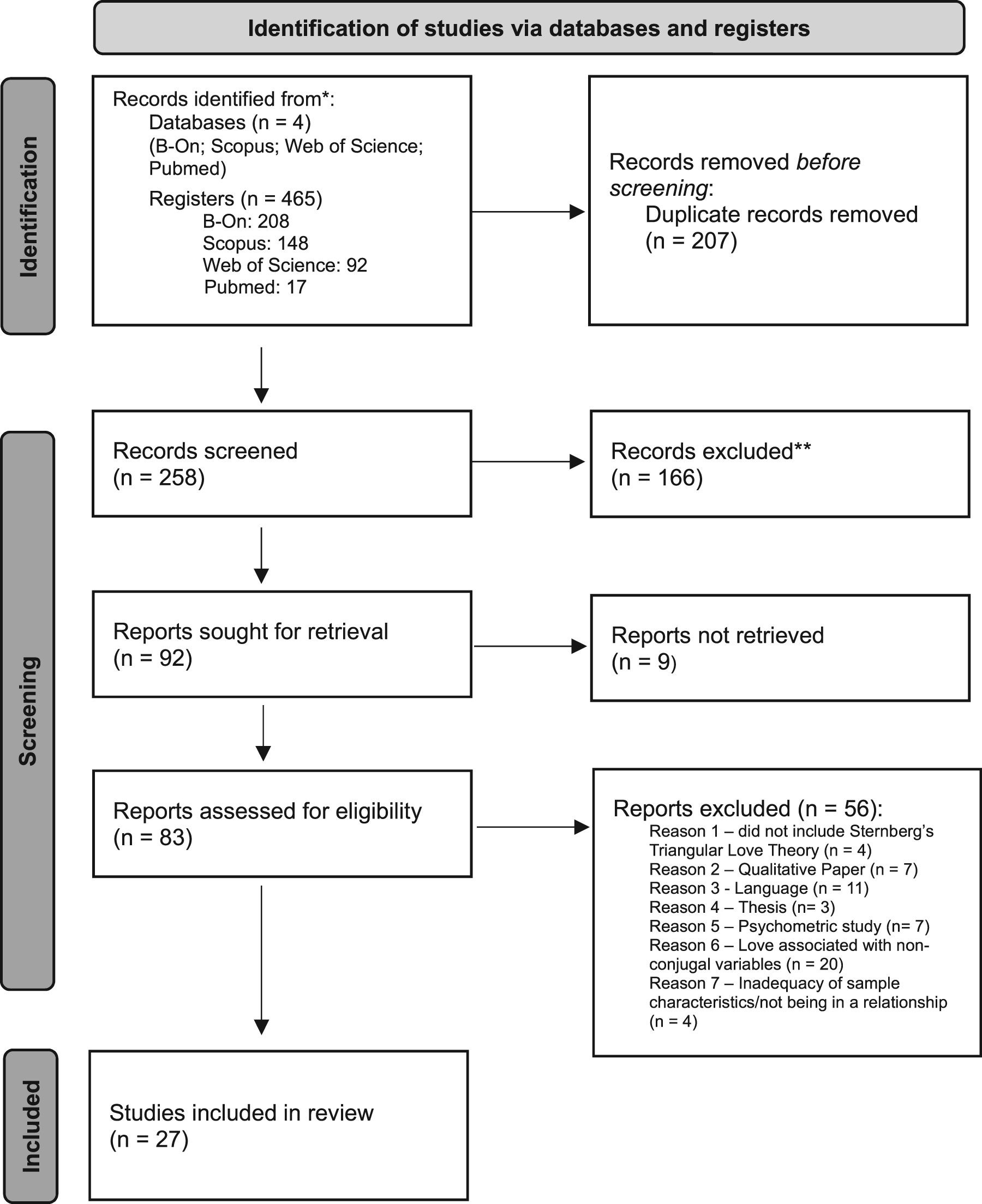
Study Characteristics
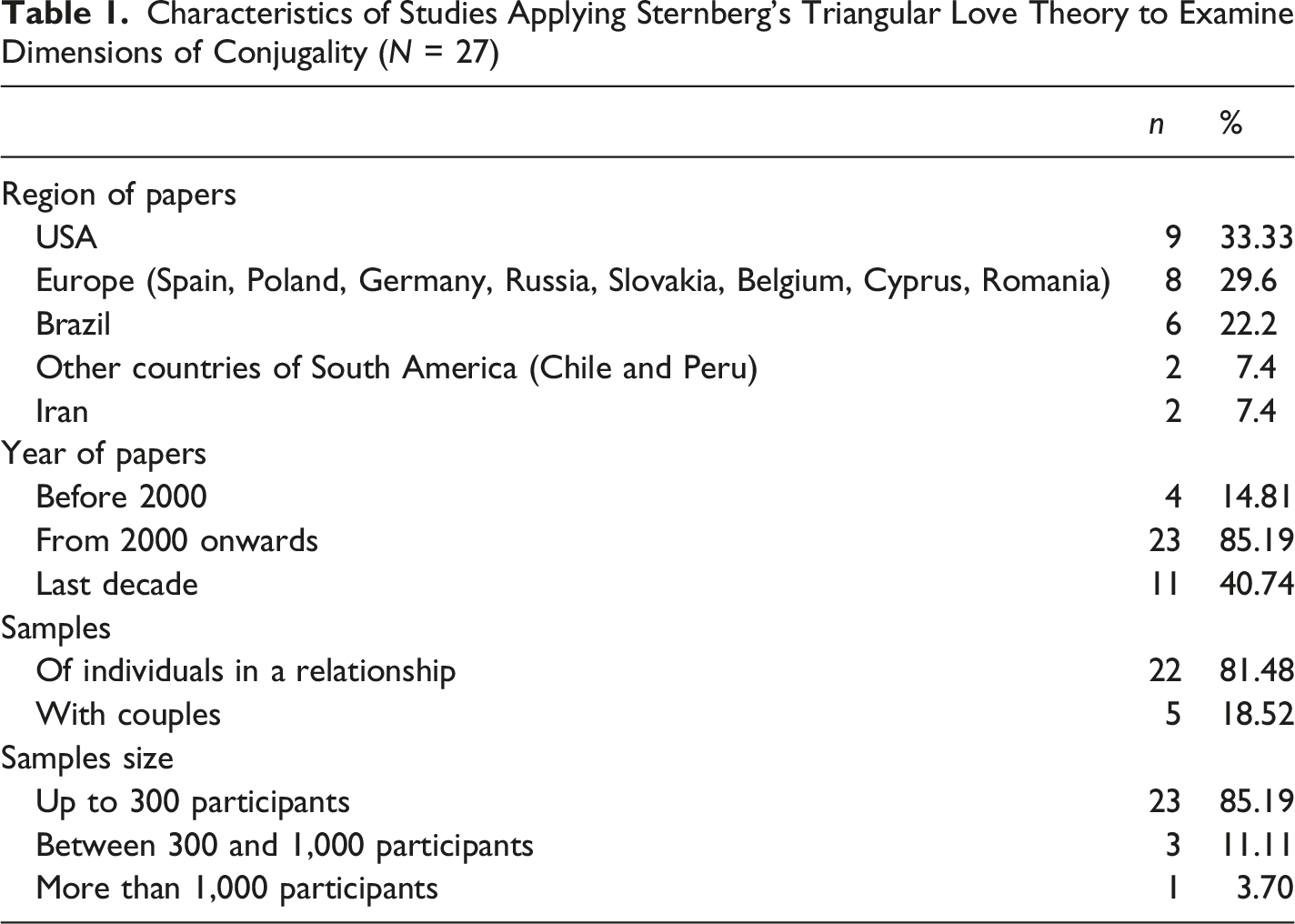
To address the first objective of this scoping review, we examined the geographical distribution, publication period, sample characteristics, and study designs of the included studies. This analysis provides an overview of the contexts in which Sternberg’s Triangular Love Theory has been applied and the populations studied.
Most of the included studies were conducted in the United States (approximately 33.3%; 9/27) and European countries (29.6%; 8/27). Approximately 22.2% (6/27) were carried out in Brazil, 7.4% (2/27) in other South American countries (Chile and Peru), and 7.4% (2/27) in Iran.
The majority of studies (85.2%; 23/27) were published from 2000 onward, with 40.7% (11/27) published in the last decade. Most studies (81.5%; 22/27) were conducted with samples of individuals in a relationship, whereas only 18.5% (5/27) included samples composed of couples. One study specifically included a sample of women who had experienced relationship violence.
All studies that included couples in the sample (18.5%) examined exclusively heterosexual relationships. Among studies including only individuals in a relationship, most (66.7%) involved heterosexual samples or did not specify sexual orientation, whereas only 14.8% (4/27) included both heterosexual and homosexual participants.
Regarding sample size, most studies (85.2%; 23/27) included up to 300 participants, while only one study (3.7%) included more than 1,000 participants (M = 232.96; SD = 205.20; Min = 55; Max = 1,042; Median = 184).
Characteristics of Studies Applying Sternberg’s Triangular Love Theory to Examine Dimensions of Conjugality (N = 27)
Operationalization of Love and Associated Variables
To address the second and third objectives of this scoping review, we examined how the construct of love was operationalized in the included studies and which relational and additional variables were analyzed in association with its components. Most studies (88.9%; 24/27) employed the Sternberg Triangular Love Scale to measure love, whereas 11.1% (3/27) used researcher-developed instruments.
Dimensions of Conjugality Examined in Relation to the Love Construct (N = 27)
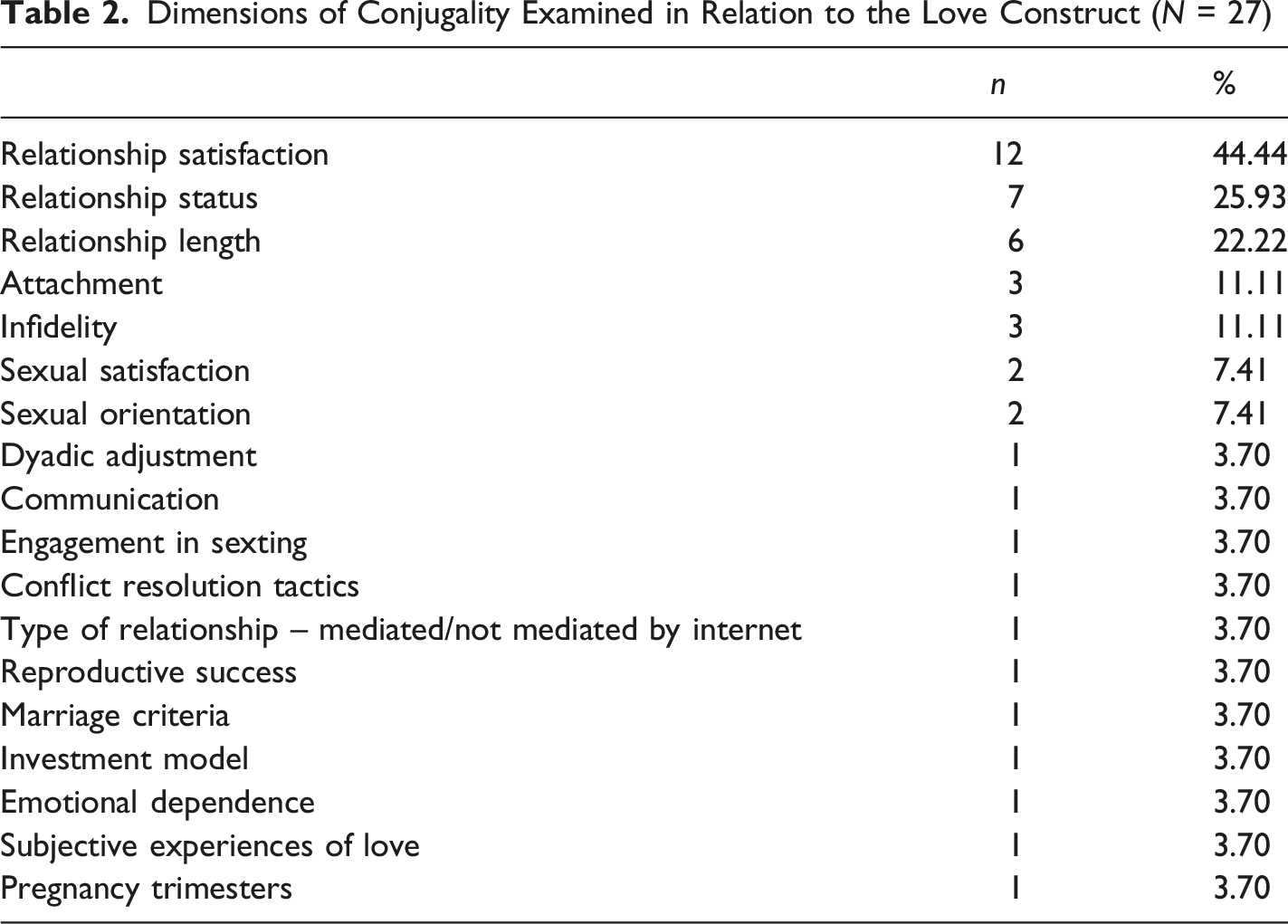
Several studies (40.7%; 11/27) also examined sociodemographic variables, namely gender, age, and education, in relation to love (see Supplemental S1 for detailed results).
In addition, some studies analyzed variables outside the conjugal or sociodemographic domains in association with love, including personality (11.1%; 3/27), psychological wellbeing (3.7%; 1/27), depression (3.7%; 1/27), pornography (3.7%; 1/27), and religion (3.7%; 1/27) (see Supplemental Table S2 for detailed results).
Associations Between Love Components and Conjugal Variables
Associations Between Love Components and Other Conjugal Variables
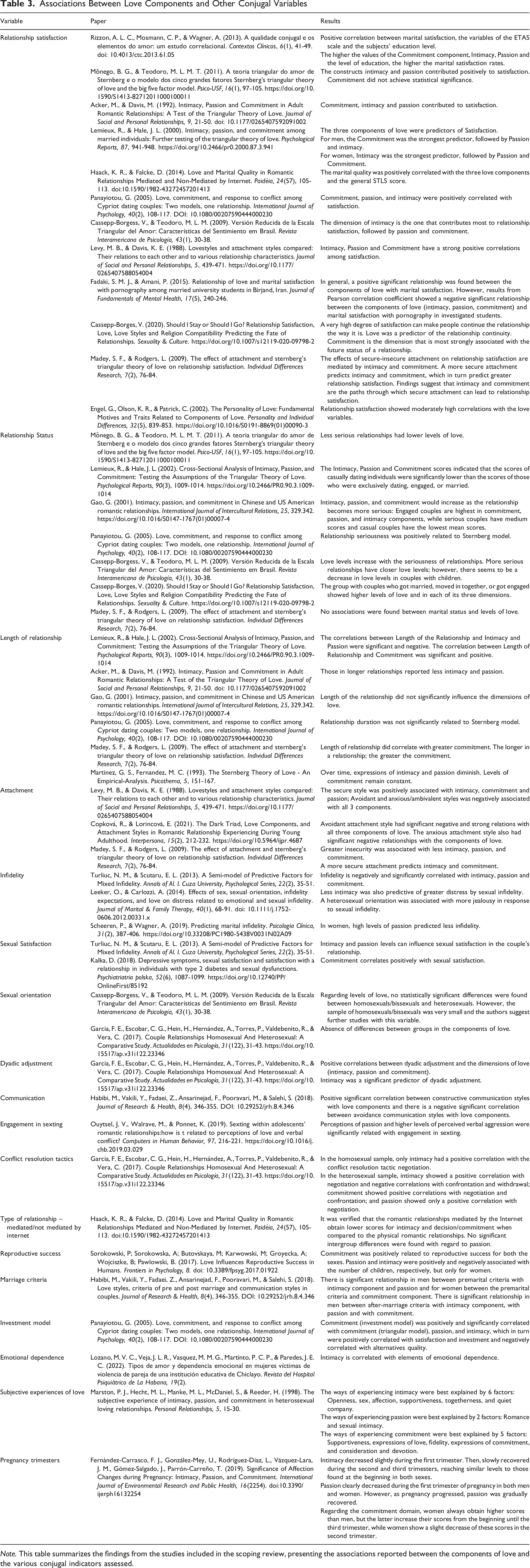
Note. This table summarizes the findings from the studies included in the scoping review, presenting the associations reported between the components of love and the various conjugal indicators assessed.
Among studies examining relationship satisfaction (10/12), all three love components were generally positively associated with satisfaction (Acker & Davis, 1992; Cassepp-Borges, 2020; Cassepp-Borges & Teodoro, 2009; Engel et al., 2002; Fadaki & Amani, 2015; Haack & Falcke, 2014; Lemieux & Hale, 2000; Levy & Davis, 1988; Panayiotou, 2005; Rizzon et al., 2013). Gender differences were reported by Lemieux and Hale (2000), who found that for men, commitment was the strongest predictor of satisfaction, followed by passion and intimacy, whereas for women, intimacy was the strongest predictor, followed by passion and commitment. Madey and Rodgers (2009) observed that intimacy and commitment positively mediated the association between secure attachment and relationship satisfaction. In contrast, Mônego and Teodoro (2011) reported significant correlations only for intimacy and passion, with no significant association for commitment. Fadaki and Amani (2015) noted that among participants who reported viewing pornography, correlations between love components and satisfaction were negative.
Studies examining relationship status (6/7) indicated that less committed or less serious relationships were generally associated with lower levels of love (Cassepp-Borges, 2020; Cassepp-Borges & Teodoro, 2009; Gao, 2001; Lemieux & Hale, 2002; Mônego & Teodoro, 2011; Panayiotou, 2005). Cassepp-Borges and Teodoro (2009) additionally found that couples with children had lower levels of love compared with couples in serious relationships without children, whereas Madey and Rodgers (2009) reported no significant association.
Among six studies examining relationship length, two found no significant correlations (Gao, 2001; Panayiotou, 2005). In the remaining four studies, length was generally negatively correlated with intimacy and passion, and positively correlated with commitment (Acker & Davis, 1992; Lemieux & Hale, 2002; Madey & Rodgers, 2009; Martinez & Fernandez, 1993).
All three studies investigating attachment reported that avoidant and anxious/ambivalent attachment styles were negatively associated with all love components (Copková & Lorincová, 2021; Levy & Davis, 1988; Madey & Rodgers, 2009). Secure attachment was positively associated with intimacy and commitment (Madey & Rodgers, 2009) and with all three components (Levy & Davis, 1988).
Regarding infidelity, it was generally negatively correlated with intimacy, passion, and commitment (Turliuc & Scutaru, 2013). Engel et al. (2002) found that higher passion predicted lower infidelity among women, whereas Leeker & Carlozzi (2014) observed that lower intimacy predicted greater distress due to sexual infidelity.
Sexual satisfaction was positively correlated with intimacy, passion (Turliuc & Scutaru, 2013), and commitment (Kalka, 2018). Studies examining sexual orientation (2/2) found no significant differences in love levels between sexual orientation groups (Cassepp-Borges & Teodoro, 2009; Garcia et al., 2017).
Additional conjugal variables were also examined, albeit each in only one study. Dyadic adjustment was positively associated with all love components, with intimacy serving as a significant predictor (Garcia et al., 2017). Constructive communication was positively associated with love components, whereas avoidance communication showed negative associations (Habibi et al., 2018). Passion was the only component significantly associated with engagement in sexting (Van Ouytsel et al., 2019). Regarding conflict resolution tactics, in heterosexual relationships, intimacy was positively correlated with negotiation and negatively correlated with confrontation and withdrawal, commitment correlated positively with negotiation and confrontation, and passion correlated positively only with negotiation. In homosexual relationships, intimacy was positively associated solely with negotiation (Garcia et al., 2017).
Romantic relationships mediated by the internet were associated with lower intimacy and commitment compared with in-person relationships (Haack & Falcke, 2014). Commitment was positively associated with reproductive success for both sexes, while for women, passion was positively associated and intimacy negatively associated with the number of children (Sorokowski et al., 2017). Love was also related to marriage criteria (criteria of choosing spouse in pre and post marriage), with premarital criteria for men associated with intimacy and passion, postmarital criteria associated with all components, and premarital criteria for women associated only with commitment (Habibi et al., 2018). Intimacy was positively correlated with emotional dependence (Lozano et al., 2022), and the commitment dimension of the investment model was positively associated with all love components, which in turn were positively correlated with relationship satisfaction (Panayiotou, 2005).
Finally, studies investigating subjective experiences of love indicated that intimacy was associated with openness, affection, supportiveness, togetherness, and quiet company; passion was associated with romance and sexual intimacy; and commitment was associated with supportiveness, fidelity, expressions of love and commitment (Marston et al., 1998). Changes across pregnancy trimesters showed that intimacy and passion slightly decreased during the first trimester and gradually recovered thereafter, while women consistently scored higher in commitment. Men’s commitment increased from the first to the third trimester, whereas women’s commitment slightly decreased during the second trimester (Fernández-Carrasco et al., 2019).
Discussion
The present scoping review aimed to examine how Sternberg’s Triangular Theory of Love has been applied in the study of couple relationships. Specifically, it addressed four objectives: to map and describe the characteristics of studies that have used Sternberg’s Triangular Love Theory to examine dimensions or indicators of couple relationships; to explore how the construct of love has been operationalized and assessed; to identify which dimensions of couple functioning and additional variables have been examined; and to investigate how the components of love, as defined by Sternberg’s triangular model, are associated with different aspects of couple relationships. Using a scoping review methodology (Tricco et al., 2018) and following PRISMA guidelines, research trends, empirical gaps, and directions for future work were identified.
Regarding the first objective, several patterns were evident. Most studies were conducted in the United States and European countries, highlighting the need for broader geographic and cultural representation, as cultural norms, modernization, and social values can influence the experience and expression of love (Sorokowski et al., 2023). Similarly, we consider it particularly surprising that Brazil showed a level of representation comparable to that of the United States and European countries. It is possible that this finding emerged as a result of the representativeness of the databases used, although we cannot disregard that scientific research output in Brazil has increased considerably in recent years, according to the UNESCO Science Report (2021).
The majority of studies were published within the past two decades, demonstrating the sustained relevance of Sternberg’s model in contemporary research on romantic relationships (Vásquez et al., 2025). Nevertheless, all included studies employed cross-sectional designs, which limit the capacity to examine how love evolves over time. Longitudinal and dyadic designs are therefore essential to capture within-couple dynamics and changes in intimacy, passion, and commitment (Espindola & Neto, 2025). Only a small number of studies included actual couples, emphasizing the importance of investigating both partners’ perspectives, particularly because partner similarity has been shown to influence relationship outcomes (Delatorre & Wagner, 2021).
Nearly all studies focused on heterosexual relationships, and few explicitly reported participants’ sexual orientation. As noted by Totenhagen et al. (2023), assuming heterosexuality without disclosure contributes to the underrepresentation of sexual minorities in relationship science. Comparative research across sexual orientations is therefore needed to assess whether Sternberg’s dimensions of love generalize beyond heterosexual samples (Cassepp-Borges & Teodoro, 2009; Garcia et al., 2017).
Addressing the second objective, most studies employed the Triangular Love Scale (Sternberg, 1997), supporting both the theoretical and empirical applicability of the model. This finding aligns with prior evidence demonstrating the scale’s validity across populations and cultures (Bauermeister et al., 2011; Hernandez & Baylão, 2020; Sorokowska et al., 2023; Sorokowski et al., 2023; Sternberg, 1997), indicating a consistent operationalization of the love construct that facilitates comparison across studies.
Regarding the third objective, relationship satisfaction was the most frequently examined relational variable, followed by relationship status and relationship length. These findings are consistent with previous literature highlighting strong associations between love and relationship satisfaction (Rokach, 2024) as well as multiple relational dimensions (Cebral-Loureda et al., 2024). Other relational dimensions, including communication, sexual satisfaction, and conflict management, were examined less frequently, revealing promising avenues for future research, particularly in exploring potential mediating or moderating roles. A subset of studies also assessed sociodemographic and individual variables—such as personality, psychological well-being, depression, religiosity, and pornography use—underscoring the importance of understanding how these factors may influence or moderate couple dynamics.
In relation to the fourth objective, results consistently indicated positive associations between intimacy, passion, and commitment and relationship satisfaction (Acker & Davis, 1992; Cassepp-Borges, 2020; Cassepp-Borges & Teodoro, 2009; Engel et al., 2002; Fadaki & Amani, 2015; Haack & Falcke, 2014; Lemieux & Hale, 2000; Levy & Davis, 1988; Panayiotou, 2005; Rizzon et al., 2013). Less serious or less committed relationships were generally associated with lower levels of love (Cassepp-Borges, 2020; Cassepp-Borges & Teodoro, 2009; Gao, 2001; Lemieux & Hale, 2002; Mônego & Teodoro, 2011; Panayiotou, 2005), although Madey and Rodgers (2009) reported no significant association, potentially due to smaller sample sizes. Relationship length was negatively associated with intimacy and passion and positively associated with commitment in most studies (Acker & Davis, 1992; Lemieux & Hale, 2002; Madey & Rodgers, 2009; Martinez & Fernandez, 1993), with some deviations from Sternberg’s (1986) predictions. Sorokowski et al. (2021) suggest a curvilinear trend, with intimacy peaking in mid-length relationships and declining in longer-term unions, highlighting the need for more nuanced longitudinal analyses (Graham, 2011).
Attachment was positively associated with secure attachment styles (Levy & Davis, 1988; Madey & Rodgers, 2009) and negatively associated with anxious or ambivalent styles (Copková & Lorincová, 2021; Levy & Davis, 1988; Madey & Rodgers, 2009), reinforcing the role of emotional security in fostering stable bonds. Infidelity was generally negatively associated with love (Leeker & Carlozzi, 2014; Turliuc & Scutaru, 2013), although one study reported gender-specific effects (Scheeren & Wagner, 2019). Love was also positively associated with sexual satisfaction (Kalka, 2018; Turliuc & Scutaru, 2013), consistent with prior research (Esfahani et al., 2022; Martínez & Rodas, 2011), although some studies linked sexual satisfaction primarily to passion (Fricker & Moore, 2002), indicating the need for further investigation.
Studies examining sexual orientation reported no significant differences in love levels, but small samples of sexual minorities limited the reliability of these findings (Cassepp-Borges & Teodoro, 2009; Garcia et al., 2017; Totenhagen et al., 2023). A subset of studies also examined additional relational and contextual variables—including dyadic adjustment, communication, engagement in sexting, conflict resolution tactics, relationship type (mediated vs. in-person), reproductive success, marriage criteria, investment model, emotional dependence, subjective experiences of love, and pregnancy trimesters. Although these studies were limited in number, they illustrate the versatility of Sternberg’s model and highlight multiple domains for future empirical testing.
It is important to acknowledge some limitations of this scoping review. First, although the search strategy was designed to be as comprehensive as possible, additional studies may have been identified if other relevant databases, such as PsycInfo, had been accessible at the time of the search. Second, the inclusion and exclusion criteria may have limited the scope of the evidence mapped, particularly because the review focused specifically on empirical studies examining associations between Sternberg’s Triangular Theory of Love and other relational variables. While this focus was aligned with the objectives of the review, it may have excluded studies addressing the theory from broader conceptual, theoretical, or methodological perspectives. Despite these limitations, the findings underscore that Sternberg’s Triangular Theory of Love remains a valuable framework for understanding romantic relationships. At the same time, the empirical gaps identified—particularly the scarcity of longitudinal studies, the limited inclusion of couples and sexual minorities, and the uneven exploration of relational and individual variables—highlight important directions for future research aimed at advancing the field.
Conclusion
This scoping review offers an updated and comprehensive overview of how Sternberg’s Triangular Theory of Love has been applied in the study of couple relationships, identifying how love has been operationalized, which relational and contextual variables have been examined alongside it, and how the components of love are associated with different aspects of couple functioning. The findings indicate that Sternberg’s model remains widely used and empirically relevant, with a substantial proportion of studies published in the last decade.
Across the variables explored, relationship satisfaction emerged as the most frequently assessed and consistently associated with the components of love, with multiple studies supporting robust positive associations. Other relational indicators—such as relationship length, relationship status, communication processes, sexual satisfaction, or sexual orientation—have also been examined, though evidence in these domains is more limited and sometimes inconsistent. Further research is therefore needed to clarify how these dimensions, as well as additional contextual or individual factors, may influence the expression and dynamics of love within romantic relationships.
Methodologically, all included studies relied on cross-sectional designs, and most were conducted outside European contexts. These patterns underscore the need to expand the evidence base through longitudinal and dyadic designs that can capture developmental changes and within-couple processes over time. They also highlight the importance of diversifying samples geographically and culturally, given that cultural norms, social expectations, and modernization levels may shape both the experience and the meaning of love.
Finally, acknowledging that love is a construct that both influences and is influenced by multiple relational and contextual factors—and that it remains, to some extent, an elusive phenomenon (Sternberg, 1997)—this review reinforces the need for sustained empirical inquiry. Future research should integrate Sternberg’s framework with broader relational, sociodemographic, and psychological dimensions, in order to deepen conceptual understanding and improve the comparability of findings across cultural and methodological contexts.
Supplemental Material
Supplemental Material - Understanding Love in Couple Relationships: A Scoping Review of Sternberg’s Triangular Theory
Supplemental Material for Understanding Love in Couple Relationships: A Scoping Review of Sternberg’s Triangular Theory in Chinan by Ana Durão and Ana Conde in Psychological Reports
Footnotes

Funding
The authors disclosed receipt of the following financial support for the research, authorship, and/or publication of this article: This article was supported by National Funds through FCT – Fundação para a Ciência e a Tecnologia, I.P., within RISE-Health, R&D Unit (reference UID/06397/2023).
Declaration of Conflicting Interests
The authors declared no potential conflicts of interest with respect to the research, authorship, and/or publication of this article.
Data Availability Statement
The data supporting this scoping review derive from previously published studies, which are cited throughout the manuscript.
Declaration of Generative AI and AI-Assisted Technologies in the Writing Process
The authors declare that the English language of this manuscript was revised and refined with the assistance of the AI tool ChatGPT, as the authors are not native English speakers. This support was used exclusively to enhance linguistic clarity and readability, without any involvement in the interpretation of data or modification of the scientific content.
Supplemental Material
Supplemental material for this article is available online.
Author Biographies
References
Supplementary Material
Please find the following supplemental material available below.
For Open Access articles published under a Creative Commons License, all supplemental material carries the same license as the article it is associated with.
For non-Open Access articles published, all supplemental material carries a non-exclusive license, and permission requests for re-use of supplemental material or any part of supplemental material shall be sent directly to the copyright owner as specified in the copyright notice associated with the article.
