






Abstract
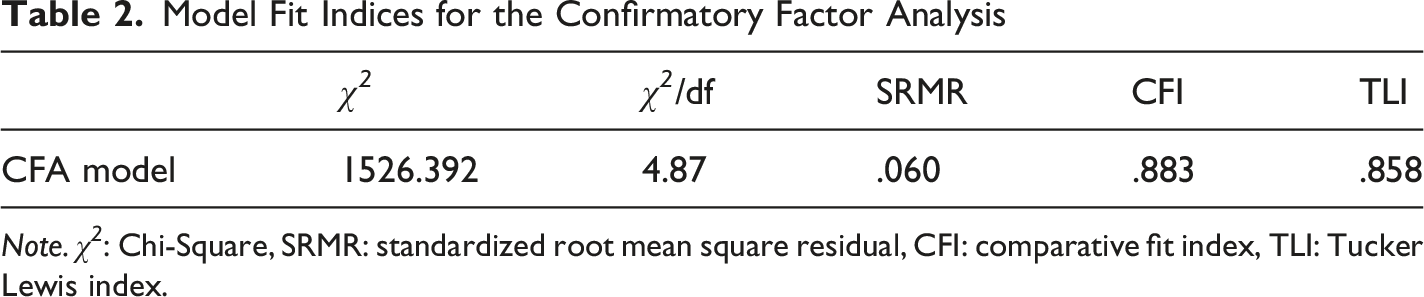
The current study aimed to develop and examine the psychometric properties of the Children’s Prosocial Behaviors in a Preschool Setting (CPBPS) scale. Preschool teachers (N = 16) completed the CPBPS and related measures for 255 children aged 3–5 years. Following item refinement procedures, the scale was reduced to 28 items representing five theoretically grounded dimensions: helping, comforting, cooperating, sharing, and defending. Principal Component Analysis and Confirmatory Factor Analysis provided preliminary support for the five-factor structure, demonstrating acceptable model fit. Internal consistency coefficients ranged from .91 to .96 across subscales, indicating excellent reliability. Evidence of convergent validity was supported by significant correlations with established measures of empathy and prosocial behavior. Exploratory analyses also revealed age- and gender-related differences in prosocial behaviors, consistent with developmental literature. Overall, the findings suggest that the CPBPS is a valid and reliable teacher-report measure for assessing multidimensional prosocial behaviors in preschool settings.
Keywords
Introduction
Prosocial behavior is commonly defined as “a voluntary behavior meant to help another” (Padilla-Walker & Carlo, 2014, p. 6). The preschool years (approximately ages 3–5) represent a critical developmental period characterized by rapid growth in emotion regulation, perspective-taking, peer interaction, and emerging moral understanding, all of which contribute to the expression of prosocial behavior (Arslan, 2025; Shoshani, 2023). During this stage, children increasingly engage in cooperative play, begin to recognize others’ emotions and needs, and develop greater behavioral self-regulation in social contexts (Brownell, 2013). These developmental advances support the emergence and increasing complexity of prosocial behaviors such as helping, sharing, and comforting others. Accordingly, recent developmental research conceptualizes prosociality as a multidimensional construct emerging early in life and shaped by both innate social sensitivities and socialization processes (Dunfield, 2014; Hamlin, 2013; Malti & Dys, 2018).
Contemporary research has renewed interest in the developmental origins of prosocial behavior. Studies with infants and toddlers suggest that rudimentary forms of helping and fairness sensitivity may emerge earlier than previously assumed, indicating that prosocial tendencies may reflect both biologically prepared social capacities and environmental influences (Dunfield, 2014). At the same time, longitudinal research highlights the importance of emotion regulation, moral reasoning, and social learning processes in shaping how prosocial behaviors are expressed across early childhood (Malti & Dys, 2018; Paulus, 2014). Thus, prosocial development is increasingly understood as the product of dynamic interactions between early-emerging social-cognitive capacities and contextual factors such as parenting and educational environments.
Several instruments have been used to assess prosocial tendencies in early childhood. For example, the prosocial subscale of the Strengths and Difficulties Questionnaire (Goodman, 1997) provides a brief global measure of helpful and considerate behaviors. Empathy-based measures, such as the Griffith Empathy Measure (Dadds et al., 2008), assess affective and cognitive responsiveness to others’ emotions. Other observational or teacher-report tools focus broadly on social competence or classroom climate. Although these instruments are useful, they may not fully differentiate between distinct forms of prosocial behavior in preschool settings. Developmental research suggests that prosocial behavior is multidimensional and may include distinct forms such as helping, sharing, and comforting (Dunfield, 2014). Consequently, existing measures may not fully capture the variety of prosocial actions that occur within preschool classroom contexts.
In the present study, prosocial behavior is conceptualized as comprising multiple distinguishable yet related dimensions. Developmental research suggests that children’s prosocial actions respond to different types of needs, including instrumental needs, emotional distress, and resource distribution (Dunfield, 2014; Malti & Dys, 2018). Accordingly, the present study conceptualizes prosociality as including five dimensions relevant to preschool classroom contexts: helping (instrumental assistance), sharing (voluntary distribution of resources), comforting (emotionally responsive behavior toward others’ distress), cooperating (coordinated engagement toward shared goals), and defending (intervening on behalf of peers in situations of unfairness or aggression). The CPBPS was therefore designed to represent these five theoretically distinguishable but related forms of prosocial behavior, and its proposed factor structure was examined through factor analysis.
Despite the recognized importance of the school environment in promoting prosocial behavior (Demirtaş-Zorbaz et al., 2025; Richaud et al., 2012; Yao, 2024), relatively few multidimensional instruments are designed specifically to assess distinct forms of prosocial behavior as they are displayed by preschool-aged children within classroom contexts. Many existing measures provide global assessments of prosociality or empathy and do not differentiate between specific behavioral domains such as helping, comforting, cooperating, sharing, and defending. In response to this gap, the Children’s Prosocial Behaviors in a Preschool Setting (CPBPS) was developed as a theory-informed teacher-report measure to capture these dimensions as they naturally occur in preschool environments. Accordingly, the present study aimed to develop the CPBPS and evaluate its factor structure, reliability, and convergent validity as a multidimensional teacher-report measure of preschool children’s prosocial behavior.
Gender Differences in Prosocial Behavior
Prosocial behavior is a key component of early childhood social and emotional development (Marryat et al., 2014), and researchers have long examined whether boys and girls differ in the frequency or type of prosocial behaviors they display. Studies generally indicate that girls tend to display slightly higher levels of prosocial behavior, particularly those related to empathy and emotional responsiveness (Eisenberg & Lennon, 1983; Girard et al., 2017). Research also suggests that prosocial behavior in early childhood is closely associated with social–cognitive abilities and language development, which support children’s understanding of others’ emotions and intentions (Conte et al., 2018). These findings highlight the importance of considering developmental and socialization processes when examining gender differences in prosocial behavior during the preschool years. Theoretical frameworks such as Social Learning Theory (Bandura, 1977) and Cognitive Developmental Theory (Kohlberg, 1966) explain how children internalize gendered norms through observation, reinforcement, and moral reasoning. Girls are often socialized to display nurturing behaviors, while boys are encouraged toward instrumental prosocial actions like helping or defending (Eisenberg et al., 2015; Espinosa & Kovářík, 2015). Empirical studies show that girls tend to exhibit higher levels of empathy and comforting behaviors (Newton et al., 2014), whereas boys more often demonstrate prosociality through physical or task-oriented actions. Interestingly, boy-dominated toddler groups have been found to resolve conflicts more peacefully than girl-majority groups (Ashby & Neilsen-Hewett, 2012; Caplan et al., 1991), reflecting gendered socialization processes (Toussaint & Webb, 2005). These patterns are reinforced by parents, teachers, and peers. Parents may socialize girls and boys differently (Baker et al., 2016), often guiding girls toward caregiving roles and boys toward problem-solving activities (Lytton & Romney, 1991), while teachers may further reinforce gender-typical behaviors in classroom contexts (Chapman, 2016; Sadker & Sadker, 1994). Peers also influence behavior, as preschool children tend to form gender-segregated playgroups, with girls favoring cooperative play and boys preferring competitive or action-oriented play (Maccoby, 1998; Martin & Fabes, 2001). The classroom environment itself further shapes prosocial development through opportunities for cooperative learning and emotional growth (Villardón-Gallego et al., 2018; Wentzel, 2015).
Age Differences in Prosocial Behavior
Preschool-aged children exhibit significant age-related differences in the types, frequency, and complexity of prosocial behaviors (Marryat et al., 2014). These changes are influenced by cognitive, emotional, and social factors that help children form positive relationships, engage in cooperative play, and develop empathy (Gifford-Smith & Brownell, 2003). Several theories explain the development of prosocial behavior across ages. Attachment Theory (Bowlby, 1969) suggests that secure attachment to caregivers fosters empathy and prosocial behaviors, which extend to peers and teachers as children age (Hughes & Dunn, 1998). Social Learning Theory (Bandura, 1977) emphasizes that children learn prosocial behaviors by observing and interacting with caregivers and peers, which becomes more frequent and diverse over time. Cognitive Developmental Theory (Kohlberg, 1966) posits that younger children perform prosocial behaviors to avoid punishment or gain rewards, while older children engage in these behaviors for intrinsic reasons.
Research suggests that the roots of prosocial behavior emerge early in development, with some forms of other-oriented responding appearing during the first two years of life. Infants and toddlers may already demonstrate simple forms of helping, sharing, and comforting behaviors before the age of two (Dunfield, 2014; Malti & Dys, 2018). For example, young children may engage in early helping behaviors such as assisting others in goal-directed tasks, indicating emerging sensitivity to others’ needs and intentions. As children move into the preschool years, these behaviors become more frequent, intentional, and socially complex as cognitive, emotional, and language abilities develop (Brazzelli et al., 2021).
Helping Behavior
Young children may already demonstrate simple helping behaviors as early as the toddler years (Warneken & Tomasello, 2006). During the preschool years, helping becomes more sophisticated and increasingly guided by empathy and consideration for others’ needs (Brazzelli et al., 2021).
Sharing Behavior
Sharing supports young children’s social development by fostering positive peer interactions and building the foundation for social-emotional skills that benefit both individual and societal well-being (Tan, 2024). Sharing begins at age 3, often motivated by external rewards, but by age 4 and 5, children share more willingly, recognizing the social benefits of sharing (Fehr et al., 2008).
Comforting Behavior
Children around age 3 show empathy for distressed peers, offering verbal comfort (Zahn-Waxler et al., 1992). By ages 4 and 5, children show more advanced empathy and comfort a broader range of peers (Hoffman, 2000).
Cooperating Behavior
Cooperation is another important component of prosocial behavior that develops during the preschool years. At age 3, children engage in parallel play and basic turn-taking. By ages 4 and 5, cooperation becomes more sophisticated, requiring negotiation and problem-solving (Gifford-Smith & Brownell, 2003; Smith, 2009).
Defending Behavior
Around age 4 or 5, children begin to intervene on behalf of others in response to unfairness, aggression, or exclusion (Swit et al., 2023 Wentzel, 2015). This behavior develops as children better understand social norms, fairness and moral expectations (Killen & Smetana, 2015; Kohlberg, 1966).
The Current Study
The current study aimed to examine the psychometric properties of the CPBPS, including its reliability, validity, and overall usefulness as an assessment tool. By evaluating these properties, the study seeks to determine whether the CPBPS can be effectively used by educators, researchers, and policymakers to assess children’s prosocial behaviors and develop interventions that support the social climate of preschool environments, ultimately contributing to the promotion of prosocial behavior in early childhood education settings.
Method
Participants
Teachers (N = 16) of preschool-aged children were recruited from four different preschools located in a Southern state in the USA. All four preschools operated under the same state childcare licensing regulations and followed standard early childhood education practices. While there were minor variations in daily routines, there were no major differences in childcare policy across the preschools that would be expected to affect children’s social development. Thus, the sample reflects children’s experiences in typical preschool settings within the region. Screening processes left us with 263 children. After eliminating incomplete/missing responses, the database for analyses consisted of data collected for 255 children (Mage total = 4.30 years, SD = .68; Mage girls = 4.25 years, SD = .72; Mage boys = 4.34, SD = .65; range: 3–5 years; n= 128 boys, N = 127 girls). Children’s age was reported in completed years only (3, 4, or 5 years old), and age groups reflect teacher-reported age in years at the time of assessment rather than exact chronological age in months.
Measurements
The teachers completed the Griffith Empathy Measure, the Strengths and Difficulties Questionnaire, the Children’s Behavior Questionnaire and The Children’s Prosocial Behaviors in a Preschool Setting for students in their classrooms. The teachers received a $50 gift card.
The Griffith Empathy Measure (GEM)
GEM (Dadds et al., 2008) is a well-known empathy evaluation tool in child development research. Teachers completed GEM for each child. It includes two subscales: affective empathy (e.g., “this child gets upset when another person is acting upset.”) and cognitive empathy (e.g., “this child can understand why other people get upset”). GEM is a 9-point Likert-type scale (−4 = strongly disagree to +4 = strongly agree) and comprises twenty-three items. It has good reliability for the global scale (.81) and subscales (cognitive = .62; affective = .83) based on Cronbach’s α indices. In the current study, the Cronbach's α indicated good internal consistency for the global scale (.91), and subscales (cognitive = .92 and affective = .91).
The Strengths and Difficulties Questionnaire (SDQ)
SDQ (Goodman, 1997) is a behavioral screening questionnaire and has five subscales, including hyperactivity, conduct problems, emotional symptoms, peer relationships, and prosocial. Teachers only completed the prosocial subscale of SDQ using a 3-point scale (0 = not true to 2 = certainly true) for each child. The SDQ has 25 items, and its prosocial subscale has five items (e.g., “This child often volunteers to help others.”). The prosocial subscale of the SDQ is a validated and commonly used assessment of children’s prosocial behavior (e.g., Becker et al., 2004). Several studies have evaluated the reliability of the SDQ (e.g., Capron et al., 2007; Goodman, 1997) and showed acceptable alpha mean range for total scale (.70–.80) and prosocial scale (.59–.66). In the current study, the Cronbach’s α of the prosocial subscale was .96. The high internal consistency observed in the present sample may reflect the use of teacher reports evaluating multiple children within the same classroom context.
Children’s Behavior Questionnaire-Teacher Form (CBQ)
CBQ-Teacher Form (Rothbart et al., 1994) is a scale that measures children’s temperament via teacher reports. The scale has 36 items and has three subscales: Surgency (e.g., “This child seems always in a big hurry to get from one place to another.”), Effortful Control (e.g., “This child is good at following instructions.”), and Negative Affectivity (e.g., “Gets quite frustrated when prevented from doing something s/he wants to do.”). It is a 7-point Likert-type scale ranging from 1 (extremely untrue of your child) to 7 (extremely true of your child). The instructions also direct the respondent to mark “not applicable” (N/A) if the behavior described is not observable in the setting. In the current study, the Cronbach's α were acceptable/good for the global scale (.84), and subscales (Surgency = .87, Negative Affectivity = .83, and Effortful Control = .79).
Children’s Prosocial Behaviors in a Preschool Setting (CPBPS)
To measure children’s prosocial skills in a preschool environment, the Children’s Prosocial Behaviors in a Preschool Setting was designed by the researchers of the current study. Specifically, the scale evaluates multiple key dimensions of the children’s prosocial behavior as expressed in everyday preschool classroom interactions. These behaviors primarily occur in interactions with peers and teachers within everyday classroom activities. By capturing these observable behaviors, the CPBPS provides valuable insights into how children display prosocial behaviors within a preschool setting. The instrument was designed as a paper-and-pencil questionnaire consisting of the items rated on a 6-point Likert-type scale ranging from Never (0) to Always (5). Items were grouped into subscales that reflect central dimensions of the children’s prosocial behavior relevant to preschool settings. The format was intentionally kept concise, with items phrased in clear and age-appropriate educational language to ensure accessibility for teachers. Completion typically required approximately 10–12 minutes, and feedback from a small pilot group of teachers indicated that the instrument was straightforward, intuitive, and feasible to administer within their daily routines. The CPBPS uses a 6-point Likert-type rating scale and can be easily completed by teachers. The instrument is straightforward to score and designed to minimize subjective interpretation by using clearly defined behavioral descriptions. The details for the scale development steps were presented below.
Results
Piloting
The CPBPS was initially designed to include 46 items from five subscales (i.e., helping, cooperating, comforting, sharing, and defending). The validity of these 46 prosocial behavior items was evaluated by three researchers from the field (i.e., early childhood education and educational psychology) who met and judged whether each item measured prosocial behavior components. In cases of disagreement, the items were omitted. This resulted in 38 items identified as accurately measuring prosocial behavior components. Pilot testing of the CPBPS was conducted before the main validation study, using a separate sample of preschool teachers (n = 9). The piloting helped check that questions were comprehensible, that the instrument was producing a good spread of scores, and that neither floor nor ceiling effects were evident. Data from this pilot study were not analyzed statistically, because of the small sample size, but all of these instrument properties were confirmed.
Principal Component Analysis (PCA)
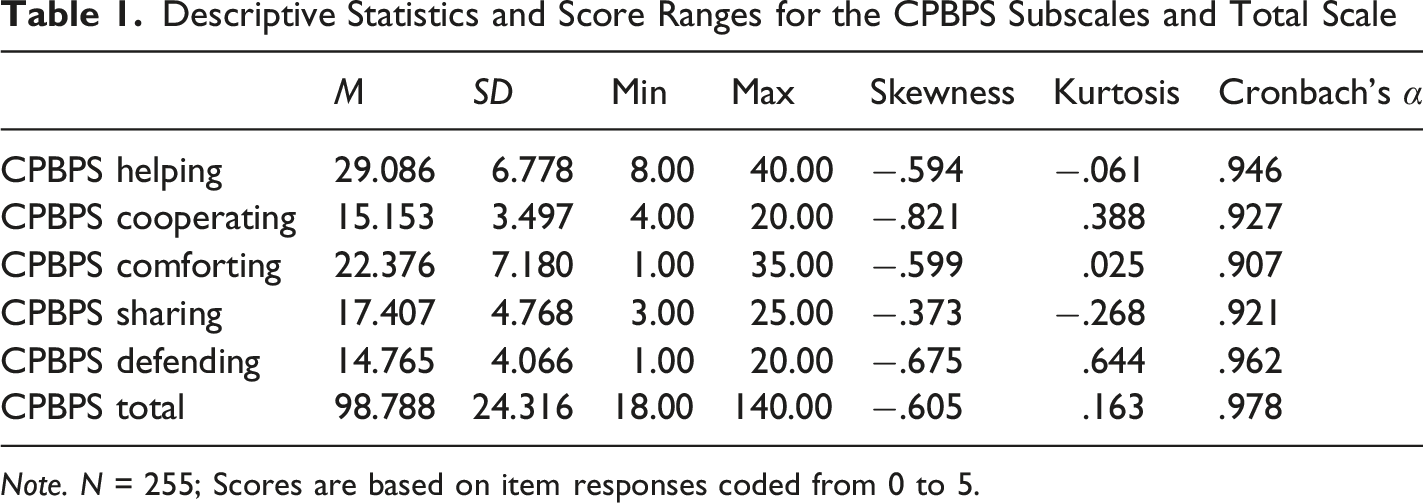
Following the pilot, the full administration of the CPBPS scale by n = 16 teachers comprised the database for analyses of n = 255 preschool-aged children. There were no missing values in the data. Floor and ceiling effects were evaluated by examining the number of individuals in the total sample who achieved the lowest or highest scores on the scales; these were deemed of importance if more than 15% of the respondents achieved the lowest or highest possible scores (Lim et al., 2015). In the present study, the proportion of participants obtaining the lowest possible score was 0.4%, and the proportion obtaining the highest possible score was 10.6%, both well below the recommended 15% threshold, indicating that no significant floor or ceiling effects were present. Factor analysis is based on correlation; therefore, it is assumed that the relationship between variables is linear. As Tabachnick and Fidell (2013) suggest, to be considered suitable for factor analysis, the correlations should be at least 0.3 or greater. Multicollinearity exists when the variables are highly correlated (r = 0.9 or above). Thus, items showing very high correlations (r = 0.9 or above; e.g., “This child helps other children in general when asked”, “This child helps grown-ups (teacher, intern, staff, etc.) in general when asked.”) and items showing very low correlation (r = 0.3 or below; e.g., “This child defends or advocates in the classroom or playground when he/she feels he/she is being bullied, abused, or hurt by a peer or others.”) with other items were removed from the model. The item-reduction process resulted in a preliminary 28 items with five factors (See Appendix). The correlations among items were sufficient to justify subsequent Confirmatory Factor Analysis (CFA). The five-factor structure suggested by the CPBPS was tested using a CFA with Analysis of Moment Structures (AMOS 7.0).
Confirmatory Factor Analysis (CFA)
Confirmatory factor analysis (CFA) is often considered superior for several reasons (Blunch, 2008; Brownell et al., 2009; Kline, 2011). Notably, it offers the advantage of analyzing the correlations between factors and allows for the estimation of parameters (e.g., factor loadings) while accounting for measurement error. Furthermore, CFA provides a robust and precise method for testing the underlying structure of a scale (Leak, 2011).
Descriptive Statistics and Score Ranges for the CPBPS Subscales and Total Scale
Note. N = 255; Scores are based on item responses coded from 0 to 5.
Model Fit Indices for the Confirmatory Factor Analysis
Note. χ 2 : Chi-Square, SRMR: standardized root mean square residual, CFI: comparative fit index, TLI: Tucker Lewis index.
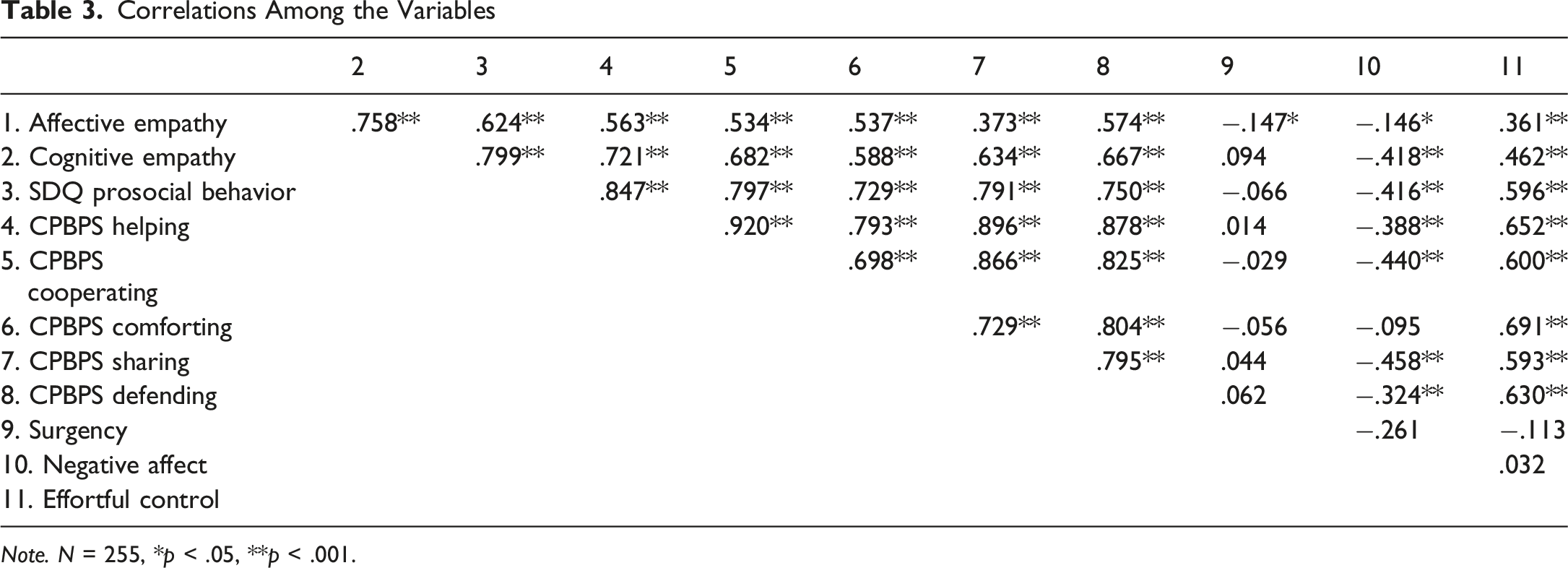
Correlations Among the Variables
Note. N = 255, *p < .05, **p < .001.
Additionally, most empathy- and prosocial behavior-related subscales were significantly and negatively correlated with the negative affect subscale of the CBQ, whereas all empathy- and prosocial behavior-related subscales were significantly and positively correlated with effortful control. The significant positive correlations between effortful control and the empathy- and prosocial behavior-related subscales are consistent with the theoretical and empirical literature. Children with higher levels of effortful control are better able to manage their emotions and behaviors, which facilitates perspective-taking (cognitive empathy), emotional responsiveness (affective empathy), and the ability to engage in thoughtful, prosocial actions, such as helping and cooperating. These children are also more capable of suppressing self-centered impulses, allowing them to act in socially appropriate and altruistic ways (Rothbart & Bates, 2006). Conversely, the significant negative correlations between negative affect and the empathy- and prosocial behavior-related subscales suggest that children who frequently experience negative emotions may be less likely to engage in prosocial behaviors and empathic responses. Elevated negative affect may interfere with the ability to focus on others’ needs or to regulate one’s emotional responses in social situations. As a result, these children may struggle with behaviors that require empathy, patience, and cooperative interaction (Rothbart & Bates, 2006). Negative emotionality can create self-focused attention, making it more difficult for children to respond sensitively to others’ distress or engage in socially constructive behaviors.
Gender Differences
Because the primary focus of the present study was scale development and validation, analyses examining gender and age differences should be interpreted as exploratory. Gender differences in the CPBPS were examined on total CPBPS scores through an independent t-test. There was a significant difference in total CPBPS scores between boys (M = 93.74, SD = 25.10) and girls (M = 103.87, SD = 22.47), t (253) = 3.395, p < .001. In order to assess gender differences across all five components in further detail, a between-subjects MANOVA with gender (boys versus girls) as the independent variable and the preliminary five CPBPS components as the dependent variables was also conducted.
Results of the MANOVA revealed a significant multivariate effect of gender on the five CPBPS components, Wilks’ Λ = .94, F (5, 249) = 3.127, p = .009, ηp2 = .059. Post-hoc univariate analyses revealed a statistically significant effect of gender on helping scores (F (1, 253) = 8.673, p = .004, partial eta squared = .033), cooperating (F (1, 253) = 9.248, p = .003, partial eta squared = .035), comforting (F (1, 253) = 14.137, p < .001, partial eta squared = .053), sharing (F (1, 253) = 7.688, p = .006, partial eta squared = .029), and defending F (1, 253) = 8.053, p = .005, partial eta squared = .031), indicating that girls received significantly higher teacher-rated scores than boys on all five CPBPS subscales. Effect sizes were small across subscales.
Age Differences
Age differences in the CPBPS were examined on total CPBPS scores through a one-way ANOVA. There was a significant difference in total CPBPS scores (F (2, 252) = 25.108, p < .001, partial eta squared = .16), between 3 years (M = 81.42, SD = 22.08), 4 years (M = 93.63, SD = 25.87), and 5-year-olds (M = 109.24, SD = 17.99). In order to assess age differences across all five components in further detail, a between-subjects MANOVA with age (3, 4, and 5-year-olds) as the independent variable and the preliminary five CPBPS components as the dependent variables was also conducted. Results of the MANOVA revealed a significant multivariate effect of age on the five CPBPS components, Wilks’ Λ = .78, F (10, 496) = 6.465, p < .001, partial eta squared = .115. Post-hoc univariate analyses revealed a statistically significant effect between age and scores on helping (F (2, 252) = 28.716, p < .001, partial eta squared = .186), cooperating (F (2, 252) = 16.837, p < .001, partial eta squared = .118), comforting (F (2, 252) = 16.813, p < .001, partial eta squared = .118), sharing (F (2, 252) = 24.697, p < .001, partial eta squared = .164), and defending F (2, 252) = 17.103, p < .001, partial eta squared = .120), indicating that when age increases the scores in all CPBPS subscales increase.
Discussion
Prosocial behaviors, such as helping, cooperating, sharing, comforting, and defending others, are fundamental in shaping the ability of children to form positive interpersonal relationships and navigate social contexts. Despite the importance of prosocial behavior, existing research lacks a comprehensive, standardized, and developmentally appropriate instrument for measuring these behaviors specifically within preschool settings. While there are various general measures of social and emotional development, as well as classroom environment and teacher-child interactions, many of these scales do not capture the full spectrum of prosocial behaviors or are not designed with young children in mind. Therefore, a gap exists in the literature for an age-appropriate tool that can assess the nuances of prosocial behavior development across different dimensions (helping, cooperating, comforting, sharing, and defending) for young children in the preschool age range (3–5 years). In the CPBPS, helping refers to instrumental assistance provided to others in completing tasks; cooperating captures coordinated engagement with peers or adults toward shared goals; comforting reflects emotionally responsive behaviors toward individuals experiencing distress; sharing involves the voluntary distribution of resources; and defending refers to behaviors in which a child intervenes on behalf of peers in situations of unfairness or aggression. Thus, the current study aimed to develop and test the Children’s Prosocial Behaviors in a Preschool Setting (CPBPS) as a tool to assess preschool-aged children’s prosocial behaviors - such as helping, cooperating, comforting, sharing, and defending - in a preschool environment as rated by their teacher. The psychometric evaluation of the CPBPS demonstrated strong internal consistency and provided preliminary evidence of validity, supporting its potential use as a teacher-report measure of prosocial behavior in early childhood education settings.
The CPBPS underwent an initial psychometric evaluation, including Principal Component Analysis (PCA) and Confirmatory Factor Analysis (CFA), which revealed a five-factor structure encompassing the subscales of helping, cooperating, comforting, sharing, and defending. These findings align with previous research emphasizing the multifaceted nature of prosocial behavior (Eisenberg & Mussen, 1989). Unlike many existing instruments that assess prosociality as a global construct, the CPBPS differentiates among several theoretically grounded forms of prosocial behavior, allowing a more nuanced assessment of how these behaviors are expressed in preschool classroom contexts. The observed factor loadings suggest that the items generally represented their intended subscales, although the high correlations among CPBPS subscales indicate that these dimensions are closely related. Furthermore, the Cronbach’s alpha values across all subscales indicate high internal consistency, reinforcing the reliability of the CPBPS as a tool for measuring prosocial behavior in preschool settings. In addition, the positive associations observed between CPBPS subscales and established measures of empathy and prosocial behavior provide further support for the convergent validity of the instrument and are consistent with previous research linking prosocial behavior with empathy and social–emotional development in early childhood. The multidimensional structure allows for a more detailed understanding of how prosocial behaviors are expressed in preschool classroom contexts.
The study found significant gender differences in the CPBPS subscales, with girls scoring higher than boys on all of the prosocial behaviors assessed. These results align with previous research that has demonstrated gender differences in prosocial behavior, particularly in early childhood (Farina & Belacchi, 2014). Girls tend to exhibit higher levels of nurturing and empathetic behaviors, which may be influenced by both biological factors (e.g., differences in neurobiological and hormonal processes associated with emotional responsiveness) and socialization practices (e.g., gendered expectations of caregiving roles for females). For instance, Simon and Nader-Grosbois (2023) found that girls scored higher on empathy assessments than boys, suggesting that girls may be more inclined toward prosocial actions such as comforting and sharing. Our results showing higher prosocial scores for girls and older preschoolers mirror earlier evidence that girls score higher than boys on prosocial teacher ratings, and that 6-year-olds are more responsible and helpful than 5-year-olds (Kalliopuska, 1991). Similarly, a study by Bouchard et al. (2020) indicated that early childhood educators perceive girls as more prosocial than boys, a perception that may be influenced by differences in pragmatic language skills and gendered socialization practices. These findings align with earlier research by Eisenberg and Lennon (1983), which suggested that girls are generally more inclined to engage in relational and emotionally supportive prosocial behaviors, while boys may engage more in instrumental helping, although these tendencies can vary across contexts.
In the current study, age differences in prosocial behavior revealed that older preschool children (5-year-olds) scored significantly higher than younger children (3- and 4-year-olds) on all CPBPS subscales. These findings are consistent with developmental theories suggesting that prosocial behaviors become more complex and frequent as children grow older. Simon and Nader-Grosbois (2023) reported that 5-year-olds exhibited higher levels of empathy compared to 3- and 4-year-olds, supporting the notion that prosocial behaviors become more complex and frequent as children mature. During the preschool years, children undergo significant cognitive and emotional growth, which enables them to better understand social rules, empathy, and the needs of others (Eisenberg et al., 2015). As children mature, they are also better able to inhibit egocentric behaviors and demonstrate more advanced forms of prosocial behavior, such as defending others and cooperating in group activities (Eisenberg et al., 1995; Swit et al., 2023). The age-related increases observed in this study are consistent with expected developmental patterns in preschool prosocial behaviors.
The CPBPS may serve as a useful teacher-report tool for assessing multiple forms of prosocial behavior in preschool settings. Recent research underscores the importance of emotional regulation in facilitating prosocial actions. For example, a study by Wilson et al., (2021) found that effortful control moderates the relationship between negative emotionality and socially appropriate behavior in preschool children, suggesting that children with higher levels of effortful control are better able to manage their emotions and engage in thoughtful, prosocial behavior. Conversely, children exhibiting higher levels of negative affect may struggle with empathy and cooperation. These findings suggest that interventions aimed at improving emotional regulation could enhance prosocial behavior in young children (Rothbart & Bates, 2006). Also, the inclusion of defending as a separate theoretically grounded subscale of the CPBPS represents an important contribution of this study. While we acknowledge that defending may not always appear prosocial from the perspective of the child whose behavior is being challenged (e.g., being told to ‘stop’), we conceptualize defending as a prosocial act within the broader group context. Defending reflects children’s efforts to uphold fairness, protect peers from harm, and maintain cooperative group norms (Wentzel, 2015). From this perspective, defending promotes the social and emotional climate of the classroom by discouraging aggression and exclusion and by supporting collective well-being. Prior research suggests that children’s interventions on behalf of peers are often motivated by empathy and fairness concerns (Malti et al., 2009). Thus, defending aligns with theoretical models of prosocial behavior that emphasize not only dyadic helping but also contributions to the functioning of the peer group (Eisenberg & Mussen, 1989). The current study therefore extends the scope of prosociality to include behaviors that protect the integrity of peer relationships and the classroom community.
In summary, recent studies corroborate earlier findings regarding gender and age differences in prosocial behavior among preschool children, highlighting the role of emotional regulation in fostering these behaviors. The CPBPS can aid educators in identifying young children who may need support in developing prosocial behaviors. By providing a multidimensional assessment of prosocial behavior that captures several distinct forms of social action in classroom contexts, the CPBPS offers researchers and educators a more detailed tool for understanding how prosocial tendencies develop during the preschool years. Implementing activities that promote cooperation, such as group tasks or collaborative play, could be particularly beneficial for children who score lower in prosocial behaviors.
Limitations
While the CPBPS demonstrated strong psychometric properties, there are several limitations that should be addressed in future research. First, the study’s sample was limited to a specific population (preschool children in the US) and assessed by US preschool teachers who reside in a southern area of the US. Future research could examine the validity of the CPBPS in other populations to determine if the scale remains applicable across a broader cultural range. Additionally, although the study demonstrated promising psychometric properties, further research with larger and more diverse samples is needed to ensure the generalizability of the findings across different contexts. Furthermore, longitudinal studies could be conducted to track the development of prosocial behavior over time and examine the long-term impact of preschool environments on children’s social and emotional growth.
Although gender and age differences were examined, formal measurement invariance testing across these groups was not conducted. Establishing configural, metric, and scalar invariance through multi-group confirmatory factor analysis would provide stronger evidence that the CPBPS functions equivalently across demographic groups. Future research with larger samples should evaluate measurement invariance to further strengthen the psychometric validation of the scale and to support more definitive group comparisons.
Implications
The findings demonstrate that the CPBPS has acceptable psychometric properties for assessing young children’s prosocial behaviors in a preschool setting. The current results support the view that the CPBPS is best represented as a teacher-report measure for assessing prosocial behavior in a sample of preschool-aged children in the United States.
Understanding the gender differences in prosocial behavior development has important implications for early childhood education. First, recognizing that boys and girls may express prosocial behaviors in different ways allows teachers to tailor their approaches to encourage prosocial behavior in both genders (e.g., play sets; Howe et al., 2022). By creating a balanced and supportive classroom climate, educators can promote the social and emotional development of all children, regardless of gender. Regarding age-related differences, educators can use this knowledge to tailor their teaching strategies to foster prosocial behavior at each developmental stage. For younger preschool children (ages 3 and 4), activities that focus on simple helping behaviors, such as assisting peers with tasks or comforting others, can be encouraged. For older preschool children (ages 4 and 5), more complex activities that require cooperation, conflict resolution, and empathy should be emphasized. Future research might also explore how prosocial tendencies translate into digital spaces as children grow older, particularly given evidence that prosociality influences digital communication preferences (Carroll, 2023).
Footnotes
Acknowledgments
We thank all study participants.

Ethical Considerations
The study was conducted in accordance with the Declaration of Helsinki, and the protocol was approved by the Ethics Committee of the University of Alabama (Approval number: 22-11-6146).
Consent to Participate
All subjects gave their informed consent for inclusion before they participated in the study.
Funding
The authors disclosed receipt of the following financial support for the research, authorship, and/or publication of this article: The study was in part possible due to funding to Dr. Nahide Gungordu from the Division of Community Affairs at the University of Alabama, from the Community Engagement Scholarship.
Declaration of Conflicting Interests
The authors declared no potential conflicts of interest with respect to the research, authorship, and/or publication of this article.
Data Availability Statement
Due to ethical concerns, supporting data cannot be made openly available.