







Abstract
In public health, it is widely accepted that the places where people live, work, learn, and play can affect their health. 1 With the continued growth of smartphones, social media, immersive video games, virtual reality, and, more recently, generative artificial intelligence (AI), digital platforms are now places where young people spend a substantial amount of their time. An estimated 95% of teens aged 13 to 17 years have access to a smartphone, about half are on social media almost constantly, and one-third use AI chatbots daily.2,3 Young people today report changes in how they connect with friends alongside increased use of digital communication in their households.4-6 In schools, new technologies are increasingly integrated into kindergarten through 12th grade (K-12) classrooms and instruction, transforming how students engage in learning and with peers.7,8
In short, screens and social media are embedded into everyday life. Young people must be prepared to leverage their advantages while using them in ways that are not detrimental to their health or the health of others. Studies linking digital media and technology use to mental and physical health outcomes reveal the potential effects of time spent in digital environments on health and well-being.9-12 As such, understanding and addressing the use of digital media and technologies from childhood through adolescence is an important public health issue. In this commentary, we outline what is known about the health effects of increased use of digital media and technology among young people and discuss actions across multiple levels to address related challenges. We discuss our plans to publish a series of future research articles to better define the effects of digital media and technology use on the health and well-being of young people and explore promising approaches to mitigate harm.
What We Know About Youth Digital Media and Technology Use and Health
Research on digital media and technology use among youth—defined here as spanning early childhood through late adolescence—has linked frequent use to a range of developmental, physical, psychological, and social effects. Developmentally, digital media use has been associated with structural and functional changes to the brain.13,14 Although effects on brain development vary by the type and timing of use,15,16 some evidence suggests adverse associations with language development, cognitive skill building, and cognitive capacity.17-20 Screen time has also been associated with aspects of physical health, such as sleep disruption and increased snacking and sedentary behaviors,11,21-23 which together may elevate the risk for obesity and other cardiometabolic conditions from childhood into adulthood.24-27 Given the high prevalence of pediatric obesity and increasing prevalence of chronic disease in the United States overall, these associations are of particular public health concern.28,29 Considerable attention has also been given to the effect of social media use on youth mental health, with evidence suggesting potential risks and benefits depending on the context of use, but generally modest effects on average.10,30-32 Evidence from nationally representative surveys of adolescents, including the Centers for Disease Control and Prevention’s (CDC’s) Youth Risk Behavior Survey (YRBS), has linked frequent social media use with poor mental health, bullying victimization, and some suicide-related behaviors.33,34
In recent years, the research focus has shifted from examining the effects of frequent digital media and technology use toward exploring the characteristics and quality of that use. This shift has revealed important caveats about potential risks and benefits of digital media and technology use, underscoring gaps in our collective understanding of its influence on health. Evidence suggests that who and what young people engage with in digital environments may matter more than overall time spent in front of a screen. 35 There are critical distinctions between frequent and problematic use 36 and passive and active use. 37 Risks and benefits may also vary by the identities and characteristics of young people,38-40 with certain groups (eg, early adolescent girls, young children) potentially more vulnerable to different types of adverse effects of digital media and technology use than others.41,42 Youth may benefit from opportunities to build community and connect with others in digital environments, 43 but overreliance on social media and emerging technologies, such as AI companions, to address feelings of loneliness or social anxiety may increase the risk for problematic use and related harms.44-46 Contextual factors, including family and peer support and household media practices, can further shape patterns of use and associated outcomes. 47
Across the evidence base, findings demonstrate substantial heterogeneity, particularly with respect to the magnitude and mechanisms of observed effects of digital media and technology use on various health outcomes.10-12 Cross-sectional studies continue to dominate the literature, limiting causal inference and leaving questions about confounding and the temporal direction of associations unresolved. Measurement approaches also vary and often rely on self-reported data, which may not adequately capture the content, context, and qualitative dimensions of use. Advancing more rigorous study designs alongside precise multidimensional measurement approaches represents an important priority for strengthening the evidence base and informing recommendations.
Multilevel Responses to Youth Digital Media and Technology Use
Against this backdrop and amid concerns about the effects of digital media and technology use on young people’s education and health, policy makers, education agencies, organizations, and industry are taking various actions to limit use or promote safer digital environments.
In the United States, at least 40 states have enacted policies that limit or restrict cell phone and other personal device use in K-12 schools, and at least 28 states have measures related to the use of AI in schools.48,49 Approaches to student device use range from restrictions during instructional time to more comprehensive “away all day” policies, requiring devices to be off and out of sight throughout the school day. 48 AI-related efforts are similarly varied, addressing responsible use, integration into curricula, and safeguards to protect academic integrity and student privacy. 49 Digital and AI literacy standards for education are also gaining popularity. 50 Despite growing policy activity, formal evaluation of these measures remains limited and the emerging evidence is mixed. Some studies report potential improvements in student behavior, engagement, or well-being following device restrictions, whereas others find minimal or inconsistent effects on student outcomes.51-55 While implementation guidance is increasingly available,55-58 further evidence is needed to identify which implementation strategies are most effective and to understand how the broader ecosystem of K-12 digital media and technology policies shapes student outcomes and school environments. Strengthening capacity for rigorous evaluation of policy implementation and impacts may help address these evidence gaps.
Leading health and educational organizations are advancing parallel efforts to build digital literacy and empower parents and caregivers to make informed decisions about their children’s digital media and technology use. These initiatives include clinical guidance, public education campaigns, and family-facing resources that offer practical tips and tools to promote healthy digital habits at home.59-62 Such efforts from trusted sources may help families navigate a complex and evolving information environment and stay informed about advances in evidence, emerging technologies, and current risks, such as AI-generated or manipulated content and newer forms of online exploitation. At the same time, the reach, uptake, and timeliness of these resources likely vary, highlighting an opportunity to partner with families to identify the most accessible and useful approaches and to support their application in practice.
At the individual level, young people are reflecting on their own digital media and technology use. Teens today are more likely to report that they spend too much time on social media as compared with just 2 years ago, and almost half report efforts to cut back on social media and phone use. 63 However, youth are also up against algorithmically driven technologies designed to capture users’ attention and maximize screen time through personalized interactive content and push notifications, with little regard for ethical, privacy, or health concerns.12,64 Although some technology companies have introduced initiatives to improve the safety of children and adolescents online, often in response to state and federal requirements,65-67 more can be done to limit features and content associated with problematic digital media and technology use during formative years.12,64,68
Federal Public Health Efforts on Youth Digital Media and Technology Use
Surveillance
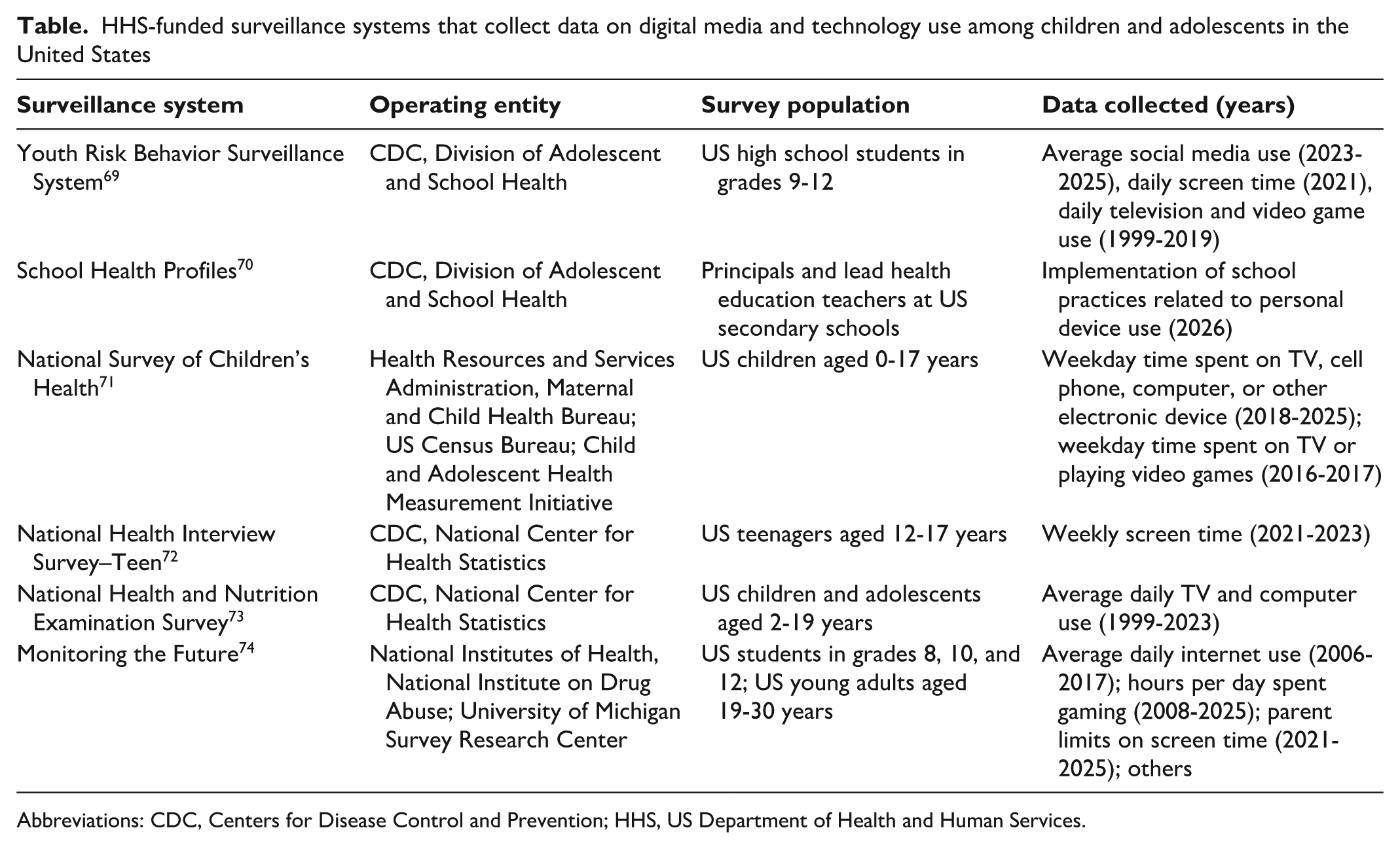
The US Department of Health and Human Services (HHS) invests in multiple public health surveillance systems that can identify national patterns and trends in digital media and technology use, as well as population-level associations with education- and health-related outcomes and protective factors (Table).69-74 For example, numerous articles on screen time and social media use among young people have been published using YRBS data, exploring their associations with health topics such as victimization, sleep, physical activity, and depressive symptoms.33,75,76 CDC’s National Health and Nutrition Examination Survey and National Health Interview Survey–Teen have also been used to explore associations among screen time, physical health, and mental health.77,78
HHS-funded surveillance systems that collect data on digital media and technology use among children and adolescents in the United States
Abbreviations: CDC, Centers for Disease Control and Prevention; HHS, US Department of Health and Human Services.
Research
HHS supports rigorous research to address gaps in the evidence base. In response to the Children and Media Research Advancement Act of 2021-2022, 79 the National Institute of Mental Health and National Institute of Child Health and Human Development formed a collaboration to support research on the short- and long-term effects of digital media and technology use on infants, children, and adolescents. To date, this initiative has supported >60 research grants that have advanced the field’s understanding of the effects of digital media and technology use on cognitive, physical, and socioemotional development,80-84 as well as bidirectional influences between smartphone and social media behaviors and adolescent mental health.85-87
The Adolescent Brain Cognitive Development Study is another example of federal investment in large-scale longitudinal research on child and adolescent development, including the role of digital media and technology use. 88 Led by the National Institutes of Health in collaboration with CDC, the National Science Foundation, the National Institute of Justice, and the National Endowment for the Arts, the Adolescent Brain Cognitive Development Study involves >20 research sites nationwide and is the largest long-term study of brain development and child health in the United States. It tracks the biological and behavioral development of children through adolescence and into adulthood and considers the influence of factors such as initiation and use of digital screen media over time. Through research from this study, we have already learned more about patterns of digital media and technology use in late childhood and early adolescence89,90 and their longitudinal associations with multiple indicators of health, such as depression, anxiety, disordered eating, behavioral disorders, sleep problems, and cardiometabolic risk. 90
Across HHS agencies, several mechanisms allow for rapid research and sharing of emerging issues experienced by young people, families, and schools. These issues are often identified through critical partnerships and surveillance systems. For example, CDC works with state and local education agencies to collect and disseminate YRBS 69 and School Health Profiles 70 data each year. Through this work, education agencies share pressing questions and issues related to adolescent and school health, which inform surveillance and research priorities. New School Health Profiles questions about school practices related to students’ personal device use and an upcoming Teen Pulse Survey that will explore multiple dimensions of adolescent digital media and technology use are examples of how such mechanisms have advanced federal activities related to this public health issue.
Communication
HHS plays a critical role in amplifying key messages to empower youth, families, and schools in making decisions about screen time, social media, AI, and other digital media and technology use. For example, the Center of Excellence on Social Media and Youth Mental Health, 59 funded by the Substance Abuse and Mental Health Services Administration, has developed and disseminated information, guidance, and training on the effects of children’s and adolescents’ social media use (risks and benefits). The center shares specific and digestible recommendations for clinicians, parents, caregivers, and young people, along with practical resources such as conversation starters, family media plans, and online learning communities. 59
Interagency collaborations on comprehensive reports engage a variety of experts, leaders, and partners in synthesizing current evidence and best practices, setting research agendas, and developing tools to address priority health issues such as youth digital media and technology use. The Kids Online Health and Safety Task Force, comprising representatives from several federal agencies, recently developed a report on online health and safety for children and adolescents. 91 This report not only outlines best practices and resources for families but also presents a set of recommended practices for industry to implement to improve the protection of young people online. US Surgeon General advisories on social media and youth mental health (2023) and the harms of screen use (2026) played an important role in raising public awareness and fostering dialogue about this public health issue,64,92 while the National Academies of Sciences, Engineering, and Medicine’s 2023 consensus report on social media and adolescent health provided a comprehensive review of the evidence with aligned recommendations for research and practice across multiple sectors. 12
Next Steps
Although robust, the current evidence on youth digital media and technology use has limitations. Continued research is needed to better understand the conditions that support safe and balanced use of digital media and technologies among young people across developmental ages, stages, and backgrounds.12,64,92 Specifically, future research should assess how digital media and technology use affect multiple domains of youth well-being and how these effects vary by platform, content, context, and patterns of engagement. Longitudinal and experimental studies are needed to characterize causal pathways and distinguish short- and long-term effects. Research should also use multidimensional measures to examine variation across young populations, exploring the potential benefits and protective factors as opposed to just risk. As the implementation of policies and practices outpaces the evidence, opportunities exist to partner with education agencies, clinicians, and industry to generate real-world evidence and iteratively refine strategies to support safe and healthy use of digital media and technologies and inform public health action.
In the coming months, Public Health Reports will share a collection of articles highlighting findings from some of the federal government’s recent work on youth digital media and technology use. In partnership with Public Health Reports, we also invite submissions from researchers and practitioners who explore the multifaceted effects of digital media and technology use on the health and well-being of young people in the United States. Of particular interest are submissions that examine protective factors and best practices that mitigate harms and promote safe and healthy use of digital media and technology among young people across school, family, and community settings, including features of digital environments that support healthier use. Original research articles, public health evaluations, case studies, and brief reports will be considered for inclusion in this special collection.
Footnotes

Ethical Considerations
This work is a commentary and does not report on empirical research involving human subjects or identifiable data; as such, ethics approval was not applicable.
Funding
The authors received no financial support for the research, authorship, and/or publication of this article.
Declaration of Conflicting Interests
The authors declared no potential conflicts of interest with respect to the research, authorship, and/or publication of this article.
Disclaimer
The conclusions in this article are those of the authors and do not necessarily represent the official position of the Centers for Disease Control and Prevention or the US Department of Health and Human Services.