







Abstract
The knowledge and beliefs that teachers hold are an important determiner of what happens in the classroom. Ideally teacher cognition should be informed by research and theory about effective language learning. This paper examines the beliefs related to vocabulary teaching held by a cohort of 60 Malaysian pre-service teachers engaged in a multi-year trans-national teacher education programme. It also examines how these beliefs are reflected in descriptions of imagined teaching. This examination suggests that pre-service teachers hold beliefs that coincide with those of their trainers to some extent, but that they do not give effective expression to their beliefs in descriptions of teaching. It may therefore be more appropriate to focus on developing knowledge of language teaching practices in pre-service teacher education than on beliefs.
Introduction
In recent years there has been burgeoning interest in teacher cognition, a concept which Borg (2003: 81) has described as ‘the unobservable cognitive dimension of teaching – what teachers know, believe, and think’. This interest can be traced back to changes in thinking about the role of the teacher; from being viewed in passive terms, as transmitters of other people’s ideas working with ‘teacher proof materials’(Connelly and Clandinin, 1988), teachers are now seen as active participants in language learning and teaching (Freeman, 2002).
One model of teacher cognition is shown in Figure 1. This seeks to capture the dynamic interplay of factors that shape teacher cognition, which in turn determine, in conjunction with contextual factors, what actually happens in terms of classroom practices. The category BAK represents beliefs, assumptions and knowledge, and is a useful notion proposed by Woods (1996) that recognizes the difficulty in distinguishing ‘between constructs such as belief and knowledge’ (Borg, 2003: 96). Findings from a study of teacher attitudes to extensive reading illustrate this category; teachers held positive beliefs about reading in general, and the potential of reading in the language learning classroom, which may have been created by prior experiences of reading in their first language (Macalister, 2010).
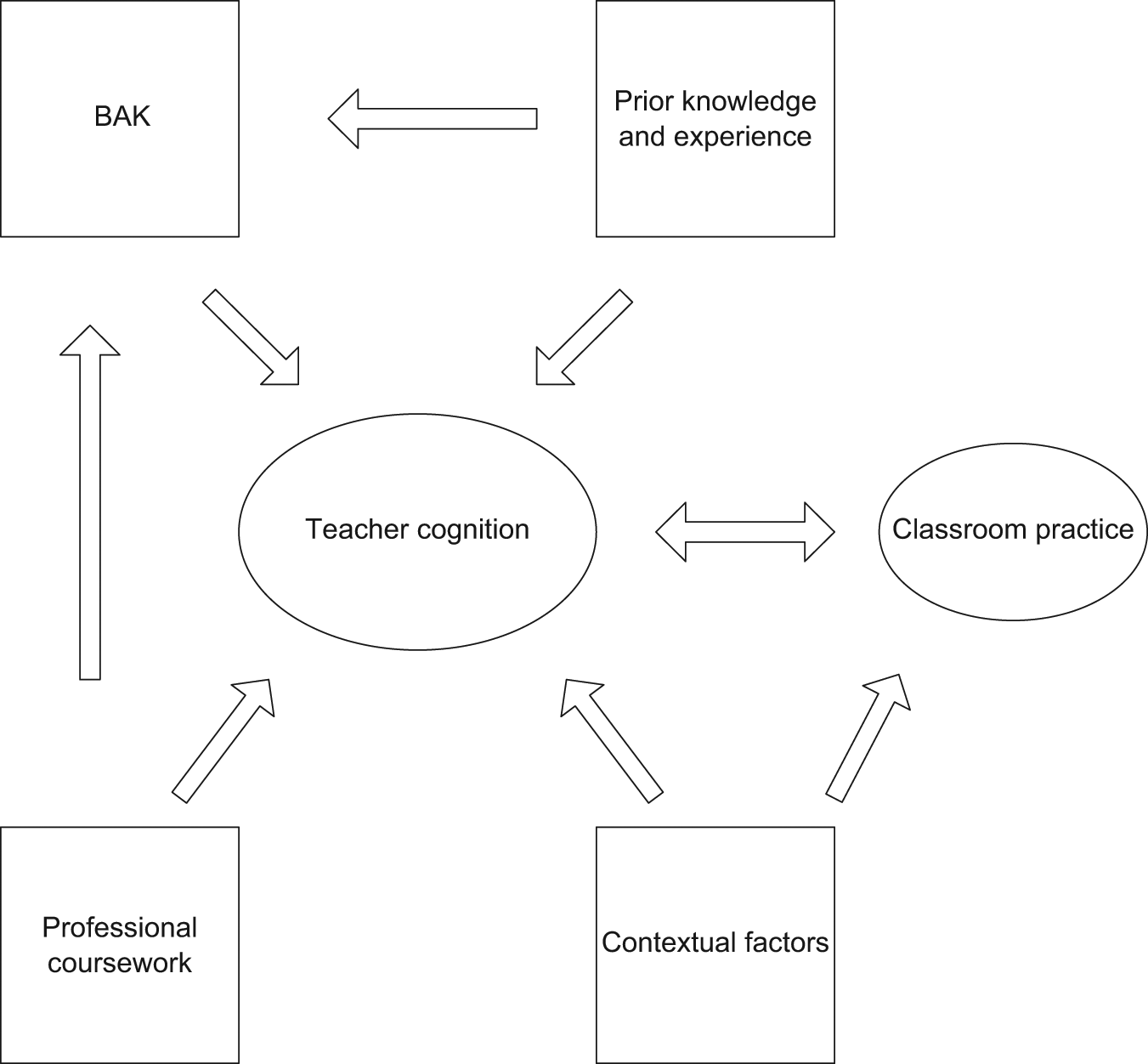
The Dynamic Nature of Teacher Cognition (Macalister, 2010)
The development of pre-service teacher cognition has received relatively limited attention to date, given that understanding pre-service teachers’ beliefs about language learning is important. Erroneous beliefs may lead to classroom practices that do not reflect research and theory about effective language learning practices (Peacock, 2001: 178). As Figure 1 suggests, and El-Okda (2005) has demonstrated with reference to reading, pre-service teachers bring beliefs to their teacher education programmes. After all, as learners themselves, they have already gone through an ‘apprenticeship of observation’ (Garton and Richards, 2008; Lortie, 1975).
Studies that have looked at changes in pre-service teacher beliefs have not been encouraging for teacher education programmes. In Hong Kong, Peacock used the Beliefs About Language Learning Inventory (Horwitz, 1985) to track the beliefs of 146 pre-service teachers over a three-year programme and found that ‘disturbingly, these beliefs changed very little over their 3 years of study of TESL methodology’ (Peacock, 2001: 186). Their beliefs were compared with those of experienced ESL teachers, gathered in a previous study; the beliefs of the teacher trainers were not, however, looked at and so the potential of the training to shift beliefs is unknown. The trainers and the trainees may have held similar beliefs.
Also using Horwitz’s BALLI instrument, Wong (2010) investigated changes in beliefs about language learning over a 14 month period among a group of 25 Malaysian pre-service teachers and similarly found that their beliefs were largely unchanged. Where change did occur it was principally in relation to beliefs about the nature of language learning. One question that was not addressed in this study was, once again, why one would expect beliefs to change.
The most obvious reason why change in beliefs is a reasonable expectation is that trainees and trainers may hold different beliefs. A complicating factor for pre-service teachers enrolled in trans-national teacher education programmes may be that they must navigate their way between groups of teacher educators who hold or espouse different sets of beliefs about what makes good language teaching. Macalister (2011) compared the approaches of two groups of teacher educators, one in Malaysia, the other in New Zealand, and concluded that differences first proposed by Holliday (1994) between language teaching as practised and promoted in Britain, Australasia and North America and, on the other hand, in tertiary, secondary and primary sectors throughout the world (the BANA/TESEP distinction) were largely still evident. The New Zealand-based trainers tended to be more learner-responsive and learner-centred than their Malaysian counterparts, and less curricularly constrained. One clear departure from the earlier distinction, however, was an absence of grammar-translation among the TESEP group; both groups had a communicative orientation. In terms of their approaches to vocabulary teaching, there were areas of both similarity and difference. These can be summarized as:
Within both groups, attention to vocabulary was given at different stages of the reading cycle, employing a range of different approaches focussing on both strategies (e.g. guessing from context) and learning new words.
For both groups, the way in which the text was read, and the goal/s in using the text contributed to the way in which vocabulary was treated.
The use of peers was more obviously used by New Zealand trainers, who also gave more emphasis on selecting useful words to give attention to.
Building on that previous study, this paper seeks to extend the focus of investigation to include the pre-service teachers, and seeks to address the following questions:
What are the differences in beliefs about the role of vocabulary in language learning between pre-service teachers and their teacher educators?
To what extent are pre-service teachers’ beliefs about the role of vocabulary in language learning evident in their descriptions of teaching?
How can teacher education programmes respond to pre-service teachers’ existing beliefs and knowledge about the role of vocabulary in language learning?
Methodology
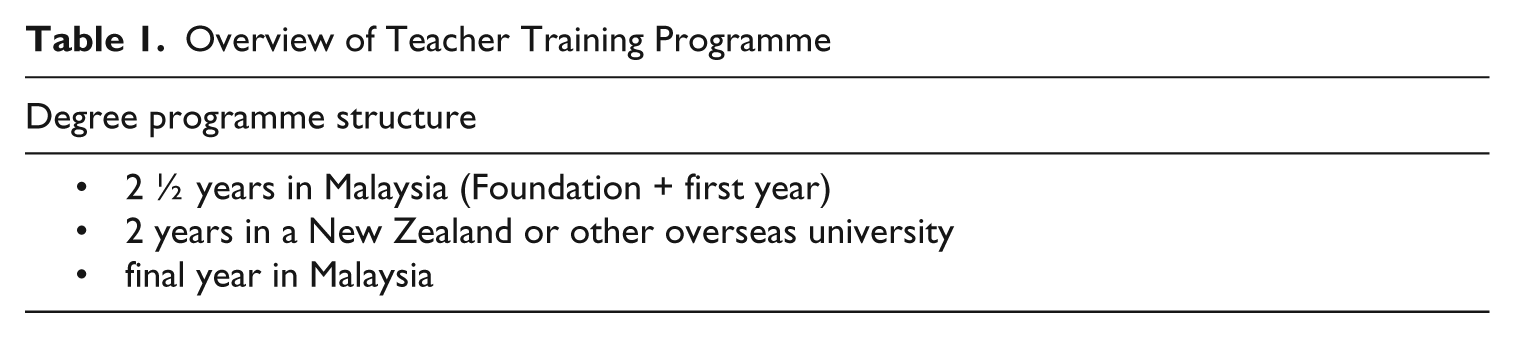
This study involves three groups of participants, the largest of which is a cohort of 60 Malaysian pre-service teachers whose teacher education programme consists of roughly equal time spent in Malaysia and New Zealand (see Table 1). The other two groups are the teacher educators, 16 in Malaysia and six in New Zealand. All pre-service teacher and New Zealand-based trainer participants completed a survey, as did 11 of the Malaysian trainers. Twelve of the pre-service teachers, as well as all the teacher educators, volunteered for an interview.
Overview of Teacher Training Programme
The 27 item questionnaire was constructed from three existing surveys – the Beliefs About Language Learning Inventory, or BALLI (Horwitz, 1985), the Teachers’ Beliefs About Literacy Questionnaire, or TBALQ (Westwood, Knight, and Redden, 1997), and the statements posed by Lightbown and Spada in their How Languages are Learned (2006: xvi-xvii). The 27 items were mainly chosen for their relevance to classroom practice, teaching reading and writing in particular, and to the pre-service teacher participants’ primary teaching orientation. Where necessary, slight re-wording of items occurred. The full set of questions can be seen in Appendix A.
All the survey and interview data were generated before the pre-service teachers began their study in New Zealand. Interviews and surveys with the Malaysian trainers were conducted in Malaysia during the first year of the pre-service teachers’ course, and with the trainees shortly after their arrival in New Zealand but before any teaching had begun.
The interviews were conducted in English, which may have had an impact on the data generated for, as Mann (2011) has pointed out, ‘[t]he language in which the interview is conducted is integrally related to the nature of the co-construction’ of the interview. Possible impacts are mentioned in the next section. During their interviews, participants were given two texts and, after having taken as much time as they wished to read each text, asked to talk about how they would use it in an upper primary class. One text was imaginative prose, the other informative. In this paper, and to ensure comparability with the teacher educators (Macalister, 2011), use of the informative prose text is discussed. This text can be seen in Appendix B.
Findings
The first research question is addressed through survey data. There were nine items where there was a difference of 0.8 or more between the two trainer groups. The areas of divergence were not restricted to one aspect of teaching practice but included vocabulary (three items), grammar (two), error correction (two), pronunciation (one) and course design (one). In general, the two Malaysian groups tended to cluster together; there were only two items where the students were closer to the New Zealand than the Malaysian trainers, and both of these related to beliefs about vocabulary learning. Table 2 shows the three items concerned with vocabulary where there was a difference of 0.8 or more. The items are arranged by the size of the difference between the trainer groups, as this may point to areas where the pre-service teachers need to navigate between conflicting messages. In Table 2, the higher the number, the higher the level of agreement with the statement; the responses have a range from 1 (strongly disagree) to 5 (strongly agree). Thus, in item 19, the best way to learn new vocabulary is through reading, the New Zealand trainers tended to disagree and the Malaysian trainers to strongly agree, a position shared by the Malaysian students. Incidentally, this was the item with the highest level of distance between the two trainer groups in the whole survey.
Responses to Vocabulary Related Survey Items with a Difference ≥ 0.8 between Teacher Educators
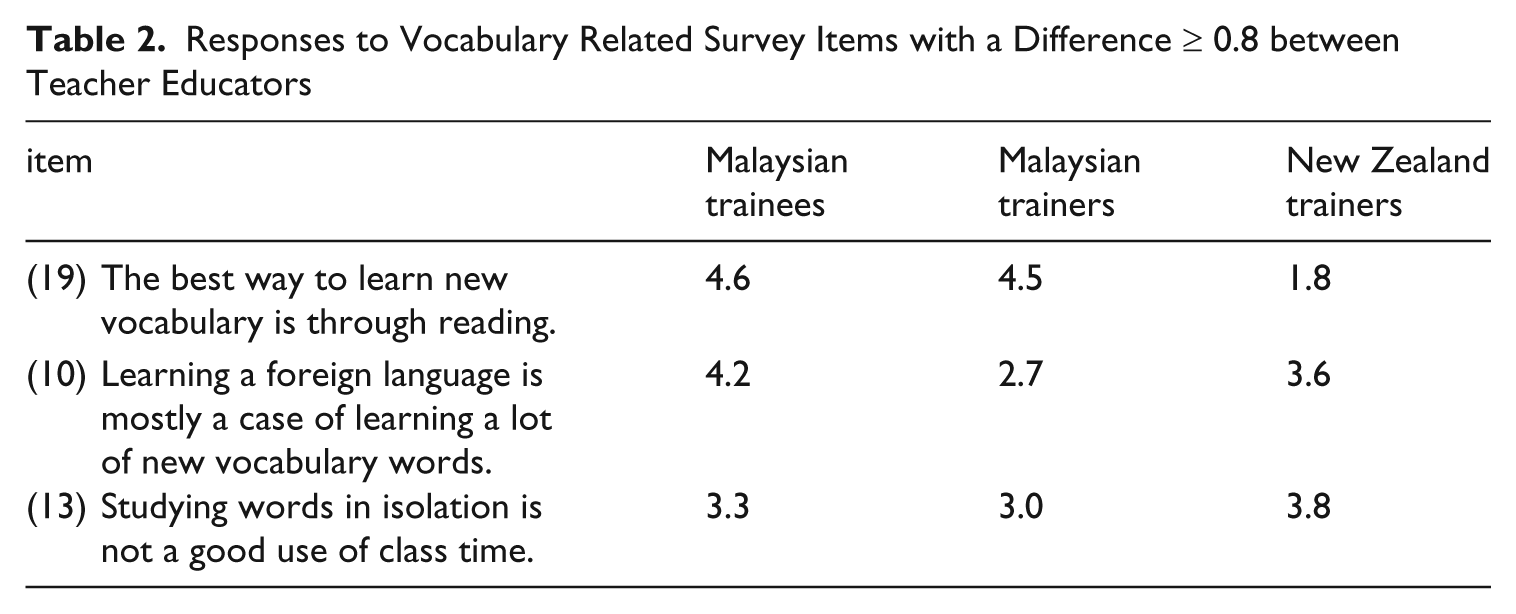
In terms of the role of vocabulary in language learning, the most obvious difference is in views on the role of reading in learning new words, with both groups of Malaysian participants indicating strong belief in the power of reading. The trainees tended to agree with the statement that learning a language is mostly a case of learning new words; in this they were closer to the New Zealand-based trainers than the Malaysian. They tended not to regard studying words in isolation as a good use of class time, and in this were closer to the Malaysian than the New Zealand-based trainers.
For the second research question, the sections of the student interviews where they were discussing how they would use the same informative text as the trainers discussed in Macalister (2011) were analysed; their approaches to the initial part of the lesson are displayed in Figure 2. However, some general comments, possibly reflecting the use of English in the interviews, need to be made before looking at the details. One or more of the following comments applies to eight of the 12 participants.
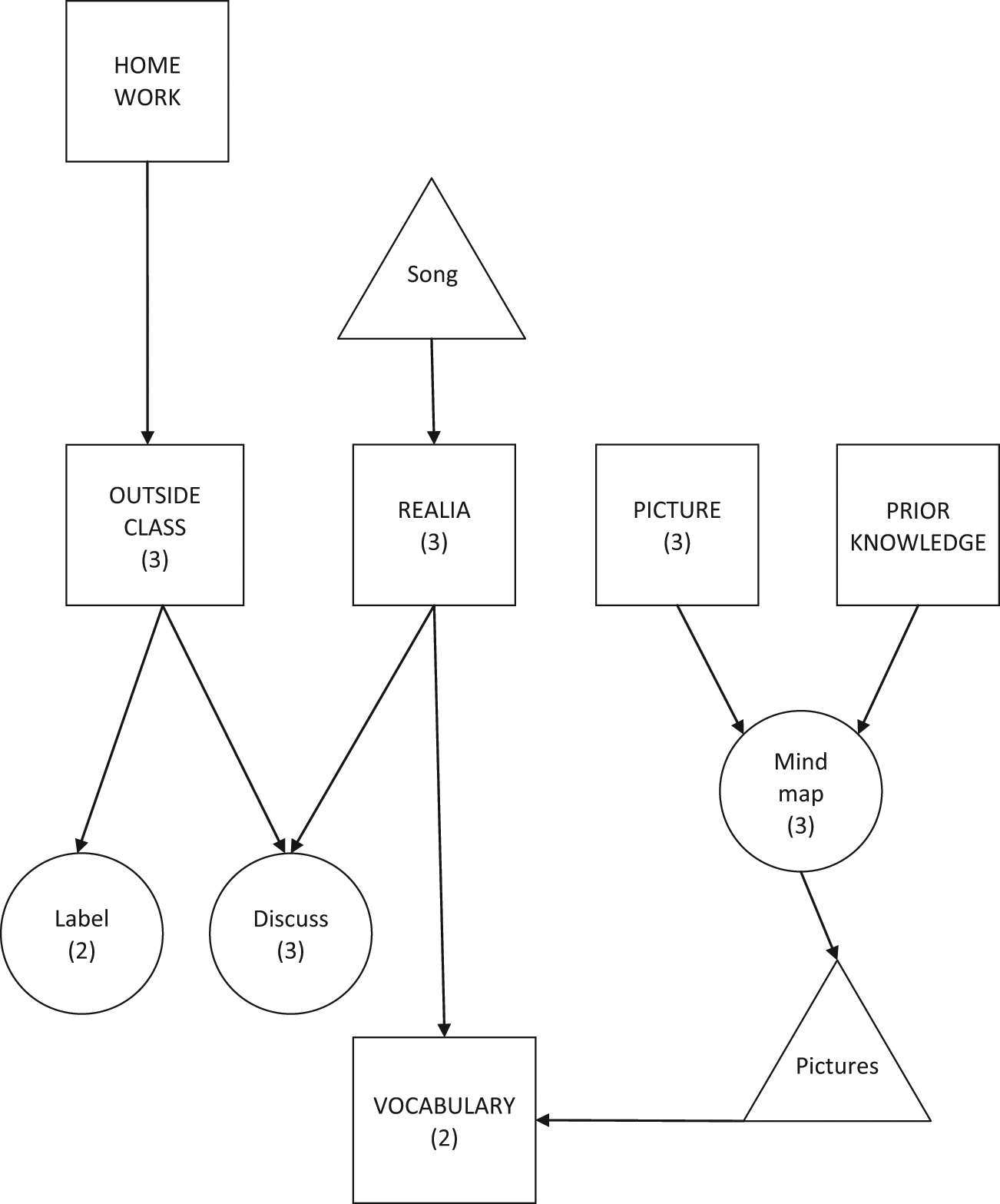
Orientation to the Text
For four of the 12, it was sometimes (very) unclear what the intended meaning was.
For two of the 12, it was clear that issues of classroom management were unaddressed.
Three of the participants forgot to include the text in their imagined lesson, and for a further two the text was clearly peripheral. Thus, in some of the lessons there was no actual reading of the text, and in others we find either no attention to pre-reading or no attention to post-reading.
That said, however, we find in Figure 2 one strong similarity between the reactions of the pre-service teachers and those of the two groups of trainers – the use of experience tasks to orient the learners to the text. Experience tasks ‘try to narrow the gap [between the learners’ present knowledge and the text] as much as possible by using or developing learners’ previous experience’ (Nation, 2009: 95) which can be done in different ways – simplifying or otherwise controlling the text; recalling previous experience; and pre-teaching or experiencing. This can be seen in Figure 2, where a range of different immediate and prior experiences are drawn on to orient the learners to the text – even though, in a few instances, the text did not obviously feature in the imagined lesson. The numbers following a suggested activity indicate the number of participants who mentioned this activity; for example, three proposed taking the learners outside the class but only one suggested they begin with a song.
There seems to have been some appreciation of the rationale for using an experience task. At least one of the pre-service teachers, for example, provided clear understanding of the reason for beginning with an experience task.
Extract 1: Experience Task
SA: But if the teacher bring some material, like coconut palm, the coconut oil also.
JM: Yeah, yeah, yeah.
SA: Maybe the students can, oh, it’s very familiar and they can talk about it.
JM: OK, good, good.
SA: So, I think this is more interactive activity between the teacher and student. We need the student to talk about their experience of this thing.
JM: OK.
SA: Maybe they can describe, and share their knowledge and experience.
JM: OK.
SA: About this.
A difference between the pre-service teachers and the two groups of teacher educators was the attention given to vocabulary during this stage of the lesson. Although not prominent in either teacher educator group, it was even less so among the pre-service teachers. It was only mentioned by two, and both were teacher-centred suggestions. In one, the teacher was translating unfamiliar words into Bahasa Malay; in the other, the teacher was explaining unknown words the learners identified.
Following the orientation to the text, the pre-service teachers focused on reading the text. Oral reading of one sort or another was frequently mentioned. This could take various forms:
Choral reading, all students together
One student reading at a time
The teacher reading aloud, with students either listening or repeating after
Silent reading of the text was only mentioned twice, and one of those mentions was as a possibility for ‘good’ learners; otherwise the reading would be oral.
Following the reading of the text, a range of unique activities were mentioned, but only one of these was explicitly about vocabulary, as shown in Extract 2.
Extract 2: Vocabulary Learning after Reading
SB: Oh, OK. It depends on the still the lesson of the objective. You want them to learn about new vocabulary maybe you can have a game you know, um, just put a picture and then you have a few alphabets. Ask them to fill in the alphabets the rest of the alphabets maybe.
JM: OK.
SB: And then you just, OK, this is the trunk. ‘T’. Just put a ‘t’ there and ask them to fill in something like that.
Discussion
The survey data does show that there are some differences in beliefs about the role of vocabulary in language learning, but that the differences do not always follow a simple Malaysia-New Zealand divide. There is difference in belief between the trainees and both trainer groups. This would seem to raise interesting questions about the extent of any potential for change in this group of pre-service teachers’ cognition about language learning, which provides scope for future investigation.
When considering how the trainees give voice to their beliefs in describing an imagined lesson, it is encouraging to find that the pre-service teachers shared with the two trainer groups an appreciation of the role of experience tasks as a means of orienting learners to the text. Of particular interest here, however, is the approach to teaching and learning vocabulary. While, on the one hand, it is reasonable to expect that this will be an area of learning for the trainees it is also a matter of some concern given the belief that learning a foreign language is mostly a case of learning a lot of new vocabulary words and that vocabulary learning had been mentioned as a goal by almost half the interviewed pre-service teachers.
Goals for a lesson can be considered in four broad categories – Language, Ideas, Skills, Text (Nation and Macalister, 2010) – which form a useful mnemonic, LIST. When asked about the objective of their imagined lesson, the trainees’ most common response was to do with content learning – an Ideas goal – followed by some sort of Language goal, either vocabulary or grammar. Most trainees mentioned more than one goal, as can be seen in the following example; this example is chosen to also illustrate the occasional lack of clarity of meaning. While it is clear there is a Language goal as well as an Ideas goal here, it is uncertain whether this is related to vocabulary or grammar, or both.
Extract 3: Goal Discussion
JM: OK, good, good. And again the same question, so someone’s watching the lesson they say that was great, I enjoyed that, thank you [name], um, what was the goal, what was the learning objective?
SC: Learning objective, first one is to learn the grammar.
JM: Yeah.
SC: They are high level words. And then they, sorry, and general knowledge, what is coconut palm, what can we do with coconuts and the grammar.
JM: OK.
The important question, however, would seem to be this: if vocabulary is seen as foundational to language learning, and vocabulary learning is a stated goal of almost half the trainees using the informative text, how is it being achieved? On the evidence of the interview discussion of the informative prose text, there was little deliberate attention given to vocabulary, and none to strategies that might promote vocabulary learning.
To be fair to the trainees however, there would presumably have been attention to unknown words during the oral reading of the text, and possibly during the orientation to the text. The oral reading practice would seem mainly, however, to be reflective of beliefs relating to error correction and pronunciation (survey items 8, 20, 24, see Appendix A) rather than vocabulary learning, as expressed in the following extract.
Extract 4: Oral Reading
JM: OK, OK, OK, OK, good. And, so, so what’s the, what’s the purpose of the reading aloud?
SC: The reading aloud?
JM: Yeah.
SC: Umm, so that the teacher can correct, correct them when they mis-pronounce words.
JM: OK, OK, OK, good. And is that how, is that how you were reading in the class, as a student?
SC: Um, yeah, I’ve been doing that in Malaysia.
JM: All your life?
SC: Yeah.
This extract also gives some idea of where the pre-service teachers’ cognition about language teaching comes from – prior experience. Interestingly, however, the other factors identified in Figure 1 are also evident in the trainees’ responses. Contextual factors are clearly influencing the choice of experience tasks, and there is some evidence that professional training had an influence.
Extract 5: Professional Coursework
JM: OK, OK, OK,, so if these ideas don’t come from your own experience as a language learner where do your ideas come from?
SB: When I was, when I learning English because that’s my subject in [place], English language teaching methodology so …
JM: At [college]?
SB: In [college]. So from that subject we are actually developing our ways of thinking, ways of teaching how to be creative, how to be critical, something like that.
Sometimes, however, the source of the ideas was unclear. As with the trainee who said, ‘Some are something that my imagine told me I wish we have in school’ the following extract would appear to be an example of the BAK factor informing teacher cognition.
Extract 6: BAK Factor
SD: Um, this labelling thing I think I’ve learnt when I was in, when I was in teaching training, yeah where we have to yeah, but um, to be true I think last time we don’t really have like much of, much of, we have a lot of worksheets yeah, we have but not so often.
For teacher educators, the positive inference would seem to be that professional coursework can play a role in developing cognition, even if other studies (Peacock, 2001; Wong 2010) have been less encouraging. However, attention to beliefs in teacher education courses is often promoted. For instance, El-Okda (2005: 52) recommended these ‘as a starting point in any methodology course’ while Peacock (2001: 189) argued that ‘work on beliefs should be an integral part of TESL core courses’.
It may be, however, that attention to beliefs on pre-service teacher education courses is less important than providing trainees with practical tools for entering the classroom. The findings in this study suggest that although trainees clearly hold a range of beliefs about language learning, including the role of vocabulary, these tend not to be evident in their descriptions of teaching. There was, for instance, no obvious understanding of how to direct attention to useful or important words (Nation, 2004) nor how to facilitate the learning of new words. While there is a degree of subjectivity involved in reacting to the descriptions of teaching, some suggestions at least seemed unrealistic, and conceptions of classroom management inadequate for effective teaching. Extract 7, for instance, suggests an unusual notion of group work.
Extract 7: Classroom Management
JM: OK, OK, and so the whole class is this is a whole class activity?
SE: Is better in a big group, I think so.
JM: OK, OK, how many in a group?
SE: 20.
JM: 20.
SE: 20 because I think this is a big task. Because they have lots of parts, lots of use.
JM: OK, OK.
SE: So each can have one.
Understanding how to organize an activity such as group work is probably more important than understanding why it is better to do an activity one way than another; the latter is not a prerequisite to effective learning, but the former is. Borg (2011) has recently argued for attention to beliefs in-service teacher training, and it may well be that this is the more appropriate time for such attention. After all, teachers may be better prepared to reflect on the reasons why they teach in a certain way once they have established a degree of confidence in their ability to be a teacher.
Conclusion
It would be unrealistic and unreasonable to expect pre-service teachers to share identical beliefs with their trainers, especially when those trainers belong to a different tradition of language teaching, as is the case with the New Zealand-based trainers in this study. It would be equally unlikely that the trainees would be able to give as effective expression to their beliefs as their trainers when imagining a lesson they might teach. Thus, it is no surprise that the trainees in this study differ in some respect from their trainers, especially those in New Zealand.
To some, the lack of ability to give effective expression to the beliefs they hold may also be unsurprising. It is, however, a cause of some concern and perhaps, therefore, it is knowledge about language teaching practices that should be the primary focus of pre-service education courses rather than beliefs about language learning.