







Abstract
An increasing number of researchers rely on genre to analyse academic and professional communication and to see how members of a discourse community use language. Since Swales’ (1990) seminal genre analysis of research article introductions, many researchers have carried out genre analysis of various types of professional and academic documents including job application letters. Subscribing to the view that genre is dynamic and socially constructed (Berkenkotter and Huckin, 1995), the present study explores if genre conventions in job letters written in Pakistan have undergone any change since Bhatia’s (1989) genre analysis of job letters in South Asian context. It was found that the job applicants no longer use the self-degradation moves as noted by Bhatia (1989). However, they still resort to glorifying the employer as a move and use old-fashioned courtly expressions to appeal to the sentiments of compassion of the employer. Although making good use of the typical formulaic expressions of the genre, most of the candidates fail to use language creatively and elaborately to present themselves as individuals with unique abilities and achievements.
Keywords
Introduction
Letter of application serves as a first step in the job seekers’ career development. According to Bhatia (1993), job application is one specific realization of a large category of promotional genre such as sales letters, advertisements, company brochures and leaflets. Job applications are inherently persuasive documents. The communicative purpose of a letter of application is to secure an interview for a job. It allows the writer an ‘open-ended creative opportunity for favourable self-presentation’ (James et al, 1994: 325). The job applicants, particularly fresh university graduates, often struggle to produce effective letters. The challenge is even greater for applicants in the contexts, such as Pakistan, where English is the second language. Apart from a weak grip over the use of language, applicants’ unfamiliarity with the generic conventions and expectations of the audience or discourse community are major factors that may render these letters ineffective.
Using both the textual and the social constructionist view of genre, this study analyses job application letters written to two organizations in Pakistan between 2005 and 2007. It explores the patterns of rhetorical moves along with their linguistic realizations, to see how the applicants in this particular setting execute the rhetorical moves of this genre and to see if any change in strategies of the moves has occurred since Bhatia (1989) undertook genre analysis of a corpus of 200 job letters from South Asian countries.
A survey of genre studies reveals two approaches: studies that focus on the textual analysis and studies that emphasize social context or discourse community. According to the traditional text-based approach to genre, the texts belonging to a genre are seen as sharing some communicative purpose, textual features and content. Recently, the genre analysts have shown a great deal of interest in genre from the social perspective (e.g. see Luzon, 2005). Genres are viewed as situated and dynamic, changing over time to respond to their users’ communicative needs. Our knowledge of genre is derived from and embedded in our participation in the activities of daily and professional life (Berkenkotter and Huckin, 1995). In the social perspective, the communicative aspect of genre is emphasized. A genre is viewed as a group of communicative events in which similar forms or content of a language is used as a significant representation of shared communicative purposes realized by members of the same discourse community (Swales, 1990: 47). The aim of genre analysis, as Bhatia (1993) notes, is not just to identify moves and strategies/steps of genre, the conventionalized order of the moves, and the linguistic features associated with the moves but also to explain how these features achieve their communicative purpose.
Taking the traditional text-based approach a step further from the level of words and sentence to the larger units of discourse, Swales (1981) proposes the term ‘move’. A move is a text segment that consists of a package of various linguistic features such as lexicon, syntax and illocutionary propositions which are responsible for providing the given segment a uniform orientation and signal the context of a discourse. Bhatia (2001: 84) defines a move as ‘rhetorical instruments that realize a subset of specific communicative purposes associated with a genre’. Similarly Upton and Connor (2001: 317) view moves as ‘semantic/functional units of texts, which can be identified through their communicative purposes and through the linguistic boundaries typical of the moves’. Swangboonsatic (2006) attempts to make the distinction between moves and steps clear by categorizing the communicative intentions and discourse structure at two hierarchical levels: the macro and the micro.
Intentions and discourse units that contribute to the overall communicative purpose and organizational structure of a text are categorized as the
Swales (1990) argues that the analysis of rhetorical moves and steps forms the basis of defining a genre. Following this approach, several studies have been conducted, analysing the job application letter genre (see Table 1).
Studies of Job Application Genre
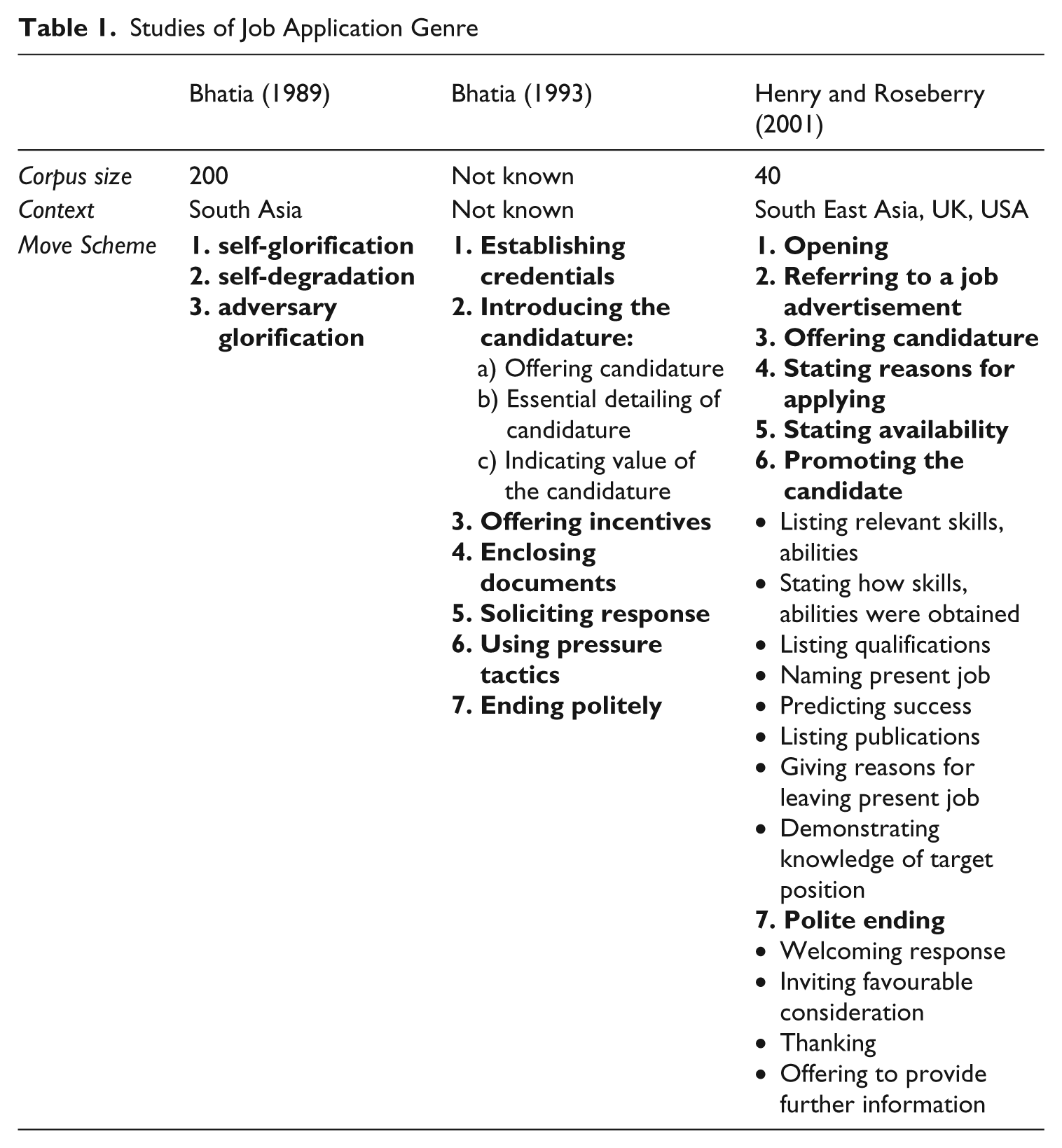
In his analysis of 200 job application letters from South Asia, Bhatia (1989) identifies three types of moves: self-glorification, self-degradation, and adversary glorification. Bhatia (1993) further refines his schematic structure of the job application. As Table 1 shows, the rhetorical moves of Bhatia (1993) are strikingly different from those of Bhatia (1989). A revisit of Bhatia (1993) however reveals that he neither mentions the cultural background of the letter writer, nor the size of the corpus. Hence it would be logical to confine the present study’s comparison to Bhatia (1989). Despite this gap, Bhatia’s (1993) schematic structure has stimulated many researchers’ interest in this genre. Henry and Roseberry (2001) work in this regard is significant because they take an in-depth and ‘narrow-angled’ view of the genre of job letters by taking their analysis from move to the level of strategy or step. Their study involves a detailed linguistic analysis together with the use of computer programs for frequencies. They come up with a more elaborate scheme of moves and steps. However, they ignore the cross-cultural aspect in their analysis, even though they obtain their corpus from South East Asian, British and American contexts.
The South Asian region has undergone significant changes in the social, political, economic and strategic spheres. The spread of globalization and information technology during the last two decades or so have ushered an era of economic, social and educational liberalization, foreign investment, growth of a diverse and vibrant media and the socially aware educated middle class. On the other hand, the political turmoil, both interstate and intra-state, nuclearization of the region, and war on terror have kept the region in the limelight. Do these socio-economic transformations have a bearing on the way people communicate? Has any change since Bhatia’s study occurred in the way job seekers negotiate their worthiness in their letters? Are there any moves and corresponding linguistic features that reflect the fabric of this genre in its peculiar socio-cultural context in which it is situated? With no work on the practice of genre in this region since Bhatia’s small scale study, this study is expected to have significant implications for the teachers of business communication, job applicants, researchers and genre analysts.
Taking a view of genre as dynamic and situated, this study investigates: What are the rhetorical moves and their linguistic realizations in the genre of application letters in Pakistan? How do these moves and the corresponding linguistic features reflect the Pakistani socio-cultural background? Has any change occurred in the way applicants present themselves since Bhatia’s genre analysis of a corpus of job application letters from South Asian countries? To this end this study will embody a genre analysis of application letters in the traditions of Swales (1990), Bhatia (1989, 1993) and Henry and Roseberry (2001).
The Present Study
Data Collection
There were three basic considerations in the collection of data for the study: (1) to obtain original and authentic letters, (2) letters written in recent years that may cater to a diachronic enquiry since Bhatia’s (1989, 1993) study, and (3) letters that successfully earned the applicants their current jobs. These considerations made the acquiring of the corpus, which is termed as ‘occluded genre’ (Swales, 1996), even more challenging. A total of 26 letters, written between 2005 and 2007, were obtained from two organizations in Pakistan: a bank in the private sector, and a sprawling industrial complex in the government sector. All of the letters were written by candidates of business administration or management background, some were experienced and some fresh graduates. The letters were selected with the help of the human resource (HR) offices following the above criteria. For ethical considerations, the HR managers were given copies of a page outlining details about the background and purpose of the study as well as an assurance of the confidentiality of the applicants’ personal information. The HR managers picked only those letters about which they got due permission from the respective writers/employees.
Data Analysis and Procedure
The genre analysis adopted in the study was a 4 stage process. In the first stage, all the letters were studied separately and tagged for identification of recurrent patterns. The macro and micro level intentions were identified which, following Swangboonsatic (2006), led to distinguishing the moves and steps. In the second stage the frequency and percentage of moves and steps was determined for the whole corpus. The third stage involved classification of linguistic patterns according to the intended rhetorical function. Finally, the rhetorical moves and their linguistic patterns were examined along with the prominent positions of moves in the job application letter. The example in Figure 1 gives a sense of the moves/steps identification: the text preceding the number corresponds to the move while the alphabetical numbers correspond to the steps inside their respective moves.
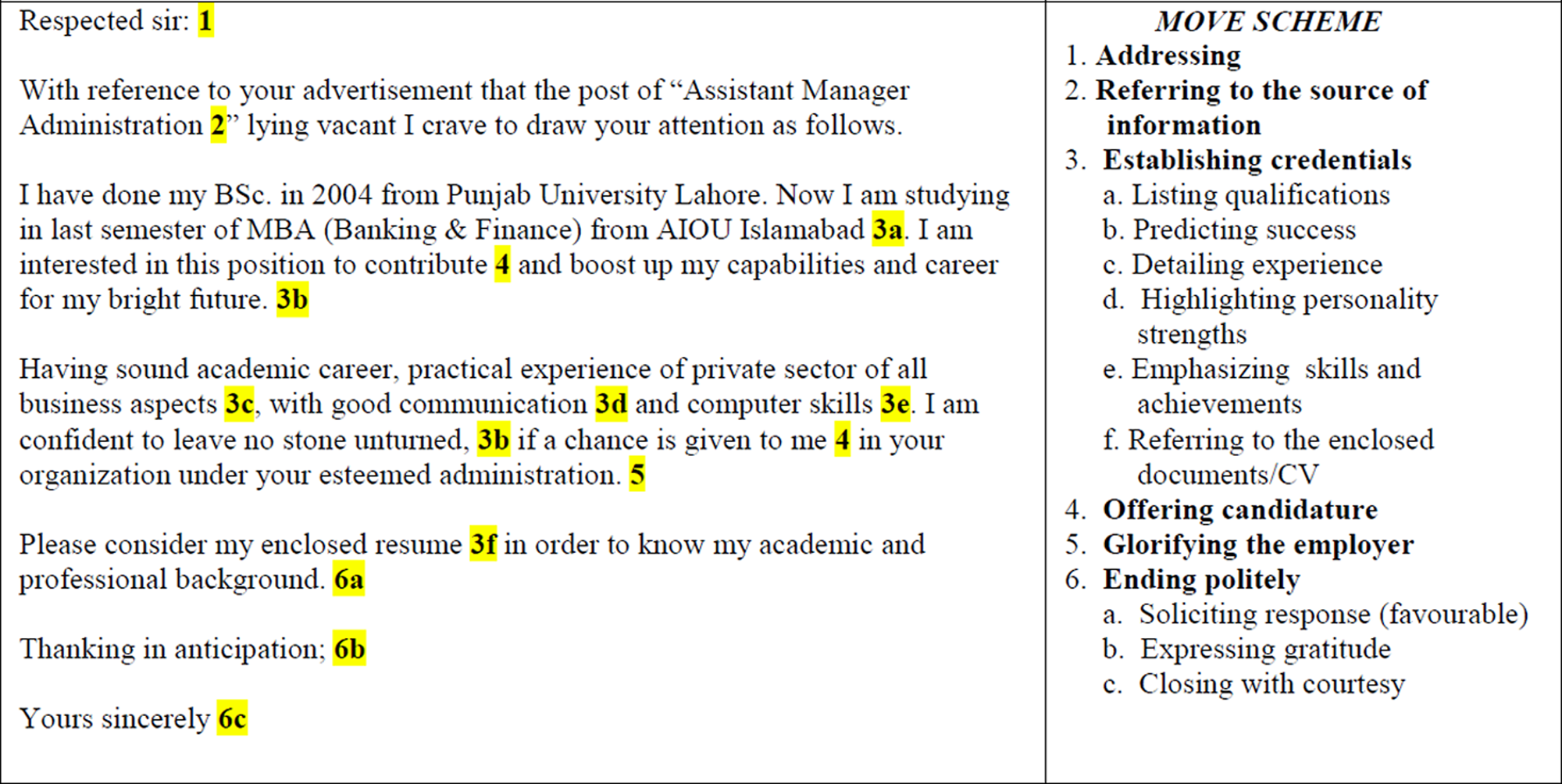
A Sample Coded Letter
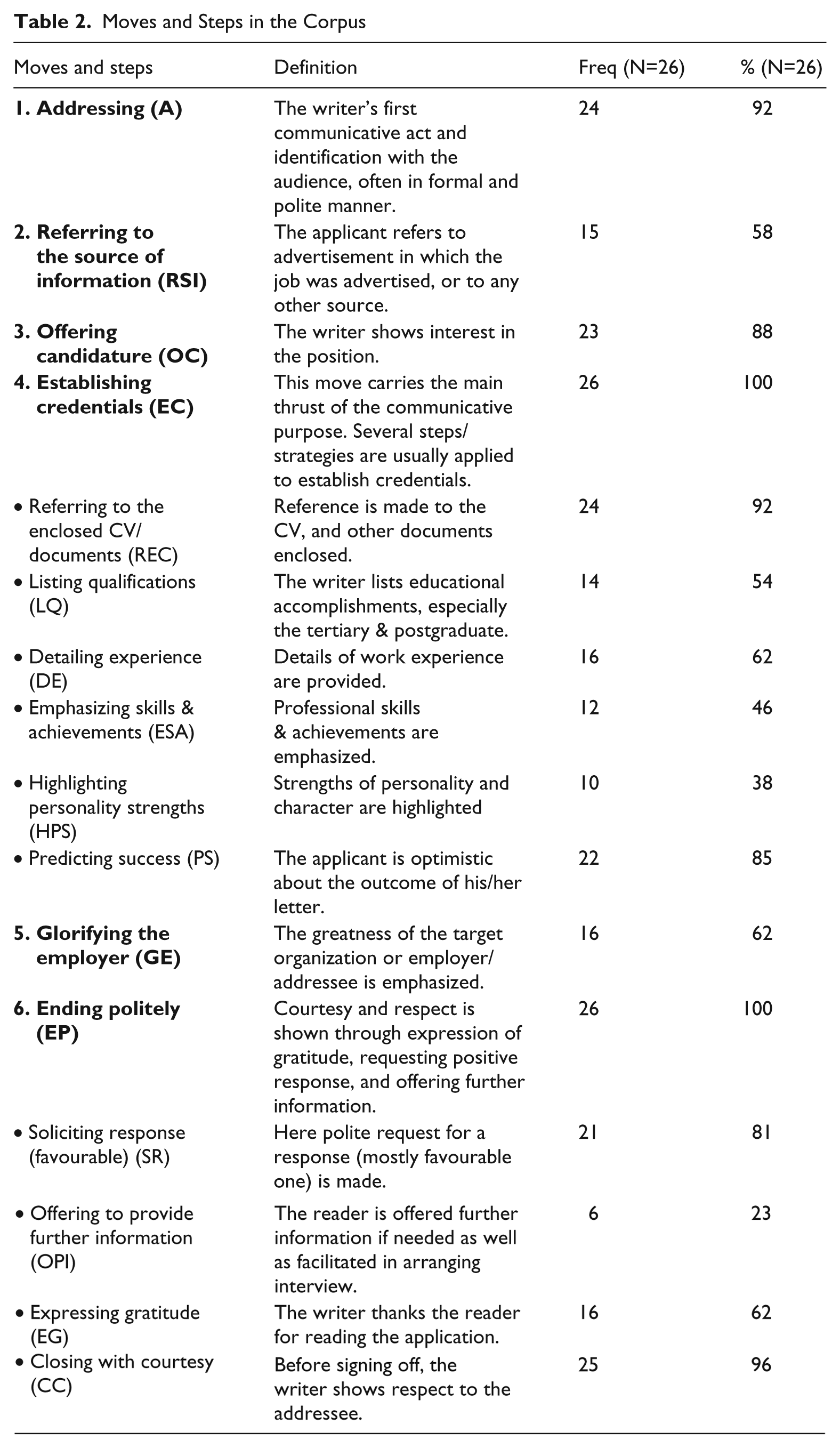
The explicit text division i.e. paragraphs, in this case, were initially observed as move markers or boundaries. But the lack of coherence in many letters showed that moves were partly embedded in one paragraph and partly in another. As was pointed out by Henry and Roseberry (2001: 158), job letters in the present study do not have already defined ‘linguistic markers of move boundaries’. As such, the analysis depended on what Brown and Yale (1983: 69) called ‘intuitive notion of topic’. On several occasions it was found that one part of a move was in one paragraph and the other portion in another paragraph. Job letters are thus different in this sense from research grant proposals, which have predefined sections under clear headings for each move (Connor and Mauranen, 1999). To achieve reliability, the data were analysed and coded in terms of the moves/steps twice with a gap of two weeks. Another genre expert was also requested to code the moves. A final scheme of the moves/steps (see Table 2) emerged after mutual agreement of the two coders.
Moves and Steps in the Corpus
Findings
The Moves and Steps in the Job Application Letters
Following Swales (1990), Bhatia (1993) and Henry and Roseberry (2001), the corpus of 26 letters was tagged for recurrent patterns of discourse units, the rhetorical moves and steps. A total of 6 moves were identified as shown in Table 2. Two of the moves, the establishing credentials (EC) and the ending politely (EP), were found to have micro-level discourse units or steps for the realization of the moves.
Most of the moves and steps noted in this corpus are in line with the findings of Bhatia (1993) and Henry and Roseberry (2001). However, certain variations are quite noteworthy. The stating reasons for applying move, which has a frequency of 11 in the Henry and Roseberry corpus, was altogether missing in the present corpus. There were a couple of instances where the moves bordered between ‘offering candidature’ and ‘stating reasons for applying’. After some discussion, the move coders decided to mark them as the offering candidature move. The sentence below is one of few instances which were discussed regarding whether it embodied stating reasons or offering candidature move.
My desire to locate a challenging growth opportunity in a fast paced business environment has prompted me to forward the attached resume for your evaluation.
Since at none of the instances the applicants had clear and specific reasons and since they tended to give an overall sense of offering candidature, it was decided to do away with the stating reasons move.
The glorifying the employer move has emerged as a dominant characteristic of the corpus in the present study while in the corpus of letters of native English speaking applicants collected by Henry and Roseberry (2001), this move is absent. The presence of the move, however, confirms Bhatia’s (1989, 1993) findings. Similar examples of employer glorification found in Bhatia (1989, 1993) were found in the corpus of the present study. Also an interesting finding was the total absence of the self-degradation move, of which Bhatia (1989) comes up with many examples. This reflects a major shift in the way people present themselves: from subservience to offering their services. Genres are dynamic and evolve with time.
The Linguistic Features and Functions of the Rhetorical Moves and Steps
The sections below present the findings that derive from the analysis of the linguistic features and functions of moves and steps identified in the present corpus.
Move 1: Addressing (A)
This is one of the most common moves with 92% occurrence. This is the writer’s first communicative act in which he/she identifies the audience. As such this is also called the salutation or opening move (Henry and Roseberry, 2001). This is surely an obligatory move not only for a job letter but for any letter. Most of the writers use the Adjective + Noun combination such as ‘Dear Sir’, ‘Respected Sir’ and ‘Honourable Sir’, while others stick to the simple noun form such as ‘Sir’. Linguistically, the move in this context is highly characterized by the use of sexist language, as the female or neutral forms of titles have been completely ignored.
The most striking aspect of the move in the current context is that none of the applicants addressed the audience by his/her name, for example, ‘Dear Mr. Suleman’. Although one reason could be the absence of the name of the HR/Recruitment officer in the advertisement, the absolute absence points towards the socio-cultural connotation. In the Pakistani culture it is considered unethical to address by name senior persons such as an elder brother, father, boss or person of authority such as the HR officer or members of the interview panel. Although teachers of business communication in Pakistan now encourage students to address the receiver by name if it is given in the advertisement in keeping with the expectations of today’s communicative practice of the business world, the findings in this corpus indicate that the social and traditional forces are still dominating the applicants’ communicative behaviour.
Another interesting finding is the use of ‘Sir’ by 96% applicants. Except one letter, none have used the more careful and neutral ‘Dear Sir/Madam’, or ‘Dear HR Manager’. This may be due to the possibility of the receiver’s name not being given in the advertisement. However, if the name is not there, then gender is also not known; hence there is a greater need for a neutral salutation. One may explain this in terms of the very low ratio of women in jobs, especially the executive and managerial positions. However, in the private sector, particularly in banks, the ratio of female staff is almost the same as the the ratio of male staff. Hence the absence of this neutral form of addressing in applications to both the government and private organizations is interesting. The finding may offer useful insight to sociolinguistic researchers who may be interested in the status and identity of women in Pakistan society.
Move 2: Referring to the Sources of Information (RSI)
This is generally regarded as obligatory move in the job application genre. This move occurs 15 times (58%) in the whole corpus where in about 12 out of 15 letters it is placed at 2nd position in the move order. The writer identifies the sources of information through which he/she came to know about the vacancy. The name of the newspaper, the advertisement date and the vacancy title are all mentioned. This move is useful for the reader/employer in that it orients them to read the letter in proper perspective. The recurrent key expressions in this move are ‘the vacancy’, ‘newspaper’ or ‘other unmentioned source’, and ‘the date’. The move, in most cases, initiates the discourse after salutation. The move has become such an essential part of the letter that even in unsolicited applications the candidates use it quite strictly (see example 2 below). Here it is interesting that the reliability of the source is emphasized through avoiding mentioning the source. Again we may look at the socio-economic factor. In a society where there are often many desperate candidates for very few jobs and where nepotism in offering jobs is a common practice, the applicant’s revealing the source of information for unadvertised jobs could be considered unethical. Hence we do not have any example of a candidate who would write: ‘Mr. Kiyani, the Manager of Operations told me at a seminar that you require an accountant in your bank’. The move also sometimes has the offering candidature (OC) and the glorifying the employer (GE) moves embedded in it within the same sentence. Examples are given below.
I have come to know
I came to know that
Move 3: Offering candidature (OC)
The move is often realized in one sentence, or part of a sentence, through simple present or present continuous tenses. The most frequent words in the move like ‘I, offer, services’ reflect the typicality of the move and applicants’ reliance on the generic conventions of the letter.
4.
5. I
Quite rightly it is one of the most explicitly established moves in the corpus. Its most frequent occurrence early in the letter (3rd move) shows the candidates’ tendency to directly state the main idea i.e. offering candidature for the post. It may also at times embed the glorifying the employer (GE) move (example 4) or is embedded in the referring to the source of information (RSI) move (example 1).
Move 4: Establishing credentials (EC)
This is the most central move that carries the main weight of the applicants’ communicative act. It has occurred 26 times (100% of the letters) in the corpus. Six strategies/steps by the applicants were found to be gearing towards establishing the credentials.
Step 1: Referring to the enclosed CV (REC)
This step has the highest frequency in the establishing credentials move (92%). It is also significant in terms of placement as it mostly occurs as the first step of the credential move. This step also contributes to the overall effort of establishing credentials. Two prominently recurrent syntactic structures emerge in the execution of this step. In the first pattern, the step is nestled in a subordinate clause followed by the main clause containing either the listing qualification (LS) or the detailing experience (DE) step (example 6). In the second pattern, the step as an independent sentence has CV/documents as the subject at the beginning of the passive sentence, and the reader or the reader’s act are placed in the predicate as adverb phrase. The actual subject ‘I’ is implied and hence omitted (example 7):
6.
7.
Many candidates have used this step to make up for the paucity of details in their letters. Although the informational evidence in a CV is not a substitute for the interpretive and persuasive discourse of the letter, many letters which were short in detail gave the impression that the writers considered both to be similar. It was observed in a few letters as if giving reference to the post and referring to the enclosed documents (CV) were the only purpose of the letter. The writer of this sentence which is taken from his brief letter of just 4 lines seems satisfied by stating in the end that ‘My CV and educational certificates are attached.’ During the informal discussion with some job applicants, it was said that they would often send their CV alone as a job application. Many said they were comfortable with preparing a CV, and found writing a small letter a daunting task. This may be so because many organizations in Pakistan, especially in the government sector, invite job applications in the form of just a CV or prescribed form.
Step 2: Listing qualifications (LQ). This is supposed to be an obligatory step of the genre of application letters. It occurred 14 times (54%) in the corpus. It is usually the first step of the credential move. The step follows a repeated pattern of simple present and present perfect tenses in the following typical form (I [subject] + Verb [present simple/perfect] + Object [degree/qualification]).
8. I have completed MBA.
9. I hold a masters degree in business.
10. I have achieved the qualifications that you desire.
11. I am MBA (corporate finance) from AIOU.
While opting for the present perfect tense for a past event (i.e. completion of qualification), the candidates deemphasize the time, and tend to bring out the importance of the action (of getting the qualification) for the present occasion (i.e. applying for the job). Despite being an established and obligatory step of the move, the 54% frequency of the step manifests a crucial shortcoming. As regards the execution of the step, almost all of the applicants appear comfortable with it because it is simply documentation of the degrees, discipline, specialization, name of the institutes attended, and in certain cases the grades and years. Successful execution of this step was seen where instead of merely listing the educational details (also given in a CV), the applicants related them to experience (DE) and job-relevant skills and achievements (ESA), which they had gained through education, as clearly shown in example 12 below. Some instances of embedding the predicting success step (PS) have also been noted in this step (example 13).
12.
13. I am sure
Step 3: Detailing experience (DE)
This was found to be the lengthiest of all the steps in the credential move. It occurred in 16 letters (62%). This is an obligatory step for the experienced candidates and is optional for the fresh graduate. It mostly occurs as the 2nd step of the credential move. The usual tense for the past experience is simple past or past continuous tense. For detailing the current experience the candidates use either present simple or continuous, with the adverb ‘currently’, or ‘at present’ (Adverb + Subject I + Verb (serve, work) + job title/designation + name of organization).
14.
However, where the step has been embedded in the emphasizing skills and achievement (ESA) step, then the detailing experience (DE) replaces the subject ‘I’, and the skills/achievements (ESA) occupies the predicate (example 15). The quite frequent use of a subordinate clause as a modifier served to cement this step with other steps in the credential move such as emphasizing skills (ESA) and hence imparts coherence to the credential move as a whole.
15.
The 62% occurrence of the step in a corpus where not all of the applicants have prior experience suggests that the move has been established in accordance to the genre convention as well as addressee’s expectations. In case of the fresh graduates, some applicants have successfully tried to present it in the form of internships and projects undertaken as part of the studies. This brings out the importance of understanding the conventions of genre in the overall writing competence of the writers. Applicants who are aware of and adhere to the genre conventions of job letters are able to produce effective and complete letters despite some shortcomings in their credentials. Bhatia (1993: 59) refers to this move as ‘essential detailing of the candidature’. According to him:
One of the most frequently used strategies for self-presentation in promotional literature is that of self-appraisal, which consists of an adequately relevant, positive and credible description of the product or service and a good indication of its potential value to its intended audience (Bhatia, 1993: 65-66).
The sentence below represents an apt example of the candidate’s self-appraisal and indication of potential value for the employer.
16. As my resume indicates I have experience in financial accounting at a private firm, as well as experience in education sector, wherein I learnt patience as well as critical thinking skills.
Step 4: Emphasizing skills and achievements (ESA). This step has perhaps the greatest persuasive significance because it manifests transformation of the applicant’s education and experience into capabilities which the employers are looking for in prospective employees for the specific job. The step occurred about 12 times (46%). An interesting syntactic feature in the move was the observance of simple linear thematic progression (Lorés, 2004: 291), where the rheme (experience [DE] as the object) of the first sentence becomes the theme (subject) of the second sentence leading to the skills (ESA) in the predicate as rheme.
17. As my enclosed resume indicates, I have the good fortune of being associated with SCHLUMBERGER Oilfield Services (Rheme: experience). This experience (Theme: experience) has
Letters which demonstrated such logical development of ideas appeared to embody a stronger communicative act than the rest because they demonstrate coherence, and logical progression of ideas.
Step 5: Highlighting personality strengths (HPS)
Interesting varieties of this step were noted in about 10 letters (38%) in the corpus. This is an optional move which, if depicted properly, can make a positive impression of the candidate. Its usual placement in the credential move is in the 4th position. The move is dominated by the use of adjectives (e.g. self-motivated, quick) for obvious reasons. The linguistic patterns of independent and embedded occurrence also lead to the rhetorical significance of the step. When they are embedded in the experience (DE), qualifications (LS) or skills (ESA) steps (example 18), they appear quite logical and convincing. However, when they stand as isolated and unsupported sentences (example 19), they seem irrational and tend to appear as what Bhatia terms as self-glorification, i.e. an unsupported claim of the writer’s own superiority based simply on feelings or desires rather on rational judgments (Bhatia, 1993: 70).
18. Emphasis on
19. I am a
Step 6: Predicting success (PS)
This is one of the most frequent steps in the credential move. The step occurred in 22 letters (85% of the corpus) mostly at 5th position in the credential move. Highly ‘I’ centred in tone, the step is mostly carried by a complex sentence with reporting verbs like ‘believe, hope, am confident’ in the subordinate clause followed by ‘that’ leading to the prediction of success in the main clause.
20.
Other forms of complex sentences involved the conditional clause, a typical and formulaic one ‘if given a chance’.
21. I assure you of my best performance
22. I will definitely prove my abilities
Moreover, it was not difficult to identify numerous Adjective-Noun collocates in the step:
23. I believe that I could make a
24. The position requirements and my skills are a
25. I am confident that I can perform this job in the
The step in this context did not appear to reinforce the credentials. Rather in many letters it looked to be a desperate effort to convince the employer for positive consideration when actual credentials were either lacking or not presented due to lack of writing skills (e.g. ‘I am sure if I am given a chance in your organization, I will perform to the best of my knowledge and skills’). However, where the details of qualifications, experience, or skills logically led to predicting success, the credentials on the whole were strengthened:
26. My efficiency in orchestrating day-to-day work activities, achieving targets and generating the best possible results in demanding situations, is the key to my success (ESA).
Move 5: Glorifying the employer (GE)
Interspersed instances of employer glorification were seen in about 16 of the letters (62%). The move is often embedded in other moves/steps such as RSI, OC, and PS. Bhatia (1993) first pointed out this move and named it as ‘adversary glorification’. Linguistically the move is heavily loaded with various adjectives: ‘Your respectable organization’, ‘Your esteemed organization’, ‘World renowned organization that has truly global presence’, ‘Your well-reputed organization’, ‘My honour to be part of such esteemed organization’, ‘Under your kind control’, ‘Under your esteemed administration.’ Such glorifying phrases often come at the end of the compound or complex sentence (e.g. ‘With due reverence, it is stated that I have come to know through the “Daily Jang” that some posts of Assistant Manager are lying vacant under
One aspect of the move is the one in which the addressee is directly glorified (e.g. ‘under your kind control’). This appears to have greater negative connotation than the employer glorification (e.g. ‘your esteemed organisation’) because it bestows undue praise on the addressee. It is taken for granted that the person who is going to read the letter will be the only authority in the recruitment process. Further it is wrongly assumed that if selected, the letter reader would be the candidate’s immediate boss after his/her selection. The purpose would have been better served by neutral expressions with controlled tone. Perhaps it wouldn’t be wrong if the issue of bestowing such omnipotent authority on the employer is seen in the socio-cultural perspective. Organizations in Pakistan have a highly centralized structure where decision making is usually dominated by a single figure.
In spite of the fact that the move hardly occurs as an independent sentence, glorifying the employer was assigned a move status as it stands out as a persuasive strategy on the part of the applicant to gain the addressee’s sympathy and compassion. It neither fits in the credentials nor in the offering candidature move. Its underlying intention renders it a rhetorical move with the sole communicative purpose of gaining positive response through its appeal to the reader’s sentiments. Moreover, given the consistency with which the candidates observed it, it was not difficult to decide that it does embody a move in the present context.
Move 6: Ending politely (EP)
The move has occurred with 100% frequency. Most of the steps in this move relied on the formulaic expressions that are typical of a job application. They are more of the ‘institutionalised expressions’ functioning as ‘book ends’ (Henry and Roseberry, 2001: 159) than any thought out strategies of persuasion. As such there is not much that is significant and peculiar of the socio-cultural context of the study. The typically used expressions for the various steps of this move are:
27. Looking forward to hearing from you. (Soliciting response)
28. Thanking you in anticipation. (Expressing gratitude)
29. If you need more information, I would be glad to provide. (Offering to provide further information)
30. Sincerely/ truly/ respectfully/ faithfully/ obediently (Closing with courtesy)
The use of adverbs such as ‘respectfully, faithfully, obediently’ in the last step of the move is interesting. Such courtly expressions used to be a norm, rather compulsion, in letters addressed to British officers of the colonial era. The tradition continued for few decades even after independence. However, their use has diminished because they are now considered to carry a connotation of servility. The genre as a dynamic entity (Berkenkotter and Huckin, 1995) has surely evolved along with the social change; with globalization, democracy, private ownership of businesses, and freedom of expression as the main precursors of the change.
Formulaic expressions are fixed patterns of phrases that have been traditionally used in the genre. They have been abundantly and consistently used in various moves, especially in the opening moves of referring to the source of information (RSI), offering candidature (OC), glorifying the employer (GE) and the concluding move of polite ending (PE). It is obvious and understandable since ‘job letters are a genre and, as such, have not only a predictable structure but in many cases predictable formulaic expressions’ (Upton and Connor, 2001: 322). Okamura and Shaw (2000) note that formulaic expressions could be useful for routine transactional as well as interactional letters. However, when the intent of many formulaic expressions is to couch personal desires and wishes behind genre-accepted norms (Upton and Connor, 2001), the reader is less likely to be convinced. The applicants in this context seem to rely on them in order to compensate for their lack of expertise in expressing themselves creatively through this genre.
Conclusion
The corpus of job application letters in this study has revealed patterns of rhetorical moves commonly associated with this genre. However, certain features were noted which could be explained in the socio-cultural context of the genre. The way the addressing move is executed speaks volumes of the roles and relations of gender and status in Pakistan. The prevailing corporate culture, which revolves around a tall, centralized and strictly hierarchical structure of organization where decision making is often dominated by a single person, especially in the government sector, shapes a highly imbalanced relation of power between the applicant and the employer. This, together with the scarcity of jobs for a large number of applicants, impacts upon the moves and strategies of the job letter writers. Thus in the glorifying the employer move the applicant beseeches the addressee as a person of omnipotent authority in the recruitment process. The findings confirm Bhatia’s (1989) adversary glorification move in the context of South Asian letters, and Ali-Ali’s (2006) glorifying the prospective employer in the context of Jordanian applicants.
As expected, establishing credentials emerged as the most central and elaborate move which was realized through various steps. However, the move in most cases was not as elaborate as it should have been. One reason for paucity of details in the credential move could be the general attitude towards job letters in Pakistan. Many applicants and employees regard the CV as more instrumental than letters in the recruitment process. An interesting finding within this move is the very higher frequency of the optional predicting success step than the obligatory listing qualifications step, the experience step and the skill and achievement step. The strategy, however, did not always seem to contribute to the credentials significantly because in most cases it was not supported by rational evidence. From the linguistic point of view, the corpus has shown abundant use of formulaic expressions.
The study has implications both for researchers and teachers of letter writing. Researchers could extend the study by filling the many gaps that this study may have left open. It is hoped that the study outlined here will stimulate researchers’ interest to conduct studies in this region which is passing through a very crucial stage of political and socio-economic transformation. There are also pedagogical implications. When a document is associated with a genre, it embodies a social action (Miller, 1984). At the same time the writers also have the tendency to fall back on their own socio-cultural norms. With the socio-cultural transformation of the society, these norms change and so should the genre also change because genres are dynamic (Berkenkotter and Huckin, 1995). Hence teachers of letter writing should not be content only with imparting the skills associated with grammar, format and vocabulary etc., but should also be mindful of the significance of its generic pattern which involves interaction in a certain social perspective. From a pedagogical point of view three areas of findings in this study are noteworthy. First, the applicants seem to have overlooked a significant rhetorical strategy for establishing their credentials, i.e. the stating reasons for applying step. Second, at times, they overdo glorification of the employer. Third, many of them are still following obsolete, colonial era, complementary closes.
Owing to the limitations imposed by the scope and size of this study, any generalization from the study has to be tentative. Is there any difference in the move scheme of experienced applicants and fresh graduates? What are the job applicants’ own perceptions about the rhetorical moves identified by the genre analyst? Would a cross-cultural comparison of letters in this context with those by native speakers be significant? More detailed studies involving a larger corpus, and looking at multiple perspectives are needed to find answers to these questions.
Footnotes
Funding
This research received no specific grant from any funding agency in the public, commercial, or not-for-profit sectors.