







Abstract
The English language has been going through a dual process of globalization and nativization. The globalization of English renders the language into a global lingua franca and an international language, whereas the nativization of English diversifies it into varieties of English, namely, World Englishes. Such ‘glocalization’ of English has realistic implications for teaching English as an International Language (TEIL). English as an International Language (EIL) is more than a ‘language’ per se. It has increasingly been conceptualized as a framework or a paradigm, developed alongside the glocalization of English, and it is a multicultural way of thinking, doing and being. EIL recognizes English variation and varieties, and it is time to introduce EIL awareness, literacy, and competence into tertiary education. This article unpacks the assumptions and definitions of EIL, and explores the pedagogical implications of teaching EIL at a tertiary institution in Australia. In particular, this article reviews and examines an EIL unit titled ‘Exploring English as an International Language’ in terms of its curriculum, materials, and pedagogical strategies. It can be argued that TEIL is not only realistic, but also essential for university students who engage in communication in a variety of international contexts in today’s globalized world.
Keywords
Introduction
The global linguistic landscape of English has gone through a paradigm shift over the past decades due to globalization and the advances in research and practice in relevant disciplines such as English as an International Language, English as a Lingua Franca, and World Englishes. Such a paradigm shift embodies the following aspects:
English has become a pluricentric language, namely from English to ‘Englishes’, with legitimate variations in lexis, syntax, discourse, pragmatics and cultural conceptualizations among different varieties of English.
The distinction between English as a foreign language (EFL), English as a second language (ESL) and English as a native language (ENL) has become blurred, and such entities are commonly replaced by notions such as English as an International Language (EIL) and English as a Lingua Franca (ELF).
The ownership of English has been challenged due to the diversification of the English language. The ownership discussion has shifted from who ‘owns’ English to users of English becoming ‘guardians’ of the language, and who has the best access to English as a multilingual tool for international communication.
In the context of ELT, there has been a shift of focus from de-contextualized ‘correctness’ to ‘appropriateness’ in context.
There has also been a shift in people’s perceptions of the role of their first language and culture (i.e. L1 and C1), from a ‘problem’ resulting from ‘interference’ to a ‘resource’ that can be naturally ‘transferred’ into their English language learning and use. In other words, the status of L1 and C1 has shifted from a ‘baggage’ of burden and negativity to a ‘badge’ of linguistic and cultural heritage and identity (Xu, 2017b: 703–704).
As far as English language teaching is concerned, one of the fundamental shifts is reflected in the shifting goals of ELT from ‘manufacturing native or near-native speakers of English to developing and mentoring effective and strategic translanguaging users of English in multilingual communication contexts’ (Xu, 2017b: 704).
In response to the paradigm shift and the diversifying needs of English learners and teachers in the era of globalization, programmes in English Language Studies, Applied Linguistics, and Education worldwide have been adjusting their course offerings. One of the adjustments is to increase the awareness of the changing linguistic profiles of the English language by offering relevant units or modules such as Teaching English as an International Language, and World Englishes. This article introduces a unit titled ‘Exploring English as an International Language’, which is offered in an Australian university to undergraduate students within the major of English as an International Language, and explores issues related to the curriculum, materials and pedagogical strategies for teaching English as an International Language.
Literature Review
Smith (1976: 38) proposed the notion of ‘English as an International Auxiliary Language’ (EIAL) in the 1970s, defining an ‘international language’ as one ‘which is used by people of different nations to communicate with one another’. He made a number of assumptions regarding the relationship of an ‘international language’ and culture. These include:
Learners do not need to internalize the cultural norms of native speakers of that language.
The ownership of an international language becomes ‘de-nationalised’.
The educational goal of learning it is to enable learners to communicate their ideas and culture to others (Smith, 1976: 38–42).
At the beginning of the 21st century, McKay (2002: 12) revisited the notion of EIL, and put forward the following assumptions. As an international language:
English is used both in a global sense for international communication and in a local sense as a language of wider communication within multilingual societies.
The use of English is no longer connected to the culture of Inner Circle countries.
English becomes embedded in the culture of the country in which it is used.
One of the primary functions of EIL is to enable speakers to share their ideas and culture with others.
Sharifian (2009b) proposes that EIL has become a new ‘paradigm’ for thinking, research and practice. In addition, Marlina (2014: 4–5) unpacks the notion of EIL further by clarifying that EIL, as a paradigm, ‘recognizes the international functions of English and its use in a variety of cultural and economic arenas by speakers of English from diverse lingua-cultural backgrounds who do not speak each other’s mother tongues’, and that the EIL paradigm ‘recognizes and embraces all varieties of English at national, regional, social, and idiolectal levels in all circles as equal’.
Explorations of teaching EIL have so far largely been at the level of theories rather than practices. Therefore it remains a question as to whether teaching EIL is realistic or idealistic. In the current domain of English language teaching, teachers have experienced ongoing challenges. For example, in the Japanese ELT context, Honna and Takeshita put forward three challenging issues, namely:
How can we teach English as an International Language (not as a Standard American or a British language)?
How can we train our students to be able to talk about themselves, their community, and their national culture?
How can we motivate our students to become interested in cultures of speakers of different varieties of English the world over? (Honna and Takeshita, 2014: 65).
They argue that ‘in the traditional American English Speaker model, Japanese students are taught American English and are expected to become speakers of American English. … It is not necessary and it is not desirable to expect to produce American English speakers in Japan’s public education system’ (Honna and Takeshita, 2014: 65).
In terms of English language teaching materials, Baumgardner (2006: 664) points out that the ‘deep sociolinguistic shifts … make it necessary for teachers of English outside English-speaking countries to infuse local culture into their English language classrooms’. ‘The overseas teachers of English … clearly felt the need for what might be called a glocal coursebook – something that would give them “a better fit” and simultaneously connect the world of their students with the world of English. … The underlying issue here is, of course, the position in which the English language finds itself today as an international language’.
As far as principles and pedagogical considerations of teaching EIL are concerned, McKay puts forward principles of a ‘socially sensitive English pedagogy’ (2012: 28), which is ‘a pedagogy that resonates with the local linguistic landscape’ (2012: 37). These principles include:
The promotion of multilingualism and multiculturalism.
Localized L2 language planning and policies.
The development of an awareness of language variation and use for all students.
A critical approach to the discourse surrounding the acquisition and use of English.
Equal access to English learning for all who desire it.
A re-examination of the concept of qualified teachers of English (McKay, 2012: 42–43).
McKay (2012: 29–30) argues further that ‘rather than relying any longer on the native-speaker model it is time for L2 professionals to investigate the language use patterns of speech communities that use English alongside other languages … What is needed then is a much more robust picture of how bilinguals in various communities around the world use English for specific communicative purposes’.
Based on a review of the current literature on EIL, Xu (2017a: 708) proposes three EIL tenets, including:
EIL, as a paradigm, has been developed alongside the glocalization, i.e. globalization and localization, of English.
EIL is a multicultural lingua franca of various cultural conceptualizations for international and intercultural communication.
EIL recognizes English variation and varieties, including different dialects of English and World Englishes.
According to Sharifian, (2009a: 249): ‘more proficient speakers are those who have been exposed to, and show familiarity with, various systems of cultural conceptualizations, participating with flexibility in EIL communication and effectively articulating their cultural conceptualizations when their interlocutors need this to be done’.
The teaching of EIL therefore involves exploring various systems of cultural conceptualizations and practices in adopting effective communicative strategies for communication in various EIL contexts, and it ‘presumes not only linguistic competence, and communicative competence, but also intercultural competences, EIL competence and meta-cultural competence’ (Xu, 2017a: 709). Meta-cultural competence is one of the interlocking competences involved in the teaching of EIL. Meta-cultural competence refers to ‘a competence that enables interlocutors to communicate and negotiate their cultural conceptualizations during the process of intercultural communication’. It involves three components, including variation awareness, explication strategy and negotiation strategy (Sharifian, 2013: 9). In order to develop EIL awareness and literacy, and teach meta-cultural competence, Xu (2017a: 711) puts forward three principles, including:
Acknowledge the paradigm shift in relation to the current use and users of English.
Anticipate different cultural conceptualizations that are embedded in English when using English as an international language for intercultural communication.
Acquire and accomplish new literacy, proficiency and competence to engage in intercultural communication in English as an international language.
In the following sections, the curriculum, materials and pedagogical strategies of the unit ‘Exploring English as an International Language’ will be evaluated and analysed, and implications for teaching English as an International Language will be explored.
Exploring English as an International Language: the Unit
‘Exploring English as an International Language’ is one of the cornerstone units within the undergraduate major of ‘English as an International Language’ (EIL) in an Australian university. The major (or programme) offers seven other units, including two gateway units, namely ‘Communication in International Languages’ and ‘Englishes for Global Communication’; the other cornerstone unit, namely ‘Language and Globalization’, and two capstone units, titled ‘Cultural Linguistics’ and ‘Language and Education’, plus two other units at the third year level, titled ‘Writing across Cultures’, and ‘Englishes in the Global Context’.
As far as the EIL programme is concerned, a survey conducted in 2017 shows that there are approximately 660 students taking EIL units for their major or minor degree studies, or as electives. These students come from eight different faculties within the university, including Arts, Education, Business, Science, Engineering, IT, Law, and Medicine, with the majority of students coming from Arts, Education, and Business faculties. 49% of the students are domestic, and 51% of them are international. In terms of English L1 and L2 speakers, 47% of the students are English L1 speakers, and 53% of them are English L2 speakers. There is an obvious diversity of the students’ linguistic and cultural profiles. This diversity is also reflected in the reasons why the students take EIL units. These include: to learn about languages and cultures, to improve competence for intercultural communication, to gain more knowledge of English, to learn about different uses of English in global contexts, to learn about different varieties of English, to work in a multi-national workplace, to work as a translator/interpreter, and to become a functional member of the global community.
The Curriculum
The unit titled ‘Exploring English as an International Language’ provides students with an opportunity to learn and critique current issues and research in English as an international language, and to explore what ‘English as an International Language’ means and implies for intercultural communication through conducting small-scale research projects on EIL-related topics.
These include:
The relationship between English as an International Language (EIL) and World Englishes.
Exploring English as an International Language (EIL): What is it? What are its implications for intercultural communication?
Exploring ‘competence’ in relation to English as an International Language.
Problematizing the notions of ‘native and non-native speakers’ of English from an English as an International Language (EIL) perspective.
Narrative inquiry: what do speakers of English say about their experiences (anecdotes or stories) of learning and using English in EIL contexts?
The Materials
The materials for the unit of ‘Exploring English as an International Language’ mainly consist of readings of the updated literature in the area of English as an International Language. A number of edited research volumes are of particular relevance to this unit, e.g. English as an International Language: Perspectives and Pedagogical Issues (Sharifian, 2009c); Principles and Practices of Teaching English as an International Language (Matsuda, 2012); Principles and Practices for Teaching English as an International Language (Alsagoff et al., 2012), and The Pedagogy of English as an International Language: Perspectives from Scholars, Teachers, and Students (Marlina and Giri, 2014). In addition, a number of seminal publications by Smith (1976), Pennycook (1994; 2004) and McKay (2002; 2012) have also been recommended to the students.
Pedagogical Strategies
Apart from the weekly readings and lectures, the unit is also based on students’ own responses to the weekly ‘survey’ questions specifically designed for the unit, due to the exploratory nature of EIL. For example, for week 1, demographic information of the students as well as their definitions of EIL have been collected through an in-class survey. Questions include: Which country were you born in? What is your first language? What other languages do you know and use? Why do you think English has become an ‘international language’? How do you define ‘English as an International Language’ (EIL)?
From week 2 onwards, survey questions vary with weekly topics, however, they are all related to EIL issues and practices. Typical questions for example include: Is it a good thing or a bad thing for English to become an international language? Why do you think so? What are the benefits and drawbacks of English as an International Language? Regarding people’s attitudes towards EIL, could you use at least five adjectives, e.g. liberating; dominant; imperialistic; convenient; exclusionary, to describe EIL? Given that we have become aware of World Englishes, and English as an International Language (EIL), what variety of ‘English’ do you actually speak?
Apart from survey-based teaching and learning, the unit is also delivered via a blended approach, taking advantage of technology-driven teaching and learning platforms, e.g. conducting discussion forums through Moodle. There are two discussion forums throughout the unit. One is an asynchronous discussion forum with weekly topics that runs through the semester, and the other is a synchronous discussion forum designated for week 5 during the class lecture and tutorial time, in which students login through Moodle and engage in an online discussion with all the students taking this unit, the lecturer and tutors. There are three topics for this discussion forum, including:
Sharing EIL stories, anecdotes and experiences.
The ‘realities’ of ‘real English’.
EIL awareness and challenges.
Specific forum discussion questions include, for example: Are some Englishes superior to others? Should we ‘idolise’ native speakers of English? When did you become aware that English has become an International Language, and how did you become aware of it? What are the difficulties or challenges of using EIL to communicate across cultures?
Through pedagogical strategies such as theoretical discussion and input, as well as survey-based and discussion-forum-based teaching and learning, the unit follows the principle of ‘thinking globally’, taking English as a global or international language in its conceptual multilingual and multicultural contexts, and ‘acting locally’, drawing upon students’ own local experiences, and gathering their immediate views and perspectives of EIL so that the unit comes from the students, to the students and for the students, in terms of its materials, contents and modes of delivery.
Data Analysis of Weekly Survey Responses, and Online Discussion Forums
This section consists of data analysis of weekly survey responses, and online discussion forums, to unpack what EIL means to the students, their attitudes to EIL, awareness and challenges of EIL from the students’ and lecturer’s perspectives, and the realistic experiences and anecdotes of EIL of the students and the lecturer. Through the data analysis, it can be seen that it is not only realistic but beneficial to teach and learn EIL in the current multilingual and multicultural contexts.
What EIL Means, and Reasons for English to Become an International Language
The current literature shows that EIL means that English is a ‘worldly language’ and it has gone beyond the English language itself embodying the ‘worldliness’ of English (Pennycook, 1994). EIL has indeed become a new ‘paradigm’ for thinking, research and practice (Sharifian, 2009b). EIL also means that English is an international language in both a global and a local sense (McKay, 2002). EIL serves as a function that English performs in an international and multilingual context (Matsuda, 2012), and EIL represents new ways of thinking, doing, and being (Alsagoff, 2012). In addition, EIL as a paradigm ‘recognizes and embraces all varieties of English at national, regional, social, and idiolectal levels in all circles as equal’ (Marlina, 2014: 4–5).
According to the unit’s week 1 survey responses, when the students have not been systematically informed of what EIL means from a scholarly or theoretical point of view, the notion of EIL means a number of things to the two seminar groups of approximately 60 ‘Exploring English as an International Language’ students. These include (note that the statements in italics below are direct responses from the students, and the number in brackets indicates the number of similar responses):
EIL is a ‘common’ language.
EIL is a language used by every corner of the world, for intercultural communication and negotiation (x7).
EIL is a common lingua franca; EIL is a common ground; EIL is a common communication platform between people of many cultures (x5).
EIL is a bridge between speakers from different cultures.
EIL is a tool, a way and a standard for effective intercultural communication.
EIL is a tool for self-expression and intercultural communication (x4).
EIL is a way to express our own cultures, beliefs, and opinions to the rest of the world (x3).
EIL is the way in which English is utilized in a multicultural and globalized context that is suitable for the modern world.
EIL is a standard for effective communication. EIL is English used to break down cultural and linguistic barriers.
EIL is a conglomeration of Englishes.
EIL is a broad term, which takes note of the fact that English is no longer just used in Inner Circle countries, but also in other countries with different dialects for different situations.
EIL is the use and spread of varieties of English all over the world and how the use of Englishes influences cultures and societies.
EIL is the different roles that English plays on the world stage.
EIL is a variety of English that exists in a constant flux to accommodate all competencies/backgrounds with the aim of transmitting ideas across cultures.
EIL is a set of the standards of different Englishes.
EIL is a combination of different types of English around the world. It is the tool to facilitate intercultural communication and the process of globalization.
EIL is a process.
EIL is a process of making English as a world language.
EIL is the location of English and the Englishization of other languages.
EIL is a subject, an area of study, and a paradigm.
EIL is a subject (area of study) that tells how English exists in different cultures and how people from different cultures communicate with one another without any obstacles (x3).
EIL is a paradigm: the unique position that English finds itself in of being so worldly spoken across the world and used for communication by native and non-native speakers alike.
EIL is a ‘beautiful’, uniting, liberating and uplifting concept.
To me EIL is a beautiful concept because even though it is one language, it reflects how multicultural our world is, and how a respectful and valid intercultural communication can be possible. EIL means stepping away from linguistic prejudices and it also means that new teaching approaches can finally be applied to languages, in order to create a relationship between the student and the language without being or feeling ‘de-culturised’. EIL makes everyone the owner of their own understanding of English.
In terms of why English has become an International Language, the students came up with the following major reasons:
Globalization, and migration (x17)
Colonization, industrialization, imperialism (x12)
International travel, tourism, business, diplomacy (x11)
A lingua franca; the most used language in ‘almost every developed country’; ‘economic superpower’; ‘a big player in the world (x10)
Media impact; English language media presented as mainstream media (e.g. books, TV shows, movies, Hollywood culture etc.) (x4)
English is much easier compared with Latin; English is also much easier compared with languages using ‘characters’ (x4)
Technology development, the Internet (x4)
Historical, political and technological reasons (x3)
The dominance of America, or Americanization, and England (x2)
Necessity (x2)
‘Growth of the world’.
This survey shows that students are not only aware that English has become an International Language, and that they also know, collectively, what EIL means to them and why English has become an International Language. This may serve as evidence that teaching and learning EIL is not idealistic but realistic and beneficial.
Attitudes to EIL
One of the survey questions is for the students to come up with five adjectives to describe EIL, and the table below is a collation of the adjectives that the students of the two seminar groups provided. These contributions suggest students remain largely positive to EIL, with adjectives that have positive connotative meanings, e.g. advantageous, embracing, empowering, sustainable, uplifting, and useful. However, students have also come up with adjectives that suggest negative connotative meanings, e.g. confusing, discriminative, divisive, exclusionary, imperialistic and notorious.
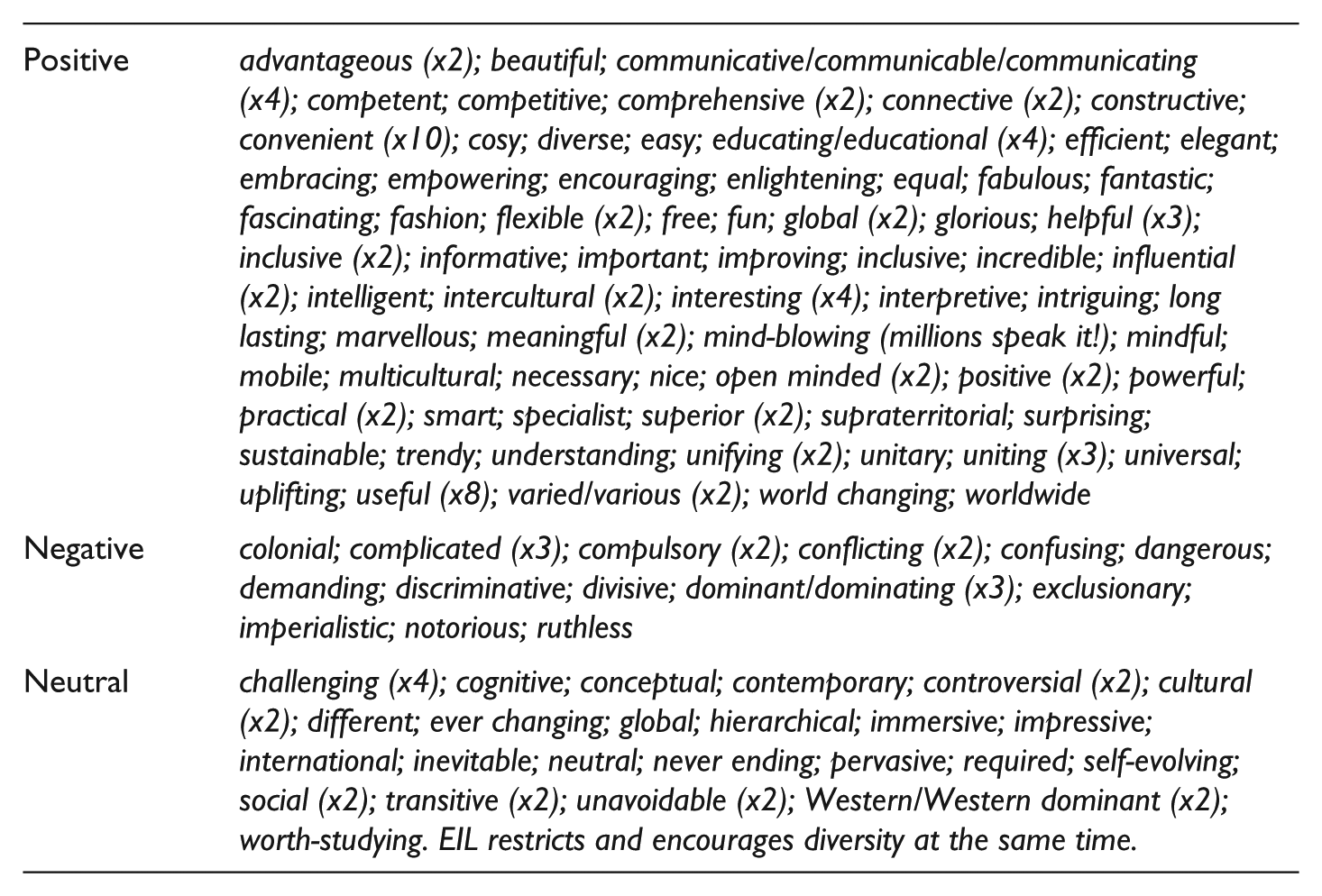
Apart from the adjectives that are indicative of the students’ attitudes towards EIL, another survey shows more explicitly how students perceive EIL, in terms of whether it is a good thing or a bad thing, and what the benefits and drawbacks of EIL are. The survey results show that around three-thirds of the students view EIL as a good thing, because it facilitates better communication across people all over the world; and the remaining third of the students view EIL as both a good thing and a bad thing, e.g. one of the typical responses is that:
For L1 speakers and Western countries, it is a good thing. For the rest of the world, I guess it’s neutral. EIL can promote communication among people from different cultural backgrounds, enabling mobility, providing more opportunities for work and learning. Notwithstanding, it threatens the existence of minority languages, and the process of English becoming an international language is a kind of Westernization.
In terms of the benefits and drawbacks of EIL, the students have expressed explicitly what they are, e.g. the benefits of EIL include:
Good, effective and efficient intercultural communication (x29)
Good cultural understanding, intelligibility and reducing misunderstanding (x10)
Many people use and learn English, so it’s a common language for international travel and tourism, business and politics (x10)
Removal of barriers between countries, spread of globalization, better mobility of people, uniting the world and promoting equality (x9)
Good job and education opportunities (x4)
Access to world academic databases and scientific pursuit (x2)
Enriching knowledge (x2)
Promoting bilingualism and multilingualism
EIL reduces risk of linguistic imperialism or the emergence of a “standard” or “correct” variety of English.
Technology development.
It saves money or cost for translating between English and other languages.
Developing a better world.
The drawbacks, according to the student survey responses, include:
Threat to other languages, taking over other languages, loss or extinction of dialects and other languages, loss of cultural identity, a killer language, and “de-culturalization” of the individual (x20)
Linguistic and cultural dominance, imperialism, invasion, discrimination, Americanization, colonization in spirit, English becoming a “superior” language (x13)
Too many varieties of English, accents, ethnolects to learn, confusion of Englishes and identities, the “standard” is diminished, and mixing of other languages (x10)
People may feel left out if they do not have the opportunity or money to learn English (x4)
We may have a strong reliance on English (x2)
Hard to keep up with the ever-changing English (x2)
People who already speak English may not feel a need to learn other languages because of the international status of English, or EIL discourages people to learn other languages (x2)
More effort for non-native English speakers (x2)
“Standard” mentality, or people who learn the language follow “standard” English blindly.
Bad for under-developed, or developing countries.
May cause conflict.
EIL Awareness and Challenges
In one of the online discussion forums, the lecturer reflected on his awareness of EIL based on his experiences of learning and using English in varying linguistic and cultural contexts.
English means a lot of different things to me at different times and in different places … when I first learned it in a non-English speaking context, it was a “foreign” language to me. Then it became a “school subject” until I started my university studies. I took English as my major (with a focus on translation, and English education). After I graduated with a Master’s degree in Applied Linguistics (TESOL stream), I became a “teacher”/lecturer of English to science and engineering university students, so English became my working language. While I was studying/working/living in Perth since 2000, and later in Hong Kong, English became somewhat a “second language”, and it was playing an increasingly dominant role in different aspects of my life. I now consider English as an International Language, because I am quite aware that English is a language with many different varieties (even many different names), and it is a language for international communication.
The students also become aware of EIL at various stages, junctures or circumstances of their lives. For example, one of the students shares a post during the discussion forum showing her awareness of EIL.
I began to become aware of English as a powerful international language when I started to study it in primary school, in Italy. Of course, at that age I was so young and I had no choice but after years and years of English learning, I realize the importance of this language for international communication. Then, I became fully aware of EIL when I took my first unit of EIL at Monash. The unit focused on intercultural communication and helped me open my mind. I realized how English has gradually become an international language and the impacts that this has on communication. I became familiar with the concept of WE and developed an open and self-critical mindset. Before this, I had never thought about WE, I was simply affected by the prejudice of English NS varieties as the standard ones. I had never fully thought about the consequences of EIL on communication and about the many challenges that it has brought. For example, EIL challenges the notions of NS and NNS because WE are now considered standard varieties. Furthermore, I think that one of the most important challenges is for intercultural communication. When people from different backgrounds come together using English as a bridge language, which kind of competence do we need to produce and negotiate meaning successfully? This is very interesting to me.
In terms of the ‘challenges’ of EIL, one of the students points out that:
One of the challenges of EIL is this idea that it will create some sort of world peace. While teaching English to adult students I found out the hard way that while English could be neutral, subject matter could almost never be neutral. We were trying to get students to chat about the nightlife in their culture. Some Spanish ladies said they loved going out to clubs and partying and spoke of Barcelona’s vibrant night life culture. Then a man from an Arabic country refused to participate, saying that they never went out to clubs or drank alcohol and he didn’t want to talk about it. It made conversation quite awkward, but it made me realize that EIL is not a solve-all solution to the world’s problems.
The point about ‘subject matter never being neutral’ and that ‘EIL is not a solve-all solution to the world’s problems’ in relation to the use of EIL have later been picked up by students and the lecturer during the forum. One of the students responded:
That is just such a good point about subject matter never being neutral. I guess even though we may have the ability to speak the same language to communicate, we are always going to have our own individual native cultural backgrounds with our ideas, values that underline how we talk and what it is that we feel comfortable discussing!
And the lecturer also responded:
I like your point that “EIL is not a solve-all solution to the world’s problems”. As we discussed in class, EIL is not a panacea for all the issues in the world, and it may just provide a different perspective to use to understand the world. Your understanding of “English never really had a nationality” is very close to our understanding of EIL.
EIL and Us
As part of one of the discussion forums, students have also shared their stories, anecdotes and experiences of EIL. For example,
A funny/embarrassing experience with miscommunication/effective communication happened when I was travelling and went to Japan in 2012. Having had no access to the internet (for Google translation application) while we were out and about, me and my cousin resorted to hand/sign language to communicate with the sales assistant. A friend had recommended us to try a specific strawberry milk from a specific brand, but after several failed attempts, we ended up with various strawberry yoghurts (because EVERYTHING was in Japanese, clearly, and had absolutely no English translation). We walked into a convenience store late one night and took a carton with a picture of strawberry and took it to the counter. The man at the counter stared at us blankly when we caught his attention, and my cousin started pointing towards his chest area as I started making cow noises (“moo moo”). The man looked at us confused and uttered the words “yeah, that’s strawberry milk” in perfect English. We were incredibly embarrassed of two things: 1) we assumed that all Japanese could not speak English; 2) we made ourselves look like fools in public! Moral of the story:
1) Never assume that people reigning from the outer-circle countries (Kachru) do not speak/understand English; 2) English is a powerful tool (in this case) because I went from struggling to purchase a carton of milk, to being able to shop for groceries at this convenience store as the man had kindly translated my shopping list for me.
One of the domestic Australian students responds by saying that:
Ha hah I love this! I hope you two laughed it off too. It can be very hard to convey info if there’s no mutual intelligibility (even though there was here and you didn’t know it)! I think it’s even harder when the other person is unfamiliar with what you’re describing e.g. trying to explain how Vegemite tastes or what a Pavlova is – two very Aussie things.
Another student, who migrated to Australia from Mauritius a number of years ago, shares her EIL experience by recalling:
When I first arrived in Australia I was confronted with a form of English I had never encountered before. The expressions and the accents made it a bit hard for me at the start. I remember my second day here, I was shocked that an old man at a “milk bar” called me “love”. I was very offended and thought he was a dirty old man. I told my uncle about it and he laughed telling me that’s how they all talk here. I was also perplexed by the “milk bar”. Why such a terminology? Is it a “bar” that sells milk? Anyway, another thing that confused me too was when I was invited to a birthday dinner at a restaurant and I found out that I was expected to pay for my meal. Where I come from, when you are invited, the host pays. I still practise that today. I still find it rude to ask my guests to pay. There’s also “bring a plate”. I was asked by my neighbour to bring a plate at a BBQ. I thought it was to save her washing up! We learn with time. It has been very interesting. That’s why I’m doing this subject. English is so different yet is spoken by millions all over the world.
Is EIL Realistic or Idealistic?
During one of the online discussion forums, one student comes to a revelation by sharing that ‘This might sound weird but since I am aware of the concept of EIL I see it everywhere!’ She continues:
I work as a waitress in the city and the staff happen to be very multicultural and multilingual as well, so even though we normally use English as a tool to communicate to each other, other languages also do play an important role and influence in a way our own version of English.
The people who work in the kitchen come from Vietnam and India and they speak English to me but use different vocabulary sometimes or different grammatical constructions (by ‘different’ I mean different from the ones that I normally use). At first, I found that quite confusing but after a few days I found it very interesting and enriching. And the funny and interesting part came when I realized that I was changing my way of speaking English when I was with them! I would suddenly start using sentences such us: “Garlic bread for table 2 comin’, yeah?” and then I would paraphrase in order to say exactly the same to my fellow waiters: “Do you know if the garlic bread for table 2 is coming?” I was not even aware of these changes in my speech for a long time and I think it is very interesting to see how we managed to accommodate our own versions of English so that communication would be more effective between us.
Furthermore, since we work in an Italian restaurant and there are Italian waiters as well, we have also incorporated some Italian expressions to our English and I think they are expressions that would only make sense in that particular context.
I have also observed that those waitresses who come from the UK are the ones that have more communication problems and I believe that is maybe because they are not used to having to negotiate meanings in order to succeed in communication. This is partly why I chose to do some research for my project for this unit about how native speakers of English experienced EIL, I really hope to come to clear and interesting conclusions!
The above post from one of the online discussion forums illustrates explicitly how EIL is in operation in the workplace in a predominantly English speaking country. As elaborated in the previous sections, EIL is a common language, and it is a multicultural lingua franca. It is also more than a ‘language’ per se, as it involves people’s mindset regarding how English is perceived and used in the real world. Therefore, EIL is more of a realistic enterprise than an idealistically standard practice. It is relevant to every user and learner of English, and it has significant implications for English language teaching, learning, and for intercultural communication.
Implications and Conclusion
The survey data and discussion forum data analysis have yielded a number of findings, which have implications for English language teaching, learning, and for intercultural communication.
The paradigm shift, as discussed in the introduction, has a lasting impact on how we perceive the socio-linguistic profiles of the changing English language. It becomes increasingly important to understand and unpack what it means for English to become an international language, and to become knowledgeable about the reasons behind the paradigm shift. It is also important to develop an attitude that is congruent to the current changing uses and users of English as an International Language. There are benefits and drawbacks of EIL, as discussed in the previous section, that learners, teachers and users of English should be aware of.
It is also important to raise our awareness of current issues of globalization and the glocalization of English, and to re-adjust our mindset and our perceptions in using English for intercultural communication. EIL may not be a solve-all tool for intercultural communication, however, it provides a revenue for people to become aware of their English teaching and learning practices, and to reflect on their past experiences, anecdotes and stories of language use, and English learning and teaching from a new EIL perspective.
Another implication is that it is important to think globally and act locally regarding teaching and learning of English. It is undeniable that English has become a global or international language, and it may not be sensible to focus exclusively on a particular variety of English, e.g. the traditionally perceived Standard Received Pronunciation and General American English, but to take a more holistic perspective in terms of the histories and current development of the English language. New disciplines and paradigms such as English as an International Language, English as a Lingua Franca and World Englishes have been a revelation for many people across the world. In the meantime, the use of English is always context-bound, and language use is a local practice. In multi-cultural and multilingual societies and communities, it makes sense to develop awareness as well as various types of competence, for example, linguistic competence, communicative competence, intercultural communicative competence and metacultural competence in relation to English language teaching and use in both the classroom and the real world.
A more general implication for teaching and learning of EIL and for intercultural communication is to follow the ‘triple-A’ principles, as stated in the literature review, namely acknowledge the paradigm shift in relation to the current use and users of English; anticipate different cultural conceptualizations that are embedded in English when using English as an international language for intercultural communication; acquire and accomplish new literacy, proficiency and competence to engage in intercultural communication in English as an international language (Xu, 2017a: 711).
In conclusion, this article acknowledges the paradigm shift from English to Englishes, and it has reviewed relevant literature on English as an International Language. It takes an undergraduate unit of ‘Exploring English as an International Language’ as an example to unpack what EIL means and its related issues and practices among learners, users and teachers of English as an International Language. This article has revisited the curriculum, materials, and pedagogical strategies of the named unit, and analysed the unit-related data, including weekly survey responses and online discussion forums. It argues that TEIL is not only realistic, but essential and beneficial for university students and lecturers who engage in communication in a variety of international contexts in today’s globalized world.
Footnotes
Funding
The author(s) received no financial support for the research, authorship, and/or publication of this article.