







Abstract
Although L2 Motivational Self System has received extensive attention over the past decade or so, its relations with the Big Five Traits and their impact on effort expended towards L2 learning within a dynamic Model of Personality has remained largely unexplored in second language (L2) studies. Accordingly, this article details a quantitative study drawing on McAdams’s (1995) model to investigate the contribution(s) of the Motivational Self System and the Big Five Traits on L2 learners’ intended effort. To this end, 654 Low-intermediate to Intermediate English as a Foreign Language (EFL) learners were asked to complete the Big Five Inventory-2 along with the Motivational Factors Questionnaire. The predictive power of the variables under the study were analysed through multiple regression including standard and sequential regressions. Among the personality traits, Open-mindedness had the greatest impact and Conscientiousness had significant, yet moderate effect on the learners’ intended effort. Among the motivational facets, Ideal L2 Self had the greatest contribution, Attitudes Towards Learning English had the second most significant part, and lastly, Ought-to L2 Self had moderate, yet significant effect on learners’ intended effort. The findings also indicated that the motivational facets overshadowed the personality traits when they were entered in to the model simultaneously. The implications and suggestions for further research were also highlighted.
Introduction
The Second Language Acquisition (SLA) field has long observed that second language (L2) learners exhibit great variation among themselves with regard to their ultimate attainment of a second language. Consequently, Individual Difference (ID) research has been an important area of investigation in second language studies. However, the theory behind the traditional ID paradigm remains problematic with forceful arguments contending that IDs do not exist as distinctly modular and relatively stable constructs (e.g. Murphey and Falout, 2013), so, how can the essence of learner characteristics and any inter-individual variations be best captured? It seems taking a greater cognizance of context and giving careful consideration to the situated nature of L2 learning is called for. As Dörnyei and Ryan (2015) argue, it appears that most of these issues can be addressed with the application of McAdams’s model of personality (McAdams, 2006; McAdams and Pals, 2006). In an attempt to articulate a comprehensive model for understanding the multidimensional nature of human individuality, McAdams and Pals (2006) developed a three-level framework for personality construct. The first level explains Dispositional Traits (DTs) which are those broad, internal, and comparative dimensions of individuality justifying inter-individual consistencies in behaviour and thought from one situation to another. They go by names such as extraversion, friendliness, dominance, depressiveness etc. and are viewed as the more stable dispositions that remain unchanged over time and under various situations. The second level accounts for Characteristic Adaptations (CAs) which are those situationally contingent aspects of individuality that subsume the motivational and/or social-cognitive concerns in personality. The constructs such as goals, motives, striving, possible selves and other contextualized features that vary cross-situationally are all considered in this level (McAdams and Olson, 2010). The third level relates to self-defining life narratives. These narratives are evolved stories of the self that explain how one understands and positions oneself in the world. The evolving life narratives that people bring into being, provide their ongoing life with purpose and meaning (McAdams and Pals, 2006). Thus, instead of simple unidirectional patterns of causality between personality and learning, McAdams model has proposed a more dynamic interaction between DTs, CAs and integrative life stories/narratives. Accordingly, as most L2 learner characteristics usually have trait-like and situated state-like manifestations at the same time and two of the three main tiers of McAdams’ model (i.e. DTs and CAs) prove compatible with these manifestations, investigating the relationship between these two tiers and their effect on L2 learning seemed an essential task to undertake. Thus, as no previous research has been conducted to examine the potentials of McAdams’s new model with regard to L2-specific constructs, the present study has been carried out to explore the interactions between DTs and one key facet of CAs ( i.e. L2MSS) on L2 learning.
The Related Literature:
Dispositional Traits
DTs represent broad individual differences in behaviour, feeling, and thought that are responsible for general consistencies in a range of situations and over a relatively extended period of time (McAdams and Olson, 2010). Typically assessed via observer ratings or self-report questionnaires, traits place a person on a series of linear and bipolar continua that characterize the most basic aspects on which individuals are typically perceived to vary. The most prominent trait taxonomy from among several well-validated factor-analytic methods to classifying the huge array of trait concepts, is the Five-Factor model of personality traits (John et al., 2008). Following the research conducted by McCrae and Costa (1987; McCrae and Costa, 2003), the five personality factors or the Big Five have been termed Agreeableness, Extraversion, Neuroticism (alternatively labelled Negative Emotionality), Conscientiousness, and Openness to Experience (alternatively labelled Open-Mindedness).
A significant portion of research investigating the causes, the consequences, and the correlates of the Big Five has measured DTs making use of the Big Five Inventory (BFI), which assesses the typical features of every single Big Five domain utilizing 44 simple brief expressions (John et al., 1991). However, in an attempt to integrate new advances in their understanding of ‘psychological assessment’ and also ‘personality structure’ into the BFI, Soto and John (2016: 2) designed and validated a new self-report test called Big Five Inventory-2 (BFI-2). Soto and John’s new inventory presents a ‘robust hierarchical structure’ (2016: 2) and minimizes individual differences in ‘acquiescent response style’ (i.e. the tendency of some respondents to consistently disagree or agree with survey questions, without any regard to their content) (2016: 3). BFI-2 additionally offers the advantages of enhanced ‘bandwidth’ (i.e. conceptual breadth) and ‘fidelity’ (i.e. precise description of behaviour), and thus provides greater ‘predictive power’ (2016: 1) than the original BFI, while still keeping the original instrument’s ‘focus, clarity, and brevity’ (2016: 4). Thus, it is a considerable improvement over the original instrument (BFI) and contributes to the enhancement of any research examining the interplay between personality traits and any other ID variable(s).
Characteristic Adaptations (CAs): L2 Motivation Facet
Traits represent broad variations in human functioning but their impact on L2 attainment is mostly mediated through the learners’ characteristic tendencies that adapt in response to the demands of specific situations (Dörnyei and Ryan, 2015). These CAs refer to constructs such as goals, plans, projects, values, possible selves, and other contextualized features of personality (McAdams and Olson, 2010). These middle-level aspects of L2 learner psychology (situated between DTs and specific behaviour) have the most direct bearing on learning behaviours and outcomes, and as such constitute the main concern for both practitioners and researchers. This is the reason why the classic ID paradigm has focused primarily on various facets of this level of personality (Dörnyei and Ryan, 2015).
One important facet of these CAs that speak mainly to the motivational aspects of L2 learners is the ‘possible selves’ representations, introduced by Markus and Nurius (1986). Possible selves articulate a multidimensional motivational self-system, representing ESL/EFL learners’ ideas of what L2 status they might acquire (i.e. the expected self), what L2 status they would ideally like to acquire (i.e. the hoped-for self), and what L2 status they are afraid of acquiring (i.e. the feared self) (Markus and Nurius, 1987). Thus, possible selves are particular future-oriented representations of people’s self-concept and are in many ways the manifestations of their desires, wishes, or fears. This being the case, vivid and elaborate possible selves can incite and direct meaningful engagement in L2 learning in the classroom and beyond. Concerning any academic implications, the framework offered by Higgins’s self-discrepancy theory (1987; Higgins, 1996) provides a particularly useful account of how motivation can be regulated by possible selves. The theory puts forward two core self-relevant, self-defining future guides: the ideal self and the ought self. The ideal self is what people hope or wish they could ideally become, while the ought self refers to the attributes that a person feels obliged or duty-bound to possess. According to Higgins, these future self-guides drive motivated engagement in learning because discrepancies between one’s actual and ideal and/or ought selves can lead to discomfort, which in turn motivates people to increase congruence between the current and future selves in order to address those discomforting discrepancies.
Synthesizing possible selves theory (Markus and Nurius, 1986) and self-discrepancy theory (Higgins, 1987) with the main findings of L2 motivation research in the cognitive-situated period, Dörnyei (2005) introduced ‘L2MSS’ for the first time. His self-based conceptualizations offer three primary sources of motivation in learning a second/foreign language: the Ideal L2 Self which reflects a desirable self-image of the kind of L2 learner that one envisions, the Ought-to L2 Self which concerns the attributes that L2 learners think they ought to have to fulfill expectations and to avoid possible negative consequences in the L2 learning process, and the L2 Learning Experience which is the individuals’ own assessments of their on-going L2 learning experience (e.g. the influence that the curriculum, the L2 teacher, the peer group, and the experience of success/failure can have on learners).
As there was no previous study (to our knowledge) investigating McAdams’s new model of personality with regard to L2-specific constructs, the researchers of the present study attempted to take up the challenge of exploring the effects of DTs (by the use of BFI-2) and one key facet of CAs ( i.e. L2MSS) on L2 learning.
Empirical Studies
Research on the relationship between the different tiers of McAdams’s model of personality with L2-related constructs is non-existent. But researchers of other fields have attempted to explore possible relationships between traits and adaptations (specific facets such as goals or motives) within the framework of differing theories or models (e.g. McAdams, 1995; Roberts and Robins, 2000; Fleeson, 2012).
In an attempt to investigate any interfaces between traits and various life goals (i.e. aesthetic, economic, relationship, social, political, religious, and hedonistic goals), Robert, O’Donnell and Robins (2004) carried out a study. They demonstrated positive relations between goals and traits between 298 college students. Extroverts reported significantly higher levels of enthusiasm for social, relationship, economic, hedonistic, and political goals. Agreeableness correlated significantly and positively to relationship and social goals and was negatively related to aesthetic goals. Openness to experience correlated significantly and positively to social, hedonistic, and aesthetic goals and significantly and negatively to economic and religious goals. They indicated that the correlation between the ratings of goal importance and certain personality traits were not so high as to lead them to the conclusion that traits subsume major life goals or vice versa. Also their study demonstrated that goals follow a different developmental trajectory than traits do. The researchers reported that the mean importance of most life goals tended to decrease over time (i.e. by their senior years), and students just maintained their interests on those life goals more consistent with their long-term ambitions in life.
In another study, Diseth and Martinsen (2009) investigated the relationship between personality traits and another facet of CAs, that is, achievement motives (motive for success and the motive to avoid failure). Their findings showed significant correlations between personality variables (except for agreeableness) and the two achievement motives. A structural equation model demonstrated that motive for success was largely accounted for by Openness, Extraversion, Conscientiousness, and Neuroticism (negatively related), and motive to avoid failure was mainly accounted for by Neuroticism and Openness (negatively related). Although several personality traits were important predictors of these two motives, motive to avoid failure and the motive for success were most strongly predicted by Neuroticism and Openness respectively.
McCabe et al. (2013) additionally explored the relationship between the Five-Factor model of personality and different achievement goals (mastery-approach and performance-approach goals, mastery-avoidance and performance-avoidance goals) in two dissimilar contexts (work and school). The results across both contexts demonstrated three sets of relations between traits and achievement goals. First, Conscientiousness had positive and strong relations with mastery-approach goals. Second, Agreeableness had positive and negative relations with mastery-approach and performance-approach goals respectively. Finally, both avoidance goals and both performance goals had positive relations with Neuroticism.
Finally, Olson and Weber (2004) examined any relations between configurations of personality traits and 16 fundamental motives (Curiosity, Social Contact, Power, Order, Honor, Independence, Idealism, Status, Romance, Family, Vengeance, Saving, Activity, Acceptance Tranquility, Eating) in 138 university students. Except for Physical Activity, personality traits and all the remaining motives were significantly related with each other (adjusted R2 = .06 to .43). Four motives were related with one single trait (the motive of Curiosity with Openness to Experience and the three motives of Tranquility, Eating, and Saving with Neuroticism) and nine combinations of two or more personality traits were significantly related to the remaining 11 motives (e.g. the Social Contact motive with Extraversion and Neuroticism or the Acceptance motive with Neuroticism and Extraversion). Total motive scores across all the sample of participants, an index showing the strength of overall motivation, were negatively related to Agreeableness and positively to Neuroticism and Extraversion.
All of afore-mentioned research point to important reciprocity between traits and some particular aspects of adaptations in non-L2 fields and domains. This lack of research in L2 contexts and with L2 constructs was our main motive to carry out the current investigation. Moreover, as there has been no specific research in L2 studies that has applied McAdams’s framework yet and it offers considerable potential for SLA, the researchers of the present study attempted to explore any relations between personality traits and L2MSS within McAdams’s model of personality.
Research Questions
Drawing on McAdams and Pals’ (2006) integrative framework, the current study undertook to address the following research questions (RQs):
RQ1: To what extent can the personality traits predict Iranian EFL learners’ intended effort?
RQ2: To what extent can the motivational adaptation variables predict Iranian EFL learners’ intended effort?
RQ3: If we control for the possible effect of DTs, is our set of motivational CAs (i.e. ideal L2 self, ought-to L2 self and L2 learning experience) still able to predict a significant amount of the variance in learning achievement as assessed by self-report measures?
Method
Participants
The sample consisted of 654 Iranian university students (305 female and 349 male students) with a variety of majors, who were studying at different universities. Their first language was Farsi/Persian and most of the students did not know any other second language except English and a few were familiar with Turkish. Their age range was between 18 to 29 years old (their mean age was 23.54 (SD= 2.23)). Students’ levels of English proficiency were different but most of them were low intermediate to intermediate learners as determined by a test of PET (Preliminary English Test) administered by the researchers at the beginning of the research process and as determined by students’ self-assessment of their own level of English proficiency. Their overall PET score ranged from 141 to 159 which corresponds to B1 level of CEFR (i.e. Common European Framework of Reference) and low intermediate to mid intermediate levels of ACTFL (i.e. American Council on the Teaching of Foreign Languages) standards. Participants were asked to complete the Big Five Personality Inventory (Soto and John, 2016) along with the Motivation Factors Questionnaire (Ryan, 2009). All the students were requested to sign an ethics consent form.
Instruments
The Big Five Inventory-2 (BFI-2)
BFI-2 which is a valid measure of the Big Five domains and a major revision of BFI was used in present study. The findings of Soto and John’s (2016) studies indicate that the BFI-2 is a notable advance over the original BFI. It presents a hierarchical structure with 15 facet traits nested within the five-factor model. It also reduces the effect of acquiescent responding by containing an equal number of false-keyed and true-keyed items on each scale. Additionally, BFI-2 provides enhanced bandwidth and fidelity and due to this bandwidth-fidelity tradeoff offers greater predictive power than the BFI. Finally, BFI-2 retains the three key strengths (i.e. brevity, ease of understanding, and conceptual focus) of the original measure. BFI-2 has 60 items (fifteen 4-item facet scales) that aggregate into five 12-item domain scales. Likert scales ranging from strongly disagree (1) to totally agree (6) were used in this inventory. This inventory examines agreeableness, extraversion, conscientiousness, Negative Emotionality (variously labelled Neuroticism), and Open-Mindedness (variously labelled Openness to Experience). The BFI-2 was meticulously translated to Persian and then back to English (two independent sources also checked the equivalence and naturalness of the translations) and finally fine-tuned through piloting (by administering the instrument to 65 students who were in every aspect similar to the target population and then conducting item analysis).
The Motivation Questionnaire
Although the complete Ryan’s (2009) Motivational Factors Questionnaire (MFQ) was administered to the participants, 28 items of MFQ relating to the purposes of this study were analysed. Seven items measuring the criterion measure or here alternatively labelled as the intended effort (i.e. self-reported levels of effort expended) and 21 items measuring L2MSS (i.e. ought-to L2 self, ideal L2 self, and attitudes to learning English) were analysed in this study. The questionnaire adopted question-type and statement-type items; the former were measured by six-point rating scales with ‘not at all’ and ‘very much’ anchoring the left and right ends respectively, while the latter by six-point Likert scales ranging from ‘strongly disagree’ to ‘strongly agree’. The MFQ went through the same process of translation, back translation, and piloting as conducted for BFI-2. In line with widely employed measures of effort expended on language learning (e.g. Hessel, 2015; Taguchi et al., 2009), participants’ self-reported levels of effort were used in this study as an approximation of their actual expended effort.
Procedure
As previous studies (e.g. Epstein, 1979; Moskowitz, 1990) have shown that personality scores often account for significant differences in criterion measures when behaviour is aggregated across varying conditions or situations, the personality and motivation inventories (translated versions) were administered twice; once at the outset of the research process and again at the end of it and then average scores for each participant was computed. The respondents were asked to answer the questionnaires at their own pace. They were permitted to ask for any ambiguities while replying the questionnaires. Once all the required data were collected, they were transformed into codes and then entered into the SPSS v. 24 programme. The analyses were then conducted through multiple regression analyses including Standard (Simultaneous) and Sequential (Hierarchical) to investigate the predictive power of the variables of the current research.
Results
To explore the first research question regarding the amount of unique variance explained in EFL learners’ intended effort (dependent variable) by each of the personality traits (independent variables), standard multiple regression was used through bootstrapping technique. As confirmed by Field (2013), bootstrapping is an approach to estimating reliable statistics of interest that can be used even when the violations of assumptions and outliers are observed in the data. In the present study, as the distribution of scores for individual variables of the personality traits tended to deviate significantly from normal, bias corrected and accelerated (BCa) 95% confidence intervals were computed around the regression coefficients based on 1000 bootstrap samples (Efron and Tibshirani, 1993) in order to obviate the need to meet assumptions of homoscedasticity and normality, which are demonstrated in parentheses in the model summaries in Table 1 below. As Table 1 shows, the five personality variables explained 26.8 % of the variance in learners Intended Effort (adjusted R2= .268), and the overall regression equation was statistically significant (F [5,648] = 48.832, p < .001). The Coefficients, however, show that not all the personality traits are important in this regression. In fact, Open mindedness had a substantial and statistically significant effect on Intended Effort (b= .307 (.161, .458), β= .276, p = .001), and Conscientiousness had a moderate and significant effect on Intended Effort (b= .167 (.023, .329), β= .142, p = .023). In contrast, Negative Emotionality (b= -.019 (-.109, .075), β= -.017, p = .666), Agreeableness (b= .089 (-.066, .233), β= .075, p = .235), and Extraversion (b= .130 (-.022, .282), β= .099, p = .089) had tiny to small effects which were not statistically significant (based on their Standardized Coefficients (see Keith, 2015)).
Linear Model of Five Personality Predictors of Effort Expended towards L2 Attainment.
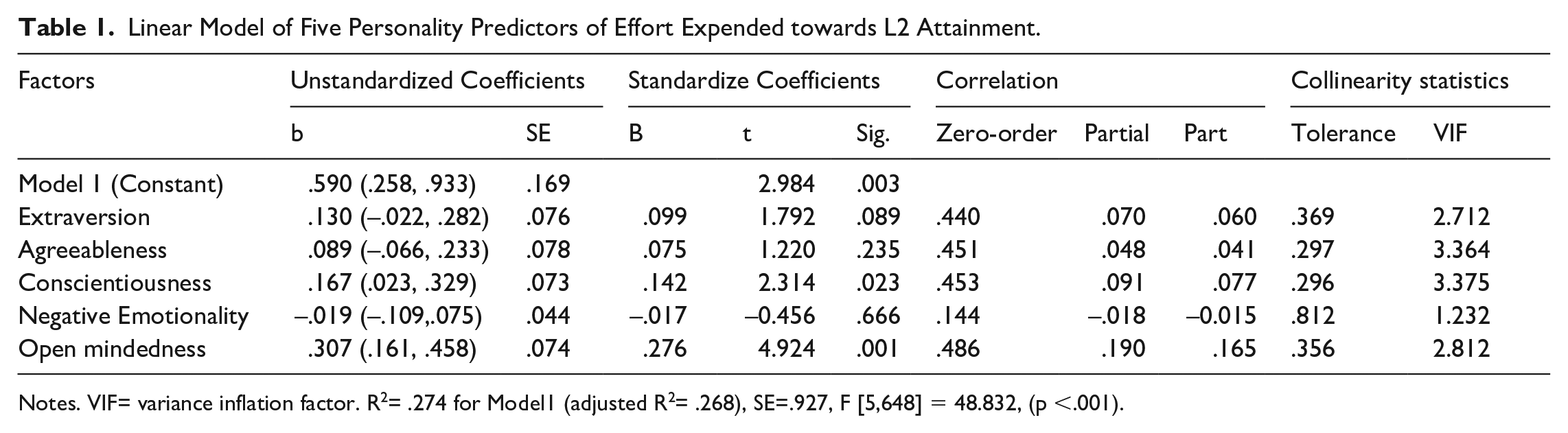
Notes. VIF= variance inflation factor. R2= .274 for Model1 (adjusted R2= .268), SE=.927, F [5,648] = 48.832, (p <.001).
To explore the second research question regarding the amount of unique variance explained in EFL learners’ intended effort (dependent variable) by each of the motivational adaptation variables (independent variables), standard multiple regression was applied. Again as there was some concern over whether motivation variables had violated the assumptions of normality or homoscedasticity, bias corrected and accelerated (BCa) 95% confidence intervals were computed around coefficients parameters based on 1000 bootstrapping samples, which are demonstrated in parentheses in the model summaries in Table 2 below. As Table 2 shows, the three motivational variables explained 83.2 % of the variance in learners’ Intended Effort (adjusted R2= .832), and the overall regression equation was statistically significant (F [3,650] = 1078.398, p < .001). The coefficients, also, show that all the motivational variables are important in this regression. Considering the unique contributions of the individual variables in this Regression Model, the most important variable explaining the criterion measure (i.e. Intended Effort) was Ideal L2 Self that had a statistically significant and very large effect on effort (b= .393 (.324, .457), β= .451, p = .001), and other two variables were also significant predictors of effort but less important than Ideal L2 Self. Attitudes to L2 Learning emerged as the second most important variable explaining effort with a large and statistically significant effect (b= .279 (.213, .343), β= .288, p = .001) followed by the Ought-to L2 Self which had a moderate and statistically significant effect (b= .247 (.174, .324), β= .226, p = .001) (based on their Standardized Coefficients (see Keith, 2015)).
Linear Model of Motivation Predictors of Effort Expended towards L2 Attainment.
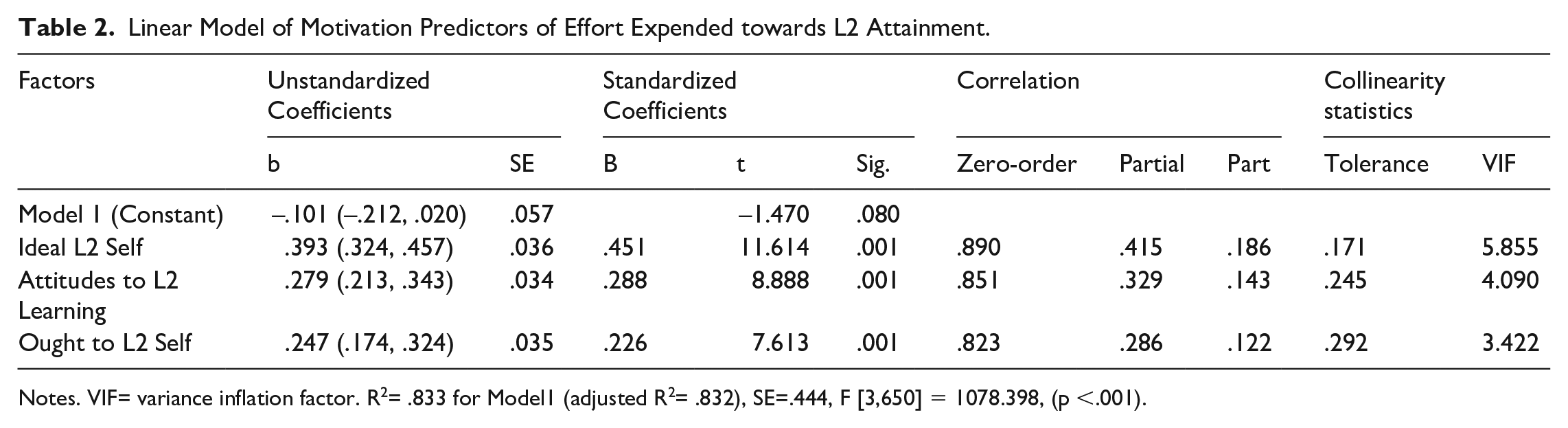
Notes. VIF= variance inflation factor. R2= .833 for Model1 (adjusted R2= .832), SE=.444, F [3,650] = 1078.398, (p <.001).
To explore the third research question regarding the amount of unique variance explained in EFL learners’ Intended Effort by our set of motivational adaptation variables after controlling for the possible effect of DTs, sequential (hierarchical) regression was applied (by implementing bootstrapping). Sequential regression is an appropriate tool for analysis when variance on a dependent variable is being accounted for by independent or predictor variables that have some shared variances by themselves (Pedhazur, 1997). Through sequential regression, researchers can analyse the effect of an independent variable (or group of variables) after controlling for other variables (Pedhazur, 1997). As correlated variables are commonly observed in educational research and are particularly prevalent in SLA, this makes sequential regression quite useful. It also allows the researchers to enter the variables in blocks or steps. In the present study, in the first block, DTs were entered into the analysis. Through this procedure, the effect of these variables were statistically controlled for. In the next step, the motivation variables were entered into the equation as a second block. Through this procedure, the researchers were able to see whether the block of motivation variables were still able to explain a significant amount of variance in the dependent variable.
As Table 3 shows, the first model explained a significant proportion of 26.8 % of the variance in the amount of effort learners reported (adjusted R2= .268; p <.001). When entered into the regression equation, motivation variables explained a further 56.3% of the variance in Intended Effort (change in R2= .563), constituting a highly significant improvement (p <.001). Therefore, second model was chosen as the final model, in which the DTs together with motivational adaptation variables explained a huge amount of the variance (i.e. 83.4%) in the Intended Effort.
Linear Model of Motivation Predictors of Effort Expended towards L2 Attainment after Controlling for the Possible Effect of DTs.
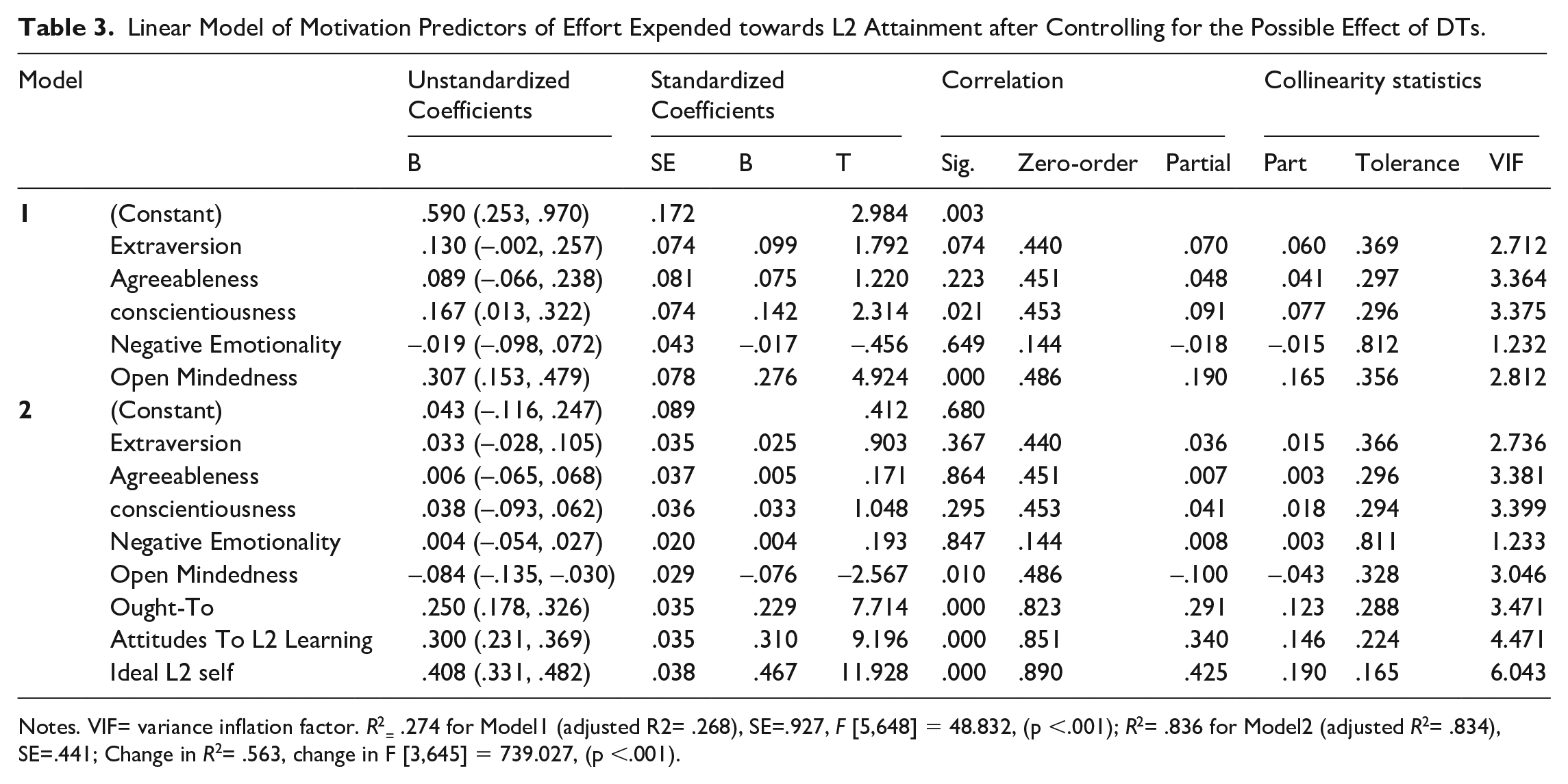
Notes. VIF= variance inflation factor. R2= .274 for Model1 (adjusted R2= .268), SE=.927, F [5,648] = 48.832, (p <.001); R2= .836 for Model2 (adjusted R2= .834), SE=.441; Change in R2= .563, change in F [3,645] = 739.027, (p <.001).
Considering the unique contributions of the individual variables in the model 2, Ideal L2 Self emerged as the strongest explanatory variable (t=11.928; p<.001; β =.467), followed by Attitudes to L2 Learning (t=9.196; p<.001; β=.310) and then Ought-to L2 Self (t=7.714; p<.001; β =.229). Although small and negative, the unique contribution of Open mindedness also reached significance (t= -2.567; p= .010; β= -.076). The remaining variables (i.e. Extraversion, Agreeableness, Conscientiousness and Negative Emotionality) did not make any significant and/or meaningful contribution to the regression equation. Moreover, the huge drop from the full to the partial and part correlations between effort and the DTs and to a lesser degree between effort and motivational adaptation variables suggests that while these two sets of variables are distinct, they do show huge overlap and the DTs are associated to the outcome variable indirectly through motivational adaptation variables. The partial correlation between Ideal L2 Self and Intended Effort was by a considerable margin the highest, indicating that the Ideal L2 Self is the strongest, and the most direct predictor of criterion measure within this model.
Discussion
The present study investigated the possible effects of personality traits and L2MSS on L2 learners intended effort given the theoretical and practical importance of these ID variables and also lack of previous studies in SLA drawing on McAdams’ model of personality.
The findings of the study as regards the first research question show that some trait domains do predict important differences in learners intended effort at strong statistical levels, especially when trait scores are aggregated over time or across varying situations. In particular, Open-mindedness in line with other studies (e.g. Verhoeven and Vermeer, 2002; Ghapanchi et al., 2011) proved to be a robust predictor of learning outcome as it had a substantial and statistically significant effect on Intended Effort. Students perceived to be the most open-minded (i.e. intellectually curious, imaginative, and aesthetically sensitive) reported expending more effort towards L2 learning whereas students perceived to be the most conservative and closed-minded reported comparatively lesser amounts of effort towards L2 learning. Also, Conscientiousness had a significant but moderate effect on Intended Effort and turned out to be a modest predictor of what an L2 learner would do in a learning situation. Within SLA research, Verhoeven and Vermeer’s (2002) study, consistent with present research, found a moderate correlation between Conscientiousness and Organizational Competence (r = 0.28). Other non-L2-studies also reported Conscientiousness as the strongest predictor of academic achievement (e.g. Abe, 2005; Kappe and van der Flier, 2012; Shiner et al., 2003).
Other personality models have traits conceptually similar to Open-mindedness. For instance, Open-mindedness is strongly related to the intuition type of Myers-Briggs Type Indicator (Costa and McCrae, 1992): Closed-minded learners tend to favor concrete and tangible information (sensing), whereas Open-minded ones prefer theoretical and abstract information (intuition)( Sutin, 2017). Interestingly, a study by Ehrman (2008) lends further support to the finding of current research. Using the Myers-Briggs Type Indicator, Ehrman (2008) found that the most important personality dimension amongst the high-achieving L2 learners was intuition – the core of which can be explained primarily by an open-mindedness factor.
More importantly, the findings of the present study as regards the second research question show that L2 motivational self constructs were also significant predictors of the learners’ Intended Effort and accounted for 83.2 % of the variance in it. The most important variable explaining intended effort was Ideal L2 Self which had a very significant and large effect on learners’ effort. As Dörnyei (2014) indicates, the power of mental imagery to simulate reality is at the core of the Ideal L2 Self ’s motivational influence: ‘Learners with a vivid and detailed ideal self-image that has a substantial L2 component are more likely to be motivated to take action in pursuing language studies than their peers without such a self-image’ (2014: 13). Also Attitudes to Learning English was the second most important determinant of effort expended towards L2 attainment. Positive attitudes towards the context of learning and L2 teacher along with motivating materials, activities and tasks seem to strongly affect both the students’ self-concept as well as the enthusiasm they have for learning a second language. Thus, our findings in line with Csizer and Kormos (2009) and Dörnyei (2001) highlight the very important responsibility teachers have towards motivating L2 learners.
The findings of present research, furthermore, is partly consistent with previous studies which indicate that the ideal L2 self both directly and indirectly (through Attitudes to L2 learning) predicts criterion measures. For instance, in their comparative study Taguchi, Magid and Papi (2009) found that in Iran and Japan, the direct route is substantially weaker than the indirect route, whereas in China direct and indirect ones are relatively balanced. Thus, they argued that in China, attitudes towards L2 attainment play a less significant role than in Iran and Japan in affecting the amount of effort expended on L2 learning.
Ought-to L2 Self also had a moderate and statistically significant effect on L2 learners’ expended effort. The Ought-to L2 self seems to play a modest role in predicting the effort Iranian learners invest in L2 as this dimension supposedly acts largely as an extrinsic motivational factor. This is not surprising in the light of other studies demonstrating that intrinsic interests, as represented by the ideal self dimension, are more influential determinants of how much energy and effort learners are ready to expend on L2 attainment than extrinsic forces of motivation (Deci and Ryan, 1985).
The findings of the present research as regards the third research question show that L2 motivational self constructs were also significant predictors of the learners’ Intended Effort even after controlling for the possible effect of DTs and accounted for 54.1% of the variance in Intended Effort. Ideal L2 Self came forth as the strongest explanatory variable followed by Attitude towards L2 Learning and then by Ought-to L2 Self. When personality and motivational variables were both put into the model, effects of the motivational self constructs greatly overshadowed the effects of personality traits. In other words, what causes difference in the amount of effort learners expend on learning English is largely due to their goals and aspirations or fears for learning English than their personality dispositions and L2 self constructs largely mediate the relationship between personality traits and L2 learning. The implication of this finding is that even if L2 learners are not very conscientious (i.e. organized or orderly, industrious, and responsible) or very open-minded (i.e. intellectually curious, aesthetically sensitive, and imaginatively creative), their English proficiency can substantially be improved by motivating L2 learners in the right ways. For instance, a number of conditions are required for these self-guides to enhance learner motivation and to have behavioural outcomes (as proposed by Dörnyei, 2014), including that the L2 learners truly have ‘desired future self-images’ and, additionally, that these desired future L2 selves are ‘sufficiently different from the current selves’, are ‘perceived as plausible’, are ‘elaborate and vivid’, are ‘not perceived as comfortably certain to reach’, are ‘in harmony with other parts of the individual’s self-concept’, are ‘regularly activated in the learner’s working self-concept’, are ‘accompanied by relevant and effective procedural strategies’, and are ‘offset by counteracting feared possible selves in the same domain’ (2014: 9–10).
In conclusion as Dörnyei and Ryan (2015) assert, personality dispositions represent the most recognizable psychological attributes of individuality but their effects on L2 learning behaviours and outcomes is largely mediated through the EFL/ESL learner’s various characteristic tendencies to adapt to particular situational demands, which can thus be considered as interfaces between trait-like dispositions and state-like adaptations. These aspects of L2 learner psychology appear to have the most direct effect on learning outcomes, and as such need more attention in future studies from both the researchers and the practitioners. Future studies also need to focus on topics concerning the relationship between different facets of CAs such as learning styles or strategies etc. and DTs to shed more light on these under-investigated areas of research.
Finally, individuals make sense of all the above interfaces between traits and adaptations by generating an ongoing autobiographical narrative that integrates the disparate dimensions of their L2 psychology and which also guides their future L2 development. So, the L2 narrative identity is an area of inquiry in need of future L2 research.
Supplemental Material
Supplemental_Material_1 – Supplemental material for The Impact of the Big Five Personality Traits and Motivational Self-System on Iranian EFL Learners’ Intended Effort: An Investigation into McAdams’ Model of Personality
Supplemental material, Supplemental_Material_1 for The Impact of the Big Five Personality Traits and Motivational Self-System on Iranian EFL Learners’ Intended Effort: An Investigation into McAdams’ Model of Personality by Majid Ghorbani and Shokouh Rashvand Semiyari in RELC Journal
Supplemental Material
Supplemental_Material_2 – Supplemental material for The Impact of the Big Five Personality Traits and Motivational Self-System on Iranian EFL Learners’ Intended Effort: An Investigation into McAdams’ Model of Personality
Supplemental material, Supplemental_Material_2 for The Impact of the Big Five Personality Traits and Motivational Self-System on Iranian EFL Learners’ Intended Effort: An Investigation into McAdams’ Model of Personality by Majid Ghorbani and Shokouh Rashvand Semiyari in RELC Journal
Footnotes
Funding
The author(s) received no financial support for the research, authorship, and/or publication of this article.
Supplemental Material
Supplemental material for this article is available online.
References
Supplementary Material
Please find the following supplemental material available below.
For Open Access articles published under a Creative Commons License, all supplemental material carries the same license as the article it is associated with.
For non-Open Access articles published, all supplemental material carries a non-exclusive license, and permission requests for re-use of supplemental material or any part of supplemental material shall be sent directly to the copyright owner as specified in the copyright notice associated with the article.
