







Abstract
The ‘multimodal turn’ has led many education systems around the world to incorporate aspects of multimodality into their language curriculum as a response to the contemporary communication environment and new literacy practices of students. In this article, we present and examine findings from a study of the enactment of multimodal pedagogies by two primary level English language teachers in Singapore. Classroom data were collected, transcribed, and analysed in this case study research. We observed eight lessons by two teachers where viewing and representing skills were taught and interviewed the teachers for their reflections on their experience. The lessons were coded in terms of the classroom practices, the knowledge focus, the types of knowledge representations present (conventional or constructed), as well as the source of the knowledge representation (i.e. whether the knowledge was teacher-constructed, student-constructed or jointly constructed by both). Our findings indicate that there was a good balance between teacher and student construction of knowledge. However, most of the knowledge represented in the lessons was factual and procedural rather than conceptual. This suggests that students had few opportunities to critically explore and challenge the knowledge taught and were not guided sufficiently to interrogate the knowledge represented. Representing skills also received less emphasis than viewing skills in the lessons. We discuss the implications of our observations on teachers’ professional learning and advance the argument on the need to pay more attention to multimodal pedagogies in literacy instruction given the incorporation of multimodality in the curricula.
Multimodal Literacy and Multimodal Pedagogies
The ‘multimodal turn’ (Jewitt, 2009: 4) describes the nature of contemporary communication and literacy practices that people are increasingly involved in. While multimodal meaning-making is not a new phenomenon, the ‘multimodal turn’ signals a shift away from the privileging of language towards the recognition of how new digital technologies have greatly expanded the many ways in which meanings are expressed. In education, the ‘multimodal turn’ was ushered in by the manifesto of the New London Group (1996: 62) on multiliteracies in light of the ‘multiplicities of media and modes’ as well as ‘increasing local diversity and global connectedness’. As a part of the multiliteracies movement, many educational systems around the world have incorporated multimodality (Jewitt and Kress, 2003; Lim, 2021a; Van Leeuwen, 2017) into their language curricula and assessments. Literacy is no longer a question of reading and writing language-based texts; students also need to develop multimodal literacy in response to the communicative demands of the digital age.
Multimodal literacy involves working with different types of texts (Kress et al., 2005). These multimodal texts are created with a range of semiotic modes – for example, print, speech, gestures, writing, media (video and audio), charts, graphs, pictures, realia – which are the central elements of meaning-making. They can be used – either individually or together in ‘ensembles’ – in communicative (inter)actions to create links with other times, places and modes (Jewitt et al., 2016). As such, multimodal literacy is about learning the knowledge and skills in engaging with and creating multimodal texts (Lim, 2018) as well as developing a sense of semiotic awareness (Towndrow et al., 2013) in contemporary communication.
Multimodal literacy has been codified as a set of pedagogic metalanguage (Anstey and Bull, 2018; Macken-Horarik et al., 2017) for different semiotic modes and intersemiotic-relations, such as print media (Lim and Tan, 2017), films (Lim and Tan, 2018), image-text relations (Unsworth, 2006, 2017), and digital multimodal composing (Liang and Lim, 2020; Unsworth, 2014, Unsworth and Mills, 2020). Scholars have also produced various other frameworks and models to facilitate the formal incorporation and teaching of multimodal literacy in the classroom, such as the semiotic modes framework (Chia and Chan, 2017), as well as Danielsson and Selander’s (2016) model for working with multimodal pedagogic text. While the importance of multimodal literacy to prepare students for the new communication environment is increasingly recognized and reflected in many literacy curricula around the world, the challenge remains for the teachers on how to design for students’ multimodal literacy learning in the classroom.
In this article, we use the term ‘multimodal pedagogies’ to describe the ways in which the teacher can design learning experiences that facilitate students’ development of multimodal literacy in the classroom (Kress and Selander, 2012). Multimodal pedagogies involve teachers making decisions about which modes of representation to use for particular curricular content, and how these are to be arranged and sequenced. It also involves designing opportunities for students to create multimodal compositions. The enactment of multimodal pedagogies includes the weaving together of a series of representations and commentary into a seamless whole (Bezemer and Kress, 2016) as well as an apt use of meaning-making resources in the design of students’ learning experiences (Lim, 2021b).
The benefits of multimodal pedagogies in enriching classroom teaching and learning are well-documented in Asia. Ganapathy and Seetharam (2016) reported that the use of multimodal texts made English Language lessons more interesting and enhanced students’ levels of engagement, understanding, and retention of the knowledge taught. Similarly in Singaporean secondary school, Anderson et al., (2017) argued that engaging in multimodal text composition allowed low-progress students to develop higher order critical and analytical skills, which the usual classroom literacy practices and activities did not offer. Their findings are consistent with Ajayi’s (2008) earlier observations on the benefits of using multimodal composing activities among high school ESL students who come from marginalized and socioeconomically disadvantaged backgrounds. Jiang and Gao (2020) also observed that the inclusion of multimodal digital composition tasks contributed to the development of digital empathy amongst Chinese EFL learners, and helped to increase their motivation and confidence in expressing themselves in English. Likewise, Chen (2021) reported that the teacher’s multimodal pedagogies in designing opportunities for students’ multimodal composing were well-received by the students, who appreciated the range of meaning-making options.
Notwithstanding, despite these benefits promised by the implementation of multimodal classroom approaches to teaching and learning, studies have reported the challenges in enacting multimodal pedagogies. These include the receptiveness of teachers to engage with multimodality as well as their readiness to teach multimodal literacy (Eilam and Poyas, 2012; Nabhan and Hidayat, 2018; Tan et al., 2019). The enactment of multimodal pedagogies may also be influenced by the nature and focus of the assessment practices (Unsworth et al., 2019). Heydon (2013) found that standardized literacy assessment practices greatly limited the curriculum time and focus for teachers to engage in multimodal pedagogies in the Canadian province of Ontario. Their instructional practices were often influenced by the pressures to teach the ‘must-dos’ – narrowly focused on the language skills which were assessed in standardized tests (Heydon, 2013: 492). A similar tension between new multimodal pedagogies and old language-dominant assessment practices has also been reported in Singapore. Tan et al., (2010: 14) documented a case study of how they progressively transformed the pedagogical practices of a Singaporean high school English Language teacher, where the ‘reading and designing of multimodal texts’ became central, and students were introduced to other semiotic modes besides language. Despite this, the teacher conceded that when confronted with the more pressing need of preparing her students for the all-important year-end examinations, multimodal literacy was ‘good to have’ but ‘not one of [the] top priorities’ in her teaching (Tan et al., 2010: 14).
In this article, we examine how two primary teachers in the English Language classroom in Singapore teach multimodal literacy and reflect on their multimodal pedagogies. Our study is guided by the research question, ‘What is the nature of the teacher’s multimodal pedagogies in the primary English Language subject classroom?’ In particular, we analyse the teachers’ multimodal pedagogies in terms of their classroom practices, the knowledge focus and types of knowledge representations, as well as the sources of knowledge representations by the teachers and students during the lessons. Our research question on the nature of the teacher’s multimodal pedagogies is set against the backdrop where multimodality was introduced as part of the English Language curriculum a decade ago in 2010.
Multimodality in the Singaporean English Language Curriculum
The city-state of Singapore has progressively incorporated aspects of multimodality into the language curriculum. Significantly, the English Language Syllabus 2010 broadened its focus beyond the learning of language to developing multimodal literacy. Students are expected to work with and analyse a variety of multimodal texts. Skills relating to viewing and representing of multimodal texts are also to be ‘taught explicitly’ (Ministry of Education, 2008: 20).
The latest English Language Syllabus 2020 highlights the ‘expanded notions of literacy’ and the ‘renewed emphasis’ on ‘viewing and representing even as the making and creation of meaning are strengthened by rich multimodal perspectives related to different semiotic modes in all areas of language learning’ (Ministry of Education, 2020a, 2020b: 16). The policy intent and signal to teachers is clear in reflecting the shift from a language-based English curriculum to one where multimodal literacy is now formally incorporated.
In light of the curriculum reforms, educational researchers and English teachers in Singapore have been exploring ways in which multimodal pedagogies can be expressed in classrooms. For example, Towndrow and Kogut (2021) explored how the creation of multimodal representations can promote secondary students’ engagement with semiotic work and a heightened sense of multimodal semiotic awareness. O’Halloran et al., (2017) also introduced a pedagogical approach for applying multimodal analysis in critical thinking through the use of a software for multimodal analysis. Other efforts focused on multimodal pedagogies in Singaporean primary classrooms (Chan et al., 2017) and secondary classrooms (Lim et al., 2015). The common goal was to develop multimodal pedagogies which could offer opportunities for the students’ development of multimodal literacy.
Data and Methods
The study reported in this article is part of a larger ongoing multi-phased research project that commenced in February 2019, focusing on the teaching of multimodal literacy in primary and secondary school contexts in Singapore. Phase 1 in the main research project (February to November 2019) involved working with nine teachers and their classes of 244 students from three secondary and two primary schools across Singapore. The objective in Phase 1 of the study was to understand how the teachers were designing opportunities for the students’ development of multimodal literacy (Lim, 2021a). Extending from the work in Phase 1, this present article adopts a case study approach to offer a deeper, more focused analysis of the nature of two primary English teachers’ multimodal pedagogies observed in the same primary school (Casanave, 2010; Yin, 2014). This is done through an analysis of i) the classroom practices, ii) the knowledge focus and types of knowledge representations, as well as iii) the sources of knowledge representations by the teachers and students during the lessons.
The data analysed in this case study comprises the classroom observations and interviews with the teacher participants teaching Primary 5 English Language from Serenity Primary School (anonymized). Serenity Primary School is a publicly funded school situated in a neighbourhood with mostly public housing in the northern part of Singapore. Students take the standard national curriculum and sit for the Primary School Leaving Examination (PSLE) at the end of Year 6. Serenity Primary School has a keen interest in the teaching of multimodal literacy and has made multimodal pedagogies in the English Language classroom the school’s curriculum innovation. In Singapore, while the English Language curriculum applies to all public schools, the teachers exercise autonomy over the pedagogies that they adopt and may choose to use different resources to achieve the curricular outcomes.
The two Primary 5 classes from Serenity Primary School comprised mixed ability students aged 11 years-old on average, and were taught by Sura and Yun (pseudonyms), who at the point of the study had 25 and 10 years of teaching experience respectively. There were 25 students in Sura’s class and 32 students in Yun’s class. The two teachers taught a multimodal literacy lesson package using a picture book chosen by the English department, titled The Colour of Home. This traces the experiences of its young Somalian protagonist, who migrated to the UK with his family to escape war back home. As he takes his first tentative steps settling into a new life, he learns to express himself through paintings, in place of the as yet unfamiliar English language. The vivid and dramatic use of colours in the book thus serve as an apt resource to develop a sensitivity to the meanings in colour.
We observed four lessons by each teacher in July 2019. To capture a holistic and thorough record of these lessons and enable the triangulation of data, various pieces of classroom data were collected from each lesson (Casanave, 2010). All lessons were video-recorded and transcribed verbatim. Researchers sitting in for the lesson observations also made field notes to contextualize and triangulate the observations made from the video analysis, ultimately providing an alternative perspective on the lessons that complements the teachers’ reflections in the subsequent interviews (Casanave, 2010). We interviewed the teachers before and after the lessons and conducted a focus group discussion with students from both classes. Students were also asked to complete a written questionnaire to express their views on the efficacy of their multimodal literacy lessons. In what follows, we limit our discussion to the nature of classroom practices observed and the nature of knowledge representations coded from the videos. Where relevant, we reference data from the teacher interviews to explain our points.
We analysed the video-recorded lessons by segmenting them into three-minute phases following Hogan et al.’s (2009) coding of the lesson phases for the knowledge focus – factual, procedural or conceptual – as well as the types and sources of the knowledge construction. We made a distinction between the source of knowledge representations constructed by the teacher alone, students alone or jointly. We also categorized the types of knowledge representations as either Conventional Representations or Constructed Representations.
Conventional Representations – represent knowledge that derives from social-historical debates on language. For instance, the system of writing (alphabetical letters, punctuation and phonetic symbols) exemplifies conventional forms of representation. Students must learn and use these representations as part of their language learning. Conventional representations usually include textbooks, video clips and workbooks.
Constructed Representations – created by teachers and learners to understand some aspect of language. Although constructed representations might be widely used in classrooms, the rules governing their constructions tend to be less prescriptive and there is a greater autonomy on the part of the agent to represent a concept or problem situation. Constructed representations may also be more limited in their use to solve or represent a restricted class of problems or concepts. For example: mind- and concept-maps on a particular topic or theme, tables and charts, numbered and bulleted lists.
Two researchers completed the coding of all data separately, before coming together for discussions to resolve any differences in applying the coding scheme. The researchers were able to reach a 100% agreement following the inter-rater discussions. The discussions about the plot of The Colour of Home with reference to the text and images were coded under the factual knowledge type, using conventional knowledge sources in the form of page-by-page scans of the actual picture book projected on screen at the front of the classroom. When the teachers explicitly guided students to utilize the semiotic modes to notice details from multimodal texts, they were in effect teaching students the method of deconstructing multimodal meanings by applying the semiotic modes. Such instances were coded as procedural and teacher-constructed knowledge. In Sura’s lessons, when she instructed her students to compare, contrast, and evaluate the impact and effectiveness of publicity posters, her students actively volunteered their justifications, which led to a lively teacher-whole class discussion and demonstrated students’ conceptual understanding of what makes an effective publicity poster. This was coded as conceptual knowledge that was co-constructed by both teacher and students.
Findings
In the interview before the first lesson in the lesson package, both teachers shared that they had previously introduced multimodal literacy to their students. Building on the students’ familiarity, both teachers started the first lesson with similar lesson designs that guided the students in discussing the different ways in which meanings were made in the picture book.
From the second lesson onwards, Sura and Yun diverged in their selection of learning activities and objectives. Sura guided students in learning how descriptive language can be used to describe emotions in narrative writing, and how publicity posters are used to convey meaning through the use of words, images and colours. Yun continued using the picture book as the main learning resource for the remaining lessons. She conducted learning activities, such as role-playing and hot-seating to guide her students in the character analyses from the book.
In her first lesson, Sura introduced The Colour of Home and guided students in viewing the images and understanding the plot. In her second lesson, she explored how gestures make meanings using a series of images to teach how different emotions could be portrayed through body language and facial expressions. This was followed by the third lesson on descriptive language and writing, where Sura introduced phrases for describing body language and facial expressions that depicted various emotions. Examples of such phrases included ‘stood rooted to the ground’ and ‘shaking like a leaf’. In the fourth lesson, Sura taught how images and text could be used together to convey the messages in print advertisements and to persuade the viewer. After this, the students worked in groups to create their own posters about Singapore (this activity was conducted around the time of Singapore’s National Day).
Yun spent the first two lessons going through the story and images from the book. She organized her students to work in groups to come up with questions on the story and invited other groups to take turns to answer these questions. In the third lesson, Yun got her students – again working in groups – to video record themselves performing a short skit based on a scene from the book. This exercise served to reinforce their awareness of body language and facial expressions in conveying emotions. In the fourth lesson, Yun moved on to a character analysis of the protagonist from The Colour of Home. Through a hot-seating activity, she asked her students to imagine themselves as the protagonist and answer questions about the protagonist’s experiences from his perspective.
Sura and Yun’s lessons were examined from the perspective of the research question – that is to understand the nature of the teachers’ multimodal pedagogies in the classroom. The nature of the teachers’ multimodal pedagogies is revealed through an analysis to i) identify the classroom practices observed, ii) code the knowledge focus and types of knowledge representations, as well as iii) identify the sources of knowledge representations during the lessons. Each aspect of the teachers’ multimodal pedagogies is described in the following sections.
Classroom Practices
Both Sura and Yun used multimodal resources, such as photographs, video clips and digitized pages of the picture book, during five of the eight lessons (Table 1). The three lessons where multimodal resources were not used included Sura’s third lesson, where purely written texts were used to teach descriptive writing, as well as Yun’s third and fourth lessons, where the class activities centred on role play and hot seating.
Classroom Practices Observed.
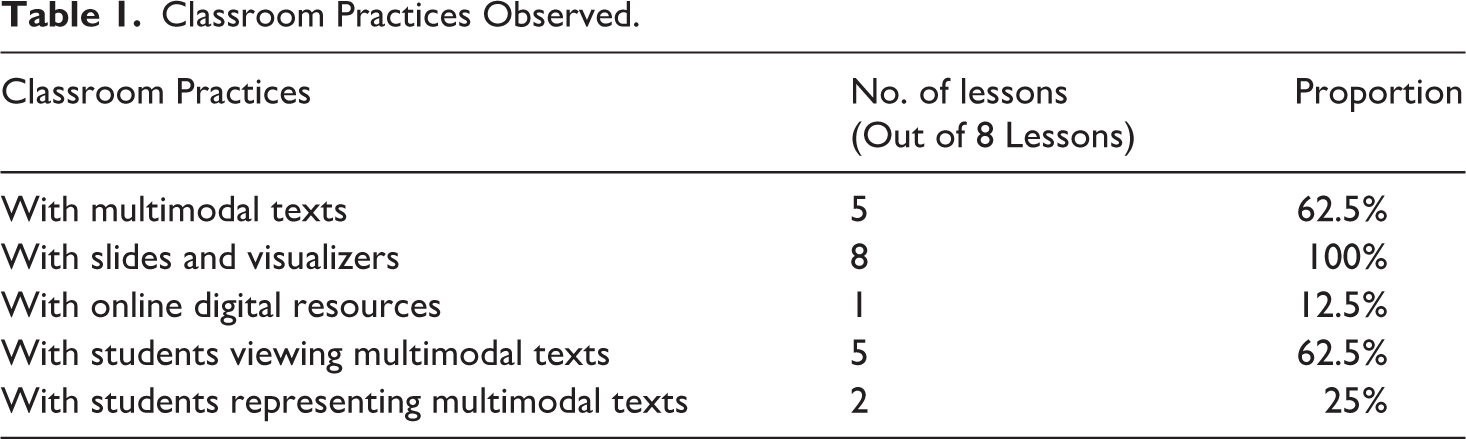
The teachers used simple technologies, such as slideshows and visualizers in all the lessons. Online digital resources were rarely used, including the use of the Internet for the search and retrieval of information during the lesson. This is with the exception of Yun who used Google Earth in her first lesson to show Somalia’s location on the map and in relation to Singapore.
Five of the eight lessons involved engaging students in the viewing of the multimodal texts. The teachers reminded students how these modes work to create meanings and used questions to direct attention to specific meanings made multimodally. They also used group discussions to have students identify the modes and meanings. Yun explained during the interview that the school’s English department chose The Colour of Home as an instructional text in addition to the regular reading texts prescribed in the syllabus, ‘because the book is richer in terms of illustrations and pictures, whereas the [regular prescribed texts are] quite limited to text’. Selecting an authentic picture book allowed the students to become ‘more familiar with the different semiotic modes’. As Sura shared in the interview, reading The Colour of Home was a different experience for her students compared to reading other texts. The Colour of Home ‘has really nice pictures’ and was ‘on a different conceptual level altogether – we’re not just looking at words; we’re looking at the message that the author and illustrator are working together to deliver’.
To enrich students’ understanding of the book, Sura asked questions that directed students’ appreciation of the pictures, colours, use of space and facial expressions. Yun also guided her students to ‘delve deeper’, ‘to take note of the details in the picture’, ‘to notice certain things’ and to ‘read between the lines’. Beyond The Colour of Home, Sura also used ‘advertisements that are very colour-based’ for her fourth lesson, to reinforce her students’ understanding of the visual mode.
The focus on representing skills was less prevalent than viewing skills in the lessons observed. Two of the eight lessons had opportunities for the students to create multimodal compositions. These referred to Sura’s fourth lesson on poster-making and Yun’s third lesson on play-acting and skits. The field notes also reported that little guidance was given by the teachers to the students in the design and development of the artefacts. The reasons for these instructional decisions were revealed by the teachers in the interview. Sura pointed out that ‘[representing skill] doesn’t show up in the exams at all’ and this lack of attention to representing skills in the formal assessments has in turn influenced teaching practices. Sura felt that in contrast to teaching representing skills, more curriculum time should be dedicated to ‘enrich[ing] [students’] language learning’ and ‘beef[ing] up their writing’.
Knowledge Focus and Types of Knowledge Representation
Table 2 displays the correspondence analysis of knowledge representations by three illustrative types of knowledge foci at the phasal level – factual (e.g. dates, facts, names, definitions), procedural (how to undertake a particular task or solve a problem, rule-based grammar, the structure of texts and methods of inquiry) and conceptual (meaning-making, the relationships between concepts, patterns and understandings). We calculated the percentages in Table 2 by dividing the total number of coded phases for a particular correspondence within lessons by the total number of phases across all coded lessons (i.e. 165 phases). The same representation could appear across multiple phases within and across lessons, and more than one representation could appear within a single three-minute lesson phase, e.g. within the same three-minute phase, both conventional factual and teacher-constructed factual knowledge could be present.
Knowledge Representations by Knowledge Focus.

The main knowledge focus in the lessons was factual in nature with a much lower presence of procedural knowledge and even lower conceptual knowledge focus. An example of factual knowledge focus is using conventional representations, such as showing a documentary video clip on the plight of Syrian migrants to the students. Factual knowledge was expressed through constructed representations when Sura taught the students about the differences in meaning and grammatical parts of speech for the words ‘refuge’ and ‘refugee’ using PowerPoint slides that she had prepared.
Procedural knowledge focus was expressed when the teachers guided students on how they could apply their knowledge of the semiotic modes in the viewing of the multimodal aspects of the book. The presence of procedural knowledge reflected the intent of the teachers in guiding students on the viewing of the multimodal texts by discussing the meanings made through the different semiotic modes.
Conceptual knowledge, where associations are drawn and relationships are made between pieces of knowledge, was less commonly present in both teachers’ lessons. An exception was in Sura’s third and fourth lessons when the students voiced their arguments and justifications for what they thought to be an effectively written piece of narrative writing (third lesson) and an effectively designed tourism publicity poster (fourth lesson). In these discussions, students not only had to know what a narrative or a publicity poster was, they also had to exercise their judgement and develop their explanations for why they had evaluated one narrative to be better written than another, or why one publicity poster might be more effective in getting its message across than another.
Sources of Knowledge Representation
Table 3 reports the types and sources of knowledge representations. The total number of phases for Sura was 78, while that for Yun was 87. In total, there were 165 phases coded for both teachers across all eight lessons. Table 3 indicates the proportion of knowledge representations by source per lesson. Like in Table 2, we arrived at our calculations by dividing the total number of coded phases across lessons where a particular type of knowledge representation was present by the total number of phases across all coded lessons (i.e. 165 phases). The same type of knowledge representation could appear across multiple phases in a single lesson, and more than one type of knowledge representation could appear within a single three-minute lesson phase. For example, within the same three-minute phase, both conventional and teacher-constructed representations could be present. The total number of phases coded for the four types of knowledge representations therefore exceeds the total number of phases constituting the eight lessons.
Knowledge Representation.
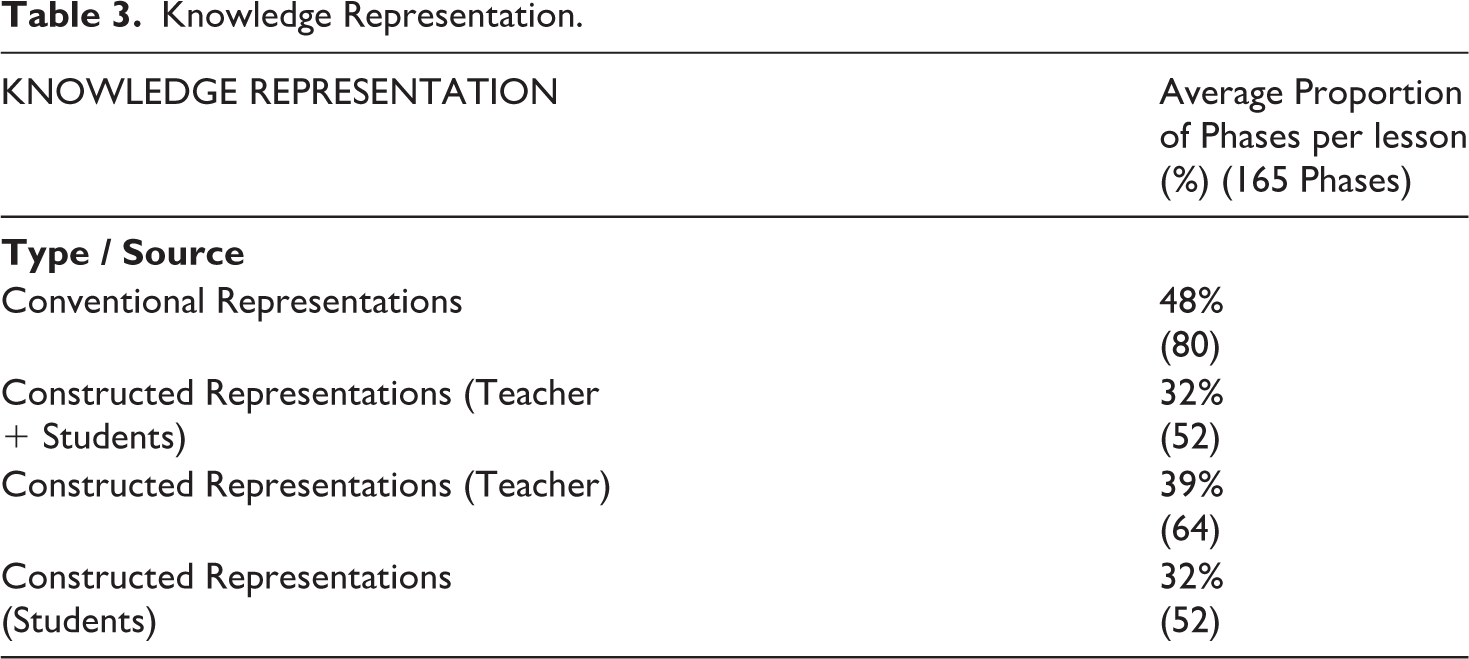
While conventional representations were used most often (48%), constructed representations were also used (32%). Examples of such conventional sources of knowledge used in Sura and Yun’s lessons included picture books, publicity posters and advertisements, videos, as well as web applications like Google Earth and online dictionaries. The range of conventional knowledge sources observed in Sura and Yun’s classes suggests that both teachers introduced authentic materials into their classrooms as teaching and learning resources instead of simply relying on teacher-constructed sources of knowledge, such as in the form of the teacher writing on the whiteboard or teaching from a deck of PowerPoint slides.
In both Sura and Yun’s lessons, emphasis was given to both the teachers’ and the students’ constructed representations at 39% for teachers and 32% for students respectively. Examples of constructed representations observed in the lessons included teacher explanations of the semiotic modes, student group discussions on character analysis, and teacher-led whole class discussions on what constitutes an effective piece of descriptive writing (as in Sura’s third lesson) or poster (Sura’s fourth lesson). The amount of time which students were actively involved in constructed representations suggests that they were not positioned entirely as passive knowledge receptacles in a teacher-dominated classroom. In the lessons, students were involved in a range of collaborative learning tasks which was followed by opportunities for them to present their work and for the teachers to comment on and critique it. Both teachers also seemed to value the students’ contributions as indicated by them frequently inviting students to speak up during the lessons, and building on their responses to co-construct knowledge.
Discussion
The nature of multimodal pedagogies demonstrated by the two teachers reveal an intentionality in the development of multimodal literacy in the students. Similar to findings of studies in Asia, such as Ganapathy and Seetharam (2016), Anderson et al. (2017), and Chen (2021), the teachers demonstrated competence in designing learning experiences that facilitated students’ development of multimodal literacy in the classroom through the adept use of multimodal representations (Bezemer and Kress, 2016).
In terms of classroom practices, both teachers made clear efforts to use multimodal texts as well as simple digital technologies as resources for learning. The practice of including materials from the students’ lifeworlds (New London Group, 1996) in teaching and learning helps students to connect what they have learnt in the classrooms with their out-of-school experiences, thereby increasing the relevance and relatability of classroom learning.
However, the low presence of representing activities during the lessons, in the form of opportunities for the students’ creation of multimodal compositions, can be of concern. The absence was attributed to the fact that representing skills were not assessed in the national examinations. As Heydon (2013) and Tan et al. (2010) highlighted, what is and is not assessed in national examinations plays a significant role in shaping pedagogical practices and curriculum coverage in the classroom. This again is reflected in our study and points to the need for assessment reforms and to better align curriculum and assessment foci (Unsworth et al., 2019).
Our analysis of the knowledge focus also shows that the knowledge focus in the lessons of both teachers was more factual and procedural than conceptual in nature. This means the students had fewer opportunities to view knowledge as meaning-making and explore the relationships between concepts, patterns and understandings from various perspectives. This is consistent with what has often been associated with Singapore’s education system (Hogan, 2014: 1), where ‘the transmission of factual and procedural knowledge’ is cited as a common trait. This can be of concern because the dominance of factual and procedural knowledge in the lessons could discourage students from challenging the knowledge they are taught and students may also not be guided to interrogate the knowledge represented during the lesson (Hogan, 2014). As such, a shift in multimodal pedagogies towards guiding students in critical analysis of multimodal texts (O’Halloran et al., 2017) and in providing them with a set of metalanguage for multimodal meaning-making (Lim and Tan, 2017; Lim, 2018; Macken-Horarik et al., 2017; Unsworth, 2006; Unsworth, 2014) could be empowering.
The teachers were intentional in using a blend of conventional and constructed representations and both teachers and students had opportunities to construct knowledge representations. One way this could be done is to allow students opportunities to connect concepts introduced in the classroom using a range of multimodal representations that they design for themselves. This is an area for future investigation in a variety of literacy instruction contexts. Providing opportunities for multimodal meaning-making is important as it can bring about positive washback on students’ learning of criticality, empathy, and even confidence (Jiang and Guo, 2020).
Admittedly, Sura and Yun are unique in that they teach in a school that has a keen interest in teaching multimodal literacy and has made multimodal pedagogies in the English Language classroom the school’s curriculum innovation. As such, their proficiencies in multimodal pedagogies cannot be generalizable to all teachers in Singapore schools. This is not the objective of the study. Rather, the objective of this case study research is to unpack the nature of multimodal pedagogies of a teacher in a primary English Language classroom, thereby creating a critical and dialogical space for readers to consider the ways in which the case of two teachers could or could not be applied to their own teaching circumstances. Instead of imposing what and how the multimodal pedagogies should look like, Sura and Yun demonstrated how multimodal pedagogies can look in the primary English Language classroom. In this, our study advances our understanding of multimodal pedagogies and how they can be practically enacted in the English Language classroom. While what Sura and Yun have shown may not be the idealized nature of multimodal pedagogies, they offer a realistic snapshot of what is presently achievable. Further research could be undertaken to explore the nature of the teachers’ multimodal pedagogies across a wider range of schools, both in Singapore, and around the world.
Conclusion
While multimodal curricula modifications and evolution are necessary, they are not sufficient to ensure deep instructional change over time. As many studies around Asia such as Bautista and Gutierrez (2020), Nabhan and Hidayat (2019), and Tan et al., (2019) have highlighted, teachers’ professional development remains key to enacting the curricular changes. An approach towards teacher-change, as part of the broader research project from which the present study is drawn, is described in (Lim and Nguyen, in press). Design-based research focusing on co-creation and transfer of expertise amongst educational researchers, curriculum specialists, and teacher practitioners is adopted to build up teacher leaders who will be change agents in their schools and lead subsequent communities of practice across schools. Teachers could be encouraged to develop communities of practice as they innovate and experiment with a repertoire of multimodal pedagogies as well as share lesson ideas and resources as a fraternity (Pang et al., 2015; Sharari et al., 2018). This, coupled with professional learning sessions through regular in-service workshops, as well as courses on multimodal literacy for pre-service teachers, can build teachers’ capacity in multimodal pedagogies.
In light of the importance and urgency of diversifying and enriching literacy practices, we advance the argument that teachers must create opportunities for students’ meaning-making practices that acknowledge the rich multimodal textual world we live in. We argue that a crucial shift in the teachers’ multimodal pedagogies would be a move towards designing more opportunities for students’ making of multimodal knowledge representations that draw on their prior knowledge and experience, and connect what they learn in school with what they experience out of school.
Footnotes
Acknowledgements
The authors thank Thi Thu Ha Nguyen for her assistance in the data collection and coding. They also thank the participating school and teachers for their contribution to this study.
Funding
The author(s) disclosed receipt of the following financial support for the research, authorship, and/or publication of this article: The data for this paper are from the study “Integrating Multiliteracies into the English Language Classroom: Developing an Instructional Approach to Teach Multimodal Literacy (Critical Viewing and Effective Representing of Multimodal Texts) (DEV 01/18 VL)” funded by Singapore Ministry of Education (MOE) under the Education Research Funding Programme (DEV 01/18 VL) and administered by National Institute of Education (NIE), Nanyang Technological University, Singapore. Any opinions, findings, and conclusions or recommendations expressed in this material are those of the authors and do not necessarily reflect the views of the Singapore MOE and NIE. This research has received clearance from the NTU-Institutional Review Board [IRB-2019-2-038].
