







Abstract

Introduction
Despite the importance of communicative activities for English as a foreign language (EFL) speakers’ willingness to communicate (WTC) and speaking skills (Rahimi and Fathi, 2022), factors such as class size, insufficient class time, administrative constraints and limited exposure to English may impede English-speaking learning (Peng and Woodrow, 2010). With the advancement of technology, artificial intelligence (AI) speaking tools have been leveraged to address the aforementioned issues and enhance EFL speakers’ communicative competence (Tai and Chen, 2023). In light of this, this technology review offers an overview of Deep English, an AI-empowered tool that provides engaging, interactive and personalized learning experiences to optimize English-speaking learning outcomes.
Overview
Deep English aims to help EFL learners move up the fluency ladder by integrating listening, speaking and discussion with the AI-powered Chatbot and real people (Figure 1). It can be accessed directly through its official website or with iPhone and Android apps and offers a Google Chrome extension for word translation. Two versions are available: the free version providing listening practice only and the premium version called Fast Frequency Formula (FFF) for $49 per month providing access to all features.
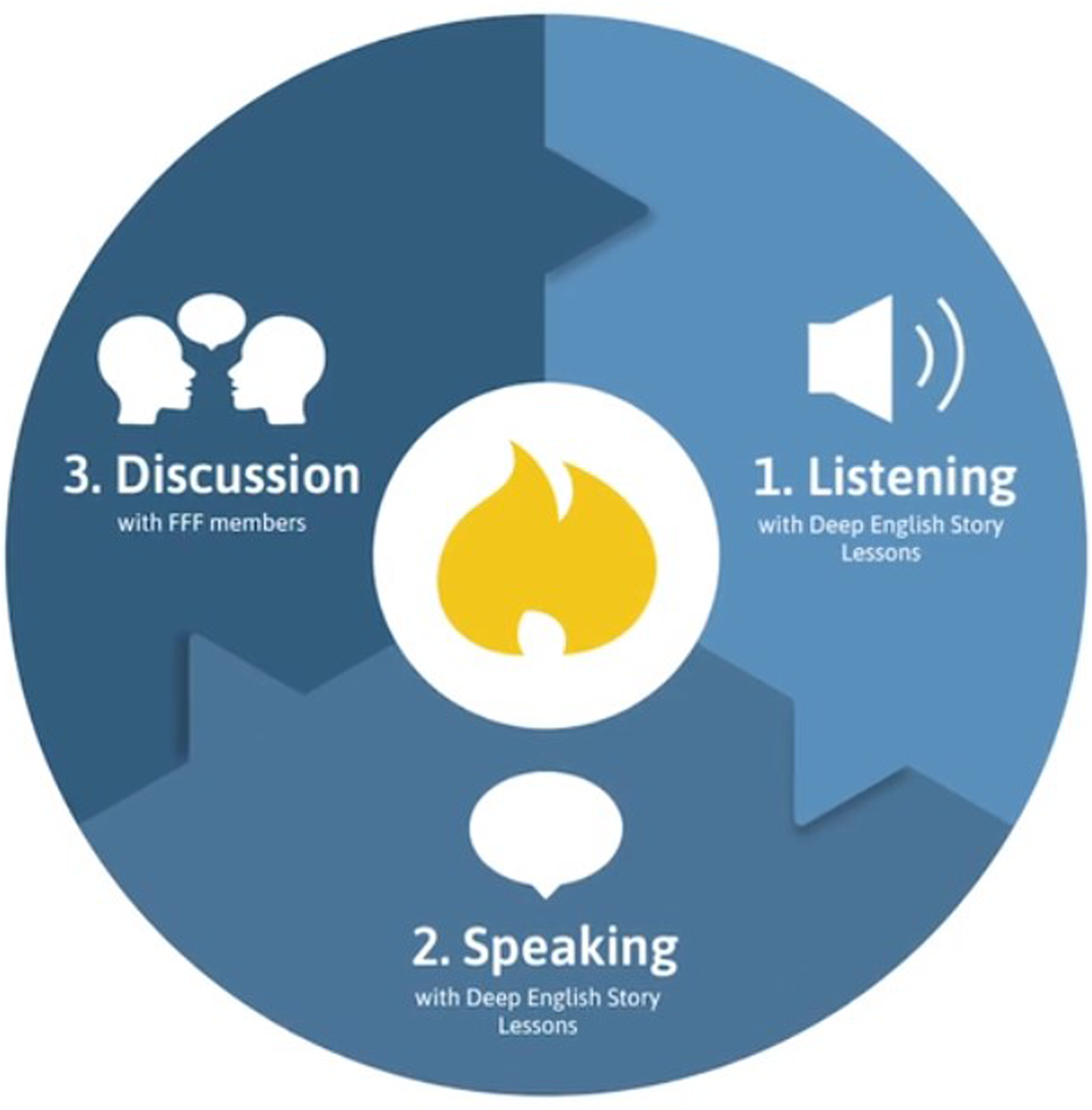
Features of Deep English.
FFF offers speaking activities through weekly and monthly story audio sessions (Figure 2). Each story is recorded in two versions (i.e. Breakthrough and Advanced) at three speeds (i.e. slow, normal and fast). The Breakthrough version features simpler sentence structures and vocabulary than the Advanced version, serving as a bridge to more advanced levels. The three speeds allow users to choose one that aligns with their ability.
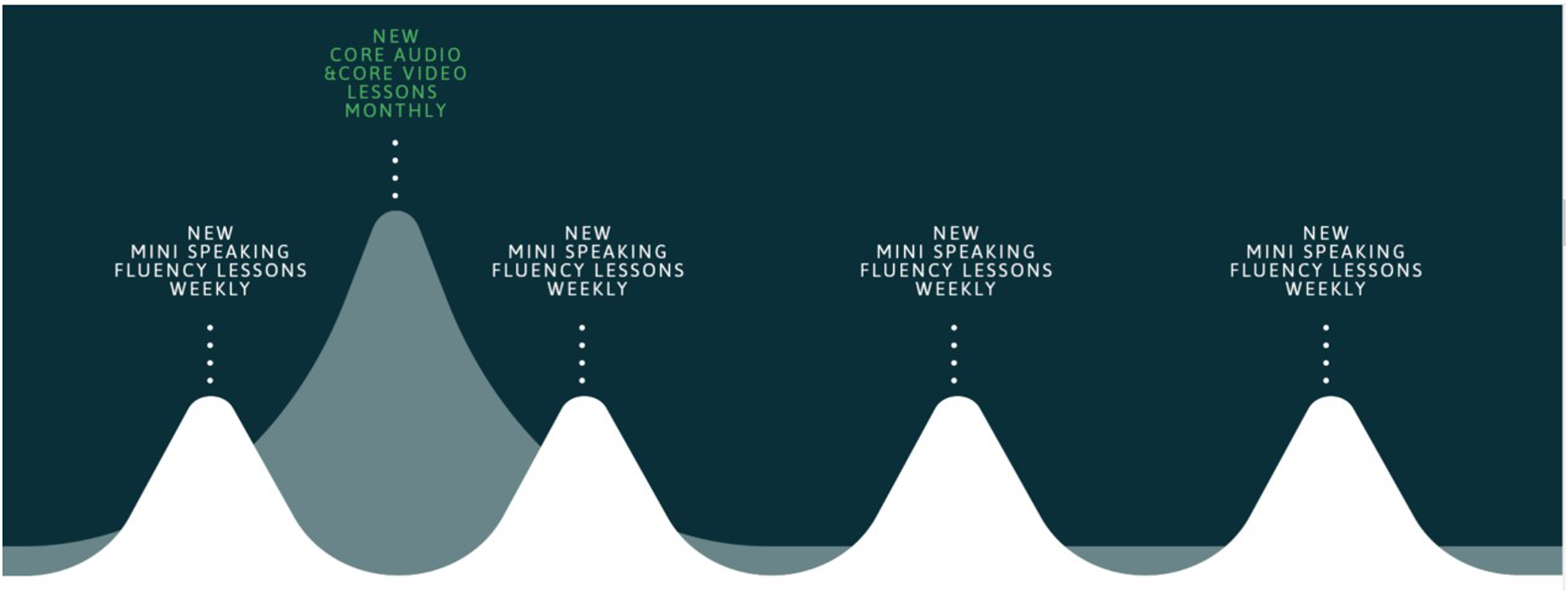
Monthly and Weekly Story Lessons.
FFF members also have access to an AI-powered Chatbot offering a wide variety of speaking activities, such as grammar workouts, roleplay and others. Featuring ‘Correct My English’, the Chatbot converts users’ spoken words into texts and presents the revised version in spoken and written forms (Figure 3). Beyond communicating with AI, a vibrant community has been developed where learners can talk with other FFF members.
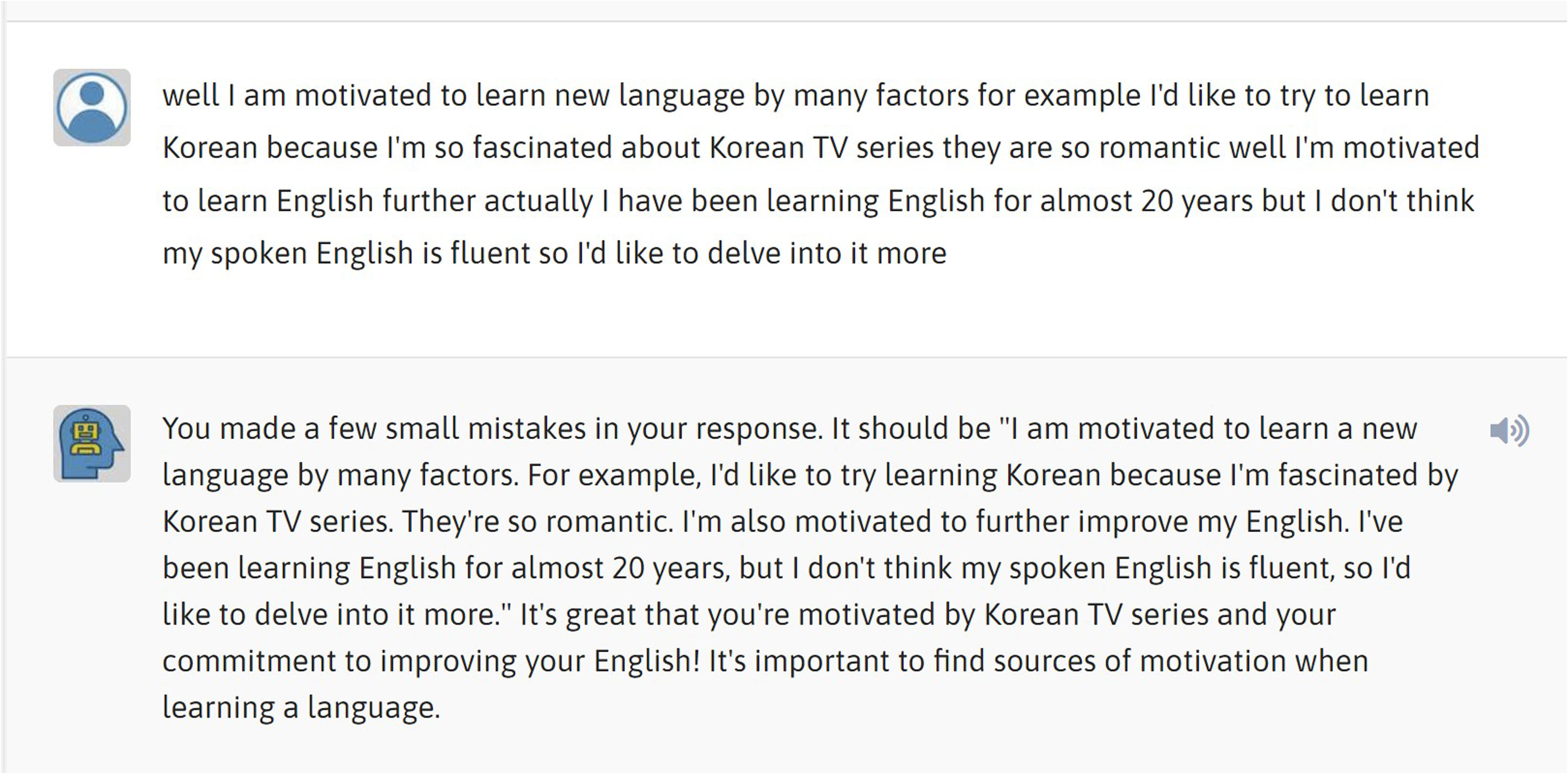
An Example of Communicating with the AI-Powered Chatbot.
Pedagogical Benefits in English-Speaking Learning
Deep English brings several pedagogical benefits by offering stimulating topics, supporting adaptive practice, providing immediate feedback and safe environments, and making English-speaking learning more engaging at different stages of instruction.
First, Deep English consistently releases captivating story audios, enticing English learners to engage in listening and speaking practice on stimulating materials. These stories can alleviate anxiety related to vocabulary retrieval and sustain users’ motivation and interest in English-speaking practice (MacIntyre and Legatto, 2011). Furthermore, the materials are curated at different levels and speeds, enabling English teachers to tailor them to students’ proficiency adaptively.
Second, the AI-powered Chatbot provides learners with multi-form tailored feedback and a supportive environment. Spoken and written feedback enables users to identify discrepancies in their speaking, accumulate vocabulary and sentence structures, and expand their language repertoire (Barrot, 2022). Furthermore, the less-threatening environment created by the AI-interactive context may reduce students’ concerns about making mistakes and motivate them to express ideas, contributing to enhanced WTC and speaking proficiency (Tai and Chen, 2023). The individualized and supportive learning experiences compensate for limitations imposed by traditional classes with large sizes.
Third, Deep English empowers teachers to create immersive and engaging learning experiences at different stages of English-speaking instruction. Before class, Deep English's regular stories can serve as warm-up activities, aiding students in familiarizing themselves with topics and vocabulary. During class, teachers can design collaborative speaking tasks, including role plays and debates on similar topics. After class, AI-based Chatbot interactions can be incorporated as part of students’ communication practice to extend learning beyond classroom hours, thus promoting communication competence (Rahimi and Fathi, 2022). This full-stage integration expands students’ exposure to English and aids in formative and summative assessments, relieving teachers of an administrative burden.
Limitations
While Deep English brings several pedagogical benefits, it still has some limitations. First, the time limit of 45 seconds for each message to the AI-powered Chatbot restricts the length of individual messages, disrupting the natural flow of conversation and hindering in-depth interactions. Second, the AI-powered Chatbot's spoken English correction mainly focuses on grammatical appropriateness and overlooks communicative function. In addition, the Chatbot faces challenges in accurately recognizing the speech of EFL learners, particularly when they have accents. In light of these limitations, other learning activities should be complemented. Face-to-face communications are encouraged to ensure an interactive and natural experience. Furthermore, teachers’ emotional support and feedback on learners’ speaking performance beyond their grammatical correctness may enhance their confidence, motivating them to use Deep English more effectively and critically.
Conclusion
Despite the limitations, Deep English is still a promising AI-powered speaking tool that can assist EFL learners in improving their English-speaking proficiency. It motivates EFL speakers to engage in interactive and captivating speaking activities and provides them with a stress-free and authentic learning environment where they are encouraged to express their thoughts. For more information on Deep English and its features, visit https://deepenglish.com/.
