







Abstract
English functions as a widespread communicative resource which is protean − highly adaptable in form − and shaped by contingencies of context. This situated variability constitutes clear evidence that pragmatic competence is central in effective language use. Understandings of English as an emergent practice therefore inform the pedagogical and administrative framework of an English as a Lingua Franca (ELF) programme at a private university in Tokyo. Within this framework, departures from native-speaker norms are interpreted as expressions of the diversity of global English use rather than as deficiencies. Despite the importance of pragmatic competence for successful ELF interaction, its role in assessment within the programme has remained largely implicit, a limitation which forms the basis of the rationale for the present study. Accordingly, this study proposes a framework of analytic rubrics aimed at making pragmatic competence in speaking more overt and assessable, expressed through attention to three interrelated constructs: intelligibility; linguistic accommodation; and communication strategies. Founded on ELF research and established principles of language assessment, the framework emphasizes clarity-oriented intelligibility work, adaptive linguistic accommodation and multistep meaning−negotiation strategies, reflecting salient pragmatic processes identified in ELF research. Each construct is exemplified by samples drawn from the English as a Lingua Franca in Japan Corpus, a resource developed by teacher-researchers in the programme. The framework therefore challenges evaluative paradigms which reward linguistic ‘correctness’ and risk marginalizing multilingual speakers whose context-specific language use facilitates successful transcultural communication regardless of conformity to native norms. Although not yet implemented, its construct-oriented design is intended to support engagement with ELF-related pedagogies and to facilitate critical language awareness. The study also proposes future directions, including rubrics for written ELF and learner-facing iterations for self-assessment, while offering a reference point for integrating ELF-aware speaking assessment into English language teaching programmes.
Keywords
Introduction
The rubric framework introduced in this study is a local pedagogical development reflective of current scholarly interest in reconceptualizing pragmatic competence in pluralistic terms. From an English as a Lingua Franca (ELF)-aware perspective, pragmatic competence refers to a capacity to participate in emergent, interactional meaning-making, achieved through alignment, repair and flexible resource use (Walkinshaw 2022; Jenkins 2022; Kaur 2022), rather than an ability to conform to native-speaker norms. Observations of ELF interactions suggest that departures from native-speaker norms seldom disrupt communicative success when interlocutors collaboratively negotiate meaning (Walkinshaw, 2022: 1–3). Accordingly, accommodation is not a unidirectional convergence (a one-way adjustment toward native norms), but a contingent, reciprocal process during which interlocutors adapt to each other during ELF interaction (Jenkins, 2022: 20–23). Furthermore, pragmatic strategies such as pre-emptive elaboration and multistep repair sustain intelligibility (Kaur, 2022: 37–44). These interactional processes form the basis for the analytic constructs articulated in the rubrics presented in this study.
English as a Lingua Franca-aware pedagogy addresses inequities ingrained in assessment systems by challenging entrenched ideas, embedded ideologies and antiquated practices associated with ‘narrow and intransigent conceptualizations of TESOL [teaching English to speakers of other languages]’ (Toh, 2019: 8) which Toh argues obstruct ‘transformative, humanizing, and contextually responsive’ education (Toh, 2019: 8). Such inhibitory influences maintain reductive views of language as bounded and static, reinforcing native-speaker norms while obscuring the performative, emergent and negotiated realities of global English use (Toh, 2019: 8). In contrast, ELF involves contextually appropriate communication with reference to intelligibility, pragmatic effectiveness and responsiveness to diverse interlocutors. As Widdowson (2015: 364–368) observes, ELF interaction brings into focus pragmatic processes through which meaning is achieved: speakers adapt linguistic form to communicative function; draw on and re-use each other's formulations; and collaboratively secure shared understanding. As Seidlhofer (2011: 198) explains, an ELF-aware perspective redirects pedagogic attention toward learners themselves and the processes through which they engage in meaning-making.
The Center for English as a Lingua Franca (CELF) at Tamagawa University accordingly positions its teaching and assessment practices as a deliberate counter to the essentialist and reductionist modes of thinking (approaches that treat language as fixed, uniform and norm bound) which Toh (2019) critiques (see also Toh, 2016). Nevertheless, there remains scope for transformative approaches to be more explicitly manifested across the curriculum. This study is an attempt to contribute to that objective by introducing a pragmatic competence assessment framework for speaking, informed by ELF-aware assessment design, with the aim of resisting educational approaches founded on native-speaker ‘correctness’ which marginalize non-native English users.
To situate the framework within its context, the following section outlines the programme's origins, theoretical underpinnings and learner profile.
The teaching context
Following the establishment of an English programme at Tamagawa University in 2013, CELF was founded in 2014, supporting the institution's international orientation. CELF offers a campus-wide ELF programme encouraging students to engage with English as both a widely circulating communicative resource and a local practice.
Classes typically comprise 18 to 22 predominantly Japanese first language speakers at beginning to pre-intermediate proficiency levels, taught by instructors from diverse linguacultural backgrounds. This pedagogical context underscores the need for developing a more explicit framework for assessing pragmatic competence.
Reason for the innovation
As Walkinshaw and Kirkpatrick (2022: 232 −233) assert, it is important to take pragmatic competence into account in higher-education contexts in view of the multilingual realities of ELF communication. At CELF, although classroom activity is generally expected to facilitate pragmatic flexibility and assessment rubrics which address pragmatic competence in general terms are available for CELF teachers to use and modify (summarized in the resource overview later in this section), there is scope to improve the extent to which the rubrics specifically reflect intelligibility, linguistic accommodation and communication strategies.
The underrepresentation of pragmatic constructs in language assessment reflects a broader issue emphasized by Shohamy (2001) who contends that tests wield considerable power by privileging certain constructs while marginalizing others. As Shohamy observes, tests are used in education and society to impose policies, define knowledge, gatekeep and perpetuate existing power structures (Shohamy 2001, Introduction: 6), each of which may be pertinent to tests which diminish pragmatic and interactional dimensions, prioritizing formal linguistic features instead. The degree to which pragmatic constructs in language assessment are underrepresented is also evident in Jenkins’ (2020: 474–476) observation that high-stakes English language tests remain strongly oriented toward native-speaker norms, thereby overlooking diversity and variability which inhere in ELF communication.
In light of the general underrepresentation of pragmatic constructs in language assessment, the overview which follows indicates the extent to which a pragmatic orientation is already present in CELF's pedagogical resources and assessment practices, by outlining relevant resources available to teachers. Via the learning management system, teachers may access resources to support ELF-aware teaching, including a framework to facilitate ELF-aware pedagogy, which is an internal document for on-campus use. This framework emphasizes communicative function rather than form in the teaching and assessment of aspects such as grammar, pronunciation and syntax, and the development of strategies such as paraphrasing, clarifying and confirming understanding. It also maintains that English is not a fixed code tied to specific communities and that native-speaker conformity is not required for successful communication. Additional resources include a Portable Document Format file of activities for ELF classrooms, provided only for use within the programme, designed by CELF full-time teachers for students at various levels of proficiency. The lesson plans which specifically address pragmatic competence to a significant extent are related to English communication strategies, Englishes in the world and intercultural communication.
At the time of writing, CELF speaking rubrics include four performance levels (excellent, proficient, basic/developing and limited/minimal) within seven dimensions: clarity and effectiveness of ELF communication; idea organization; back channelling; communication strategy use; lexical appropriacy; cultural referencing; and collaborative engagement. Levels of proficiency within each dimension are indicated by adverbs of manner (e.g., consistently and effectively uses communication strategies). While these rubrics acknowledge aspects of pragmatic competence, they do so with limited elaboration of specific clarity-oriented adjustments, specific accommodation practices, or specific negotiation strategies. The analytic framework proposed here therefore represents a more explicit and theoretically grounded articulation of pragmatic constructs.
To recognize adaptation, accommodation and consequent achievement of communicative success as valid indicators of ELF proficiency, this study focuses on three interrelated constructs: intelligibility; linguistic accommodation; and communication strategies. Intelligibility is understood as a co-constructed, emergent achievement, established ‘in flight’ (Widdowson, 2015: 366) through reciprocal adjustments during interaction. Rather than relying on pre-established norms, ELF users negotiate meaning, adapting pronunciation, lexis and discourse structure as communication unfolds (Widdowson, 2015: 364–366). Linguistic accommodation is similarly locally generated, as interlocutors reformulate, repeat and creatively recombine linguistic resources to establish common ground and develop shared conventions in the course of interaction (Widdowson, 2015: 364–366). Communication strategies such as paraphrasing, prosodic adjustment and lexical innovation, are therefore not deviations from idealized norms but evidence of pragmatic adaptability and cooperative engagement in the moment (Widdowson, 2015: 364–366). These processes exemplify what Widdowson (2015) describes as the pragmatics of variation: language use shaped by communicative function rather than adherence to fixed forms. This orientation directly informed the rubric design: descriptors avoid native speaker forms and instead emphasize adaptive, interaction driven practices which reflect how ELF users achieve shared understanding in diverse contexts. The framework presented here is therefore consistent with evolving discourse (Li, 2020; Tajeddin et al., 2020) on reconceptualizing pragmatic assessment in English as an international language contexts by moving beyond native-speaker paradigms toward interactional adaptability and context-sensitive evaluation.
Accordingly, the selection of these three constructs is a principled response to the limitations of native-speaker-normative assessment. Rubrics which privilege formal accuracy, lexical range, or native-like fluency do not accurately reflect the processes by which multilingual speakers achieve communicative success in ELF settings. By contrast, intelligibility work, linguistic accommodation and communication strategies pertain to the adaptive, collaborative and context-responsive practices which sustain ELF interaction. The rubric therefore represents a shift from evaluating conformity to native norms toward evaluating the interactional processes through which meaning is co-constructed.
A construct-oriented analytic rubric is appropriate for assessing spoken ELF communication because ELF interaction is characterized by emergent, co-constructed meaning, rather than stable form-based norms. Analytic descriptors allow assessors to attend to the interactional processes, such as intelligibility work, repertoire-sensitive adaptation and negotiation strategies, which enable communicative success in multilingual interactions. In contrast with holistic or form-focused scoring, analytic rubrics make these construct-specific processes visible, assessable and pedagogically useful, bringing assessment into closer correspondence with communication in ELF contexts rather than with native-speaker norms.
Description of the innovation
To facilitate the assessment of ELF-related pragmatic competence, the framework draws on scholarship in ELF and pragmatics (Widdowson, 2015; Jenkins, 2015, 2022; Kaur, 2022; Walkinshaw, 2022), CELF programme objectives (Ishikawa, McBride & Suzuki, 2025: 89, 99, 173–176) CELF programme pedagogical guidelines (Tamagawa University, n.d.) and analysis of authentic interaction data from the English as a Lingua Franca in Japan (ELFJ) Corpus (English as a Lingua Franca in Japan Corpus, 2023). The English as a Lingua Franca in Japan Corpus (2023), developed by a group of CELF teacher-researchers, consists of transcribed conversations between Tamagawa University students and interlocutors of eight nationalities (see description in Kuroshima et al., 2025: 225, 226).
The framework's three construct-specific analytic rubrics, intelligibility, linguistic accommodation and communication strategies, each consist of a concise construct definition founded on ELF-informed pragmatics, performance bands describing gradations in proficiency, samples from the English as a Lingua Franca in Japan Corpus (2023) to help guide assessor judgments, and brief rater notes. These rater notes provide concrete indicators, such as listener uptake, cue recognition, or the use of gesture, that help assessors interpret the descriptors consistently and avoid over-reliance on abstract judgments. The rubrics are not intended to replace existing CELF rubrics, but to complement them.
While presented separately to preserve the integrity of each construct, the rubrics are designed to function as interdependent components of a coherent assessment scheme. Nevertheless, the framework intentionally avoids producing a single composite score, allowing teachers to interpret and apply results flexibly, whether for specific feedback or integration into broader assessment systems.
Although analytically distinct, the three constructs are interdependent in practice. Intelligibility work often overlaps with accommodation, and both may involve strategy use. However, the rubric separates them to avoid conflating clarity-oriented adjustments (intelligibility), repertoire sensitive adaptation (accommodation) and breakdown management behaviours (communication strategies). This separation facilitates accurate assessment and is consistent with ELF research emphasizing the multifaceted nature of pragmatic competence (Li, 2020; Tajeddin et al., 2020).
The rubrics were developed through an iterative process drawing on the author's accumulated knowledge and artificial intelligence (AI)-assisted drafting with subsequent human validation to ensure theoretical and contextual alignment. AI-generated preliminary categories and descriptors were subsequently refined and validated to ensure consistency with ELF research, corpus data and pedagogical objectives.
Although the framework draws on corpus excerpts, descriptor creation followed a primarily theory-driven, top-down process informed by ELF pragmatics research (e.g., Widdowson, 2015; Jenkins, 2022; Kaur, 2022). Corpus samples were then selected to illustrate each construct, support assessor interpretation and facilitate learner metapragmatic awareness, rather than to generate descriptors inductively.
To provide readers with a clear conceptual overview before the full rubrics are presented, Table 1 summarizes the three analytic constructs which constitute the framework. Each construct is represented through its focal orientation, key indicators and typical interactional behaviours. This summary serves as an orienting map, highlighting the dimensions of pragmatic performance which the subsequent analytic rubrics elaborate in greater depth.
Summary of analytic constructs in the English as a Lingua Franca pragmatic competence framework.
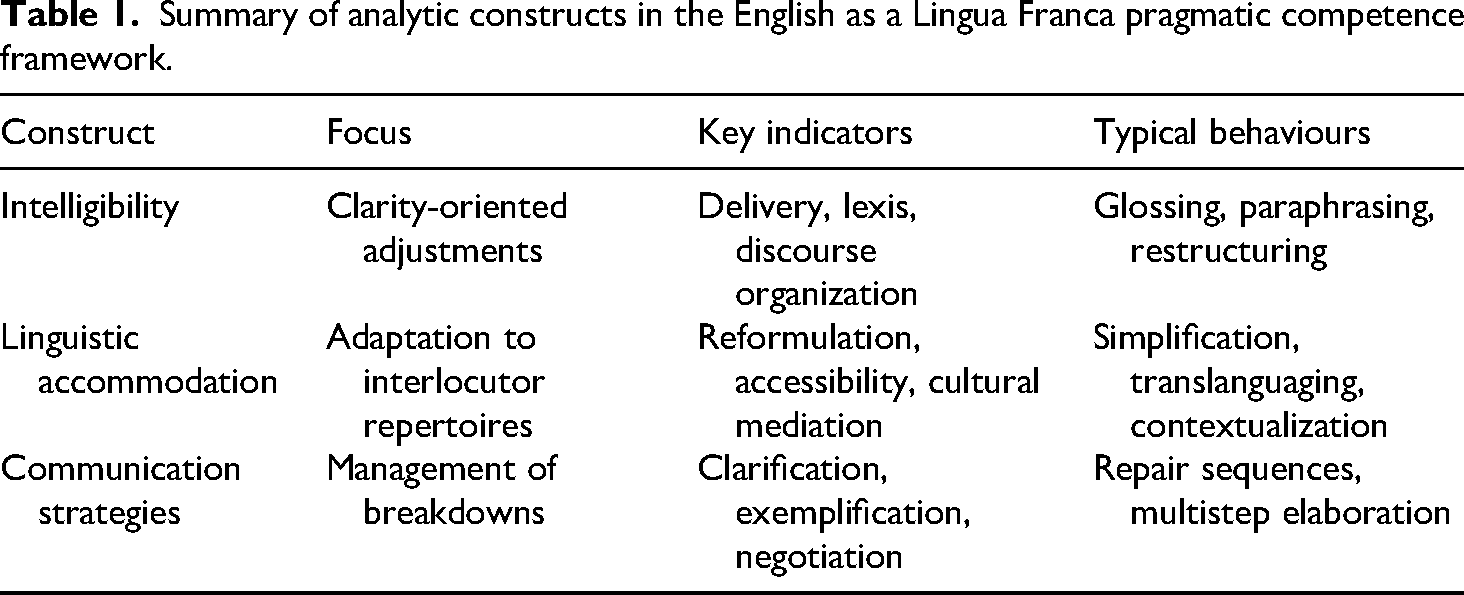
Each construct is structured to reflect the interactional contingencies documented in ELF research. Intelligibility is founded on the degree of clarity-oriented adjustment because ELF users routinely modify delivery, lexis and discourse structure in response to emerging listener needs. Linguistic accommodation is presented through proactive, cue-responsive and minimal forms, because accommodation unfolds as a gradient, contingent process shaped by interlocutor repertoires. Communication strategies are differentiated by the complexity and timing of repair moves, reflecting empirical findings that ELF users draw on multistep negotiation sequences when intelligibility or accommodation alone are insufficient. The form of each rubric therefore mirrors the interactional patterns observed in ELFJ Corpus data and in the wider ELF pragmatics literature.
Having established the conceptual foundations of the framework, the remainder of this section presents the analytic rubrics for intelligibility, linguistic accommodation and communication strategies, including overall descriptors, observable criteria, English as a Lingua Franca in Japan Corpus (2023) samples, associated ELF/pragmatics concepts and brief rater notes. To support practical use, each descriptor highlights observable behaviours (such as glossing, reformulation, gesture, or multistep repair) which assessors can identify in real time.
Analytic rubrics for ELF spoken interaction: intelligibility; linguistic accommodation; and communication strategies
Note
All corpus excerpts are taken from the English as a Lingua Franca in Japan Corpus (2023) and are reproduced with permission.
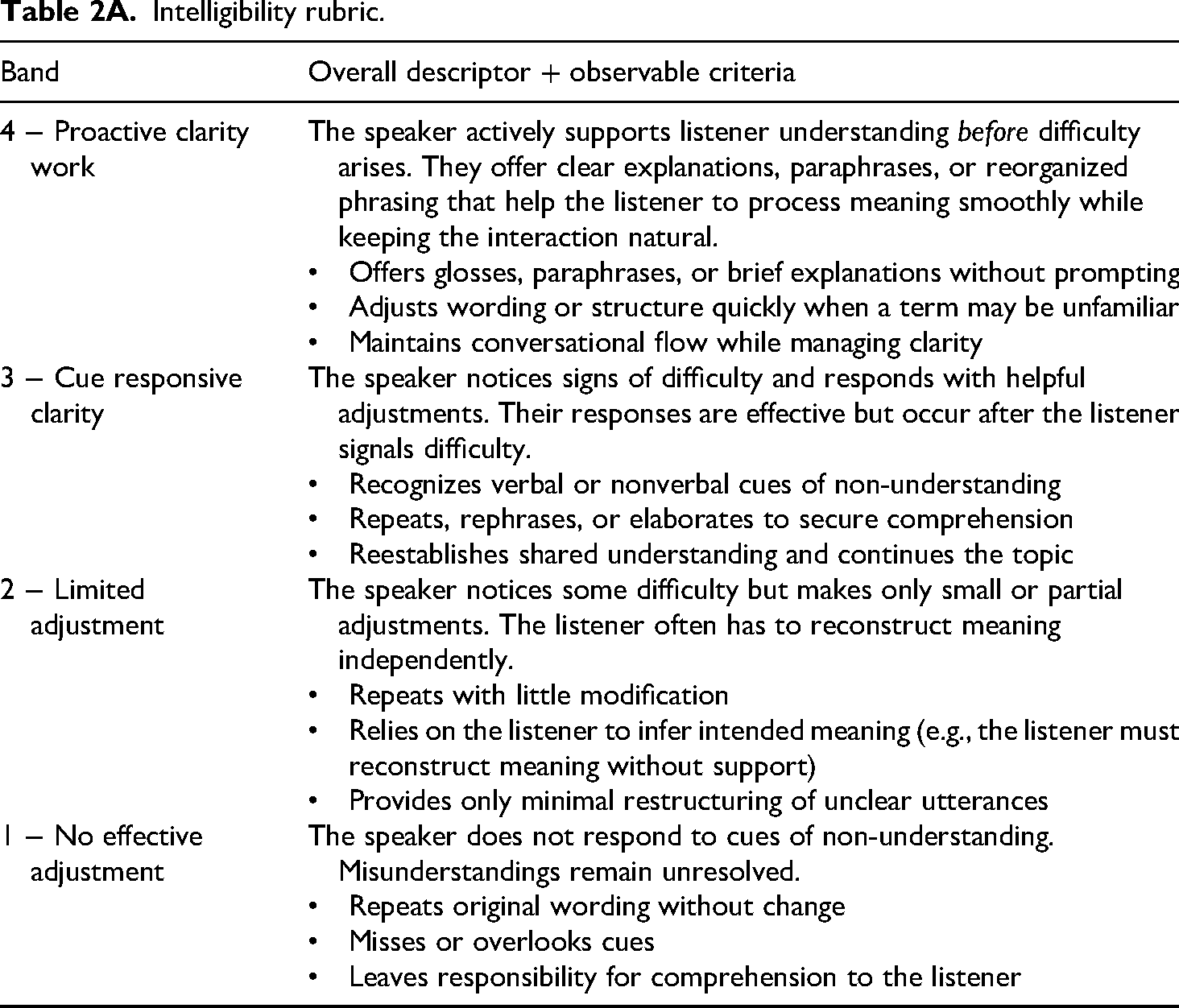
1. Intelligibility: Analytic rubric with ELFJ Corpus samples (see Tables 2A and 2B)
Construct definition
Intelligibility rubric.
Intelligibility: English as a Lingua Franca in Japan (ELFJ) Corpus samples and associated concepts.
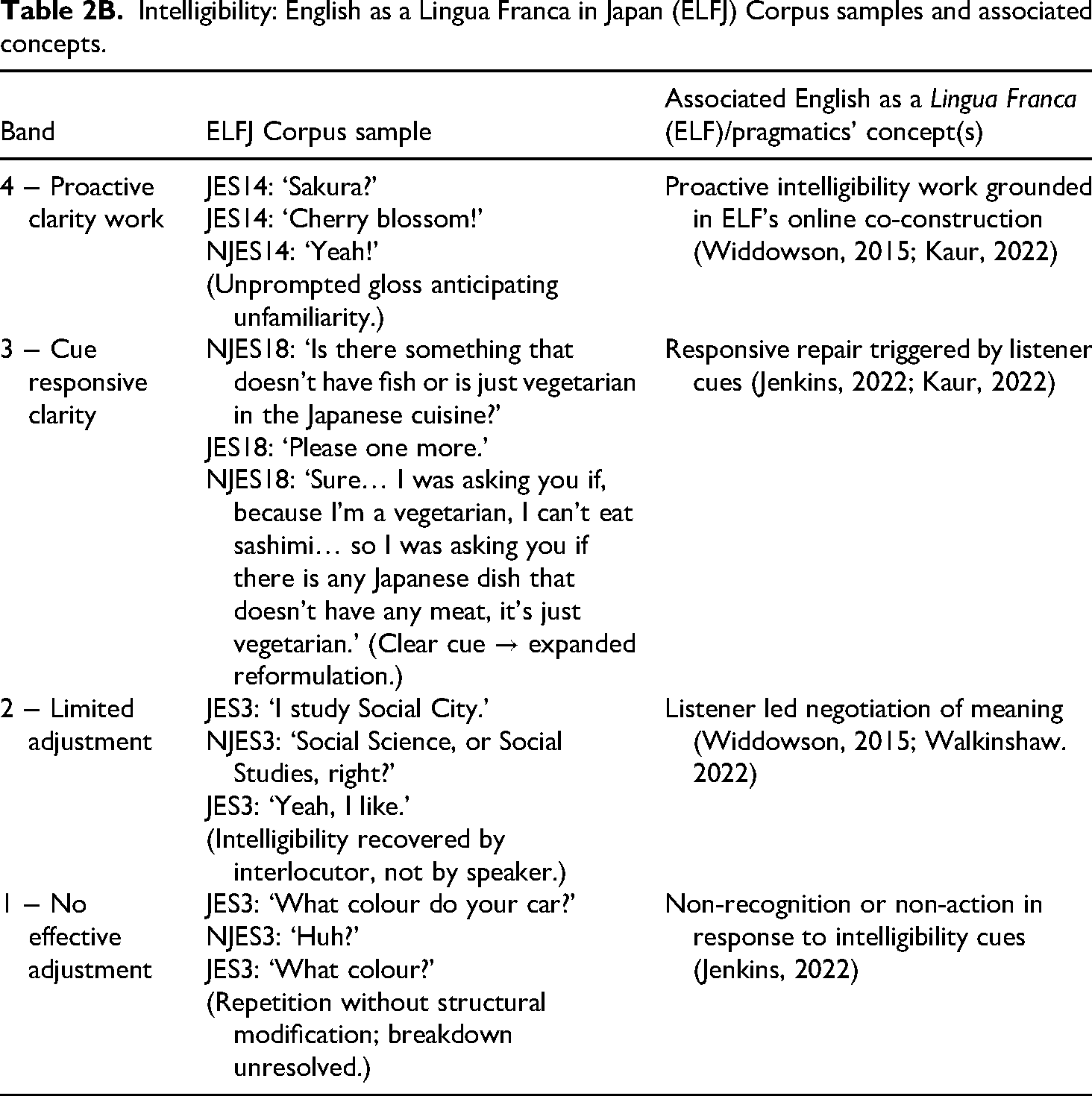
The intelligibility construct focuses on how speakers facilitate listener processing through clarity-oriented adjustments to delivery, lexis and discourse organization. This is consistent with Widdowson's (2015) argument that meaning in ELF interaction is achieved ‘in flight,’ through online modifications that respond to emerging interactional needs. Higher-band performance reflects what Kaur (2022) describes as pre-emptive elaboration: speakers anticipate potential trouble sources and proactively gloss or paraphrase key terms. For example, in the ELFJ Corpus, a speaker offering ‘Sakura? Cherry blossom!’ demonstrates proactive intelligibility work that supports shared understanding without interrupting conversational flow. Lower-band performance, by contrast, reflects limited or absent adjustment, leaving the burden of interpretation to the interlocutor. The rubric therefore conceptualizes intelligibility as a co-constructed, interactional achievement rather than a static property of accent or grammatical accuracy.
Intelligibility interacts closely with the other constructs because clarity-oriented adjustments often create the conditions in which accommodation and strategy use become unnecessary or less effortful. At the same time, when intelligibility work is insufficient, speakers may rely more heavily on accommodation or communication strategies to sustain mutual understanding.
Rater notes
Do not conflate accent with intelligibility; focus on listener uptake and repair strategies.
Consider both verbal and non-verbal cues.
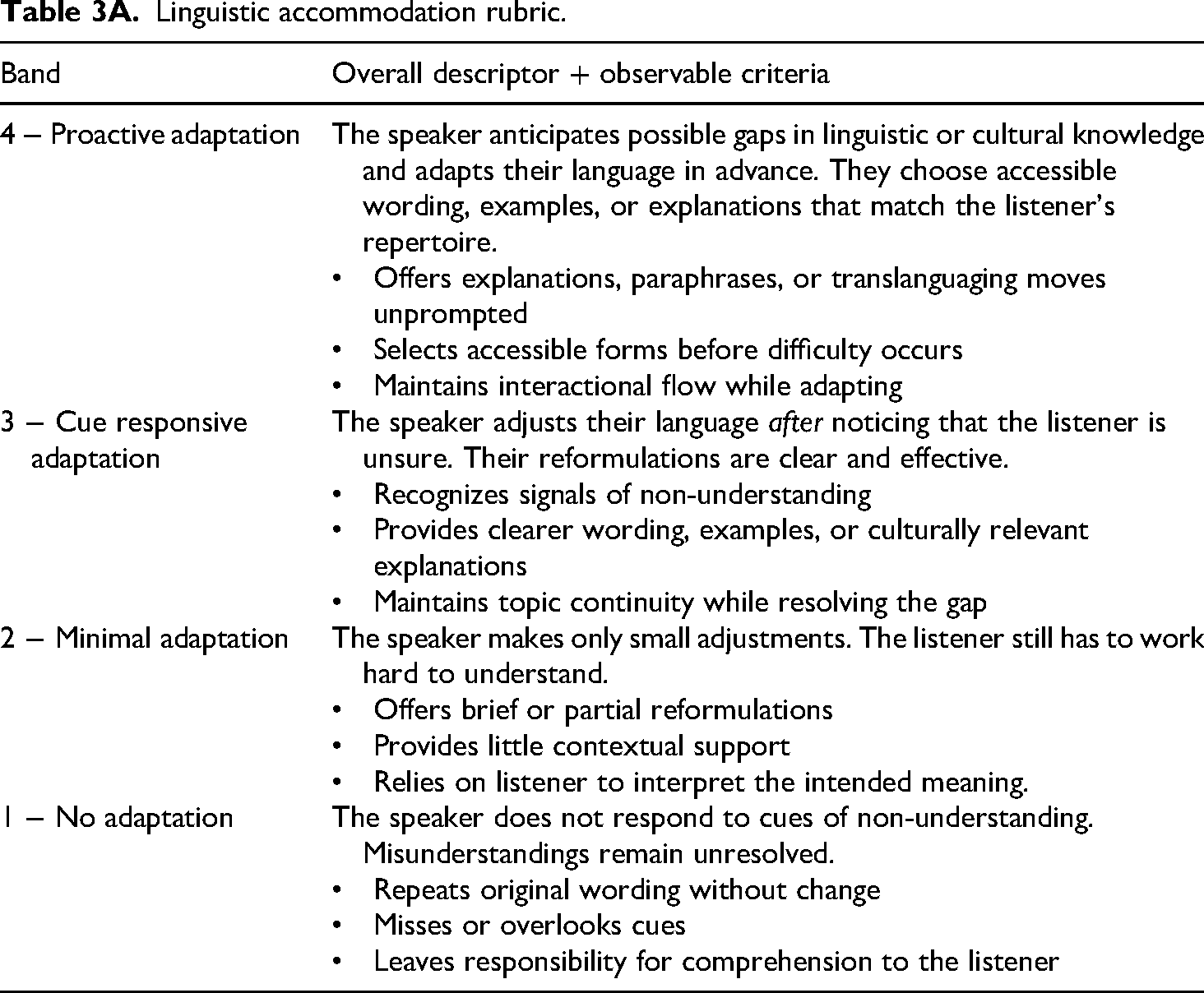
2. Linguistic accommodation: Analytic rubric with ELFJ Corpus samples (see Tables 3A and 3B)
Linguistic accommodation rubric.
Linguistic accommodation: English as a Lingua Franca in Japan (ELFJ) Corpus samples and associated concepts.
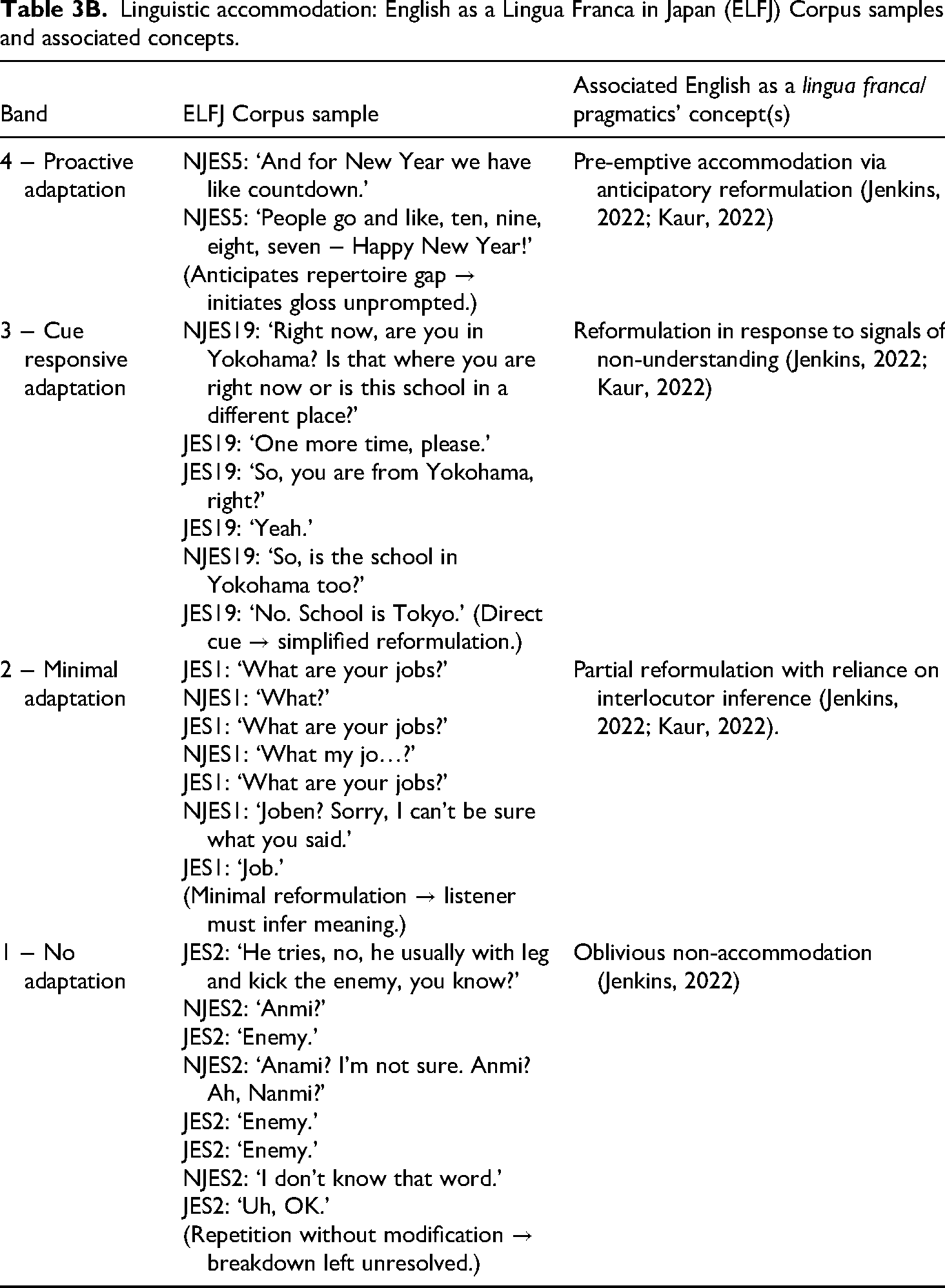
Construct definition
The extent to which the speaker adjusts or reformulates linguistic choices, including lexis, phrasing, register and cultural references, to enhance accessibility for interlocutors with differing linguistic or cultural backgrounds.
In the rubric, linguistic accommodation is conceptualized as the speaker's ability to modify language in ways that support mutual understanding in ELF interaction. Drawing on Jenkins’ (2022) account of accommodation as an interactionally negotiated process rather than a convergence toward native-speaker norms, the descriptors distinguish between proactive, cue-responsive and minimal adjustment. Higher band performance involves anticipatory moves, such as self-initiated translation or reformulation (‘we have like countdown… like, ten, nine, eight, seven − Happy New Year!’), which demonstrate sensitivity to interlocutor repertoires. Mid-band performance reflects adaptation prompted by explicit cues, while lower band performance shows little or no adjustment, leaving responsibility for interpretation largely to the interlocutor. The rubric therefore foregrounds accommodation as a situated, interaction-driven dimension of ELF pragmatics.
Linguistic accommodation intersects with intelligibility in the sense that both involve modifying language to support listener processing, but accommodation places greater emphasis on tailoring choices to interlocutor repertoires rather than on clarity alone. Linguistic accommodation also intersects with communication strategies: effective accommodation can reduce the need for repair, whereas limited accommodation often triggers strategy use, as listeners must rely on clarification requests, paraphrasing, or contextual elaboration when the speaker's adjustments are insufficient.
Rater notes
Focus on bridging strategies, not grammatical accuracy.
Consider cultural as well as linguistic accessibility.
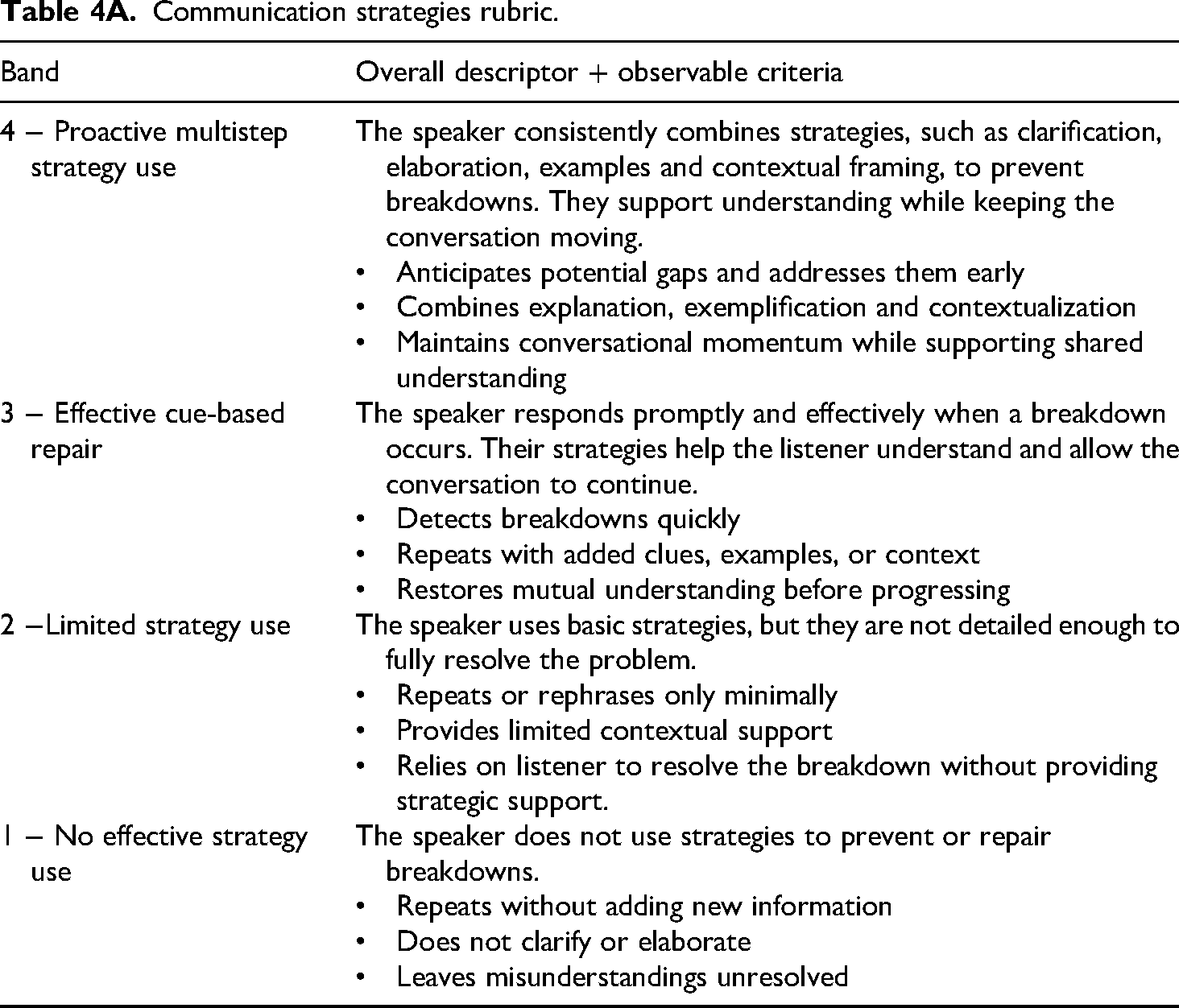
3. Communication strategies: Analytic rubric with ELFJ Corpus samples (see Tables 4A and 4B)
Communication strategies rubric.
Communication strategies: English as a Lingua Franca in Japan (ELFJ) Corpus samples and associated concepts.
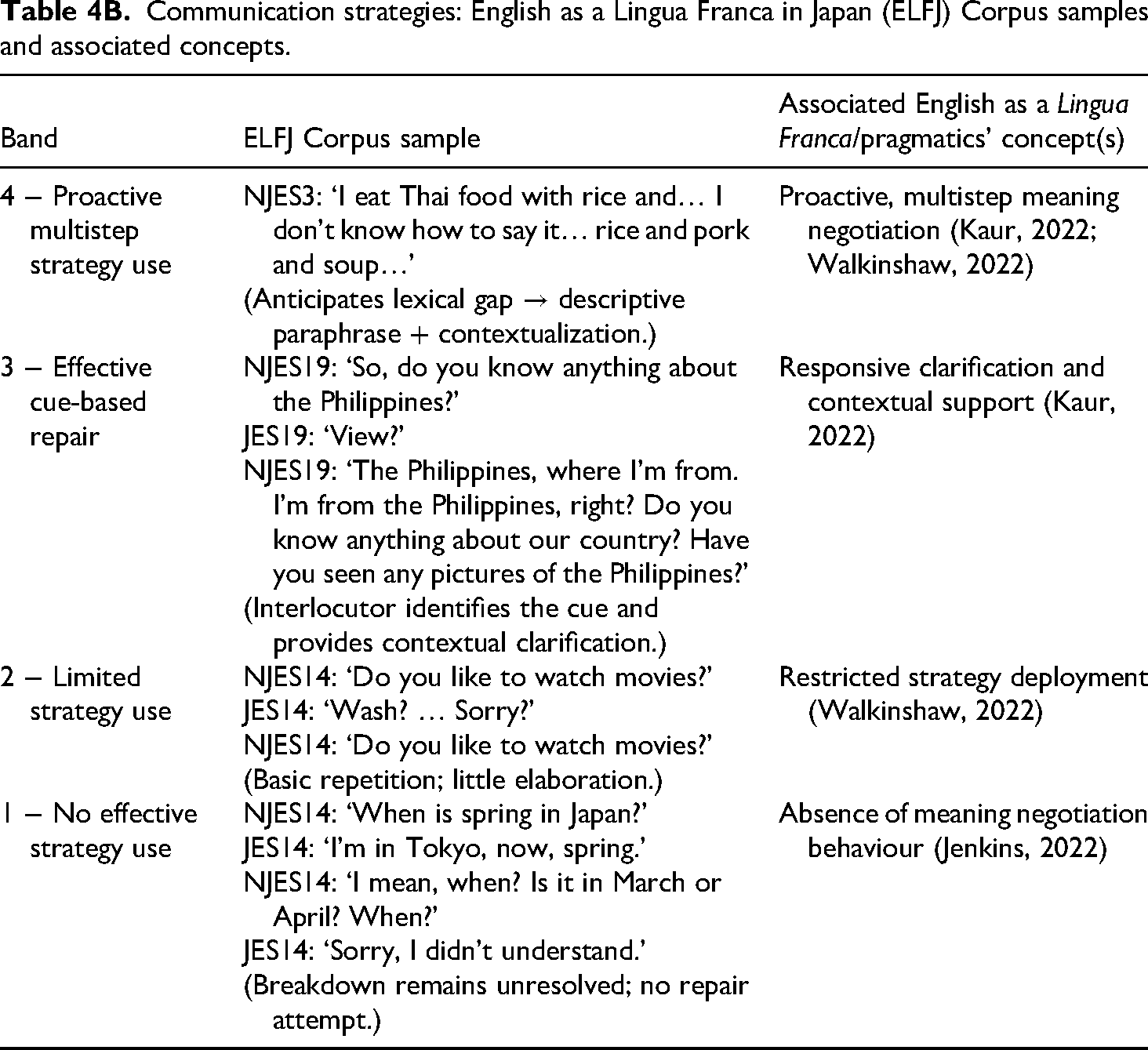
Construct definition
The range and effectiveness of the speaker's meaning negotiation strategies, such as clarification, elaboration, exemplification and contextual framing, used to prevent or resolve communication breakdowns.
Communication strategies concern how speakers manage potential or actual breakdowns through negotiation moves such as clarification, exemplification, contextual framing, or multistep repair. This construct draws on Kaur's (2022) analysis of multistep meaning−negotiation sequences and Walkinshaw's (2022) emphasis on responsive repair. Higher-band performance reflects proactive, multi-layered strategy use, such as descriptive paraphrasing combined with contextualization (‘I eat Thai food with rice and… I don’t know how to say it… rice and pork and soup…’). Mid-band performance involves effective cue-based repair, while lower-band performance reflects restricted or absent strategy use, leaving breakdowns unresolved. The rubric therefore frames communication strategies as evidence of pragmatic resourcefulness and collaborative engagement.
Communication strategies complement intelligibility and accommodation by providing resources for managing moments when clarity or adaptation alone do not resolve emerging trouble. In this sense, strategy use functions as a final layer of pragmatic support, activated when intelligibility adjustments or accommodation efforts are insufficient to maintain smooth interaction.
Rater notes
Attend to whether the speaker initiates or responds to repair sequences, and whether these moves successfully resolve breakdowns.
Distinguish between simple clarification requests and multistep negotiation strategies that combine paraphrasing, exemplification and contextual framing.
Consider both verbal and non-verbal resources (e.g., gesture and prosodic emphasis) used to maintain mutual understanding during moments of uncertainty.
Reflection
The framework represents progress in making ELF-related pragmatic competence more manifestly part of the ELF programme. The rubrics encourage teacher and learner consideration of the fluid, co-constructed nature of meaning-making in multilingual communication.
Pragmatic competence is inherently context dependent, so analytic rubrics, rather than holistic ones, are appropriate. Intrinsic to the design is a recognition of intelligibility, adaptability and strategic resourcefulness as legitimate and measurable dimensions of competence in ELF contexts.
Pedagogically, the utilization of these rubrics could contribute to learners’ engagement with their own language use. Feedback specifically linked to discrete constructs could enable identification of strengths and areas for development, signal that strategies such as meaning negotiation and repair are valued competencies, and facilitate metapragmatic awareness through connections between rubric descriptors and authentic English as a Lingua Franca in Japan Corpus (2023) examples. Moreover, when employed for self-assessment or peer-assessment, the rubrics may encourage critical reflection on communicative choices: how language is adapted to interlocutor needs; which strategies are deployed when intelligibility is at risk; and how such considerations confirm or diverge from students’ conceptions of pragmatic norms. Such processes may assist learners to comprehend the range of variability and diversity of ELF interactions and facilitate learner agency, positioning students as active co-constructors of communicative success rather than passive recipients of correction.
Limitations
While the proposed assessment framework offers a contextually responsive approach to evaluating pragmatic competence in ELF interactions, several limitations are acknowledged. Firstly, the framework has not yet been implemented or empirically tested in classroom settings, and its influence on teaching, learning and assessment practices remains speculative. Secondly, in the specific institutional context, a private university in Tokyo, there are few students from non-Japanese linguistic and cultural backgrounds, which limits the range within which consideration of intelligibility, linguistic accommodation and communication strategies may be necessary. Thirdly, while the rubrics are supported by locally derived corpus samples, further validation is needed to ensure their reliability and applicability across diverse interactional contexts. Finally, the framework's emphasis on pragmatic constructs may require extensive professional development for teachers less familiar with ELF-aware pedagogy.
Future pedagogical directions
While these limitations highlight the need for further empirical validation and institutional adaptation, they also offer a rationale for broadening pedagogical approaches. One significant aspect is professional development to assist teachers with consistent interpretation and application of the rubrics through workshops and calibration activities which emphasize adaptive, inclusive interactional practices and consistent decision making. The rater notes included with each of the constructs within the rubric can serve as calibration reference points, guiding assessors to focus on observable behaviours such as reformulation, elaboration, or reliance on interlocutor inference. Calibration sessions may involve guided analysis of corpus excerpts, discussion of ambiguous cases and alignment on construct boundaries. Teachers could work with (draw on) the rater notes to calibrate their responses to construct-specific behaviours, such as distinguishing accent features from intelligibility-relevant evidence including listener uptake, repair initiation and the use of verbal or non-verbal cues. For linguistic accommodation, the notes can guide assessors in identifying repertoire-sensitive adaptations, including reformulation, translanguaging and culturally relevant explanations, and in differentiating these from general clarity work. For communication strategies, the notes can help teachers to recognize multistep negotiation sequences, exemplification and contextual framing, enabling assessors to develop shared expectations about what constitutes effective breakdown management in ELF interaction. Calibration sessions could also include short demonstrations of what each descriptor ‘looks like’ in practice, using corpus excerpts to illustrate behaviours such as proactive glossing, cue-responsive reformulation, or reliance on interlocutor inference.
Other possible future pedagogical directions include the development of a parallel analytic rubric for academic writing, to address aspects such as stance-taking, hedging and reader orientation for diverse readers. Furthermore, developing a learner-facing version would position the rubrics as instruments for learner self-assessment and reflection so that students could interpret descriptors, evaluate their own performance and relate ELF-oriented constructs to their communicative goals, which may facilitate metacognitive engagement, critical awareness and autonomous strategy development. Implementing these measures could contribute to efforts to recalibrate language education toward context-responsive communicative practice and more equitable assessment, challenging entrenched deficit-based paradigms and encouraging learner-centred practices.
Footnotes
Funding
The author received no financial support for the research, authorship, and/or publication of this article.
Declaration of conflicting interests
The author declared no potential conflicts of interest with respect to the research, authorship, and/or publication of this article.
