






Abstract
Responding to current interest in how pragmatic competence can be taught and assessed in Global English contexts, this study examines whether Global Englishes (GE)-informed classroom pedagogy can support the development of early pragmatic awareness in the absence of explicit pragmatics instruction. The study reports a re-analysis of classroom data from a GE-oriented module implemented in an Italian secondary school, in which learners engaged with Asian Englishes and other English varieties through presentations and reflective journals. Although the original module was designed to raise awareness of linguistic diversity rather than to teach pragmatics, the dataset provides insight into how learners attend to meaning, interaction and sociocultural norms across English-using contexts. The analysis is framed through the Adaptive Control of Thought–Rational (ACT-R) model, focusing on the emergence of declarative pragmatic knowledge as a precursor to later procedural development. Findings indicate that learners developed conceptual awareness of context-dependent lexical meanings, sociocultural expectations shaping interpersonal communication and discourse practices associated with different Englishes. These reflections were particularly pronounced when learners engaged with Asian Englishes, which appeared to prompt noticing of pragmatic variability and reasoning about communicative appropriateness across contexts. While no evidence of procedural pragmatic competence was observed, learners’ reflections align with ACT-R's account of early pragmatic development as the accumulation of declarative knowledge through exposure, noticing and reflection. The study contributes empirical evidence to the underexplored relationship between GE pedagogy and pragmatics by showing how GE-informed classroom activities can foster foundational pragmatic awareness in school contexts where explicit pragmatics instruction is constrained.
Keywords
Introduction
Research in Global Englishes (GE) has established convincing evidence that English is used in varied, multilingual settings shaped by local sociocultural conditions. This work has challenged the privileging of idealised native-speaker norms and has argued for pedagogies that acknowledge the diversity of Englishes learners encounter in real communication (Galloway and Rose, 2015; Rose and Galloway, 2019; Rose and McKinley, 2025; Rose et al., 2021). Despite this progress, little empirical research has examined how GE-oriented pedagogy relates to the development of pragmatic awareness. The two areas share underlying concerns with contextualisation, social meaning and communicative appropriateness, yet they have remained largely separate in research and practice. This leaves a conceptual and empirical gap in our understanding of how learners begin to develop pragmatic sensitivity through GE-informed tasks that were not designed for pragmatics instruction.
The present study contributes to addressing this gap. It draws on existing data from a GE intervention in an Italian secondary school (Andreani and McKinley, 2025) and applies Anderson's (1993, 2007) Adaptive Control of Thought-Rational (ACT-R) model to examine how learners may have begun to build early, declarative forms of pragmatic awareness. The original intervention did not include explicit pragmatics teaching. This absence reflects the realities of secondary school curricula, where time, assessment pressures and required content leave little room for sustained pragmatics instruction. In such contexts, any pragmatic development is likely to be implicit, arising from exposure, reflection and noticing, rather than from structured practice.
Interpreting these implicit processes requires a theory that can account for the early stages of pragmatic development. ACT-R provides such a framework by differentiating clearly between declarative knowledge and the proceduralisation processes that allow learners to use pragmatic strategies in interaction. Studies drawing on ACT-R in second language (L2) pragmatics (e.g., Oyama, 2023) have shown that learners first accumulate conceptual knowledge about sociocultural meanings and discourse norms. Only later, through repeated contextualised use, does this knowledge reorganise into procedural routines. The data examined here, generated through a GE-focused module, are naturally suited to analysing this declarative stage. Through presentations and journals, learners described noticing lexical, pragmatic and sociocultural variation across Asian and other English varieties.
Although these tasks did not target pragmatics explicitly, they created opportunities for the types of noticing that ACT-R predicts as precursors to procedural development. If the diversity of Englishes is increasingly central to communicative practice, then developing sensitivity to different ways of expressing meanings, managing relationships and navigating sociocultural expectations becomes essential. Understanding how GE-oriented tasks facilitate this sensitivity is therefore both theoretically important and practically relevant, particularly for educational contexts where explicit pragmatics teaching cannot be systematically implemented.
The study is also positioned within the teaching−research nexus (McKinley, 2019), bringing together theory from L2 pragmatics and practice from Global Englishes Language Teaching (GELT) to examine whether GE-oriented lessons can foster early forms of pragmatic awareness that matter for learners’ real-world communication.
The study contributes empirical evidence on the underexplored relationship between GE awareness and pragmatic development, using ACT-R to show how implicit learning processes within GE-oriented lessons may support early pragmatic awareness.
Theoretical framework
GE and the development of awareness
Global Englishes research has established that English is used across a wide range of multilingual contexts and that communicative effectiveness depends on interlocutors’ ability to navigate linguistic and sociocultural diversity (Galloway and Rose, 2015; Rose and Galloway, 2019). GE-oriented pedagogy therefore encourages learners to recognise diverse Englishes as legitimate resources, question narrow standard language ideologies and attend to contextualised meaning-making (Rose and McKinley, 2025; Rose et al., 2021). This concern with context-sensitive language use also informs recent GE-informed work on multilingual writing feedback, which argues that pedagogical responses should attend to rhetorical effectiveness, audience and context, rather than defaulting to native-speaker standards (McKinley and Rose, 2026). When learners explore linguistic variation, they may develop forms of GE awareness that include noticing how speakers’ express meanings, position identities and manage relationships in context. These processes have conceptual overlap with pragmatic awareness, although they are rarely framed in those terms.
To date, research directly examining the relationship between GE awareness and pragmatic competence remains limited. Studies of GE in secondary school contexts, including the Italian intervention reported by Andreani and McKinley (2025), have documented shifts in learners’ attitudes, recognition of diversity and emerging criticality. Pragmatics research, by contrast, has focused on how learners interpret and enact contextually appropriate behaviour (Kasper and Rose, 2002; Taguchi, 2015) but has seldom considered how exposure to diverse Englishes shapes these processes.
In the present paper we distinguish between Asian Englishes and other English varieties explored in the participants’ presentations, as illustrated in Table 1.
English varieties explored in classroom presentations and journals.
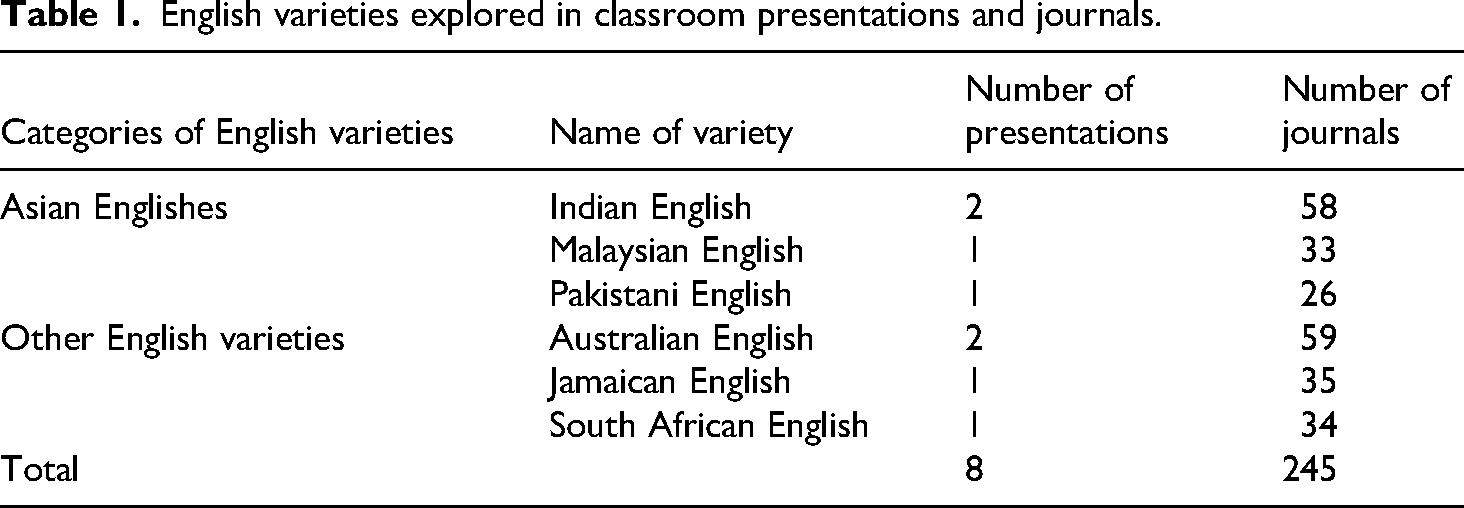
We use other English varieties as a descriptive label for the Australian, South African and Jamaican Englishes included in the classroom presentations and journals. This avoids treating these contexts as straightforwardly monolingual or ‘first language (L1) English’ settings, while recognising that they provided useful points of comparison with the Asian Englishes explored in the module. The labels in Table 1 are therefore descriptive rather than fixed linguistic categories, since GE research recognises English varieties and speaker communities as permeable, multilingual and subject to change (Galloway and Rose, 2015). Asian Englishes are understood here as heterogeneous and locally embedded varieties shaped by specific sociolinguistic histories, communicative practices and cultural contexts (Bolton et al., 2020; Kachru, 1998).
Pragmatic competence and the role of noticing
Much work in instructed pragmatics has shown that pragmatic development often begins with noticing (Bardovi-Harlig, 2018; Schmidt, 1993). At this early stage, pragmatic awareness involves recognising that language forms do not carry fixed meanings across contexts, but are interpreted through relationships, expectations and sociocultural norms. Differences in pragmatic norms refer, for example, to the tendency for British speakers to use ‘please’ routinely in request situations, whereas American speakers use ‘please’ less frequently in comparable contexts (Murphy and De Felice, 2018). Pragmatic awareness involves noticing such pragmatic differences between one's L1 and L2. However, as noted by Barron (2003) and Houck and Gass (1999), learners often assume that the pragmatic norms they possess are universal and independent of language-specific conventions. As a result, they may not actively seek to acquire the pragmatic norms of the target language. For this reason, appropriate instruction has been argued to play a crucial role in the development of pragmatic competence (Cohen, 2008; Halenko et al., 2019). Once learners begin to understand these differences, they may identify contrasts between their expectations and the behaviour of interlocutors, articulate hypotheses about sociocultural norms and recognise how different linguistic forms can index relations, stance, or politeness. These early insights are typically declarative, such as recognising that ‘cheers’ is frequently used to mean ‘thank you’ in British English, and are shaped by exposure to diverse models of communication. The development of such pragmatic awareness is often assessed through tasks that ask learners to judge the degree of pragmatic appropriateness in the target language and/or to explain the rationale underlying their judgements (e.g., Bardovi-Harlig, 2018).
This distinction between implicit learning processes and explicit pragmatic knowledge is useful for the present study because the module did not teach pragmatics directly, but created opportunities for noticing through task-based engagement with English variation. Although explicit instruction can accelerate pragmatic learning, it is not always feasible. Secondary school curricula tend to prioritise grammatical accuracy, textual competence, literature and examination requirements. As a result, sustained instruction in pragmatic strategies is seldom possible. For many learners, the development of pragmatic awareness therefore occurs incidentally through exposure to varied communicative examples and activities that encourage reflection on meaning and use. GE-oriented lessons provide precisely these opportunities, even when pragmatics is not an explicit learning target.
ACT-R and the declarative–procedural interface in pragmatic development
The ACT-R model is one of the most fully developed cognitive architectures, designed to account for the structure of the human mind. A central distinction in ACT-R is between declarative knowledge and procedural knowledge. Declarative knowledge is represented in the form of chunks, which are organised units comprising related facts, rules, or propositions. Procedural knowledge is represented as production rules, that is, IF–THEN condition–action pairs. Each chunk is associated with conditions governing its retrieval, and when these conditions match those specified in a production rule, the corresponding chunk is retrieved and made available for processing. In this framework, chunks contain slots that hold relevant contextual values, such as setting, speaker relationship, communicative function, or variety of English.
The ACT-R model offers a useful lens for examining how learners might begin to develop pragmatic understanding in GE-focused lessons. According to ACT-R, learning begins with declarative knowledge, which can later be compiled into procedural routines through repeated, context-rich practice (Anderson, 1993, 2007; Anderson and Lebiere, 1998). Studies applying ACT-R to L2 pragmatics have shown that learners typically begin with declarative insights about sociocultural meanings, discourse norms and appropriateness, which form the foundation for later proceduralisation (Li, 2012, 2019; Oyama, 2023).
For example, a learner may first store ‘cheers’ as a toast-related expression, then later add contextual values such as informal British English, thanking, or leave-taking. From an ACT-R perspective, these contextual values become part of the learner's declarative representation of the item. Repeated contextualised use may then support production rules that allow the learner to select the expression appropriately in interaction.
This distinction is especially relevant for school-based GE interventions. Because explicit pragmatics instruction is not embedded in the curriculum, lessons are more likely to support the development of declarative knowledge. Learners may recognise, for example, that particular lexical items carry different pragmatic meanings in different Englishes, that speakers in different contexts use different strategies for showing politeness or friendliness, or that speech styles and registers shift depending on community norms. These observations reflect early insights into sociocultural meaning-making rather than procedural ability. In other words, such noticing is assumed to facilitate the development of declarative chunks. ACT-R allows us to interpret these insights as cognitive evidence of the first stage of pragmatic development. Figure 1 illustrates this movement from an initial to an enhanced chunk representation.
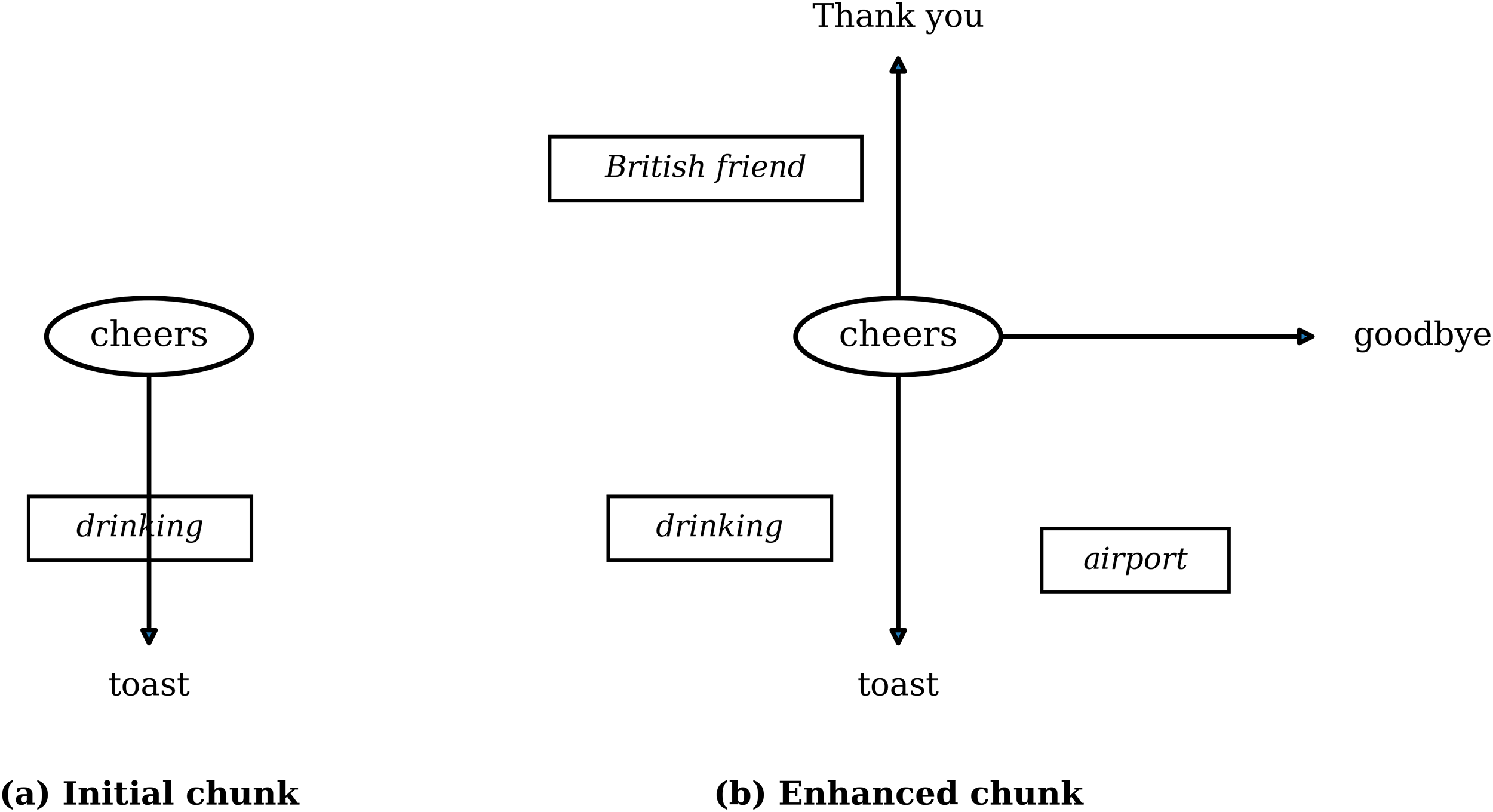
From initial to enhanced chunk representations.
Methods
Research design
This study uses a qualitative re-analysis of an existing dataset generated during a GE module implemented in an Italian secondary school. The re-analysis applies the ACT-R framework to explore evidence of early, declarative pragmatic awareness in learners’ reflections. The original intervention did not include pragmatics instruction, and the re-analysis does not attempt to infer procedural pragmatic ability. Instead, the focus is on identifying insights that align with the early stages of pragmatic development described in ACT-R.
The study is positioned within the teaching−research nexus. The re-analysis was conducted collaboratively by the teacher-researcher who designed and delivered the original intervention, and a second researcher with expertise in pragmatics and ACT-R theory who was not involved in the original dataset. This collaboration is consistent with calls to ground Teaching English to speakers of other languages (TESOL) research in real classroom contexts and to strengthen researcher–practitioner partnerships (McKinley, 2019).
Context and participants
The research took place in a state secondary school in northern Italy. English is allocated three hours per week, with each class lasting between 50 and 60 min depending on the school's annual timetable, and explicit instruction in pragmatics is not included.
Ninety-six students aged 15 to 17 participated across four intact classes. Their English proficiency ranged from B1 plus to B2. Although all had sustained exposure to British and American English through school materials and examinations, their familiarity with other Englishes had largely developed informally through online media and popular culture.
Ethical approval for the original study was obtained through institutional processes. Parental consent and student assent were collected, and all data were anonymised before the re-analysis. The written consent provided by participants and their families included permission for anonymised data to be used in future research projects. The re-analysis was therefore conducted in line with the original consent process and with institutional approval for the reuse of secondary qualitative data (Ruggiano and Perry, 2019).
Instructional module
The GE module spanned six weeks and was taught within regular English lessons. Its objective was to broaden learners’ understanding of English variation and to encourage reflection on how different Englishes are used in global communication. The module was structured around two introductory lessons, which revolved around three audio-visual materials that students watched during class time. After watching, students engaged in discussions about the topics presented in the videos, namely accommodation, linguistic variation, contact-induced linguistic change, as well as lexical and morphosyntactic features of South African English and Indian English. Students were then asked to conduct independent group research on an English variety which culminated in an in-class presentation task (see Appendix 1 for the prompts for the independent group research). Learners also completed reflective journal tasks during the preparation period and after each presentation (Andreani and McKinley, 2025) (see Appendix 2 for examples of prompts for the reflective journals).
A task-based approach already informed the participants’ English language classroom, and students were familiar with presentation tasks involving meaning-focused interaction and collaborative work (Ellis, 2003; Ellis et al., 2019). This orientation was compatible with GELT, since task-based work can prioritise meaning, communication and flexible language use over prescriptive norms (Rose and Galloway, 2019). The module was not assessed, which helped support open reflection in the journal entries and reduced possible anxiety around the presentation task.
The module prioritised linguistic and cultural diversity as participants’ presentations focused on how English spread across the territories and communities where their chosen varieties are used. They also explored their lexical, morphosyntactic and phonological features. It did not include any teaching of context-sensitive language use, pragmatic strategies, or speech act performance. Any references to communicative norms or socially meaningful language use arose incidentally through learners’ engagement with materials and reflective work. This instructional context is central to the rationale for analysing the data through ACT-R, which predicts that implicit exposure and reflective noticing support the development of declarative knowledge.
Data sources
Two qualitative datasets were used in the re-analysis. The first comprises the PowerPoint group presentations in which learners described the history, speakers, linguistic features and cultural associations of an English variety. The second comprises solicited journal entries written during the preparation period and soon after each presentation. While in the preparation stage learners explained their choice of variety and any prior familiarity with it, after each presentation they reflected on what they found interesting, surprising, or challenging during their research. Moreover, the participants who attended the presentations in class recorded what drew their attention in each variety. These data also reflect the kinds of reflective and exploratory tasks commonly used in GE-oriented research in secondary schools (Andreani and McKinley, 2025). Our approach to analysing student-generated texts followed established guidance for qualitative data work in applied linguistics, which emphasises transparency around data provenance and interpretive procedures (Rose et al., 2020).
These data offer insight into learners’ interpretive processes. They also reflect authentic classroom practices typical of secondary schooling, which supports the position of the study within the teaching−research nexus.
Analytical approach
The analysis involved a close reading of all presentation and journal data. An initial inductive coding cycle identified segments where learners commented on aspects of communication that depended on context, interlocutor relationships, or sociocultural expectations. These included observations about shifting meanings of lexical items, differences in discourse patterns, culturally grounded registers and views on how speakers’ express politeness, informality, or identity.
A second, theory-driven analytic cycle interpreted these segments through the ACT-R framework. ACT-R conceptualises learning as progressing from declarative knowledge to proceduralised routines. In this study, evidence of declarative knowledge included explicit statements about sociocultural meanings, contrastive insights into communicative practices across Englishes, or reflective comments that linked linguistic form to social function. The analysis focused on identifying such early-stage knowledge, rather than on performance or behavioural evidence.
This combination of inductive and theoretically informed analysis allowed the re-analysis to remain grounded in learners’ own expressions while using ACT-R to interpret how GE-oriented tasks may support early pragmatic awareness.
Researcher roles
The re-analysis was conducted jointly by Andreani, the teacher-researcher who had implemented the module and collected the data, and Oyama, an external researcher specialising in pragmatics and ACT-R theory. This collaboration was important for two reasons. First, the teacher-researcher brought contextual knowledge about the curriculum, instruction and learners, which ensured that interpretations remained realistic for secondary education. Second, the pragmatics specialist provided the theoretical expertise needed to interpret the data within an ACT-R framework. This approach aligns with the call to integrate teaching and research in ways that are transparent, context sensitive and pedagogy informed (McKinley, 2019).
Findings
Our re-analysis highlighted several areas in which learners engaged with pragmatic aspects of communication while exploring different Englishes, with their most sustained insights arising in relation to Asian Englishes, particularly Malaysian and Indian English. Although the original module did not include any instruction in pragmatics, we found that the GE tasks encouraged students to notice how communicative meanings shift across cultural contexts. These insights remained conceptual, but they align with ACT-R's view of early pragmatic learning as the accumulation of declarative knowledge. Three thematic patterns guided our interpretation.
Learners’ awareness of context-dependent meaning in asian englishes and other englishes
Across the presentations and journals, we noted numerous comments on how words and expressions carried different meanings in Asian Englishes than in the British or American varieties they were familiar with. In particular, presentations about Malaysian and Indian English frequently identified examples where a familiar English word took on locally meaningful functions (Hashim, 2020; Pillai and Ong, 2018; Sridhar, 2020). For instance, Participant 21 observed that Malaysian English speakers ‘use action to say arrogant’ and Participant 10 pointed out that ‘the word “terror” in Malaysian English means “cool,” but there isn’t a corresponding word in British English.’” This elaboration is reiterated by Participant 13, who argued that ‘this variety's vocabulary differs from English in some meanings, such as “terror” which means “terrific” or “cool.” This may cause some misunderstandings if someone doesn’t know the meaning in Manglish, 1 as it is often very different from the British one,’ Although numerous participants recorded the shifting meaning of this word in their journal entries, other words such as ‘steady’ and ‘tackle,’ whose local meaning was explained in the relevant presentation, did not seem to find the same resonance enjoyed by ‘terror.’ Regarding Indian English, Participant 92 showed an interest in its ‘typical slang and the meaning, that we may not find in traditional English, for example “mugging” or “out of station,” when you want to say that are you leaving the town.’ Furthermore, Participant 43 commented on Indian English, noting that ‘in this language the word “hotel” means “restaurant.” This is really strange because in almost every part of the world, a hotel is a place where you can sleep.’ This illustrates how learners compare context-dependent word meanings with their existing knowledge about English as they continue to acquire new forms.
Similarly, Participant 43 found that ‘when South Africans say “robot” they mean “traffic light.”’ Participant 32, who chose South African English as their variety, also mentioned that ‘it's interesting to discover that there are some vocabularies that mean the opposite of what you think,’ Participant 49 similarly noted that ‘[t]he vocabulary strikes me because it is very different from British English and if you don’t know this variety, it could be difficult to understand several words.’ Across these reflections, students often treated unfamiliar lexical meanings as context-dependent rather than as simple vocabulary differences (Coetzee-Van Rooy, 2020).
We interpreted these reflections as evidence that learners were beginning to think about how meaning depends on context and interlocutor expectations. Their comments were often framed as observations rather than as rules, which fits with the kind of early-stage, declarative knowledge that ACT-R describes. In ACT-R, procedural knowledge, represented by production rules, retrieves declarative knowledge, or declarative chunks, by referencing the information stored in the slots of those chunks. For instance, a learner with only British or American English knowledge about the word ‘terror’ will possess a chunk that links ‘terror’ with ‘extreme fear.’ As a result, when a chunk containing the slot value ‘terror’ is retrieved, the associated information, ‘extreme fear,’ is returned almost automatically. In contrast, learners who, like the participants in this study, are aware that ‘terror’ can also mean ‘cool’ in Malaysian English will have additional information, such as ‘Malaysian English’ and ‘cool,’ encoded within the chunk containing ‘terror.’ Therefore, in a Malaysian English context, retrieving a chunk with the slot values ‘terror’ and ‘Malaysian English’ will yield the meaning ‘cool.’ In this way, learners appeared to be forming initial ideas about how pragmatic meaning varies across communities, even though they were not asked to practise these forms.
Recognition of sociocultural norms and interpersonal expectations in asian englishes
We also found that students made thoughtful observations about how social relationships shape communication in Asian Englishes and other English varieties. This was especially apparent in reflections on Malaysian and Pakistani English. Writing about the latter variety, for example, Participant 87 wrote: ‘Something that lingers in my mind is that Pakistani people refer to things not using “it,” but using “he/him” or “she/her.” For example, “I’m going back home” becomes “I’m going back to her.” I think it's quite adorable’ (Rahman, 2020). Participant 21 focused on some discursive norms used in Malaysian English: ‘I was interested in the fact that they use “isn’t it.” It tends to be used in all tag questions (for example “you know her, isn’t it?”). Then they use tags like: “ah.” “or not,” “can or not” (“come with me, can or not?”).’ Participant 25 explained that in their opinion this specific use of polite tag questions ‘shows how a country incorporates its own grammar even when it comes to speaking another language. One example is the use of “can” in phrases like “help me, can or not?”’
Learners noted that choices of address, levels of formality, or polite expressions often related to age, hierarchy and cultural values. Some students attempted to explain these patterns in terms of respect or social roles. Regarding Australian English, for example, Participant 61 observed that in Australia ‘we can find different types of English with different accents’ and added: ‘In my opinion, it's a youthful and informal variety, with many abbreviated forms’ (Manns, 2019; Willoughby and Manns, 2019). Several respondents expanded on the theme. For example, Participant 44 claimed that ‘the habit of shortening the words strikes me most. Surely this habit exists also in British English, but it's not so much popular, because it would seem unofficial and informal.’ Numerous participants recorded examples of abbreviations in their journal entries, with Participant 72 claiming: ‘I like this feature since it makes the language a bit more friendly,’ while Participant 55 elaborated on the consequences: ‘Australians cut off a consistent part of the words, making some words very similar. The sentence is faster to pronounce but harder to understand.’ In interpreting these reflections, we noticed that students were not simply describing linguistic features. Instead, they were trying to account for how communication is influenced by social expectations. This represents an early form of metapragmatic awareness because students were beginning to comment on the social meanings attached to linguistic choices, even though they were not yet demonstrating the ability to use those choices in interaction. It also reflects the kind of conceptual engagement with sociocultural norms that ACT-R positions as a precursor to proceduralisation. From a pedagogical perspective, we found it significant that learners reached these insights without receiving instruction about pragmatics. Their engagement with Asian Englishes and other English varieties encouraged them to think about how interpersonal relationships shape communicative choices.
Interpretive insights into socially situated language use
A third area of insight involved students’ reflections on how English varieties were embedded in wider social, institutional and cultural contexts. These comments were not always pragmatic in a narrow speech-act sense. However, they showed that learners were beginning to connect language use with domains of communication, audience expectations, formality, identity and social function. We therefore interpret these reflections cautiously as evidence of emerging awareness of socially situated language use, rather than as evidence of pragmatic performance.
Regarding Indian English, some participants noted its role in formal and institutional domains such as politics, education and the legal system, while also functioning as a lingua franca in a linguistically diverse country. Participant 96 elucidates this point: ‘India is a large state with an high number [sic] of citizens. There are a lot of districts with their own language, so they use this variety to talk to each other.’ Similarly, writing about Pakistani English, Participant 79 claimed: ‘I was struck by the fact that many of the most popular newspapers in the country have a counterpart written in English.’ Participant 95 was interested instead in ‘how Pakistani English has affected South Asian literature, and I think that literature in general is a thing that we can all have access to.’ Regarding Malaysian English, Participant 12 wrote: ‘Although I wasn’t surprised by the existence of English-medium schools, it stroked [sic] me that English is the language they use in politics. I also wasn’t expecting the fact that English was so spread, almost evenly, in the whole country.’
Similar patterns appeared in reflections on other English varieties, where learners noted how English could be associated with different institutional, historical and everyday communicative functions. These comments were useful as comparative evidence, but the clearest examples of socially situated language use came from the Asian Englishes discussed above.
We interpreted these reflections as indications that learners were beginning to pay attention to socially situated language use at a broader discourse level. What stood out to us was that many students attempted to explain why these patterns might occur. Rather than listing features, they often linked their observations to cultural values, shared conventions, or interactional preferences. This suggests that learners were moving beyond noticing linguistic difference and were beginning to reason about the communicative norms that underpin these patterns. This reasoning aligns with ACT-R's account of how declarative knowledge develops through reflection.
Integrating the themes
Together, these patterns show how learners’ engagement with GE, particularly selected Asian Englishes, encouraged them to reflect on meaning, interaction and discourse in context. As researchers, we viewed these reflections as early signs of pragmatic awareness. The insights were not procedural, which is consistent with the lack of pragmatics instruction and with ACT-R's account of early learning through exposure, noticing and reflection. Even so, the reflections suggest that GE-focused pedagogy can create space for learners to form conceptual insights that are foundational to later pragmatic development.
Discussion
The purpose of this study was to explore whether a GE-oriented module, delivered without any pragmatics instruction, could still foster early forms of pragmatic awareness among secondary school learners. We approached the dataset through the ACT-R framework in order to identify whether learners showed signs of the declarative knowledge that forms the foundation of pragmatic competence. In this section, we discuss how the findings answer the research questions and how they contribute to the gap in research linking GE awareness with pragmatics.
RQ1: How do learners describe pragmatic features when engaging with asian englishes and other varieties of english?
Learners described pragmatic features mainly through reflections on context-dependent meaning, culturally specific expressions and interactional norms. Their comments showed an awareness that communicative meaning is shaped by sociocultural context, especially when familiar English words or forms carried different meanings in Asian Englishes. This awareness appeared to unsettle assumptions about the universality of pragmatic norms. As Barron (2003) and Houck and Gass (1999) note, learners may assume that pragmatic norms from one language or variety transfer straightforwardly to another. In this study, engagement with diverse Englishes prompted learners to notice that such assumptions do not always hold.
These findings extend work on GE-informed pedagogy by showing that tasks designed to raise awareness of English variation can also draw learners toward pragmatic dimensions of communication. The students were not simply identifying linguistic difference. They were beginning to consider why a particular expression carried a different meaning in one context, or how politeness and informality might reflect cultural expectations. Their reflections therefore align with early stages of pragmatic development, especially noticing and awareness building (Kasper and Rose, 2002; Taguchi, 2015).
RQ2: What forms of declarative pragmatic awareness emerge in a GE-oriented module with no explicit pragmatics instruction?
The analysis identified several forms of declarative pragmatic awareness. Learners recognised that lexical choices could convey social meanings, that politeness could be expressed through locally specific forms and that discourse patterns could reflect shared communicative values. Their reflections often included explanations or hypotheses about why these differences existed. This interpretive engagement is consistent with ACT-R's account of declarative knowledge chunks as foundations for later proceduralisation (Anderson, 1993, 2007; Anderson and Lebiere, 1998). In this sense, learners were beginning to build conceptual representations of pragmatic meaning, even though the module did not ask them to practise pragmatic strategies.
The findings build on Andreani and McKinley's (2025) account of attitudinal development and increased awareness of linguistic diversity in the same context. The present re-analysis shows that the same GE-oriented intervention also generated insights linked to early pragmatic development. Although explicit instruction is often effective in L2 pragmatics (Plonsky and Zhuang, 2019), the data suggest that GE pedagogy can support foundational pragmatic awareness through exposure, comparison and reflection. This is especially relevant in school contexts where sustained pragmatics instruction may be difficult to accommodate.
These insights also connect with intercultural communicative competence, particularly the capacity to reason about culturally anchored communicative practices (Baker, 2015; Byram, 1997). However, in this study such reasoning emerged through a GE-focused pedagogical design, suggesting that GE awareness and pragmatic awareness may develop in mutually reinforcing ways.
RQ3: In what ways do learners connect pragmatic variability to broader issues of linguistic diversity, intercultural understanding, or attitudes toward english varieties?
We observed frequent examples of learners linking pragmatic variability to cultural values, identity expressions and local communicative norms. Students described how the use of English in Asia was shaped by cultural traditions or social relationships, and several interpreted these patterns as legitimate and meaningful adaptations of English. This connection between pragmatic behaviour and broader sociocultural diversity reflects the aims of GELT, which seeks to encourage learners to recognise how English is shaped by its multilingual users (Galloway and Rose, 2015).
These reflections also align with the interpretive dimension of intercultural competence. Learners did not merely identify differences. They attempted to understand why those differences made sense within particular communities. This suggests that GE-informed tasks created opportunities for intercultural reasoning, which is central to the development of contextually grounded pragmatic competence.
Importantly, we also found that reflecting on Asian and other GE prompted learners to question their prior assumptions about correctness and ownership. This kind of attitudinal shift is consistent with the findings of Andreani and McKinley (2025) and indicates that GE awareness and pragmatic sensitivity may develop in parallel. Our re-analysis offers empirical evidence supporting this relationship.
Contribution to the research gap
A key aim of this study was to address the lack of empirical work linking GE awareness and pragmatic competence. The findings show that GE-oriented tasks can support the formation of pragmatic awareness even without explicit pragmatics instruction. This complements recent work on pedagogical interventions targeting pragmatic development in English as a lingua franca and Global English contexts (e.g., Caprario, 2025), while illustrating how early pragmatic awareness may also emerge through broader GE-informed classroom engagement. Interpreting the data through ACT-R adds theoretical depth by showing how learners’ conceptual insights can be understood as declarative knowledge that may support later procedural development.
Conclusion
Reflection on contributions of the study
This study examined how a GE-oriented module in an Italian secondary school supported early forms of pragmatic awareness without explicit pragmatics instruction. Through a re-analysis of presentation and journal data using ACT-R, we identified ways in which learners engaged with context-dependent meaning, sociocultural norms and discourse practices, especially when working with materials on Asian Englishes.
We interpreted these insights as forms of declarative knowledge that may provide a foundation for later pragmatic development. Although learners did not practise pragmatic strategies, their reflections showed emerging awareness of how English is used across communities and how context, relationships and cultural values shape communication. The study therefore extends GE research by showing that GE-informed tasks can prompt learners toward forms of awareness associated with early pragmatic development.
Pedagogical implications
The findings suggest that GE-oriented activities can help learners reflect on the relationship between linguistic form and sociocultural meaning. Even relatively simple tasks involving Asian Englishes can encourage learners to consider how communicative intentions, cultural expectations, identity and social distance influence language use.
The ACT-R model also gives teachers a way to understand these activities as more than general awareness-raising. If declarative knowledge is a precursor to procedural skill, GE-informed materials can help build the conceptual foundations of pragmatic competence while remaining feasible within school curricula.
Limitations of the study
The study has several limitations, though these are partly features of classroom-based re-analysis. The dataset comprised presentations and journal entries that were not designed to elicit pragmatic performance. The analysis therefore reveals what learners noticed and reflected on, rather than how they would behave in interaction. While this aligns with ACT-R's focus on declarative knowledge, it limits the conclusions that can be drawn about procedural ability.
The secondary school context shaped the nature of learners’ reflections. Students worked within time constraints and a curriculum focused on other aspects of English learning, and the journals varied in depth and detail. Some learners may therefore have noticed pragmatic features without expressing them in writing. The collaborative re-analysis by the teacher-researcher and pragmatics specialist also shaped the interpretation, although this was central to the study's teaching−research orientation.
Finally, the study was situated within one school context, and the reflections analysed emerged from a specific cohort engaging with a particular set of GE materials. As with all qualitative work, our intention was not to generalise beyond this setting. Instead, we aimed to offer a detailed example that illustrates how learners may begin to develop pragmatic insights when engaging with GE-oriented tasks.
Future research could compare GE-informed activities such as those examined here with more explicit approaches to pragmatics instruction, especially to explore which aspects of pragmatic awareness develop through exposure and reflection and which require more guided practice. We believe the evidence presented here contributes meaningfully to the ongoing discussion about the relationship between GE awareness and pragmatic competence and supports a growing recognition that GE-informed pedagogy can foster conceptual understandings that are foundational to pragmatic development.
Footnotes

Funding
The authors received no financial support for the research, authorship, and/or publication of this article.
Notes
Appendix 1: An abridged version of the prompts used for the independent group research.
Appendix 2: Examples of prompts for the reflective journal tasks.
Why have you chosen this variety?
Have you ever heard anyone using this English variety? If so, briefly explain this experience. If not, tell me where you think you can find this variety.
What have you learnt about this variety so far?
What strikes you about this English variety? Why?