







Abstract
With the continued lower employment rate for persons with disabilities, researchers are focusing more on barriers to employment that reach beyond functional impairment. Personality and self-efficacy have consistently been important factors when considering employment outcomes for persons without disability; less is known about these factors as they relate to job tenure in samples of people with disabilities. A sample of 56 individuals eligible for vocational rehabilitation services was used to investigate the relationship among personality, work behavior efficacy, and length of prior employment. Results of this study revealed that work behavior efficacy and personality are related to length of prior employment. Personality was found to account for a significant amount of variance in work behavior efficacy, and personality was a stronger predictor of length of prior employment over work behavior efficacy. Specifically, the personality trait openness significantly contributed to length of prior employment, and openness and neuroticism significantly contributed to length of prior employment among persons with low education. A discussion of the dynamic nature of personality as it relates to persons with disabilities and employment is included.
Keywords
The importance of the person–environment fit has been established as foundational to understanding vocational outcomes and is considered a key facet in most career-development theories (Herr, Cramer, & Niles, 2003). According to these theories, job satisfaction and job satisfactoriness are necessary for optimal vocational outcomes. Satisfaction can briefly be described as the degree to which an individual’s traits are congruent with the demands of the job. In essence, a satisfied employee is one whose job demands match his or her abilities and interests. Satisfactoriness is the extent to which the employee is valued by the organization; employees with high satisfactoriness are deemed valuable in their organizations as they demonstrate positive job performance, conformance, adjustment, and dependability (Herr et al., 2003). The importance of investigating both domain-specific states along with global, enduring traits on job satisfactoriness and job satisfaction has been well established in the career-development and vocational-behavior literature among persons without disability.
Global traits (such as personality) and contextual traits (such as self-efficacy) are important employment variables that can be operationalized under the encompassing descriptors of job satisfaction and job satisfactoriness (Barrick & Mount, 1991; Hartman & Betz, 2007). For instance, measuring personality traits is one mechanism to assess congruence, an important construct for satisfaction. Work efficacy ratings have been linked to job performance, a component of satisfactoriness, and job tenure is likely to be reflective of job satisfaction and satisfactoriness.
Some findings among the variables have been replicated by several researchers providing strong evidence for the strength of the relationships. Specifically, job satisfaction is consistently positively related to agreeableness and negatively related to neuroticism (Barrick & Mount, 1991; Van den Berg & Feij, 2003). Conscientiousness is a robust predictor of job performance across occupational types, and extraversion and openness have been found to predict job performance for specific occupational types (i.e., sales and extraversion) and tasks (i.e., learning new job duties and openness; Barrick & Mount, 1991; Van den Berg & Feij, 2003). Furthermore, there is a positive, significant relationship between self-efficacy and personality (Hartman & Betz, 2007; Van den Berg & Feij, 2003), and some research points to the role of efficacy moderating personality’s impact on job satisfaction and satisfactoriness (Nauta, 2004; Van den Berg & Feij, 2003). Persons with high self-efficacy have consistently been found to rate higher on job searching skills, career development, and general work productivity (Stajkovic & Luthans, 1998).
Although the relationships among these important variables have been investigated among samples of people without disabilities, the relevance of these variables in research is far less well established in the rehabilitation literature among persons with disabilities. Among those with disabilities, maladjusted personality expression is often the focus, as is efficacy related to disability adjustment, pain management, and job seeking (Benedict et al., 2005; Denison, Åsenlöf, Sandborgh, & Lindberg, 2007; Grant et al., 2004; Lezak, 1987; Strauser, 1995).
Given that facilitation of competitive employment is a primary goal of the rehabilitation process, and given the research findings and theoretical importance of person–environment fit in the career-development literature, investigation of these variables as they pertain to persons with disabilities becomes critical. Perhaps one explanation for the lack of this type of research in samples of people with disabilities is due to the much-needed focus in the past on functional impairment, compensatory strategies, supportive interventions, and other necessary research aims that improved program and policy initiatives for persons with disabilities. However, the competitive employment rate for persons with disabilities continues to lag behind the employment rate for persons without disability despite these program and policy improvements (National Organization on Disability, 2000; Wehman, Revell, & Brooke, 2003). Assessment of the qualities known to relate to optimal vocational outcomes is important for professionals looking to improve work outcomes for those at risk of unemployment. For this reason, it is necessary for rehabilitation researchers and service providers to better understand how these variables relate to each other and to job outcomes for persons with disabilities.
Personality
There are multiple personality assessments, but most standardized assessments conceptualize personality as a trait, or an innate and stable characteristic, or cluster of characteristics, for an individual (Costa & McCrae, 1992). The “five-factor model” (FFM) of personality has emerged as the most widely accepted and researched model regarding personality development and structure and is viewed among many in social psychology as the unified framework for personality (De Raad, 2000). Research results regarding personality structure across different cultures, ethnicities, demographic groups, and research settings have provided empirical support regarding the factorial structure and validity of the FFM constructs of openness, conscientiousness, extroversion, agreeableness, and neuroticism.
The FFM is not a diagnostic model, but rather conceptualizes normal personality expression. Persons high on the Neuroticism subscale are said to express a tendency to experience distress, which may include anxiety, fear, or negative affect and self-reproach. Persons who score high on the Extraversion subscale are likely to express sociability, positive affect, exuberance, and optimism. Persons high on the Openness subscale are described as imaginative, intellectually curious, attentive to feelings, and unconventional. Persons who score high on the Conscientiousness subscale are said to be purposeful, dutiful, determined, and reliable. Finally, persons who score high on Agreeableness are described as being prosocial, altruistic, polite, sympathetic, and eager to help others (Costa & McCrae, 1992).
Research results related to career development and vocational behavior has linked the FFM with important constructs and outcomes such as vocational identity (Holland & Gottfredson, 1994; Holland, Gottfredson, & Baker, 1990), Holland RIASEC types (Arbona, 2000), employment status (De Fruyt & Mervielde, 1999), job satisfaction (Furnham, Petrides, Jackson, & Cotter, 2002; Holland & Gottfredson, 1994; Judge, Heller, & Mount, 2002), job performance (Barrick & Mount, 1991; Hogan, 1996; Judge, Higgins, Thoresen, & Barrick, 1999; Tett, Jackson, & Rothstein, 1991), job turnover (Salgado, 2002), income and career success (Judge et al., 1999), and career satisfaction (Lounsbury et al., 2003). Within populations of persons without disabilities, the personality traits of conscientiousness, extraversion, and neuroticism were linked to career self-efficacy and job satisfactoriness (Hartman & Betz, 2007). Conscientiousness and extraversion have consistently been positively associated with desirable job satisfactoriness, and high levels of neuroticism are consistently associated with reduced job satisfactoriness and self-efficacy (Hartman & Betz, 2007).
Self-Efficacy
There are also ample means of measuring self-efficacy for given behaviors, but in general, efficacy is used to measure one’s confidence in specific behaviors, rather than global confidence across multiple domains (Bandura, 1986). In this sense, efficacy assesses a state, rather than a global trait. States are conceptualized as being more temporary and contextual than traits. Self-efficacy is operationalized as a social-cognitive construct incorporating an individual’s confidence and expectations to perform a given behavior, including behaviors not previously performed (Bandura, 1977; O’Sullivan & Strauser, 2010). Efficacy expectations encompass a person’s confidence to perform a given task, such as a specific work behavior. A related but distinct concept is the notion of outcome expectations, which is the confidence that the given behavior (i.e., work task) will result in an expected outcome (i.e., sense of accomplishment; Strauser, 1995). Efficacy expectations and outcome expectations affect an individual’s likelihood to perform new behaviors that are perceived as challenging, but also potentially rewarding, to the individual (Bandura, 1977; Strauser, 1995).
Assessment of task-specific efficacy can help determine an individual’s likelihood of initiating and sustaining effort to complete the task at hand, with high efficacy related to higher likelihood to initiate and maintain effort required to complete the task. Self-efficacy is viewed as an individualistic construct, as the word self in the label suggests, rather than a collectivist construct. It is therefore an appropriate construct to consider in any behavior performed by an individual, such as work tasks (Bandura, 1986). A better understanding of the relationship among individuals’ global personality traits and their state-specific work behavior efficacy as they relate to employment outcomes may lead to improved vocational interventions aiming to increase person–environment fit, and thus job tenure for persons with disabilities. The importance of this relationship has been established in samples of people without disabilities. Rather than assume that findings will be similar in samples of persons with disabilities, the results should demonstrate or dispute the findings presented in samples of people without disabilities.
The primary purpose of this exploratory study is to examine the relationship among employment tenure, work behavior self-efficacy, and personality traits in a sample of people with disabilities eligible for vocational rehabilitation services. First, the relationship between the FFM of personality and work behavior self-efficacy was examined in a sample of individuals with disabilities. Second, the impact of the five-factor personality structure and contextual work behavior self-efficacy on the length of prior employment was examined. The outcome variable length of prior employment is of interest for several reasons. This variable was preferred over employment status as a measure of job tenure, because our sample reported being unemployed at the time of data collection, which was also a time of unusually high national unemployment rates (9%–11%), and a rate of 9% unemployment in the state where participants resided. For this reason, we believe that current employment status did not reflect job tenure for our sample; rather, the high unemployment rate reported by this group is likely partially due to the high unemployment rate in the state of residence and nation at the time of data collection. Participants were asked to provide their longest period of prior employment to gauge their past employment tenure during a more stable labor market. For the current sample, length of prior employment can be operationalized as an outcome that reflects job tenure during a stable labor market. According to Dawis and Lofquist (1984) and Bretz and Judge (1994), “job tenure is the most basic indicator of satisfaction because it purportedly represents a state in which the individual finds the work environment to be acceptable (satisfaction), and the environment finds the individual to be acceptable (satisfactoriness)” (Bretz & Judge, 1994, p. 33). In a previous study, work personality and work efficacy explained 24% of the variance in length of prior employment (Strauser, O’Sullivan, & Wong, 2010). Finally, employment tenure has been linked to important life outcomes, including financial stability, social capital, improved well-being, and psychological adjustment, and as such, likely a more salient variable of interest compared with job status for our sample (Bluestein, 2006; Lin, 2001; McKee-Ryan, Song, Wanberg, & Minicki, 2005). The following two research questions guided this exploratory study:
Research Question 1: Is there a significant relationship among the FFM of personality, contextual work behavior self-efficacy, and length of prior employment in a sample of persons with disabilities?
Research Question 2: Do the FFM of personality and contextual work behavior self-efficacy account for a significant amount of variance in length of prior employment in this sample?
Method
Participants
A total of 84 individuals who were eligible for vocational rehabilitation services from the state of Illinois participated in this study. Of these, 56 provided complete data on all of the variables of interest. All 56 reported current unemployment at the time of data collection, with 17.6% reporting their longest consecutive employment period being less than 3 months, 14% reporting 3 months, 21.1% reporting 6 months, and 28.1% reporting a year or more as their longest consecutive period of prior employment (M = 6.2 years; SD = 1.57). Participants were at least 18 years of age, were currently receiving state vocational rehabilitation services, had a diagnosis of a disability, and agreed to voluntarily participate. Participants with severe cognitive and/or developmental disabilities were excluded. Participants ranged in age from 19 to 69 years (M = 40.7; SD = 13.2). The majority of participants were Caucasian (81%), followed by African American (13.1%), Hispanic (2.4%), Asian (1.2%), and Native American (1.2%). Most of the participants reported their marital status as single (57.1%), followed by married participants (26.2%), divorced participants (11.9%), and the remaining were separated or widowed (4.8%). Most participants were females (57.1%), with 41.7% of males, and the remaining did not report gender. The majority of participants (35.7%) completed their education through the 12th grade, followed by 16.7% completing some college, 15.5% completing community college, 13.1% acquiring a 4-year college degree, and 3.6% completing a graduate program. Within the remaining participants, 8.5% completed their GED, 2.4% completed school through the 10th grade, 1.2% completed school through the 9th grade, and 1.2% completed school through the 8th grade. Thirty-six percent of the sample reported having a physical disability, 31% reported having a psychiatric disability, and 18% reported having a learning disability. Age of disability onset is not known for this sample.
Procedures
Employees of the Illinois Department of Rehabilitation were given packets containing informed consent, demographic form, and research instruments for distribution to participants who met eligibility criteria for this study. All participants were informed in writing that their participation was voluntary, that they are free to withdraw without penalty, and that the type, amount, and quality of rehabilitation services were not dependent on participation in this study. Participants were informed that if they completed the packets and returned them to their service providers, they would be eligible for entry in a lottery drawing to receive a US$50.00 gift certificate. Data from survey packets were entered and analyzed using SPSS for Windows version 19.0. A total of 230 packets were distributed to vocational rehabilitation employees. Of those 230 distributed to vocational rehabilitation counselors, 157 packets were distributed to eligible participants. Eighty-four of these were completed and returned for a response rate of 53.5%, and 56 of these completed the variables of interest, for a final response rate of 35.6%. The Institutional Review Board at a participating institution approved this study.
Instruments
NEO-PI-R Short Form (Five Factor Model of Personality, Short form, Revised)
This is a 48-item measure that assesses the five-factor personality traits of neuroticism, extraversion, openness, conscientiousness, and agreeableness on a 5-point Likert-type scale, ranging from “strongly disagree” to “strongly agree” (Costa & McCrae, 1992). This scale is considered a “gold standard” measure of five global personality traits that are consistent with multiple cultures (Costa & McCrae, 1992). These five domains measure normal personality, not psychopathology; T-scores are normed according to gender. Persons who score high on the Neuroticism subscale are said to express a tendency to experience distress, which may include anxiety, fear, or emotional instability. Persons who score high on the Extraversion subscale are likely to express sociability, exuberance, and optimism. Persons high on the Openness subscale are described as imaginative, intellectually curious, attentive to feelings, and unconventional. Persons who score high on the Conscientiousness subscale are said to be purposeful, dutiful, determined, and reliable. Finally, persons who score high on Agreeableness are described as altruistic, sympathetic, and eager to help others (Costa & McCrae, 1992). The NEO-PI-R has established convergent validity with other measures of personality, including the State-Trait Personality Inventory, Eysenck Personality Inventory, Holland’s vocational codes, and sentence completion measures (Costa & McCrae, 1992). Internal consistency measures range from .56 to .81 in self-report forms to .60 to .90 in observer rating format. Test–retest reliability coefficients range from .79 to .83, with a 3-month interval, using college students (Costa & McCrae, 1992). A sample item from the Conscientiousness subscale is “I’m pretty good at pacing myself so as to get things done on time.” A sample item from the Openness subscale is “I believe letting students hear controversial speakers can only confuse and mislead them.” For the current sample, T-score means and SD for each factor are in the average to slightly below average range of scores, no means were in the very high or very low ranges: Neuroticism (M = 3.33, SD = 1.15), Extraversion (M = 3.04, SD = 1.03), Openness (M = 2.70, SD = 1.00), Agreeableness (M = 2.89, SD = 1.21), and Conscientiousness (M = 3.12, SD = 1.00).
Contextual Work Behavior Self-Efficacy Scale (CWBSES)
This scale contains 26 items making up four subscales (Occupational Adjustment, Performance Adjustment, Adaptation to Stress, Attendance) pertaining to individuals’ confidence to perform behaviors linked to positive vocational behavior and job maintenance (Strauser, O’Sullivan, & Wong, 2010). Respondents are asked to rate their confidence level to handle specific work-related behaviors on a 10-point Likert-type format with responses ranging from 0 (always problematic) to 9 (never problematic). Sample items include “I am confident in my ability to function independently on the job” and “I am confident in my ability to interact positively with my supervisor.” The total scale internal consistency of the CWBSES with the current sample is excellent (α = .96). Internal consistency estimates for the four subscales range from good to excellent: Occupational Adjustment (α = .92), Performance Adjustment (α = .78), Adaptation to Stress (α = .84), and Attendance (α = .86). Higher scores on any subscale suggest higher levels of self-efficacy related to the work domain described. For the current sample, the CWBSES total score mean is 7.39 (SD = 1.53).
Statistical Analyses
For Research Question 1, Pearson correlation analyses were conducted to examine the relationships among length of prior employment, CWBSES total scale, and the five NEO-PI-R subscales. A linear regression analysis was conducted as a follow-up to determine the relationship between total CWBSES score and the five subscales of the NEO-PI-R (see Results section for our rationale of entering the total score for the CWBSES, to reduce multicollinearity). For Research Question 2, a hierarchical linear regression was followed to investigate how well the five subscales of the NEO-PI-R and the total score for the CWBSES would predict the length of prior employment among people with disabilities. As 28 of the 84 participants did not report their length of prior employment, chi-square analyses were conducted to examine any differences in demographic characteristics of these participants and the participants used to compute the hierarchical regression. Chi-square analyses indicated that there were no differences in demographic characteristics in terms of gender, χ2(1) = 2.017, p = .156; marital status, χ2(4) = 1.133, p = .889; education, χ2(8) = 11.813, p = .160; and ethnicity, χ2(4) = 2.017, p = .145; between the drop-out participants (those not reporting length of prior employment) and the participants used to compute the hierarchical regression analysis. To further enhance the internal validity of the regression analysis, several ANOVA analyses were conducted to examine differences on any of the six predictor variables, including the five subscales of NEO-PI-R and the total score of CWBSES based on age, gender, and education level of participants (see Result section for our rationale of entering the total score for the CWBSES, to reduce multicollinearity). To account for these six predictor variables, Bonferroni adjusted alpha levels were set as .05/6 = .008 in these analyses. No significant differences were found on any of the six predictor variables based on gender (F = .000–.783, ps > .008), age (F = .055–3.549, ps > .008), and education level (F = .001–2.673, ps > .008) of participants.
Results
For Research Question 1, Pearson correlations were computed to examine the correlations between the subscales of CWBSES, NEO-PI-R, and the length of prior employment. Due to the multiple correlations being examined, the alpha level was adjusted to .01 to reduce the Type I errors associated with the analyses. High correlations among the three subscales of CWBSES (Occupational Adjustment and Performance Adjustment, Occupational Adjustment and Adaptation to Stress, and Performance Adjustment and Adaptation to Stress; rs > .70) suggested that the relationship among subscales might reflect multicollinearity. To address this, the total score for CWBSES, rather than subscale scores, was used to interpret the relationship between contextual work behavior self-efficacy, the five personality factors, and the longest period of prior employment (see Table 1). The CWBSES total score was significantly and positively related to the following NEO-PI-R subscale Conscientiousness (r = .383, p < .01) and the variable longest period of prior employment (r = .362, p < .01). The CWBSES total score was significantly and negatively associated with the subscale of the NEO-PI-R Neuroticism (r = −.424, p = .001). A follow-up linear regression analysis was conducted to investigate how well the FFM subscales would predict total CWBSES (see Table 2). The overall model was significant, F(5, 50) = 4.659, p < .001, adjusted R2 = .250, with Neuroticism (B = −.444, p = .002) and Conscientiousness (B = .477, p = .007) making unique contributions. The results indicate that 25.0% of the variance in contextual work behavior self-efficacy can be explained by the personality traits of Neuroticism and Conscientiousness.
Correlations Between the Total Score of CWBSES, NEO-PI-R, and the Length of Prior Employment (N = 56)
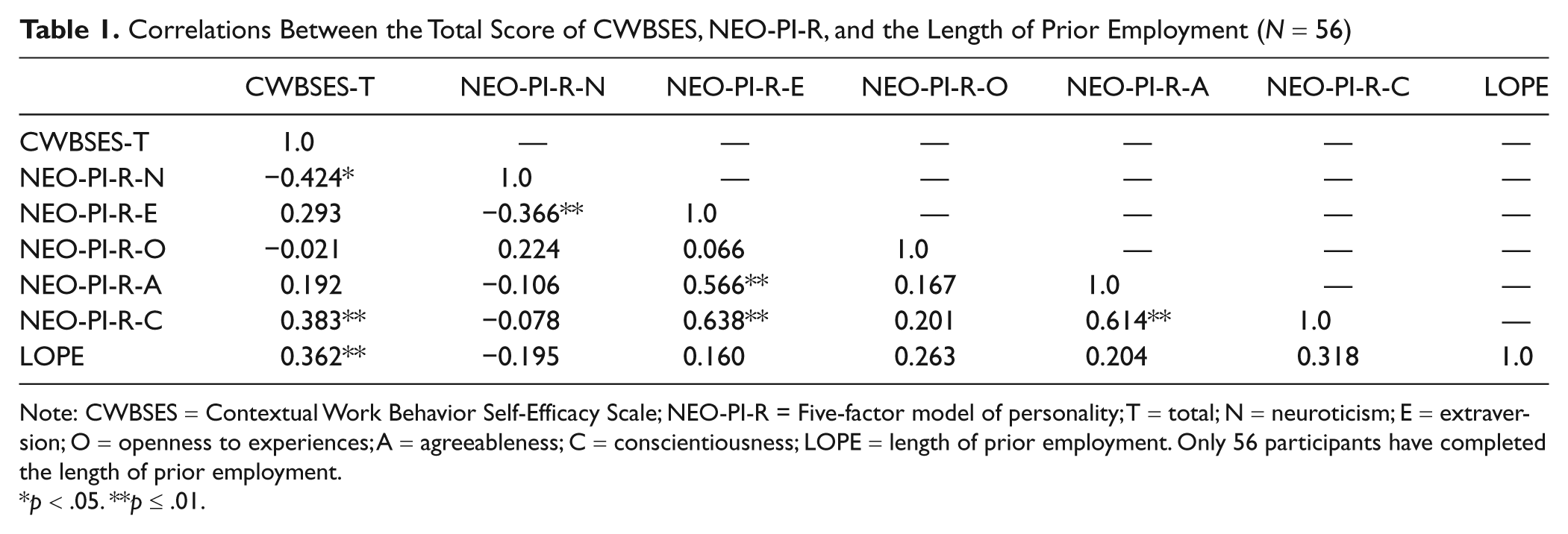
Note: CWBSES = Contextual Work Behavior Self-Efficacy Scale; NEO-PI-R = Five-factor model of personality; T = total; N = neuroticism; E = extraversion; O = openness to experiences; A = agreeableness; C = conscientiousness; LOPE = length of prior employment. Only 56 participants have completed the length of prior employment.
p < .05. **p ≤ .01.
Multiple Regression Analysis for Predicting the Contextual Work Behavior Self-Efficacy (N = 56)
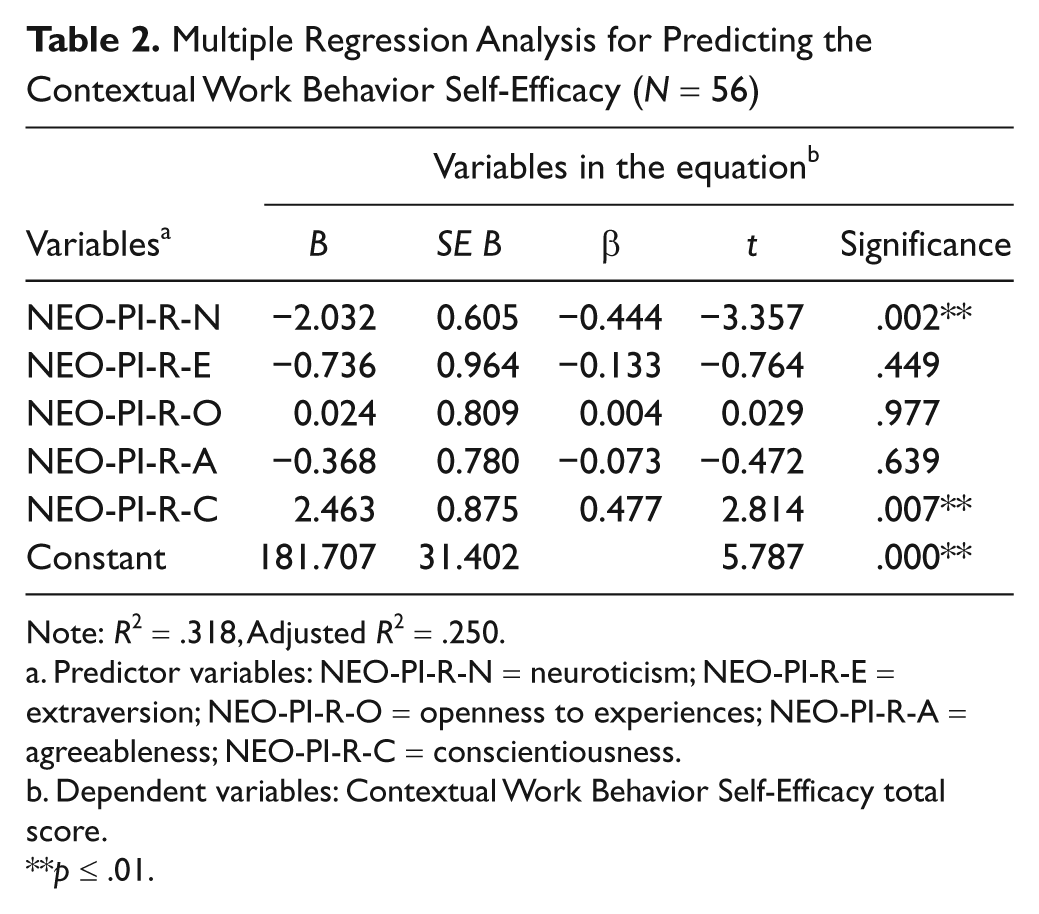
Note: R2 = .318, Adjusted R2 = .250.
Predictor variables: NEO-PI-R-N = neuroticism; NEO-PI-R-E = extraversion; NEO-PI-R-O = openness to experiences; NEO-PI-R-A = agreeableness; NEO-PI-R-C = conscientiousness.
Dependent variables: Contextual Work Behavior Self-Efficacy total score.
*p ≤ .01.
For Research Question 2, a hierarchical linear regression was computed to investigate how well the subscale scores of NEO-PI-R and the total score of CWBSES could predict the length of prior employment among people with disabilities (see Table 3). The decision to enter the five variables for personality into Model 1 was based on prior research examining personality and vocational outcomes. Prior research indicates that all five FFM traits have been positively and significantly linked to vocational behaviors. Specifically, the FFM traits of conscientiousness, extraversion, and neuroticism have consistently been related to multiple work outcomes (Hartman & Betz, 2007). The trait of openness was found to predict job training proficiency (Barrick & Mount, 1991), and agreeableness was positively associated with social work-skill efficacy (Nauta, 2004). In the current sample, the FFM traits of neuroticism and conscientiousness were found to predict CWBSES, and significant correlations were found between work behavior efficacy and length of prior employment.
Hierarchical Multiple Regression Analysis for Predicting the Longest Period of Prior Employment (N = 56)
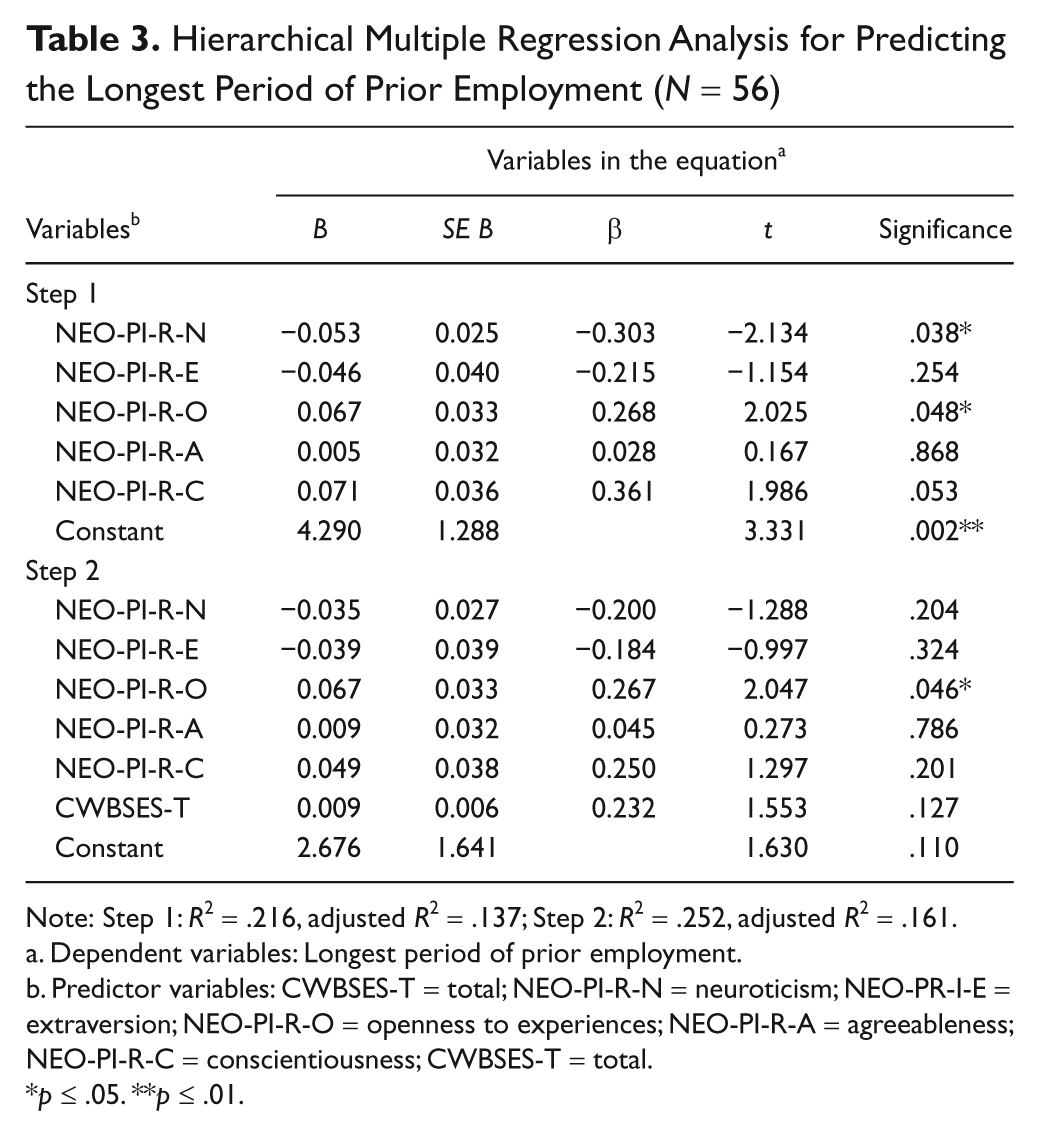
Note: Step 1: R2 = .216, adjusted R2 = .137; Step 2: R2 = .252, adjusted R2 = .161.
Dependent variables: Longest period of prior employment.
Predictor variables: CWBSES-T = total; NEO-PI-R-N = neuroticism; NEO-PR-I-E = extraversion; NEO-PI-R-O = openness to experiences; NEO-PI-R-A = agreeableness; NEO-PI-R-C = conscientiousness; CWBSES-T = total.
p ≤ .05. **p ≤ .01.
The variance inflation factors were computed as a measure of multicollinearity for the seven variables. All variance inflation factors of predictor variables in both models are less than 7.0, indicating that multicollinearity among the predictors in each model did not unduly affect the regression estimates (Neter, Kutner, Nachtsheim, & Wasserman, 1996). When the five subscales of NEO-PI-R were entered alone, the model was found to be significant, F(5, 50) = 2.750, p = .029. The adjusted R2 value was .137, indicating that 13.7% of the variance in the length of prior employment was explained by the model. The beta weights, presented in Model 1, suggest that two subscales, Neuroticism and Openness (ps < .05), made unique contributions to the model. When the variable of CWBSES, Total, was added in Model 2, the entire group of variables significantly predicted the longest period of prior employment, F(6, 49) = 2.758, p = .022, total adjusted R2 = .161, indicating the entire group of variables explains 16.1% of the variance in length of prior employment. However, the total score of CWBSES did not significantly improve the model (F change = 2.413, p = .127). Interestingly, only Openness maintained a significant relationship with length of prior employment in Model 2 (p = .046), whereas the significant relationship observed between length of prior employment and Neuroticism was absent in Model 2 (p = .204).
Discussion
The purpose of this exploratory study was to investigate the relationship among personality traits, work behavior efficacy, and length of prior employment for persons with disabilities. The overall results of this exploratory study provide continued evidence for the robust relationship among personality, efficacy, and work outcomes, and the importance of considering both stable personality traits and more contextual work states when evaluating and exploring intervention options for those at risk of unemployment. Specifically, results of Research Question 1 reveal significant relationships among the personality factors of neuroticism (negative correlation, unique contribution) and conscientiousness (positive correlation, unique contribution) with total Work Behavior Self-Efficacy. In addition, a significant positive relationship was found between length of prior employment and Work Behavior Self-Efficacy. These findings suggest that individuals who reported higher levels of conscientiousness (operationalized as the tendency to be reliable and purposeful) also reported higher confidence performing work behaviors, and people who reported higher levels of neuroticism (operationalized as the tendency to be emotionally unstable or reactive) reported lower confidence performing work behaviors. These findings are theoretically congruent and consistent with prior research on people without disability that has found significant directional relationships among the personality factors of neuroticism and conscientiousness and career-related self-efficacy, and job performance (Hartman & Betz, 2007; Reed, Bruch, & Haase, 2004).
The correlation analysis also reveals that people who reported higher levels of work behavior efficacy reported longer periods of employment. This is consistent with prior research findings indicating that high self-efficacy relates to positive work outcomes (Stajkovic & Luthans, 1998) and makes sense given that highly efficacious people would be expected to maintain employment.
Results related to Research Question 2 indicate that the combined predictor variables of the five-factor personality traits and work behavior efficacy significantly contributed to length of prior employment, with personality being the more robust predictor. Specifically, in Model 1, when the FFM traits were entered alone, personality accounted for 13.7% of the variance in length of prior employment with neuroticism and openness making unique contributions. In the second model, the FFM and CWBSES were entered into the model, and in this case, the overall model accounted for 16% of the variance in length of prior employment, with only openness making a unique contribution. Importantly, the findings related to the second model indicate that work behavior efficacy did not significantly improve the model. This finding is surprising given the positive and significant correlation found between length of prior employment and work behavior efficacy (r = .36) in our sample and prior research findings (Stajkovic & Luthans, 1998).
The results pertaining to Research Question 2 may be indicative of a moderating effect among the variables. A variable is a moderator if it changes the direction or strength of the relationship between predictor variable and outcome variable. A variable is said to be a mediator if it accounts for the relationship among the predictor and outcome variable (Baron & Kenny, 1986). Moderating variables and predictor variables carry the same level of causality to the outcome variable, whereas predictor variables are “casually antecedent” to the mediating variables (Baron & Kenny, 1986, p. 1174). A moderating relationship is the more likely possibility when examining the relationships in the current study as relationships exist among all variables, with the strength of the relationship changing in the presence of another variable, and no reason to believe that one variable is an antecedent to the other. It is not known whether personality or efficacy is the moderating variable in the current study. The results of all of the analyses support the notion that one variable is likely impacting the strength of the other. Specifically, work behavior efficacy significantly relates to personality traits (N and C) and length of prior employment. Furthermore, personality traits (predictor variable) were weakly related to length of prior employment (outcome variable) in the correlation analysis and Model 1, but significantly related to length of prior employment in Model 2 when all variables were entered together. These results taken together could suggest the possibility of the variance in work behavior efficacy changing the impact level of personality on length of prior employment. Thus, efficacy may be moderating personality’s relationship to length of prior employment. It is also possible that personality is moderating efficacy’s impact on length of prior employment. Our current sample did not have adequate power to allow for statistical testing of moderation models among the variables. This type of hypothesis testing was beyond the scope of the study. Our results can only provide a conceptual model regarding how the variables might relate. Prior research suggests that efficacy moderates the relationship among personality and job tenure (Nauta, 2004; Van den Berg & Feij, 2003). Follow-up studies should aim to confirm whether a moderating relationship exists among the variables in samples of people with disabilities.
Openness as a predictor was a surprise given the limited support for this trait in the literature and the findings from our correlation analysis. This finding indicates that individuals who are more intellectually curious, creative, and attentive to their inner feelings reported longer periods of employment. This is the first study that we are aware of that found a significant relationship between openness and length of prior employment. This is important because openness has previously corresponded with specific artistic or intellectual work interests, or learning new tasks (Nauta, 2004; Van den Berg & Feij, 2003), not general outcomes such as length of prior employment. In the second model, openness was the only significant predictor of job tenure.
Post Hoc Hypothesis and Testing
This surprising result led to a post hoc hypothesis and analysis. Prior research consistently shows a significant, positive relationship between openness and general intelligence and education (Costa & McCrae, 1992; Judge et al., 1999). Our sample reflects this trend, with significant differences in openness among the groups, with people in the high education group (n = 31) reporting significantly higher levels of openness (M = 3.03, SD = .91), compared with the low education group (n = 26, M = 2.23, SD = .86, p < .001). Although our sample’s mean scores for openness falls within the average range for the normal population, our sample also reflects higher education levels than is typically representative for persons with disability. Given that our sample was drawn during a time of unusually high unemployment rate (Bureau of Labor Statistics, 2011), it is not surprising that our sample reported higher education levels than expected, as more people in the general population were experiencing unemployment at that time, including people with high education levels. We speculated about these connections confounding our results.
To investigate further, we conducted a post hoc analysis. We divided our sample into high and low education groups and conducted hierarchical linear regressions using openness and neuroticism as predictor variables, and length of prior employment as the outcome variable. People who reported having more than a high school education were grouped as high education (n = 30), and people with a high school education or less were grouped together (n = 26). We selected openness and neuroticism because these were the only two factors found to be significant in Model 1. The results of the regression analysis indicate that neuroticism and openness were found to be significant in the low education group (ps = .03) and explained 19.8% of the variance in length of prior employment, but none of the factors was significant in the high education group (ps > .40; see Table 4). This finding suggests that personality traits may be particularly salient factors in employment length for people with disabilities who are less educated. Given that our sample did not report extreme scores in any of the personality measures, the significance of openness and neuroticism on length of prior employment in the low education group is somewhat surprising. This finding is significant because persons with disabilities are far less likely to have more than a high school education, compared with their nondisabled peers (Bureau of Labor Statistics, 2011). Vocational interventions focused on personality assessment and positive expression may be particularly relevant for persons with disability and low education status.
Post Hoc Regression Analyses for Predicting Length of Prior Employment (N = 56)
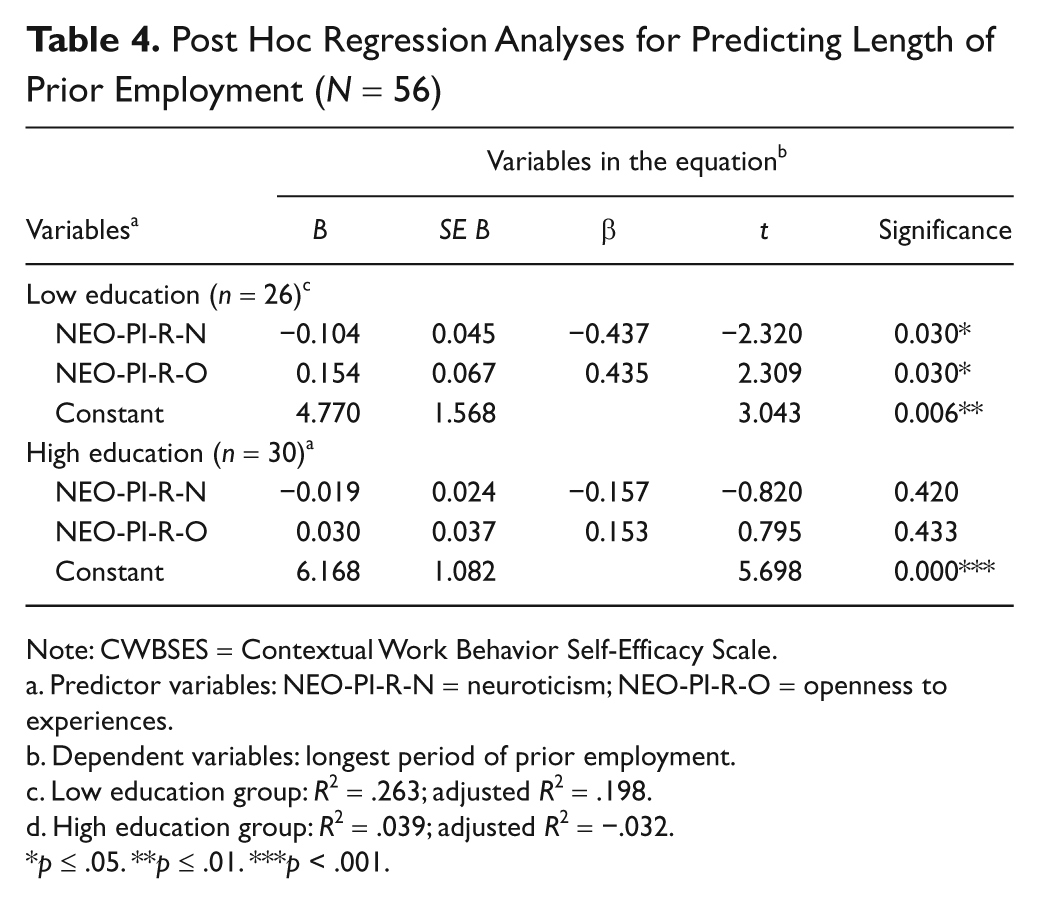
Note: CWBSES = Contextual Work Behavior Self-Efficacy Scale.
Predictor variables: NEO-PI-R-N = neuroticism; NEO-PI-R-O = openness to experiences.
Dependent variables: longest period of prior employment.
Low education group: R2 = .263; adjusted R2 = .198.
High education group: R2 = .039; adjusted R2 = −.032.
p ≤ .05. **p ≤ .01. ***p < .001.
Implications for Rehabilitation Practice
Researchers have argued that although many elements of personality are stable over time, recent longitudinal results reveal the developmental and dynamic nature of personality traits across the life span (Fraley & Roberts, 2005; Roberts, Caspi, & Moffitt, 2001). Specifically, negative trait expression reduces with age for a sizable minority of populations studied (Roberts et al., 2001). Personality stability is more likely when one’s environment is also stable. Significant changes in environment require development of new behaviors for the person to interact in his or her new environment. This fluid person–environment interaction is believed to contribute to personality development and changes in expression over time (Roberts et al., 2001). This is relevant to persons with disabilities as acquisition of a disability frequently requires significant environmental changes to facilitate vocational goals, manage symptoms, and navigate changes in relationships. Such significant changes may contribute to changes in personality expression.
When we consider employment outcomes for persons with disabilities at risk for unemployment, the developmental feature of personality can be seen as encouraging. For instance, practitioners and researchers can focus on finding ways to enhance personality expression that is known to be positively and significantly related to positive vocational outcomes (such as high levels of openness and conscientiousness), while also incorporating interventions that can reduce expression of traits associated with worse employment outcomes (such as high levels of neuroticism).
A more disconcerting perspective of this dynamic feature of personality concerns persons who acquire a disability and must change career or vocational goals to accommodate impairments or health status. A person who was previously employed in an environment that promoted optimal personality expression for that individual may experience incongruity for the first time post disability. This experience might lead to changes related to expression of openness, neuroticism, and conscientiousness, all of which could negatively affect employment outcomes, including work self-efficacy for many and job tenure for those with low education levels. Many disabilities, such as traumatic brain injury or brain cancer, and the subsequent treatment for these disabilities could lead to reduced expression of openness (or at least the subcomponent of openness that is intellectual expression), a trait found to be a significant predictor of length of prior employment in the current study. For persons who express negative components of neuroticism, cognitive-behavioral interventions aimed at reducing anxiety levels are recommended, particularly for persons with disability and low education. For persons who express average levels of neuroticism and openness, a continued effort to explore education is recommended as these levels of personality expression were found to negatively affect job tenure in the current sample of persons with low education.
Knowledge of personality trait expression related to work outcomes is useful for rehabilitation and vocational counselors as they implement strength-based strategies with their clients to emphasize and leverage strengths while working toward counseling and vocational goals. Continued efforts focused on personality and efficacy assessments for persons with disabilities may strengthen our understanding of factors that contribute to improved employment outcomes for this population that go beyond assessment of functional impairment, skills, abilities, and interests. Specifically, it will be useful for future studies to continue to investigate the possible moderating relationship among personality, efficacy, and job tenure.
Limitations and Future Research
Conclusions about the results of this current study are limited by the following considerations. First, this study utilized a cross-sectional exploratory approach that limits the ability to determine any causal link between the variables. Future research should aim to use larger samples and more sophisticated models to estimate the relationship among these variables, including investigation of efficacy as a possible moderator between personality expression and employment tenure. Our study only investigated the relationships among personality, efficacy, and job tenure as reported by persons with disabilities who were currently unemployed at the time of data collection. Future research should investigate whether similar relationships among the variables are found in samples of persons with disabilities currently employed. Future research should also aim to validate participants’ responses regarding personality and efficacy with employer ratings of the same qualities. An understanding of threshold scores for any of the predictor variables could answer questions related to “how much.” In other words, what are the “good enough” or threshold levels of conscientiousness, neuroticism, openness, and efficacy needed to predict job satisfaction and satisfactoriness. Finally, given the negative impact of social stigma on employment outcomes for persons with disabilities, future research should aim to investigate how stigma covaries with personality and efficacy when investigating job tenure.
Conclusions
The overall results of this study suggest that traits (personality) and states (work behavior self-efficacy) are related to each other, and both relate to job tenure in a sample of individuals eligible for vocational rehabilitation services. The traits of conscientiousness and neuroticism significantly predicted work behavior self-efficacy, a construct that has been significantly related to positive vocational outcomes for persons without disability (Stajkovic & Luthans, 1998). When considering traits and states in a model predicting job tenure, personality expression was found to be the more robust predictor of length of prior employment. The personality factors of neuroticism and openness made unique contributions to length of prior employment, with openness maintaining its contribution when work behavior efficacy was added to the model. The results from this sample support prior research findings in samples of people without disabilities, which suggest the importance of personality expression as a construct to consider in career interventions (De Fruyt & Mervielde, 1999; Furnham et al., 2002). Surprisingly, work behavior efficacy did not make a significant contribution to the model predicting length of prior employment. This finding is inconsistent with research on persons without disability that demonstrates a strong relationship between work efficacy and positive vocational outcomes (Stajkovic & Luthans, 1998). This is the first known study that found the personality trait of openness significantly contributing to length of prior employment. Results from a post hoc analysis revealed that personality factors (neuroticism and openness) significantly related to length of prior employment only for those with low education levels, implying that higher education may offset vocational consequences associated with negative personality expression. More research is needed in this area with larger samples to examine how personality, efficacy, education, and disability intersect and affect career and employment outcomes for persons with disability.
Footnotes
The author(s) declared no potential conflicts of interest with respect to the research, authorship, and/or publication of this article.
The author(s) received no financial support for the research, authorship, and/or publication of this article.