







Abstract
Parent–practitioner engagement in the early years has become a key policy in remediating the negative effects of poverty upon children’s early educational outcomes. Although this approach is shared across several developed countries, there has been limited attention upon how practitioners think about poverty and their engagement with parents in poverty. Our mixed methods study in England and the USA provides rare evidence addressing these issues. Among our practitioners in both countries ‘parent blame’ for poverty featured to some extent in the accounts of a majority of practitioners. We also found a relationship between the extent to which our practitioners felt individual parents are culpable for poverty and their reporting of more negative engagement with parents – particularly in England. We claim this is worthy of further study as a potential threat to the ‘child–parent–practitioner triangle’ and to remediation of poverty’s effects within early educational contexts.
Introduction
This article describes research which aimed to develop knowledge about early childhood education and care (ECEC) practitioners’ engagement with parents in poverty. Measured by income thresholds in both countries living in poverty is a significant problem as it is highly predictive of negative educational consequences for children. Across both England and the USA over 20% of children are living in poverty and there are sizable and persistent income-related gaps in children’s early educational outcomes before they enter school (Dickerson and Popli, 2014; Stout Sasinsky, 2013; Waldfogel and Washbrook, 2011: 1). Several research studies also show the negative impact of poverty upon parental investment and children’s experiences as they grow up in England and the USA (Bassok et al, 2016: 1; Richards et al, 2016: 43). We begin by showing how in both countries there has been a policy emphasis on ECEC engaging parents as a means of remediating these problems attached to poverty (Allen, 2011; Field, 2010; Love et al., 2005; Mathers and Smees, 2014; Schweinhart et al., 2005). While a focus upon parental engagement should not distract from critical scrutiny of the context of recent funding cuts in both countries and their implications for disadvantaged children (Alston, 2017, 2018), we highlight how research suggests engagement has benefits. We move on to show, though, how policy around parental engagement is not value-neutral in either country with a negative construction of parents in poverty framing it. Indeed, we note engagement is further complicated by its contingent nature and the influence of practitioners’ perceptions of poverty and disadvantage. Below we draw on rare data from practitioners in several locations across England and the USA which reveals how they shared a negativity expressed about disadvantaged parents found in policy discourse. We argue this is a threat to engagement and the important ‘child–parent–practitioner triangle’ in the early years.
Policy, parenting and ECEC
Since the new millennium began many governments across the globe have prioritized family policy as a mechanism for tackling social ills such as poverty (Faircloth et al., 2013; Organisation for Economic Co-operation and Development (OECD), 2012). There are differing national trends in how the significance of family has emerged (Faircloth et al., 2013). In the UK and the USA – the contexts focused upon in this article – politicians have moved away from an earlier resistance to supporting policies which encroach too extensively into family life. The UK government and the US Federal government, along with individual States, have become increasingly active in family and parenting policy to support interventionist approaches in the last two decades (Eisenstadt and Oppenheim, 2019: 148; Wilinski and Morley, 2019). Some differences between the policy approaches adopted by successive UK governments are evident (Eisenstadt and Oppenheim, 2019). Similarly, in the USA variation in family policy approaches between States is evident (Department of Health and Human Services & U.S. Department of Education (DHHS & DE), 2016). There is, however, one common feature of family policy between the UK and USA that runs through the period since the millennium began. This has been growing emphasis upon ECEC as a core part of provision which can support parents and children (DHSS & DE, 2016: 1; Eisenstadt and Oppenheim, 2019: 105; Wilinski and Morley, 2019).
Within both countries there is also a specific emphasis on ECEC engaging parents in poverty. The UK’s first Child Poverty Strategy, for example, mentions ‘empowering’ ECEC services and practitioners ‘to do more for the most disadvantaged’ via the provision of free early education places for children aged two to five. A current plan to tackle a lack of social mobility has emphasised the engagement of parents in poverty with early years practitioners in the delivery of ‘evidence-based home learning environment programmes that support early language development’ (Department for Education (DfE), 2017a: 12; Her Majesty’s Government (HMG), 2018). Early educational curricula in both England and the USA emphasise parents’ active engagement with practitioners in their children’s education to ensure their ‘school readiness’. This engagement is described as ‘essential’ (New York State Education Department (NYSED), ONLINE. 8; Ohio DoE, ONLINE) via ‘partnership working’ (DfE, 2017b: 5). In the USA, the War on Poverty and No Child Left Behind campaigns both set out to target parental engagement with practitioners in children’s early learning (won Kim, 2019: 2). Federal programmes such as Early Head Start and Head Start are targeted at the poor and place an emphasis upon parental engagement as an important factor in the development of young children (Ansari and Gershoff, 2015: 562; Nix et al., 2018: 106). Many States have actively supported an emphasis on parental engagement which locates low-income families as the subjects of intervention by expanding Pre-K (Pre-Kindergarten) and other ECEC provision (Stark, 2010; Wilinski and Morley, 2019).
Via engagement with families in poverty it is expected ECEC in both countries can reduce pressures on parents by helping support their resourcefulness and resilience when parents are trying to protect their children from risks attached to living in adverse circumstances. There is an expectation ECEC can improve capabilities by ‘helping parents to parent’. In this way it is hoped practitioners engaging with parents in poverty can support children’s learning (Smith, 2018: 28) and reduce existing ‘attainment gaps’ (DWP(Department for Work and Pensions) & DfE (Department for Education), 2011: 35). Moss (2014: 3) highlights this logic – invest in ECEC so it can engage with parents and you will get high returns on investment including children’s improved academic performance and school readiness. These are considered essential to later achievement in school and beyond. As will be highlighted such engagement is potentially beneficial, although it is not straightforward or value-neutral.
The benefits of parent–practitioner engagement in ECEC
There is significant research, nationally and internationally, showing parental engagement in children’s learning is positively related to achievement (Campbell, 2011: 6). This is true of all phases in education including the early years (won Kim, 2019). The significance of engagement between parents/carers and early education practitioners has become ‘well established’ across several developed countries (Mahmood, 2013: 55) – including England and the USA (Bierman et al, 2017; Draper and Wheeler, 2010). Engagement of parents can be in preschool setting life generally and more specifically it can be in their children’s learning. Traditionally, therefore, it has involved variety and can include parents working with staff in settings and parents as governors or on management committees. Parents can also become involved in the design and shaping of workshops and courses. Parents can run services such as toy libraries while sharing observations and jointly planning next steps for their child’s learning with practitioners (Draper and Wheeler, 2010: 180). This responsibility for their children’s learning, intellectual development and educational success has become a key remit of parenting in early childhood across most developed countries since the turn of the millennium and it is this outcome parents are increasingly expected to support through engagement with early years practitioners (Smyth, 2016: 731).
Practitioners become engaged with parents in their child's learning via their general practice, through ‘parent pedagogy’ and when providing skills provision designed to help parents better support children (Draper and Wheeler, 2010; Jensen, 2018; Ward, 2013). When involved in engagement research reveals parents prefer co-construction and joint-involvement with practitioners. They want to be listened to, respected and have their views and knowledge taken seriously (Draper and Wheeler, 2010; Vandenbroeck 2014). Practitioners are expected to ensure that a trusting, respectful relationship develops from the initial contact with all parents and that the early educational environment is warm and welcoming to all parents. As Owen (2019: 476) notes, best practice expects an ‘inclusive perception’ will pervade the thinking of practitioners which involves ‘the acknowledgement and celebration of difference, rather than its problematization’.
Parent–practitioner engagement, values and the poor
Policy concerning parental engagement focused upon parents in poverty is not value-neutral. Rather, it is the product of the prevailing political context within which it is developed and differing political constructions of child poverty are important in this regard. Some consider child poverty a structural issue caused by economic divisions and issues attached to low income and the labour market (Eppard et al., 2017; Rank, 2011). Lack of access to economic resources means parents are restricted when investing materially in their children’s education and they experience financial stress compromising family relationships and attachments with children (Cooper and Stewart, 2013; Stock et al, 2014). A second explanation for poverty supported by neoliberal polity, though, has become influential and focuses upon the behaviours of the poor rather than wider economic forces. From this perspective poverty is expressed in the form of unacceptable behaviours deviating from the ‘respectable’ behavioural norms of dominant society, for instance as the lifestyle of a subculture or ‘underclass’. The inadequacy of people’s power over financial and other resources is seen as irrelevant to the question of how they behave (Veit-Wilson, 2000).
Constructing child poverty as a problem of the negative behaviours of the poor has allowed for it to be made amenable to treatment via ECEC. Gillies (2008) notes how in England the political rhetoric of successive governments around parental engagement via ECEC reveals a common class specific focus on disadvantaged parents as failing their children. Poverty is constructed within policy discourse as a problem of the ‘troubled’ behaviours of the poor with parents in poverty ‘reproducing a cycle of deprivation and anti‐social behaviour’ (Gillies, 2008: 1079). As such, a prominent focus of ECEC’s engagement with parents in poverty has been an expectation it can address parenting deficiencies and alter their negative behaviours (Gillies et al., 2017; Her Majesty's Government (HMG), 2018: 7; Jensen, 2018). Similarly, in the USA, Wilinski and Morley (2019: 5) observe how parental engagement in ECEC can be conceptualised in two ways – ‘doing with’ and ‘doing to’. It is the latter which has increasingly become the focus of parental engagement with low-income parents as they receive interventions with class-based and cultural assumptions designed to improve deficient parenting by extending the school learning environment into the homes of the poor.
Practitioners and their views about poverty and the poor
Parental engagement is not straightforward and often poses a challenge, particularly when engaging those labelled ‘hard-to-reach parents’ including those in poverty (Campbell, 2011). The personal views of practitioners and how they perceive and interact with parents are important to engagement (Ward, 2013: 13). It is recognised how ECEC practitioners having ‘positive attitudes’ towards parents increases their levels of engagement (Knopf and Swick, 2007; Ward, 2013). ECEC practitioners’ views about parents in poverty are important in their efforts to engage such parents. ECEC practitioners are unlikely to be immune to the negative constructions evident in policy mentioned earlier. Research suggests these are held by the wider population. ‘Parent blame’ is a central feature of these representations of the poor in both countries (Hall et al, 2014; Howard et al, 2017; Jensen, 2018; Rose and Baumgartner, 2013; Shildrick, 2018). Despite the potential significance of ECEC practitioners’ views about parents in poverty however, research on these issues is extremely limited.
There are some small-scale studies which have considered practitioners narratives about poverty. For instance, an exploratory qualitative study by Ipsos Mori with practitioners holding varied job roles found their views on the causes of poverty ranged from ‘material circumstances to parenting attitudes and behaviours’ (Cameron et al., 2008: 9). Similarly, recent qualitative research within integrated preschool settings in the South-East of England found a complex range of responses among 38 practitioners when asked about the poor. These included negative notions about the undeserving poor (Lyndon, 2019). Smith (2018) focused upon views held by practitioners about parents and their links to practice. It explored how mothers experienced the resources provided by a small town in the East Midlands of England to support their children’s literacy development and spoke with preschool staff involved. It found that practitioners held more negative views about those mothers from social housing estates and blamed these mothers for their children not being ‘school ready’. This shaped very different provision designed to engage them in supporting their children’s literacy compared with provision for other mothers. Several of the mothers and carers from the social housing estates felt stigmatized and this negatively affected attendance among them (Smith, 2018: 28–29). Similarly, qualitative research in Turkey examining the processes around parental engagement in preschool activities also found ‘negative attitudes’ and ‘the behaviour of teachers’ were ‘important problems’ which negatively affect relations with parents in poverty (Kocyigit, 2015).
As indicated, though, evidence about practitioners’ views on poverty and how these may link to engagement remains rare. Despite this, there is growing recognition that engaging with parents in poverty is dependent upon well-educated and competent staff. A lack of pre-service training in this respect can be problematic (Peters and Shamahd, 2014: 412). Mahmood’s research (2013: 5) rightly highlights how ECEC practitioners should not be ‘presumed to be responsible for lack of parent-teacher collaboration’ and how some parents are not responsive. Mahmood, however, also indicates the importance of competent staff without negative attitudes when it comes to working with parents in poverty. Addressing the lacuna in the evidence base, below we provide modest but unique evidence which has explored transnationally the views of ECEC practitioners about the causes of poverty and how these relate to engagement with parents in poverty. To the best of our knowledge, it is the first study to do so across two countries.
Methodology
A mixed methodology comprising a quantitative survey strand and a qualitative interview strand was used to achieve the research aim and answer the research questions mentioned earlier. Below we will make no claim to our sample being representative of the wider ECEC workforce in England and the USA. Our ability to generalize the findings is therefore limited. To our knowledge, however, this is the first study to examine the relationship between general perceptions of the causes of poverty and ECEC practitioners’ perceptions of, and involvement with, parents in poverty. So we adopt ‘moderatum generalization’ below with our conclusions being ‘testable propositions that might be confirmed or refuted through further evidence’ (Payne and Williams, 2005: 296). Interviewing was with ECEC practitioners. Overall 60 semi-structured interviews with ECEC practitioners were undertaken in both countries. Across England 30 interviews with ECEC practitioners were completed in Teesside (n = 10), Worcestershire (n = 10) and Northants (n = 10). These three English locations were selected via variation sampling to include practitioners working in relatively urban and rural contexts (e.g. more urban Teesside and more rural Worcestershire and Northamptonshire). Across the USA, 30 interviews with ECEC practitioners were also completed in New York (n = 20) and Ohio (n = 10). These US locations were based on convenience as contacts with academics were established in these locations. Practitioners were selected for interview purposefully and had to work with children living in poverty according to the income thresholds for households in both England and the USA. Given the large percentages of children experiencing poverty in both countries (in England 30% and in the USA 21% using a threshold some consider to be far too low – see Tilly, 2019) it is difficult to find ECEC practitioners that do not work with children and parents in poverty. Interviewees were asked to confirm they worked with children in poverty before being interviewed. The questionnaire also included an introduction which made clear it was only to be completed by those working with children in poverty living in households below the income thresholds for poverty in both countries. In the USA, it was also targeted at practitioners in settings known to work with parents in receipt of Federal and state assistance programs. Practitioners also had a relatively high status as ECEC practitioners – e.g. Pre-Kindergarten teachers in the USA and senior practitioners (level 5 or above in the national qualifications framework) in England.
The questionnaire was administered online via a popular established online survey software package. Within England a link to the online questionnaire was sent to practitioners completing programmes at level 5 and above at the English authors’ respective Universities. The link to the online questionnaire was sent to around 500 such practitioners. In the USA the link to the questionnaire was sent via emails to a list of early years settings obtained online and via personal contacts. This approach made it impossible to calculate a precise response rate; however, the purpose of the present study was merely to explore the relationship between poverty beliefs and perceptions of parents in poverty in a reasonable sample of experienced practitioners. Participation was completely voluntary, and no incentives for study completion were provided. In total 338 questionnaires were returned from practitioners (159 from the USA and 179 from England).
The qualitative semi-structured interview strand considered in-depth the views of practitioners about the causes of poverty and their experiences attached to their work with parents in poverty. The interview guide was constructed around themes focusing upon practitioners’ backgrounds, roles both general and relating to parents and children in poverty, meanings attached to poverty and its causes, and work with/support for parents and children in poverty. The quantitative questionnaire was constructed with several blocks covering themes of interest. It started with a section containing nine variables concerning beliefs about the causes of poverty. Five variables portrayed poverty as being due primarily to individual-based factors (e.g. ‘People who are exposed to chronic/generational poverty generally only have themselves to blame’.). The remaining four items portrayed poverty as being due primarily to situation-based factors (e.g. ‘Chronic/generational poverty is primarily maintained by factors that are largely beyond the control of the individuals in question’.). All items on these variables were responded to using nine-point scales (1 = ‘strongly disagree’; 9 = ‘strongly agree’). A further section asked practitioners to respond to four statements regarding their involvement with parents/carers living in poverty: ‘regularly attend conferences’, ‘volunteer in the classroom’, ‘are responsive to communications’, ‘are engaged in child’s learning/development’ – each measured on a nine-point scale (1 = ‘strongly disagree’; 9 = ‘strongly agree’).
The quantitative analysis of questionnaire data involved descriptive and inferential statistics. For purposes of the analysis, the nine variables on the poverty belief scales were combined and then averaged into a composite measure for individualistic and situational beliefs. In doing so, the reliability coefficient indicated a good level of inter-item consistency (α = .78). Similarly, the four variables indicating involvement with parents were also averaged into a composite and were highly interrelated (α = .86). Qualitative theme analysis was completed using Nvivo software categorising themes of interest such as poverty beliefs and work with parents in poverty and the exploration of links between these themes. Ethical approval for the project was gained from relevant Research Ethics Committees of participating universities. All practitioners participating within both the quantitative and qualitative strands of the research across both countries provided informed consent and were given guarantees about confidentiality, anonymity and privacy. Pseudonyms are used below.
Findings
Causes of poverty and pervading ‘parent blame’
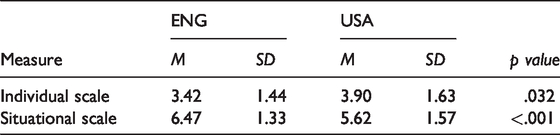
We found a level of complexity in responses from practitioners when asked about the causes of child poverty. Although Table 1 shows in both countries situational factors were agreed to be more important than individual factors in causing poverty (measured on the scale 1 = ‘strongly disagree’ up to 9 = ‘strongly agree’), there was little mention of inequality attached to economic structural factors. Rather, open responses to the survey questionnaire and via interviews revealed how chief among situational factors was a ‘cycle’ of poverty. Practitioners implied there is transmission of negative values and behaviours via socialization across generations and this results in a learned helplessness amongst parents which prevents them taking actions to escape poverty.
Poverty beliefs by nation.
The majority of our practitioners emphasized ‘poor parenting’ as part of this ‘cycle’ with cross-generational transference of negative parenting behaviours and values such as lack of motivation and low aspiration from parents to children – these feature in cultural underclass theories. This meant parents had received poor parenting, and the parenting they were now undertaking with their children was also viewed by many practitioners as deficient and a key cause of poverty: England – Zara – I’ve seen a lot of instances where parents and their children are in poverty because their parents were in poverty and they haven’t had the help necessarily, from the generations before them. England – Sadie – the lack of parental skills, that lack of support for the children and the fact that we’ve got families who are in a cycle where two or three generations have never worked and so you have children in the school who are in that cycle of poverty. USA – Leonard – I think it is a cycle. It’s, you know they are in poverty, their parents grew up in poverty, and it just continues USA – Katlyn – Lack of knowledge. We can start to talk about how they may have had generations of lack of knowledge as parents where they weren’t taught correctly, but the buck needs to stop somewhere, the cycle needs to re-start somewhere. England – Selena – For me the biggest factor, the biggest contributing factor for child poverty is parental engagement or involvement with their children and their aspirations for their children. England – Anne – I think it’s the choice of the parents of why they’re living in poverty. I don’t think it’s anybody else’s fault apart from them … I think it’s about how they use the money … They spend it on things that they don’t need. England – Laura – When they [parents] are getting the money in, they’re choosing to spend it on other things that aren’t helping their children – so the Sky TV. I’m a mam [mother] and I wouldn’t dream of letting my children go hungry, and not going to school with shoes on, for something that I wanted. USA – Wendy – Bad choices, poor choices … it boils down to choices. In your control, out of your control. USA – Yolanda – A lot of parents they ignore children, and that leads to poverty. USA – Doris – poor choices, that the parents made and that automatically puts the child in this situation that they really have no control over which isn’t fair to them. England – Zoe – sometimes families can’t help the circumstances that they’re in or that they get into. I think when parents become unemployed. And I think sometimes, as much as I hate to say it, it does run in generations … I’ve seen a lot of instances where parents and their children are in poverty because their parents were in poverty and they haven’t had the help necessarily, from the generations before them. USA – Danielle – probably lack of jobs, or lack of the will to work maybe in some cases even, and then just poor choices maybe, that the parents made and that automatically puts the child in this situation that they really have no control over which isn’t fair to them.
Negativity and engagement with parents in poverty
As mentioned earlier, the negativity expressed above about parents and their parenting is important as practitioners’ views of parents ‘have an impact on the way they perceive and interact with them’. Indeed, with regard to the ‘child-parent-practitioner triangle’ in the early years it is identified how ‘in any situation it would be very hard to build trusting and supportive relationships if one partner held negative or misplaced views of the other’ (Ward, 2013: 13). Our quantitative data from the closed questions in our survey, and qualitative data from the survey’s open questions and our interviews, highlighted practitioners’ negative views about the engagement of parents in poverty within ECEC. Via the online survey, practitioners responded to four statements regarding their views and interactions with the parents living in poverty. They were asked about the extent to which they agreed these parents ‘regularly attend conferences’, ‘volunteer in the classroom’, ‘are responsive to communications’ and ‘are engaged in child’s learning/development’. Each measure was on a scale from 1 (strongly disagree) through to 9 (strongly agree). Table 2 reports their responses.
Attitudes to parents in poverty by item by nation.
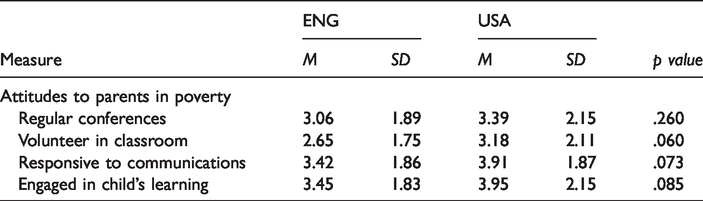
Table 2 shows within both countries practitioners responding to the survey were negative about parental engagement with disagreement being the average across all four measures. The practitioners in England perceived parental engagement a little more negatively across the measures than their counterparts in the USA, although, between countries slight differences in means were not statistically significant. What was quite startling within the qualitative data was the conscious way some practitioners expressed their negativity towards parents in poverty when discussing their attempts to engage them – several revealed this was a challenge and what one called ‘the hard bit’. Those attaching blame to parents in poverty for their poverty appeared also to accentuate the need for parents’ compliance and acceptance of treatment prescribed to eliminate their deficiencies. Consequently, several practitioners’ described approaches to engaging parents in poverty which were focused mostly upon the parent rather than the parent-child relationship, were hierarchical rather than reciprocal, and were very much a top-down process. In a context where academic discourses, theory and good practice guidance emphasize joint involvement and co-construction if parents from all backgrounds are to be successfully engaged, several practitioners made it clear they were first among un-equals and were addressing deficiencies when it came to working with parents in poverty. The knowledge of parents in poverty was rarely mentioned as an asset: England – Karissa – the Children’s Centre does a lot to help with parenting skills but unfortunately some parents aren’t so educated and they have trouble raising their children. England – Clare – we can educate the parents … They need the [pedagogical] support to be able to parent effectively. England – Anne – I think they should be made to go to classes for their benefit [welfare payments] … to have them all build up their self-esteem … just giving them a better positive mental attitude England – Dolores – you try and get them onto courses to better themselves … And as much as you try and show them the right steps … they generally don’t take the opportunities that are there for them. England – Sacha – They [parents in poverty] just come [to parenting provision] because they think they should. Not because they’re thinking it will benefit their children … they see it as a babysitting service. USA -– Nina – It depends on the parents’ attitude. Do they want to take the advice? You have to have the parent support and parent willingness. I would say nobody wants to be told there is something wrong. USA – Yvette – Some families seem to not be able to change the course of their family history … I do see my role as helping parents understand. USA – Wendy – I’ve worked with parents in poverty who are concerned about their children … But I can also see that without a support system it would be very difficult for them to do those things – because that’s not your norm.
Correlation between the engagement composite and the poverty beliefs individual composite.

Correlation between the engagement composite and the poverty beliefs situational composite.

*p < .01.
This is interesting because it does suggest reported differences in levels of engagement with parents in poverty are indeed tied, at least to some extent, with general poverty beliefs. A parsimonious explanation of this finding is belief poverty is caused by individual-level factors creates a bias against the poor which has some degree of influence on engagement with parents in poverty. While some practitioners in our study sent food parcels home with children the latter were very much seen as innocent victims but this was less the case with their parents. Indeed, one of the interviewees in England vividly highlighted the challenge of changing negative views about parents in poverty: England – Sharon – I don’t know whether I should share this but I will. One of my staff is pregnant at the moment. She’s due to leave. And a parent of one of the deprived children is also pregnant. And she’s found out she’s having a little girl. She’s [the parent’s] got all boys. So she came in the other day with this huge bag of clothes for my member of staff cause she said, “I’m not having a boy and you are.” And my member of staff refused to even put the bag in her car because of the family it came from. And I just thought, that is just so wrong because your perception of that family. There was nothing wrong with the stuff. It was lovely and clean. Most of it was brand new. But she wouldn’t even open the bag and look in it. And that really breaks my heart. It really does.
Conclusion
ECEC alone cannot address the negative effects of poverty in the early years, but it can help support parents facing extremely challenging circumstances in which raising children is made much more difficult. The ‘child–parent–practitioner triangle’ is key in ECEC and particularly important when working with poverty. Building relations with parents, though, is not easy and is broadly accepted to work best when reciprocity is evident – i.e. joint involvement, mutual respect and influence – and therefore practitioners’ views are important in this respect. We found a good deal of negativity expressed towards parents in poverty by the practitioners providing data for our research. We also found, particularly in England, the practitioners believing poverty is a result of fallible choices made by individuals harboured more negative opinions of disadvantaged parents and reported less involvement with these parents. As indicated, we must be cautious in attaching wider relevance to our findings, though we do believe our research is unique and important in the context where ECEC is expected to play a role in remediating child poverty and practitioners work with parents in poverty is a key element of this work. Parents may be unresponsive to practitioners, but given that parents in poverty already struggle with a long list of challenges and disadvantages, these issues deserve further empirical attention. Our findings, when viewed alongside those from other recent research, suggest professional development connected to working with parents in poverty needs priority.
This is not straightforward. Peters and Shamahd’s (2014) research demonstrates the importance of such in-service professional development for ECEC practitioners who work with children and parents from disadvantaged backgrounds. They highlight the challenges involved and the need for pedagogical support which is sustained over long periods of time and developed by specialized staff (such as pedagogical coaches). Such training also needs to be organized in a comprehensive way. Owen’s (2019: 476) study in England explored the reversing of deficit-based discourses amongst practitioners and the promotion of ‘diversity gain’ in seven early years settings in England. It supports the use of a ‘critical communicative methodological approach’ with an emphasis upon exploration and listening for understanding if ‘authentic inclusion’ of parents in poverty is to be achieved. It also highlighted how ‘practitioners felt that there was a distinct lack of resources, including funding, time and expertise, to support inclusive practice appropriately’.
Footnotes
Acknowledgements
We are grateful to all the practitioners providing data for our research.
Declaration of conflicting interests
The author(s) declared no potential conflicts of interest with respect to the research, authorship, and/or publication of this article.
Funding
The author(s) disclosed receipt of the following financial support for the research, authorship, and/or publication of this article: The authors express gratitude to The British Academy and The Society for Educational Studies for providing financial support which facilitated the development of the research.
