







Abstract
The underrepresentation of females in certain fields has been studied extensively in many countries. Similar to other parts of the World, the number of females graduating each year from universities in the Arab World now exceeds the number of males, yet gender differences in educational fields persist. The objective of this study is to review the extant literature on the gender gap in science, technology, engineering, and mathematics (STEM) in the Arab World. The review synthesizes the findings of 86 articles that were published in journals and conference proceedings. This review explores gender differences in mathematics performance, math anxiety, self-concept, and occupational career choices. The review also explores social barriers that contribute to the underrepresentation of females in STEM fields. The study highlights differences between results obtained in the Arab World and results obtained in Western countries while also noting the differences between the Arab countries themselves. Finally, the study suggests directions for future research.
Keywords
Introduction
Career choices have important implications on the lives of students (Bandura et al., 2001), as well as on the economy as a whole (Xie et al., 2015). An understanding of how and why these choices are made is necessary because it will help educators influence the lives of students by directing resources to appropriate education and support programs (DuBois, 2001). It is now well documented that the gender gap between males and females in university enrollment rates has not only narrowed but has been reversed (Buchmann and DiPrete, 2006; OECD, 2019). However, closer inspection of the data reveals a troubling finding, and that is that females continue to be underrepresented in engineering and computer science while being overrepresented in education, the humanities, and health (Master et al., 2017; Schuster and Martiny, 2017).
Purpose of the study
The purpose of this study is to present a systematic review of studies investigating gender differences in career choices in Arabic countries. As noted by Spierings (2014), Arabic and Muslim countries have been classified mostly as conservative and patriarchal and have been usually treated as a different group due to Islam's “nature.” This dualistic conception has been challenged on the basis that traditional divisional of labor exists in the vast majority of countries to differing degrees and manifests itself in, among other things, gender differences in career occupations. In addition, considerable variations have been found in Arabic countries in terms of women's employment and economic participation (Spierings, 2014; Spierings et al., 2009).
Starting from this premise, the present study does not seek to review the literature on gender differences in career choices in the Arab World due to the “special nature” of these countries. Instead, this paper seeks to expand current knowledge by reviewing the literature in an empirical context that has been largely neglected by authors from other parts of the World. While Arabic countries have much in common, there are also important differences. Hence, by reviewing the literature, it would be possible to identify the similarities between these countries in addition to the differences.
Arabic countries present an interesting context to study gender differences. Since the 1960s, the social structure of most Arabic countries has changed due to a variety of factors, most notably due to mass education, which has resulted in a decrease in female fertility rates, increased women's labor force participation, and increased the average age of marriage (Moghadam, 2004). These changes in the social structure have resulted in the replacement of classic patriarchy by neopatriarchy (Sharabi, 1988).
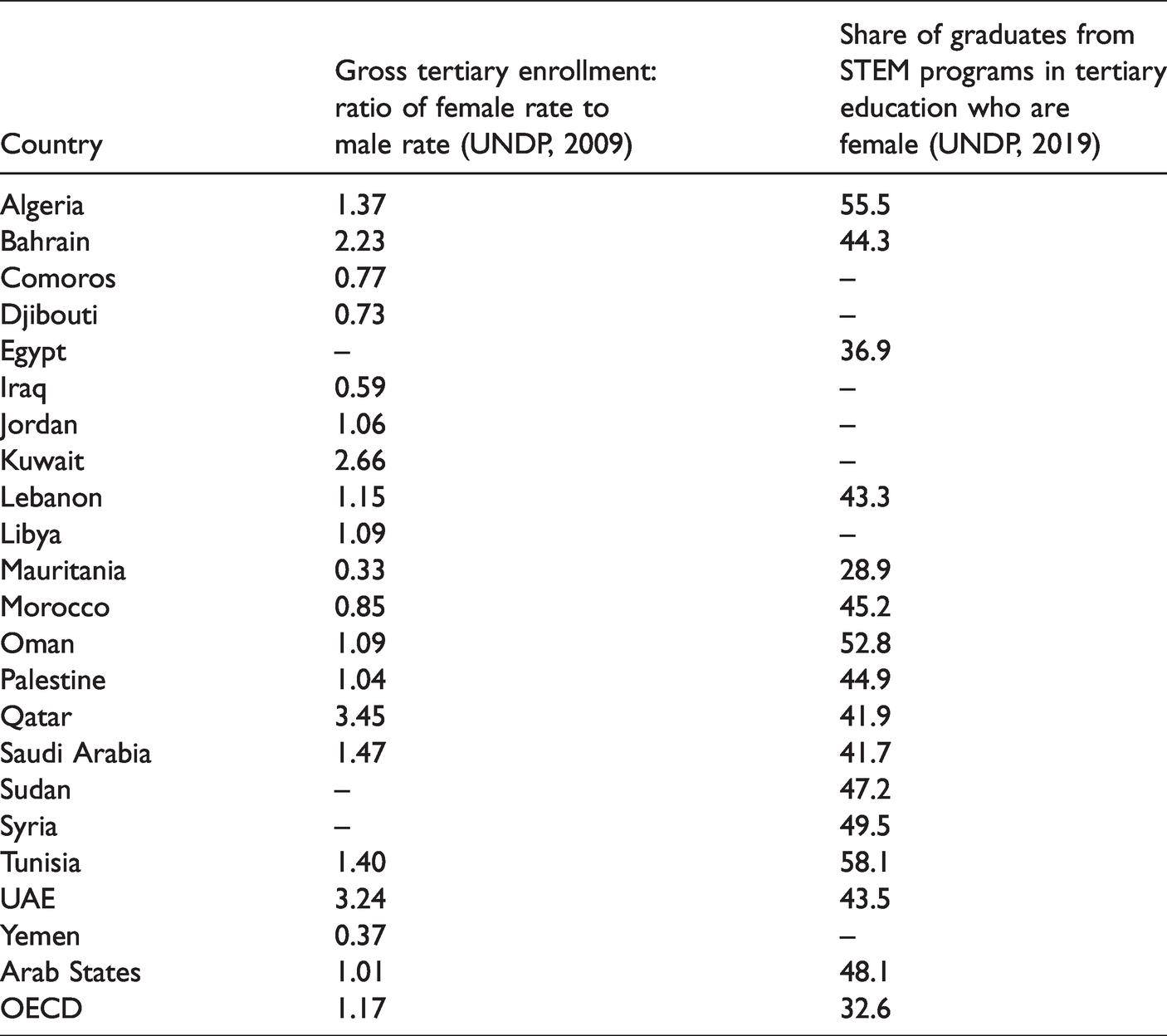
Table 1 shows a list of the Arabic countries in addition to statistics relating to female participation in STEM fields. The first statistic is the ratio of the female enrollment rate in tertiary education to the male enrollment rate. It can be clearly seen that there is considerable variation, with the rate for females being larger than the rate for males in countries like Algeria, Kuwait, UAE, Saudi Arabia, and Tunisia, while the rate for females is lower than the rate for males in countries like Comoros, Djibouti, Iraq, Mauritania, Morocco, and Yemen. The second statistic is the percent of graduates from STEM programs who are female. Once again, we see variation but not to the same extent as the first statistics. In most countries, the share of female graduates in STEM programs is less than half, but not to a great degree. We see that in many countries, the percentage is in the 40 s. Interestingly, Algeria, Oman, and Tunisia report a higher share of female graduates than male graduates. The largest gaps are seen in Egypt and Mauritania. The average for Arabic countries is higher than that of OECD countries.
Gender comparisons in education and occupation.
Methodology
Review framework
Reviewing the existing literature in the Middle East allows for the development of a framework that is based on frameworks used in other studies (Ceci et al., 2009; Lent et al., 2000). The framework is shown in Figure 1 and acts as a guideline for discussing the results of the literature review. The framework is largely based on social cognitive theory (SCT) (Bandura, 1986), one of the most used models to explain female career choices. SCT explains gender development in terms of reciprocal causation, which is why in the framework there are bidirectional links between certain elements. SCT distinguishes between the immediate environment and the larger social context (Lent et al., 2000). While the larger social context is largely given, individuals can select and even construct their own immediate environments through what Bandura (1989) called selection processes. These selection processes depend on an individual's self-efficacy, which develops using information from an individual's performance and emotional state, as well as from both the larger, societal environment and the immediate environment. While self-efficacy is partially dependent on performance, it nonetheless influences performance since people avoid activities that they believe exceed their performance (Bandura, 1977).
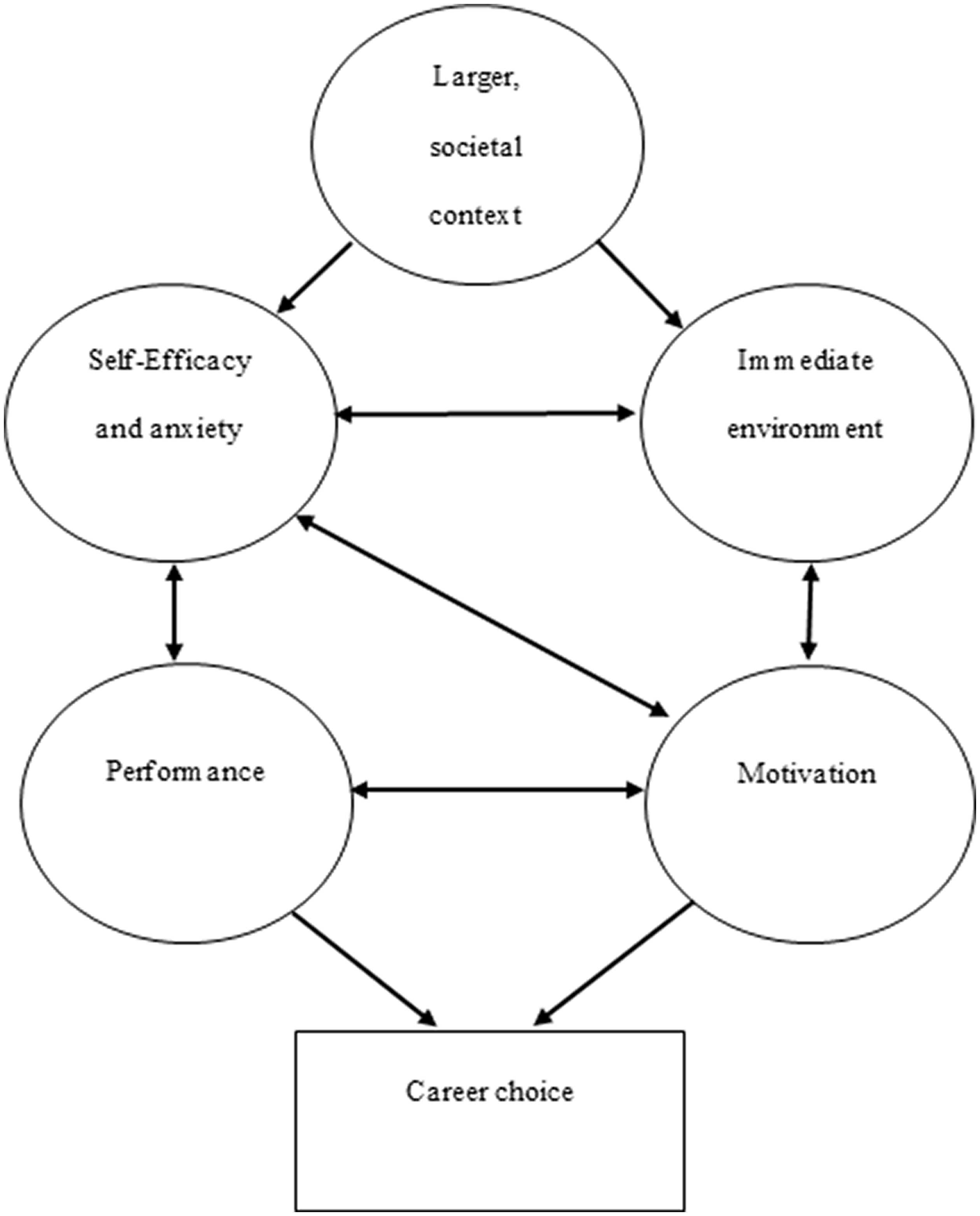
Social cognitive theory framework used in the review.
Data collection
The Scopus database was used to search for the documents. The search query was made up of three parts. The first part included the phrases “gender,” “gender differences,” “gender gap,” and “gender diversity.” The second part included the phrases “math,” “mathematics education,” “engineering,” “mathematics,” “career choices,” “engineering education,” “science education,” “computer science education,” “STEM, ” and “STEM education.” The third part included the names of all Arabic countries. Within each part, the OR operator was used, while between the parts, the AND operator was used. In other words, the first part will be triggered if the article title, abstract, or keywords contained any of the three phrases “gender,” “gender differences,” “gender gap,” and “gender diversity.” The same logic applies to the second and third parts. In order for an article to satisfy the query, it has to contain at least one phrase from each part. This is why the AND operator was used between the parts.
The query resulted in 240 records being returned. Articles that were not written in English were excluded. In addition, notes and letters to the editors were also excluded. The remaining articles were briefly examined in order to situate them within the framework used by this review. Out of the 240 documents, 90 were found to be suitable for the purposes of the current study. Out of these 90 documents, 64 were articles, 4 were book chapters, and 22 were conference papers. The four book chapters were dropped from the analysis, leaving a total of 86 documents. Figure 2 shows the publication trend for both journal articles as well as conference papers over time, up to and including July 2020. As is indicated in the figure, studies on this topic started in 1993 and increased over time. However, during the last couple of years, it seems that interest in the topic has started to wane.
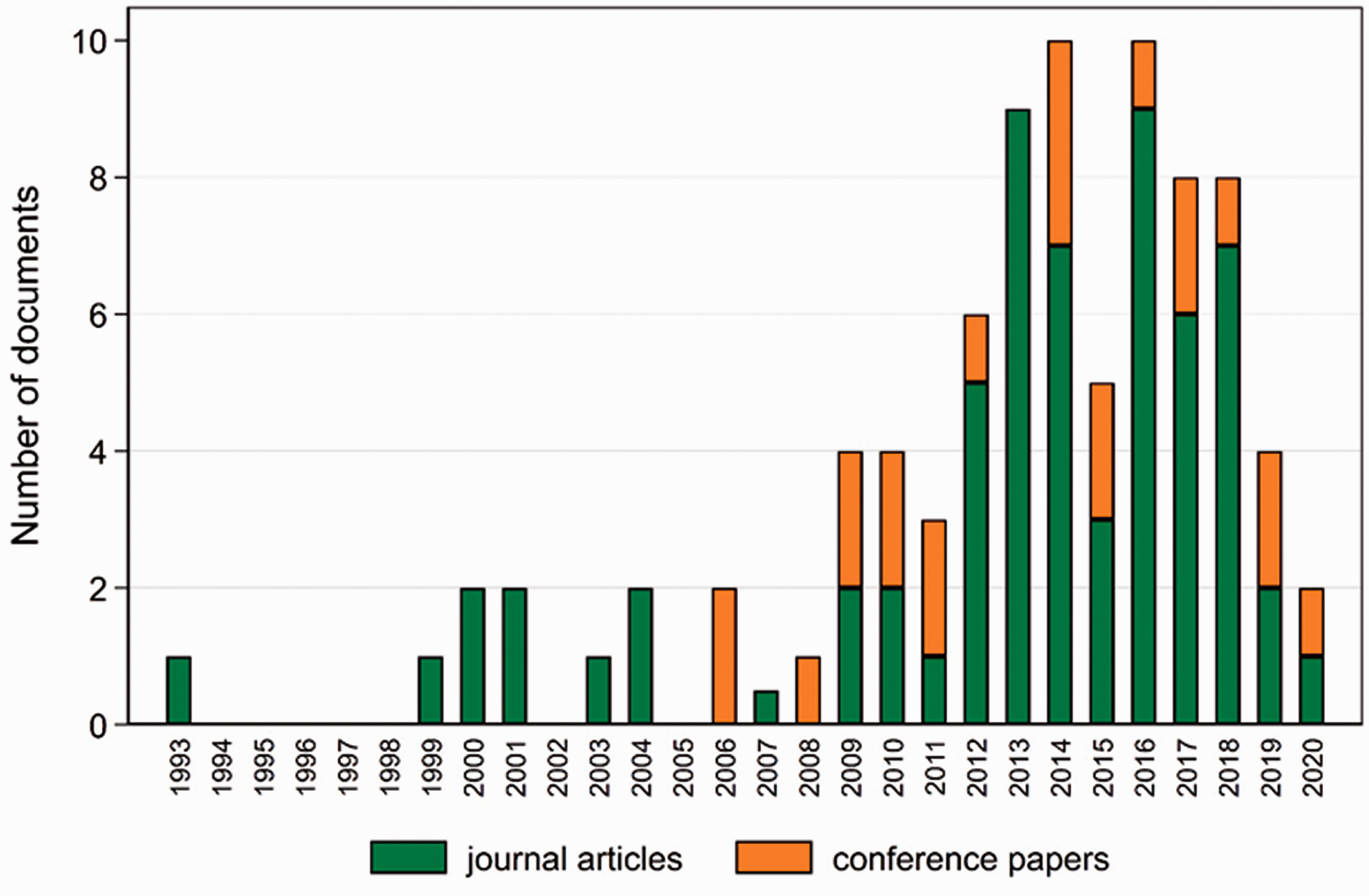
Publications over time (up to July 2020).
Analysis and results
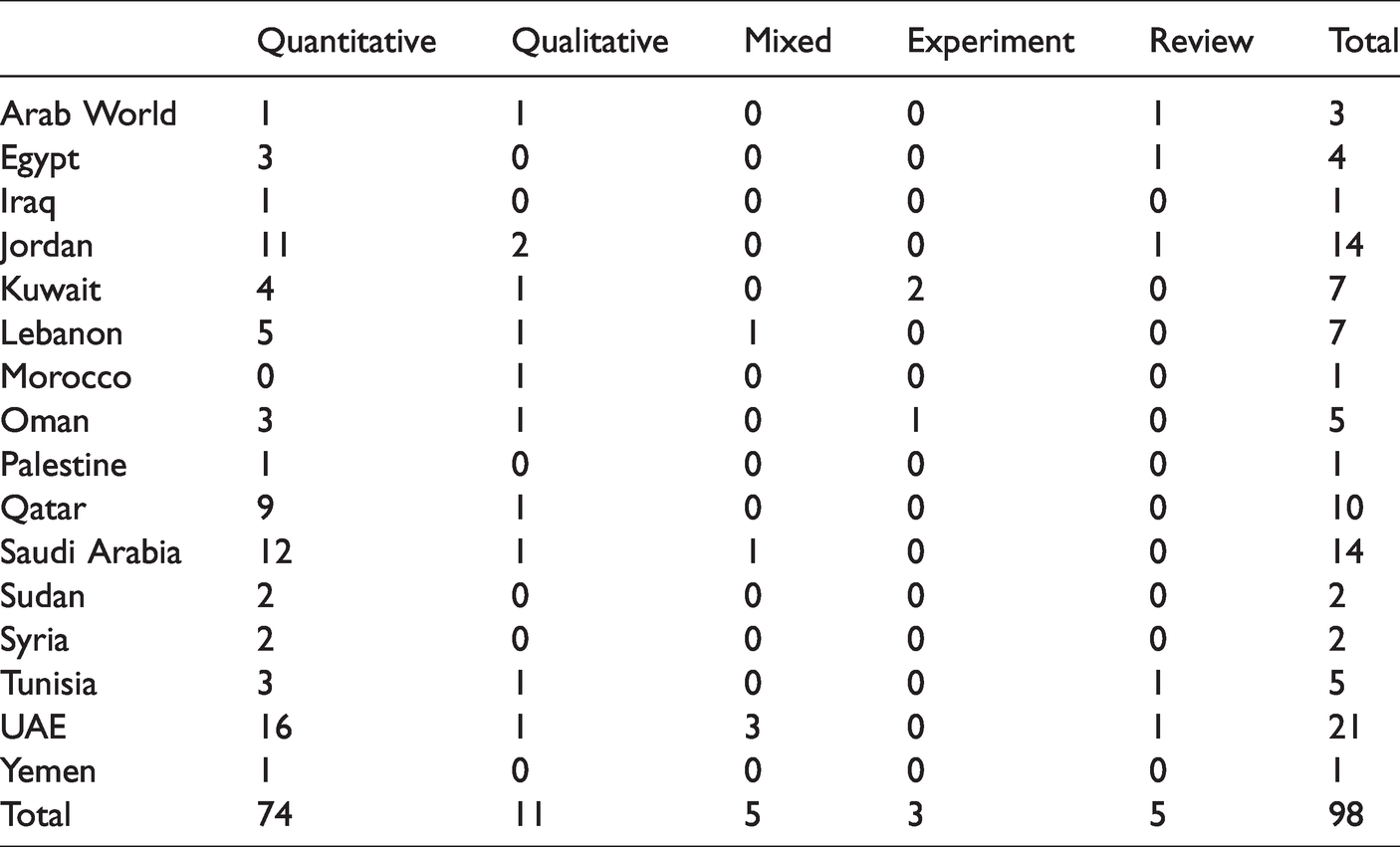
The search query included a total of 21 countries. Table 2 divides the documents among these countries. It should be noted that some documents dealt with more than one Arab country. Specifically, while 71 of the documents dealt with a specific country, the remaining fifteen were cross-national in nature. In these cross-national studies, the document was counted once for each country. This is why the total number of documents displayed in Table 2 is 98. Looking at the table, we can see that there were three documents that did not specifically deal with a country or a specific group of countries. Instead, the empirical setting is these documents included the Arab World. Hence they were grouped as “the Arab World” (Afiouni, 2014; Baram-Tsabari and Kaadni, 2009; Beddoes et al., 2009). Only 15 countries are included in Table 2 because the following countries were not part of any studies: Algeria, Bahrain, Comoros, Djibouti, Libya, and Mauritania. According to Table 2, the UAE is the most popular setting, followed by Jordan, Saudi Arabia, Qatar, and Lebanon.
Number of documents grouped per country grouped by research type.
Methodological issues
In addition to listing the number of publications dealing with each country, Table 2 divides these publications by research type. Documents were classified as relying on quantitative data, qualitative data, both quantitative and qualitative data (mixed-methods), data generated from an experiment, or secondary data (labeled review despite the fact that none of the articles was a systematic literature review). The majority of the studies relied on quantitative data (almost 76%), while only 11 documents (almost 11%) used qualitative data. Again, it should be noted that these numbers are based on double-counting some documents twice. The reason being is that the table is formatted in such a way as to display the number of studies that dealt with each country using each research type. If we factor out the countries and instead only consider each document once, then out of the total 84 documents, 65 were quantitative (almost 76%), eight were qualitative (almost 9%), five were mixed-methods, five were reviews, and three relied on experiments. Either way, we see that quantitative studies far outnumbered other types of studies.
Next, studies were grouped based on their design, i.e., cross-sectional or longitudinal. Only seven studies were longitudinal, five of them being quantitative, one qualitative, and one experimental. Once again, an imbalance is revealed. Given the finding that around 74% of documents were quantitative and cross-sectional in design, there is clearly a need for more qualitative studies and more longitudinal studies as well.
The preponderance of quantitative studies warranted a closer look at their nature. A more detailed look at these quantitative studies revealed that almost 75% of them relied either on descriptive statistics (Ahmed Alawad et al., 2015; Ainane and Bouabid, 2017; Imran et al., 2014; Lau et al., 2011; Mahani and Molki, 2011; Sulaiman and AlMuftah, 2010), or bivariate data analysis (Al-Hroub, 2009; Alzahrani and Stojanovski, 2017; Banabilh, 2013; Manzar, 2004). Only a small number of studies used more sophisticated quantitative tools such as Bayesian analysis (Smail, 2017), regression (Kiliç et al., 2012; Sawaf et al., 2018), and structural equation modeling (Areepattamannil et al., 2016; Mozahem et al., 2018, 2020).
The environment
As discussed previously, the gender gap in STEM fields in Arabic universities is not as large as the one observed in Western countries. However, the percentage of women in STEM fields in the industry in the Arab World is as low as the levels observed in Western countries, suggesting a significant drop in female representation as females move from education to employment (Adams and Miller, 2016). For example, although women made up around 40% of undergraduate engineering students at the largest two universities in Jordan, they represented around 30% of all registered engineers in the Jordan Engineers Association (Abu-Lail et al., 2012). Another study in Egypt also states that while the country seems to have been successful in terms of training female engineers, the difficulty facing these engineers starts after graduation when they are looking to enter the workforce (Mody and Brainard Suzanne, 2005). As such, an investigation into the factors that lead to this drop is crucial for both understanding and tackling the problem. Such an understanding is better tackled using qualitative research since it allows for a richer investigation of the complex forces at play. Unfortunately, as noted above, there is a dearth of qualitative studies in this field in the Arab World.
One such study conducted in the UAE has shown that there are several barriers that prevent female engineering students from finding employment, such as the lack of female role models and a strongly biased working environment (Samulewicz et al., 2012). Almost half of the students who had intended on working after graduation reported being concerned that their parents would want them to seek an “office job,” or at least a job that was appropriate for the local culture (Samulewicz et al., 2012). These concerns are not without reason, given the fact that engineering sites are not female-friendly. For example, one study reports that rig sites in the UAE are not equipped for females (Wafa, 2011). Clients have also been part of the problem, especially when it comes to allowing female engineers to go offshore or to stay overnight. Male professionals on these sites have questioned the need for females, stating that the oil industry in the country has been running well without the need to employ females (Wafa, 2011). As stated in one study, “Harsh working conditions, a less than convenient work schedule, living arrangements and family obligations make the oil and gas industry one of the least attractive industries for women” (Ainane et al., 2019: 63). Despite this, data from the UAE indicates that female engineers are attracted to field jobs more than male engineers (Ainane et al., 2019). However, in the presence of social barriers, some female engineering students find themselves choosing fields that have an “office” job, such as computer engineering and chemical engineering (Al-Sanad and Koushki, 2001).
It is not only female engineers that report significant barriers to their career. A study exploring bias against female medical 1 interns revealed that 35% of the surveyed medical interns believed that topics such as maternity and parenthood could influence the program director's selection choice (Attieh et al., 2018). In the same light, 45% of the surveyed program directors indicated that this was an important factor that is taken into consideration during the interview process. The interns' colleagues showed similar inclinations, with 46.6% indicating that having a pregnant colleague would increase their own workloads. The choices of medical students have also been shown to be affected by the lack of same-sex role models in certain medical fields (Abu-Zaid et al., 2018). The lack of same-sex role models in Arabic countries can be extreme, such as in Kuwait, where despite the fact that almost 62% of civil engineering undergraduates being female, 94 percent of the faculty members were male (Al-Fares and Al-Abdulmuhsen, 2008). In Egypt, women make up 12% of the faculty of engineering in various universities (Mody and Brainard Suzanne, 2005).
Studies have also explored the effect that parents and teachers have on such decisions. In one study, the participants, who were female engineering students, made it clear that their parents' support was crucial to them choosing the field (Mozahem et al., 2019). However, these same participants did note that their male siblings enjoyed greater freedom. Studies have also found that mathematics teachers viewed mathematics as a male domain and tended to attribute the success of boys to ability while attributing the success of girls to effort (Sarouphim and Chartouny, 2017). This result is supported by another study conducted in Jordan, where it was found that boys perceive receiving more encouragement from their science teachers than the girls did (Mahasneh et al., 2016).
In general, women report that their educational choices were restricted by their parents in comparison to the choices of the male siblings (Tlaiss, 2015). These social restrictions have been cited as a factor in females choosing an academic career over a career in industry (Afiouni, 2014). It therefore comes as no surprise that female medical students consider the teaching opportunities of each field when choosing their specialty (Mehmood et al., 2012). Similarly, the authors of one study note that in 2009 around 80% of the entering science class in the University of Jordan were females, and they attribute this to the fact that women with science degrees can be employed as school teachers (Abu-Lail et al., 2012). Like most Arabic countries, the authors note that teaching is a suitable career for women whose primary responsibility will be raising families. However, even when women do choose an academic career, the social barriers continue to exist, with one study in Saudi Arabia finding that although female medical graduates who were appointed to academic positions in a university have succeeded in junior levels, academic promotion to higher ranks was slower for them in comparison to males (Al-Tamimi, 2004).
Self-efficacy and mathematics anxiety
Some studies have investigated whether gender differences exist in terms of self-concept. A study using data from elementary and preparatory schools reported no gender differences in math self-concept (Abu-Hilal and Nasser, 2012). Another study using data or graduate engineering, computer engineering, and computer science students also found no gender differences in engineering self-efficacy (Galeshi, 2019). A third study comparing American students to students in Saudi Arabia also found that there were no gender differences in Saudi Arabia when it comes to self-concept despite the fact that girls outperformed boys significantly (Marsh et al., 2014). However, when age was accounted for, results suggest that mathematics self-efficacy decreases with time for girls but not for boys (Mozahem et al., 2020). Therefore, while, on average, no gender differences are observed in terms of math self-efficacy, results indicate that gender differences develop over time.
Given that math anxiety is related to self-concept and self-efficacy (Ahmed et al., 2012), some studies have investigated whether gender differences exist in math anxiety. However, the small number of studies investigating the issue in Arabic countries have contradicting results. In an analysis of the data from PISA 2012 pertaining to students in Qatar, it was found that students who had higher levels of anxiety on mathematics had an overall lover mathematics score (Alzahrani and Stojanovski, 2017). A study conducted in a university in Jordan revealed that female students had a higher probability of having math anxiety than male students (Smail, 2017). A third study conducted in Lebanon found no gender differences in attitudes toward math (Sarouphim and Chartouny, 2017). One possible explanation for this might be that attitude towards math was context-dependent. For example, one study conducted in the UAE using students in grade 8 found that boys had more positive attitudes than girls in one type of class setting, while girls had more positive attitudes than boys in another class setting (Alkhateeb and Jumaa, 2000).
Attitudes toward computers and technology
In addition to math self-efficacy, studies conducted in Western countries have investigated whether computer self-concept is predictive of career choices in technological fields (Sáinz and Eccles, 2012). Unfortunately, the few studies conducted in the Arab World have only investigated gender differences in attitudes towards computers as opposed to self-perceptions about computer skills. In a study conducted in Saudia Arabia, it was found that students had positive attitudes towards technology, with no gender differences being found (Alothman et al., 2017). In another study focusing on gifted students, the author found that mathematical performance was correlated with attitudes towards computers for both male and female students, with no gender differences (Subhi, 1999).
Performance
Several studies analyzed data collected from international exams such as the Program for International Student Assessment (PISA) and Trends in International Mathematics and Science Study (TIMSS). The vast majority of these studies have found that females outperform males in math (Alzahrani and Stojanovski, 2017; Cheema, 2016; Marsh et al., 2014; Melkonian and Areepattamannil, 2018; Reilly, 2012). However, in one study that was primarily focused on Turkey, the authors found no gender differences in the performance on PISA of students from Jordan (Kiliç et al., 2012). This finding was also replicated by other studies that analyzed data from PISA (Shafiq, 2013). In one of the most detailed studies that looked at results from TIMSS 2007, it was found that almost all countries with the largest gender differences in favor of girls were Arab countries (Marsh et al., 2013). The study compared four Arab countries and four English-speaking Anglo-Saxon countries. In all four Anglo-Saxon countries, gender differences were mostly small to moderate in favor of boys. Gender differences favoring boys were also found in the motivation constructs. Across the Arab countries, on the other hand, gender differences in motivation were small, but they favored girls. As noted by the authors, “clearly the largest gender differences are the substantially higher scores for girls in both math achievement and especially science achievement” (Marsh et al., 2013: 15).
Some studies used country-specific datasets. For example, in what is probably the largest study of its kind in Lebanon, data from more than ten thousand students from the 9th and 13th grades were used in order to investigate whether gender differences existed in Arabic, foreign languages, math, science, and life skills (El Hassan, 2001). The study found that there were significant gender differences in languages favoring girls but no significant gender differences in math and science.
Other studies analyzed data from specific institutes with the result also being that the majority of these studies finding that girls outperform boys on math (Abu-Hilal and Nasser, 2012; Alkharusi, 2016; Rabab’H et al., 2015), with a smaller number of studies finding that there were no gender differences in performance (Sarouphim and Chartouny, 2017). Even when the students concerned were enrolled in non-science majors, studies have found that female students outperformed male students in quantitative courses (Yousef, 2013).
In one of two unique studies, primary school students in Oman completed four working memory tests, a mental rotation test, and a motor test (Zayed and Jansen, 2018). The results indicated that “there were no relevant gender differences in cognitive, motor, and academic development” (Zayed and Jansen, 2018: 6). However, the authors caution that the lack of gender differences might be due to the fact that the sample was made up of 8-year old primary school students, while gender differences in such tests become detectable between the ages of 9 and 10. This is clearly illustrated by another study that was also conducted in Oman but this time on ninth graders. The study found that boys outperformed girls in spatial ability while girls outperformed boys in working memory capacity (Al-Balushi and Al-Battashi, 2013). An earlier study in the UAE had found that gender differences exist in terms of thinking style, with males tending to endorse the right-hemisphere style more than women, and women tending to endorse the integrated style more than men (Albaili, 1993). The study also found that students in applied science majors scored higher on the right thinking style than students in social science majors, while students in social science majors scored higher on the integrated style than students in applied science majors. Taking the results of these two studies, it can be seen that while initially there are no gender differences, as individuals develop, these gender differences start to manifest themselves. Unfortunately, there is a gap that research has yet to fill. The only study conducted in the Arab World that sheds light on this gap was conducted in Lebanon, where the authors find that as girls grow older, the information that they receive from their surroundings changes, thereby lowering their self-efficacy in fields such as math (Mozahem et al., 2020). Given that self-efficacy is a self-fulfilling prophecy (Betz, 2004), the drop in self-efficacy would steer females in a direction away from the field that pertains to the specific self-efficacy. This might explain the developed gender differences in thinking style. However, these gender differences, as shown in this section, do not manifest themselves in academic performance. This raises the question, how are these differences, if they do exist, manifested?
While most studies investigating performance rely on scores, one rare study attempts to tackle performance not by looking at the final score but by looking at the nature of the solution provided by the students. This study looks at the solutions provided by 24 male 20 female eighth-grade students in Kuwait to a specific mathematical problem (Ahmad and Greenhalgh-Spencer, 2017). The study reports two interesting findings. One finding is that out of the 24 male students, seven left the question with no response, while only two of the 20 female students did not respond. This finding that female students are more engaged is supported by findings from other studies in the region that have found that female students are more active on online learning management systems (Mozahem, 2020b) and that they are less likely to give up and withdraw from a course (Mozahem, 2019). Another finding from the study was that the female students who did provide a solution “rarely provided any details or articulation of a relationship,” while the male students “provided more details, such as using language to describe the rule” (Ahmad and Greenhalgh-Spencer, 2017: 337). Therefore, male students showed a greater understanding of the question. The authors of the study conclude that although in Kuwait, girls outperform boys, it seems that boys have a more sophisticated understanding of the concepts. This was also supported by the finding that although girls outperformed boys overall on the national math exams, boys demonstrated a higher level of understanding on high cognitive demand questions (Ahmad and Greenhalgh-Spencer, 2017). Taken as a whole, the findings that girls outperform boys, but that boys show better understanding of concepts, in addition to the finding by one study from the University of Khartoum in Sudan that found significant gender differences in IQ in favor of boys (Khaleefa et al., 2014), highlights the need for a more sophisticated analysis of gender differences in performance.
Gender differences in motivations
One study found that the primary reason for seeking employment in engineering for females was to support themselves and their families financially. The second most important reason was professional aspirations (Samulewicz et al., 2012). Several studies have found that there are gender differences in the reasons for choosing certain occupations. For example, data from students enrolled at the Petroleum Institute in the UAE reveals that the primary reason for female students enrolling in the institute was serving their country, followed by high salaries and social status. Male students, on the other hand, indicated high salaries as their top reason (Ainane and Bouabid, 2017). Similar results were obtained in another study, also focusing on students at the Petroleum Institute (Ainane et al., 2019) and in a study using medical students in a university (Rashid et al., 2013). Another study, this time conducted in Syria, also found that income was significantly more important for male students compared with female students (El-Hammadi, 2013). Similar results were obtained in a study in Saudi Arabia (Osuagwu et al., 2014). A fewer number of studies found that the primary reason for choosing science-related fields for both genders was financial (Banabilh, 2013).
Gender differences in major choices
When looking at the gender composition of students in STEM majors in Arabic countries, an interesting finding that strikes the reader is the large percentage of females in these majors. For example, the number of female students enrolled in the College of Engineering At Qatar University is reported to be greater than the number of male students enrolled in the same college (Sulaiman and AlMuftah, 2010). In the UAE, one study finds that the number of female Emirati students enrolled in the Industrial Engineering and Management program is more than double the number of male Emirati students (Brahimi et al., 2013). Similar disparities have been observed in Kuwait (Al-Fares and Al-Abdulmuhsen, 2008). However, a closer inspection reveals that this is due to the fact that the number of female students in the university as a whole is larger than the number of male students. For example, the same study that reported that the number of female students in the College of Engineering at Qatar University was larger than the number of male students also reports that while 33% of bachelor's degrees awarded to male students are for graduating engineering students, only 14% of bachelor's degrees awarded to females are for graduating engineering students, with the majority of female students graduating from the College of Arts and Sciences (62%). In addition, the same study that looked at the gender composition of students enrolled in the Industrial Engineering and Management program also reported that the situation for expatriate students is reversed, i.e., the number of male expatriate students is almost double the number of female expatriate students. What these numbers reveal is that, when looking at the gender composition of these colleges and programs, it is important to note that in some countries, especially in the Gulf area, the number of female students enrolled in the university vastly exceeds the number of male students. The reason for this is that males have more freedom in traveling and in choosing other universities that are not gender-segregated, while females have more restricted choices (Sulaiman and AlMuftah, 2010). Therefore, results obtained by studies using data from gender-segregated in the Gulf need to be considered in this light.
While the gender gap is not as large as the one observed in Western countries, it exists nonetheless, with boys displaying a higher level of interest in subjects such as physics and girls displaying a higher level of interest in subjects such as biology (Baram-Tsabari and Kaadni, 2009). Studies conducted in universities in Arabic countries have found a gender gap in enrollment in engineering programs, always favoring male students (Alaraje and Elaraj, 2018; Al-Sanad and Koushki, 2001; Imran et al., 2014). In a study conducted in Norway, Spain, and Tunisia, the authors looked at students enrolled in the Software Engineering course that is part of computing-related bachelor programs. The study found that women made up 10.97%, 20.63%, and 47.50% of the students enrolled in this course over three years in Norway, Spain, and Tunisia, respectively (Colomo-Palacios et al., 2019). At the graduate level in Tunisia, women account for 42% of the Ph.D. degrees in engineering and 41% of PhDs in mathematics and statistics (Jaziri, 2019). However, this is not the case in all Arabic countries. For example, in Lebanon, the gender gap in majors such as computer science and mechanical engineering is as large as the one observed in Western countries (2014). Results suggest that these gender differences in interest in career occupations develop over time (Mozahem et al., 2018).
Discussion
Gender differences in career occupations have received considerable attention from researchers (Han, 2017; Herman, 2015). This study contributes to this discussion by reviewing the state of affairs in Arabic countries. The analysis of the documents reveals several interesting findings. Like other parts of the World, the share of female students in tertiary education has increased significantly to the point that females in higher educational institutes now outnumber males in higher educational institutes in many of the Arabic countries. Also, like many other countries, there are gender differences in fields of study, with females being underrepresented in STEM fields even in Arabic countries where the ratio of female enrollment rate to male enrollment rate is higher. However, in most cases, the gap is smaller than the one observed in more developed countries in general and Western countries in particular. Some studies in Western countries have shown that there are significant disparities in the gender composition of the various fields that make up the STEM category (Cheryan et al., 2017), with women being much more underrepresented in fields such as engineering than fields such as biology and medicine. The present review has shown that this is not the case in most Arabic countries. In general, female representation not only in STEM fields in general but in engineering, in particular, is higher than the figure in Western countries. This review has also revealed that there are studies that have documented how, in some cases, more females were enrolled in engineering programs than males (Al-Fares and Al-Abdulmuhsen, 2008; Brahimi et al., 2013). However, it is crucial to note that these numbers come from gender-segregated universities in Gulf countries. Given that men have more freedom in terms of choosing their destination when it comes to higher education institutes (Sulaiman and AlMuftah, 2010), many of these gender-segregated universities are primarily composed of females.
Another interesting finding revealed by this review is that while studies in Western countries have documented either no gender differences in math (Hyde et al., 2008) or a small advantage for boys (Marsh et al., 2013), the situation in Arabic countries is drastically different. The majority of studies in Arabic countries have documented that girls have a significant advantage in math along with other subjects such as reading and writing (Alzahrani and Stojanovski, 2017; Marsh et al., 2014). A smaller number of studies have found no gender differences (Kiliç et al., 2012). None of the studies revealed results in favor of boys. Whether it was GPA, grades on national exams, grades on individual subjects, or grades on international tests, studies conducted in Arabic countries have systematically shown that girls outperform boys in most cases.
Coupled together, the finding that the gender gap is smaller in Arabic countries in terms of career choices and that girls outperform boys academically, specifically in math, highlights the need to better understand the social barriers that are present in Arabic countries. This review has revealed that after education, the gender gap in STEM fields rises to reach levels observed in Western countries. Hence, the “leaky pipeline” phenomenon (Blickenstaff, 2005) is stronger in Arabic countries. The studies investigating these barriers reveal that there is a strong gender bias against women in certain fields, specifically in engineering. Studies have shown that there is a lack of role models (Al-Fares and Al-Abdulmuhsen, 2008), lack of support from colleagues (Wafa, 2011), lack of support from the extended family (Mozahem et al., 2019), and an expectation that eventually the women will have to prioritize their family over their work (Tlaiss, 2015). The review has also revealed that of the few studies that have investigated gender differences in attitudes to technology, none have found a gender difference in favor of boys.
Studies investigating math anxiety have produced inconsistent results across countries. While some studies found gender differences in favor of boys in Jordan (Smail, 2017), studies in Qatar found gender differences in favor of girls (Alzahrani and Stojanovski, 2017), and studies in Lebanon found no gender differences (Sarouphim and Chartouny, 2017). Studies investigating math self-concept have produced more consistent results, with the majority of the studies finding no gender differences (Abu-Hilal and Nasser, 2012; Galeshi, 2019). However, one study that included a sample of students from different levels of school did find that while no gender differences in math self-efficacy exist in the younger students, stereotypical differences exist in the older group (Mozahem et al., 2020).
This review has also found that there are gender differences in motivation, with male students placing higher importance on financial motivators than female students (Ainane and Bouabid, 2017; Samulewicz et al., 2012).
The various findings of this study are best understood in the context of SCT, which was the theoretical framework used in this review. SCT views individuals as agents of experience who do not merely react to their environment (Bussey and Bandura, 1999). According to SCT, individuals chose to activate their environments, which is why the concept of human agency is of critical importance in SCT (Zimmerman, 1990). Given this ability of individuals to choose certain aspects of their environment, Lent and his colleagues have called for incorporating both contextual supports as well as barriers into such studies (Lent et al., 2000). As revealed by this literature review, several studies in the Arab World have concentrated on contextual barriers facing women, with a lack of attention being directed towards the level of support received by women who persist in such fields. This is probably due to the fact that most studies dealing with the environment have focused on the larger societal context, with little attention being paid to the immediate environment. This conception of the environment as a series of embedded circles with the immediate environment being encircled by the larger social context has not been adopted by the studies covered in this review.
In addition to the above, the finding by the majority of research covered in this review that female students do not underperform male students on math and science also supports SCT because it shed light on the plurality of factors that contribute to the decision of whether to pursue a career in STEM fields or not. SCT argues that gender development happens through a process of triadic reciprocal causation in which individuals gather information from four different sources, only one of which is performance achievements. A recent computer simulation of SCT has shown how this development emerges (Mozahem, 2020a). This review has revealed that most studies have found that females either outperform males in math or at least perform as well as them, but that results about gender differences in mathematics anxiety are not conclusive. As such, the results support the notion that the formation of self-efficacy is a complicated process that depends on bidirectional relationships between a plurality of factors and does not merely depend on achievement.
Future research
Although the above findings are important, the gaps that are revealed in this review are probably more important than the current findings. This review has uncovered that there are many gaps that exist in the current literature. First, although this review included 21 countries, a total of only 86 documents were found about the topic. This means that, on average, there are around four studies per Arabic country. This is clearly not sufficient given that more than 400 million people live in these countries and that human development is a crucial need for many, if not all, of the countries (UNDP, 2009). It has also been revealed by this review that countries such as Algeria, Bahrain, Comoros, Djibouti, Mauritania, and Libya have yet to receive any attention, with no study being found focusing on any of them. Egypt, with a population of more than 98 million, has been the context of just four studies.
Another group of limitations all relate to the methodology used by the studies. Most studies were quantitative in nature. Had the discrepancy been small, this would not be of concern. However, only 11 qualitative studies were included in this review. This is especially concerning given the finding that the “leaky pipeline” phenomenon is stronger in Arabic countries than in Western countries. The understanding of this phenomenon requires an in-depth understanding of the surrounding social structure, something that qualitative research is well equipped to do. This lack of depth is also apparent in the quantitative studies, where the majority of these studies, almost three-quarters of them, utilized descriptive or bivariate data analysis. Therefore, there is a need for more qualitative studies and more sophisticated quantitative studies.
Another limitation that is related to the methodology is the dearth of longitudinal studies. Only six longitudinal studies were identified by this review. Given that studies have found that self-efficacy contributes to academic performance over time (Caprara et al., 2011) and that occupational aspirations develop over time (Helwig, 2004), it is important that studies in the Arab World incorporate time into the design of their studies.
Finally, this review has revealed that most studies investigating differences in performance relied on test scores, without considering the fact that different questions require different abilities. In other words, most studies did not investigate whether there were gender differences in complex problem solving despite the fact that this is an important mathematical skill in STEM majors. Only a single study in the Arab World investigated gender differences in complex problem solving, and the result of this study indicates that boys have a more sophisticated understanding of complex mathematical problems than girls (Ahmad and Greenhalgh-Spencer, 2017). Therefore, future studies would have to resolve this issue but incorporating the type of question into their study of gender differences in academic performance. Perhaps, as stated by Abu-Hilal and Nasser (2012), girls outperform boys academically in all areas because socially, boys in the Arab World have more freedom with how they choose to spend their time while girls are more restricted to the house where they work on their school.
Footnotes
Availability of supporting data
The list of articles used in this literature review is available upon request.
Declaration of conflicting interests
The author(s) declared no potential conflicts of interest with respect to the research, authorship, and/or publication of this article.
Funding
The author(s) received no financial support for the research, authorship, and/or publication of this article.
