







Abstract
This article examines the narratives of faithful female financiers of the Bible—the Shunammite woman, Joanna, and Lydia—to commend womanist leadership practices as a framework for leading change. Their example is demonstrative of the womanist leader who leverages faith as a grounding means and engages her lived experience as one who is marginalized and oppressed to expand her contextual perspective. Such experiences help gird her with strategies to subvert efforts to marginalize her voice and suppress her impact. So girded, the womanist leader is empowered to direct her change efforts as sacred praxis for the betterment of others. This example is recognized in these Biblical exemplars. These women additionally leveraged the power of wealth which further solidified the permanence of their praxis.
Keywords
Womanist leaders affect change. This statement is not made lightly, for women of African descent have been shaped in an oppressive, patriarchal, White-supremacist culture that has attempted to suppress any potential and personhood that does not suit the need of its capitalistic, privilege-prioritizing purposes. Since arriving to the North American continent, women of African descent have been forced into a system that stripped, demeaned, and used their brains, backs, and abilities to feed a perpetuating system that relegated them to the bottom. Yet, recognizing their inherent dignity and fighting for what was just and right, womanist leaders emerged as an agent of change. They used their leadership to bring others together and empower those who had been downtrodden. From their marginalized and often overlooked position, African American women helped to drive change in our midst, examples of which are visible in over 400 years of existence on this continent.
Womanist leadership practices are promoted as this catalyst for change. These practices are the codification of the lived experiences of people impacted by compounding intersectional forces of race, ethnicity, gender, class, and orientation that conspire to oppress. However, if people would but seek the benefit of that other marginalized perspective, they would learn so much about power and privilege. People would understand the challenges of those who do not have and be compelled to use their influence to lift and not leave behind. Giving voice to those who have been societally silenced enables learning that change is possible. This article is about encouraging change.
Specifically, it considers a womanist leadership framework to identify the characteristics of womanism and provides a model through which these characteristics are operationalized. The model also serves as a lens through which one can view biblical exemplars whose lives stand as an example to follow. The article explores the Shunammite woman (2 Kgs 4:8–10), Joanna, one of the women who supported Jesus and the disciples from their own means (Luke 8:1–3), and Lydia, the businesswoman who housed Paul and his companions in Philippi. For each of these women, this article highlights the tactics whereby their efforts were cheapened or trivialized. Nevertheless, they, like womanist leaders after them, used their influence to make a difference. Moreover, these women, serving in the rare role as benefactors, leveraged economic means as an instrument of power to ensure lasting change for those they supported and in the communities they served. This kind of selfless generativity enabled them to function in counter-hegemonic ways. They did not use their wealth for self-aggrandizement or personal gain; they used their wealth to forward the faith.
A womanist leadership framework
Establishing a womanist leadership framework requires the articulation of characteristics that speak to how women of African ancestry move and function in the world. By understanding this lived experience and its specific struggles, needs, and concerns, certain traits emerge. In her theory of Africana-Melanated Womanism, developed in contrast to Black feminism and womanism, scholar Clenora Hudson-Weems has accomplished an exhaustive assemblage of such traits. Hudson-Weems notes, in general, most Africana women do not identify with the established theoretical concept that, in a patriarchal system, gender is primary in women’s struggle and thus they cannot see themselves as feminists. 1 She emphatically asserts that a theoretical system that speaks to the issues of white women cannot serve as a suitable framework for women of African ancestry. Womanist or Womanism, coined by Alice Walker in her prose In Search of Our Mothers’ Gardens, is more expansive. A womanist is a universalist committed to the survival and wholeness of entire people, male and female. 2 Such a stance emboldens the womanist to advocate for family, community, and any who are disenfranchised. For Hudson-Weems, however, Walker made the mistake of likening a womanist to a black feminist of color. Creating only a slight differentiation in color, this nearly analogous comparison establishes Walker’s concept of affinity between the womanist and the feminist. 3
Thus, developing a system that transcends what she sees as the limitations of Black feminism and womanism, Hudson-Weems, in her theory of Africana-Melanated Womanism, brings together 18 characteristics pertaining to women of African descent demonstrative of:
Who she is: Self-Naming, Self-Defining, Spiritual, Whole
How she functions: Mothering, Family-Centered, Nurturing, Genuine in Sisterhood, Male Compatible, Respectful of Elders
How she is viewed: Respected, Recognized, Strong, Authentic
How she works in the world: Flexible Role Player, Adaptable, Ambitious, In Concert with Male in the Liberation Struggle.
The woman of African descent is self-named and defined, despite societal attempts to limit personhood with stereotypical labels or demeaning imaginary. This woman is not yoked by the labels that attempt to demean or marginalize her. She eschews such labeling because she knows who she is and revels in the freedom and wholeness such self-definition provides. Being self-knowing provides the woman of African descent with a rooted sense of self and security in her sacredness.
This woman of African descent leverages her self-assuredness to function in a generative way, extending herself to all in her sphere of influence. Relationally, she is mothering and nurturing because the care of family, immediate and extended, is central to who she is. Given the importance of a relational way of being, she is inclusively considerate of men and women and respectful of others, particularly elders. In fact, a love of others is a primal concern along with self and provides a positive template for living in the world.
The lived experiences of the African-descendent woman make her strong. She must be because she has suffered the generational abuses transmitted from fore-parents. Her need for strength has not embittered her, however. She is authentic in her dealing, which does not always bring recognition and respect; nevertheless, the authenticity fuels her determination to push the boundaries as sacred praxis. Moreover, the respect that she commands provides her the space and ability to function flexibly in the world. A woman of African ancestry can lead, but just as importantly, she can follow. She is adaptable, but ambitious, for the causes in which she engages. And, because she is inclusive, she functions in concert with men in the struggle for the liberation of her people. These characteristics garner value by undergirding self-respect of one’s integrity.
From this reflection depicting how African American women have lived, led, and survived, I developed a Model of Womanist Leadership (see Figure 1). 4 It is the culmination of traits and characteristics that speak to an emergent system of leadership and is distinguished from patriarchal and matriarchal, Eurocentric models. A Womanist Leadership model is anchored by faith at its foundation, expanded by intersectional standpoint perspectives, girded by counter-hegemonic strategies, and focused on the community as the loci of its efforts.
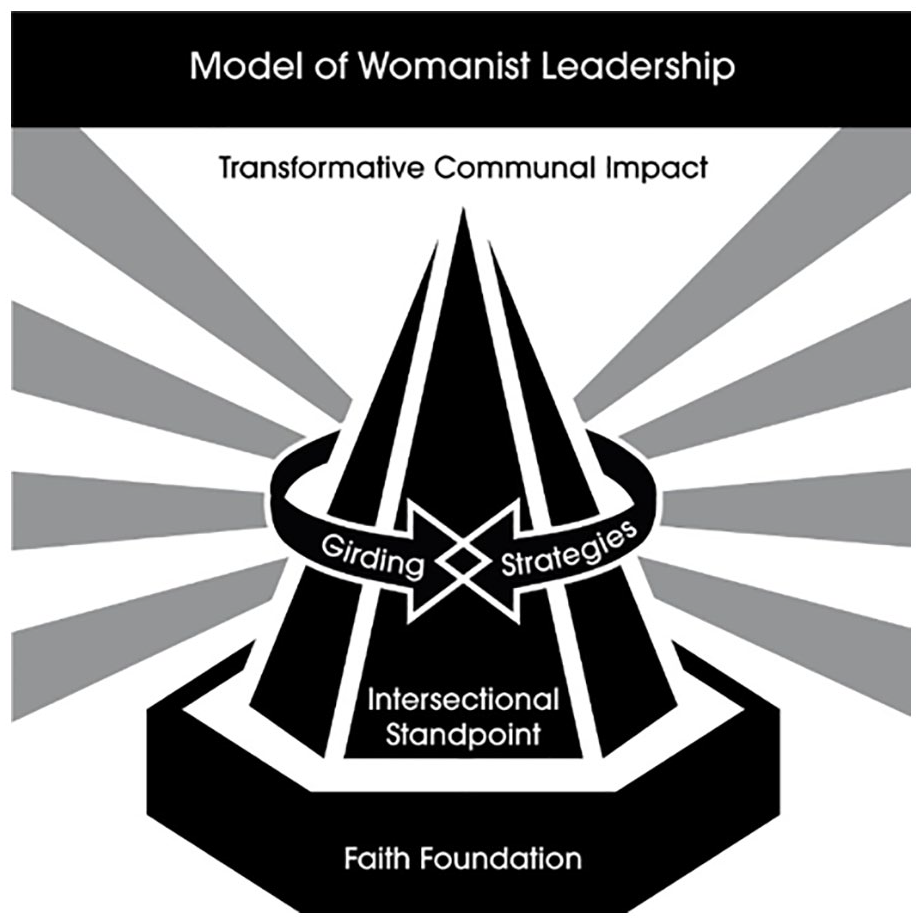
Model of Womanist Leadership.
Faith functions at the foundation of this model and recognizes that African American women are the most spiritually adherent people in the United States. 5 The African American woman is grounded by faith because in her faith she recognizes a God who sees her and regards her. She sees in Jesus Christ a Savior who sides with people like her, those who are most marginalized in society. Because Jesus has overcome the world, through faith, she too could overcome. Such knowledge provides an anchoring foundation. Nothing could compare to a God who gives heed to her affliction, demonstrates concern for her situation, and provides liberation for her future.
A womanist leadership model features an expanded focus in its perspective because it encompasses the experience of surviving multiple oppressions, yielding an increased awareness of socio-contextual challenges. African American women understand being deemed as other and valued as less than. As such, she can apply her experience to most contexts with adaptable empathy. This intersectional standpoint situationally locates and promotes the validity of varying experiences and makes space for an expanded dialectical perspective. Her experience as a marginalized other who has been discriminated against and subjected to intersecting oppressions positions her to challenge and dismantle preconceived notions in the dominant culture.
Because of the challenges waged by a demeaning dominant culture, African American women have girded themselves with strategies that upend hegemony. Declaring herself beautiful when society declared her ugly, asserting pride in blackness rather than accept the label as insulting, and using undervaluation as a power strategy to exert influence are only a few ways African American women have “flipped the script” to obtain the upper hand. Rather than submit, she seeks ways to surpass as a means of declaring self-worth.
Combining these components of faith foundation, expanded intersectional perspective, and counter-hegemonic girding strategies, African American women use their leadership power to focus their efforts on the community. Communal connections for African American women are core relationships because in the community women have been nurtured, affirmed, and prepared. Given such value, an ethic of service has been cultivated. She seeks to serve without recompense or recognition. The model of leadership observed in African American women more often demonstrates a collective effort in which women came together to make a difference for the broader community.
Overlaying Hudson-Weems’s characteristics with this womanist leadership model demonstrates strong coherence. Hudson-Weems’s grouping of “Who she is” aligns with the model’s foundation of faith. Her spirituality, wholeness, and self-definition speak to a rooted faith that is foundational. “How she functions” aligns with her intersectional perspective. The roles that she plays, mother, sister, nurturer, male compatible, demonstrate the diversity of perspectives she inhabits and understands. “How she is viewed” aligns with girding strategies. The fact that she is strong and respected is gained from her self-protecting strategic moves. “How she works in the world” aligns with the community. She can be what she needs to be, flexibly adaptable as a team member, assertive as a team leader, and in concert with men to get the job done for the benefit of others.
Such a framework becomes the mechanism through which one can view faithful female financiers: women of the Hebrew Bible and New Testament who lived and functioned in generative ways indicative of womanist leadership practices. These women use power afforded to them through wealth and economic status. Rather than being self-indulgent, however, they use their wealth to advance the faith, thereby positively impacting the community.
Specifically, this article considers the Shunammite woman who built an apartment for Elisha providing him a place to lodge while in Shunem (2 Kgs 4:8–10), Joanna, one of the women who supported Jesus and the disciples from her own means (Luke 8:1–3), and Lydia, the businesswoman who housed Paul and his companions in Philippi (Acts 16:11–15). Although the narratives downplay or trivialize the significance of the women, their actions demonstrate how belief in the cause of faith motivated them to surmount subordinated female stereotypes to function as financiers, not for themselves but for the benefit of others. From these narratives, one can understand how women can leverage a position of power, which financial means provides, to lead change using womanist methods to help and promote the community.
The Shunammite woman
Second Kings 4:8–37 tells the story of a wealthy woman in the town of Shunem. The prophet Elisha was known for traveling the region, preaching, prophesying and performing miracles among the people. Through his ministry, Elisha comes to this town because “the road to everywhere passes through Shunem.” 6
In verses 8–10, several notable aspects of this narrative emerge. First, the woman is described as “great” (v. 8). 7 Considering the use of this term in Genesis through 2 Kings, greatness is an attribute of economic or political status and only in this instance is used to describe a woman. 8 Such attribution makes her significant. Second, the woman is described as literally overpowering Elisha, insisting that he stay for a meal. 9 The combination of these descriptors—she is great and compelling—suggests her to be a woman who understands and exercises authority. Third and notably, the woman demonstrates an absolute conviction about her assertion of who Elisha is. She does not simply think he is a holy man; she effectively says, “I know.” That sense of knowing drives her. While the passage suggests that she conferred with her husband regarding her plans, some commentators, such as Danna Nolan Fewell, suggest that the woman personally took charge and supervised the household addition herself. 10 The detailed appointments of the constructed room are additionally notable (v. 10). They demonstrate the extent of her wealth and hospitality, conferring honor upon this man she designated as holy. While some might argue that the woman harbored self-centered motives for her hospitality, 11 the text provides no such indication. Rather this woman’s generosity may explain Elisha’s desire to repay.
In the exchange of verses 12–13, the reader is to suppose that Elisha is speaking to his servant while the woman is nearby, having been summoned by Gehazi at the behest of Elisha. He does not address the woman, however, instead seeming to ask Gehazi if the woman would have him to speak to the king or the commander of the army on her behalf. Although she answers that she lives among her own people, it is as though she is speaking to no one while the men carry on their conversation without acknowledging her response. 12 Patriarchy would have made the woman’s diminishment normative as it would any response asserting independence. To that point, medieval author Bachya Ibn Paduka believes the woman’s response to be too self-assured and materialistically satisfied, for a truly spiritual person would recognize themselves as an alien in an alien country. 13
Yet, responding to her answer without formal acknowledgment, Gehazi notes that the woman is without a son and that her husband was old. Elisha calls the woman near, and she draws closer in the doorway again without acknowledgment. 14 Only in verse 16 does Elisha address the woman directly, telling her that she will have a son. To most commentators, her ambivalent response is surprising. Rather than express gratitude, the woman cautions the prophet not to tease her. Most women without children are labeled by such status, and their stories revolve around the negative stigma of childlessness. 15 Thus, it would follow that the Shunammite woman would want a child. But this was not the case. The men “hadn’t asked her if she wanted a child. They had merely assumed. They assumed that that was what every woman wanted, what every woman needed to make her life complete.” 16 Elisha’s response was not about what the Shunammite woman wanted. Feeling indebted to the woman, Elisha wanted to relieve his sense of obligation.
Perhaps this explains why Midrash ha-Godol describes the Shunammite woman as a mother who is unengaged in the needs of her child after his birth. 17 She is not seen as a doting mother, for the Biblical text does not confirm this woman’s role in her son’s rearing. Arguably, however, this story is not about the Shunammite woman but rather about the miraculous works of the prophet. As such, the reader has no window into the family’s life until an event dictates intervention, related in verses 18–24. Years later, the child is working in the fields with his father. The boy, having collapsed, complaining of a headache, is taken to his father, who in turn instructs the servants to take the boy to his mother. These directives demonstrate the woman’s active connection with her son. In fact, she holds the child in her lap until he dies. Then, as if understanding how a prophet works, she takes the child to Elisha’s room and places him on the bed. 18 The depth of her faith is demonstrated by that act and by her subsequent actions in the narrative.
Her grounded faithfulness is in stark contrast to that of her husband’s (vv. 23–24). While the woman seeks to rush to Elisha immediately, her husband sees no need, understanding Elisha as more of a cultic functionary than as a prophetic wonderworker. 19 She never discloses that the child is dead, but rather notes, “All will be well.” Her response, in fact, is an ironically dismissive “shalom,” suggesting a peace she could not have felt in the moment. Her words are saved for the prophet, explaining why, in the next scene of the narrative (vv. 25–30), she similarly dismissed Gehazi, who runs to meet her having been recognized by Elisha. Throwing herself at Elisha’s feet, she emerges as a forceful mother determined to gain restitution from the prophet. 20 Because she did not ask for a child, she does not accept responsibility for his death. Imagining the woman’s words, Fewell credits the woman with saying, “You brought this boy into this world. You are responsible for his well-being.” 21 Elisha believes he can send Gehazi and his staff as a proxy, but the woman is unpersuaded. “As the Lord lives, and as you yourself live, I will not leave you,” she insists. Her persistence moves Elisha to return with her to her home to perform the miracle for which this passage is known, related in the narrative’s final scene (vv. 31–27). Seeing the child dead, Elisha prays and lays his hands upon him to restore warmth. After walking around the room, Elisha leans over the child, who sneezes prior to opening his eyes. Calling his servant, Elisha tells Gehazi to tell the Shunammite woman to take her son.
Much in this woman’s narrative is demonstrative of what is attributable to womanist leadership. Faith is present and active. The Shunammite woman is certain that Elisha is a man of God and confers holiness with an anointing motif reflective of the elevation of a king. She exercises faith when she lays her child on Elisha’s bed. Understanding how the effects of a prophet are imbued with power, she, through faith, exercises a belief that laying the child on the bed is sufficient for restoration. Even the fact that she bypasses her husband and Gehazi to get to Elisha demonstrates faith. Reminiscent of Elisha who utters the same words to Elijah in 2 Kgs 2:2, the woman will not leave until Elisha consents to return with her to her home.
The Shunammite woman’s functioning aligns with her intersectional perspective. Being a woman, she is deferential, as cultural protocols would have demanded, even as the men of this narrative slight her. She is accepting of the role she plays, particularly as a childless woman, without that role’s being all-subsuming. As a mother, however, she demonstrates she will move heaven and earth for her child.
But she also functions as someone from the landed gentry, which gives her power. She is a woman of property, giving her a vaulted status in the community. Nevertheless, she is of the community. Her self-sufficiency is not derived from her wealth but from being in a community with her people. As such, she has no need for favors from Elisha. From this strength, she is generative and uses her wealth in service to others and, in this narrative, in service to Elisha.
These womanist attributes collaborate to enable the Shunammite woman to lead change emboldened by faith and enabled by finances. Through faith, she discerned the role of a holy man. Through her finances and influence, she oversaw the building of a separate apartment for Elisha’s use as he passed through Shunem. But the power that came from wealth meant that the woman could exercise a confident self-assuredness that she could play a submissive role without sacrificing self. Gehazi attempted to be the go-between, but arguably, the woman refused to speak to Gehazi. She directed her responses to Elisha. If this was not obvious in the first exchange in which Elisha attempted to offer repayment, it was after her son died. Her response to her husband and Gehazi demonstrated that these men were simply not on the same level. She leveraged power and addressed Elisha as an equal. She led change, a change responsible for the restoration of life.
Joanna
The Gospel of Luke 8:1–3 notes women among the followers of Jesus. Joanna, wife of Herod’s steward Chuza, was among them (v. 3). Who was this woman? Only Luke records her name, introducing her in chapter 8 and mentioning her as one of the women at the tomb (24:10). She was said to have been cured of infirmities, but no indication of her illness exists. Most of what is commonly said about Joanna is about her husband and the associations assumed from him. Joanna is married to Chuza, whose Aramaic name is known from Nabatean inscriptions. 22 As a steward, Chuza would have functioned as an administrator, overseer, or governor. 23 Through her husband’s role, Joanna would have had ties to the Herodian household, distinguishing her as a court-connected financial contributor. 24 While the resources provided by the women were unspecified, one would assume hers were of a financial nature. Thus, Joanna is a married, healed, and financial benefactor who contributed to Jesus. However, these sparse details suggest a backstory that may explain why so little is known.
Joanna is a married woman and nothing in the context suggests that her marriage has come to an end. 25 While nearly unimaginable in the sociocultural context, this married woman presumably leaves her husband to become a follower of Jesus. Why should this be surprising? Jesus maintained, “No one who puts a hand to the plow and looks back is fit for the kingdom of God” (Luke 9:62 NRSV). Joanna, following his command, picked up her cross to follow Jesus.
But this liberated stance for a married woman may explain Joanna’s relative obscurity. Rather than share the story of an estranged female financier supporting the gospel ministry of Jesus, commentators were moved to forward theoretical premises to make respectable that which would have otherwise been scandalous. In response to the supposition that Joanna left her husband, some scholars suggest Chuza was dead. 26 Had this been the case, Joanna’s widowed state would make her inclusion in the narrative more palatable, as a widow providing from her resources to support Jesus’s ministry. Such a widowed exemplar would have served as an admirable example for other women. Moreover, her healing would have served as a source of humility. Being grateful to Jesus for his compassion, she would show her love through generosity. Rather than being independent or liberated, Joanna is recast as a humble and grateful servant moved to give from her resources.
Another theory challenges the notion of female discipleship, suggesting that women traipsing about the countryside with an itinerant, single minister would not have been respectable. A woman’s place would have been in the home, and any religious or political movement that lured her away from home would have been scandalous. 27 Thus, women were not thought to “be with” Jesus in ways that would have required them to be on the road or away from family. Instead, the suggestion is that Joanna may have journeyed with Jesus on a limited, selective schedule since his ministry would have been confined to lower Galilee. 28 Had this been the case, Joanna conceivably might not have left her husband at all. Rather, he was aware of her travels and was at least tolerant of them. 29
It would also follow that her service, and that of her female companions, would not have been considered ministry as performed by men but rather the service of hospitality. This theory relegates women to domestic work such as shopping, cooking, sewing, and preparing meals. 30 Thus, the women would be portrayed like that of Martha in Luke 10, one preparing a meal for Jesus and the disciples, but not being a part of proclamation or exhortation. Similarly, serving from their resources would mean purchasing the goods needed for meals. At issue, however, is the fact that the word used to describe the women’s service, diakonia, is the same word used to describe eucharistic table service and the proclamation of the word. 31 Rather than affirming the equality of their service, Luke depicts ministry as female-supported and subordinated to male leadership, in keeping with the patriarchy of the day.
Yet these subjugating theories that have attempted to obscure Joanna’s significance fail in part because of her role as a benefactor. “Traditions of patronage for various institutions by Gentile and Christian women provide a significant context for considering the possibility of benefaction by Jewish women.” 32 While highly likely that the societal context would have frowned upon such roles for women, patronage was an important factor in the growth of Christianity. 33 It was the model of social networks that made the exchange of goods and services possible, thereby financing and forwarding the gospel message. As Elisabeth Moltmann-Wendel notes, Joanna was wealthy, and she tangibly aided by using her influence and contributing the funding needed for ministry. She was credited for providing Jesus with the valuable garment that he wore to the cross, 34 a garment so finely made in one piece that soldiers cast lots for it rather than tear it. Joanna’s impact was significant, and theories to make her story palatable to a male-dominated society cannot erase that reality.
The attempt to silence Joanna’s story is reminiscent of womanist leadership challenges. African American woman are often unnamed and unknown in the historical record. Moreover, suffering invisibility, their stories are often made interchangeable and indistinguishable from others. 35 Joanna was arguably the most significant of the women listed in Luke 8:1–3, but her story was buried, and her contribution was rendered indistinguishable. But this does not prevent Joanna from acting. Drawing upon a womanist leadership framework, Joanna’s faith in Jesus Christ motivates her. Although her transformation story is lost to history, one might imagine she had some encounter with Jesus and, suffering illness, was healed. Or one might imagine that upon hearing his sermons she questioned her life.
After all, her husband was the steward of Herod Antipas, the man responsible for the beheading of John the Baptist, and son of Herod the Great, the man responsible for executing Hebrew boys under the age of two. The fealty of her husband to Herod and the proximity to domestic affairs would have provided firsthand insight into the sinful lifestyle of the royal family. One can imagine that Joanna, having met Jesus Christ, could no longer tolerate her environment. She left the opulence of Herod’s residence at Tiberias to be counted as a disciple of the one who had no place to lay his head. She experienced that metanoia moment through faith in Jesus Christ.
She did not, however, renounce her wealth to follow Jesus. This detail makes her contextual standpoint unique. Joanna would have been a member of what we understand as the middle to upper class in comparison with so many to whom Jesus ministered. Therefore, she used her wealth to make a difference. She used her resources to affect change. Moltmann-Wendel, quoting French priest Jean Claude Barreau, suggests that Joanna was a well-to-do-independent lady who leveraged her good connections and regularly contributed to the treasury that Judas managed. 36 This picture of Joanna is a far different one than what is commonly reported. She was a powerful woman who used influence, prestige, connections, and wealth to enable the forwarding of the gospel, which of course was the sacred praxis for the benefit of the greater community.
Her girding, counter-hegemonic move was to leave her husband to become one of the few married disciples who followed Jesus. Her example upends how one views discipleship. The gospel narrative is replete with stories of Jesus engaging with women through conversation, inclusion, and transformation. However, the story scarcely extends to the effect of Jesus’s encounter in the lives of the women. And when it does, the woman suffers a character assassination that victimizes. This victimization is true of Mary Magdalene who at best was characterized as seriously possessed or at worst, thanks to Pope Gregory, a prostitute. But Joanna’s story says that women could be recognized as disciples because Jesus included and credited the women. Joanna could be a benefactor because Jesus clearly accepted her patronage. And while possibly conjecture, Joanna’s story seems to suggest that when women find themselves untenably and unequally yoked, they too can leave and follow Christ.
Lydia
In the Acts of the Apostles 16:14–15, Lydia is introduced. A Macedonian businesswoman whom Paul and his entourage encountered, Lydia is one of the women gathered at a place of prayer by the Gangites River. Designated “a worshiper of God,” one might infer that she was Gentile, because Cornelius 37 and those in Thessalonica 38 and Athens, 39 who worshipped God but were not proselytes to Judaism, were similarly described. However, although theologians John Calvin and Eugene Jacquier referred to Lydia as Jewish, 40 ambiguity exists regarding her ethnicity. Nevertheless, Lydia is known to be from Thyatira, a city in Asia-Minor known for commerce, and is described as a dealer of purple cloth. While scholars are clear that her business dealings position her as a woman of economic means, they are divided over the extent of her wealth and status. For example, Gail R. O’Day suggests that because Lydia sold purple cloth, a luxury item for the wealthy, not only was she wealthy, but her business put her in contact with the elite of Philippi. 41
Christine Schenk asserts that while Lydia would not have been considered elite, lacking an aristocratic birthright, she likely enjoyed a higher status than freedmen or freeborn men. 42 At issue for Schenk is the business of dyeing cloth purple. If the dye was made from rare murex shellfish, Lydia may have enjoyed greater economic means because more capital was needed in such processes over those using inexpensive plant sources. The true class differentiator, however, is the dye business. Manufacturing of dyed cloth required urine to set the dye, and elite families would have avoided such an enterprise. 43 At the other extreme, Richard I. Pervo suggests Lydia was possibly a former slave who operated a business. 44 Such designation as a freed woman would indicate that Lydia’s economic means are the result of her business ownership, but, because of a former condition of servitude, she holds no social status.
However, who she is and what she does positions Lydia for remembrance. As a worshiper of God, she is a person of faith but is not fully integrated into the Jewish community. 45 This marginalized status relegates Lydia to the periphery of the faith community, but when the Holy Spirit opens her heart to hear Paul’s message, Lydia embraces the gospel wholeheartedly. Patristic authors such as Ernest Renan are not as generous. He characterizes Lydia as an emotional woman ruled by her attachment to a man, not to a religious movement, belief, or God. 46 Yet arguably, the gospel message reveals a place of belonging and community for Lydia and in response, she and her entire household are baptized. Moreover, she is moved to act and serve from her resources. She hosts Paul and his followers in her house, prevailing upon him to stay.
The need for prevailing on Lydia’s part may have been the result of several factors. The first may have been Paul’s bias in evangelizing. While in Troas (Acts 16:9), Paul has a vision of a man pleading that he come to Macedonia to help. Undoubtedly, Paul is seeking men with whom he could share the gospel message. Upon arrival, however, Paul finds not men but a group of women. Therefore, it is conceivable that Lydia has to insist that Paul remain in her home. Her words, perhaps reminiscent of the pleading man in Paul’s vision, are persuasive and he is moved to accept her invitation.
Second, the unseemly nature of a woman hosting men in her home might have raised concerns. John Chrysostom portrays Lydia as a lowly but morally upright woman. In his teachings, Chrysostom notes that it was acceptable for Pauline disciples to stay in Lydia’s home without evident male presence because hers was a proper and modest home headed by a humble and virtuous woman. 47 Others believe that acceptability was rooted in Lydia’s lodgings. “Lydia must have lived in a relatively large dwelling, perhaps a domas, to accommodate her own household, Paul and Silas, and ‘the brothers and sisters who gathered there.’” 48 A domas was a freestanding building that would have included a dining area and a courtyard possibly capable of hosting up to 200 people. 49 Such suggestions ensure that propriety was preserved. They also affirm, however, the likelihood of significant wealth.
That ability to provide from her own resources may have moved Lydia to constrain Paul and offer hospitality. In addition, the joy of inclusion and baptism into the community was significant and Lydia sought to give back. One suggestion is that “She [was] the Martha of Acts.” 50 Thus, Lydia’s efforts to constrain were not aggressive. She was not a forceful woman, but rather an extremely grateful one. 51 This genteel and pious characterization, however, neuters the importance of Lydia’s patronage, because it reifies her power and minimizes her impact. On the contrary, Lydia’s financial patronage opens the door for meaningful change.
First, as a patron, Lydia had authority. In a patron/client relationship, honor accrued to the one who provided hospitality, goods, and services and came with the expectation of authority. 52 In the ancient world, gender was not a determining factor because honor was afforded to both men and women who served as patrons. This same protocol was observed in the early church in which little difference existed between the patronage of men and women. 53 Therefore, Lydia’s patronage would have conferred authority, allowing her to wield power and influence in the shaping of the ministry at Philippi.
Second, because of Lydia’s patronage, Paul gained access to social relationships and a potentially wide audience. 54 Not only was Lydia baptized upon conversion, but so too was her entire household, an unknown but potentially significant number. In addition, Lydia would have had a wide network of wealthy business clients. Leveraging such networks would have greatly aided outreach and furthered beneficence. Thus, the networking power of patronage served as a catalyst that helped Christianity spread rapidly.
Lydia’s wealth and network would have solidified her leadership role. As the head of the household, Lydia would have likely presided at the meal and offered the blessing over cup and bread. 55 Moreover, because evangelization was conducted person-to-person and house-to-house by women who reached out to other women, children, freed persons, and slaves, Lydia would have had an active role in converting new members. 56 As a result, Lydia would have enjoyed significant authority in the church because the church’s growth was due, in part, to her. This assertion is corroborated by Gennadi Sergienko who argues, based on Luke’s account of Lydia in Acts 16 and a close analysis of the letter to the Philippians, that women played an important role in the life of Christian communities. 57 Notably, in his letter to the church at Philippi, Paul never mentions Lydia or the women who may have exercised such leadership. Although they welcomed female patrons, there were differences among early Christian leaders concerning acceptable roles for women within the structure of the church. 58
Reflecting on Lydia’s narrative highlights several attributes that fit the model of womanist leadership: a foundation of faith, an expanded perspective as an enabler, insistence as a girding strategy, and community as motivator. As noted, Lydia was a woman of faith. She was open to the word preached by Paul because she had faith in God. Through the power of the Holy Spirit, she received the gospel and recognized her inclusion into the community of believers. Thus, faith was the foundation for action, and it moved her to extend herself.
Lydia extended herself in gratitude and service. Grateful to God, Lydia offered her home. But more so, she recognized that she could leverage her position and perspective to open doors for Paul’s ministry. Lydia could provide financial support because of her wealth. She could host gatherings because of her large estate. Furthermore, Lydia could bring people to hear the gospel message because of her network. Like scores of unnamed African American women whose stories are lost to the background to which they were relegated, Lydia’s full impact is unknown. She was, however, undeniably one of the leaders of the church of Philippi.
The ability to make a difference was Lydia’s strength. As a businesswoman, the strategies of growing a client base would not be lost on her. In this case, Lydia was not trying to convince more people to wear purple. She was attempting to evangelize a community so none would be lost. She would leverage her network in service to God and to her community.
Conclusion
The purpose of this article is to explore how faithful female financiers—the Shunammite Woman, Joanna, and Lydia—demonstrated the embodiment of womanist leadership. Moreover, they affected change through leadership grounded in faith, an exercise of sacred praxis. By faith, the Shunammite woman discerned that Elisha was a man of God and made an apartment for him in her home that served as a convenient location between Jezreel and Samaria. Joanna received the gospel message through Jesus Christ and was, by faith, moved to support evangelization efforts throughout the region of Galilee. Lydia heard the word of God through Paul and prevailed upon him to minister from her home.
These women exhibited characteristics that demonstrated an expanded intersectional standpoint. Their actions were motivated by their contextual perspective as women and their socio-cultural concern for others. Out of concern for Elisha the Shunammite woman wanted to serve him. Compassionate concern for Jesus and the ministry moved Joanna to provide from her resources. The lived experience of communal inclusion caused Lydia to insist that Paul make her home his home as well. Their perspectives heightened their sensitivity and increased their ability to demonstrate compassion.
They were undoubtedly respected for their strength and persistence, which for them were girding strategies. The Shunammite woman demanded that Elisha return to her home to restore the life of the son he prophesied that she would have. She refused to leave Elisha, even as he attempted to send his servant to her home as proxy. Joanna left her husband, unconcerned by the optics of a married woman’s serving as a disciple. Her marital ties to the Herodian court did not deter her call to ministry. Lydia persistently convinced Paul to make her home a hub for ministry. She demonstrated savvy by leveraging her network, catalyzing the growth of the new church.
Their actions were reflective of womanist leadership. They galvanized and were supported by the collective strength of others to yield communal impact. The Shunammite woman rejected Elisha’s offers of repayment for her hospitality because she had all she needed through connection with her community. In the company of other women, Joanna led and served in ways that ensured the continuance of the gospel story. Lydia gathered with women to worship and continued in community to build a church so others might experience inclusion through conversion. Lifting as they climbed, they brought communities of people together to render change.
In addition to their womanist leadership tactics, they claimed the power that resulted from economic resources. Each was wealthy and could use her wealth to affect change. The Shunammite woman had money to build an apartment. But that money also secured independent thought and action. While the scriptures suggest she spoke to her husband about building an apartment, her words were more informational in nature because she had already decided what she wanted to do. Joanna similarly used her means to finance the gospel. She too exercised independence and a scandalous courageousness. The fact that she left her husband to follow an itinerant minister turned enemy of the state perhaps explains why her story is obscured. Lydia’s story was similar. She was a businesswoman who used her resources effectively to establish a church, her network to grow it, and her capital to sustain it.
Yet like so many womanist leaders, while they affected change, they were not fully recognized or remembered for it. The Shunammite woman’s name is lost to us. Joanna’s story is forever conflated with women whose existence is obscured by paternalism. Lydia’s story reduces her to a humbly pious woman kind enough to open her home. The cheapening, however, does not change the impact. As leaders who embodied womanist characteristics, the three women were rooted in faith and persistently focused on community. In addition, as faithful financiers, they used the power economic wealth provided, which ensured the permanence of their change efforts. Recognition did not matter. These women blazed a trail and established a precedent that could not be undone. They demonstrated the sacred praxis of affecting change through persistence and permanence. And the impact is still being felt.
Footnotes
1.
Clenora Hudson-Weems, Africana Womanism: Reclaiming Ourselves, 5th ed. (New York: Routledge, 2020), 10.
2.
Alice Walker, In Search of Our Mothers’ Gardens: Womanist Prose (New York: Open Road, 1983), xi–xii.
3.
Hudson-Weems, Africana Womanism, 14.
4.
Debora Jackson, Meant for Good: Fundamentals of Womanist Leadership (Valley Forge, PA: Judson, 2020), 133.
5.
Jackson, Meant for Good, 51.
6.
Julie Baretz, The Bible on Location: Off the Beaten Path in Ancient and Modern Israel (Lincoln: University of Nebraska Press, 2015), 239.
7.
NRSV renders the word “wealthy.” In the KJV, 2 Kgs 4:8 reads, “And it fell on a day, that Elisha passed to Shunem, where was a great woman; and she constrained him to eat bread”.
8.
Wesley J. Bergen, Elisha and the End of Prophetism, JSOTSup 286 (New York: Bloomsbury T&T Clark, 1999), 90.
9.
Danna Nolan Fewell, “The Gift: World Alteration and Obligation in 2 Kings 4:8-37,” in A Wise and Discerning Mind: Essays in Honor of Burke O. Long, ed. Saul M. Olyan and Robert C. Culley (Providence, RI: Brown Judaic Studies, 2020), 111.
10.
Fewell, “The Gift,” 111.
11.
Bergen, Elisha and the End of Prophetism, 93.
12.
Burke O. Long, “Framing Repetitions in Biblical Historiography,” JBL 106.3 (1987): 390.
13.
Daniel S. Breslauer, “Literary Images of Women in the Jewish Tradition,” HS 22 (1981): 55.
14.
Long, “Framing Repetitions,” 390.
15.
Claudia V. Camp, “1 and 2 Kings,” in Women’s Bible Commentary, ed. Carol A. Newsom, Sharon H. Ringe, exp ed. (Louisville: Westminster John Knox Press, 1998), 113.
16.
Fewell, “The Gift,” 114–15.
17.
Erica Brown, “Shunammite Woman,” in Praise Her Works: Conversations with Biblical Women, ed. Penina Adelman (Philadelphia: Jewish Publication Society, 2004), 158.
18.
Camp, “1 and 2 Kings,” 113.
19.
Bergen, Elisha and the End of Prophetism, 99.
20.
Long, “Framing Repetitions,” 390–91.
21.
Fewell, “The Gift,” 121.
22.
François Bovon, Luke 1: A Commentary on the Gospel of Luke 1:1-9:50, Hermeneia (Minneapolis: Fortress, 2002), 301.
23.
Bovon, Luke 1, 301.
24.
F. Scott Spencer, Salty Wives, Spirited Mothers, and Savvy Widows: Capable Women of Purpose and Persistence in Luke’s Gospel (Grand Rapids: Eerdmans, 2012), 73.
25.
Christoph Stenschke, “Married Women and the Spread of Early Christianity,” Neot 43.1 (2009): 148.
26.
Elisabeth Moltmann-Wendel, The Women Around Jesus (New York: Crossroad Publishing, 1996), 134; Stenschke, “Married Women,” 159.
27.
Spencer, Salty Wives, 74.
28.
Spencer, Salty Wives, 74–75.
29.
Spencer, Salty Wives, 76.
30.
Jane Schaberg, “Luke,” in Women’s Bible Commentary, ed. Carol A. Newsom, Sharon H. Ringe, exp ed. (Louisville: Westminster John Knox Press, 1998), 376.
31.
Schaberg, “Luke,” 376.
32.
Susan Marks, “Follow That Crown: Or, Rhetoric, Rabbis, and Women Patrons,” JFSR 24.2 (2008): 85.
33.
Christine Schenk, Crispina and Her Sisters: Women and Authority in Early Christianity (Minneapolis: Fortress, 2017), 34.
34.
Moltmann-Wendel, Women Around Jesus, 136.
35.
Jackson, Meant for Good, 10.
36.
Moltmann-Wendel, Women Around Jesus, 137.
37.
Acts 10:2.
38.
Acts 17:4.
39.
Acts 17:17.
40.
Alexandra Gruca-Macaulay, Lydia as a Rhetorical Construct in Acts, Emory Studies in Early Christianity 18 (Atlanta: SBL Press, 2016), 14, 18.
41.
Gail R. O’Day, “Acts,” in Women’s Bible Commentary, ed. Carol A. Newsom, Sharon H. Ringe, exp ed. (Louisville: Westminster John Knox Press, 1998), 400.
42.
Schenk, Crispina and Her Sisters, 20.
43.
Schenk, Crispina and Her Sisters, 20.
44.
Richard I. Pervo, Acts: A Commentary, Hermeneia (Minneapolis: Fortress, 2009), 403.
45.
Kjell Nordstokke and Jørn Lemvik, “The Feminization or Engendering of Diakonia: New Testament Perspectives” in Diakonia in a Gender Perspective, ed. Kjell Nordstokke, Stephanie Dietrich, Knud Jørgensen, and Kari Karsrud Korslien (Eugene, OR: Wipf & Stock, 2016), 39.
46.
Jill E. Marshall. “The Recovery of Paul’s Female Colleagues in Nineteenth-Century Feminist Biblical Interpretation,” JFSR 33.2 (2017): 28.
47.
Gruca-Macaulay, Lydia as a Rhetorical Construct, 12.
48.
Schenk, Crispina and Her Sisters, 35.
49.
Schenk, Crispina and Her Sisters, 35.
50.
Pervo, Acts, 405.
51.
Gruca-Macaulay, Lydia as a Rhetorical Construct, 18.
52.
Schenk, Crispina and Her Sisters, 33.
53.
Schenk, Crispina and Her Sisters, 34.
54.
Schenk, Crispina and Her Sisters, 34.
55.
Schenk, Crispina and Her Sisters, 40.
56.
Schenk, Crispina and Her Sisters, 61.
57.
Valeriy A. Alikin, “Women as Leaders in the Gatherings of Early Christian Communities: A Sociohistorical Analysis,” in Stones, Bones, and the Sacred: Essays on Material Culture and Ancient Religion in Honor of Dennis E. Smith, ed. Alan H. Cadwallader, Early Christianity and its Literature 22 (Atlanta: SBL Press, 2016), 229.
58.
Marks, “Follow That Crown,” 85.
Author biography
The