







Abstract
Wage inequalities between identical workers of different race, ethnicity, and gender are a persistent feature of labor markets. However, most labor market models either ignore important empirical evidence or focus very narrowly on specific labor market dynamics. To better understand such wage differences, we create a labor market model that integrates firm competition for workers, employee movement between jobs in response to market signals, potential monetary frictions in the job transition process, and workers' collective action which is a function of government support. Our model shows that because of gender- and race-specific historical and social outcomes, like the relatively lower household wealth of Black and Latino families and the increased household responsibilities of women, women and minority workers are more exploitable; employers can push their wage farther below the value of their marginal product. Also, our model shows that the cumulative wage gap for non-White women is greater than the additive gaps of being nonmale and non-White. Lastly, our model shows that a reduction in government support for collective action enables employers to wield monopsony power more freely, independent of changes in employer concentration. Because certain groups are more exploitable, employers' increased capability in wielding monopsony power means increased wage differentials replicating discriminatory biases against marginalized groups of workers.
Introduction
Disparate wage outcomes between like workers of different race, ethnicity, and gender remain one of the most persistent features of the labor market. For example, in 1979, after controlling for education, experience, and location, Black women working full time in the United States earned 69% of equivalent Black men, and White women earned 62% of equivalent White men. For women, following advances family planning, access to education, and workplace protections in the late 1960s and early 1970s, gender wage differences decreased between 1979 and the early 1990s, since then the female–male wage gap has not improved. In 2015, full-time Black women still made only 84% of their Black male counterparts, and White women made 78% of equivalent White males. In terms of wage differences between individuals of different races, in 1979 after controlling for education, experience, and location, a Black male working full-time made, on average, 83% of an equivalent White male. Since then, wage differences between equivalent White and Black workers have worsened. By 2015, the relative wage of a Black male worker compared to an equivalent White male worker had decreased 5 percentage points (Daly et al., 2017).
Similar results exist between Latino and non-Hispanic White workers. In 1979, after controlling for education, experience, and location of work, Latino men working full time earned 83.5% of equivalent non-Hispanic White males. Since then, the wage gap between Latino male workers and non-Hispanic White male workers has not improved by much with Latino males making 85.1% of equivalent non-Hispanic White males in 2017 (Mora & Davila, 2018). In addition to these patterns, gender, race, and ethnicity interact to create intersectional wage gaps, where women of color face a cumulative wage gap that is larger than the sum of racial, ethnic, and gender wage gaps, as is found in the empirical literature on the wage gap faced by Black and Latina women (Darity et al., 2018; McGrew & Bahn, 2018).
How do we understand these wage differences? And how do we understand how they have changed over time? While a number of current labor market models highlight important features of persistent disparate pay levels, current theoretical literature only offers partial understandings. In this paper, we seek to provide a more complete answer to these questions through highlighting a number of important labor market dynamics and worker characteristics from empirical and theoretical literature and through constructing a labor market model which incorporates all of these elements. We expand upon the job search model pioneered by Burdett, Mortensen, and Pissarides (Mortensen, 1998) with literature on how racial and gender disparities in wealth impact labor market outcomes. As we will see, this model sheds light on the mechanisms underlying racial, ethnic, and gender wage differences, how they change over time, and helps us better understand how to remedy them.
Analyses on Racial and Gender Wage Gaps—Human Capital Theory
The predominant explanation of wage differences between workers of different racial, gender, and ethnic groups in economics is human capital theory, which explains wage differences as stemming from differences in productivity that can be measured by “capital” allotments such as years of education and years of work experience. Thus, according to human capital theory, the wage gaps highlighted in the introduction are a result of differences in productivity not revealed in the data. If data on workers were better, there would be no differences in wages between like workers. Nobel prize-winning economist Heckman (1998) makes this exact point: “most of the disparity in earnings between blacks and whites in the labor market of the 1990s is due to differences in skills they bring to the market, and not to discrimination within the labor market.” And, political scientist and historian, Thernstrom and Thernstrom (1997) editorialized the same point in the Wall Street Journal: “what may look like persistent employment discrimination is better described as employers rewarding workers with relatively strong cognitive skills.” Human capital theory explanations portray wage differentials based on presumed productivity differences as justified, since workers are paid equivalent to the value they produce, as moderated through competitive forces.
The “skills gap” narrative prevalent in policy making, undergirded by the theory of skill-biased technical change (Autor et al., 2006), leads to the conclusion that the solution for wage inequality should primarily be increasing human capital through education and training. While the human capital theory explanation is pervasive in the economics profession and other spheres, it does not seem to well fit with empirical data. For example, when controlling for skill level as measured by education, wage gaps grow for women and minority men (Barrow & Rouse, 2005; Gould, 2019). Likewise, those from low-income backgrounds have lower returns to education compared to those from higher income backgrounds, resulting in lower lifetimes earnings on average (Bartik & Hershbein, 2018). Also, when decomposing wages of women by race and ethnicity compared to White men, the explanatory power of the human capital-based hedonic wage model declines for Black and Latina women, with a larger portion “unexplained,” or interpreted as the result of discrimination, compared to White women. This implies that increasing the human capital of non-White women will not be sufficient to bridge intersectional wage gaps when their relatively lower wage levels are the result of unique discriminatory barriers that non-White women face.
Furthermore, numerous audit studies have shown that employer discrimination persists even after better controlling for productivity. For example, Pager (2003) and Pager et al. (2009) hired and trained Black, White, and Latino testers and constructed identities to better control for productivity. The only exception to these identically constructed testers was that White testers were given a criminal record of serving 18 months for possession of cocaine with the intent to distribute. These testers were sent to hundreds of employers in Milwaukie and New York City; both studies found that minority applicants with no criminal record received positive responses from employers at essentially equivalent rates as Whites just out of prison. Likewise, Gaddis (2014) performed a correspondence study by sending resumes with White and Black sounding names for individuals with elite and less selective college degrees to jobs listed online. He found that the response rate for Black individuals with an elite college degree was almost the same as the response rate for a White individual with a less selective degree, and of the Black candidates that received calls, the salary offers were 10% lower on average than White candidates. And Bendick et al. (1994) conducted a field experiment in which they sent out 149 job applicants for in-person interviews to observe employer responses for equally qualified candidates of different racial backgrounds. They find that treatment was less favorable for the African American applicants.
Compensating wage differential theory is another popular explanation for wage differences between like individuals of different gender groups. The logic is that women of a given educational level are more likely to choose jobs that have lower wages because of love for that line of work. In this situation, lower paid workers are compensated by higher utility from enjoyment of the work; thus, overall utility from work is the same between like workers although wages are different. While this is potentially an important factor, it does not negate other dynamics, as we will show below. At the same time, the compensating wage differential explanation fails to explain wage differences between like workers inside a given industry—a prominent feature of labor markets.
Analyses on Racial and Gender Wage Gaps—Monopsony Power
A number of economists have sought to explain some part of these wage gaps through employer monopsony power, where workers are exploited by being paid less than the value of their marginal product (Manning, 2003). 1 In the original application of monopsony, Robinson (1933, pp. 301–304) presents a wage discriminating monopsonist model where White and Black workers have different supply elasticities, and the lower labor supply elasticity of Black workers leads to a lower wage compared to White workers. In a similar line of research, Reich (1981, pp. 204–215) presents two models of White–Black wage disparities. In the first model, employers pay White workers more than their marginal product in order to break up worker solidarity and pay Black workers less than their marginal product. In the second model, parallel to Robinson, employers have monopsony power and White and Black workers have different labor supply curves. Because the supply curve for Black workers is less elastic, monopsonistic employers exploit them more; that is, employers are able to reduce the wage of Black workers farther below the value of their marginal product. Paralleling Becker's original analysis but adding a monopsonist twist, Black (1995) creates a monopsony model and assumes that some firms will not hire Black workers. As a result, wage differentials both hurt discriminating firms and workers.
In terms of the gender pay gap and monopsony, Robinson (1933) explains lower wages for women compared to identical men as stemming from the higher rate of unionization of men compared to women. And most recently, Manning (2003) uses his generalized oligopsonist model to integrate the idea that differences in wages between men and women are due to the greater household constraints on the latter which reduces competition for female labor and increases the degree to which women are willing to trade-off wage growth for nonpecuniary benefits. Both dynamics increase the degree to which a monopsonist employer can exploit female workers.
All of these monopsony models highlight an important dynamic: employers seem to have significant wage setting power. For example, there is evidence that monopsony power exists in nursing (Bruggink et al., 1985; Hurd, 1973; Link & Landon, 1975; Prager & Schmitt, 2019; Staiger et al., 2010; Sullivan, 1989), in professional sports (Bodvarsson & Brastow, 1999; Bodvarsson & Pettman, 2002; Kahn & Shah, 2005), and in manufacturing (Benmelech et al., 2020). There is even evidence that employers can push the wage below the marginal product in jobs contracted through the internet that are completed remotely (Dube et al., 2018). Wage setting power seems to be wielded by the largest employer in the United States, Walmart (Dube et al., 2007), and also seems common among companies that command less employees. Indeed, it even seems to be wielded by the government in the education sector (Falch, 2011; Landon & Baird, 1971; Ransom & Lambson, 2011; Ransom & Sims, 2010). 2
At the same time, these models highlight a number of other important dynamics like the ability of employers to exploit the increased household obligations of women compared to men and the less elastic labor supply curves of Black workers. In terms of the first point, Webber (2016) finds that women's lower labor supply elasticity, across industries in the United States, leads to 3.3% lower earnings, all else equal. This is reinforced by industry studies, where research on K-12 teachers in Missouri finds that the gender wage gap is replicated in the education sector, despite rigid pay structures, due to men being more likely to sort into higher paying school districts as a result of their relatively higher labor supply elasticity (Ransom & Lambson, 2011).
In terms of the relative elasticities of the labor supply curves, there is considerable empirical evidence that shows that Black workers' labor supply is more elastic than White workers' labor supply. Given a monopsonistic employer that could wage discriminate, this would mean that White workers would be more exploited. However, Reich (1981) and Wrigley-Field and Seltzer (2020) explain that this empirical data is flawed because Black workers are more likely to be fired when labor demand decreases. Thus, statistics on comparative elasticity of labor supply confound worker exit in search of higher wages or movement out of the labor force with employers firing workers because of a decrease in labor demand. Likewise, despite the passage of the Civil Rights Act of 1968, Darity and Mason (1998) survey the literature to demonstrate the persistence of discriminatory hiring practices along the lines of race and gender, which would lead to the intuitive conclusion that women and minority men would be less likely to receive job offers in their search compared to other workers, all else equal.
To be sure, there is a significant reason to think many non-White workers might have less elastic labor supply curves that would impact job matching and result in discriminatory wage outcomes. For example, wealth is important in overcoming the many potential monetary obstacles that can confront a worker attempting to move between jobs. Potential monetary obstacles could be as small as temporarily forgone wages resulting from the need to take days off to interview or a delay in pay when one transition between jobs—a cost which low-wealth families may not be able to bear. Obstacles could potentially be much larger, involving a period of unemployment because the initial transition to the new job did not go as planned. Thus, extreme wealth inequality between White, Black, and Latino families, as well as between women and men, in the United States would mean that like workers from different racial and gender groups have different ease and thus ability to navigate labor markets. As a result, it is likely that women and minority men are less sensitive, and rightly so, to wage differences between their job and others.
In terms of wealth inequality, using data from the Survey of Consumer Finances, the Urban Institute calculates that the average financial wealth of a Black family in the United States in 2016 was $139,523—84.8% less than that of the average White family. The median financial wealth for a Black family in the same year was $17,409—89.89% less than that of the median White family. 3 In certain places, the disparity between White and Black family wealth is even larger. For example, Muñoz et al. (2015) find that in Boston the median net wealth of Black families is only $8—while the median net worth of White families is $247,500. While research clearly demonstrates the low median wealth of Black families, Chiteji and Hamilton (2002) also find that middle class Black families are not buffered against the impacts of poverty, and to a greater extent than middle class White families. Extended family networks with siblings and other relatives are in poverty reduce the ability of Black households to accumulate wealth as well.
Similar patterns are replicated for Latino families, whose median net worth was $20,700 in 2017, compared to a median net worth of $171,000 for White families in the same year (Dettling et al., 2017). Following the Great Recession, both Latino and Black families' net worth also took longer to recover from the financial shock. While White families began to see positive growth in their net worth between 2010 and 2013, Latino and Black families continued to have decreasing net worth in this period, only beginning to recover between 2013 and 2017 (Solomon and Weller, 2018).
While the gender wealth gap is harder to empirically measure due to shared household assets in heterosexual couples, women also face significant obstacles in their financial security that could make it more difficult to leverage wealth to search for a job. Although variations in stock market participation are often given as one explanation for women's lower levels of wealth, women also face additional risk in the labor market and housing markets as well as through caregiving responsibilities, resulting in a greater propensity for negative shocks to their assets (Weller & Tolson, 2017). Similar to the multiplicative effect of gender and race on the gender wage gap facing Black women, research also suggests that they face multiplicative barriers to accumulating wealth by retirement years due to the compounding effects of labor market discrimination, state policies that exacerbate racial inequality, residential segregation, and disparities in health outcomes (Brown, 2012). Reduced opportunities in the labor market further exacerbate women's ability to save earnings and grow assets, which ultimately results in lower levels of economic well-being throughout the life cycle (Denton & Boos, 2007; Ruel & Hauser, 2013).
While Black (1995), Manning (2003), Reich (1981), and Robinson (1933) highlight important dynamics in explaining racial and gender wage differences, they are also incomplete. For example, Robinson and Reich start from the firm-level labor supply curves. Thus, differences in labor supply between individuals of different racial groups have to be abstractly explained instead of derived, and changes in firm-level competition for labor also have to be abstractly attributed to the firm-level labor supply curve instead of derived from competition in wages between firms. This level of abstraction reduces the potential theoretical understanding the model can provide.
In contrast, using a version of Burdett and Mortensen (1998), Manning (2003) explicitly models the job search process for employed and unemployed workers. While labor market frictions give employers monopsony power, the form used by Manning does so in a curious way. In the model, employers randomly send out job offers to a small group of workers. If the offer is greater than the worker's current wage or reservation wage depending on if she is employed or unemployed, respectively, the worker accepts the offer. The tunnel vision imposed on workers through only seeing job offers from a few employers and the inability to apply themselves gives the employer monopsony power. This setup both seems unnecessary, except maybe in creating equilibrium wage dispersion, and unrealistic. Contrary to the dynamic presented in Manning, firms rarely, except maybe for very elite positions, seek out specific workers that have not applied for a job. Second, by not incorporating frictions in the job search and change process for workers, the model presented by Manning is not able to explain differential monopsony power stemming from differences in worker's ability to confront job market frictions as a result of different levels of wealth. Potentially, this is why Manning thought that monopsony power was less important for explaining Black–White wage differences.
Also, the models in Black (1995), Manning (2003), Reich (1981), and Robinson (1933) cannot explain why the actual wage gap for Black and Latina women, as revealed by empirical work, is higher than the additive wage gap between Black and White men and White women and men. The reason for their inability to explain this empirical outcome is because none of the models integrate the unique socially salient identities that emerge at the intersection of gender and racial and ethnicity, resulting in dynamics that increase the exploitability of these groups.
Lastly, these models do not well explain the change in wage differences between equivalent workers over time. For example, from Robinson (1933) and Reich (1981), change in wage differences between workers of different race and ethnicity could be attributed to change in the relative elasticity of labor supply of Black workers. However, like explained above, these changes would have to be exogenous changes as opposed to endogenously derived in the model. In terms of Manning (2003), changing gender wage differences could only come from a reduction in the relative mobility of women. To be sure, change in relative mobility is important. For example, following the Women Right's Movement and associated policy and cultural shifts in the 1970s, including expanding access to contraception that delayed women's childbearing, the gender wage gap converged to women earning 70% of equivalent men by the 1990s and just under 80% by 2000 (Bailey et al., 2012). However, it does not seem to be the only dynamic at play.
Worker Power and Wage Discrimination
An important dynamic which is missing from all of these models is that workers can act as a countervailing force, through collective action, to stymie employer monopsony power. However, workers' ability to do so is dependent on institutional support for collective action. When institutional support for unions, strikes, and other forms of collective action does not exist, employers are able to wield monopsony power more freely, independent of changes in employer concentration. Because certain groups are more exploitable due to decreased mobility resulting from greater household obligations or a decreased ability to weather job market shocks, employers' increased capability in wielding monopsony power means increased wage differentials.
There is considerable evidence that worker power, in general, has decreased over the last four decades as a result of change in judicial understand and administration of labor laws. For example, Stelzner (2017) shows that the National Labor Relation Act (NLRA), the main federal labor law in the United States, has been reinterpreted to the determent of workers by the courts and the National Labor Relations Board (NLRB), the body charged with administering the NLRA. Additionally, through decreases in funding, dramatic changes in the mindset of those heading the administration, and increased outside political pressure, the NLRB has significantly increased the time it takes to decide contested cases. For example, during the 1960s and 1970s, the median number of days the NLRB in DC took to respond to contested unfair labor practice cases averaged 131 days. In the 1980s, response times jumped to 258 days. And by the 2000s, the median number of days the NLRB in DC took to respond to contested unfair labor practice cases jumped to 486. Unfair labor practices are actions taken by an employer or union that are deemed illegal by the NLRA. For example, firing a worker for participating in an economic strike or participating in union activity is an unfair labor practice. Clearly, if it takes more than a year for NLRB to issue its final decision on an unfair labor practice, engaging in such actions is a very effective strategy for scaring workers in the short term.
Additionally, there have been dramatic changes in state-level labor laws. For example, a number of states have recently passed right-to-work laws—prohibitions of stipulations in union–employer–employee contracts that require workers to join the union, or at least pay some part of the union dues, in order to stay employed at the job. Right-to-work laws also represent “ideological onslaught of the first order” sending notice to workers that government supports employers' prerogatives in the workplace (Licthenstein, 2013, pp. 117–118). Louisiana passed a right-to-work law in 1976; Idaho in 1985, Oklahoma in 2001, Indiana in 2012, Michigan in 2013, Wisconsin in 2015, West Virginia in 2016, and Kentucky and Missouri in 2017. And, the Supreme Court, in a recent decision, seems to have adjudicated a federal right-to-work for public sector unions for the entire United States. 4
Sadly, the above exposition does not exhaust the new role of government in labor markets. Indeed, there has been a number of other changes affecting worker power. For example, the federal real minimum wage has been allowed to decrease considerably from its high in the late 1960s. Franchise law has been remade to allow franchisors to exert more power on franchises and ultimately the workers at the ground level (Callaci, 2021), and antitrust laws have been increasingly used against workers instead of businesses—even though firm concentration has increased dramatically over the last four decades and labor unions and strikes have plummeted (Vaheesan, 2018).
A number of studies have shown that these changes in the orientation of government have had considerable effects on workers. For example, many have found that right-to-work laws have a statistically significant negative effect on collective action (Carroll, 1983; Davis & Huston, 1993; Ellwood & Fine, 1987; Garofalo & Malhotra, 1992; Gould & Shierholz, 2011; Stelzner et al., 2019). And Stelzner et al. (2019) show that changes in adjudication and administration of the NLRA and change in social norm around employers' using permanent replacement workers during economic strikes explain much of the fall in worker power since 1980.
This reduction in worker power has enabled employers to wield monopsony power more freely, independent of changes in employer concentration (Stelzner & Paul, 2020). These changes in institutions which frame the wage setting process are important for understanding changes in the degree to which employers can discriminate. Because certain groups are more exploitable due to decreased mobility resulting from greater household obligations or a decreased ability to weather job market shocks, employers' increased capability in wielding monopsony power means increased wage differentials. This same dynamic of the protective power of formal labor institutions is revealed in a recent paper on the extension of the minimum wage to agricultural, food service, and nursing home jobs in 1966. Because this extension of the minimum wage reduced firms' ability to wield monopsony power and because almost one-third of Black workers were located at firms in such industries, the wage gap between Black and White low-wage workers fell considerably in the late 1960s and 1970s (Derenoncourt & Montialoux, 2019).
Thus, there is evidence that monopsony power is ubiquitous and that employers can exercise their monopsony power more intensely on certain groups. Because of the socially constructed norm which places more household responsibilities on woman compared to men on average, women are more likely to supply their labor to a smaller geographical area. This gives the firms in that area more monopsony power over their female employees. Likewise, Black and Latino workers are less likely to respond wage differences between jobs because of the potential monetary shocks that can befall a worker in the job transition process and the dramatically lower average and median household wealth of Black and Latino households compared their White counterparts. This allows firms to more intensely exercise their monopsony power over Black and Latino workers. Lastly, workers can diminish firms' monopsony power through collective action. However, changes in laws which disempower workers would reduce that power and have a larger negative impact on female and Black and Latino workers—because they are more exploitable.
In order to better understand wage differences between like workers of different race, ethnicity, and gender and how these differences change over time, in the following section, we create a job market model that incorporates all of the dynamics highlighted above. Firm-level competition over labor is endogenized. Labor market dynamics pivot around firms' posted wage and workers' decisions to respond to market signals, and worker power, which is a function of institutional support for collective action, can mitigate employer's monopsony power. As we will see, integrating these dynamics yield a labor market model that can endogenously explain wage differences, how they change over time, and help us better understand how to remedy these persistent wage disparities.
A Model of Employer Monopsony Power and Wage Discrimination
Imagine there are L workers supplying their labor and N firms demanding it. Initially, workers are spread evenly between firms. Thus, each firm starts with
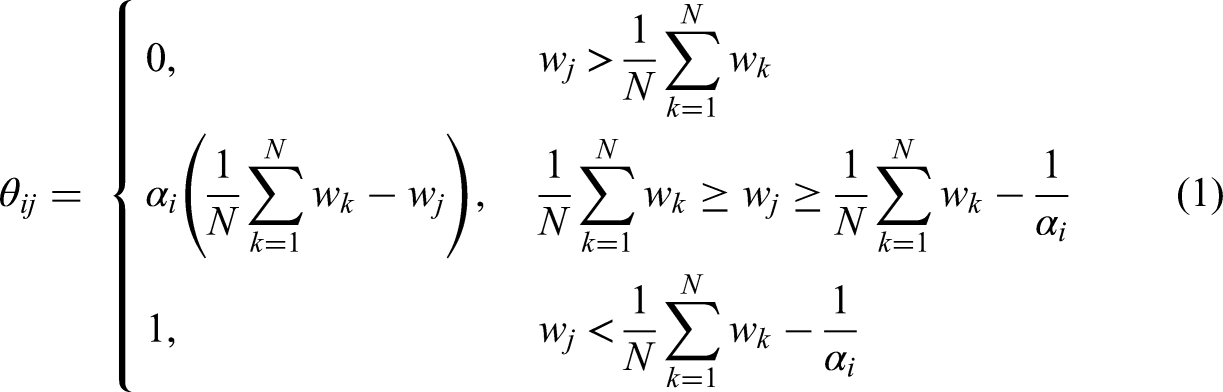
As explained above,
Using the initial firm-level labor supply explained above and the probability that a worker will leave the firm for another job, we can construct an expected labor supply curve for firm j,

By taking the derivative of

Given the assumption that firms are rational and want to maximize profits, we can now determine firm hiring and production behavior. In order to focus on the wage dynamic, let us assume that the firm faces a perfectly elastic demand curve for its output at the market price of one, and that each worker produces one unit of output. Thus, the profit function for firm j takes the following form:



The best response function for the firm takes the following form:


The equilibrium wage shares the following relationships with the degree to which workers react to wage differentials,


Consequently, equation (9) shows that if, on average, female workers are more likely to limit the geographic extend of their potential labor supply because of greater household responsibilities, the number of firms that compete for their labor, N, will be less. If firms are able to wage discriminate and recognize that women, on average, have less demand for their labor, they would be able to exploit female workers more than male workers—creating a gender wage gap. Note that, this dynamic would reinforce misogyny; unless the higher level of exploitation is consciously recognized, female workers would seem to be less productive than male workers. Also, employers who arrive at
From equation (8) and the relationship between wealth and sensitivity to wage differentials, we can see also that Black and Latino labor would be more exploitable than White labor:

From equations (7)–(10), we can analyze the cumulative wage gap for Black and Latina female worker. As mentioned above, empirical evidence shows that the wage gap for individuals that are both nonmale and non-White are greater than the sum of individual racial, ethnic, and gender wage gaps. Our model yields the same results. The additive and cumulative reduction in wage for a Black female worker would be the following:


The first value in equations (11) and (12),
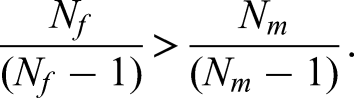
To better conceptualize these differences, in Figure 1, we graph the Nash equilibrium wage,
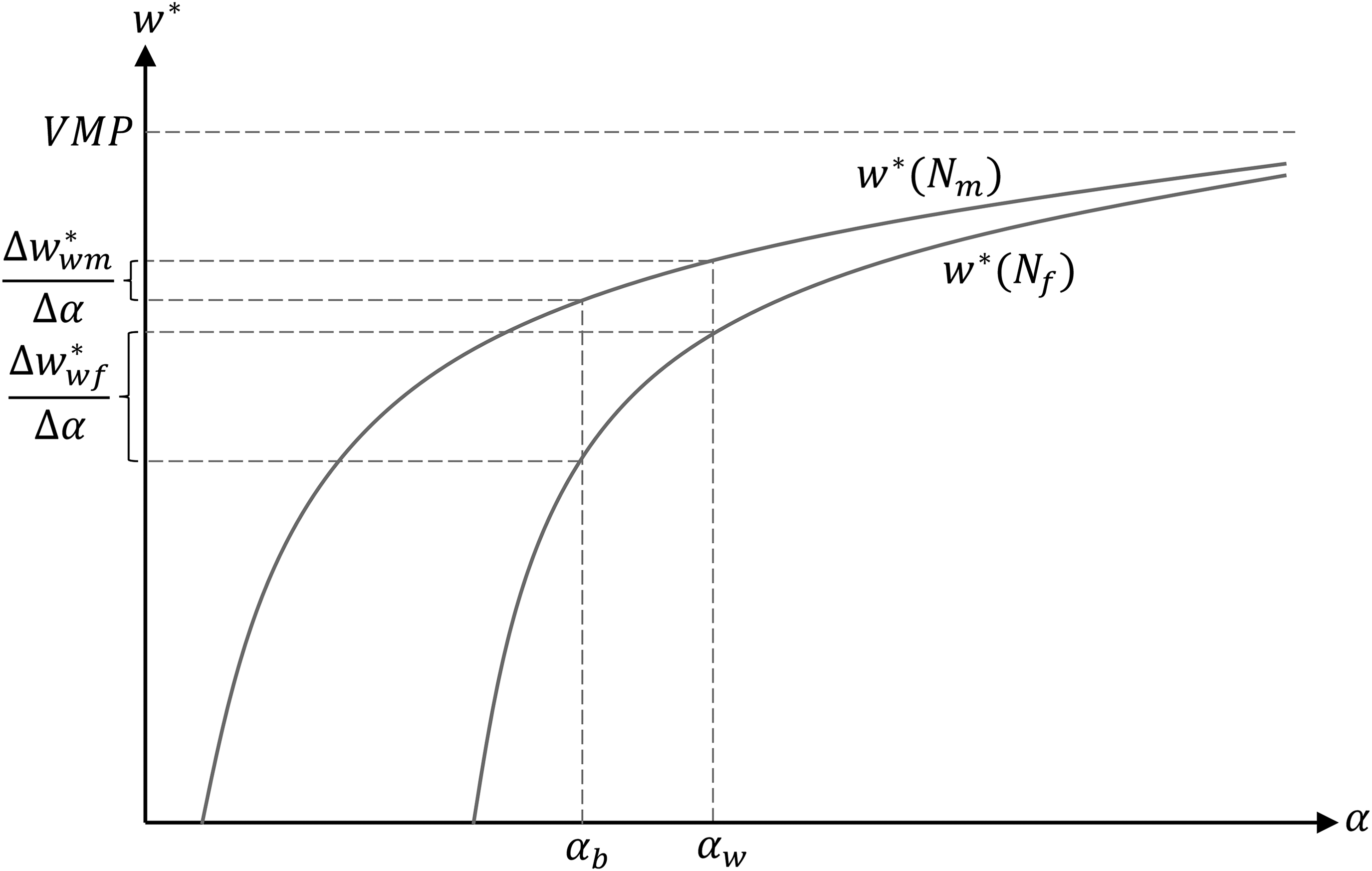
Visualizing wage penalties.
As shown in equation (8) and depicted in Figure 1, increases in the
Changing Wage Gap
How has the wage gap changed over time? The above model can only explain a change in the wage gap from changing gender roles at the home, and increased wealth inequality between racial, ethnic, and gender groups. While those dynamics definitely offer some explanatory power, it seems like other factors are also at work. As explained above, decreased institutional support for collective action in the wage setting process has increased employers' ability to wield their monopsony power, independent of changes in employer concentration. Because some workers are more exploitable for the reasons highlighted in the previous two sections, an increase in employers' ability to wield their monopsony power would lead to an increase in the wage gap between White and Black workers, White and Latino workers, and male and female workers.
In order to model this dynamic, imagine workers have the following utility function, U:

Thus, workers' utility maximizing intensity of collective action takes the following form:

Imagine a firm's total output is proportionally reduced by one minus the level of collection action. Zero collective action would lead to the same amount produced as in the previous model. When collective action is nonzero, output is decreased. Indeed, the decrease in output is the leverage workers place on employers to better their situation. The profit function would take the following form:



As a result of the dynamic highlighted in equation (17), a decrease in the level of institutional support for workers would increase inequality between equally productive workers:

In terms of the wage gap between women and men, a decrease in institutional support for collective action would have the same effect as with the racial wage gap:

As noted above, the female–male wage gap decreased between 1979 and the early 1990s and then has remained nearly unchanged since. Given the evidence on the decline in worker power from the 1980s on and the effect of the Women Right's Movement Civil Rights Movement and associated policy and cultural shifts in the 1970s, this model would infer that the changes from the latter outweighed the former between the 1980s and early 1990s. However, since the early 1990s, this model would infer that the changes in worker power have neutralized any positive effects from policy changes and cultural shifts around gender roles at the home and at work.
Conclusion
As we have shown above, wage differences between like workers of different race, ethnicity, and gender, and the change in these wage differences overtime, can be explained theoretically by explicitly modeling firm competition for workers through wage posting, employee movement between jobs in response to market signals, differential household responsibilities for male and female workers, differential response to potential monetary frictions in the job transition process due to racial and ethnic wealth inequality, and workers' collective action which is a function of institutional support for collective action. These gender- and race-specific labor market frictions give employers more power over women and Black and Latino workers and thus create racial, ethnic, gender, and intersectional wage gaps. Additionally, the reduction in support for labor over time has made it increasingly possible for employers to push down the wage of these more exploitable groups.
In terms of remedying wage gaps between like workers of different race, ethnicity, and gender, the model shows that individual strategies, such as those implied by the human capital model, would most likely be ineffective. As explained above, the dynamics that create these wage differences make misogyny and racism profit maximizing because offering women, Black, and Latino workers lower wages because of believed lower productivity would parallel the rational profit maximizing strategy given the increased exploitability of these groups. Thus, the market would not eliminate discrimination as argued by Becker (1957) and others. Instead, misogyny and racism would thrive in a monopsonist labor market. For the individual worker trying to combat her wage difference, increasing the geographic scope of potential jobs or increasing the degree to which she risks potential monetary shocks from the job market would not affect the treatment received by misogynistic and racist employers.
Also, for workers facing employers following the rational, profit maximizing strategy laid out above, it would be difficult for a worker to convey their individual difference from the group in terms of exploitability. And if the worker could only convey it to her actual employer, the employer might, consciously or subconsciously, realize that other employers are most likely unaware of the differences in exploitability of this individual. Thus, it might still be maximizing for the employer to offer the worker the lower wage—forcing her to accept the wage difference or quit and weather the job market where other employers will assume she is more exploitable.
In contrast, the model outlined above shows that policies which combat wage discrimination, wage setting power, gender household roles, and household wealth inequality would be effective in reducing wage differentials between like workers of different race, ethnicity, and gender. In terms of combating wage discrimination, such policies would reduce employers' ability to profit from differential levels of exploitability through paying more exploitable workers lower wages. Indeed, we effectively followed this policy in the United States with the Civil Rights Act of 1964 (Card & Krueger, 1993). However, since the 1980s we have moved away from actively combating wage discrimination. More recently, the Trump Administration halted an Obama Administration executive order that would increase the ability of the Equal Employment Opportunity Commission to gather more detailed and long-term firm-level data on wage levels by race and gender.
In terms of combating wage setting power more generally, as explained above, this can be done through increasing institutional support for workers. The countervailing power created by workers' collective action reduces employers' monopsony power and thus their ability to exploit workers generally and to more intensely push down the wage of more exploitable workers. For example, looking narrowly at the nursing occupation where women are a significant majority of the field and Black women are overrepresented among low-wage nursing occupations, McGregory (2013) finds that the Black–White wage differential between registered nurses all but disappears among unionized registered nurses (RNs). However, as shown above, since the 1980s, we have moved in the opposite direction in terms of supporting workers in the United States, with deleterious effects on the racial, gender, and intersectional wage gaps. Policies that increase the ability of unions to organize and bargain, such as sectoral bargaining and the repeal of Right-to-Work laws (Labor and Worklife Program, Harvard Law, 2020), would provide a greater countervailing power against exploitation.
At least a portion of the search frictions experienced by women are a result increased caregiving responsibility within families and the gendering of paid caregiving work as feminine. A suite of family economic security policies, including universal access to paid family and medical leave, paid sick leave, affordable childcare, improving transportation, would all have a disproportionate effect on women workers who bear the brunt of caregiving responsibilities within families. Improving paid care work through improving the pay of direct public sector employment such as in the K-12 education sector or more generous subsidies to quasi-public industries such as the healthcare sector would likewise have a disproportionate positive impact on women workers in caring labor. Helping families balance household care with market work and improving opportunities for paid care workers both serve to decrease women's search frictions vis-à-vis misogynist employers.
In terms of reducing wealth inequality, a number of scholars have called for such actions. For example, Hamilton and Darity (2010) call for the implementation of ‘baby bonds' to reduce household wealth differences. Under their plan, every American would receive a bond at birth from the government funded through progressive taxation. The value of the bond would vary inversely with family wealth reaching $50,000–$60,000 for children from families in the lowest wealth quartile. Such a strategy would reduce the wage gap through equalizing the relative degree to which White, Black, and Latino workers respond to market signals given potential monetary shocks in the job search and transition process.
Understanding the underlying mechanisms that contribute to the persistence of racial, gender, and intersectional wage gaps, and the systemic discrimination that supports them is critical to developing a policy agenda that fosters equity. Thus, the model presented in this paper outlines a number of options to address persistent wage inequalities between like workers of different race, ethnicities, and gender.
Footnotes
Acknowledgments
The authors thank Nancy Folbre, Sydnee Caldwell, Terry-Ann Craigie, Todd Sorensen, and Douglas Webber for comments on the paper.
Declaration of Conflicting Interests
The authors declared no potential conflicts of interest with respect to the research, authorship, and/or publication of this article.
Funding
The authors received no financial support for the research, authorship, and/or publication of this article.
