







Abstract
How can Americans on the political left and right both claim their views represent those of Jesus? Using nationally-representative data in which Americans rated Jesus on the left-right ideological spectrum, we assess what characteristics are associated with Americans’ ratings and consider arguments about causal ordering. Competing expectations are drawn from “images of God” research and research showing political identities influence Americans’ religious characteristics. Focusing on Christians first, the strongest predictors of where Christians place Jesus was their own ideological identity followed closely by views on Christian nationalism. No other religious, racial, or partisan characteristics were associated with where Christians place Jesus. For insights on causal direction, we interact religiosity measures with ideological identity and Christian nationalism, finding identical patterns regardless of religious commitment. We also run models to see if patterns differ for non-Christians and the influence of ideological identity and Christian nationalism are nearly identical. Given that Americans’ ideological placement of Jesus has little to do with their own religious identity or commitment, findings lend more support for the theory that Christians and non-Christians alike project their own ideological identities and views about Christian nationalism onto Jesus rather than such characteristics following from stable images of Jesus.
Scholars and commentators on religion have for centuries recognized that the values and biases of human societies are often reflected in those of their gods (Froese and Bader 2007, 2010; Hodges et al. 2013). Faith communities and leaders have themselves assumed that their beliefs about their gods (i.e., their doctrine or theology) influence their social values and arrangements. For example, the Christian mystic A. W. Tozer (1961:1) wrote “We tend by a secret law of the soul to move toward our mental image of God. This is true not only of the individual Christian, but of the company of Christians that composes the Church.”
This perspective has been influential in the social sciences, shaping empirical studies that focus on how stable “images of God” shape Americans’ religious, political, and social views (Bader et al. 2010; Baker and Whitehead 2020; Froese and Bader 2007, 2010; Mencken and Fitz 2013; Stroope, Draper, and Whitehead 2013; Whitehead 2012, 2014). Other thinkers, however, argue this relationship is inverted as societies largely project their own biases and values onto their gods. Those adopting this view include classical social theorists (Durkheim 1995 [1912]; Feuerbach 1845; Spinoza 2002) and most contemporary social scientists (e.g., Epley et al. 2009; Jackson, Hester, and Gray 2018; Oishi et al. 2011; Ross, Lelkes, and Russell 2012).
One particularly relevant instance of this self-god overlap in the American context is the way Jesus Christ is often claimed to represent the political values and policy preferences of the Christian left and right (Hendricks 2006; Kennedy 2008; Prothero 2003). The subtext of claims that one’s political views represent those of Jesus Christ, at least for self-identified Christians, is that Jesus himself has set the example that the faithful are now following with their religious, political, or social claims (“This is what Jesus thinks; therefore I think it too.”). Some studies have assumed American Christians are projecting their political identities or values onto Jesus (e.g., Oishi et al. 2011; Ross et al. 2012). But evidence in support of causal direction is limited.
In this study, we draw on data from a nationally representative sample of Americans whom we asked to rate Jesus on the ideological spectrum from 1 = “extremely left-wing” to 10 = “extremely right-wing” in order to assess what characteristics are associated with Americans’ ratings and to consider arguments about causal ordering. Though our cross-sectional data cannot definitively establish causal direction, and bi-directionality remains possible, our findings lend more support to the theory that Americans’ ideological identities and views on Christianity’s role in government influence where they place Jesus ideologically, rather than their commitment to following Jesus’s teaching influencing their own politics. Our study thus provides new evidence that both calls for future research and contributes to a better understanding of the relationship between Americans’ political and religious views.
Background and Expectations
Scholars and philosophers have long noted the overlap between societies’ values and ideals and how they perceive their own gods. Confessional communities generally do not begin from the assumption that they project their values onto god, but the opposite—that their own values and goals are built on the foundation of what their gods value or demand from them. Falwell (1980:29) insisted America’s founders “established America’s laws and precepts on the principles recorded in the laws of God.” They were “guided by biblical principles” and America’s foundations “find their roots in the Bible.” In his book Politics According to the Bible, evangelical theologian Grudem (2010:13) insists “It is important to understand that I see these [conservative political] positions as flowing out of the Bible’s teachings rather than positions that I hold prior to, or independently of, those biblical teachings” (emphasis his).
Classical social theorists, however, have long suspected the reverse is more likely the case. Spinoza (2002:904) famously wrote “a triangle, if it could speak, would likewise say that God is eminently triangular, and a circle that God’s nature is eminently circular. In this way each would ascribe to God its own attributes, assuming itself to be like God and regarding all else as ill-formed.” Similarly, Feuerbach (1845:21, 25) argued that theology amounted to humans projecting their values: “The fact is not that a quality is divine because God has it, but that God has it because it is in itself divine…That which is the highest in the estimation of man is naturally the highest in the estimation of his God; what pleases man pleases God also.” And Durkheim (1995 [1912]:226–27) concluded that “god” represents “society” with all its moral weight. Thus, even if persons believe they are conforming to their god’s values, they are really conforming to the group’s: “the faithful are not mistaken when they believe in the existence of a moral power to which they are subject and from which they receive what is best in themselves. That power exists, and it is society.”
These two perspectives have their advocates in the contemporary social sciences. Working within the “strong program” of the sociology of religion that seeks to understand religious beliefs and values as independent variables, scholars have argued that theology matters, and in particular, how people conceive of God has an independent effect on their political and social views. Numerous studies in this vein have found that conceiving of God as angry, loving, authoritative, benevolent, critical, or distant is associated with Americans’ views about church-state relations and a host of policy preferences (Bader et al. 2010; Froese and Bader 2007, 2010). Others have found certain images of God are associated with rates of volunteering (Mencken and Fitz 2013) and reporting greater meaning and purpose in life (Stroope et al. 2013). Beyond God’s emotional or dispositional characteristics, other strains of this research show that seeing God as more maternal or masculine also corresponds to certain social views and policy preferences (Baker and Whitehead 2020; Whitehead 2012, 2014).
Other studies within the field of experimental social psychology have also reported that beliefs about divine characteristics and preferences also matter in shaping views and behaviors. Smith et al. (2022) found that American Christians and Israeli Jews would often attribute greater universalism or dehumanizing tendencies to their god than themselves (see also Pasek et al. 2020, 2023), and asking participants to think about their god’s views shapes their own views.
Yet another strand of research assumes the self-god overlap is primarily the result of humans projecting their group values as supposed by classical theorists. Epley et al. (2009) found people’s beliefs on social and moral issues were strongly correlated with estimates about God’s beliefs on these issues. And when the researchers manipulated participants’ beliefs about certain political issues, this caused them to change their beliefs about God’s views as well. Indeed, using neuroimaging, the authors found substantial overlap between neural activity when reasoning about one’s own beliefs and God’s beliefs. These findings would be entirely consistent with burgeoning research in sociology and political science showing that Americans’ political identities, these days representing more core group-identities, often precede and influence their religious identities (e.g., Campbell, Layman, and Green 2020; Hout and Fischer 2014; Margolis 2018), their evaluations of politicians’ religiosity (Perry and Davis 2024), and their views about God’s influence on American politics (Perry 2022, 2024).
Directly relevant to the current study, Ross et al. (2012) identified a moderately strong correlation between Christians’ own ideological identities and where they placed Jesus on an ideological spectrum from 1 = most liberal to 100 = most conservative. They also found a strong correspondence between Christians’ beliefs about various policy issues and what they thought Jesus’s views on these issues would be. Interestingly, while the authors describe this correspondence as examples of “projection,” they do not empirically discount the possibility we might expect from the “images of God” research, namely, that Christian respondents begin with stable views about Jesus and adjust their ideological identities and policy preferences accordingly. In fact, their results may lend support to that theory. They find that Christians more attached to their faith showed a greater correspondence between their political views and their estimations of Jesus’. This is what we might expect if theological beliefs are shaping political views: more devout Christians would be more eager to adjust their views to those of Jesus.
In our study, we seek to test the correspondence between Americans’ personal characteristics and how they rate Jesus on the ideological spectrum. In light of previous research, we expect a strong correlation between Americans’ political views and where they locate Jesus.
Yet we also weigh evidence for arguments about causal ordering. Though the survey data we use do not allow for experimental manipulations or substantive accounting for temporal precedence, and thus we cannot definitively determine causal ordering or discount bi-directional influence, we reason theoretically from interactions across key political characteristics and indicators of religious commitment and identity.
The “images of God” research would lead us to expect that Christians’ understandings of what Jesus is like politically would motivate them to embrace certain ideological identities and political views (Froese and Bader 2007, 2010). But we would expect this to be the case primarily among the more committed Christians, that is, those who would be more eager to adjust their views and values to those of Jesus. Concretely, if Christians are adjusting their own political identities and views to those of Jesus (as confessional Christians and “images of God” research would argue), we would expect these correlations to be stronger among those who are more religiously committed compared to more nominal Christians. Conversely, we would expect weaker associations between nominal Christians’ political identities and values and where they rate Jesus, since nominal Christians would be less inclined to adjust their characteristics to those of Jesus. Alternatively, if both devout and nominal Christians show identical correlation patterns between, for example, their ideological identity and where they place Jesus, this might suggest something besides devotion to follow Jesus’ example is driving the correlation. That is, both devout and nominal Christians may project their ideological identities and views onto Jesus.
Similarly, we run analyses to see whether patterns differ for non-Christians. This allows us to draw similar comparisons. If Christians and non-Christians show identical correlation patterns between their ideological identity and where they place Jesus, we can be surer in the case of the latter group that it is not because they are adjusting their own identities and views to their stable “image of God.” Thus, a plausible alternative explanation would be that both Christians and non-Christians are projecting their ideological identities and political views onto Jesus.
Methods
Data
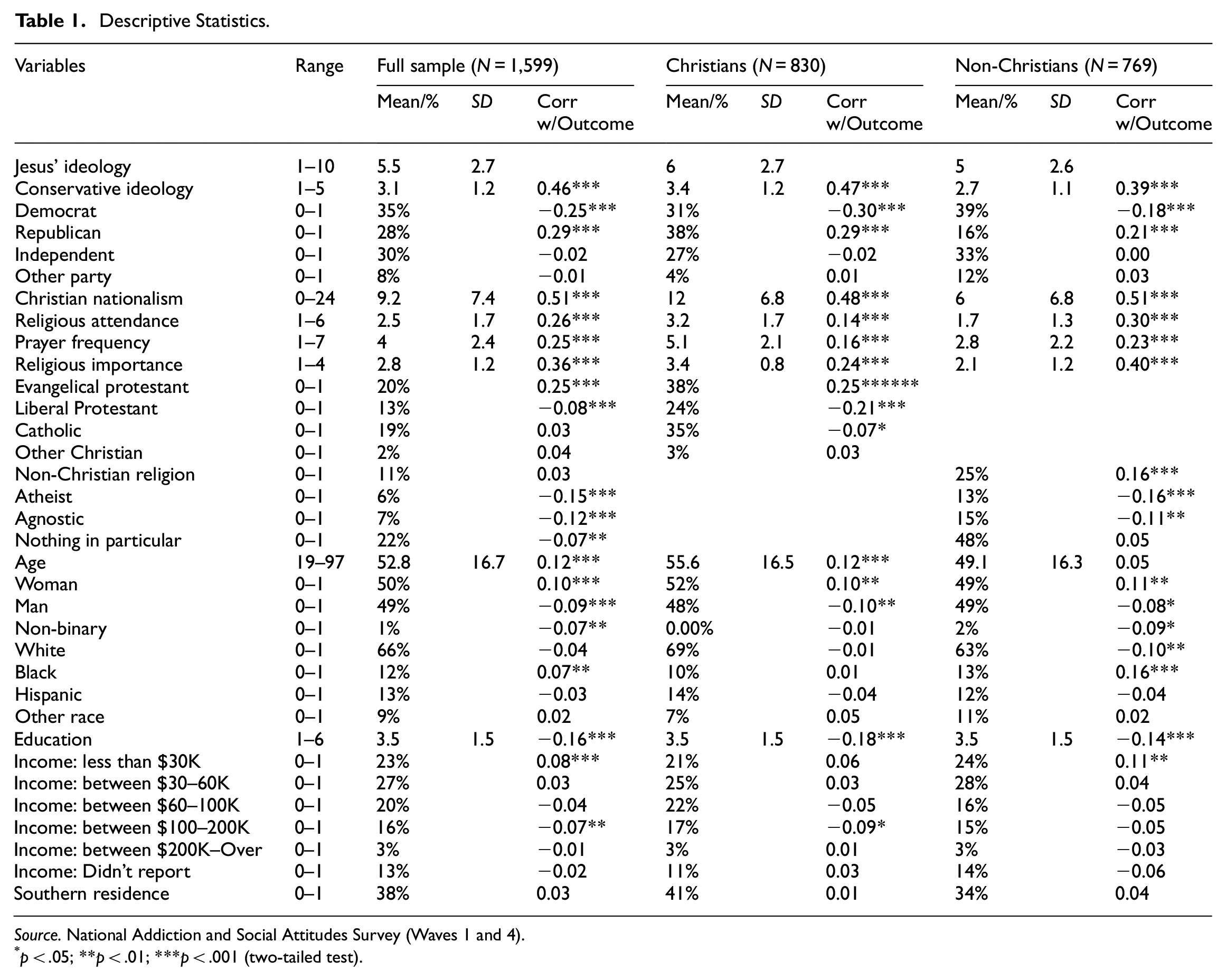
Data for this study come from Waves 1 and 4 of the National Addiction and Social Attitudes Survey (NASAS) (Perry, Whitehead, and Grubbs 2023). The NASAS was designed by the authors and fielded in by YouGov, an international research data and analytics company. Wave 1 was fielded in March of 2022 and Wave 4 was fielded in March of 2023. YouGov recruits a panel of respondents through websites and banner ads. These respondents are not paid directly but are entered into lotteries for monetary prizes. In order to draw a nationally representative sample, YouGov employs a method called “matching.” Drawing a random sample from the American Community Survey, YouGov then matches a respondent in the opt-in panel who is the closest to the Census respondent based on key sociodemographic factors. Because of the specific recruitment and sampling design used by YouGov, the company does not publish traditional response rates. However, YouGov develops sampling weights in order to ensure that the survey sample is in line with nationally representative norms for age, gender, race, education, and census region. The resulting original March 2022 survey sample included 2,809 Americans that were matched and weighted. Our final analytic sample in full models is 1,599 cases after attrition and a modest amount of missing cases. Table 1 presents descriptive statistics for a variables used in the analyses, for the full sample and for Christians and Non-Christians separately.
Descriptive Statistics.
Source. National Addiction and Social Attitudes Survey (Waves 1 and 4).
p < .05; **p < .01; ***p < .001 (two-tailed test).
Where Americans Place Jesus on the Ideological Spectrum
In Wave 4 of the NASAS, we asked Americans “Where would you place the following individuals or groups on an ideological spectrum from 1 = Extremely Left-Wing to 10 = Extremely Right-Wing?” The list included a variety of individuals and groups (whom we focus on in another study), including Jesus Christ, Adolph Hitler, Martin Luther King Jr., Nazis, Communists, and others. For Jesus Christ, the average rating was 5.5 (SD = 2.7) indicating the average American placed Jesus almost perfectly at the middle. 1 In fact, as Figure 1 shows, over 40% of all Americans placed Jesus at 5 or 6 on the scale. Placement was largely similar for Christians and non-Christians, with the only major difference being that Christians were nearly twice as likely to place Jesus at 10 (extremely right-wing) compared to non-Christians (19.2%–10.8%). Given the nature of the outcome measure, we use ordinary least squares regression.
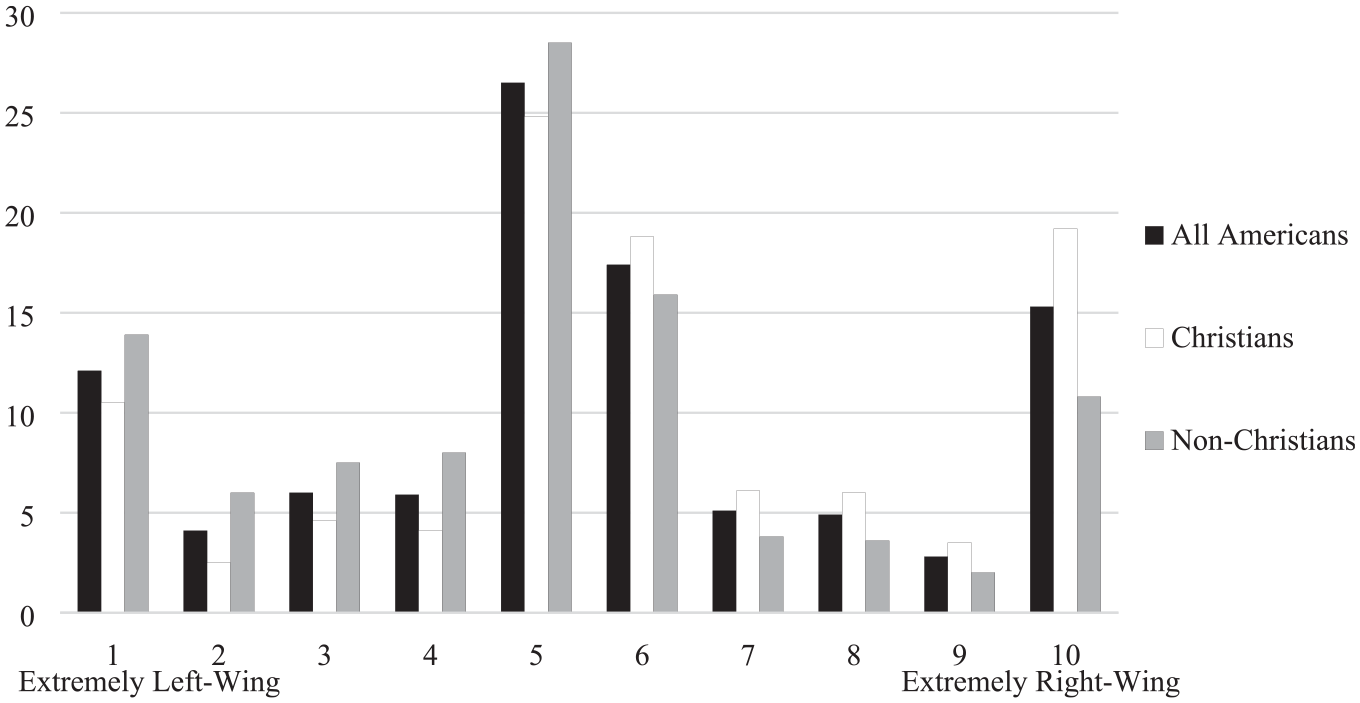
Percentage distribution of where Americans place Jesus Christ on the left-right ideological spectrum.
Key Predictors and Controls
Whatever the theoretical connection, our general expectation is that Americans’ political and religio-political characteristics will correspond strongly to where they place Jesus on the ideological spectrum. We include a number of measures to account for these characteristics. Ideological identity is measured with values from 1 = Very Liberal to 5 = Very Conservative. 2 We also measure party identity using dummy variables, with Democrat (reference category), Republican, Independent, and Other Party ID.
Following Froese and Bader (2007, 2010), we anticipate a significant association between Christian nationalist views and where Americans place Jesus on the ideological spectrum. Christian nationalism has been measured in a variety of ways (Davis and Perry 2021; Djupe, Lewis, and Sokhey 2023; Gorski and Perry 2022; McDaniel, Nooruddin, and Shortle 2022; Perry, Riccardi-Swartz, et al. 2023). We introduce a strong measure of Christian nationalism incorporating questions from other studies and adding new ones. Americans were asked to indicate their level of agreement with six statements: (1) “America holds a special place in God’s plan.” (2) “The federal government should declare the United States a Christian nation.” (3) “I consider founding documents like the Declaration of Independence and the US Constitution to be divinely inspired.” (4) “I consider being a Christian an important aspect of being truly American.” (5) “Christians have a responsibility to gain control over national institutions like government, education, and the media.” And (6) “The Bible should be the foundation of our legal system.” The alpha for these measures .943. 3 Given the extremely high reliability of the measures, we follow the example of previous studies that incorporate multiple Christian nationalism items by creating an additive index from 0 to 24. Higher scores indicate greater affirmation of Christian nationalism.
Traditional religious characteristics include measures of religious identity and religious commitment. Religious identity was measured with the following categories: Evangelical Protestant, Liberal Protestant, Catholic, Other Christian, Non-Christian Religion, Atheist, Agnostic, Nothing in Particular. 4 When focusing on Christians (Table 2), Evangelicals are the reference category; when focusing on non-Christians (Table 3), those in non-Christian religions (e.g., Jews, Hindus, Buddhists, Muslims, etc.) are the reference category. 5 We also include a religiosity index consisting of measures for religious service attendance (1 = Never–6 = More than Once a Week), prayer frequency (1 = Never–7 = Several Times a Day), and religious importance (1 = Not at All Important–4 = Very Important). These are standardized and summed to create a religiosity index (Cronbach’s alpha = .84).
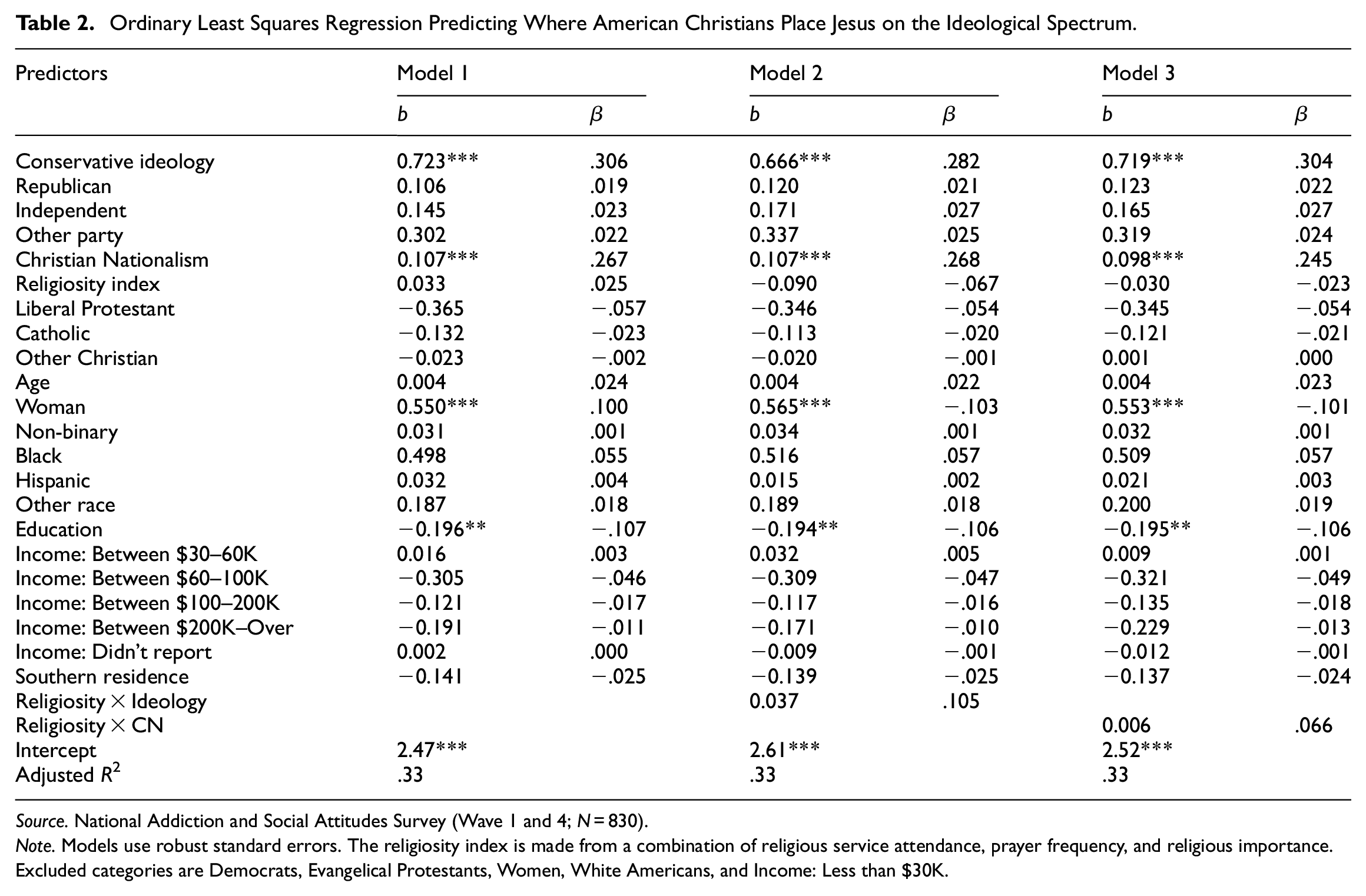
Ordinary Least Squares Regression Predicting Where American Christians Place Jesus on the Ideological Spectrum.
Source. National Addiction and Social Attitudes Survey (Wave 1 and 4; N = 830).
Note. Models use robust standard errors. The religiosity index is made from a combination of religious service attendance, prayer frequency, and religious importance. Excluded categories are Democrats, Evangelical Protestants, Women, White Americans, and Income: Less than $30K.
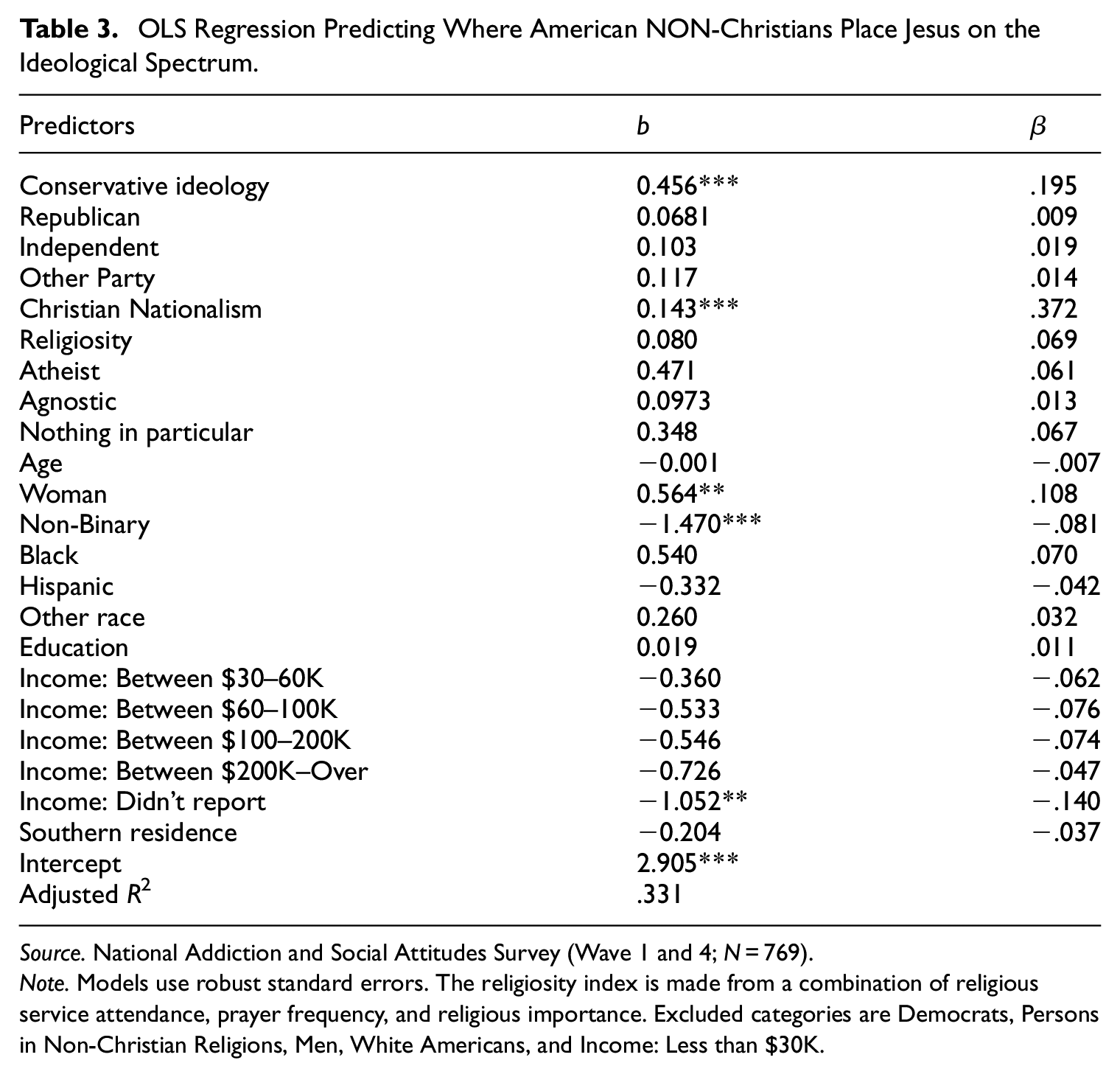
OLS Regression Predicting Where American NON-Christians Place Jesus on the Ideological Spectrum.
Source. National Addiction and Social Attitudes Survey (Wave 1 and 4; N = 769).
Note. Models use robust standard errors. The religiosity index is made from a combination of religious service attendance, prayer frequency, and religious importance. Excluded categories are Democrats, Persons in Non-Christian Religions, Men, White Americans, and Income: Less than $30K.
Lastly, each analysis includes demographic controls. Age is measured in years from 19 to 97. Sex was measured with dummy-coded variables with men (reference), women, and non-binary persons. Similarly, racial identity was measured with dummy variables, with White (reference), Black, Hispanic, and Other Race. Educational attainment was measured with attainment categories from 1 = less than high school to 6 = post graduate work. Household income is measured with a series of dummy variables, including less than $30K per year (reference category), $30 to 60K, $60 to 100K, $100 to 200K, $200K or more, and did not indicate income. Lastly, we included a control for living in the Southern United States.
Plan of Analysis
The analysis proceeds as follows. We first make note of substantive bivariate associations presented in Table 1. We then turn to multivariate analyses in Tables 2 and 3. The analysis in Table 2 limits the sample to Christians and presents results from ordinary least squares (OLS) regression models predicting how Americans rate Jesus Christ on the left-right ideological spectrum. Model 1 presents the main effects model. Models 2 and 3 introduce interaction terms. Table 3 replicates Model 1 from Table 2, but instead focuses on non-Christians. All Models include both unstandardized and standardized regression coefficients to present both statistical and substantive significance. To interpret interactions, we focus on marginal effects presented in Figures 2 and 3. All models use robust standard errors to adjust for the survey weights in the multivariate analyses.
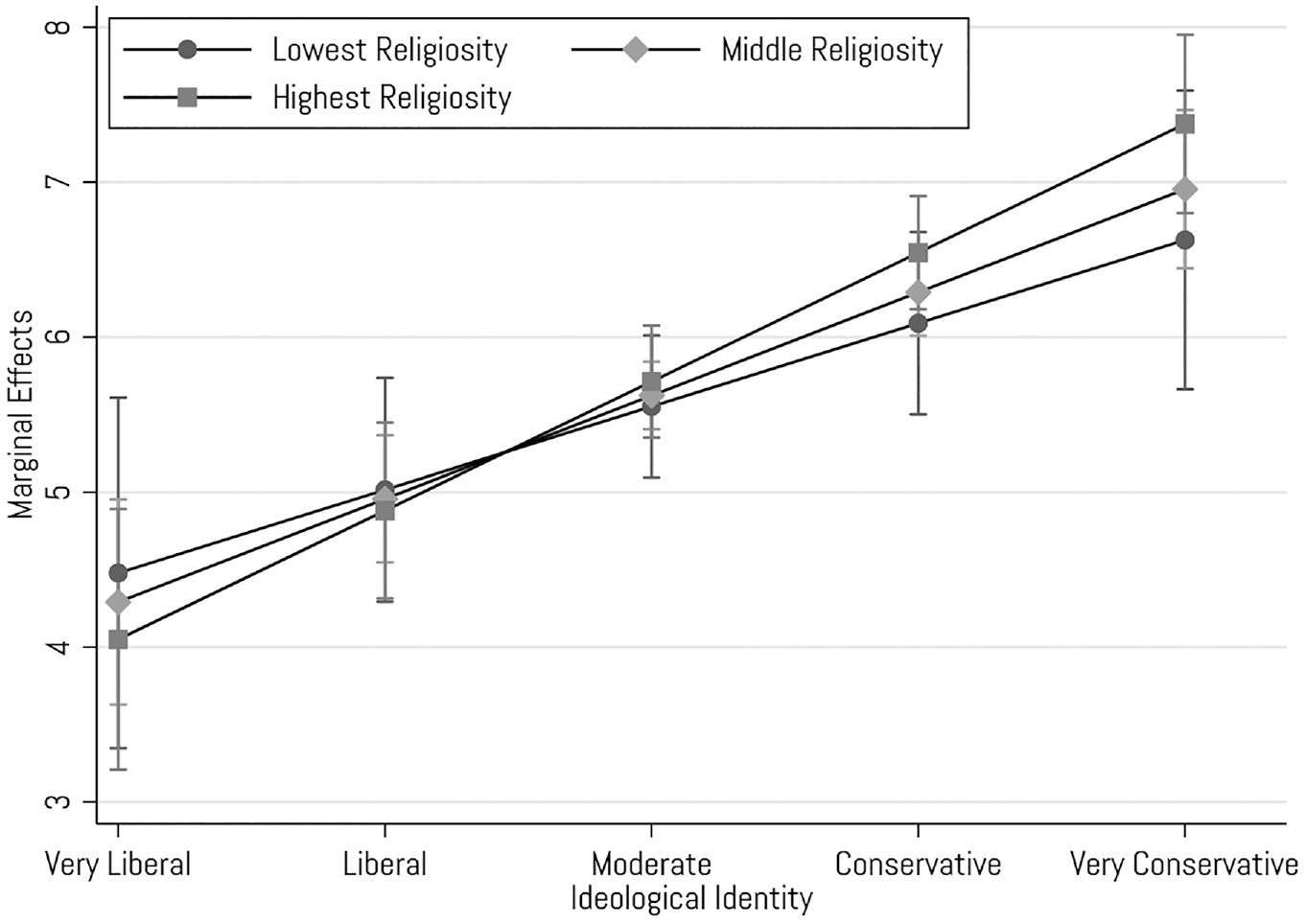
Predicted marginal effects of where Christians place Jesus Christ on the left-right ideological spectrum across ideological identity and religiosity.
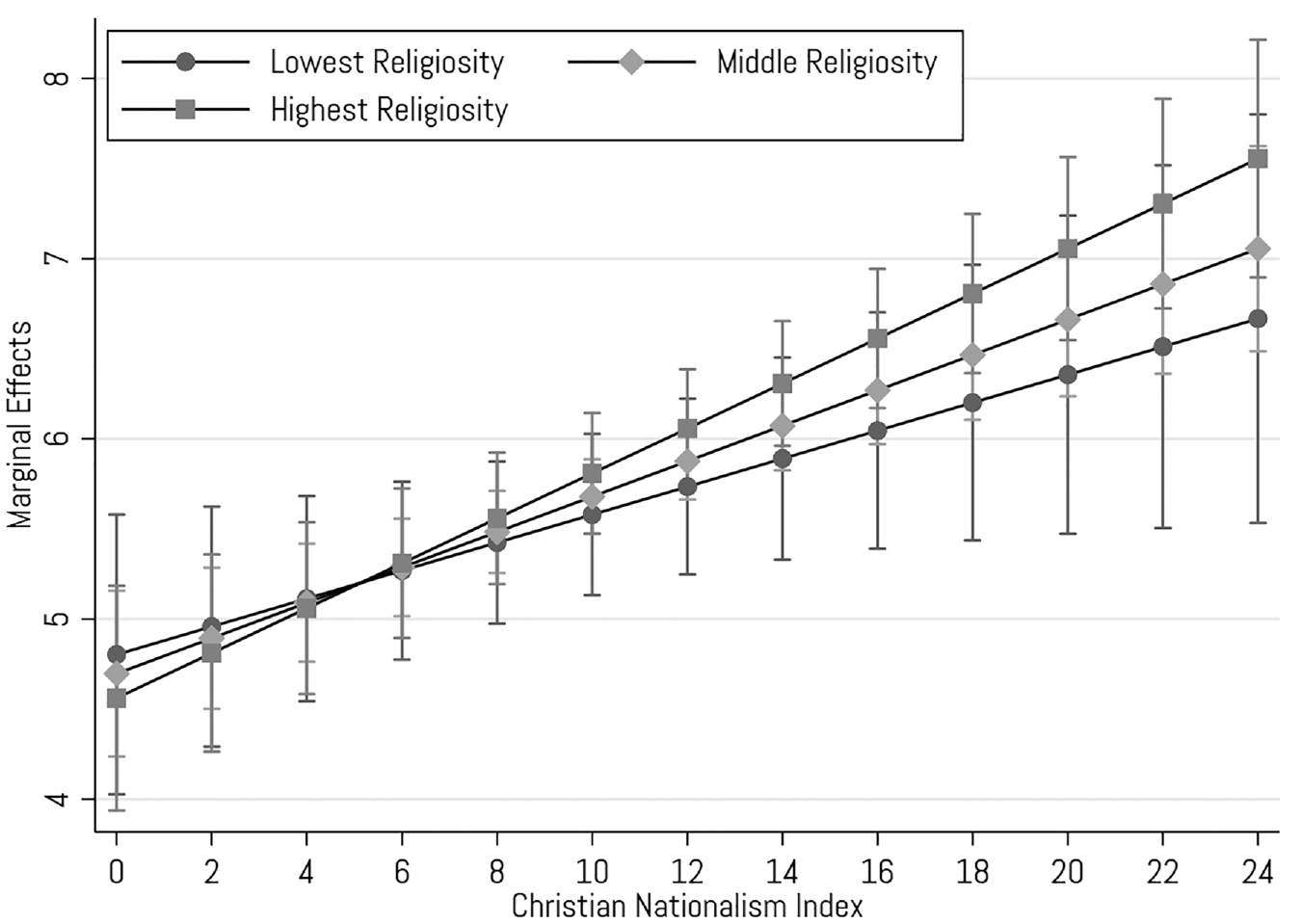
Predicted marginal effects of where Christians place Jesus Christ on the left-right ideological spectrum across Christian nationalism and religiosity.
Results
Zero-order correlations presented in Table 1 indicate that, for the whole sample and Christians in particular, the strongest association between predictor variables and where Americans place Jesus on the ideological spectrum is their views about Christian nationalism, followed by their own ideological identity. The signs indicate that Christian nationalism and identification with ideological conservatism are positively associated with placing Jesus further rightward. The direction of these associations, however, is undetermined.
Other significant associations are just as we would expect. Descriptively, Democrats tend to rate Jesus further left and Republicans tend to rate Jesus further right. So too, those who are more religious (in terms of attendance, prayer frequency, and religious salience) tend to rate Jesus further right. Evangelical Protestants are more likely to rate Jesus rightward, while Liberal Protestants rate Jesus further left. Interestingly, atheists and agnostics are also more likely to rate Jesus further leftward. Because atheists and agnostics (who tend to be more politically left-leaning) would not intuitively seek to base their own political views on how they view Jesus Christ ideologically, these associations would more intuitively suggest that atheists and agnostics are aligning Jesus with their own ideological identities and commitments. Because these religious and political variables are all closely related, we turn to multivariate analyses in order to better isolate associations.
In Model 1 of Table 2, we see that the strongest predictors of where Christians place Jesus Christ on the ideological spectrum is their own ideological identity (b = 0.723; p < .001; β = .306), followed closely by their views on Christian nationalism (b = 0.107; p < .001; β = .267). Both patterns are in the expected direction. Despite significant bivariate associations in Table 1, with controls in place, no other religious characteristics are associated with where Americans place Jesus, nor are their racial or party identity. After Christian nationalism, the most significant predictors of where Christians place Jesus are their level of education (b = −0.196; p < .001; β = −.107), with more educated Christians placing Jesus further leftward. Christian women (b = 0.550; p < .001; β = .100) tend to place Jesus further rightward compared to Christian men. 6
Though the data do not allow us to test causal direction directly, testing for interaction effects between conservative ideological identity, Christian nationalism, and indicators of religious commitment allow us to consider arguments theoretically. Models 2 and 3 present interaction terms between our religiosity index and ideological identity (Model 2) and Christian nationalism (Model 3). Neither the interaction term in Model 2 (p = .346) nor Model 3 (p = .323) approach statistical significance. Even so, we plot out the marginal effects to affirm the influence of ideological identity and Christian nationalism does not vary across measures of religious commitment.
Figure 2 plots the marginal effects of where Christians placed Jesus on the left-right spectrum across ideological identity and religiosity. At no point do the lines differ significantly from one another, indicating that the association between ideological identity and where Christians place Jesus on the ideological spectrum does not vary by whether they are more or less religious. If American Christians started with their understanding of Jesus’s ideological views, and this understanding is what led them to identify more with ideological liberalism or conservatism (as we might expect from “images of God” research), we would expect that those who are more devout (intuitively, those who would be more interested in aligning their own political identities and values to those of Jesus) would show different patterns than those who seem to be Christians only in name. Alternatively, we might expect those who are nominal Christians would show weaker associations between ideological identity and where they place Jesus. But patterns in Figure 2 show us that Christians’ religious commitment tells us little about where they locate Jesus ideologically. Instead, for Christians, greater conservatism is associated with placing Jesus further rightward on the ideological spectrum, regardless of religiosity.
Figure 3 largely replicates the patterns for Figure 2, but here we plot marginal effects of where Christians place Jesus on the left-right ideological spectrum across our Christian nationalism index and religiosity. Patterns are nearly identical. Across values of Christian nationalism, knowing how religious a Christian is tells us little about where they place Jesus ideologically. But as they affirm Christian nationalism more strongly, the likelihood that they place Jesus further rightward increases similarly for devout and nominal Christians alike.
Table 3 tests these patterns in another way by focusing on non-Christians. Even more so than relatively irreligious Christians, persons who identify with non-Christian religions or as unaffiliated would intuitively have no motivation to align their political views and values with those of Jesus (see also the correlations for atheists and agnostics in Table 1). Yet we see in Table 3 that the patterns for non-Christians are virtually identical to those we see for Christians, with the strongest predictors in this case being views on Christian nationalism (b = 0.143; p < .001; β = .372), followed by ideological identity (b = 0.456; p < .001; β = .195), each in the expected direction. 7
One notable difference is that while educational attainment is associated with Christians placing Jesus further leftward on the ideological spectrum (b = −0.196; p < .01; β = −.107), there is practically no association for non-Christians (b = 0.019; p = .784; β = .011). An examination of marginal values (see Online Table A1; Model 4 and Appendix Figure A4) affirms non-Christians tend to place Jesus at the same place across the ideological spectrum regardless of their education, while Christians gradually place Jesus further leftward on the ideological spectrum with each additional level of education, to the point where they are statistically indistinguishable from non-Christians if they have post-graduate education.
Discussion
Scholars and theorists of religion have long observed a correspondence between the values of human societies and those of their gods (Froese and Bader 2007, 2010; Hodges et al. 2013). While early social scientists and more recent research from a group-identity perspective would lead us to expect that people project their views and biases onto their gods (Durkheim 1995 [1912]; Epley et al. 2009; Feuerbach 1845; Ross et al. 2012; Spinoza 2002), other researchers have argued that “images of God” can influence Americans’ political views and values (Froese and Bader 2010; Whitehead 2012, 2014). Focusing on how Americans place Jesus Christ on the left-right ideological spectrum, our analyses of nationally-representative data affirm ideological congruence between Americans and Jesus. In particular, the strongest predictors of where Americans locate Jesus ideologically are their own ideological identity and their views on Christian nationalism. Yet we also show that these associations hold regardless of whether Americans are Christians or non-Christians, devout or irreligious. Though this does not directly demonstrate causal direction, it does suggest the more plausible theoretical explanation is that ideological identities and orientations to Christianity in the public square influence where Americans place Jesus ideologically (regardless of their own commitment to Christianity itself).
Given that these data cannot establish causal ordering, our findings do not necessarily contradict “images of God” research that has shown whether Americans view God as authoritative, benevolent, critical, distant, maternal, masculine, and so on predicts their political beliefs and orientations toward religion in the public square. At bottom, our findings support these associations: Americans who rate Jesus as more ideological rightward also tend to be those who themselves are ideologically conservative and supportive of Christian nationalist views. Yet the patterns did not support what we might assume if stable “images of Jesus” were driving Americans to adopt particular ideological identities or stances on Christian nationalism. That is, we would anticipate that ideological identity and Christian nationalism would correspond more strongly with where Americans place Jesus ideologically among those who would be most inclined to align their views with his. This was not the case.
Though interactions and marginal effects for Christians in Table 2 (in combination with the similar patterns for non-Christians in Table 3) indicated that ideological identity and Christian nationalism was associated with how Americans rated Jesus on the ideological spectrum regardless of their attachment to religion, it is possible that significant differences would have been found given a large enough sample size. But even then, the more important issue to consider would be how substantively different are the opinions of devout Americans (who arguably want their politics to align with Jesus) and irreligious Americans (who would not care) compared to the enormous differences we see between Americans who share different ideological identities or opinions on Christianity in politics.
How do we interpret the different association between ideological placement for Christians and non-Christians across values of education? Theoretically, it could be that because non-Christians are less likely to make educational choices on the bases of what they think about Jesus, where they place Jesus on the ideological spectrum is simply unrelated to their placement, while for Christians, placing Jesus further rightward on the ideological spectrum contributes to their getting less education as adults, assuming their thoughts about Jesus are stable before they finish high school (though unlikely to be the case, see Margolis 2018). Alternatively, it could be that educational attainment is simply not the primary driver of where non-Christians place Jesus ideologically (which is apparently more connected to ideological identity, Christian nationalism, and gender; see Table 3), while for Christians, educational attainment is a liberalizing force, pushing their vision of Jesus further leftward on the ideological spectrum. Though each direction of influence may be a possibility, unfortunately, determining the causal ordering of the association will have to be left to future studies.
On the topic of future research, data limitations for this study also suggest avenues for future research. Though the NASAS waves are panel data, they cannot definitively demonstrate temporal precedence between key predictors and the outcome variable. An ideal next step would be experimental designs (e.g., Epley et al. 2009) in which Americans are randomly assigned to conditions that prime partisan or ideological identities. Researchers could then assess whether priming these identities causes Americans to place Jesus further rightward or leftward on the ideological spectrum. Alternatively, testing “images of God” assumptions, researchers could randomly assign participants to conditions in which Jesus could be understood as more liberal or conservative (see Ross et al. 2012). Researchers could then assess whether such treatments incline participants, and Christians in particular, to adjust their own ideological identities or views on Christianity’s supremacy in the public square. In terms of measurement, future studies could test alternate wordings for the left-right ideological spectrum or multiple dimensions. Though placements followed predictable patterns based on respondents’ own identities (see Online Appendix Figure A1), future studies could use terms like most liberal/most conservative. Or they could compare responses to different dimensions like economically liberal/economically conservative, socially liberal/socially conservative, and morally liberal/morally conservative.
It is worth speculating about the continued role of Jesus Christ as a stable image to which Christians adjust their own political values and practices and/or a possible projection of ideological or subcultural identities and values. Left or right-leaning Christians may to some degree be driven by a stable image of Jesus as left or right-leaning, respectively. Yet progressive Christians are among the least politically active and diminishing in numbers (Baker and Marti 2020). Additionally, partisan sorting has resulted in the situation where the political left is increasingly comprised of secular Americans and those of minority religious faiths for whom Jesus Christ will not necessarily be as valuable a mouthpiece as other cultural heroes like Martin Luther King Jr., Abraham Lincoln, or other advocates for equality and civil rights (Perry 2022, 2023, 2024). Yet as our findings suggest, even atheists and agnostics contest the view that Jesus Christ was more conservative, placing him further leftward on the ideological spectrum. And even committed Christians’ views about Jesus may be more shaped by their ideological identities and values than those tied to their religious lives. Thus, the person of Jesus, like religious identities in general (see Perry 2024; Pew Research Center 2021), may gradually be emptied of theological meaning, and increasingly replaced with purely ideological, partisan, and moral meanings.
Supplemental Material
sj-pdf-1-rrr-10.1177_0034673X241239570 – Supplemental material for In Our Own Image: How Americans Rate Jesus on the Ideological Spectrum
Supplemental material, sj-pdf-1-rrr-10.1177_0034673X241239570 for In Our Own Image: How Americans Rate Jesus on the Ideological Spectrum by Samuel L. Perry, Joshua B. Grubbs and Cyrus Schleifer in Review of Religious Research
Footnotes
Declaration of Conflicting Interests
The author(s) declared no potential conflicts of interest with respect to the research, authorship, and/or publication of this article.
Funding
The author(s) received no financial support for the research, authorship, and/or publication of this article.
Supplemental Material
Supplemental material for this article is available online.
Notes
References
Supplementary Material
Please find the following supplemental material available below.
For Open Access articles published under a Creative Commons License, all supplemental material carries the same license as the article it is associated with.
For non-Open Access articles published, all supplemental material carries a non-exclusive license, and permission requests for re-use of supplemental material or any part of supplemental material shall be sent directly to the copyright owner as specified in the copyright notice associated with the article.
