







Abstract
Faith communities are commonly guided by the mandate to care for others, an integral part of the Christian faith, motivating believers to fulfill their perceived religious responsibility to serve those in need. The strategies faith communities embrace to promote the well-being of more disadvantaged members of their community are further molded by their moral and social frameworks. In the wake of the pandemic, which heightened the economic insecurity of many families and their churches in the U.S., it is increasingly vital that churches engage in careful, strategic planning to address the needs of their congregations and local communities through their ministries. Drawing on case study research of four Protestant Black churches in North Philadelphia, this qualitative exploratory study aims to understand how churches address social needs in their local communities, and to explore if and how churches use any form of strategic planning to optimize their resources for this purpose. This study offers insights emerging from four key approaches—great leader, missional, data-driven, and partnership—that guide these churches in planned ministries to support community well-being. Ultimately, this research seeks to assist church leaders to better steward needed resources for church maintenance, congregational care, and community outreach amidst financial realities.
Keywords
Poverty remains a persistent issue in the United States, affecting about 34 million individuals in the United States before the pandemic (U.S. Census 2020). In 2023, this number rose to nearly 37 million people, a poverty rate of 11.1 percent (Shrider 2024). In the face of rising poverty, religious institutions, particularly churches, have traditionally played a significant role in addressing poverty in local communities. With the retracting role of the state in social service provision, congregations, and para-church organizations have become significant contributors to social and humanitarian service delivery to vulnerable populations in the U.S in recent years (Botchwey 2007; Chaves et al. 2021; Cnaan and Boddie 2001; 2006; DiIulio 2007; Scott and Cnaan 2018; Smith, Boddie, and Peters 2018; Stoesz 2016). In terms of services, some of these organizations focus on causes impacting particular groups of people experiencing poverty (e.g., hungry, homeless, elderly, children), while others have a wider remit (Cnaan et al. 2006). Additionally, some tend to take a charity approach, providing direct assistance and material support to address the immediate needs of individuals and families experiencing poverty, while others embrace a broader systemic approach by investing in educational and employment programs as well as broader community development initiatives to promote the long-term self-sufficiency and well-being of individuals and families in impoverished communities (Cisneros 1996; Cnaan 1999; Corbett and Fikkert 2014). Black churches are among the churches most likely to go beyond charity to create poverty alleviating programs with community development strategies (Boddie and Park 2021; Chaves and Higgins 1992; Chaves and Tsitsos 2001; DiIulio 2007).
Faith communities are commonly guided by the mandate to care for others, an integral part of the Christian faith, and believers are driven by their perceived religious responsibility to serve those in need (Wuthnow 2006). The strategies faith communities embrace to further well-being among more disadvantaged members of their community are also molded by their moral and social frameworks. However, these organizations are often stretched to the limits with dwindling budgets, limited staff with professional training, and insufficient funding sources to develop programs. For instance, the 2021 National Congregations Study revealed that about a third of all congregations have no savings (Holleman, Roso, and Chaves 2022). Hence, church leaders simultaneously face the realities of tight finances and the Biblical mandate to serve “the least of these.” Additionally, services and programs are often developed without appropriate planning, program development or management skills, or well-defined program evaluation measures. Moreover, mission and service programs are often created without a full understanding of social problems such as poverty, resulting in myopic responses to complex problems. With the pandemic compounding the economic insecurity of many families and their churches in the U.S., it is vital that churches are engaged in careful, strategic planning to support the needs of both their church members as well as individuals in the local communities through their ministry programs.
Strategic planning in nonprofit organizations is “a systematic process through which an organization agrees on and builds commitment among key stakeholders to priorities that are essential to its mission and are responsive to the environment. Strategic planning guides the acquisition and allocation of resources to achieve these priorities” (Allison and Kaye 2015:1). According to Heard (2020), strategic ministry planning is an ongoing process that provides direction and context for the futurity of present decisions and priorities. Drawing on such an external and internal analysis, strategic planning within the church context is also described as the organizational process of pairing the church’s capabilities with its ministry activities (Clinton, Williamson, and Stevens 1995). Thus, strategic planning ensures that church members know how the proposed plan, resources, and activities will support the church’s larger mission and purpose; thereby providing a foundation for more effective ministries (Rusbuldt, Gladden, and Green 1980). Such strategic planning is guided by vision and promotes effectiveness, provides focus, prompts motivation, produces stability, and prescribes purpose (Heard 2020). A lack of strategic planning, in contrast, can lead to failures in a church’s ability to meet its missional and organizational goals (Shah, David, and Surawski 2003).
There is limited research on the underlying motivations and processes that guide the church’s approaches to addressing poverty and need in their local communities, particularly whether their approaches focus primarily on charity services or have a more social justice-oriented, systemic underpinning. A gap also exists in the literature regarding the use of or relationship of strategic planning in churches, specifically in relation to poverty alleviation ministries. Drawing on interviews with pastors of four Protestant Black churches in North Philadelphia, this qualitative exploratory study, consequently, has two main objectives: (1) to understand how churches address need in their local communities, and (2) to explore if and how churches use any form of strategic planning to effectively harness their fiscal, in-kind, and human resources to further the well-being of more disadvantaged members in their local communities in the short- and long-term.
This research offers insights for purposeful, sustainable decision-making processes that include robust discussions about the alignment of services and programs reshaped by the pandemic with the church’s identity, priorities, and resources. These findings also help support the building of strategic partnerships and relationships with non-profits by identifying areas in which the churches need to be further equipped in their efforts to be responsive to the needs of their communities (Placido and Cecil 2014). Lastly, this research guides strategies to equip church leaders to better steward needed resources for church maintenance, congregational care, and community outreach amidst financial realities.
A Mandate for Caring for the Poor
The mandate to care for others is a sacred calling for Christians, and often driven by their spiritual and moral responsibility to serve those in need (Dhandi, Sutrisno, and Moriah 2023; Linthicum 2000; Rhee 2012; Wuthnow 2006; See Deuteronomy 15:11; Isaiah 58:11 and Luke 4:16-19). In the New Testament, Jesus recites the Old Testament and established his ministry for the poor and others in need saying, “The Spirit of the Lord is upon me, because he has anointed me to bring good news to the poor. He has sent the hungry, the homeless, the imprisoned, and the widow.” The church and its members are called to mobilize their faith to express God’s restorative love. Congregations and faith-based organizations have consequently long served as “silent partners” in meeting the needs of their local communities based on their knowledge of and relationships with the community residents (Botchwey 2007:36). However, Peter Greer, CEO of Hope International asserts that “effective obedience to the clear biblical command to clothe the naked and give food to the hungry requires asking the question of how. Thoughtless responses run the real risk of strengthening the chains of poverty that bind captives around the world” (Sherman and Yates 2022:18).
Some congregations focus on providing charity services such as food and clothing, while others embrace more extensive neighborhood vitalization and community development initiatives based on concepts of social responsibility and social justice (Cisneros 1996; Dorrien 1995; Gorrell 1988; Unruh and Sider 2005). Such services focus on social action and encompass “advocacy, economic and community development, lobbying, and political mobilization” (Cnaan et al. 2006:90). These services go beyond merely alleviating human suffering and instead focus on addressing the underlying conditions that contribute to such distress.
Examining the interplay between communities of faith and the broader community on a single street within the city of Philadelphia, Day (2014:xi) asserts that “place matters” and that the religious practices of congregations both shape and are shaped by the social, cultural, and economic context of a neighborhood. In alignment with Day’s argument that congregations are not impervious to their environments, Skocpol (2021) maintains that the idea of religious congregations serving as catalysts for social change is deeply ingrained as a core objective of a civil society. Berger and Neuhaus (2021) were pioneers in recognizing and emphasizing the significance of intermediary voluntary associations that operate independently from the state but fulfill numerous crucial societal functions. Religious congregations, in particular, are integral to fulfilling this role across the United States (Cnaan, Boddie, and Yancey 2003, 2005; Cnaan et al. 2006; DiIulio 2007; Putnam and Campbell 2012; Smidt 2003). Although the term “congregation” lacks a comprehensive and consistent definition in the larger literature (Cnaan and Boddie, 2001), several studies have examined the nature and extent of poverty alleviation-related services by Christian congregations in the United States (Botchwey 2007; Chaves and Eagle 2016; Chaves et al. 2021; Cnaan et al. 2006; Scott and Cnaan 2018).
Types of Social Service Delivery Among Congregations
Drawing on survey data from the 2012 National Congregations Study that included a diverse national cross-sectional sample of 1,331 religious congregations, Chaves and Eagle (2016) report that 83 percent of the congregations were engaged in social services or community development projects assisting individuals beyond their own congregation. Further, they found that the most common type of assistance involves addressing food insecurity. Over half (52%) of all congregations identified feeding the hungry—local food banks, running a food pantry or soup kitchen, or participating in Crop Walk fundraisers—as one of their top four social service programs. Other frequently mentioned services included addressing healthcare needs (21%), constructing or repairing homes (18%), and providing clothing or blankets to individuals (17%). However, initiatives necessitating long-term commitments and more involved interaction with those in need, such as aiding prisoners, domestic violence victims, the unemployed, and substance abusers were mentioned far less frequently, and only 11 percent of congregations included any of these activities in their list of prioritized endeavors. Chaves and Eagle (2016) note that despite the significant percentage of congregations participating in some form of social service activity, demonstrating interest in the needs of their local communities, a mere 14 percent of congregations allocate a minimum of 25 percent of their staff members’ working hours to social service projects. Furthermore, even after excluding congregations that reported no engagement in social services, the median congregation in 2012 dedicated only $1,500 or approximately 2 percent of the average congregation’s budget directly to their social service activities.
Cnaan and colleague’s (2006) Philadelphia Census of Congregations found that almost 93 percent of urban congregations actively provide social services, ranging from traditional charity-based services to more extensive advocacy and community development efforts. Additionally, on average, a congregation in Philadelphia offered 3.08 distinct programs. The two services frequently provided by congregations in the study included children and youth programs (72.3%) and food assistance programs (41%). The authors note that while the former programs focused on children and youth within the congregation, the latter were typically targeted at individuals not affiliated with the congregation. Interestingly, only around 44 percent of congregations offered specific services for the elderly that included programs like visitations (22%), recreational programs (17.3%), transportation (12.5%), and meals for seniors (10.3%).
In terms of more community development-oriented programs, Cnaan et al. (2006) found that about 11 percent of the congregations were involved in neighborhood cleanup activities, 9 percent provided a space for community meetings, 5.3 percent provided job training programs, 6.6 percent engaged in housing rehabilitation or new building initiatives, and 4.3 percent recruited new businesses. Moving beyond their local community, almost 14 percent of the congregations participated in international relief efforts. However, the study found that congregations prioritize social service provision over social change and addressing the root causes that give rise to those needs. Although a portion of congregations (17.5%) engage with local neighborhood associations and even provide them with space, very few actively advocate for causes that were historically significant for congregations, such as affirmative action, social justice, welfare rights, environmental action, racism, and peace. These findings appear to affirm the norm ingrained in American congregational life to assist the less fortunate rather than attempting to refashion the social system (Cnaan et al. 2005, 2006).
Owens and Smith (2005) focus on service provision among 122 congregations in low-income public housing neighborhoods in four cities: Camden, New Jersey; Denver, Colorado; Indianapolis, Indiana; and Hartford, Connecticut. Findings revealed that 72 percent of the congregations provided at least one social service with 64 percent providing services in less than five program areas. Similar to previous research, the most common program areas focused on youth, prison ministry, and food services; services that involved minimal planning and did not necessitate financial sustainability considerations and dependence on numerous volunteers. Furthermore, a majority (69%) of congregations primarily offered services to the wider community with over 50 percent of recipients being non-congregants. As de Souza Briggs (1998) in his discussion on the concept of social capital argues, these findings suggest that the services offered essentially focus on helping individuals “get by” but not necessarily “get ahead” (p. 178). Sider, Olson, and Unruh (2002) call for more holistic social ministries that go beyond charity to address root causes through justice ministries. Congregations can offer ministries that span a broad spectrum from relief (giving a person a fish), individual development (teaching a person to fish) to community development (giving a person fishing equipment) and structural change (helping everyone get fair access to the fishing pond) (Sider et al. 2002:86).
Congregational Social Service Delivery During and Post-Pandemic
More recent research on congregational responses to community need during and post-pandemic draws from Faith Communities Today research, a collaborative research initiative encompassing multiple religions, that has been monitoring trends in the U.S. religious landscape since 2000 (Faith Communities Today 2021). Findings are based on an extensive survey encompassing 15,278 congregations from 80 distinct denominations and faith traditions; the largest survey of its kind ever conducted. The Faith Communities Today 2020 research found that at least 30 percent of congregations were engaged in some social justice ministries, while over 40 percent offered programs for seniors, youth, community service, and global ministry. These findings reveal that faith communities make significant investments in their local contexts through these programmatic efforts, benefiting both their internal membership and the surrounding community.
Drawing from online surveys of a random sample of 38 Christian congregations and 2,074 responses, the Hartford Institute for Religion Research (2021) examined the impact of the pandemic on religious communities in the United States and their community ministries. The survey found that 61 percent adopted new ministries during the pandemic and 45 percent planned to make permanent changes to their community ministry efforts. New or added areas of ministry included social support (e.g., elder care, phone trees, transportation), food distribution, and financial assistance (e.g., relief funds, rent or utility support). Given the social unrest that accompanied the pandemic, a small percent (6%) of congregations also started or developed social action and advocacy-oriented ministries centered on anti-racism and voter registration. All in all, among the congregations that initiated or broadened ministries amid the pandemic, 76 percent indicated involvement in one to four ministries, while almost a quarter (24%) reported the addition and growth of five or more ministries within their congregation.
Using data from the fourth wave of the National Congregations Study, Holleman, Roso and Chaves (2022) examined the technological and financial capacities of congregations in 2018 to 2019, just prior to the outbreak of the pandemic. The study found that one-third of congregations did not possess any form of savings account and only one of out every five had savings equivalent to or more than their annual budget. Further, small, more socially disadvantaged, and mainly Black congregations were more likely to have inadequate savings compared to larger, more affluent, non-Black congregations. The authors underscore the need to examine how such inequalities in terms of financial preparedness to address the social and economic challenges triggered by the pandemic might have impacted congregations’ ability to support their members and community both during the pandemic and in the long-term.
Strategic Planning for Social Service Delivery in the Church
While churches are not business entities, they are involved in activities that call for careful planning and implementation in order to steward their resources in ways that support their missional priorities (Awuku-Gyampho and Asare 2019; Pfang 2015). Yet, research shows that few churches engage in any form of strategic planning, particularly in relation to community ministries and programs (Migliore, Stevens, and Loudon 2009). We thus discuss what research has identified as some of the key approaches as well as benefits and challenges of embracing strategic planning in churches.
There are several biblical accounts that illustrate God as a planner. Examples include the creation story (Genesis 1-2), Noah and the flood (Genesis 6-9), Nehemiah rebuilding the broken wall (Ezra 7, Nehemiah 1-8), and Jesus’ teaching regarding the importance of planning when building a tower or going to war (Luke 14:28-32). These accounts emphasize planned design and activities to achieve specific goals. Heard (2020) suggests that strategic planning is biblical in as much as it is a part of exercising Christian faith, a part of stewardship, and a part of faithfulness to God’s calling. Strategic planning also serves as the foundation for the organization’s mission, goals, objectives, and strategies and tactics to achieve those objectives (Heard 2020). Migliore et al. (2009) assert that a strategic plan benefits churches by helping them to (a) conduct a SWOT (Strengths, Weaknesses, Opportunities, and Threats) analysis of their church’s internal and external environment; (b) evaluate goal-setting and achievement within stated time periods; (c) promote staff and member commitment and collaboration in problem-solving; and (d) prepare to meet unexpected changes or challenges with their available resources. Churches may also consider using the SOAR Model that identifies strengths, opportunities, aspirations and results (Stavros, Cooperrider, and Lynn Kelley 2003). The logic model is another tool that can be used by churches for strategic planning to identify vision, inputs, activities, outputs and outcomes (Janzen and Weibe 2010).
Strategic planning consequently offers church leaders an opportunity to develop long-term plans that require consideration of what, how, and where the church wants to commit its limited resources over a period of five to ten years (Migliore et al. 2009). Ireland and Chew (2016) refer to this as the church’s Mission Action Plan (MAP): a “living document” that summarizes the church’s mission based on its unique background and goals for the future. This process involves first assessing the church’s situation and possible mission opportunities; second, discerning the church’s calling and priorities; and third, planning the “what, who, and when” in terms of action steps to be taken (chapter 1). Heard (2020) identifies the foundation for strategic planning as visioning that considers church leadership, lay leadership, church location, congregational gifts, financial status, education, dreams, and prayer. A strategic plan thus brings a church body together for a common goal, minimizing the potential for unnecessary duplication or competition between various groups within the church (Lindgren 1965). A related benefit is that careful planning allows churches to consider the best ways to move forward when faced with competing priorities (Dobson 2012). Furthermore, proactive planning can keep pastors and church leaders from expending time and energy on reactive strategies like “fighting fires” rather than proactive strategies that are more like “practicing fire prevention” (Migliore et al. 2009:8). Ultimately, through strategic planning, church leaders create a unique ministry model reflecting a biblical mission and vision for addressing both church and community needs (Malphurs 2013).
Another key benefit is that a strategic plan also allows churches to evaluate the effectiveness of their ministries both in the short- and long-term using concrete goals (Dobson 2012). Burns and Hunt (1995) examined the relationship between strategic planning and ministry effectiveness using a sample of 45 pastors of one denomination in the Eastern United States. They found, perhaps unsurprisingly, that there was a positive relationship between formal planning and both church and ministry effectiveness in key areas such as mission, programs, finances, and outcomes. Planning can thus bolster ministry effectiveness by reducing the inefficient use or waste of resources, increasing creativity, and easing the burden of decision-making because of clearly established standards (Soudatti 2020). Strategic planning should be accompanied by prayer and partnership with other organizations (Sider et al. 2002).
Lindgren (1965:226) noted that most churches were not involved in any form of systematic long-term planning but rather reflected a “hand-to-mouth planning” that focused on the immediate problems “without placing them in proper perspective in relationship to either past or future.” There does not appear to be a significant shift in this approach among churches since then. For instance, despite the benefits of strategic planning, a study found that larger churches (250+ members) were more likely to engage in developing more formal, written long-term plans, while smaller churches either did not feel the need or have the capacity for more long-range planning (Burns 1992). It is therefore important to understand what keeps some churches from adopting a strategic planning approach, particularly for their church ministries.
One leading challenge is the lack of management training among pastors and church leaders (Migliore et al. 2009; Shah et al. 2003). While spiritual growth and congregation care are undoubtedly primary concerns for pastors, they are also called to take on management responsibilities such as budgeting and church finances, fundraising, staff hiring and supervision, and conflict resolution. Yet they find themselves woefully unprepared to take on these additional responsibilities (Zech 2021). Moreover, there may be few to no church members with management experience or skills on which pastors can capitalize on (Migliore et al. 2009).
Another key challenge is that planning is often viewed as unscriptural. In contrast to businesses, setting measurable goals is perceived as inappropriate for an organization focused on spiritual matters. The reluctance to use strategic planning also reflects a desire not to run ahead of God but to wait on His guidance instead. These views help to explain why most churches tend to have more short-term and informal plans sparked by immediate needs rather than long-term and formal plans structured in a systematic manner (Migliore et al. 2009).
Lastly, yet another challenge lies in issues that arise with implementing the plan. Some of the pushback against strategic planning in the church includes concerns that it is time-consuming and impractical given the constantly changing environment within which the church operates. Strategic planning can also turn into the end rather than being a means to the end. The last concern becomes an issue when the planning process is limited to a committee and does not involve genuine conversations with leadership and members about the church’s goals, honest assessment of the congregation’s strengths and limitations, ministry opportunities, and the implementation of activities to support desired church ministries (Migliore et al. 2009).
Methods and Data
Our study used a qualitative, case study design of four Protestant, Black churches in North Philadelphia. Given the high poverty rate in North Philadelphia, this study explores how the churches respond to the needs of more disadvantaged members of their local communities in one of the city’s poorest areas. By reaching out to churches in one neighborhood, we were able to identify similarities and differences in how these churches responded under similar conditions. We contacted pastors recommended by Philadelphia Leadership Foundation staff as those with illustrious histories of consistent community engagement. These churches were chosen to serve as “positive outliers” that challenge assumptions and generate new frameworks for Black churches serving high-need communities and related strategic planning. Twelve pastors from various faith traditions were identified and contacted by email and/or phone to participate in this study. However, only five church leaders agreed to serve as key informants, and one was unable to complete the interview on the day scheduled. Data was collected from November 2022 to July 2023 through various approaches including one online (Zoom) 45 to 60-minute, semi-structured interview with a designated leader from each church. In one case, the pastor designated the church administrator to represent the church in this study. A second church recommended a follow up interview with an administrator.
This study analyzes the church leader’s responses to the following overarching questions:
(1) What does addressing need in the community look like within the context of your church in terms of the ministries or programs you are engaged in?
(2) How does the church determine which or what ministries to engage in and/or support?
(3) Does the church partner with other churches and/or non-profit organizations in the community for their ministries? If yes, with whom? How?
Interviews were audio recorded and transcribed with consent from the participants. Church leaders also completed a brief survey providing more detailed responses regarding planning and sponsoring community ministries. One of the researchers visited the North Philadelphia neighborhood and the churches as well as reviewed the church websites and collected other articles on the history and activities of these churches.
Using a brief survey, we collected demographic data on the churches’ size (membership), member profile (e.g., ethnicity, average age, income level), year established, area of North Philadelphia served, when the church began serving the community, annual budget for poverty alleviation programs, and if the church is part of a denominational group or network. Additionally, we collected data on the pastors’ educational background, the number of years served as a pastor and the number of years at the particular church, and if the pastor and/or the church leadership had been part of any training to develop church ministry programs for poverty alleviation in local communities. Data was also collected from the church websites. Notes from site visits were another source of data used for this study. The study received IRB approval from Baylor University.
As a case study approach, this research seeks to generate “thick data” describing each church’s history, leadership, mission and motivations, partnerships, and other data that informs the development (or lack of) of poverty alleviation programs, particularly the use of strategic planning for these church ministries. The transcriptions of the interview audio recordings and other data sources were analyzed using an inductive, open coding process to identify key themes in participant responses. The following themes emerged: neighborhood (external)/congregational (internal) context, leadership, missional identity, partnership, types of programs, and information sources.
Results
Service Delivery by Congregations
Neighborhood context
This study focused on North Philadelphia as this area has the highest poverty rate (around 45%) in the city and the highest concentration of poverty (23%) in the state of Pennsylvania. The pandemic has only exacerbated economic need, particularly among low-income families, threatening to increase already existing income inequalities in the state (Haider and Eichel 2022). The four churches included in this study are located in a predominately African-American section of the city. However, the percentage of Black residents is declining as more White residents move to this part of the city (Economy League Greater Philadelphia 2021). The churches that participated in this study are also predominately African-American.
Also important, Black Philadelphians are more likely to live in poor neighborhoods than White Philadelphians (Diez Roux et al. 2017). Residents living in neighborhoods with the highest poverty rates also tend to have worse health. This includes premature mortality and a risk for multiple chronic diseases. Given their limited financial resources, those living in these communities also tend to have worse diets and are more likely to become obese. Violent crime and poor housing quality are also more prevalent (Diez Roux et al. 2017). Research finds that Philadelphia has been facing persistent job reductions since the start of the pandemic, especially in low-wage industries, disproportionately affecting Black and female workers (Haider and Eichel 2022).
The church leaders confirmed that they witness the above-mentioned poverty in the following ways—vacant buildings, abandoned cars, poor housing quality as well as high crime rates, and the lack of amenities like full-service grocery stores. The inner-city landscape and the symptoms of despair in the lives of far too many community residents, as well as the injustices they witness, call these churches into service. One of the pastors spoke of the impact of living in such conditions of poverty and the need for the church to go beyond serving individuals to changing the conditions in the community.
Congregational context
The Church of the Advocate
The George W. South Memorial Church of the Advocate (known as Church of the Advocate) was established in 1897. Since its inception, it has been “a church for the community, a church for ‘every man’, and a church for all” (Historical Society of Pennsylvania n.d.) It has continued to play a significant role in the social history of the local community and beyond (Kochis 2023). The Advocate has always supported its parishioners and community (Historical Society of Pennsylvania n.d.). This church has sought to live out the mission “one world, one people, and one love.” As the community shifted from one that was primarily German and Jewish working-class residents to African Americans, the church has retained its commitment to the community. Under Father Paul M. Washington’s leadership, the congregation shifted away from its previous history and identity to become more socially progressive (McKenzie 2014; Sowder 2017). The church was on the forefront of several social movements. The church also became a gathering place for children, artists, preservationists, athletes and the “least of these” (Kochis 2023; McKenzie 2014; Sowder 2017). The church continues to build community based on the principles of peace, respect, and service. Today, about 20 people regularly attend in-person worship services at the church. However, those that share the social justice heritage of the church are a much larger group. This group participates liturgically and sacramentally in social justice activities like the jazz concert series and other programming to lift up the causes of the marginalized.
Christian Tabernacle Church of God (COGIC)
Christian Tabernacle Church of God in Christ was founded in 1953 under the leadership of Bishop Ruben Timothy Jones Sr. and Mother Jones in their home in West Philadelphia. The church grew under the founders as well as their son, Bishop R.T. Jones Jr. At its peak, the church was located in North Philadelphia with 1,500 members. The church entered a new chapter in 2016 under the leadership of Elder J. Christopher Barmore when it relocated to a new higher-income community for three years until it returned to a location in North Philadelphia. The church continues to experience spiritual and numeric growth. The church has about 200 members, and 130 regularly attend. In a community with many needs, Christian Tabernacle seeks to become the example of Christ’s love toward every person they encounter while impacting the community and restoring families through the power of the Gospel (Christian Tabernacle Church of God in Christ 2023).
Zion Baptist Church
Zion Missionary Baptist Church of Philadelphia was established in 1882 and is the oldest Black church north of Market Street. The church began as a missionary prayer meeting in the home of Mr. & Mrs. Lewis Simms under the leadership of Pastor Horace B. Wayland (Zion Baptist Church of Philadelphia 2019–2025). The church grew in membership, relocated, and expanded its ministries under several pastors. Zion Baptist’s seventh and most celebrated pastor is Rev. Leon Sullivan. The church grew from 600 members to 6,000 under his leadership (Zion Baptist Church of Philadelphia 2019–2025). Its ministries also expanded to respond to the broader community’s needs to include a day care center, credit union, community center programs, employment agency, retirement home, adult education courses, reading classes, entrepreneurial training, GED classes, scholarship programs, family counseling, and shopping center. Zion now offers a smaller set of ministries.
Deliverance Evangelistic Church
The Deliverance Evangelistic Church was established in 1961 by 10 members during a prayer meeting led by the late Rev. Benjamin Salters and Mrs. Essie Salters. Membership increased as Rev. Benjamin Smith preached and ministered to the community, and the members acquired a larger building and began to focus on street evangelism. As the number of individuals accepting Christ grew, the church relocated to a vacant theater that could seat 3,000 people and accommodate overflow through closed-circuit television rooms. In 1992, the church moved to a new facility that seats 5,100, where it continues its work and service today under the leadership of the senior pastor, Rev. Glen Spaulding (Deliverance Evangelistic Church n.d.a.). The church’s mission focuses on transforming the whole person, so they are equipped to evangelize and serve the community through their life, worship, and compassion (Deliverance Evangelistic Church n.d.b.).
Congregations addressing community needs and poverty
Table 1 below provides a summary of each of the four Black churches in our study sample, addressing community need and poverty. This table includes the church’s denomination, year established, membership size, types of services provided, and existing partnerships. As shown in the table, all four congregations provide a range of community services to different age groups and included both relief/charity programs (e.g., food, clothing) as well as more community development-oriented services such as education, employment, health, and neighborhood safety and advocacy. Furthermore, all four churches partner with other churches, community organizations, and the government (federal, state, and city) to meet the needs of the community through diverse ministries and programs.
Black Church Sample Characteristics.
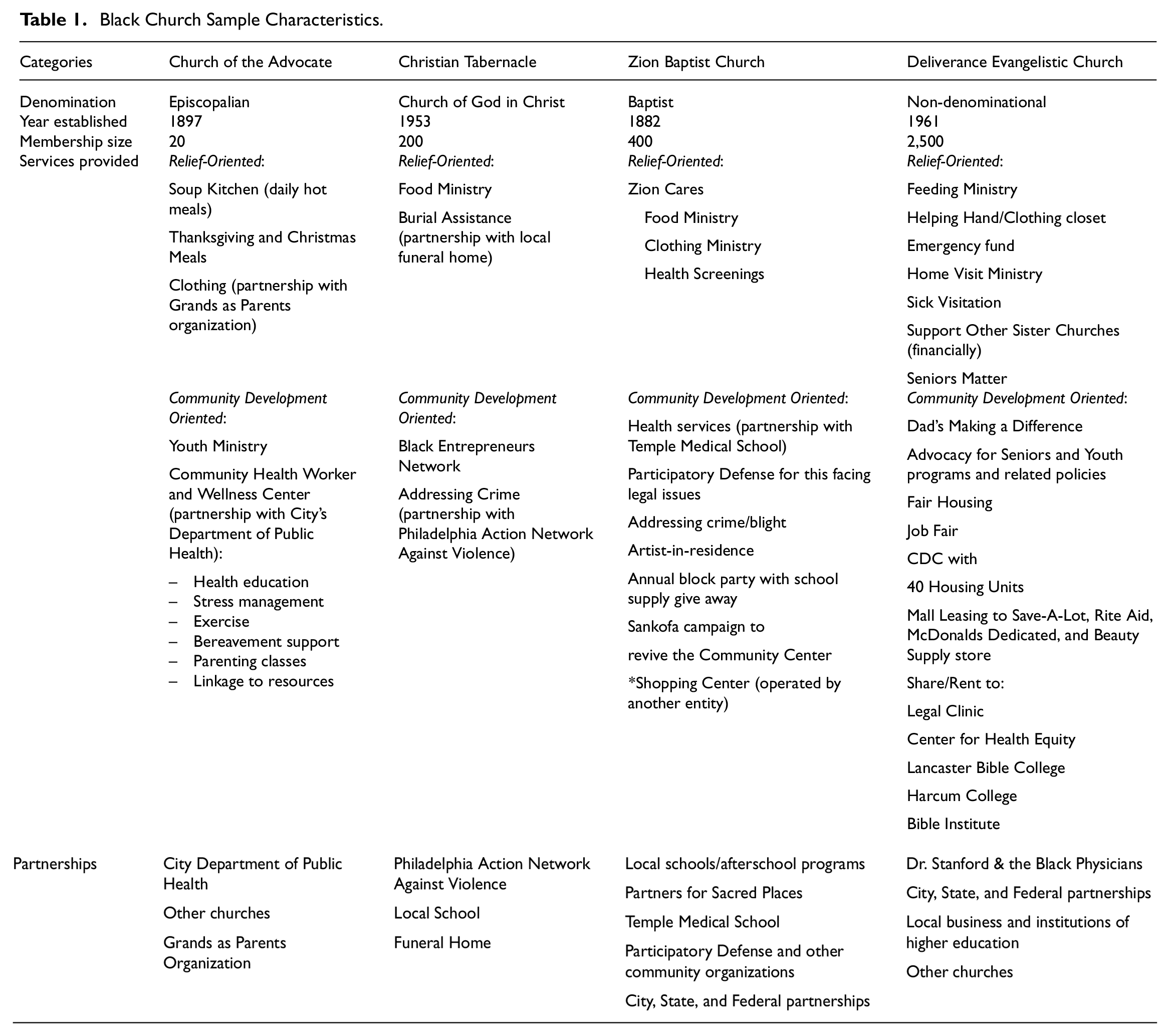
Three of the four churches—Church of the Advocate, Zion, and Deliverance—actively engaged in relief-oriented feeding and clothing ministries for needy families. One example of other relief-oriented services was Christian Tabernacle’s burial funding assistance program that emerged from an urgent need during the pandemic. In addition to relief-oriented programs, all four churches are engaged in community development and improvement ministries. The Church of the Advocate partnered with the Philadelphia Department of Public Health to provide a community health worker who helped individuals coming to their soup kitchen to identify other needed resources. Based on the formal assessment of the Department of Public Health, the church also established a Wellness Center during the pandemic, offering health education, stress management, exercise, bereavement support, and parenting classes. Christian Tabernacle partnered with the Philadelphia Action Network Against Violence to address crime in the neighborhood. This church also started a Black Entrepreneurs Network to provide a platform for those within the church to grow their business. Zion Baptist paused all of its programs during the pandemic. In partnership with several organizations, Zion resumed programming with schools, afterschool programs, the Boy Scouts as well Temple Medical School to meet critical needs once it returned to its in-person worship services. With the infusion of new resources and technical assistance from Partners for Sacred Places and the partnership with the CDC, Called to Serve, Zion is in the initial stages of rehabilitating its old church facility and gymnasium to respond to needs identified from various stakeholders. Finally, the Deliverance Evangelistic church offers a wide range of community ministries. Through the Dads Making a Difference program, Deliverance has provided key ministries such as job fairs, housing, life skills, and job training for low-income fathers. During the pandemic, this church focused on meeting basic needs while also expanding its network to open its facility to the Philadelphia Black Doctors Consortium and later the Dr. Ala Stanford Center for Health Equity in 2021.
Approaches to Ministry Strategic Planning
Four key approaches emerged in terms of how the churches in this study planned for which or what types of ministries to engage in and support: Great leader approach, missional approach, partnership approach, and data driven approach (See Figure 1). The great leader approach and missional approach reflect the calling and theological foundations of the church. The data driven and partnership approaches speak to the importance of identifying both internal and external resources and collaborations for effective ministry. The four approaches are not mutually exclusive, rather churches used a combination of these approaches to different degrees as they determined ministry provision and involvement.
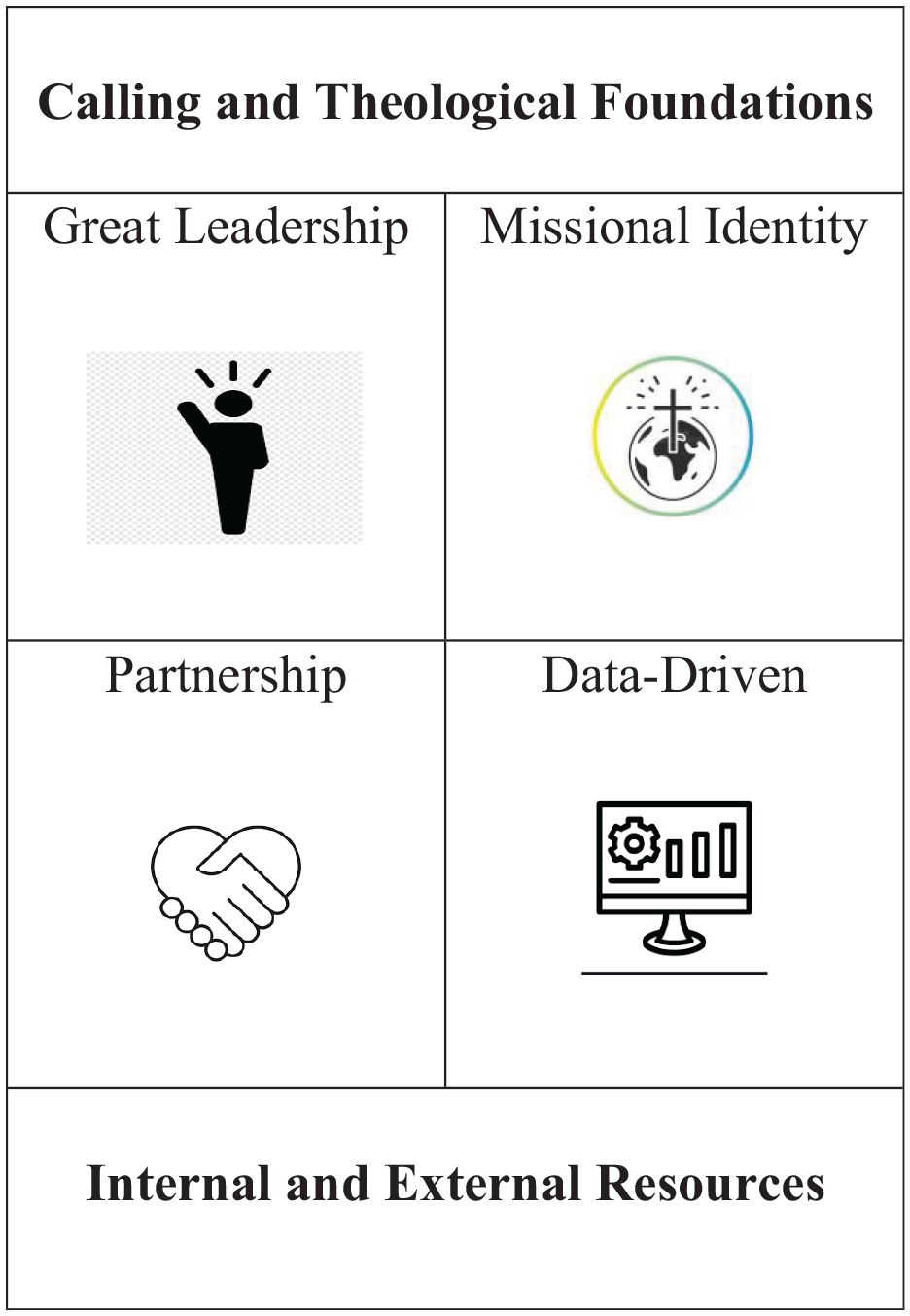
Strategic planning approaches.
Great leader approach
Charismatic pastoral leadership often drives the direction of a church. In some cases, the legacy left by great leaders can not only shape the direction and strategic planning of the church but can also overshadow the leadership goals of those that follow for many decades. Great leaders like Father Paul Washington and Rev. Leon Sullivan are bigger than life. The Black church has a long line of other great leaders—Richard Allen, Absalom Jones, Martin Luther King, Jr., and Pratha Hall Wynn. Great leaders demonstrate qualities such as initiative, strong decision-making, ambition, courage, and possess moral authority as well as humility.
The Church of the Advocate is one church that has continued to walk in the shoes of its most influential and nationally recognized church leader, Father Paul Washington (1962–1987). Father Washington’s ministry distinctively created spaces for those that often found no other place to belong (McKenzie 2014). Washington’s leadership ushered in radical identification with those living in poverty, on the margins, and with oppression. Most notably, the church became a pilot for urban missions and received an annual subsidy from the Diocese of Philadelphia to carry out their ministries. Washington’s leadership promoted the power of community organizing. The imprint of his leadership remains with the church today in the ways it serves the “least of these,” namely through the Advocate Café, the food ministry he established and is reflected in its social justice events as well as the new Wellness Center.
This study found that the Church of the Advocate best reflected the great leader approach to strategic planning. Zion Baptist Church also enjoyed the transformative leadership of Rev. Sullivan (1950–1988). Rev. Sullivan stands out as one of the most innovative, strategic, and influential Black church leaders of the twentieth century (Franklin 2011). From the pulpit to the halls of power, Rev. Sullivan garnered international attention for fighting for equality in the U.S. and South Africa. Under his leadership the church membership grew, and the church organized to develop programs to improve economic and educational opportunities. Deliverance Evangelistic has only had two prominent leaders: Rev. Benjamin Smith and Rev. Glen Spaulding. The community-focused leadership of these notable pastors offers an example for ministers who step into the opportunities for expanded ministry as their church enters a new season in one of the most challenging communities in Philadelphia. Most notably, under the leadership of Rev. Smith, the church dedicated its 165,00 square feet worship complex and educational wing along with its shopping mall to the work of the Lord. Rev. Smith’s strategic plan for education and economic empowerment continues to inform the work of the church through the imposing and functional structure of its facility.
The Christian Tabernacle Church of God in Christ (COGIC) was founded by another phenomenal leader, Bishop R. T. Jones. As a bi-vocational pastor, his leadership extended beyond the church. He served as a manager of the Public Housing Authority and received various awards in this role, as well as other services throughout the city. Under his leadership, the church grew to be a mega-church with several ministries. In part, this might be due to the legacy of Bishop Mason, the founder of the denomination, and the ways his perspective on service to the community informed COGIC ministries. The current pastor, Pastor Barmore, has been greatly influenced by the work of these pioneering COGIC ministers as well as internationally renowned pastor, Rev. Dr. Leon Sullivan.
Missional approach
The missional approach to strategic planning reflects the “missionary” or “sending” nature of God’s activity in the world making the kingdom of God visible. Churches assume a missional approach by going into the world, especially their community embodying both the word and the deed of the life of Christ. The primary purpose is to experience the rebirth of humanity, recreated in the image of God. “It is not so much that God has a mission for his church in the world, but that God has a church for his mission in the world” (Wright 2020:148). With this approach people and purpose are more important than programs or the charisma of the leader.
Zion Baptist Church reflected this approach significantly during the leadership of Rev. Leon Sullivan. This church’s ministries captivated the spirit of the members and called them into ministries that few churches had ever accomplished. Rev. Sullivan is most well-known for ushering in ministries to facilitate social change by leveraging economic resources of the church and its members (Roth 2013). These ministry strategies included the implementation of the “10-36” plan projects that grew to 3,000 members donating $10 for 36 months (Franklin 2011). With the funds raised, Zion completed an apartment building as well as the development of a new million-dollar garden apartment complex and Opportunity Towers I & II. By 1967, the members raised enough funds to break ground for the first African American-owned shopping center, “Progress Plaza” that included a 20-year, million-dollar lease with the A&P grocery store chain. Another distinct economic initiative included selective patronage against companies discriminating in hiring. Zion continues to highlight its spiritual and economic empowerment mission and moral obligation to help the poor, the disenfranchised, and the vulnerable.
The other three churches also have engaged in the missional approach in some ways. The Church of the Advocate has lived by its mission of love expressed by social justice and has extended its reach beyond its members. Though the church membership has dwindled, it has continued to promote acts of love like feeding the hungry, clothing the naked, and serving those in need of jobs, health care, etc. This mission of love for their neighbors has extended to children, youth, adults, and seniors. The foundation for this mission is based on Mark 12:30-31. This call is to prioritize loving God and loving your neighbor. Christian Tabernacle Church of God in Christ has expressed its mission of love for neighbors as a church embedded in the community and relevant to the community. This church has sought to also impact the community by restoring families through the power of the Gospel. A food ministry was first established when the church relocated to meet an obvious need in a community that has lacked a full-service supermarket. The Deliverance Evangelistic Church is another church that has been motivated by God’s love to serve in the same ways Jesus served in the gospels. This church also has equipped other churches to serve their local communities. Rev. Benjamin Smith chose North Philadelphia to be a blessing in a community with many needs. Each of the churches stressed the implementation of ministries that have been designed to care for the physical needs of people across the lifespan, including their health, education, and employment. However, the relief-oriented programs like food pantries and soup kitchens typically evolved from informal strategies with limited planning.
Data-driven approach
Some churches use a data-driven approach, a method of decision making based on data and the insights drawn from available information. All four churches used data to inform their ministry strategies. Their data collection included both informal and formal methods. Conversations with community members and walks around the community were part of the informal data collection methods used by the churches. Christian Tabernacle Church of God in Christ best exemplifies the use of the data-driven approach to strategic planning. This church identified who and how to serve first by walking around the community. Pastor Barmore, the church’s senior pastor, shared a bishop’s encounter with a pastor who invited him several times to his church. When the bishop finally accepted the invitation, he asked that they first walk around the community. As they walked around the community three or four times, the bishop kept track of the responses of the community residents to the church. On their return to the church, the pastor invited the Bishop into the church. The bishop replied, “You might as well close up your church because no one in the community knows who you are.” This pastor understands that an informal strategy like getting to know the community residents during regular community walks is key to crafting a ministry responsive to the needs of their neighbors and local community.
The Church of the Advocate has engaged Community Health workers to actively listen to the community members who have participated in the Advocate Cafe to help the church prioritize and respond to the needs of those impacted by poverty. Prior to the partnership with the City this data was collected more informally by church staff. The Deliverance Evangelistic Church and Zion Baptist Church also have made time to listen to their members and those they serve to establish new ministries and improve existing ones. These listening opportunities have typically been more informal thought conversations with community stakeholders. However, Zion is beginning to take more grassroots approaches to planning with formal town hall meetings, focus groups, and charrettes in its process to relaunch its community center. Leaders at Zion recognize the changing demographics of its local community and that the community has the history and experience to help translate the needs into solutions. The planning of these Black churches continues to build upon their access to consultants and other experts both within the church as well as external experts.
All the churches have also drawn on more formal data to direct their ministry involvement. The Church of the Advocate has benefited from the expertise of the Public Health Department to guide the church into new areas of service and provide support for ministries the church no longer has the capacity to offer alone. Inspired by the legacy of Rev. Sullivan, Christian Tabernacle primarily has used available community-level data from the census and other sources to inform a more formal assessment process and determine who and how to serve through their ministries. The church has also started implementing church surveys to better understand the skills members possess that can be gifts placed in service to various ministries. Zion Baptist has also assessed the church’s financial and social capital when identifying the best ways to meet the community’s needs. This church has also drawn from various data sources to understand current trends as well as assess its ability to secure resources from philanthropic organizations, the government, and other donors through its nonprofit organizations. The Deliverance Evangelistic Church, a mega church, has benefited from a diverse congregation with a wide range of expertise (e.g., law, business, human services, education, and research). Consultancies are a primary way that this church has accessed data, knowledge, and the needed skills to assist them in their strategic planning.
Partnership approach
All the churches have actively relied on partnerships with other churches, community organizations, and the government as they have engaged in ministries. The Deliverance Evangelistic Church has relied extensively on partnerships to extend its reach into the community. For example, the church was designed with spaces for a gym, classrooms, and extra space that could be rented to community partners for programs. Their partners include other churches, businesses that lease their property like Save-A-Lot and McDonald’s, educational institutions like Harcum College, and health institutions like the Dr. Ala Stanford’s Health Equity Center and the Black Physicians Consortium. The church has also expanded its community reach with local, state, and federal government funding and partners.
Other churches have also invested in strategic partnerships to better serve the community. Church of the Advocate has partnered with the City’s Department of Public Health, which has provided a community health worker to assist soup kitchen participants in identifying and assisting the church to establish more sustainable health-related programs. The new health worker has replaced the social work support the small church can no longer include in its annual budget. The Advocate has also partnered with other churches and organizations to provide services to community members across various age groups, especially youth. To engage in advocacy and systematic change, Church of the Advocate is a member of Philadelphia Interfaith Action. Christian Tabernacle has focused on the needs of local school students, neighborhood crime, and Black entrepreneurship through its partnerships. Christian Tabernacle has also met with community partners like schools to assess the needs of students. As mentioned earlier, the church formed a partnership with the Philadelphia Action Network to address crime and build a safer community. Their Black Entrepreneurs Network has sought to build relationships and support church members with their ideas and plans.
Zion Baptist Church capitalizes on its proximity to Temple Medical Center to meet the community’s health needs and draws from the expertise of its members. To advance its ministries, the church is currently undergoing a process to revive its community center. This initiative is led by one of its ministers and benefits from several partnerships initiated to relaunch the church’s community center. Partners for Sacred Places has provided technical assistance along with input from the Temple Medical School and other community members and leaders. Zion also partners with other organizations to address issues of food insecurity, crime, blight, and traffic problems. Zion partners with Participatory Defense to assist community members with legal issues. Zion and the other three churches have been most successful at sustaining programs through public or private partnerships.
Discussion
Black churches in North Philadelphia, have long served as pillars of the community. However, Black churches now face significant shifts in attendance, especially among young people (Pew Research Center 2021). This changing landscape highlights the urgency for churches to be more relevant to those in their pews as well as the broader community. Church leaders in this study affirm that addressing poverty is a biblical and moral obligation. As such, these churches and their ministries address poverty through a combination of relief services, economic empowerment, long-term development programs, and advocacy.
The four Protestant, Black churches in this study have a distinct legacy influenced by biblical mandates, leadership of previous pastors, missional identity, the identified needs of those served, available partnerships, and the skills and passion of members. Church ministries such as food pantries, soup kitchens, and clothing closets are common and reflect the call in Matthew 25 to care for those in need. Specific strategies to identify who and how to provide services to alleviate poverty might be unique to each church and its available resources and partnerships. One church leader noted the difficulty of finding other churches in North Philadelphia committed to serving those facing poverty, highlighting an ongoing challenge in church collaborations.
All four Black churches in this study reported using some type of informal and formal strategic planning to guide their poverty alleviation work. Historically, much of this planning has been led solely by their senior pastors. However, leaders at historic churches like Zion recognize the limitations of this approach and are more actively seeking strategies to plan holistic and sustainable community services. Increasingly, these churches are adopting grassroots and formal strategic planning approaches as well as forging partnerships with organizations like the Public Health Department, Partners for Sacred Places and Community Development Corporations. Partners not only assist with strategic planning, but they also offer other technical assistance such as training, funding, and networks to help churches expand their reach and impact. Black churches in this study are primarily leveraging partnerships to transition from offering short term relief to long term solutions addressing the root causes of poverty.
As a case study highlighting illustrious examples, this research is not generalizable to a broader population or setting. These findings may not fully represent the challenges and barriers faced by other congregations seeking to alleviate poverty and engaging in strategic planning. In addition, these findings may also be influenced by interactions with the participant or the researchers’ biases. Hence, future research is needed to pair additional churches of more typical or struggling cases based in high-poverty neighborhoods (see McRoberts 2003). Ideally, by interviewing more churches in North Philadelphia and using mixed-methods, these illustrious cases are tested against broader trends to provide a more balanced view. Studying churches in high-poverty areas in other regions of the country might bring to light other structural factors (e.g., leadership, funding, policies) that influence how the churches plan and meet the needs of their communities. Ideally, future research could also conduct participatory research that engages most of the churches in a high-poverty neighborhood as well as practitioners, policymakers, and/or community members to get diverse perspectives on strategic planning and what makes these cases successful in their context. Future research could help us best understand how churches meet needs, the partnerships and other inputs needed, and the extent to which these churches more effectively address poverty when using strategic planning. Additional research is also needed to explore how denominational differences, racial/ethnic composition, socio-economic status, and clergy education shape anti-poverty initiatives. In particular, examining strategic planning that includes entrepreneurial approaches, such as workforce development, small business incubation, and cooperatives, could shed light on new paths for breaking the cycle of poverty among individuals and increasing the circulation of resources within a community (Sherman and Yates 2022).
Ultimately, this study emphasizes the essential role of strategic planning in facilitating churches to align their mission, resources, and partnerships to achieve greater impact in high-poverty neighborhoods. Through well-planned collaboration, holistic approaches, and the equipping of local leaders, churches can move from charity-driven models to sustainable community development initiatives for poverty alleviation. As churches continue to adapt to the needs of their local communities, strategic planning will serve as a crucial tool to secure long-term effectiveness.
Footnotes
Acknowledgements
We wish to thank Matthew Manion, the director of Villanova University’s Center for Church Management as well as our mentors for this fellowship—Katie Day, Marti Jewell, David King, Sharon Miller, Scott Thumma, and Charles Zech. We also thank Christina Ware for her research assistance as well as Beth Kilpatrick for editorial support.
Declaration of Conflicting Interests
The author(s) declared no potential conflicts of interest with respect to the research, authorship, and/or publication of this article.
Funding
The author(s) disclosed receipt of the following financial support for the research, authorship, and/or publication of this article: Funded by Villanova University’s Church Management Fellowship.
