







Abstract
While most prior research assumes that if someone attends religious services, they only attend at one place of worship, a handful of studies suggest that some individuals do regularly attend multiple congregations. This paper seeks to answer the following questions: What percentage of U.S. adults who attend religious services attend multiple congregations? What are the socio-demographic and religious characteristics of those who attend multiple congregations and how do they compare to those who only attend one congregation? What are the reasons for attending additional congregations? And, how do the congregational activities of multiple attenders compare to those who only attend one congregation? We examine these research questions using a nationally representative survey of U.S. adults conducted in 2023. Most American adults who attend religious services attend multiple congregations at least occasionally. Comparing those who always attend services at the same congregation to those who attend multiple congregations, we found that they differ in terms of education, marital status, political ideology, sexual identity, religious identity, and overall religious service attendance. This paper provides interesting insights into the religious and socio-demographic profile of U.S. adults who attend multiple congregations.
Introduction
Congregations in the United Sates exist in a religious/spiritual marketplace where individuals can shop around for the best fit to meet their preferences (Bellah et al. 2007; Dougherty and Mulder 2020; Hammond 1992; Roof 1989; Sikkink and Emerson 2020; Stark and Finke 2000; Turner 2004; Twitchell 2007; Wellman, Corcoran, and Stockly 2020; Wolfe 2003). Individuals attending a congregation may visit another congregation to see what it is like and may switch congregations if one better serves their needs (Higgins and Djupe 2022; Sikkink and Emerson 2020). Higgins and Djupe (2022) identified that, in addition to the house of worship they attend, roughly 35 percent of American adults visited another congregation within the past six months. Visiting is considered “congregation shopping.”
Recently, several studies have drawn attention to issues with how social scientists measure religious identities and affiliations—assuming, for instance, that people can only have one religious identity or affiliation or that their religious affiliation is consistent with the congregation they attend (if they attend; Corcoran, Scheitle, and Dabbs 2021; Djupe, Burge, and Garneau 2024). Corcoran et al. (2021) found that some US adults report multiple religious identities and Djupe et al. (2024) found that approximately a fifth of American adults attend religious services at a congregation inconsistent with their reported religious affiliation. Just as individuals may have multiple religious identities or affiliations, they may also attend more than one congregation. Yet, congregational studies tend to assume that individuals only attend one congregation and, if they visit another, it is because they are “shopping” for a new congregation. While this may be due to shopping for a new congregation, as Corcoran et al. (2022:809–810) note, it could be because “individuals may choose to attend more than one congregation in order to have more of their needs met, perhaps the ultimate expression of religious individualism.” Still, nearly all surveys inquiring about congregations allow respondents to only identify one congregation (see the National Survey of Youth and Religion for a notable exception, Smith and Denton 2003).
Congregational membership or attendance is often considered exclusive except when someone is visiting/shopping around for a new congregation. A few studies suggest that this viewpoint may not be accurate. In 2009, Pew found that 35 percent of U.S. adults attended more than one congregation. Using a sample of U.S. megachurch attendees, Corcoran et al. (2022) found that 13 percent of their sample considered the megachurch “their home church” but also attended other congregations. Using interview data collected from attenders of ethnic or Black congregations, two studies reported some participants describing how they regularly attend services at the ethnic or Black church and also attend another church (Corcoran et al. 2022; Kurien 2012). All this research suggests that attending multiple congregations may not be unusual in the United States. Yet, we know very little about individuals who attend multiple congregations. In this research note, we seek to answer the following questions: 1. What percentage of U.S. adults who attend religious services attend multiple congregations? 2. What are the socio-demographic and religious characteristics of those who attend multiple congregations and how do they compare to those who only attend one congregation? 3. What are the reasons for attending additional congregations? 4. How do the congregational activities of multiple attenders compare to those who only attend one congregation? We examine these research questions using a nationally representative survey of U.S. adults conducted in 2023.
Data
We designed an original survey that was fielded using NORC’s AmeriSpeak panel to a representative sample of U.S. adults. Using address-based sample frames and recruiting via telephone, face-to-face methods, and mail, the AmeriSpeak panel is a probability-based sample of more than 35,000 households. More information regarding the technical details of the panel can be found in NORC (2022). Our survey was fielded from November 7, 2023 to December 9, 2023. NORC invited 8,472 individuals to take the survey including an entirely random sample as well as an oversample for those known to report a race or ethnicity other than White. The completion rate was 24.8 percent with a total of 2,103 respondents who completed the survey. The cumulative response rate was 4.2 percent, which handles the panel recruitment rate (21.5%), individual survey completion rate (24.8%), and the panel retention rate (78.9%). NORC statisticians calculated data weights using Current Population Survey population benchmarks to account for both characteristics of the panel and the survey (e.g., oversample).
Measures
Multiple congregational attendance: Respondents were asked “How often do you currently attend religious services?” with the following response choices 1. Never, 2. Less than once a year, 3. About once or twice a year, 4. Several times a year, 5. About once a month, 6. Two or three times a month, 7. Nearly every week, 8. Every week, and 9. Several times a week. Following the Pew Forum on Religion & Public Life (2009), anyone who did not respond with “never” (i.e., anyone who provided a response from 2 to 9) was asked the following question: “Aside from when you’re traveling and special events like weddings and funerals, do you always attend religious services at the same place, mostly attend at one place but occasionally go to different places, or do you go to different places on a regular basis?” with the following response choices: 1. Always attend at the same place, 2. Mostly attend at one place but occasionally go to different places, and 3. Go to different places on a regular basis. Those who responded with 1, were then asked questions related to the one congregation they attend. Those who responded with 2 or 3 (i.e., those who attend multiple congregations) were asked the same or similar questions but for each of up to 3 congregations they attend. They were first asked “how many different places of worship do you attend religious services at, whether occasionally or regularly?” 2, 3, or 4 or more. Next, they were asked to think of the place they attend religious services the most often and then asked a series of questions about that congregation each reminding them “still thinking about the place you attend religious services the most often…” This was then repeated for “second most often,” and, if they indicated they attended 3 or 4 or more congregations, then the “third most often.” Below we present the consistent questions asked across respondents, but to minimize repetition, do not present the lead-in telling multiple attenders to think about the congregation they attend the most often, second most often, or third most often.
Congregational attendance: As noted above, all respondents were asked how often they attend religious services. For those who attend multiple congregations, they were also asked the religious service attendance question for each of up to three congregations they attend the most often. We also converted the ordinal responses into number of weeks attended per year for mean comparisons, which we describe further in the results section.
Congregational tenure: Respondents were asked how long they have been attending religious services at this place of worship—less than 1 year, 1 to 2 years, 3 to 5 years, 6 to 10 years, 11 to 20 years, or more than 20 years. We also converted tenure into number of years by using the mid-point of the intervals with less than 1 year equaling 0.5 years and more than 20 years equaling 20.5 years.
Congregational giving: Respondents were asked “During the last year, approximately how much money did you and other family members in your household contribute to this place of worship?” The response choices were: 1. We do not contribute money to this place, 2. Less than $500, 3. $500 to $999, 4. $1,000 to $1,999, 5. $2,000 to $2,999, 6. $3,000 to $3,999, 7. $4,000 to $4,999, 8. $5,000 to $5,999, 9. $6,000 to $6,999, 10. $7,000 to $7,999, 11. $8,000 to $8,999, 12. $9,000 to $9,999, or 13. $10,000 or more. A response of 1 was converted to 0, a response of 2 to 250, a response of 13 to 10,499.5, and for the rest the midpoints of each range were used.
Congregational volunteering: Respondents were asked about their congregational volunteering with the following question “About how many hours per month do you volunteer at this place of worship?” Response choices were: 0 hours, 1 to 2 hours, 3 to 4 hours, 5 to 10 hours, and 11 or more hours. We also converted congregational volunteering into number of hours per month by using the mid-point values of the intervals with 0 hours remaining 0 and 11 or more becoming 11.5 hours.
Reasons for attending the congregation: The following question was asked of those who only attend one congregation and multiple attenders but, for the multiple attenders, only in regard to the congregation they attend the most often: “Why do you attend this place?” They could then check as many of the following as applied: I like the style of service.; I like the religious leader.; I have family that attend here.; I have friends that attend here.; It is close to where I live.; and My children are involved in groups or activities at this place. Multiple attenders were asked the following question regarding the congregations they attend the second and, if applicable, the third most often: “Why do you attend this [second or third] place in addition to the place you attend most often?” This question was asked separately for the congregation they attend religious services at the second most often and the third most often. They could select any of the following response choices that applied: This place has a different style of service.; This place represents a different religious tradition.; This place has services at a different time of day.; This place has a connection to my race or ethnicity.; I have family that attend this place.; I have friends that attend this place.; I attend this place when traveling.; I attend this place for special events.; This place has more groups or activities for children.; This place has more groups or activities for adults.; This place is closer to my home.
(Non)Religious Identity/ies: We also asked respondents regarding their (non)religious identity or identities, and, following Corcoran et al. (2021), allowed respondents to select all that applied. There were over 20 possible response choices provided including multiple Christian options (Protestant, Catholic, Latter-day Saint [Mormon], Orthodox, Other [please specify], and Nothing Specific), Jewish, Muslim, Hindu, Buddhist, Confucian, Taoist, Shinto, Jain, Sikh, Pagan, Wiccan, Other Religion, Secular humanist, Agnostic, Atheist, and I do not have a religious identity. The last four were combined into a religious none category. Pagan and Wiccan were combined due to small sample sizes. Write-in responses for “Other Religion,” if they could be classified, were re-coded to the applicable category. Due to small sample sizes, Confucian, Taoist, Jain, and Sikh were collapsed into the Other Religion category. We distinguished between evangelical and non-evangelical Protestants using a separate item that asked, “How well do the following terms describe your religious or spiritual identity?” Respondents who identified as Protestant or just Christian who reported that the term “evangelical” described them “very well” or “extremely well” were coded as evangelical Protestant, otherwise, we coded them into non-evangelical Protestant. Respondents who selected more than one religious identity were coded as “Multireligion.”
Socio-demographic variables: Respondents were also asked their age, gender (woman, man, something else), education (less than HS up to post grad study/professional degree), household income, marital status (married, widowed/divorced/separated, and never married), whether they have children under 18 living in their household, their political ideology (very liberal, somewhat liberal, moderate, somewhat conservative, very conservative), US region (Northeast, Midwest, South, and West), and sexual identity (lesbian or gay, straight, bisexual, or something else).
Analysis
All analyses are conducted using Stata/SE version 14.2 and are weighted using the weights provided by NORC statisticians and the svy command. Respondents who reported never attending religious services were not asked questions regarding congregations and are not included in the final analytical sample. After removing cases that have missing data on the measures described above, the overall analytical sample size is 1,346. Some questions were only asked of respondents who reported attending more than 1 congregation, which reduces the sample to 758 for those questions and to 198 for questions only asked of those who reported attending 3 or more congregations. First, we begin by providing univariate statistics for measures asked of the entire sample. Second, we estimate cross-tabulations between socio-demographic/religion variables and type of congregational attender and produce a design-based F-test. Third, for each reason for attending a congregation, we provide percentages for those who always attend at the same place and for the congregations multiple attenders attend the most often, second most often, and third most often. As reasons for attending are binary (no = 0, and yes = 1) with the mean representing the proportion of yes responses, we estimate a t-test for differences in means via the svy function, which allows us to use the weighted data. However, conducting z-tests of differences in proportions using the unweighted data produces consistent results (results not shown).
Fourth, we provide percentages, means, and 95% confidence intervals (CI) for congregational activities (i.e., donation, volunteering, attendance, and tenure) by whether the respondent always attends the same congregation or, for multiple attenders, for each of the congregations they listed as attending the most often. For multiple attenders, we also created a combined measure for each activity to reflect the respondent’s overall participation in that activity. For congregational donation, volunteering, and attendance, we summed across all available values for the congregations they attend the most often, second most often, and third most often and then reported the mean and 95% CI of that sum. For congregational tenure, we computed the mean tenure across each of the reported congregations and then computed the grand mean for multiple attenders (i.e., the mean of their mean tenure) and the 95% CI. As the responses of those who attend multiple congregations are not mutually exclusive (i.e., they were asked the same questions for each congregation they attend up to three), cross-tabulations with a design-based F-test cannot be used to compare across categories. Instead, we estimated adjusted Walt tests to compare the mean values for each variable for those who always attend at the same place to the combined mean values for those who attend multiple places to determine if they statistically differed.
Results
Figure 1 presents congregational attendance type as both a binary variable (i.e., always attends at the same place vs. multiple attenders) and broken down by occasional versus regular multiple attenders. Roughly 46 percent of congregational attenders always attend the same place with 54 percent attending multiple congregations regularly or occasionally. Of multiple attenders, roughly 76 percent of them attend one place but occasionally go to different places and 24 percent of multiple attenders go to different places on a regular basis.
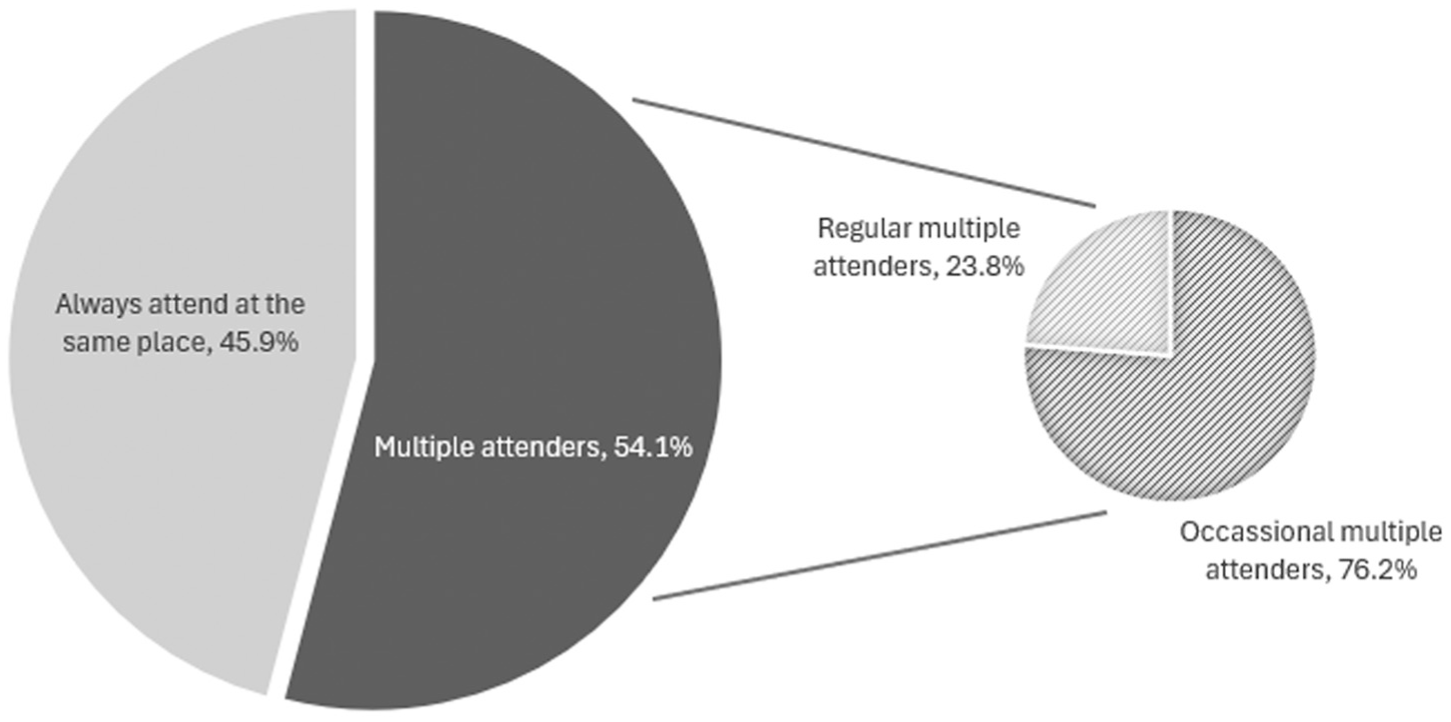
Congregational attendance type, weighted.
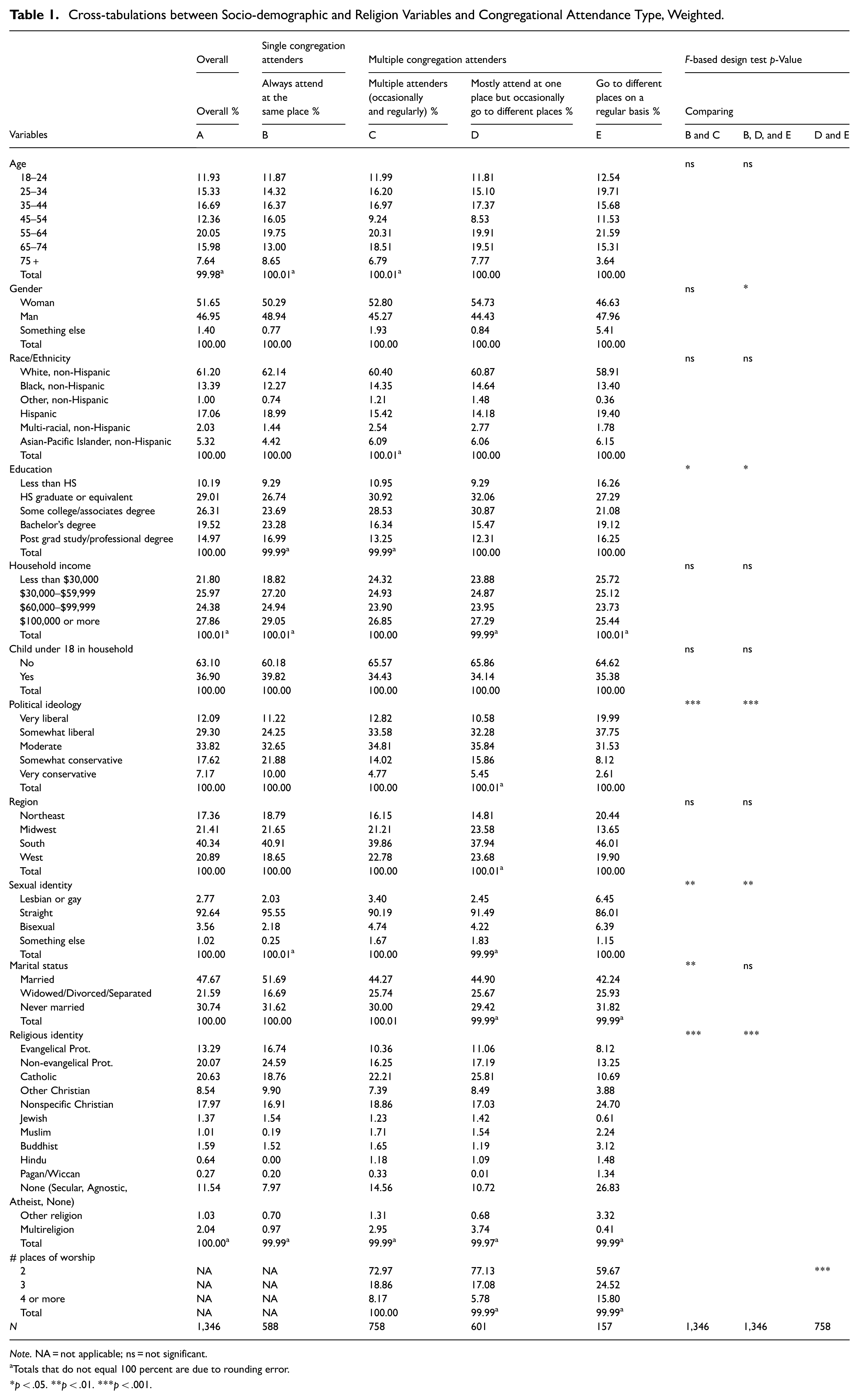
We begin by comparing multiple attenders to those who only attend one congregation by demographics and religious identity. These results are shown in Table 1. This table presents the overall descriptive statistics for each variable (column A), for congregational attendance type as a dichotomous variable (columns B and C), and as a three-category variable breaking down multiple attendance by occasional versus regular multiple attenders (columns B, D, and E). We estimated F-based design tests for both the dichotomous congregational attendance variable and the three-category measure.
Cross-tabulations between Socio-demographic and Religion Variables and Congregational Attendance Type, Weighted.
Note. NA = not applicable; ns = not significant.
Totals that do not equal 100 percent are due to rounding error.
p < .05. **p < .01. ***p < .001.
Descriptively, regular multiple congregational attenders appear to be slightly younger (18–34 range) and are less likely to be over age 75. An F-based design test shows no significant relationship between age categories and congregational attendance type. There are statistically significant gender differences in congregational attendance category for the three-category measure of congregational attendance. Women make up roughly 53 percent of multiple attenders (55% of occasional multiple congregational attenders and 47% of regular multiple attenders) and 50 percent of those who always attend the same place. Although those who report a gender as “something else” make up a small percentage of the overall sample, they make up 5 percent of those who regularly attend multiple congregations.
White, non-Hispanic respondents make up a slightly higher percentage of those who always attend the same place (62%) compared to those who attend multiple congregations (60%), whether occasionally (61%) or regularly (59%) though the overall differences for race/ethnicity are not statistically significant. In terms of education, 16 percent of those who regularly attend multiple congregations have less than a high school degree compared to 9 percent for those who always attend the same place or occasionally attend multiple congregations. About 63 percent of those who occasionally attend multiple congregations are high school graduates or have some college compared to 50 percent of those who always attend the same place and 48 percent of those who regularly attend multiple congregations. There is a statistically significant relationship between education and congregational attendance whether measured as a binary or three-category variable. Those who always attend the same place are more likely to have higher levels of education compared to multiple attenders with 40 percent of the former having a bachelor’s degree or higher compared to only 30 percent of the latter. Marital status is significantly related to the binary measure of congregational attendance. Those who always attend the same place are more likely to be married (52%) and less likely to be widowed/divorced/separated (17%) than multiple attenders (44% and 26% respectively). Political ideology is also significantly related to congregational attendance regardless of how it is measured. Multiple attenders are more likely to be liberal and less likely to be conservative. Fifty-eight percent of regular multiple attenders are very/somewhat liberal compared to thirty-five percent of those who always attend the same place. There are also statistically significant relationships between sexual identity and both measures of congregational attendance. Only 86 percent of regular multiple congregational attenders are straight compared to 95.5 percent of those who always attend the same congregation and 91 percent of those who occasionally attend multiple congregations. There are larger percentages of lesbian or gay and bisexual respondents (6%) among those who regularly attend multiple congregations. There are no statistically significant relationships in congregational attendance by household income, having children under the age of 18 in the household, and region.
In terms of the religion variables, overall, there is a statistically significant relationship between congregational attendance type and religious identity. There are higher percentages of Protestants and other Christians among those who always attend at the same place compared to the other categories, whereas there are higher percentages of Catholics and those who identify with multiple religions among those who occasionally attend multiple congregations. There are higher percentages of Muslims, Buddhists, Hindus, Pagans/Wiccans, Other religions, and nones who regularly attend multiple congregations. It is important to keep in mind that the “nones” in the sample are those who identified attending religious services at some level and thus they do not reflect those who never attend. Multiple attenders were asked the number of places of worship they attend. Overall, approximately 73 percent of multiple attenders attend 2 congregations, 19 percent attend 3, and 8 percent attend 4 or more. Those who regularly attend multiple congregations attend more congregations (3 or 4 or more) compared to those who attend occasionally (77% attend 2 congregations) and this relationship is statistically significant.
Reasons for Attendance
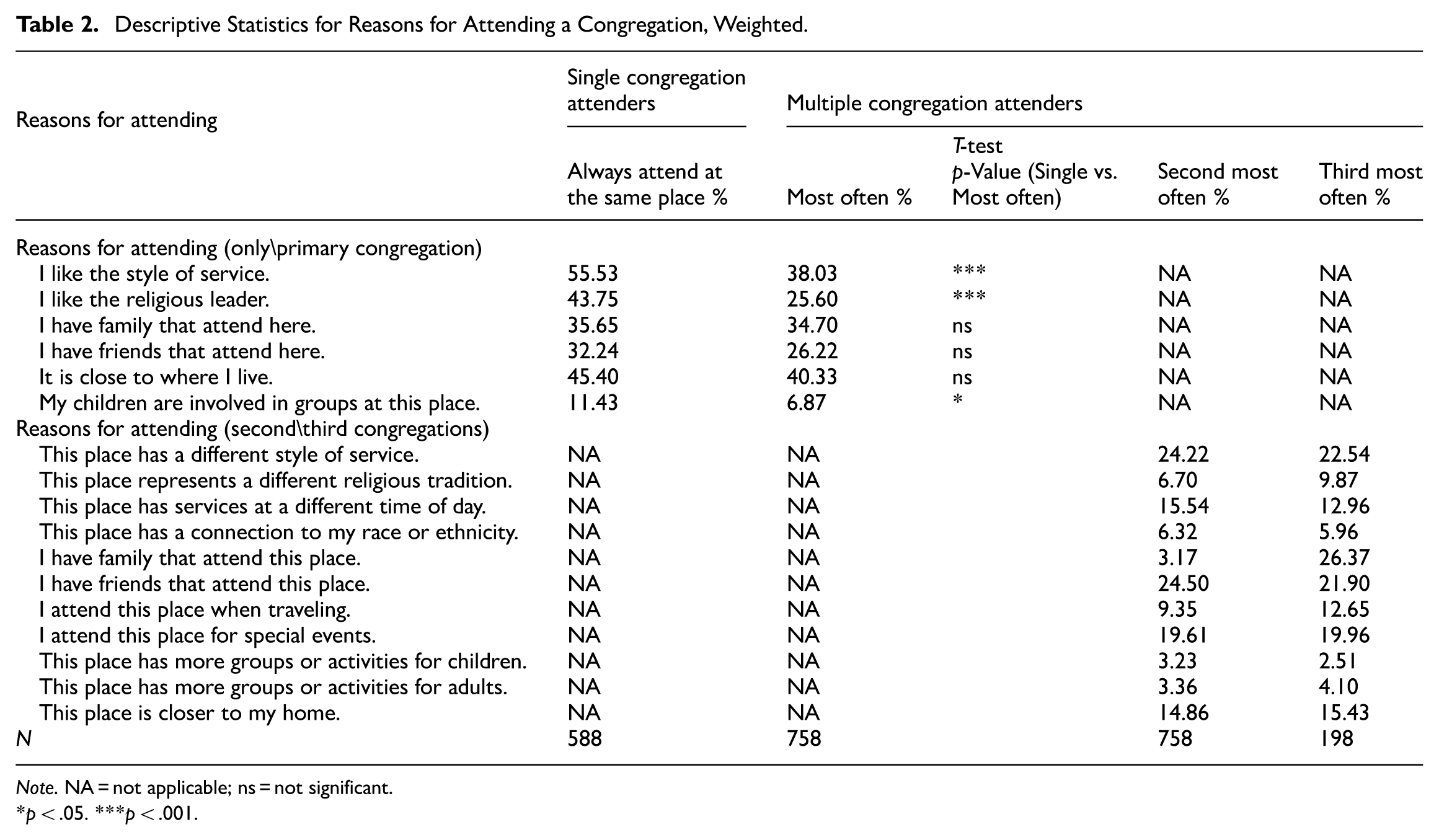
Table 2 presents the reasons for attending a congregation. For those who always attend the same place, the most important reasons for attending are that they like the style of service (55%), it is close to where they live (45%), and they like the religious leader (44%). For those who attend multiple congregations, for the congregation they attend the most often, the most important reason is because it is close to where they live (40%), followed by liking the style of service (38%), and they have family who attend there (34%). We estimated t-tests for mean differences in reasons for attending comparing those who always attend the same place to multiple attenders based on the congregation they attend the most. Those who always attend the same place had significantly higher percentages of reporting their reason for attending as liking the style of the service, the religious leader, and because their children are involved in groups. For those who attend multiple congregations, for their second and third (if applicable) congregation they attend the most often, they were asked the reasons for attending that congregation in addition to the one they attend the most often. For the congregation they attend the second most often, the most important reasons for attending are they have friends that attend (24.5%), it has a different style of service (24.22%), and they attend for special events (20%). For the congregation they attend the third most often, the highest percentages were for having family who attend (26.37%), the congregation having a different style of service (22.5%), and attending for special events (20%).
Descriptive Statistics for Reasons for Attending a Congregation, Weighted.
Note. NA = not applicable; ns = not significant.
p < .05. ***p < .001.
Congregational Tenure, Donation, and Volunteering Patterns
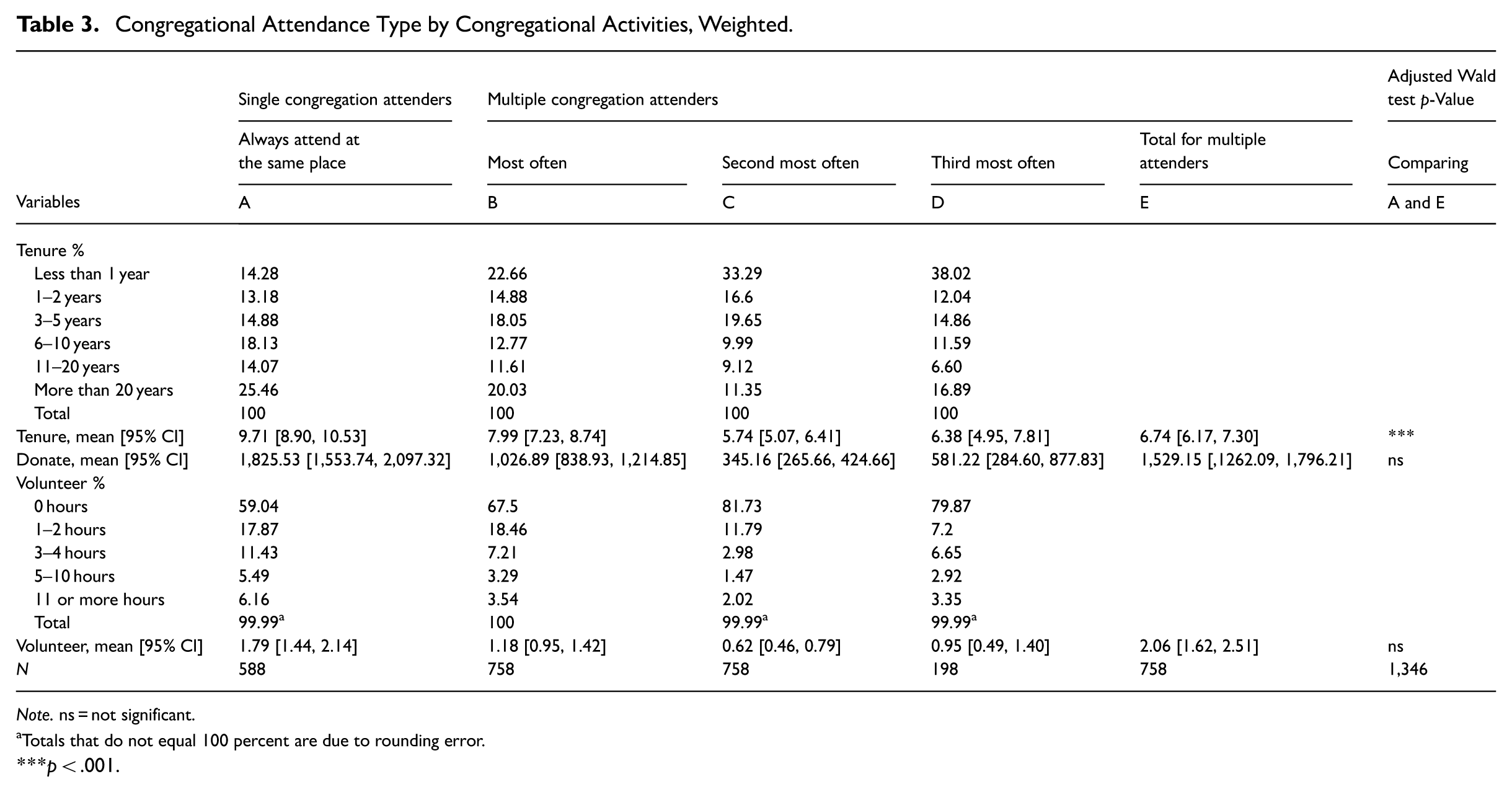
Table 3 presents bivariate statistics for congregational activities by congregational attendance category. Note that the most often, second most often, and third most often are not mutually exclusive categories, so respondents can respond to all three. Those who always attend the same place generally have higher percentages of having been at that congregation for longer compared to multiple attenders regardless of which congregation they are asked about. Using mid-points for congregational tenure, those who always attend at the same place have an average tenure of around 10 years. For multiple attenders, we calculated their mean tenure across the congregations they attend and then took the grand mean of that. The average congregational tenure for multiple attenders is around seven years. An adjusted Wald test shows that the grand mean for multiple attenders significantly differs from the mean for those who always attend at the same place meaning that the latter have a longer tenure at their one congregation than the average tenure of someone who attends multiple congregations.
Congregational Attendance Type by Congregational Activities, Weighted.
Note. ns = not significant.
Totals that do not equal 100 percent are due to rounding error.
p < .001.
In terms of donating time and money to one’s congregation, on average, multiple attenders overall donate similar amounts of time/money to their congregations as those who only attend one congregation; however, for multiple attenders, the time/money is split among the congregations they attend, such that some congregations receive more or less time/money than others. In terms of donating to one’s congregation, the mean amount donated by those who always attend the same place is $1,825, compared to $1,027 for the congregation one attends the most often, $345 for the congregation one attends the second most often, and $581 for the congregation one attends the third most often. Looking at the non-overlapping 95% CIs, those who attend multiple congregations donate to each congregation significantly less than those who always attend at the same place donate to their congregation. Additionally, the amount of money donated to the congregation they attend the second most often is significantly less than the amount they donate to the congregation they attend the most often. If we sum the amount of money multiple congregational attenders donate to their congregations (i.e., their cumulative donation), the mean amount is $1,529, which, while less than the mean amount for those who always attend at the same place, is not statistically different according to an adjusted Wald test. Thus, overall, we cannot say that multiple congregational attenders donate less money to congregations than those who always attend the same place, though they donate less money to each of the congregations they attend.
In terms of volunteering, those who always attend the same place volunteer more for that congregation than multiple attenders do at any of the congregations they attend. Using the quantitative measure of volunteering, those who always attend at the same place and multiple attenders do not significantly differ in the average number of total hours they volunteer for a congregation(s) per month, which is roughly two hours. In terms of multiple attenders, on average, they volunteer for each congregation they attend approximately one hour each month. These 95% CIs do not overlap with the 95% CI for always attending at the same place. This suggests that, overall, multiple attenders do not volunteer less than those who always attend at the same place, however, they do volunteer fewer hours to each congregation they attend compared to those who always attend at the same place.
Religious Service Attendance Patterns
Unlike the congregational tenure, donations, and volunteering variables, we asked an overall religious service attendance question of all respondents as it served as a screener for those who would receive the follow-up question on how many congregations they attend. For those who exclusively attend one congregation, the answer should have been relatively straight forward as they only had one congregation to report on. For those who attend multiple congregations, it is unclear how they would respond to a question asking them for their overall frequency of religious service attendance. We can think of this as akin to asking someone with multiple jobs how many hours they work a week. Do they respond by trying to sum or average the number of hours across jobs? Or do they report the number of hours from the job they work at the most? A priori we do not know what method multiple attenders would use to respond to this question. However, we also asked multiple attenders to report their religious service attendance frequency separately for each of up to three congregations they attend the most frequently. This provides an opportunity to compare how multiple attenders respond when given an exact congregational referent versus the overall religious attendance measure.
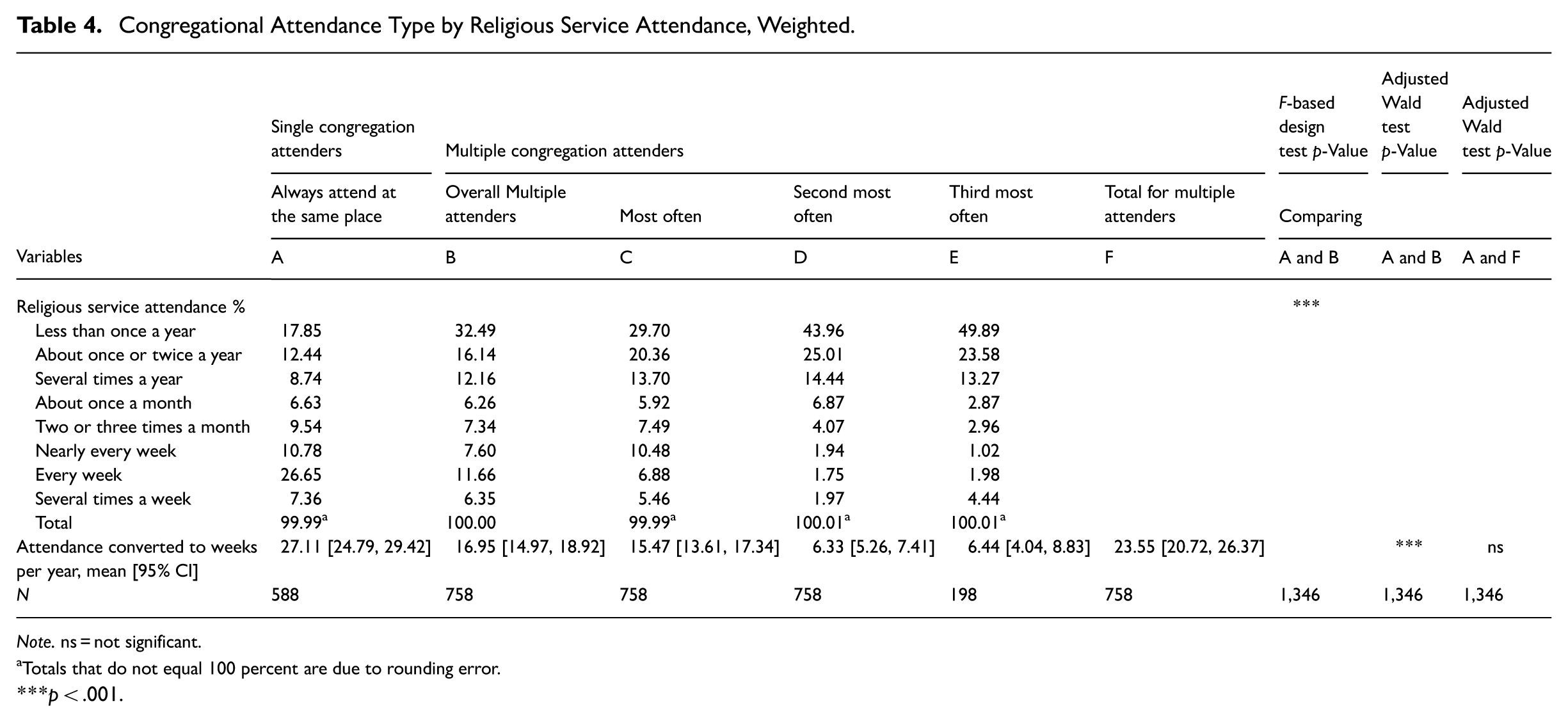
Table 4 presents congregational attendance type by religious service attendance. Columns A and B compare those who always attend at the same place to multiple attenders using the overall religious attendance measure. Those who attend multiple congregations overall report attending less frequently than those who always attend the same place. Thirty-four percent of those who always attend at the same place attend every week or more compared to eighteen percent of multiple attenders. Next, we can compare how multiple attenders report their overall attendance versus how they report their attendance for each of up to three congregations they attend the most frequently. We can see that the frequency they report for the congregation they attend the most often is the closest to what they reported in the overall measure. Overall average religious service attendance for multiple attenders is also significantly and highly correlated with average attendance at the congregation they attend the most often (Pearson’s r: .897, p < .000, results not shown). Additionally, multiple attenders attend their second and third most frequently attended congregations considerably less often than their most frequently attended. For example, about half of multiple attenders say they go to their second and third most-attended congregations less than once per year.
Congregational Attendance Type by Religious Service Attendance, Weighted.
Note. ns = not significant.
Totals that do not equal 100 percent are due to rounding error.
p < .001.
While multiple attenders attend their second and third most often attended congregations less frequently than their most often attended congregations, it is a separate question what their cumulative religious service attendance frequency looks like. To examine this, we need a quantitative measure of religious service attendance. We followed Marcum (1999) and converted attendance into number of weeks per year the respondent attended a congregation: Less than once a year = 0.5 per year; About once or twice a year = 1.5 weeks per year; Several times a year = 6 weeks per year; About once a month = 12 weeks per year; Two or three times a month = 30 weeks per year; Nearly every week = 46 weeks per year; and Every week and Several times a week = 52 weeks per year. Using this measure, the average frequency is 27 for those who always attend the same place (column A) and roughly 17 for multiple attenders based on the overall attendance measure (column B), which represents a statistically significant difference. For multiple attenders, for the congregation they attend the most often it is 15 (column C) and 6 for the congregations they attend the second and third most often (columns D and E). These 95% CIs do not overlap with the 95% CI for mean attendance frequency for those who always attend at the same place. So multiple attenders attend any given congregation less often than those who always attend the same congregation.
To capture how frequently multiple attenders attend religious services across all the congregations they attend, we summed up the frequencies across the congregations they attend and then averaged them. The average cumulative attendance frequency in weeks per year for multiple attenders is 23 weeks per year (column F). On average, the frequency of attendance for multiple attenders is not significantly different from the attendance of those who always attend at the same place based on an adjusted Wald test. The difference between this result and the one comparing overall religious service attendance suggests that the latter measure underestimates the cumulative religious service attendance frequency of multiple attenders.
Discussion and Conclusion
The social scientific study of religion has historically conceptualized attendance as occurring at one congregation (Corcoran et al. 2022) even though some empirical work has indicated that that is not a real reflection of the lived experience of religion in America (Corcoran et al. 2022; Pew Forum on Religion & Public Life 2009; Thumma and Bird 2009). As such, we know little about those who attend multiple congregations. Using new U.S. nationally representative survey data of adults, this study examined those who report attending multiple congregations compared to those who always attend the same congregation. Excluding those who do not attend religious services, data from the Pew Forum on Religion & Public Life (2009) shows that of Americans who attend religious services, 51 percent always attend the same place, 12.5 percent attend different places regularly, and 36.11 percent attend different places occasionally. 1 Using the same survey question, we found 46 percent of Americans who attend religious services always attend the same place, 13 percent attend different places regularly, and 41 percent attend different places occasionally. Thus, in 2009, 48.61 percent of Americans who attend religious services attended multiple congregations, whether occasionally or regularly, which increased to 54 percent in 2023. Most American adults who attend religious services attend multiple congregations at least occasionally. This suggests the importance of describing the profile of multiple attenders and how they compare to those who always attend the same congregation.
Comparing those who always attend services at the same place to those who attend multiple places, we found that they differ in terms of education, marital status, political ideology, sexual identity, religious identity, and overall religious service attendance. Compared to those who only attend one congregation, higher percentages of multiple attenders identify as Catholic or nonspecific Christian, are widowed, divorced, or separated, are politically liberal, have lower levels of education, and report their sexual identity as lesbian, gay, bisexual, or something else. Among those who mostly attend at one congregation but occasionally go to different places, there are higher percentages of women compared to those who always attend at the same place. Most multiple attenders attend two congregations. We also find that the most prevalent reasons for attending a congregation differ depending on whether the respondent always attends at the same place or is a multiple attender. Compared to multiple attenders reporting on the congregation they attend the most, significantly higher percentages of those who always attend the same place report liking the style of service, liking the religious leader, and their children being involved in groups as their reasons for attending the congregation.
In terms of congregational activities, we find that those who attend multiple congregations overall donate, volunteer, and attend congregations at similar average levels as those who always attend the same congregation. This suggests that the average total amount of congregational giving, volunteering, and attending is consistent across attenders whether they attend one or more congregations. However, this means that multiple attenders generally give less time and money to each congregation they attend. In this way, these activities are zero sum—the more time or money someone gives to one congregation, the less they have to give to other congregations (Hill and Vaidyanathan 2011). This is consistent with a study on megachurch multiple attenders that found attending a megachurch and another church was negatively associated with volunteering and giving to the megachurch (Corcoran et al. 2022). From a congregational perspective, variations in membership giving, volunteering, and attendance may reflect differences in attendance exclusivity. While it benefits congregations to have exclusive attenders, it also benefits them to have multiple attenders who may not be willing to exclusively attend but still occasionally or regularly attend and contribute.
Additionally, while some prior research assumed that those who attend multiple congregations are shopping for a new congregation, we found that the average tenure at the second and third most often attended congregation was approximately six years. A sizable minority of multiple attenders reported attending their second (33%) or third (38%) most often attended congregation for less than one year, which could represent shopping. Yet, 11 percent and 17 percent of multiple attenders reported attending their second and third most often attended congregations respectively for more than 20 years. Although multiple attenders, on average, do not participate in the activities of additional congregations to the same extent, it is not necessarily indicative of congregation shopping for all multiple attenders.
This study also highlights potential measurement issues in survey research on religion. Given that most American adults who attend religious services attend multiple congregations, what do they think about when they are asked how much they give or volunteer for their congregation or how frequently they attend it? Do they think about the congregation they attend the most, which becomes their referent congregation? In this case the response would not reflect the entirety of their congregational giving, volunteering, or attendance. Or do they think about their average or total levels of giving, volunteering, or attendance? In that case, it would provide a better reflection of their overall congregational activity, but not necessarily their activity with any given congregation. Because we asked religious service attendance frequency of all respondents and also followed up with the same question for each (up to three) congregations multiple attenders attend, we were able to see how correlated the overall attendance measure was with the specific measures as well as with a total cumulative attendance measure. That is, we were able to compare the way religious service attendance is classically asked in surveys to asking it for each of the congregations attended. When multiple attenders respond to an overall attendance measure, they appear to use the congregation they attend the most often as their referent (r = .897, results not shown). Their total attendance is also highly correlated with the overall attendance measure (r = .82; results not shown) though not as strongly as attendance at the congregation they attend the most often. In this way, overall attendance measures for multiple attenders likely reflect attendance at the most frequently attended congregation and not the other congregations one attends. Future research should identify multiple attenders and ask about congregational activities with a defined referent congregation.
This study is not without limitations. It draws on data from a cross-sectional survey, so we are unable to establish causality. Eight percent of multiple attenders reported attending four or more congregations, but we only asked congregational activity questions for the three congregations they attend the most frequently. Thus, the measures of total tenure, donations, volunteering, and attendance are underestimated for those who attend more than three congregations. While we have measures of reasons for attending multiple congregations, we cannot capture why multiple attenders attend more than one congregation and how that may impact their spiritual life. This would be best achieved through interviews with multiple attenders, which represents a fruitful avenue for future research. Additionally, this study focused on those who attend religious services and cannot provide the responses of congregational leaders. Future research should examine the perspectives of congregational leaders and how they respond to multiple attenders and the potential impacts of multiple attenders on their congregation.
This is one of the first studies to explore the characteristics of multiple attenders, their congregational activities, and reasons for attending different congregations using a nationally representative sample of U.S. adults (see also Pew Forum on Religion & Public Life 2009). This study did not distinguish between in-person and remote service attendance, which represents a fruitful avenue for future research given the rise in congregations that offer remote participation in services (Hartford Institute for Religion Research 2021). Additionally, this study focused on the characteristics and behaviors of multiple attenders not on the congregations they attend. Examining what congregational characteristics are associated with attenders exclusively attending a congregation versus attending multiple congregations would be an interesting area for further research.
Footnotes

Ethical Considerations
The Institutional Review Board at West Virginia University approved the protocol for this study (IRB#2303743645).
Consent to Participate
Prior to participation in the AmeriSpeak Panel, NORC obtains informed consent either orally or electronically.
Funding
The authors disclosed receipt of the following financial support for the research, authorship, and/or publication of this article: This publication was made possible through the support of Grant 62630 from the John Templeton Foundation. The opinions expressed in this publication are those of the author(s) and do not necessarily reflect the views of the John Templeton Foundation.
Declaration of Conflicting Interests
The authors declared no potential conflicts of interest with respect to the research, authorship, and/or publication of this article.
Data Availability Statement
Data will be made available at the end of the grant funding period.