







Abstract
Interacting disturbances involving wildfire, drought, heat extremes, insect outbreaks and wind events are increasingly reshaping ecosystem structure, regeneration and biodiversity. This review synthesises evidence on how climate change alters disturbance regimes, how wildfire interacts with other natural disturbances, and which management responses are most likely to sustain ecosystem resilience. Literature was retrieved from major academic databases and search platforms, screened using explicit eligibility criteria, and synthesised narratively. The review was guided by the Scale for the Assessment of Narrative Review Articles (SANRA). Thirty-seven (37) core studies formed the principal evidence base, supplemented by recent comparative literature used to strengthen interpretation. Across biomes, wildfire–drought interactions emerged as the most consistently documented pathway of resilience decline, commonly reducing regeneration, accelerating vegetation stress and shifting community composition. Interactions with windthrow and insect outbreaks also amplified structural damage and altered fuel conditions, although their effects depended strongly on disturbance sequence, timing and severity. Recent work on megafires, prescribed burning and fire–flammability feedbacks further shows that management cannot rely on single-disturbance assumptions. Instead, resilience depends on maintaining structural and compositional diversity, anticipating cascading effects, and aligning interventions with future climate trajectories. Overall, interacting disturbances research indicates that climate adaptation must move beyond suppression-focused strategies toward context-specific, ecologically informed management.
Keywords
1. Introduction
Natural disturbances such as wildfire, drought, windstorms and insect outbreaks are fundamental components of ecosystem dynamics. They influence nutrient cycling, productivity, successional pathways and the spatial distribution of biodiversity, and many landscapes have historically persisted under disturbance regimes that remained within ecologically tolerable ranges.1,2 Under contemporary climate change, however, those ranges are shifting. Higher temperatures, changing precipitation regimes, increasing vapour-pressure deficit and longer periods of atmospheric dryness are intensifying vegetation stress and modifying the timing, frequency and spatial overlap of natural disturbances.3,4 The result is not only an increase in the magnitude of individual disturbances, but also a rise in the probability that multiple disturbances will occur in close sequence or interact in non-additive ways.
This issue has become central to disturbance ecology because ecosystems rarely experience wildfire in isolation. Drought can weaken plant physiological resistance, reduce regeneration potential and increase the likelihood of insect outbreaks; windstorms can create heavy surface fuel loads and alter stand structure; and insect-induced mortality can change canopy continuity, dead fuel distribution and subsequent fire behaviour.1,5,6 Buma 7 argued that disturbance interactions should be understood not simply as co-occurring events but as linked processes capable of triggering cascading ecological effects. That framing is especially relevant under climate change because the same climatic drivers that elevate wildfire risk also intensify drought, extreme heat, and in some regions biotic attack and wind-related instability.4,5,8
Wildfire occupies a particularly important position within this network of interactions. It is both a disturbance in its own right and a process that can magnify or be magnified by other disturbances. Evidence from boreal forests, dry conifer systems, Mediterranean woodlands, savannas and grasslands shows that wildfire can accelerate recovery failure when it follows drought, redirect successional trajectories after insect or wind disturbance, and reinforce alternative vegetation states when positive fire–flammability feedbacks develop.9,10 Recent biodiversity assessments from the 2019–2020 Australian megafires also demonstrate that megafire impacts are shaped by fire severity, prior fire history, drought context and land tenure, showing that large fire events increasingly need to be interpreted through a compound-disturbance lens. 11
Despite a growing body of literature, the evidence remains fragmented. Many studies focus on one interaction type, one biome or one management intervention, limiting generalisation across ecosystems. Previous syntheses have shown that compound disturbances can alter resilience mechanisms, but they also indicate that sequence, severity and ecological context strongly determine outcomes.7,12,13 There remains a need for a concise narrative synthesis that brings together wildfire-centred interactions, compares findings across major ecosystem types, and evaluates whether the management responses proposed in recent literature are ecologically robust under future climate trajectories.
Accordingly, this review synthesises evidence on climate-driven interactions between wildfire and other natural disturbances and analyses their implications for ecosystem resilience. The review compares the major findings across ecosystems, identifies where the strongest evidence exists, and evaluates management strategies including thinning, prescribed burning, salvage logging, nature-based approaches and resilience-oriented planning. The review is guided by the Scale for the Assessment of Narrative Review Articles (SANRA), 14 with additional transparency derived from PRISMA-informed screening and explicit reporting of the evidence base. 15
2. Review methodology
This review adopted a systematic narrative synthesis design. Literature was searched across Web of Science, Scopus, PubMed, ScienceDirect, Google Scholar and ResearchGate using Boolean combinations of the terms “wildfire”, “natural disturbance”, “drought”, “heatwave”, “windthrow”, “insect outbreak”, “compound disturbance”, “resilience”, “management” and “climate change”. Searches prioritised studies published between 2000 and 2025, although a small number of earlier foundational studies were retained where necessary to frame mechanisms or theory. Screening proceeded through title review, abstract assessment and full-text evaluation.
Eligibility criteria required studies to examine wildfire together with at least one additional disturbance or stressor, such as drought, heat extreme, insect outbreak, wind event or flood, in a way that was ecologically relevant to interaction effects. Studies focused exclusively on single disturbances without analytical discussion of interaction pathways were excluded. Empirical field studies, modelling studies, experimental studies and high-quality reviews were eligible if they contributed directly to understanding ecological outcomes, resilience mechanisms or management implications under climate variability or climate change. Opinion pieces lacking analytical or evidentiary support were excluded.
From the initial search pool, 498 publications were screened in detail and 37 studies formed the core evidence base for narrative synthesis. The final evidence base comprised empirical field studies, modelling studies and review articles spanning boreal forests, Mediterranean ecosystems, dry temperate forests, tallgrass prairie, savannas and Australian forest landscapes. Wildfire appeared in all retained studies, most commonly in combination with drought, followed by insect outbreaks and wind-related disturbances.
The synthesis was guided by two complementary reporting frameworks. PRISMA principles were used to improve transparency in search, screening and evidence selection. 15 SANRA was used to strengthen the justification of the review’s importance, the transparency of the literature search, the quality of referencing, the balance of scientific reasoning and the presentation of relevant data. 14 Because the article is a narrative review rather than a meta-analysis, evidence was interpreted comparatively rather than statistically pooled. Particular attention was given to three analytical themes: first, how climate change reshapes disturbance linkages second, how wildfire interacts with drought, wind and insects to affect resilience, and third, which management strategies appear most credible under interacting disturbances conditions.
3. Climate change is increasing the likelihood of disturbance interactions
Across the reviewed literature, climate change emerges less as a background trend than as a mechanism that reorganises disturbance regimes. Rising temperature, evaporative demand and vapour-pressure deficit reduce fuel moisture, weaken plant water status and increase mortality risk, thereby increasing both flammability and the amount of dead organic material available to burn.4,8 These processes expand the temporal window in which wildfire can occur and also make ecosystems more vulnerable to pre-fire or post-fire stress. This helps explain why interacting disturbances are becoming more ecologically consequential, especially where recovery intervals are shortened (Figure 1). Conceptual synthesis of the pathways through which disturbances interact and ecological responses and resilience-oriented management options.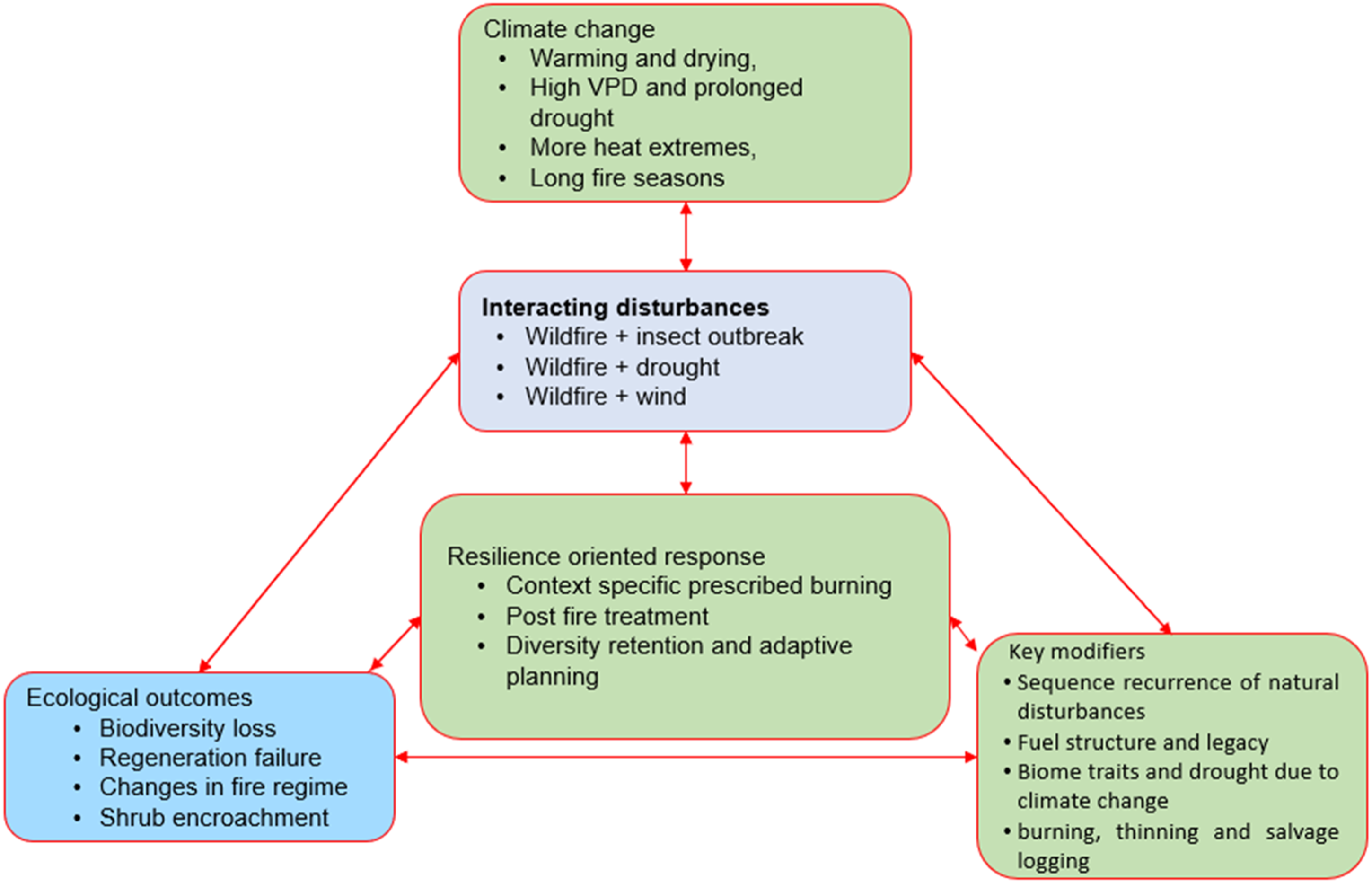
The present synthesis is consistent with Burton et al. 1 and Kleinman et al., 13 who emphasised that disturbance interactions often arise because one event changes the biophysical template on which the next event acts. However, the reviewed studies show that under modern climate warming, the linkage is increasingly driven by a common climatic forcing rather than by disturbance sequence alone. Leonardos et al. 16 similarly argued that contemporary fire risk in parts of Europe must be interpreted through interacting drought, heat and fuel processes rather than through fire weather alone. The implication is that compound disturbance should not be treated as an occasional exception, but as a likely regime feature in many climate-sensitive ecosystems.
Buma’s conceptual analysis 7 is particularly useful in interpreting these findings. He showed that disturbance interactions can become cascading when an initial event modifies fuels, microclimate, demographic structure or biotic resistance in ways that amplify subsequent disturbance. The studies reviewed here support that argument. In practical terms, drought increases stress and mortality, bark beetle attack may redistribute live and dead fuels, windthrow increases coarse woody debris, and subsequent wildfire then acts on a landscape already transformed by previous disturbance. That pathway helps explain why some landscapes now cross resilience thresholds more readily than was historically expected.
4. Wildfire–drought interactions provide the clearest evidence of resilience decline
Wildfire–drought interactions are the most consistently documented disturbance combination in the core evidence base. Whitman et al. 9 showed that short-interval wildfire followed by drought in north-western Canadian boreal forests sharply reduced stem density and severely constrained conifer recruitment, indicating that interacting disturbance can exceed the regenerative capacity of historically dominant species. This study remains one of the strongest empirical demonstrations that compound disturbance can push a forest beyond its resilience threshold. The boreal findings are broadly consistent with McDowell et al., 17 whose synthesis provide multi-scale evidence that global forest vegetation dynamics are undergoing persistent changes that are influenced by the convergence of persistently changing abiotic drivers and disturbance regimes.
Comparable interactions are evident outside boreal systems, although their ecological expression differs. In resprouting Australian forest, Walden et al. 18 found that drought followed by wildfire produced limited immediate canopy collapse but increased the abundance of small stems, implying structural reorganisation rather than outright stand replacement. In tallgrass prairie, Ratajczak et al. 19 showed that extreme heat, drought and wildfire caused strong non-additive vegetation responses, reducing dominant grass cover while increasing forbs cover. Compared with the boreal studies, these grassland and eucalypt examples indicate that resilience erosion does not always appear first as mortality. It may instead appear as altered size structure, reduced dominance of functional groups or early compositional change that foreshadows longer-term transformation. This interpretation is reinforced by Paudel et al., 20 who showed after successive fires in Sierra Nevada mixed-conifer forest that seedling establishment rebounded most strongly in wetter post-fire years, underscoring how post-fire moisture conditions regulate whether recovery proceeds or stalls.
Mediterranean and other water-limited systems further underline the importance of drought timing and recurrence. Batllori et al. 21 showed that cumulative fire and drought effects can shift Mediterranean ecosystems away from tree persistence and toward shrub-dominated states. This interpretation aligns with Kitzberger, 10 who argued that positive fire-flammability feedbacks may create difficult-to-reverse landscape traps when repeated burning maintains a more flammable vegetation state. A complementary spatial simulation by Paudel et al. 22 projected climate-enhanced fire as a driver of reduced forest heterogeneity and increasing conifer-to-shrubland or grassland conversion risk in the Sierra-Cascade region. Taken together, these studies suggest that the greatest resilience risk does not arise from a single severe drought or a single fire alone, but from repeated disturbances that shorten recovery windows and progressively erode the mechanisms needed for regeneration.
The comparison with earlier single-disturbance literature is instructive. Studies focusing only on wildfire severity often infer post-fire risk from fire behaviour metrics alone, whereas the reviewed compound-disturbance studies reveal that identical fire severity can produce different ecological outcomes depending on antecedent drought, recovery interval and climatic stress after burning. This helps explain why generalised recovery expectations are increasingly unreliable under climate change.
5. Wind, insects and wildfire create sequence-dependent outcomes
Interactions involving windthrow and insect outbreaks are more variable than wildfire–drought interactions, but they provide some of the clearest evidence that disturbance sequence matters. Seidl and Rammer 5 demonstrated that climate change can intensify the interactions between wind and bark beetle disturbances in forest landscapes, thereby increasing the probability that structural damage and mortality will later influence fire behaviour. Buma and Wessman 12 similarly showed that disturbance interactions can impair forest resilience mechanisms when one event alters the structural template needed for recovery from the next.
The interaction between bark beetles and wildfire has often been assumed to uniformly increase crown-fire risk, yet the evidence is more nuanced. Simard et al. 23 found that mountain pine beetle outbreaks in lodgepole pine forests may reduce the probability of active crown fire in the short term by thinning canopies, even though they also alter fuel structure. This contrasts with more general assumptions that insect outbreaks always amplify wildfire severity. The discrepancy is important because it cautions against simplistic causal narratives. In some systems, insect-caused mortality may temporarily reduce canopy fire spread; in others, later red-stage or grey-stage conditions may elevate surface or torching potential. Thus, disturbance interaction must be analysed mechanistically rather than inferred from mortality alone.
Summary of the main disturbance interactions and ecological outcomes identified in the synthesis.
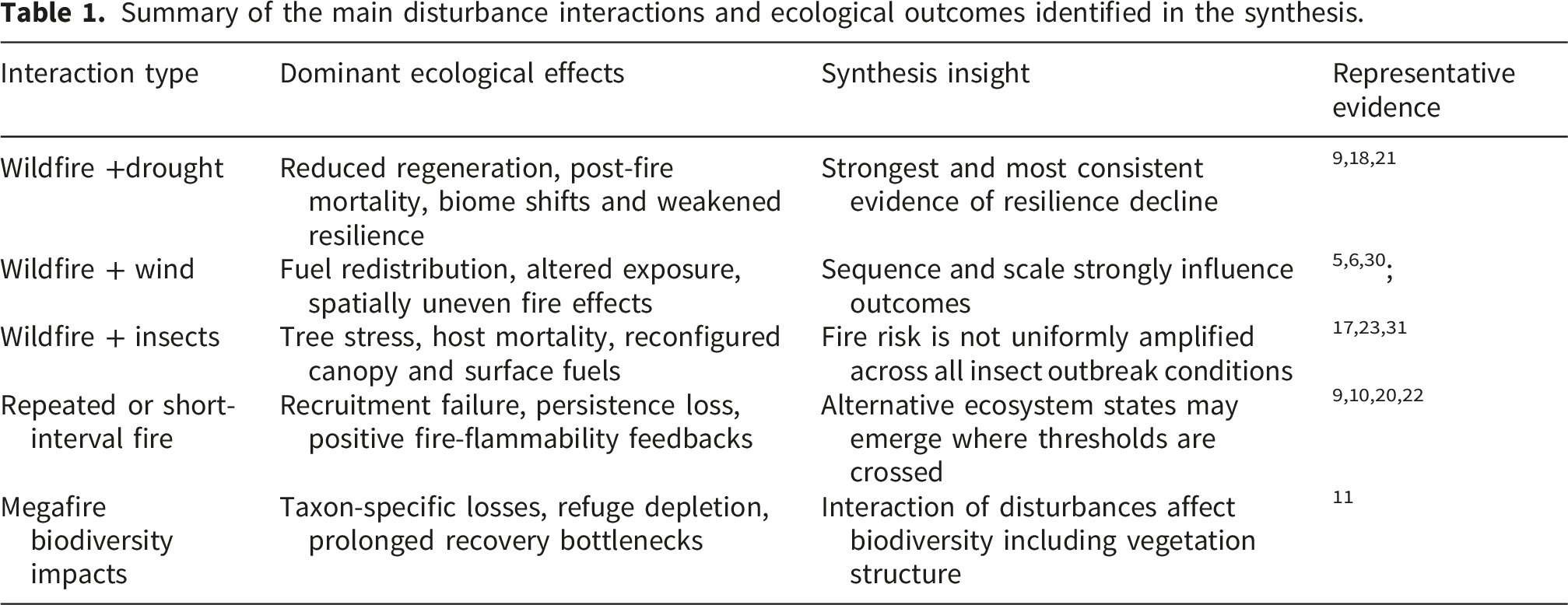
Recent megafire literature extends this sequence-based interpretation from stand dynamics to biodiversity outcomes. Driscoll et al. 11 showed that the effects of 2019–2020 Australian megafires on biodiversity status were strongest in areas with frequent fires, severe burning, and extreme drought conditions, where plants and animals declined or increased depending on the taxa. The findings demonstrate that prior disturbance history modifies the ecological effect of megafire. In other words, large fire events are interpreted as interaction outcomes embedded within broader disturbance histories, not as isolated disasters.
Fire is not merely a disturbance event; rather, it is a fundamental ecological process that interacts with other natural disturbances, including droughts, insect outbreaks, storms, floods, and climate variability. The ecological consequences of fire are closely associated with the characteristics of the prevailing fire regime. 32 Among the key components of a fire regime, fire timing, or seasonality, is particularly important because it determines the environmental conditions under which fires occur and strongly influences subsequent ecological responses. 33 Fires occurring during the dry season may produce ecological outcomes that differ markedly from those occurring during the wet season, even when fire intensity is similar. 34 These differences arise because the ecological effects of fire seasonality are closely linked to the phenological stages of organisms and the prevailing environmental conditions at the time of burning.
The vulnerability of organisms to fire varies throughout the year because biological processes are inherently seasonal. 35 For example, ground-nesting birds, small mammals, reptiles, and amphibians may experience increased mortality when fires coincide with breeding, nesting, or reproductive periods. Likewise, the effects of fire on plant populations depend largely on their developmental stage at the time of burning. 32 Fires occurring during seed dormancy may have relatively limited effects on population persistence, whereas fires during flowering, seed production, or seed maturation can substantially reduce reproductive success and subsequent recruitment. 36 Consequently, fire timing serves as a critical determinant of species survival, regeneration dynamics, community composition, and long-term ecosystem resilience.
6. Management implications: From suppression to resilience-oriented adaptation
The reviewed studies show that no single management strategy is universally effective under interactive disturbance. 37 Instead, resilience-oriented management depends on matching interventions to ecological context, disturbance history and anticipated climate trajectories. 36 In western dry forests, Baker 38 and Baker and Williams 39 proposed bet-hedging strategies that retain structural diversity and reduce dependence on any single regeneration pathway. This approach is reinforced by the current synthesis because diverse stand structure appears repeatedly as a buffer against uncertain sequences of drought, fire and insect attack.
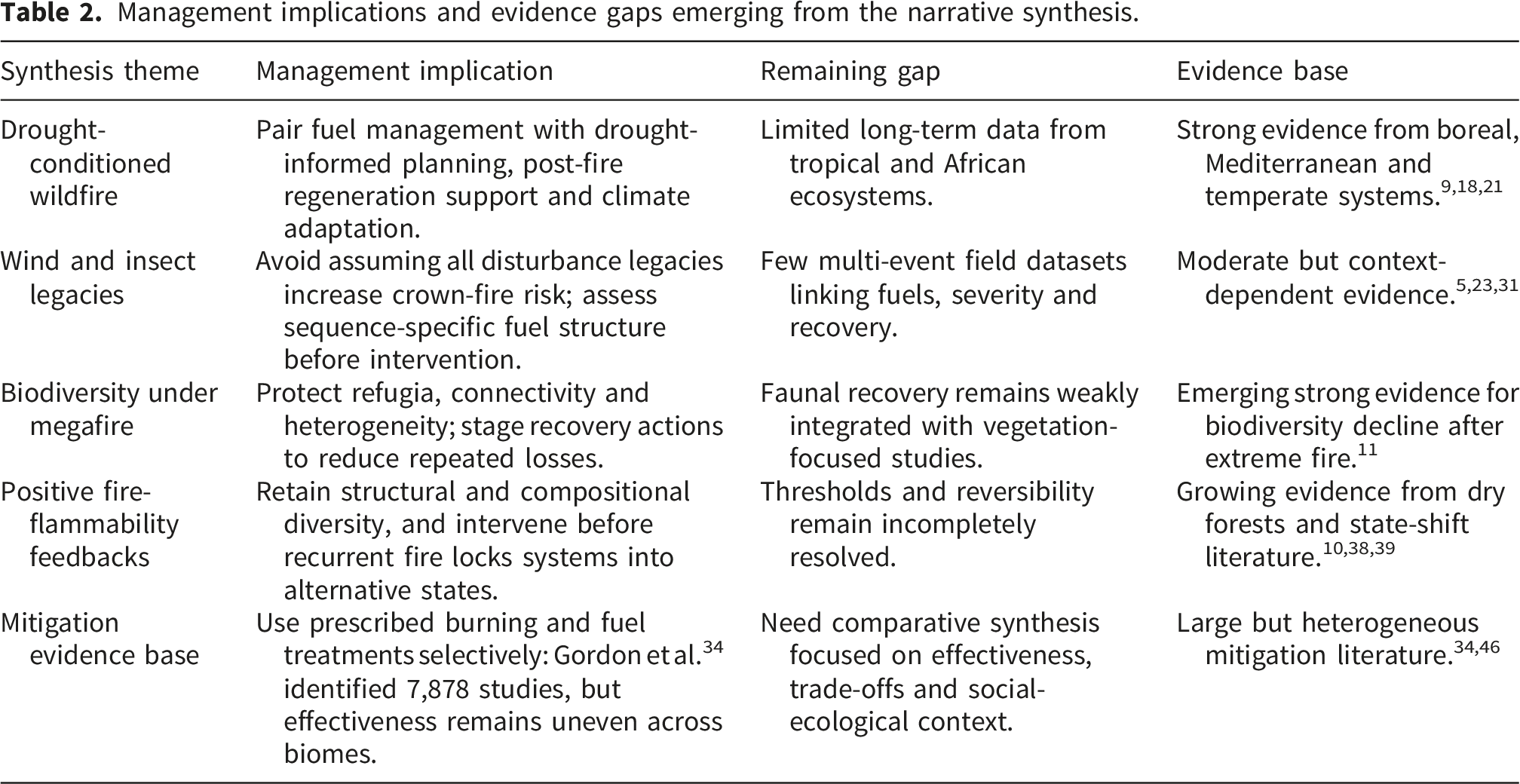
Prescribed burning remains one of the most frequently advocated interventions, yet recent literature also highlights major evidence gaps. Gordon et al. 34 identified 7,878 peer-reviewed studies on prescribed burning alone, but also showed that this literature is geographically biased toward high-income countries and still underrepresents topics such as air pollution, health and wildfire risk management. This matters for the present review because prescribed burning is often promoted as a general solution to wildfire risk, while the empirical basis for its effectiveness across all ecosystems is uneven. 40 Prescribed fire may lower fuel loads and reduce subsequent fire severity in some forests, but its resilience benefits depend on burn frequency, season, treatment scale and how burning interacts with drought and vegetation recovery. 41
Similarly, salvage logging and post-disturbance interventions should not be treated as universally beneficial. The ecological outcomes of such intervention, vary greatly depending on ecosystem type, disturbance severity, climatic conditions, management intensity, and the timing and scale of intervention. 21 Although these practices are often implemented to accelerate recovery, reduce hazards, or restore ecosystem services, scientific evidence demonstrates that they can also produce unintended ecological consequences that may impair long-term ecosystem resilience and recovery. Some studies show that fuel-reducing interventions can lower future fire intensity or aid access and operational safety, but others indicate trade-offs with carbon storage, habitat retention and regeneration potential.31,35 Parajuli et al. 42 further suggest that integrating physical harvesting of dead wood with other fuel treatments can reduce wildfire hazards while improving carbon outcomes, whereas Parajuli and Markwith 43 show that dead wood amount and quality are positively associated with biodiversity across many forest systems. These studies sharpen a key trade-off in compound-disturbance management: removing coarse woody debris may sometimes reduce hazard, but excessive removal can also diminish habitat value and simplify post-disturbance structure. Loudermilk et al. 35 and Repo et al. 44 therefore point to the need to evaluate management through multiple objectives rather than wildfire risk alone. Under compound disturbance, a treatment that reduces immediate fuel hazard may still undermine biodiversity, soil protection or long-term adaptive capacity if it simplifies structure too strongly.
Nature-based and adaptive planning frameworks offer a broader strategic response. Baker et al. 45 argued that working with natural disturbances can, in some settings, function as a climate-adaptive restoration pathway rather than merely a hazard to be suppressed. The RAD framework and related adaptive approaches similarly encourage managers to distinguish where resistance, acceptance or directional transformation is most realistic. 46 These frameworks are useful because they explicitly recognise that some ecosystems may not return to previous states under recurrent compound disturbance. This is especially relevant where positive flammability feedbacks, repeated drought or recovery failure make historical baselines difficult to restore. 47 The core question is not only how to prevent the next wildfire, but how to sustain ecological function when wildfire interacts with drought, insects, wind and heat extremes over time.
7. Major patterns of disturbance interactions, ecological responses and management implications
Effective management plays a critical role in moderating disturbance interactions thereby reducing ecosystem vulnerability, enhancing resilience, and interrupting disturbance feedback mechanisms. For instance, sustainable forest management, controlled grazing, watershed protection, vegetation restoration and thinning overly dense forests, decreases fuel loads and competition for water, thereby lowering both drought stress and wildfire intensity. 32
Long-term datasets capturing repeated interacting events are still scarce, especially outside North America, Europe and Australia, Africa being in particular. This limits confidence in predicting whether altered states are transient, reversible or effectively locked in by feedbacks. The evidence base is also uneven across biomes; grasslands, savannas and tropical systems remain comparatively underrepresented despite their exposure to warming, drought and fire regime change. Finally, much management literature still evaluates treatment effects against single-disturbance metrics, even though the reviewed studies show that resilience depends on interactions among multiple stressors.7,13,34
8. Integrated synthesis, and future research directions
Management implications and evidence gaps emerging from the narrative synthesis.
9. Conclusion
Climate-driven disturbance regimes are increasingly characterised by interaction rather than isolation. The evidence reviewed here shows that wildfire frequently combines with drought, windthrow, insect outbreaks and extreme heat to produce ecological effects that exceed those expected from single disturbances alone. Wildfire and drought interactions provide the clearest and most consistent evidence of resilience decline, but other interaction pathways also alter fuel conditions, regeneration processes, biodiversity outcomes and successional trajectories.48–50
A central insight of the review is that ecosystem response to disturbances depends on sequence, recurrence and context. The same disturbance can have very different ecological consequences depending on antecedent drought, prior fire history, management legacy and the time available for recovery. This helps explain why some landscapes retain resilience while others move toward shrub encroachment, structural instability or alternative fire-prone states.
Approaches that preserve structural and compositional diversity, recognise trade-offs, and align interventions with likely future climate trajectories are more defensible under interacting disturbances regimes. In this sense, enhancing ecological resilience is less about preventing all disturbance than about maintaining the ecological capacity to absorb, reorganise and adapt when disturbances increasingly interact.
Footnotes
Acknowledgement
The authors sincerely acknowledge the support of the Mbeya University of Science and Technology (MUST), particularly the Department of Earth Sciences and the Department of Crop Science and Horticulture, for providing an enabling academic and research environment during the preparation of this review. We are grateful to colleagues who contributed through constructive discussions and insights that helped refine the interpretation of the reviewed literature. The authors appreciate the contributions of researchers whose published work formed the foundation of this review. We acknowledge the help of ChatGPT (free research version of GP (5-2), and Grammarly (free plugin for browsers) for correction of grammar.

Author contributions
Funding
The authors received no financial support for the research, authorship, and/or publication of this article.
Declaration of conflicting interests
The authors declared no potential conflicts of interest with respect to the research, authorship, and/or publication of this article.
Data Availability Statement
This article is a systematic review based exclusively on previously published literature.