






Abstract
Objective
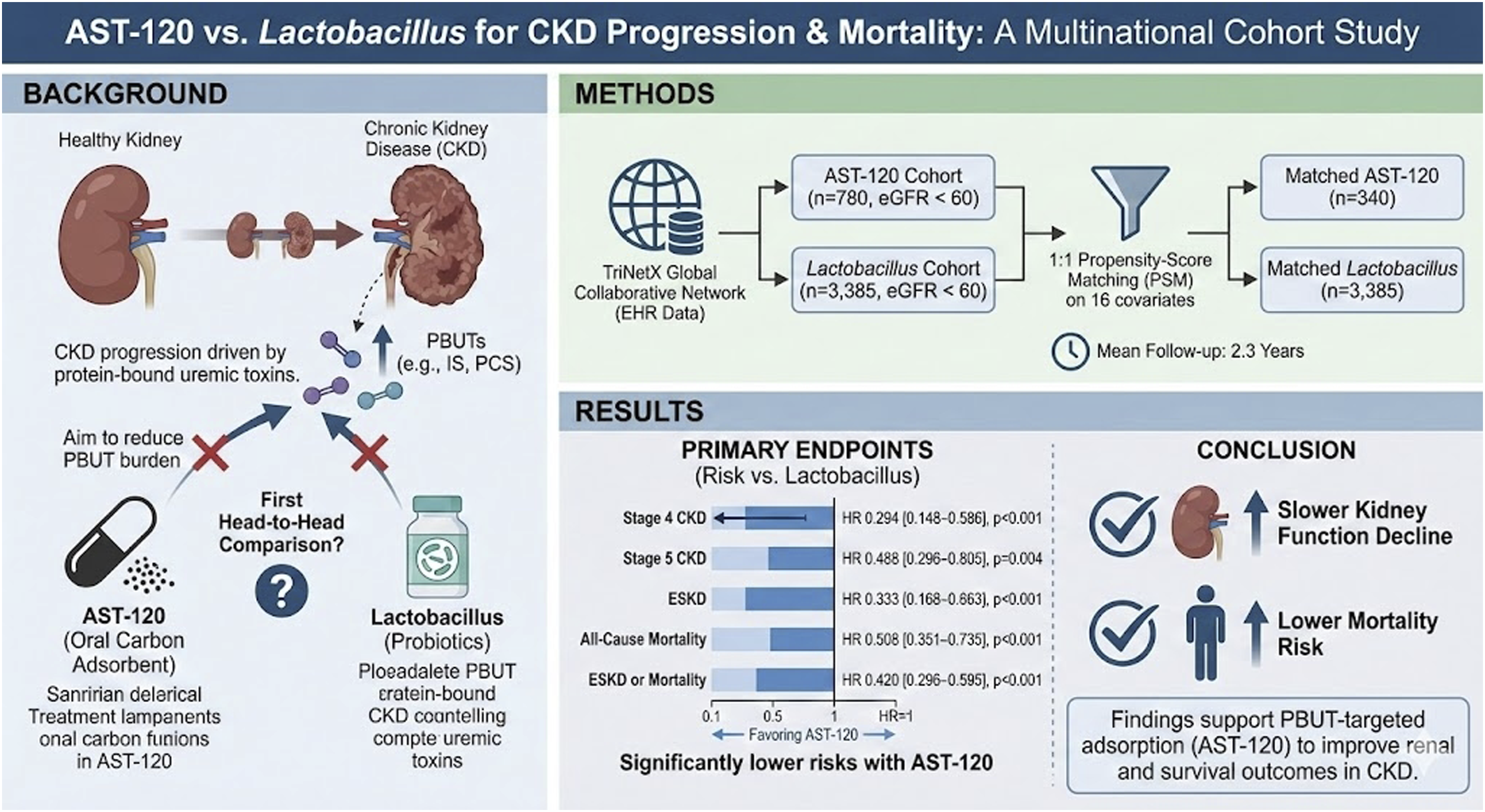
Chronic kidney disease (CKD) progression has been associated with the accumulation of protein-bound uremic toxins (PBUTs), such as indoxyl sulfate and p-cresyl sulfate. AST-120, an oral carbon adsorbent, and probiotics (e.g., Lactobacillus) have been used in clinical practice to modulate PBUT burden, but comparative real-world data on long-term outcomes remain limited.
Methods
We conducted a retrospective, multinational study using de-identified electronic health records from TriNetX Global Collaborative Network. Adult patients (≥18 years) with baseline estimated glomerular filtration rate <60 mL/min/1.73 m2 who received AST-120 or Lactobacillus between January 2001 and July 2025 were identified. After 1:1 propensity score matching on 16 baseline covariates, 340 patients were included in each group. Primary outcomes were progression to stage 4 or 5 CKD, end-stage kidney disease (ESKD), and all-cause mortality. Time-to-event analyses were performed using Cox proportional hazards models.
Results
Over mean follow-up of 2.3 years, AST-120 use was associated with lower risks of progression to stage 4 CKD (HR 0.294; 95% CI 0.148–0.586), stage 5 CKD (HR 0.488; 95% CI 0.296–0.805), ESKD (HR 0.333; 95% CI 0.168–0.663), and all-cause mortality (HR 0.508; 95% CI 0.351–0.735), compared with a probiotic-exposed reference cohort. The composite outcome of ESKD or mortality showed a similar association.
Conclusions
In this propensity score–matched real-world cohort, AST-120 use was associated with more favorable renal and survival outcomes compared with a probiotic-exposed reference population. Given the observational design and potential for residual confounding, these findings should be interpreted as hypothesis-generating.
Keywords
Introduction
Chronic kidney disease (CKD) is defined by abnormalities in kidney structure or function that persist for more than three months and may ultimately progress to kidney failure. In addition to addressing underlying etiologies, current CKD management strategies include the use of angiotensin-converting enzyme inhibitors (ACEIs), 1 angiotensin receptor blockers (ARBs),2,3 and sodium-glucose cotransporter 2 inhibitors (SGLT2is)4,5 to attenuate the decline in renal function, in accordance with the Kidney Disease: Improving Global Outcomes (KDIGO) guidelines. 6 Furthermore, novel agents such as finerenone7,8 and semaglutide 9 have demonstrated renal benefits in patients with diabetic kidney disease. Recently, increasing attention has been directed towards therapies targeting the gut–kidney axis10,11 by lowering protein-bound uremic toxins (PBUTs).12–14 Interventions aimed at modulating this aberrant axis of uremic toxin production and absorption include dietary modification (such as low-protein15 and high-fiber diets 16 ), modulation of the gut microbiota through the use of prebiotics, probiotics,17,18 and synbiotics, adsorption of uremic toxins with agents such as AST-120 (Kremezin), 19 and regulation of renal transporters (e.g., meclofenamate20,21).
Among protein-bound uremic toxins, p-cresyl sulfate (PCS) 22 and indoxyl sulfate (IS) 23 have been most extensively studied for their associations with renal outcomes and cardiovascular mortality. In addition to serving as biomarkers,23,24 both toxins are considered pathogenic factors that directly contribute to renal function deterioration and increased cardiovascular mortality.25,26
AST-120 is an oral carbon adsorbent designed to bind both PCS and IS in the gastrointestinal tract, thereby reducing the systemic burden of these PBUT(14). Several studies have suggested that AST-120 may prolong the time to dialysis initiation.27–31 Landmark clinical trials, including CAP-KD( 32 ), EPPIC( 33 ), and K-STAR( 30 ), have demonstrated that AST-120 can attenuate the decline in estimated glomerular filtration rate (eGFR), predominantly in analyses of secondary endpoints or post hoc subgroups. Consistent with these findings, our previous study also demonstrated that AST-120 use was associated with slower renal function deterioration and reduced all-cause mortality. 34
In recent years, basic science studies have demonstrated that probiotics can modulate gut dysbiosis, leading to reductions in serum PCS and IS. Probiotics have also been shown to reverse gut dysbiosis and ameliorate increased intestinal permeability, often referred to as “leaky gut syndrome”.18,35,36 Recent review articles have highlighted the potential renal benefits of probiotic therapy.37,38 Among various strains, Lactobacillus species have been most frequently reported to be associated with renal benefits.39,40 However, there remains limited clinical evidence from human studies to conclusively demonstrate the renal benefits of probiotics, including Lactobacillus.
Both AST-120 and probiotics, such as Lactobacillus, target (PBUTs). To date, no comparative studies have evaluated the effects of AST-120 versus Lactobacillus on renal function and mortality. In this study, we conducted a multinational, multicenter, propensity score–matched cohort study to investigate the effects of these two PBUT-targeting therapies on renal outcomes and all-cause mortality.
Material and methods
Database of TriNetx
The TriNetX Global Collaborative Network is a federated real-world data (RWD) platform that integrates de-identified electronic health records (EHRs), claims, and other longitudinal clinical data from participating healthcare organizations worldwide. By harmonizing data from diverse sources—such as inpatient and outpatient encounters, laboratory measurements, medication orders, procedures, and diagnostic codes—TriNetX enables robust observational research across broad patient populations. As of 2025, the network encompasses over 200 million patient records spanning North America, Europe, Asia, and Latin America, with representation across all major age groups, disease states, and care settings. As of July 2025, a search of the PubMed database yielded over 1,700 published articles on this topic, highlighting the growing academic and clinical interest in this field.
TriNetX employs a common data model to standardize terminology (e.g., ICD-10, LOINC, RxNorm) and to facilitate seamless cohort identification, patient characterization, and outcome ascertainment. The platform’s analytical suite supports advanced study designs, including cohort discovery, propensity‐score matching, survival analysis, and competing‐risk modeling, all executed behind institutional firewalls to ensure compliance with privacy regulations such as HIPAA, GDPR, and other regional requirements. Data remain on-site at each contributing institution; only aggregated and anonymized summary results are returned to the investigator, thus mitigating the risk of re-identification.
By providing near–real-time access to large, heterogeneous datasets, TriNetX accelerates hypothesis generation, feasibility assessments, and post-marketing surveillance, complementing traditional clinical trials. Its utility has been demonstrated in diverse therapeutic areas—including nephrology, oncology, and infectious diseases—facilitating rapid insights into treatment patterns, safety signals, and comparative effectiveness. While observational by design, studies conducted on TriNetX can employ rigorous methodologies to address confounding and bias, thereby yielding high-quality real-world evidence to inform clinical practice and regulatory decision-making.
Ethics statement
The study utilized a retrospective, observational design, drawing upon de-identified patient records from the TriNetX Research Network. In compliance with institutional and international ethical standards, the Institutional Review Board of Taichung Veterans General Hospital reviewed and approved the protocol (Approval No. CE24589B; approval date: November 25, 2024), and granted a waiver of informed consent due to the use of anonymized data. TriNetX operates under stringent privacy regulations—including HIPAA, GDPR, and equivalent statutes—ensuring that all individual-level information is irreversibly aggregated and anonymized to preclude re-identification. Furthermore, on the basis of these de-identification procedures, the Western Institutional Review Board has determined that studies relying solely on aggregated counts and summary statistics are exempt from full review, thereby permitting the present analysis to proceed under this exemption. This study was conducted in accordance with the ethical principles of the Declaration of Helsinki of 1975, as revised in 2024.
Study design and patient selection
We conducted a retrospective cohort study using de-identified electronic health records from the TriNetX Global Collaborative Network. Patients were identified using predefined inclusion and exclusion criteria, and all eligible individuals meeting study criteria during the study period were included in the analysis. Adults (≥18 years) with a baseline estimated glomerular filtration rate (eGFR) < 60 mL/min/1.73 m2—calculated via the 2021 CKD Epidemiology Collaboration (CKD-EPI) equation (LOINC 98979-8)—were eligible for inclusion. Figure 1(a) outlines the patient‐selection algorithm. In the TriNetX Global Collaborative Network (n = 167, 026, 157), we first identified all adults with at least one prescription for AST-120 (RxNorm: OMOP4700454; n = 5,401) or for any Lactobacillus formulation (RxNorm: 6204, 100272, 6205, 602811, OMOP5051433; n = 1,366,165). To mitigate immortal‐time bias, patients were required to have at least one follow-up encounter within three months of their index prescription (AST-120: n = 2,728; Lactobacillus: n = 903,469). We then selected those with a CKD-EPI eGFR < 60 mL/min/1.73 m2 measured within one year prior to the index date. Patients with a diagnosis of acute kidney injury (AKI) (ICD-10 N17) or end-stage kidney disease (ESKD) (ICD-10 N18.6) in the year before their index prescription were excluded to ensure inclusion of chronic renal dysfunction only. This process yielded 780 AST-120 users and 3,385 Lactobacillus users eligible for propensity‐score matching (PSM). We then conducted 1:1 propensity‐score matching on 16 baseline covariates—age at index (years old), sex, body mass index (kg/m2) (9083), systolic blood pressure (mmHg) (TNX Curated 9085), history of heart failure (ICD-10 I50), ischemic heart disease (ICD-10 I20-I25), hypertensive disease (ICD-10 I10-I1A), diabetes mellitus (ICD-10 E08-E13), long-term nonsteroidal anti-inflammatory drug (NSAID) use (ICD-10 Z79.1), use of NSAID (ATC code M01A), concomitant use of sodium–glucose cotransporter-2 inhibitors (SGLT2i) (ATC code A10BK), angiotensin-converting enzyme inhibitors (ACEi) (VA code CV800), and angiotensin II receptor blockers (ARB) (VA code CV805), baseline eGFR (ml/min/1.732m2) (LOINC 98979-8), glycated hemoglobin (%) (LOINC 4548-4), and urine protein-to-creatinine ratio (UPCR) (mg/mg) (TNX Curated LG34791)—resulting in 340 matched patients per treatment arm for subsequent analyses. The reporting of this retrospective cohort study conforms to the Strengthening the Reporting of Observational Studies in Epidemiology (STROBE) guidelines.
41
Each patient was included only once in the study. The index date was defined as the first eligible prescription during the study period, and repeated prescriptions from the same individual were not considered separate observations. Patient selection and population definition.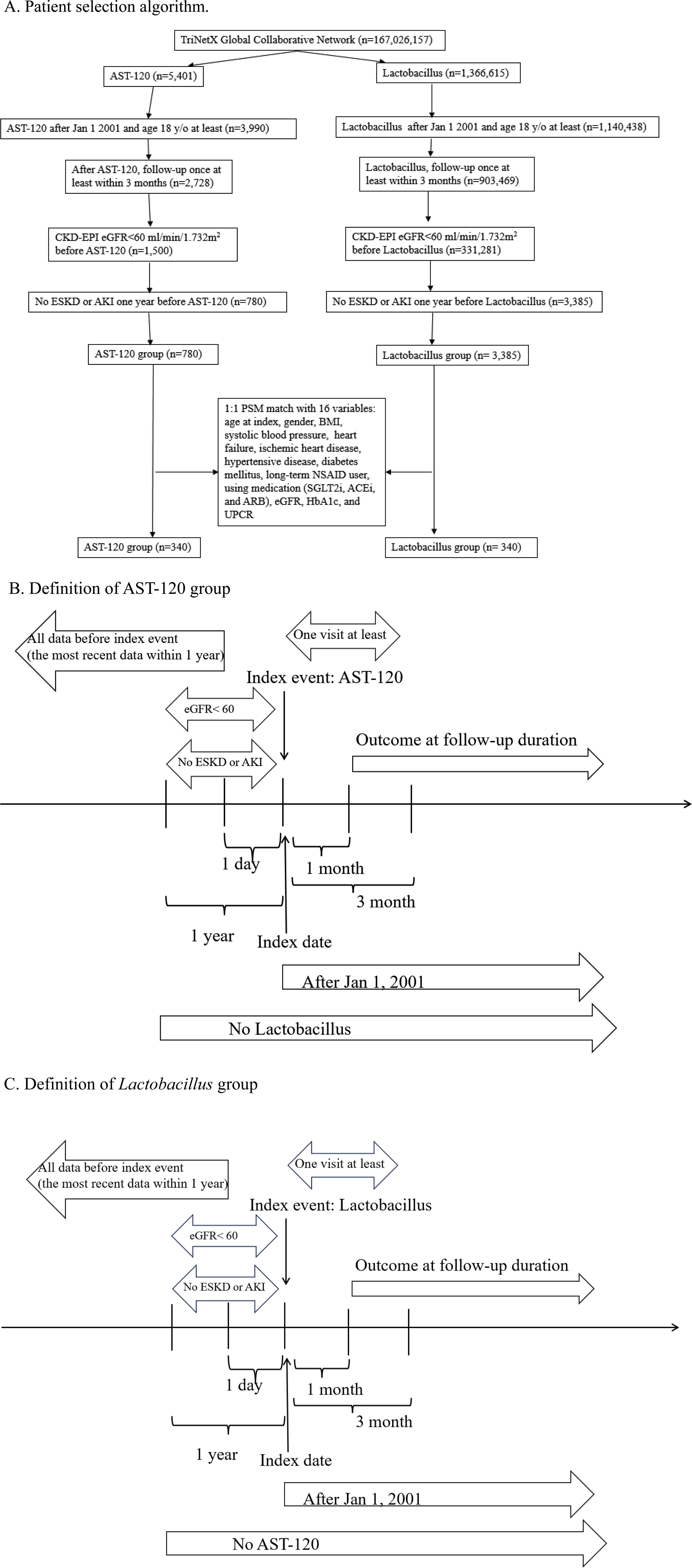
Population definition, baseleine data collection and outcome measurement
Both cohorts are delineated in Figure 1(b) (AST-120) and Figure 1(c) (Lactobacillus). Adult patients were identified by receipt of AST-120 (RxNorm OMOP4700454; n = 5 401) or any Lactobacillus formulation (RxNorm 6204, 100272, 6205, 602811, OMOP5051433; n = 1 366 165) between January 1, 2001, and June 4, 2025, using the TriNetX Global Collaborative Network database. The date of first prescription was defined as the index date. Prior to the index date, all patients were required to have an eGFR < 60 mL/min/1.73 m2 and no recorded diagnosis of AKI (ICD-10 N17) or ESKD (ICD-10 N18.6). AST-120 is commonly administered at a total dose of 6 g/day (typically 2 g three times daily) and is generally prescribed between meals. Lactobacillus exposure included multiple commercially available formulations identified by RxNorm codes, reflecting real-world prescribing patterns. Because formulation composition, bacterial strains, doses, and treatment duration vary across clinical settings, these therapies were analyzed as a heterogeneous probiotic exposure category. Only the first qualifying prescription was used to define the index date, and each treatment episode was included once in the analysis.
Baseline covariates were extracted from the 12-month period preceding the index date, using each patient’s most recent measurements to characterize clinical status at study entry. To minimize reverse causality, outcome follow-up commenced one month after the index date; patients were also required to have at least one follow-up encounter within three months of the index date. The primary endpoints were renal progression—defined as onset of stage 4 CKD (ICD-10 N18.4), stage 5 CKD (ICD-10 N18.5), or ESKD (ICD-10 N18.6)—and all-cause mortality. To preserve cohort purity, the AST-120 group excluded any patient receiving Lactobacillus during the study period, and the Lactobacillus group excluded any patient receiving AST-120. Other time-to-event outcomes were analyzed using Cox proportional hazards models. Because of platform-related limitations within TriNetX, competing-risk analyses could not be implemented uniformly across all outcomes.
Subgrous analysis
We conducted prespecified subgroup analyses stratified by sex (male vs. female) and by age category (young: 18–65 years; older: > 65 years). The study design, including baseline covariates and outcome measures, was identical across all subgroups.
Statistical analyses
PSM was performed at a 1:1 ratio using nearest‐neighbor matching without replacement and a caliper width of 0.1 standard deviations of the logit of the propensity score. Covariate balance was assessed by standardized mean differences (SMD), with SMD < 0.1 denoting adequate balance. Matching was executed via the built‐in TriNetX analytics tool. Continuous variables are presented as mean ± standard deviation (SD) and were compared using Student’s t‐test or Wilcoxon rank‐sum test as appropriate; categorical variables are reported as counts (percentages) and were compared using χ2 or Fisher’s exact tests. Time‐to‐event outcomes were analysed by Kaplan–Meier survival curves with log‐rank tests for group comparison, and Cox proportional hazards models were used to estimate hazard ratios (HR) with 95% confidence intervals (CI). To account for death as a competing risk for end‐stage kidney disease (ESKD), we applied the Fine and Gray subdistribution hazard model. All statistical analyses were conducted in R version 4.2.0 (R Foundation for Statistical Computing, Vienna, Austria), with two‐sided P < 0.05 considered statistically significant.
Results
Baseline characteristics of this cohort before and after matching
Baseline characteristics of study subjects (before and after propensity score matching).
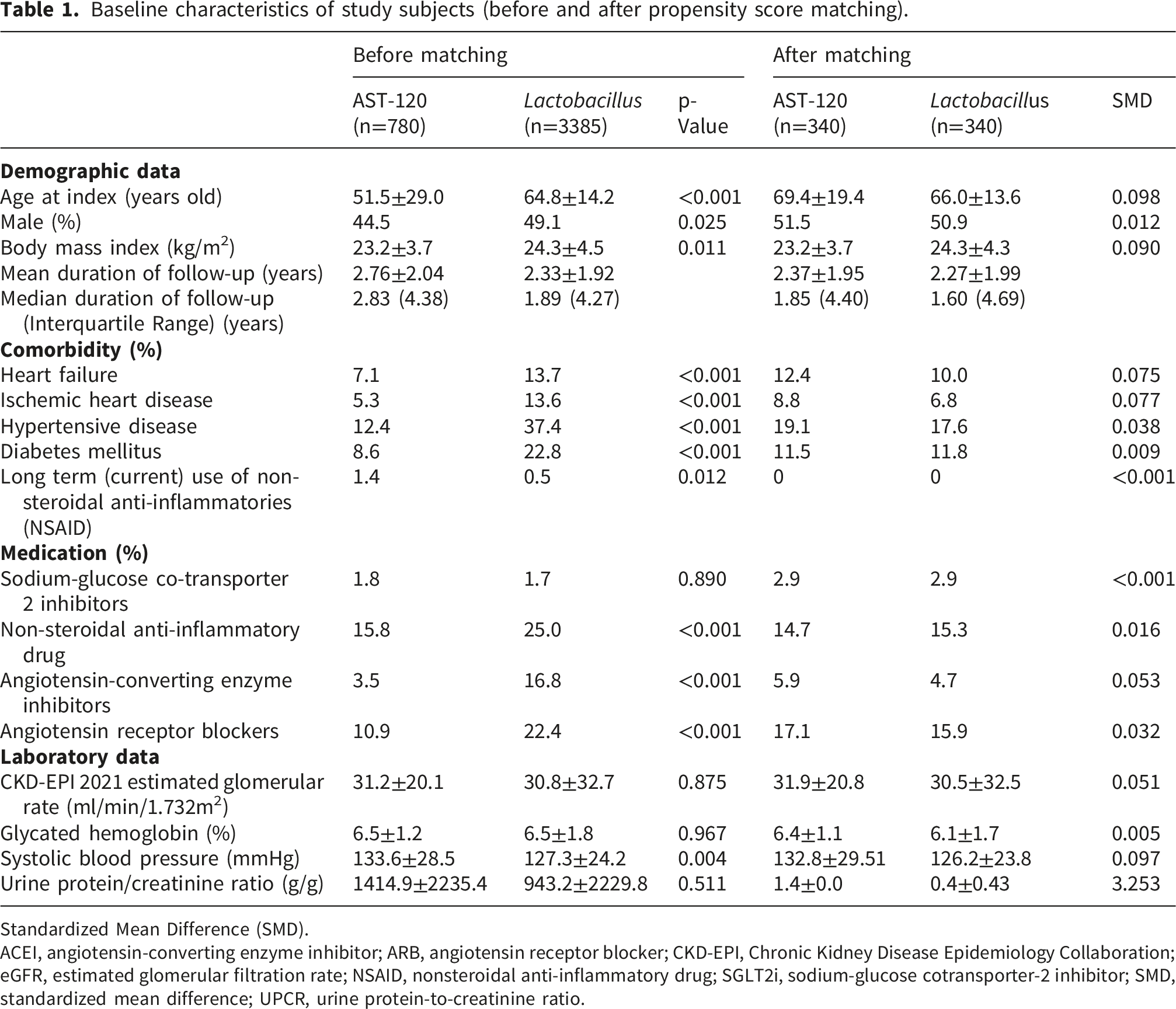
Standardized Mean Difference (SMD).
ACEI, angiotensin-converting enzyme inhibitor; ARB, angiotensin receptor blocker; CKD-EPI, Chronic Kidney Disease Epidemiology Collaboration; eGFR, estimated glomerular filtration rate; NSAID, nonsteroidal anti-inflammatory drug; SGLT2i, sodium-glucose cotransporter-2 inhibitor; SMD, standardized mean difference; UPCR, urine protein-to-creatinine ratio.
In the post-PSM cohort, patients were older (mean age 66.0–69.4 years), had low eGFR (30.5–31.9 mL/min/1.73 m2), and normal SBP (126.2–132.8 mmHg). The prevalence of comorbidities was relatively low, with 12.4–20.0% for heart failure, 6.8–8.8% for ischemic heart disease, 17.6–19.1% for hypertension, and 11.5–11.8% for diabetes mellitus. There were no long-term NSAID users in either group. The use of renal-protective medications was also low, with SGLT2 inhibitors used in 2.9% of patients, ACEi in 4.7–5.9%, and ARB in 15.9–17.1%. The mean duration of follow-up was 2.37 ± 1.95 years in the AST-120 group and 2.27 ± 1.99 years in the Lactobacillus group, respectively.
Annual incidence of renal outcomes in the AST-120 and lactobacillus groups (propensity score–matched cohort analyses)
Incidence of outcomes in the AST-120 and Lactobacillus groups (after propensity score matching) at maximum follow-up duration and at 1-, 2-, 3-, 4-, and 5-year follow-ups.
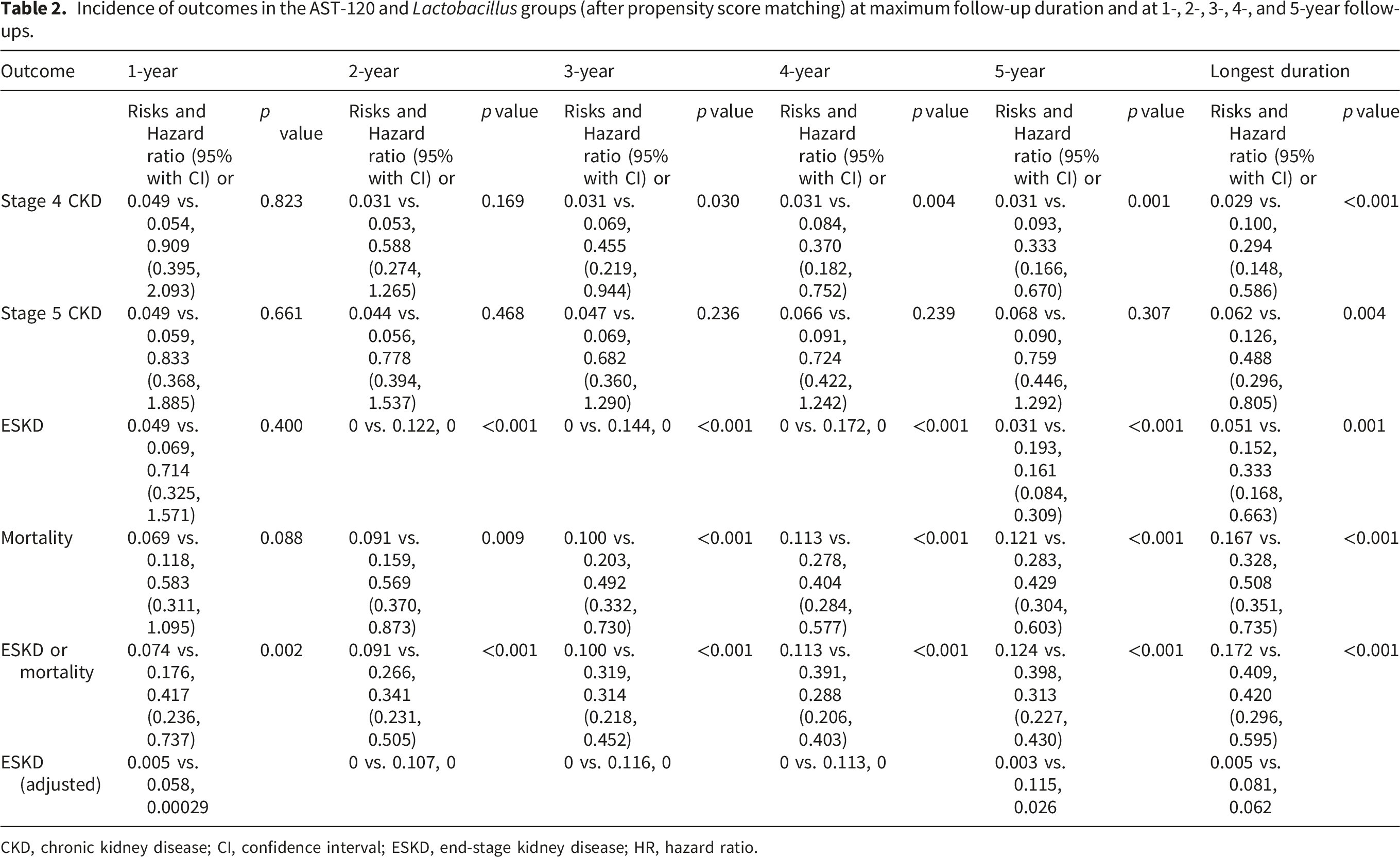
CKD, chronic kidney disease; CI, confidence interval; ESKD, end-stage kidney disease; HR, hazard ratio.
Kaplan–Meier survival curves for renal outcomes in the AST-120 and lactobacillus groups (propensity score–matched cohort analyses)
Kaplan–Meier survival analyses demonstrated significant differences in patient outcomes between the comparison groups. For stage 4 CKD (Figure 2(a)), the survival curves showed a significant separation, with the AST-120 group exhibiting a lower incidence compared to controls (log-rank p<0.001). Similarly, patients in the intervention group had a significantly reduced risk of progressing to stage 5 CKD (log-rank p=0.001) (Figure 2(b)). The risk of ESKD was also significantly lower in the intervention group, as indicated by the Kaplan–Meier estimates (log-rank p<0.001) (Figure 2(c)). Furthermore, all-cause mortality was significantly reduced in the intervention group (log-rank p=0.001) (Figure 2(d)). Analysis of the composite endpoint of ESKD or mortality showed a pronounced and statistically significant benefit for the intervention group (log-rank p<0.001) (Figure 2(e)). Kaplan–Meier analyses of renal and survival outcomes in the propensity score–matched cohort. Outcomes shown represent analyses performed exclusively in the matched population and should not be generalized directly to the unmatched overall cohort. CKD, chronic kidney disease; ESKD, end-stage kidney disease.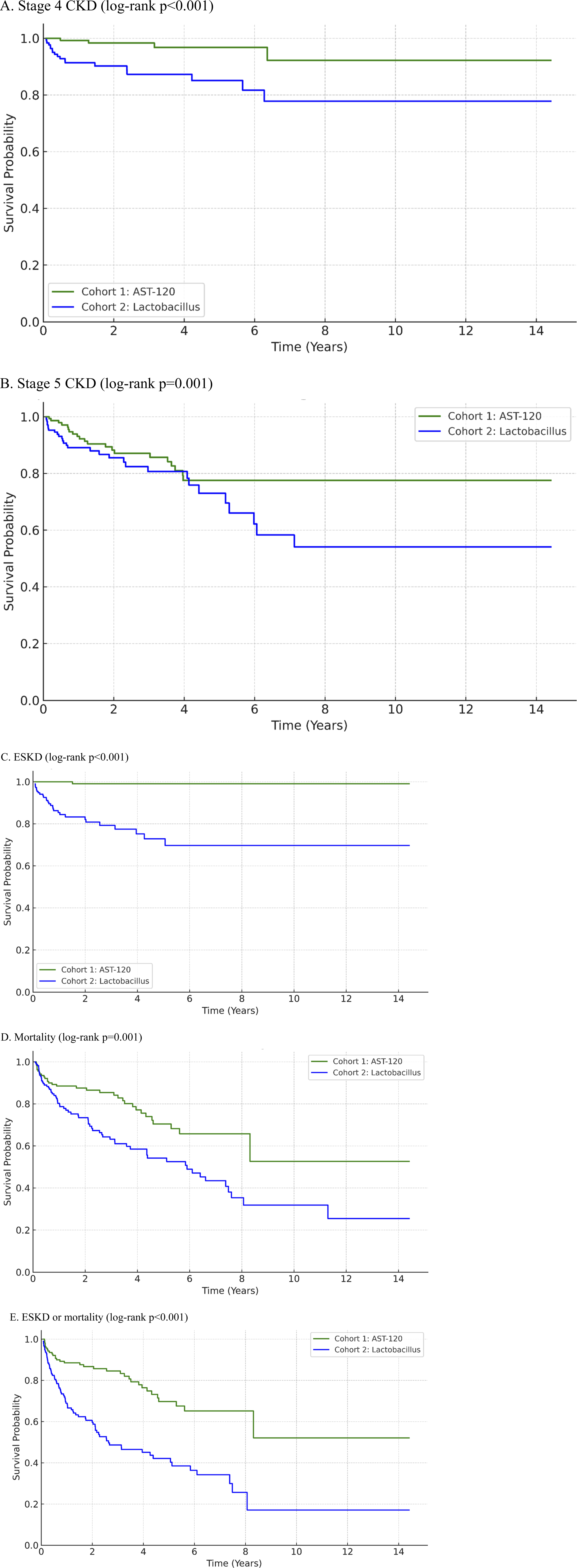
Subgroup analysis between AST-120 and lactobacillus groups according to gender and age (propensity score–matched cohort analyses)
Baseline characteristics before and after PSM for male (n=256), female (n=181), young (n=96), and old (n=337) patients are presented in Supplementary Tables 1, 2, 3, and 4, respectively. Renal outcomes and mortality for all subgroups are summarized in Supplementary Table 5 and Supplementary Figure 3 (Forest plotting).
Subgroup analyses revealed that the AST-120 group demonstrated significantly reduced risks of adverse renal outcomes and mortality across most subgroups. Among male patients, the HR for stage 4 CKD, stage 5 CKD, ESKD, mortality, and the composite outcome of ESKD or mortality were 0.185 (95% CI: 0.095–0.359), 0.493 (0.333–0.728), 0.106 (0.056–0.202), 0.509 (0.337–0.769), and 0.429 (0.296–0.621), respectively (all p < 0.001 except mortality, p = 0.0009). Among female patients, corresponding HRs were 0.345 (0.173–0.687, p = 0.001) for stage 4 CKD, 0.385 (0.191–0.774, p = 0.005) for stage 5 CKD, 0 for ESKD (p < 0.001), 0.545 (0.290–1.026, p = 0.0533) for mortality, and 0.414 (0.228–0.752, p = 0.0021) for the composite outcome.
In the age-based subgroups, patients aged >65 years experienced significant reductions in risk for stage 4 CKD (HR: 0.263, 95% CI: 0.133–0.519, p < 0.001), stage 5 CKD (HR: 0.625, 0.406–0.961, p = 0.030), ESKD (HR: 0.192, 0.099–0.372, p < 0.001), mortality (HR: 0.5, 0.35–0.714, p < 0.001), and the composite outcome (HR: 0.422, 0.303–0.588, p < 0.001). In contrast, possibly because of the limited sample size (n=96), the reduction in risk was not statistically significant among younger patients (18–65 years) for stage 4 CKD (HR: 1, 0.436–2.292, p = 1), stage 5 CKD (HR: 0.833, 0.378–1.836, p = 0.650), mortality (HR: 1, 0.492–2.033, p = 1), and the composite outcome (HR: 0.833, 0.429–1.617, p = 0.5883); however, a significant reduction was observed for ESKD (HR: 0.435, 0.219–0.864, p = 0.013).
Discussion
In the context of chronic kidney disease management, AST-120 has been extensively evaluated in randomized controlled trials, including EPPIC, which did not demonstrate a significant benefit in primary endpoints across broad CKD populations. These findings highlight the complexity and heterogeneity of CKD progression and suggest that the potential role of AST-120 may not be adequately captured by conventional trial designs alone. The present study was not intended to challenge existing randomized evidence, but rather to provide complementary real-world data reflecting routine clinical practice. Using a large multinational cohort from the TriNetX Global Collaborative Network, our analysis offers insight into long-term renal and survival outcomes associated with AST-120 use in a real-world setting, where patient selection, treatment adherence, and prescribing patterns may differ substantially from those in randomized trials.
Several important limitations related to treatment comparison warrant careful consideration. AST-120 and Lactobacillus differ substantially in regulatory status, clinical indication, and prescribing intent. Lactobacillus is not a guideline-recommended therapy for CKD progression and was therefore used as a reference cohort rather than a therapeutically equivalent comparator. Although extensive PSM and competing-risk analyses were applied to mitigate baseline imbalance, residual confounding and confounding by indication cannot be fully excluded. In particular, patients prescribed AST-120 may represent a clinically distinct subgroup characterized by differences in disease severity, closer nephrology follow-up, physician prescribing preferences, or other unmeasured clinical characteristics not fully captured within structured electronic health records. In addition, previous studies 42 evaluating probiotics in CKD populations have used highly heterogeneous treatment durations, commonly ranging from approximately 4–12 weeks and occasionally extending to several months, while an optimal treatment duration remains undefined. Because detailed duration and adherence information were not consistently available in the TriNetX database, duration–response relationships could not be evaluated in the present study. Variability in treatment duration may contribute to heterogeneity in treatment effects and further increase residual confounding. Because substantial baseline imbalance existed before matching, comparative outcome analyses primarily relied on the matched cohort, which represented the principal analytical population for estimating treatment associations. Accordingly, the observed findings should be interpreted as comparative real-world associations reflecting treatment selection and clinical practice patterns rather than definitive evidence of therapeutic superiority.
AST-120 was first approved in Japan in 1991, and as of 2021, a total of 21 full-text clinical studies had evaluated its efficacy, including 15 randomized controlled trials encompassing 3,763 patients. According to a recent network meta-analysis, 43 AST-120 significantly reduced the risk of ESKD (RR = 0.78, 95% CI: 0.62–0.99) and composite renal outcomes (RR = 0.78, 95% CI: 0.63–0.97) in patients receiving tailored-dose therapy compared to those not receiving AST-120. Our previous study in 2024 34 also demonstrated that AST-120 was associated with a reduced risk of ESKD and all-cause mortality. Although serial eGFR trajectories were not consistently available in the current database, previous randomized trials and observational studies have suggested that AST-120 may attenuate the rate of eGFR decline. Therefore, the observed reduction in advanced CKD and ESKD outcomes in our study may be compatible with a slower long-term deterioration of kidney function. Although these findings primarily support potential renoprotective effects, the observed mortality benefits may not be explained solely by kidney-related mechanisms. Beyond renal mechanisms, CKD is increasingly recognized as a cardio-renal disorder characterized by complex interactions among oxidative stress, chronic inflammation, and cardiovascular dysfunction.44,45 Prior studies have demonstrated that inflammatory 46 and oxidative pathways contribute substantially to cardiovascular risk and mortality in CKD populations. Therefore, the observed mortality signal in our study may partially reflect unmeasured cardiovascular and inflammation-mediated risk beyond renal disease progression alone. These findings should be interpreted within a broader cardio-renal continuum rather than a purely kidney-specific framework.
In contrast, several issues remain unresolved regarding the use of probiotics for renal protection. First, most studies utilized mixed probiotic formulations, accounting for approximately 80% of the total. According to a recent review, 42 Lactobacillus and Bifidobacterium were among the most frequently used genera. Lactobacillus-containing formulations were included in 19 studies (73%), while Bifidobacterium-containing formulations appeared in 17 studies (65%). Because many studies used mixed probiotic formulations, these categories were not mutually exclusive and percentages therefore do not sum to 100%. While Lactobacillus has emerged as a potential therapeutic option for patients with CKD, current evidence is largely based on preclinical studies, with limited support from human clinical trials. Second, there is no established consensus on the optimal probiotic dose, with reported doses ranging widely from 1.6 × 10¹⁰ to 2.0 × 10¹² CFU. Third, the appropriate duration of probiotic therapy in CKD patients remains unclear. Lastly, the timing of probiotic administration—whether with meals or postprandially—has not been standardized. One small study (n = 24) 47 suggested that combining probiotics (including Lactobacillus strains) with a low-protein diet may have additional benefits in modulating microbiota-derived and proatherogenic toxins in CKD patients; however, results remain inconclusive, and other studies have reported conflicting findings. 42 In summary, although there is emerging evidence supporting the renoprotective potential of Lactobacillus, the clinical evidence for AST-120 remains more robust and consistent in demonstrating its efficacy in slowing renal function decline. The apparently more consistent evidence supporting AST-120 may partly reflect the relatively homogeneous mechanism of action and more standardized clinical use of AST-120, whereas the probiotic literature encompasses heterogeneous strains, formulations, doses, treatment durations, and study populations. Such heterogeneity may contribute to the variability and inconsistency observed across probiotic studies. From a clinical perspective, our findings should be regarded as hypothesis-generating rather than practice-changing. They underscore the need for future studies aimed at identifying patient subgroups most likely to benefit from AST-120 therapy, as well as for pragmatic or targeted trial designs that better reflect real-world prescribing contexts, particularly in Asian populations where AST-120 remains in clinical use.
There are notable differences between AST-120 and Lactobacillus regarding proposed mechanisms potentially related to renal outcomes. Prior studies have suggested that AST-120 may reduce both p-cresyl sulfate (PCS) and indoxyl sulfate (IS), two major protein-bound uremic toxins (PBUTs). In contrast, studies involving hemodialysis populations suggest that Lactobacillus-based therapies may predominantly reduce PCS levels with relatively limited effects on IS(40). In addition to its adsorptive properties, AST-120 has also been reported to influence gut microbiota composition.48–50 Experimental studies have suggested restoration of reduced Lactobacillus abundance in animal models and improvement of intestinal barrier integrity through modulation of toll-like receptor–related pathways.51,52 AST-120 improved renal function by restoring gut Lactobacillus populations and enhancing intestinal barrier integrity through toll-like receptor pathway modulation, thereby mitigating systemic inflammation and contributing to its renoprotective effects. 51 Third, AST-120 exerts anti-inflammatory effects by lowering serum IS levels, which are known to locally induce superoxide production via activation of the NF-κB signaling pathway and promote oxidative stress.53,54 Moreover, beyond animal studies, AST-120 has been shown to partially restore gut microbiota composition and influence short- and medium-chain fatty acid metabolism, as evidenced by 16S rRNA pyrosequencing and serum metabolomics profiling. 55 However, these biological pathways were not directly assessed in the present study because measurements of PBUTs, inflammatory biomarkers, oxidative stress parameters, and microbiome profiles were unavailable in the TriNetX database. Therefore, these mechanisms should be interpreted as biologically plausible hypotheses inferred from prior experimental and clinical literature rather than direct observations from our analysis. Fourth, combination therapy with AST-120 and Lactobacillus failed to demonstrate additive benefit in animal models, 51 suggesting that their mechanisms of action may overlap. This implies that the therapeutic effect of Lactobacillus may be attenuated when co-administered with AST-120. Overall, while Lactobacillus-based therapies may provide potential renal benefits, interpretation of comparative efficacy should remain cautious.
To our knowledge, this study is the first multinational real-world propensity score–matched analysis comparing AST-120 and Lactobacillus-based probiotic exposure in patients with CKD. Unlike prior randomized trials focused primarily on AST-120 versus placebo, the present study provides complementary evidence reflecting real-world prescribing patterns and treatment pathways. Although causal inference cannot be established, these findings may help identify patient populations for future targeted investigations.
There are several limitations to this study. First, Lactobacillus-based probiotic exposure represented a heterogeneous treatment category encompassing numerous formulations and bacterial strains. In routine clinical practice, probiotic prescriptions vary substantially in strain composition, dosage, duration, and administration patterns across institutions and clinicians. Because these details were not consistently available in the database, the comparator cohort should not be interpreted as a standardized intervention but rather as a real-world treatment exposure category reflecting routine prescribing practices. Accordingly, this study should not be considered a head-to-head efficacy comparison between two standardized therapeutic agents, and residual heterogeneity among probiotic formulations may have introduced unmeasured variability that limits interpretation of the findings. Second, serum PCS, IS, and biomarkers reflecting oxidative stress or inflammatory activity were unavailable, precluding direct evaluation of proposed toxin-related mechanisms. Similarly, gastrointestinal health status and dietary patterns were not consistently captured within the TriNetX database. Conditions such as inflammatory bowel disease, chronic gastrointestinal disorders, restrictive dietary patterns, and differences in nutritional intake may substantially influence gut microbiota composition and generation of uremic toxin precursors. Because these gut-related and inflammatory factors may influence both toxin production and clinical outcomes, residual confounding from unmeasured modifiers cannot be excluded. Third, medication adherence, treatment duration, and detailed dose information could not be consistently assessed. Previous studies evaluating probiotics in CKD populations have reported substantial variability in treatment duration, ranging from several weeks to several months, while an optimal treatment duration remains undefined. Consequently, duration–response relationships could not be evaluated in the present study and may have contributed to heterogeneity in treatment effects. Fourth, serial renal laboratory measurements were not consistently available across all patients; therefore, longitudinal renal function trajectories, including eGFR slope analyses, could not be evaluated. Although renal progression was assessed using clinically meaningful longitudinal outcomes such as progression to advanced CKD stages and ESKD, these outcomes cannot fully substitute for direct serial renal function measurements. Fifth, the number of cases in some subgroup analyses, particularly among males, was limited and may have reduced statistical power. In addition, although most baseline covariates achieved adequate balance after propensity score matching, residual imbalance remained for baseline UPCR. Because proteinuria is a major predictor of CKD progression, residual confounding related to disease severity cannot be completely excluded. The marked residual imbalance in UPCR after matching may be attributable to the substantial missingness and variable availability of UPCR measurements across participating healthcare organizations within the TriNetX network, which may have limited the effectiveness of matching for this variable. Finally, because patient-level linkage across healthcare organizations is unavailable within TriNetX, cross-institutional duplicate registration cannot be entirely excluded and represents an inherent limitation of the database.
Despite these limitations, the directionally consistent associations observed across renal and survival outcomes suggest that AST-120 use may be associated with more favorable clinical trajectories in selected CKD populations. Notably, the magnitude of effect observed in this real-world analysis should be interpreted cautiously. Although extensive adjustment and propensity score matching were performed, observational study designs remain susceptible to residual confounding, selection bias, and possible overestimation of treatment effects. Therefore, effect-size inflation cannot be fully excluded.
Conclusion
In this large real-world cohort, AST-120 use was associated with more favorable renal and survival outcomes compared with a probiotic-exposed reference population. Given the observational design and potential for residual confounding, these findings should be interpreted cautiously and may support future studies aimed at clarifying the role of AST-120 in selected CKD populations.
Supplemental material
Supplemental material - Effectiveness of AST-120 and probiotics (Lactobacillus) on renal function in patients with chronic kidney disease: A retrospective cohort study from the TriNetX global collaborative network
Supplemental material for Effectiveness of AST-120 and probiotics (Lactobacillus) on renal function in patients with chronic kidney disease: A retrospective cohort study from the TriNetX global collaborative network by Chang Chi-Hsien, and Shang-Feng Tsai in Science Progress.
Supplemental material
Supplemental material - Effectiveness of AST-120 and probiotics (Lactobacillus) on renal function in patients with chronic kidney disease: A retrospective cohort study from the TriNetX global collaborative network
Supplemental material for Effectiveness of AST-120 and probiotics (Lactobacillus) on renal function in patients with chronic kidney disease: A retrospective cohort study from the TriNetX global collaborative network by Chang Chi-Hsien, and Shang-Feng Tsai in Science Progress.
Supplemental material
Supplemental material - Effectiveness of AST-120 and probiotics (Lactobacillus) on renal function in patients with chronic kidney disease: A retrospective cohort study from the TriNetX global collaborative network
Supplemental material for Effectiveness of AST-120 and probiotics (Lactobacillus) on renal function in patients with chronic kidney disease: A retrospective cohort study from the TriNetX global collaborative network by Chang Chi-Hsien, and Shang-Feng Tsai in Science Progress.
Footnotes
Acknowledgements
The authors have no additional acknowledgements to declare.

Ethical considerations
This study was approved by the Human Research Review Committee of Taichung Veterans General Hospital (Approval No. CE24589B; approval date: November 25, 2024). All methods were carried out in accordance with relevant guidelines and regulations. Because this retrospective study used de-identified patient data, the requirement for informed consent was waived by the Institutional Review Board.
Author contributions
Chi-Hsien Chang: Conceptualization, Data curation, Investigation, Writing—original draft preparation.
Shang-Feng Tsai: Conceptualization, Methodology, Formal analysis, Supervision, Writing—review and editing.
All authors reviewed and approved the final manuscript.
Funding
The authors disclosed receipt of the following financial support for the research, authorship, and/or publication of this article: This study was supported by grants TCVGH-1140604C, TCVGH-1133603C, and TCVGH-1123603C from Taichung Veterans General Hospital.
Declaration of conflicting interests
The authors declared no potential conflicts of interest with respect to the research, authorship, and/or publication of this article.
Data Availability Statement
The data used in this study are not publicly available due to Institutional Review Board (IRB) regulations. According to the approved ethical protocol, the data are restricted for use solely within the scope of this study and cannot be shared with external individuals or organizations.
Supplemental material
Supplemental material for this article is available online.
References
Supplementary Material
Please find the following supplemental material available below.
For Open Access articles published under a Creative Commons License, all supplemental material carries the same license as the article it is associated with.
For non-Open Access articles published, all supplemental material carries a non-exclusive license, and permission requests for re-use of supplemental material or any part of supplemental material shall be sent directly to the copyright owner as specified in the copyright notice associated with the article.
