







Abstract
Nowadays, the introduction of digital technology improves the condition of the workplace and employees’ productivity, but the unstable behavior of employees is still typical in Internet enterprises in China. Sometimes, employees frequently show their behavior reversals between cooperation and conflict. An integrated analysis method with three steps is performed to explore its reason. First, an evolutionary game model is employed to examine the strategies of individual employee’s behavior selection between cooperation and conflict. Second, the cellular automata are developed to simulate the evolution of employee group behavior selection over time. The frequent behavior turnovers between cooperation and conflict are illustrated. Third, catastrophe theory and method are used to identify the hidden cusp catastrophe patterns under the evolution of group behavior selection. Research results reveal that individual employee selects cooperation if the penalty exceeds half the cost. Simulation results show intense and sudden changes in employee group behavior selection, in which cusp catastrophe patterns exist. The cusp catastrophe model can intuitively interpret the mechanism by which factors, such as average perceived payoff and proportion of cooperation employees, influence the behavior state of the employee group. The mechanism of catastrophe in frequent behavior turnover is explored. This methodology, which is based on the theoretical framework of social exchange theory, integrates evolutionary game theory, simulation, and catastrophe theory to identify the catastrophe mechanism in behavior turnover and make theoretical and practical contributions to behavior selection research.
Keywords
1. Introduction
Introducing digital technology in China creates new modes for macro enterprise operation and micro employee communication. Frequent use of digital technology during work lessens resource consumption, enabling employees to accomplish tasks with better outcomes. 1 These advantages of digital technology facilitate the working process and motivate employees to cooperate. 2 However, digital technology is deforming traditional work engagement and job crafting for employees. 3 These technologies might be so advanced that they might cause anxiety and resistance to employees. 4 Such disadvantages would hinder cooperation and lead to negative consequences, such as insults and conflict. 5 In China, insults and conflicts among employees are still common in enterprises. Investigation Report on the Living Conditions of White-collar Workers in 2020 from Zhilian Recruitment (an online recruitment platform in China with 230 million users) showed that 63.65% of the interviewed white-collar employees claimed to experience insults in the workplace. According to the Investigation Report on the Living Conditions of White-collar Workers in 2020, faced with insult in the workplace, 26.88% of white-collar employees chose to confront the co-workers who insulted them, 6.49% of them would even publicly use social media to break the news. The statistics above indicate that although there are conflicts of interest with the co-workers who insulted them, over one-third of white-collar employees select to solve insults in the workplace by directly confronting the co-workers who insulted them.
Under this circumstance, guiding employees to select cooperation instead of insults or conflicts during their interactions is a highlighted topic for managers in organizations. 6 To provide insight into the cooperation mechanism of employees, we decide to take employee interaction as the basis and apply social exchange theory to interpret the cooperation mechanism of employees. Social exchange theory considers interaction as the joint activity of two or more individuals whose goals are to receive the reward by exchanging behavior that individuals cannot achieve alone. 7 Essentially, the interaction of individuals (in this context, employees) is the behavioral exchange for obtaining both material and non-material rewards, such as money and information. 8 Under the interaction paradigm of social exchange theory, employees benefit from the information service provided by digital technology, while employees expend time and effort as costs in return. 9 Also, digital technology continuously collects workplace data to thoroughly supervise employee behavior, forming a solid basis for employee punishment. 10
Therefore, we know that employee behavior is influenced not only by digital technology but also by the behavior of others with whom they interact, resulting in gaming among employees. For the evolution of individual cooperation and conflict behavior, the game theory is the widely accepted approach. 11 The concise mathematical frameworks describe the relationship between participants (e.g., different types of networks) and the rules of behavior selection participants follow (e.g., social norms). 11 Game theory can also explore the stimulation policy of group collaborative behavior 12 and the mechanism of cooperation behavior evolution under different network scenes. 11 During interactions, most employee conflicts result from irrational impulses related to psychological factors (e.g., emotion brought by digital technology). 13 Therefore, evolutionary game theory based on bounded rationality 14 is proposed to analyze the behavior selection mechanism of employees. Evolutionary game theory assumes that game participants are not entirely rational. 14 Humans and creatures usually trigger behavior selection with irrational intuition when encountering complex issues, 15 such as lack of knowledge and information. 16 As a well-established methodology, evolutionary game theory can discover valuable conclusions in the new research scenario.
However, along with the merits and demerits of digital technology, employee behavior becomes highly unstable and changes drastically, hindering cooperation and triggering group conflict. 17 The workplace environment relates to the arriving task for employees, while the work condition is the tool or the technology they use to complete the task. All of them are in the changing state. 18 Employees adapt to the changing environment and deform work engagement and job crafting. 3 Meanwhile, employees have different traits. Some have an unselfish preference to cooperate with co-workers, 19 and some have irrational thoughts or beliefs, e.g., dysfunctional myths. 16 The above situation is a typical complex human behavior system with a comprehensive effect of various psychological factors. No traditional approach can study it 19 since the total impact of all psychological factors may lead to a group with discontinuous behavior. Thus, the equilibrium of group behavior selection is fleeting and divergent. Such individual phenomena may affect the employee group from the bottom-up and increase the risk of accidents. Reversals and sudden behavior changes during employee interaction are becoming more common in labor- and technology-intensive enterprises. The labor-intensive factory of Luxshare makes extensive use of cheap labor to engage in assembly lines, in which ordinary workers are constantly under intensive supervision and great stress, and it is common for workers to turnover within a short period after signing up. The technology-intensive Tencent has similar issues, although its management style is more humane. In January 2022, one Tencent employee directly accused his manager in a group chat after working continuously for 20 h, refusing to perform his duties and proposing turnover. This incident sparked widespread public concern and negatively affected Tencent’s enterprise image. The sudden changes contain catastrophe features, such as bimodality (i.e., relating to two behaviors) and divergence (i.e., the behavior might diverge and become quite distinct). 20 This paper will discover whether the catastrophe mechanism exists in employee group behavior selection and explore the reasons for sudden changes and prevention methods.
Based on the social exchange theory, we apply the evolutionary game model to study individual employee’s behavior selection between cooperation and conflict. Then we use a cellular automata model to simulate employee groups’ behavior selection over time. Then we apply cusp catastrophe analysis to study whether or not the catastrophe mechanism embeds in sudden changes in groups’ behavior selection, how sudden changes happen, and how to prevent them.
2. Literature review
2.1. Social exchange theory in employee group and the impact of digital technology
Social exchange theory states that for an individual engaged in exchange, what they give may be a cost, just as what they get may be a reward. 8 An exchange is not a matter of a single-stimulus response; it is more analogous to the interaction process; and the outcome from one stage becomes the input for the next. 21 Employees receive help and harm from co-workers from whom they engage in those behaviors, respectively. 22 Employee perceptions of interactions are essential for organizations because they shape employee and organizational outcomes. 23 Thus, managers need to hold employees accountable for behaviors (e.g., cooperation) that encourage high-quality interactions, 24 laying the foundation for digital technology introduction.
Digital technologies are gradually integrated into employee interactions, which provide convenience for employees but also impose additional costs such as attention and time on employees. 25 From the perspective of employee interaction, scholars find problems like employees perceiving a lack of safety in voicing their information and benefit during digital technology introduction. 26 Past cooperation with others may impede cooperative interactions, escalate the conflict, and result in benefit loss. 27 When conflicts occur between employees, managers can quickly find out and punish them with digital technology. 10 Overall, digital technology significantly affects employee interactions’ benefits, costs, and losses, influencing their behavior selection.2,28 Digital technology can make employees willingly cooperate or severely conflict with others in the workplace, making the game model suitable for employee interaction. 29 Even though social exchange theory is effective at interpreting employee interaction, problems remain, particularly with the inaccuracies in predictions of the factors that influence employee behavior and the inadequate understanding of the mechanisms by which digital technology influences employee behavior. 30
2.2. Evolutionary game theory
Classical game theory is the foundation for studying behavior selection. 31 However, classical games cannot interpret the dynamics of participants reaching the equilibrium of behavior selection. The equilibrium of behavior selection is often impossible to achieve instantaneously, and all game participants must adjust their strategies and reach a dynamic equilibrium continuously. 32 Thus, evolutionary game theory based on bounded rationality is proposed in this paper. 14 When employees interact with each other, the strategy of their behavior selection will dynamically change with the situation they face (e.g., the workplace environment and their psychological state) until the behavior selections of all employees reach a dynamic equilibrium. By then, they all select the most profitable strategy (i.e., evolutionary stable strategy (ESS)). 33
Evolutionary game theory can analyze workers’ exposure to automation risk as the introduction of digital technology and document a negative correlation between employee representation and individuals’ automation risk. 34 The evolutionary game model can also study the influence of social norms on group behavior, indicating that exposure to higher levels of societal threat leads to stronger norms for organizing social cooperation. 35 Dinnie finds that the behavior selection of game participants (in this context, employees) depends on other participants’ behavior selection and their subjective and external objective factors. 36 Li implies that the psychological factor could affect individual employee’s behavior selection in the game, which the evolutionary game model could capture. 37 The probability of an individual member selecting cooperation will affect other members’ selection. 38 In addition, in an evolutionary game model, reciprocity and punishment could be the determining factors of cooperation. 39 Although the evolutionary game model studies individual employee’s behavior selection of cooperation and conflict, it cannot interpret the sudden changes in behavior selection. Existing studies have paid little attention to whether the new work and communication modes will cause sudden changes in employee group behavior selection after introducing digital technology.
2.3. Cusp catastrophe theory
As we mentioned in section 1, sudden changes between cooperation and conflict among interactions in employee groups are fleeting and divergent. Small continuous changes in the present situation might cause massive discontinuous changes in group behavior. It is difficult for the evolutionary game model to predict and interpret such drastic, sudden changes. There might be catastrophe mechanisms in employee groups’ behavior selection. However, the evolutionary game theory cannot discover and analyze such mechanisms. Thus, we propose a cusp catastrophe model to explore whether catastrophe mechanisms exist in employee groups’ behavior selection. Thom initially proposed the cusp catastrophe model,
40
and Zeeman carried this model into different scenarios.
41
Cusp catastrophe theory was initially used to describe discontinuous changes that cannot be characterized by calculus and was later widely used to study discontinuous changes in system states caused by continuous variables.
20
According to cusp catastrophe theory, the state of a system (e.g., employee groups’ behavior selection) can be described by potential function as Equation (1). Where

The main idea of the cusp catastrophe theory for behavior is that behavior selection always reaches equilibrium states. 42 When the system reaches equilibrium, the potential reaches a minimum, and the derivative of the potential function equals 0, which is the equilibrium surface function as Equation (2) 43 :

This surface has two equilibrium states illustrated in Figure 1 with R language. In Figure 1, the continuous variables
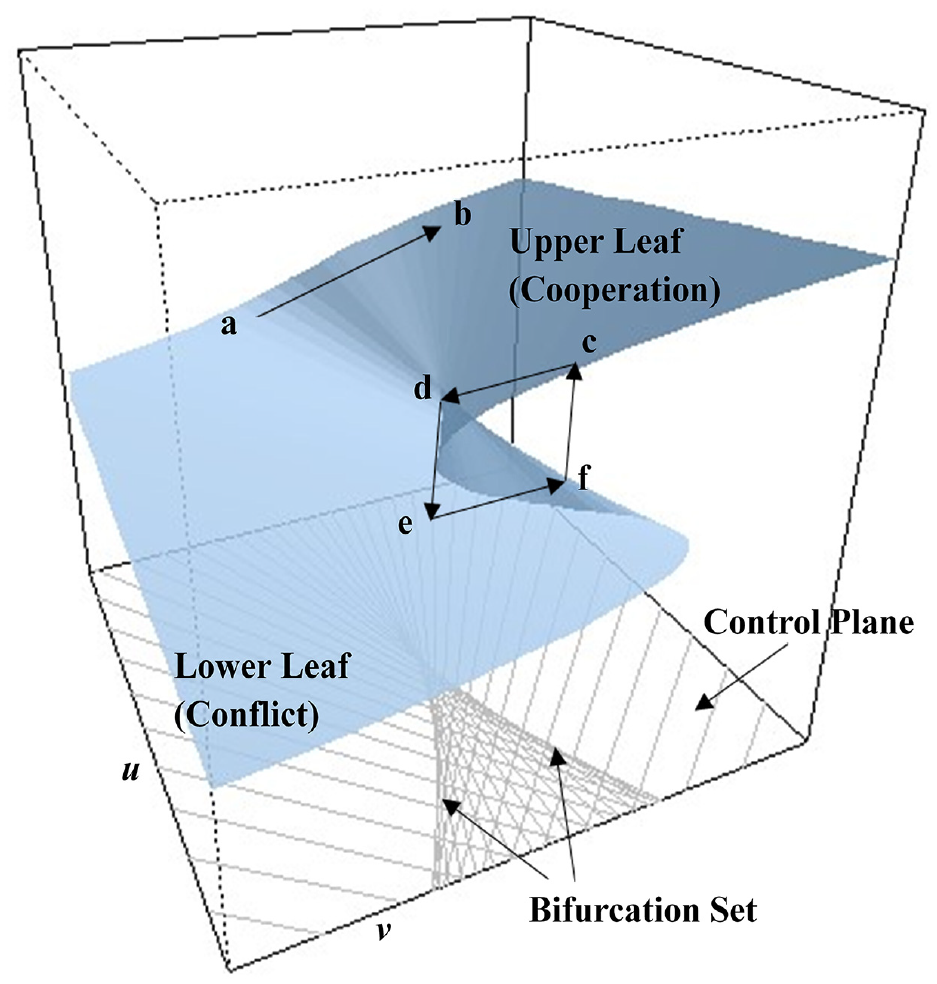
Cusp catastrophe model for sudden changes in behavior.
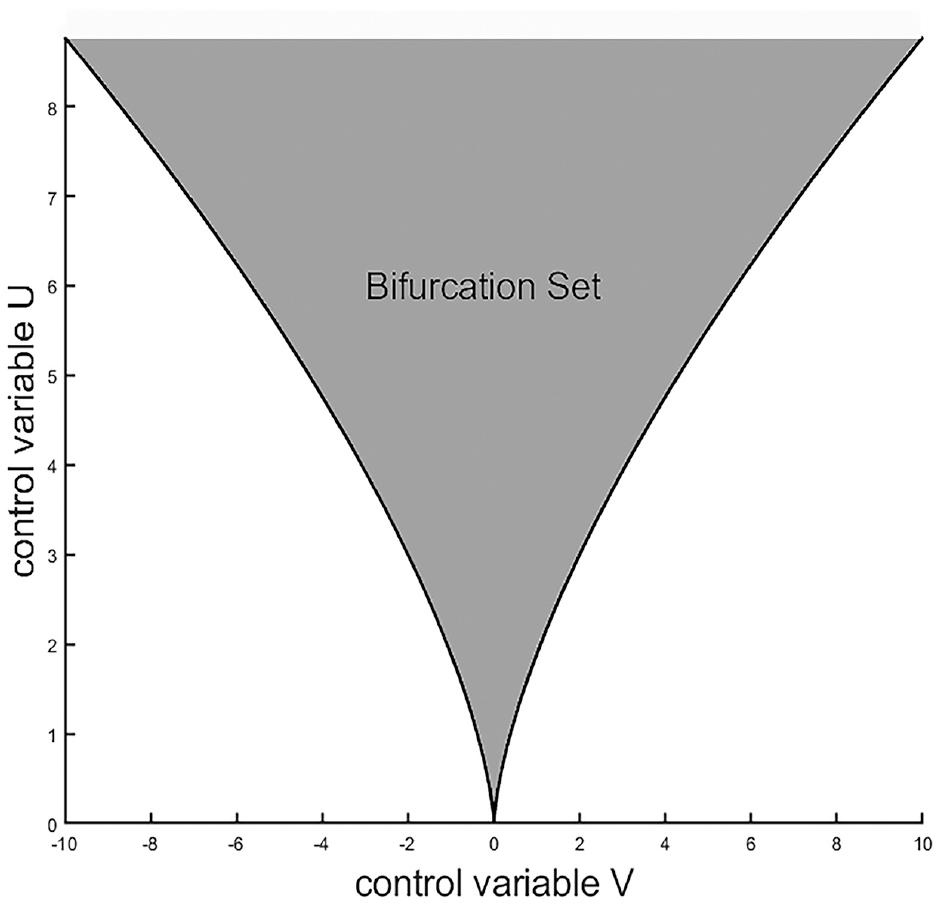
Bifurcation set (unstable area of employee behavior).
To obtain the mathematical function of the bifurcation point set, we derive Equation (2) to obtain Equation (3):

Equation (4) is the derivative of Equations (2) and (3), representing the edge of the bifurcation set for behavior on the control plane. The left side of Equation (3) is greater than 0 if the projection of the state on the control plane enters the bifurcation set area, and sudden changes become to be highly probable. We notice that the greater the value of

Cusp catastrophe theory is now widely used in research in behavior dynamics. 45 Some scholars considered two control variables: external workplace and internal psychological factors. 46 Scholars explored the effect of job tension and group cohesion on the sudden withdrawal behavior of nurses, stating that the cusp catastrophe model explains the behavior turnover of employees better than the linear regression model. 47 Song et al. 48 embedded a cusp catastrophe model into the relative agreement model to study the frequent polarization or reversal of employee opinion and explore the factors that influence the evolution of employee opinion. Dimas et al. 49 applied the cusp catastrophe model to analyze team satisfaction and conflict. Conflict-handling strategy is the control variable determining whether sudden changes happen in satisfaction mode. Guastello et al. used two cusp catastrophe models to effectively untangle the effect of cognitive workload and other complications on the performance of individuals. They indicated that subjective workload and fluid intelligence (i.e., psychological factors of employees) as control variables are vital to team performance. 50
There were various approaches for fitting cusp catastrophe models, including maximum likelihood, 51 Guastello’s 52 least squares approach, and the longitudinal method considering the longitudinal nature of data. 53 The research object locates at only a period. The evolution of group behavior is simulated within such a period. It means the time series of the data is not significant. Thus, we choose the maximum likelihood method. Grasman et al. 51 developed the Cuspfit package in R language, which employs maximum likelihood to facilitate fitting the cusp catastrophe model. This package contains several functions related to the catastrophe model, including functions to fit cusp catastrophe models based on input data from the system, evaluate the model, and display the results. All empirical research shows that the cusp catastrophe model is better than the linear model regarding conflict and sudden changes in employee behavior. The cusp catastrophe theory model can describe sudden changes in individual or group behavior.
The rest of this paper is organized as follows. Section 3 describe the methodology of this paper. Section 4 builds the evolutionary game model to determine employees’ behavior selection strategies. Section 5 develops the cellular automata model for employee groups using AnyLogic 8.7. Then we employ the cusp catastrophe method (i.e., Cuspfit package) to analyze the simulation results and explore the catastrophe mechanism in the employee group’s behavior selection in section 6. We take some discussions on control ways for employee behavior in section 7. Section 8 gives the conclusions and limitations.
3. Methods
Figure 3 (drawn with Visio 2019) outlines the methodology of this paper, in which three squares represent the research methods in the following sections. First, an evolutionary game model will be proposed to analyze the individual employee’s behavior selection strategies, considering the impact of digital technology. Second, we use cellular automata to simulate employee interactions and employee group’s behavior selection over time. Then, we propose cusp catastrophe theory and its Cuspfit package to explore the catastrophe mechanism of sudden changes in behavior selection.

Basic methodology.
4. Calculating strategies of individual employee’s behavior selection
Based on the description above, during employee interactions, digital technology brings benefits to employees and reduces employee’s work costs. While intense information transition may increase employee’s work costs, thorough supervision provides a basis for appraisal. These factors significantly affect the behavior selection of employees, so that employees may choose cooperation or conflict. This paper specifies the set of employee strategies as < cooperation, conflict >.
According to the social exchange theory and game model of cooperation behavior, 54 considering the impact of digital technology, we design the payoff matrix for cooperation and conflict behavior, as shown in Table 1.
Payoff matrix for cooperation and conflict behavior.

Where
Since employees’ rationality is bounded, their cognitive ability is also limited. They can only perceive the payoff at the next stage based on neighbor employees’ behavior selection at the last time stage. According to the model setting and the characteristics of evolutionary game theory, we obtain the dynamic adjustment strategy of employees based on bounded rationality, i.e., replicator dynamic function.
55
Suppose that at time

Proposition 1
When
According to Proposition 1, we can get Corollary 1 as follows.
Corollary 1
When
The proofs of Proposition 1 and Corollary 1 are detailed in Appendix 2.
Corollary 1 shows that when the penalty value is lower than half of the cost and the proportion of employee groups who select cooperation behavior is lower than
The above studies on behavior selections are at the individual level. Next, we explore the selection of cooperation and conflict behavior at the group level by developing a cellular automata model based on Proposition 1 and Corollary 1 using AnyLogic 8.7.
5. Simulating employee group’s behavior selection
5.1. Modeling setting
In enterprises, digital technology can collect data on employee groups, such as benefits, costs, and behavioral tendencies. We can convert these data into model variables for further analysis. From the perspective of the employee group, digital technology gradually eliminates the time and space boundaries of employees’ work. Employee interaction becomes more structured because of the standardized information interaction form in enterprises. 57 The cellular automata model can describe the structured neighborhood space and combine the microscopic individual interactions with the macroscopic group evolution in a bottom-up manner. Although the cellular automata model cannot accurately characterize all the enterprise’s characteristics, it focuses more on specific research elements, and the simulation results can also provide practical implications.
The system model in section 4 considers cooperation and conflict as the result of individual employee’s behavior selection, which depends on external information and internal psychological traits. 58 The external information includes the behavior selection of neighbor employees and the benefits, costs, and penalties brought by digital technology. The internal psychological traits of employees are strongly autonomous, independent, full of personal emotion, and achievement motivation. 59 According to trait theory, 60 the internal psychological trait is a set of features with a core that significantly impacts behavior selection. In this paper, we assume psychological traits as the subjectively perceived payoff of employee behavior. We select perceived payoff and “easygoing degree” as the internal psychological trait. Thus, we classify employees into three categories 60 :
Easygoing employee: An employee who is easily affected by neighbor employees’ behavior.
Neutral employee: An employee who is to some extent influenced by neighbor employees but will not follow neighbors.
Independent employee: An employee who is less likely to be affected by neighbor employees and tends to think independently and make rational decisions.
Based on Proposition 1 and Corollary 1, we build a cellular automata model using AnyLogic 8.7.
61
The parameter
As mentioned in section 1, conflicts are still common in China’s labor- and technology-intensive enterprises. We set
5.2. Simulation results
Figure 4 shows the simulation results with AnyLogic 8.7.
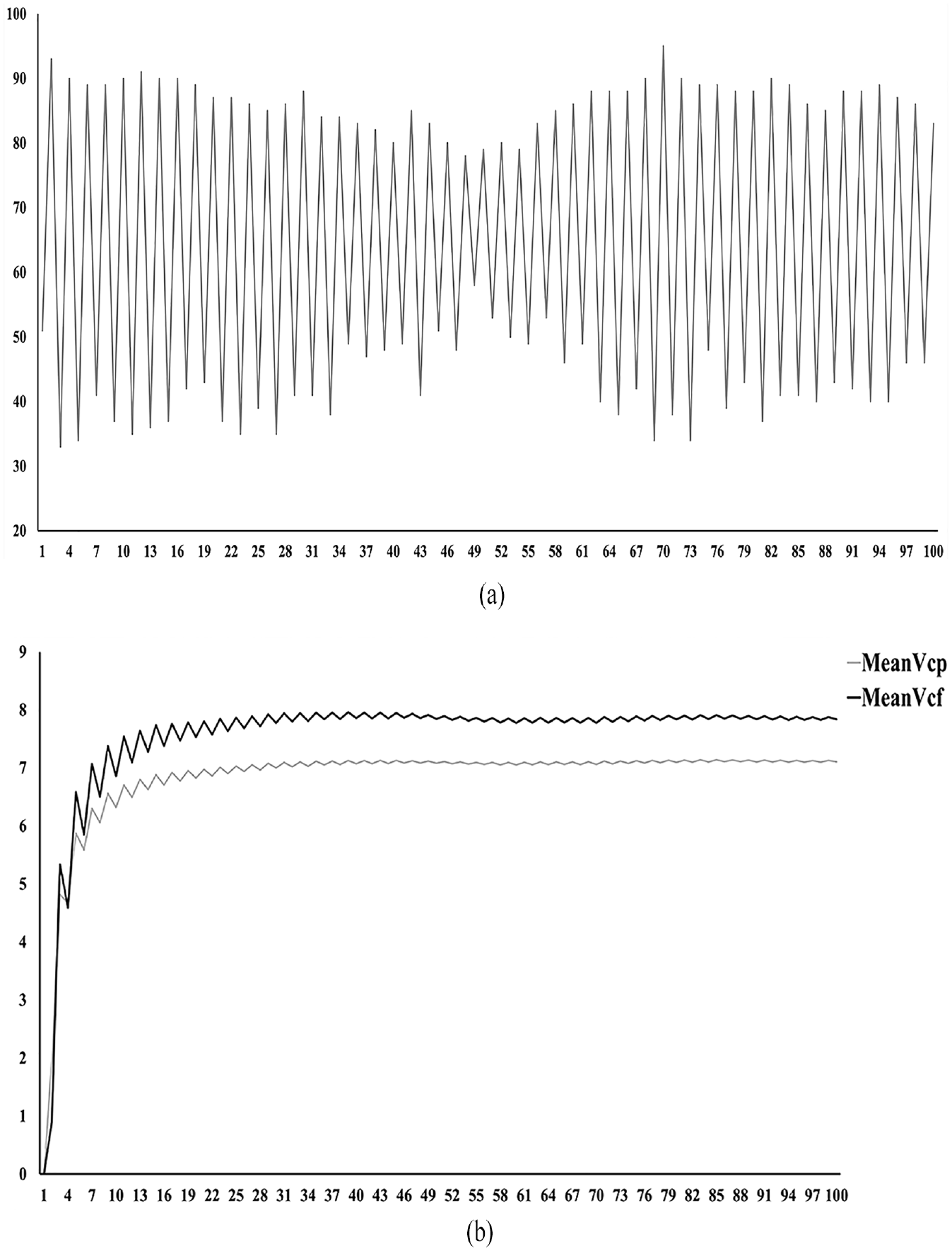
Simulation results. (a) Evolution of
In Figure 4(a) and (b), the horizontal axis represents the time stage of simulation, and the vertical axis represents the number of cooperation employees and the value of
In addition to the perspective of the employee group, we analyze the individual employee’s behavior selection with time advancing. Using AnyLogic 8.7, Figure 5 shows the behavior of each employee in the cellular automata at different time stages, where the gray grid represents cooperation and the white grid represents conflict. Figure 5(a)–(d) depict the distribution of cooperation and conflict employees in the cellular automata grids at four consecutive time stages, respectively.
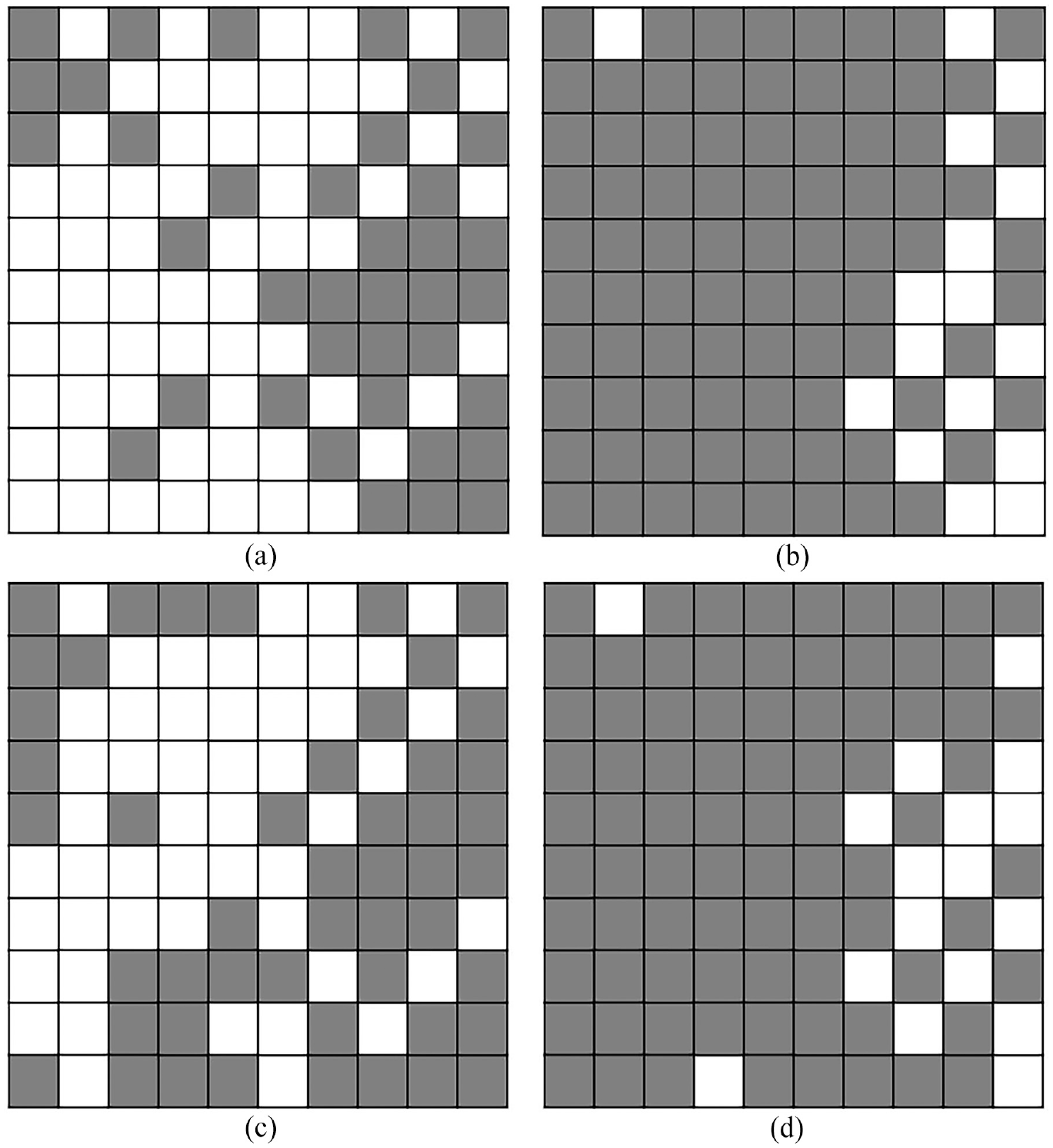
Behavior evolution of employees at four different time stages. (a) t = 33. (b) t = 34. (c) t = 35. (d) t = 36.
As shown in Figure 4, the value of
To further study the mechanism of behavior selection reversal in employee groups, we illustrate the number of employees with behavior selection reversals and the changes in the number of cooperation employees at each time stage in Figure 6.
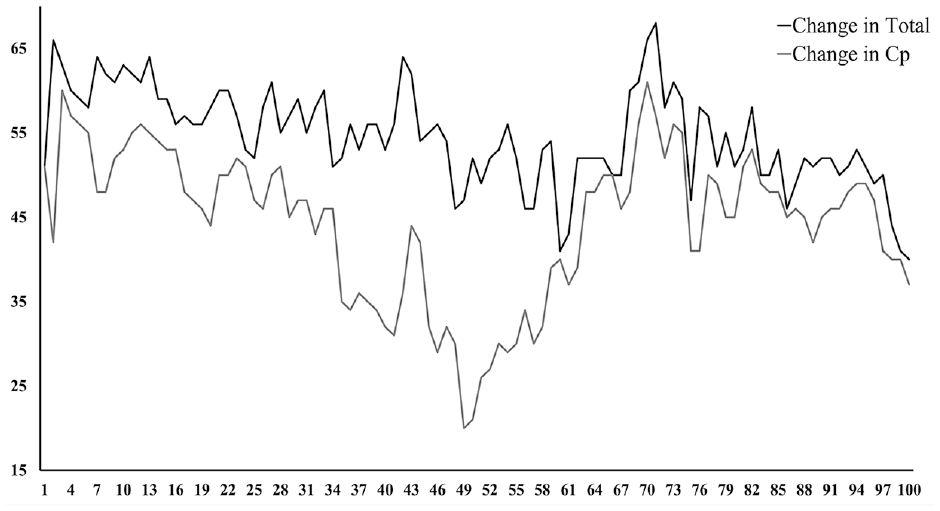
The number of employees with behavior selection reversals (
Similar to Figure 4, the horizontal axis represents the time stage of simulation, and the vertical axis represents the number of employees with behavior selection reversal and the number of changes of cooperation employees. As the increase in
Corollary 1 indicates that when
6. Exploring catastrophe mechanism of sudden changes in behavior selection
6.1. Setting of fitting method and variables
The Cuspfit package was written in R language, whose fitting approach is detailed in Appendix 4. It employs maximum likelihood to facilitate the fitting of the cusp catastrophe model. It also provides functions related to cusp catastrophe models for fitting and evaluating the cusp catastrophe model based on input data. It is taken as a tool for assessing the cusp catastrophe model fitting
51
. Before the nonlinear fitting analysis, we treat the variables to make them in the same dimension. The number of employees who select cooperation behavior is delegated by the ratio of cooperative employees to the total number of employees, i.e.,
Variable
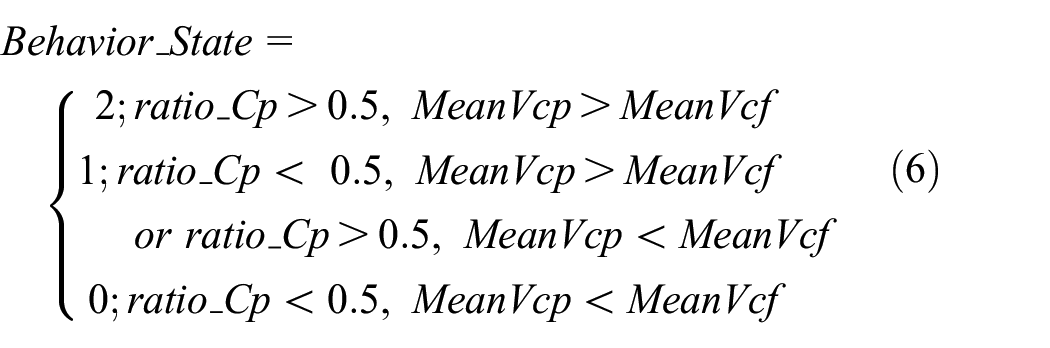
In the real world, the behavior state of employee groups is discrete, so Equation (6) divides the behavior state of employee groups into three discrete values, here
As mentioned in section 5, individual behavior selection depends on external information and internal psychological traits. To study the catastrophe in behavior, scholars generally regard behavior selection as a state variable
6.2. Identifying cusp catastrophe pattern
The Cuspfit package contains functions that perform the fitting of linear, logistic, and catastrophe models to the experimental data. We use the Cuspfit package to compare the fitting result of linear, logistic, and cusp models, and to test whether the cusp catastrophe model is the best explanatory model for the experimental data. We stipulate
Comparison of fitting results of linear, logistic, and cusp model.

The
The fitting results show that the cusp model is the most appropriate for fitting experimental data. It means there are cusp catastrophe patterns in the sudden changes in behavior selection. Based on the fitting results in Table 2, we verify that the cusp catastrophe mechanism does exist in the evolution of behavior selection of employee groups. We then perform the Cuspfit package to explore the mechanism of the catastrophe in sudden changes in behavior.
6.3. Fitting cusp catastrophe model
The fitting results of the cusp catastrophe model are shown in Table 3. It shows that state variable
Coefficients of cusp catastrophe model.
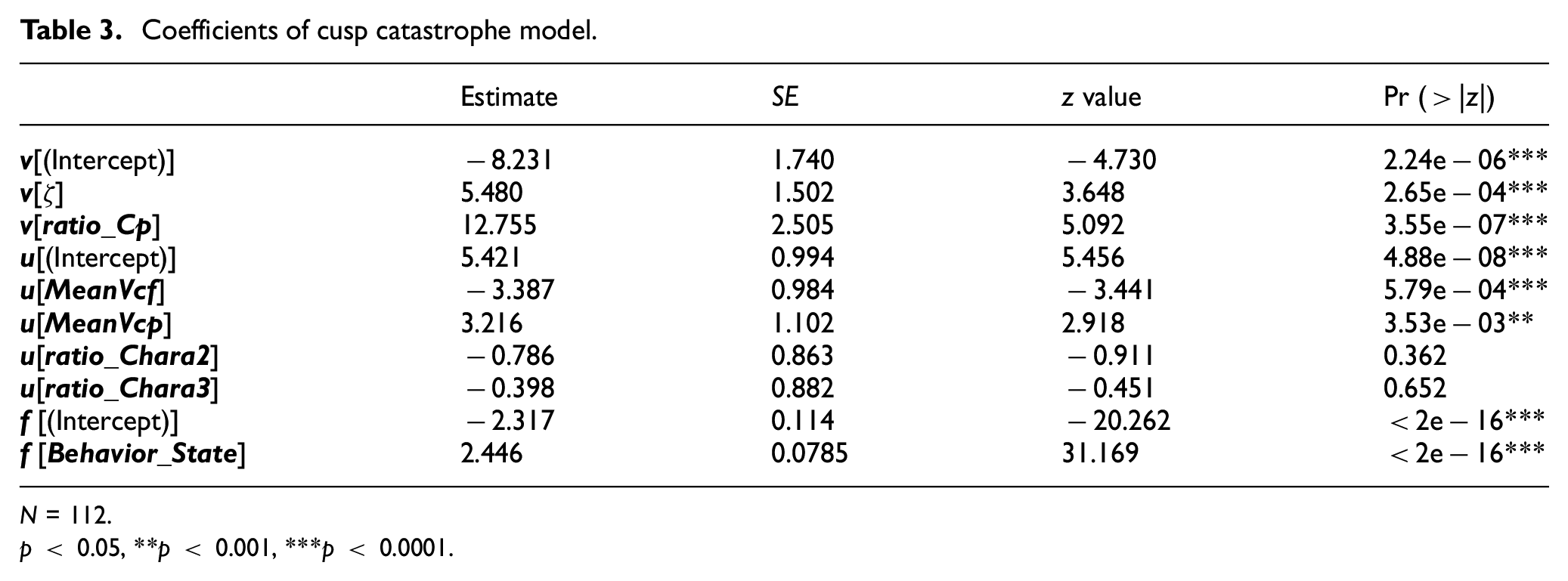
N = 112.
p < 0.05, **p < 0.001, ***p < 0.0001.
As mentioned in section 2.2, if the projection of the behavior state on the control plane enters the bifurcation set area, the left side of Equation (3) is greater than 0. With coefficients in Table 3, we obtain Equation (7), which represents the circumstance that the behavior state of employees becomes unstable and reversal probably happens:

Combining Equation (7) and the bifurcation set in Figure 2, we discover that once the values of
7. Discussion
7.1. Behavior selection strategies of individual employees
Initially, social exchange theory is applied to construct a fundamental theoretical framework of employee interaction. Then, we use an evolutionary game model to study how the perceived benefit, cost, and conflict penalty (i.e.,
Under the impact of digital technology, we theoretically extend the conditions that prevent employees from conflict by finding that individual employees stick to cooperation if the penalty value exceeds half the cost value (i.e.,
7.2. Behavior selection evolution of employee group
The above findings of strategies are about the individual employee’s behavior selection. How about the employee group’s behavior selection? Based on the behavior selection strategies of individual employees, we build a cellular automata model to simulate the behavior selection evolution of employee groups. The number of employees who select cooperation behavior is illustrated. Sometimes the data of employee individuals and group cannot explicitly reflect their behavior evolution after the introduction of digital technology, or the relevant data collection is difficult. The cellular automata model can convey the mechanism of individual interactions of employees and the evolution of employee group behavior states.
Using a simulation model based on evolutionary game theory, we discover intense changes in employee groups’ behavior selection in a new enterprise scenario with digital technology, developing the research conclusions in the traditional workplace. 69 We find that the number of employees who select cooperation changes sharply over time, and the reversal of individual employee’s behavior selection is extremely drastic. At the group level, the number of employees who select cooperation changes harshly (see Figure 4(a)), and behavior selection reversals of employees at the individual level are even more intense (see Figures 5 and 6).
To explore the underlying mechanism of this phenomenon, we use catastrophe theory and its tool to analyze behavior selection evolution.
7.3. Catastrophe mechanism of employee behavior
We use the Cuspfit package to find that the Cusp model is better than linear and logistic models regarding employee cooperation behavior, confirming that the cusp catastrophe patterns exist in the behavior selection of employees. Then the Cuspfit package is applied to find the mechanism of catastrophe in behavior selection. The fitting results are as follows.
First, we pioneer Equation (7) as an early warning method for enterprises to determine whether the employee groups’ behavior is stable and how far it is from sudden changes. The greater value of
Second, we find that perceived payoff significantly influences variable
Third, the greater
Interestingly, we discover that with the introduction of digital technology, a higher proportion of cooperation employees not only encourages cooperation but also reduces internal turbulence and enables employees to cooperate stably without sudden changes within the enterprise. A cooperative atmosphere among employees brings cognitive advantages for aligning various group members. 72 Profound cooperative culture still encourages more employees to cooperate, promoting the stability of cooperation in enterprises and forming virtuous feedback. Managers should emphasize that other employees are willing to motivate employees to cooperate. 73
7.4. Summary and implication
First, we analyze the interaction among individual employees using an evolutionary game model. According to Proposition 1 and Corollary 1, employees will firmly select cooperation if the penalty value must exceed half of the cost value (i.e.,
Second, we apply cellular automata to simulate the interaction in the employee group. Simulation results show drastic and sudden changes at the employee group level and more drastic reversals at the individual employee level. The evolutionary game model cannot explain the mechanism of such changes in employees’ behavior selection.
Third, fitting the experimental data with the Cuspfit package, we find the nonlinear catastrophe mechanism in the employee group’s behavior selection. The cusp catastrophe model’s fitting result is better than the linear and logistic models. The fitting result indicates that the internal factor (i.e., control factor
The theoretical contributions and significance of this paper are as follows:
Both positive and negative impacts of digital technology on employees are considered and introduced as variables in the evolutionary game model in this paper. The evolutionary game model uses formulas (i.e., Proposition 1 and Corollary 1) to accurately analyze the mechanism by which benefit and cost affect employees’ behavior selection, addressing the imprecise behavioral prediction issues of social exchange theory 30 and improving the social exchange theory analysis framework.
From the perspective of comprehensive effects of internal and external factors, the cooperation behavior evolution can be seen as employees’ decision-making process with a lack of knowledge and information (i.e., internal factors) 16 to adapt to the dynamic environment with workplace and digital technology (i.e., external factors). 18 Catastrophe theory can aid the game model in revealing more extent findings than Proposition 1 and Corollary 1 that only the game model deduced.
Only one approach cannot explore the underlying mechanism of complex human psychological activities. Based on the theoretical framework of social exchange theory, this paper integrates evolutionary game, simulation, and catastrophe theory to provide a research framework for this field, 19 profoundly enhancing the analysis ability of the evolutionary game model for cooperation behavior evolution11,12 and complementing previous research from the perspective of the evolutionary game and catastrophe.27,30
The nonlinear behavior mechanisms of employees’ behavior selection from individual strategies (i.e., Proposition 1 and Corollary 1) to group catastrophe (i.e., the number of employees who select cooperation changes sharply and intense reversals in individuals’ behavior happen) are explored. Such a catastrophe analysis approach extends the application of catastrophe theory to employee work behavior. 3
An integrated research framework is provided to study employee interaction and behavior selection in digital technology engagement. Future researchers can extend and modify the framework based on specific research topics.
The practical contribution and management significance of this paper are as follows:
Following the background of the digital economy, using models and simulation to discover quantitative conditions for cooperation and sudden changes in behavior selection of employees, and indicating new characteristics of employee interaction under the impact of digital technology.
This paper discovers the catastrophe mechanism in the employee group, revealing the new challenges for enterprises when introducing digital technology. The methodology of this paper provides feasible measures for managers to prevent and reduce sudden changes and conflicts, motivating employee cooperation and creating an excellent cooperative culture within the enterprise.
In labor- and technology-intensive enterprises (such as Luxshare and Tencent mentioned in section 1), digital technology can collect data on employee groups, such as benefits (such as salary, recognition), costs (such as time expenses), and behavioral tendencies. This paper’s methodology can obtain the behavior state of employee groups based on the above data, analyze their condition with the equilibrium surface of the cusp catastrophe model, assess the risk of sudden changes in employee groups’ behavior selection, and provide valuable suggestions for managers.
8. Conclusion and future research
To explore the mechanism of employees’ behavior selection of cooperation and conflict, the integration analysis method, i.e., integrating evolutionary game, cellular automata simulation, and catastrophe theory, is developed in this paper. Based on social exchange theory, we build an evolutionary game model to calculate the individual employee’s behavior selection strategies. A cellular automata model is employed based on these strategies to illustrate that employee groups’ behavior changes drastically, and sudden individual behavior changes are even more drastic. The Cuspfit package confirms cusp catastrophe patterns in the sudden changes in employee behavior and explores its mechanism.
Although previous research shows that individual preference selection and environment heterogeneity enhance the evolution of cooperation,
74
they did not explore the mechanism in detail. We find that control factors composed of benefit, cost, and penalty value brought by digital technology (
There are limitations to this paper. The methods and conclusions need validation by data from enterprises. The cellular automata in this paper do not consider the complex relationship network among employees. The ability of employee groups to absorb, resist, and recover from changes in external environmental factors (i.e., resilience) is not considered. Moreover, the Cuspfit package overlooks the longitudinal nature of data and thus cannot analyze longitudinal data. In future work, we can further verify the validity of the simulation model by applying real-world data from Internet enterprises. We can also build complex network models to study diverse interactions among employees. In addition, using the cusp catastrophe model to analyze the ability of employee groups to absorb, resist, and recover from changes in external factors is also promising research. Last, we can acquire longitudinal data of employee groups and introduce longitudinal methods to study cusp catastrophe mechanisms in employee groups.
Footnotes
Appendix 1
Appendix 2
Appendix 3
Appendix 4
Appendix 5
Acknowledgements
The authors thank Hanwen Zhang for her contribution to data collection. The authors of this manuscript are the members of the Department of Management Science and Information Management, School of Management, Huazhong University of Science and Technology, and are not employed by any non-academic government agencies. The authors declared no potential conflicts of interest concerning the research, authorship, and publication of this article.
Funding
This work was supported by the China National Nature Science Fund (Grant Nos. 71971093, 72101158, and 72271192).
