







Abstract
Crime rates are increasing across the Indian society. Normally, such crimes are attributed to two broad categories of factors: (a) psychological factors like individual or mob fury and (b) administrative factors like the failure of law and order machinery. These explanations, however, do not account for the increasing rates of such demeaning instances. This article, attempting to explain the increasing crime rates, focuses on the social control theory. The main argument of the article is that the rapidly declining informal social control causes the phenomenal rise of decadent behaviour in the contemporary Indian society. Due to modernising forces, traditional social institutions and structures such as family, kinship, caste system and village community have become weak. As a result, the traditional informal social control based on shame has gradually diminished. And the sense of guilt, the functional alternative to shame, as an informal mechanism of social control, has not yet been fully institutionalised. This seems to be the major factor giving rise to widespread deviant behaviour in India. Although formal mechanisms of social control like police and judiciary do exist, they cannot be very effective without being reinforced with the informal social control.
Horrendous offences are increasing in contemporary India. Alarmingly, these degrading incidents are not confined only to the youth, and nor are they contained in the private sphere of individuals. The alarming increase in instances of mob lynching reveals that the morally repugnant behaviour has also engulfed the public domains of the Indian society. The fact is further corroborated by rampant corruption, which has enveloped almost all sections of the Indian society such as politics, government bureaucracy, police, judiciary, medicine, health care, armed forces, banks, businesses, industries, education and science and technology. Unsurprisingly, the Berlin-based ‘Transparency International’ reported in its Corruption Perceptions Index 2017, that India is one of the most corrupt countries, ranking 81 among a group of 180 countries surveyed. The report also indicates that the rate of corruption in India has significantly increased as compared to that of 2012. 1 Besides, as shown in Table 1, rates of cognisable crimes have also increased over a period. In the year 2016, a total 48,31,515 cognisable offences committed under the Indian Penal Code and Special and Local Laws were recorded, showing an increase of about 6 per cent over the year 2014. And the crime rate increased from 367.5 in 2014 to 379.3 in 2017. 2
Incidence and Rate of Cognisable Offences Committed Under the Indian Penal Code (IPC) and Special and Local Laws (SLL) During 2014, 2015 and 2016
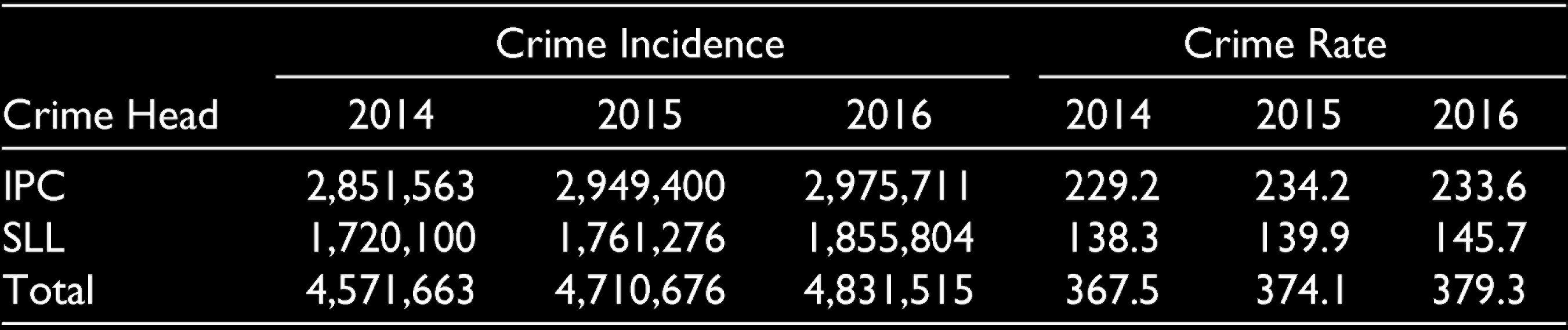
According to the above-referred source, crimes against women have also increased by 2.9 per cent in 2016 over 2015. A majority of the crimes against women reported in 2016 were under ‘Cruelty by Husband or His Relatives’ (32.6%), followed by ‘Assault on Women with Intent to Outrage her Modesty’ (25.0%), ‘Kidnapping & Abduction of Women’ (19.0%) and ‘Rape’ (11.5%) (Government of India, 2016, p. xix).
Theories Explaining the Deviance
Normally, such crimes are attributed by the media either to psychological factors such as individual abnormality, fury, passion or crowd behaviour or to the administrative factors like the failure of the law and order machinery of the society. But such explanations are trivial. To give a more comprehensive explanation of the mounting degree of deviance in India, deeper societal and moral factors need to be explored, since such crimes are indicative of the decaying moral fabric of the Indian society.
Evidently, other societies, including modern Western ones, are also not free from grievous crimes including mass killings related to ethnic cleansing or holocaust (de Swaan, 2015). However, some of the explanations of those phenomena also appear to be less than satisfactory. For instance, one such account, known as the situational explanation, formulated by Milgram (1974) and Arendt (1963–2006), attributes such crimes to the immediate situation that causes normal people to commit evil acts, meaning thereby: ‘Under identical circumstance anyone might commit similar crime’. Alternatively, the Dutch sociologist, de Swaan, proposed a socio-psychological explanation (2015). According to de Swaan, the social and psychological compartmentalisation of the predator and victim, caused by indoctrination and brainwashing propaganda, is responsible for the monstrous acts of genocide committed by the Nazis. Apparently, such explanations have an element of truth, but are inadequate from the moral and sociological standpoints.
Interestingly, sociologists have formulated several fascinating theories of crime and deviance. For instance, the 19th-century French sociologist, Emile Durkheim, one of the founders of modern sociology, was the first to formulate a sociological theory of the deviant behaviour. Explaining the variance in suicide rates in different groups, he argued that it was a societal rather than an abnormal individual phenomenon. Examining social compositions of different groups having differential suicide rates, Durkheim found that unusually high or low suicide rates were inversely related to social cohesiveness: the greater the social solidarity, the lesser the suicide rates, and conversely, the lesser the social cohesiveness, the greater the suicide rates (1897–2006). Inspired by Durkheim, Merton, the renowned American (sociolo)gist, developed the structural–functional theory of anomie (1968). Identifying four types of deviant behaviour, namely innovation, ritualism, retreatism and rebellion, Merton argued that they were the dysfunctional consequences of: (a) the overemphasis on the goal of success along with the underemphasis on culturally prescribed legitimate means to achieve it, and (b) the structural inequality of opportunities in the American society (1968, pp. 198–258). On the other hand, Lemert (1951) and Becker (1963) of the symbolic interaction school have proposed the labelling theory, attributing the cause of deviance to the process of labelling the deviants as ‘deviants’, who, in turn, owning that label, behave accordingly. In contrast, some sociologists proposing the conflict theory of crime argued that the deviance is caused by social inequalities and associated power dynamics (Liazos, 1972).
In this article, taking a cue from the social control theory proposed by Durheim and Merton, but departing from their arguments, I contend that declining informal social control is responsible for the rising decadent behaviour in the contemporary Indian society.
Morality and Informal Social Control: The Role of Shame and Guilt
It is now widely accepted by evolutionary biologists (Alexander, 1987), evolutionary psychologists (Campbell, 1975) and sociobiologists (Wilson, 1980) that, although human beings share many characteristics with higher animals, as explained by Darwin and Dawkins (Dawkins, 1967), humans are not merely animals. The distinguishing feature of the human society is culture, resulting from human actions and also determining them. Culture specifies certain norms, values, customs, institutions, practices and mores to be followed by human beings, making them moral animals, despite their self-serving animal instincts. Central to the morality is the ability of humans to anticipate the consequences of their actions (Ayala, 2010, p. 9018). This morality, encoded in culture, becomes the social glue bonding the members of the society, taming their basic instincts and enabling them to learn how to live in harmony with others. Hence, the concept of ethical behaviour, based on the moral idea of ‘good’, as opposed to ‘bad’, is universal in the human society, though specificities of such conceptions may vary spatially and temporally. Every society develops the moral code of conduct defining a ‘good’ life. Members of the society internalise these cultural norms through the socialisation process, a process transmitting culture from one generation to another, mostly within the family and the educational institutions. These internalised norms, conjoined with informal sanctions like feelings of guilt and shame, maintain social order.
There are also formal mechanisms of social control. Formal control, codified in laws and enforced by the state-supported structures like police and judiciary, is more important in modern complex societies, whereas, the informal social control has been relatively prominent in simple societies. However, informal social control is not completely absent in complex societies. In fact, the formally codified laws and regulations complement the informal norms in the society, for no society can formally monitor every action of each citizen. Even if a society attempts to do so, the law enforcement personnel deficient in morality would be sorrowfully ineffective. Hence, the importance of informal control, based on societal morality and implemented by the feelings of guilt or shame, cannot be underestimated in any society. 3
Varying Importance of Shame and Guilt in the East and the West 4
Moral emotions of shame and guilt become the motive force to be ‘good’ and to avoid being ‘bad’ (Tangney, Stuewig, & Mashek, 2007). Morality thus negotiates the inherent social conflicts between the ‘self’ (ego) and ‘others’ (alter), resulting from egocentric or ‘animalistic’ instincts. Since emotions of shame and guilt are self-conscious emotions occurring in the situation of moral lapses, causing negative self-evaluation, they are often used synonymously. However, emphasising the difference between the two, Piers and Singer (1971) indicate that each of the two emotions produces different patterns of behaviour.
According to some scholars, the concept of guilt, traditionally rooted in the Christian belief of sin, is deeply internalised by the Westerners (Delumeau, 1990; Fredriksen, 2012). Not surprisingly, it has been the subject of interest among the Western scholars of various disciplines like psychology and anthropology. Freud, seeking roots of guilt in an individual’s subconscious, argues that guilt, or self-reproach, has two sources: (a) fear of authority and (b) fear of the superego. Guilt arises from doing or intending to do something ‘bad’; whether the action or intention is bad in absolute moral terms is irrelevant (Freud, 1930–2004). For instance, hatred for parents creates a feeling of guilt in an individual not because it is morally bad but because it causes the fear of loss of parental love.
On the other hand, the American anthropologist Ruth Benedict asserts that guilt as well as shame are embedded in culture. Writing during the Second World War, she made a distinction between shame culture and guilt culture to explain the difference between the actions of the Japanese and American soldiers (Benedict, 1946). According to her, the concepts of ‘right’ and ‘wrong’, or ‘proper’ and ‘improper’ behaviour, are culture-specific; they differ from society to society. She claimed that the USA was a guilt culture while Japan was a shame culture. By highlighting this distinction, Benedict (1946) initiated a debate regarding shame culture versus guilt culture. Later, several scholars confirmed the distinction between the two cultures. For instance, after examining ancient Greek epics and plays, the renowned Irish classic scholar E. R. Dodds noted that shame was the guiding principle of honour and good life among the early Greeks, governing the Homeric man who was more concerned about public opinion than the fear of God. Later on, the moral emotions shifted towards guilt in Greece, beginning with the classical period (Dodds, 1951–2004).
Distinguishing the psychological and anthropological concepts of guilt, Gananath Obeyesekere, the US-based anthropologist of Sri Lankan origin, argues that psychological or, what he calls, primary guilt (P guilt) is different from the social or, what he considers, secondary guilt (S guilt). For instance, ambivalence towards one’s parents produces a feeling of psychological guilt, whereas, a feeling of guilt experienced while violating traffic norms is an example of social guilt; the latter promotes conformity to societal norms (Obeyesekere, 1981, pp. 78–80).
However, some scholars argue that guilt and shame are not dichotomous concepts; there is a considerable overlap of feelings denoted by the two. Although Western societies rely greatly on guilt, the concept of shame is not completely absent there (Lal, 1998–2001, pp. 153–171). In the West, for instance, a person hitting a car against a tree while driving being sick will feel guilty. Nonetheless, the same person will feel ashamed if s/he attributes the accident to his/her incompetence (Wong & Tsai, 2007, p. 210). Moreover, the phenomenon called ‘trial by media’ in the West is also a mechanism to shame the persons publicly. Similarly, in the shame cultures of the East, it cannot be said that people are devoid of conscience or of guilt feelings. A person in the East will feel guilty for betraying one’s own family members or friends, for causing social injury to them. For instance, Obeyesekere found that in Sri Lanka, the feeling of betrayal of a person by a relative surfacing at the time of the relative’s death causes tormenting guilt, resulting in suffering and self-inflicted punishment (1981, pp. 77–78). But the individuals in the East will feel ashamed for not coming up to the expectations of his/her group members. Moreover, the amount and intensity of the feelings of shame and guilt vary from person to person even within the same culture. Some people are naturally more oriented to one kind of emotion than the other. Nevertheless, in reality, societies inevitably tend to emphasise one over the other. Deepak Lal, for instance, after reviewing the literature on the subject and surveying the history of Eastern and the Western civilisations, concludes that Western societies are characterised by two significant traits: individualism and the importance of guilt as a social control mechanism, whereas, Eastern civilisations are configured around two opposite poles, namely collectivism and shame (1998–2001, pp. 5–95). Hence, a consensus is emerging among scholars that there is a difference between the guilt culture and the shame culture (Tangney & Dearing, 2002; Tangney, Stuewig, & Mashek, 2007).
Distinguishing Characteristics of the Guilt Culture and the Shame Culture
Scholars have identified several distinguishing characteristics of the guilt culture and the shame culture (Crieghton, 1990; Fessler, 2004). Some of the major differences are depicted below.
To begin with, in a guilt culture, the actors think individually regarding the propriety of their behaviour, without regard to the reaction of others, whereas, members of the shame culture, also often denoted as ‘shame–honour’ culture, are bothered about what ‘others’ think about their actions. In the guilt culture, individuals feel guilty when they think that they have done something which they should not have done, or they did not do what they should have done, even if the ‘others’ have not noticed. Such persons have developed an ego-ideal based on the norms taught by their parents, teachers and society. On the contrary, in the shame culture, individuals feel ashamed viewing themselves from the standpoint of ‘others’. They think it shameful if they have been noticed in ‘improper’ situations by the ‘wrong’ people. However, they will not feel ashamed doing the same thing if they think that no one has noticed their aberration. For instance, as Madan observes, in India, to show intimacy with one’s spouse in privacy is acceptable, but in the presence of other relatives, it is considered shameful (1989, p. 119). In other words, guilt implies self-consciousness, whereas, shame entails other consciousness.
Additionally, in the shame culture, the foundation of social norms is in the group identity and associated ideas of shame, honour, duty, glory, loyalty and reputation. In India, for example, it is regarded as the duty (dharma) of the parents to arrange their daughter(s)’s marriage; their failure in doing so is looked down upon in most communities. Many terms frequently used in India connote the feelings associated with shame and honour: sharm, sharam, laj and lajja (all the terms meaning shame), izzat or abru (honour), nak (i.e., nose, as a symbol of prestige, e.g., nak katana [dishonour], nak bachana [to save the honour]), shir (i.e., head, as a symbol of honour, e.g., shir neechaa karana [to lose respect], the shir unchaa karana [to gain respect]), or munh (i.e., face, symbolising the social standing, e.g., munh kala karan [to lose honour]), nam (i.e., name, signifying reputation, e.g., nam bigadana or badnam karana [to lose fame], nam banana or nam roshan karana [to gain fame]) and so forth. Such terms are culturally irrelevant in the guilt culture of the West.
Besides, in the guilt culture of the West, moral norms and values governing the behaviour of individuals are assumed to be universal, being equally applicable to all members of the society, without regard to their social status. Whereas, in the shame culture, emphasising the ascribed status (the status inherited by birth), such rules are particularistic and situation specific. What is shameful for a person of one group may not be shameful for a member of another group. For instance, in India, to partake of leftover food is shameful for upper-caste members, whereas, it is considered normal among some of the lower castes. Or, what is shameful in one situation may not be considered so in another situation. In many Indian communities, crying for adult males in private or in the family may not be considered as dishonourable or shameful as doing the same in public or in the presence of ‘others’.
Moreover, the shame/honour culture, which considers success as honourable and failure as disgraceful, creates a social pressure on its members to win by any means, right or wrong, and to avoid failure at any cost. In such a situation, members, after failing, usually try to explain away their failure, using any alibi, justifiable or not. Since the conformity to group norms is considered an important goal and not the means used to achieve the goal, members of the shame culture are often tempted to use what the Westerners may consider ‘morally unfair’ means. The usual tendency to seek social approval or to avoid ridicule or derision from one’s peers in such a society is more pronounced than the tendency to be morally upright. Not surprisingly, many middle-class Indian parents, who are almost neurotically concerned about the success of their children in scholastic performance, do not mind allowing their wards to adopt unethical practices, for the middle-class parents generally worry about the negative reactions of the ‘significant others’ (their neighbours, relatives, friends, etc.) regarding their children’s failure. They consider failure as more humiliating and shameful than the use of wrong means to succeed. Unwittingly, it gives rise to a general feeling among the members of such a society that they are almost free to do whatever they feel like doing, provided they can get away with it. And, if caught, they would try to ‘save their face’ by disowning their deviance, or twisting either the facts or interpretation of facts or using the psychological defence mechanisms such as rationalisation, scapegoat and so forth. In the West, however, such cover-up would not only be unwarranted but also insufferable.
Also, members of a guilt culture consider their lapses as human and, therefore, pardonable. The importance of this fact is indicated by the prevalence of the age-old institution of ‘Confession’, particularly in the Catholic Church. Thus, guilt is more like self-inflicted punishment caused by moral transgression, and shame is akin to self-defacement due to an individual’s failure in attaining a socially defined ego image and jeopardising the reputation of the ‘membership group’, which is also his/her ‘reference group’. 5
Notably, Freud’s focus on guilt, disregarding shame, in his theories (Morrison, 1989, p. 5), reflects the relatively greater importance of guilt in Western culture. Similarly, Obeyesekere has pointed out that in the Sinhala language of Sri Lanka, like many other Eastern languages, appropriate terms expressing the emotion of guilt are conspicuously absent despite the fact that there are a number of words signifying shame and related ideas such as honour, status, prestige, loss of self-esteem and ridicule (1981, p. 79). This fact indicates that in Eastern societies, the concept of guilt is less important.
Societal Roots of Shame and Guilt Cultures
The roots of shame and guilt cultures can be traced to: (a) the differential emphasis on individualism in Eastern and Western societies and (b) the distinctive socialising processes in each culture.
Varying Emphasis on Individualism in the East and the West
Western individualism values personal freedom and achievement. In the West, personal accomplishments and achieved status are appreciated and rewarded. The individualistic West underscores competition, motivating people to ‘stand out’ as unique individuals. In contrast, the collectivist East appreciates belongingness of individuals to their group and conformity to group norms. In the East, ‘self-effacement’, ‘bashfulness’, ‘humility’ and ‘modesty’ are valued, instead of being ‘unique’. In India, a Hindu’s notion of the self (karta) is characterised by his/her location in the social hierarchy, particularly by caste status, defining the duties and obligations (dharma) of a person. A Hindu karta is a duty-bound moral agent (Khare, 1999; Madan, 1989, pp. 76–78). In such a society, conformity to group norms is approved, and dissent and difference are frowned upon.
The highly individualistic Western societies, following the Judaeo-Christian religious traditions, emphasise the responsibility of individuals for their actions. The need to conquer the evil tendencies of individuals and emphasis on owning moral responsibility for their own actions, both rooted in the biblical concept of sin, and deeply imbibed in their conscience, cause unbearable pangs of guilt for their moral lapses, even if their faults are unknown to others. Besides, the Western education system also reinforces individualism by nurturing independent thinking. In contrast, collectivist Eastern societies, lacking the biblical concept of sin, depend on traditional communities to enforce social norms by shaming the deviants. Besides, the education system of Eastern societies fosters memorisation rather than the application of one’s own mind. Hence, even the educated people of Eastern societies are often incapable of applying their thought processes for morally guiding their social actions, leave aside a very large mass of uneducated and illiterate population greatly dominated by the authoritarian and conservative communities.
Since Eastern societies emphasise the cohesive group relations, approval or disapproval of the community, instead of the individual’s conscience, directs a person’s behaviour. As noted by Ronald, the American psychiatrist, ‘…The child is expected to be obedient and respectful of elders, to contain aggressive reactions, and to conform to traditionally well-defined responsibilities in Indian extended family…’ (1988, p. 264). The Westerners compete to win the ‘race’, to get ahead of others. Therefore, the ‘losers’ or the ‘laggards’ are looked down upon. Eastern societies, on the other hand, though do not undermine competition, generally encourage their members not to fall behind the others in their group, instead of outsmarting them. The emphasis on shame in the East is, therefore, consistent with the high value of collective orientation, as against the individual’s autonomy and independence cherished in the West. In the Eastern culture, a person’s inadequacies, considered shameful and causing humiliation to the group, may result in his/her expulsion from the group, driving other individuals to conform to group norms. Thus, the difference in cultural emphasis on shame and guilt in the East and the West, respectively, is related to the varying importance given to individualism in the two cultures.
Distinct Socialisation Processes in the East and the West
Socialisation is the process whereby individuals acquire the culture of their society. Since each culture tends to develop a modicum of value consensus, despite internal diversities, the self versus collective orientations are embedded differently in socialising processes with distinct types of sanction, and varying emphasis on shame and guilt in Eastern and Western cultures. While Western societies give primacy to autonomy and self-reliance of the individual, the goal of socialisation in the West is also to make a person independent from childhood. Unsurprisingly, in the USA, paediatricians advise parents of newly born babies to allow them to sleep alone, preferably in a separate room. On the contrary, in Japan and India, children are normally encouraged to sleep with their parents or siblings, in the same bed, often sharing the same blanket, almost up to adolescence. This practice is not due to a shortage of space. It is the result of the cultural norm in India and Japan to promote dependence on parents among children, as sleeping together is believed to promote group affinity (Crieghton, 1990, pp. 298–301).
Moreover, it is normal for parents in India to actively participate in the most personal decisions of their children, such as the choice of subjects to study, occupations to prefer and spouses to be selected (Ronald, 1988, p. 330). Arranged marriage, as against the norm of romantic love in the West, is still a preferred institution of the Indian parents and children. Correspondingly, in India, the separation of grown-up children from their parents, even after marriage, is often a painful phenomenon for the entire family. Similarly, discord in the family forcing grown-up sons to leave their natal families, or married couples to divorce or parents to live in old age homes has been mostly considered as a shameful phenomenon in the Indian society. As a corollary, social isolation, or rejection, or expulsion from the group, like expelling a person from the caste, is generally considered the most severe punishment. In the West, on the other hand, children are not only expected to be independent but are also separated from the parental family mostly by the age of 18. The absence of such separation is usually considered abnormal in the Western culture. And the Western individuals do not bother much about what others think regarding them. Therefore, expulsion from the group is not considered as a serious punishment by them.
Moreover, socialisation of Indian girls and boys in a middle-class family differs from the West. An Indian mother would generally socialise a girl child by eroding her individuality, anticipating her adjustment in the family in which she would be married. Since divorce or separation from her husband is considered disgraceful and maladjustment with her in-laws is viewed with anxiety, the anticipatory socialisation of a girl begins with the onset of puberty or adolescence. 6 From childhood, an Indian girl is made conscious of her gender and her future role as a married person (Das, 2007, p. 69; Madan, 1989, p. 109). The gender distinctions among Indian boys and girls are so strongly ingrained in their persona during their childhood socialisation that to admonish a boy saying ‘Don’t behave like a girl’ or to scold a girl saying ‘Don’t behave like a tomboy’ is considered a shameful reprimand.
The difference in cultural emphasis on self versus collective orientation is also reflected in the social sanctions preferred by Western and Eastern parents while socialising their children. In a Western society like the USA, the most common punishment for moral lapses of their children is ‘time outs’, that is, confining them to their room, so that they can introspect on their wrongdoings and presumably develop the feeling of guilt. On the other hand, in Eastern societies like Japan and India, shaming is the predominant means to discipline the children (Ronald, 1988, pp. 264–265). Eastern parents, particularly mothers, punish their children for their misbehaviour by refusing to interact with them, declining to talk to them and even avoiding eye contact, pretending that the ‘unruly’ children do not belong to them anymore. This kind of banishment may continue for a while as a punishment to shame the children, ignoring their efforts to reconcile or their desperate cries of protests (Crieghton, 1990, pp. 298–299). Likewise, in Indian schools, the most common punishments given by teachers, like asking students to stand up on a bench in front of their classmates, publicly deriding them by calling them gadha (donkey) or bevakoof (idiot) etc., are aimed at insulting, ridiculing, humiliating and ultimately shaming them.
The variation in the socialisation processes of the two cultures, however, has the same goal: to inculcate ‘appropriate’ behaviour among children, in conformity with the preferred values of each culture which are, of course, diverse: ‘self-orientation’ in the West and ‘collective orientation’ in the East (Crieghton, 1990, pp. 298–301). Thus, there is consonance between the cultural value of the concept of the self and the socialisation process, accompanied by different types of sanctions, in both, the West and the East.
The varying emphasis on guilt or shame as the social control mechanism in the West and the East, respectively, is due to the general tendency of each culture to develop a degree of value consensus for harmonious social relations. In the West, the values of individualism and autonomy, the socialisation processes accompanied by appropriate punishment and the development of guilt as an internalised sanction are mutually compatible. Likewise, the values of the collective orientation and the dependence on the group, the processes of socialisation supported by befitting punishments and the development of shame as a moral sanction are in consonance in Eastern cultures (Crieghton, 1990).
Modernisation and Erosion of Social Control
No society is static. A variety of endogenous and exogenous factors change any society over a period, causing social problems, as witnessed both in contemporary Eastern societies like India as well as in Western societies of Europe and North America. As noted above, in the Homeric Greek, shame was the guiding principle in the social life, and later on, guilt developed in classical Greece. And still later, modern individualism emerged in the West since the Renaissance of the 15th century and the Reformation of the 16th century. Following the Enlightenment, which originated in the mid-17th century, reason and instrumental rationality acquired centre stage, eclipsing faith. Modern science obliterated the need for God to explain the natural world, provoking Nietzsche to proclaim that ‘God is dead’, implying that the Christian God is no longer a credible source of absolute moral principles and that there is no objective and universal moral law. As a result, individuals were encouraged to be egocentric, thinking more for them, and also to challenge any authority based on tradition, religion or convention, including the Christian morality based on the concept of sin, weakening the grip of guilt over the Western individuals and causing a widespread moral crisis and ethical slackness in the West (Lal, 1998–2001, pp. 153–178). Although this view is too pessimistic, it has an element of truth. Extending his argument further, paradoxically, Lal makes an opposite argument about Eastern societies. Admitting that Eastern societies have borrowed the modern institutions of political democracy and the market economy from the West, he believes that the kind of moral crisis which engulfs the West will not affect them, because, he thinks, their social bonds will not be undermined as they do not depend on the Christian religious beliefs of sin but are cemented by the socialisation processes based on shame (Lal, 1998–2001, pp. 153–178).
A cursory look at the evidence from India, however, exposes the inaccuracy of Lal’s assertion about Eastern societies. Undoubtedly, it is true that the Indian society, before the British rule, was a simple society characterised by agricultural economy and primordial institutions such as the joint family, kinship, caste and village community. It is also true that the norms for socially approved behaviour were enforced mostly by the mechanism of shame. Nevertheless, historically, the Indian society was neither homogenous nor static. The modernising processes (Eisenstadt, 1966; Lerner, 1958; Levy, 1966), of industrialisation, migration, urbanisation etc., initiated in India during the British rule and accelerated after independence, have most significantly changed the Indian society.
To be sure, it has been observed long ago that the modernising processes do not completely displace the traditions (Gusfield, 1967). The empirical evidence from the Indian society also corroborates the point (Madan, 1987, 1989; Rudolf & Rudolf, 1967; Shah, 2014; Singer, 1959; Singh, 1973, 1978; Srinivas, 1962; Sundarrajan, 2012). The recent studies on the Indian middle classes also reject the idea of essential commonality among the Indian middle classes, stressing the difference between the pre-liberalisation and post-liberalisation middle classes, and also emphasising internal differentiations within the post-liberalisation middle classes in terms of class and gender. Amid consumerism, promoted by media hype and new sources of household income, the influence of traditional institutions of caste, family, kinship and community has diminished. Yet, as Roy (2016, p. 289) points out, inter-caste lovers are mercilessly punished by the caste panchayats. Civil or court marriages, based on the concept of affective individualism, are still socially disapproved, as indicated by the numerous criminal cases filed by the relatives of girls accusing their male partners of kidnapping, abduction and even rape. Thus, the emerging Indian middle class, full of complexities and contradictions (Donner, 2002, 2016; Fernandes, 2016; Patel, 2014; Roy, 2016; Srivastava, 2007), revealing the amalgamation of tradition and modernity, also reflects what Eisenstadt calls ‘multiple modernities’ (Eisenstadt, 2000).
Undoubtedly, the most perceptible and enveloping change taking place in India, due to modernisation, is growing individualisation, creating occasions of tensions within the families (Ronald, 1988, p. 332). The evidence shows that the modern values of individualism, freedom, liberty, privacy, equality, achievement, competition, mobility, etc., enshrined in the constitution of independent India, are actively promoted by the related processes of industrial capitalism, urbanisation, secularism, cosmopolitanism, consumerism, etc. As a result, the traditional institutions such as the joint family, kinship, caste and village community have become weak, giving rise to a mass society privileging individualism, self-orientation, anonymity, competition and privacy, particularly in the contemporary urban India. This newly emerging culture is also gradually spreading to rural India, with the increasing modernisation.
The tensions among conservative Indian parents, trying to retain their control over their teenage children, interested in exercising their choices in different spheres of life, like purchasing material goods or choosing life partners, are increasing. This process has been given a tremendous impetus by the ongoing digital revolution fostered by mobile phones, the Internet and social media. Consequently, parental control and collective authority are further weakened across contemporary India, which in turn has resulted in gradual erosion of the informal social control backed by shame. Of course, Western societies are also experiencing a moral crisis due to the declining religiosity and simultaneous decay of the concept of guilt in modern times. Notwithstanding that, in the West, the rule of law and the formal social control institutions, like police and judiciary, are still relatively more effective thanks to the deeply ingrained professionalism. Besides, in Western societies, the notions of citizenship and civic sense are relatively stronger in comparison to the developing countries of the East (Almond & Verba, 1963/1989, pp. 1–44). On the contrary, the concept of the rule of law in India is not yet fully institutionalised and socially legitimised. The police force and judiciary are plagued not only by the shortage of staff but also by the lack of professionalism, to a large extent. Such a system deficient in morality, backed by inadequate informal control, is miserably ineffective. Besides, as the cleanliness drive initiated by the Government of India indicates, the concepts of citizenship and civic sense are yet to evolve to a critically significant level. Therefore, the role of informal social control mechanisms becomes more important in India.
Since the processes of change experienced by India are now almost irreversible, it would be unrealistic to wish that the traditional informal social control based on shame, institutionalised in the pre-British Indian society, can be restored. India will have to search for new ways and means to strengthen informal social control. Without reinforcing the informal social control, it will be difficult to arrest the moral erosion eating into the vitality of the Indian society, exemplified by the heartless adulteration of milk, milk products and food items; the honour killings with or without the sanction of the khap (caste) panchayats; the merciless murders of unborn girls in the embryo form; countless gang rapes; endless communal riots; rampant money laundering and sex scandals of the religious leaders; repugnant money minting by politicians and the legislators merely for performing their legitimate duties; ruthless suppression of individual freedoms, dissent and difference in the name of moral policing; widespread mass copying and plagiarism found in many academic institutions; and many more such instances of this distressing phenomenon.
However, still there is a ray of hope. As Taylor (1989, 2007) has observed, even in modern Western societies, the concept of moral good has not totally disappeared, despite the fading influence of religion. The Western individuals do not completely lack in spirituality since the concept of the self is linked to morality, and morality implies what one considers to be good. Likewise, in India, though emerging individualism and instrumentalism are the new cultural alternatives available to the people, spirituality and the concept of good are not completely displaced. Nonetheless, with rising individualism and declining sense of shame, it is essential that the emotion of guilt needs to be strengthened along with the formal instruments created to maintain law and order, like police and judiciary. Since change is a slow process, it seems, in the meantime, India is likely to remain a society with weak informal social controls of both shame and guilt. With widespread socio-economic inequalities conjoined with fragile formal and informal mechanisms of social control, large-scale deviance is likely to prevail in contemporary India, at least for some time.
Footnotes
Acknowledgements
The author is grateful to Professor A. M. Shah and Professor Bhikhu Parekh for their valuable comments on the previous drafts of the article.
Declaration of Conflicting Interests
The author declared no potential conflicts of interest with respect to the research, authorship and/or publication of this article.
Funding
The author received no financial support for the research, authorship and/or publication of this article.