







Abstract
Why parents prefer private schools when the government schools provide education free of cost is the major question confronting the social scientists in contemporary India. What constitutes school choice and what is the nature of the relationship between the socio-economic background of the children studying in government and private schools are some of the key research questions addressed in this article. What is the response of the Dalits towards government and private schools, as most of the previous empirical studies are based on government schools? The current article, based on an empirical study conducted in private schools in Telangana, argues that caste, class and gender play a significant role in shaping school choice among the Dalits. Though a Dalit middle-class parent provides equal opportunity for his/her daughter on par with a son, working-class Dalit parents prefer a private school for sons and a government school for daughters. As English as medium of instruction provided in private schools is perceived as a standard of quality, and, therefore, the aspired option tends to attract Dalits to private schools, they experience the paradoxical situation. On the one hand, they are not happy with the functioning of government schools; on the other, they find it extremely difficult to cope up with the multiple demands of private schools such as higher fees and hidden forms of discrimination on the lines of caste and class.
Background
What are the factors motivating parents towards private schools in India in general, and Telangana state in particular? Whether it is limited to only the upper and middle classes located in urban areas, or preference for private schools as a common phenomenon gained importance in rural areas? If yes, what is the response of Dalits towards the school choice? What is the role of gender and class in determining the school choice among Dalits in contemporary Telangana? The present article aims to address the above-mentioned questions. The article is broadly divided into two sections: the first section presents the broader theoretical debates and reviews empirical studies related to school choice. It also discusses methodology and the sample selection. The second section presents the findings of data and highlights the key conclusions.
Conceptualising School Choice in Sociology of Education
Access to education dominated the sociology of education studies until the 1990s, whereas, in the post-liberalisation era, the focus shifted from access to quality (Goswami, 2017; Jayaram, 2015; Nambissan & Srinivasa Rao, 2013). Thus, school choice has become one of the key themes in the Sociology of Education. According to sociologists, the neoliberal regimes unleashed the new forms of educational management and culture. The new regimes aiding the privatisation of public institutions celebrate privatisation of education as a solution to the failure of public education across the developed and developing countries. British sociologist Brown (1997) is one of the first scholars to theorise school choice within a sociological framework. For Brown, ‘the third wave 1 and rise of parentocracy 2 ’ acquired momentum since World War II. He conceptualises the third wave as the acceleration of the ideology of parentocracy. According to it, ‘a child’s education is increasingly dependent upon the economic potential and wishes of parents instead of the ability and efforts of pupils’. Brown’s ‘third wave’ characterises the acceleration of the ideology of parentocracy, which institutionalises the spirit of rational choice in school selection and legitimises ‘parent choice’ in the name of ‘educational standards’ and ‘free markets’.
A number of studies examined the school choice theory from the perspective of class, gender and ethnicity. Gintis (1995) is one of the first scholars to analyse the political economy of the school choice in America from a class perspective. According to him, state policies encouraged the growth of private schools in America. Education is declared as a market good, and children are treated as consumers. Private markets in school education are justified in the name of the quality of school service and meeting the educational choices of consumers. But, Stephen (1993) points out that school choice is a sociological issue. Based on the educational policy reforms in the USA and the UK, he argues that social stratification is strengthened with growing differentiation in the private education systems. He pointed out that ‘the market works as a class strategy by creating a mechanism which can be exploited by the middle classes as a strategy of reproduction in their search for relative advantage, social advancement, and mobility’.
Bosetti (2004) locates school choice as part of the rational choice theory. According to Bosetti, parents act as utility maximisers and make decisions based on the cost–benefit analysis of schools. He argues that parents from privileged class prefer private education, whereas parents from the socially and economically disadvantaged groups do not have the option in school choice. For parents’ choice of school is a rational process. According to Holme (2002), parents identify the potential schools of their choice and choose the school that objectively matches their criteria. The main argument is ‘how parents make meaning of their school choices is particularly important, given that several studies have found that the racial and ethnic makeup of schools appears to be important to parents’.
Chris (2009) points out that the demand for school choice in the UK began in the early 1980s; his study highlights the trends in social segregation in schools. He argues that students from low-income families are partially denied to get admission into schools known for good standards. However, in India, with the growing demand from the parents, corporate schools have spread all over the towns and cities to meet parental aspirations. Of course, debates on the functions and dysfunctions of corporate schools divided the scholarly community on issues of quality and equity. The field observations indicate that the quality of education differs from one school to the other. The private schools have been hierarchically categorised based on the fee structure. People who can pay high fees get a high-quality education, and people who pay low fees get a low-quality education.
Socio-economic conditions, academic and peer-group pressure play an important role in students’ school choice in America. Lauen (2007) observed that the parents who take care of their children in education find the best schools and even reside nearer to the schools in which their children are studying. It is also evident in corporate schools that the children who are from the educated and upper strata families do well in the examinations because they get cooperation from their parents during the study hours. One of the key factors in the selection of school choice is the school environment, which provides security and safety, besides ensuring overall academic and social fulfilment (Bagley et al., 2001). In most of the low-cost private schools, we may not find qualified and experienced teachers. So, the people from poor families who send their children to private schools expect quality education even though they are forced to pay high fees that is charged by the school management. The parents who have girl children look for a school that provides safety with a good environment. Approaching school choice from a feminist lens gained critical significance only from the 1990s. Scholars from the Global North and Global South made a systematic attempt to understand choice in school from a gender perspective. However, the feminist reading of education by Acker (1984), Weiner (1986), Salomone (2004), Stambach and David (2005) and Pratt-Clarke (2011) highlight the diverse themes ranging from gendered socialisation to preference for single-sex schools. A critical review of these writings reveals that the meanings and interests attached to the choice of schools in the case of girls tends to function in a restricted sense. A feminist intersectional approach to the study of school choice highlights that class, religion, race, tribe and caste of gender play a significant role in determining school choice in the Western and Eastern countries; Indian society is not an exception to this phenomenon. In this article, an attempt has been made to analyse the role of gender in determining school choice for girls from diverse socio-economic and occupational backgrounds. An overview of the above-mentioned multiple feminist approaches to the study of education reveals that the culture of patriarchy is the foundation for gender discrimination across cultures and countries.
The foregoing studies by social scientists in general, and sociologists, in particular, have articulated three ideological schools of thought, which have a larger implication on the manifest and latent functions of education. First—the right to free education as a constitutional right—as education is considered as a means of economic opportunity and social equality, state legitimacy of school choice policy goes against the constitutional notion of equality of opportunity. Second, while the notion of right to liberty believes that freedom of choice is a fundamental right guaranteed by the modern constitutions, the state should allow the individual to choose the school of their choice. Thus, the parents and children have the right to choose the schools according to their ideology and interests. It is the responsibility of the state to protect the choice as a fundamental right of the stakeholders.
This school of thought believes in the idea of rational choice theory and not bothered about its implications for the right to equality. The third school of thought approaches school choice from the gender perspective. They problematise the limitation of the right to equality and the right to liberty theories in school choice. They highlight the role of religious, social and cultural practices in mediating the educational chances and choices of girls in the selection of a school.
However, studies on school choice in India attracted the attention of scholars over the past one and half decades. School choice studies in India are broadly divided into the pro-school market and anti-school market.
Tooley et al. (2001, 2003, 2009) is a prominent scholar on the school choice theory in the context of Asian and African countries. He critiqued the state-sponsored schooling and argued that the government schools fail to ensure quality either in educational standards or in developing the ideal ecology of knowledge. He went on to the extent of arguing that working-class children are the worst victims of government schools. He advocated for the privatisation of education and believed that it is the only solution for the crisis in public education. Based on the case studies from the different developing countries, he coined the concept of ‘low-fee schools’. 3 According to him, the private schools widened the scope for school choice for the poor parent, which was a historical privilege enjoyed by only the upper- and middle-class parents across the developed and developing countries.
In India, there are thousands of schools that are unrecognised, and in the states of Telangana and Andhra Pradesh, there still exists the functioning of unrecognised schools, which have created difficulties for the children after the admission process into such schools. Many cases have been reported, but as of now, no action has been initiated against such schools. Series of empirical studies conducted by Muralidharan and Kremer (2007), Dixon and Tooley (2005) and Srivastava (2013) across the states in India bring out the success stories of lowfee private schools. The major finding of these studies shows that schools are categorised into the best, better and average schools.
A critical review of the above-mentioned studies shows the key factors responsible for the mushrooming of low-fee private schools across the states in India in general, and Andhra Pradesh and Telangana in particular. In the context of South Asia, English-medium schools have been referred to as ‘passport to privilege’. Rahman (2005) argues that private schools have mushroomed in New Delhi, over the past three decades, which are often referred to as ‘teaching shops’ aimed to attract the urban poor, and the key selling point is the English medium (Miller, 2005). The essence of the argument is that the pro-school market scholars question the state and demand why the state denies quality education to the working-class children by obligatory education in a government school. They question the moral claims of the state-sponsored education and advocate the low-fee private’s schools for poor children. However, these claims are contested by social scientists and sociologists on the private education system in India; based on empirical studies, they highlighted a number of issues and challenges responsible for the decline in quality and standards in the state-run educational institutions.
The growing demand for education and the massive expansion of schools in India partially brought children into the folds of schooling; however, still, a large group of children are excluded from schools due to various reasons, exposing equity in accessing elementary education (Govinda & Bandyopadhyay, 2012). Kingdon (2007) argues that the demand for schooling by Scheduled Caste and Scheduled Tribe families have not been matched by the supply of quality education. On the contrary, the quality of education and environment in government schools have declined over the years, and, today, not just the rich but also those with middle-income families send their children to private schools.
Sharma’s (2017) study found that there is discrimination against deprived children who joined private schools. Under the Right to Education (RTE) Act, the marginalised children get a chance to study in private schools, but the management shows an indifferent attitude towards these children. Even after the implementation of the RTE Act, in India, only 15% of the seats were filled in private schools, and 10% of the seats were left vacant. She argues that there is a sense of discrimination against the children admitted under this quota. These children were not treated with dignity; they denied entitlements and facilities such as textbooks, uniforms, library, Information and Communication Technology (ICT) facilities, co-curricular programmes and sports. Though the state advocates RTE and a 25% quota for the children belonging to the economically weaker sections, these children experience caste and class discrimination in most of the private schools. In addition to that, even the working-class children and parents face discrimination by teachers in government schools (Ramachandran, 2003a, 2003b).
Scholars like Nambissan (2012) argue that low-fee private schools have gained momentum in rural India. According to her, the proportion of enrolment in private schools reached almost 25% at the national level, and some states like Haryana and Punjab crossed the 50% mark, whereas the southern states crossed the 30% mark. She questions the promise on which these schools survive and gains social acceptance. Though the quality, low fee, English medium and discipline are some of the guiding principles of these schools, in reality, low-cost schools represent the highest form of heterogeneity and fragmentation. She claims that there is little evidence to prove the promise of high-quality education in low-fee budget schools. However, the field observations elucidate that, in the rural villages, the economically settled families started sending their children to private schools, followed by the working class.
In the states of Andhra Pradesh and Telangana, the parents from low-income families send their children to private English-medium schools. They value the English medium with quality education and global exposure for their children, and the Telugu medium is the root cause of parental dissatisfaction towards government schools. The number of parents sending their children to private schools has doubled over a period of one decade. But gender discrimination in private schools is due to high fees and other educational expenses. Given a chance, the majority of the parents give more preference to their sons and are willing to send them to private schools, whereas the daughters are sent to government schools. This trend has gained prominence over the years among the poorer families. Surprisingly, deprived families are ready to sacrifice their small properties and livestock to ensure quality education for their children (Woodhead et al., 2013). The researchers point out the market-driven approach in Indian schooling in general, and Telangana, in particular, is primarily responsible for the emergence of market-driven schooling. In recent days, it is found that the choice of schooling is based on the economic class, caste and cultural dimensions; relatively, the children from marginalised sections remain in the government schools. From this study, it has been found that significant changes have been observed in the state of Andhra Pradesh after the implementation of the RTE Act 2009, which came into effect from 1 April 2010 onwards.
The foregoing studies by social scientists in general, and sociologists, in particular, have articulated three ideological schools of thought that have a larger implication on the manifest and latent functions of education. First—the right to free education as a constitutional right. As education is considered as a means of economic opportunity and social equality, state legitimacy of school choice policy goes against the constitutional notion of equality of opportunity.
Second, while the right to liberty believes that freedom of choice is a fundamental right guaranteed by the modern constitutions, the state should allow the individual to choose the school of their choice. Thus, the parents and children have the right to choose the schools according to their ideology and interests. It is the responsibility of the state to protect the choice as a fundamental right of the stakeholders. This school believes in the idea of rational choice theory and not bothered about its implications for the right to equality. The third school of thought approaches school choice from the gender perspective. They problematise the limitation of the right to equality and right to liberty theories in school choice. They highlight the role of religious, social and cultural practices in mediating the educational chances and choices of girls in the selection of schools.
The preceding debates highlight the contested claims on the issues of equity and quality of education in low-fee private schools. However, we hardly find any sociological study that deals with the aspirations and experiences of parents from marginal groups of the Indian society such as Dalits, Adivasi and Backward Classes who send their children to the low-fee private schools. In this article, an attempt has been made to fill this gap.
The following pages provide school diversity at both the primary and secondary levels and complexities that guide Dalit parents in the selection of school choice in contemporary Telangana towns.
In the state of Telangana, 70% of schools are under government control, whereas 27.5% falls under the category of private unaided schools and almost 2.5% of schools functioning under the category of private aided schools. The data inform that most of the schools are either owned by the government or private institutions located in Hyderabad and Ranga Reddy districts compared to the rest of the districts in the Telangana. It is also interesting to observe that most of the schools concentrated in developed regions of Telangana. Thus, there is an uneven pattern in the distribution of schools; most of the tribal regions were educationally backward.
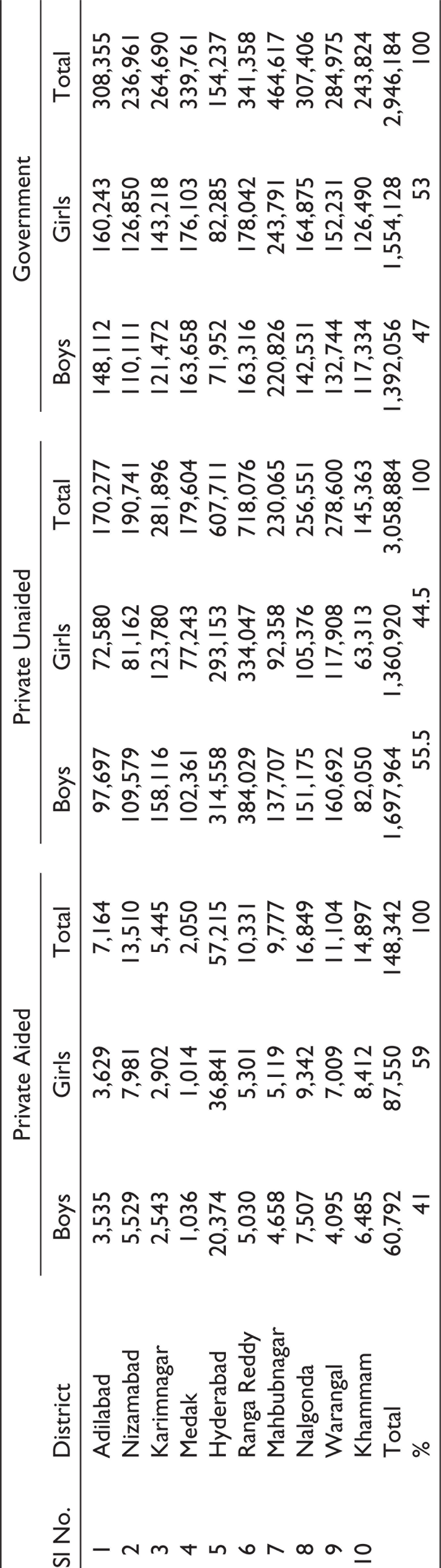
Table 1 demonstrates the relationship between gender and school choice. It is interesting to note that 53% of girls have enrolled in government schools when compared to 47% of boys. The pattern of enrolment in aided schools also represents the government school patterns. This trend is nearer to the national patterns of enrolment across the states in India. Whereas the data related to the private unaided schools represent the reverse trend wherein 59% of boys enrolled in private aided schools, 41% of girls go to private schools. This is where one has to understand the sociological dimension of the gender dimension of class; those who hail from the lower classes tend to choose a government school for girls and private schools for boys. Thus, the enrolment pattern across the districts in Telangana reveals that there is a gendered pattern in school enrolment.
While management-wise school enrolment revealed in Table 1 demonstrates the macro picture from the perspective of gender, the current study aims to explore what the approach of Dalits towards school choice is and what is the role of gender and class among the Dalits in shaping the schools.
Methodological Protocols
Telangana is one of the leading states that promote the low-fee private schools. Warangal district is selected as a study area in Telangana state, which is next to the capital city of Hyderabad, that has emerged as one of the educational hubs. To understand the pattern of school choice, villages and wards in the city were selected. For the present study, four villages in Warangal district and two wards in Greater Warangal Municipal Corporation (GWMC) were selected purposively. A total of 75 parent respondents were selected randomly from the study areas, which include 50 respondents from rural areas (i.e., from four villages) and 25 respondents from urban areas (i.e., two wards). A structured questionnaire was used for eliciting the basic profile of the respondents, whereas an in-depth interview technique was used to access the insights of Dalit parents about the selection of schools in rural and urban Telangana.
Off late, several scholars such as Chitnis (1972), Jayaram (2015), Wankhede (1999), Nambissan (2010), Srinivasa Rao (2013), Nagaraju (2014), Harinath (2013), Temaji (2009), Himabindu (2006) and Ramesh Babu (2005) made a systematic attempt to examine the Dalits 4 engagement with educational institutions. Most of the studies focused on the issues of access to schools and colleges, and the role of structural issues and functional challenges responsible for higher dropout rates, discrimination and humiliations experienced by Dalits in government schools and colleges. It is difficult to find sociological studies on private schools with a special focus on the issues of accessibility and experiences of Dalit children. This is where the current study aims to fill the scholarly gap in the sociology of school choice from the Dalit perspective in India. To provide a context to the personal narratives of respondents, we wish to provide the background by presenting the socio-economic and educational profile of the respondents.
Students Enrolment in Telangana for the Year 2014–2015 (erstwhile districts)
Findings and Discussion
In India, there are three types of educational systems: (a) government (b) semi-government local authority like the municipality or panchayat (through their educational committees) and (c) private trusts. Until the 1990s, most of the schools were under the management of either the government or private aided schools, but with the advent of globalisation and liberalisation, the intense process of privatisation of education gained momentum. One of the major outcomes is the mushrooming of unaided private schools across the states in India, which is a common phenomenon. What is the response of Dalits towards private schools is a key sociological question that needs the utmost attention. The statistical analysis of the school data in Telangana shows that schools, either government, private aided or private unaided, represent the highest level of diversity and hierarchy. A closer analysis of school mapping shows hierarchy in both government and private schools; however, the private school hierarchy is visible because of its sheer number, spread across the villages and publicity.
Choice of School: Parental View
Several empirical studies conducted on the functioning and performance of private schools reveal that parent’s beliefs towards the public and private educational systems have changed over time.
The study found that the majority of Dalit parents send their children to private schools (see Table 2). The most important question to be explained is why Dalit parents working in the non-formal sector preferred an unaided private school for their children? What drives these poor parents who are also not educated? To answer these questions, the personal narratives of the Dalit parents are presented in the following pages:
Mrs. Saritha, a 39-year-old Dalit (Mala community) woman said that she has two children. Her son is studying in a private school and her daughter is going to the government school. She said that her husband had expired five years back and she is struggling with financial problems. To support the family, she engages her daughter in the agricultural works and enrolled her in the government school. She says that if she is sent to the private school she has to be regular to the school and financially the family suffers without her support. She said that though she is financially poor she thought that at least her son should be provided with quality education in private school for his better future and that is why she is sending her child to private school.
Dalit Parents and Schools’ Choice for Children Studies

The above case study is one of the classic examples of how a Dalit woman, who lost her husband, works as an agricultural labourer and uses rational choice theory in school selection. Her choice is gendered in nature; she chooses a private school for her son and a government school for her daughter. Despite her critical social, personal and economic conditions, she wanted to educate her children, but she considered that her son’s education was more important than a daughter because of the patriarchal mindset. It can be understood that in the patriarchy social system, men hold the primary power and dominate in the roles of leadership, moral authority, social privilege and control of the property. So that is the case why the male children are given priority than female children.
Educational Levels of the Respondents
According to Wankhede
parent’s educational background is an important aspect of a child’s education. Education enables social mobility or at least guarantees status retention. Though parent’s education helps to achieve upward mobility, the shift from traditional occupation to modern white-collar occupation has been possible through education only. The education works as a means for social and occupational mobility in an upward direction. The next generation gets benefitted from their parental education as the children are better off than their father’s education. (Wankhede, 1999, pp. 120–121)
However, like the theory of cultural reproduction, the argument of Jayaram (2015) is based on the status of inheritance or retention and is more prevalent between father and children’s higher education, though there is upward mobility that is selective in character.
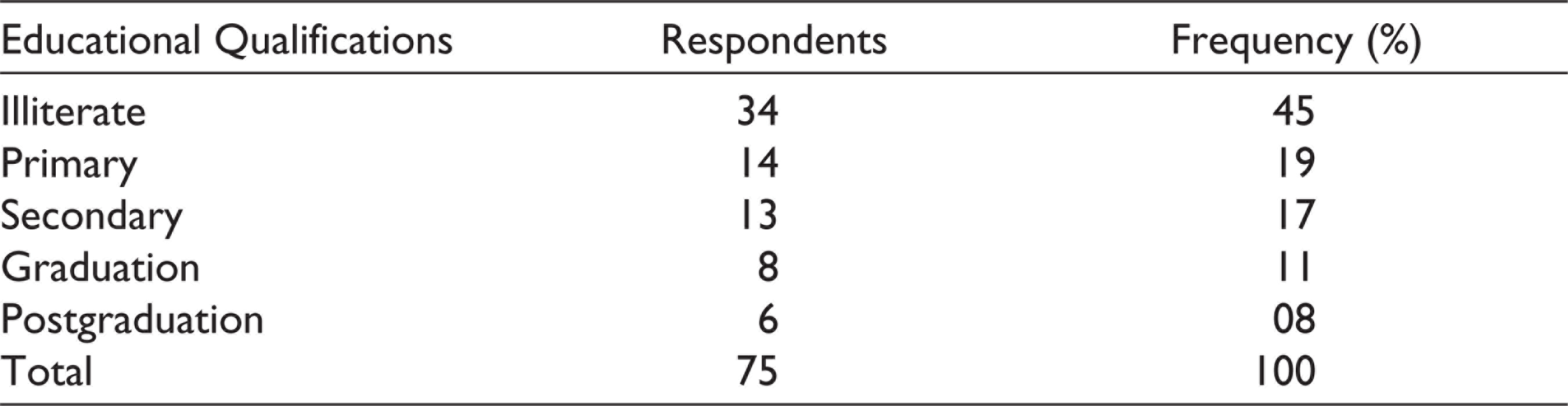
The study observed that education plays an important role in the selection of school choice in Telangana. It is found that the majority of the respondents are illiterates and only 8% have completed their postgraduation (see Table 3). It is interesting to note that around 36% have completed either primary or secondary schooling. However, data related to graduation and postgraduation reveal that around 19% have completed studies. Thanks to the positive discrimination policy of the state, Dalits have started to attach positive significance to education and employment in the public and private sectors. However, those parents with graduation primarily hail from urban areas of Telangana.
Educational Qualifications of the Respondents
Occupational Profile of Parents
Bourdieu’s (1986) sociological studies on education and culture have a larger bearing on understanding the nature of the relationship between occupation and school choice. The fundamental argument of Bourdieu is that the culture of learning to a large extent determined by non-economic factors such as occupations, educational level and residential neighbourhood plays a significant role in shaping the quality of thought and quality of life communities. In the case of rural India, there is a direct relationship between social ranking (caste) and spatial concentration; one cannot ignore its role in shaping access to material, socio-cultural, spiritual and knowledge resources. Thus, one needs to classify the office-based occupations, which encourage a culture of learning and those occupations which are not part of the culture of learning.
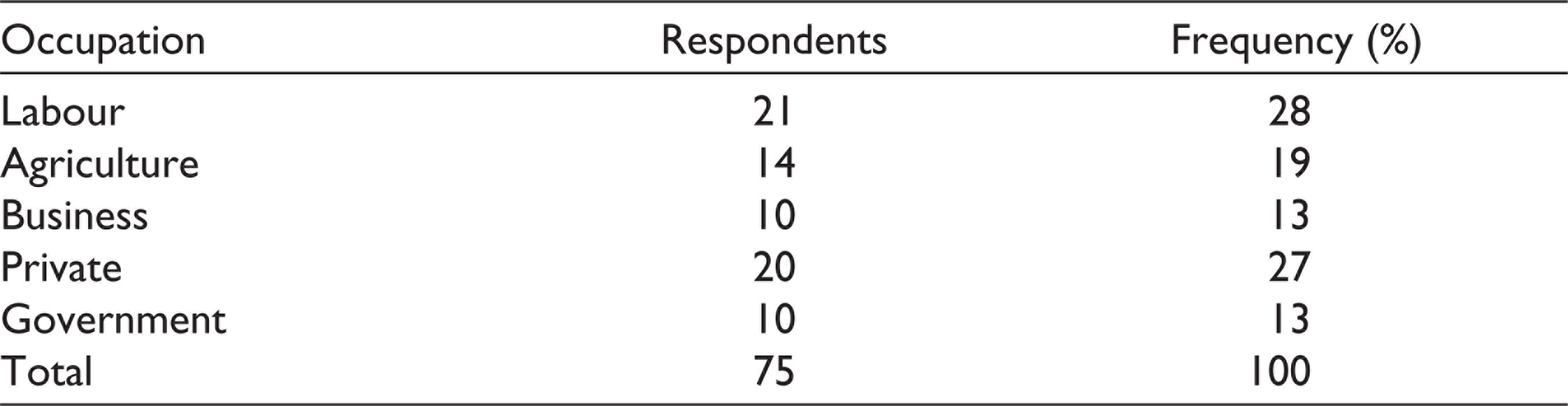
From Table 4, it is observed that only 13% of Dalits have worked in government sectors followed by 27% who are engaged in the private sector. Thus, we can argue that the majority of the Dalits are not part of office-based occupations, which enable them to access diverse sources of information either in the government or in the private sector. Almost one-third of Dalits work as agricultural labourers. One of the defining features of the Dalits’ occupational profile is that the majority (87%) are engaged in the unorganised sector. The study argues that access to the degree of social, cultural and symbolic capital tends to be determined by the economic position of the parents in traditional and modern occupations. The parents involve the children in the household work and tune them to learn new things that are useful in life. Students know how hard it is for parents to work for the survival of the family. Parents take the assistance of the children whenever required in both agricultural and non-agricultural activities. The study tried to find out whether the school-going children are engaged in household work and assist their parents at home. From the study, it is found that 92% of Dalit parents take the help of their children in different kinds of household activities at home, whereas only 8% of the respondents stated that their children would not assist them in any type of household work.
Occupation Levels of Parents
From the above-mentioned analysis, it can be understood that without the aid of the children, some of the families are unable to survive, so the children must take part directly or indirectly in the household work. From the above-mentioned arguments that are made by the parents, it is understood that the children who study in private schools are not involved in any household work at home, whereas the children who study in government schools help their families in the household work. It can also be noted that girl children in few families mainly face more problems due to household work, and they are unable to concentrate on their education and because of that, some of the children drop out of school education and take care of their families. The educated families and employee families do not disturb their children and do not involve them in the household activities, and they do not divert their minds to other activities in the house, and they encourage them in their studies. One can also understand that parents insist on girls to help in the household activities rather than the boys. To overcome this kind of issue, the parents have to create a conducive atmosphere for studying at home.
Income Levels of the Parents
As the Indian state moved from Nehru’s socialism to Narasimha Rao’s economic reforms, the nature and direction of public resource management witnessed a paradigm shift. The education sector has seen massive privatisation from the primary to postgraduate education. Thus, education is not considered as a public good anymore; rather, a private entity wherein parents are referred to as buyers and the school management functions as a private company. In this context, it is very much important to examine the monthly income of the Dalit parents and its significance for meeting the educational expenses incurred towards educating the children in private schools. As private schools known for charging different types of visible and invisible fee charges, parents should have the economic capacity to bear the educational expenditure.
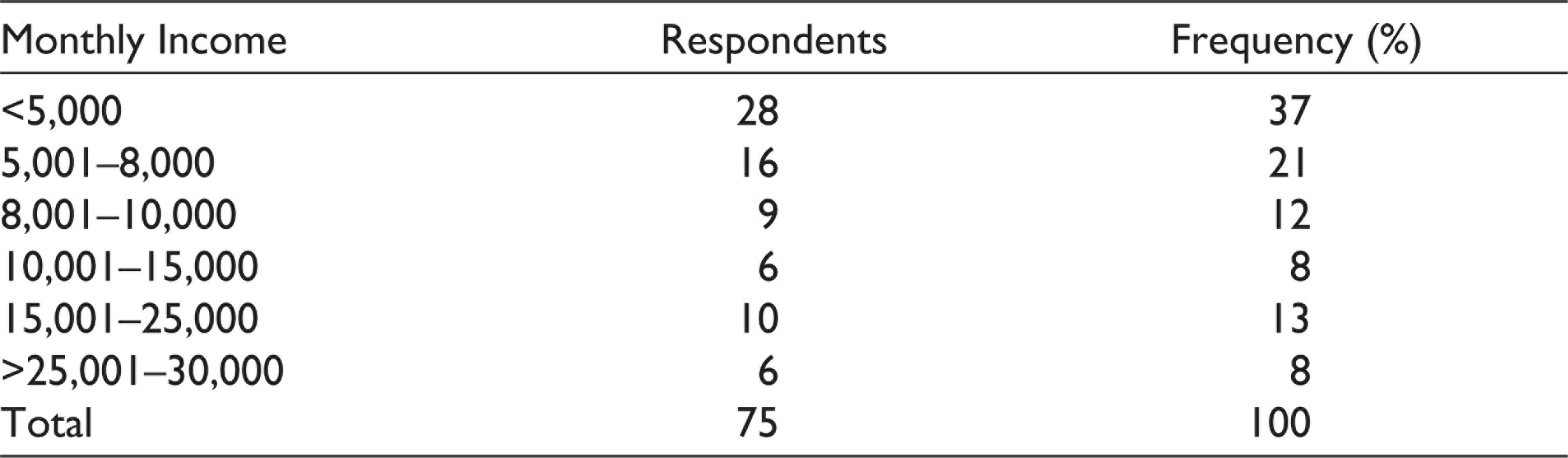
Table 5 reflects the economic status of the respondents. The majority of around 37% earns not even ₹200 per day. Almost 70% of the monthly income is less than ₹10,000 per month, which is equal to ₹300 per day. What is the meaning of education for Dalit working parents situated in a rural and urban setting is a key question that confronts sociologists. One can see the wide gap between the aspirations for private schooling and the economic viability of Dalit households in the selected sample. As the Dalit parents realised the critical significance of private schooling, they tended to evolve multiple plans to select schools for their sons and daughters. The following personal narrative of Dalit women highlights what is the meaning of a private school for Dalits:
Mrs. Rajitha a parent respondent who is about 38 years is from Dalit (Madiga) community working as a Self-Help Group (SHG) leader in the village and her husband works as a bus conductor in a government transport corporation. She said that she had three children, out of whom one is a girl child. Three children are studying in a private school. Boys are studying in a residential school and a girl child is studying in a private school which is near to their village. She said that they are paying around 50000/-rupees per annum for their boys and 15000 rupees paid towards daughter’s school fees which include the transportation charges. She says that the private schools which are nearby the village do not enjoy a good name and the students’ strength is also less when compared to other schools. She said that whenever they have a financial problem she takes a loan from the self-help group and repays the amount as per the installments. She says that being a member of a government employee family and a leader of the self-help group there is no need to send their children to government schools. She claims that sending children to a government school is a sign of low status among relatives.
Income Levels of the Respondents
The most striking observation from the above narrative is that the sense of pride and sense of shame is attached to the private and government schools, respectively. Those who work for the government sector tend to consider admitting their child into a government school is below their dignity. They assume that government schools are meant for the poorest of the poorer sections of society. The key observation of the study is that Dalits do not have the opportunity to enjoy absolute choice; rather, they have to adopt diverse strategies to deal with restricted choice. It is claimed that most of the private schools teach in the English medium, whereas the government schools teach only in a vernacular language that does not have any relevance in the market-driven economy in the era of globalisation. However, it is important to highlight the malpractices followed by private schools by making false mark sheets to appease parents. Our study found that some of the private schools try to manage the parents by awarding marks even if children do not score good marks in the examination. So, if the parents realised that their children failed to score good marks, they preferred to choose another school for better quality education for their child. So, to retain the children in their schools, the management awarded high marks to the children. Management of awarding higher marks to the children used as a strategy and thus one needs to rethink the so-called quality and standards of the private school children.
Parents’ Perceptions of Teachers’ Attitude
Parents’ satisfaction with the teachers’ attitude is also one of the important factors in the selection of schools and shape the perceptions towards quality. Due to the growing parent’s aspirations, schools attach a lot of responsibilities and use teachers to achieve desired results. Within the school compound, the teachers’ attitudes play a vital role in determining the educational achievements of students. Sometimes, the students may not be in a position to tell their parents and give a complaint to the concerned school authorities. In this case, there is a need for the parents to focus on the attitudes of the concerned teachers who teach in schools. From the study, 75% of the Dalit parents said that the teacher’s attitude is right and satisfactory, whereas 25% stated that they are not satisfied with the teachers’ attitudes and behaviour towards their children:
Sadaiah a parent respondent who is about 40 years hails from Dalit (Madiga) community said that the teachers working in the government schools misbehaved with the parents and the students. He stated that the teachers would not respect the parents, and not even bother to maintain friendly relations with the children. He also expressed that they punish the children without a valid reason and because of that the children are afraid to turn up to the school regularly. He also said that the teachers don’t attend school regularly, and few of them would leave the campus during the school hours. He stated that the headmaster is least bothered about the behavior of the teachers and because of that the freedom of the teachers is more.
From the foregoing analysis, one can understand that the attitude of government school teachers compared with private school teachers is highly satisfactory. The study observed that the sense of owning and caring children in a private school is absent in government schools. This is where the role of the teacher became a source of sociological scrutiny in state policy and public understanding. It is found that there is scope for parental right to voice their concerns about the educational standards in private schools. And there is no scope for the children and parents to voice their concerns in the case of government schools. Private schools are always ready to respond to the demands of the market. The teachers have to change their mindset and maintain a harmonious relationship with the students so that they can go for higher education with the support of teachers. If the teacher’s attitude is not right, it reflects on the students, and this may affect their ability to learn and get dropped out of the school. Though most of the government teachers are trained, they are not socially sensitive towards the unique problems confronted by Dalit children and parents in schools and society. So, for maintaining a good atmosphere, there is a need for cooperation between the teachers, students and parents for better education and development in the school.
Conclusion
School choice is one of the key themes of study in sociology in general, and sociology of education in particular. Though the private school choice theory is viewed from the perspective of class and gender, a critical review of studies reveals that issues of access to education dominated for more than five decades. Though over the past two decades, sociological studies on school choice gained critical importance, what are the aspirations and expectations of Dalits towards the private schools’ choice are yet to be studied. This article aimed to fill this intellectual gap. The current study reveals that 75% of Dalits send their children to private schools. However, there is a hierarchy in private school choice. Most of the Dalit parents send their children, especially girl children, either to government schools or nearer by low-fee private schools, whereas the Dalit boys are sent to better quality private schools. The article argues that it is the sense of learning in private schools and a sense of unlearning in government schools push Dalits towards private schools. The sense of shame and pride attached to the government and private schools, respectively, is also responsible for shaping the Dalit school choice. Dalit parents experience a sense of dignity by sending their children to private schools. Thus, the article submits that there is an interplay of class, gender and caste, which guide Dalits parents in school choice.
Footnotes
Acknowledgements
The article is an outcome of the PhD thesis titled ‘Social Location and School Choice: A Sociological Study in Telangana’, submitted to the Department of Sociology, University of Hyderabad. The authors are thankful to the Department of Sociology and the University for academic and institutional support.
Declaration of Conflicting Interests
The authors declared no potential conflicts of interest with respect to the research, authorship and/or publication of this article.
Funding
The authors received no financial support for the research, authorship and/or publication of this article.