






Abstract
While the process of integration allows diversity, forced assimilation encourages homogenisation as the inherent distinctiveness gets subsumed under the dominant cultural system. Despite various constitutional policies, provisions, developmental approaches and strategies adopted to protect, preserve and promote the culture and ethnic identity of the tribes in North-East India, there have been instances of forced assimilation. It is the larger group that strongly influences the numerically smaller tribal communities which subsequently leads to the process of ethnocide. Drawing insights from the literature on ethnocide, the article examines the cultural marginalisation, forced assimilation and cultural homogenising process that has taken place among the Hrangkhawls of Tripura. The article argues that the modern development approaches, heterogenous cultural blindness and forced assimilation have compelled the numerically smaller tribal communities like Hrangkhawls towards cultural marginalisation and ethnic identity distortion in the multi-ethnic state of Tripura.
Introduction
The residual task of analysing and improving developmental issues of Schedule Tribes (ST) within the ambit of merely economic dimension rather blurs the development matter. Despite decades of planned economic development that has remained a critical component of India’s developmental programme, and policy measures for the well-being of the tribal communities, various studies have indicated the incidence of land alienation, displacement, marginalisation, economic exploitation and cultural marginalisation (Ambagudia, 2010; Fernandes, 2017, pp. 33–34). Simply put, the state-led development programmes have been unable to effectively address the actual developmental needs of the tribal communities. Therefore, there is a need for a development trajectory that would address integrated tribal development strategies instead of merely devising a development strategy induced by the process of modernisation approaches (Hettne, 1993; Stavenhagen, 1988).
The axiomatic assumption of the modernisation approach is that economic prosperity would yield better prospects and lead to a higher desirable living standard for the marginalised sections of the society thus, paving the way for the formation of modern society. However, it falls short of addressing the prerequisites of the disadvantageous sections of the tribal society (Stavenhagen, 1988). In this mode of development, socio-economically deprived tribal communities are merely seen as the beneficiaries and their development interests are often dismissed as transient. The disintegration and exclusion of tribals’ worldviews, epistemologies and cultural aspects in the development plans are based on the perception that they are backward and primitive (Xaxa, 2005, p. 1363) and remain as an impediment to development (Sen, 1992). In particular, cultural aspects are merely perceived as a temporary annoyance that will eventually fade (Hettne, 1993). However, these cultural aspects of many tribal communities have not vanished (Stavenhagen, 1988) though they have been consigned to social marginalisation and cultural deprivation.
Irrefutably, the development process has trickled down and numerous benefits have been accrued by diverse tribal communities; however, these benefits are restricted to specific communities within a multi-ethnic society. Although the numerically dominant communities even within a tribal society have benefitted the most and have always taken away the lion’s share at the cost of the numerically smaller tribal communities, the tribal communities have struggled to reap the benefits of the modernisation approach to development. Therefore, the uneven growth and unequal development process have left enough scope for the perpetuation of social and economic disparity. Subsequently, these demographically smaller tribal communities experience immense ‘identity fragmentation’ and ‘erosion of culture’ and ‘threat to traditional practices’. As they continue to fall into the trap of forced assimilation, the process of cultural homogenising forces them to align with other communities under a generic group formation and without getting their distinct cultural recognition and representation (Arora, 2007). Tripura is one such multi-ethnic state situated in India’s North-eastern region that has witnessed instances of forced assimilation and cultural homogenisation faced by the numerically smaller tribal communities; however, these communities are constantly making efforts to maintain ethnic boundaries between other tribal communities (Arora & Kipgen, 2012b) on account of potential threat to their cultural and ethnic identity. There is hardly any scholarly attempt to analyse the nature and dynamic of these processes.
Against this backdrop, this article examines the nature of the complex relationship that exists between the state and numerically smaller tribal communities 1 in Tripura. The article specifically examines how these numerically smaller tribal communities that are designated as sub-tribes in a multi-ethnic Tripura struggle to survive as a cohesive social unit and protect their distinct cultural practises and ethnic identity. Considering tribal communities as ethnic groups, the article has drawn insights from Xaxa’s (1999) formulation of ethnic groups that denotes linguistic, cultural and political boundaries demarcated either by these groups or the state. Precisely, by examining state development approaches with special emphasis on sociocultural aspects that is manifested through its various developmental programmes, cultural outreach and initiatives to celebrate the uniqueness of ethnic identity and protect traditional practices, the article offers an analysis and argues how the process of homogenisation has led to forced assimilation among different numerically smaller tribal communities in Tripura. The article particularly addresses the challenges of cultural marginalisation faced by the Hrangkhawl 2 community, one of the numerically smaller tribal communities in Tripura, due to the top-down oriented modernisation approach, assimilationist framework and homogenising process. The article analyses how the inherent problems that emanate from this mode of development approach create a ‘sense of deprivation’, ‘erosion of cultural practises’ and ‘ethnic identity distortion’ as the smaller tribal communities struggle to keep abreast with the numerically larger tribal communities.
The article has made use of the primary and secondary sources of data. The empirical data have been collected from August 2021 to February 2022 from five Hrangkhawl villages spread across three districts of Tripura where the Hrangkhawls are the only inhabitants. A total of 80 respondents were chosen through purposive sampling technique, of which, 20 respondents are from Kamalachara village in Dhalai District, 25 respondents are from Tuimairang and Killa villages in Sipahijala District, and 25 respondents are from Debthang and Rangamura village in Khowai District of Tripura. The remaining 10 respondents were the executive members of the customary bodies, community organisations and youth associations. Multiple tools of data collection such as participant observation, interviews and structured schedules were employed to collect empirical data.
Ethnocide and Indigenous People: A Theoretical Consideration
According to Arora (2007, p. 208), ethnographic studies on tribal societies in post-colonial India have demystified the depictions of tribes as ‘an isolated, self-contained and primitive social formation’. Hence, considering the proximity between tribes and castes in social formation, assimilation is frequently considered an appropriate strategy for tribal development in India (Babar, 2018). However, in this developmental process, the culture, tradition, custom and identity which are the pronounced markers of the distinctiveness of different tribal communities (Xaxa, 2005, p. 1364) are overlooked and their significance is hardly recognised. Tribal communities are constantly seen as those who are on the outskirts of Indian society and any changes that are taking place to them are merely interpreted as the process of assimilation (Xaxa, 2005). Although social change is inevitable, such a process of assimilation does not provide much scope for integration, let alone accommodate distinct tribal cultures within the process of social change. Pointing out the changes that unfold among indigenous people including tribal communities, Stavenhagen (1988) asserted that this may lead to the extinction of the ethnic group itself and that this neglect of ethnic questions in development thinking is not an oversight but a ‘paradigmatic blind spot’. Hence, this should not merely be seen as a lamentable by-product of the development process, particularly in areas where special provisions exist to safeguard and promote indigenous/tribal communities. This could also be seen as the design of the developmental model that stems from the process of modernisation and subsequently pushes the weaker sections of society to the periphery (Hettne, 1993). They not only find themselves on the brink of losing their ethnic identity but also unable to transmit their culture, language, identity and so on, which is considered as the process of ethnocide (Stavenhagen, 1988).
As per UNESCO
3
definition,
Ethnocide means that an ethnic group is denied the right to enjoy, develop and transmit its own culture and its own language, whether collectively or individually. This involves an extreme form of massive violation of human rights and, in particular, the right of ethnic groups to respect for their cultural identity.
According to Pruim (2014), ethnocide as a cultural process refers to the destruction of various cultures’ ways of thinking, living and being. It seeks to eliminate cultural differences, particularly the notion of differences that exist within minority groups by transforming the group’s cultural norms via forced assimilation. Substantiating a similar notion, Stavenhagen’s (1988) idea of ethnocide assumes significance to articulate the growing sense of deprivation among the marginalised communities. He formulated ethnocide primarily into two significant components: (a) economic and (b) cultural. ‘Economic ethnocide’ is incorporated into development theory and practice, implying that all pre-modern forms of economic organisation must inevitably disappear to give way to either private or multinational capitalism or a combination of capitalism and socialism in state planning. On the other hand, ‘cultural ethnocide’ is the process wherein culturally distinct people lose their identity because of state policies that erode their land and resource base, their language, their own social and political institutions and traditions, their art forms, religious practises and cultural values (Stavenhagen, 1988).
This article draws its theoretical and conceptual arguments from Stavenhagen’s formulation of ethnocide, especially taking ‘cultural ethnocide’ as a process where numerically smaller tribal communities have faced forced assimilation and cultural homogenisation. Homogeneity is an ideological construct that presupposes the existence of a single homogenous group that functions in a unilateral direction. In this sense, in a developing country, ethnic diversity is often seen as one of the reasons for the lack of consensus on economic priorities and development approaches which subsequently hamper economic performance. Therefore, in achieving this homogeneity, the state in a multi-ethnic society uses a variety of methods and strategies to foster common culture via forced assimilation or forcing the smaller communities to adhere to common cultural patterns. It may be clarified that the use of ethnocide or cultural ethnocide as the frame of analysis does not consider political violence or any sort of genocide events. The article only focuses on the effects of the state-led development projects that are primarily based on the modernisation principle merely focussing on economic development, thereby overlooking the ethnic questions and cultural aspects of the tribal communities in the developmental process. As Stavenhagen (1988, p. 62) argued that the swindled consequences of the development projects are the result of deliberate state dominant or control strategies adopted by dominant elites (numerically and politically) wherein indigenous/tribal communities fail to maintain, preserve, and revitalise their cultural identity and lifestyle.
Tribes, Heterogeneity and Development in North-East
Romanticising the notion of tribes as a homogenous and undifferentiated category is an ideological construct, presupposing the existence of a unified community. This notion has been largely interrogated by various scholars due to their distinctiveness and heterogeneity in India (Pathy, 1982; Shah, 1979). However, in post-colonial studies carried out on different tribal communities, they are still romanticised as one homogenous group. Especially, in developmental studies, the adopted development approach has been uncritically equated with economic growth which is measured by higher GDP, national income and per capita income indicators. This subvert tribal traditions and identity due to its homogenising logic, thus making the tribals vulnerable (Kumar, 2017, p. 154). North-East India is endowed with different natural environments, ethnic identities, tribal communities and distinctive ontologies, languages, dialects, customary practices and lifeways have witnessed such developmental approaches. Fernandes (2017, p. 33) argues that the development plan which is based on the principles of economic modernisation has brought modern agriculture in rural areas necessitating the adoption of modern agricultural practises in place of traditional and customary practices. This implies that the prevailing Eurocentric mode of development in the tribal development approach which derives its strength from the modernity paradigm primarily adopts a unilateral path of development. This approach that arose in a neoliberal setting resulted in increasing state intervention in the mode of economic growth causing enormous difficulties in attaining sustained growth for vulnerable communities thereby pushing them to the margin (Sen, 1992, p. 85). Also, in the pursuit of modern society, this path of development adopted by the developing countries has led to the abandoning of tribal innate systems (Sen, 1992). For instance, Fernandes (2017) argues that traditional production methods such as shifting cultivation, collective ownership of resources of the marginalised tribal communities have been replaced or are being replaced by modern practices of farming and plantation.
This mode of development has an undeniable impact on the cultural sphere. As Maddison (2009) argues, the imposition of cultural blindness overlooking the significance of heterogeneous societies and their worldviews yields harmful consequences. The policies and programmes are formulated without considering the social and cultural aspects of tribal communities, with development being seen as more of an imposition than a process intimately linked to their life process (Imchen, 1990). In this development approach, there is no such established development paradigm in which marginalised sections of tribal communities can make their own decisions to ensure their livelihood security and social well-being while preserving cultural identity and way of life. This implies that without adequately appreciating the requirements and resource structure of tribals, particularly the cultural aspects, there has been an excessive focus on industrialisation, exploitation of mineral and forest resources and change from shifting cultivation to settled agriculture, among other things.
Most importantly, in the context of modernisation, the tribal communities regardless of their numerical strength and distinctiveness are expected to assimilate into a larger community and embrace modernisation. According to Babar (2018), such forced assimilation is a process of centralisation and denial of constitutional and territorial rights to indigenous tribal people as this sort of top-down development policy is alien to tribal society and unsuitable in their sociocultural context. Chaudhuri (1982) corroborating similar viewpoints asserted that the entire development process was started without serious consideration for the tribals’ actual needs (cited in Kumar, 2017, p. xviii) and continuously the native tribals’ values, beliefs, personality traits and their socio-political dispositions have been ignored (Imchen, 1990). Considering the possibility of cultural marginalisation that emanates from the ensuing process of development and change, the present article tries to examine the numerically smaller tribal communities of Tripura who encountered difficulties and challenges to protect their cultural aspects despite the existence of various constitutional safeguards.
Multi-Ethnic and Marginality in Tripura
Tripura is a land of multiple tribal communities, where each community has its distinct language, custom, ethnic identity, cultural practices and social institutions. As per the Census 2011, there are 19 STs residing in Tripura (see Table 1). Many numerically smaller tribal communities, designated as sub-tribes or sub-clans, are accommodated in these 19 tribal communities. However, there are not any separate census data available on these sub-tribes or sub-clans; instead, they are clubbed with other communities although these sub-tribes differ from each other in terms of dialects and sociocultural lifestyles. The absence of demographic data on these numerically smaller tribes encourages the homogenising process as they often get subsumed into the larger communities.
Tribal Population of Tripura (1971 to 2011).
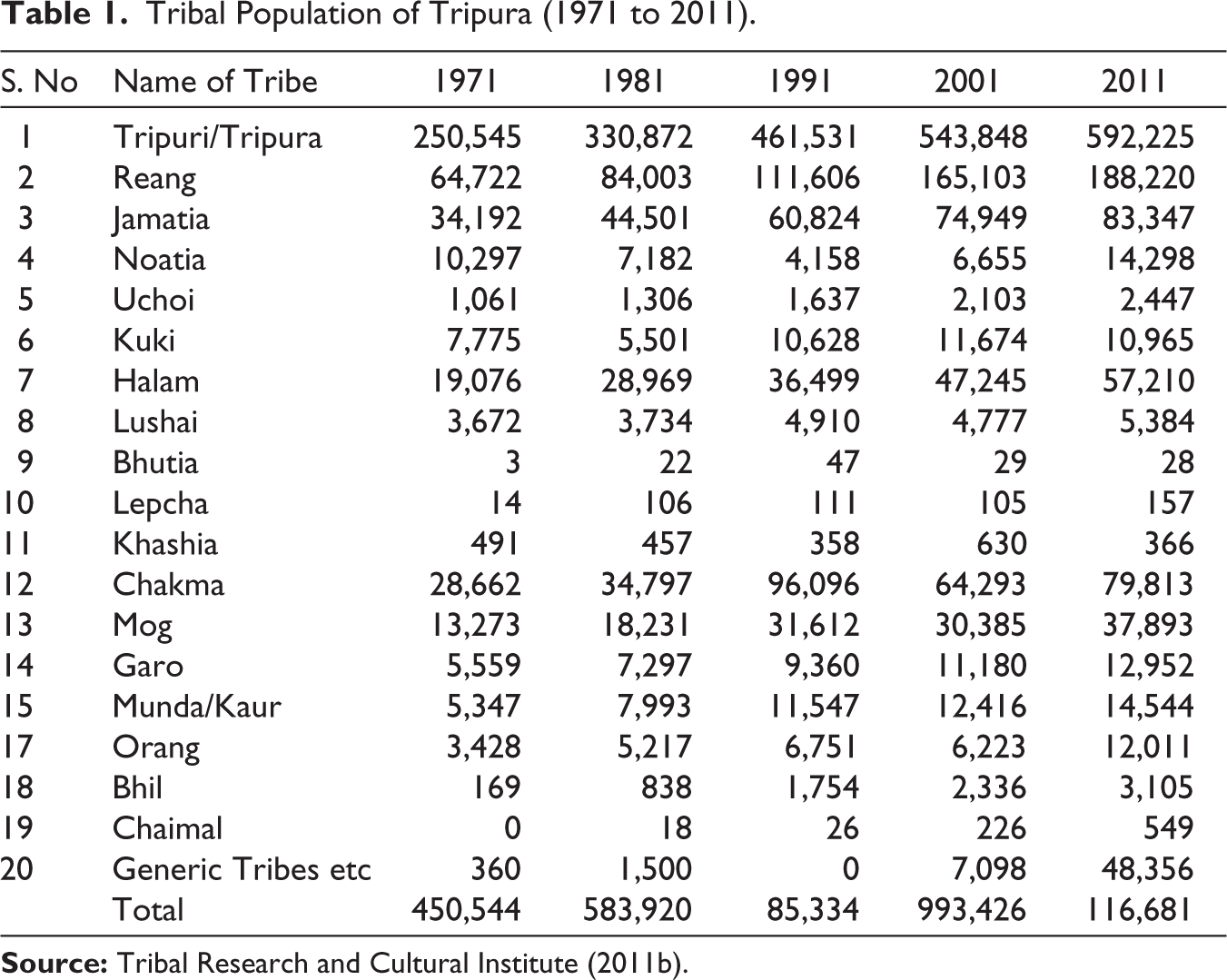
Regardless of whether numerically larger or smaller, all the tribal communities of Tripura have been the victims of drastic changes inflicted primarily due to the exodus of immigrants from neighbouring Bangladesh (Bhattacharyya, 1990). The impact of demographic change led to the transformation of a new settler society (Ganguli, 1983) constituting a tribal population of 31.8% as per the 2011 census. This change has impacted the fabric of tribal culture and tradition by considerably influencing their language, attire and dances (Tripura, 2015). Realising the need to safeguard their distinct culture and identities, and to fulfil their political aspirations along with various constitutional rights and provisions, the Tripura Tribal Areas Autonomous District Council (TTAADC) was established in 1985 under the Sixth Schedule. However, various departments of state agencies that are institutionalised to safeguard and preserve tribal culture and tradition could not ensure the protection and preservation of the tribal communities’ culture and tradition. Rather, various state-led economic development programmes alienated them from their land, languages and other cultural aspects, and their traditional governance structures have been destroyed in the name of economic development (Fernandes et al., 2021). A greater shift in the administrative power further led to the enactment of several policies that were detrimental to the tribal community’s culture and identity (Bhattacharyya, 1990). However, among all tribal communities of Tripura, those who were numerically smaller and who were trapped under a generic identity are the worst victims. The forced assimilation and homogenising process significantly affected their unique sociocultural characteristics. What is intriguing is that the overall turmoil of the tribals’ aesthetic values and distorted cultural aspects have been framed as the mere offshoot of the process of modernisation and societal change and numerically smaller ethnic communities are subsumed as one homogenous group (Dev Varman, 2012; Sen, 1993). To corroborate the above articulation on sense of deprivation, cultural and ethnic identity distortion that is taking place among the numerically smaller tribal communities, the article examines the experiences of Hrangkhawls in Tripura.
The Hrangkhawls of Tripura
The Hrangkhawls are one of the indigenous tribal communities in the state of Tripura who are linguistically, ethnically and ancestrally kin to Chin-Kuki-Mizo 4 (Hrangkhawl, 2018). Soppitt (1893) affirmed that Hrangkhawls were ‘old Kukis’ who shared a common language, customs and their ancestral kin with the larger Chin-Kuki. They once lived in Manipur, but later relocated to Tripura. The Hrangkhawls believed that they descended from a cave ‘sinlung’ or ‘chinlung’ (Hrangkhawl, 2018). This cave is also known as ‘khurpuitlanung’, which translates to ‘stone cave’, and is located somewhere in South Central China (Halam, 2014). Hrangkhawls are convinced that their forefathers came out from this cave, which is evidenced in their legend of Manmasi, which means a ‘hill origin, being out of the stone cave’ (Hrangkhawl, 2018).
According to a community-based census carried out by the Hrangkhawl Customary Assembly (HCA) in 2018, the population of Hrangkhawls was 6,824. 5 In the erstwhile Tripura Kingdom, the Hrangkhawls were known as the bravest soldiers who displayed exemplary bravery in the protection of land and keeping the enemy at bay. As observed from the fieldwork, even now, the elderly members of the Hrangkhawl community narrate the heroics of their ancestors. Therefore, being loyal soldiers of Tripura kings, Hrangkhawls had special recognition. Even the term ‘Hrangkhawl’ is interpreted with two syllables: ‘hrang’, courageous warrior, and ‘khawl’, win over enemies through hardship and difficulties (Hrangkhawl, 2018). The two syllables of Hrangkhawls are translated as courageous warriors who conquer over their foes rightly by any means. This indicates that the Hrangkhawls were the first to move forward at the battleground. Accordingly, Hrangkhawls claimed themselves as ‘Ralmaisak,’ which translates as ‘the first group to march for battle against the foes’ (Hrangkhawl, 2017, 2018). However, the Hrangkhawls are not categorised in the ST list as a separate community but as a sub-tribe clubbing under a generic community in Tripura. One significant reason for this could be the erstwhile Tripura king’s initiative to include them in an umbrella generic community which is referred as the ‘Halam community.’ This was a conscious effort of the king by noticing the similar characteristics found among the various smaller ethnic communities. According to Bhattacharya (1905), the term ‘Halam’ derives its literal meaning from the ‘Kokborok’ 6 language, which is composed of two words: ‘ha,’ which means ‘land or the earth’s surface’, and ‘lam’, which means ‘path or road’. This means the ‘Halam’, refers to the people who were submissive to the king and helped conquer the land. With this etymological meaning, Halams are considered submissive and loyal to their king (Bhattacharya, 1905). Subsequently, this community consisting of diverse smaller ethnic communities having homogenous characteristics gained traction in the post-independence era. However, the different sociocultural characteristics of each of these communities made them distinct even though they were included under a cohesive unit such as Halam. The Hrangkhawls were one such smaller community which became a sub-tribe of Halam. When enquired, the respondents were neither able to mention the name of the king nor the year when they were merged with Halam though they were candid enough to mention that Halam is basically a generic nomenclature which accommodates several tribal communities.
Historical evidence suggests that Halam community shared their ancestral affinity with the larger Kuki group (Halam, 2014). Halams, along with other tribal communities are considered to be the indigenous community of Tripura which can primarily be attributed to the historical events of the Tipperah (erstwhile Tripura name) kingdom (Halam, 2020). For example, the Rajmala or the Royal Chronicle (Vol. 1) and the Krishnamala, the chronicle of Rajah (king) Manikya, which were written in the 15th century and 18th century, respectively mentioned the Halam as sub-tribes of Kukis (Halam, 2020). However, the British political agent W.W. Hunter in 1873 pointed out the existence of the Halams and how they were different from the present-day Kuki in Tipperah Kingdom. Thereafter, based on this historical account, in all census records of the Tipperah Kingdom, the Halams and the Kukis were enumerated as separate tribes, which is continued even in contemporary times. For example, Hunter mentioned that in 1874–1875, the population of Halams and the Kukis were 5,577 and 2,041, respectively (cited in Halam, 2020, p. 2). This enumeration between Halams and Kukis is because of cultural affinities found between Halams and other Kokborok-speaking tribal communities in Tripura. For example, Hunter wrote that ‘the custom of the Halams are becoming more closely allied with those of the Tipperahs, like the Halams wear dhutis like the Tipperahs, while the kukis do not’ (cited in Halam, 2020, p. 3). Regarding this, Arora and Kipgen (2012b, p. 435) stated that the division between ‘old Kuki’ and ‘new Kuki’ appellation is based on linguistic and cultural affinities made by the British. This shows that today those numerically smaller tribal communities of Tripura such as Hrangkhawls who are categorised as sub-tribes were old Kukis, and they were clubbed together under a generic Halam community without sociocultural and linguistic classification made among them.
As per the 2011 census, the Halam community ranks fifth position in terms of numerical strength among the 19 tribal communities in Tripura. The Halam community is divided into 12 dafas and hence commonly known as ‘barka-halam’ or ‘baro-halam’. This baro-halam refers to 12 sub-tribes of different smaller tribal communities. However, the correct number of sub-tribes of the Halam community has remained erroneous. For example, as it is mentioned in the Rajmala, a chronicle of Tripura (cited in Das & Choudhury, 2011, p. 29) the Halam community is divided into 13 dafas: (a) Morchhum or Molochh (b) Rangkhol (c) Koloi (d) Kaipang (e) Rupini (f) Kapl/Deb (g) Khulong (h) Chadai (i) Langai (j) Bongcher (k) Mochhrang (l) Korbong (m) Phutilangla. Hence, it creates confusion about whether the Halam community consists of 13 dafas or 12 dafas or more. Moreover, their identity has been influenced by a variety of nomenclatures or generic terms. For instance, according to Bhattacharya (1905), they are known as Kukis by the Bengalees. The Cacharis called them ‘Lushais’. The Manipuris called them ‘Khonais’. In the Chin Hills and generally on the Burma border, all their clans are called ‘Chins’. The Tripuri community refers to them as ‘Sikam’, and it is believed that the Tripura king bestowed the term ‘Halam’. As evident from the above, historically the Hrangkhawls faced distortion in their ethnic and cultural identities which continued even today, and they are subject to cultural marginalisation, social exclusion and ethnic identity fragmentation.
Social Exclusion in the Cultural Sphere
With constitutional provisions such as Article 244(2) and 275 (1), and special provisions of the Sixth Schedule for the state of Tripura, efforts have been made to protect the rights of the tribal communities. As Arora (2007, p. 209) argued, these special provisions are created to protect the tribal communities and give them special administrative power besides providing the scope to critically examine the political and administrative process towards the recognition and conferment of political aspiration. This is also to protect them from land alienation and exploitation and allow them to pursue their cultural lives (Sen, 1992, p. 79). From various departments and institutions, many schemes and programmes were initiated to preserve, safeguard and promote tribal culture. The state development agencies and institutions take up research projects to document tribal culture and map tribal life and culture while providing financial assistance for the celebration of tribal festivals, collection of tribal artefacts and organisation of customary leader’s conferences. These institutions help develop various databases related to tribal life. Hence, it was expected that along with numerically larger tribal groups, the culture and identity of smaller communities like Hrangkhawls would be preserved and promoted. However, neither proper documentation nor any sincere efforts have been made to preserve the culture and identity of the numerically smaller tribal communities, except only for numerically larger tribal communities in Tripura. Consequently, the Hrangkhawls being the numerically smaller community feel deprived as they continue to be projected within generic tribal communities in the government reports.
Hrangkhawls, like other tribal communities in Tripura, had a rich cultural and traditional heritage. However, due to a lack of representation in the decision-making bodies, cultural and administrative committees, their culture, language, customs, traditions and ethnic identity are not getting due recognition. Despite the provisions of the Sixth Schedule to safeguard and revive their distinct ethnic identity and tradition, the interests of lesser-known tribal communities particularly the interest of Hrangkhawls have not been adequately addressed. This was observed from the field visit as traditional harvest festivals Roul-Sa-Fak of Hrangkhawls receive hardly any acknowledgement, representation or recognition. This shows that Hrangkhawls try to project their distinct sociocultural and ethnic distinctiveness by promoting their ethnic festivals and sociocultural attributes such as language, traditions and customary practices. According to the respondents, though they have been trying to get recognition for their harvest festival, they have not received any positive response while other numerically larger tribal communities of the state have received adequate representation in various sociocultural activities and programmes. For instance, Kokborok Day is celebrated on 19 January every year. To mark the occasion, various activities such as seminars, recitations, cultural programmes and exhibitions are organised by the state which indicates that more emphasis is given to the numerically larger tribal communities as it is visible in terms of financial support and cultural preservation and representation. In this context, one could note that larger tribal communities have been able to receive indigenous Kokborok language recognition in the state of Tripura because of their consistent collective efforts in the language movement which is continuing till today. Like other larger tribal communities in the state, Hrangkhawls seek financial support from the government to celebrate their cultural programmes and demand for their distinct ethnic identity and language recognition. This indicates that Hrangkhawls are aware of their cultural marginalisation and how it has affected their cultural representation. However, they face insurmountable problems. For instance, the president of the ‘Hrangkhawl Youth Association’ (HYA) narrating the hardships and discriminatory practices said,
When we approach one of the state departments for financial assistance for our community leaders conference and annual gathering, they would ask us, which community we belong to. Every year, we celebrate our traditional harvest festival Roul-Sa-Fak and organise the annual HCA conference. However, till now neither we have received any financial assistance nor any recognition.
Narrating the ordeal, the president of HYA opined that for the annual conference of HCA, which was held on 24 and 25 January 2022, the executive members of HCA and HYA visited the nodal officers of the agencies and sought financial support. Assurance was given to them for financial assistance to bear all the expenses, but after the conference, they were not provided with the assistance as promised. It was also observed that in the state’s annual cultural calendar, the Roul-Sa-Fak festival and HCA annual conference were not included, although formally HCA had consistently requested the state authorities to add these. The observation made here is that financial support for events such as community festivals, conferences for community leaders, and overall sociocultural development is limited to the Halam generic community or numerically larger tribal community not specific to Hrangkhawl community. One can observe that the cultural calendar lists all the major tribal festivals and melas [fair] celebrated in the state and provides sponsorship to these events intending to preserve and promote these festivals which are significant in the tribal worldviews and lifeways. When enquired about the nature of support received from the agencies in this regard, the respondents were categorical in their response and opined that whenever a member of the community seeks financial assistance and recognition for their festivals, these have never been entertained. This indicates that the state-sponsored programmes have not been effectively implemented and monitored. Moreover, in the absence of proper assessment reports on the financial support received by each tribal community, it is difficult to ascertain the nature and kind of financial assistance provided to different tribal communities.
In the cultural sphere too, instances of cultural distortion and marginalisation are observed particularly with regards to the recognition of customary laws. The respondents pointed out that there have been instances where the representatives of Hrangkhawls were not included to deliberate on the issues relating to customary law. It may be stated here that customary law is the set of customs, values, practices and beliefs adhered to by the members of the community as obligatory rules of conduct and social institution. The customary cultural practices assume significance from the point of view of the assertion of the ethnic identity of a community. The customary practices are also essential for safeguarding not only internal affairs such as marriage, kinship, etc., but also external affairs such as safeguarding them in the development domain, protecting the forest areas which is linked to identity and culture. The customary law and practices are different from one tribal community to another in Tripura. But with an objective to initiate the process towards developing common customary law for the tribal communities in Tripura is underway. For example, a letter dated 15 June 2022 was issued to deliberate on constituting a ‘common customary law of the Indigenous people’ of Tripura. It was informed by the secretary of the HCA that they have not received any letter in this regard. The meeting was attended by a few heads of tribal groups from larger communities and there was no representation from the Hrangkhawl customary body. This further reaffirms the homogenising process which leads to the distortion of unique customs and cultural practices.
Another factor contributing to the loss of cultural identity of the Hrangkhawls is the potential threat to their language (dialect) as there is no attempt for the recognition and documentation of their languages and dialects by any of the state agencies or institutions. Although a language department was created to document, protect and promote tribal dialects and languages, these have not been effectively addressed for the numerically smaller tribal communities. Instead efforts have been made to assimilate them. For instance, a letter was issued on 24 June 2022 for the preparation of the Halam language grammar book at the primary level. This meeting too was held without the representatives from the Hrangkhawls. Since Halam is a generic group, it is not clear which language will be considered as Halam language and grammar. Here too the numerically smaller tribal communities under the Halam community will face the real threat. This is one such process of homogenising all sub-tribes under Halam to form one ethnic community. As Arora (2007) argued the articulation of ethnic subjectivity undermines linguistic solidarity. Likewise, the linguistic distinctiveness of Hrangkhawls continues to be undermined in the homogenising process.
Distortion of Ethnic Identity
The studies conducted under the aegis of state agencies endorse that the Hrangkhawl community is considered a clan of the Halam community in Tripura. For example, Dev Varman’s study (2012) shows that Halam is a homogenous social group wherein different communities including the Hrangkhawls are part of. The studies of Sen (1993) and Das and Choudhury (2011) also show that Hrangkhawls are a clan of the Halam community. However, these findings and analyses could have resulted from the misconception of the clan system in the Halam community. This misinterpretation could be the result of the ‘heterogenous colour blindness’ and concealing of the tribal distinctiveness and ethnic diversity of the state of Tripura. During the field visit, all the respondents did not approve that they are a clan of the Halam community; instead, they insisted that they carry a distinct ethnic identity with their own clan, culture, tradition and community institutions. This was also echoed by the secretary of HCA as he argued that Hangkhawls have their own clan members which include rwipu, laikai, dabder, saitawl, sairang, drwmkha, molalkhak, vaplom, khongpu, dorja, tangkor and chawnbak. The Rai [chief] of the Hrangkhawl community also resented this very claim of common Halam identity and argued that ‘when we have our own clans, how can we be the descendants or clan of the Halam community’. Further, community-based literature written in leaflets also endorses that Hrangkhawls have distinct ethnic identity, clan members and historical accounts. However, government reports and research studies conducted and funded by the state agencies have not considered the claims made by the Hrangkhawls. Therefore, it may be argued that the extent of heterogeneity that exists within the tribal communities that are subsumed under a generic category has not been addressed thus paving the way for forced assimilation.
Today, Hrangkhawls of Tripura prefer neither to be addressed as ‘Halam’ nor as ‘Kuki’, instead, they prefer to use as distinct ‘Hrangkhawl’ except for their association with generic identity only to establish an intrinsic connection with their larger brethren of Chin-Kuki-Mizo (Lalsim, 2012). When enquired about their response on their preference for a particular community through which they would like to be associated, most of the respondents were unable to give a categorical response. Maybe the ethnic identity fragmentation and prevailing various nomenclatures of generic identities have influenced this response pattern. The apprehension of losing their unique ethnic identity and the fear of missing out on development benefits they receive from the government also hold them back from spelling out their preference. Since the Halam community is taken into consideration by the Government for the implementation of the various developmental programmes and schemes, separate census data on different tribal communities have not been prepared. Even, in its first-ever study conducted in the year 2011 on Halam tribes of Tripura, a separate census or statistical report on the population of each sub-tribe of the Halam community was not provided. Nevertheless, the state relied on this study and conceived the diverse group as a single homogeneous community, that is, Halam. It is also interesting to note that despite Hrangkhawls being classified under the Halam community, they are also identified as Kuki in the official government reports and circulars. For example, in the state/union territory-wise list of STs in India published by the Ministry of Tribal Affairs (2022), Government of India, Hrangkhawl community is missing from the list of Halam’s sub- tribes, where only the names of the sub-tribes such as Bengshel, Dub, Kaipeng, Kalai, Karbong, Lengui, Mussum, Rupini, Sukuchep and Thangchep are included. Instead, the Hrangkhawls are classified as a Kuki sub-tribe and the word Hrangkhawl is misspelt as ‘Rangkhole’. Furthermore, as per the records of the list of the sub-tribes of Halam published by the Tribal Research and Cultural Institute of the Government of Tripura (2011b), Koloi, Korbong, Kaipeng, Bong, Sakachep, Thangachep, Dab or Nabin, Bongcher, Molsom, Rupini, Rangkhowl, Chorai, Lankai, Kaireng (Darlong), Ranglong, Marchafang and Saihmar were included. The Tribal Research and Cultural Institute (2011a) record shows 17 numbers of sub-tribes of the Halam community, in which Hrangkhawl is mentioned in the 11th number. Thus, this has created a situation of fragmentation of ethnic identity for the Hrangkhawls. As found in the study, the distorted ethnic identity of Hranghawls is also visible in the ST certificate issued by the Government of Tripura. For example, those who live in the Dhalai district are issued ST certificates under the Halam community while those who live in the Khowai district are either included under the Kuki community or the Hrangkhawl community.
The Hrangkhawls are aware of their ethnic identity fragmentation and have raised their concerns through the HCA. The HCA has issued objection memorandum repeatedly to correct the spelling of Hrangkhawl from ‘Rangkhole’ and to dissociate from the Kuki community. However, according to the secretary of HCA, even after sending their objection for the third time, their grievances were not addressed. The secretary asserted that the weakening of their traditional customary laws and superseding of the state development policies on their social and political institutions are the reasons that can be attributed to this. Due to the lack of power vested in their customary institutions, the respondents lamented that the community cannot prevent any state-led development projects that are being implemented in the name of economic development. These economic-centric projects have led to further problems such as resource extraction and monocropping coming into their villages which have adversely affected their livelihood security. Notwithstanding these challenges, the executive members of HCA pointed out that they are continuing their efforts towards creating a sense of belonging among Hrangkhawls by conducting a community-based census, organising sociocultural events, sponsoring the youth’s association and their festivals, and most importantly promoting activities for community-based conservation and preservation of village and forest resources.
Development Ails and Ethnocide
Development per se is a simultaneous process of cultural, economic and political, wherein its process should involve institutions, organisations, ethnic groups and local bodies of knowledge (Arora & Kipgen, 2012a). Specifically, the significance of sociocultural factors interconnects with subtleties to enhance the technocratic development measures. However, under the pretext of merely a modernisation approach to economic development, the multi-ethnic state of Tripura embarks upon a development model that provides unequal benefits to the numerically smaller tribal communities; it also creates ethnic and cultural distortions. This mode of development brings cascading effects on their culture, tradition and identity. In the absence of integrative policies, cultural assimilation is primarily considered an appropriate strategy. In the state’s development approach, distinct heterogeneous characteristics have been explicitly ignored as if their society is a development stumbling block and a ‘passing annoyance’ that will eventually disappear (Hettne, 1993). Even if the goal of the development model is not to commit cultural ethnocide, many development projects are primarily encouraging acts of cultural ethnocide (Stavenhagen, 1988). Many welfare-oriented development programmes are designed and influenced by exogenous factors such as political, financial and external interests that benefit a certain section of society, thus creating social disparity. It is also a fact that due to demographic imbalance and the conversion of the state into a new settler society (numerically and politically dominant) along with larger tribal communities constitute the dominant state ideology that facilitates the formation of homogenous groups ignoring the interest of other numerically smaller tribal communities like Hrangkhawls who remain at the receiving end, often leading to passive acceptance. This may lead to hierarchies and ethnic conflicts among the tribal communities in Tripura due to emerging community/group ranking with each other and dominant-subordinate associates in tribal/ethnic alliances (Arora, 2007).
According to Stavenhagen (1988, p. 62), the state apparatus frequently deny that they are responsible for the process of ethnocide and their policies are not confined to a specific tribal/ethnic group but instead intended to help various ethnic groups. Commenting on the aspects of tribal development, Xaxa (2005, p. 1364) also asserted that it would not be appropriate to say that the specific features of tribals are completely ignored, but they were not at the forefront of conceptualisation and their integration in the development process. One could also argue that change is inevitable and universal, and no society can remain static and unchanged for an extended period. Intercultural influences and diffusion are universal processes that occur even when states try to eliminate or limit them (Stavenhagen, 1988, p. 63). These are natural processes that should not be regarded as ethnocide. However, only when an ethnic group loses its ability to reproduce itself culturally and socially because of such forced changes (whether consciously or unconsciously imposed) and is unable to maintain its culture as a creative tool, the impact of ethnocide assume significance.
In the context of Tripura, the scholars have presented contrasted arguments while they analyse the present mode of tribal development in Tripura. While some argue that the tribal middle class in Tripura is growing because of the benefits provided through various development schemes, some studies also suggest that tribal communities have benefited from state-led development initiatives which have helped them to safeguard their identity, language and culture. However, both these arguments can be contested as the benefits have been confined to only a certain section of tribal communities, whereas numerically smaller communities have been relegated to the periphery. Many times, the emergence of this unequal development is also perceived due to the avoidance of tribal communities to take the benefits of development schemes and programmes (Tripura, 2022). However, Hrangkhawls and other tribal communities are not opposed to modern society per se as they want to reap the benefits of all schemes, while maintaining their unique cultural and ethnic identities. However, the concept of integration is seemingly missing in the developmental model or plans in a multi-ethnic Tripura; instead, what is taking place is forced assimilation and homogenising culture. Tribes with smaller numerical strength are perceived to be insignificant and serve only as an annoyance in the development process. It is not that Hrangkhawls have completely lost their ethnic identity, cultural or traditional practices but they are on the verge of doing so, as the process of ethnocide is slowly and steadily trickling in. Hence, there is a need for adequate compilation, recognition, representation and protection of their interests by adopting a notion of ‘ethnodevelopment’ (Stavenhagen, 1988; Sen, 1992) so that a sense of deprivation and disdain does not develop among them which may lead to unrest and protect their distinct social organisation. Nevertheless, smaller tribal communities like Hrangkhawls continue to raise their concerns against the homogenising process and forced assimilation in a bid to protect their distinct cultural practices and identities.
Footnotes
Declaration of Conflicting Interests
The authors declared no potential conflicts of interest with respect to the research, authorship and/or publication of this article.
Funding
The authors received no financial support for the research, authorship and/or publication of this article.