







Abstract
This article examines how caste hierarchy is spatially reorganised through state-led religious infrastructure development in an Indian pilgrimage town. It argues that sacred infrastructure functions not merely as economic investment but as a sociological mechanism that reorders ritual authority, property relations and everyday access to urban space. Drawing on qualitative political sociology and spatial ethnography, it analyses Tuljapur, a major Hindu pilgrimage town in India, undergoing state-led infrastructure expansion centred on a historic temple complex. The study shows that sacred infrastructure functions as a critical mode of regional political economy, organising economic activity, settlement morphology and access to institutional authority. Rather than producing inclusive growth, temple-centred development consolidates spatial hierarchies by embedding caste-based regimes of access within the material fabric of planning and infrastructure. The article further demonstrates how state actors mobilise sacred space as a site of governance and legitimacy, rescaling state power through selective infrastructural investment while reproducing existing inequalities. By foregrounding religion and caste as spatial and political–economic forces, the article advances debates in regional and spatial theory on hierarchy, governance and uneven development. It argues that sacred towns are not exceptional or marginal spaces but key sites through which contemporary state and regional transformation are enacted.
Introduction
Across South Asia, sacred towns have long functioned as dense socio-spatial formations in which religion, political authority, economic circulation and everyday life are deeply entangled. Far from being residual or pre-modern spaces, pilgrimage centres and temple towns have historically played a constitutive role in regional political economies, structuring patterns of settlement, labour, land use and governance. In contemporary India, these sacred geographies are increasingly being repositioned within state-led development agendas, where large-scale infrastructure investments and urban renewal projects seek to transform religious towns into engines of regional growth. This article examines such a transformation in Tuljapur, a prominent pilgrimage town in Maharashtra, to interrogate how religious infrastructure, caste hierarchy and state power interact to reshape space and political economy.
Tuljapur is home to the Tuljabhavani temple, one of the most significant Shakti pilgrimage 1 sites in western India and a long-standing locus of regional religious authority. Historically embedded within Marathwada’s agrarian and caste order, the town has functioned as a nodal point connecting ritual economies, local markets and political patronage networks. In recent years, however, Tuljapur has been drawn into a new phase of state-led spatial transformation, most visibly through the announcement of a ₹1,865 crore temple and town development plan by the Government of Maharashtra (2025). Framed as an initiative to improve infrastructure, enhance pilgrimage experience and stimulate regional development, the project signals an intensified state interest in mobilising sacred space as a site of economic and political intervention. This moment provides a critical empirical window into how religious towns are being reworked as national development spaces.
Building on work that conceptualises pilgrimage sites as dynamic socio-spatial formations rather than static religious landscapes (Shinde, 2012), this article situates Tuljapur within a broader literature on the production of space in sacred towns. Studies of Hindu pilgrimage centres have shown how religious place-making unfolds through long-term interactions between ritual practice, environmental transformation, institutional authority and economic circulation, producing layered spatial orders that are continually contested and reworked. More recent scholarship has extended this analysis to examine how contemporary states rescale governance through pilgrimage infrastructure, integrating sacred towns into urbanisation strategies, tourism circuits and regional growth agendas, as demonstrated in work on Mathura–Vrindavan and other major pilgrimage corridors. These studies underscore that pilgrimage urbanisation is not merely a cultural process but a political and economic one, deeply entangled with state spatial strategies.
At the same time, much of this literature has paid insufficient attention to caste as a constitutive spatial force within sacred towns (Béteille, 1996; Srinivas, 1987). While caste is widely recognised as a foundational axis of social hierarchy in India, its operation as a mode of spatial governance, organising access to land, ritual authority, economic opportunity and infrastructural benefits remains under-theorised in regional and urban studies. In temple towns like Tuljapur, caste hierarchies are materially inscribed in the spatial organisation of sacred and commercial zones, the control of temple-adjacent economies and the differential valuation of religious sites associated with dominant and marginalised communities. This article treats caste not simply as a social identity or cultural residue but as an informal yet powerful regime of spatial governance that shapes regional political economy.
The analysis is further anchored in political geographic scholarship on state power and spatial unevenness in India. Rather than viewing the state as a uniform territorial actor, this literature emphasises how state power is selectively deployed across space, producing uneven development outcomes through differentiated infrastructural investment, regulatory attention and symbolic recognition. Sacred towns offer a particularly revealing lens into these processes, as they allow states to fuse material development with cultural legitimacy, mobilising religious affect to stabilise authority and depoliticise redistribution. The Tuljapur development plan, announced during the Navratri festival 2025 and framed through the language of devotion, heritage and growth, exemplifies this sacralisation of development as a mode of governance.
The article asks three interrelated questions. First, how does religious infrastructure function as a form of regional economic infrastructure in a national context? Second, in what ways do caste hierarchies operate as spatial governance regimes within a sacred town, shaping access to space, resources and institutional power? Third, how does contemporary state-led development intervention reconfigure existing spatial and political relations and with what implications for regional inequality and governance?
By addressing these questions through an empirically grounded case study of Tuljapur, the article makes three contributions to debates in political sociology and regional studies. First, it advances a spatial political economy of religion by conceptualising temples and pilgrimage towns as infrastructural nodes within regional development processes. Second, it foregrounds caste as a spatial and territorial force, extending critical discussions of informality, governance and exclusion. Third, it contributes to theorising state rescaling by showing how sacred space becomes a key terrain through which development, legitimacy and power are co-produced. In doing so, the article argues that religious towns are not peripheral to contemporary spatial politics but central sites where the cultural, economic and governmental logics of regional development converge.
Religious Infrastructure and Regional Political Economy
A growing body of critical scholarship has challenged the tendency to treat religion as external to political economy or sacred space as analytically distinct from processes of urbanisation and regional development. Instead, scholars across geography, anthropology and urban studies have demonstrated that pilgrimage centres and temple towns are deeply entangled with material infrastructures, institutional power and economic circulation, functioning as spatial formations through which authority, labour and value are organised over time (Appadurai, 1981; Bentzen & Gokmen 2023; Eck, 1981; Ensminger 1994; Freitag, 1980). This literature provides a crucial starting point for rethinking religious infrastructure as a constitutive element of regional political economy rather than as a cultural residue within otherwise secular development processes (Oommen, 2004).
Work on pilgrimage urbanisation has shown that sacred centres historically generate durable patterns of settlement and built form, often preceding and shaping later phases of urban growth. Classic studies of Hindu pilgrimage by Eck (1981) and Morinis (1984) foregrounded the spatial logics through which ritual movement produces networks of towns, routes and nodal centres across regions. Subsequent scholarship has extended these insights by emphasising the material and environmental transformations that accompany pilgrimage, including land modification, water management and the construction of ritual and commercial infrastructure (Bharati, 1963; Singh, 1992). Shinde’s (2012) analysis of place-making and environmental change in a Hindu pilgrimage site is particularly influential in demonstrating how sacred landscapes are actively produced through historically layered interactions between devotees, local institutions and ecological processes. By foregrounding the co-production of ritual space and material infrastructure, this work destabilises any sharp distinction between religious practice and economic or environmental governance.
More recent interventions have explicitly situated pilgrimage towns within frameworks of urban and regional political economy. Scholars have shown that pilgrimage generates not only episodic religious gatherings but sustained economic systems involving transport networks, hospitality industries, informal labour markets and real estate speculation (Olsen, 2014; Singh & Rana, 2023). In this sense, pilgrimage operates as a form of circulatory urbanism, producing seasonal yet recurrent intensifications of population, consumption and infrastructural demand that shape regional development trajectories. These dynamics are especially pronounced in secondary towns and non-metropolitan regions, where religious centres often function as primary engines of economic activity in the absence of industrial investment or large-scale manufacturing (Shinde & Olsen, 2023).
Within this literature, temple towns have been analysed as distinctive urban forms organised around religious institutions that anchor markets, residential clusters and administrative functions. Studies of South Indian and North Indian temple towns have documented how temples historically acted as landholding institutions, employers and regulators of craft production and trade, embedding religious authority within regional economies (Champakalakshmi, 2011; Stein, 1980). Gupta et al.’s (2025) work on the spatial organisation of Indian temple towns extends this tradition by demonstrating how temple complexes continue to structure settlement morphology in contemporary contexts, shaping road networks, commercial frontage and land values. Such analyses underscore that temples are not merely symbolic centres but material infrastructures that organise space and economic life at town and regional scales.
At the same time, political geographic scholarship has drawn attention to the changing relationship between pilgrimage, urbanisation and state power under contemporary regimes of development. Studies of Mathura–Vrindavan and other major pilgrimage regions illustrate how sacred towns are increasingly incorporated into state-led strategies of spatial rescaling, tourism promotion and heritage-led growth (Datta, 2024; Varma et al., 2026). These interventions involve significant public investment in transport, sanitation, surveillance and urban design, reconstituting pilgrimage centres as governable spaces aligned with regional development agendas. Importantly, this literature highlights how such projects often operate through the language of cultural preservation and religious service, obscuring their role in redistributing land, resources and authority.
Despite these advances, existing research has tended to privilege macro-scale analyses of pilgrimage economies or historical accounts of temple institutions, often overlooking the everyday practices through which religious infrastructure governs regional political economy in the present. Moreover, much of the literature treats economic outcomes, such as employment generation or tourism growth, as self-evident benefits, without sufficiently interrogating how access to these benefits is structured by social hierarchies and spatial control. As scholars have noted more broadly, infrastructure is never neutral: It produces differentiated access, visibility and value, often reinforcing existing relations of power even as it promises connectivity and growth (Graham & Marvin, 2001; Larkin, 2013).
This article builds on these insights by conceptualising religious infrastructure as a spatial–economic assemblage through which regional political economy is actively governed. It approaches the temple complex not as a bounded religious site but as an infrastructural node that organises flows of labour, capital and authority across the town and its hinterland. By situating Tuljapur within wider debates on pilgrimage urbanisation, temple-town morphology and state-led spatial rescaling, the analysis foregrounds the role of religious infrastructure in producing uneven regional development. It advances a critical epistemological stance that treats sacred space as a site where economic value, political legitimacy and social hierarchy are co-produced, making religious towns central rather than peripheral to contemporary inquiries into space, governance and development.
Caste as Spatial Governance and Regional Exclusion
While religion-oriented analyses of pilgrimage towns foreground ritual economies and symbolic geographies, a parallel body of scholarship on caste and development demonstrates that social hierarchy in India operates through deeply material and spatial mechanisms. Across disciplines, caste has been shown to exert persistent effects on economic opportunity, asset ownership, labour segmentation and access to state resources, even under conditions of rapid urbanisation and market integration (Das, 2011). Importantly for regional studies, this work emphasises that caste is not a residual cultural variable but a dynamic institutional structure that actively shapes regional economic trajectories and spatial outcomes.
In development economics, caste has been conceptualised as a durable system of discrimination and advantage that mediates access to land, credit, employment and public goods. Contributions have demonstrated how caste continues to structure inequality through occupational closure, intergenerational transmission of disadvantage and differential access to development interventions, particularly in non-metropolitan and rural regions (Deshpande, 2011; Thorat & Newman, 2012). Rather than diminishing with growth, caste hierarchies are often reworked through new market and policy regimes, producing uneven development outcomes across regions. This literature is especially relevant for understanding sacred towns, which often sit at the intersection of agrarian hinterlands, informal economies and state-led infrastructure investment (Vasavi, 2014).
At the same time, sociological and geographic scholarship has increasingly foregrounded caste as a spatial force, shaping patterns of settlement, segregation and connectivity. Studies of rural and peri-urban India show that caste is materially embedded in village layouts, neighbourhood formation and access to infrastructure, producing spatial hierarchies that both reflect and reproduce social power (Shah et al., 2006; Thorat & Sabharwal, 2015). Montes et al.’s (2018) analysis of social networks in Indian villages provides quantitative evidence that caste structures not only social ties but also spatial proximity and interaction, resulting in communities that are ‘connected but segregated’. Their findings demonstrate how caste boundaries are maintained through everyday spatial practices, limiting the diffusion of information, resources and economic opportunity across caste lines. Such work underscores that spatial segregation is not incidental to caste hierarchy but central to its reproduction.
Urban and regional scholarship has extended these insights by examining how caste shapes land markets, housing access and patterns of urban expansion. In their analysis of urban peripheries, Upadhya and Rathod (2021) show how caste mediates access to land and capital in rapidly transforming city edges, producing differentiated trajectories of accumulation and exclusion. Their work highlights how dominant caste groups leverage historical land control and political influence to capture the benefits of urbanisation, while marginalised castes are relegated to precarious settlements with limited infrastructural support. These dynamics are not confined to large metropolitan regions but are equally evident in small towns and secondary cities, where informal governance arrangements play a decisive role in shaping spatial outcomes.
This literature suggests that caste operates as a regime of spatial governance, a set of informal yet powerful rules that regulate who can occupy, use and benefit from particular spaces. Rather than functioning solely through explicit discrimination, caste governance works through control over land adjacency, ritual authority, commercial frontage and proximity to administrative institutions. In religious towns, these spatial mechanisms are often intensified, as access to sacred infrastructure is closely tied to economic opportunity. Control over temple-adjacent spaces enables certain groups to monopolise pilgrimage-related markets, hospitality services and ritual labour, translating symbolic authority into material advantage.
Despite these insights, caste remains under-theorised in regional studies and planning scholarship, where spatial inequality is frequently analysed through lenses of class, informality or governance capacity, with limited attention to caste as a structuring institution. This omission is particularly striking in analyses of religious urbanisation, where caste is often treated as a background social variable rather than as a constitutive element of spatial production. By contrast, critical urban theorists have argued that social hierarchies must be understood as territorially embedded and infrastructurally mediated, shaping the distribution of resources and risks across space (Roy, 2009; Weinstein, 2014).
Building on this body of work, this article conceptualises caste not as a static social identity but as a form of territorial governance that structures the regional political economy. In the context of Tuljapur, caste hierarchies shape access to sacred space, commercial zones and infrastructural benefits, producing a spatial order in which economic opportunity is unevenly distributed along caste lines. This approach allows for a more precise analysis of how development interventions, particularly those framed as neutral improvements to infrastructure, interact with existing regimes of spatial control. As the next section argues, state-led planning and development in sacred towns does not simply overlay caste space but often formalises and amplifies it, embedding social hierarchy into the material and administrative landscape of regional development.
Development, State Rescaling and Sacred Space
Scholarship on the spatiality of the state has long emphasised that state power is neither territorially uniform nor evenly exercised across space. Authority is produced through selective interventions, differentiated regulatory regimes and uneven infrastructural investment, resulting in spatially variegated forms of governance and development. Political geographers have shown that such unevenness is not a failure of state capacity but a constitutive feature of how states operate, particularly in postcolonial contexts where historical legacies, political priorities and social hierarchies shape the geography of state action (Corbridge et al., 2005; Jessop, 2007; Painter, 2006). Within regional studies, this perspective has informed analyses of how smaller regions, districts and towns are differentially incorporated into national development trajectories.
In the Indian context, a substantial literature has documented the fragmented and uneven spatial reach of the state, highlighting how policy implementation, infrastructural provision and administrative presence vary sharply across regions and social groups. Scholars have pointed to the coexistence of intensive state intervention in some spaces and relative neglect in others, producing a patchwork of governance regimes within the same political territory (Corbridge et al., 2005; Gupta, 1995). This uneven spatiality is particularly visible in small towns and secondary urban centres, which often fall outside the primary focus of metropolitan-centric development strategies yet become sites of targeted intervention under specific political or symbolic imperatives.
Recent work has argued that religious and cultural sites constitute one such imperative, increasingly mobilised within regional development strategies. Pilgrimage centres, in particular, have emerged as key nodes through which states seek to rescale governance, attract investment and assert political legitimacy understood in cultural as well as administrative terms. Singh’s (2025) study on pilgrimage and urban expansion demonstrates how religious sites are actively integrated into planning frameworks, transport corridors and regional growth agendas, transforming them into infrastructural anchors within broader territorial strategies. Rather than remaining exceptional or marginal, sacred spaces become central to state imaginaries of development, tourism and urban modernisation.
This literature highlights a shift from viewing pilgrimage sites as objects of regulation or heritage protection to treating them as strategic assets within the regional political economy. Through investments in roads, sanitation, surveillance and urban design, states reconstitute religious towns as governable and investable spaces, aligned with narratives of development and national or regional pride. These interventions are often framed through the idioms of service provision, cultural preservation and public welfare, which serve to naturalise state presence while deflecting attention from the redistributive and political consequences of spatial restructuring. As such, pilgrimage-led development operates as a form of state rescaling, where authority is exercised not only through administrative decentralisation but also through the reorganisation of space around culturally resonant infrastructures.
Political geography has further shown that such rescaling processes are inseparable from questions of legitimacy. Jessop’s work on the strategic–relational state underscores that projects are always oriented towards securing consent and stabilising authority under specific historical conditions. In contexts marked by social inequality and regional disparity, cultural and religious infrastructures provide powerful means of producing affective attachment and moral legitimacy, allowing states to present development as both materially beneficial and symbolically meaningful. Sacred spaces thus become privileged terrains for what Painter (2006) describes as the ‘state effect’, where disparate practices and institutions are experienced as coherent and authoritative.
In India, the mobilisation of sacred space for development purposes intersects with longer histories of state–religion entanglement, but it acquires new significance under contemporary regimes of infrastructure-led growth. Scholars have noted that large-scale investments in religious towns often coincide with efforts to rebrand regions, stimulate tourism-driven economies and consolidate political constituencies at the regional level (Datta, 2024; Shinde & Olsen, 2023). These interventions frequently bypass conventional redistributive mechanisms, relying instead on spatial transformation to deliver economic benefits indirectly through market expansion and increased circulation. As a result, development is spatialised rather than socialised, raising critical questions about who gains access to newly created value and who bears the costs of reorganisation.
This article builds on these insights to argue that sacred space functions as a key instrument, enabling the state to align infrastructural development with cultural legitimacy. By investing in pilgrimage towns, the state simultaneously addresses regional development objectives and performs its commitment to religious and cultural values, thereby stabilising authority in politically and economically marginal regions. However, as the analysis of Tuljapur will show, this mobilisation of sacred space is not politically neutral. Instead, it reconfigures local political economy by interacting with existing regimes of spatial governance, often reinforcing entrenched hierarchies even as it expands infrastructure and visibility.
Methodology
This study adopts a qualitative methodological approach grounded in political sociology and spatial ethnography to examine how religious infrastructure, caste hierarchy and state power intersect in the production of regional space. The article draws on 14 months of fieldwork conducted between 2022 and 2024, including 42 semi-structured interviews with temple authorities, municipal officials, traders and priests; analysis of district planning documents; and participant observation during major pilgrimage cycles. Rather than treating space as a passive container of social processes, the research is informed by relational and processual understandings of space developed within political geography and critical urban studies, which emphasise how power, governance and economy are constituted through spatial practices (Massey, 2005; Painter, 2006). Methodologically, this requires attention to both institutional arrangements and everyday spatial negotiations through which development is enacted and contested. Qualitative political sociology provides a framework for examining how material resources, institutional authority and economic opportunities are distributed and contested, while spatial ethnography enables close attention to how these dynamics are embedded in the organisation and use of space. This combination allows the study to move between structural processes, such as state rescaling and infrastructural investment and the situated practices through which caste and religious authority are reproduced in everyday life.
Spatial ethnography, as employed here, is not limited to observation of social interaction but is oriented towards tracing how space itself is governed, accessed and differentiated. Following work that treats space as produced through practice, representation and regulation, the methodology attends to the spatial arrangement of sacred and commercial zones, movement patterns of pilgrims and residents and the material demarcations that organise inclusion and exclusion within the town. This approach is particularly suited to the study of religious towns, where economic activity, ritual practice and governance are tightly interwoven in spatial form.
The empirical material draws on three primary sources: field observations, semi-structured interviews and documentary analysis. First, field observations were conducted across multiple sites within Tuljapur, including temple precincts, pilgrimage routes, market areas and residential neighbourhoods. These observations focused on spatial practices related to ritual, commerce and mobility, as well as the everyday interactions between temple authorities, local residents, pilgrims and state actors. Particular attention was paid to how space was regulated informally through caste norms and institutionally through signage, policing and infrastructural design. Second, the study is informed by semi-structured interviews with a range of actors connected to the town’s religious and economic life. These included temple-affiliated functionaries, priests, local traders and service providers, residents from different caste locations and individuals involved in local governance and planning processes. Interviews were oriented towards understanding perceptions of development, access to economic opportunity and experiences of spatial inclusion and exclusion. Rather than seeking representative coverage, the interviews were designed to capture differentiated positionalities within the town’s political economy, allowing analysis of how development is unevenly experienced. Third, documentary analysis was undertaken of town planning documents, government notifications, development proposals and publicly available materials related to the Tuljapur temple and town development plan. These documents were analysed as artefacts of state spatial reasoning, revealing how sacred space is framed within policy discourse, how development priorities are articulated, and how particular spatial interventions are legitimised. Reading these materials alongside ethnographic observations allows the study to trace the disjunctures and alignments between planning imaginaries and lived spatial realities.
Analytical Strategy and Methodological Positioning
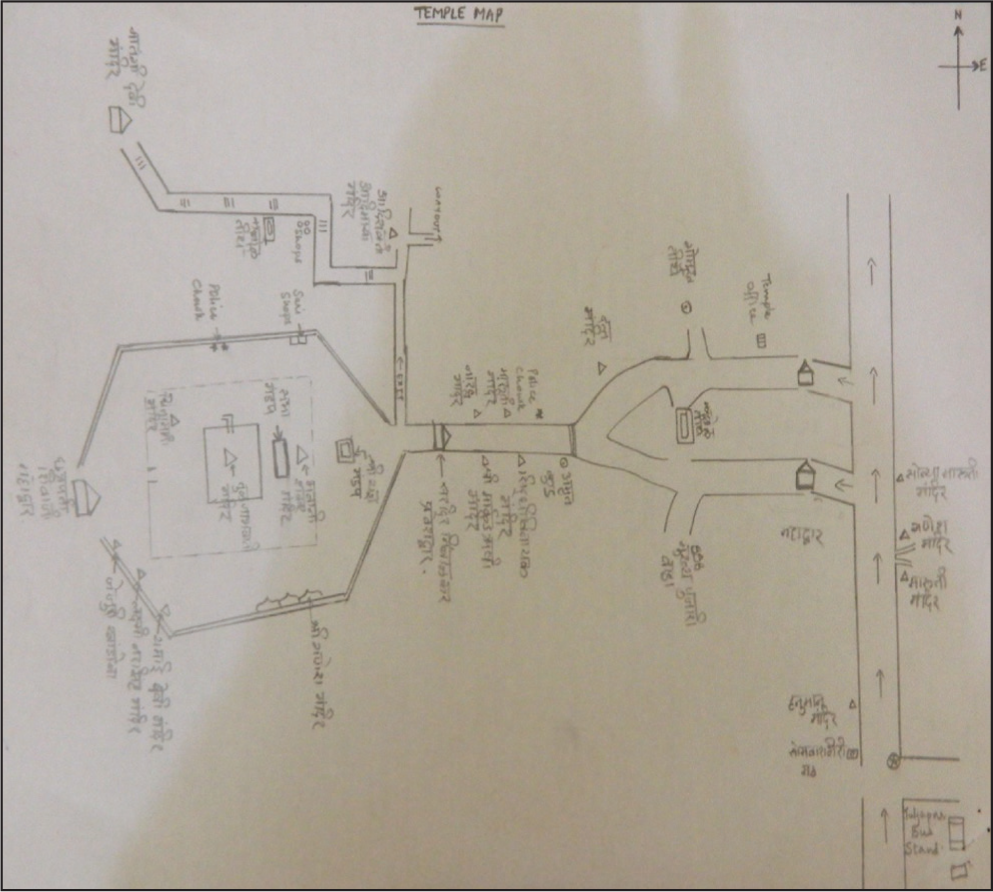
Analysis proceeded iteratively, moving between empirical material and conceptual frameworks drawn from regional political geography and cultural economy scholarship. Field notes, interview transcripts and documents were coded thematically, with particular attention to recurring spatial patterns related to access, control and visibility. Rather than treating caste, religion and state action as discrete variables, the analysis focuses on how they intersect in the governance of space, producing a regional political economy that is both materially grounded and symbolically legitimised. Spatial analysis in this study is interpretive rather than cartographic. The emphasis is on how spatial hierarchies are enacted through proximity to sacred infrastructure as seen in Figure 1, control over commercially valuable locations and differential exposure to state investment. This approach aligns with critical work on infrastructure and governance that foregrounds lived experience and power relations over formal spatial metrics.
A Map Tuljabhavani, the Temple Premises and the Spatial Invisibility of the Matangi Temple.
This methodological approach is grounded in traditions of regional politics and the cultural economy of cities, which stress the importance of situated, qualitative inquiry for understanding uneven development. By combining political sociology with spatial ethnography, the study responds to calls for empirically rich analyses that connect macro-level processes of state rescaling with micro-level practices of governance and exclusion. The methodology is thus designed not only to document spatial inequality but also to interrogate the processes through which development interventions come to reproduce or reconfigure existing power relations in regional contexts.
Sacred Infrastructure, Spatial Hierarchy and Developmental Reconfiguration
Tuljapur is a medium-sized pilgrimage town located in the Marathwada region of Maharashtra, a region historically characterised by agrarian distress, uneven industrialisation and episodic state investment. The town’s regional significance derives primarily from the Tuljabhavani temple, one of the most prominent Shakti pilgrimage sites in western India, which attracts large numbers of devotees during Navratri and other ritual periods while sustaining a steady flow of visitors throughout the year. Far from functioning as a discrete religious enclave, the temple complex operates as the town’s central infrastructural and economic node, shaping patterns of settlement, circulation and livelihood across Tuljapur and its hinterland.
The Temple as Regional Economic Infrastructure
Field observations and interviews reveal that the Tuljabhavani temple structures the town’s economy in both direct and indirect ways. Temple-centric activities generate employment across a range of sectors, including ritual services, retail, transport, accommodation, food provisioning and informal vending. These activities are spatially concentrated around the temple precinct and along key approach routes, producing a dense commercial core where economic opportunity is tightly coupled to proximity to sacred infrastructure. Local actors repeatedly described access to temple-adjacent space as a primary determinant of livelihood viability, underscoring the material importance of religious infrastructure in organising the town’s political economy.
The economic effects of pilgrimage extend beyond the immediate temple precinct. Seasonal influxes of devotees generate demand for transport and services across the town, while ritual calendars shape temporal rhythms of work and income. However, these benefits are unevenly distributed. Control over permanent commercial structures, shopfronts and storage spaces near the temple is highly concentrated, while more precarious forms of labour, such as temporary vending or service provision, are relegated to marginal or regulated zones. In this sense, the temple functions not merely as a generator of economic activity but as a spatial filter that differentiates access to value based on location and institutional affiliation.
Caste, Sacred Space and Informal Spatial Governance
Caste hierarchies are central to the organisation of space and economy in Tuljapur (Krishnan & Jambhulkar, 2015). Ethnographic observation indicates that access to sacred authority, commercial opportunity and spatial proximity to the temple is stratified along caste lines, producing a spatial order that is widely recognised but rarely formalised. Dominant caste groups occupy positions of ritual authority and exercise informal control over temple-adjacent economic activities, while marginalised castes are spatially and institutionally distanced from the town’s most valuable zones.
This stratification is materially inscribed in the town’s sacred geography. The Tuljabhavani temple occupies a central and elevated position, both physically and symbolically, while the Matangi temple, associated with Dalit religious traditions, is located on the town’s periphery. Field accounts indicate that this spatial separation is not merely historical but actively reproduced through everyday practices, including patterns of movement, investment and maintenance. While the Tuljabhavani precinct benefits from continuous infrastructural upgrading and administrative attention, peripheral sacred sites remain under-resourced, reinforcing a hierarchy of religious value that maps onto caste differentiation.
Caste-based spatial governance also shapes economic participation. Interviews with local traders, priests and service providers suggest that entry into lucrative pilgrimage-related markets is mediated by caste networks that regulate access to capital, information and institutional support. These informal governance mechanisms operate alongside formal regulations, producing a layered system of control that privileges certain groups while rendering others dependent on precarious or informal arrangements. In this way, caste operates as a territorial regime that governs not only social interaction but the spatial distribution of economic opportunity within the town.
Development Planning and the Rescaling of Sacred Space
The announcement of a large-scale temple and town development plan marks a significant moment in Tuljapur’s spatial and political trajectory. Framed by state authorities as an initiative to improve infrastructure, enhance pilgrimage experience and stimulate regional development, the plan signals an intensification of state involvement in the town’s sacred economy. Fieldwork suggests that this intervention is widely perceived as both an opportunity and a threat: While some residents anticipate improved connectivity and increased economic activity, others express concern about displacement, exclusion and loss of access to space.
Analysis of planning documents and public discourse reveals that the development plan prioritises infrastructure in and around the Tuljabhavani temple precinct, including circulation routes, public amenities and beautification projects. These interventions effectively rescale the temple from a local religious institution to a regional development anchor, integrating it more closely into state imaginaries of tourism-led growth. However, this rescaling also risks formalising existing spatial hierarchies. By directing public investment towards already privileged zones, the plan may consolidate caste-based advantages under the guise of neutral infrastructure improvement.
The timing and framing of the development initiative further underscore its role in governance. Announced during a major religious festival and articulated through the language of devotion and heritage, the project mobilises sacred affect to legitimate large-scale spatial intervention. This fusion of religious symbolism and developmental rhetoric obscures the distributive implications of planning decisions, rendering questions of access and exclusion secondary to narratives of regional pride and growth.
Taken together, the empirical material shows that Tuljapur’s transformation is not simply a story of urban upgrading or pilgrimage management. Rather, it reveals how religious infrastructure, caste governance and state planning intersect to reconfigure local political culture. The temple operates as an infrastructural node that concentrates economic value; caste hierarchies regulate access to this value through spatial control and state-led development amplifies these dynamics by selectively investing in sacred space. The result is a process of regional development that expands infrastructure and visibility while reproducing entrenched inequalities in access and authority.
This case demonstrates that sacred towns are critical sites for understanding contemporary regional development in India. Far from being exceptional or culturally isolated, Tuljapur illustrates how development unfolds through culturally resonant infrastructures that carry historical hierarchies into new spatial forms. The next section draws these empirical insights together to reflect on their broader implications for theories of state rescaling, spatial governance and uneven development. This article has examined Tuljapur as a sacred town undergoing state-led spatial transformation to argue that religious infrastructure, caste hierarchy and local development are co-constitutive rather than analytically separable processes. Bringing together insights from political sociology, spatial ethnography and state theory, the discussion synthesises the empirical findings to advance three interrelated conceptual contributions to debates in local epistemologies.
Contemporary Development Planning in Tuljapur: State Infrastructure, Community Contestation and Spatial Reconfiguration
Recent years have marked a significant escalation of state-led intervention in Tuljapur through the announcement of a large-scale temple- and town-centred development plan. In 2025, the Government of Maharashtra formally proposed a ₹1,865 crore infrastructure programme aimed at transforming the Tuljabhavani temple precinct and the surrounding town into a ‘world-class religious and cultural destination’, with implementation scheduled over a multi-year horizon and symbolically inaugurated during the Navratri festival period (Swarajya, 2025). The temporal alignment of the project launch with a major ritual calendar underscores how state development initiatives strategically harness religious affect and pilgrimage temporality to legitimise spatial intervention.
Official policy narratives frame the project as a comprehensive modernisation effort, emphasising crowd management, improved darshan facilities, transport access, sanitation and public amenities (Government of Maharashtra, 2026; Times of India, 2025). Within this framing, sacred infrastructure is explicitly positioned as a regional growth engine, linking pilgrimage flows to tourism development and local economic expansion. Such narratives resonate with broader state strategies across India that mobilise religious sites as anchors for regional development and infrastructural visibility (cf. Shinde, 2012; Singh, 2025).
However, empirical material from Tuljapur complicates these development imaginaries. Field observations and interviews conducted for this study reveal that the spatial logic of the proposed plan intersects unevenly with existing social hierarchies and settlement patterns. Temple-adjacent zones, already dominated by historically powerful caste groups and institutional actors, are prioritised for infrastructural upgrades, circulation improvements and symbolic beautification. Peripheral residential areas, where marginalised caste communities are more densely located, appear largely absent from planning discourse, reinforcing long-standing patterns of spatial neglect documented in studies of temple towns and religious urbanism (Gupta et al., 2025; Upadhya & Rathod, 2021).
Local contestations surrounding the development plan further illustrate how sacred space functions as a politically charged terrain. Media reports document protests by residents and priestly groups who criticised early design proposals as spatially biased and culturally insensitive, particularly in relation to iconographic choices and land-use reorganisation near the temple precinct (Times of India, 2024). While some of these objections were framed in religious or aesthetic terms, interviews suggest that they also reflected deeper anxieties about displacement, loss of economic access and exclusion from decision-making processes. These dynamics echo broader findings in political geography that show how state-led spatial restructuring often provokes conflict when it intersects with entrenched local governance regimes and informal power structures (Painter, 2006; Roy, 2009).
Crucially, caste emerges in this context not merely as a social background variable but as a mediating force in the distribution of development benefits. Fieldwork indicates that control over ritual services, commercial spaces and informal regulatory authority around the temple is concentrated among dominant caste networks, enabling them to convert religious proximity into durable economic advantage. The formalisation of infrastructure through state planning risks further institutionalising these advantages by embedding them in road alignments, zoning decisions and circulation routes. As such, development operates as a mechanism through which existing caste-based spatial hierarchies are rendered infrastructurally durable.
From the perspective of state spatiality, the Tuljapur plan exemplifies a mode of regional state rescaling that operates through selective infrastructural investment rather than administrative reorganisation. By intensifying intervention in symbolically potent sacred space, the state expands its territorial presence while aligning itself with religious legitimacy. Yet this rescaling is uneven: It amplifies state visibility and capacity in temple-centric zones while leaving broader questions of social equity and participatory governance unresolved. In this sense, sacred space becomes a vehicle for both infrastructural modernisation and the reproduction of uneven regional development.
Taken together, the contemporary development trajectory of Tuljapur highlights how state-led planning in sacred towns is inseparable from local political economy and community power relations. Far from being a neutral technical exercise, the development plan represents an ongoing negotiation over space, authority and belonging, one in which religion, caste and state infrastructure converge to reshape the town’s regional role while deepening existing inequalities.
The Tuljapur case demonstrates that religious infrastructure functions as a central organising mechanism of regional political economy, rather than as a peripheral cultural appendage to development. The temple complex operates as an infrastructural assemblage that structures labour markets, commercial geographies and temporal rhythms of economic activity. In doing so, it produces spatial concentrations of value that extend beyond ritual practice into everyday livelihood formation. This finding reinforces and extends scholarship that treats infrastructure as a socio-material system through which economic and political relations are stabilised and contested.
However, the empirical material also complicates celebratory accounts of pilgrimage-led growth by showing that the economic productivity of sacred infrastructure is inseparable from regimes of spatial control. Access to temple-adjacent spaces, rather than participation in pilgrimage per se, emerges as the critical determinant of economic advantage. This highlights the need for regional political economy to attend not only to aggregate growth effects but also to the spatial mechanisms through which value is differentially captured within religious towns. Sacred infrastructure, in this sense, does not merely generate economic activity; it governs its distribution.
Caste as Territorial Governance Rather Than Social Residue
The analysis advances a spatial understanding of caste by demonstrating how hierarchy is reproduced through territorial arrangements and everyday practices of spatial regulation. In Tuljapur, caste operates as an informal but effective regime of governance that structures proximity to sacred infrastructure, control over commercial zones and access to institutional authority. These spatialised mechanisms translate symbolic religious dominance into material advantage, revealing caste as a form of territorial power rather than a static social identity.
This finding challenges approaches that treat caste as a background variable or cultural constraint within regional development. Instead, caste emerges as a dynamic spatial institution that actively mediates how infrastructure is used, valued and governed. By foregrounding caste as spatial governance, the article contributes to broader debates on informality and power in urban and regional contexts, showing that informal institutions can be both durable and highly effective in shaping development outcomes. Importantly, this perspective also reveals how spatial inequality is normalised through everyday practices, rendering exclusion both routinised and politically opaque.
The Tuljapur development initiative illustrates how states mobilise sacred space as a strategic terrain for rescaling governance and asserting legitimacy. By investing in temple-centric infrastructure and framing development through religious and cultural narratives, the state aligns material intervention with affective attachment, producing development as both an economic and a moral project. This fusion enables the state to expand its spatial presence while deflecting attention from the distributive implications of planning decisions.
The analysis shows that state rescaling in sacred towns operates less through formal administrative reorganisation than through selective spatial investment. Development is enacted by intensifying infrastructural attention in symbolically resonant zones, effectively repositioning the temple as a regional growth anchor. However, this process also formalises existing spatial hierarchies, embedding caste-based advantages into the material fabric of development. In this sense, sacred space becomes a vehicle through which the state reproduces uneven development under the guise of neutral infrastructure provision.
Taken together, the Tuljapur case underscores the importance of integrating religion, caste and power into analyses of space and development. The findings suggest that sacred towns are not exceptional or marginal but exemplary sites where contemporary spatial politics are rendered visible. They reveal how development unfolds through culturally embedded infrastructures that carry historical hierarchies into new spatial configurations.
This article has examined Tuljapur as a sacred town undergoing state-led spatial transformation to argue that religion, caste and infrastructure are central, rather than peripheral, to contemporary processes of regional development. The article advances regional and spatial scholarship in three key ways. First, it contributes to debates in regional studies by integrating religion into analyses of political economy and infrastructure. Rather than treating sacred space as culturally exceptional or analytically marginal, the study shows how temples and pilgrimage towns function as infrastructural nodes that organise labour markets, settlement patterns and development priorities. In doing so, it expands prevailing understandings of regional growth and uneven development to include culturally embedded forms of infrastructure.
Second, the article foregrounds caste as a regime of spatial governance that structures access to economic opportunity and institutional power. By demonstrating how caste hierarchies are materially inscribed in the organisation of sacred and commercial space, the analysis moves beyond identity-based accounts to reveal how social inequality is reproduced through territorial control and everyday spatial practices. This perspective underscores the importance of incorporating informal governance structures into analyses of development and planning, particularly in non-metropolitan contexts.
Third, the study contributes to theorising the state rescaling by showing how sacred space is mobilised as a site of infrastructural investment and political legitimation. The Tuljapur case illustrates how the state’s engagement with religious towns enables it to align development objectives with cultural affect, thereby expanding spatial reach while obscuring distributive consequences. This highlights the need for greater critical attention to the symbolic and spatial dimensions of state-led development initiatives.
The findings position sacred towns as critical sites for understanding uneven regional development in contemporary India. More broadly, the article opens new pathways for research on the political economy of religion, suggesting the need for comparative and longitudinal studies that examine how religious infrastructure shapes development trajectories across regions and governance regimes. The case demonstrates that infrastructural development in contemporary India cannot be understood purely through economic metrics. It must be analysed as a sociological process through which caste hierarchies are recalibrated, ritual authority is institutionalised and the state re-enters everyday life in new forms. By situating religion within the core analytic concerns of spatial theory and regional studies, the article calls for a rethinking of how development, infrastructure and power are conceptualised in culturally complex contexts.
Footnotes
Acknowledgements
The author would like to thank Dr. Suresh Madhavan, Assistant Professor, TISS, Mumbai, for their valuable comments, constructive criticism, and intellectual support during the course of this research.
Declaration of Conflicting Interests
The author declared no potential conflicts of interest with respect to the research, authorship and/or publication of this article.
Funding
The author received no financial support for the research, authorship and/or publication of this article.