







Abstract
In this article, I explore interstitiality – a concept based on Gil Eyal’s notion of ‘spaces between fields’ – as a potential heuristic lens for observing contemporary elites, applying it to high-ranking figures in the Compagnia San Paolo (CSP). CSP is a banking foundation (Fondazione di origine bancaria or FOB) that was set up in the 1990s arising from the privatization of the Italian banking sector. After outlining the theoretical underpinnings of interstitiality, I bring the construct to bear on my own empirical work. First, I elucidate what FOBs are and why they may represent a valuable interstitial observatory on a significant segment of power elite. Second, I examine CSP as an emblematic instance of an FOB. Third, I illustrate the main characteristics of CSP’s elites, suggesting that these groups reflect the features of interstitiality insofar as: they merge logics and grammars of justification from different fields; and, given their high degree of mobility across fields, they contribute to disseminating discursive and governmental practices of hybridization. My aim, as advocated for by Mike Savage and Karel Williams, is to enrich the sociological debate on elites by introducing a new conceptual tool.
Introduction
In this article, I argue that the notion of interstitiality developed by Eyal (2013) offers a valuable conceptual and analytical key to investigating contemporary elites. In support of this, I discuss a case study on the highest-ranking figures in an Italian foundation of banking origin, relating it to recent lines of sociological enquiry into elites.
Elites have once again become the object of keen scientific investigation: the increasing gap in power and wealth between the so-called ‘one percent’ and the rest of the world, as well the electoral outcomes in Western countries indicating a shift of the electorate from centrist positions towards the more radical proposals of right-wing populist leaders, has contributed to renew the interest for this field of enquiry. The reasons for the previous disinvestment from the study of elites were due in part to increasing fragmentation and specialization within the social sciences (Denord et al., 2018; Zald & Lounsbury, 2010). The current revival has raised a vibrant debate on how to refine existing conceptual and analytical tools.
The very definition of elites is at the core of this debate. In my research, I am keen to use this term operatively, critically and flexibly, following a socio-historical approach informed by the Anglo-American pragmatist tradition of C. W. Mills (1956). Without embracing any rigid, a priori, definition of an elite, I broadly understand it to be any group of people who wield a certain degree of influence over society, who identify as such, and who are also perceived as such from the outside, by virtue of an ethos or vocabulary of motives (Mills, 1940) that is the source of their legitimacy.
Rather than focusing on a specific group, individual, family, or resource, I identified a level of analysis at which to observe flesh and blood elites and their role in politics. Specifically, I chose to focus on large banking foundations (Fondazioni di origine bancaria, FOBs), which are among the key sites where political, economic and financial power are concentrated in present-day Italy. I must also point out that in this article I have not studied how elites exert their influence, but from which position they wield it.
There are currently 86 FOBs, 1 which are spinoffs of banks, established by law, and legally required to invest their assets in policy areas that largely coincide with the brief of local government. FOBs vary greatly in terms of size, territorial scale and the composition of their board: in my research, I concentrated on one emblematic instance: the Compagnia San Paolo (CSP) of Turin. CSP is one of the largest foundations in Europe in terms of grants and assets (Salamon, 2014) and, together with Fondazione Cariplo in Milan, remains the main shareholder of Intesa, the leading Italian banking group. This choice enabled me to observe a cross-cutting elite segment, as well as unusual ways of conceptualizing and acting in politics.
The interpretive framework that I adopted drew on a combination of secondary literature and interviews with 35 key informants (50% FOB insiders; 50% FOB outsiders). I also compiled a prosopography, based on 16 socio-demo and positional variables (e.g. types and number of fields worked in during professional career, years’ service in CSP), of the 130 members of the seven most recent boards of directors of CSP (1991–2019), which I analysed longitudinally, using the term of office of the seven boards as the independent variable.
I set out to assess interstitiality at two different levels: in CSP as an organization and among its highest-ranking people. I contend that this concept, which I here innovatively apply directly to elites, can help to advance sociological enquiry into ruling groups, following Savage and Williams (2008). Indeed, not only do interstitial spaces appear increasingly key to the exertion of power by elites, but, stretching the original concept of interstitiality, I attribute an interstitial quality to the CSP elite per se: more specifically, not alone is this group situated in an interstitial space, but its influence is legitimated by an interstitial ethos. Essentially, the case of CSP illustrates how a group of people, who are already powerful in other fields (i.e. who already belong to elite formations in other contexts) can constitute themselves as a new political elite, that is to say, a ruling group that seeks to establish itself as a legitimate actor in policy making, by virtue of the philanthropic-financial ethos of their institution. 2 An ethos whose frame is interstitiality, understood as a vector for the hybridization and circulation of logics, grammars of justification, dispositives, and actors across fields.
The question posed by Eyal: Are there spaces between fields?
The FOBs’ origin – and partly unforeseen evolution – from a policy framework launched in the 1990s with the aim of privatizing the Italian banking system, explains why they cannot be reduced to a single field in Bourdieu’s sense, confirming the value of interstitiality as an analytical category. Elite studies have conventionally drawn on Bourdieu's concept of the field, as well as on Weber’s relational definition of power. Yet most of the literature almost exclusively observes the relations within a given field (e.g. the phenomenon of interlocking directorates), assuming these to be the most salient connections. But what if elites do not pertain to just one field, but to multiple fields?
This is the question that I was confronted with in my study. I found that Eyal had addressed a similar issue while studying the history of expertise in Arab affairs in Israel (2006). His empirical problem concerned the unclear distinction between the academic and bureaucratic-military fields, which are closely but blurrily connected in Israeli Middle Eastern studies. Hence, Eyal (2013) began to challenge Pierre Bourdieu’s concept of the field by asking: Are there spaces between fields?
As is well known, from Bourdieu’s relational perspective (2000), each field represents the relatively autonomous domain of a particular kind of capital within the broader social world. Such universes enjoy considerable independence because they are subject to logics and rules that are internally established and observed. The concept of fields has the unquestionable merit of pointing up actors’ and practices’ embeddedness in cultural, cognitive and normative structures. It thus appears to offer a robust heuristic tool for conceptualizing and construing social objects as bundles of relations rather than as individual elements, actors, or things.
However, Eyal argued that Bourdieu applied his relational approach to political programmes, works of art, lifestyles and scientific theories, but did not bring it to bear on the distinction between different fields.
To address this issue, Eyal proposed merging Bourdieu’s social field theory and Latour’s concepts of network and hybridity (1998). He drew on the Latourian concept of network of intelligence expertise to compensate for the main limitation he noted in Bourdieu’s theory, namely that the latter overlooked the effective content of actors’ actions and consequently also the issue of boundaries, which he took to be thin and rigid. While Bourdieu’s perspective could potentially accommodate viewing the space between fields as an additional field, it would remain a half-field that was less autonomous, with more marginal actors. For Eyal, Latour’s notions of networks and hybridity encourage more careful scrutiny of actors’ actual modes of action. These constructs also draw attention to the spaces between boundaries, which Latour conceptualizes as located inside a network, as well as thick and crisscrossed by the mesh of relations that scientists shape to recruit allies.
In sum, the key contribution of Eyal’s sophisticated argument is the heuristic potential inherent in his theorization of the spaces between fields. Firstly, the concept supports a more advanced understanding of the notion of boundary work. Determining what is to be considered a field as well as what – and what does not – fall within it requires collaboration among different agents who must simultaneously both generate connections and reproduce their separation.
Yet for my purposes here, an even more fruitful application of Eyal’s theory is to think of the space between fields as interstitial in the sense proposed by Michael Mann (1986): ‘a space that is underdetermined, where things can be done and combinations and conversions can be established that are not possible to do within fields. In short, it is a space that has been opened up by some abrupt change and that can generate even more changes’ (Eyal, 2013, p. 177).
Since Eyal first proposed the concept of interstitiality, two authors – Dakowska (2014) and Medvetz (2012) – have applied the specific notion of interstitial ‘space’ or ‘field’ to empirical phenomena. Like Eyal, without explicitly thematizing it in terms of elites, they both used the concept to point up power processes and thus indirectly mutations in elites. Dakowska studied political foundations, in the German public action system abroad. Conceptually different from think tanks or philanthropic foundations, these organizations act as ‘brokers’ between the administrative, NGO and political party fields, as well as between national and foreign space. By reconstructing the genesis of these para-diplomatic organizations, Dakowska shed light on the process whereby their multidimensionality made them major players in German foreign politics. Here, Dakowska was explicitly referencing Medvetz’s work on US think tanks, when he argued that the core of these institutes’ influence lies in their unsettling ambiguity. German political foundations also seem to be situated in an interstitial space between ‘different systems of action that obscures their recognition’ yet ‘nevertheless constitutes the key to understanding their power’ (p. 13). Medvetz proposed examining the broader context in which think tanks have arisen, rather than simply focusing on what think tanks are and how they can vary. In his own work, he reconstructed the gradual emergence of the space of American think tanks as a distinct sub-space of knowledge production at the crossroads between the academic, political, economic and media fields.
In her research on contemporary influence elites, Janine R. Wedel (2017) appears to indirectly appeal to the concept of interstitiality. She describes the emergence of different kinds of organizations as a flex net, where elites ‘intermesh hierarchies and networks, serve as connectors and coordinate influence from multiple, moving perches, inside and outside official structures’ (Wedel, 2017, p. 153).
Think tanks, political foundations and flex nets: each of these cases appears to confirm the importance of hybridization and blurriness as new modes of organization among contemporary power elites, thereby contributing to theory building on this topic (Glaser & Strauss, 2009).
‘I have created a Frankenstein’: 3 The strange thing known as an FOB
The related concepts of space between fields and interstitiality offer a crucial interpretive key to unravelling the ‘crazy things’ known as FOBs – ‘Unidentified Flying Objects’ (Martin, 1989) – and their elites. To analyse FOBs, I draw on Dakowska and Medvetz, because, as in their studies: ‘to clarify the status of these ambiguous creatures. . . . We will need to build the structural blurriness of the object into our conceptualization itself’ (Medvetz, 2012, p. 16).
A close look at the genesis and current functions of FOBs suggests why they constitute a space between fields A first noteworthy aspect of the controversial history of Italy’s banking foundations is that they were perceived as ‘strange creatures’ from the outset. They are the unforeseen outcome of a public policy framework introduced in the early 1990s, beginning with the so-called Amato–Carli Law. Though often perceived as having established the FOBs, this law’s main purpose was to privatize the Italian credit system. It went about privatizing the banks by separating their management and control functions. Otherwise, the Finance Ministry would have remained the banks’ owner, supervisory authority, and sometimes main debtor. The Amato–Carli legislation established a new public subject termed the ‘conferring body’, which inherited the philanthropic mission of the former public banks, while the banking business itself was assigned to a ‘conferee’ joint-stock bank. The privatization of the banks initially only took place at the ‘formal’ level. It was not until the Ciampi Law of 1998 that the (public) conferring bodies were turned into (private) FOBs and legally required to forgo control of the banks. It took another five years, political turmoil, and two sentences from the Constitutional Court to arrive at the banking foundations’ current legal form and their unusual legal definition as ‘subjects in the organization of social freedoms’. In 2003, the Court confirmed the 1998 Ciampi Reform and declared unconstitutional the so-called Tremonti Law, which had aimed to make representatives of the local authorities the majority actors in the governance of the foundations. This brief synopsis of the evolution of FOBs suggests that they are genetically located between politics, the market and philanthropy. Their implication in multiple fields appears to have made them into a place where different sources of power are intertwined, blend, and even compete for space.
FOBs display a uniquely amphibian, hybrid, neither state nor market nature, given their straddling of the public and private sectors and a range of different fields. Many philanthropic ventures or organizations – around the world – are regulated by the state, but FOBs are the only kind whose founder was the law (Pastori & Zagrebelsky, 2011); 4 they are private but obliged to invest their assets in specific policy areas that largely overlap with the brief of local government; they are independent of the banks they originated from yet many remain among their banks’ main shareholders; both public actors (e.g. elected bodies, universities, hospitals) and private bodies (e.g. chambers of commerce, foundations, Catholic authorities) are involved in the appointment of their advisors. The fields they intercept include: banks, via filiation and shareholding relationships, and the financial sector more generally; politics, given that a set number of FOB board members must be appointed by local authorities; public administration, in that FOBs are required by law to invest their assets in social services, education, research, art and culture (Ravazzi, 2016); the economic sector, because, since 2003, a large group of FOBs have owned 18.4% of the Cassa Depositi e Prestiti (CDP), 5 a publicly controlled joint-stock company and traditional channel for financing public bodies; furthermore, the critical literature on FOBs suggests that they are the main route by which politics ‘creep into’ banks (Zingales & Perotti, 2012); organized civil society and universities, who are involved in the appointment of the FOBs’ governing bodies and can be beneficiaries of FOB grants; and Italian and European philanthropy. 6 Striving for independence vis-a-vis politics and finance, fortified by their liminal position, helped by historical circumstances 7 and by their remarkable capacity for innovation and adaptation, FOBs have played an outstanding role in policy making, with a repertoire that echoes the so-called new philanthropy. They have become progressively more hybridized given ‘new’ philanthropy’s manifest reliance on the interweaving of benevolence and business (Arrigoni et al., 2020).
This interplay has been at the heart of contemporary philanthropy since the spread of venture philanthropy in the US in the 1990s (Frumkin, 2003). Salamon (2014) defines it as a revolution, led by a novel philanthropy whose key traits – entrepreneurial dimension, measurability, capacity for innovation and risk taking – are captured by a new, and creative, set of labels: Effective Philanthropy, Catalytic Philanthropy, Strategic Philanthropy, or Philanthrocapitalism (Bishop & Green, 2008). 8 ‘New philanthropy’ may be viewed as combining the logic of grantmaking with the logic of investment (Guilhot, 2006; McGoey, 2015) and philanthrocapitalism as perhaps its most complete expression (Bishop, 2011). The FOBs have been drawing inspiration from these new trends since the late 1990s, even explicitly appealing to authors such as Olivier Zunz and Lester Salamon. Furthermore, at the policy making level, the FOBs wield control – through their social housing programme – over the single leading instance of strong financialization in Italian social welfare, a process that, in addition to actors and narratives, also involves technical instruments, assets, contracts and flows of money organized according to the logic of the financial markets (Chiapello, 2019).
In brief, FOBs have gradually assumed increasingly political functions without giving the impression of doing so, replacing the mechanisms of representation with those of finance and philanthropy and becoming key players in policy making. They are a place of hybrid power, and typical of the non-elected authorities that have become more numerous due to a process of depoliticization whereby political issues are redefined as technical issues and transferred from the government arena to non-democratically elected bodies and technocratic structures (Brown, 2008; Mastropaolo, 2011). The range and influence of FOBs’ political functions are considerable. As we have seen, they have a large asset base at their disposal 9 with little or no accountability regarding the use they make of it 10 in the domains of responsibility of local government. Although the funding that they deliver to these sectors does not rival public spending in overall quantitative terms, in times of economic austerity and recessions, they can step in to ensure financial coverage for basic services (for example, infant-toddler centres in Turin) or, in the case of an unforeseen emergency, such as the first three months of the COVID-19 pandemic in 2020, they are well placed for rapid intervention. Furthermore, the FOBs are increasingly attempting to fulfil an avant-garde function by experimenting with new solutions, which, if successful, could be adopted by the public sector (Acri, 2014). In recent years, this capacity to influence policy making has been operationalized via ‘competitive procedures’ for selecting funding recipients that are designed to steer local institutions and non-profit organizations towards the adoption of specific policies and modes of operation. FOBs’ power of influence is furthermore determined by the presence on their boards of elite figures 11 from other domains. FOBs also play a political role at the national level in both policy making and finance. An example of their clout in the former domain is the earlier mentioned social housing policy, which – since it was launched by Fondazione Cariplo in Lombardy in 2004 – has decisively influenced regional and national policy making; more specifically, it has led to the setting up of real estate funds for social housing, which in 2017 were presented to the European Parliament as one of the most impactful investment programmes in the world. In relation to finance, the larger FOBs have retained a decisive say in top appointments in the banking sector; they are the leading institutional investors in the Italian real economy and they are key stakeholders in the investment banking group CDP, which is the third largest financial institution in Italy (after Intesa and Unicredit).
Interstitiality tested on the Compagnia di San Paolo
I tested the concept of interstitiality on one of the two largest Italian FOBs, the Compagnia San Paolo (CSP) in Turin, as an emblematic case. This is an institution with a long history, dating back to 1563; it plays a key role in local urban governance (Belligni & Ravazzi, 2012); its range of action transcends local borders; together with the FOB Fondazione Cariplo of Milan, it is the main shareholder in Intesa, Italy’s leading banking group; it is a highly dynamic foundation in terms of its commitment to networking with other European foundations and one of the most solid and wealthy philanthropic investors in Europe.
As represented in Figure 1, 12 CSP appears to be located in a space between different fields with thick boundaries resembling frontiers. This space appears to span the boundaries of the political, academic, financial-philanthropic (economic) and media fields. In addition to the fields in which FOBs originated (politics and finance), academia stands out as a key new field: many board members are academics, while the universities appoint a certain number of CSP board members, as well as receiving grants from and signing agreements with the foundation. The space taken up by CSP is also populated by senior civil servants, auxiliary politicians 13 and other public figures, who often also enjoy the status of opinion leaders in the national mainstream media.
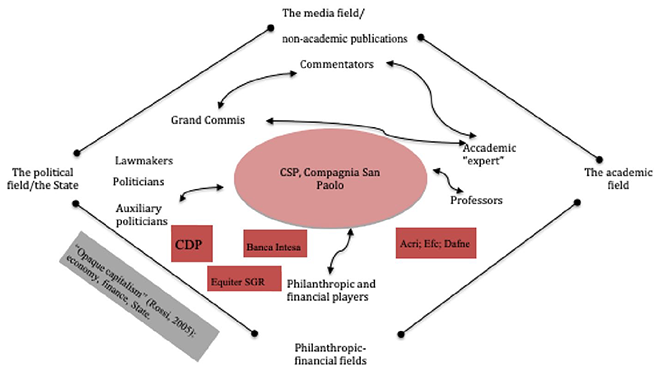
CSPs (and FOBs) positioning in policy making expertise.
CSP is connected to, but also independent of, the fields it overlaps with. On the one hand, its links with these domains situate it in an interstitial humus propitious to the creation of new things that would be impossible to realize in any of the individual fields in which it is involved. On the other hand, its independence and originality are most effectively expressed in the domain of policy making, where its positioning relies on its philanthropism, a true agent of hybridization between politics, 14 knowledge, 15 finance and philanthropy.
In relation to the two dimensions of expertise proposed by Eyal (2006) – independence/dependence and openness/closure with respect to public engagement – CSP’s specific expertise seems to be located in the independence quadrant of the field (displaying a maximum or average degree of independence) and halfway between openness and closure. In fact, it tends to be positioned towards the middle of the field, given its considerable though variable degree of autonomy. Now for Eyal, occupying the centre of the field means being in the best position to defend oneself from other, more peripheral sources of expertise.
CSP’s expertise would appear to be a case of almost perfect independence (Bourdieu et al., 1991), because it is not subject to strict, binding obligations towards anyone, whether voters, shareholders, or clients.
Rather, it enjoys broad freedom to select which actors it wishes to interact with and how (e.g. via memoranda of understanding with universities) while, on the other hand, it enjoys great scope to influence grant-seeking organizations, which are required to address certain themes or adopt certain tools and strategies as established in CSP’s competitive selection criteria or guidelines.
FOBs’ strong degree of autonomy places them in a position of advantage over other forms of expertise, with whom levels of competition remain low. FOBs have the power to influence these other areas of expert knowledge, given their board members’ mobility and connections with multiple fields. Perhaps it is not over daring to suggest that CSP’s expertise attains its maximum power when it loses ownership of the knowledge it generates, because at this point it has successfully established a general episteme (Foucault, 1969) or cultural hegemony (Gramsci, 1975). 16
In sum, CSP’s power appears to derive from its nature as a hybrid and independent space, which allows it to play a role in politics outside of and/or in parallel with official political organs. Indeed, being located in an interstitial space implies, in addition to hybridization, remaining ‘in-between’, that is to say, in a liminal zone between the boundaries of multiple fields, a position that tends to make the ties and actions of both the CSP as an organization and the individual actors within it somewhat less visible. My observation of the elites circulating inside and outside CSP, as reported in the next section, shows how the process of hybridization also takes place ‘inside’ and ‘through’ individual actors.
Hybrid CSP elites: Between nomadism and rootedness
Having first focused on CSP as an ‘object’, I was next able to use it as a level at which to observe a particular segment of elite: the members of the CSP’s board of directors from 1992 to 2019. 17 CSP afforded me the opportunity to examine an elite group from a triple perspective. First as actors who were already powerful before their involvement in the foundation, given that CSP is a positional pool of elites: they were co-opted into the FOB on account of positions they already occupied or had occupied in their careers and by virtue of professional reputations that they had already built up. Second, as actors who are powerful because they are located in an independent centre of power that disposes of considerable assets to be invested in areas of public interest. Third, as actors who are even more powerful – and this is where the heuristic value of interstitiality comes into play – because they are part of an institution that derives additional power from its hybrid nature and positioning between different fields.
The profiles of the elites who sat on the last seven boards seem to provide an ideal match for CSP’s position as a philanthropic-financial actor involved in policy making. Independently of the initial predominance of appointees from the field of finance, from the outset the majority of board members were brokers, auxiliary politicians and experts (e.g. academics and high-ranking civil servants). In other words, CSP appears to be the expression of an elite of ‘political-cultural’ agents with the capacity to create and disseminate vehicular ideas, 18 whose distinctive characteristic is its capacity to connect discourses, tools and actors from different fields. Furthermore, the fact that CSP board members are often auxiliary politicians facilitates the spread of ‘hybridization’ between the public and private sectors. In a study of ‘the European Eurocracy’, Laurens (2015) challenged conventional critiques of lobbying that simplistically frame it as an attack on the public sphere by the private sector: on the contrary, if mediators of capitalism exist, they are to be found at the centre of a system of relations that connects political-administrative actors with lobbyists. This mixing and collapsing into one of public and private may also be observed in the careers of the CSP board members. The chameleon-like quality of the CSP elite and the resulting ever-changing amalgam may also be seen at work in two further phenomena. First, a clear process of osmosis, beginning in the early 2000s, between the composition of the CSP’s General Board and local government and business elites. 19 The appointment to chairperson in 2004 of the lawyer Grande Stevens, an influential figure at the national level with close ties to Fiat and the Agnelli family, unequivocally suggests that this osmosis had been successful to the point that the CSP’s elites now mirrored and overlapped with those of the city of Turin. The latter space holds together a set of leading local groups: ‘left-wing’ liberals, small and medium enterprises, the Fiat milieu, and the moderate wing of the former PCI (Italian Communist Party). The cross-contamination process has become so pronounced over the last three boards (2008–2019) that, arguably, appointment to the CSP almost automatically denotes membership of the local Turin elites. The second phenomenon of interest, which is related to the first, is the fact that changes in the political composition of the CSP board members appear to reflect developments in the broad political area of the Italian centre-left post-1992. More specifically, during the initial Ulivista (from the name of a centre-left coalition) era, the political appointees were a mix of left-leaning former Christian Democrats, former left-wing liberals and ex-communists, only to subsequently mirror the increasing dominance of the centrist components of this loose political grouping. The patterns do not match perfectly, but a certain degree of commonality may be observed.
Concerning board members’ multiple affiliations, 20 it is evident from Figure 2 that from the very first board under analysis, appointees have been characterized by a broker profile, the majority of them having worked in over four fields in the course of their professional careers. The lower number of members with a background in five or more fields on the most recent board is due to a higher than average degree of turnover and an increased proportion of younger members. 21
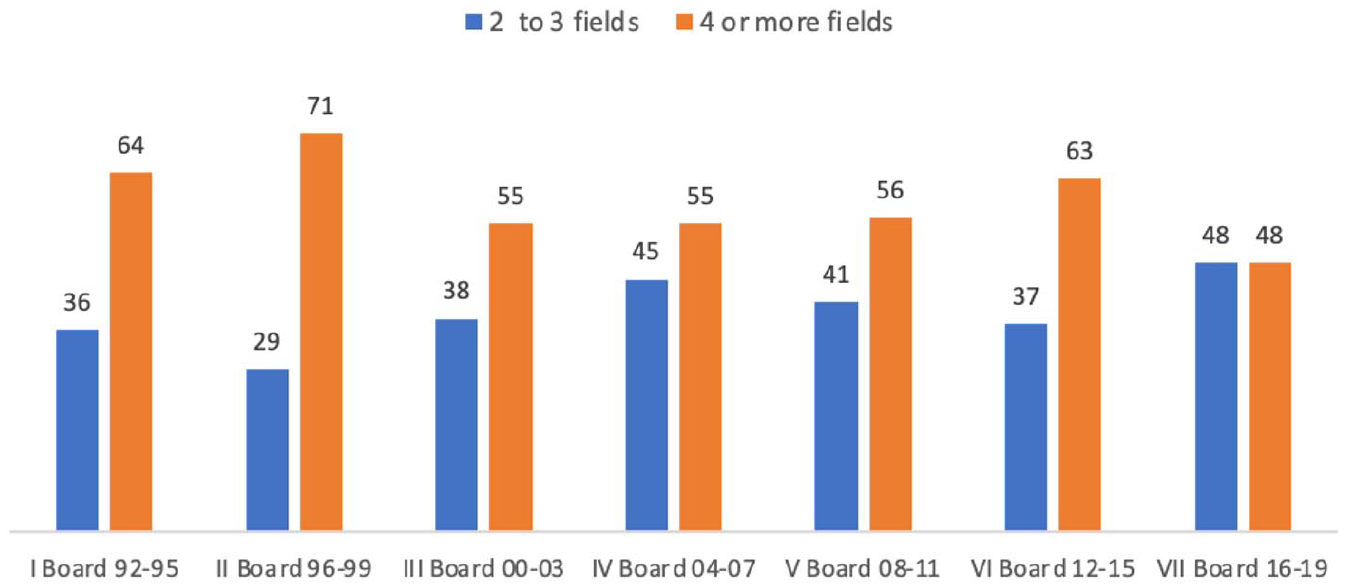
Number of fields throughout the career, per board (%).
With regard to board members with expert profiles, academics have been over-represented on the various boards to a remarkable extent (comprising in this sense the leading category of appointees). 22 Indeed, as shown in Figure 3, academics have always represented at least one-third of all board members.
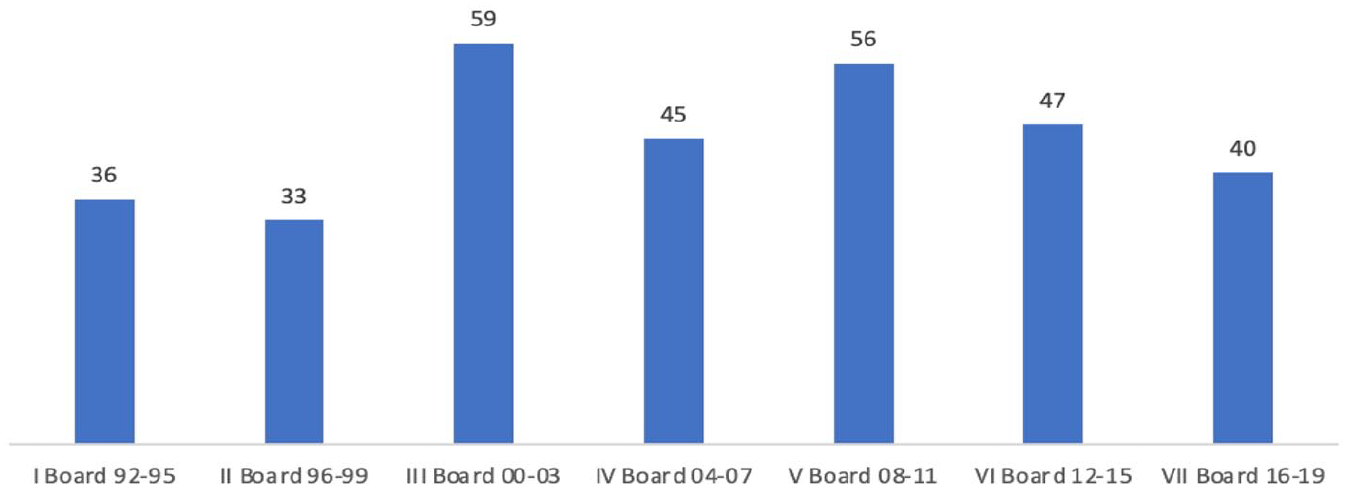
Expert-academic as first field (% of all board members).
More generally, CSP appears to cultivate and generate a new ‘elite of experts’ whose speciality is intermediation. This group includes legal and business consultants, narrative builders and communications experts; many of its members have a background in academia, the media, or the cultural sector more broadly.
The CSP elites are brokers with a high degree of mobility across fields but are they also somewhat ‘cast in stone’. This is borne out by Figure 4, which illustrates the high proportion of non-career politicians and members of ‘the San Paolo circuit’ 23 or ‘CSP circuit’ 24 among their ranks.
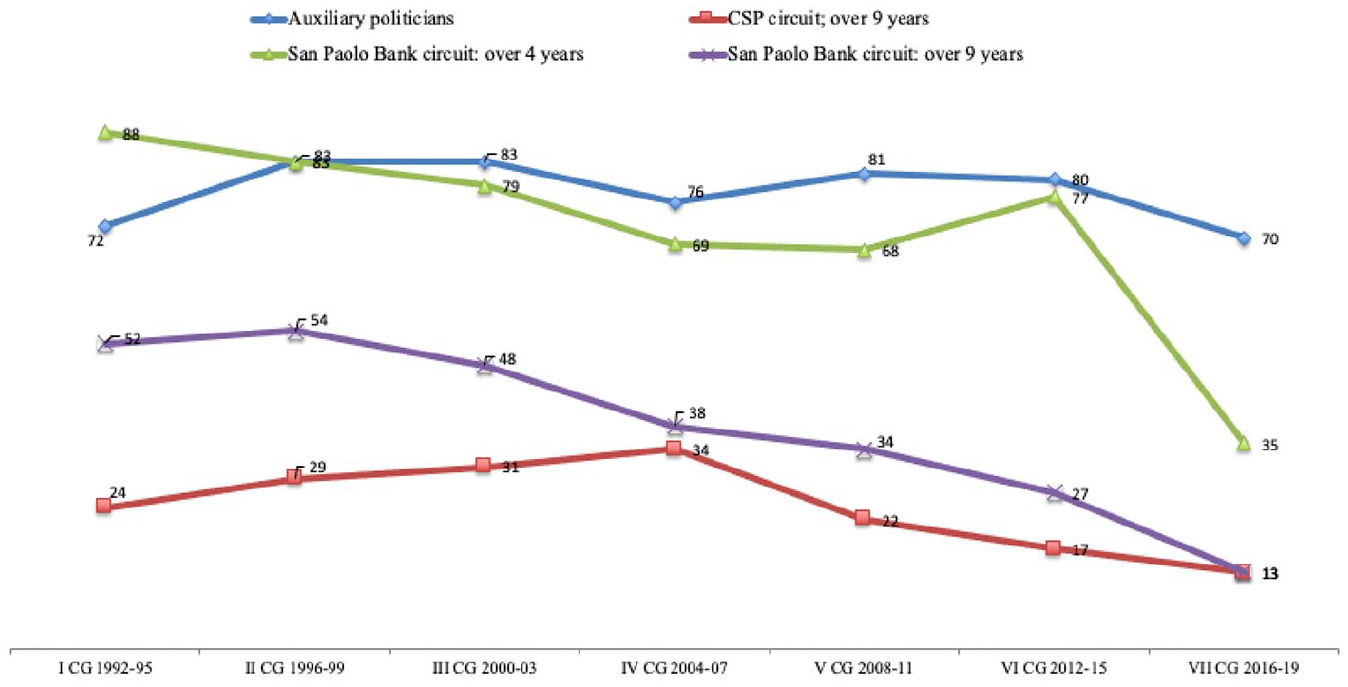
Elites: mobile, experts. . . cast in stone?
Finally, Figure 5 represents the positioning of the members of CSP’s last three boards of directors: the majority are concentrated in the middle of the various fields, intersecting at least three of them.
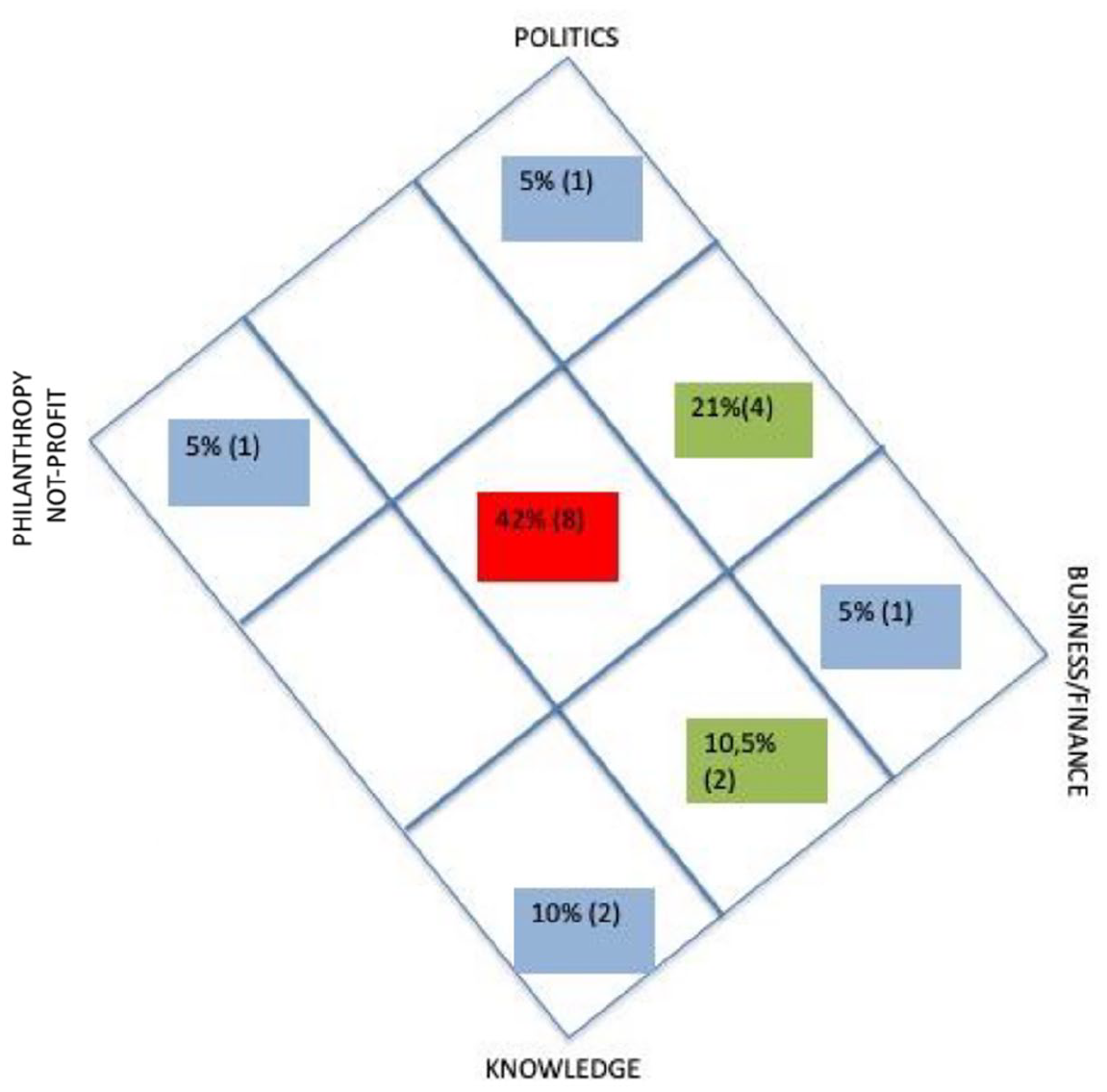
CSP board (CGD) members: 2008–2019 fields involved in during career (%).
The graph expresses approximate broad patterns based on my analysis of board members’ careers. Given that virtually all appointees belong to or have belonged to at least two fields in the course of their professional lives, for the purposes of this graph I only took into account the formally more significant fields and did not include the FOB field at all, although numerous board members had previously served at length in FOBs. Hence the empty spaces between philanthropy and some of the other fields.
Interstitiality (Eyal, 2013) – broadly denoted by individuals who simultaneously or consecutively belong to several fields and/or are members of an interstitial organization and, above all, who function as agents of hybridization between logics, norms, tools and practices – thus appears to offer an ideal interpretative key for this specific elite segment. It is of particular value in reconstructing the modus operandi of an elite that, by virtue of its being simultaneously both everywhere and nowhere, builds up its power independently of its members’ social backgrounds and officially held positions. Such a group has the capacity to rapidly change its tactics and style in response to fluctuations in the new financial capitalism and, therefore, possibly also ready to abandon its traditional communities and loyalties without too many regrets (Bauman, 2007). An elite so defined also speaks to Simmel’s (1908/2006) figure of the stranger: someone who is here today and may remain again tomorrow. It is a potentially nomadic, interchangeable and fluid elite, yet paradoxically, precisely due to its interstitial, connective and anarchic nature, one that appears to have become increasingly stable and solid over time, gradually taking on the appearance of being ‘cast in stone’.
Conclusions
In this article, I have attempted to show that the concept of interstitiality may be usefully brought to bear on the study of elites, by discussing how I myself applied it to the CSP banking foundation, across the organization as a whole and in relation to individual high-ranking figures within it. In CSP, I observed a new mode of constituting and shaping a ruling group: an elite whose status derives from its capacity to gain recognition as an influential group in the domain of policy making, and whose legitimacy rests on a specific interstitial financial-philanthropic ethos.
In addition to my own empirical case study, the recent sociological literature appears to confirm the emergence of new ways of forming elite groups, offering a set of insights that speak to the concept of interstitiality. My work thus contributes to the line of enquiry prompted by Savage and Williams (2008) in their work Remembering Elites. Scholars in this recent tradition have suggested that elites are opaque and elusive in the current era of financialization. The factors accounting for elite groups’ ‘disappearance’ from scrutiny include disciplinary divisionism and a ‘Weberian’ tendency to analyse elites in terms of their positions at the top of stable institutions. However, while such posts of command still matter, the institutional landscape has undergone significant disruption since the final decades of the twentieth century, leading to a blurring of the borders between states, corporations and NGOs. Hence, the time has come to deploy a broader mix of approaches, concepts and methods in tracing the dynamic evolution of traditional and emergent elites. Within the recent literature inspired by Savage and Williams, Janine R. Wedel (2009, 2017) stands out for her focus on new ‘influence elites’ that have emerged in the current scenario and may be defined as fragmented, varied, disintermediated and fuzzy. Wedel studied influence elites in specific organizations (a think tank, a flexible network, a consulting firm), identifying a set of characteristics of new elites that are equally applicable to the CSP elites I observed. Specifically: these elites are flexible; they bridge and blur logics and actors from different fields; they exert their influence operating both within and outside of formal structures; they establish, mobilize, or adapt entities to structure their mode of influence on policy and public opinion; their power remains partly hidden – their strength lies in their ability to cross boundaries, escaping notice in the process. Wedel’s overall argument is that ‘another kind of power related to mobility of roles within and through command posts has arisen, and sometimes is the way policy is enacted’ (2009, p. 157).
Interstitiality has also been evoked in another key line of enquiry within recent elite studies, that initiated by Zald and Lounsbury (2010). Authors contributing to this strand of research have argued that organizational studies have increasingly neglected the study of core societal power centres. Failure to investigate elites has significantly reduced the discipline’s capacity to understand how powerful organizations shape societies. Hence, it is time for organizational studies to re-engage with the topic of elites. The debate inspired by this ‘call to arms’ has pointed up two main, interconnected, research requirements: (1) theoretical and analytical tools for exploring the complex interplay between power as domination and power as networking, that is ‘between institutionalized power hierarchies and interstitial power matrices’ (Reed, 2012a, p. 204); (2) a conceptualization of elites that combines a position-based approach with an action-based approach (Reed, 2012b), or a focus on the holding of power with a focus on the mobilization of power (Scott, 2008).
Our discussion thus far suggests the value of investigating whether and to what extent interstitial elites are a feature of financial capitalism and what exactly happens in interstitial spaces.
To push this analysis one step further, could it be that finance underpins all processes of mobility and interstitiality in today’s elites? Is not finance mobile and interstitial by nature? The power of money as the agent of hybridization and conversion par excellence is certainly not a new concept or phenomenon; 25 nonetheless, given the unprecedentedly vast power of the contemporary financial sector, we must ask whether it has not now reinforced this traditional role, acquiring enhanced capacity to invade, flow and creep into other fields. And if finance plays a key part in interstitial processes, does this imply – in the terms of Savage and Williams (2008, p. 9) – that those who control money have established themselves as key social and political agents with the capacity to expand their power base across fields to which they once seemed extraneous, such as welfare?
The strong presence of academics in new technocratic agencies such as FOBs, think tanks and political foundations raises the additional question of expertise as a new way of organizing elites such that experts tend to become organic components of elite groups.
Other questions arise from the debate on the transnationalism of fields and elites. Similarly to the business elites studied by Michael Hartmann (2017), who challenged the myth of a transnational corporate elite, FOB elites appear to be primarily entrenched in national structures, suggesting that intersections between fields may also play a part in consolidating a wider sphere of influence at both the national and local levels. In this case, a ‘piece’ of policy making has been concentrated around a new form of organized philanthropy that mixes together different kind of elites. Following Julian Go and Monika Krause (2016) we might also think of FOBs as a ‘field’ in their own right (the ‘foundations’ field) and, further still, as organizational actors within a broader transnational field. If so, what kind of relationship does the FOB ‘field’ have with the field of global financialized philanthropy? Undoubtedly, philanthropy in the English-speaking world has exerted a general cultural influence on the philanthropy of FOBs, but how exactly is this influence transmitted? Are there specific international networks to which FOBs belong that may suggest the emergence of a transnational elite?
In sum, in a context of radical depoliticization and financialization, it appears that hybrid, interstitial spaces and organizations are among the most privileged places for the exercise of power in our contemporary era. In these spaces, we may identify a range of elites from different fields of power. We may also observe changes in these elites, such as the increasing hybridization of given fields, and analyse whether certain fields are expanding at the expense of others with whom they overlap. In my own case study, I began by observing CSP and its board members, without trying to impose a priori boundaries around assumed elite groups: this allowed me to conduct a transversal study, which showed that interstitiality was a key characteristic of both the organization and its most senior – elite – figures. I argue that these elites’ membership of multiple fields (which is not a novel phenomenon) and their interstitiality (which might be a new feature) may in any case be interpreted in a new light by relating them to current processes of governmental, discursive and social depoliticization (d’Albergo & Moini, 2018). These processes both boost and are fuelled by the blurring of boundaries between different domains (de Leonardis, 2013; Wolin, 2006). Indeed, aside from the forms that depoliticization can take, it may be viewed above all as the demise of vertical modern institutions in favour of a society based on networks (de Leonardis, 2007). It should come as no surprise, therefore, that within the flat landscape of the network, collective (organizations) and individual (elite) actors situated in hybrid or interstitial spaces will gain in importance. This might even be part of a broader shift from a ‘government of laws’ to a ‘government of men’ (Bobbio, 2005). To speculate even further, in a self-regulating context (where there is no longer a public/state monopoly on matters of collective interest) and a regime of financialized capitalism (characterized by shorter and more destructive cycles than in the past), should interstitiality, fluidity and an absence of loyalty to institutions not be viewed as indispensable prerequisites for a power/influence elite?
Footnotes
Declaration of conflicting interest
I declare that there is no conflict of interest.
Funding
The author received no financial support for the research, authorship, and/or publication of this article.