







Abstract
The sociology of war has thus far focused on the history of past wars, neglecting ongoing evolution over social attitudes toward the risk of potential wars. In contrast, international relations scholars tend to neglect the legacy of past wars in the analysis of the social reception of security discourses. To address these lacunas, this article draws on the notion of war frames and focuses its analysis on the critical voices of the securitization process. Through interviews with leftwing politicians and intellectuals conducted after the Russian invasion of Ukraine in 2022, as well as polls and media analysis along with ethnographic observation in the southern part of Okinawa, this article explains why Japan’s defence budget has dramatically increased while attachment to ‘pacifism’ remains strong. This apparent contradiction can be partly understood as a response to Russia’s aggression, which triggered Japanese people’s fear of a conflict over Taiwan and Okinawa, thus challenging the pacifist posture that has prevailed in Japan since the end of World War II. Adopting a sociological perspective, this article shifts the focus from political elites and security experts to opposition parties, intellectuals and civil society.
Introduction
Drawing on recent works in the sociology of war (e.g. Malešević, 2025; Mann, 2023) and Wang’s (2026) sociological reconceptualization of Judith Butler (2009)’s Frames of War, as well as sociological insights from security studies, this article aims to understand to what extent different understandings of Japan’s war legacy are currently at play in the socio-political debate over how Japanese society should tackle security threats. In the contemporary literature on Japan, the term ‘Postwar Japan’ (Sengo Nihon) implicitly means the period that started after 1945 and continues to the present; other postwar periods, such as the aftermaths of World War I and the Russo-Japanese war (1904–1905), need to be specified. The present-centrism of this ellipse is motivated by the Constitution of Japan: adopted after World War II to replace the Meiji Constitution of 1889, it still prevails today and sets the meta framework for contemporary Japan, most famously with its Article 9 formally renouncing belligerency. However, relinquishing its right to initiate hostilities has not erased the controversial legacy of Japan’s past wars, nor does it protect the archipelago from military attacks by other countries. Japan’s past wars, and in particular its violent armed conflicts in China from the early 1930s until the defeat of 1945, have continued to poison Japan’s relations with its neighbours. Meanwhile, China, Russia and North Korea have, with growing intensity in recent years, constantly harassed Japanese coast guards and Self-Defence Forces, pushing its political elites to seek out legal and societal responses.
Our study focuses on Japan’s response before and after the Russian full-scale offensive against Ukraine in 2022. Similar to European nations, this conflict served as a wake-up call for Japanese society. Given that Russia is a direct neighbour, and considering the longstanding territorial disputes since the end of World War II, the war significantly heightened Tokyo’s concerns regarding Moscow. However, it was China, rather than Russia, that became the primary focus of Japan’s national defence enhancements adopted in December 2022 (Teraoka & Sahashi, 2024). Since World War II, Japan’s primary security threats have included the Soviet Union/Russia, China and North Korea; while none of these nations posed a direct military threat to Japan’s sovereignty during much of the Cold War and in subsequent decades, recent developments have intensified concerns surrounding China (Liff & Lipscy, 2022). Beijing’s military provocations and frequent drills near Taiwan have amplified fears of a potential Taiwan emergency scenario, such as a maritime blockade or a partial or full-scale military invasion (Liff, 2022). Given Okinawa’s geographic proximity to Taiwan and its strategic significance – bolstered by a substantial presence of US military bases and, more recently, the development of Japanese Self-Defence Forces in the southern part of Okinawa – a Chinese attack on Taiwan could implicate both Tokyo and Washington in the conflict (Liff, 2022).
Security studies typically emphasize the narratives of the political elites and security experts in power. In contrast, adopting a sociological perspective, this article shifts focus to the critiques emerging from opposition parties, intellectuals and civil society. Moreover, departing from the capital, we take a look at the perception of the situation in the Yaeyama islands; close to Taiwan, this southwestern part of Okinawa has seen a growing deployment of Japanese Self-Defence Forces in line with the securitization of China. We propose that even when policymakers succeed in increasing defence spending for the sake of national security – illustrated by Japan’s case in 2022 – analysing the perspectives of critical voices on security discourse can reveal underlying flaws or blind spots in our understanding of the war–society nexus and the social reception of security threats. Beyond the political opportunities created by the shock of Russia’s attack on Ukraine, we seek to clarify the extent to which Japan’s response to military harassment by China is reshaping the symbolic landscape of postwar Japan and the role of different frames of war in this process. To achieve this, we integrate analysis of public opinion polls and surveys with interviews conducted with Japanese politicians, scholars and civil society representatives in Tokyo and Okinawa.
Through this case study of Japan, we hope to open a debate with two ranges of scholars. To sociologists, we aim to highlight the relevance of war frames and securitization theory in the analysis of war threats. To security studies scholars, we aim to demonstrate that war frames and critical voices matter in the (de)securitization process. Meanwhile, we contribute to the sociology of war in showing the central place of war in our understanding of contemporary societies, even for countries such as Japan that position themselves as pacifist.
The sociology of war and Japan’s securitization of China
In spite of recent developments, post-WWII sociology has neglected the study of war and its impact on society (as underlined by Joas & Knöbl, 2008; Malešević, 2014, 2025; West & Matthewman, 2016). Similarly, Japan is still peripheral to Western sociology in general. The case of Japan has nevertheless received attention from leading sociologists of war, with a focus on the modern period up to the end of World War II. In his seminal work on the Sociology of War and Violence, Siniša Malešević (2010) finds that, although Japan has experienced fewer inter-state wars than most other large polities, it has, paradoxically, also developed one of the most militarist social organizations ever (Malešević, 2010, p. 162). As Malešević summarizes the role of warfare in the history of modern Japan (Malešević, 2010, pp. 162–165), the ‘warring states’ of the fifteenth and sixteenth centuries were marked by constant armed conflicts between the feudal lords (daimyo). The Tokugawa shogunate (1603–1868) then imposed a strict control of the samurai class and the daimyo – now turned into the shogun’s vassals – and a seclusion policy of tightly monitored trade with foreign countries. The result was a long period of political stability and economic prosperity. In the mid-nineteenth century, as Western powers threatened to impose unequal trade treaties similar to what the Tsing empire was compelled to accept, the shogun forces lost domestic battles and the administration of the Meiji emperor quickly transformed Japan into a modern power with military reform as its priority. Malešević concludes that, as with Russia and the Ottoman empire, the Japanese path to modernity owed a great deal to war and militarization, providing another non-Western example where prolonged domestic warfare led to state centralization and the ‘unprecedented monopolization of violence’ (Malešević, 2010, p. 165).
In his magnum opus On Wars, Michael Mann (2023) developed a similar perspective through further study of the literature, to conclude that the ‘history of Japan reveals the importance of domestic power struggles in decisions of war and peace’ (Mann, 2023, p. 179). As he argues, after 240 years of peace, Japan’s modernization and militarization began a self-defence reaction to foreign imperialism under the Meiji, but thereafter ‘repeated victories in war combined with fear of class struggle at home developed a militaristic culture baked in to political, economic, and ideological institutions’ (Mann, 2023, p. 177). The long war on the Chinese continent from 1931 to the end of World War II was particularly devastating (Tsurumi, 1982/2010). After atomic bombs and unconditional surrender, Japan embraced pacifism and democracy under US guidance, alongside a much-reduced worship of the emperor. Mann (2023) eventually notes that if ‘some virulent nationalism remains and prevents the apologies and reparations that postwar Germany has offered, most Japanese seem content to be citizens of a peaceful economic giant’ (Mann, 2023, p. 179). Yet, although Japan has long kept its military spending below 1% of GDP, the size of its economy has allowed it to be among the world’s top-ten military spenders, and aggressive moves by China could drive it even further (Mann, 2023, p. 179).
Since the end of World War II, Japan has had three major security concerns: the Soviet Union/Russia, China and North Korea. For most of the Cold War and the three decades that followed, none of these was considered a serious and direct military threat to Japan’s sovereignty. In recent years, however, China has increasingly become the major concern, an issue that has been addressed almost exclusively by political scientists and international relations scholars (e.g. Green, 2022; Liff, 2022; Schultze, 2016; Teraoka & Sahashi, 2024). And the bulk of this research borrows from the theory of securitization.
Introduced by the Copenhagen School of Security Studies (Buzan et al., 1998; Wæver, 1995), securitization theory was inspired by John Austin’s philosophy of language to take security as a speech act. Their followers have enriched this theoretical approach with input from Foucault’s theory of governmentality and the sociology of Bourdieu (e.g. Balzacq, 2011, 2015; Balzacq et al., 2016; Bigo & Walker, 2007; Salter, 2008). The core question to be studied is less about the reality of the threat – whether it is objective or dependent on subjective perceptions – but how an issue (e.g. troop movements, migration or environmental damage) is socially constructed by some as a threat but downplayed by others. Security is thus seen as a constant debate between antagonistic speech acts, hence the notions of securitization and de-securitization to conceptualize this perspective: every step that a discourse manages to turn into an issue of security can be retrieved back by another range of discourse.
In the case of Japan, Williamson (2014) combines this approach with Niklas Luhmann’s sociology of risk to analyse the political debate over defence policy during the immediate postwar period (1945–1960). The debate pitted political elites, on one side, against leftwing intellectuals, peace movement activists, unions and women’s groups, on the other. Whilst the former favoured extraordinary measures for a state of exception against potential threats from the Soviet Union, the latter wanted to avoid the US ensnaring Japan in its war against communism. The dialectic between these two groups of ‘risk entrepreneurs’ – as the author calls them – constituted the securitization process which eventually set the three pillars of Japan’s defence policy characterized by the pacifist Constitution, the instauration of the Self-Defence Forces and the security treaty with the US.
In a similar vein, Oren and Brummer (2020) compared the securitization of foreign threats in policy speeches during the 1950s-1960s. They found that the Korean War (1950–1953) served as a critical juncture after which a securitization move was made to cast communism as a clear existential and political menace. In addition to the Soviet Union, Japanese political leaders perceived China as an existential political risk but not as a direct military threat. This changed after China started its nuclear bomb programme in 1964. However, during this period, mainstream political leaders, including the rightwing Liberal Democratic Party, founded in 1955, displayed such a strong aversion to war that they were determined to avoid embroiling Japan in one; they preferred to put their trust in the US nuclear umbrella and focus on the economy.
Looking at the evolution of territorial tensions over the Senkaku islands (Diaoyu in Chinese) since the 1970s, Danner (2014) highlights that although these are uninhabited rocks, the securitization of the dispute was initiated by the populace of both Japan and China (nationalist activists in almost all instances), whereas the state (both Tokyo and Beijing) would usually de-securitize it in the end, giving priority to mutually beneficial economic interests and sometimes capitalizing on the dispute to get a better bargaining position. However, after decades of peaceful Sino-Japanese relations since the end of World War II, thanks to the priority given to mutual economic interests and a pause on lingering historical grievances, China’s growing assertiveness, especially around the Senkaku/Diaoyu islands has pushed the political right to securitize China.
Several researchers underline the instrumental role played by Prime Minister Shinzo Abe in this process (Dell’Era, 2024; Garcia, 2016; Green, 2022; Liff, 2022; Lindgren, 2019). Abe encouraged a reinterpretation of the Constitution to allow for the limited exercise of collective self-defence. This initiative paved the way for new security legislation in 2015, which now allowed Japan’s Self-Defence Forces to come to the aid of allies, such as the United States. The conditions are strict – the attack on the ally must pose a clear danger to Japan – but as Lindgren (2019) argues, if China’s assertiveness is the driving force behind this policy shift, fear of abandonment by the United States in case of an armed conflict is another strong motivation.
Most recent research deals with the impact of the new global environment in the wake of Russia’s full-scale attack on Ukraine. For instance, Hanssen and Koppenborg (2023) found that the Ukraine war only moderately impacts Japan’s energy policy; instead, it contributes to increasing its securitization of China.
With the exception of Williamson (2014), whose study does not cover the recent period, all these studies disregard the voices critical of increasing defence spending and reforming security laws; the nuances among these critics are even more neglected. Moreover, in contrast with the plethora of works on the militarism from the Meiji Restoration to the defeat of 1945, there is scant research on civil–military relations in postwar Japan. A few ethnographic studies show that if the Self-Defence Forces have generally been well accepted by postwar Japanese society, the emphasis is put on disaster relief rather than combat operations (Frühstück, 2007; Sasaki, 2015), which is confirmed by the Japanese government itself in a recent survey on the Self-Defence Forces (Naikakufu [Japan’s Cabinet Office], 2023). Another blind spot of security studies on Japan is a weak understanding of the Japanese populace’s possible reactions in the event of a confrontation with a foreign power such as China, either directly or as an extension of an armed conflict between China and Taiwan. Our article aims to address these flaws by engaging with the literature on the securitization of Japan from a nuanced sociological perspective that brings in the voices of critical actors generally neglected in the research.
Japan’s war frames
Considering the plurality of voices in the security debate about China implies paying much closer attention to the legacy of past wars, including the problem mentioned by Mann (2023, pp. 177–179) in his conclusion on the case of Japan: to what extent does ‘virulent nationalism’ and the lack of a true reconciliation between Japan and China matter? For this, we draw on Wang’s (2026) concept of war frames. Combining the notion of frames of war (Butler, 2009) with the frame analysis introduced by Goffman and Sewell’s approach to historical events, Wang (2026) conceptualizes war frames through two layers. The primary level is mainly cognitive for it involves different war experiences. The secondary level is mainly communicative: it deals with war narratives emitted by some and received by others. Positive and negative reactions to these narratives (resulting from different experiences, family oral histories, school teaching, etc.) generate what Paul Ricœur (1981) called a hermeneutic circle.
In a previous article, Wang (2015) examined the case of postwar Japan and identified two dominant war frames. Defended by rightwing intellectuals such as Fusao Hayashi (1964) and later popularized by manga writer Yoshinori Kobayashi, the ‘Greater East Asian War’ frame casts Japan’s century-long military enterprise as a just and self-defensive campaign to modernize and protect Asia from Western domination. This frame either denies or euphemizes Japan’s war crimes; alternatively, these are considered inevitable collateral damage no worse than that perpetrated by Western powers. Instead, the emphasis is put on the positive aspects of Japan’s colonial policies in Taiwan and Korea. Up to this day, the visits by rightwing politicians to the Yasukuni Shrine in Tokyo epitomize this war frame: confronting the protests of Beijing, Seoul, Washington and Japan’s political left, those politicians respond that the souls of Japan’s dead soldiers are equally ‘grievable’, as Butler (2009) would call it.
The other dominant war frame is derived from the ‘Pacific War’ narrative imposed by the US during its occupation of Japan (1945–1952). It was introduced by the General Headquarters of the Supreme Commander for the Allied Powers, as the American-led administration was known. This new narrative compelled Japanese people to ‘embrace defeat’ (Dower, 1999) and internalize the victor’s interpretation of history, casting the war as an unprovoked aggression led by a clique of militarists who violated international law. This frame, which underpinned the Tokyo Trial (1946–1948), reinforced the idea that Japan had lost to the US, not to China, and it also displaced attention from Japan’s atrocities in Asia, exonerating the emperor and ordinary citizens from responsibility. A variant of that frame draws on Article 9 of the Japanese Constitution as a moral foundation for postwar democracy and peace education. This pacifist or antiwar (hansen) frame positions the Japanese people as victims, symbolized by the memory of Hiroshima and Nagasaki (Tsurumi, 1982/2010). Although not explicit about Japan’s responsibility, this variant contributed to setting a more favourable environment for the war reparations claims that arose after the end of the Cold War from Korea, China and other countries. One of our interviewees was instrumental in that process.
The coexistence of these different war frames explains persistent divisions over history textbooks, national memory, and constitutional revision. Each of these war frames developed its own sense of justice, victimhood and ‘grievability’. The pacifist variant, while seeking to transcend this polarization, is itself contested amid debates over Japan’s ‘abnormal’ pacifism and the legitimacy of the Self-Defence Forces. While the Pacific War frame has nurtured this pacifist approach, the Great East Asian War frame has encouraged a rearmament of Japan, starting with the establishment of the Self-Defence Forces beginning in the early 1950s (Sasaki, 2015, pp. 2–5). We argue that these competing war frames greatly influence ongoing debates over Japan’s defence policy and the securitization of China.
Security studies generally focus on the speech act of political elites, in particular those in the ruling party, which tends to reduce the diversity of social actors to a passive ‘audience’ (Léonard & Kaunert, 2011). Moreover, this emphasis on rulers and dominant political elites gives less attention to the ‘counterstrikes’ from intellectuals, opposition parties, civil society and the social margins of the nation. We therefore address this blind spot of securitization theory by examining the risk perception of leftwing elites (from the centre-left to the more radical left) and the geographic periphery of Okinawa, both audiences having been thus far neglected in the literature. The idea is to picture the nuances of grey between the failure or success of securitization around the momentum stirred up by the Russian aggression in Ukraine and the rising threat of a ‘Taiwan contingency’, put in perspective within the longue durée of postwar Japan. The literature generally identifies China as Japan’s main target of securitization (e.g. Dell’Era, 2024; Garcia, 2016; Green, 2022; Liff, 2022; Lindgren, 2019; Teraoka & Sahashi, 2024). Though we agree, we posit that the process is not black and white, but can be better understood by examining the arguments of critical voices. These can help with sketching the scale and scope of the securitization, its weaknesses or blind spots. More specifically, as we examine the case of Japan after the start of the Ukraine war, we aim to understand to what extent securitization has been transforming the symbolic framework of postwar Japan and what could be the implications in the event of a conflict with China, either directly or deriving from a ‘contingency’ over Taiwan.
Data and methods
This article adopts a mixed approach combining quantitative and qualitative data. A sociologist specializing in the quantitative analysis of East Asian societies – in particular, Taiwan and China – and their relations to Japan, Sonoda collected polls from Japanese mainstream media (NHK, Asahi, Yomiuri, Nikkei, Mainichi, Kyodo, etc.) before and after the outbreak of Russia’s full-scale invasion of Ukraine in February 2022, in order to understand the Japanese perception of foreign threats, focusing on the cases of China and Russia. These media have their own research departments and have occasionally carried out public polls. The sample size varies from 800 to 1600, depending on the timing and budget of each company. The newspaper Yomiuri for example – which is Japan’s number one newspaper, selling approximately 6 million copies daily, 10 times more than The New York Times – combines telephone surveys with mail surveys while other companies use the Randum Digit Dialling (RDD) method to collect 800+ samples. Considering the limited sample size, we use the poll data as an indication of the trends rather than the source of more rigid (causal) analysis. In the meantime, Sonoda conducted content analysis of the Yomiuri by using the online database Yomidasu Rekishikan and inserting keywords like ‘Ukrainian crisis’ (Ukuraina kiki) and ‘Taiwan contingency’ (Taiwan yūji) to count the number of appearances in the newspaper’ articles during that time period (see Figures 2 and 3). Additionally, to grasp competing security discourses, he looked at official documents such as the minutes of debates from the Japanese National Diet, as well as the press release information of the House of Representatives and the Ministry of Foreign Affairs to observe the extent to which the Russian aggression of Ukraine contributed to further securitization of China, and the relative importance of the ‘Taiwan contingency’ in this process.
Meanwhile, Jobin and Hirai conducted a series of interviews in November 2022 in Okinawa. Later, they carried out interviews with politicians from the opposition parties and left-oriented scholars (such as political scientists and constitutional law experts), as well as experts on Taiwan and China. Our sampling criteria was their influence in the mainstream media, in particular the centre-left Asahi or Mainichi. To follow up on their publications or public statements related to the topic, the outline of questions was personalized around a common question: to what extent does Abe’s warning that ‘a Taiwan contingency is a contingency for Japan’ really apply and how likely is it to commit Japan in case of a Chinese military attack on Taiwan? Would the Japanese elite and Japanese society at large support such an engagement? The timing of these interviews (early 2023) was opportune, as the cabinet of Fumio Kishida – Abe’s successor – was implementing a major shift in security policy stirring a heated public debate (Teraoka & Sahashi, 2024).
The study was conducted in accordance with ethical research practices: all interviewees were given information about the research aims and use of data. Identifying details were removed or anonymized, and when in doubt, interviewees were offered the opportunity to check quotes. In total, a dozen in-depth interviews were conducted in Japanese, recorded and transcribed (those quoted in the article are listed in Table 1). Only three of these interviewees were women; though we had additional conversations with female informants during our stays in Okinawa, we are aware of this bias, which derives from high gender inequality in Japan even in the academic and intellectual spheres.
Interviews quoted in this article (all male, approximate age between 40 and 70).
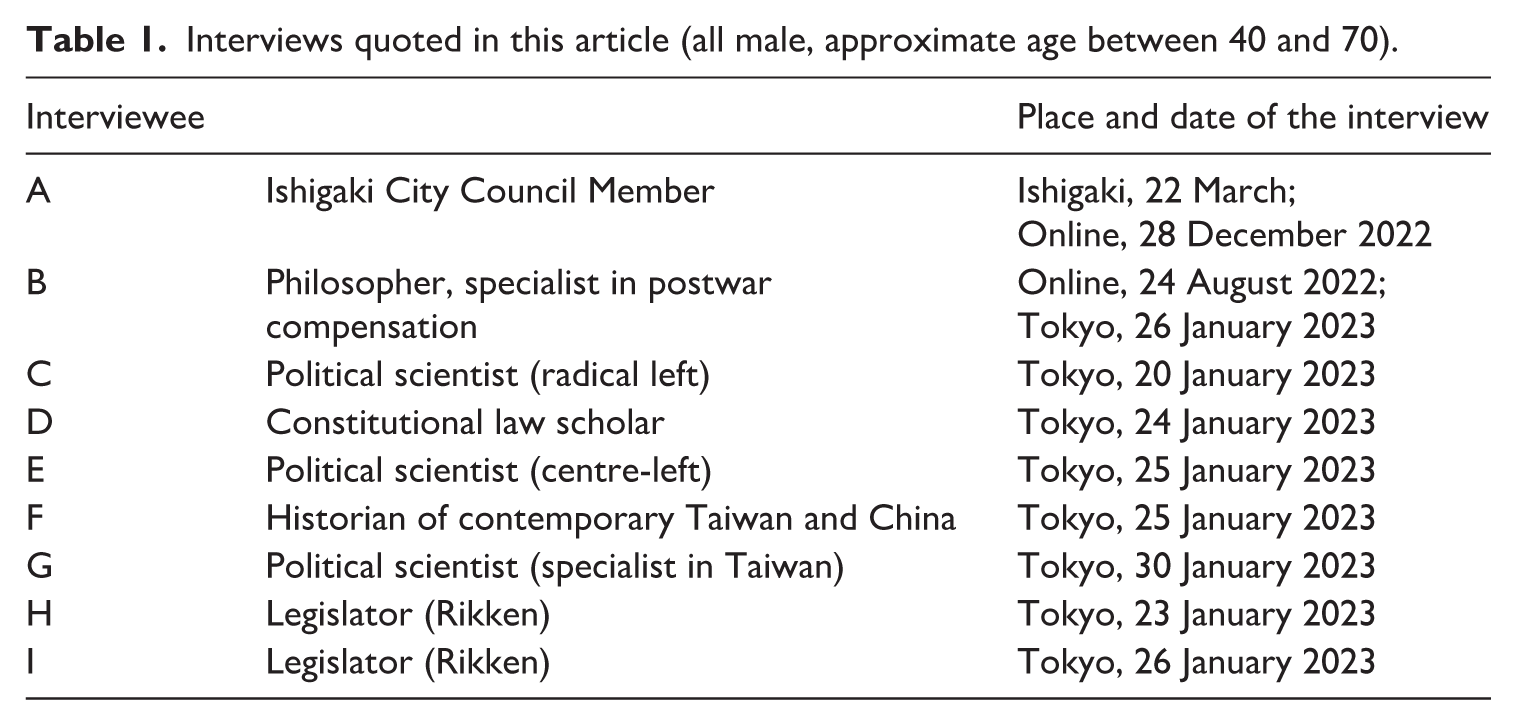
We annotated the transcripts separately and selected the most salient stances regarding the impact of the war in Ukraine and the risk of war between Taiwan and China. During the interviews, our analytical angle adopts the sociology of critical capacity – aka sociology of the critique – which gives credit to the moral competence of actors instead of imposing on them the critical judgement of the sociologist (see Boltanski, 2011; Boltanski & Thévenot, 1999).
Our motivation in focusing on the perceptions of Japan’s political left was twofold. First, as already mentioned, the literature on security issues generally pays scant attention to the critical voices from the antiwar frame. Second, due to our early academic research, which gave us more familiarity with this ideological sphere (Jobin’s PhD dissertation dealt with Japan’s labour and environmental movements while Hirai’s addressed issues of transitional justice in Taiwan, South Korea and China), we wanted to check the ‘postcolonial solidarity’ – so to speak – of the Japanese left toward the vulnerable situation of Taiwan. In case of a military conflict between China and Taiwan, would the Japanese left, who have long criticized the US–Japan security alliance and have not actively engaged with the Taiwan issue, set camp on a position of neutrality and pacificism, or would it show a solidarity comparable to that of Lithuania after the Russian invasion of Ukraine (Janušauskienė & Mamaiev, 2026)? Answering this question serves as an important indicator for examining how Japanese society has critically responded to, or accepted, the securitization of the ‘Taiwan contingency’ discourse.
In a second step, the three authors discussed how the quantitative and qualitative data collected could illuminate the security debate among Japan’s political elite and its social reception. The exchange of ideas was facilitated by the three authors’ command of Chinese and Japanese and their long-time observation of the socio-politics of Japan, Taiwan and China. Moreover, the sociology of war as developed by Malešević and Mann, and Wang’s model of war frames encouraged us to look at the legacy of past wars as decisive components for understanding the elite’s speech acts and their popular reception. We believed this approach would aid in clarifying the relative impact on Japan’s security policies of the war in Ukraine and the growing tensions in the Taiwan Strait.
The shock of the Ukraine war
The late Prime Minister Abe Shinzo spent much political capital attempting to improve relations with Russia and sign a peace treaty. The strategy was China-focused, based on the idea that if Russo-Japanese relations were developed, Sino-Russian relations would weaken. But despite Abe offering economic and territorial concessions and meeting Vladimir Putin over 25 times, the policy failed (Liff & Lipscy, 2022; O’Shea & Maslow, 2024). Following the annexation of Crimea in 2014, PM Abe even resisted Western calls to seriously sanction Russia on the grounds that isolating Moscow would draw it even closer to Beijing. However, Putin’s full-scale war of aggression against Ukrainian democracy in February 2022 was a tremendous shock for Japanese society.
This challenge to the international order set at the end of World War II by the Allies – including the Soviet Union – drove a drastic change in Japan–Russia relations. Along with its strategic coordination with China, Russia was now described as a ‘strong security concern’ on its own and three major strategic documents adopted by the Kishida administration in December 2022 (the National Security Strategy, the National Defence Strategy and the Defence Buildup Programme) reflected that concern (Goroku, 2024). In hindsight, Japanese leaders’ long courtship of Putin and efforts to bring about a historic peace deal began to appear misguided (Hikotani, 2022). The sheer scale and almost anachronistic nature of the invasion shocked Japanese public opinion to become a focusing event (O’Shea & Maslow, 2024, p. 662). Like in European countries, the Japanese were horrified by the atrocities committed by the Russian army, further aggravating unfriendly feelings toward Russia, which reached a record 94.7% one year after the attack (Kyodo News, 2023). The Japanese were touched by the dire situation of Ukrainians compelled to leave their homes, and if the government felt any pressure to take a hard line against Russia, it came from the public, not Washington or Brussels (Brown, 2023). The fear of another nuclear disaster from Chernobyl or Zaporizhzhia nuclear plants evoked painful collective memories for the Japanese, recalling the atomic bombings on Hiroshima and Nagasaki and the Fukushima nuclear plant disaster.
This popular sympathy for the Ukrainians encouraged political elites and the Japanese government to join sanctions against Russia and show support to Ukraine. Soon after the invasion, the Japanese government and the National Diet overtly supported Ukraine and criticized Russia (and China). On 23 March 2022, President Zelenskyy was invited to deliver a speech at the Japanese Diet. And on 8 April, in reaction to the war crimes committed in Ukraine, the Ministry of Foreign Affairs expelled eight diplomats and trade representatives from the Russian Embassy in Japan. While aid to Ukraine faced growing fatigue in Europe and North America, support was still strong in Japan and those in the archipelago who attributed the Russian invasion to NATO’s eastward expansion remained marginal (Figure 1).
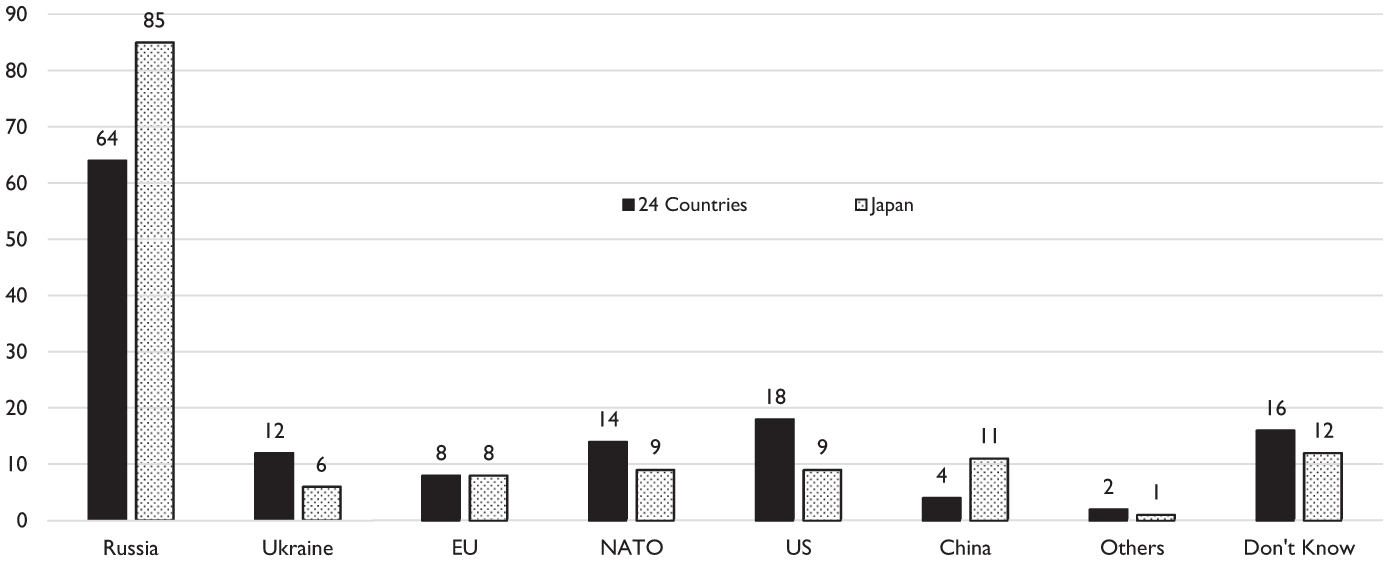
Poll on the countries found responsible for the ‘Ukrainian Crisis’ (Unit: Percentage).
If the Russian assault on Ukraine provided a favourable context for PM Kishida to conduct a major transformation in security policies, even more decisive were his image as a ‘dove’ and his support for fiscal discipline (Teraoka & Sahashi, 2024). Actually, as a lawmaker reminded us (interviewee I), even before Ukraine, Japan, like its European counterparts, was being pressured by the US to increase military spending by 2% of GDP.
However, Japanese security experts, political and intellectual elites, and PM Kishida himself, were quick to turn the spotlight from Russia to China under the catchword ‘Today’s Ukraine could be tomorrow’s East Asia’. In a nutshell, Russia – along with North Korea – has worked as a proxy for securitizing China and carrying Japan’s defence to a much more ambitious stage (Hanssen & Koppenborg, 2023; O’Shea & Maslow, 2024).
As early as March 22, one month after Moscow’s incursion into the frontiers of Ukraine, a survey conducted by the Nikkei – Japan largest financial newspaper with a daily print circulation of approximately 2 million copies – showed that 77% of respondents were concerned that if the international community failed to stop Russia’s invasion and border changes, it would inspire China to use force against Taiwan (Goroku, 2024).
While the number of reports on the ‘Ukrainian crisis’ (Figure 2) declined, those on a ‘Taiwan contingency’ suddenly surged in the Japanese news media (Figure 3).
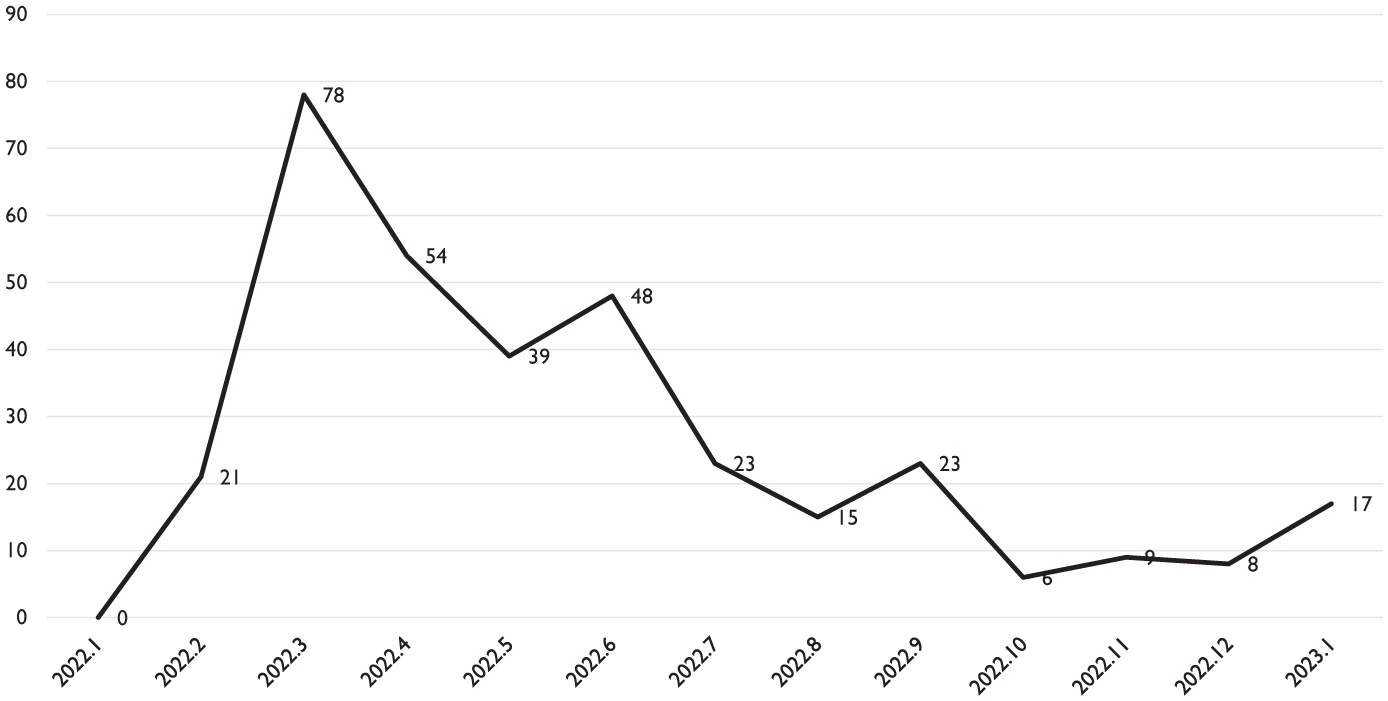
Number of news reports on the ‘Ukrainian crisis’ in Yomiuri, January 2022 to January 2023.
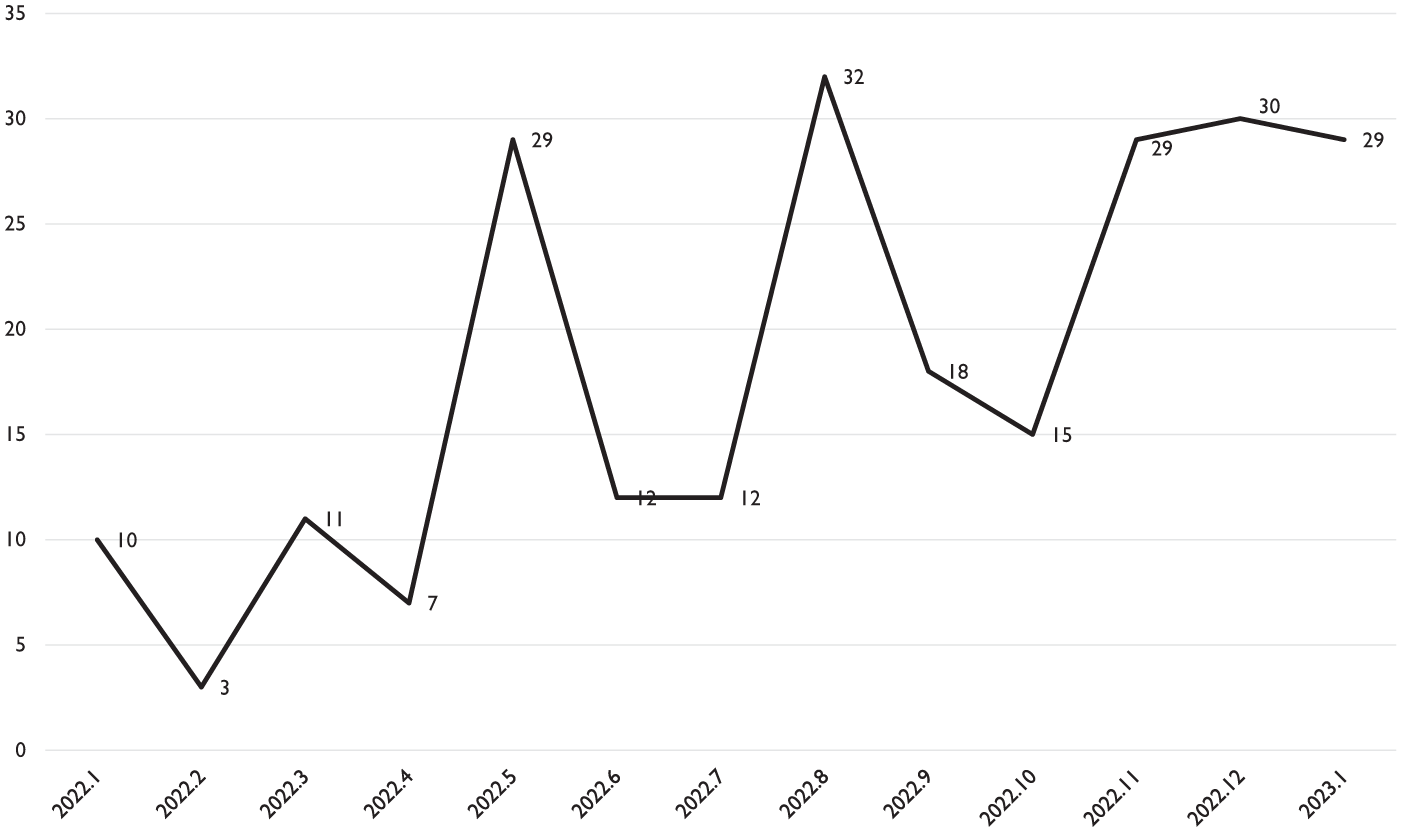
Number of news reports on the ‘Taiwan contingency’ in Yomiuri, January 2022 to January 2023.
A good barometer of the success of the securitization operating in the aftermath of the attack on Ukraine can be seen in the fact that support for the acquisition of counterstrike capabilities had jumped to 60% of respondents by the end of 2022, twice as much as four years earlier (Figure 4).
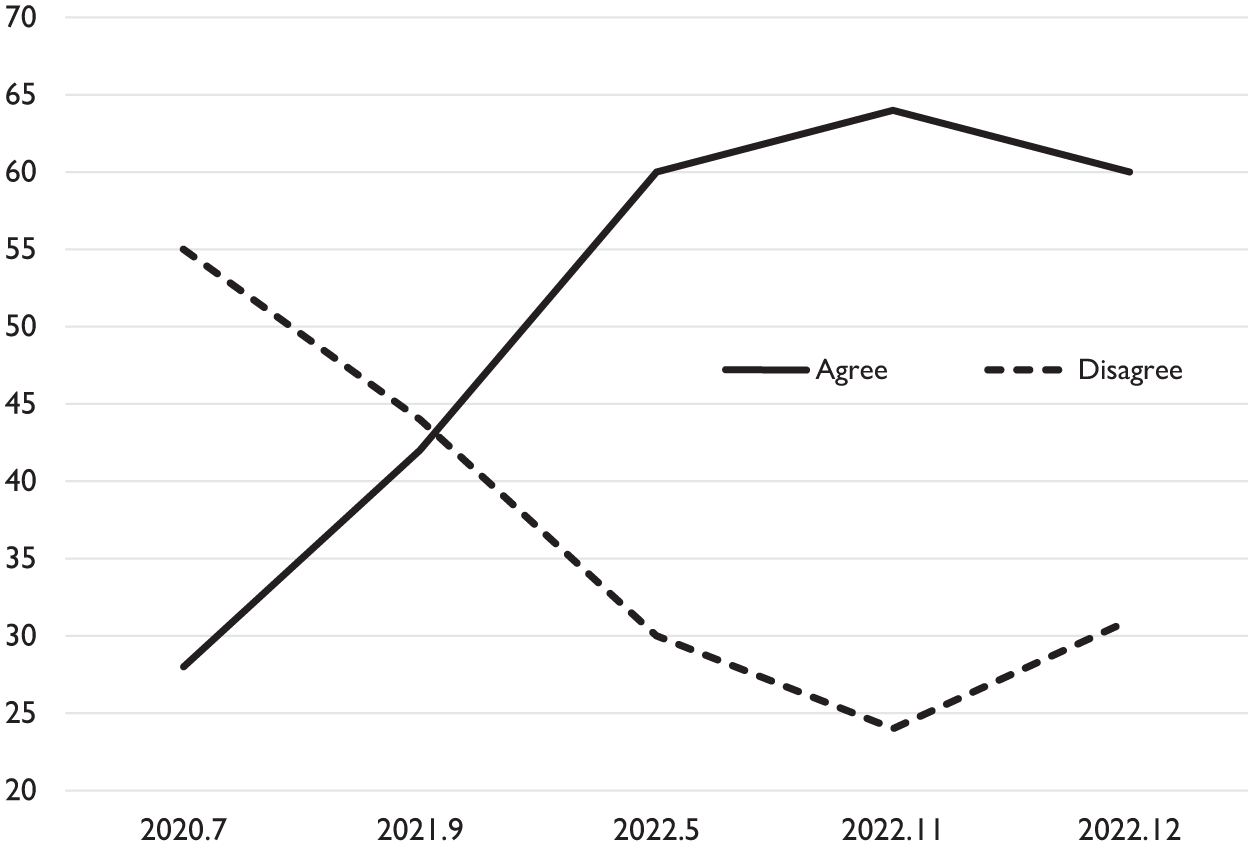
Opinions on acquisition of counterstrike capabilities (2020–2022) (Unit: %).
A big obstacle for securitization is a budgetary concern, as reflected in a sharp decline of support for more spending on defence (Figure 5). In particular, a majority of the political spectrum was against increasing taxes to finance the new defence programme.
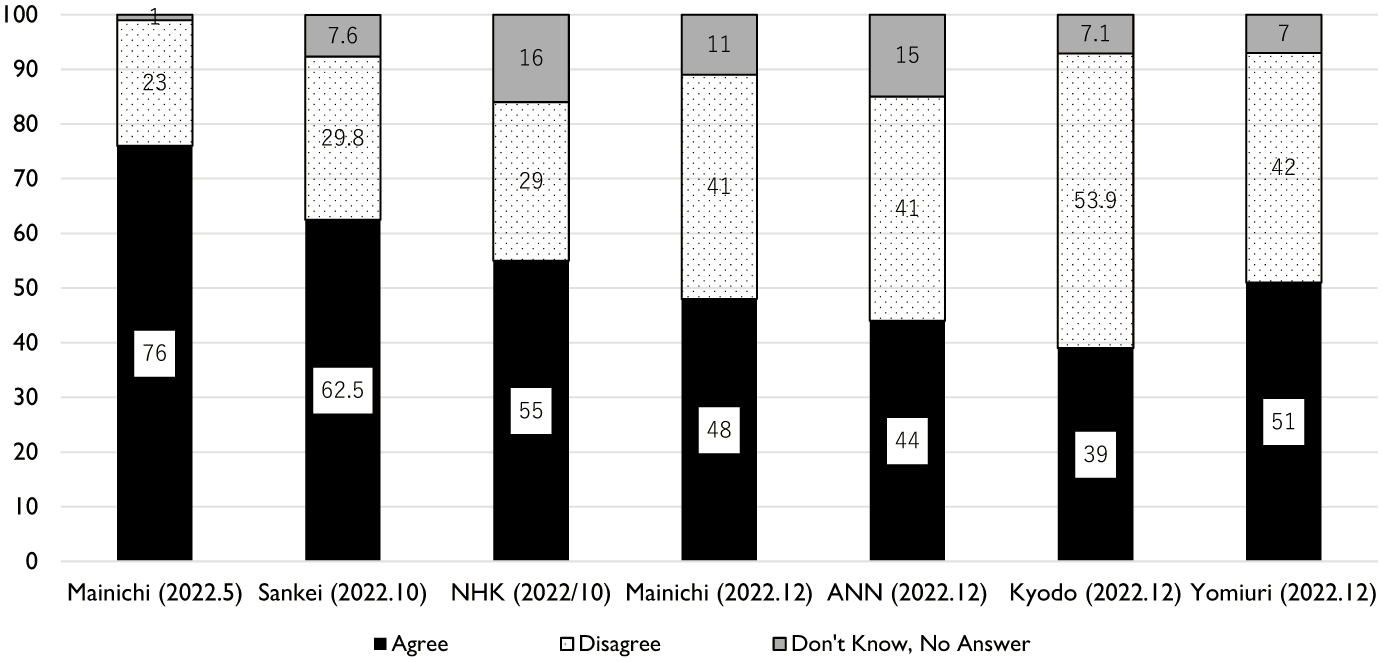
Opinions on an increase in the defence budget between May and December 2022 (Unit: %)
To sum up, since the Russian aggression of Ukraine, there has been little domestic opposition to the security shift operated by the Japanese government to securitize China. A major political factor can be found in the long domination of the Liberal Democratic Party (LDP), which has held legislative and executive power almost without interruption since 1955 (and continuously since 2012), a rare case in world political history. After years of efforts to securitize China, in particular during PM Abe’s second cabinet, the Russian assault on Ukraine offered a favourable context, and given the absence of unified competitors to the LDP, it was relatively easy for the ‘dove’ PM Kishida to push for this security agenda. However, the space for action is narrower regarding an increase in the defence budget. Moreover, in spite of advocacy for modifying Article 9, it thus far remains untouched as the ultimate reminder of the postwar pacifism. Since the invasion of Ukraine, Russia has conducted several military drills and joint patrols with China in the vicinity of Japan, generating further anxiety in the archipelago. North Korea’s nuclear tests are another matter of concern. However, as our analysis of polls and media suggests, the biggest threat is a possible emergency over Taiwan, often referred to as a ‘Taiwan contingency’ (Taiwan yūji) or ‘the problem of Taiwan’ (Taiwan mondai).
The fear of a ‘Taiwan contingency’
In August 2022, Beijing used the pretext of the US House of Representatives Speaker Nancy Pelosi’s visit to Taiwan to launch large-scale military drills around the island. During these operations, and for the first time in history, China fired ballistic missiles into Japan’s Exclusive Economic Zone (EEZ), in the sea of southern Okinawa, creating another shock in Japanese society, and in particular great emotion in Okinawa. Most affected were the Yaeyama and Miyako islands, also known as the Sakishima islands, which have their own specific cultural identity (Matsuda, 2008); closest to Taiwan, they were the point of impact of the Chinese missiles. As a member of the city council of Ishigaki, the main island in Yaeyama, explained to us (Interviewee A), the Ukraine war has made the residents fear that an armed conflict with China may break out in this part of Japan even without the occurrence of a Taiwan emergency:
That is why we are against the construction of a missile base here. I understand the Self-Defence Forces’ southwest shift, and I also know that China is a difficult country to deal with. However, rather than asking residents whether they are for or against military buildup, the question is whether they can evacuate, and whether they can protect their lives and property. But currently, we see no plan for shelters in the Self-Defence Forces facilities. How can we protect ourselves from missiles? [. . .] And the food stockpiles are only for two days. If we can’t store food and medical supplies for at least for one month for 50,000 people, then we should be able to evacuate the civil population. But how can we safely evacuate 50,000 people? (Interviewee A)
In response to this criticism, in March 2025, the central government in Japan announced a plan to evacuate approximately 120,000 inhabitants from the Sakishima islands to the prefectures of Kyushu and Yamaguchi over a six-day period in anticipation of an armed attack or other crisis. Uncertainties and worries remain, partly due to a blatant lack of communication between the central government, the Self-Defence Forces (SDF), local authorities and civilians.
Our informants in Yonaguni, a small island closest to Taiwan with only 1600 inhabitants, felt that their opinion was ignored after a referendum in 2016 won a slight majority in favour of welcoming an SDF base. As shown in a recent survey of the Japanese government (Naikakufu [Japan’s Cabinet Office], 2023), those in favour of the deployment of the SDF on the island share with the rest of Japan a positive view of the SDF: while these forces are especially valued for disaster relief operations, a high percentage of respondents also acknowledge their decisive role in national defence. Those inhabitants of the Yaeyama islands who are opposed to the deployment of the SDF tend nevertheless to agree with security experts that in the case of more serious events over Taiwan, it might be difficult for Japan not to become embroiled in the conflict. But compared to military experts, they are worried about the consequences for the civil population and question the seriousness of the preparation.
Meanwhile, leftwing intellectuals who are critical of the ongoing securitization of China tend to stick to more general views. For instance, a radical leftwing political scientist, who enjoys 80,000 followers on the social media platform X and is often interviewed by the Western media for his command of English, focuses on the critique of US imperialism and tends to duplicate Beijing’s narrative:
If Tokyo does not respect the ‘One China Principle’, if Japan happens to support the independence of Taiwan, which is a former colony of Japan, or if Tokyo declares strongly that it will stand for Taiwan in case of an emergency, I am afraid that the Chinese side will perceive Japan and the United States as supporting Taiwanese independence, hastening Beijing to conduct an armed unification. (Interviewee C)
In other words, ‘the problem of Taiwan’ derives from the partisans of Taiwan’s independence and their US supporters. Actually, US administrations have never encouraged nor supported Taiwan’s declaration of independence. Moreover, Beijing even rejects the sovereignty of ‘the Republic of China’, Taiwan’s official name (see in this monograph Lin & Chen, 2026). This scholar acknowledges that Taiwan used to be a Japanese colony and he shows sympathy for its current democracy. On a personal note, he enjoys spending holidays there with his family, which reminds us that Taiwan is Japan’s favourite destination, not China, even for scholars endorsing Beijing’s narrative. But when it comes to geopolitics, he advocates realism to claim that Japan has no responsibility toward Taiwan:
In the best scenario, Taiwan will be backed by the United States to become heavily armed, like the Israel of East Asia, somehow maintaining its independence and its democracy. But the Taiwan War will be a proxy war between the United States and China, with the possibility of escalating into a nuclear war. In the less ideal scenario, Taiwan will eventually be invaded, and it cannot be helped. But the best way to avoid war is that we should not prepare for it. Especially for Japan, deterrence is not the answer. Because there are limits to what Japan can do, and in the event of an emergency, Okinawa will be the first to be sacrificed. Taiwan is just a pawn for the US, and the US can’t be trusted. It may sound rude, but it is the same as for stray dogs, cats, and pets, when they need to be euthanized. Tokyo cannot take responsibility for Taiwan. (Interviewee C)
That was indeed an abrupt way to present the problem. Instead of expressing postcolonial solidarity, Taiwan is eventually compared to a pet and a pawn of US imperialism. Actually, given Beijing’s threats, most Taiwanese are not in favour of declaring formal independence; they only want to maintain their de facto independence and refuse to be annexed by Beijing (see in this monograph Wenger et al., 2026). Interpreting that legitimate wish as a rationale to justify Beijing’s irredentism is therefore like blaming the victim instead of the aggressor. As Zhang et al. (2022) highlighted, there is a tendency among radical left- and rightwing critiques to reduce the struggles of Ukraine and Taiwan to proxy wars between the great powers. In Japan and Taiwan, debates continue to intensify amid these circulating frames: for example, certain antiwar activists have repeated the classic leftwing critique of American imperialism while downplaying China’s aggressive moves against Taiwan and Japan and the expansion of its military bases in the South China Sea.
Conversely, Interviewee G, a proponent of increasing deterrence, argues that if Japan, the US and Taiwan maintain the current status quo for the next 10 years or so until Xi Jinping’s fourth or fifth term, a Taiwan emergency can be prevented. Another expert in Taiwan and geopolitics presents an even stronger rationale:
Russia invaded Ukraine thinking it could win. The key to deterrence is not to let the other party think they can win. Currently, the combined defence powers of Japan, the US, and Taiwan have an advantage over China, and a Taiwan emergency is deterred because China believes in Japan and the US intervening. (Interviewee F)
From another perspective, a philosopher specialist in postwar compensation, who is renowned for his critical views of the proponents of the ‘Greater East Asian War’ frame and their historical revisionism, shares his feelings about the ideological mood facilitating the security shift:
The Ukraine war has sharpened concerns about a Taiwan emergency, and North Korea is also conducting frequent missile tests, making war more real than ever in Japan. With defence experts giving their comments on tactics and weapons almost every day, it smells like preparation for war. Under the Kishida administration, security policies that the Abe administration could not achieve are now being implemented. (Interviewee B)
Elsewhere during our discussion, he partly endorsed the narrative blaming NATO for the Russian aggression of Ukraine. However ill-informed, this view on contemporary Ukrainian history (cf. in this monograph Kutsenko & Kostiuchenko 2026; Janušauskienė & Mamaiev, 2026) derives in part from his knowledge of the tragic social consequences of the heavy US military presence in Okinawa, which have included the rapes of local women. The bitter situation of Okinawa echoes the tragic history of the ‘comfort women’ of World War II – women from Korea, Taiwan and elsewhere forced by the imperial army into sexual slavery – whose cause he has championed through his publications and his intellectual support for the Women’s International War Crimes Tribunal on Japan’s Military Sexual Slavery (an international civic initiative drawing on the Russell model). Importantly, in contrast with the political scientist who compared Taiwan to a pet or a US pawn, this philosopher expresses solidarity with Taiwan.
In summary, regardless of political tendencies, it is understood in both Tokyo and Okinawa that a ‘Taiwan contingency’ can turn into an emergency for Japan. Although leftwing intellectuals tend to put the blame for that scenario on ‘provocations’ from Taipei, Tokyo and Washington, we also saw significant variants among adherents of the pacifist war frame: from solidarity with Taiwan to a postcolonial posture that refuses to admit any implications for Japan. Our look into the neglected part of the ‘audience’ has thus allowed us to understand with more nuance the risk perception regarding a Taiwan contingency. However, if Beijing were to escalate its current military harassment of Taiwan into a full-scale invasion, it remains to be seen if the Japanese government would engage the SDF in response and if Japanese society would support that option.
According to the World Values Survey of 64 countries, the Japanese regularly manifest the lowest rate of willingness to fight in the event of foreign aggression. Drawing on the World Values Survey, Nogami (2022) conducted a survey shortly before and after the outbreak of the war in Ukraine with a cohort of youths and found that the majority were unwilling to serve in the SDF, followed by approximately a third of undecideds, while those willing to serve peaked at 23%. However, the question intentionally included a demanding level of commitment, such as agreeing to serve on one of the numerous islands in the Japanese archipelago – such as Yonaguni in Okinawa. Consequently, we might presume that if the attack were directly against one of the four main islands such as Honshu, the share of those who would accept joining the SDF would probably be higher. In any case, these questions will certainly mutually influence the debate on the securitization of China, in particular over the issue of a ‘Taiwan contingency’.
Article 9 or the ultimate symbol of the pacifist frame
The debate on security issue in Japan is always closely related to the legal constraints imposed by the Constitution of Japan (Nihon koku kenpō), promulgated in November 1946 and made effective in May 1947. The partisans of the ‘Greater East Asian War’ frame have long criticized this constitution as imposed by the US, in particular for its Article 9 (e.g. Hayashi, 1964; cf. Lummis, 2013; Saaler, 2016). These two short paragraphs (430 words in the English translation) renouncing the conduct of war and the retention of military forces have been vilipended by the most radical rightwingers as a fundamental deprivation of Japan’s warrior tradition (the spirit of bushido, etc.). In contrast, liberal leftwing intellectuals who endorse the ‘Pacific War’ frame have embraced this constitution, and Article 9 in particular (see Dudden, 2012; Hahm & Kim, 2015). A good example is the ‘Article 9 Association’ (Kyūjō-no-kai). Founded in 2004 at the initiative of the winner of the Nobel Prize in Literature Oe Kenzaburo, it took an active role in the movement against the reform for the right of collective self-defence. 1
The Constitutional Democratic Party of Japan (Rikken-minshutō), established in 2017 and partly derived from the Japan Socialist Party, is another symbol of the attachment of many Japanese to the postwar constitution and its Article 9. As one party-member elected to the House of Representatives explains:
It is good that Japan has a law like Article 9. The basic interpretation of it should stick to its initial three pillars of exclusive defence, the right of individual self-defence and the minimum necessary force. [. . .] Our current defence system of Pac-3 and Aegis interceptor missiles respects the principle of exclusive defence and they can be used in various ways to counterattack if necessary. But if they were to be used in a preemptive attack, it would be against the principle of exclusive defence, so I’m opposed to it. [. . .] The problem lies in the obsession with deterrence: [. . .] it leads to an arms race and a security dilemma. (Interviewee I)
Another legislator from that party adds:
Japan should stick to the principle of its pacifist constitution, that is, an exclusively defensive security policy. In the worst scenario, even if China attacks its southwestern islands, Japan’s first response and application of its self-defence right should be limited to counterattacks. But that should not include attacking the enemy’s bases. (Interviewee H)
These remarks refer to the 2015 reform of the security legislation based on a reinterpretation of the constitution and the ‘right of collective self-defence’. According to it, even the acquisition of counterstrike capabilities to launch retaliatory strikes on an adversary’s territory (tekikichi kōgeki nōryoku) remains constitutional. However, constitutional law scholars have challenged this reform (see Haley, 2017). As one of them explains, the idea of collective self-defence was added to the initial interpretation based on the notion of ‘exclusive defence’ (senshu bōei), which justified the existence of the Self-Defence Forces but excluded capacities to attack enemy bases, such as intercontinental ballistic missiles (Interviewee D). The government has argued that these new capacities will only be exercised in a limited way, but the red line is unclear, even to Japan’s allies, such as the US and South Korea, not to mention potential enemies like China, North Korea and Russia. Some legal scholars therefore emphasize that the right of collective self-defence and exclusive defence are contradictory (see Yokodaido, 2024). Interestingly, public opinion supports both ideas, thus reflecting both this legal contradiction and the hesitations of Japanese policymakers.
To solve that contradiction, ultimately, rightwing ‘hawks’ in line with the late Shinzo Abe, have aimed to modify Article 9. So far, this has not happened and, given the lack of political consensus required to make it possible, seems unlikely, at least in the near future. However, incremental changes in Japan’s security legal framework have already significantly hollowed out Article 9 of its initial meaning.
In a joint poll conducted by the centre-left newspaper Asahi Shimbun and the University of Tokyo in February 2023, 62% of respondents supported further strengthening Japan’s defence capabilities while only 12% were ‘against’ or ‘somewhat against’ (Goroku, 2024; see also Figure 5). But a majority opposed raising taxes to pay for the new defence programme, compelling PM Kishida to postpone the tax hikes. Echoing this trend, a political scientist renowned for his analysis of liberal democracy and influential in the centre-left shows his concern for this indirect constitutional revisionism:
The revised security document states that enemy base attack capabilities are keeping in line with the policy of exclusive defence, but being able to retaliate by ‘initiating the use of force’ is clearly unconstitutional. However, if you look at polls, there is a majority of support for developing the capacity to attack the enemy’s bases, so that the only question that remains is funding. In other words, people are okay with the idea, but they don’t want to pay more tax for it. Is that okay? How about the identity of Japan as a nation? Is it fine to decide without any proper discussion a policy that completely denies the pacifism of Article 9? (Interviewee E)
This view exemplifies how Article 9, derived from the Pacific War frame, has become the ultimate symbol of the pacifist frame and national identity. However, a liberal philosopher already mentioned criticizes the rhetorical attachment to Article 9 from a leftwing angle:
The slogan ‘Protect Article 9 of the Constitution’ is meaningless because under the current security system, war is easily possible without constitutional amendment. Moreover, under the Japan-US security system, given the globalization of NATO and the heavy presence of US military bases in Japan, including Okinawa, it will be difficult for Japan to avoid becoming engaged in the war. But are Japanese citizens really prepared for war? (Interviewee B)
This critical view within the left does not seek to abolish Article 9, quite the contrary. However, the expert on Taiwan and China retorts the argument against deterrence and the preemptive use of missiles:
The perception that an expansion of Japan’s defence spending will cause a security dilemma is fundamentally wrong. If a war can be prevented by increasing defence spending even by trillions of yen, actually such expenditures remain cheap compared to the tremendous cost of a war. [. . .] The reason why Japan needs to consider the preemptive use of ballistic missiles is both strategic and economic. While it is difficult to intercept transcontinental ballistic missiles once they have been fired from China or North Korea, it is easier to destroy the enemy’s missile silos, and the overall cost is much cheaper. (Interviewee F)
Moreover, this perspective implies endorsing the Japan–US alliance as the lesser of two evils:
Although the peace that East Asia has enjoyed thus far has not been perfect, it is also true that the military power of the United States has maintained the status quo and peace in East Asia. The Japan–US alliance is just one piece of that puzzle. (Interviewee F)
If this approach has become dominant among Japan’s security experts and influential on the political right, it is not driven by an ideological attachment to the ‘Greater East Asian War’. Instead, it is more for pragmatic concerns over Beijing’s growing irredentism in the region and fear of Washington’s disengagement.
To summarize, while the liberal left-leaning camp that endorses the pacifist frame generally accepts the idea that China has become a serious matter of concern, this side of the political spectrum still calls for restrictive investments in the military and limitations in strike capacities. Inversely, those leaning toward the right advocate increasing investments and a revolution in strike capability to acquire sufficient credibility in deterring China’s territorial ambitions. While the latter option departs from the defence regime that has prevailed under the legal framework of the postwar constitution and the US–Japan Security Treaty, Article 9 remains a guardrail for the pacifist frame of the political left and a useful national symbol for the political right in pursuing an ambiguous diplomacy.
Conclusion: Halfway toward reframing postwar Japan?
After World War II, war became a marginal topic in sociology, as if the discipline entered an ‘eternal peace’ or some form of the ‘end of history’ (Malešević, 2010). Meanwhile, in the field of international relations studies, securitization theory departed from the realist perspective to address the threat of war as a speech act. We argue that this approach is a valuable tool for the sociology of war. Moreover, as we have demonstrated with the case of Japan, this theory helps in analysing the interactions between the state and society under the threat of war. We refine this approach by bringing in the longue durée of war frames and by focusing on the responses from the political centre-left and a peripheral population, two types of ‘audience’ generally neglected by both security studies and the sociology of war.
Much as in Western and other industrialized countries, Japan has tended to treat the threat of war as a negligible concern, even when East Asia was a major hotspot of the Cold War (as exemplified by the Korean War and the Vietnam War). This attitude, which was further encouraged by the end of the Cold War, has changed dramatically, however, in recent years. Driven by the momentum created by Russia’s full-scale invasion of Ukraine, the securitization of China initiated by Prime Minister Abe has largely been advanced by his successor, Prime Minister Kishida, and confirmed by his successor PM Shigeru Ishiba. Current PM Sanae Takaichi has taken an even more radical stance by stating that a Chinese attack on Taiwan could constitute an existential threat to Japan, requiring the use of its self-defence forces. Though it remains to be seen how Japanese society would support such an action, we have seen that public opinion has generally endorsed the comprehensive package of defence policy reforms, including the controversial issue of acquiring transcontinental ballistic missiles capable of striking China.
However, our attention to a neglected part of the ‘audience’ shows that there is a perception gap between the government’s defence reform policies and public support. Our interviewees among the political left and the inhabitants of Okinawa who adhere to the pacifist frame partly acknowledge the necessity of responding to Beijing’s growing irredentism, and to a lesser extent, threats from Russia and North Korea. Yet they also show a tendency to downplay Beijing’s aggressiveness and reduce the ‘problem of Taiwan’ to a proxy war provoked by Washington. Consequently, they support defence increases if it does not signify a fundamental shift in the socio-political system in place since the end of World War II, as symbolized by the postwar Japanese Constitution and its Article 9: hence, for instance, the rejection of transcontinental ballistic missiles. Actually, this ambivalent attitude is not limited to the political left and the inhabitants of Okinawa, but reflects a nationwide hesitancy and unwillingness to engage with military activities in case of an armed conflict. By paying attention to the voices of the political opposition and peripheral population we thus endeavour to understand the bigger picture of the war–society nexus, from the legacy of past wars to reactions in the face of ongoing wars and the threat of possible wars in the future.
As Malešević (2026) reminds us in his foreword to this monograph, war ‘shapes nearly every aspect of social life’. Wang’s (2026) conceptualization of war frames further underlines the lasting influence of certain war events and the clash of interpretations through an ‘hermeneutic circle’. Our study of postwar Japan confirms that different war frames durably permeate social minds and, moreover, demonstrates that the securitization debate draws upon the existing war frames. However, despite political disputes over the risk of future war, we also show that war frames will not stop the securitization debate from moving forward and eventually redesign national security, at least partially.
Footnotes
Acknowledgements
Thanks to our interviewees, and to research assistant Jyun-hua Huang for his help on the literature review, to Rebecca Fite for her editing assistance, as well as Silke Roth, The Sociological Review editor, and to five anonymous reviewers for their valuable remarks that allowed us to substantially improve the initial manuscript.
Funding
The authors disclosed receipt of the following financial support for the research, authorship, and/or publication of this article: Jobin thanks Academia Sinica and Hirai the Suntory Foundation for research grants.
Declaration of conflicting interests
The authors declared no potential conflicts of interest with respect to the research, authorship, and/or publication of this article.
