






Abstract
This article explores how menopause can be creatively reimagined through collective, embodied practices that challenge the limitations of contemporary cultural understandings of menopause. It argues that experiences of menopause can be transformed through practices that emphasise emplacement – siting or situating menopausal experiences within specific landscapes – and through shared activities that foster reflection, solidarity and empowerment. By foregrounding embodied and situated knowledge, the article contributes to sociological debates on creative and participatory methodologies, demonstrating how practices such as walking can ground abstract sociological theory and generate new ways of understanding lived experience. The article takes the form of a visual essay that reflects on the creative process of developing ‘better ways’ of experiencing and ‘doing’ menopause – approaches that seek to enhance the physical, emotional and psychological wellbeing of those undergoing this life transition. It focuses on a series of menopause-oriented walks entitled Walking the Menopause, in which rural landscapes become sites for reflection and collective meaning-making. Methodologically, the article draws on creative practices including mapping, drawing and walking. It examines three walks in particular: one developed in response to my own experience of surgical menopause, a one-to-one walk, and a group walk incorporating the experiences of other women.
Keywords
Introduction
In February 2021, I underwent a radical hysterectomy – a necessary surgical operation due to the growth of a large fibroid in my womb. This involved the removal of the uterus, ovaries, cervix and fibroid. A few months later, I began experiencing the extreme effects of a surgically induced menopause, which significantly impacted my physical body, cognitive processing and psychological wellbeing.
Writing as a creative practitioner who works in the fields of site-specific art and walking-performance, in this article I reflect on how and why I emplaced – sited or situated – my experience of menopause within a carefully chosen rural landscape, and how I worked with other women to do the same where they use a process of walking and map-drawing. 1
The result of this emplacement process was a series of site-specific menopause walks collectively entitled Walking the Menopause (Wilson, 2021–2024). These walks included private solo walks that I created in response to my ‘cliff edge’ menopause following my hysterectomy. Others were developed as one-to-one walks, and some were created for groups.
For this article, I examine two of these menopause walks. Firstly, one of my own solo walks – Walking the Menopause: Eskdale. This took place in a steep-sided valley in Eskdale in the western Lake District, Cumbria, UK, called Stanley Ghyll. I then turn my attention to the second example, of a group walk – Walking the Menopause: Scout Scar – that I created for International Women’s Day 2023 on Scout Scar, a limestone escarpment near the town of Kendal in the south Lakes. 2 The latter walk was open to women+ taking part in a day of menopause-related events and workshops. It invited participants to move together through the landscape, speak about menopause, and share experiences.
Drawing on the insights of Greer’s (1991) The Change: Women, Ageing and the Menopause, Lock’s (1993) Encounters with Aging: Mythologies of Menopause in Japan and North America and Houck’s (2006) Hot and Bothered, it becomes clear that for too long, women have been expected to endure menopause alone – in silence and often in shame – with little knowledge or support. Walking the Menopause together – in communitas – challenged this isolation, offered support and became an act of solidarity. As I will explore later, even the making of this walk involved a number of collaborators reflecting how its collective nature was part of its significance and purpose. More broadly, the discussion of the practice of collective walking as a method and a practice contributes to the sociological discussion about how walking can help develop a grounded way of thinking about sometimes abstract sociological theories and issues (Jackson, 2026) and foreground embodied, situated knowledge.
Creatively re-imagining and seeking ‘better ways’ of doing the menopause
Dominant imaginings of menopause are extremely limited and restricted, with a poverty of ways to think, speak and feel about the menopause beyond clinical, reductive or pathologised narratives (Orgad, 2026; Orgad & Steffan, 2026; Simmons, 2026; Steffan et al., 2026; Throsby, 2026). Contemporary discussions and representations tend to fall into the realm of self-help books (Throsby, 2026), blogs, wellness advice, diets and exercise plans (Steffan et al., 2026) and other popular forms and media – few of which centre lived, bodily experience and rarely do they allow for deeper collective/shared reflection.
Walking the Menopause emerges thus not only from personal experience but from this wider cultural context and the poverty of imagining menopause. In similar ways to Datta et al.’s (2026) use of cartoons as a way to invite women to reimagine menopause, Simmons’ (2026) use of body maps with LBGTQ+ participants going through menopause, Ramsey’s (2026) experimentation with film to offer an alternative narrative and Franks’ (2026) use of costume and punk performance to negotiate her menopause journey, my practice offers innovative methods that seek to address this poverty.
Specifically, by foregrounding movement and place as sources of knowledge, my practice (and this article) makes three central interventions that contribute to imagining more expansive, but also socially situated, ways of doing menopause. First, it offers emplacement as a methodological tool, that is, a technique or strategy, to express and reimagine menopause. Second, it places the walking, sensing, thinking and feeling body at its core. Third, it brings people together to build networks, knowledge(s) and new imaginings. By centring walking, emplacement and visual reflection, my aim is to expand how menopause can be understood beyond the body-as-site to menopause-in-relation – in particular, in relation to landscape, movement, rhythm and environment. In so doing, I seek not simply to analyse menopause differently but to enact a different way of knowing it.
In her book Surgical Menopause: Not Your Typical Menopause, Kemp (2021) discusses the brutality and aftermath of surgical menopause and makes a clarion call: ‘There has to be a better way’ of preparing women for menopause (Kemp, 2021, p. 1). This call inspired me to undertake the Walking the Menopause project and motivated me to reach out to women. Like Kemp (2021, p. 1), I wanted to ‘ensure other women don’t follow the same path’ – that is, of being unprepared for menopause experiences that ‘completely floor’ them, where ‘their mental wellbeing suffers; their relationship suffers and invariably their careers suffer too’. I wanted to help them and myself find new paths because, as Kemp says, ‘when it comes to our health, forewarned is indeed forearmed, and knowledge is power’ (Kemp, 2021, p. 1; see also Franks, 2026, on the notion of knowledge is power).
In what follows, to illustrate both walks and my creative process, I use photographs; distilled excerpts from my scripted words – on menopause, the landscape and the invitation to walk and undertake actions – and copies of menopause-maps. To demonstrate the impact of Walking the Menopause: Scout Scar, I share extracts from these maps and written feedback from collaborators and participants.
Emplacing and walking life-events
I am a UK-based artist and researcher who creates site-specific walks, visual artworks, installations and walking-performances. My practice addresses and gives-a-voice to life-events experiences that are challenging and marginalised and often remain unmarked – including breast cancer and surgery, hysterectomy surgery, terminal illness, death and bereavement, infertility and involuntary childlessness. These works have been made and performed on-site in a wide range of landscapes: from subterranean caves and limestone pavements in the Yorkshire Dales and mountain summits in Snowdonia to crumbling coastlines in Cornwall, and remote tarns and slate quarries in the Lake District. These works demonstrate how site-specific performance – especially when it is visually led and encompasses landscape and walking as metaphor – can give visibility to experiences that are difficult to express in words alone.
Though much of my work has an autobiographical foundation and is rooted in personal experience, it often invites others to collaborate and participate. For example, Warnscale: A Land-Mark Walk Reflecting on In/Fertility and Childlessness (Wilson, 2015) – a walking-performance created in the Lakeland Fells – was informed by my own as well as other women’s experiences of childlessness-by-circumstance and the ‘missing’ life-event of biological motherhood. It was the creation of Warnscale, and the way I involved these women in a series of mapping-walks, that began my development of drawing and mapping as a method.
This approach developed significantly during later projects, including Women’s Walks to Remember (Wilson, 2018–2019), which invited women who could no longer walk to draw memory-maps of landscapes that they could no longer reach physically but were meaningful to them. I then used these maps to walk on their behalf as a surrogate walker and brought photographs and films of their landscape back to them. Then during the pandemic, I offered the method out publicly and invited people to use it to remember through the drawing of memory-maps places they could not physically access.
These mapping projects revealed how the act of drawing/mapping landscapes within a specific context enables connections to emerge and experiences to surface that otherwise remain unspoken or inexpressible. The Walking the Menopause work builds on methods – here, the menopause-maps become a tool of reflection and expression – that can help the process articulating and navigating menopausal experience through landscape (and metaphor).
Walking the Menopause: Eskdale – A (private) solo walk
The first menopause-walk I created was in Stanley Ghyll in Eskdale. This walk was private and personal to me. I undertook it after my hysterectomy surgery, at a time when my menopause symptoms were extreme and only just diagnosed – before I began hormone replacement therapy. This was the lens through which I experienced the place.
The walk began in the valley bottom and followed a route of meandering paths that ascended through woodland populated with standing and felled trees, leading to the open fells above. All the while, I was walking in parallel to a series of dramatic waterfalls that often remained out of view but could occasionally be glimpsed between the trees or when crossing narrow footbridges. At times, it was necessary to circumvent closed-off pathways and heed danger signs warning of hidden drops (Figures 1 and 2).
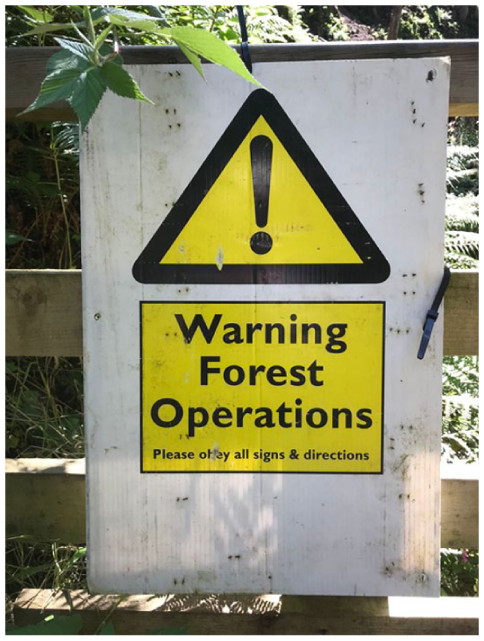
Walking the Menopause: Eskdale. Blocked off inaccessible path.
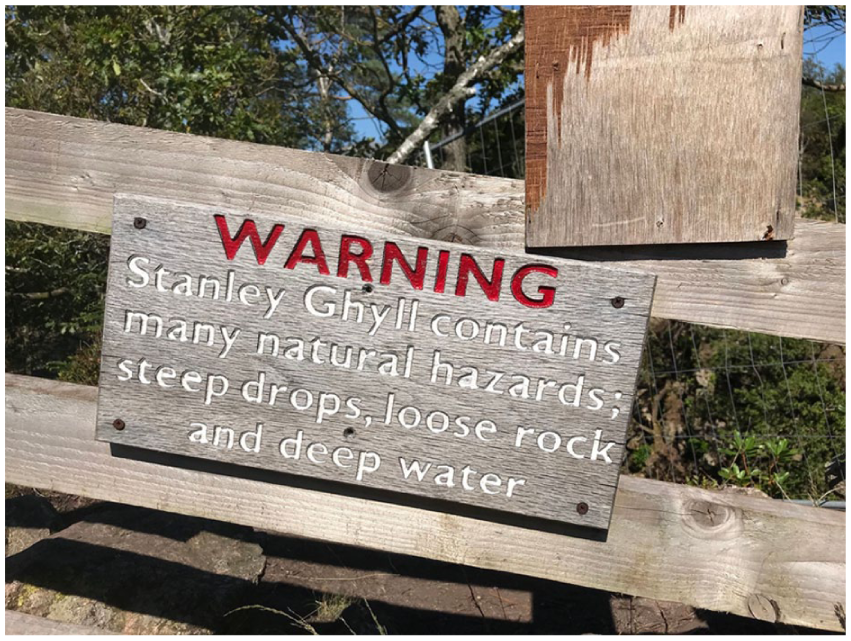
Walking the Menopause: Eskdale. Warning sign.
En route, I undertook activities such as leaping over and balancing on stepping stones to cross a stream, swimming in an ice-clear river (Figure 3) – where the unexpected view of the riverbank from the water brought fresh insights into the landscape – and taking rubbings of felled and raw tree stumps using paper and pencil to reveal intricate growth circles and chainsaw marks. At the top of a waterfall, I lay on rocks next to pools of water that would soon spill over and cascade down the valley to where the walk began – and would eventually return.
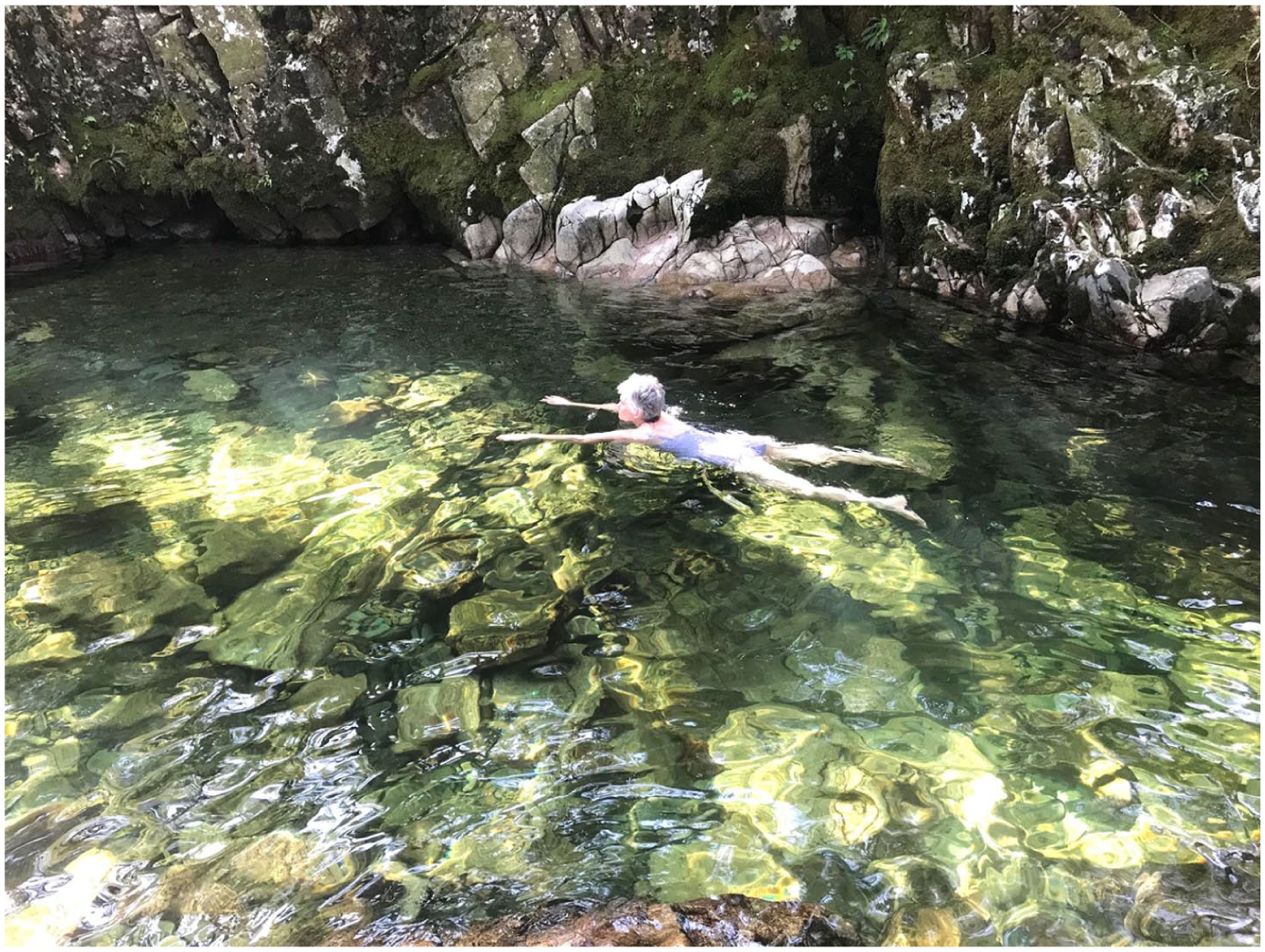
Walking the Menopause: Eskdale. Swimming in Gill Force.
Actions were important and helped me reconnect – physically and emotionally – with my body: swimming in the river was a physical reminder that my body was still strong and capable, while felled trunks and chainsaw cuts in tree stumps spoke to my surgery and healing body.
One feature and activity became particularly significant, leading to my decision to emplace and express my experience of surgical menopause in this site – and to consider that emplacement might be a helpful tool for others. A vertiginous viewing platform jutted high over the valley, offering a dramatic view down the landscape and out across the distant fells (Figure 4). However, for me, stepping onto this platform triggered a bodily response that felt exactly like a hot flush.
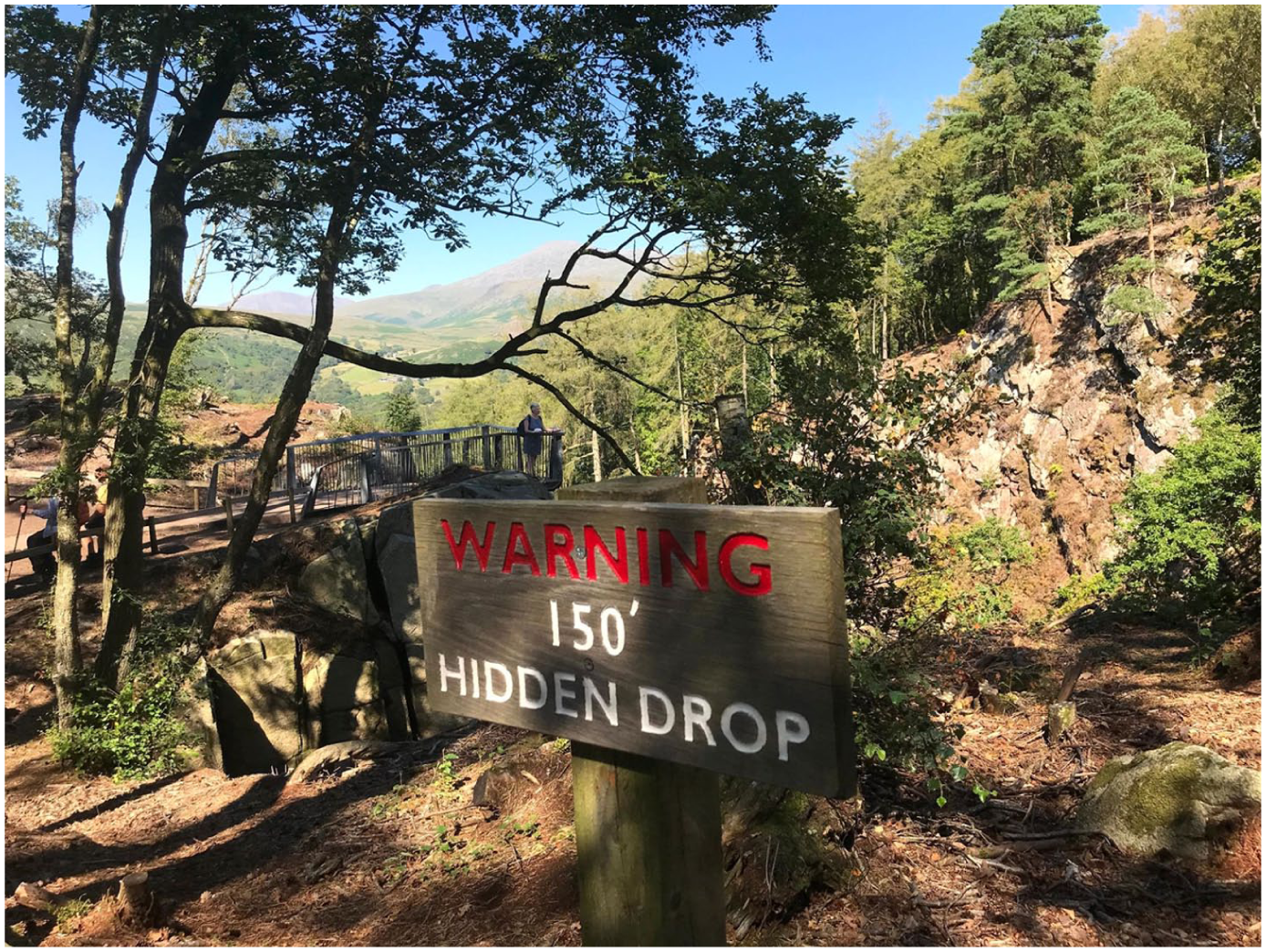
Walking the Menopause: Eskdale. Standing on Stanley Ghyll Force viewing platform.
The physical effects of my menopausal symptoms – particularly hot flushes – felt like electric shocks streaming upwards from my feet, surging through my body and into my chest, like a flock of birds flapping their wings. I would feel a fluttering in my heart and pulsing waves through my armpits. The description below is the closest I can get to putting these sensations into words:
As I approached the viewing platform, I had a sense of dread. With trepidation, I stepped forward, taking small, faltering steps onto the wooden platform. As soon as it came within reach, I grabbed the handrail and inched myself along, not looking over the edge at the ravine beneath or down through the gaps between the boards under my feet. Halfway, I stopped – frozen to the spot, unable to go further. My heart raced. My temperature rose. My chest palpitated.
With sudden clarity, this vertiginous – hot flush-like – sensation seeded an idea in my mind: to find landscape sites that emulate or map onto menopausal symptoms and experiences – an emplacement process that makes them tangible and material, so others might come to understand by feeling them too.
Walking the Menopause: Scout Scar – Reimagining together
On a very cold International Women’s Day, 8 March 2023, I led 14 participants on a two-hour Walking the Menopause walk on Scout Scar – a carboniferous limestone landscape near Kendal in the southern Lake District, Cumbria.
Carefully planned through solo site visits and pilot walks with friends – who helped identify sites that spoke to their peri/menopause experiences – this walk followed a 5-kilometre route along topographical fault lines, edges and scars; over dry, ice-shattered and weather-worn bone-rattling limestone pavements to cairns and icy trig points. Along the way, we stopped at a series of ‘stations’ – side-ways-bent, wind-blasted trees; rare juniper bushes viewed close-up through geology eyeglasses; and an erratic covered in bright lichen – as well as transitional places such as walls, edges and gates.
As we walked, participants were invited to tune into the landscape and environmental forces – wind, rain, ice, sound – and to use these as metaphorical means to reflect on, and if they felt inclined, share their peri/menopause experiences: physical, emotional and corporeal. At each station, I offered interpretive reflections that drew connections between features of the landscape – its geological and human-made structures, its climate, flora and trees – and different aspects of the menopausal transition. These included both physiological and psychological symptoms (such as joint stiffness, memory impairment, irritability, anxiety, depression, vertigo and vasomotor disturbances), as well as broader social ramifications including isolation, employment disruption and diminished self-confidence and self-esteem.
My input and framing are intended to be light-touch and suggestive rather than prescriptive, allowing space for participants to form their own connections and interpretations, and to share openly and freely – both with me and the rest of the group – as much as they feel comfortable. For some, an out-of-place erratic reflected the unpredictability that menopause had brought. Holly leaves prompted conversations about spiky rage and anger. Others found that shards of rock clinking underfoot triggered thoughts of drying bones and the loss of oestrogen to receptors.
Some stations included simple activities: using a magnifying glass to shift perspective and closely examine juniper leaves and berries or walking slowly while savouring the flavour of a Fox’s Glacier Mint. For reasons I will explain shortly when looking at the mapping-walk process – and inspired by the lyrics from the song ‘Dem Bones Dem Bones Dem Dry Bones’ by The Delta Rhythm Boys 3 – participants were encouraged throughout the walk to attune to their bodies: from toe to head and head to toe.
This practice invited them to notice physical sensations, acknowledge the embodied effort of walking, and attend to the surrounding environmental stimuli: the cold air on their faces, the strong wind at their backs, the calls of birds overhead, the clattering shards of limestone underfoot, and the mingled scents of bark and minty sweets.
Using a series of photographs taken during the Scout Scar walk, along with pared-back excerpts from my prompts – on menopause, the landscape and the invitation to walk and undertake actions – Figures 5 to 11 offer a snapshot of the walk.
Before setting off, I introduced the walk, explaining that we would follow a pre-planned route with stops at designated ‘stations’ – places for viewing, reflection and transition along the way. Participants were invited to share as much or as little as they wished, with the understanding that their experience would shape the perspective through which they engaged.
Station 1: Scout Scar – The edge/the spine
Menopause: Sharing my story of surgical / cliff-edge menopause. Body Scars.
Extreme symptoms: hot flushes, couldn’t remember words, anger, anxiety, depression.
Action: As we walk along this bony edge, consider your peri/menopause symptoms.
Walking (low impact activity): good for mental, physical, and social health.
Station 2: Limestone clitter circle and wall
Landscape: Carboniferous Limestone – formed from skeletons and bones of sea creatures – used to create cairns, shelters and walls.
Fragments of frost-shattered rock – sharp edges. Glaciation, wind and frost.
Action: Walk beyond the wall, through a Dry Valley / Valley of the Dry Bones (Ezekiel). Look and listen closely noticing the sounds underfoot, bony trees, fossils of sea creatures. Be aware of your body, from your toe bone to your head bone:
A dem bones, dem bones, dem dry bones
Well, your head bone connected from your neck bone
Your neck bone connected from your shoulder bone
Your shoulder bone connected from your back bone
Your back bone connected from your hip bone
Your hip bone connected from your thigh bone
Your thigh bone connected from your knee bone
Your knee bone connected from your leg bone
Your leg bone connected from your ankle bone
Your ankle bone connected from your heel bone
Menopause: What in your body or life feels brittle, dry, or losing strength? Notice it, and imagine how you might reconnect or regain resilience.
Station 3: Sideways (wind-blasted) yew tree
Landscape: Prevailing south westerlies. Hawthorn, Yew, Holly. Spiky leaves. Stunted growth. Bent by wind. No standing water – area has drained, poor soil, lack of nutrients.
Menopause: Oestrogen throughout the body is depleted, leaving bones, joints, and connective tissue weaker, energy lower, and moods more reactive. What in your body or life feels spiky, bent-over, or short-tempered?
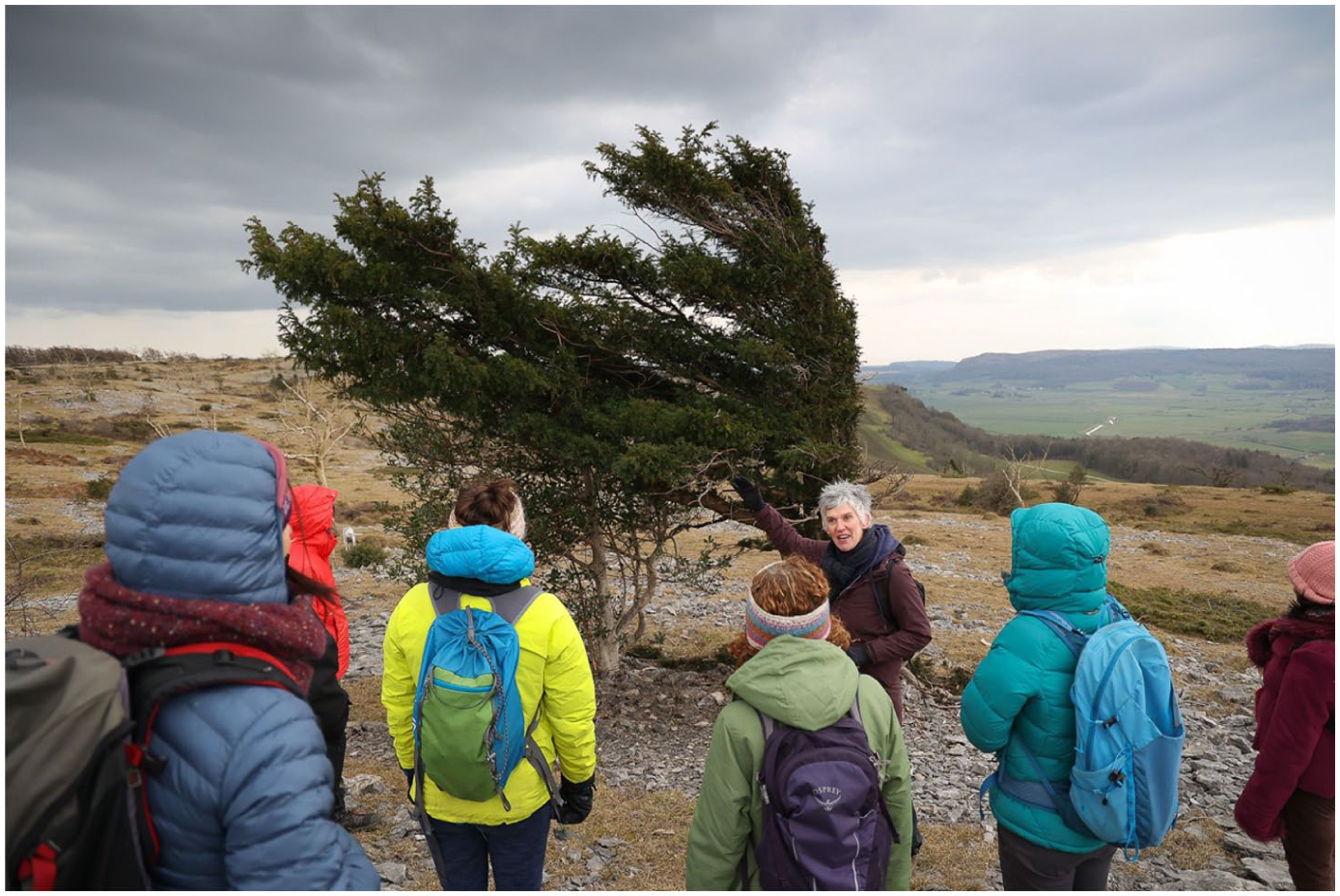
Station 3: Sideways (wind-blasted) yew tree.
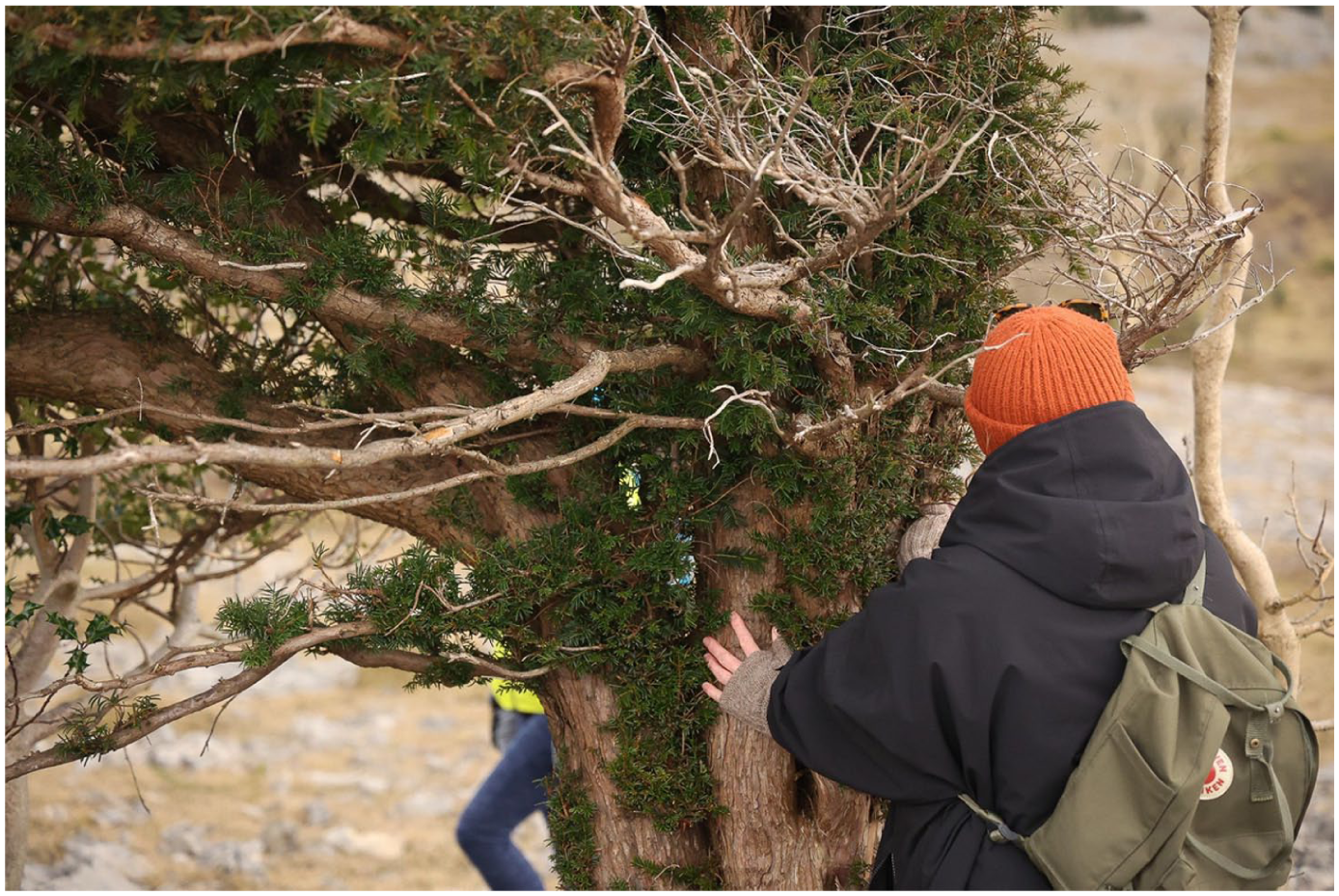
Station 3: Sideways (wind-blasted) yew tree.
Station 6: Juniper bush
Landscape: Juniper. Evergreen conifer. Bark peels with age. Lives for up to 200 years. Female plant pollinated by wind. Green structures mature over 18 months into purple-black, aromatic, berry-like cones. Two winters dormancy before new plants grow.
Action: Use the eyeglasses for close-up looking.
Menopause: What in your life is slowly maturing, resting, or preparing for new growth?
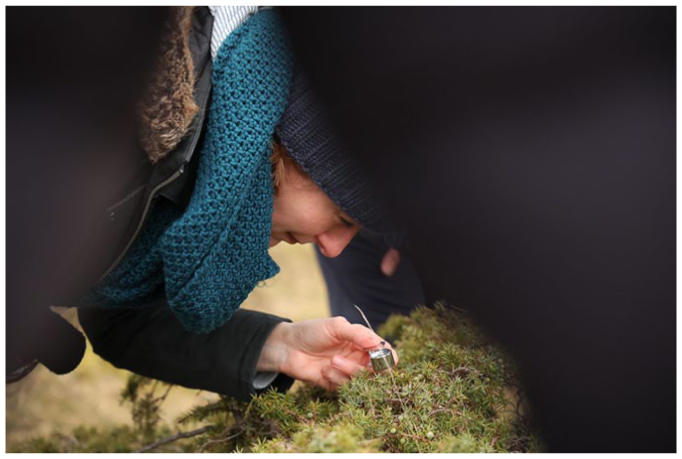
Station 6: Juniper bush. Close-up looking with magnifier.
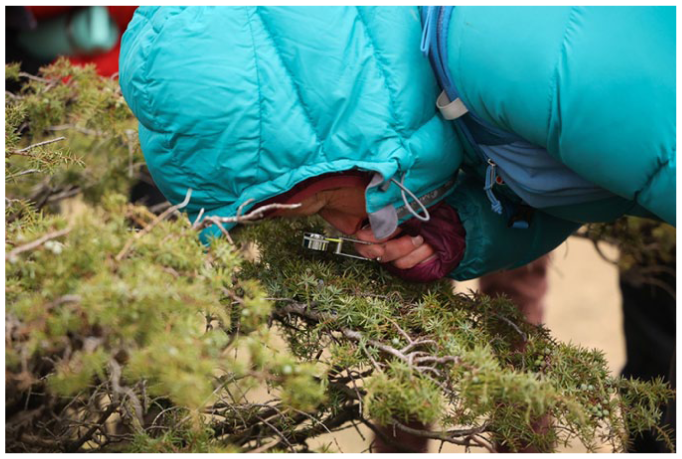
Station 6: Juniper bush. Close-up looking with magnifier.
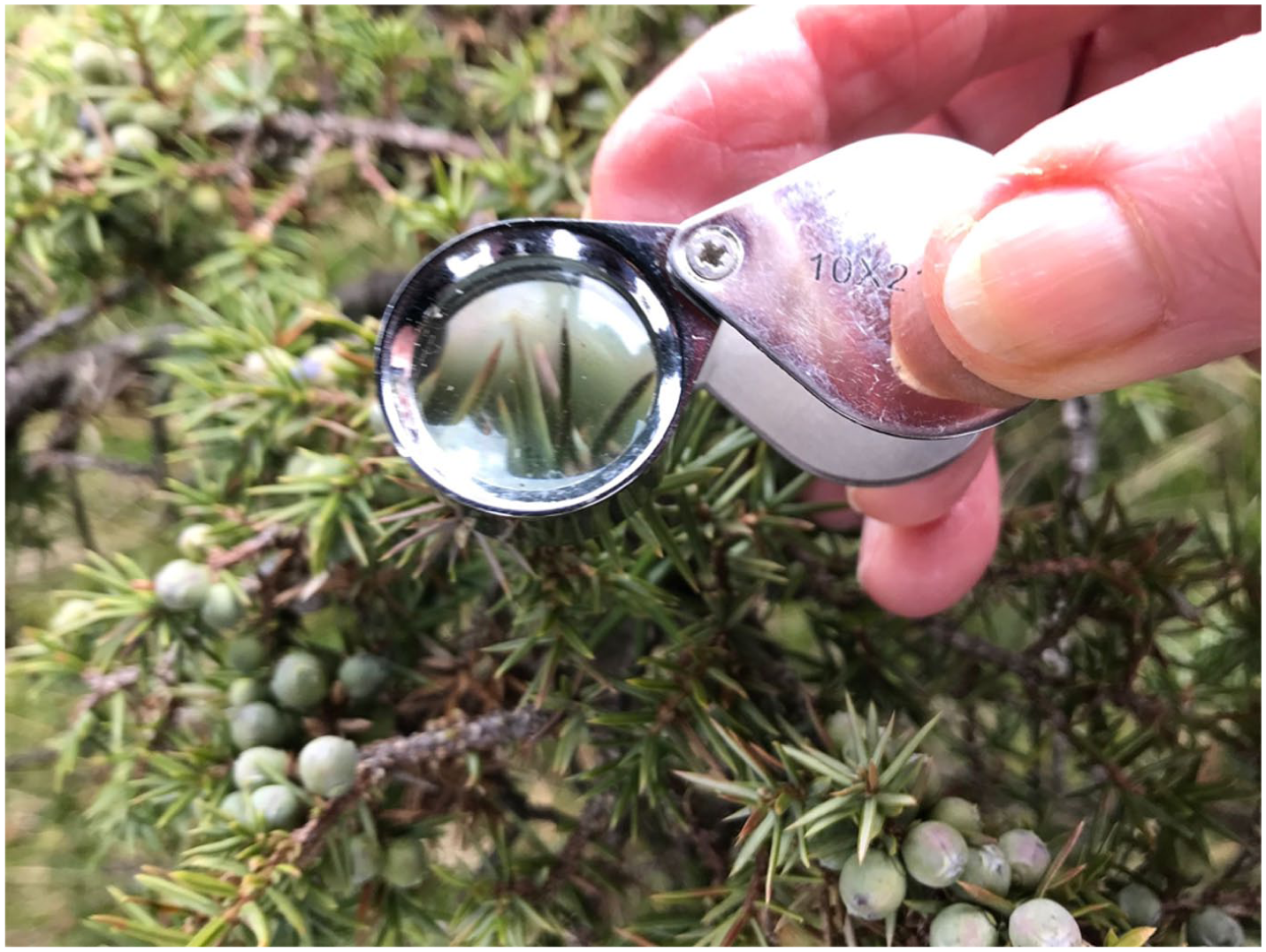
Station 6: Juniper bush. Close-up looking with magnifier.
Station 7: Small cairn – View of the Howgills and Yorkshire Dales
Landscape: Notice the glacial erratics at your feet, covered in bright lichens.
Action: Walk. Look at the distant view and far off fells.
Menopause: What in your life feels erratic, strange, or out of sorts? What surprises, delights, or new possibilities are emerging amid the change?
Station 8: Ash tree buds – Survival. New future
Landscape: Surviving Ash Dieback. Chronic fungal disease characterised by leaf loss and crown dieback. Spores carried on the wind. Buds sooty black, one larger bud at the end of each shoot.
Menopause: Time to pause and reframe. Survive. Grow. New life. New future.
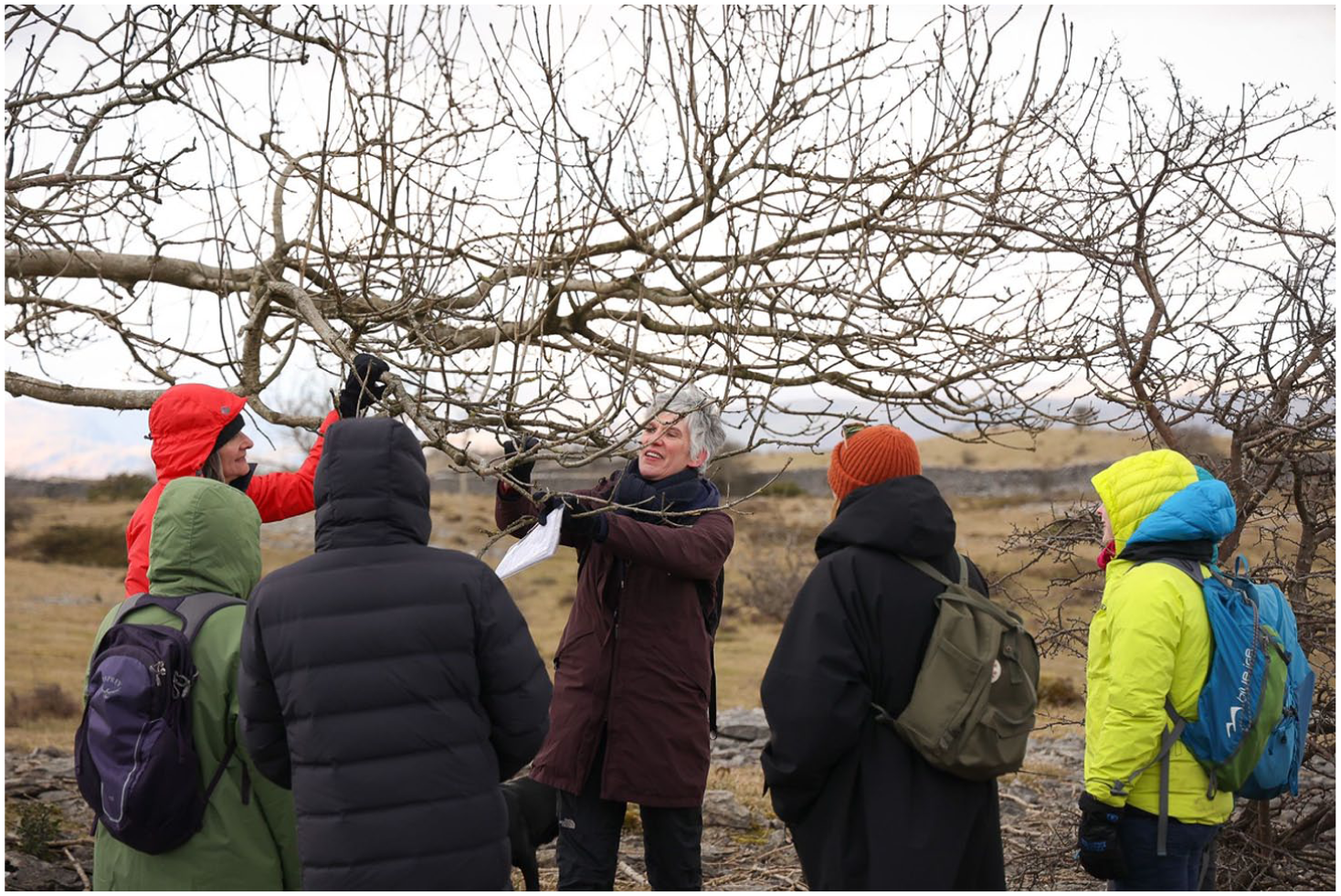
Station 8: Ash tree buds – Survival. New future.
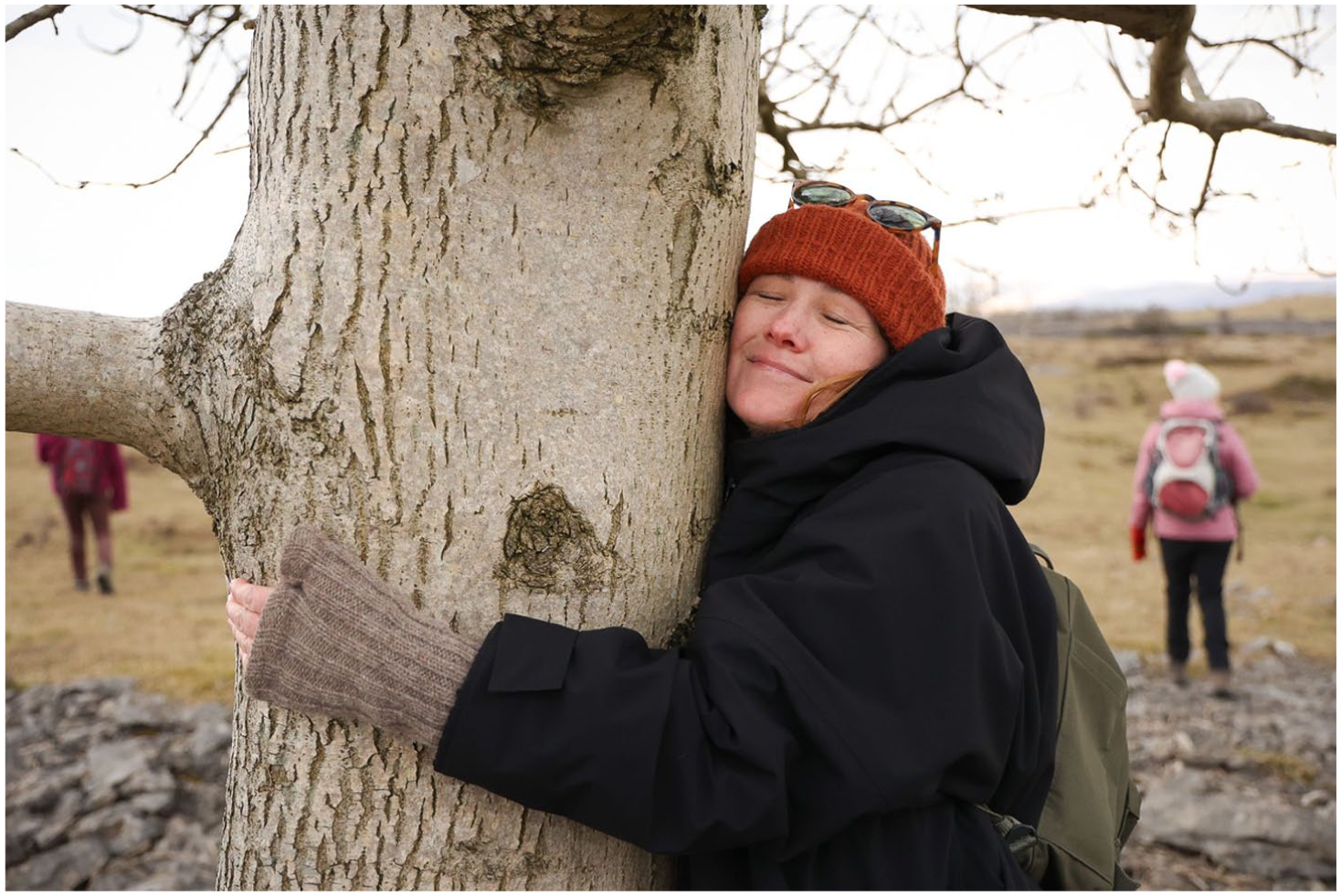
Station 8: Ash tree buds – Survival. New future.
Station 9: Trig point and wall
Landscape: Trigpoint. Scout Scar’s highest point – 235m.
Fox’s Glacier Mint – 100 years of taking it slowly. Polar Bear balancing on solitary glacier.
At Fox’s we believe life is better when you take things slowly. These principles go right back to 1918, when Eric Fox first established the Fox’s Glacier as long-lasting sweets with flavours that are worth savouring and taking time over (quote from Fox’s Glacier Mints packet).
Menopause: What icebergs or slippery, unstable ground are you balancing on?
Action: Walk slowly, take time, savour your mint. Consider ways you might find balance and ask for support: family, friends, colleagues, community. You are not alone.
Station 10: Shelter and viewing station
To encourage further reflection, at Station 10, the final station – a viewing shelter with a dome-shaped roof known locally as ‘The Mushroom’ – from where, on a clear day, it is possible to see as far as Blackpool Tower, the Old Man of Coniston, the Langdales, and across to the Yorkshire Dales, participants were given paper and drawing materials and invited to map or ‘draw out’ the walk as they had experienced it. They were asked to highlight key features, moments, thoughts, actions or conversations that resonated with them.
By this time, the temperature had dropped very low, making it too cold to sit and draw outside. Instead, participants took the paper home and drew their menopause-maps there. Figure 12 is one of these maps that was drawn by Tina and then posted to me.
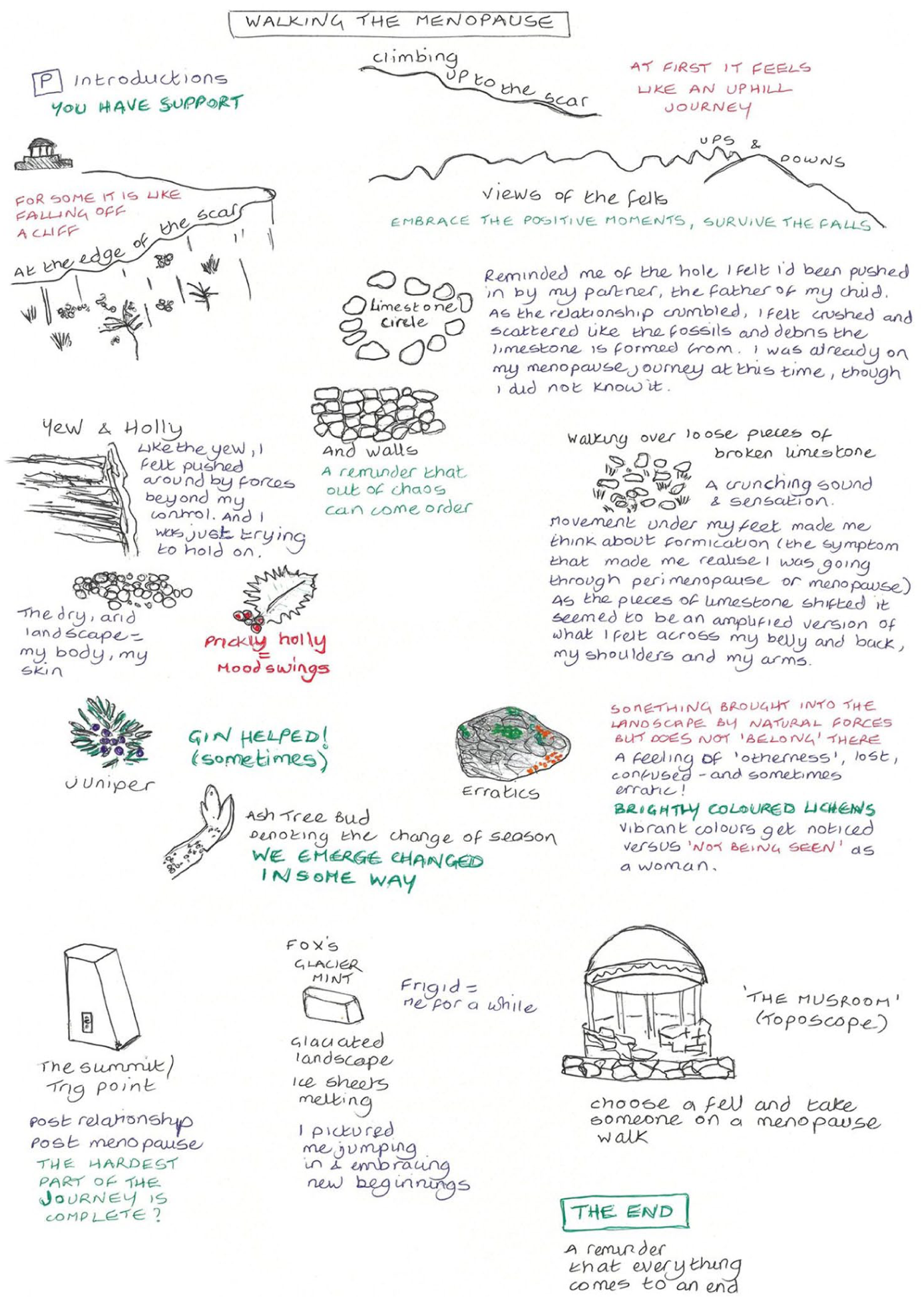
Tina’s Walking the Menopause: Scout Scar menopause-map.
Tina’s Walking the Menopause: Scout Scar map is personal and disarmingly and honest. It shows how, for her, the landscape became a multisensory and metaphorical space that reflected her experience peri/menopause. It illustrates how the emplacement process brought about a merging of land, body, menopause symptoms and imagination. As she walked, guided by the framing of each station, an external (physical) journey and an inner (imaginative/memory) journey occurred simultaneously.
For example, she describes how, when ‘Walking over loose pieces of broken limestone’, the ‘crunching sound and sensation’, as well as the movement of the rock underfoot prompted her to ‘think about formication (the symptom’ she writes, ‘that made me realise I was going through perimenopause or menopause). As the pieces of limestone shifted, it seemed to be an amplified version of what I felt across my belly and back, my shoulders and arms.’ 4 Also, her map captures the links between the landscape, natural forces and other physical menopausal symptoms: ‘The dry, arid landscape = My body my skin. Prickly holly = mood swings. Fox is Glacier mint // Glaciated landscape // FRIGID = me for a while. Juniper [berries] // GIN HELPED! (sometimes).’ And how, like the wind-bent yew trees, she ‘felt pushed around by forces beyond my control, and I was just trying to hold on’.
The map also shows how, for Tina, the landscape gave voice to how menopause cannot be separated but is interwoven with and impacts upon everyday life, including, for example, a significant but strugglingly relationship. The limestone clitter circle reminded her ‘of the hole I felt I’d been pushed into by my partner [. . .]. As the relationship crumbled, I felt crushed and scattered, like the fossils and debris the limestone is formed from. I was already on my menopause journey at the time, though I did not know it.’
As well as the past, she reflected on change, considering how the buds of the ash tree denoted the change of season and how – due to menopause – ‘we emerge changed in some way’. At the Summit / Trig point, where Fox’s Glacier mints were handed around, her map shows her asking whether now she is ‘post-relationship’ and ‘post-menopause’, and whether ‘the hardest part of the journey is complete’. She uses the view of the distant fells and the ups and downs of valleys and summits to ‘embrace the positive moments’ and ‘survive the falls’, and pictures herself ‘jumping in [off melting ice sheets] and embracing new beginnings’.
As a concluding gesture, participants were invited to study the 360-degree toposcope – a circular map etched inside the ceiling of The Mushroom shelter. The map, like the view itself, takes in the Lakeland Fells, Yorkshire Dales, Bowland Fells, Morecambe Bay, and beyond. Participants were then encouraged to choose a location from the map – perhaps a fell they liked the name of (Swirl How, Bowell, Pike o Stickle), knew well, or had never been to but would like to explore – and think of a person or people they would like to take there: someone experiencing peri/menopause; a family member with whom they would like, or need, to share their experience; or a group of friends or colleagues who could walk this journey alongside them. The aim of this was to encourage a sense of community beyond the walk and the day itself, and more broadly to build a Walking the Menopause network that functioned not only as an embodied form of reflective practice, but also as micro-acts of feminist place-making, wellbeing and community connection. My choice was Farleton Fell, where a few months later I created and led another menopause walk.
I will now explore how the Scout Scar walk was created through a series of exploratory menopause-mapping walks with several other women+. The aim was to develop familiarity with the site and to begin integrating menopausal experiences by exploring which elements of the landscape acquired significance, and what menopause-related themes might emerge.
Creative methodology: Walking, mapping and emplacing
The creative process was structured into four distinct phases, each designed to progressively deepen the relationship between the physical landscape of Scout Scar and the experiential dimensions of menopause.
Phase 1: Initial site walks
This phase began with initial site walks that I undertook independently to familiarise myself with the site (Figure 13). This was followed by a walk with a colleague who specialises in women’s health and menopause and was seeking wider means to communicate, educate and inform women about the peri/menopause outside of medicine and medical intervention. I also walked with my partner and on another occasion with an artist friend who lived locally and knew the site well (see Figures 14–16). During each walk, we engaged with the landscape through the lens of menopause, drawing from our individual positions. Working this way brings many different perspectives on the site and the subject. From these experiences, a route was developed and key ‘stations’ – places of resonance along the path – were identified. Some initial themes also began to emerge, which connected with the theme of International Women’s Day that year: #EmbraceEquity: ‘equity isn’t just a nice-to-have; it’s a requirement’ (IWD, 2023).
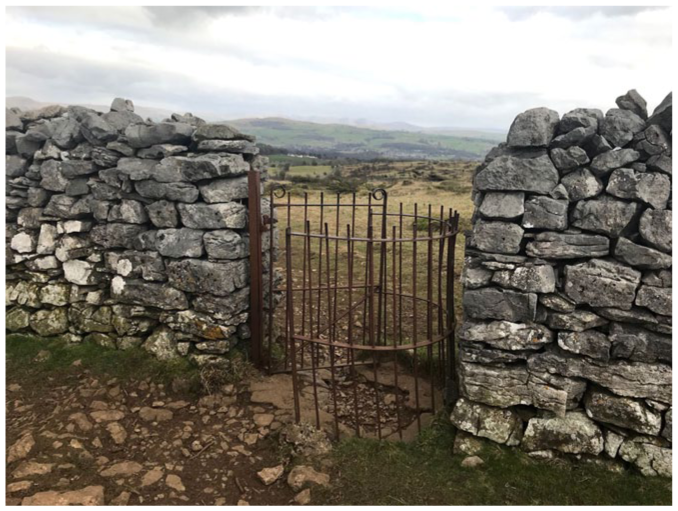
Initial site walks at Scout Scar (phase 1 of creative process). Gate and wall.
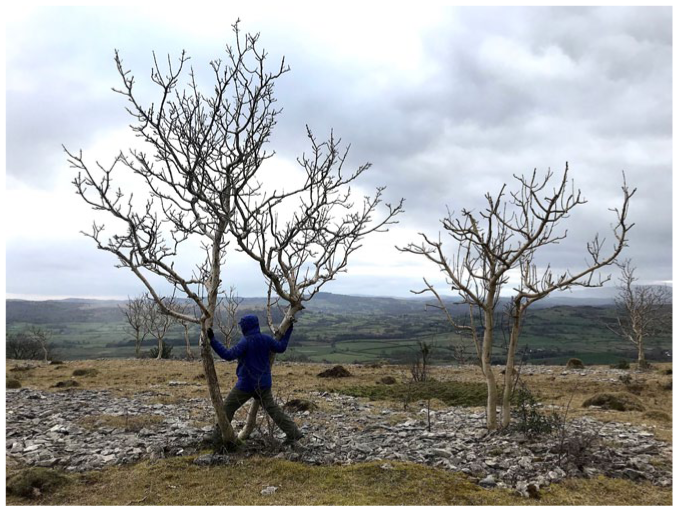
Initial site walks at Scout Scar. Bony trees.
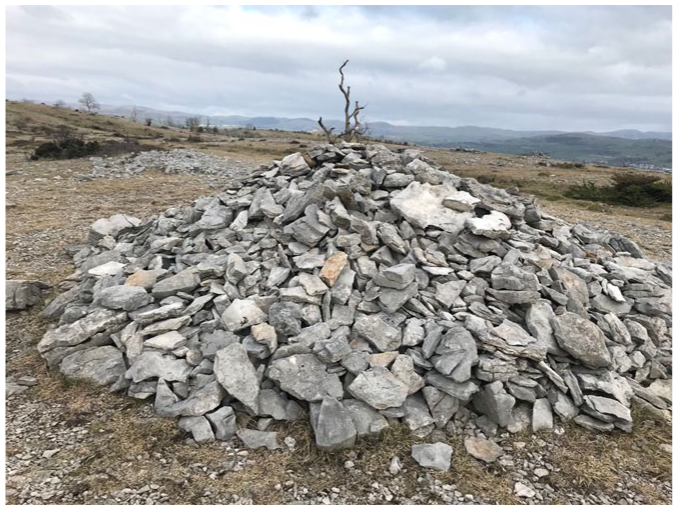
Initial site walks at Scout Scar. Limestone cairn.
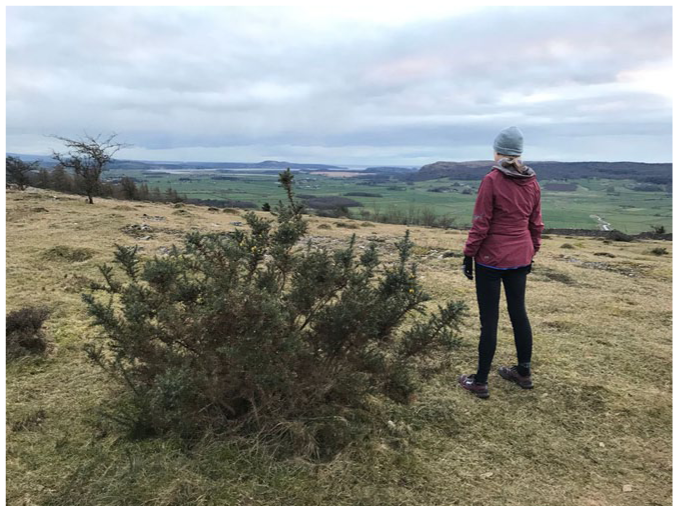
Initial site walks at Scout Scar. Juniper.
Phase 2: Site-based research
This phase involved research into the geological and environmental characteristics of Scout Scar. The objective was to enrich the project’s contextual grounding and provide a deeper understanding of the landscape’s physical and symbolic affordances. I examined its geological formation, how the rock interacts with the local environment, and processes such as frost action, wind and rain – seeking not only factual insight but also potential metaphors.
I studied site-specific plant life, their life cycles, and why they thrive here, alongside map analysis to trace shifts in rock type, terrain and habitat. I paid attention to boundaries and edges, as well as man-made features – walls, cairns, viewing points – that add layers of meaning.
Research drew on maps, documents, local knowledge and field observations. Time constraints prevented collaboration with geologists, farmers and residents on-site, but the process still yielded a detailed understanding of how the site works – knowledge essential for guiding others through it.
Phase 3: Menopause-mapping walk with friends
To ensure that the final walk would speak to a diversity of lived experiences, this phase involved a walk and map-drawing exercise on 5 March 2023 at Scout Scar with three participants – friends of mine – each at different stages of the menopausal transition.
Hilary (aged 70s): Experienced menopause several decades ago in a context lacking both support and understanding. Her professional role had required her to conceal the physical and emotional challenges she faced.
Steph (aged 60s): Had never previously spoken of her menopause experience, describing it as a period of profound disruption followed by personal transformation and liberation.
Ruth (aged 50s): Was in the midst of menopause and grappling with its ongoing physical, emotional and psychological impacts.
Louise (the author) (aged 50s): Managing surgical menopause symptoms with HRT, supported by nutrition and exercise.
The menopause-mapping walk with friends was designed to test and refine the prototype menopause-walk that was beginning to take shape and to further investigate the intersections between menopause and the landscape. As we walked, each participant responded to the site through the lens of our own menopausal experiences (Figure 17). I noted their responses and the stories that emerged, which were further captured in the menopause-maps each of us drew at the end of the walk. Altogether, it proved invaluable, bringing a range of insights that informed the content and structure of the final walk.
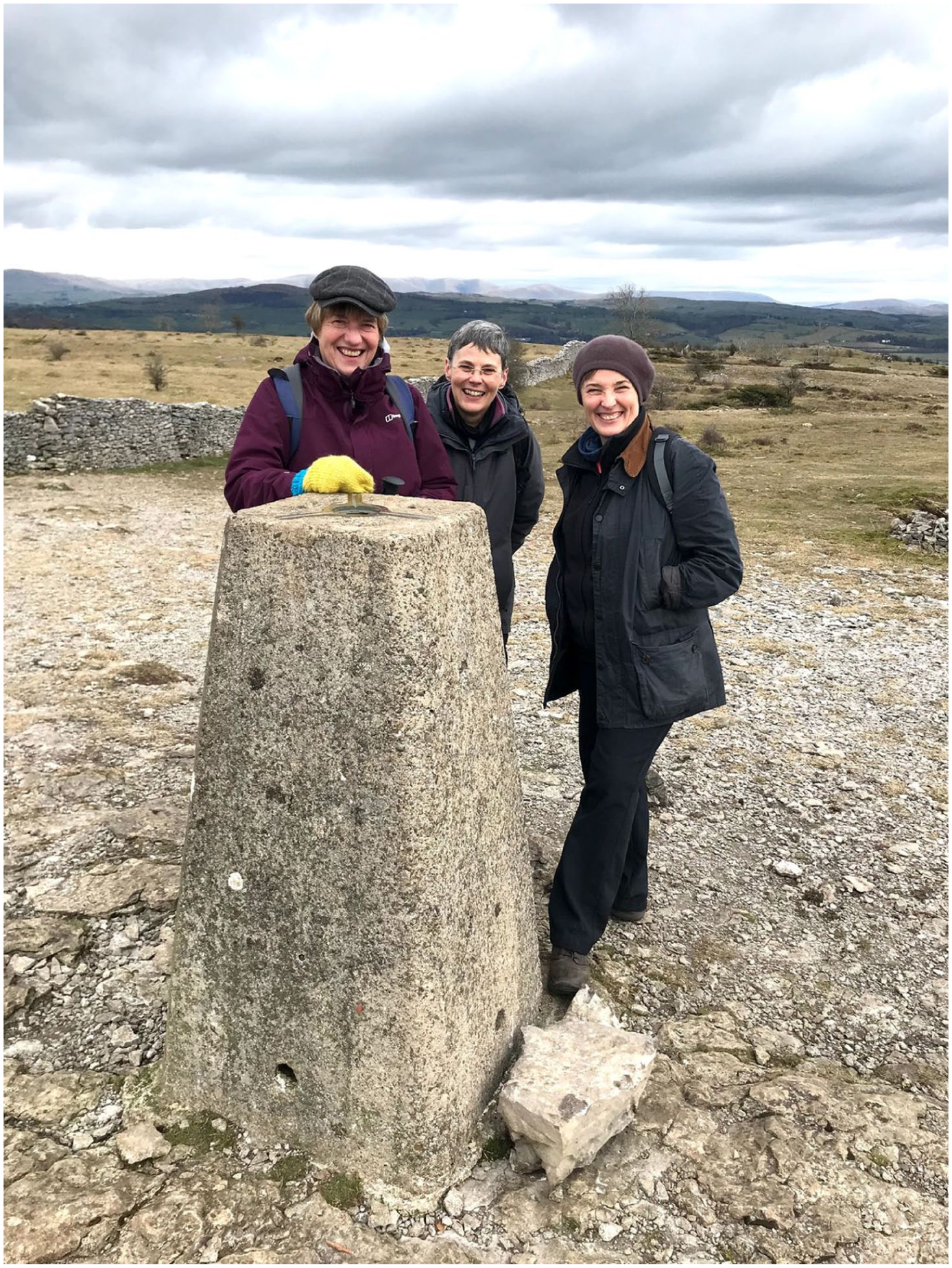
Scout Scar menopause-mapping walk with Hilary, Steph and Ruth.
Being friends, all three were familiar with my practice and some of the previous mapping-walks I had led. I had walked with each of them on other occasions, and menopause often came up in conversation. There was a willingness to engage with the walking and mapping process – they knew this walk would inform a public walk and were supportive of that. This familiarity created fluid conversation and a level of honesty that allowed us to dive straight into exploring the site through the context of menopause – without holding back or tempering what we wanted to say and express. Prompted by the landscape – views, terrain, plants, weather – we spoke openly about the effects of menopause, which for each of us had brought serious challenges – lack of confidence, burnout, anger, body pain – and the personal, relational and professional consequences. The willingness to speak openly about experiences that hadn’t been previously voiced brought about many connections and a deep sense of emplacement. Knowing each other well also meant we could move with certainty and playfulness between personal stories, reflections, cultural and art references – including music, art, religion and literature.
Mapping instructions provided to participants:
Using your paper and drawing materials, you are invited to map or draw experiences of menopause, situating them within a landscape.
Your map may be personal or may reflect the experiences of others – such as family, friends, colleagues, or under-represented groups.
You are encouraged to draw from lived experience and knowledge or from emergent, forming understandings.
The form may be pictorial, graphic, or abstract. You may use words, lines, symbols, and imagery in monochrome or colour.
The landscape may be real, imagined, or hybrid – urban or rural, near or far. Let your imagination guide the process.
Include landmarks, objects, memories, myths, or metaphors that connect bodily experience to the land.
Enjoy the process. Let your map evolve organically as you draw.
Before I look at the maps, I explain that the next phase was one of distillation and synthesis.
Phase 4: Distillation and synthesis
In the final phase, I analysed the conversation and resulting maps and integrated them with the previous research, the other walks and site-based findings, alongside menopause themes. This synthesis informed the final walk route, where to locate stations, viewing places and transition sites, and actions that would take place. It shaped the narrative dramaturgical structure of the route and these interventions, ensuring the walk moved through a range of site-specific and menopause-specific themes and concerns, and had a distinct beginning, middle and end.
I will now show and look in more detail at the menopause-maps drawn by Hilary, Steph and Ruth (Figures 18–20).
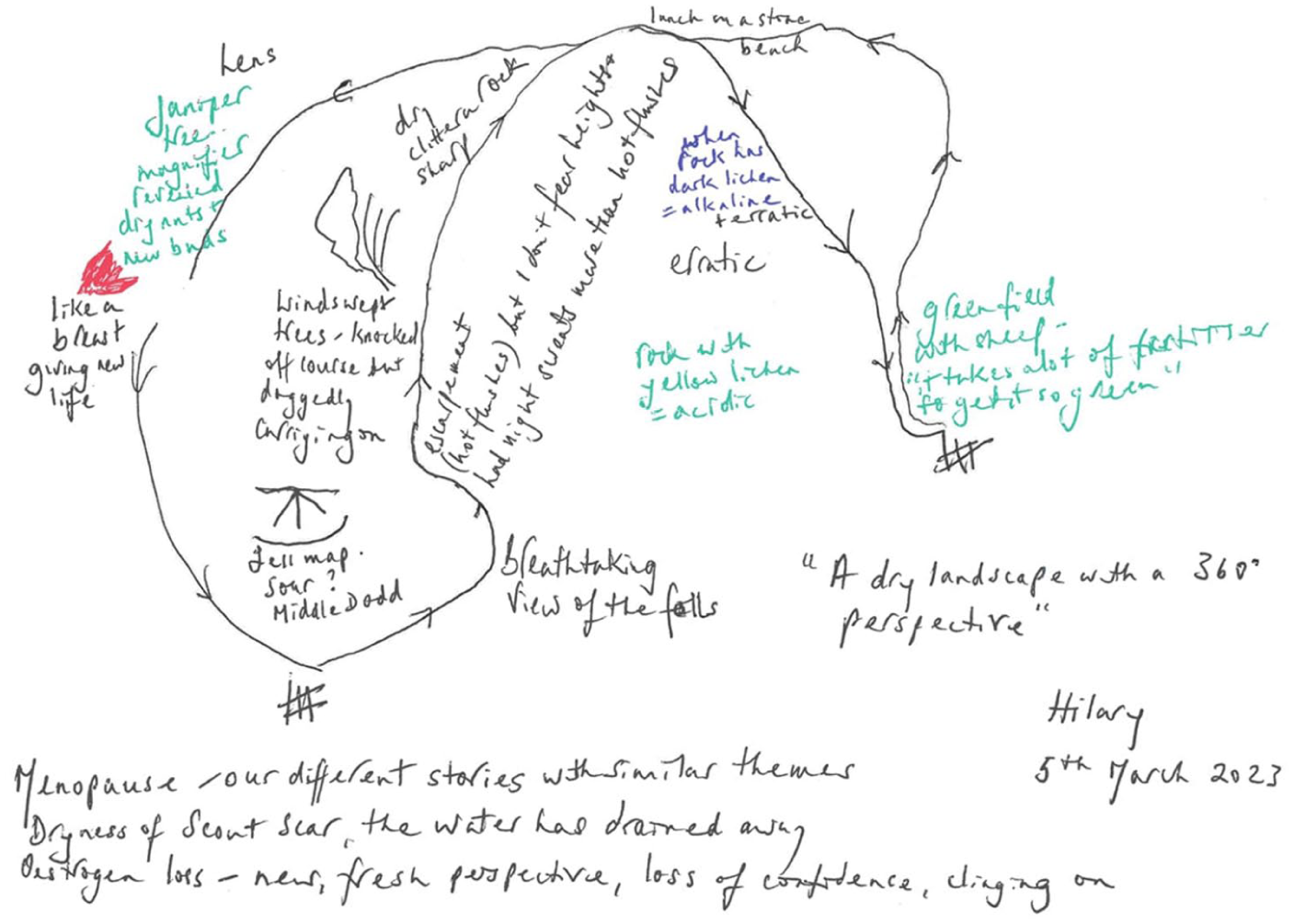
Hilary’s Scout Scar menopause-map.
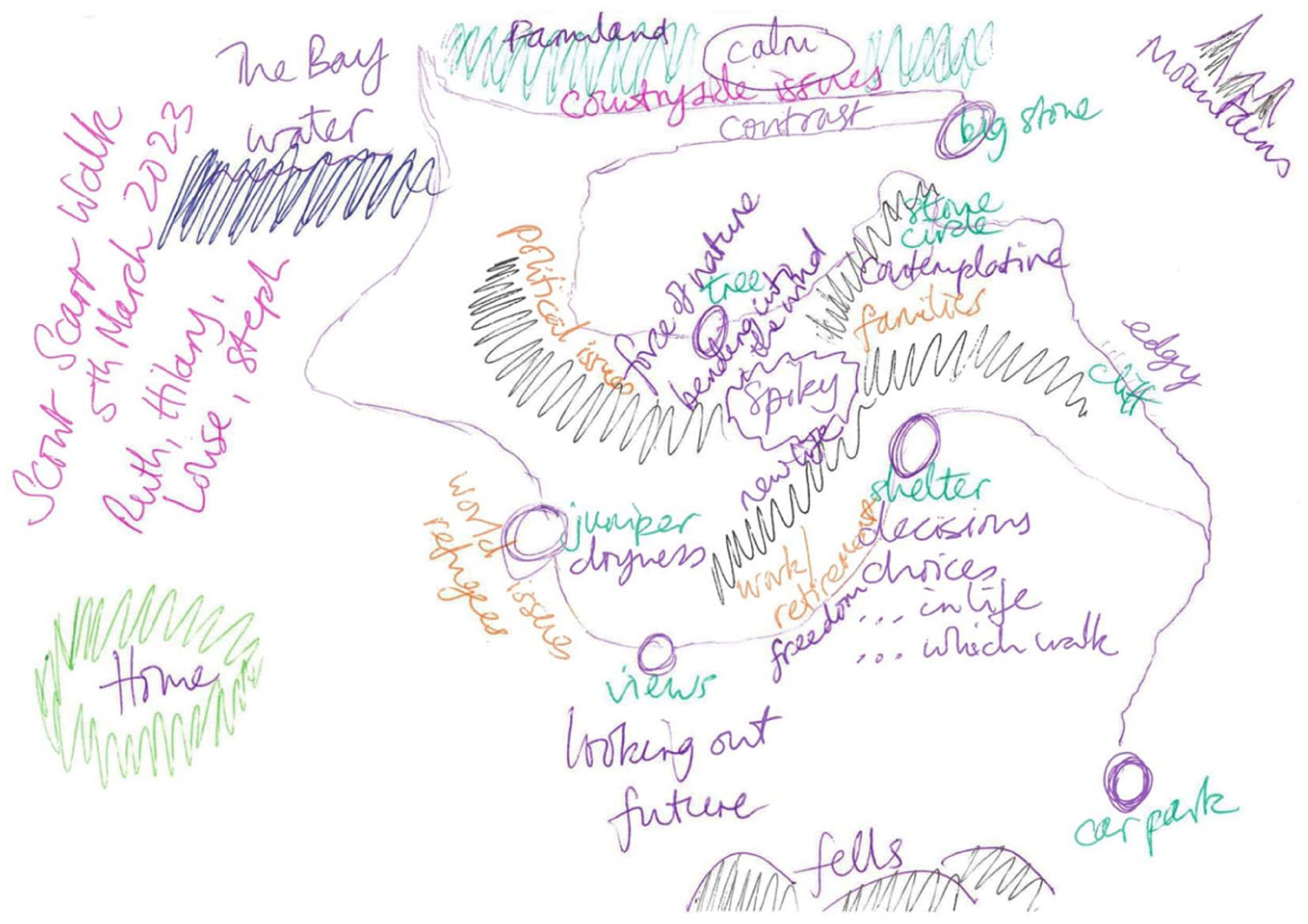
Steph’s Scout Scar menopause-map.
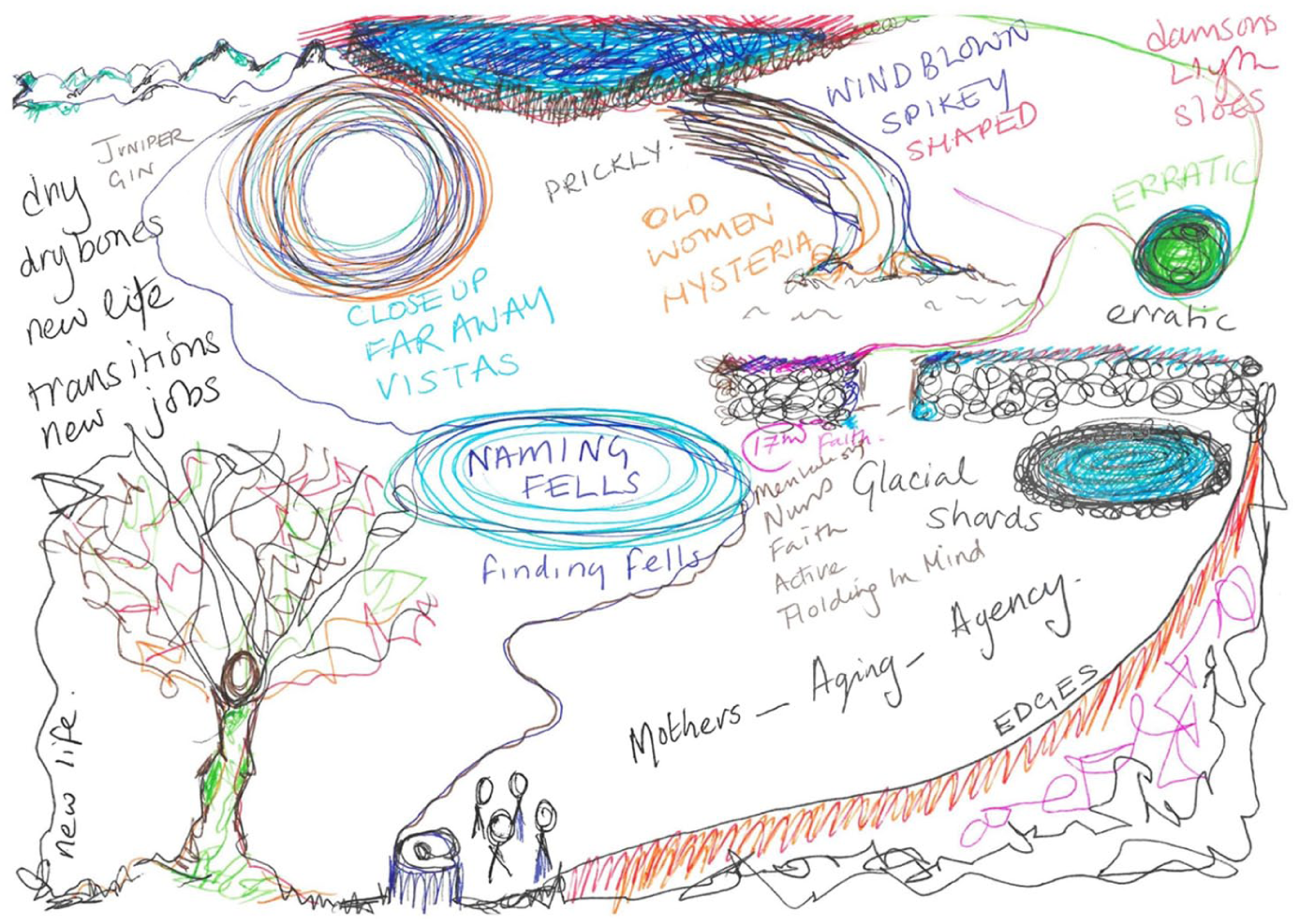
Ruth’s Scout Scar menopause-map.
Hilary recognised that, although her fellow walkers had a different menopause story, there were similar themes. She identified Scout Scar as ‘a dry landscape with a 360° perspective’ and drew parallels between the dryness of Scout Scar, from where water had drained, and the draining away of oestrogen with menopause. She mapped how, for her, this loss brought with it a loss of confidence, and a sense – like the trees and plants on the scar – of clinging on. She noted that, just as a magnifying glass brought new perspectives on leaves, buds and berries, there is also a need for new and fresh perspectives on menopause that this way of collective walking and emplacing can bring about.
My introduction at the start of the walk about the escarpment we were standing on, and my own cliff edge menopause, created space for Hilary to share how she didn’t have hot flushes but did have night sweats (Figure 18). This helps me feel confident that other walkers will hear an emplaced menopause story and feel able and encouraged to bring their own experiences to mind.
Steph’s map revealed how she noticed links between the forces and qualities of nature – a tree bent by the wind, spiky holly leaves, the contrast between the stark grey-dryness of Scout Scar compared to the lush-green farmland, and the vertical edge or scar that separated them (Figure 19). Many of the sites she marked became stations or viewing places where distant fells and the water of Morecambe Bay could allow a looking both outwards and inwards, as well as to the future. She also noted places that were calm, where issues might be recognised and contemplated, choices about life, work and the wider world be considered, and decisions made.
Ruth’s map showed her making connections between the landscape and mythic figures and stories, especially those relating to transformation, resurrection and restoration. She connected the landscape to the Ezekiel ‘Dry Bones’ story and song in relation to the body and walking. Ruth illustrated how menopause is a time of transitions, ageing, and new beginnings that can bring with it agency and new life.
Each map highlights the unique ways in which Steph, Hilary and Ruth experienced and interpreted menopause through the landscape of Scout Scar. While there were common themes, the maps also revealed distinct individual journeys and perspectives.
Walking the Menopause: River Lune to Long Churn Cave – One-to-one
As well as contributing to the Walking the Menopause: Scout Scar walk in late summer and winter 2022, I undertook a series of one-to-one menopause-walks with Ruth. These walks were bespoke to her and emplaced her experiences into two sites: firstly, the River Lune in Lancaster, UK, and then a network of underground passageways in Long Churn Caves, Yorkshire, UK.
The initial walk involved a lot of sharing and conversation, a swim in the river and a menopause-mapping exercise (see Figure 21). From this, major themes of darkness and fire emerged, along with mythic underworld figures such as Inanna and Kau-Pele. These figures reflected Ruth’s need to go deep inside the earth – and into herself – ‘in order to burn things off and return to the surface transformed and resurrected, like the kingfisher of brilliance’ we saw darting around the riverbanks.
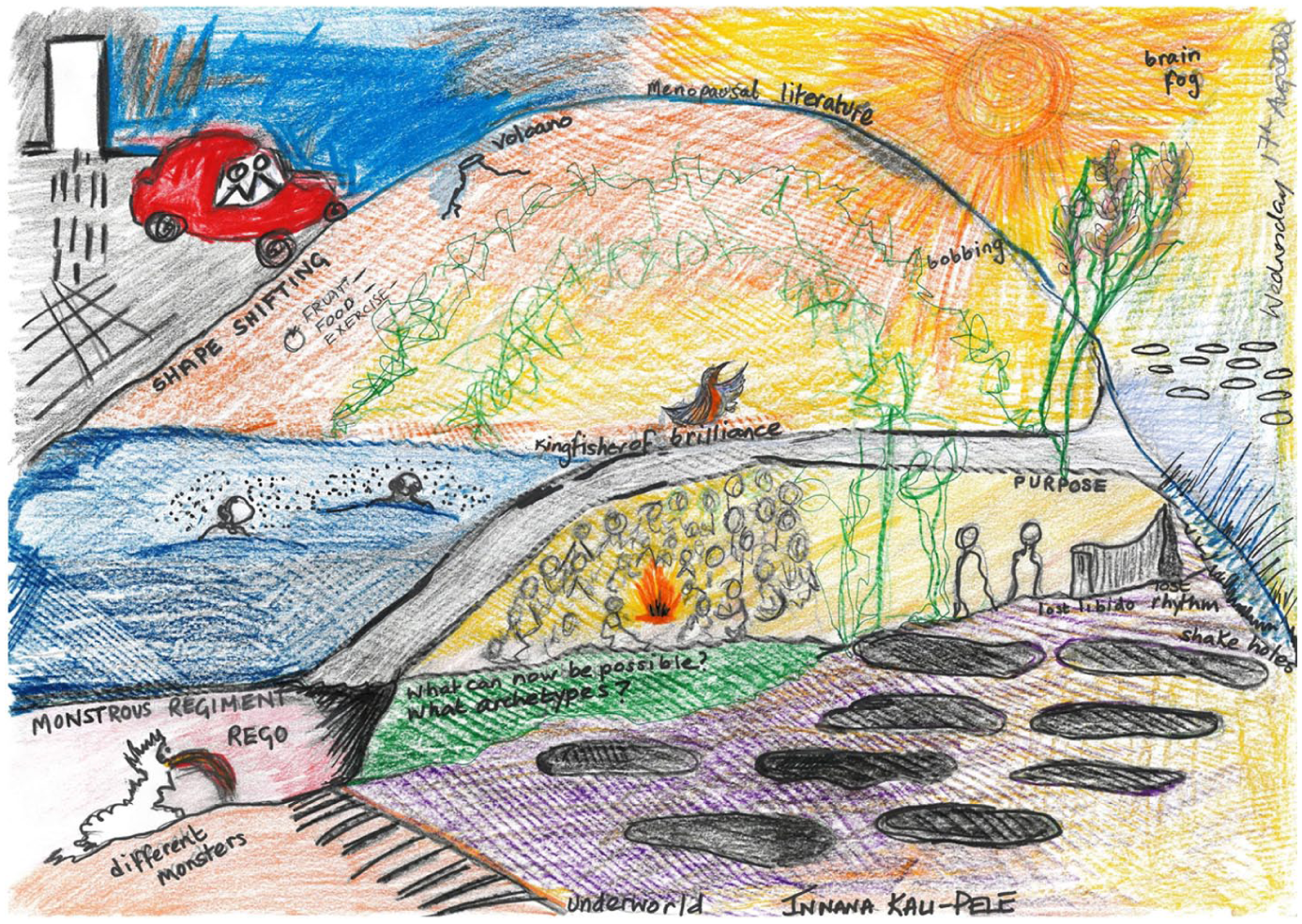
Ruth’s Walking the Menopause: River Lune menopause-map.
The themes that emerged from the initial River Lune walk suggested that an underground environment would reflect her specific experience, which led us to the caves. There, we walked further, played in and explored limestone pavements, shake holes and the subterranean landscape of rock and water, wrote poetic responses, and drew (see Figures 22 and 23).
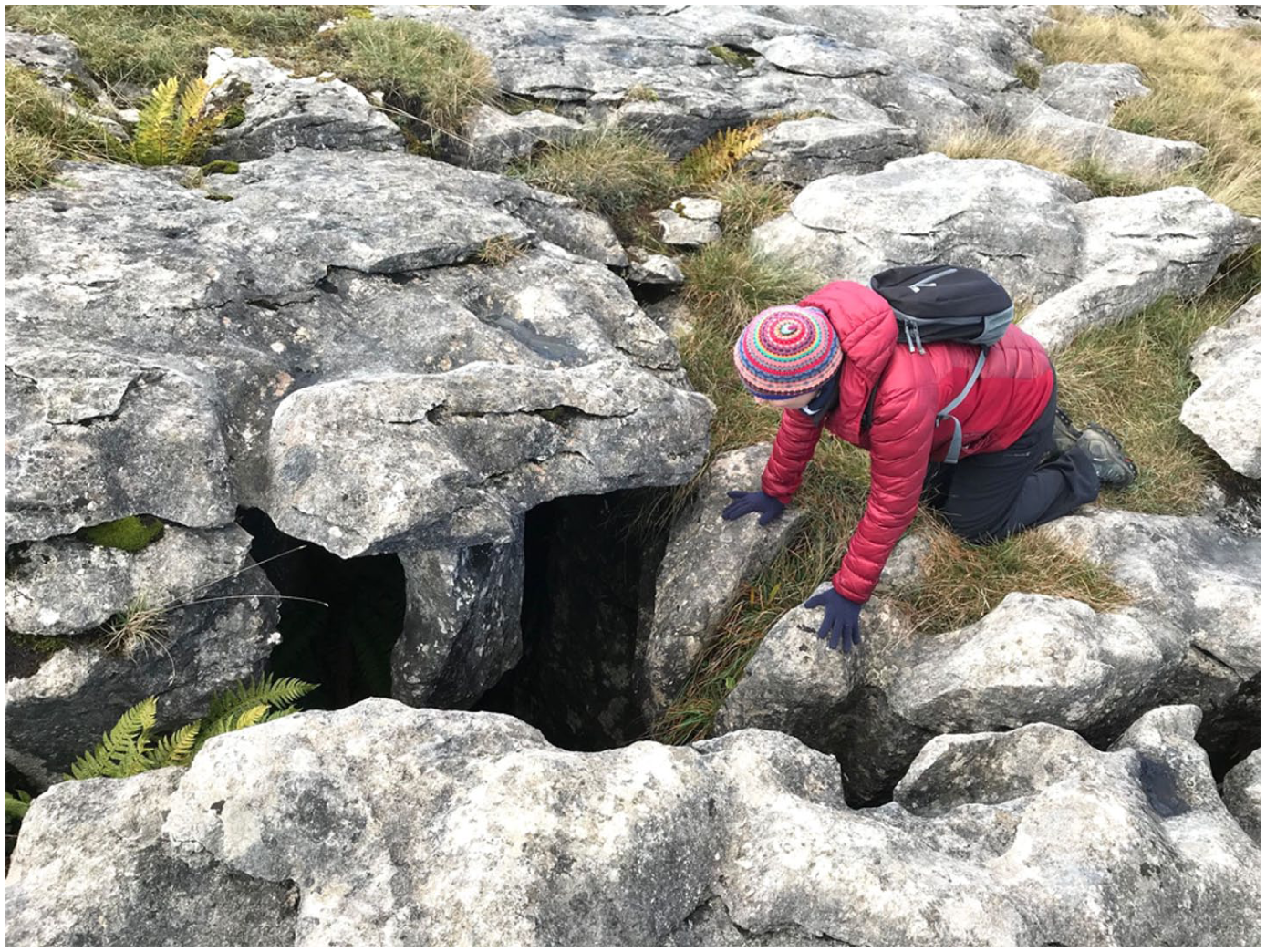
Walking the Menopause: Long Churn Cave. Ruth above ground.
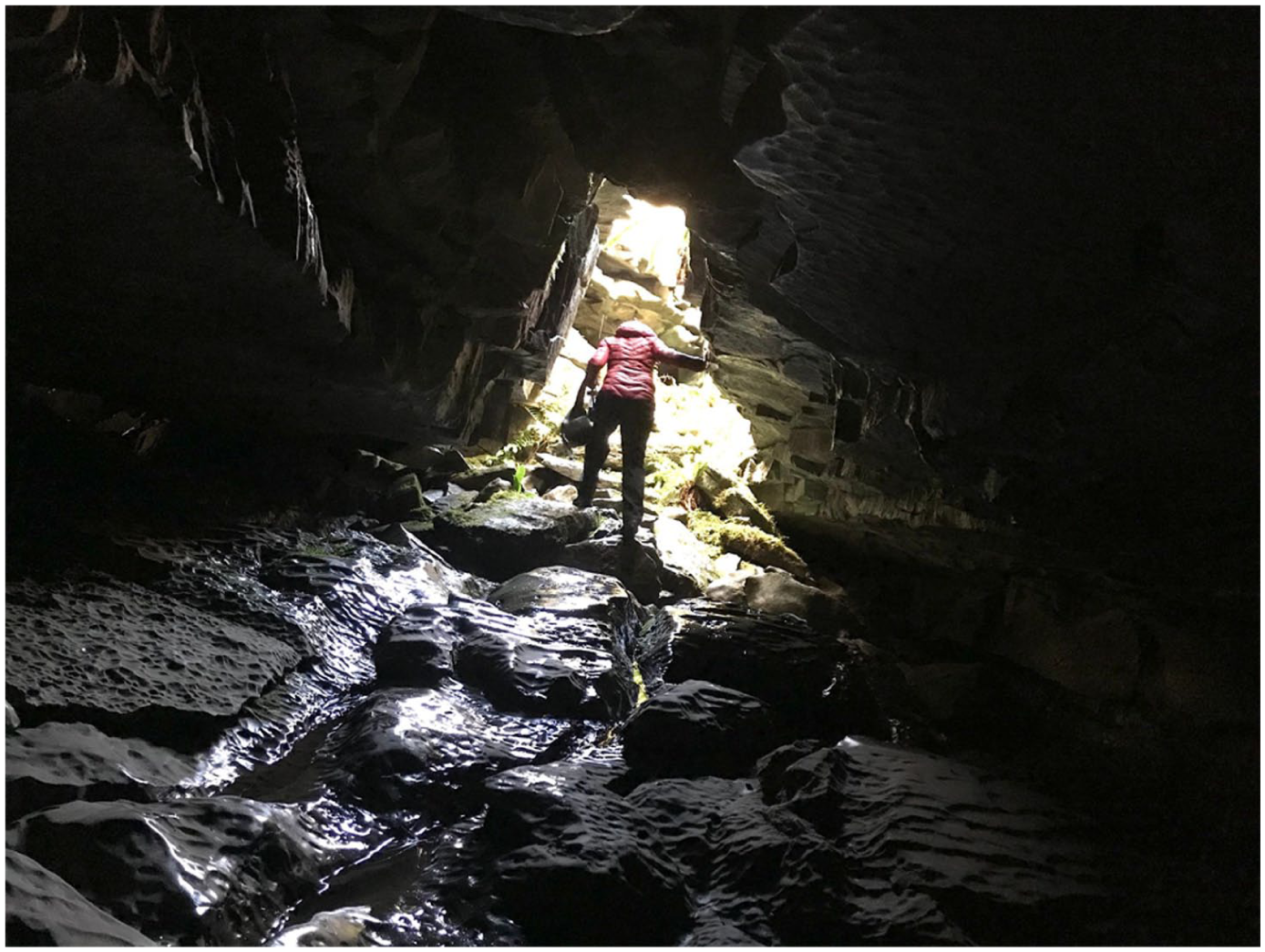
Walking the Menopause: Long Churn Cave. Ruth below ground.
As her reflective feedback below shows, for Ruth the process of walking and emplacement had a significant and transformative effect:
Walking and talking with Louise has enabled me to start naming and shaping the experience of menopause in a creative and healing way. I’ve had time to reflect upon and see with more clarity and with different perspectives what my bodymind has been experiencing through the last eight years. Having written that sentence I now want to lie down on the earth and roar with laughter. There has been so little clarity throughout this time and so many moments where perspective went walk about. I often feel as if these have been the lost years and yet and yet. With Lou’s support and an invitation to lean into the land; the landscape has come to support me and enable me to find new ways to move forward. Moreover, there has been a strong emphasis on discovering what is still possible and what new stories/new creations can be grown. We have talked and drawn and made marks. We have swum in rivers and climbed into caves and all the while talked about our bodies and the changes we are undergoing and paid attention to what helps.
5
Reflection and conclusion
This article has focused on the process of making a series of walks that explore, communicate and express menopause experiences through creative methods. It has shown how the Walking the Menopause project, and sociological walking as a method more broadly, can accommodate both personal ‘solo’ walks and walks, whether one-to-one, with friends, or in a group, that connect with others, all the time using the landscape as a metaphor where menopausal journeys can be emplaced. In doing so, the project responds to the limited and often reductive ways menopause is currently imagined, offering ways to think, speak and feel about menopause beyond dominant clinical and individualised narratives.
It demonstrates how this approach can be a powerful way to reflect and find meaning – so that participants can discover ‘better ways’ to navigate menopause (or other aspects of personal and social life), making the experience more manageable and even transformative. Specifically, by foregrounding movement and place as sources of knowledge, this practice offers emplacement as a methodological tool, places the walking, sensing, thinking and feeling body at its core, and brings people together to build shared understandings, knowledge(s) and new imaginings.
The one-to-one walk with Ruth went deeply into an individual experience of menopause and led to a landscape that was specific to her. Walking with friends (as part of the creative process) brought a range of perspectives and complex interconnections between menopausal experiences and the site, which were enriched further when shared with a larger public group on Scout Scar. This walk opened up wider conversations, removed shame and fostered solidarity. Here menopause became something shared – common ground was found, along with embodied, lived knowledge, understanding, compassion, support and truth. While recognising that everyone’s experience of menopause is different and unique, what all these side-by-side walking methods brought is a shared realisation that participants are not alone, but part of something larger that needs to be recognised and expressed in order to be supported and reimagined. It is important to stress that this was not just a group of women coming together. The very act of bringing women together in this way was powerful, creating a new kind of site-based body practice beyond menopause. By centring walking, emplacement and visual reflection, this work begins to expand how menopause can be understood beyond the body-as-site to menopause-in-relation – in particular, in relation to landscape, movement, rhythm and environment. In so doing, it seeks not simply to analyse menopause differently but to enact a different way of knowing it.
Representing the experiences of those living with menopause in this way can help negotiate and possibly narrow the gap between lived and clinical understandings of menopause. In doing so, it may help policymakers, clinicians and the wider public gain a greater awareness of the diverse impacts of menopause. To that end, the practice of walking and emplacement seeks new or alternative ways of looking at and interpreting landscape as a means to foster alternative ways of understanding and doing menopause. Situated within the broader sociological field, this project aligns with feminist methodological approaches that challenge traditional, hierarchical and linear processes of research and knowledge production. In particular, it builds on and develops Jackson’s (2026) approach to collective walking as a critical feminist sociological practice, which foregrounds shared, embodied engagement with landscape as a way of generating knowledge. Such approaches have the potential to unsettle conventional hierarchies within both research and teaching, opening up more collaborative and situated ways of understanding embodied experiences such as menopause.
Footnotes
Consent for publication
People who feature in the photographs have given their verbal consent for images to be used in displays and published articles.
Funding
The author received no financial support for the research, authorship and/or publication of this article.
Declaration of conflicting interests
The author declared no potential conflicts of interest with respect to the research, authorship and/or publication of this article.