






Abstract
Selfie-editing technologies, including in-phone editing tools, filters and apps like Facetune, provide the ability to digitally edit and ‘enhance’ facial and body features in photos shared on visual social media platforms. This study is unique in focusing on how young people understand and experience the practice of editing self-images through qualitative and visual methods. It is based on a study with 79 young people in Australia. Editing bodily and facial features was experienced as editing the self. We map the different categories of editing young people undertook, including photo-taking, post-production, ‘touch-ups’ like removing blemishes, and ‘structural’ edits to one’s face or body shape that can mimic cosmetic surgery procedures like rhinoplasty. Participants described significant tensions between different editing practices, which we conceptualise as ‘affective frictions’, illustrating the tenuous boundaries and meanings associated with different forms of editing. These boundaries and the frictions between them highlight the complexities, ambivalences and tensions surrounding young people’s experiences of editing practices which are crucial for understanding the contemporary demands of visibility in social media cultures. Our findings extend feminist sociological understanding of how embodied subjectivities are navigated in a digital-physical context where perfected images are a baseline norm for young women in contemporary media cultures.
Introduction
Images of the self proliferate daily, both in images taken and shared, and in surveillance images continually captured in the on and offline spaces we inhabit. In popular discourse, young people’s selfie-taking tends to be presented in pathologised or risk-based terms (Baishya, 2024). However, as sociologists of visual culture have long argued, selfie-taking and editing must be situated as an implicit part of everyday self-representational practices associated with the ascendance of social media and smartphone culture (Senft & Baym, 2015; Tiidenberg & Gómez Cruz, 2015; Warfield, 2016). In this context, though the settings and socio-cultural significance of selfie-taking and self-representation practices in digital media have been explored, the actual editing practices young people engage in, and their meanings for identity and embodiment, are not well understood. Where Cambre and Lavrence’s important work shows how young people use a digital forensic gaze on others (Cambre & Lavrence, 2023; Lavrence & Cambre, 2020), our study aimed to understand how young people edit their own images. In this article we catalogue the range of different practices comprising ‘image editing’ drawing on qualitative and visual data from a study with young people aged 18–24 in Newcastle and in Melbourne, Australia. Editing bodily and facial features was experienced as editing the self. We discuss the range of practices articulated by our participants, from ‘lighter’ edits, such as adjusting lighting, colour and contrast of the photo image, through to ‘heavier’ edits applied directly to the face and body, such as reshaping or resizing facial and body features to mimic cosmetic surgical interventions (like rhinoplasty or lip fillers). In particular, we explore how different kinds of editing are framed through ‘boundaries’ of acceptability in an image culture where attempts at perfection are at once expected, yet highly moralised. Participants described how different editing practices carried distinct weight aligning with moral judgements surrounding self-presentation, where dramatic alterations were demonised as ‘risky’ and could be aligned with a flawed subjectivity. We conceptualise the boundary-work between different editing practices using a lens of affective friction to explore the different qualities and meanings attached to editing practices. The focus on affect helps us to take seriously the ambivalences, tensions and sensed aspects of the self associated with editing self-images (including shame, guilt and discomfort). Where our previous research theorised the meanings of virtual selfhood produced through the capacity to dramatically edit one’s digital image-self (Coffey, Dobson, et al., 2026), this article examines the breadth and meanings of different practices comprising image. In doing so, we aim to advance feminist sociological understandings of how boundaries of the body are navigated through newer virtual practices such as image-editing technologies. The affective power of images – particularly when they are the focus of personal intervention and correction through editing – is significant for understanding contemporary formations of embodied subjectivity, and so the specific practices comprised through editing need to be thoroughly interrogated.
The article is structured as follows. First, we situate the study in the substantial literature on gendered and digital self-presentation and the theoretical frameworks of affect and embodiment we use to understand images and selfhood as fluid, dynamic and tenuous through editing practices. We then describe the study’s methodology, methods and study design, before defining each of the categories of image editing participants described: first in photographic practices and ‘production’ edits; then more overt ‘touch-ups’ which directly but subtly edited bodily and facial features; and then the kinds of ‘structural edits’ like bone-shaving and feature-altering which made substantial changes to participants’ faces and bodies and had the potential to create a jarring experience of self. The boundaries between these practices are tenuous and created frictions for participants’ sense of embodiment and identity. These frictions surface how bodily and digital boundaries in editing are sensed and discussed by participants, and are important for understanding how and why editing practices are significant in young people’s lives.
Digital Presentation Ideals and Image-Editing Practices on Social Media
Beauty and selfie-editing apps like Facetune and FaceApp were developed in the mid-2010s, promising professional-quality photoshopping and airbrushing editing tools, enabling a user to ‘effortlessly enhance the attractiveness of their selfie’ (Coffey, Dobson, et al., 2026). These apps offer users the ability to ‘optimise’ their face and body, mimicking cosmetic surgical alterations, while more ‘playful’ features included an ‘ageing’ filter and ‘gender swap’ tool. Studies of the impacts of selfie-editing apps for body image tend to be limited to quantitative survey-based methods, rather than exploring how the act of editing an image of oneself is experienced and understood (Tiggeman et al., 2020). In qualitative social media, feminist and cultural studies, selfies have been widely studied as a cultural phenomenon (Abidin & Gwynne, 2017; Baishya, 2024; Gill, 2023; Gorea, 2021; Tiidenberg & Gómez Cruz, 2015; Warfield, 2016). Other qualitative studies of selfie-editing have used interviews or focus group methods to reflect on images of others, such as celebrities or influencers (Lavrence & Cambre, 2020). Editing practices can intensify body image pressures ‘towards perfection’ in visual social media (Coffey, 2024; Gorea, 2021). Young women in particular describe seeing themselves differently through intensified self-scrutiny, termed ‘nanosurveillance’ (Elias & Gill, 2018), a ‘metric gaze’ (Gill, 2023) or a ‘digital forensic gaze’ (Lavrence & Cambre, 2020). This work points to the significance of image-editing practices in a visual social media landscape where intense self-scrutiny and forensic forms of looking are normalised and routinely required of young people. In contrast to common pop culture depictions of selfie-taking and editing as frivolous, narcissistic or self-absorbed, our research contributes to a rich body of qualitative work on youth, social media and self-presentation in showing how these young people carefully navigated the impossible and contradictory demands of ‘authenticity’, ‘self-optimisation’ and ‘perfection’ that have become normalised and mundane in relation to digital self-presentation in gendered and racialised ways (Banet-Weiser, 2021; Chen & Zeng, 2024; Dobson, 2015; Glatt, 2024; Kanai, 2016; Sweeney-Romero, 2022).
While social media have provided spaces of exploration and solidarity, particularly for marginalised subjects across gender, sexuality, race and ability (Knight-Steele, 2021; Pascoe, 2011; Robards et al., 2018; Sobande, 2017), they also simultaneously constitute spaces of disciplining, regulation and capture (Dobson et al., 2018; Glatt, 2024; Kanai, 2026; Pitcan et al., 2018). For young women, platforms like Instagram extend consumer culture’s normalising modalities of understanding the body – as primarily commodity and brand (Reade, 2021; Savolainen et al., 2020; Toffoletti & Thorpe, 2018). Yet, as Banet-Weiser (2012, 2021) argues, this impetus to continually adjust and modify the self in a branded relationship with viewers and followers does not remove the imperative to remain ‘authentic’. The stakes of self-representation are high, especially for young women, for whom potential designations as ‘superficial’ and ‘fake’ continually hover in broader suspicions of feminised media culture (Zimmerman, 2021). Further complicating this environment for young women is the increasing compulsoriness of visibility of the self on social media and having a public face as part of demonstrating normalcy in everyday youth sociality (Gill, 2023). Selfie practices – taking, editing and posting them – are at once profoundly personal and profoundly cultural and social, highlighting the dominant appearance-based norms, exclusions and marginalities which underpin the perpetuation of inequalities on gendered, racialised and classed lines (Grindstaff & Torres Valencia, 2021). Such practices indicate how young people, particularly young women, navigate ‘the new gaze economy of digital culture’ (p. 747).
Theorising Embodiment and Virtuality
Embodiment and physicality now proceed in virtual form (Coffey, Dobson, et al., 2026), where flesh and digital limits are in constant tension through wearable tech, visual social media platforms and image-editing apps (Nash, 2022). This project’s theoretical and methodological approach centres on understanding the relationship between image-based digital practices and young people’s embodied identities. The theoretical framework extends approaches in feminist and youth sociology and cultural studies which focus on the body and affect as central for understanding social and cultural phenomena (Budgeon, 2003; Coleman & Ringrose, 2013). This is drawn from theories of bodies as ‘entangled processes’, ‘defined by their capacities to affect and be affected’, which then mediate action or possibilities (what bodies can do) (Blackman & Venn, 2010, p. 9). We extend concepts of affect to understand participants’ digital practices as social and embodied, taking a view of bodies as formed through intersecting registers: flesh, selfhood, representation and cultural context (Tiidenberg et al., 2020). This perspective conceptualises how embodiment and digital social media are entangled and how sensations are crucial for understanding the meanings of embodied social media practices, such as selfie-editing. The concept of affect has been broadly theorised in differing ways in feminist research. In Deleuzian-inspired work, affect foregrounds the embodied qualities of feeling (Hickey-Moody & Malins, 2007) and how this shapes relations between people, objects and socio-cultural forces (Coleman, 2009, 2013). Gendered patterns are mediated through affective relations which create the conditions for embodiment (Coffey, 2021; Coleman, 2009). A focus on affect as embodied sensations and qualities of feeling (an entanglement of emotion and affect) has been important for understanding a range of gendered and digital practices, including how young people experience body and appearance norms (Coffey, 2021), practices of reading and evaluating images (Gill, 2023; Kanai, 2016), and how power circulates affectively through images (Coleman, 2009; Ringrose & Harvey, 2015). We draw from this body of scholarship to theorise that young people ‘materialise’ their bodies through digitally mediated practices such as image editing.
Methodology and study design
The study is unique in focusing specifically on how people understand and experience the practice of editing their own self-images through qualitative and visual methods. We designed the ‘smartphone live capture’ method to study how young people edit their photos with peers in workshop settings (Coffey, Kanai, et al., 2026). The project’s methodology produced multiple different forms of data, including narrative (interviews) and visual data (edited selfies, photo elicitation and video capture of workshops), centring the relational and embodied dimensions of selfie-editing (such as gestures and feelings) to be explored, capturing the affective and hard-to-articulate processes by which selfies are edited by young people in the workshops, and the meanings made of the body, self, and others. Following Taguchi (2012) and Coleman (2009), the analytic approach specifically attends to the affective relations between images and bodies as important for understanding how young people ‘materialise’ their bodies through digitally mediated practices.
The project used qualitative methods to understand how the capacities and tools enabling image-alteration provided by selfie-editing apps are used and experienced. The project was conducted with approval from the University of Newcastle’s Human Research Ethics Committee (H-2022-0053). We conducted 33 in-depth semi-structured interviews and 13 participatory ‘selfie-editing’ group workshops with a further 56 young people aged 18–24 who take selfies and who use editing apps, in Melbourne and Newcastle, Australia. The study was promoted through hard-copy fliers posted on university campuses and public spaces like shopping centres in Melbourne, Newcastle, and the Central Coast regions, and also through Meta advertisements on Instagram and Facebook. This was targeted to reach young people aged 18–24 who edit their self-images. Interested participants then self-selected to participate. This method of purposive sampling is appropriate for exploratory qualitative methodologies and aimed to generate theoretically illustrative rather than externally generalisable data (Schreier, 2018). This approach also meant that a wide range of different editing experiences and practices were captured in this study.
Participants gave informed consent by completing a consent form for interviews and for selfie-editing workshops that used the ‘smartphone live capture’ method. Participants were able to select whether they consented to their screen recordings being anonymised and used in publications reporting the study’s findings. Images (screenshots) and screen recordings were anonymised via cropping and ‘artistic edits’ functions in PowerPoint, and were checked by participants prior to being used in presentations and/or publications. These processes of consent and anonymity were followed in accordance with the conditions of ethical approval in place for this research. Participants self-identified their gender, and were predominantly cis-gender women identified as ‘female’ or ‘cis woman’ (56), followed by ‘non-binary’, ‘genderfluid’ or ‘questioning’ (12) and ‘male’ / ‘cis man’ (11). They identified as from a range of ethnic, racial and cultural backgrounds, with majority as ‘White Australian’ or ‘Caucasian’ (41), or ‘of Asian descent’ (27). Most were studying at university and working, and were from a range of class backgrounds, some with parents working in trade and mining industries, and others from families with professional backgrounds as public servants, doctors and lawyers. Gender, race, ethnicity and class dynamics informed the particular editing and image reading practices undertaken by participants. Participants throughout the study referred to a ‘beauty standard’ in visual social media that informed how and why images should be edited or ‘corrected’. This ‘beauty standard’ is always-already gendered, racialised and classed through appearance norms and expectations. Young people did not always edit in accordance with these norms, yet they were continually referenced as the ‘standard’ they knew their own images would be read alongside in a highly pressured visual economy where beauty and physical flawlessness is reified, particularly for young women. Because of this, our emphasis in the analysis section primarily focuses on young women’s perspectives, as they tended to provide the most detailed descriptions of the different boundaries between editing practices.
The majority of participants made ‘minor’ or ‘light’ edits to a photo and their faces through adjusting light and contrast, and ‘touching up’ features like removing blemishes. Approximately one third of participants described currently or previously making edits ‘structural’ or ‘heavy edits’, through changing the dimensions or ‘structure’ of facial and bodily features, including ‘cosmetic surgery tools’, which reshape and resize noses, ‘bone shaving’ of cheeks or shoulders, ‘skin grafting’, or waist ‘cinching’ (see Figure 1 and Table 1 for an overview of the different practices and tools). We have excluded filters from our analysis here, because we focus on the deliberate and direct editing practices young people undertook. The rapid evolution of facial filters comprises an entirely different form of image editing, where users are not in control of, let alone aware of, the changes being made to their facial features (Hawker, 2025).
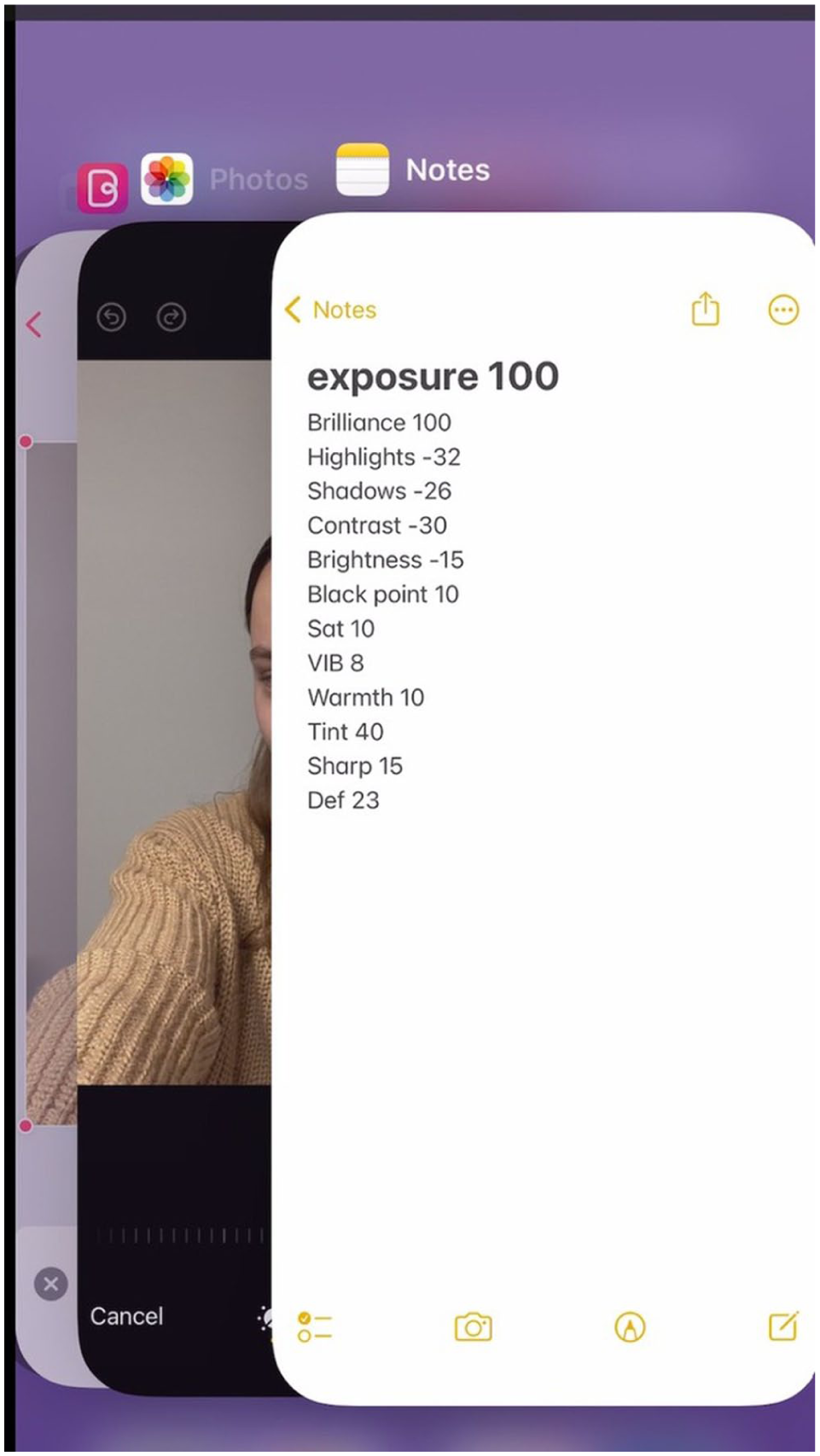
Katy’s Notes with Instructions on What Light Settings to Adjust to Edit her Photos.
Categories of Editing Practices.
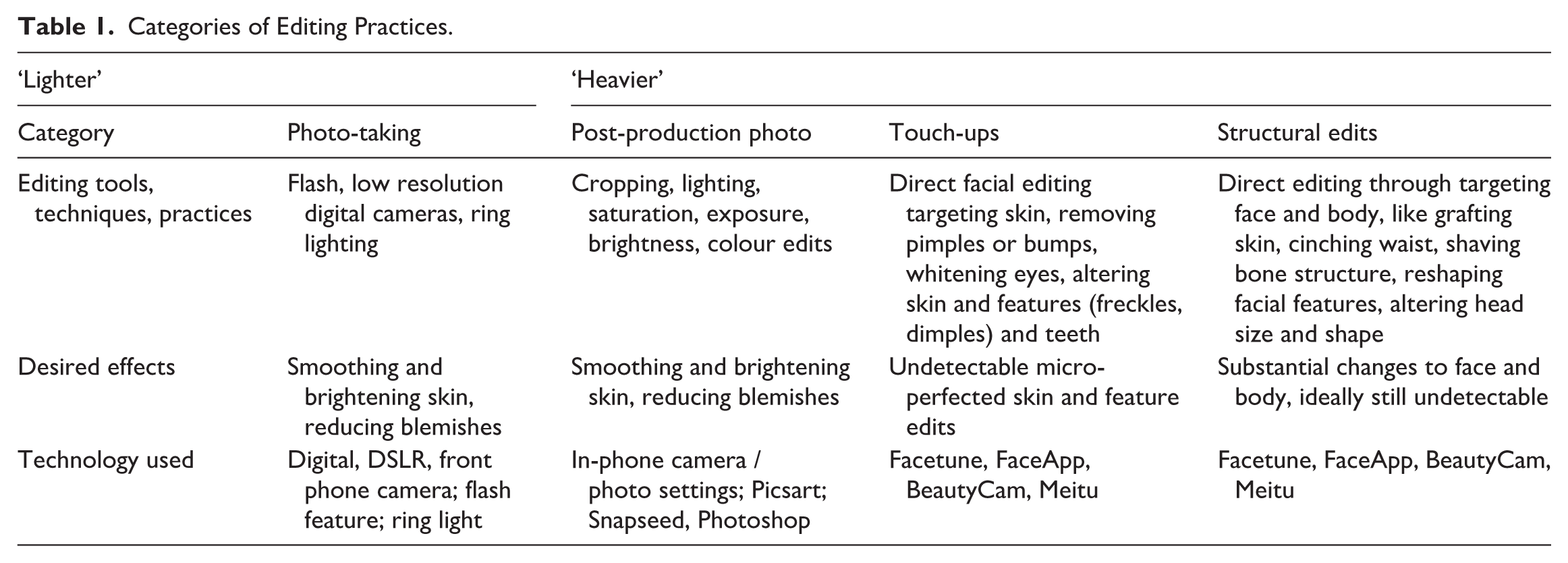
In the next section, we define and analyse each of the categories of image editing participants described. We begin by discussing ‘photo edits’ used in young people’s selfie taking and editing practices, focusing on the delineation participants made between ‘photo edits’ as ‘post-production practices’, including edits to an image’s light, saturation and colour tone as a form of image editing, before describing more overt or targeted edits to faces and bodies using specific editing tools in discrete editing apps like FaceApp, Facetune and Meitu.
Imaging Practices, ‘Good Production’ and Light ‘Post-Production’ Photo Edits
Selfie-editing practices were very broadly defined by participants. Some understood editing as beginning in the moment an image was captured. For example, the technique of taking a selfie – whether using the front or back camera, or using a flash or not – ‘counts as editing’, as these practices all created subtle differences in the quality of light and shadow affecting perception of an image. For example, a camera’s flash, much like a ring light, can create more flattering light, which participants described as having the effect of making skin appear smoother, features appear brighter, or reducing the appearance of acne. Sun, for example, described how using a digital camera with a low image resolution with a flash ‘makes everything smooth’ and has the effect of editing, without directly removing blemishes or acne herself through deliberate editing:
Last time I hung out with these guys [gesturing to two other workshop participants] I had a huge acne on my face, and I was like ‘Guys, don’t judge me because I might edit that one big pimple out’, but then I took a picture with a digital camera, so you know, it’s not that clear, right. . . so the acne couldn’t be seen either way. I usually like taking pictures with flash, like that camera and flash, and you can’t see anything, it’s like automatically edited but it’s not edited, it’s just the flash that makes everything smooth.
What even is editing? It’s a very loose term.
Yeah, yeah, true. I mean it’s one thing to use Facetune or FaceApp, that’s very clear, it’s the whole editing toolkit.
But, yeah, it’s like I’m taking a good picture and if there’s huge acne it just ruins everything, I would just like [makes cutting noise] make it disappear. (Sun, 20, she/her, Malay; and Lan, 18, female, Vietnamese; workshop group discussion, Newcastle)
Sun’s acne is a problem to be fixed (‘it ruins the photo’), and by using a digital camera taken with a flash effect, she can circumvent negative associations of editing directly (‘don’t judge me’). Participants were conscious of different ways technology might create distortions that could subtly reduce the appearance of blemishes. This was presented as a kind of ‘happenstance’ form of editing, though both have the effect of reducing the appearance of blemishes. By altering appearance in this way they could avoid negative associations with effortful editing, which attracts judgement.
In group workshop discussion, Marie (22, she/her, Caucasian Australian) tells us that she ‘instinctively’ flips selfies horizontally to match the version of herself she sees in the mirror. She considered this as ‘editing’ in how the photo is taken. She interpreted the flip as a change to the digital image as distinct from editing her appearance: ‘that’s not changing my appearance, but it’s just changing the photo’. This action was ‘just the first step of making the picture look how – it’s if you look in the mirror’. Such practices were commonly framed as ‘post-production’ effects rather than direct ‘editing’ of appearance.
Photo edits were similarly described as part of a photographic ‘post-production’ process that was about fine-tuning the photographic image rather than directly making corrections to participants’ own physical appearance. These ‘photo edits’ were the most ubiquitous type of editing, with all of our participants engaging in and accepting the practice as a normative part of selfie-taking. Making lighting, colour and camera adjustments were so commonplace that many did not categorise them as ‘edits’ until reflecting on the definition with others in the group workshops and interviews. Discussions of these edits were often couched in terms of professional photography.
Practices such as brightening and colour-grading of photos were understood by some participants as making a photo more real, like ‘real life’, because they gave participants the ability to ‘correct’ perceived imbalances or inaccuracies created by their phone cameras. In the exchange below, Katy and Jacinta further discuss tensions between editing ‘the photo’ which is ‘justifiable’, and the ‘body’ which feels ‘gross’ or problematic:
See how it was greyscale, gross, and boring, and now it’s a bit more pink? It’s a bit obvious, and I used to have brilliance somewhere in the 30s. If it’s zero, it’s fine, but I’ll leave it at 30. Before major editing. For me, this is not. . . it is editing the photo, but it’s not editing my body.
Yeah, it’s more just fixing the lighting.
So, in my mind, I can justify this, and I don’t feel gross about it, because. . .
Yeah, because a lot of photographers would do it automatically.
That’s what. . . In my head. . .
They’ve got all the settings [in their camera], whereas. . .
It’s like. . . yeah.
We can’t do that with our phone.
Yep.
You probably could, to a degree, while taking it. We’re not that skilled, so we just do it in post-production. (Katy, 20 and Jacinta 21, both she/her, Caucasian; workshop group discussion, Central Coast)
Katy differentiates between colour adjustments and ‘major editing’ by drawing an affective distinction between editing the photo and editing her body. While the former is about making the photo less ‘ugly and boring’, the latter registers as a change to her body that risks making her feel gross because of the moralised norms associating editing with inauthenticity. Colour edits, in contrast, are a way of legitimising certain kinds of editing, framed here in relationship to professional standards of photography.
Participants acknowledged that sometimes lighting and colour edits could result in changes to how they looked in photographs, but made distinctions that were important to them regarding intentionality and authenticity. For instance, Erin framed colour and lighting edits as acceptable in a way face and body edits are not:
When does it become authentic, when does it become fake? Probably, yeah, when it starts altering the body and the face, I think. I mean, sometimes when I turn up the brightness in the image, it might blur out something like a pimple or some pores. Yeah, just trying to blur it out a little bit. (Erin, 19, she/her, Caucasian)
Like Katy, Erin draws a line between body and face edits and colour edits, marking out the former as the point where things ‘become fake’. Though her colour edits do subtly alter her face in the image, she describes the differences in brightness and blurring options as distinct from intentional appearance editing. Again, there is a sense that because the anti-blemishing effects of such are a somewhat ‘coincidental’ effect of lighting changes (which can be ‘justified’ as Katy said) rather than direct, deliberate edits, such practices are thought to attract less judgement from peers and other viewers.
Photo and lighting edits were also discussed as a way of making the photo ‘reflect what it actually is like’. In a workshop, for instance, Cassie and Chloe discussed how light adjustments were made to more accurately represent the ‘real’:
The light can look a bit, you know, dodgy compared to – compared to what it looks like in person. So I feel like sometimes you just try and enhance that slightly so that it kind of reflects what it actually is like.
Backing up Cassie, Chloe comments on the normativity and social acceptability of making such aesthetic adjustments:
I don’t think it’s bad.
I would say nowadays – I feel like most people do.
I feel like it’s naïve to look at a photo and think that it hasn’t been [touched up] as well. (Chloe, 19 and Cassie, 23, both she/her, Caucasian; workshop group discussion, Newcastle)
Lighting and colour ‘post-production’ editing practices are seen as relatively accepted, and do not register as ‘bad’ or morally questionable – under certain, specific conditions, where enhancement for ‘accuracy’ is legitimised.
Overall, we suggest, editing through the process of taking a photo with ‘good production’ equipment, and/or editing an image’s light balance, contrast or tone was viewed as socially ‘acceptable’. In contrast, directly editing one’s features or body could be understood as shameful. The practices discussed in the following section move from the tacit photo edits which had the effect of smoothing skin or removing blemishes, framed as a ‘happy accident’, to the direct and intentional practices of ‘touching up’ and ‘optimising’ facial features using specific apps and editing tools.
‘Touch-ups’: Subtly ‘Optimising’ Facial Features
‘Touch-ups’ were defined as editing practices that directly and intentionally changed something about the subject in the image such as removing a pimple, fixing stray pieces of hair, adding virtual make-up or whitening one’s teeth or eyes. These were often framed as ‘light’ or ‘minor’, in ‘corrective’ terms, as distinct from edits that altered the structure of a participant’s face or body. Touch-ups were often understood as a step further than photographic post-production practices involving lighting corrections. Participants would often add an explanation or justification for making these direct facial edits, as though in anticipation of judgement from others. These practices, like lighting edits, were sometimes described as improving the quality of the photo as an aesthetic artefact, representing ‘what I really look like’ in correcting errant shadows or other perceived inaccuracies in an image. This often focused on removing ‘temporary’ perceived flaws like blemishes, or optimising an image to ‘what I could realistically look like on my best day’.
Amina explains to Citra how she sometimes whitens her eyes:
Or, sometimes, actually, I like to whiten the. . . the. . . the whites of my eyes.
Oh, so they like, pop. . . pop more?
So that they pop more.
Oh, okay, okay, okay.
But like, yeah, it’s like. . . I feel like when I edit my photos, it’s more like, how it makes the. . . the photo as a whole lot better. . . I mean, nobody really notices the whites of my eyes, but I just feel like the. . . the photo looks crisper. (Amina, 21, she/her, Indonesian; Citra, 19, she/her, Malaysian Indian; workshop group discussion, Newcastle)
In this exchange, Citra immediately tries to justify the whitening of the eyes (so they pop more?). This could be to help Amina feel comfortable, and not judged, for editing her photo directly. Amina follows by explaining that the purpose is to improve the photo overall, rather than improving her appearance.
A different avenue of justification for touch-ups was to represent the best, ‘real’ version of themselves, what they ‘could look like’ on a ‘good’ skin day or with make-up on.
if I edit my skin then I will try and do, like, ‘this is what I look with make up on’. I wouldn’t try and take all my pores out and stuff like that. It’s just like I could look like this if. . .
I think I kind of feel the same way. Like I was saying, it’s like I’m not editing it, like . . . in my brain. . . I’m not really editing my photos. . . I’m not changing them to something that is impossible. I think that was what I had in my brain. . . yeah, it’s like, my skin could look like this, and does look like this, just not today. (Bridget, 24, she/her, Chinese Australian; Hazel, 19, she/her, Caucasian; workshop group discussion, Melbourne)
Hazel’s touching-up practices present a ‘possible’ portrayal of herself: ‘I could look like this’ realistically. This temporal displacement may aid in negotiating the feelings around editing: rather than touch-ups creating a ‘fake’ self, they become a way of locating the ‘real’ self as more beautiful (her skin ‘does look like this’) outside of the particular moment the photograph was taken.
It was important to participants that touching-up did not feel as if it was going ‘too far’. Creating boundaries around the practice that related it to physical beauty practices was a way to manage this tension.
For me, like I would never make a photo that doesn’t look like me because I feel like it’s weird. So even though I edit, my standard is that it still has to look like me. But maybe with makeup. (Sue, 24, she/her, Taiwanese; interview)
Sue feels that if her selfies did not look like her it would be ‘weird’, an uncomfortable feeling, similar to Katy feeling ‘gross’ if she edited her body. Drawing a comparison between make-up and digital touch-ups helps define this boundary line for her, offering a material ‘real’ counterpart that acts as a benchmark for how far she is willing to go virtually.
‘Touch-ups’ were understood as an everyday way to maintain a reassuring sense of control over one’s image; ‘not that I’m not happy with myself’, as Sara put it, but:
It’s kind of like, to have control over. . . I guess how you want to look, or if there’s something that you don’t like, to know that you can get rid of it, I guess.
This control oscillated over the things that could otherwise destroy a photo, understood as an equation of: ‘In that photo I would look better if. . .’.
Sara gave the examples of skin imperfections:
You know, right now, my skin’s not great. Maybe I’m stressed with uni, maybe I haven’t eaten the best. That’s a really nice photo with people that I love, but I would really like if my skin didn’t look like that. Or if there’s a really significant pimple or whatever, that just for me ruins the photo, I can just get rid of it and know that I have control over that. I find it quite powerful, if I’m honest. Yeah. That sounds almost toxic, but I don’t know. . . (Sara, 22, she/her, Caucasian; workshop group discussion, Newcastle)
Sara’s reflections show ambivalence surrounding editing, appearance and control. Sara touches up photos to correct her skin (‘it didn’t look like that’). Self-judgements creep into her description – ‘my skin’s not great’, and ‘maybe I haven’t eaten the best’ – and she expresses a desire to ‘fix’ what she does not like by ‘getting rid of it’. However, she also extends a degree of self-compassion, suggesting that these ‘faults’ might just be the result of stress and attaching them to ‘that photo’ rather than herself. She manages these feelings through editing, rejecting them as shameful by positing touch-ups almost as a form of kindness to herself in that she can give herself the gift of nice photos ‘with people [she] loves’. While relishing the feeling of control this gives her, her concern that there might still be something ‘toxic’ about it offers an example of how beauty ‘involves an attachment that both offers promise and entails cruelty and compromise’ (Coleman & Figueroa, 2010, p. 369).
Whilst these kinds of edits were defined as ‘small’, direct, yet subtle editing practices to ‘correct’ a facial detail, sometimes ‘touch-ups’ like removing blemishes, cellulite and blurring the body could add up to become ‘heavy editing’. Avery gives an account of what they understood as ‘heavy editing’ practices:
When I was heavy editing, I would use like the VSCO camera or I would use Facetune. . . and I would never – so I wouldn’t be changing the like structure of my face but I was doing things like whitening my teeth, whitening my eyes, sharpening bits and bobs. I would blemish remove sometimes. Like if I had a whopping great big pimple I would just [makes clicking sound] that guy away. I was also changing things on my body like removing cellulite for example. I would also. . . I would really up the grain on my photos cause I’m particularly insecure about sort of like neck down. . . the lower half of my body I would kind of mess around with the shadow play to sort of make things a little blurrier or harder to see, and I would use a lot of grain, um, so that you kind of couldn’t fully see my whole body whilst it’s still being a body shot. (Avery, 24, them/them, Caucasian; workshop group discussion, Melbourne)
The volume of these micro, subtle changes add up to ‘heavy’ or substantial changes when all put together in one photo. Avery described making these changes to correct imperfections or things they were ‘insecure about’. Importantly, whilst describing these heavy editing practices, Avery still took care to note ‘I wouldn’t be changing the like structure of my face’. These kinds of edits were termed ‘structural edits’ by participants, and were described by most as ‘crossing a line’.
I’d retouch, say, a birthmark or a freckle.
How about the shape of the cheekbones?
I personally have never done anything like that before on my own photos; I’ve never done any structural edits. It’s more like retouching, just kind of small touch ups, small adjustments that don’t change the overall appearance and still represents what I generally look like. (Marie, 22, she/her, Caucasian; workshop group discussion, Melbourne)
Making structural edits was described as a boundary or tipping point for editing practices. The potential for structural editing to substantially change what someone ‘generally looks like’ was discussed as problematic and fraught for a range of reasons, as we discuss next.
‘Structural Edits’: Substantial Changes to Faces and Bodies
Structural editing practices were described as edits that changed the facial or bodily structure of the subject of the image. This included changing facial structure through changing jaw or cheek lines, nose and lip size, head or forehead size, and grafting skin from different parts of the face. Structural body edits included cinching the waist, shaving bone structure from shoulders, and reshaping breast dimensions. These practices historically have been associated with photoshopping techniques used by professional photographers in fashion and beauty industries, and roundly critiqued in feminist media studies literature and popular commentary for being ‘fake’ and harmful in creating unrealistic standards of physical appearance (Coffey, Dobson, et al., 2026; Elias & Gill, 2018). Selfie editing apps such as Facetune, FaceApp, BeautyCam and Meitu specifically promise the ability to create professional-quality photo edits similar to those in Photoshop, but without requiring professional skills and available in the palm of your hand.
These practices were almost always described as being socially problematic or morally fraught, through overtly contravening the moralised principles of ‘authenticity’ and naturalness that are implied in the construction of tacit, indirect editing practices as socially and morally acceptable. Structural edits were viewed as creating an image that was ‘not real’, ‘not me’. This virtual ‘me but not me’ has been analysed elsewhere as representing a break between a current, actual, ‘authentic self’ and an idealised, perfected image of oneself (Coffey, Dobson, et al., 2026). Participants felt this incongruence could become toxic for their self-image, creating or deepening body image concerns.
Katy, for example, described how making small edits snowballed into making more and more changes, from changes to the photo, to touch-ups, and then structural edits:
There’s a selfie that I took for my 19th birthday. I was editing it and it started with just acne, wispy hair, getting rid of like a hand dryer next to me, like just things around me and I remember I was like ‘I want to get rid of this’, and then I turned to my face and then I started like shaping the face and then I started turning my body like, a fold of something on my arm, I faded the skin, and literally I don’t know why I felt compelled but I wanted to make my breasts bigger just for the side angle, and then at that point I was like this is too much and I thought. . .
Like what am I doing? If it’s just one pimple or, you know, I’m not always going to have this so it’s not really changing who I am. [But] when you start editing things to an extreme like to the point where, you know, you don’t look like yourself, that’s when it starts to really affect your self-image and perception of yourself, I think. (Workshop group discussion, Newcastle)
Katy describes how making small adjustments accumulated as she started to see more and more to correct. This cumulative tension was ‘building up’ until it suddenly felt ‘too much’. The impermanence of the pimple (‘I’m not always going to have this so it’s not really changing who I am’) shows how skin can have a different temporality, where skin qualities like oiliness or blemishes are impermanent and can change day-to-day. This contrasts with the temporal dynamic of ‘structural edits’ which altered comparatively ‘permanent’ features such as face shape and breasts. These dynamics are important in understanding the substance and context of physical and digital boundaries which are central for understanding how editing practices are defined and experienced.
Another participant, Felicity, discussed how ‘micro tuning’ features on her face (using Facetune) meant she had learned to be hyper-aware of which specific changes she ‘wished’ she could have in real life:
I’ll do it so much, I’m micro-tuning my face to a point where I’m just kind of like, ‘I genuinely wish I looked like that’, right, and the worst thing is like when I do edit a photo, I know what specifically I want to change about myself. It’s not even just like in that moment I’m like, ‘Oh, I’ll look better like this’ but it’s like, ‘Oh, I wish the version of myself had more uptilted eyes, had a smaller nose, had a smaller like, you know, smaller jaw’, that kind of vibe, right, like I know specifically what I would, like what I’m tuning. . . (Felicity, 19, she/her, Chinese; interview)
In this example, the substantial changes Felicity makes to eye shape, nose and jaw have the impact of creating an optimised, wished for, ‘version of herself’ along racialised, white beauty ideals. She is critical of herself for knowing precisely what she wants to change (‘the worst thing is. . .’), registering the personal-political implications of the reshaping of her ‘wished-for’ face along Western lines, deepening her sense of unease, as we have discussed further elsewhere (Coffey, Dobson, et al., 2026; White et al., 2024). The knowledge of what to fix, and how, creates a set of enduring affective relations that extend temporally beyond the moment of editing into how she views her face generally, and what she wishes she could ‘fix’.
Ruth described negotiating a similar sense of tension and unease when experimenting with Facetune for the first time, and realising she could ‘warp’ her body to look slimmer:
I took um some photos of myself in lingerie [for] a little bit of a self-love moment and um I thought, ‘I wonder what would happen if I put it in Facetune?’ and I was like, ‘Okay, so there’s a, there’s a smooth-out filter to smooth my skin’ and later on, I realised, ‘Oh shit, there’s a warpy-type filter, I can actually change my body’ and I looked at it and instantly I liked this other version of myself that wasn’t real and it just, yeah, messes with your – like I could see how slippery that slope would be if I did post that. So yeah, I just, I got a bit scared when I saw that. (Ruth, 19, she/her, Aussie; workshop group discussion, Melbourne)
The potential for Facetune edits to create a different ‘version of self’ registered immediately for Ruth as perilous. She describes this as a ‘slippery slope’, where the affective relations of editing are felt as having an out-of-control potential which could create significant risks to her sense of self and embodiment. Other participants similarly described an embodied intensity in terms of a ‘spiral out of control’ that could disrupt their sense of self-congruence.
Others, like Sandra and Jenna below, described feelings of guilt and shame about their past editing practices. Structural editing was associated with excess; as Sandra describes, ‘going all the way’:
When I was in high school I used to go all the way. I’m actually very ashamed of it, especially during the summer time with swim suits; pictures of that. I’m guilty; guilty as charged. Editing my body and making my waist appear smaller and Facetuning and stuff like that. (Sandra, 18, she/her, East Maitland; workshop group discussion, Newcastle)
Sandra’s tone was one of confession and apology, as though she hoped other participants would empathise with her past ‘bad’ practices that she has ‘recovered’ from. In a similarly charged tone, Jenna discusses the tensions between being drawn to edit a photo through ‘structural edits’ like changing the angle of her shoulder, and the sense of guilt that set in almost immediately afterwards:
My mum took such a beautiful photo of me on the beach but all I kept looking at was my shoulders. And I was like, ‘oh like I swear no one will actually notice if I just moved them in like a tiny little bit’. And I did and I – put it up – and I just felt really guilty. . . like, well it’s not a real photo now because like I’ve modified my body to look better on social media. And then like people started liking it and I started feeling bad because everyone was like ‘oh – you look great in that photo’. I deleted it the next day. (Jenna, 20, she/her, Caucasian; interview)
The affective relations here between having her eyes trained on a perceived flaw (shoulders) and being drawn towards changing them (‘I swear no one will notice’) created an unpleasant sense of friction for Jenna. She simultaneously pulled both towards the appeal of ‘looking better’ and felt she has failed the demands of authenticity (‘it’s not a real photo now’). These examples articulate key contradictory discourses participants are aware of and navigate in editing their photos and posting them on social media. Fears around possible accusations of fakeness in their editing were particularly potent in relation to structural editing practices. The key tension is between feeling a boost of confidence from improving appearance, and feeling that, morally, politically and personally you shouldn’t be doing it:
You do get kind of a boost of confidence as you’re doing it but then you do sort of like – you know, there is that sort of feeling that you probably shouldn’t be doing this.
Yeah.
You know that you’re doing it and you shouldn’t really necessarily. . . mixed feelings, yeah.
And why shouldn’t you be doing it?
Well, I feel like your natural [appearance] – this is what you are, your day-to-day people they kind of see this and not necessarily what’s on the picture so. . . (Workshop group discussion, Newcastle)
The friction – the push and pull over the terrain of the body – is created here through the assumption that one shouldn’t be structurally editing. This registers affectively as guilt or shame, not just about the practice itself but about the desire to edit one’s self.
Discussion
The selfie-editing practices we have explored require careful, sophisticated forms of looking and reading images. Our findings extend existing knowledge about how a digital forensic gaze operates in young people’s visual social worlds in how they read and see others (Cambre & Lavrence, 2023), to focus specifically on how this gaze is turned inwards in the practice of editing an image of oneself. The meanings informing particular kinds of editing practices differed greatly. Equipment and production elements like lighting edits and small ‘touch-ups’ were framed as ‘acceptable’, normal and widespread ways of editing. In contrast, ‘heavy’ or structural editing practices were felt to be more contentious and were framed as having significant implications for one’s body image and sense of self. We conceptualise what these differences mean, and why they matter, through an affective lens to highlight the relational points of friction held in the delineations between these different kinds of editing practices.
One of the core affective frictions meaningful for understanding the different kinds of selfie-editing practices described throughout the study was the relation between ‘real’ life and the photographed image. Selfies that were judged as more ‘real’ elicited positive feelings and were experienced on an affectively smoother plane. Practices of adjusting the lighting, image angle, colour and tone of images were understood commonly as photo-editing rather than self-editing practices and registered as an affectively ‘easier’ and ‘smoother’ experience, where prevarication, feelings of stasis, stress or shame were generally absent. More dramatic alterations were those mimicking ‘cosmetic surgery’ effects (Coffey, Dobson, et al., 2026) which enable the size of facial features, like the nose, sculpting a jawline or cheekbones, or using to change the shape and size of noses, raised significant tensions for participants. Broadly, the perception seemed to be that changing their facial or body features significantly created a tension between the ‘real’ physical self, and a digitally ‘optimised’ version of the self. The existence of a digitally altered self created a series of affectively registered tensions for participants, as the boundaries between their image and their sense of self were felt as suddenly unstable or in question through the technologically mediated practice of image editing. In other words, ‘structural’ edits to one’s face or body was often understood as having the capacity to ‘change who you are’. This sense of the self being unstable through editing then created another core set of affective frictions through tensions between the boost of confidence often felt in relation to an ‘optimised’ self-image and the uncomfortable sense that one should not be editing in the first place. Uncomfortable and difficult feelings like shame or guilt are particularly gendered for young women who feel they are failing to be unaffected by body image concerns, or to just ‘be confident’ (Gill, 2023). Points of tension in gendered subjectivities (‘you get a boost of confidence [but] you shouldn’t be doing it’) cohere in these affective frictions and are a way of focusing on how power and inequalities are implicated in digitally mediated practices such as image editing.
While writing the sections on ‘light edits’, we were struck that participants’ articulations of ‘feeling normal’ seemed aligned with smooth (frictionless) relations; the ease of discussing minor, ‘light’, ‘appropriate’ or uncontroversial forms of editing, enabling a sense of fitting in, not worrying, not feeling self-conscious, and so on. Writing the ‘lighter’ section we felt we were trying to describe a set of feelings and sensations defined by a lack of negativity, or the absence of self-consciousness or judgement because they are not breaching any social norms that might stir up these intensities. There is a sense of lightness in these production, lighting and photograph edits, as in not feeling burdened with the anticipation of judgement. In contrast, in the structural editing discussions, deeper frictions and heaviness are described as these practices surface tensions between editing and the possibilities (and constraints) for embodiment and self. These frictions arise from participants’ capacities to forensically analyse their faces and bodies in a broader image-based visual culture where images of perfected women hold particular social value, alongside severe judgements and moralising about how image editing is ‘deceptive’ and mentally ‘toxic’. Here, young women in particular must somehow navigate a context where they must not fall victim to the social and gendered norms of appearance that dominate visual culture, whilst feeling at the same time that everyone watching and judging their appearance (Gill, 2023). In this context of assumed peer surveillance, the wrongness and anxiety around doing something socially ‘bad’, and the feeling of not matching up to standards of confidence and ‘healthiness’ compounds into the potential for a negative ‘spiral’ or deep sense of ‘incongruence’ between image and self.
Relational points of friction are important for understanding how the boundaries of digital embodiment materialise through editing practices. Participants described how editing practices can alter ‘who they are’, or who they feel themselves to be, if they ‘go too far’ in editing. Temporality and impermanence of blemishes (‘I’m not always going to have this, it’s not changing who I am’) establishes a boundary between editing more ‘permanent’ physical features in ‘structural edits’, like changing jaw shapes and waists. Regardless of whether or not participants actually made ‘structural’ or ‘heavy’ edits, dramatically editing one’s face and/or body was widely described as a moralised boundary. This is because editing practices are culturally associated as feminine coded activities linked to beauty and appearance concerns as vain, narcissistic and dishonest. Tensions surrounded participants’ use of ‘structural’ or cosmetic surgery editing tools, where admitting to editing meant being vulnerable to the charge of being complicit in one’s own repression, and complicit in one’s own demise through poor body and associated wellbeing harms. We have focused on examples primarily from young women where the meanings associated with different editing practices carried distinct weight aligning with moral judgements surrounding self-presentation and imaging practices aligning with heterosexual feminine gender norms. These boundaries in meanings between editing practices, we argue, are important for understanding how persistent gendered and racialised norms and inequalities materialise and are experienced in contemporary digital visual cultures.
The points of tension between different practices illustrate how editing presents a challenge to the supposed stable, unitary boundaries of identity and fleshed embodiment when participants are confronted with an edited, optimised, digital image of themselves. The focus on affect helps us to take seriously the ambivalences, tensions and sensed aspects of the self associated with editing self-images (including shame, guilt and discomfort). These aspects are important for understanding the complexities of digital and embodied life, and the centrality of affect and sensed experience for understanding how and why these practices are significant in young people’s lives. This perspective aims to take bodies and sensations seriously as a point of sociological examination, as ‘entangled processes’, ‘defined by their capacities to affect and be affected’, which then mediate action or possibilities (what bodies can do) (Blackman & Venn, 2010, p. 9). The frictions between editing practices and embodiment enable us to focus on the feelings and sensations, and what possibilities (and constraints) these generate. This understanding adds to feminist sociological studies of affect and embodiment to show how bodies ‘materialise’ through practices such as image editing in a context of new tensions between virtual-physical bodies (Coffey, Dobson, et al., 2026; Nash, 2022).
Conclusion
The affective boundaries between editing practices are significant for understanding the intensive demands for feminine optimisation, perfectibility and authenticity, and how self-editing practices create new possibilities and constraints of selfhood in contemporary visual digital cultures. We have mapped out the range of editing practices described by our participants, and how meaning around these were made, negotiated and experienced affectively. The method of smartphone live capture enabled us to study young people’s own editing practices in real time and at close range, and to explore the ‘actual doing’ of editing, rather than relying solely on young people’s narratives about a practice as in traditional qualitative methods such as semi-structured interviews. The live capture method meant young people had a different visual and practical register to draw on, to show (not just tell) what they are doing and why it matters. The focus on affect helps us to take seriously the jarring experiences participants navigate whilst intervening to alter digital self-images: including ambivalent and contradictory feelings relating to feeling and looking good, whilst also registering shadows of discomfort, vigilance, shame and anxiety. These frictions are important as they surface how bodily and digital boundaries in editing are sensed and discussed by participants, and are important for understanding how and why editing practices are significant in young people’s lives. These findings extend feminist sociological understandings of how embodied subjectivities are navigated in a digital-physical context where perfected images are a baseline norm for young women in contemporary social media cultures. This focus on personal image editing, and turning the digital forensic gaze on oneself, illustrates the contemporary power of images and how they operate affectively to create the conditions of possibility for identity and embodied subjectivity. A limitation of this article is that we have excluded facial filters from our analysis of editing practices, because filters provide automated, rather than deliberate changes made by a user. As AI is increasingly becoming embedded in the visual tools of everyday life, including augmented reality filters which make ‘automatic’ corrections to a user’s facial features in the newest iterations of smartphone technologies, it is crucial for feminist sociological analysis to be at the forefront of examining how such processes may be profoundly altering visual culture and subjectivity. Such new technologies raise a set of urgent challenges to existing and new forms of gendered and racialised inequalities that require urgent attention.
