






Abstract
Collective singing has been viewed as an important sociological component in the literature written about social movements. However, it has seldom been the explicit focus of examination. This study analyses the use of collective singing during the intense moments of the Yesha movement protest against Israel’s disengagement from the Gaza Strip. Content analysis of interviews with 14 protesters and 14 security force members (SFMs) shows that protesters used collective singing to evoke emotions that would help them raise morale, vent negative emotions, strengthen solidarity, experience spiritual transcendence, foster hope, empower themselves, mourn and achieve closeness to the SFMs. The results are discussed in the light of sociological theories.
Introduction
The ability of music to evoke emotions has been extensively studied (e.g. Juslin and Laukka, 2003). The human voice is a unique musical instrument which can express emotions, power and basic needs (Bruscia, 1987). The singing voice is known to be the most effective instrument in expressing definite emotions (Bodner and Gilboa, 2006) and in a social context, collective singing has been found to be a powerful force. Singing the national anthem, for example, is believed to have the capacity to evoke feelings of pride and patriotism, thus uniting masses of people (Kolstø, 2006). Most research on the use of music in collective actions focuses on the content of lyrics, exploring their meaning for performers and audiences (e.g. Turino, 2008). There are relatively few works that investigate the role of music in collective actions, despite the prevalent belief that music is a form of intersubjectivity which transcends lyrics through musical elements such as melody, tempo, rhythm, and harmony (e.g. McDonald, 2009). Collective singing has only briefly been mentioned in the literature as significant in forming collective emotions (e.g. Jasper, 2003) and Eyerman and Jamison (1998) have related to it only theoretically in the context of social movements. This study empirically examines the sociological role of collective singing when used by a social movement during intense moments of protest. Its main object is to examine how collective singing is used to achieve social goals. While this study is certainly attentive to lyrical meaning, it also tries to determine which musical elements and which musical genres are most effective in collective singing.
Collective Singing in Social Movements
The presence of emotions within social movements has become the subject of much inquiry in contemporary sociological research. 1 Emotions are viewed not only as individual reactions, but rather as a constitutive component in social relations and actions (e.g. Goodwin et al., 2000; Jasper, 1998). Emotions play a central role in shaping collective actions. Social movements are flooded with a range of emotions, affecting relationships with both opponents and collaborators (Kemper, 2001). It has been suggested that the key to the relative success or failure of creating collective mobilization is the degree to which emotions spread within the group and become its implicit focus of attention (Collins, 2001). Jasper (2003) suggests differentiating between reciprocal and shared emotions within a social movement. Both kinds of emotions reinforce each other, thereby building a movement’s culture. Reciprocal emotions are directed from one participant to the other in order to establish intimacy, friendship, love, solidarity and loyalty as ongoing feelings. These emotions are linked to the pleasure, joy and satisfaction of being engaged in collective activities such as losing oneself in a collective singing event. Shared emotions are held by a group as a whole and are directed towards government policies or representatives which frequently function as an object for venting rage and anger.
Durkheim’s (1995) theory of collective effervescence explains the role that emotions play within mass gatherings of social movements. Collective effervescence is the perceived emotional energy, power, and solidarity formed by the amassing of large numbers of people who feel connected in some way. Goodwin and Pfaff (2001) claim that mass gatherings, especially those that involve communal singing, produce a collective effervescence of excitement and passion. Similarly, Lindsey (1994) describes how social movements are aroused by songs which unify members against a common opponent. Young (1996) and Morris (1984) illustrate how mass singing in the US Civil Rights Movement in the 1960s enabled the demonstrators to forge a new determination, faith and spiritual power. Freedom songs, which were sung at almost all of the movement’s meetings in Alabama, created feelings of togetherness which encouraged the marchers to keep the movement strong, dignified, and centred on the goal of non-violent resistance. Turino (2008) describes how these songs were used as a potent vehicle to express deep and powerful sentiments.
A shared music culture allows people to intimately feel part of a community and is a primary means through which a collective identity is articulated. Music and songs can mould feelings within social movements, thus contributing to the formation of a collective identity. Songs provide access to feelings and thoughts that are shared by large collectives, and therefore are central in forming a collective identity (Eyerman and Jamison, 1998).
The Yesha Movement
This study attempts to analyse the intense moments of the Yesha movement’s protest against Israel’s disengagement from the Gaza Strip. Yesha in Hebrew is an acronym for Yehuda Shomron veAza – Judea, Samaria and Gaza – the names of the regions that comprise the West Bank of the Jordan River and the Gaza Strip. The political views of Yesha stem from Zionistic and religious sources which inspire its followers. This settlement movement was established in 1974 by a national movement named Gush Emunim (Block of the Faithful). The movement’s ideology was based primarily on the teaching of Rabbi Tzvi Yehuda Kook who believed that the coming of the Messiah would be hastened through Jewish settlement in the Greater Land of Israel which God had promised to the Jewish people. In Rabbi Kook’s view, the State of Israel represents the initial redemption to be followed by travails that precede the final arrival of the Messiah (Gewirtz, 1986). Gush Emunim and its successor movement, the Yesha movement, call for the retention of physical control over Judea, Samaria and Gaza, claiming that these regions are inseparable parts of the State of Israel.
The Israeli Disengagement from the Gaza Strip
In March 2005, the Israeli government decided on a unilateral withdrawal from parts of Samaria and Gaza. This step included the evacuation of Gush Katif, a bloc of 17 Israeli settlements in the Gaza Strip, and four more settlements in Northern Samaria. Some of these settlements were almost 30 years old. The evacuation of settlements stood in stark contrast to the ideological worldview held by the Yesha movement. The movement organized large demonstrations in major cities, mobilizing tens of thousands of protesters. In the interim leading up to the implementation of the Disengagement, Yesha undertook a campaign to fill the country with orange ribbons which were tied to cars and houses and many Yesha supporters wore orange clothes and carried orange bags and flags. As D-day approached, protest activities moved beyond what is normally considered legitimate. These included blocking off major roadways in the centre of the country, taking over abandoned buildings, establishing illegal outposts, and more (Shechory and Laufer, 2008).
As the actual evacuation neared, the level of tension within Israeli society escalated. Newspaper articles expressed fear of an imminent civil war (e.g. Galili, 2005). The evacuation of Gush Katif lasted six days during which 8000 people were evacuated, their homes demolished and their communities split. The destruction of homes, the destruction of synagogues and the transfer of bodies for reburial, all contributed to the trauma (Shechory and Laufer, 2008).
The Gaza Strip was declared a closed military area before and during the evacuation. Nevertheless, 5000 young religious people from all over the country managed to cross the military barrier in order to thwart the evacuation. Those people were the most dominant protesters during the demonstrations. Since they were not residents of the Gaza Strip, they were not busy packing their belongings and were thus able to invest time and energy in protesting. Their resistance was mostly passive: they tied themselves to one another and talked and cried before the security forces, trying to convince them to disobey orders. One of the most frequent sights was of protesters’ collective singing, both amongst themselves and in front of the security forces.
The security force members had a very difficult task. They confronted a situation in which they had to evacuate innocent citizens from their homes, including parents with babies, and then demolish their houses. In the end, the level of physical violence during the actual evacuation was considerably lower than expected. Pictures of protesters and security force members walking towards the buses, singing passionately together, crying and hugging one another, were salient and broadcast all over the world.
The Current Study
This study examines the use of collective singing within a powerful protest group. It is an empirical research of the sociological role of collective singing during Israel’s disengagement from the Gaza Strip from two different perspectives: how it was perceived by protesters as opposed to how it was perceived by the security force members (SFMs). The point of view of the SFMs is used as an external perspective upon the protesters’ singing (for an analysis of this phenomenon from a socio-psychological perspective, see Bensimon, 2009). The research questions focus on the social goals of the collective singing during the disengagement: how those goals were achieved textually and musically, which musical genres were most effective and what characterised them musically.
Method
Participants and Procedure
28 participants from two different groups agreed to participate in the study. They were recruited through snowball sampling (Steglitz et al., 1976). The protesters’ group included 14 young demonstrators in their early 20s who identified themselves as supporters of the Yesha movement and had come from outside the Gaza Strip to join the struggle. The SFM group included 14 policemen and reserve soldiers in their late 20s who had participated in the disengagement process as part of their service. Each group had an equal representation of both genders. The criterion used for ending the sampling process was categorical saturation (Strauss, 1987). The point of saturation arrived at a similar stage for both groups.
Retrospective interviews were carried out six to 12 months after the evacuation. Thus, the experiences were still fresh in the participants’ minds. Participants signed an informed consent form and were assured that all interviews would be kept confidential. They were also informed that they were not obliged to participate in the research and could stop the interview at any time. For ethical reasons, the participants’ names were changed as well as any other details that might reveal their identity.
Data Collection and Analysis
Open-ended in-depth interviews were conducted (Kvale, 1996). Each interview, later transcribed, lasted one to one and a half hours. The participants were asked to describe their experiences during the evacuation. Whenever an interviewee mentioned a musical event, he or she was asked to describe its subjective meaning. Content analysis (Guba and Lincoln, 1981) began with a repeated reading of the interview’s transcription followed by extraction of meaningful categories and themes.
Trustworthiness of the Study
Trustworthiness was established through the use of several verification measures. First, member checks (Lincoln and Guba, 1985) were done, whereby the initial findings were shared with the interviewees to get their feedback regarding the adequacy of the analysis. Their corrections and comments were then integrated into the final product. Second, peer debriefing (Lincoln and Guba, 1985) was conducted by sending transcriptions of two random interviews to two peer groups. Each group contained five members who were asked to perform content analysis on one of the interviews. The integrated outcome was given to two more peers for reflection.
Findings and Discussion
The results indicate that the musical experiences during the disengagement can be divided into three separate chronological stages. The first stage of the disengagement spans the last months and weeks preceding the evacuation. The second stage includes the one to two days of the actual evacuation. The third stage consists of only a few critical hours, in which the last, hard core protesters were evacuated from the settlements’ synagogues. Due to the limited scope of this paper, only a few citations are presented as illustrations. The citations that were chosen are indicative of the views expressed by protesters and SFMs. Due to the fact that the data were collected through retrospective interviews, the participants’ interpretations may have been influenced by events which have occurred since the evacuation and this should be taken into consideration.
The First Stage
Raising Morale through Euphoria
The first stage of the disengagement spans the last months and weeks preceding the evacuation. Here, protests against the disengagement included blocking off major roadways in the centre of the country and entering the Gaza Strip even though it had been declared a closed military area. The largest demonstration was held a month before the evacuation at Kfar Maimon, a farming community about 15 miles north of Gaza. It was a non-violent protest which continued for three days. The WorldNetDaily (Klein, 2008) estimated the crowd to be close to 100,000 protesters. After three days of nonviolent protest, the protesters left Kfar Maimon and went home.
According to the protesters, the collective singing at Kfar Maimon was a festive event which included mainly happy rhythmic religious songs. This music genre is characterized by fast tempo and major keys which have been found to be associated with happiness (Scherer and Zentner, 2001). Protesters sang and danced to the beat of these songs, which lifted their spirits and filled them with euphoria. They believed that despite the massive presence of SFMs which blocked their way to Gaza, they would prevail. That is how Orna, a protester from Tel-Aviv who took part in the Kfar Maimon demonstration and later, accompanied by her friends, invaded the Gaza Strip by foot, describes those days:
Sunset was the time when the real festival began. Each evening, a van would appear at the Kfar Maimon entrance and a famous singer would stand on top of it and sing. Instantly, the road leading to the settlement would become a huge dance floor… There were so many people that it was almost impossible to dance. One evening it was Jeremiah and his band, and other evenings there were other famous singers. That was the day’s highlight. They sang all the happy rhythmic songs from their discs… Everyone danced together as if they were one … It had an amazing effect! It raised the morale tremendously! We felt euphoric and victorious. We thought that if so many protesters came to Kfar Maimon a month before the evacuation, many more would come in the actual evacuation and there wouldn’t be enough SFMs to evacuate us.
Happy rhythmic religious songs are characterized by a strong beat. A beat is the basic time unit of music, the pulse of the mensural level. Beats are usually grouped into measures of equal length when the number of beats in a measure is indicated by a time signature. Music with a strong beat is characterized by a strongly accented first beat and a fast tempo (Wallace, 1987). Songs with a strong beat were found to raise the morale in many social contexts (Folkestad, 2002) and indeed, in this context, the protesters’ feeling of elation and high morale can be attributed to the effect of these songs. Moreover, as described above, this collective singing was accompanied by synchronized dancing which had already been found to strengthen social attachment and increase cooperation among group members (Wiltermuth and Heath, 2009).
Venting Anger and Rage
Many of the protest songs and slogans which were sung during the first stage of the disengagement had been composed specifically for that event. They were called in Hebrew ‘Shirei Hitnatkut’ – Disengagement Songs. Protest songs are the most widely used tool for conveying political messages and are defined as musical works ‘whose lyrics speak out against a specific social, political or economic injustice. It states or implies that change is needed’ (Lockard, 1998: 33). During the first stage of the disengagement, such songs were sung and shouted repeatedly in a strong beat for hours on end, expressing anger and rage towards the SFMs. Simon, a protester who came to Kfar Maimon from a small settlement in central Israel, shared his experience:
By shouting slogans and singing Disengagement Songs all day long in front of the policemen, we were able to express our anger non-violently. I have no doubt that without those songs we might have ended up hitting them… During those days, I was very angry. I remember not being able to identify with the national flag or sing Hatikva (Israel’s national anthem). Instead, I adopted the orange flag as my new flag and the Disengagement Songs as my anthem.
The use of singing as a means for venting anger and rage may well have contributed to keeping this tense situation non-violent and under control. Indeed, the level of physical violence was considerably lower than expected and the evacuation ended with no serious injuries (Newman, 2005). The use of music as an acceptable outlet for anger and rage is well documented in music therapy literature, particularly group therapy (e.g. Bensimon et al., 2008). It seems that the negative emotional energy embodied within the Disengagement Songs contributed to emphasize the distinction between the camps. The protesters’ inability to identify with national symbols, like the national flag and anthem, suggest that they defined themselves as having a separate collective identity. Those songs may have enabled the protesters to perceive the SFMs as external objects, thus drawing the line between themselves and the SFMs.
The protesters’ separative position can also be understood through Ahmed’s (2004) elaboration on the unifying nature of national objects. She regards ‘the nation’ as an object of love that forges a bond between individuals. A flag is considered ‘a sticky sign’, which allows it to stick to other ‘flag signs’ and gives the impression of coherence (the nation ‘sticking together’). The use of the flag in public displays a sense of ‘with-ness’ and ‘for-ness’. Similarly, an anthem can also be defined as a sticky sign which, according to Eyerman and Jamison (1998), places individuals in the long-standing tradition of national identity and reminds them of their place within their culture. Hence, it seems that at this stage of the disengagement, the protesters did not wish to feel any ‘with-ness’ or ‘for-ness’ with the Israeli society. Rather, they preferred to separate themselves from the mainstream Israeli society, building their own distinctive group with its own symbols (such as the orange flag).
When exposed to the repeated singing and shouting of the Disengagement Songs, the SFMs, being on the other side of the fence, felt irritation and anger. Like the protesters, they too used collective singing as a means for venting their negative feelings. In order to express their anger in a legitimate way, they sang almost the same songs in their camps, but with slight, funny twists, triggering feelings of amusement rather than irritation. An example of this separative effect is illustrated in the following interview with Dror, whose job as a policeman was to escort violent protesters to detention. During those long hours, he and his colleagues were exposed to the non-stop singing of the protesters in the police car:
The protest songs and the slogans were repeated so much during those days. It was like a mantra which irritated us and got on our nerves. For example, on the way to detention, they would sing on and on while we were driving: ‘Here are detained proud Zionistic prisoners!’. So, in the evening, in our camp, we played around with the words and made slight twists which sounded like this: ‘Here live great drug dealers!’. It was funny and it also helped in decreasing the levels of anger and irritation which we had accumulated during the day.
The Second Stage
Solidarity Through Feelings of Togetherness
The second stage includes the one to two days of the actual evacuation, when most settlers and protesters who had come from outside the Gaza Strip were evacuated. They witnessed the destruction of homes, synagogues and communities. The most popular songs sung during this stage were folk songs, called in Hebrew ‘Shirei Eretz Israel’ – Songs of the Land of Israel. These songs stress the connection of the nation of Israel to its land, heritage and ethos (Eliram, 1995) and tend to evoke feelings of nostalgia and shared fate (Amir, 1998).
Many of the protesters came from other parts of Israel and were strangers to each other. However, the interviews show that singing the Songs of the Land of Israel built a sense of togetherness and enabled the protesters to collaborate and behave as a group within a very short time. One song, which was sung the most, is called in Hebrew ‘Al Kol Eleh’ – ‘For All These Things’ (written and composed by Naomi Shemer). The translation of the first verse and its famous chorus is presented below:
Upon the honey and the thorn Upon the bitter and the sweet Upon our tiny infant daughter Grant protection, my Good Lord
Chorus:
Upon all these Please grant protection, my Good Lord Upon the honey and the thorn Upon the bitter and the sweet. Do not uproot that which has been planted Do not forget the great hope Bring me back and I shall return To the good land.
Assaf, a protester from Rehovot, described the unifying power of this song:
We came from all over Israel! We were disorganized strangers, without a leader. But when a few people began to sing Al Kol Eleh, all of a sudden we became unified, protesting enthusiastically against the disengagement. I recall this song, and especially the words – Do not uproot that which has been planted; Do not forget the great hope; Bring me back and I shall return to the good land – those words were very powerful.
The easily spread collective singing testifies to the shared emotions of the crowd. Those emotions were revealed only when the singing began, thus enabling a feeling of unity (Park, 1972). The unifying nature of collective singing in social movements’ protests is well known in the context of the US Civil Rights Movement in the 1960s (Morris, 1984; Young, 1996) and in other events such as the students’ mass singing at Tiananmen Square on June 4 1989. The collective singing in those instances was vital to the formation of a collective consciousness and to raising the level of group solidarity (Samson, 1991). The ability of collective singing to evoke feelings of togetherness can also be explained through findings showing that synchronous singing may create positive emotions which weaken the psychological boundaries between the self and the group (Ehrenreich, 2006), foster cooperation and strengthen group cohesion (Wiltermuth and Heath, 2009). Turino (2008) suggests the term ‘sonic bonding’ to describe the sense of oneness which is created when a group of people sings together in close synchrony.
The song ‘For All These Things’ was also sung during the 1982 Yamit evacuation that was part of the Israel–Egypt Peace Treaty. The song reminded the disengagement protesters of the ideological commitment to operate together against a government decision they thought to be wrong. Yaron, a protester from Jerusalem, describes the unique meaning of this song:
It was clear to everybody that ‘For All These Things’ was special. This song recalled the evacuation of Yamit and the strong resistance that had been there. Therefore, the minute this song was heard, everyone joined the struggle against the evacuation with renewed vigour, attempting to convey the message that the past must not repeat itself.
The words of this song acted as emotional key words, calling individuals to unite and operate as a collective. Eyerman and Jamison (1998) mention the capacity of music to create quick emotional bonding among strangers who belong to the same social movement. Songs can contribute to the construction of a collective memory which can later be recalled at other times and places. Indeed, the song ‘For All These Things’ first entered the collective memory in 1982, and was recalled in 2005. It served as a communication channel between generations of the same movement by reawakening forgotten structures of togetherness.
However, in order to confront the actual evacuation, the protesters needed to use a new strategy in their struggle by talking to the SFMs’ hearts and making it emotionally difficult for them to evacuate. That strategy was described by Yotam, a protester from the Galilee:
We sang Songs of the Land of Israel, especially during the days of the evacuation, in order to speak to the hearts of the policemen and soldiers. We particularly stressed the following words from the song ‘For All These Things’: “Do not uproot that which has been planted; Do not forget the great hope; Bring me back and I shall return to the good land.” We wanted to evoke within the soldiers patriotic feelings which would make it emotionally difficult for them to evacuate their brothers from parts of the beloved homeland. We hoped that would bring about their refusal to obey orders.
As expected by the protesters, these songs, which symbolise the great love of the homeland for both protesters and SFMs, created a feeling of togetherness and unification between the two opposing groups. Some SFMs, like Gilad, a reserve soldier, even joined the protesters in singing:
The Songs of the Land of Israel really touched me. On one occasion, I even joined the protesters in singing. It moved me since I knew the songs. The love of the homeland is common to us all. All of us, soldiers and protesters, are patriotic and that was why it was easy for me to join them.
However, this unifying state did not last for long. Protesters reported that in many cases, once the SFMs joined them in singing, they withdrew and stopped singing at once. That probably occurred because they were not ready for such unification and needed to first define their boundaries as a collective. Joseph, a protester from Jerusalem, described those feelings:
Many soldiers joined us in singing whenever we sang Songs of the Land of Israel. In those situations, we felt as though we were too close to them, being almost one group, and I think that we weren’t ready for such closeness at that stage. Therefore, whenever they joined us in singing, we stopped.
The Third Stage
Spiritual Transcendence and Hope through Ecstasy
The third stage of the disengagement process lasted only a few critical hours, in which the last protesters, the hard core, were evacuated from the settlements’ synagogues. For those protesters, their evacuation symbolised the tragic finality of the uprooting. They had already witnessed the entire evacuation of Gush Katif and realised that they had no chance against the overwhelming number of SFMs. God was their last resource of salvation and the vehicle for reaching out to Him and asking for redemption was through praying and singing. They sang spiritual Biblical songs ecstatically, in slow tempo and soft volume. These songs, which are called in Hebrew ‘Shirai Ge’ula’ – Redemption Songs, are traditionally used as passionate prayers for deliverance, requesting relief from affliction and expressing confidence that redemption will soon come (Yaron, 1974). Protesters reported that the ecstatic singing of Redemption Songs made them feel united with God and worthy of the Messiah’s arrival. They hoped for last minute redemption. Rina, a protester from northern Israel, describes her feelings:
We stood in the synagogue, hundreds of women, ecstatically singing Redemption Songs. The more we sang the more hope we had for a miracle. It was clear to us that we had already suffered enough and now it was time for a miracle. We were sure that the Messiah was about to come any minute! We sang each song maybe a hundred times, its last line reviving and empowering the first one and so on and so on, endlessly. The ecstatic singing enabled a kind of transcendence, a connection to God and hope. It gave us a strong feeling of being close to God, that God was with us, that God was on our side. We were certain that the Messiah was on his way and that he was just running a little late.
It seems that during the disengagement, the stronger the confrontation with the harsh reality, the more utopian was the call for unification. But together with this desperate illusory plea for salvation, another source of comfort began to emerge – the human connection. Ruth, a protester from southern Israel, talked about her feelings of assimilation within the collective as a result of the ecstatic singing: ‘We were about a thousand girls who sang as one. I felt as if I was not myself, but part of this one holistic voice, part of a collective entity’. This quote indicates how powerful these Redemption Songs were compared to all the other music genres sung during the disengagement. Those songs increased the sense of fusion with the collective while decreasing separative feelings.
The ecstatic singing enabled the protesters to feel closer to one another while experiencing powerful transcendental unification with God. According to Durkheim (1995), feelings of closeness to God can produce feelings of power and even omnipotence. In Durkheim’s view, a collective charged with effervescence is the locus of religious vitality and force and is therefore the source of religion itself. Religion feeds on emotions of collective effervescence which keeps it lively and dynamic. Otherwise, it either dies or stagnates. The ecstasy experienced in a congregation can produce an out-of-body experience. The individual feels transformed into a new being and feels capable to transform the surroundings as well. Similarly, the protesters’ ecstatic singing, which brought about a sense of no-self on the one hand and a sense of collective-self on the other, reflects the wish to transform reality. The heightened emotions brought about by the ecstatic singing made the protesters feel much closer to God, thus believing that a transformation was attainable. This experience is in accordance with Durkheim’s (1995) social basis of the concept of God: in emotionally charged collective occasions, the belief in God provides the experience of power, exaltation, and transcendence above everyday mundane experiences. God enables emotional unification, empowering a group with the sense that ‘God is on our side’. God is not only good, but also omnipotent, and therefore no power can stand against him and evil must lose in the end.
Collective Mourning and Human Closeness through Expression of Pain
While the ecstatic singing of Redemption Songs fostered hope for a happy ending, at the same time, it also expressed feelings of deep sadness and helplessness, enabling a collective expression of mourning. Dan, a protester from Jerusalem, who fortified himself together with hundreds of people in the Neve Dekalim synagogue, describes his feelings:
Once we noticed that all the protesters had been evacuated and we were the only ones left surrounded by hundreds of SFMs, our ecstatic singing of Redemption Songs turned into an expression of loss and grief. Those songs helped us express our sadness and helplessness. It was a kind of collective mourning.
Perhaps one of the most well known examples of the use of Redemption Songs in a political protest is that of the African-Americans in their revolt against slavery during the nineteenth century. Those songs were called ‘spirituals’ – Biblical songs such as ‘Didn’t My Lord Deliver Daniel’ which symbolised the African-Americans’ struggle for redemption (Dunaway, 1987). Musically, Redemption Songs are characterised by a slow tempo, soft volume and minor key. Studies have shown that slow tempo (Balkwill and Thompson, 1999), soft volume (Juslin, 1997) and minor key (Meyer, 1956) are musical components usually associated with sadness. Moreover, studies have found that the singing voice is the most effective instrument in expressing sadness or calmness (Bodner and Gilboa, 2006). Indeed, although not directed intentionally towards the SFMs, the intense sadness and pain expressed through those songs had a deep effect on the SFMs. When exposed to the Redemption Songs, the SFMs became emotionally open to feel the protesters’ authentic expressions of pain and consequently responded warmly and compassionately, hugging, crying and singing with the protesters. Eran, a reserve soldier, witnessed this process when he and dozens of soldiers broke into a synagogue in which hundreds of protesters were fortified:
When we broke into the Neve Dekalim synagogue to evacuate the men who were fortified within, we found them singing their holy songs [Redemption Songs], crying and dancing with the Torah scrolls [Holy Scriptures]. It was an astonishing sight! I remember that I was almost paralysed when I saw their authentic pain. Then, my officer, who probably felt comfortable enough, joined them and they accepted him. Afterwards, most of us joined them as well. We hugged them, danced with them and cried with them. At those moments I felt we had no barriers and I could empathize with their horrible situation.
The unification between protesters and SFMs continued when they took the Holy Scriptures out of the synagogue together and walked toward the buses which took the protesters out of the Gaza Strip. Amos, a policeman, gave the following account of his experience: ‘The singing, crying and hugging continued even when we left the synagogue with the protesters and accompanied them to the buses with the Torah scrolls. I had not expected such a sad evacuation’. The SFMs’ warm and empathic response made the protesters feel that the SFMs had finally understood their pain and that the evacuation was difficult for them as well. That was how Oded, a protester from Jerusalem, described it: ‘When I saw the soldiers crying with us and hugging us, I understood that they were really sorry for us. I felt that they had really understood our difficult situation’. The expression of pain and sadness through Redemption Songs made it easier for the SFMs to develop empathy toward the protesters. This effect is corroborated by studies which show how expressions of vulnerability can promote empathy between individuals from groups who have had a history of troublesome interaction (e.g. Gurin et al., 1999).
The Redemption Songs sung during the disengagement became a powerful source of strength. In times of need, when the expected salvation from God was not fulfilled, the protesters turned to the SFMs who were open to hear their distress and express warmth towards it. The consoling effect of that unexpected unification can be seen in the following comment from Shirona, a protester from Samaria:
Leaving the Gush knowing that I had left behind me soldiers and policemen who didn’t hate me had a consoling effect. It was terrible enough leaving that beloved region. I did not want to add on to it the feeling that I was partly responsible for tearing our society apart and causing serious damage to our nation’s unity.
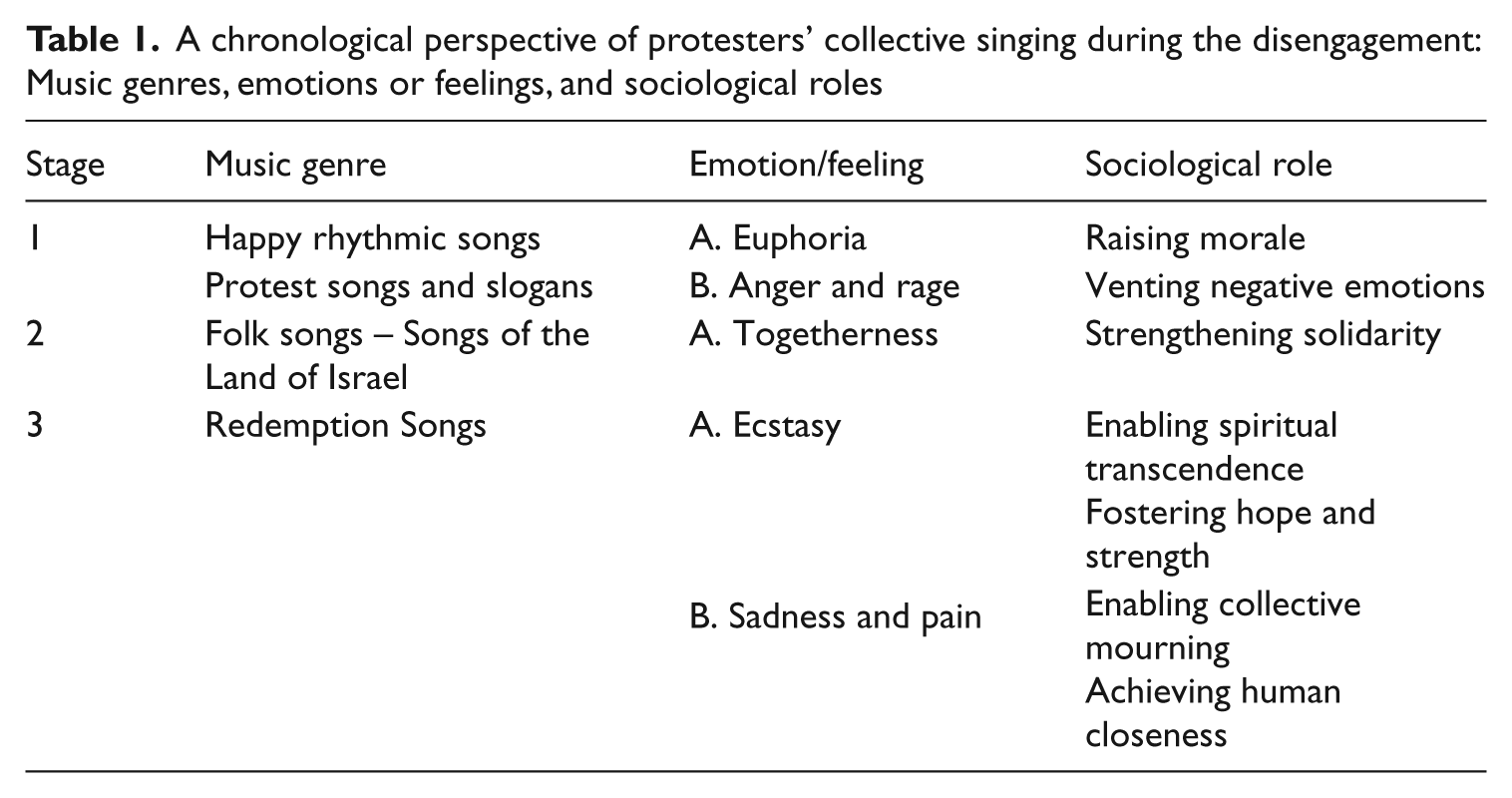
Table 1 lists the musical genres which the protesters used in their collective singing, the emotions expressed through the singing, and the sociological roles of music and emotion during the three stages of the disengagement. It shows the musical genres and musical elements that were used at different stages of the disengagement to evoke emotions such as euphoria, togetherness and ecstasy on the one hand, and anger, rage, sadness and pain on the other hand. Those emotions contributed to raising morale, venting negative emotions, strengthening solidarity, enabling spiritual transcendence, fostering hope and strength, enabling collective mourning and achieving human closeness.
A chronological perspective of protesters’ collective singing during the disengagement: Music genres, emotions or feelings, and sociological roles
The findings of this study describe a sociological process which can be analysed through the unification-separation vectors as defined by Shoham (1999). This theory is a useful tool in analysing characteristics of different cultures from a sociological-cultural perspective. According to Shoham (2005), cultures can be classified along a continuum which comprises of two vectors, a unification vector and a separation vector. Unification means identifying with an external object or a symbolic construct and continuously striving to lose identity by fusing with it. Separation is the opposite vector and is defined as aiming to break off from surrounding life-forms and objects. A totally unified or separant culture does not exist in reality, but there are signs indicating the dominance of one type over the other within existing cultures. Cultures on the unification end are dominated by self-manipulation and continuously strive towards unity and constancy. Cultures on the separation end are characterized as manipulating the other, segregated, in flux, with a strong tendency to behave militantly. Throughout their existence, cultures experience various separating and unifying forces and respond by working towards overcoming pressures and restoring a sense of equilibrium.
The sociological roles of the collective protest singing in this study reveal an interesting chronology which can be explained through Shoham’s unification-separation vectors. In the first stage of the disengagement, the protesters felt the need to strengthen their unification vector. This was achieved through happy rhythmic religious songs which created euphoria and raised morale. In parallel, since the actual evacuation still seemed far away, it was easy to develop the optimistic thought that the evacuation would never occur. This belief raised the need for separative forces which were expressed through angry protest songs and slogans. Those forces assisted the protesters in drawing the boundaries between them and the SFMs, thus helping define their separate collective identity. Those songs also functioned as a vehicle for venting negative feelings of anger and rage, keeping the tense situation under control.
In the second stage of the disengagement, the possibility of evacuation became more realistic and therefore raised the protesters’ stress levels considerably. In spite of that impending threat which was supposed to intensify the separative forces, the protesters moved towards reinforcing the unification vector by creating feelings of togetherness with the SFMs through folk songs – Songs of the Land of Israel. However, it became clear that the protesters were not ready for such unification. They first needed to define their boundaries as a collective.
The third stage of the disengagement, in which the core group of protesters was evacuated from the synagogues, presented the immense separative force of the actual evacuation which had been hovering over the protesters as a threatening shadow for months. Facing this extreme separative force, the protesters needed a much more powerful unification vector. The ecstatic collective singing of Redemption Songs enabled them to experience spiritual transcendence and made them feel almost fused with one another and with the Almighty. This proximity to God strengthened the unification vector to the point where the protesters believed they were going to be redeemed. But once the hope of salvation was lost, the atmosphere changed and the ecstatic Redemption Songs became a means for expressing collective mourning which touched the SFMs deeply and drew empathic responses. By letting the SFMs cry with them and hug them, the protesters continued raising the level of unification which eased their pain and balanced the threatening forces of separation stemming from the disengagement process. At that stage, the protesters’ earlier need to draw boundaries between them and the SFMs was replaced with a wish for unification.
Conclusion
McMillan (1996) claims that a sense of community is achieved through shared experiences and in order to obtain these experiences, the members of the community must have contact with one another. Since art is also based on experiences, McMillan places art as a central component in developing a sense of community. The findings of the current study stress the social role of experiences in collective singing as fostering sense of community within a social movement. The protesters used collective singing to evoke emotions that would help them raise morale, vent negative emotions, strengthen solidarity, experience spiritual transcendence, foster hope, empower themselves, mourn and achieve closeness to the SFMs, all of which created dynamics which were essential to keeping the movement alive and active. Moreover, the study demonstrates how the flow of emotions and feelings evoked by collective singing can subconsciously be steered by a dynamic interplay between unification and separation vectors. Accordingly, the traumatic evacuation is seen as a strong, separating event, threatening to tear the protesters away from their beloved home and land. In response to such an extreme separation, the protesters moved from separation to unification. The process began with separative forces, whereby excommunicating national symbols like the flag and anthem helped the protesters define their boundaries as a collective. It ended with unifying forces by expressing sincere concern for the unity of Israeli society. During that emotional journey, the protesters gradually increased their efforts to reinforce the unification vector. First, they achieved this among themselves, then by a spiritual unification with God, and finally with the SFMs as their human surroundings.
In this study, music was shown to be a useful tool in understanding group processes, since music is an inseparable part of our daily life as individuals as well as collectives. Extracting musical information should be accompanied by carefully examining the use of different music genres at specific situations, the emotions and feelings that music genres raise and express and the role they play in the societal arena. While in this case, a movement from separation towards unification was clearly evident, other case analyses may show different dynamics. Additional studies should examine collective singing within other social movements and in other cultures during demonstrations. Broadening the knowledge in this field may bring forth more suggestions as to how to quell tensions in explosive situations.
Footnotes
Acknowledgements
I wish to thank the participants who shared their experiences with me. Much appreciation is given to the Schnitzer Foundation for Research on the Israeli Economy and Society for supporting this research.