







Abstract
The aim of this article is twofold. First, we examine whether there are differences between ex-cohabiting and former married men and women in their income change after relationship dissolution. Second, we focus on differences between divorced and ex-cohabiting men and women in coping with the changed income situation after relationship dissolution. We look at two coping strategies: increasing one’s labor-market participation and finding a new partner. We look at differences in the effectiveness of applying those strategies between separated and divorced women and men. After controlling for compositional differences, there are no differences in the effectiveness of increasing the number of hours worked between divorced women and ex-cohabiting women. Divorced women gain more financially by finding a new partner than ex-cohabiting women. There are no differences between ex-cohabiting men and divorced men in effectiveness of both coping strategies.
One of the major changes in family composition in recent decades has been a dramatic increase in divorce rates. In 1960, the crude divorce rate per 1000 in the EU-15 was 0.5; in 1980, this figure had increased to 1.4, and by 2009 it had reached 2.0 per 1000 (Cronos, 2005). Another significant trend has involved the increase in couples living together without being married. In most Western and Northern European countries, over half of all people between the ages of 25 and 34 years who have partners are currently living in cohabitation unions (Kiernan, 2004). What makes unmarried cohabitation so significant is not only its prevalence, but also its widespread acceptance. A substantial majority of young people accept unmarried cohabitation and actively endorse living together before marriage as a good idea to see if they really get along (Thornton and Young-DeMarco, 2001).
In the past decade, considerable research has been conducted on the economic consequences of the dissolution of legal marriages (for a review, see Andreß et al., 2006). Less is known about the economic consequences of the dissolution of cohabitation unions. In light of the increasing number of cohabiting couples, it is logical to expect an increase in the number of cohabiting relationship dissolutions in the future. This article focuses on the financial consequences of both marital and non-marital dissolution in Belgium.
The first objective of this article is to document the extent to which economic consequences of relationship dissolution differ for formerly cohabiting and divorced partners. In doing this, we closely follow two previous studies that addressed this topic. One of the first studies in this area was conducted by Avellar and Smock (2005), who examined the economic effects of the dissolution of cohabitation relationships in the National Longitudinal Survey of Youth (NLSY) in the USA. The authors concluded that, after the dissolution of a relationship, divorced men fare the best (+10.8%), followed by formerly cohabiting men (–1.8%), formerly cohabiting women (–24%), and divorced women (–48%). One limitation of this study was that the investigation was restricted to first cohabitations; the conclusions can thus be generalized only to young adults who experienced the dissolution of a relationship. We should also note that the economic status of cohabiting couples in the United States is lower than that of married couples, while the opposite is the case in Europe (Manning and Brown, 2003). From a European perspective, Manting and Bouman (2006) investigated the economic consequences of the dissolution of both marital and cohabitation unions in the Netherlands. They found that the post-relationship decline in economic well-being was greater for divorced women (–23%) than it was for formerly cohabiting women (–14%). The economic consequences of relationship dissolution were greater for formerly cohabiting men (–4%) than they were for divorced men (+7%). In this study, we present descriptive analyses on Belgian data to supplement the findings of the studies by Manting (2006) and by Avellar and Smock (2005). In addition to this descriptive analysis, this study aims to advance the understanding of the consequences of these dissolutions by attempting to explain the differences between formerly cohabiting and divorced partners and by testing whether the differences continue to hold after controlling for several background variables.
The second purpose of this study is to identify differences between formerly cohabiting and divorced women and men with regard to the effectiveness of strategies for overcoming the negative economic consequences of relationship dissolution. Two possible strategies that are regularly tested in the literature are remarriage (or re-cohabitation) and increasing labor-market participation. Some studies have focused on the effect of re-partnering on income level (De Wilde and Uunk, 2008; Morrison and Ritualo, 2000; Ozawa and Yoon, 2002; Schmiege et al., 2001). Others have brought the employment status of divorced women into focus (Joshi, 1998; McKeever and Wolfinger, 2001). In line with Jansen et al. (2009), we incorporated both of these strategies into our analyses. To the best of our knowledge, this is the first study to perform an explicit test on the difference between divorced and formerly cohabiting men and women with regard to the effectiveness of these strategies. We used large-scale administrative data from the Belgian Labor Market and Social Security Data Warehouse in order to answer our research questions. This dataset contains longitudinal information on a large number of divorced and formerly cohabiting people.
Literature Review and Hypotheses
Legal and Cultural Context of Marriage and Cohabitation in Belgium
Belgium belongs to the group of countries with low marriage rates and high divorce rates (Cronos, 2005). The divorce rates in Belgium are among the highest in Europe (Mortelmans et al., 2009). In 1960, the crude divorce rate per 1000 in Belgium was 0.5; in 1980 it had increased to 1.5 and by 2009 it had reached 3.0. By comparison, the divorce rate for Europe as a whole was 2.0 in 2009 (Cronos, 2005). Compared to other European countries, Belgium takes an intermediate position regarding the number of people in cohabiting relationships. In Belgium, approximately half (47%) of all people between the ages of 25 and 34 who were living with a partner in 2000–2001 were not married (Kiernan, 2004).
With respect to Esping-Andersen’s (1991) typology of welfare states, Belgium is usually assigned to the group of Corporatist European welfare regimes. In many cases, these regimes seek to maintain traditional status divisions. Even though the state does provide welfare arrangements, responsibility for organizing the distribution of these benefits rests largely with non-governmental organizations. A characteristic of the Belgian system involves the extent to which health and unemployment benefits and pensions (whether complete or partial) are related to earnings. This is a carry-over from the classic male-breadwinner model (Raeymaeckers et al., 2008a, 2008b). This principle is also represented in the generous family benefits and social transfers, which support a traditional division of labor. Nevertheless, the existence of an elaborate childcare infrastructure that enables women to combine work and family provides evidence that Belgium also has characteristics of the dual-earner model (Mortelmans and Jansen, 2010).
The traditional union in the country remains the legal marriage. As an alternative to marriage, people can cohabit. This factual union has no legal consequences, and it offers no form of protection in case the relationship should end. In 2000, Belgium introduced a ‘Declaration of Cohabitation’, according to which two cohabiting people can register their cohabitation and enter a state of ‘legal cohabitation’. The declaration introduces several protective measures for cohabiting couples, which resembles those existing for married couples. In this article, the terms ‘cohabiting’ or ‘consensual union’ do not refer exclusively to this legal cohabitation regulation. We use the term ‘consensual union’ to refer to both registered and non-registered households in which two people are living together without family ties and without being married to each other.
Economic Consequences of Relationship Dissolution
For two reasons, we expect the financial consequences of union dissolution to be different for formerly married and for formerly cohabiting couples. First, compared to married couples, cohabiters have a more equal division of paid work (Snoeckx et al., 2008). As a result, married women are more often financially dependent on their partners than cohabiting women. Second, cohabiters are less likely to have children, and they tend to be younger when ending a relationship (Batalova and Cohen, 2002; Brines and Joyner, 1999; Hamplova, 2002; Rindfuss and Vandenheuvel, 1990; Wu and Schimmele, 2005). Having dependent children can be disadvantageous for an individual’s economic situation. In addition to the fact that children bring extra costs, a number of indirect costs are also involved (e.g. time spent at home caring instead of working). Because of the differences between formerly married and cohabiting women, the impact of relationship dissolution on the economic well-being of these two groups can be expected to be less for formerly cohabiting women than it is for divorced women, many of whom lose all (or most) of their household income (Hypothesis 1). For men, we expect the economic consequences for formerly cohabiting men to be worse than they are for divorced men (Hypothesis 2). Due to the more equal division of labor, formerly cohabiting men lose a greater proportion of their household income following relationship dissolution than divorced men.
Effectiveness of Strategies for Overcoming Post-relationship Financial Distress
Research has indicated that people who re-partner after divorce have higher incomes than divorced people who remain single (De Wilde and Uunk, 2008; Duncan and Hoffman, 1985; Fokkema, 2001; Morrison and Ritualo, 2000; Mortelmans and Jansen, 2010). Ozawa and Yoon (2002) demonstrated that the financial advantages of remarriage were smaller for women with children. Furthermore, the difference in income after re-partnering, as compared to income immediately following relationship dissolution, was higher for people with high levels of education than it was for people with less education. Based on these findings, we can hypothesize that formerly cohabiting women benefit more from re-partnering than divorced women (Hypothesis 3a). Further, formerly cohabiting men are likely to benefit more from re-partnering, given that (as stated above) formerly married men experience less financial loss following the dissolution of a relationship than formerly cohabiting men (Hypothesis 3b).
Cohabiting couples have less traditional views regarding labor and family responsibilities. Married women are more likely to be dependent on their husbands and to be less experienced in the labor market. Men and women in younger age groups are more likely than older people to live in cohabitation unions (Kiernan, 2004). We assume that, on average, older women have invested more in their relationships (e.g. by taking care of children and the household for a longer time). For this reason, they have much more to gain from increasing their labor-market participation, as compared to women who had stronger ties to the labor market during their relationships. We therefore expect that former married women gain more income by increasing their labor-market participation after the dissolution of a relationship (Hypothesis 4a).
Because cohabiting men and women have a more equal division of labor-market participation and household tasks, we expect that formerly cohabiting men can gain more income than formerly married men can by increasing their labor-market participation (Hypothesis 4b).
Method
Data
To answer our research question, we used the Belgian Labor Market and Social Security Data Warehouse, a large-scale administrative dataset containing information from nearly all social security agencies in the country (e.g. National Office of Social Security, National Employment Office, and the National Institute for Health and Disability Insurance). A sample was drawn consisting of 30,000 households that had experienced the dissolution of a union in 1999: 15,000 divorced couples and 15,000 formerly unmarried cohabiting couples. We excluded all self-employed persons, as the database contained no reliable information on their income. We also excluded all individuals who had died or whose partner had died during the observation window. Finally, we imposed a maximum age of 55 for inclusion in the sample, as older people might face more difficulties in applying the strategies to mitigate the economic consequences of union dissolution, and because they might experience declines in income due to retirement (or early retirement). With these restrictions taken into account, we used data from 18,747 women, of whom 43 percent were divorced and 57 percent had previously been living with a partner without being married. We used data from 14,929 men, of whom 41 percent were divorced and 59 percent had experienced the dissolution of an unmarried cohabitation relationship. Data were available starting from 1998 (the year before the dissolution) up to 2003 (four years after the end of the relationship).
Measurements
The dependent variable was household income. This included earnings from employment, as well as public transfers because of disability and career interruption for all household members older than 16. We used the modified equivalence scale developed by the Organization for Economic Cooperation and Development (Förster, 2007) to adjust the household-income measures for household composition and household needs. Using this scale, the first member in the household was weighted with a factor of 1, and other household members of 14 years of age or older with a factor of 0.5. Children under 14 were weighted with a factor of 0.3. This equivalence scale has been successfully applied in other studies examining the economic consequences of relationship dissolution (e.g. De Wilde and Uunk, 2008; Uunk, 2004; Van Damme et al., 2009). The economic consequences of separation are dependent on economies of scale. The estimated effects were thus also dependent on assumptions regarding these economies of scale and, more specifically, on the equivalence scale. For more information about this issue, see Jarvis and Jenkins (1999). The income measure was adjusted for inflation. To make the income paths linear and to cope with the skewness of the data, we took the natural logarithm of the adjusted household income.
We used the following measurements for our independent variables. Increase (or decrease) in labor-market participation was measured categorically. The labor-market position of the respondents in the years after the relationship dissolution was compared with their position before the dissolution. People who did not have a paid job before the relationship ended and who started to work afterwards were considered as having increased their labor status. People who had worked part-time and increased their employment to a full-time position after the dissolution were also considered as having increased their labor-market participation. Re-partnering was defined as living with a new partner (married or not) after the dissolution of the union in question.
In the analyses, we controlled for a number of background variables. These variables concerned the differences between divorced and formerly cohabiting partners: economic dependence, the presence of young children in the household, age, labor-market participation during the relationship and household income before the dissolution. Economic dependence was operationalized as earning less than half of the household income. It is obviously possible that some people who earned more than half of their household income did not earn enough to make a living after the end of the relationship. On the other hand, other people might have contributed less than half of the household income before the relationship ended, but who earned enough money to be economically independent on their own. These possibilities notwithstanding, we consider contributing less than half of the household income to be a good indicator of economic dependence. We used age as a mean-centered variable. The control variable ‘having children in the household’ measured the presence of children younger than 14. The operationalization of the other background variables (e.g. gender) was obvious.
Design
Like most recent studies on this issue, we used a longitudinal design. Cross-sectional data would not be sufficient for estimating the consequences of relationship dissolution. Many people remarry or enter another cohabitation union after the dissolution of a relationship. It is possible that the group of people who remained single constituted a selective sub-sample of all people who had experienced the dissolution of a partnership. One option would have been to use panel data to estimate financial consequences. Despite the considerable advantages of panel data (Jansen et al., 2009), non-response and selective attrition from the initial sample might introduce bias, as observed by Blossfeld and Rohwer (1997). Another limitation of some earlier studies involves the number of relationship dissolutions observed (Andreß et al., 2006). Our sample allows us to include thousands of relationship dissolutions in our models. This large administrative sample has several advantages. First, the statistical power is greater, making parameter estimates more robust. Second, it allows us to examine the financial consequences of relationship dissolution in more detail (e.g. focusing on the dissolution of cohabitation unions). In most studies, this has not been possible, due to the small number of people who had experienced these events. We use growth models (Singer and Willett, 2003) to model the economic consequences of relationship dissolution. Longitudinal data can be seen as multilevel-data, in which repeated measurements are nested within persons (Hox, 2002). This will generate a two-level model, with time (in years) on the first level and individual characteristics on the second. Using multilevel analysis is advantageous because it does not lean on the assumption of independence of observations and it gives more accurate estimates of the standard errors. Because of the large sample size, we set the level of significance at p< 0.001.
Results
Descriptive Results
Figure 1 presents the distribution of median adjusted household incomes. Compared to means, medians provide a better picture of the typical case, and they are less sensitive to outliers. These results clearly reflect the well-known gender gap in the economic consequences of relationship dissolution. On average, the economic consequences of relationship dissolution were more negative for women than they were for men. As expected, we also see that divorced women lost more income (–33%) than did formerly cohabiting women (–24%).
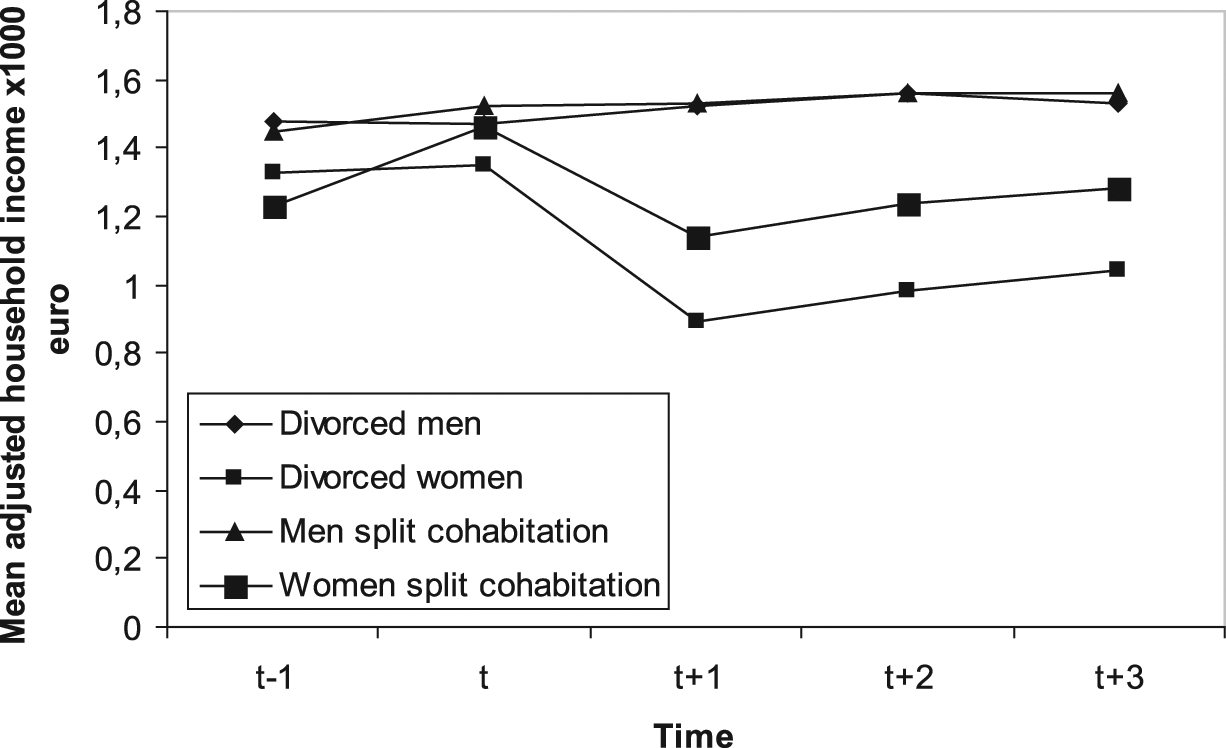
Mean adjusted household income differences for formerly married and cohabiting men and women
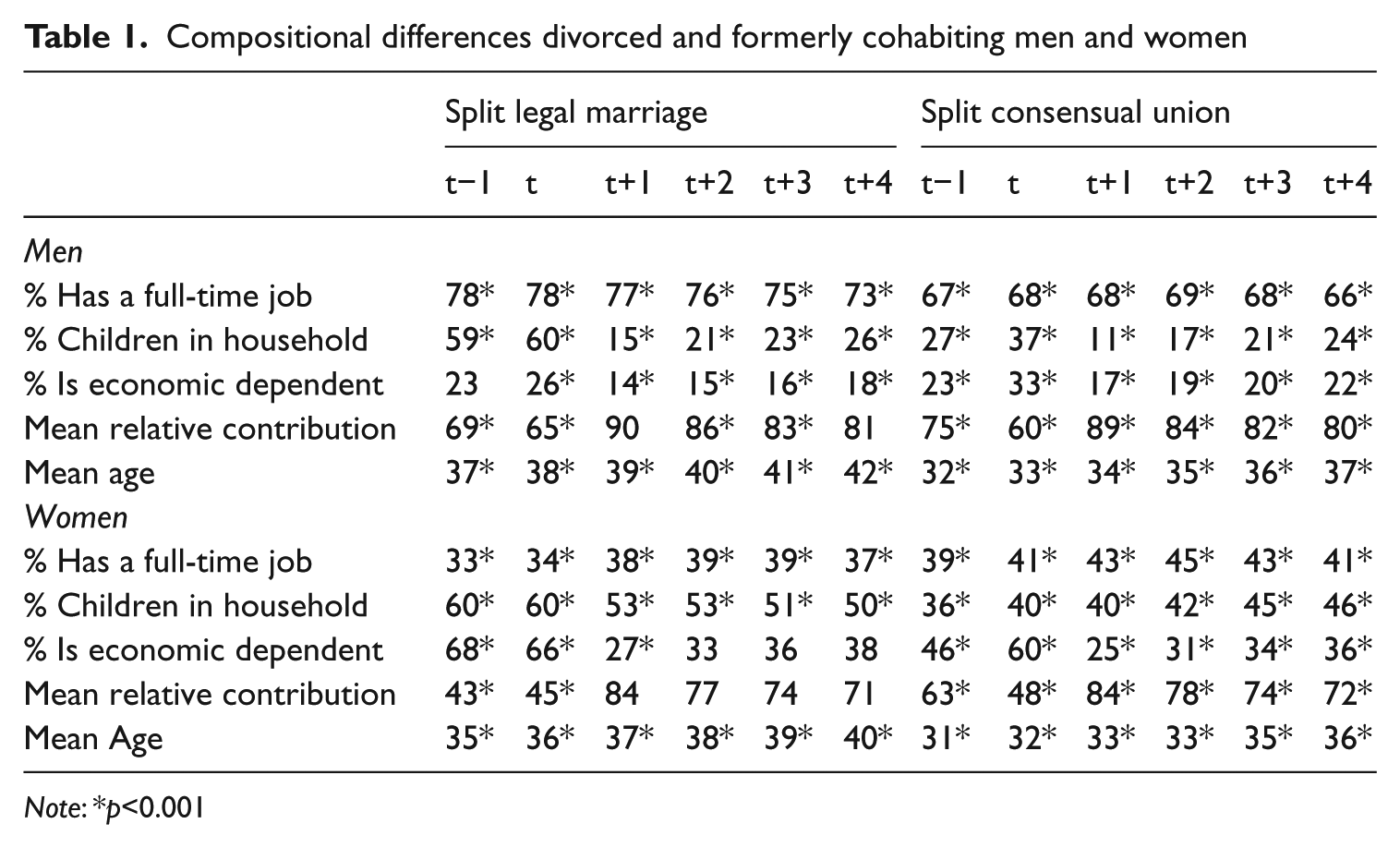
Table 1 shows the compositional differences between divorced and formerly cohabiting men and women. We see that the contributions that married women made to the household income were lower than those made by cohabiting women. In the year before the dissolution, 68 percent of the married women were economically dependent on their partners (i.e. they earned less than half of the household income). Only 46 percent of the cohabiting women were dependent on their partners. Another difference between cohabiting couples and married partners involved the presence of young children in the household. As shown in Table 1, about 60 percent of the married couples had children in their households before the relationship dissolution. In contrast, merely 27 percent of the cohabiting men and 36 percent of the cohabiting women had children in their households before the end of the relationship. After divorce, more than half of the women had children in their households, as compared to only 15 percent of the formerly married men. This difference was also observed among the formerly cohabiting couples. After the dissolution of the relationship, 40 percent of the formerly cohabiting women had dependent children in their households, as compared to 11 percent percent of the formerly cohabiting men. Table 1 further shows that the divorced women in the sample were generally older (by four years) than the cohabiting women. On average, the divorced men were five years older than the formerly cohabiting men.
Compositional differences divorced and formerly cohabiting men and women
Note: *p<0.001
Different Financial Consequences after Relationship Dissolution for Divorced and Formerly Cohabiting Men and Women
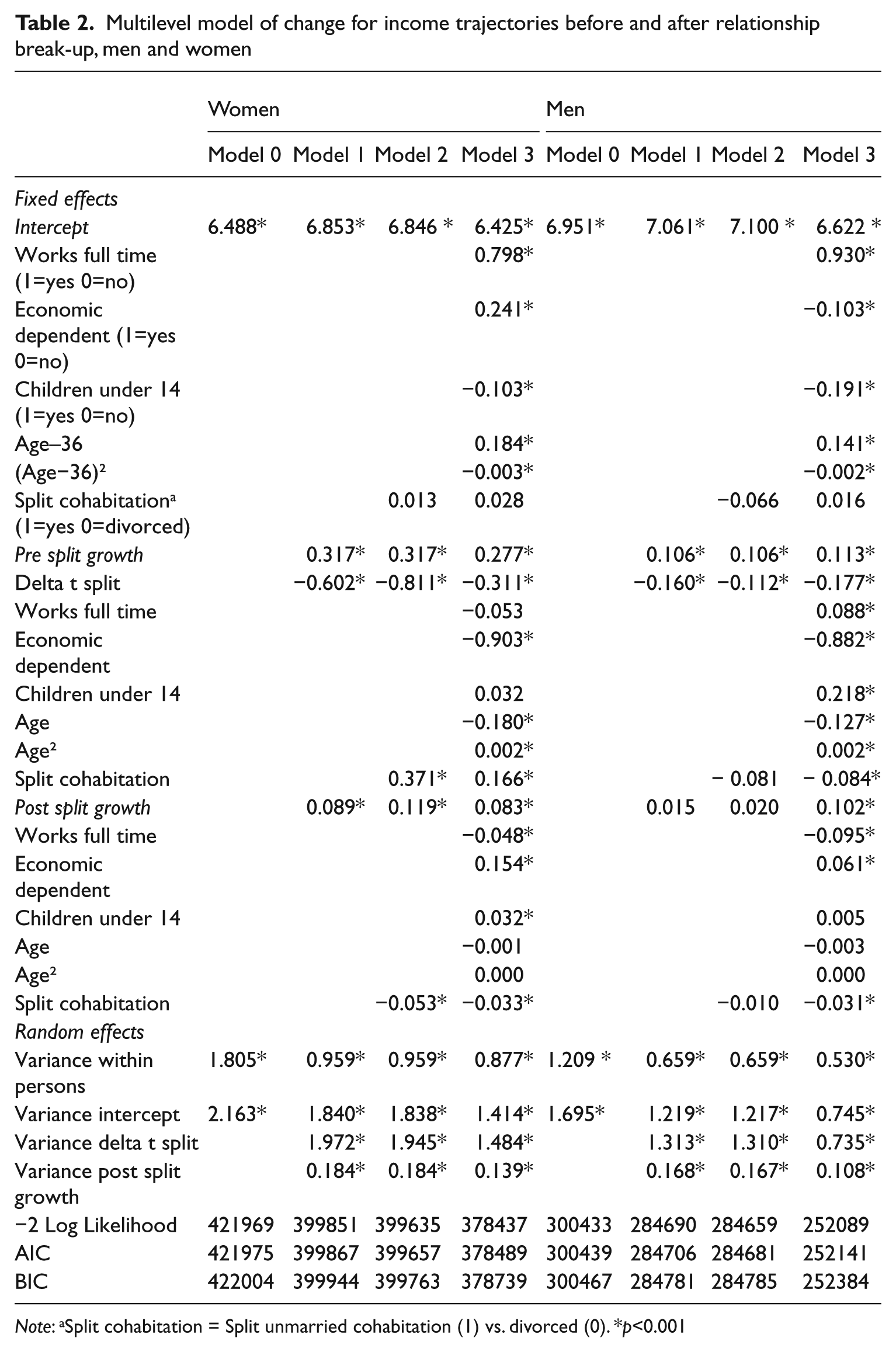
Our descriptive results demonstrate that there is a gender gap in the economic consequences of relationship dissolution. For this reason, we estimated separate models for men and women. By estimating the null random intercept model we can disentangle the total variance in household income in a within-group (within individuals, over time) and a between-group (between individuals) variance component. The variance decomposition model is displayed in Table 2 (Model 0). As shown in the table, 45 percent of the variance in household income (1.805/((1.805+2.163)/100)) can be explained by differences within women (over time), and 55 percent of the variance (2.163/((1.805+2.163)/100)) can be attributed to differences between women. For men, these figures are respectively 42 percent (1.209/((1.209+1.695)/100)) and 58 percent (1.695/((1.209+1.695)/100)). As shown by Model 1 in Table 2, both men (−0.160) and women (−0.602) experienced a significant average decline in income resulting from the union dissolution.
Multilevel model of change for income trajectories before and after relationship break-up, men and women
Note: aSplit cohabitation = Split unmarried cohabitation (1) vs. divorced (0). *p<0.001
We predicted that the economic consequences of relationship dissolution would be worse for divorced women than they were for formerly cohabiting women (Hypothesis 1). At the time of the separation, there were no differences between divorced and formerly cohabiting women with regard to household income (0.013 in Model 2 in Table 2). Immediately after union dissolution, household income decreased faster for divorced women than it did for formerly cohabiting women. The initial decline after relationship dissolution was −0.811 for divorced women, with formerly cohabiting women experiencing an income decline of −0.44 (−0.811+0.371). These results notwithstanding, it would be hasty to conclude that the effect of union dissolution on the economic well-being is worse for divorced women than it is for formerly cohabiting women. Divorced women recovered more rapidly than formerly cohabiting women. The post-divorce income growth for divorced women was 0.119, while their formerly cohabiting counterparts experienced income growth of only 0.066 (0.119−0.053). Controlling for compositional differences between divorced and formerly cohabiting women (i.e. age, economic dependence, presence of young children and labor-market participation during the relationship) reduced the dissimilarities in the economic consequences of relationship dissolution. The differences between divorced and formerly cohabiting women with regard to the immediate decline after relationship dissolution decreased by 44 percent, and the differences in income growth after the dissolution decreased by 62 percent. Nonetheless, these differences remained significant.
In Hypothesis 2, we predicted that the economic consequences would be worse for formerly cohabiting men than they would be for divorced men. At first glance (Model 2 in Table 2), there appears to be no difference between the two groups of men following the separation. Both the initial decline after relationship dissolution (−0.112) and the income growth after relationship dissolution (0.020) were the same for divorced men and formerly cohabiting men. Controlling for compositional differences reveals differences in the economic consequences of union dissolution. Formerly cohabiting men indeed experienced a sharper decline in income (−0.177−0.084=−0.261) after relationship dissolution than divorced men (−0.177). Furthermore, the household income of divorced men grew at a faster rate (0.102) after relationship dissolution than the household income of formerly cohabiting men (0.102−0.031=0.071).
Effectiveness of the Application of Strategies for Overcoming the Financial Consequences of Union Dissolution
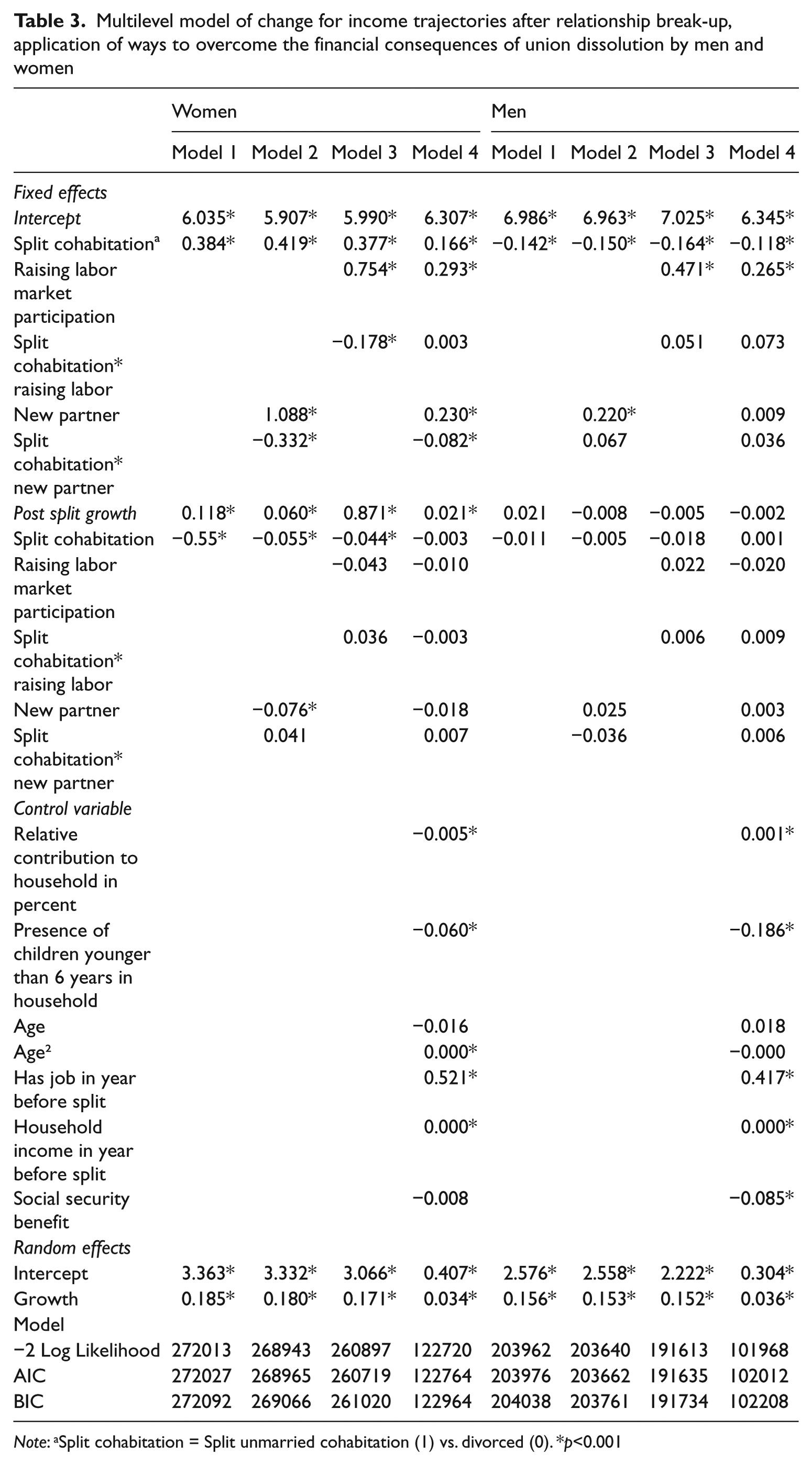
In the next step of the analysis, we examined differences in the effectiveness of strategies for moderating the economic consequences of union dissolution for divorced and formerly cohabiting men and women. The growth in income after relationship dissolution is modeled in Table 3. With regard to Hypothesis 3a, Model 2 shows that having a new partner appears to be more influential on divorced women (1.088) than it was on formerly cohabiting women (1.088−0.332=0.756). This result holds even after controlling for background variables.
Multilevel model of change for income trajectories after relationship break-up, application of ways to overcome the financial consequences of union dissolution by men and women
Note: aSplit cohabitation = Split unmarried cohabitation (1) vs. divorced (0). *p<0.001
Hypothesis 3b predicts that formerly cohabiting men would benefit more from re-partnering than divorced men. Although we found that income did increase on finding a new partner (0.220), we found no differences between divorced and formerly cohabiting men. For men, after controlling for compositional differences, the positive income effect of finding a new partner was no longer significant. Their household income did not rise after re-partnering.
Hypothesis 4a states that divorced women would gain more by increasing their labor-market participation than formerly cohabiting women, as they would be more capable of increasing their working hours, given that they had been less active on the labor market before. As expected, increasing labor-market participation had a greater impact on divorced women (0.754) than it had on women who experienced the dissolution of a consensual union (0.754−0.178=0.576).
We predicted that formerly cohabiting men would gain more by increasing their labor-market participation than divorced men (Hypothesis 4b). As shown by Model 4, men who increased their labor-market participation after the separation had higher household incomes than men who had not increased their labor-market participation (0.471). There were no differences, however, between divorced and formerly cohabiting men.
Discussion
The objective of this article was twofold. First, we examined differences between divorced and formerly cohabiting couples with regard to the economic consequences of relationship dissolution. We aimed to go beyond mere description. We found that the immediate decline in income after union dissolution was steeper for divorced women than it was for formerly cohabiting women. On the other hand, divorced women recovered at a faster rate than formerly cohabiting women. Background variables (work experience, being economically dependent, having children and age) explained a major part of the differences between the two groups. The differences remained significant, however, even after controlling for differences between the two groups. For men as well, we considered whether the economic consequences of relationship dissolution were dependent on the type of union that had existed before the dissolution. For men, we initially found no differences in economic effects of union dissolution, although a difference emerged between divorced and formerly cohabiting men after controlling for background characteristics. The effects of union dissolution on economic well-being were worse for formerly cohabiting men than they were for divorced men.
The second aim of this article was to study whether there were differences between divorced and formerly cohabiting couples with regard to the effectiveness of strategies for coping with the changing economic situation following relationship dissolution. Both strategies examined in this article (i.e. increasing labor-market participation and re-partnering) proved effective for women as ways to improve their financial situations. We found that an increase in labor-market participation had more of an impact on divorced women than it did on formerly cohabiting women. After controlling for compositional differences, however, the differences disappeared. The positive effect of finding a new partner on household income was higher for divorced women. For men, we found an increase in household income for men who had re-partnered. There were no differences between divorced and formerly cohabiting men with regard to the effectiveness of re-partnering. After controlling for compositional differences, the positive effect of re-partnering on household income was no longer significant. Increasing labor-market participation is an effective strategy that men can employ in order to overcome the negative financial consequences of relationship dissolution. We found no difference between divorced and formerly cohabiting men.
We hypothesized that divorced women would benefit less from finding a new partner than formerly cohabiting women (Hypothesis 3a). Our results differed from those found by Ozawa and Yoon (2002), for several reasons. First, their study was based on a small sample in the early 1990s, and they focused on people who had remarried. Moreover, all of the people in their study had remarried within 24 months, which might indicate that these cases constituted a highly selective group of people who had remarried soon after their previous relationships had dissolved. In general, divorced women experience a greater income relapse after the dissolution of their relationships than do women who have not been married (Manting and Bouman, 2006). It is logical to expect that therefore they could gain more by finding a new partner. De Wilde and Uunk (2008) showed that this is not the case for all women; it is specific to women who had previously had a higher income. Additional analyses of our data (not shown here) show that divorced women had higher household incomes (by approximately 10%) than women who had lived with their partners without being married. For this reason, we can expect divorced women to gain more by finding a new partner than formerly cohabiting women. One explanation could be that women tend to search for partners who can offer them the same financial situations that they had before the end of their relationship (Jansen et al., 2009). It is important to note that the household incomes of many formerly cohabiting women who have new partners are higher than those of divorced women with new partners, although divorced women do experience a greater increase in household income after re-partnering.
Strengths and Limitations
We used large-scale administrative data to answer our research questions. As described earlier, one major advantage of such data is the absence of selective panel attrition. Furthermore, the problem of social desirability was not an issue with these data. Additional advantages included the size and longitudinal character of the dataset. The administrative data allowed us to use a very large sample of both married and cohabiting people over a considerable period. The data obviously had a number of limitations as well. This type of dataset is not created for scientific research. We therefore missed a number of control variables that would have been interesting for our research questions: education, values regarding relationships, gender and emancipation, and the duration of the relationship that ended. Although we had information about several sources of income (state benefits and labor-market participation), we did not have other financial information that could have increased the model fit: savings, debts, house quality, financial support from family and friends, and spending patterns.
In this study, we analyzed household income before and after the relationship dissolution. In doing so, we assumed that both partners had enjoyed equal access to these economic resources during the relationship. This is obviously not the case for all couples (Lundberg et al., 1997). For this reason, we might have overestimated the economic consequences of relationship dissolution. Moreover, we assumed shared economic resources for both married and cohabiting couples. It is possible that married couples are more likely to share their economic resources than cohabiting couples. If this is true, we especially overestimated the economic consequences of the dissolution of consensual unions. On the other hand, our information covered only one year before the dissolution. For this reason, we might have underestimated the economic consequences of relationship dissolution. For example, in anticipation of an impending separation, some people might have increased their labor-market participation or found other living arrangements (although not officially).
Conclusion
There are several ways in which one can develop the results from this article. First, there are other ways to cope with the negative financial consequences of relationship dissolution than the two strategies presented in this study. Examples include living with family or friends, drawing on public-assistance benefits, and adjusting spending patterns. In future studies, it would be interesting to consider whether and how people apply such strategies to mitigate the consequences of relationship dissolution.
Second, our study does not take the context of the relational break-up into account. Being a one-country study, we focus on the individual trajectories without taking the broader picture into account. We agree with Surkyn and Lesthaeghe that culture and a normative context is by no means the only factor responsible for demographic transitions but is ‘a non-redundant factor in sustaining a long-term demographic trend through periods of slower and faster economic growth alike’ (2004). Cultural and religious traditions have a long-term influence on people’s life course decisions and behavior (Inglehart, 2003). Earlier research has already shown the importance of cultural values as an explanatory factor for the differences in trends regarding divorce between the Scandinavian countries (being Europe’s forerunners for divorce rates) and the Southern European countries and Ireland (Ester et al., 1994). This has remained the case since 1965, despite European countries reaching more convergence and coming closer to Scandinavian demographic patterns (Ester et al., 1994; Lesthaeghe, 1986), and there is still a clear geographical pattern in divorce figures (Eurostat). The normative context is also relevant regarding the strategies employed to cope with the financial consequences of union dissolution. The assumption that people act rationally and make coping decisions in an individualistic way to maximize their own personal gain has been called the ‘rationality mistake’ (Barlow and Duncan, 2000; Duncan and Edwards, 1999). It is suggested that such decisions are taken with reference to moral and socially negotiated views about what is right and proper. Calculations about individual utility maximization (in this case about applying strategies) may be important once these social and moral understandings are established, but they remain essentially secondary (Duncan et al., 2003). The moral context differs between countries. In terms of the persistence of traditional values in general and the tolerance of divorce in particular, Belgium reflects a moderate position (Gelissen, 2003; Inglehart and Baker, 2000). The normative context also differs between groups within countries (e.g. class and ethnicity, see Duncan and Edwards, 1999). Cross-national and qualitative research (Duncan and Strell, 2004; Schmiege et al., 2001) is needed to complement our findings on how and why people apply strategies to overcome the financial consequences of union dissolution.
Third, the institutional context (e.g. level of public childcare provisions, income support for single parents, child maintenance and availability of jobs) is important to understand the financial consequences of union dissolution. Previous studies showed that public policies can diminish the negative effects of union dissolution (Burkhauser et al., 1990; Uunk, 2004). Institutional factors also influence the way people cope with the negative financial consequences of union dissolution (Van Damme and Uunk, 2009). Van Damme et al. (2009) showed that income-related institutions have a negative effect on separated women’s chances of employment and that generous public childcare provisions increase the odds of women starting to work after divorce. Furthermore, it is found that in countries with higher welfare support, the effect of welfare reliance on re-partnering is more negative than in countries with lower welfare support (De Wilde and Uunk, 2008). As we focused on one country we were not able to take the institutional context into account. Replication of this study in countries with different levels of childcare services and female labor-market participation would enhance our knowledge regarding the financial consequences of union dissolution.
After the differences in welfare state provision, the legal rights for cohabiting couples may influence their coping behavior or have consequences for their post-relationship finances. Trends in cohabitation and its implications for family life in western societies are well documented (Bumpass and Lu, 2000; Gonzalez et al., 2010; Hardie and Lucas, 2010; Hohmann-Marriott, 2011; Kennedy and Thomson, 2010; Liu et al., 2011; McClain, 2011; Wu et al., 2010). A major point in the research on cohabitation concerns the legal registration of the relationship. Willetts (2003) pointed to several reasons why people might choose registered cohabitation (e.g. economic benefits and ideological motivations). However, only a few studies have been conducted on the relation between the legal rights of registered cohabitatees and the consequences of a break-up. In many countries, there are still disadvantages to registered cohabitation as compared to marriage (Boele-Woelki et al., 2006). A general discussion regarding the differences between marriage and registered cohabitation is further complicated by national differences in regulating laws. One example concerns parentage. For a married couple, the legal parentage of both the birth mother and her husband are legally established at the moment of birth. In some countries, the mother’s male registered partner is not automatically regarded as the legal father, but the father needs to formally recognize the child. Another example is housing. Rules on obtaining home ownership or regulations for deceased partners concerning ownership vary according to the legal status of the union. We were not able to make a distinction between registered and non-registered cohabitation. More research on this issue is needed to fully understand the broader consequences of unmarried cohabitation.
Footnotes
Acknowledgements
We would like to thank the reviewers for their insightful suggestions.
Funding
This research received no specific grant from any funding agency in the public, commercial, or not-for-profit sectors.