







Abstract
Lay perceptions of social structure and economic distribution have a particular salience in the current era of widening inequalities which has characterised Britain since the 1980s. Research into subjective beliefs has generated puzzles: people underestimate the extent of inequalities, see themselves as being situated ‘near the middle’ irrespective of their objective position, and allegedly hold an a-social view of the underpinnings of socio-economic inequalities. This article presents a new qualitative analysis of lay perceptions of inequality. It does so with a particular focus on context, biographical experience and social change. The qualitative and temporal perspectives reveal that people are more sophisticated analysts of social process, and of their own situatedness within the wider social structure, than often thought. This has implications for sociological understanding but also holds relevance for renewing political options for intervention. Additionally, the evidence offers insights into lived experiences of inequality through a period of significant restructuring.
Introduction
The rise in socio-economic inequalities in the UK since the 1970s, and recession and austerity since 2008, have given a renewed importance to understanding lay experiences of inequality. Researchers frequently identify a gap between extant socio-economic inequalities and lay perceptions of such inequality. It is widely noted that, when asked how they see themselves positioned within wider society, people assign themselves members of a ‘middling group’ of ordinary, working citizens (recognised in successive governments’ ‘hard working families’ trope which seeks mass appeal). A widely held sociological view is that contemporary cultural framings undermine critical awareness of the structural underpinnings of social inequality. Commonly this is linked to individualising tendencies (e.g. Clery, 2012) but influential recent work points to ambivalence as people ‘switch’ between assertions of agency and a deflected, problematic, awareness of structural process (e.g. Miles et al., 2011; Savage, 2005). Another perspective asserts that it is reference group processes which encourage people to see themselves as relatively middling in society and to misconstrue the true extent of inequality (e.g. Kelley and Evans, 1995). Individualisation, ambivalence and reference group perspectives emphasise relative naivity in lay understandings of inequality. However, we know surprisingly little about how people interpret and attribute meaning to their own positioning within wider society.
This article offers a new qualitative analysis of how people perceive the structure of social inequality, how they evaluate it when asked to do so, and how they see themselves to be situated within it. I explore contextual factors which help illuminate self-positioning. I consider how people describe their biographical trajectories and wider structural changes. We will see that when reflecting on such changes (and on continuities), people offered nuanced accounts of social structural processes. These accounts suggest they hold a more ‘sociological’ understanding of inequality than implied in accounts of lay naivity or ambivalence. The analysis thus tackles a question with import for sociological explanation, and with relevance for political debates regarding popular support for differing kinds of progressive political intervention. Additionally, people’s accounts provide insights into lived experiences across a widely diverse ‘middling group’ in an era of inequitable change.
Perceptions of Inequality
Inequality and questions of distribution become more pressing. The trend to growing inequalities over the last 40 years has been especially highlighted through the long recession, with the entrenchment of poverty and soaring of elite income, and the re-assertion of global capital interests and neo-liberal claims (Dorling, 2014; Lansley and Mack, 2015; Taylor-Gooby, 2013). The period from the 1950s to the mid-1970s saw a slight convergence in incomes across the population and was characterised by Lansley and Mack (2015) as one of egalitarian capitalism. Since the 1970s this trend has reversed and income inequalities between the upper and lower deciles have widened significantly (Taylor-Gooby, 2013). Through the economic recession from 2008, middle income groups did less well than the highest income groups, with measures suggesting growing inequalities in subjective well-being (Barnes and Hall, 2013) and a fall in living standards across a majority of the population (Gordon, 2015), although the effects on the poorest were sharpest (Broughton et al., 2015).
In this context, how are social arrangements perceived and evaluated by the public? There is a wealth of survey data documenting continuities and changes in attitudes relating to welfare, and to inequality more generally. Some argue a growth of individualised explanations for poverty (e.g. Clery, 2012) yet, if such ‘devil take the hindmost’ values are read from data on attitudes to unemployment benefits, evidence regarding beliefs about inequality suggests a different story. The clear majority of people see the income gap as too large (Pearce and Taylor, 2013; Taylor-Gooby, 2013) and there is wide support, in the UK and internationally, for ameliorating income differences between rich and poor (Barnes and Hall, 2013).
Longstanding theoretical traditions document links between people’s social psychological dispositions, beliefs about inequality and their own social and economic circumstances. An important strand in British sociology through the 1950s into the 1970s sought to theorise these relationships (e.g. Bulmer et al., 1975). Lockwood had argued that social and economic contexts engendered differing images of societal inequalities, and saw the expanding demographic group of privatised workers to hold a more commonly ‘de-socialised view’ of the social structure than hitherto: the privatised worker saw himself [sic] as ‘a member of a vast income class … of “ordinary people” who “work for a living”’ (1975: 25). However, explanatory cul-de-sacs underlay a declining interest in class-related imagery, and class analysis itself became much less central within the discipline (Bottero, 2005; Savage, 2005). The 1990s resurgence in culturalist analyses of class inverted Lockwood’s assertion (1975: 26) that ‘inequalities take on an extrinsic and quantitative rather than intrinsic and qualitative form’. Researchers sought to theorise experiences of inequality within a social structural context in which there is no normative framing through which to make positive sense of it (Savage et al., 2001; Skeggs, 1997), and class was deemed hidden and implicit in people’s experiences of inequality, but no less powerful. Some of this research engaged with processes of cultural othering and boundary drawing between in- and out-groups; for example, Shildrick and MacDonald (2013) showed the relevance of such processes in their study of poverty noting how, even among the most disadvantaged, poverty is seen to describe the experience of others, a marker of victimhood and lack of agency from which study participants sought to distance themselves. People may ‘disidentify’ from othered groups to shore up their own identity, but what if there is no immediate anxiety in this respect?
Asked about their view of society and their own position within it, people commonly assert a diamond or onion shape and see themselves to be situated in the middle of the wider distribution (e.g. Cruces et al., 2013; Pahl et al., 2007; Savage et al., 2001). Savage argued that this is a moral claim as much as an account of social position, an assertion of ordinary individualness. In making it, people invoke classed others (snobs, the upper class), revealing a problematic relationship between their sense of themselves as free agents and their partial awareness of social structural forces: ‘the idea of class is needed to sustain individualistic identities, but because it also disrupts it, it then is pushed back into the wings’ (Savage, 2005: 939; revisiting Lockwood and colleagues’ qualitative data). Structural processes are elided through an ‘elemental individualism, with little conception of the individual as a social product, but rather an insistent declaration on the individual as “natural” sovereign of their own lives’ (2005: 939). The argument that social structural forces are acknowledged and straight away displaced implies an uneasy articulation within lay understanding. Other analyses have emphasised how lay perceptions of class are multi-faceted, and that class is too aggregated a concept to reflect this complexity in lay perceptions of inequality (e.g. Irwin, 2015; Payne and Grew, 2005). Here the conflicted element in lay perspectives was argued to result from social scientists’ constructs.
Other research emphasised the salience of patterns of sociality so that, within a hierarchical structure, people tend to interact with (socialise, marry, work alongside) others like themselves (Bottero, 2005). People ‘read’ the world from their own, situated, position, and extrapolate out from their own experience (Bottero, 2005; Kelley and Evans, 1995). This encourages a middling tendency in subjective social location, and an underestimation of the extent of inequality (Evans and Kelley, 2004; Kelley and Evans, 1995; Lindemann and Saar, 2014; Rowlingson et al., 2010). Evans and Kelley (2004) argued that a blend of reference group processes and objective structures combine to shape people’s imagery and understanding of social inequality. Building on this in her theorisation of stratification as individualised hierarchy, Bottero (2004) challenged an influential argument within sociology – that forms of symbolic domination and class othering are important drivers in reproducing inequalities (e.g. Skeggs, 1997). For Bottero this reified a concept of conscious class action when in fact inequalities are reproduced through routinised practices undertaken across the hierarchy of inequality. In her account, conscious class action should be analysed as a specific rather than general account of inequality. Bottero’s analysis particularly emphasised homosociality in theorising why ‘class’ is not routinely relevant in lay perceptions and identities, since ‘normal processes of hierarchical differentiation work to subsume the significance of inequality’ (Bottero, 2004: 999). The evidence presented in this article partly echoes these analyses; for example, there was little explicit exclusionary sentiment articulated in participants’ accounts. We may also allow that people tend to weight their immediate experience more than distant ones (e.g. Bottero, 2004; Evans and Kelley, 2004). However, in a dynamic social hierarchy, people do encounter significant differentiation. It is not unusual to experience oneself in a differing social position compared to parents, siblings and peers, or to experience one’s cohort as being divided between fellow travellers and others ‘left behind’. As we will see, in reflecting on such differentiation, people offer a view inflected by their social situation, yet they also reveal themselves to be nuanced analysts of social structural processes, and articulate a more coherent and detailed conception than implied by much literature in the area.
Methods
The research project, on parenting and inequalities, was designed to explore aspects of contemporary parenting with reference to debates about the reproduction of inequalities and diversity within, as well as across, social classes. It was also designed to explore temporal change as children grow older. The project started in 2008 with a survey (n = 564) of parents who had mostly pre-teenage children involved in out-of-school organised activities, and a series of semi-structured interviews with a strategically sampled subset of parents across 34 households in 2008–2009 (see Irwin and Elley (2011) for details). Thirty parents were interviewed again in 2011 and twenty one for a third time in 2014, as their children grew through their teenage years. 1 The sample itself comprised a spread of middle, intermediate and working-class households. The middle-class participants were mostly graduates and commonly worked in the public sector (e.g. in health, legal and education related professions). Intermediate and working-class participants worked in a range of manual and service sector jobs (e.g. junior administration, postal work, manufacturing and sales work). The sample covered an extensive range across the income spectrum, but did not include those in severe poverty.
In the second and third wave of interviews, participants were asked subsets of questions about their perceptions and experiences of aspects of social inequality. The analysis of questions relating to class and comparison asked in wave two generated rich data on how people see their circumstances compared to salient reference points (Irwin, 2015). Participants did not routinely take a bird’s eye view of social inequalities. As part of the third round of interviews, I decided it would be of particular interest to force this question and require people to reflect on the structure as a whole, as well as their own positioning. A question asked in the International Social Survey Programme (ISSP) and included in the 2009 British Social Attitudes Survey (BSAS) presented respondents with a series of diagrams representing societal inequality (reproduced in Figure 1). The text and question read: ‘The five diagrams show different types of society. Please read the descriptions and look at the diagrams below. First, what type of society is Britain today – which diagram comes closest?’. During interview, participants were given a sheet of paper with these diagrams and descriptions, which I also read to them. As in the ISSP, they were also asked, with reference to the same diagrams: ‘What do you think Britain ought to be like – which would you prefer?’ (NatCen Social Research, 2009). The distribution of results in the BSAS shows that across Britain the most common description of ‘society today’ was type B, at 40 per cent. Approaching 20 per cent each described it as type C and D. The most common description of what Britain ought to be like was type D, at 58 per cent of respondents (NatCen Social Research, 2009). Several writers draw on the ISSP and other large data sets and undertake comparative analysis across countries (Guillaud, 2013; Lindemann and Saar, 2014) and over time (e.g. Kenworthy and McCall, 2008). To my knowledge, the question, widely utilised in quantitative analyses, has not been used as a prompt within qualitative research, yet theoretical work and extant evidence point to the value of an enhanced qualitative understanding of how people interpret and respond to questions about the structure of inequality and their own place within it (e.g. McCall, 2013; Rowlingson et al., 2010).
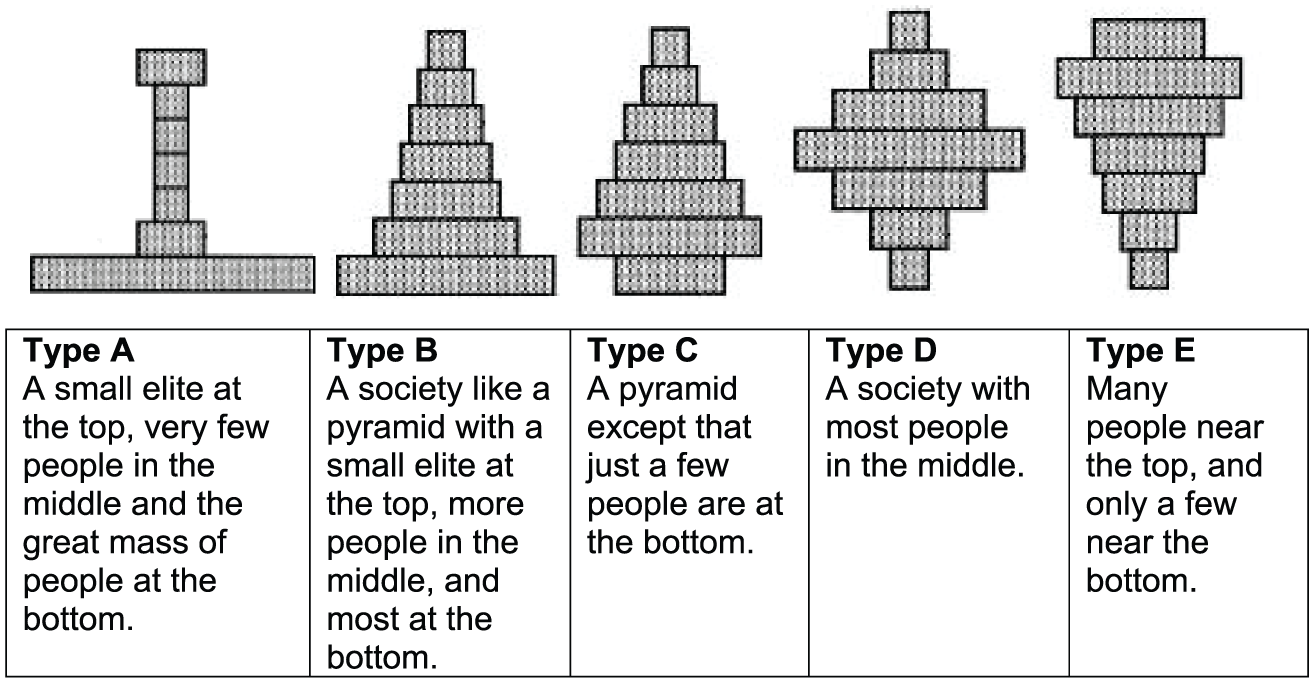
International Social Survey Programme (ISSP) ‘type of society’ question.
The broad questions I address through the data are as follows:
How did participants describe the pattern, and nature, of societal inequality?
How did they see themselves to be situated within the hierarchy, and how were contextual factors influential?
How did participants talk about continuities and changes in the structure of inequality?
How did they describe their own experience, and any biographical change, in relation to wider societal changes?
Through accounts of their own experiences participants gave ‘a view from a place’. In the analysis which follows I explore these views and the contexts which influenced them. I address question 1 in the first analysis section, and questions 2 to 4 in the second section.
Descriptions of Inequality
The study participants grew up in the 1960s and 1970s, and themselves formed families and raised children through the 1990s and 2000s. The first part of the analysis draws out some themes relating to perceptions of inequality. Most saw the structure as very unequal, and judged it negatively. Asked ‘What type of society is Britain today?’, the majority chose diagram B, echoing the general pattern evidenced in national data (BSAS, 2009). There was strong general disapproval of the structure, commonly interpreted in terms of an uneven distribution of opportunities and life chances, an elite with too much power and injustice, polarisation and the entrenchment of disadvantage. The sample did not cleave in any simple ways in their views about the unequal structure. It was certainly not the case that the professional middle classes described the structure in egalitarian terms, as might be anticipated (e.g. Kraus et al., 2012), and most were critical of the extent of inequality and of poverty, some very emphatically so. Lisa saw society as best described by diagram C. She said:
I think the extent of inequality is growing but the people who have more are able to maintain more … and I think the number of people who can’t get anything and are really struggling is growing. (University administrator)
This theme of growing polarisation was a common one, articulated by people across socio-economic groups and often seen to be exacerbated by (then Coalition) government austerity policies. Many felt that a disadvantaged group, and underclass, was solidifying (cf. Sachweh, 2012). Clare saw the structure of inequality as best described by diagram A, and pointed to a stark divide between a mass and an elite. This related to her trenchant criticism of the injustice of inequality:
I can’t believe we’re in a supposedly civilised society where people can be so utterly disenfranchised from so many different aspects. How can people die early in a place like Britain, how have we got food banks? (Arts sector professional)
There was also widely expressed concern about people’s ability to access opportunities, and the diminution of such opportunities. Alex, who identified type A as descriptive of society today, said:
The welfare state has generated a huge underclass of people who have grown up in a culture of not working, and I felt, although Tony Blair did lots of horrendous things, one of his phrases about giving people a hand up, not a hand out, was, I think, really important. (Hospital consultant)
For Andrew:
It’s vitally important that we do as much as we can to avoid inequality and give people the opportunity … People have got to want to help themselves though, to some extent, and you’ve got to provide them the opportunity, and I don’t necessarily think that’s the case now. (Professional, made redundant, currently setting up a business)
These sentiments echo evidence that evaluations of inequality are often made with reference to the distribution of opportunity as much as to outcomes (Rowlingson, 2010), and concerns that current inequalities undermine opportunities (McCall, 2013; on the USA context). The themes described were not exclusive to the middle classes and extended across much of the sample. However, participants living in disadvantaged circumstances emphasised constraint and often the effects of power, domination and struggle in their own lives (cf. Kraus et al., 2012). Pete, in describing why he identified diagram ‘B’ as representing Britain today said:
It’s always been the same people with money at top … it keeps people at the top at the top, and people at the bottom, and that will never change. (Ill-health and non-employed)
Jenny had struggled financially, particularly after the untimely death of her husband. She saw diagram B as representing society today. Asked if she saw the general pattern of inequality as being relevant to herself she said:
I think in society today there’s a lot of poor people there, struggling, and once you get down to … if it’s beyond your circumstances and you end up on that bottom level, like meself, it’s hard to get back up and to push yourself up, and I think, I see … I’m scrimping and scraping every week with money and things, and food. (Part-time sales assistant)
Similarly, Ben invokes his own experiences of constraint in his account:
… people are struggling to survive. It’s not a case of being not able to go on holiday this year, or ‘I can’t have this big car’. They are saying, ‘I can’t pay me electric’. And we’ve been through, we’ve struggled with that. (Self-employed driving instructor)
Ben also alluded here to deservingness and the way in which positions are valued, voicing an argument for fairness through the moral valuing of diverse positions (cf. Sayer, 2005):
I see so many people working so hard for so little money, and I’ve never understood why somebody has to accept that they get paid so much less than someone else … I’m not saying the people at the top don’t deserve a lot of money, if they’ve set the business up and that, but surely the person with the brush at the bottom deserves a living?
In sum, in answering questions about the general structure of inequality in society, participants commonly described it as resembling a pyramid (diagram B), although several opted for diagrams A and C, and they were concerned about increasing inequalities and an entrenchment of disadvantage. Inequalities were described in terms of material resources, employment and opportunity, control over circumstances, power, injustice and inclusion, as well as respect and recognition. These themes were common across the sample although there were some differences in emphasis. Higher up the income scale some were more likely to emphasise opportunity and contribution while those lower down were more likely to emphasise their personal experiences of struggle and constraint. This evidence is consistent with national level attitudinal data, which suggests people are very critical of the extent of inequality and concerned that it is worsening. While many linked deservingness and contribution, so too they held concerns about a growing and excluded class apart, and were animated by motifs of fairness and a decent and inclusionary society, and of the availability of opportunities (cf. McCall, 2013; Rowlingson et al., 2010; Sachweh, 2012). I turn now to how participants saw themselves to be situated within the structure of inequality and how they interpreted this.
Self-Placement and Views of Inequality Through a Generation of Change
When asked where they saw themselves to be situated within the social structure, my participants slightly ‘bunched’ towards the middle in their assessment of their own position, echoing the published evidence reviewed earlier. With Savage and colleagues, I argue that the common trope of being ‘middling’ is, in part, a moral claim. However, in my sample I found no examples of dissonance between individualism and structure but coherence. Participants did not agonise over a structure agency tension. Assertions of individualism and agency were consistent with awareness of context, constraint and social complexity. Familiar reference points are salient in their accounts but through them participants described continuities and changes through their lifetimes, both in the social structure and in their position within it. They offered very rich, nuanced and diverse accounts of broader social arrangements, and changes in the structure of opportunity as it has impacted on them. It is partly through these accounts of their biographical experiences that we can understand why they see themselves to be currently situated in the ways they describe. I organise the empirical data primarily with reference to material social circumstance, and descriptions of biographical and societal continuities and changes.
Middle-class participants recognised their privileged position with reference to material resources and associated efficacy. Alex saw himself to be positioned in the second or third tier down in diagram A:
Oh, we’re really lucky, we’re up near the top, financially. … and I think the other part of this is control, you know, I think having control about your circumstances leads to a better quality of life, and I think people who’ve got more control are happier, and we’re really lucky, I think we’re right up near the top of that. (Hospital medical consultant)
Sam saw himself in the third tier down, within diagram C:
… if you think about it in income terms, you know, I do quite well, and therefore I think I’m probably, you know, third layer down, something like that. I’m hardly a lord and I know lots of people that earn substantially more than me, erm … but I earn substantially more than most people. (Professional, healthcare)
The only middle-class participant who situated herself on a lower tier of the hierarchy was Clare. She had relatively limited economic resources for a middle-class participant, referring in previous interviews to not holidaying abroad and to relying on her mother for financial help with household repairs. She worked in a professional role in a low paying sector and her husband had experienced extensive unemployment due to mental health issues for many years. Clare saw society represented in diagram A, and described herself as situated one step up from the bottom of the hierarchy. She talked herself around to a recognition that, all things considered, she might be in the middle, but her first instinct reflected the unexpected mental health and financial difficulties she had confronted through much of her married life:
Do you think your position has changed over your lifetime?
Yeah it’s gone down. And that’s entirely to do with mental health issues I think and the impact … it’s difficult isn’t it. … our class position hasn’t changed, our income has changed and our choices have changed … there is no way to make any provision for that if somebody is ill during their working life, you can’t do it. … We’re in a much better position than loads of people, and then we are in a much worse position than others, so I guess we are in the middle in that respect.
Clare’s initial low self-placement, unusual for a middle-class participant, seemed to point to the gap between what she felt she could have reasonably hoped for, and the position she was, in fact, in. The most direct reference point here related to her biography, the making of ‘reasonable’ expectations, and how they had been undermined. While she reverted to a customary middling position, an acknowledgement of relative good fortune, her initial assertion of doing relatively badly offered a poignant glimpse into disappointment.
Many in the sample saw themselves to have moved social position through their lifetime. Some participants emphasised the growth of opportunities. Qualitative evidence on social mobility is relatively sparse (although see, for example, Friedman, 2013; Miles et al., 2011). Miles and colleagues posit that in advancing ‘modest stories’ of upwardly mobile careers, the men they interviewed sought to establish their individuality against the risk of being seen as a careerist or ‘cipher’, a carrier of a structural process: the men’s accounts reflected a tension between asserting individual agency and acknowledging structural process (Miles et al., 2011). Below, I explore evidence regarding the links drawn between personal biography and social structural change, and find no such tensions marking people’s accounts.
Deborah saw herself to be situated in the middle of diagram B, echoing familiar accounts:
I probably would have to put myself in the middle, erm … yeah, I’d say middle class, sort of middle of the road, both working, you know, semi-detached house, that sort of thing, maybe go on holidays and, you know, not too badly off, really. (Local government worker)
She felt the general structure of inequality had changed from type A through her lifetime, and noted general changes to which she linked personal ones:
Well, I think we’re better off than our parents were, both myself and [my husband]. … so, you know, and where we live is a lot nicer than where we came from, sort of thing, and we both work and, I think, financially we’re better off than our parents were.
The picture of improving circumstances as compared to their parents’ generation is echoed in other accounts. There were varying degrees of agency emphasised by participants within narratives of lifetime improvement, and this was a strong motif in the accounts of the next three participants. However, each of them also recounted their sense of belonging to a cohort of ‘fellow travellers’. Maggie grew up in a context of relative poverty, and saw her family circumstance as ‘towards the bottom’, but she had moved up and saw herself to be situated on the middle tier of diagram B. She was an accountant in the education sector who gained professional qualifications through employment. She described a long-term shift in the ability of those with working-class backgrounds to enhance their life chances:
I think maybe the rich are getting richer and the poor are getting poorer, but I do think you have more people that are – my brothers and sisters tell me all the time, I’m middle class and they’re not (laughs) – I do think you probably have more people that [were] typical working class a lot of years ago, maybe got a profession, there’s more people that have done degrees, that have got careers, erm … which you probably see moving more away from typical working-class backgrounds. (Accountant)
Maggie saw herself as strongly authoring her own success, and described how hard she had worked to get her job and her in-work qualifications. However, this was consistent with her sense that she was part of a cohort which could advance itself. She contrasted her own success with the experiences, and lack of drive, of two of her siblings. Her weaving together of drive, determination and a growth in opportunities for her cohort come together in her account of her biographical mobility. Whether it was absolute or relative mobility was a moot point from her perspective, as she reflected that there used to be more people ‘in the bottom’ of the hierarchy than now, but, then again, she said: ‘I don’t know, maybe it’s just me that’s changed as to who you sort of socialise and see’.
Like Maggie, Andrew was also strongly assertive of his agency in getting ahead in life, but so too this was described with reference to a long run expansion of opportunities. Andrew identified as middle class and was embarking on a new private enterprise venture in the care sector. He lived with his wife, both had degrees, and they were well off economically. He saw them as being in the middle of society (type B) and felt he had risen a couple of tiers since his own upbringing. Andrew saw himself as a grammar school success story, describing his own upward mobility trajectory as part of a general expansion of opportunities for working-class youngsters:
I actually had the benefit of the old grammar school, everybody stayed there, and the old ethos stayed the same … it was a good school, it was the old public school … and then it became a grammar school, and I caught the tail end.
He described the link between his own journey and wider social structural changes providing opportunities for upward mobility which had subsequently been closed off:
I think there’s more people who are middle class, in inverted commas, but then I just think that’s starting to highlight the gap between those who have moved that step and those who haven’t. It’s almost like the drawbridge has drawn up behind people, because there isn’t, you know, in certain parts of the country …, there isn’t the opportunity to cross the bridge. Yeah, I do think it’s changed; I think we were probably the golden generation of the opportunity to do something different, in terms of home ownership and things like that as well.
Julia also described an experience of upward mobility from a working-class upbringing, and emphasised her own determination and drive in shaping this. She too saw herself as part of a wider set of societal changes and expanding opportunities. Her account was inflected with her Black British identity. Interestingly, Julia was the only participant to see the current pattern of inequality as resembling diagram D. Her response to the question about change in the structure of inequality was framed with reference to migration, ethnicity and racism, and some weakening of minority disadvantage, suggesting her relatively positive image of societal inequality was influenced by this perception of improvement:
I would say about 30 years ago there was a bigger divide. But there isn’t as much of a divide [now] in that sense. (Social welfare professional)
Like others, she reflected on social structural processes in ways closely bound up with her own experiences. Here class and ethnicity overlap:
So, if you look at, kind of, like our generation and our parent’s generation, and a black Caribbean coming into this country, … not that I believe in the class system, but it’s there anyway, but a lot of us are coming out where we’re educated now and we’re doing quite well and we can live in [relative comfort].
Across these examples we can see how people read and interpret the structure in ways strongly inflected by their own position and experiences. The evidence suggests that people ‘read’ the structure from their situation, and then commonly ascribed themselves a ‘middling’ status. There are echoes here of Miles and colleagues’ (2011) argument that upwardly mobile men ‘tell a modest story’, a moral claim to being a regular bloke. While some of my participants, especially women, asserted their own determination in authoring trajectories of upward mobility from a working-class background and foregrounded their own agency and determination (see Irwin (2015) for further discussion), they also saw their mobility as part of a historically situated widening of opportunities for members of their cohort. They did not set agency against social structural context but as consistent with it.
I turn now to those who were objectively less well off in material terms. Despite extensive disadvantage, Pete (just like the more advantaged participants above) assigned himself a middling position within society. He was in ill-health and non-employed, a former labourer living in a high-rise flat in a very disadvantaged part of Leeds. He described society as type B, and put himself in the middle: ‘I’m not made of money, but there’s a lot of people worse off than I am’. Such an assessment implies a consistency between his (highly constrained) expectations and experience.
Ben refused the terms of the task altogether. Between the second and third interview, Ben and his wife were forced to sell their house and move into private rented accommodation. Ben had lost his previous job and now worked full time as a self-employed driving instructor. His wife had gained a degree as a mature student, had recently been made redundant from her professional role within a local authority, and moved into a low-level service sector job. They had struggled with debt for some time. At various points it was clear Ben was loathe to classify for fear of engaging in moral judgements on terms not of his own making. When I asked him how he saw himself to be situated with reference to the diagrams of society, he said:
Where am I in society? I’m here (indicating his physical positioning in his lounge at home). It’s for other people to judge.
It might be that in his refusal of the question there is a broad echo with the evidence of Miles and colleagues who identified dissonance among men who were downwardly mobile (Miles et al., 2011). However, it is important to note that across successive interviews Ben referred to his hatred of his mother’s social snobbery, and his resistance to the task of classifying was inseparable from his broader and longstanding philosophy.
Earlier we saw how those in disadvantaged circumstances described their experience in terms of constraint, but looking at accounts through a temporal lens illustrates the complex reflexivity people employed in accounts of their own social positioning. Mike considered that he had stayed in a fairly constant position within society throughout his lifetime, on the second tier up in diagram B. He worked in window fabrication, and had experienced spells of unemployment. A recent lottery win by his lifelong partner made a quite significant, if not radical, difference to their lives: ‘With us lottery win it’s just got us to where we should have been if we’d had kids at a normal age’. Mike had been a teenage father and has lived with the mother of his children (who he recently married) since his early 20s. He believed things had changed little since his childhood in the general pattern of inequality, although he identified some important changes impacting negatively on working-class experiences and opportunities. A theme among working-class participants was the declining value of their wages, and this was echoed by Mike:
I was earning more money 10 or 15 years ago than I’m earning now. My wage is 10 per cent or 15 per cent down on what I wo’ earning 10 or 15 years ago. I couldn’t imagine having a kid now, like seven or eight year old, and bringing them up now. I just couldn’t do it on the wages I’m on now. (Window fabricator)
He reflected further on a structure in which working-class opportunities for modest progression had, in his view, been undermined:
Life’s a roller coaster. You get your ups and downs. But work shouldn’t be like that, work shouldn’t be a rollercoaster. You should start at the bottom and work your way to the top. But it dun’t work like that anymore, you work at the bottom and you stay at the bottom.
Despite a broadly unchanging pyramid structure of inequality, Mike was very strongly critical of what he sees as the undermining of opportunities for modest progression:
What’s gone wrong? Why an’t it improved? Why haven’t the wages improved? It’s gone backwards.
Jenny placed herself unequivocally on the bottom tier of diagram B. She believed the structure had become less equal through time, and traced her own journey upwards from a poor working-class childhood to a decent income, contingent on her earnings and those of her husband, who worked in routine manual work, and on owner occupation in the 1980s. She then confronted growing difficulties related to a decline in income, and then more recently due to her husband’s untimely death, and her own struggles looking after her children. She recounted aspects of her own biography with reference to a changing structure of opportunity and constraint:
… you see, in the 80s, I would have said we were more like that [diagram D], in the 80s. … we bought our first house and there was more chances and there were more jobs, a lot more jobs.
And do you think your own position has changed over your lifetime?
Yeah, yeah, I do, I had a really good job. I had a fantastic job and I gave it up to have [my son], … sometimes I do dream about it and think, ‘Oh, I wish I were still there’.
You said before that you felt like you’ve changed position and described it in a structure that’s changing from D to B almost?
Yeah. So I’m like … (indicates a move from the bottom to the middle tier of D) I should say, ‘95, er … ‘94 and then, when I had [my son], I had no money coming in and then I went back to work after he were three, just part time. So I would say I wor about there (bottom of B). I’m, you know, low again, very low. … Yeah. So, that’s why I said, in the 80s, it was booming, you know, everything were booming, and then we’ve hit millennium and it seems to have just gone pht, pht. You know, I’d say about 2005 it started changing.
Jenny’s account again reveals how visions of the structure as a whole, for her an expansion and then contraction of opportunities from the 1980s to the 2000s, dovetail and overlap with her biographical experiences, and evince coherence rather than ambivalence in her description of her personal experience and how it related to change in the structure of opportunity and constraint.
Through this section we have seen accounts of social structural inequalities and changes from very diverse vantage points. To state that my participants often saw themselves as part of a large middling group would hide the enormous complexity and diversity within their accounts. To state that they asserted their individualism and agency would cloud the manifest ways in which they saw these to be socially embedded. Of course participants read and evaluated the structure of inequality in ways inflected with their own biography and social experience, but through this they also offered nuanced accounts of the intersection of their agency and wider social contexts of constraint, opportunity and social change.
Conclusion
The analysis presented in this article offers new evidence on lay perceptions of socio-economic inequality. Many researchers have tackled this question and been especially interested in the partiality of such perceptions, and the ways in which cultural and social processes limit people’s vision, by encouraging individualised understandings, by engendering ambivalence or because people ‘look sideways’ to social similars. These allegedly explain the tendency for people to assign themselves a middling position within the structure of socio-economic inequality, and naivity regarding the extent of inequality, and the structural processes shaping it. In the analysis presented here I took the visual diagrammatic representations of social inequality as used in ISSP surveys as a prompt within semi-structured interviews. A crude ‘summary typology’ of how people might construe society, in qualitative interview it engendered rich discussion of socio-economic inequalities and of participants’ own circumstances and situatedness in respect of this wider structure.
The analysis echoes extant evidence showing that inequality matters to people, who are critical and concerned about its extent. Many commented negatively on the growing divide between ‘haves’ and ‘have-nots’. High earners perceived the growth of an underclass and the diminution of opportunities, while low-income participants were more likely to emphasise injustice and struggle. How participants saw themselves to be situated within the structure of inequality was of especial interest in light of suggestions that social and cultural processes constrain awareness of the extent of inequality, and render structural processes opaque. Influential accounts have posited a disconnect between people’s inherent individualism and their ability to apprehend structure. Reference group explanations offer a more ‘structural’ view of people’s relative disengagement with extensive inequality (it is not unknowable, just not that salient in people’s day-to-day lives). The analysis offered here takes a different emphasis. Partly echoing Savage and colleagues, I have suggested that participants, in seeing themselves in ‘middling’ positions, were taking a moral positioning as well as a social one. If they saw themselves at or near the bottom of the hierarchy, this too was partly a moral claim, to do with injustice and a sense that things should be otherwise. However, it is important to recognise the one-dimensionality of the question about self-placement. Seeking more depth, I asked participants about developments through their own lifetimes and they offered often very nuanced descriptions of biographical and social structural continuities and changes. The evidence illustrates ways in which they read structural context partly through their biographical experiences. Through their accounts we saw subtle descriptions of changes in the structure of opportunities and their own place within this. For some this was about how they themselves had authored success in these contexts, for others it was about their inability to break through constraint, and their experiences of this worsening. Occasionally it was about both upward and downward movement. Participants offered sophisticated accounts of the link between their own experiences of opportunity and constraint in relation to wider social and economic arrangements through their lifetimes. This is not to say they had an ‘objective’ picture of such arrangements, they still had a ‘view from a place’. Here the analysis partly echoes Evans and Kelley (2004) and Bottero (2004). Crucially, the evidence presented shows how the ‘view from a place’ was multi-faceted, complex and in process, as people moved through biographical and historical time. The qualitative and temporal perspective thereby offers rich evidence on the complex and nuanced nature of lay understandings of social structural inequalities.
Much qualitative research into lay understandings of inequality has oriented to what people do not see (coherent classes, inequalities within a middle mass). This article has focused instead on what people do see, and the contexts influencing their views, and offers a new interpretation of lay perceptions. The analysis holds policy implications too in showing lay unease with extensive inequality, concern about exclusion, and evidence that inequality is seen as an issue for everybody, not just a problem for ‘the poor’, or a criticism of excessive wealth (although these are important). People care about inequality, about the distribution of opportunity, and about fairness and inclusion. Enhancing knowledge and a presumption of sophistication in lay understanding could contribute to more reasoned political discussion and even to the renewal of progressive political agendas.