







Abstract
There has been recent recognition of the potentials of walking as a social research method but less has been written about its pedagogical uses in sociology. This article sets out an approach for using walking in teaching as a collective practice that has the potential to shake up the traditional dynamics of the classroom. It argues that moving through the streets together and in dialogue makes a feminist intervention through challenging the figure of the lone male walker who still looms large in walking literature. The article sets out how walking can be used as an engaged and live teaching method to bring sociological concepts to life, generating and developing the sociological imagination of students. Using an example of a walk in Westminster, the article gives a practical outline for how these ideas can be mobilised.
Introduction
Sociologists are not known for walking, despite its long – if submerged – history in the discipline. Nevertheless, in recent years there has been renewed recognition and discussion of the potentials of walking as a social research method (Bates and Jackson, in press; Bates and Rhys-Taylor, 2017; O’Neill and Roberts, 2020). But less has been written about its pedagogical uses in sociology. Using walking to teach sociology also has a long history, as Carrigan (2019) describes, in the early to mid-19th century, the sociological organisation Le Play House conducted 70 educational tours that were ‘intended to inculcate a sociological sensibility in participants’. This is a tradition that fell out of mainstream sociology but has been revived over the last two decades. Pointing to these submerged histories, Back and Puwar argue: ‘Within sociology’s past, tendencies can be recovered that provide the historical foundation for live sociology. Invention and methodological innovation were very much part of the early days of sociology’ (Back and Puwar, 2012). Using walking in sociological teaching, then, is a way of reclaiming this history of sociology as an inventive craft and putting it to work with students.
What, then, is sociological about walking, and how might it be used in teaching? Charlotte Bates and I argue that going for a walk can be a way of expanding sociological attention: generating different questions, and understanding the messiness of reality [. . .] making the links between forms of everyday social life and larger societal problems and questions, as C. Wright Mills (1959) puts it, being able to understand the inter-relation of ‘private troubles and public issues’. (Bates and Jackson, in press)
It is not that walking gives us an instant magical moment of revelation but rather that it can be generative, it may spark our sociological imaginations and ‘help us to develop a grounded way of thinking about sometimes abstract sociological theories and issues’ (Bates and Jackson, in press). Using walking in teaching sociology is not just an invitation to students to bring their studies to the outside world and apply them, but also to be prompted by the outside world to ask sociological questions.
There are various innovative contemporary uses of using walking in sociological teaching in the UK. Penfold-Mounce (2024) uses two podcasts to guide student walkers: the ‘York and Crime’ walk and the ‘Death and Culture’ walk. She argues: Adopting walking as a teaching and learning tool stimulates the imagination and develops an active learning experience [. . .] It draws on walking as an immersive embodied knowledge where understanding is grounded in bodily experience.
Making the link between this embodied, situated knowledge and other sociological concepts, Charlotte Bates encourages students ‘to mesh their own experiences with some of the material discussed during the module’. Bates convenes the sociological walking course ‘Sociology on the Move’ 1 at Cardiff University, where students learn about different approaches to sociological walking and then try them out. Others, such as Paton (in press) and Back (2017) at the University of Glasgow use walking as research-led teaching, bringing alive long embedded histories of research in situ for students. Lisiak et al. (2018) provide some inspiration on how collective walking in class might be taken forward into co-writing. Their article on walking in Berlin, using the ideas of walker Franz Hessl and the sociologist of modernity and the city, Marshall Berman, presents snippets from individual walks that are then crafted into a collage.
While walking can be used in teaching sociology in multiple innovative ways, this article sets out an approach to using collective walking in teaching as a sociological critical feminist practice that has the potential to shake up the traditional dynamics of the classroom. Drawing on nine years of teaching urban sociology through walking, the article draws out the possibilities and challenges that using the city as a classroom brings. In the article, I argue that moving through the streets together and in dialogue has the potential to make a feminist intervention through challenging the ubiquitous figure of the detached lone male walker (or flâneur) who still looms large in walking literature. The article sets out how collective walking provides an alternative way of moving and learning from place.
While adverse weather conditions, finding stopping off places for discussion in a highly marketised city, and declining levels of student confidence in navigating the city post-Covid have posed challenges to delivering this kind of teaching, the article argues that walking together can be a productive way of creating new sociological conversations and prompting participation. The combination of different students and the constant churn of the city mean that the same walk never happens twice.
After setting out the approach forged towards using collective walking in teaching, in part through my own sociological biography, and drawing on a range of feminist thinkers and walkers, the article guides the reader through one walk used in teaching. The walk focuses on how power and history are embedded, inscribed and contested, showing how teaching sociology through walking can be mobilised in place. I then set out some of the practicalities and challenges of teaching in this way.
Collective Walking as an Engaged and Live Teaching Method
The archetypal figure of urban walking is the flâneur, as set out in the works of Baudelaire (1964) and Benjamin (1999). Wandering alone, he wryly contemplates the city, ‘botanising on the asphalt’ (Benjamin 1999: 36). As the naturalist reads and classifies the natural world, so the flâneur reads and classifies the city. As a postgraduate student working in the Centre for Urban and Community Research (CUCR) at Goldsmiths in the mid-2000s, I was very taken with this figure, while fully embracing the feminist critiques and discussions that have grappled with his gendered and classed dimensions (Wilson, 1991; Wolff, 1985). For Wolff, the woman could never be a flâneur due to the gendered dynamics of the city of modernity, while Wilson (1991) points to an alternative history of flâneuserie as found in the work of modernist writers such as George Sand and Virginia Woolf. Drawing on another set of historical accounts, Carby (1992) focuses on moral panics about the presence of Black women in cities that emerged during the period of mass migration of Black people from the American South to the northern cities, highlighting the policing of Black women’s bodies in public space and illustrating how they challenged these gendered and racialised norms.
Despite these ongoing debates about the possibility of the flâneuse (see Elkin, 2016) and gendered, racialised and classed experiences of walking, lone White male walkers such as Sinclair (2002, 2003, 2015) and Self (2007), and their adventures in the urban edgelands, continue to loom large in urban walking literature.
As students, while reading these debates, we were also encouraged to learn about the city through getting lost. Our teachers Michael Keith and Ben Gidley would take us to London’s East End and talk us through the layering of Huguenot, East European Jewish and Sylheti Bangladeshi migration on the streets (see Gidley, 2003; Keith, 2005). In parallel, I was encouraged by walking sociologist Caroline Knowles – whose work spans walking the cities of the homeless (Knowles, 2000) and the super-rich (Knowles, 2022) – to use walking methods in my research.
I mention these walking teachers by name not as reminiscence, but as further disrupting the idea of walking as solitary and to demonstrate how teaching practices are developed between peers and over generations of academics. We always walk in dialogue with past walks and a range of ideas from elsewhere (Jackson and Lisiak, 2025) and these experiences as a student have profoundly shaped my own practice of teaching through walking. This article is motivated by a desire to share some of the innovative teaching practices that have been spread through academic generations and networks in teaching and intellectual exchanges but have rarely been formally documented.
Where I develop this tradition of walking pedagogy further, through teaching practice and this article, is by thinking about what it is to walk collectively. The walking that I use in teaching is communal. We move through the streets together discussing what we see, hear and feel.
In a previous article, I put forward an approach to thinking and writing about walking in the city from a situated and feminist perspective that drew on a wider selection of artists and theorists than those in the walking canon. I argued: the flâneuserie I am advocating here: a) is attuned to how different forms of power unfold in and through public space b) uses attunement to power as the basis for interventions that challenge the status quo c) uses walking to read the past, present and futures of spaces, against the grain d) recognises that experiences of walking are situated and embodied rather than universal e) is multiple and based on a collective effort f) provides insights into the urban without claiming to be complete or universal. (Jackson, 2021: 38)
This approach emerged from reading about walking, from using walking in research, but also crucially from teaching with walking. It is an approach that Agata Lisiak and I have called ‘engaged walking’ (2025), where the walker acknowledges how interactions with others, both those we walk with physically and those we think with, shape our walking experience and transcend the classroom. We suggest: Engaged walking is always relational, always done together with others – no matter if we actually walk alone or with company – because we walk in and across others’ footsteps, we bring in our own manifold experiences from various geographies and times, we interact with nonhuman worlds as we traverse the street. (Jackson and Lisiak, 2025: 221)
In setting out engaged walking as an approach, we are drawing directly on ideas from engaged pedagogy by hooks (2010) that we learn best when we are interacting with each other and our surroundings and that our teaching and learning extend beyond the classroom.
My use of walking in sociology teaching involves prompting the students to walk with the ideas of others; for example, in the walk below with the ideas of Puwar (2004, 2010). While I use a range of different walking techniques in my teaching practice – for example, using silent soundwalking in research methods training – for most of my walks, I set out a theme and readings beforehand. I have stopping off points along the way where I discuss key concepts and raise issues for discussion, but I am always clear that this is not a traditional guided tour, and the students are active participants. They are encouraged to think about how our walking together is a way of learning from each other. On the move, stories are exchanged, past experiences or associations with places are shared. One example comes from walking in Peckham, a fast-changing area in the South London borough of Southwark, in 2024. When we got to one of our stopping off points – a rooftop bar with a public viewing platform – we found it had permanently closed and were unable to go up as planned. But one of the students told us about her experiences of working in a rooftop bar operated by the same company, the clientele of social media influencers, and what it was like to work there. Another student was knowledgeable about the history of the canal that has been reshaped into a cycle path on that site. Their expertise and experience fed into the collective learning experience. This interactivity between walkers can greatly enhance sociological learning. As a recent student reflected: Whilst in the classroom it is easy to learn the themes being discussed in broad terms, of gender, race, gentrification, on a walk you will always experience unexpected challenges that necessitate the nuance and reflection that are often lost in text. Sometimes these challenges will come from your colleagues and peers, sometimes from the space, and sometimes from the people you encounter. (L di Mambro-Moor, personal communication, 15 May 2024)
This comment underlines the ‘liveness’ of walking as a teaching method. While a classroom is always live, always dependent on the dynamics of the group, getting out of the classroom and walking also brings a host of other factors immediately into play. The weather, the unknown people that you meet, the scenes you move through, can all shape the learning experience, even when the walk leader is using the same plan.
Luca’s reflections on this unpredictability that can enrich and add nuance to learning resounds with Les Back and Nirmal Puwar’s call for ‘Live Methods’ (2012), that can engage with the world in real-time. Central to the proposal for live methods is a utilising of the senses and the practising of sociology as an inventive craft. They suggest: We need to take our research tools and devices for a walk . . . As the idle walker evades the disciplinary grids of being in the city, they present us with a prototype that prompts unexpected relationalities with the environment, the body and the senses. Presented with strange encounters, alternative ways of categorizing and knowing the world emerge. (Back and Puwar, 2012: 10
Here, going for a walk is both a metaphor for an openness in thinking and letting thoughts wander and a concrete example. Teaching with walking can also be ‘live’ and a way of allowing students to generate new sociological questions and ways of knowing. This has much in common with approaches to using walking with participants in research, where the environment prompts questions and reflections (Bates and Rhys-Taylor, 2017; Clark, 2017; Kusenbach, 2003; Moles, 2008). Similarly, the city is an active component in the teaching encounter, rather than a passive backdrop. And just as Bates and Rhys-Taylor (2017: 2) argue, ‘By sharing conversations in place and at participant’s pace, researchers are beginning to fully more appreciate the transient, embodied and multisensual aspects of “the social”, so too can teaching in place and at students’ pace enrich teaching sociology and promote an embodied and multisensory engagement with the city.
As Luca flags above, key to this liveness is encountering others who act as informal guides. In 2022, while the group peered through a fence onto Convoy’s Wharf – a large riverside site that is awaiting significant urban development in Deptford, in Lewisham, south-east London – a woman stopped to reflect with us on how Deptford was changing. She told the group how she enjoyed some of the newer coffee places but was ultimately worried about the future of the neighbourhood and being priced out by high rents. In the same spot, walking with a different group, we met a council worker putting up a notice about public consultation on the site. Another time on the same route, we bumped into Deptford-based sociologist Anita Strasser, who had written one of the key readings we were using for our walk (Strasser, 2020). Speaking to her immediately brought the reading to life for the group.
Other characters have been less helpful. At the beginning of a walk at Kings Cross, a man who was trying to take a photograph of the Henry Moore sculpture, which was also our meeting place, took exception to our presence as a group and pushed me out of the way (‘I said get out of the way, DARLING’). This public demonstration of misogyny was unsettling for me and the group, but we could reflect on previous class discussions of gender, and questions of who gets to take up urban space, who gets to inhabit the role of The Guide in public. This latter encounter also shows how walking together effects the streets we move through and how people perceive us. We are never observers floating above the scene but are changing it as we move, feeding into the place as process, to paraphrase Massey (2005: 154). This brings possibilities, the sharing of stories with passersby, but also risks.
While these walks are grounded in London, they provoke questions about London’s entanglement with other places – in international flows of people and capital, including histories of coercion and domination – to use Massey’s term, its ‘global sense of place’. As Massey argues of her local high street in north-west London: ‘It is (or ought to be) impossible even to begin thinking about Kilburn High Road without bringing into play half the world and a considerable amount of British imperialist history’ (Massey, 1994: 154).
These histories become highly visible in the Westminster Walk, outlined below, but equally have shaped, and continue to shape, areas where these histories are more submerged. For example, the location referred to above, Deptford, is a former dockyard from where most of the so-called ‘voyages of discovery’ were launched (Steele, 2000: 25) and which is being constantly reworked by waves of migration. When we walk through Deptford, the traces of these flows are heard in the soundscape, in Vietnamese, Chinese and reggae music, and can be seen through the repeated motif of the anchor.
Urban inequalities are embedded in London through these histories and are shaped by contemporary processes such as tightening forms of bordering (Jones et al., 2017; Yuval-Davies et al., 2019), and regeneration projects that displace London’s poorest residents (Elliott-Cooper, 2019). The dynamics of place feed into an uneven experience of walking, along lines of race, sexuality, gender and dis/ability, where some are regarded as ‘space invaders’ (Puwar, 2004).
This is captured in an essay by Wright (2020), who, in her walk through the gentrifying landscape of South London in lockdown, makes visible processes of the classed reordering of London 2 , while reflecting on walking and the threat of racial hostility. In her walk she is in dialogue with various ghosts, including young men killed in racist murders. She reflects on how Ahmaud Arbery was killed while jogging: ‘another reason to kill Black men is added to the list: exercising in nature’ (Wright, 2020: 34). This resonates with Cadogan’s essay (2016) that reflects on the constant scrutiny he is under as a Black man walking New Orleans and New York City. He concludes: ‘Walking while black restricts the experience of walking, renders inaccessible the classic Romantic experience of walking alone’ (Cadogan, 2016: 142).
Walking in a group does not dispense with these uneven experiences of walking in cities but does offer tools for opportunities for bringing them to light, thinking about them collectively and even disrupting them.
For example, the gendered aspect of taking up public space and disrupting conventions to make an intervention in the city is taken forward by the Blank Noise collective in Bangalore. Blank Noise emerged out of an MA thesis project by Jasmeen Patheja on women’s experiences of public space and has evolved into ‘a critical node within broader youth-led online activism in India’ (Mitra-Khan, 2012: 114). Their ‘Step-by-Step Guide to Unapologetic Walking’ uses walking to challenge the power dynamics of public space. They challenge the walker to: walk very very slowly. walk without your phone. walk without your eyes fixed to the ground walk in the middle of the pavement walk with your chin a little raised walk without your bag. walk without your sunglasses walk with your shoulders leaned back walk looking at passersby walk alone walk alone walk at 5am. 3am.2pm. noon. midnight.8pm.3pm. walk humming a song. walk whistling. walk day-dreaming. walk smiling walk swinging your arms. walk with a skip walk alone walk wearing clothes you always wanted to but could not because you thought you might be ‘asking for it’. walk without a duppata. walk without your arms folded. walk without a clenched fist. walk smiling walk smiling walk smiling walk smiling
This set of instructions creates a community of walkers by inviting those carrying out the action to share their experiences on social media. Drawing on the example of Blank Noise is instructive in teaching students that to walk is not a neutral act, and that we are placed and read differently in the scenes that we walk through along lines of gender, race, class and sexuality.
The political potentials of collective urban walking are also found in the work of Rose (2020), founder of the Loiterers Resistance Movement (LRM) in Manchester. Morag unsettles the figure of the able-bodied walker, insisting that walking also includes the use of sticks and wheels. The LRM meet to walk the streets of Manchester on the first Sunday of the month, to walk as a kind of resistance to the urban transformation that is happening in Manchester. For example, they use a technique of CCTV Bingo to interact playfully with forms of urban surveillance. Blank Noise and the LRM use walking to become attuned to how different forms of power unfold in and through public space and to challenge that playfully, in order to imagine the city differently.
In the next section, I take you on a sociological walk to demonstrate how I have used these ideas to inform my walking teaching practices. The walk that I use here was part of the course ‘London’ that I convened at Goldsmiths from 2017 to 2024, a course taught almost entirely through walks across London. The first iteration of this course was created by Caroline Knowles, originally as a visual urban sociology course taught through walking that became less about the visual and more about the walking under my convenorship. So, while this particular walk is my own, the approach to teaching urban sociology on the hoof in this way was heavily influenced by Caroline. The course was intensively taught over five weeks in four-hour sessions.
Walking Westminster
We meet under the clock at Charing Cross 3 station at 9 a.m. Railway stations are good places to meet for these sessions as they are sheltered and have toilets, although the coffee shop opportunities can distract the bleary-eyed students as they emerge from the trains. We wait for the group to gather. Someone is always late, but luckily the students are good at self-organising and adept at sharing the location of the group using digital technology, so latecomers can catch up if necessary. In the station, I check in with everyone and distribute handouts that contain information about the key concepts that we are walking with, our route and details of the exercises for the walk. The handouts also contain QR codes the students can scan that link to a Padlet page where there are extra resources, and a place to upload their own thoughts and photos from the walk.
The only problem with railway stations as walking meeting points are the loud announcements. Anyone leading a walk in a large city like London must constantly think about the volume of voice, background noise and places that are set back from the street where a group can congregate. So, before I give the overview of the walk, we leave the station, emerging into a bright and blustery March morning. We can hear the hammering of building from somewhere. The streets are starting to fill with tourists and workers. We cut across the front of St Martins-in-the-Fields church, passing one tent and a group of people on the steps at the sharpest end of the homelessness crisis in London (Shelter, 2024), and walk to our first stopping point.
We gather at Edith Cavell’s statue. This is a long stop as I introduce the key themes of the walk and talk about some practicalities. This walk is taking place in Week 4 of the course, and the group are used to my reminders about road safety. However, I point out that this is the only walk in the course where we encounter other walking groups. On our route, we pass multiple blue badge guides and umbrella-waving experts. I remind them that sociological walking is different. We will be moving through the same spaces but asking different questions. I remind them that it is easy to go wrong when writing about such tourist sites for the assessment, when the students will write their own walk. It is not enough for a sociological assessment to rehearse the history of these monumental buildings. They need to be discussed in relation to a sociological theme.
I explain that Westminster is the heart of political power in the UK. That in this session, we will walk the corridors of power and the wide streets of the imperial city to consider how hierarchies are written into the fabric of buildings and sustained – and subverted – by the performance of those who participate in these spaces. I then introduce our key concepts for the walk. Our key thinker today is Puwar (2004, 2010). I point them to the handout that sets out the following ideas and recap them:
I reassure students that they do not need to ‘get’ all of these ideas right away. We will be thinking with these as we walk. I ask them to be attentive as we walk to the built environment, performance and power. What is the purpose of this architecture and what are the possibilities for subverting it through other interventions and imaginings? I read my favourite quote from one of the key readings: Inhabitation of space enables bodies to move in planned and co-ordinated ways but also in unpredictable ways. Boundaries etched in architectures of stone and iron grids do not go unchallenged. Even the cosiest and most constrained of public men’s dwellings can be shaken. Unheard political bodies can take root in the most coveted of polite society’s digs. Puwar (2010: 299, emphasis added)
Part of the stress and excitement of teaching on this particular route is that there are always moments of protest and disruption on the streets, but the walk leader cannot know these in advance, you just have to see what happens.
And finally, I get to Edith Cavell, who has been waiting patiently for my preamble to finish. I explain that 4% of named statues in London are of women (Goodwin, 2021) compared with 21% that are of men. And there are twice as many statues of animals as named women. Only two statues in London are of women of colour. The space we are walking through today has a high number of statues of named White men – and I encourage students to think about how the presence of these statues feeds into the production of space (Lefebvre, 1991).
We cross over the road towards Trafalgar Square and stop briefly in front of the National Gallery where, on 10 March 1914, the painting known as the Rokeby Venus was slashed by Mary Richardson – this attack was committed in protest at the incarceration of Emmeline Pankhurst (the founder of the Women’s Social and Political Union). More recently, in October 2022, Anna Holland and Phoebe Plummer, two activists from Just Stop Oil, threw tomato soup at Vincent van Gogh’s Sunflowers, proclaiming: ‘What is worth more, art or life?’ (Gayle, 2022). I encourage the students to discuss these moments of protest and disruption to monumental space. Why this place?
We move towards the expanse of Trafalgar Square, discussing our previous experiences of this place and of similar places (Figure 1). Usually someone has been on a protest here and others have experienced it as tourists during childhood. I give a brief overview of the history of the square, thinking with Puwar’s concept of ‘archi-texture’ (2010), from its conception by the architect John Nash, in 1812, to its naming after the Battle of Trafalgar and Nelson’s towering presence. I discuss the history of protest in Trafalgar Square from the 1880s onwards and encourage students to bring in their own examples. We then turn to Nelson’s Column in order to think about the politics of statues and the movement inspired by the Rhodes Must Fall and Black Lives Matter movements (see Rhodes Must Fall Oxford, 2018; Tinsley et al., 2024), which has led to discussions of the removal of many statues that commemorate those who participated in the slave trade and Britain’s imperial wars. Here, I draw on the work of the historian Richard Drayton on the curation of the city through these statues. He argues: As we have begun to question how our museums are ordered, so must we begin to interrogate how our cities were curated by and for privileged minorities. Civic spaces and sculpture were tools through which nineteenth- and twentieth-century elites sought to command the values of the living and the unborn. In their rehearsal of the world view of the winners, they do not just obliterate the losers, they rehearse permanently the violence of domination.
How is this space classed, raced and/or gendered?
How do people interact (or not) with the space, each other and statues?
How do the presence and activities of tourists feed into the production of this space?
Take photos to support your argument
(Drayton, 2019: 651)
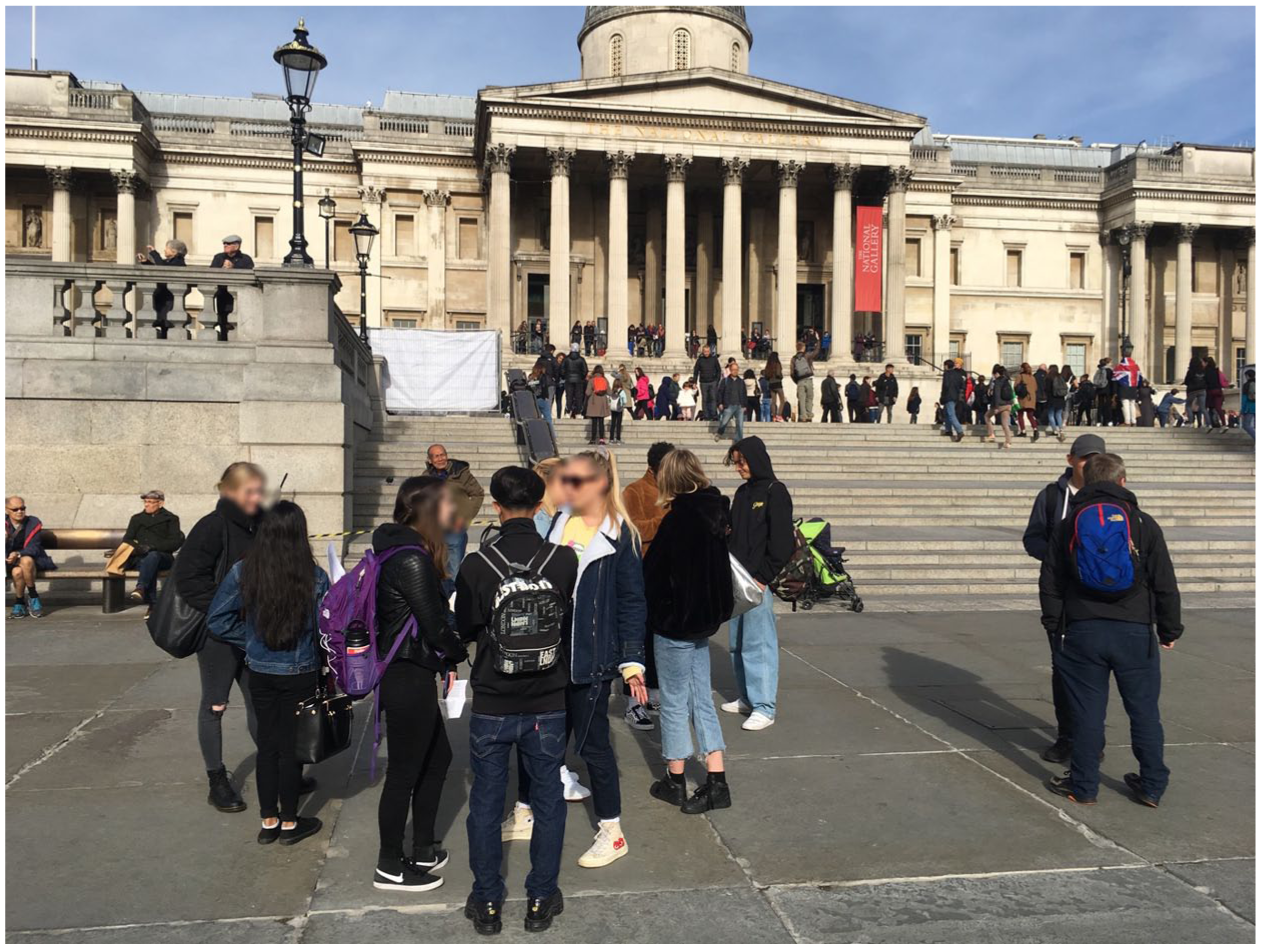
Students in Trafalgar Square, 2018.
I then give the students a quick 15-minute observation exercise to conduct in small groups.
When the students return, as the weather permits, we gather on a cluster of benches to do five minutes of timed ‘free writing’ about their observations. I find that students are usually surprised about how much they can write in this time, and it is a way of building up their confidence for the assessment where they will write their own walk. I encourage students to practice writing about these scenes first, then they can then think about threading them together in the form of a written walk. If there is time, I ask students to pair up with someone from another group and discuss their thoughts.
But at this point, my eye as leader is firmly on the clock, as I have timed the walk to coincide with the Changing of the Guard on the Mall. We march down the Mall, a ceremonial tree-lined street, to the corner of Marlborough Road, where we jostle with many other walking groups who are working with the same timing and looking for a good viewing spot (Figure 2). We witness the choreography and the pomp of the soldiers marching from Buckingham Palace to Horse Guards Parade, all brass and bearskin. I ask the students to reflect on this as a performance. How does it layer and produce space? What is it for? We talk about the choreography of Queen Elizabeth II’s funeral procession on these streets in 2022 and how the streets worked as a film set for the occasion. We also talk about ‘the queue’ to view the Queen lying in state at Westminster Hall and how performing being in the queue was a performance of Britishness and belonging (Hoerst and Vestergren, 2022).
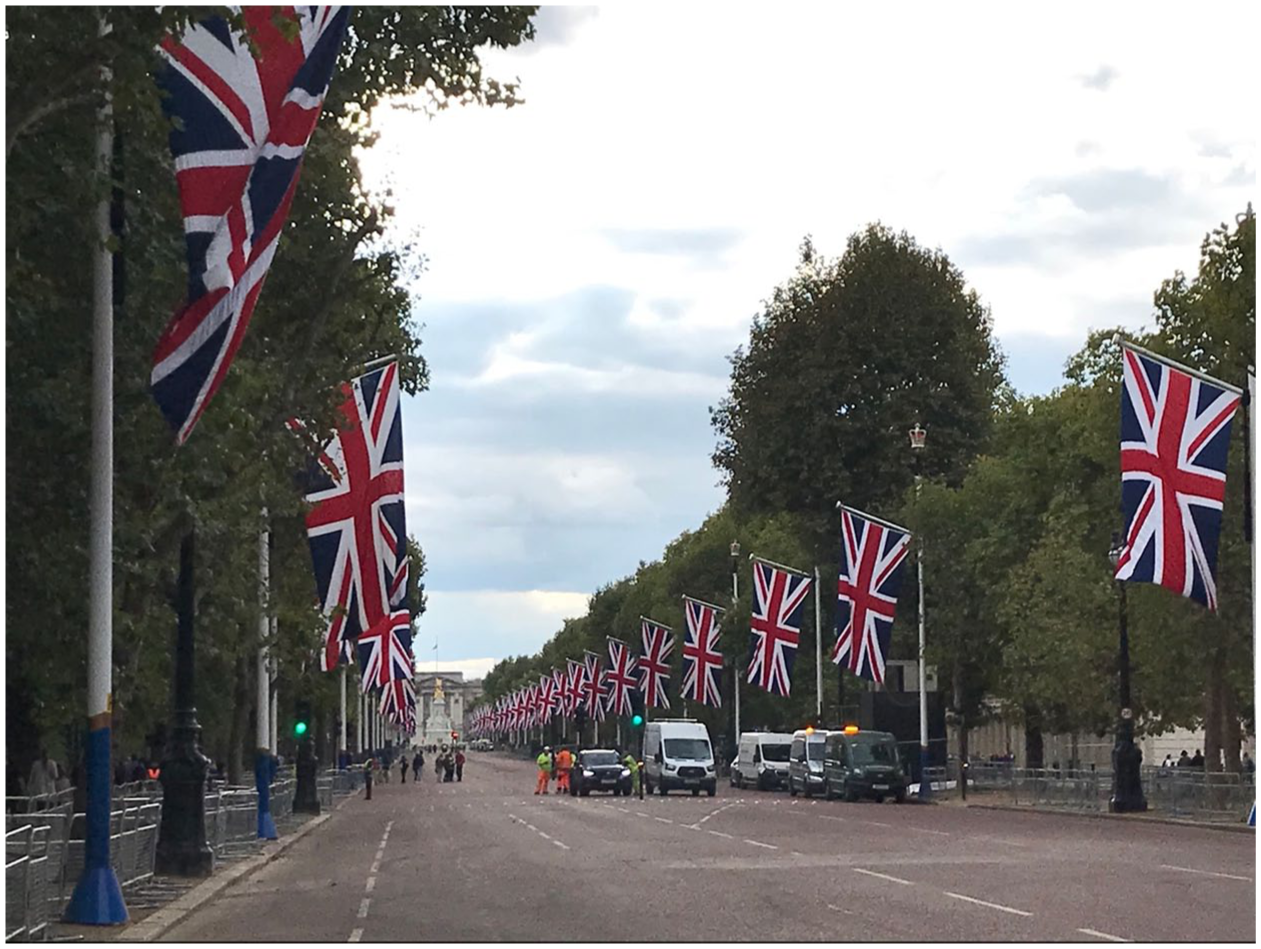
The Mall, 2022.
We then cut through the leafy and grand St James’s Park. This gives the students time to talk as we walk, the opportunity to enjoy a bit of green space and to have a break from me talking and asking them questions. They are usually very taken with the waterfowl residents, including pelicans. We come out at the exit closest to Clive Steps, where we find the Clive of India statue.
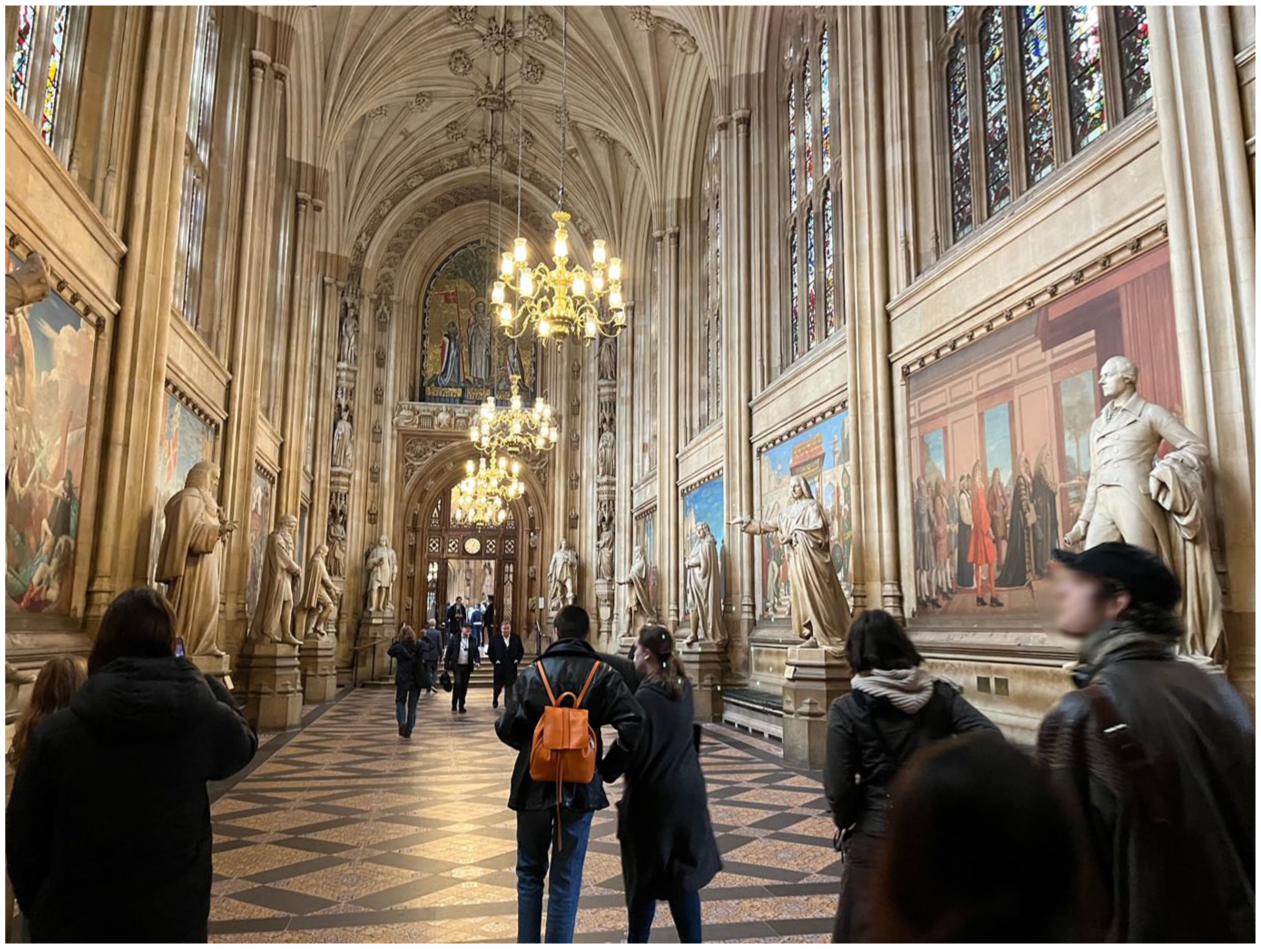
Students in the Houses of Parliament, 2024.
There have been renewed demands since 2020 to take down the statue of Clive, who, through establishing the dominance of the East India Company (EIC), laid the foundation for the British Empire in India and was also culpable in the Bengal Famine (1769–1773) (Haider, 2020). What I want to draw the students’ attention to here is the timing around the statue. Clive first arrived in India in 1744, but the statue was not erected until 1906. As Drayton (2019) argues, in the late 19th century and early 20th century, there was a boom in putting up statues of British imperialists from an earlier period. This was a time when Britain was consolidating and expanding its empire and these statues – at home and abroad – served as a display of this power. Why then, we discuss, is it so contentious to remove statues now? The students usually have a lot to say on this subject. I also introduce into this discussion Paul Gilroy’s work and suggest that we could think of this reluctance to let go of statues as stemming from what he diagnoses as a state of postcolonial melancholia, where the end of empire remains unmourned and we are cast in this perpetual, melancholic state (Gilroy, 2005a).
Handily, we are also by the Churchill War Rooms, which prompts a discussion of the continuing significance of the Second World War in the national psyche. I point out that Gilroy was writing nearly 20 years ago and how prescient this analysis was. Weaving up the steps, we pass many government departments and see the traces of red paint (fake blood) that has been daubed on the Foreign Office. Across the street a group is protesting about women’s rights in Iran.
We loop up past the Cenotaph – a key location for national rituals of memorialisation – and Downing Street, just in case we see a famous resident, and then loop back down to Parliament Square. This is an apt location for discussing protest, including that of the anti-war protestor Brian Haw, who lived for almost 10 years in a peace camp at this site. The government’s response to Haw’s protest led to The Serious Organised Crime and Police Act (SOCPA) (2005) that restricted the right to demonstrate within an exclusion zone of up to one kilometre around parliament. (Puwar, 2010). Today, just outside this zone, there is an anti-Brexit protestor booming 80s pop classics with the words changed for political purposes. I also reflect on my own experience of being kettled by police in this square during the student protest of December 2010, hemmed in with shivering school children in blazers.
The students then repeat the same observation exercise from Trafalgar Square. This square has a different rhythm, and, unlike Trafalgar Square, is somewhere they have not usually visited or thought about previously. After a second attempt at timed writing, they are usually tired and this is an opportunity to grab a snack and a break before we go into Westminster for a guided tour (pre-booked, through the local MP).
While queuing up for the airport-style security, I remind them that the guided tour we will embark on is not explicitly sociological but that they should take our discussions from the walk forward on performance, power and ‘archi-texture’. In the Great Hall, we wait for our guide. We discuss the idea of the ‘somatic norm’: who can we see here? How can you tell who is working and who is visiting? Students often reflect on how they feel in the space, ‘Even if I was dressed smartly I wouldn’t feel like I belonged here’, says one. I remind the group of a quotation from one of Puwar’s research participants (a female Labour Party MP): ‘It is such a male institution, because it is an institution built by men, shaped by men, in men’s image’ (Puwar, 2004: 77).
I then hand over to the guide, who, unlike me, has headsets for the students to listen to their amplified narration. It’s a respite for my voice and I get to enjoy being guided. We move through the different spaces of the chambers, the House of Lords or the House of Commons, depending on what is in session. Afterwards, I notice that several students decide to stay and spend more time here, getting viewing passes for the House of Commons public gallery.
Practicalities and Challenges
Leading a walk like the one above is a careful balancing act. It requires the leader to provide contextual/historical knowledge of place and keep it sociological by using a set of questions, concepts and readings for the students to think with, while also leaving space for them to contribute their own reflections on the places in dialogue with these ideas. Perhaps leaving space in the walk for these responses is the most challenging aspect. It is easy to overcram with ‘facts’ and points from the reading. But a lively teaching method requires a willingness as a leader to think on one’s feet and leave space for student reflection.
Conversely, it is necessary to prepare the students for this kind of course or session in advance – to explain what it will be like so that they can make an informed choice to take the course. A key challenge is accessibility and inclusion. While I ask about accessibility issues in advance of the course, there is an obvious issue of potential exclusion here. Extending the invitation to join to include many ways of walking, including using sticks or wheels, only goes so far as mitigation. Those who cannot walk or wheel very far would be unlikely to take this course.
While I build breaks and sitting stops into the sessions, it is still a physical way to learn and can be tiring. The physical challenges of the course became most obvious to me when I conducted it in the early days of pregnancy, when bathroom stops were imperative and digestive biscuits were discreetly nibbled. However, the flipside of the accessibility issue is that the traditional lecture format is also exclusionary for many learners. I have found that students who have struggled with more traditional teaching methods thrive on this course. Walking courses and sessions can be an exciting addition to the curriculum but should always be either an option or adaptable for these reasons of accessibility.
Another challenge is numbers. This course was always capped at 20. It would be difficult to expand the numbers for practical reasons (making oneself heard) and safety reasons. There are other ways of using collective walking in teaching for modules with larger numbers; for example, using more traditional in-person or online lectures accompanied by walking seminars with smaller groups (see https://sociologyonthemove.tumblr.com/).
The weather is a constant challenge. Wherever possible, I schedule parts of the session to move through undercover areas including shopping areas, railway stations, galleries and museums. This means that if the weather is terrible, these parts of the walk can be elongated, and others truncated. I might stretch out a writing exercise or rejig my route according to the forecast.
The biggest practical challenge for using this method in a city is finding places to stop where a sizeable group of students do not need to buy anything, especially places sheltered from the weather. London is a heavily privatised city where sitting down often comes with the price of a coffee. Places we have used to stop for discussion include parks, the British Library, Trafalgar Square, Kings Cross station, and large café areas where a couple of people buying tea is enough to claim the space for a short period. It is important for the walk leader to thoroughly research these options in advance and to think about how these challenges can be met. There is a paradox here, in that to foster the possibility of spontaneity and encounter, good planning and fallback options are key.
These are all points to consider for thinking about whether this is a teaching method transferable to other contexts. While I have outlined the challenges for teaching this course in London, there is an integrated public transport system, and it is a city where walking (from commuters to school groups to guided tourist walks) is commonplace. Therefore, the group for the most part can move around the city together without attracting unwanted or negative attention.
And then there are the world events you cannot plan for. Delivering this course was particularly difficult in the immediate aftermath of the COVID restrictions. While conversations with academic peers confirmed that a decline in student participation in general was an issue, for courses using walking, there was also a decline in confidence in navigating the city and in interacting with other students. It took a lot of prompting to get groups to speak to each other, and perhaps in this instance, the effect of leaving the classroom was more unsettling than it was liberating.
Conclusion: Collective Walking as Sociological Practice
There are many ways to use walking in teaching sociology, and in other disciplines and fields. The approach put forward here aims to use collective walking as a way of stimulating the sociological imagination of students and teachers. This is not just about illustrating a set of theories through urban examples, but using exercises of observations, writing and sharing to generate fruitful exchanges about the links between the ‘private troubles and public issues’ (Mills, 1959) of cities. The approach to walking proposed here is co-produced and feminist in moving beyond the idea of the lone walking male genius and reworking ideas of knowing through walking. This resounds with the spirit of the ‘Manifesto for Live Methods’(Back and Puwar, 2012) and with the earlier creative movements in sociology it harks back to.
Thinking with these ideas also involves considering the role that engaged and live teaching plays in the generating of new ideas and approaches in sociology. Reflecting on the writing of ‘Live Methods’ in the context of Goldsmiths’ sociology, Puwar comments: You could teach anything . . . And Michael [Keith] himself brought so much walking into it. It was part of this wider osmosis that was affecting us . . . There were multiple authorings in this process. The students were doing all this work as well that was around us as an affective intellectual ecology. (Jackson and Paton, 2025)
This recollection directly references the contribution of walking teaching to the atmosphere that ‘Live Methods’ emerged from, but more importantly and widely it points to the co-constitutive relationship between inventive teaching and research. These innovations in walking in teaching were closely bound to innovations in using walking in research (see Bates and Rhys-Taylor, 2017; O’Neill and Roberts, 2020). Engaged pedagogy can produce ideas that stimulate the leader’s sociological imagination, as well as those of the students, in ways that feed back into research.
It is also necessary to point out that using more experimental teaching methods for sociology is at risk in the contemporary UK university, where large student numbers and packing out lecture halls are the aspiration of the day (Davies, 2024). As Paton cautioned a decade ago: ‘We are submitted to the logic and language of value, measured by big data, subject to metrics . . . It affects knowledge production and how we practice the craft of sociology’ (Paton, 2015). In the UK, the development and use of live and engaged teaching methods in sociology could be another casualty of the contemporary crisis in higher education.
Footnotes
Acknowledgements
This article is dedicated to all the students and colleagues I walked and talked with at Goldsmiths between 2015 and 2024, and particularly Michael Keith, who started the walking legacy at the Centre for Urban and Community Research.
Funding
The author received no financial support for the research, authorship, and/or publication of this article.