







Abstract
Survey items that capture attitudes towards gender roles in the private and public spheres typically only measure agreement with a traditional gender role attitude. Respondents who disagree with such items may hold egalitarian views – favouring either equality or role-reversal – or may endorse pluralist beliefs. Using data from the ESS CRONOS Survey, we contrast a conventional measure of gender attitudes with an alternative version that clearly distinguishes between traditional, equality and role-reversal positions. Analysing responses to the question of whether men make better political leaders than women, we find that most respondents support gender equality, with only 15% favouring male and 10% female leadership. Notably, nearly half of the respondents classified as traditionalists based on agreement with the conventional item report equality beliefs when offered distinct egalitarian response options. These findings underscore the limitations of conventional scales in capturing the diversity of gender role attitudes.
Keywords
Introduction
Empirical measures of individual gender role attitudes and their aggregated equivalents on the societal level – gender ideology or gender equality – have a long-standing tradition in (comparative) survey research. Many of the gender role items still in use date back to the 1960s and were incorporated into large-scale cross-national surveys, such as the International Social Survey Programme (ISSP) and the European Values Study and World Value Survey (combined: Integrated Values Surveys, henceforth IVS), in the 1980s (Braun, 2008; Walter, 2018). It is therefore unsurprising that most of these items assess the agreement with traditional gender roles, focusing on women’s roles in the private sphere and men’s in the public sphere.
Gender role attitudes are rooted in the notion of separate spheres and gendered adult responsibilities. This framework assigns men primary responsibility for the public sphere, including paid employment and social and political participation, as well as control over the resources necessary to attain social status. Women, by contrast, are positioned in the private sphere, where responsibilities centre on household management, caregiving, childrearing and providing emotional support to their family, using resources allocated by the male household head (Braun, 2008; Davis and Greenstein, 2009; Paxton et al., 2021; Walter, 2018). This separation of public and private spheres legitimizes a gendered division of labour between paid (men) and unpaid (women) work and produces gendered pathways to social need satisfaction, whereby men attain status through public roles and women derive affection through domestic and care work (Steverink et al., 2011, 2020). Individuals who hold traditionalist gender role beliefs endorse this separation of spheres, whereas those with egalitarian beliefs reject it. This rejection may reflect the belief that men and women should participate equally in both public and private spheres and share responsibilities therein (equality beliefs), or the belief that these roles should be reversed (role-reversal beliefs). In addition to traditionalist and egalitarian gender role beliefs, a third position rejects the applicability of uniform norms to all members of society, emphasizing instead that individual circumstances require individualized arrangements (pluralist beliefs). This pluralist perspective primarily concerns beliefs about the division of responsibilities between men and women in the public and private domains, and applies to a lesser extent, or not at all, to beliefs about general rights and abilities.
The majority of conventional gender role items capture only the degree of agreement or disagreement with a traditional gender role attitude (see Table 1 for examples). 1 They do not, however, distinguish between support for gender equality and support for gender role-reversal: these positions are inextricably conflated within the disagreement categories. Without better options, many studies operationalize preferences for equality or role-reversal via disagreement with traditional attitudes. For instance, in their analysis of ‘The true clash of civilizations’, Inglehart and Norris (2003) capture gender equality via disagreement with statements like ‘On the whole, men make better political leaders than women do’, ‘When jobs are scarce, men should have more right to a job than women’ and ‘A university education is more important for a boy than for a girl’. The disagreement with the view that men make better political leaders has also been used as an indicator of role-reversal in the form of support for women as political leaders (Allen and Cutts, 2018) and support for women’s ability to govern (Alexander, 2012). Similarly, rejecting the idea that men should be prioritized for jobs in times of scarcity has served to capture attitudes towards women’s right to work (Kasmiarno and Susamto, 2024) and towards women’s equal rights to employment (Chai et al., 2022).
Examples of the longest-running items that were still included in the youngest waves (ISSP, 2022 and IVS, 2017–2022).
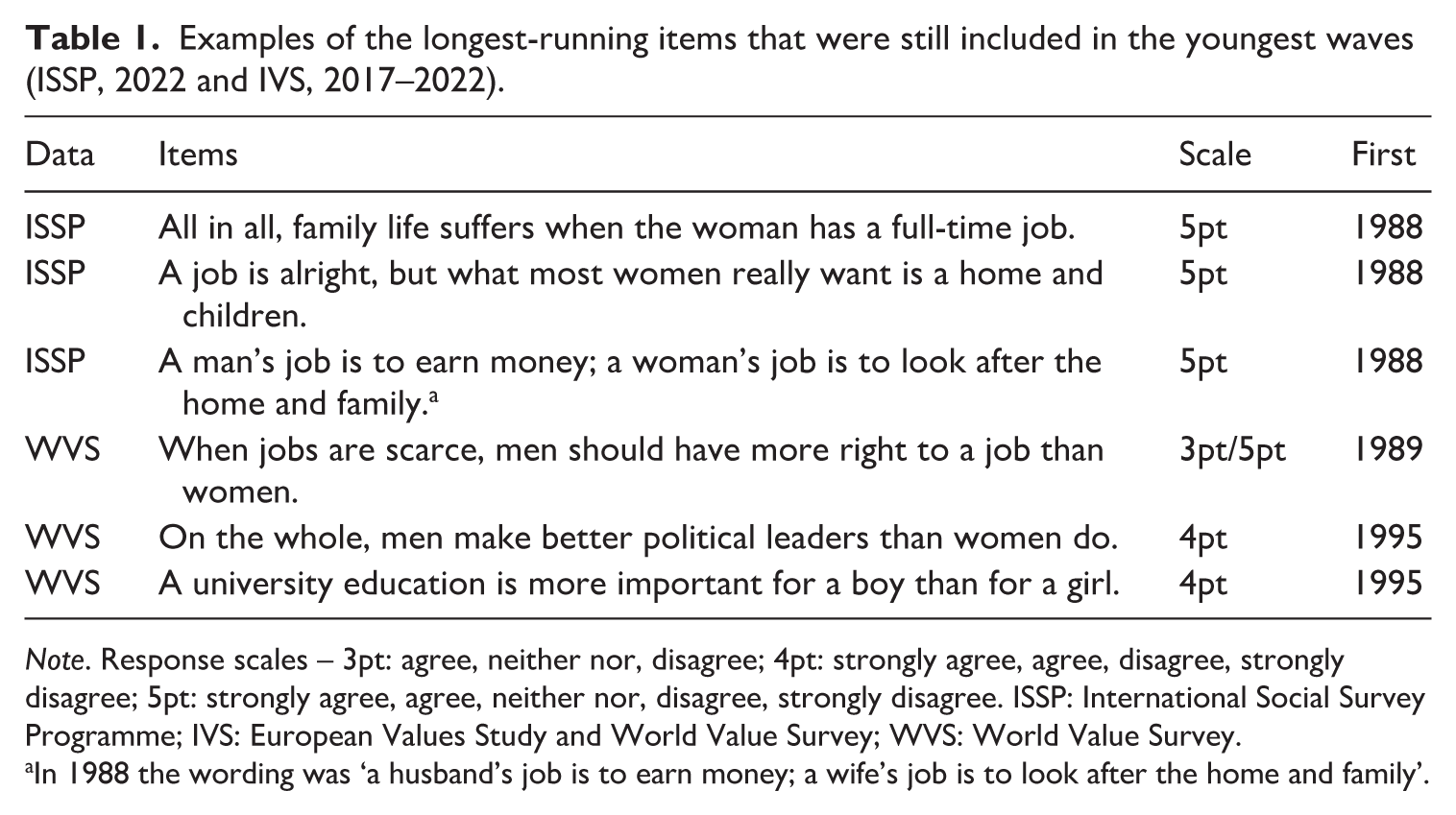
Note. Response scales – 3pt: agree, neither nor, disagree; 4pt: strongly agree, agree, disagree, strongly disagree; 5pt: strongly agree, agree, neither nor, disagree, strongly disagree. ISSP: International Social Survey Programme; IVS: European Values Study and World Value Survey; WVS: World Value Survey.
In 1988 the wording was ‘a husband’s job is to earn money; a wife’s job is to look after the home and family’.
The asymmetry between the clear meaning of agreement and the ambivalence of disagreement in these items is rarely acknowledged. Anderson et al. (2021: 971) are a notable exception in explicitly addressing the issue we investigate in this article: The question asks whether respondents agree with the statement that ‘men make better political leaders than women’. This means that the responses of ‘agree’ or ‘strongly agree’ indicate the belief that men make better leaders. However, the response categories ‘strongly disagree’ or ‘disagree’ do not clearly indicate whether respondents believe women to be better political leaders. Instead, disagreeing with the statement that men make better leaders may simply indicate that respondents see men and women as equally qualified to be leaders.
These limitations in reflecting the diversity of contemporary egalitarian views have been addressed by previous critiques (Braun, 2008; Walter, 2018). One of the major criticisms with these items relates to this lack of discrimination within the group of non-traditionalists. The way the gender role items are phrased – with a focus on traditional gender roles – provides a clear answering option for traditionalists, but not for egalitarians, who can either favour equality or role-reversal, and not for pluralists, who reject the notion of a general norm entirely (Braun, 2008). Exemplified by the statement ‘It is a man’s job to earn money and a woman’s job to look after the home and family’, this would imply the following:
Traditionalists can simply agree that it is a man’s job to earn money and a woman’s job to look after the home and family to express their views.
Egalitarians’ disagreement with this item, however, could be read as a preference for men and women to equally share in paid and unpaid work (equality) or for women to earn the money and men to look after the home and family (role-reversal).
Pluralists’ disagreement would imply rejecting the norm in general – a belief that every person and household should make up their mind individually about how (equal or unequal) to share in paid and unpaid work.
The lack of clarity causes respondents with non-traditional views to distribute themselves unsystematically across the disagreement side of the scale – from the seemingly ambivalent middle option to strong disagreement – without their position necessarily indicating how close or far they actually stand from traditional gender role attitudes (Braun, 2008). Such a violation of the monotonic ordinality assumption introduces bias both in analyses that treat these items as ordinal and in country-level aggregates based on means or medians. However, the problem goes even further. Based on data from the European Social Survey’s CROss-National Online Survey, we will show that inconsistencies between respondents’ actual beliefs and their survey responses are not confined to non-traditional views. A within-respondent comparison of answers to the conventional ‘men are better political leaders than women’ item and to a modified version with response categories that clearly distinguish between traditional, equality and role-reversal attitudes suggests substantial misclassification of respondents, with traditionalists more frequently misclassified than egalitarians. Assuming that similar misclassifications occur for other gender role items, this would imply that indices based on the prevalence of these groups, such as the Emancipative Values Index (Welzel, 2013), the Gender Equality Index (Inglehart and Norris, 2003) and the more policy-oriented Gender Social Norms Index published by the United Nations Development Programme (UNDP, 2023), are potentially skewed.
Data and measure
All subsequent analyses and illustrations are based on the CROss-National Online Survey (CRONOS 1), which was initiated by the European Social Survey (ESS) in 2016 (European Social Survey European Research Infrastructure (ESS ERIC), 2023). The panel was implemented alongside ESS Round 8 (2016/2017) in Estonia, Great Britain and Slovenia. Respondents aged 18 or older who completed the ESS face-to-face interview were invited to participate in six 20-minute online surveys over a 12-month period. To ensure inclusivity, participants without private Internet access were provided with a tablet and an Internet connection. Data collection for the first wave of CRONOS 1 took place from 1 February 2017 to 30 June 2017, wave 2 was fielded shortly after from 1 April 2017 to 1 June 2017. CRONOS 1 included conventional measures of gender role attitudes in wave 1 as well as variations of these measures in wave 2 to test measurement robustness across modes and over time, making the data uniquely suitable for the purpose of our analysis.
While previous research on the issue of ‘incomplete scales’ focused on gender roles in the private sphere (Auspurg and Düval, 2024; Braun, 2008; Walter, 2018), our concern is gender role attitudes regarding the public sphere, particularly the belief that men make (or do not make) better political leaders than women. This item differs from most of the gender role items in two ways: it is chiefly concerned with the public sphere, and thus should be less biased by stereotypical beliefs that people derive from their personal lives. 2 Further, it does not address a normative ideal of how life should be, but rather ascertains people’s beliefs about the ability of men and women to be good political leaders. People with equality and pluralist views should thus share the belief that men and women are equally qualified to be good political leaders.
In wave 1, respondents were asked to indicate the extent to which they agreed with the statement ‘On the whole, men make better political leaders than women do’ on a four-point scale from ‘Agree strongly’ to ‘Disagree strongly’ (henceforth: conventional item/scale). In wave 2, they were asked to assess the statement ‘On the whole, who would make better political leaders, [men or women]?’ using the response options ‘Men much better’, ‘Men somewhat better’, ‘Both sexes equally’, ‘Women somewhat better’, ‘Women much better’ (henceforth: alternative item/scale). 3 The panel design of CRONOS enables us to investigate how people with traditional and non-traditional views on the traditional item would answer this question when provided with traditional and multiple clearly distinct egalitarian response categories.
The political leader item is the only gender role item included in the CRONOS waves for which the question phrasing was sufficiently similar to enable a meaningful comparison among the variations. While other items shared the same comparable response scales, they did not lend themselves to comparison due to differences in framing, target groups or conceptual focus. For example, the item ‘When jobs are scarce, men have more right to a job than women’ is only comparable to a limited extent to the item ‘For whom is having a job more important, men or women?’, as the former is framed around scarcity and legal entitlement, whereas the latter concerns subjective importance. Similarly, the item ‘A university education is more important for a boy than for a girl’ differs from ‘For whom is a university education more important, men or women?’ in that it addresses children rather than adults. 4 Lastly, the item ‘A job is alright but what most women really want is a home and children’ could be compared to ‘For whom is looking after the home and children more important, men or women?’ or ‘Whose task is it to look after the home and children, men or women?’. However, the latter focus on perceived importance and responsibility, whereas the former refers to personal desire.
Results
Figure 1 illustrates how people responded to the statement that men make better political leaders than women based on the conventional scale in wave 1 (left side), and how they responded to the question ‘Who makes a better political leader, men or women?’ based on the alternative scale in wave 2 (right side).
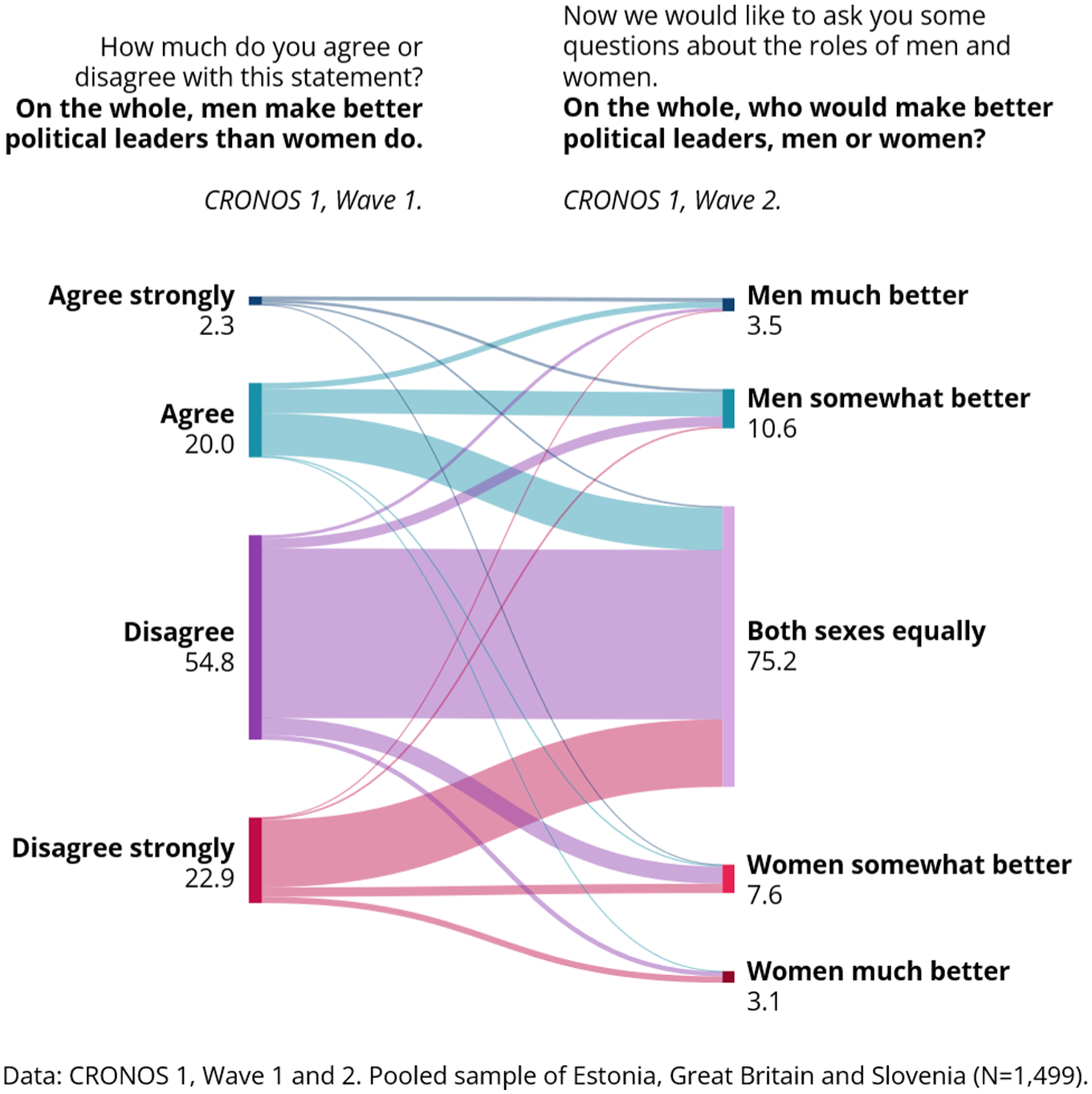
Changes in the response to the question of men’s and women’s ability for political leadership.
Three insights can be drawn from this. More than half (53%) of those who would have been classified as holding a traditional view (based on agreeing or strongly agreeing with the conventional item) report equality views on the alternative item, meaning they believe both sexes are equally qualified to be good political leaders. Among those categorized as egalitarian in the conventional item, that is, those who disagreed or strongly disagreed, most view men and women as equally qualified for political leadership, while nearly 13% believe women make better political leaders than men (role-reversal). Extreme shifts in opinion are rare: only 3% of those reporting traditional beliefs on the conventional item report a role-reversal position on the alternative item, and nearly 6% of conventional egalitarians shift to a traditionalist response on the alternative scale.
Comparing the three countries in our sample (Figure 2), we find that their ranking in terms of traditionalism remains consistent when contrasting agreement with the conventional item and the belief that men make better political leaders in the alternative item: Estonia ranks highest, followed by Slovenia and then Great Britain. However, if we shift the focus to equality, that is, the belief that both sexes are equally qualified, Estonia ranks above Slovenia, while Great Britain remains most egalitarian (or rather equalitarian). Finally, if we contrast only the groups who believe that one gender is more qualified than the other, Slovenia was the most egalitarian, whereas Estonia would again be the most traditional – with nearly six times as many respondents believing men are more qualified than women. Great Britain could then be classified as the most ‘emancipated’, with slightly more than twice as many respondents believing women are more qualified than men.
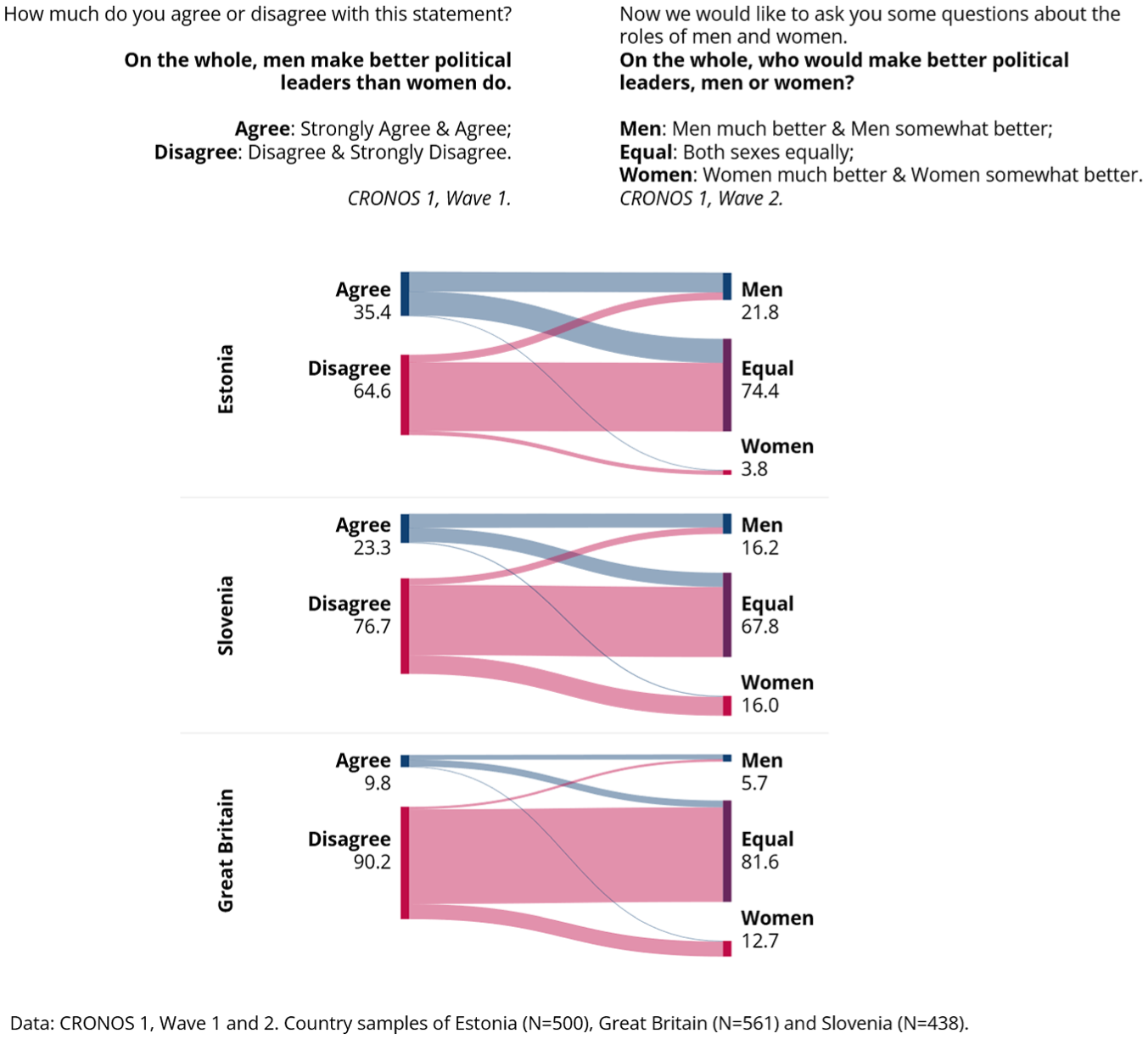
Changes in the response to the question of men’s and women’s ability for political leadership in Estonia, Slovenia and Great Britain.
Figure 3 displays the distribution of responses to the alternative item on men’s and women’s ability for political leadership, disaggregated by socio-demographic characteristics. Across all groups, equality attitudes (men and women are equally capable leaders) are the most prevalent, typically followed by traditionalist (men make better political leaders) and role-reversal attitudes (women are better political leaders). Notable group differences include: (1) traditionalist attitudes are more common among men and younger respondents aged 18–35; (2) equality attitudes are slightly more frequent among women and those aged 36–50; and (3) role-reversal attitudes are more prevalent among women and individuals aged 51 and older, and least common among men and respondents aged 36–50. The descriptive gender differences align with prior research based on the conventional item, indicating that men more frequently hold traditionalist beliefs about political leadership (Allen and Cutts, 2018; Chan and Di, 2024; Kim, 2025). While research using the conventional item typically finds that traditionalist beliefs increase with age (Chan and Di, 2024; Kim, 2025), 5 our results reveal that traditionalist beliefs (alongside role-reversal beliefs) are strongest among the youngest and oldest age groups. Whether this pattern reflects the modified question design or indicates a stalling of the long-observed trend towards greater egalitarianism among younger cohorts, or even a re-traditionalization of younger people as recent analyses suggest (Menkhoff and Wrohlich, 2025), remains an open question for future research.
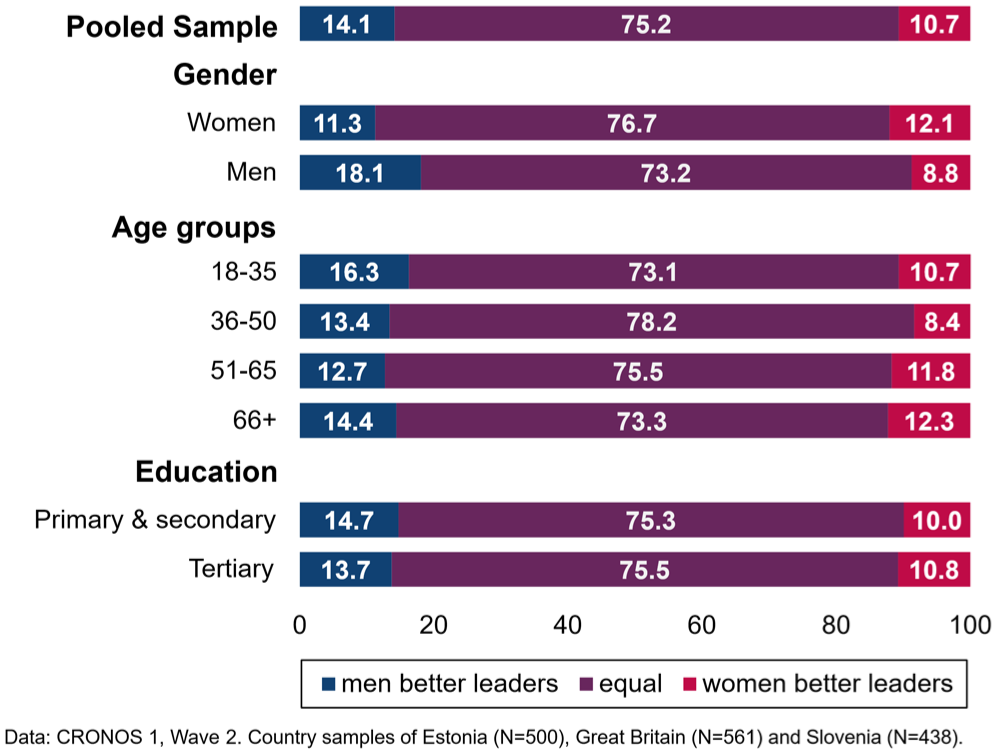
Responses to the question of men’s and women’s ability for political leadership in wave 2, by socio-demographic characteristics (in %).
Figure 4 shows the transitions in responses between the conventional and the alternative item, broken down by the same socio-demographic characteristics to identify potential systematic misclassifications in specific subpopulations. We consider respondents misclassified if they: (1) expressed agreement with the conventional item but reported equality or role-reversal attitudes on the alternative scale, or (2) disagreed with the conventional item but reported a traditionalist belief on the alternative scale.
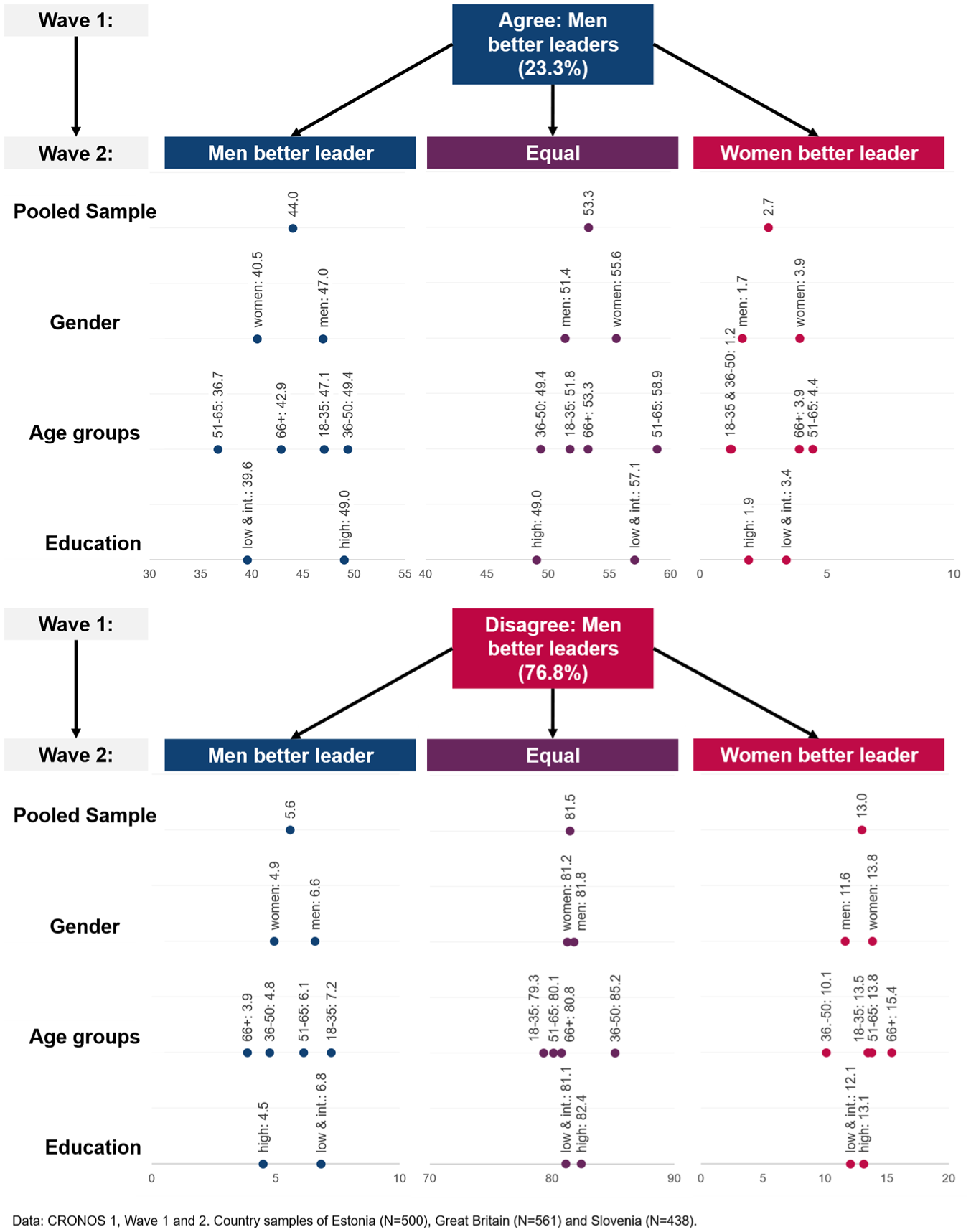
Changes in the response to the question of men’s and women’s ability for political leadership in Estonia, Slovenia and Great Britain by socio-demographic characteristics.
The key findings indicate that women are more frequently misclassified as traditionalists than men. Older individuals, particularly those aged 51–65, are more often misclassified as traditionalists than younger respondents. Those with lower educational levels are more likely to be misidentified as traditionalists than those with higher education. Misclassifications as holding egalitarian values occur far less frequently. Nonetheless, men and lower-educated individuals are somewhat more often misclassified as egalitarians. There is no clear age pattern, though the oldest group is least likely and the youngest most likely to be misclassified. Two reasons come to mind why lower educated people were more likely to be misclassified: research shows that lower education is linked to certain response styles, among them acquiescence; that is, the tendency to agree to items independent of their content, as well as a preference for midpoint responses (Meisenberg and Williams, 2008; Weijters et al., 2010). 6 Since the alternative item does not include an agreement response option, lower-educated respondents may be more likely to select the midpoint of the scale, the ‘equal’ category, in order to minimize cognitive effort, thereby shifting from the traditionalist to the egalitarian category. Alternatively, it may be the ambiguity of the conventional item that initially elicited acquiescent responding as a means of cognitive relief, whereas the unambiguous response options of the alternative item only then allowed respondents to provide answers that accurately reflect their true beliefs.
The more frequent misclassification of women as traditionalist may likewise reflect acquiescence responding, which has been shown to be more common among women than men (Meisenberg and Williams, 2008). In line with the gender affinity effect, women are more likely to support female political leaders (and men male leaders), driven by feelings of group solidarity and the expectation that greater descriptive representation of women in politics will contribute to the advancement of issues that disproportionately concern women, such as childcare and family welfare (Toshkov and Cretti, 2024). Since the conventional item does not offer response options that explicitly capture the belief that women may be better able to represent and advance women’s interests, female respondents may instead resort to an acquiescent response style. This tendency may be further amplified by the fact that, at this point in the questionnaire, respondents had already answered four gender role items in a row in which, like the present item, beliefs about gender equality or role-reversal could not be clearly expressed.
Conclusion
Using the widely employed item ‘Men make better political leaders than women’ as an example, we showed that scales centred on a single value orientation, typically the traditional one, often fail to capture the full range of respondents’ actual beliefs. Limited response options tend to conflate distinct positions such as egalitarianism and role-reversal, and thus risk systematic misclassification. Our analysis reveals that a considerable number of respondents are inaccurately categorized: many who endorse gender equality are labelled traditionalists, and vice versa. These misclassifications are not trivial. In our experimental sample, one in four Estonians (26%) were misclassified – 20% as traditionalists and 6% as egalitarians. Similar patterns emerged in Slovenia (18% misclassified: 12% as traditionalists, 6% as egalitarians) and Great Britain (8% misclassified: 6% as traditionalists, 2% as egalitarians). Within populations, misclassifications as traditionalists are particularly common among women, older respondents and those with lower and intermediate educational levels, while misclassifications as egalitarians are more common among men and people with lower and intermediate educational levels.
Although tendencies towards a re-traditionalization of gender role norms can be observed in certain societal (Menkhoff and Wrohlich, 2025) and political segments (Sauer, 2024), along with corresponding social media trends, such as the soft femininity of the stay-at-home girlfriend rooted in tradwife ideology (Sykes, 2025) and the manosphere’s ideologies of alpha and sigma male, red and black pills (Solea and Sugiura, 2023), societies as a whole in most parts of the world continue to move towards increasingly egalitarian gender role attitudes (Menkhoff and Wrohlich, 2025). This liberalization, however, comes at the cost of a steadily declining informational value of conventional gender role items. Fewer respondents express traditional views, while the meaning of egalitarian responses remains ambiguous. This issue is particularly pronounced for items focused on the public sphere. In the latest wave of the European Values Study (2017–2022), over 90% of respondents in Iceland, Norway, Denmark and Spain disagreed that men make better political leaders. More than 10 European countries exhibit similar rejection rates for the statement that men should have greater job rights when work is scarce. In 17 countries, over 90% disagree with the item stating that a university education is more important for boys than girls – exceeding 95% in 10 of them. In Iceland, these items are already near constants: fewer than 1% endorse the traditional view on education, under 2% on jobs and just over 5% on political leadership. In order to gain meaningful insight and track the development of gender role attitudes in contexts where traditional views are increasingly rare, response scales must become more precise and differentiated on the non-traditional side.
Recently surveys have started incorporating more differentiated egalitarian perspectives into their questionnaire design. In its 2012 module on Family and Changing Gender Roles, the ISSP incorporated options for respondents to choose either parent or an equality option for questions on parental leave and full-time or part-time work arrangements. The ISSP 2022 module on Family and Changing Gender Roles includes a broader range of questions allowing respondents to express both traditional and equality and role-reversal viewpoints. As regards gender roles in the public sphere, the ISSP asks, for instance, whether respondents believe that women or men are better suited to serve in certain leadership positions, namely as cabinet minister in the national government, as head of a university and as senior executive of a large company, with response options ranging from ‘Women are much better suited’ to ‘Women and men are equally suited’ and ‘Men are much better suited’. As for gender roles in the private sphere, the ISSP asks respondents to indicate who should manage certain tasks in a hypothetical family with a father and a mother raising a five-year-old child, for instance: provide for the family financially; take care of the child on a daily basis; teach the child how to behave; take time to listen to and advise the child if he/she has problems; try to be a role model for the child. Response options range from ‘The mother mostly’ to ‘Mother and father equally’ and ‘The father mostly’.
This marks an important step towards a question-response design that is inclusionary of non-traditional views. However, at least regarding the private sphere, pluralist views are still not explicitly considered and thus remain hidden within any of the response categories or the non-response option. Moreover, some of these questions may be more difficult to answer for respondents with traditional than for those with egalitarian views. For example, individuals with a traditional outlook may see teaching proper behaviour, giving advice and serving as a role model as responsibilities primarily undertaken by the same-sex parent – an option that is not available in this question battery.
While some progress has been made – particularly in questions on (childcare) responsibilities within households – most gender role items remain conceptually incomplete and asymmetrically framed. This is not just about legacy or preserving time series. Even newer items and those that lack a continuous time series frequently replicate the same asymmetrical framing. For example, when asking whether a single mother or father can raise a child as well as a married couple (ISSP, 1988, 2022), or whether a same-sex couple can do so as well as a male-female couple (ISSP, 2012, 2022), the heterosexual couple is implicitly treated as the norm. Respondents may indicate that they see no difference, but they are not given the opportunity to opine that single parents or same-sex couples might do a better job of raising children than heterosexual couples.
Based on our findings, we recommend refraining from phrasing questions and statements in a way that only allows agreement or disagreement with the (presumed) prevailing norm. Instead, question wording should offer respondents a choice between the (presumed) prevailing norm and beliefs that deviate from that norm. Accordingly, response categories should explicitly offer traditional, egalitarian and role-reversal options, as for instance implemented in the ISSP 2022. In addition, where necessary, we recommend including a response option for pluralist views in order to prevent the inflation of egalitarian and non-response categories. This recommendation is not limited to research on gender roles but is likely to be beneficial for other areas of research on attitudes and beliefs more broadly.
Moreover, some important questions are still not being asked – and thus certain attitudes and beliefs would not be captured even if response scales were improved. Two examples illustrate this:
More than 35 years after the publication of The Second Shift (Hochschild and Machung, 2012), we still ask whether children suffer when their mother works – but we do not ask whether mothers suffer when they are the sole caretakers in two-adult households, shouldering the entire mental load.
Despite growing scientific and public concern (Reeves, 2022) about the detrimental effects of absent fathers – especially, though not exclusively, on boys’ development and well-being – surveys continue to focus on the harm caused by the absent mother. Instead, we should be asking whether family life, and especially young children, might suffer when fathers work full-time and are largely absent from their families.
It should be noted that our analysis is limited to three countries, which, despite their heterogeneity, cannot be considered representative of Europe as a whole, let alone of countries worldwide. For now, our findings highlight the need for researchers to critically reflect on what these survey items can and cannot measure. Future research should prioritize the development of improved scales that distinguish between traditional, egalitarian, role-reversal and, if appropriate, pluralist attitudes. This will help prevent misclassification and enable more reliable analyses of the state of gender beliefs and their shifts over time.
Footnotes

Funding
The authors received no financial support for the research, authorship and/or publication of this article.
Declaration of conflicting interests
The authors declared no potential conflicts of interest with respect to the research, authorship and/or publication of this article.