







Abstract
Educational systems considerably influence educational opportunities and the resulting social inequalities. Contrasting institutional regulations of both structures and contents, the authors present a typology of educational system types in Germany to analyze their effects on social inequality in eastern Germany after unification. After 1990, the comprehensive secondary school was replaced by three types of differentiated secondary schooling. In this unique field experiment of model transfer and institutional change in a federal country, reforms in these state educational systems—all originally of a uniform socialist type—led to participation rates rising to western enrollment levels, yet with substantial state-level differences. These are attributable to the divergence of educational systems reformed according to contrasting western German models. These types substantially and differentially generate intergenerational inequalities. The authors chart the sharp and significant effects of education policy reforms and societal transformation following German unification.
Keywords
Educational systems generate and reproduce social inequalities. Numerous internationally comparative studies demonstrate that educational systems, varying across space and time, result in contrasting levels of student enrolment, achievement, and attainment (e.g., Shavit and Blossfeld 1993; Baker and LeTendre 2005). Such studies typically compare the outputs produced by school systems, often measured in school performance or educational attainment. These comparisons are important for educational research and policy making. Too often, insufficient attention is paid to the changing contexts in which these outputs are created. In particular the institutional arrangements of educational systems are highly relevant for educational and social stratification processes within societies (e.g., Meyer 1977; Kerckhoff 1995; van der Werfhorst and Mijs 2010). The relevance of long-standing national traditions in educational institutions persists even in an era of globalization (Mayer 2001).
At the same time, differences abound within federal countries, such as the United States and Germany, requiring explanations below the nation-state level (see Freitag and Schlicht 2009). Especially in federal countries with internal differentiation, typologies offer a useful tool to understand patterns of institutional development, especially in periods of political and social transformation. German unification after 1989 provides a unique occasion to investigate the effects that reforms of educational institutions have on educational opportunities and their impact on social inequality. The transformation of eastern Germany resulted in a developmental “field experiment” (see Humphreys and Weinstein 2009).
After the fall of the Berlin Wall, the preunification standardized and uniform national educational system of the German Democratic Republic (GDR), in particular comprehensive secondary schooling, was replaced with contrasting state (Länder) educational systems, on the basis of various models developed in the Federal Republic of Germany (FRG) during the post–World War II period. Thus, a standardized plot in the former GDR was seeded with different types of institutional arrangements borrowed from the FRG, providing opportunities to observe how differential outcomes result from divergent institutional change. Analyzing the consequences of this field experiment in postunification Germany from 1990 to 1997, we show that differing educational institutions have extensive impact on the distribution of educational opportunities and, consequently, on educational and social stratification. In so doing, we contribute to the literature on such education reform processes, such as Sweden’s comprehensive school reform from the late 1940s onward (Erikson and Jonsson 1996; Leschinsky and Mayer 1999; Meghir and Palme 2005), Finland’s implementation of comprehensive secondary schooling from 1972 to 1977 (Pekkarinen, Uusitalo, and Kerr 2009), and Scotland’s reduction of curricular differentiation in the 1980s (Gamoran 1996). Yet unlike these shifts to comprehensive schooling and decreasing differentiation, the German experiment analyzed here includes several models of stratified secondary schooling, based on existing Western systems, that involved increasing differentiation. These models, interpreted and adapted, were transfered from western to eastern Germany in the early 1990s in a phase of transformative change.
The educational differences accounted for here are variations in educational opportunities—measured by participation rates—among youth in five Länder of eastern Germany (with the exception of Berlin) in the seven years following unification. As elsewhere, participation rates both in different school forms and in different tracks within comprehensive schools are decisive in causing achievement and attainment inequalities (van der Werfhorst and Mijs 2010). Germany’s contemporary general educational system is among the most stratified in Europe (Organisation for Economic Co-operation and Development [OECD] 2011). General means nonvocational education that is available to everyone; however, a large proportion of students are channeled into apprenticeship training or prevocational training programs (Solga 2008). Thus, school participation among 16- to 19-year-old youth is closely related to whether students are enrolled in low, intermediate, or high forms of secondary schooling (traditionally called Hauptschule, Realschule, or Gymnasium) or in stratified tracks within comprehensive schools (Gesamtschulen) (see OECD 2011 for an overview). These tracks end after grades 9, 10, or 12/13, respectively. Each school form or track, in turn, provides students with the credentials needed to qualify for progressively more prestigious educational pathways and remunerative employment opportunities. Given Germany’s tight linkage between attained occupational qualifications and employment (Kerckhoff 2001), individuals without such credentials face challenging transitions and labor market marginality (Allmendinger 1989; Solga 2008). Consequently, focusing on differential participation rates in stratified organizational forms of secondary schooling is particularly relevant in Germany.
In this longitudinal analysis, we examine the effects of the postunification introduction of different educational models based on western Germany’s institutionalized state systems. What effects did the institutionalization of these contrasting types of educational system have on educational participation of different groups? To demonstrate how differing educational institutional arrangements account for varied student participation rates, our argument proceeds in four steps. First, we present a typology of educational systems, organized around the institutional regulation of school structures and curricular contents. Second, we allocate the Länder educational systems in eastern Germany within this typology. Third, we hypothesize which institutional configurations should have stronger or weaker influences on educational opportunities. Finally, we discuss these types of reformed educational systems as they generate inequalities differentially.
To contextualize the analysis, the next section outlines the German situation of a divided nation, beginning with an overview of schooling. Next, we identify educational reforms in western Germany undertaken since the 1960s and their inequality-generating effects. The alternative, comprehensive school approach taken in the GDR is detailed, emphasizing its consequences for educational participation there. Then, we examine the field experiment of societal transformation—the unification of Germany—that led to the transfer of a range of educational models from western to eastern German Länder and their divergent institutionalization.
Reforms of Educational Systems in the Germanies
Stratified Educational Systems in Germany
The traditional German educational systems reproduced existing educational and social stratification, depending on their Länder-specific design, as we demonstrate below. In the early 1990s, these regionally variant systems served as models for the new eastern states’ “new” postsocialist educational systems. Traditionally, students are divided into different types of secondary schools, after only four to six years of primary schooling. Starting at the bottom in terms of expectations and curricular difficulty, these secondary school forms mainly comprise the Hauptschule, the Realschule, and the Gymnasium. Whereas the Hauptschule has now been eliminated in some states, the other school forms have considerably expanded everywhere. Germany’s educational systems are even further differentiated when considering rising rates of segregated special schooling, despite inclusive education reforms (Powell 2009), and comprehensive schools (Gesamtschulen) in most of which several tracks are offered in one school building (Leschinsky and Mayer 1999).
The nonselective Hauptschule’s short five-year program has the lowest status and provides the fewest career opportunities. On leaving school, some Hauptschule graduates may find an apprenticeship leading to blue-collar positions, while less successful others participate in a range of vocational preparatory courses. Traditionally, the majority of Germans were enrolled in the Hauptschule, but this has changed completely with education expansion (Baker et al. 1985:216). As do the special schools, the Hauptschule enrolls students of lower status, ability, previous performance, and aspirations; most belong to disadvantaged groups, including those from migrant backgrounds or whose parents are poorly qualified and unemployed or holding insecure jobs (Solga 2008; Powell 2009).
In contrast, the Realschule leads to a certificate intended to enable entry into white-collar apprenticeships, business, and/or skilled trade apprenticeships; it has become the de facto minimum standard school-leaving degree for most occupations. A few years shorter than the Gymnasium, the Realschule program is nonetheless quite rigorous. In some states, this qualification provides access to programs that, eventually, lead to university admission; however, permeability between vocational training and higher education remains quite limited, especially for those who did not attend the highest secondary school form (Powell and Solga 2011). The Gymnasium leads to the degree required for university entrance (Abitur) after 12 or 13 years of schooling. It was and is a selective and demanding school form—and remains the preferred pathway leading to studies in classic professions such as medicine, law, and teaching.
Conflicts about education reforms have been intense, not just since the OECD–Program for International Student Assessment (PISA) studies emphasized that the tested performance of 15-year-olds in Germany’s schools was middling overall, albeit with tremendous state variation (Deutsches PISA-Konsortium 2002; OECD 2011). From the 1960s, debates about educational (in)equalities resulted in school reforms in West Germany, including the (only partially successful) establishment of the comprehensive Gesamtschule (Leschinsky and Mayer 1999). Attempts were made to overcome the stark disadvantages suffered by girls and youth with working-class, Catholic, or rural backgrounds (Peisert 1967); later, special educational needs and ethnic disadvantage became areas of widespread concern. Numerous reforms have been implemented but unevenly distributed across the Länder, given that German federalism resolutely assigns responsibility for schooling to the states (Oswald, Baker, and Stevenson 1988; Freitag and Schlicht 2009). In spite of myriad reforms, since unification around a third of German pupils leaves school before or at age 16 (Destatis 2012). In contrast to many other developed democracies, the proportion of each cohort attending college has been limited by institutional barriers to higher education expansion, such as stratified secondary schooling and the attractive vocational training system (Powell and Solga 2011).
The effects of educational reforms on educational and social inequality in western Germany over the decades continue to be debated. Some researchers conclude that disparities have remained stable and that expansion actually facilitated the persistence of differential educational opportunities (Blossfeld 1993). Others find that, with enormous educational expansion and changing occupational structures (Köhler 1992; Erikson and Jonsson 1996), there are increased opportunities for formerly disadvantaged social groups. The cleavage remains between those continuing to Abitur level and others, most of whom attend school for 10 years (Müller and Haun 1994; Henz and Maas 1995; Schimpl-Neimanns 2000). This has led to extreme disadvantage and stigmatization of those who are below that level (Solga 2008). Thus, while disparities in educational opportunities remain a complicated matter, persisting inequality and prevalent disadvantage are undisputed. Indeed, although Germany has long been among the most influential educational models worldwide (see Phillips 2011) by providing free public education, in developing the modern research university (and the Gymnasium to prepare its students), and in fostering the “dual system” of school and workplace-based vocational training (Powell, Bernhard, and Graf 2012), it is simultaneously one of the countries in Europe with the highest levels of reproduction of educational and social inequalities (OECD 2011).
The Special Case of Eastern Germany as a Former Socialist Country
The original educational systems of eastern Germany exhibited very little variation by region in educational participation rates of 16- to 19-year-olds. Using 1981 as the baseline, and for comparative purposes calculating these rates by what would become states after unification, we find similar participation rates across the regions (Müller-Hartmann and Henneberger 1995); the rates for East Germany (around 21 percent) are roughly half that for West Germany (around 38 percent) (see Figure 1).
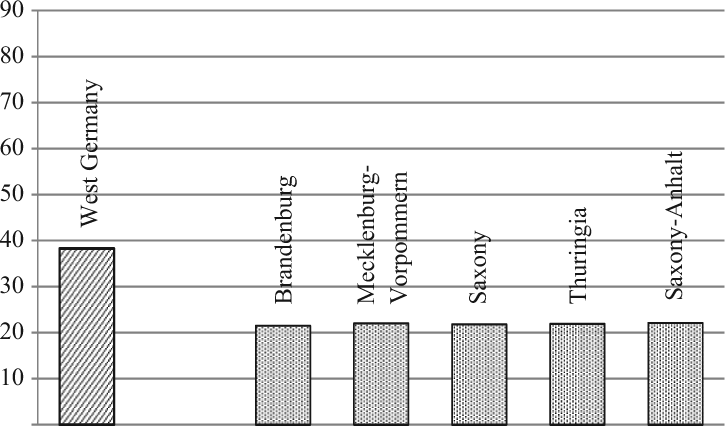
Participation in general education of 16- to 19-year-olds in the German Democratic Republic (1981) and the Federal Republic of Germany (1982), in percentages.
After unification, various institutional arrangements in western Germany were adopted in eastern Germany, only slightly modified. The eastern Länder had partner states in western Germany, facilitating transfer. This is notable because before unification, the GDR had a typical socialist educational system, introduced under Soviet influence: a uniform, public, secular, free system—supposedly without differences with respect to gender, denomination, or region (Fischer 1992). The GDR provided a general school from 1st to 10th grade for everyone. Thereafter, strong selection processes, based on academic merit, social background, and party allegiance (Geißler 1983), resulted in only about 10 percent of youth attaining the level (Abitur) required for university entrance directly, and another 5 percent transferring after vocational training (Baske 1990; Fischer 1992). Selection mechanisms in the GDR increasingly reproduced existing social stratification (Solga 1995) also found in other socialist countries (Rijken 1999; Gerber 2000). However, with respect to this analysis—educational participation in different regions—the GDR’s educational system produced exceptional equality. This equality provides the baseline for the empirical tests, reported here, of the field experiment of postunification effects following introduction of contrasting western German schooling models. How did the transferred educational system types influence educational opportunity across the new states of unified Germany? What differential impacts did these models, once institutionalized, have? Before turning to our analysis, we present a typology of Germany’s educational systems to understand their variance.
A Typology of Educational Systems in the Germanies
Germany has extensively stratified educational systems (Allmendinger 1989; Kerckhoff 2001; Buchmann and Dalton 2002; Pfeffer 2008). However, within Germany considerable differences exist between the Länder, due especially to states’ authority over education. This enables comparison of highly stratified and less stratified institutionalized educational systems within one national context.
Previous accounts of variation utilized various ad hoc classifications, which typically included correlations with the ideology of parties governing the respective states, classification by educational outputs, or regional status (Köhler 1992; Schnitzer et al. 1998). Although these regional typologies are beneficial, they share shortcomings with classic international comparative studies (see Turner 1960; Hopper 1967). Both international and intranational investigations lack a theoretically informed typology that captures the wealth of pertinent differences found in Germany’s educational systems.
The typology developed here overcomes such deficiency by focusing on institutional differences between state educational systems at the primary and secondary levels, linking these institutional dimensions to sociological theory and demonstrating how the institutional types in the property space account for different educational outputs produced by the various systems. This typology accounts for differences in educational participation rates based on both structural and content dimensions. Each dimension—the degree of institutional regulation of (1) school structures and (2) educational contents (curricula) taught and the way it is controlled—has demonstrated utility in studies of school tracking (e.g., Gamoran and Mare 1989; Lucas 2001; Lucas and Berends 2002) and curricula (e.g., Benavot et al. 1991; Stevenson and Baker 1991; Gamoran 1996).
The structure dimension refers to the timepoint at which students are distributed to different levels of secondary schooling (after fourth or sixth grade or in mixed forms), what kinds of secondary schooling are available (comprehensive, strictly divided between three school forms, or hybrid forms), and how easy or difficult it is to enter these forms or to switch between them (permeability).
The content dimension refers to what kinds of educational contents are taught. Curricula may emphasize subjects that encourage reflection about oneself and others, such as psychology, and include aspects about the modern world and work life or vocational training. Alternatively, curricula may emphasize classic subjects and the canon that follows traditional humanist ideas. The subdimension control of educational contents refers to how strictly regulated these contents are; how much influence parents, teachers, and students have on what is taught and how; and whether there are centralized final exams in a state (resulting in very tight control of contents) (see Stevenson and Baker 1991).
Assessing Germany’s educational systems, we identified 20 indicators to characterize these structural and content dimensions (see Table A1 in the appendix). The degree of institutional regulation/control on each of these indicators was assessed using the sociological dimension of structural tightness/looseness. Coser (1974) framed this dimension in terms of how “greedy” institutions are to reduce autonomy and exert collective control. Since that initial formulation, the structural tightness/looseness dimensions have been refined and applied to account for differences in a variety of outcomes. Data on the institutional regulation of these indicators were gained by analyzing state laws, rules, regulations, and curricula for the various aspects of schooling in each Land.
Cross-classifying these two dimensions results in a property space containing four types of systems (see Table 1). A tight outcome in the structure dimension refers to the fact that there is a traditional three-tier school system, whereas a loose outcome stands for more permeable structures, including the presence of comprehensive schools and reforms enabling transitions between school forms. In the educational contents dimension, “tight” refers to the fact that there is an emphasis on classic humanist contents that are tightly controlled; this is a conservative outcome. Loose regulation of the educational contents symbolizes more modern contents and more authority for individual teachers and less central control, a liberal approach. The intersection of these dimensions of institutionalized regulation results in the four system types, of which we find three in eastern Germany.
Property Space for Educational Systems along the Dimensions of Institutional Regulation of Contents and Structures, with Länder (1997).
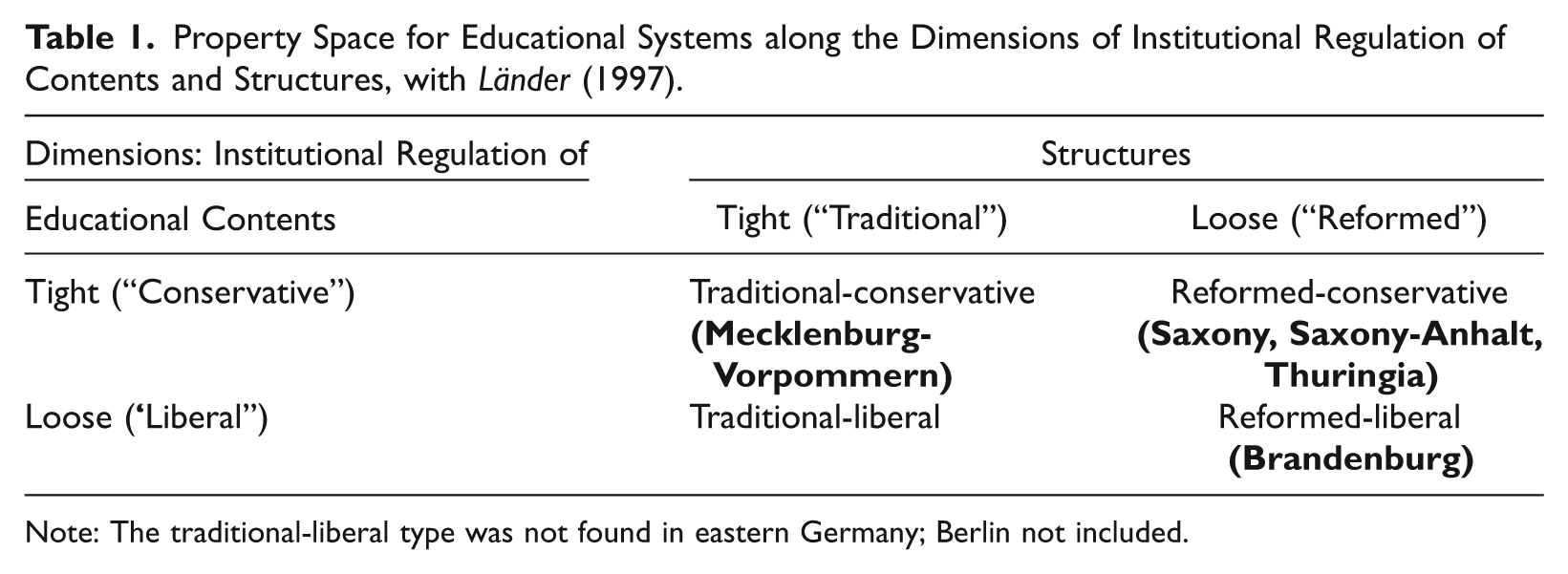
Note: The traditional-liberal type was not found in eastern Germany; Berlin not included.
Eastern Germany’s Educational Systems in 1997
All four of these types of educational systems currently exist in Germany; these procedures and categories can be equally applied to western Germany (see Below 2002:28–34). For the eastern German states, three of the four possible types of educational systems existed in 1997 (reforms thereafter changed the distribution once again). The fourth, the traditional-liberal type, existed only in western Germany, in which the structure is tracked with looser control of contents and more modern curricula. In Mecklenburg-Vorpommern, the structures of the educational system were traditional, with ability tracking of the students after fourth grade into three different school forms; the educational contents were tightly controlled and conformed to a conservative canon. In neighboring Brandenburg, we find the opposite in both aspects: a reformed educational system with grade school lasting until the end of sixth grade and comprehensive schools with an increasingly relevant secondary school form; curricula with a stronger emphasis on modern, reflexive aspects and very little centralized control. Additionally, in this Land, the duration of schooling leading to the Abitur was longer. Saxony, Saxony-Anhalt, and Thuringia were mixed types that lay in between these tight and loose extremes. In these states, school structures were more reformed, with combined secondary schools for two of the three tracks and final designation to those only after sixth grade. Contents, however, were more conservative and tightly controlled.
These types form the basis for the following hypotheses and empirical analyses.
Linking Educational System Types to Educational Opportunities: Hypotheses
Fundamentally, different degrees of institutional regulation of structure and content in the educational systems have contrasting implications for various roles experienced by students and other actors in the educational system (Coser 1974; Boldt and Roberts 1979; for further elaboration, see Below 2002:chap. 2; Below and Roberts 2006). These role expectations and experiences, in turn, have important implications for inequalities in educational participation, achievement, and attainment. To test these theoretical implications, the different educational systems in eastern Germany are compared with respect to the level of participation by 16- to 19-year-olds in the general school system and the strength of social and gender inequalities within and between the system types.
Western Germany’s educational systems have been and remain tightly structured with a strict selection after fourth grade and stratified secondary school forms. The curricula reproduced the classic humanist contents, under strict control, and led to very unequal educational opportunities—reproducing the existing social structure. This was the situation when debates on educational opportunities and reforms began in the 1960s; in a few western Länder, particularly Bavaria, it still is. Thus, we argue that an educational system that is tightly regulated both in structure and contents leads to greater inequality in educational opportunities. Accordingly, we expect that in tight school systems groups that have historically been affected by social selection and are thus underrepresented (blue-collar workers’ offspring, children of less educated parents or in rural areas, and in the case of eastern Germany, boys) will remain underrepresented.
A reformed-liberal system, on the other hand, should yield less replication of social stratification. Its looser regulation of structures, softer transitions, and combined school forms should be more forgiving. Contents that reflect the real world and working life and that can be adjusted according to students’ and teachers’ needs should facilitate the participation of youth from diverse backgrounds. Thus, in reformed-liberal systems, we would expect higher participation rates overall and less inequality, meaning higher participation rates even among individuals from social groups that traditionally drop out.
Länder with hybrid educational systems—tightly regulated in one aspect and loosely regulated in another—are expected to produce participation rates in between; also, opportunities for usually disadvantaged groups should be higher than in tightly structured and lower than in loosely structured educational systems. We test these hypotheses below.
Analyses
The data used to test the hypotheses about the effects of school types on educational participation derive from the German 1997 microcensus. Because in the former GDR socialist regime the regions that were later to become the eastern German Länder had remarkably similar participation rates (see Figure 1), these provide a baseline against which the effects of the varying educational systems implemented after 1990 can be assessed. The 1997 microcensus, a 70 percent subfile of a 1 percent sample of the German population, is ideal because the data were collected long enough after 1990 for the different institutionalized models to produce effects. After 1997, considerable further reforms changed educational systems again; thus, 1997 is the latest timepoint to analyze initial postunification reforms under the original field experiment conditions.
The relevant 16- to 19-year-old German youth in the eastern German states were extracted from the 1997 microcensus, yielding 4,741 cases for analysis. The age group of 16- to 19-year-olds is the relevant one for this analysis since mandatory schooling requires 9 or 10 years of participation after entry at age 6. (None of the 16- to 19-year-olds in this sample had been allocated to tracked secondary schooling prior to the transition.) Any state variations in school participation rates within the 16- to 19-year-old category are related to student choice and their means and aspirations. Of course, of high relevance here, selection mechanisms are also crucial since students in this age group normally attend only the highest school form, leading to Abitur and thus university entrance, while those attending lower tracks have already exited the general school system. The microcensus comprises a wide range of relevant conditional variables for analysis, including social background: the head of the family, his or her occupational status and level of general and vocational education, the student’s gender, community size, and the state in which the student lives (see the list of variables in endnotes). 1 We use this database to test the hypotheses regarding the effects of institutional configurations on educational participation.
Findings
In the longitudinal analysis, we compare differences across eastern Germany with the historical baseline situation (1981) of practically no differences in participation rates among the GDR’s regional educational systems, which reveals two major findings. This selection of findings is divided into educational system and individual levels. Contrasting educational participation in Figure 2 emphasizes the divergence in rates for 16- to 19-year-olds in the eastern German Länder and the western German mean.
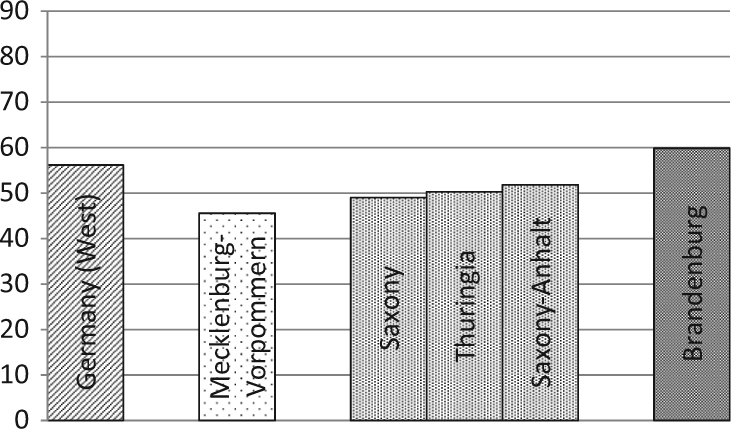
Participation in general education of 16- to 19-year-olds in eastern German Länder and western Germany (1997), in percentages.
First, overall levels of participation rose considerably since the GDR’s legal restrictions on educational attainment no longer applied. When the artificial cap on educational participation in higher secondary schooling was lifted, education expanded and began to catch up to western levels, with the most liberalized system even surpassing the western German mean. The core proposition—that institutional arrangements cause educational (in)equalities—is vividly demonstrated. Second, the implemented educational models and resulting divergent institutionalization of educational system types produced remarkable differences in participation rates in less than a decade.
As other researchers have found, expansion and heightened stratification are not mutually exclusive (see, e.g., Shavit and Blossfeld 1993). As participation rates rose to western levels, expansion was highest in the reformed-liberal type (least rigid structure and content) and lowest in the traditional-conservative one (more rigid with regard to both content and structure), with the reformed-conservative one in between. The differential impact of educational system type on educational participation rates reflects our expectations (see Table 2). The findings indicate that considerable changes in participation rates took place in eastern Germany within a very short period of time, as the new school systems were installed in 1991/1992 and 1992/1993 (see Below 1999, 2000). Similar results were found for western Germany, which also exhibits strong variations between educational system types.
Participation in General Education of 16- to 19-year-olds in the Eastern German States, by Father’s General Educational Level and Sex, 1997 in percentages.
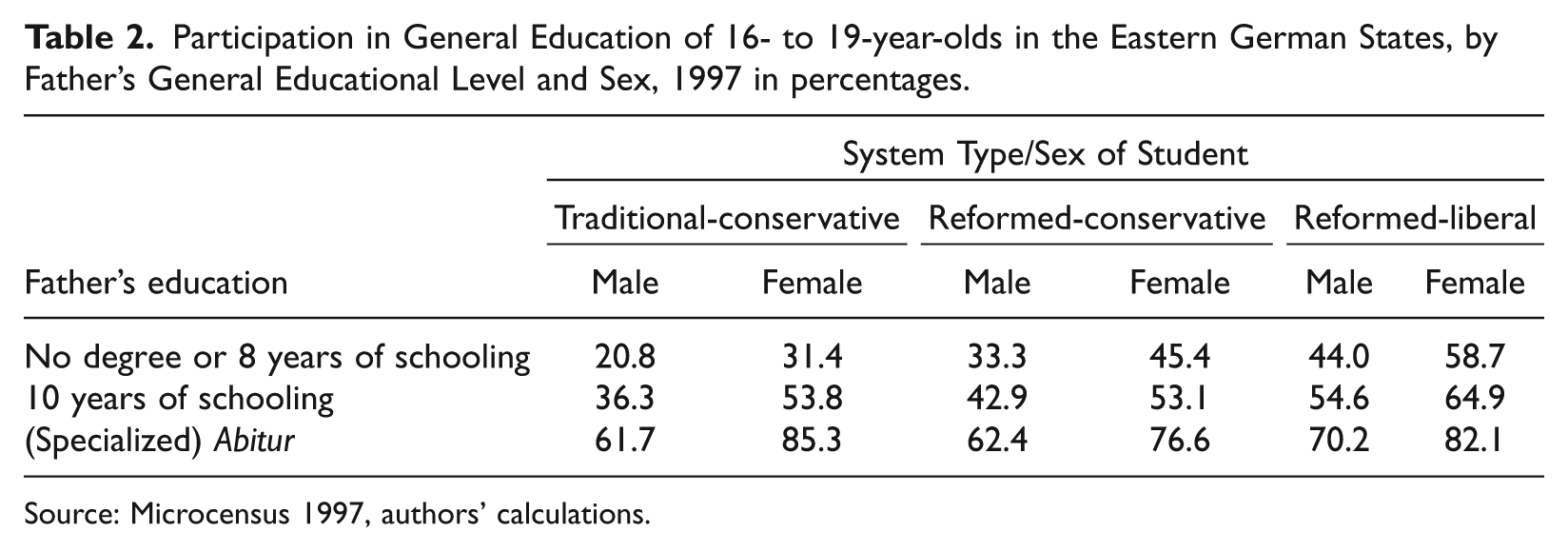
Source: Microcensus 1997, authors’ calculations.
Examining how the institutional effects on educational participation are related to the father’s educational level and student’s gender, on the individual level, Table 2 reveals an important interaction with social background: While children of highly qualified fathers do not differ greatly in their participation in general education between the educational system types, the differences for those with lower qualified fathers are quite striking. Among children of fathers with lower educational attainment, the probability of remaining in the general educational system after the mandatory schooling period is low (21 percent for males and 31 percent for females) in the traditional-conservative system. In contrast, the reformed-liberal system is about twice as high (44 percent and 59 percent), although certainly not equal for children of highly qualified fathers. Whereas the state-provided educational system has little effect on the extended participation in general education of children of highly qualified parents, it considerably affects the children of less educated parents. A more sophisticated investigation using log-linear regression of the influence of the social background on participation in education on the individual level confirms these findings (see Table 3). 2
Explaining Participation in Education of 16- to 19-year-olds in the Eastern German States, 1997: Parameter Estimates (log-odds) of the Logistic Regression Models.
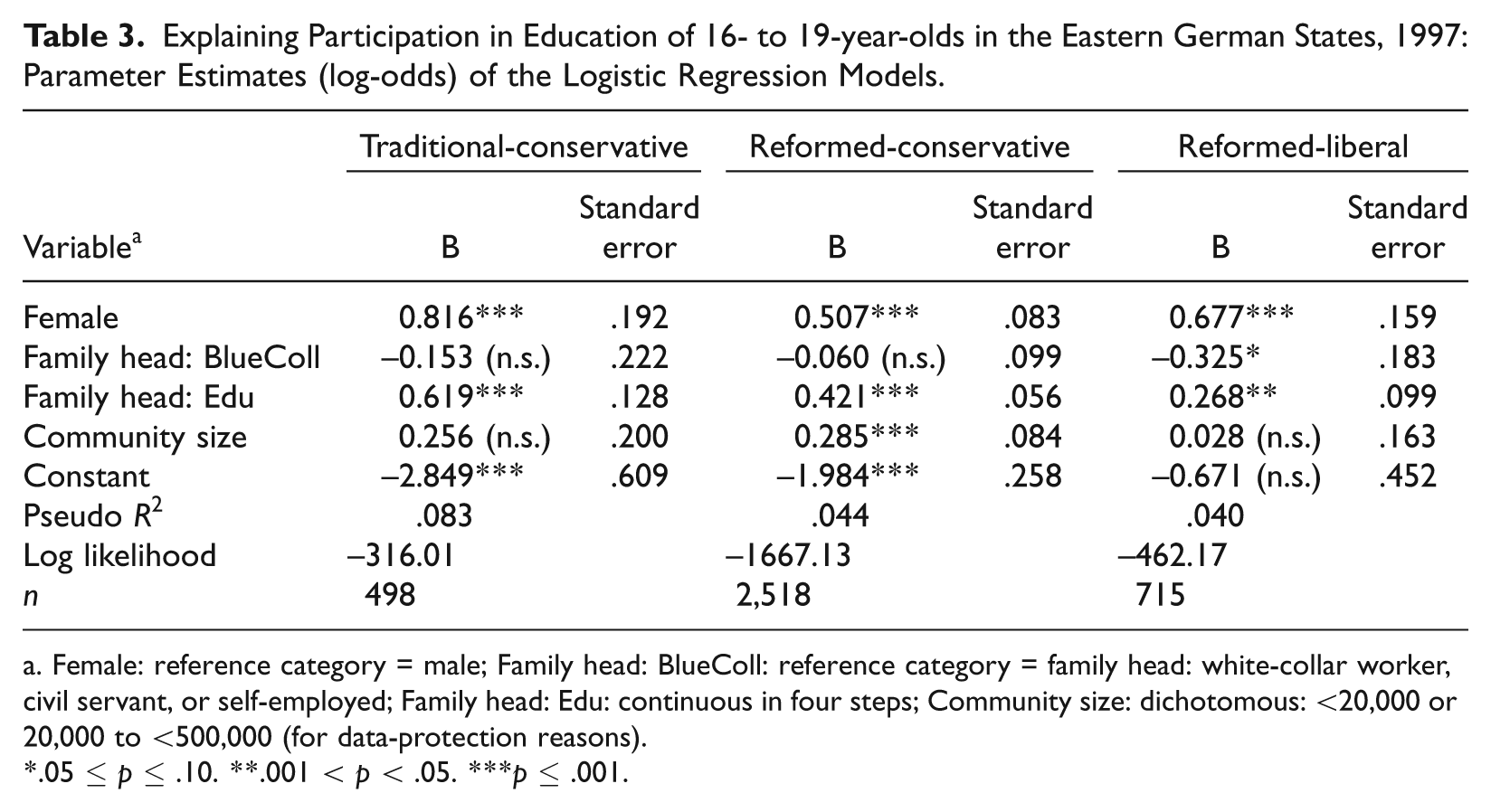
Female: reference category = male; Family head: BlueColl: reference category = family head: white-collar worker, civil servant, or self-employed; Family head: Edu: continuous in four steps; Community size: dichotomous: <20,000 or 20,000 to <500,000 (for data-protection reasons).
.05 ≤ p ≤ .10. **.001 < p < .05. ***p ≤ .001.
The analysis in Table 3 uses the types of educational systems as separate entities. Thus, the influence of the independent variables can be assessed within the different systems. The table, giving logits (the natural logarithm of the quotient of a probability and its complement), shows that in all three types of educational systems, girls have considerably higher participation rates than boys. The odds (e to the power of the logit) are between 2.26 (e 0.816) in the traditional-conservative system and 1.66 (e 0.507) in the reformed-conservative system, implying that girls attend general schooling between more than one and a half and more than two times more than boys after compulsory school age (i.e., 16–19 years). Thus, for the eastern states, an especially strong disadvantage of boys in the educational system is evident. In the GDR, girls also had a considerable advantage over boys (Below 2002:92)—a finding in many countries, especially former communist ones, in which females are overrepresented in (higher) education. Having one’s family head as a blue-collar worker has a negative effect in all school systems, 3 although here this effect is only significant in the reformed-liberal system. In addition, the father’s education has significant effects in all three systems, which is strongest in the traditional-conservative type. Overall, the three types of educational systems show significant inequalities in educational participation.
In the traditional-conservative system, boys suffer the greatest disadvantage, while the family head’s educational status has the greatest influence on participation. In the reformed-conservative system (with higher levels of significance partly due to greater case numbers), the girls’ advantage over the boys is smallest, and it is only within this system that community size (a traditionally important factor for educational inequality in Germany) has a significant effect on participation. In the reformed-liberal system, the advantage of girls over boys is less strong than in the other two systems, and here the family head’s educational status is of lower significance than in the other systems (slight negative significance of the family head’s being a blue-collar worker).
Overall, although the patterns of inequality vary across the systems, inequalities are weaker in the reformed-liberal system, where the level of participation generally is highest. Underrepresented groups gain relative advantage in a looser, more open system. The divergence between the institutionalized types of educational systems is remarkable, especially between the reformed-liberal and the traditional-conservative systems. The effects of the reformed-conservative type range between the other two.
The presented empirical analyses confirm the hypotheses that the transfer of western German models to replace the uniform socialist system that existed in the GDR resulted in substantial and rapid changes. Overall, participation rates in grades after compulsory schooling are much higher than before. There is less selection than there had been in the GDR, where only 10 percent pursued general schooling past 10th grade. Beyond notable expansion, the educational reforms implemented by the Länder had considerable, divergent effects on educational opportunities. The traditional-conservative type was most selective, while the reformed-liberal type encouraged the least reproduction of existing social stratification.
Discussion
A theoretically informed, empirically grounded typology of state educational systems in Germany was used to test the impact of educational model transfer from western to eastern Germany after the peaceful revolution of 1989. The empirical investigation demonstrated that institutionalized educational system types have predictable, important impacts on educational participation rates—and these can change at a dramatic pace. Social inequality, defined as differential educational participation rates in stratified educational systems dependent on social background, was found in all analyzed types. However, the level of inequality varies systematically by type. The typology helped to explain patterns of rising differences found among the Länder of eastern Germany in an era of political and societal transformation. The typological dimensions—the institutional regulation of structures and of educational contents and their tight or loose regulation—help explain divergent participation rates and levels of social inequality across the reformed educational systems of eastern Germany.
These findings imply that social inequality can be reduced by altering those aspects that make up the property space, namely, the institutional regulation of educational contents and structures. Educational opportunity and social inequality are affected not only by how educational institutions are structured, and whether and how early tracking occurs, but also by which contents are taught and how they are tested. Jointly, these differences substantially affect whether students from various social backgrounds decide to drop out, enter vocational training, or continue in general education.
Whereas the traditional-conservative type with its tight regulations leads to the greatest social inequality among youth, the reformed-liberal type of educational system with a loose regulation of both dimensions generates the least social selectivity. States with hybrid institutional types that mix reformed structures with conservative contents produce effects between the other two types. Considering ongoing debates in Germany, the United States, and elsewhere about national, standardized curricula and tests, these findings stress the importance of discussing the regulation and reform of both school structures and contents.
The field experiment of eastern Germany’s Länder after unification demonstrates that policy choices among alternative educational models have important consequences for educational opportunities and social inequality. Unlike other European countries that reduced differentiation in secondary schooling to become more egalitarian during the post–World War II period, Germany’s unification and the model transfer increased stratification according to an increasingly anachronistic model. In less than a decade, these education policies had immediate and striking effects of institutional transformation that resulted in rising inequality.
Footnotes
Appendix
Indicators used for the typology in Table 1, and their tightness or looseness, Eastern German states (1997).
| Brandenburg | Mecklenburg-Vorpommern | Saxony | Saxony–Anhalt | Thuringia | |
|---|---|---|---|---|---|
|
|
|||||
| Transition to secondary I level after grade school early/late | − | + | + | + | + |
| Gymnasium begins early/late | − | + | ○ | ○ | ○ |
| Duration of schooling until Abitur | − | + | + | + | + |
| “Orientation stage” after grade school | + | − | ○ | − | |
| Number of orientation classes | − | + | + | − | + |
| Transition to secondary II level after secondary I level early/late | − | − | − | + | + |
| Duration of compulsory schooling period 9 or 10 years | − | + | + | + | + |
| Kinds of schools, secondary II level (tracks, comprehensives etc.) | − | + | ○ | + | ○ |
|
|
|||||
|
|
|||||
| Foreign language mandatory through final exams | − | + | + | + | + |
| Religion as a subject with a curriculum | − | + | + | + | + |
| Philosophy as a subject with a curriculum | − | − | + | − | + |
| Psychology as a subject with a curriculum | − | + | + | − | + |
| Sex education as a subject with a curriculum | − | + | + | + | + |
| Arbeitslehre (vocational, shop training) as a subject in Gymnasium (secondary I or II level) | − | − | + | + | − |
| Political education as a mandatory subject | − | + | + | + | − |
|
|
|||||
| Centralized final exams | − | + | + | + | + |
| Grades are given early/late in grade school | − | + | ○ | ○ | + |
| The way oral contributions are evaluated in secondary II level | − | + | ○ | ○ | + |
| Entrance exams for admittance to the Gymnasium | − | ○ | + | + | + |
| Standard grade point average as a prerequisite for admittance to the Gymnasium | ○ | ○ | + | ○ | + |
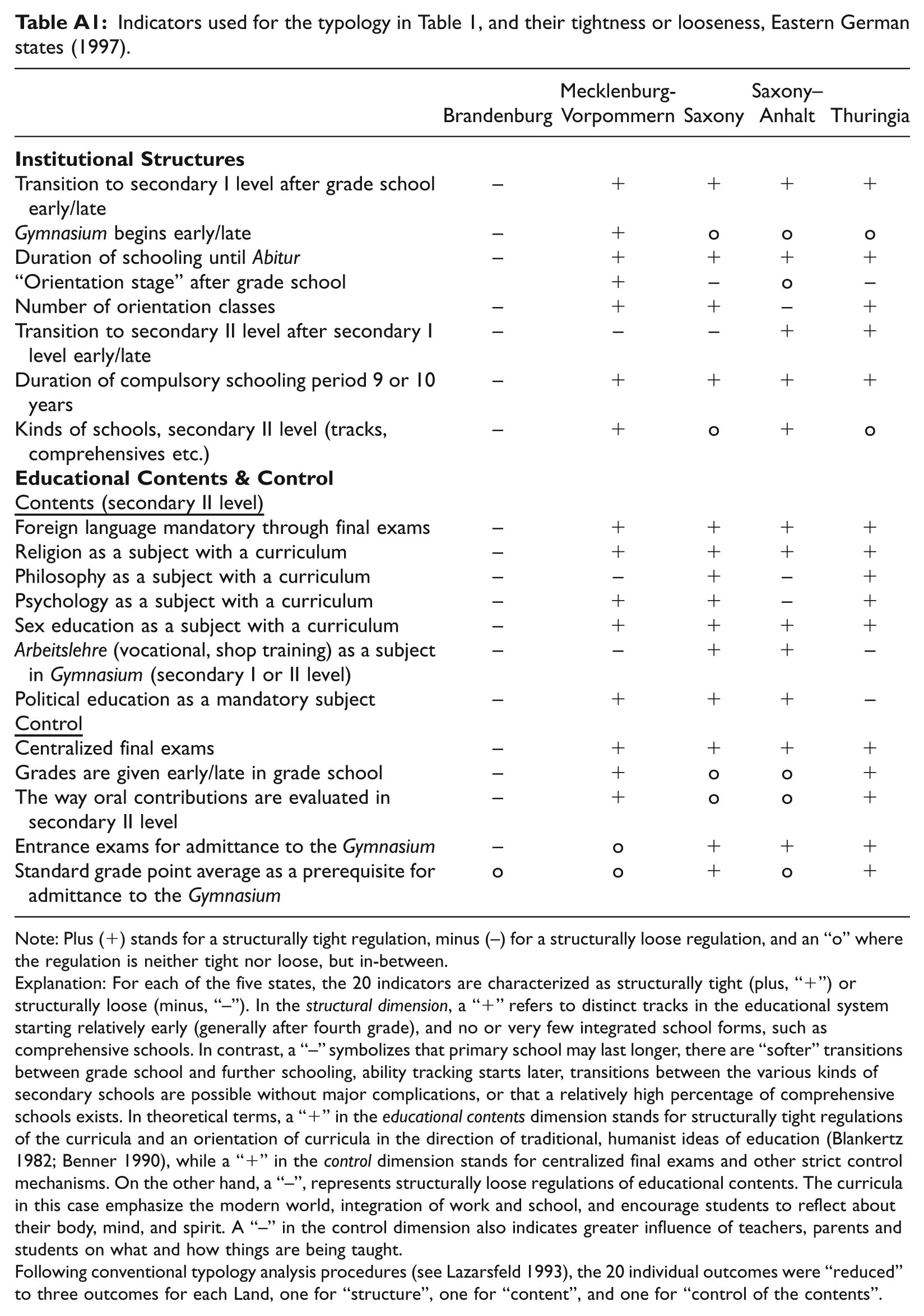
Note: Plus (+) stands for a structurally tight regulation, minus (–) for a structurally loose regulation, and an “○” where the regulation is neither tight nor loose, but in-between.
Explanation: For each of the five states, the 20 indicators are characterized as structurally tight (plus, “+”) or structurally loose (minus, “−”). In the structural dimension, a “+” refers to distinct tracks in the educational system starting relatively early (generally after fourth grade), and no or very few integrated school forms, such as comprehensive schools. In contrast, a “−” symbolizes that primary school may last longer, there are “softer” transitions between grade school and further schooling, ability tracking starts later, transitions between the various kinds of secondary schools are possible without major complications, or that a relatively high percentage of comprehensive schools exists. In theoretical terms, a “+” in the educational contents dimension stands for structurally tight regulations of the curricula and an orientation of curricula in the direction of traditional, humanist ideas of education (Blankertz 1982; Benner 1990), while a “+” in the control dimension stands for centralized final exams and other strict control mechanisms. On the other hand, a “−”, represents structurally loose regulations of educational contents. The curricula in this case emphasize the modern world, integration of work and school, and encourage students to reflect about their body, mind, and spirit. A “−” in the control dimension also indicates greater influence of teachers, parents and students on what and how things are being taught.
Following conventional typology analysis procedures (see Lazarsfeld 1993), the 20 individual outcomes were “reduced” to three outcomes for each Land, one for “structure”, one for “content”, and one for “control of the contents”.
Acknowledgements
The authors gratefully acknowledge the reviewers’ helpful comments. Work on this article benefited from the lead author’s postdoctoral stays at the Center for European Studies, Harvard University, and the European University Institute, Florence. The findings and views reported here are the authors’ and do not necessarily reflect the views of the German Federal Ministry of Education and Research.
Notes
Author Biographies