







Abstract
Parenting education programs aim to teach parents, often low-income mothers, a set of skills, behaviors, and attitudes believed to promote improved opportunities for their children. Parenting programs are often offered in schools, with instructors teaching pregnant or parenting teens about child development, attachment, and discipline strategies. Despite the large numbers of participants and significant public and private funding going to parenting education, sociologists of education in the United States have paid little attention to the topic. Existing research, by scholars in other disciplines, has found parenting education to be a relatively weak intervention. Yet this research focuses exclusively on individual-level processes, paying little attention to social context or other factors. This study uses extensive observational and interview data from parenting education programs in two schools and one social service organization to examine what is taught, what is not, and the intersections between program content and the structural realities shaping parents’ lives. The results show that although they were designed for low-income mothers, the classes were silent on the issue of poverty, treating poverty-related concerns as irrelevant to the task of parenting. Furthermore, when such topics did emerge, instructors redirected the conversations to personal behaviors and characteristics. Thus, the ‘‘hidden curriculum’’ of parenting education conveyed the message that good parenting should be unaffected by the challenges of poverty. The mothers, however, struggled to provide for their children in conditions of extreme scarcity, making it difficult for them to focus on other parenting issues.
Keywords
Each year, hundreds of thousands of people, mostly mothers, participate in parenting education programs in the United States. Parenting programs are often offered in schools, with instructors teaching pregnant or parenting teens about child development, attachment, and discipline strategies. Many districts offer special programs for parenting teens designed to provide parenting support and keep them in school (Van Pelt 2012). Other programs are in daycares, prisons, or social service agencies; still others are home-based, involving visits from nurses or educators. Parenting education is generally designed for families with children deemed at risk—of abuse, neglect, school failure, delinquency, or other outcomes associated with growing up in poverty. Such programs are a response to well-documented differences in childrearing between low- and higher-income families (Gadsden, Ford, and Breiner 2016; Hart and Risley 1995; Putnam 2015; Rothstein 2004). Proponents hope that by enhancing children’s experiences, early interventions like parenting education will improve opportunities for low-income youth (Cruz 2009; Gadsden et al. 2016; Marmot 2016; The Saguaro Seminar: Civic Engagement in America 2016; Watson and Edelman 2013).
Despite the many participants, significant funding (federal funding alone runs to hundreds of millions of dollars annually; Gadsden et al. 2016; Haskins and Barnett 2010), and the fact that parenting education is often offered in schools, sociologists of education in the United States have paid little attention to the topic. Most research on parenting education has been conducted in other disciplines and assessed the extent to which programs produce certain outcomes among parents, such as avoidance of corporal punishment, increased engagement with children, and greater emotional responsiveness (for reviews, see Duncan, Ludwig, and Magnuson 2010; Grindal et al. 2016). 1 Research shows that when implemented with fidelity, some programs produce small changes in parenting behavior and children’s outcomes. However, this research has focused exclusively on individual-level processes, paying little attention to social context. To understand why parenting programs often fall short, we need a fuller examination of what is taught, what is not, and the intersections between program content and the structural realities shaping parents’ lives.
As sociologists have observed, schools and other educational organizations are key sites of socialization. In the United States, scholars have shown that the “hidden curriculum” of schools often teaches students to embrace meritocratic ideologies related to personal agency, success, and failure (Apple 2004; MacLeod 2008). Parenting education programs—with their focus on individual skills rather than the structural forces that affect poor families—can play a similar role. Yet the hidden curriculum of parenting classes has received no scholarly attention.
By attending to social structure and the hidden curriculum, this article helps move our understanding of parenting education past its largely individualistic orientation. We use extensive interview and observational data collected at parenting classes in two schools and one social service agency over a three-year period to ask: What do parenting education classes teach—both explicitly and implicitly? And to what extent do classes resonate or conflict with mothers’ perspectives, needs, and challenges?
Although designed to serve low-income mothers, the programs we studied ignored poverty-related struggles, treating them as unrelated to the task of raising children and sending the message that good parenting should be immune to poverty. Yet the mothers were operating in conditions of extreme scarcity, conditions that, they reported, made it difficult for them to focus on issues beyond providing for their children’s basic needs (Mullainathan and Shafir 2013).
This article demonstrates the importance of parenting education programs to the sociology of education. Not only do such programs consume significant resources, they also represent an underexplored link between education and poverty policy. In many ways, parenting education exemplifies the educationalization of social problems (Labaree 2008)—or the impulse, especially strong in the United States, to look to schools and other educational organizations to address pressing issues, such as poverty, unemployment, and racism (Katz 2013; Steffes 2012). Historians have examined this process, but there has been scant sociological work on its implications (Randles 2017 is an exception).
By closely analyzing points of disjuncture between parenting education and the challenges facing low-income mothers, this article shows that the classes ultimately reinforced normative ideologies that deemphasize structural barriers. Our analysis also contributes to the literature on parenting education, identifying strategies for improvement, and adds to our understanding of the role schools play in the process of educating young parents. We do not deny that parenting programs could be useful, but we raise questions about their shortcomings and the messages they send to struggling families.
Parenting Education and Low-Income Families
A large literature shows that children’s early experiences are critical for their development (e.g., Zigler, Finn-Stevenson, and Hall 2002) and that parenting practices tend to vary by class (Lareau 2011). For example, compared to more advantaged parents, low-income parents frequently use fewer words in communicating with children, read to their children less often, and use more punitive discipline styles, all of which are associated with reduced social and academic outcomes (Hart and Risley 1995; McLeod and Shanahan 1993; Rothstein 2004; but see Sperry, Sperry, and Miller forthcoming). Low levels of warmth, insufficient cognitive stimulation, and corporal punishment are especially common among families experiencing severe financial stress (Yoshikawa, Aber, and Beardslee 2012). Parenting education programs target these behaviors, aiming to “strengthen positive parenting and home environments” in low-income families (Rafferty and Griffin 2010:154). Because teen parenting in particular is linked to negative outcomes for mothers and children, some scholars and advocates argue that schools are ideally suited to provide parenting and pregnant students necessary services, including parenting classes (National Women’s Law Center 2010; Watson and Edelman 2013).
In assessing the impact of parenting education, studies find participants are somewhat more likely to engage their children and avoid excessively harsh discipline strategies, but the impact on children is small—and sometimes nonexistent (Brotman et al. 2011; Chang, Park, and Kim 2009; Grindal et al. 2016; Gross et al. 2003; Zigler, Pfannenstiel, and Seitz 2008). Additionally, many effects decrease over time, often disappearing altogether (Gross et al. 2003). Programs involving home visits from highly trained nurses have the best long-term outcomes (Olds 2010; Tolani, Brooks-Gunn, and Kagan 2006). Also, low-income and adolescent parents are least likely to benefit from parenting programs (Bakermans-Kranenburg, van IJzendoorn, and Bradley 2005; Duncan et al. 2010). Thus, some scholars question the utility of such programs to significantly alter parenting practices or improve children’s outcomes (Duncan et al. 2010; Furstenberg 2011; Tolani et al. 2006). The development of culturally relevant programs—designed to emphasize cultural strengths, value parents’ beliefs, and teach racial socialization—is promising (Kumpfer et al. 2002). However, such programs have not been implemented widely or subject to extensive research (Baumann et al. 2015; Coard et al. 2007).
The extant research is useful, but its focus on individual-level processes has led to silence on such key topics as the social context of parents’ lives or, with a few exceptions on the part of Canadian and European scholars (Gillies 2005; Macvarish 2014; Romagnoli and Wall 2012), the assumptions underlying parenting programs. Many schools, especially those serving under-credited, overage youth, include parenting education in their programming (Barnet et al. 2012; U.S. Department of Education 2013), yet our understanding of parenting classes as part of larger educational projects remains incomplete.
Education, the Hidden Curriculum, and the Problem of Scarcity
Sociologists have long used the concept of the hidden curriculum to understand how schools socialize students (Jackson 1968). In contrast to the official curriculum, the hidden curriculum manifests in rules and routines, decisions about what to teach, teacher-student interactions, and other subtle practices (Golann 2015; Jackson 1968). In addition to promoting behaviors (e.g., obedience or orderliness), the hidden curriculum can have an ideological component, conveying taken-for-granted messages about society and students’ place in it (Anyon 1979; Apple 2004; Giroux 1984). Often, these messages legitimize inequality, encouraging students to embrace normative notions of opportunity and achievement (Apple 2004; Giroux 1984; MacLeod 2008), accept racial inequalities (Lewis and Diamond 2015), and engage in individual competition (Demerath 2009).
Curricula send messages through their exclusion of key topics as much as through their inclusion of others. As Eisner (1985) observed, decisions about what to teach pass along traditional assumptions about what is and is not important to learn. In Anyon’s (1979) analysis of U.S. textbooks, she observed that key elements of U.S. history—for example, the strength of radical political groups in the early twentieth century—were effectively missing from the texts, an absence that ultimately delegitimized redistributive policies. Thus, Anyon (1979:383) concluded that textbooks “encourage education and other actions that attempt to change the individual, while leaving the unequal economic structures intact.”
Informed by this perspective, we explore the hidden curriculum of parenting education, namely, the subtle messages the classes send about raising children in poverty. We operationalize the hidden curriculum in two ways. First, following Anyon and others, we see it as existing in what is left out of the formal curriculum—in this case, the issue of poverty. Second, we see the hidden curriculum manifesting in the ways instructors guide discussions about poverty.
We also draw from research on scarcity that helps explain why the lack of connection between the curriculum of parenting education and mothers’ experiences is so problematic. As Mullainathan and Shafir (2013) show, conditions of scarcity—be it money, food, time, or other resources—affect cognitive functions. Facing scarcity, people tend to focus single-mindedly on the resource that is in short supply. This can be helpful, allowing people to work efficiently in pursuit of particular goals, but it also causes people to “tunnel,” or ignore other things, such as parenting skills, that are not directly connected to the immediate concern.
Methods
The first author, Cucchiara, conducted ethnographic research in two schools and one social service agency in a large northeastern city over a three-year period. She consulted with a nonprofit organization that funds dozens of parenting classes to identify sites where programming was offered consistently and reputed to be high quality. Although funding for parenting classes came through child protective services and was intended to reduce abuse or neglect, she deliberately avoided sites where the majority of parents were there because they had children “in the system” due to abuse or neglect as that would introduce issues not addressed by the research questions. Instead, she selected two schools that required parenting or pregnant students to attend parenting class and one social service agency where only a few participants were mandated to attend by child protective services.
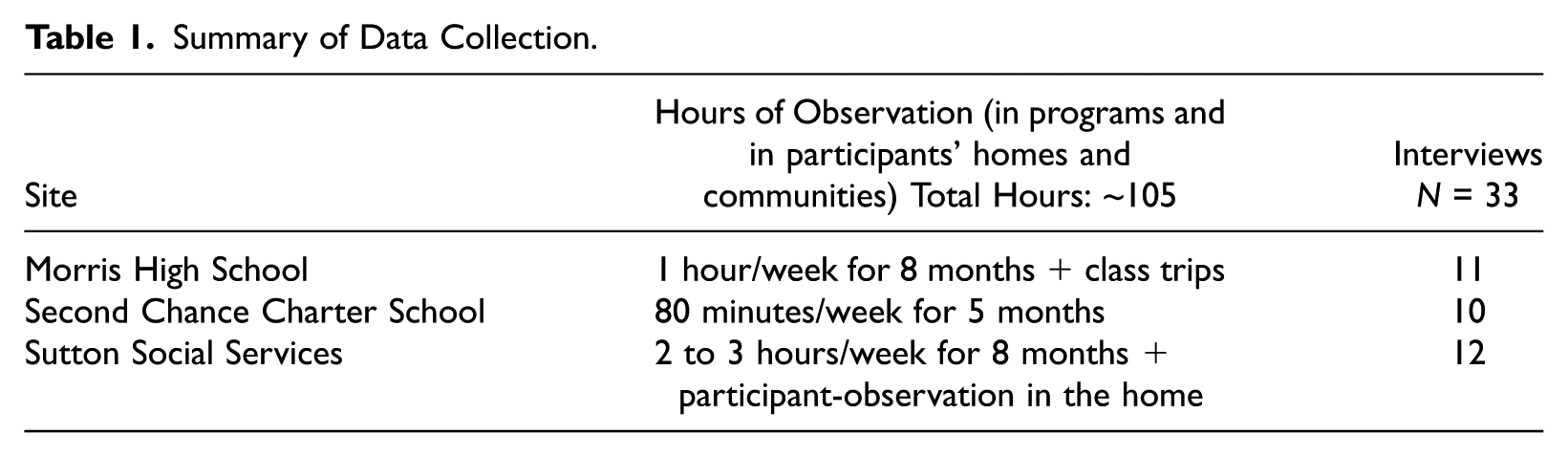
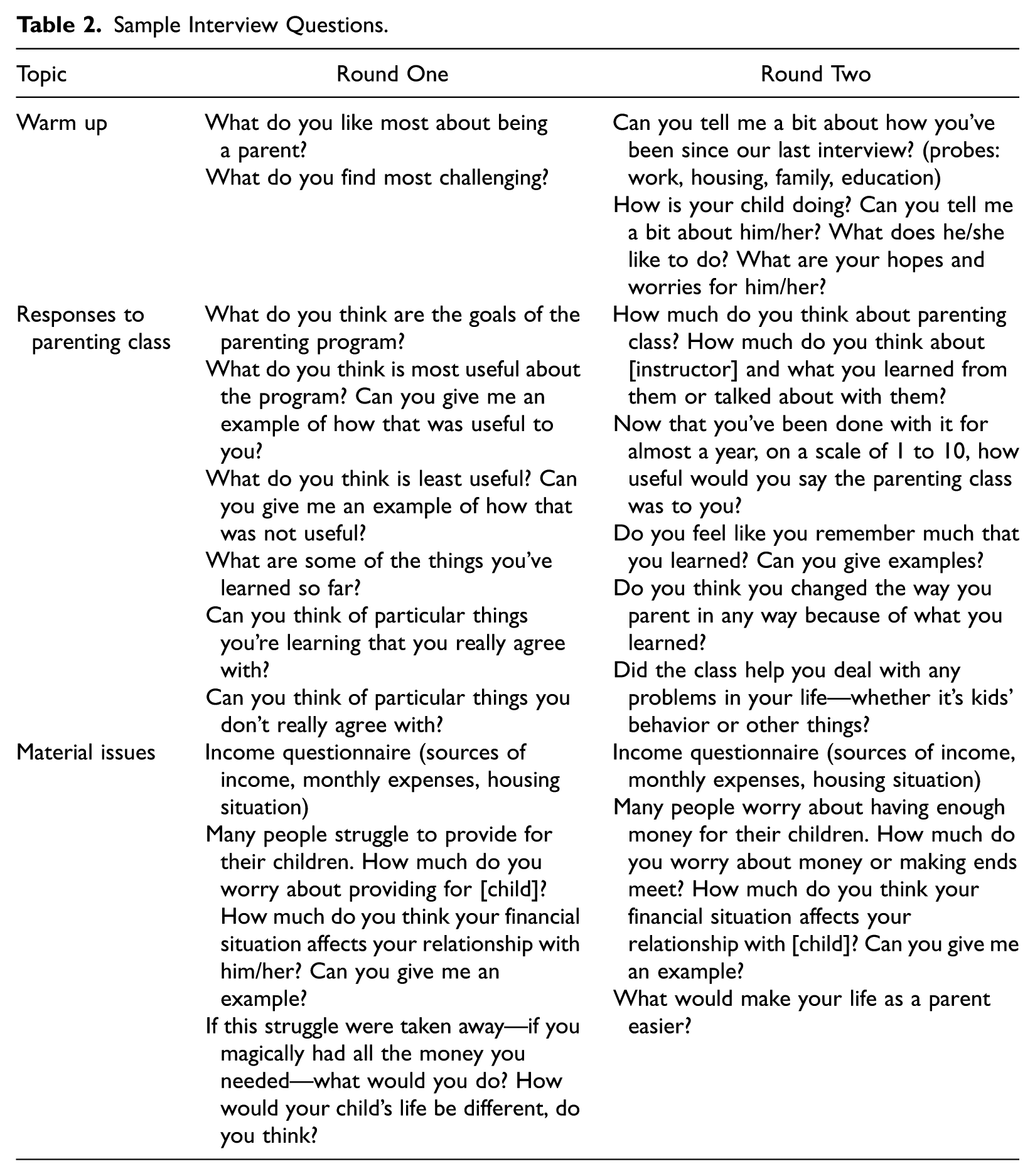
Cucchiara served as a participant-observer at classes, field trips, and other activities and visited mothers in their homes (for more than 100 hours of observation). Class observations focused on program content, implicit and explicit messages from the instructors, and mothers’ interactions with the instructor and one another. As Table 1 shows, she conducted 25 interviews with parenting class participants (7 were second interviews), 3 with family members of class participants, and 5 with instructors, for a total of 33 interviews. 2 Interviews occurred over a several-month period at each site, beginning a few weeks after observations started. Interviews with mothers typically took place in their homes and lasted 60 to 90 minutes (see Table 2). Of the 25 participant interviews, 7 were second interviews conducted four months to a year after the program had ended, with the goal of providing a longitudinal perspective on the mothers’ experiences and the effects of the class. 3 Information also was collected from interviewees about monthly income and expenses, using a form developed in collaboration with participants. Each interview participant received a $30 gift card. Program administrators and instructors shared key documents, including official guidelines for parenting education programs, assessment tools, and curricular materials. All interviews were recorded, professionally transcribed, and checked for accuracy.
Summary of Data Collection.
Sample Interview Questions.
The majority of participants and all instructors were African American. All participants were low-income, and instructors came from low-income or working-class backgrounds. As a white, middle-class woman, Cucchiara stood out in these settings. To reduce participants’ discomfort, she repeatedly stated that she was not evaluating the program or its participants but wanted to “understand how parenting classes work.” She brought snacks to classes and at one site, helped serve dinner. To build rapport, she chatted with parents before and after class, asking about their children and making jokes with them. A mother herself, she sometimes shared stories of her own children or remarks about the challenges of motherhood. The participants showed her increasing warmth by smiling, giving hugs, and including her in their conversations. Approximately 90 percent of the mothers agreed when asked to participate in the interviews. She tried not to call attention to the social distance between her and the mothers and did not intervene when parents spoke in interviews of financial or other difficulties. However, in two instances she did help, driving one mother and her feverish son to the hospital and giving another threatened with homelessness $200 for a deposit on an apartment. (In both cases, the assistance was offered after the first interview and was not solicited by the parents. These actions are consistent with those of other ethnographers [e.g., Desmond 2016]; there is no evidence they affected data collection.)
Various strategies ensured our portrayal of class content and messages is accurate. During data collection, Cucchiara created working lists of topics discussed in class and checked them with participants and instructors. She also drafted reports sharing general findings about parents’ responses to the programs. (The reports, which were shared as a courtesy rather than at the request of the organizations, included no specific information about instructors or participants and were completed after she had left the field. She received no payment.) She used agencies’ responses to the reports to assess her accuracy in capturing program goals and scope.
The authors worked collectively to analyze the data through careful reading, memos, and regular discussions. We first developed a list of central themes, including themes derived from the research questions and those emerging from the data (LeCompte and Schensul 2010). We collapsed our original list of more than 100 themes into 12 codes, such as “instructor messages,”“curriculum/program,”“students’ responses,” and “parents’ lives/experiences outside of class.” We used the Dedoose qualitative data analysis program to code the data. To ensure accuracy and reliability, each document was coded twice. When inconsistencies occurred, we erred on the side of applying (rather than removing) a particular code, even if this meant a single excerpt received multiple codes. This ensured no important data were missed.
For this article, we recoded all data related to “parents’ lives/experiences outside of class” into a set of more fine-grained categories (including “poverty,”“violence,” and “housing instability”), and we wrote memos on the relationship between parents’ concerns and class content. We also reexamined all fieldnote data for instances when poverty or other life challenges surfaced in the classes. In each case, we identified who raised the issue, the context of the discussion, and how instructors responded. Because our analysis was inevitably influenced by our middle-class status, presenting our ideas in multiple settings, writing memos, seeking feedback from other scholars, and continually revising our drafts helped us gain important analytic distance. All names are pseudonyms. Participants referred to instructors using honorifics, so we do the same here.
“They Need to be Empowered to Do Things for Themselves”: Parenting Education and Mothers in Poverty
Our analysis revealed a striking lack of congruence between program material and the mothers’ lives—a disconnection that conveyed important assumptions about parenting and poverty. We begin by providing a brief overview of parenting education in the city and introducing each site. Next, we outline the content of the classes (the explicit curriculum), highlighting the focus on individual issues at the expense of social context. Then, we describe the hidden curriculum and the messages it sent. We next discuss the centrality of poverty in mothers’ lives and its effect on parenting. We end with a brief discussion of the mothers’ own comments about the classes, which suggest their impact was limited.
Introduction to Sites
For the most part, parenting education in the city is designed for people struggling with poverty and related challenges. Classes are funded by the Department of Human Services and managed by Social Services United, a large intermediary organization. Providers are required to use research-based curricula designed to increase supportive parenting, improve parent-child relationships, and promote alternatives to corporal punishment. All instructors must receive training from an approved professional development organization. Classes run throughout the year in a variety of settings, including schools, social service agencies, churches, daycares, and medical centers.
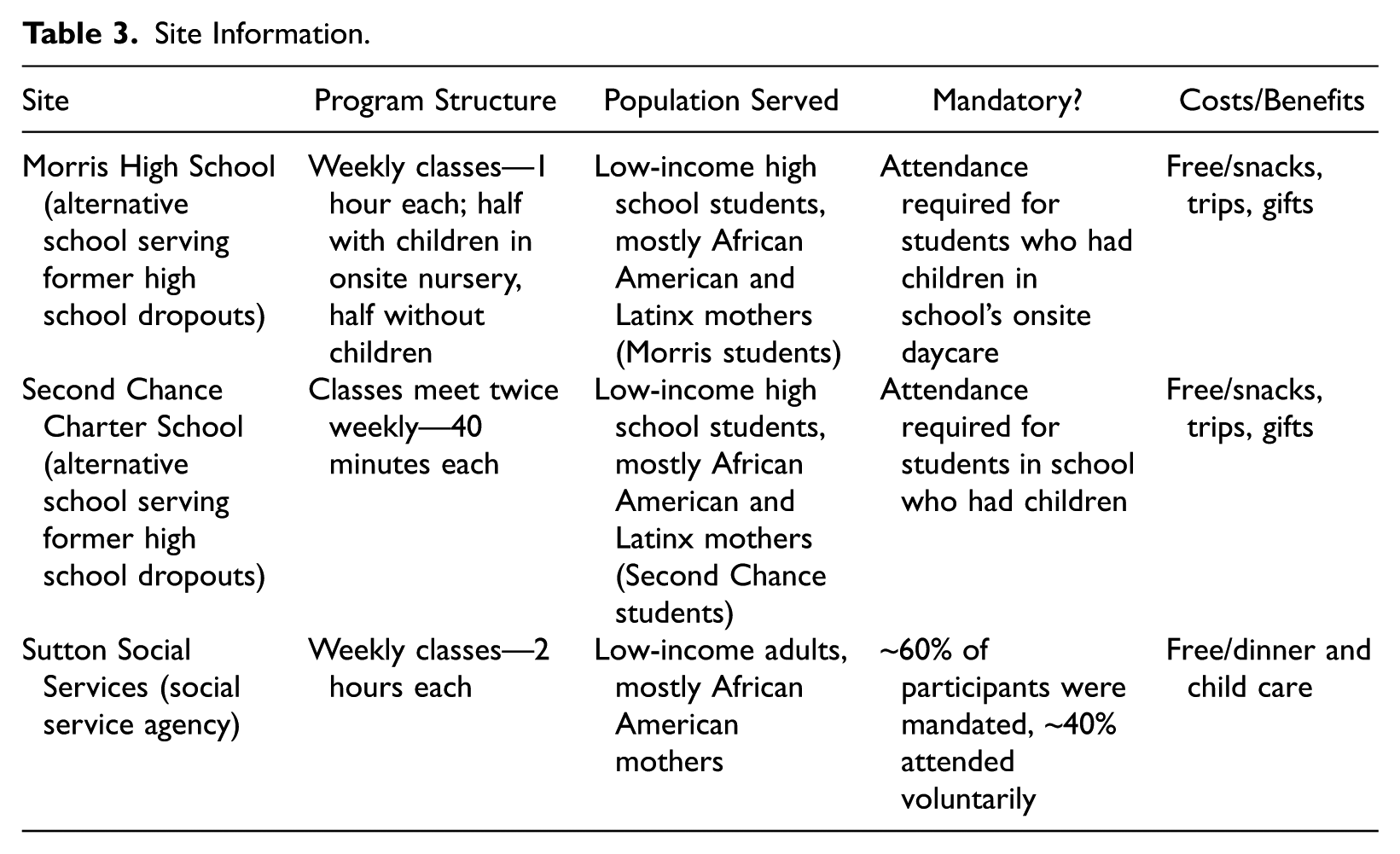
All three study sites (Morris Alternative High School, Second Chance Charter High School, and Sutton Social Services) serve low-income parents, mostly mothers (see Table 3). Classes are free to participants. Morris and Second Chance are schools for overage, under-credited youth. At the time these data were collected, there were about a dozen such schools in the city and more than 10,000 across the country (Carver, Lewis, and Tice 2010). Morris is operated by a nonprofit organization that receives a contract from the school district, and Second Chance is a charter school. Both schools had contracts with Parenting Partnerships (a local nonprofit agency that offered parenting programming) to provide parenting education to their students. Sutton is a social service agency that offers classes in a number of settings, including the branch office where the first author collected data. Despite some differences, the programs are similar enough in structure and goals to provide useful points of comparison.
Site Information.
Morris
Morris Alternative High School is located in a former warehouse in a low-income neighborhood, surrounded by modest two-story row houses. One of the first contract-based alternative schools to open in the city, Morris uses a module system to structure students’ learning and provide frequent feedback. The school emphasizes high expectations for behavior; its 200 students wear blue uniform shirts and black skirts or pants, moving in an orderly manner through the building. Morris offers multiple supports for students, including social workers, therapists, and onsite daycare for students with infants and toddlers.
Students who had children in the daycare were expected to attend parenting classes. All students in the parenting class were low-income mothers, age 16 to 21. About half were African American, and half were Latinx; there was one white mother in the class. The hour-long classes met once each week during lunch, alternating between starting in the daycare for 30 minutes (with children) and then moving to a social studies classroom (without children) or spending the whole period in the classroom (without children). Both spaces were relatively small, but whereas the nursery had a brightly colored rug, toys, and child-sized furniture, the classroom was narrow and sparsely decorated, with occasional notes about homework jotted on the blackboard.
The instructor, Mama Odette, was a middle-aged African American woman with a warm, effusive manner. She had long dreadlocks and often wore colorful Afrocentric styles, such as dashikis and headwraps. Mama Odette was the mother of three children, one of whom had special needs. She had not completed college but had been active in education, family literacy, and arts programming for two decades. As evidenced by the name she used in her teaching, Mama Odette cultivated a familial relationship with the students: She called the mothers her “daughters,” said “I love you,” and engulfed them in fierce hugs. She identified with the mothers—having experienced poverty and single motherhood herself—and peppered her classes with personal stories. Mama Odette took a broad view of her teaching, saying in an interview that she wanted mothers to know “they’re not alone, that there are resources for them, and that their children are precious.” She brought toys, books, snacks, and other gifts; read and played with the children; and led open-ended discussions.
Second Chance
Second Chance Charter School was founded two decades ago to address the city’s dropout problem and provide job training to vulnerable youth. The school, which serves more than 200 students between 18 and 21 years old, offers a combination of traditional academic classes and vocational training. Second Chance emphasizes nurturing relationships between students and staff, helping students take ownership over their learning, and nonviolent conflict resolution. Students rotate between traditional academic classes and on-the-job training at hospitals, daycares, or construction sites. The school occupies two floors of a low-rise office building on the edge of the city’s downtown. There are no uniforms, but students often wear gray hoodies with Second Chance emblazoned on the front. There is no onsite daycare, so students’ children are in offsite daycares or with family.
Like Morris, Second Chance had a contract with Parenting Partnerships to provide parenting classes, which were held in a science classroom for two 40-minute periods each week. The science teacher’s desk sat in the back, and she regularly walked in and out during the class, chiming in when the conversation touched on science-related topics. The school required all students with children to take the class. Most participants were African American, but a few were white or Latinx. All were low income. Whereas the Morris mothers’ children were babies or toddlers, some of the Second Chance mothers had children as old as five or six.
The instructor, Miss Naomi, was an African American woman in her 20s. She was from a working-class family in the city and had graduated from a state university. Miss Naomi dressed stylishly, sporting trendy vests, hats, and tall boots. She wore bright makeup and chewed gum throughout class, her rapidly moving jaws in time with her quick responses. She explained in an interview that her goal for the class was to empower the parents: “I want them to be confident, to make decisions for them and their kids. I want them to make small changes with their parenting, because you’re not going to break the cycle all at once.” She focused on promoting children’s healthy social, emotional, and cognitive development. Miss Naomi was friendly with the mothers but did not have Mama Odette’s maternal air. With no children herself, she treated the mothers more as peers or younger siblings, using slang (e.g., “ratched” or “trippin’”) freely but also speaking authoritatively when she wanted order. Whereas the Morris group remained somewhat consistent for the duration of the study, the students at Second Chance were divided into two groups (A and B). When observations began in December, Group B was attending academic classes (including parenting class), and Group A was learning job skills at various sites. In January (and again every six weeks or so), the groups switched. Each group had parenting class for half the school year.
Sutton
Sutton classes were held in a storefront social services office in a poor neighborhood, squeezed between a bodega and a pizza shop. Sutton was not connected to a school. Instead, as a cheerful sign advertising “Empowered Parenting” announced, its programs were offered to the public. Sutton also received parents required to attend as a condition of living in a group home Sutton ran (as transitional housing for young mothers) and parents required to attend a class because they had a case with child welfare services. Approximately one third of the participants were in the housing program, one third were referred by child welfare, and one third were there voluntarily. Participants ranged in age from 18 to 50 years. They sat at tables pushed together in a back room, where motivational posters hung on walls paneled in wood veneer. While the mothers attended classes, their children watched movies, supervised by a child-care worker, in a nearby kitchen area.
The instructor, Mr. Michael, was an African American man in his late 40s. He was the father of two children, one deceased and one in college. A professor of human services in a nearby university, Mr. Michael had worked with Sutton for years, beginning as a child-care worker in his teens. He dressed in pressed jeans and corduroy jackets; his thick glasses and sedate manner made him look serious, although he also was quick to smile. Mr. Michael focused on the affective elements of parenting, explaining in an interview that his “main goal is to help people get back in touch with loving their children instead of fixing or punishing them or correcting them.” He saw this as essential to individual and social well-being: “Because when people don’t feel loved they may do all kinds of things to compensate . . . that are destructive to the individual and to family members and to society.” The director of the branch office, Mr. Shawn, moved between the class and his office, occasionally joining the conversation. Mr. Shawn was an African American man in his 60s, wiry in build and energetic, who had served time in prison and was active in programs for ex-offenders. Halfway through each two-hour class, he served a free dinner, usually pizza and chicken wings.
“We Always Want to Be Encouraging and Positive”’: The Explicit Curriculum
Classes at Morris, Second Chance, and Sutton were similar in goals and approaches. All instructors ostensibly used a curriculum mandated by the agency, although the Sutton and Morris instructors modified it significantly. At Sutton, the instructor used Confident Parenting, 4 and at Morris and Second Chance, the instructors used Parenting Partnership’s curriculum. As Table 4 shows, class content (both instructors’ remarks and written materials) was fairly consistent across the three sites. This was the explicit curriculum.
Class Content by Site.
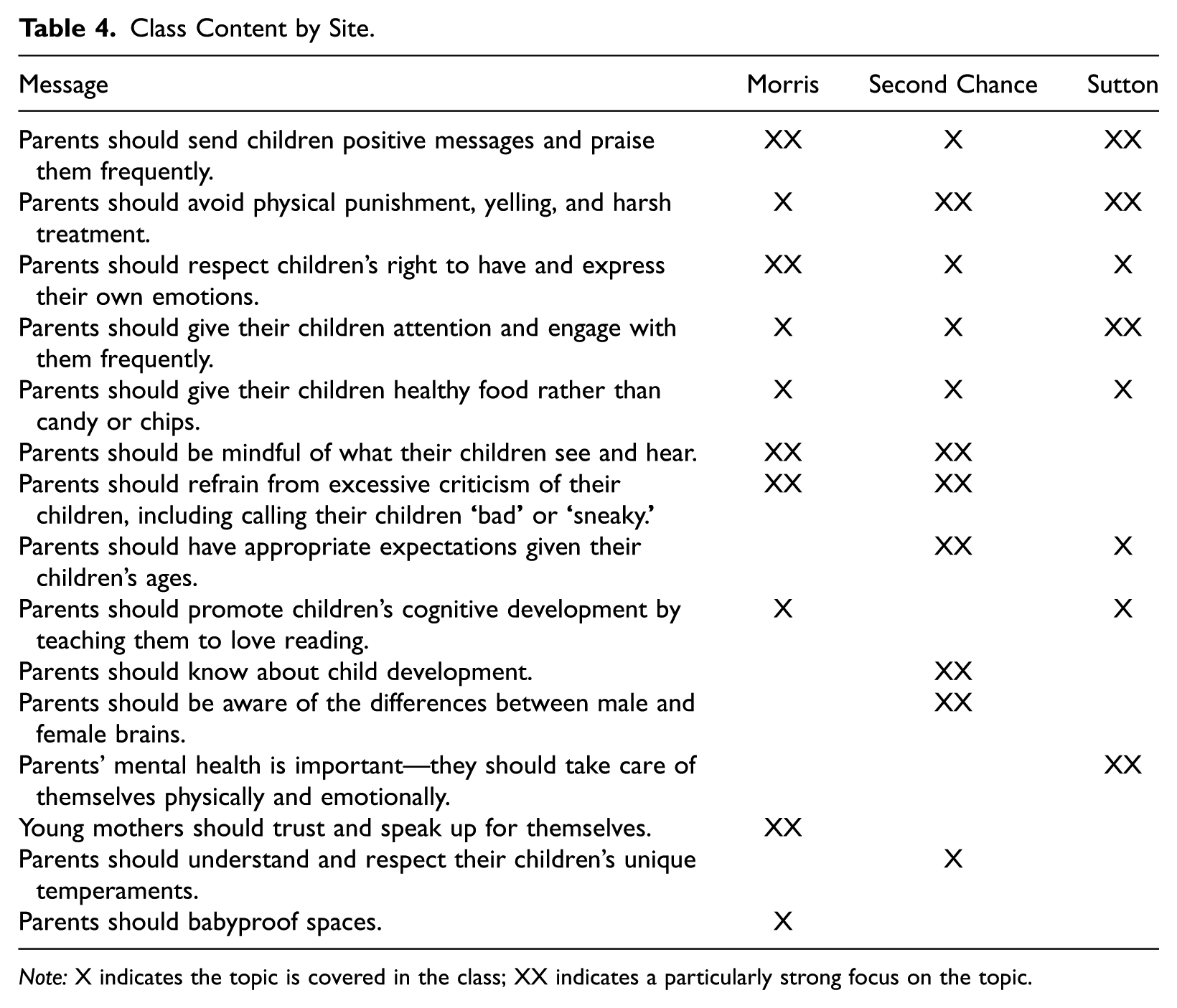
Note: X indicates the topic is covered in the class; XX indicates a particularly strong focus on the topic.
Because the programs received federal funds aimed at preventing child abuse and neglect, all included at least some discussion of avoiding physical punishment, although this was most emphasized at Sutton. At all three sites, parents were encouraged to engage with their children through language, play, and reading; respect and foster emotional expression; build children’s self-esteem; and use praise rather than criticism. Class content resonated with contemporary expectations (and instructors’ perspectives) that good parenting meant promoting children’s growth and development (Hays 1996; Lareau 2011). Additionally, the curricula focused on practices individual parents could or should take up. Informed by psychological theories of child development and mental health, such practices ostensibly could be implemented by any parent at any time regardless of other conditions that might affect their lives. Instructors acknowledged in interviews that poverty was a major challenge for participants, but this did not manifest in their teaching.
Morris
Parenting Partnerships expected instructors at Morris and Second Chance to use its curriculum, whose 10 sessions focused on goal setting, child development, discipline, and healthy relationships. Yet Mama Odette, the Morris instructor, seldom referred to the curriculum or shared curriculum materials. Instead, her classes were loosely structured, often involving easy exchanges with the mothers, and focused on helping them and their children feel loved and valued. A class in mid-October was typical.
Five mothers (two African American, two Latinx, and one white) sat at desks facing Mama Odette, who stood at the front of the room unpacking her bags. Mama Odette began by telling the students they would be talking about child development. The conversation quickly got sidetracked as the mothers called out questions about their children’s issues, such as not sitting still to eat or refusing particular foods. Mama Odette wove advice in with anecdotes from her own experiences, encouraging the mothers not to put too much on a child’s plate and describing how she mixed green beans in with noodles for her finicky daughter. Mama Odette directed the conversation to the topic of fatigue and short tempers, reminding the mothers that child abuse often happens when parents are tired. When the mothers began talking about their experiences as children (one described her mother’s constant criticism), Mama Odette responded, “Always tell kids they’re smart and beautiful. It’s not the kid, it’s the behavior.” Five minutes before class ended, Mama Odette picked up a handout that had been on the table next to her and, appearing to read from it, asked the mothers if they knew the critical ages for speech development and reminded them that reading helps build vocabulary. As class concluded, she passed out gifts for the mothers, small snack containers. Most classes followed this pattern, with Mama Odette responding to questions, discussing various parenting tactics, and sharing her experiences.
Second Chance
Miss Naomi, Second Chance’s instructor, followed the curriculum more faithfully than did Mama Odette. She came to class with a lesson plan—derived from the Parenting Partnerships curriculum—and adhered to it closely. To her, good parenting meant being attuned to children’s developmental needs. For example, on a wintry day in December, she began class by referring to the previous day’s conversation about toilet training, reminding the nine young women in attendance not to pressure their children to toilet train too early. Then she introduced a game from Parenting Partnership’s curriculum about gender and brain development. She put the students into two teams and gave each a plastic bag filled with about 20 slips of paper. Each slip listed a characteristic, such as “bonds through talking” or “feels excited when faced with a threat.” The goal, as written in the program’s curriculum, was to identify which was more typical of male or female brains and sort them accordingly. The mothers talked to one another as they sorted the slips, joking that girls’ brains develop faster than boys’. Miss Naomi then reviewed the answers, comparing the teams to see who had gotten the most “correct.” The winning team cheered, and the losing team muttered about cheating. Miss Naomi ended by saying it was important to expose children to both men and women: “I know people think you’re the mother and the father. I get that. But even if it’s not the father, kids need to see a positive man. Maybe an uncle. Or an old head [respected older man] in the neighborhood.” Classes like this— comprising some introductory conversation, an activity from the curriculum, and a brief wrap-up—were typical.
Sutton
Sutton classes began with a check-in, in which each participant briefly shared how they were doing and updates from the previous week. This often took the first 30 minutes of the two-hour class. Although Sutton officially used the Confident Parenting curriculum (which emphasized skills for managing behavior and building healthy relationships), Mr. Michael rarely shared materials or led activities from the curriculum. For instance, nine parents were in attendance one night in February when, after a brief check-in, Mr. Michael took out a stack of index cards and began reading questions, including, “What was the best gift you ever got as a child?” and “If you could undo one thing your parents did, what would it be?” Parents responded, talking about the dollhouse or roller blades they received as children and wishing their parents had finished school.
The class continued in this way, and after a break for dinner, Mr. Michael wrote HALTS on the board and led a discussion of the dangers of parenting when you are hungry, angry, lonely, tired, and serious. He reminded parents that they and their children needed healthy food: “A bag of chips and a hug is not a meal for nobody.” He went through each of these, asking for suggestions from parents and sharing his own examples—emphasizing positive parent-child interactions—until class ended. Each element of HALTS could conceivably connect to the difficulties attendant to raising children in poverty, but Mr. Michael made no mention of this. His advice, like that of the other instructors, may have been useful and well intentioned, but it focused only on individual issues, implying all parents were equally positioned to follow it. Here, as at the other sites, the absence of references to poverty or how it could affect raising children sent important messages, a topic we take up next.
“You Have to Be Strong”: The Hidden Curriculum
Whereas explicit curricula manifest in program material, lesson plans, and discussion topics, hidden curricula are delivered through more subtle mechanisms. With respect to the parenting classes, the hidden curriculum conveyed the message that poverty should not be a barrier to good parenting and parents: Individuals were responsible for their children’s well-being. This message showed up in two ways. First, classes did not address the material conditions of mothers’ lives or the extent to which their situations made it difficult to focus on parenting skills. Second, when poverty-related topics did emerge, instructors deflected the conversation away from structural concerns and toward individual analyses, implying that parenting should not be affected by poverty.
Silence
Like all educational endeavors, parenting classes communicate through the presence and absence of particular content. As we have shown, references to poverty and its consequences were missing from curricular materials and instructors’ lessons. Indeed, at Morris and Second Chance, the topic of poverty rarely surfaced. At Sutton, however, parents had more opportunities to raise issues that concerned them, and poverty-related problems emerged frequently. In those instances, the instructors’ silence was striking.
As noted earlier, Mr. Michael began each Sutton class with check-in, an opportunity for parents to provide brief updates. In their comments, parents frequently referenced difficult events in their lives, often involving violence or worries about finding a job or a home. For example, one night in November, Taylor, an African American woman, was trembling as she spoke of her nephew’s murder. “They killed him,” she said. “He got killed the day after election day. It was the first time he voted. They took pictures. Then he got killed.” Voice breaking, she described the funeral, where her nephew’s young son realized at the last minute that it was his father being buried and tried to jump in with the coffin. Early in January, Paula, another mother, recounted spending New Year’s Eve on the floor because “they started shooting” outside. Jen, a white woman, frequently related her struggles to find a job and a place to live, and another mother described her son’s school as so out of control he was stabbed with a pencil by one boy and had his “teeth punched out” by another.
In general, Mr. Michael nodded understandingly, commenting about how difficult these things were. However, he rarely allowed the class to discuss parents’ stories in depth or connected them to the evening’s topic. Thus, the night Taylor described her nephew’s funeral, Mr. Michael focused on treating children with affection. The night Paula recounted the bullets on New Year’s Eve, the lesson covered increasing motivation among children. And a few minutes after the stories about school violence, Mr. Michael played a video on using praise and teaching children to express their feelings.
Mr. Shawn, the administrator who sometimes joined in the classes, was especially clear about the distinction between parenting issues and participants’ life circumstances. For instance, when Sherisse, a young mother living in transitional housing with her infant son, described her frustration at the house rules, Mr. Shawn interjected, saying, “Is this a parenting issue? This is not a place for that conversation. This is not about parenting.” To Mr. Shawn, housing concerns had nothing to do with the class’s focus on parenting skills. In exchanges like this and in their general silence about poverty, instructors drew boundaries between topics that were appropriate to parenting class (individual attitudes and practices) and topics that were not (poverty-related challenges). Thus, the classes reinforced the notion that good parenting was independent from material concerns.
Reframing
The hidden curriculum of parenting classes also was evident in instances when instructors did respond to mothers’ comments about food insecurity, housing instability, or violence. In these moments, instructors at all three sites had the same response: They reframed the conversation to emphasize individual responsibility, minimizing the impact of structural factors on mothers’ ability to raise their children.
For example, one spring day, nine participants sat at tables in the Second Chance classroom, talking about discipline. Students were completing a sheet about the families in which they were raised, responding with “seldom, sometimes, or frequently” to statements like “Communication was direct in my family” or “In my family, the parent has absolute authority.” They reviewed their answers together, and when it came to the third item, “Disorder and chaos [were common] in my family,” several called out “frequently!” Shanay, a young African American woman who wore her hair in heavy bangs and had an intense expression on her face, frowned as she explained: There are lots of kids in my house. I be cussing. People eat my food—food I put in the fridge. They don’t respect nothing. I went to Friday’s with my daughter. We didn’t eat our food there and we brought it home. Someone ate it! My mom said we should have just eaten it there.
A number of parents chimed in, talking about experiences with their food being eaten by others or keeping refrigerators locked.
Miss Naomi responded quickly, saying families should not be locking up food because “we should have more respect.” She recounted her mother’s asking her and her sister what they wanted so they would not argue about food. In response, another mother laughed, exclaiming, “Ain’t no choosing in my house!” Rather than addressing this and the extent to which lack of choice or protecting food could be a function of overcrowding or scarcity, Ms. Naomi continued to emphasize “respect.” This exchange is revealing: Shanay was describing a situation where so many people were living in one space that it was difficult to maintain clear boundaries, and the mothers who chimed in were speaking of homes where access to food was a source of conflict. These difficult situations are not uncommon in poor households, but Ms. Naomi did not empathize with Shanay or the other mothers (or even seem to understand their situations), nor did she discuss how to handle these conflicts. Instead, she shifted the focus from structural issues (poverty, overcrowding, food scarcity) to individual behavior (respect), seeming to suggest that if families only treated one another differently, conflicts over food would disappear. Her comments also drew boundaries between families like hers, characterized by respect and care, and the students’ families.
Mama Odette had a different approach. Rather than distinguishing herself from the mothers, she noted that she too had been a single mother living in poverty, and she understood what the mothers were going through. However, she devoted no class time to poverty-related issues. Instead, she affirmed the mothers’ commitments to making better lives for their children, highlighting the importance of individual characteristics and actions.
For example, on a chilly day in mid-November, six mothers sat at desks in the classroom, chatting and eating bags of chips Mama Odette had given them. Mama Odette led a conversation about the importance of their children seeing them helping others, including giving food to people who are homeless or hungry. The mothers responded, with two exclaiming they would hate being homeless and others describing people they knew who had deliberately committed crimes, preferring jail to homelessness during the winter. When Mama Odette mused that people often gave up when life was difficult, Wenda spoke up. A 20-year-old African American woman, with long curls and a sweet smile, Wenda had one daughter, was pregnant with her second, and was living in a shelter. She described how homelessness affected her: “When I went to the shelter, it motivated me so much. It got me back on track.” Mama Odette smiled, nodding in affirmation, “You let yourself be motivated! You knew you can’t give up!”
Other mothers agreed, echoing Mama Odette’s comments about remaining strong in the face of adversity. Mama Odette looked serious then, telling the mothers to take pride in all they were doing for their children: “The first thing you should do in the morning is look in the mirror and say, ‘I see a queen.’” The young women listened intently, nodding in response. Although Mama Odette’s words were powerful, she did not identify strategies for dealing with housing instability or discuss the reasons poverty is so pervasive and unyielding in the United States. Nor did she provide any opportunity for sharing concerns about other poverty-related issues. Instead, in this instance, the only time the class dealt directly with poverty during the 16 sessions observed, Mama Odette kept the conversation focused on individual traits, telling the girls they alone determined their fates.
Classes at Sutton similarly avoided structural issues, but instructors did allow one extended conversation about raising children in violent neighborhoods. The mood was cheerful one December night as 10 parents sat around the table, joking about the upcoming holiday celebration. After a quick check-in, Mr. Michael handed out a document the class had reviewed the previous week, listing resources in children’s lives, such as support from families or reading for pleasure, that can help them flourish. They took turns reading aloud and commenting.
When they got to number 35, “Resistance skills: young person can resist negative peer pressure and dangerous situations,” Sherisse objected, saying with an earnest expression, “Lots of them can’t. Their pride is on the line.” Referring to the city’s murder rate, she argued that appearing to fear conflict made people vulnerable. Mr. Shawn responded by reframing the issue around family bonds. Looking from Sherisse to the other parents, he said, “There is always the pull of peer pressure. It depends on their attachment to their family. When they feel love, they can resist the brother on the corner. We gotta make our kids feel like they are part of something.” Tina, whose oldest son was in prison, raised her hand, brow furrowed, but Mr. Michael spoke instead, “Kids need to feel attachment, love. If they don’t feel a part of a loving family unit, the likelihood is that they’ll go the wrong way.” Resisting this, Tina shook her head and burst out, “That’s not true! My son had everything he needed and still went the wrong way!” She was visibly upset by this conversation, looking to the instructors for affirmation. In a soothing voice, Paula (another parent) chimed in, saying to Tina, “That’s his choice.” Relieved, Tina nodded and thanked her. Neither Mr. Michael nor Mr. Shawn said anything in response, and the conversation moved on.
In this instance, the instructors placed the blame for youth violence and crime squarely at the feet of the parents. Their focus on the individual failed to acknowledge considerable evidence of neighborhood variation in children’s exposure to violence and chances for mobility (Sharkey 2013) and of racial discrimination in employment, criminal justice, and other domains (Pager 2007; Western 2007). Instead, instructors implied that youth become involved in crime because something is missing at home. Their comments resonate with Wall’s (2018) account of parenting education materials that promote the notion that proper attachment can create “ideal neoliberal citizens” who are resilient, skilled in managing risks, and self-directed. Strong family bonds are likely helpful, but it is also clearly true that, as Tina noted, some young people raised in supportive homes nevertheless go “the wrong way.” Additionally, the fact that structural forces beyond parents’ control can interfere with a family’s emotional functioning went completely unacknowledged. The point of these examples is not that the instructors deliberately set out to promote a particular ideology. Indeed, they were likely attempting to offer encouragement and support within the context of a class whose focus was on parenting skills. However, such comments, combined with the silence on structural concerns, foregrounded individual responsibility and downplayed the impact of poverty—despite the fact that poverty was, as we will see, central to the mothers’ experiences.
“Money-Wise, I’m on My Own”: Raising Children in Poverty
The mothers in this study were trying to provide for their children in one of the poorest big cities in the United States. Unemployment and poverty rates were high, there was not enough affordable housing, and poor neighborhoods were plagued by violence. The classes presented good parenting as promoting self-esteem and cognitive development, but to the mothers being a good parent meant providing for their children in the face of challenges rooted in structural forces far beyond their control. We now briefly explore these challenges to contextualize parents’ experiences and highlight the disjuncture between their circumstances and class content.
Feeding children
In their interviews, mothers spoke of difficulties providing sufficient food for their children. Wenda, a 20-year-old African American student at Morris, had a toddler and a newborn. She had moved out of a shelter a week before her interview, which was conducted on folding chairs in the otherwise empty living room of her new apartment in a public housing building. Wenda’s monthly income was approximately $200 (not including food stamps), and she often did not have enough to feed her and her children. But, she said, “I make it last. I struggle through.” She had a routine for the end of the month, when she ran out altogether: “That’s when it’s borrowing time!” For these mothers, food shortages were a part of life. They spoke about them in a matter-of-fact manner, noting, for example, that they “start to run out of milk” or relied on rice and gravy or cereal at the end of the month.
An incident at Sutton provides an especially vivid example of what it means to be unable to feed one’s children. Jen was a white woman in her late 20s overcoming drug addiction. She had a 6-month-old daughter, born prematurely, and she was struggling to find work and care for her. Usually an eager participant, she seemed distracted one March evening. She was trying to give her daughter a bottle, holding her and crooning quietly, but the baby was unable to drink. Jen became increasingly agitated. She gestured to another mother and they stepped out, moving quietly to avoid interrupting the instructor-led conversation about temper tantrums. They returned a few minutes later and sat back down, but the baby was still struggling. Jen’s body was tense as she hunched over her.
Finally, when class broke for dinner, she explained to those nearby that she had a new “slow-flow” bottle because her daughter had reflux. The cereal she mixed in with the formula was clogging the nipple. Cucchiara suggested rinsing out the bottle and starting again, with fresh formula and no cereal, but this was not an option. With no money to purchase more, that was all the formula Jen had and her only bottle. She had gone to the bathroom to try, unsuccessfully, to poke a bigger hole in the nipple. Mr. Shawn and Cucchiara both attempted to help her, but the formula-cereal mix could not get through. Jen became more and more frustrated, exclaiming, “I just bought this bottle for 10 dollars at Babies R Us! Poor baby is so hungry.” The baby “hasn’t eaten in hours,” she said, her voice rising in panic, “I’m about to throw this [bottle] out the window!” Finally, Jen found another bottle and was able to switch tops. She tried again, holding her daughter carefully and letting out her breath in a big sigh as she listened to the baby’s swallows.
Feeding babies can be stressful in the best of circumstances: Many parents worry about whether the baby is eating, digestive problems, and keeping bottles sterile. Yet people who are not living in poverty have the option to buy another bottle or try a new kind of formula. These options were not available to Jen. Mr. Shawn did try to help, but he did this quietly and during the break, in a way that did not interfere with the class’s intended focus.
Keeping children housed
For many mothers, housing insecurity created additional challenges (Desmond 2016). Parents told of struggling to find a stable place to live, sharing small spaces with friends or family members, dealing with unsanitary housing, and living in shelters. For example, Bernice was a 19-year-old African American student at Second Chance who lacked stable housing: “I was moving back and forth from my godmom house and then I moved back to my mom house. And then once I met [my son’s] father, I was living with him and his family. And then I went back after he got incarcerated.” By her second interview, a year later, Bernice and her son had moved to a rented room. Although she was happy to have her own space, the room was infested with mice—so much so that Bernice’s face crinkled in disgust when she described them getting in her food.
Other parents faced constant threats of eviction from landlords or families. Kayley, a white mother of two children at Morris, was 20 at the time of her second interview. She moved from her mother’s house after having conflicts with family members, ultimately leaving school as well: “I didn’t really have a stable place I was staying and stuff, like nowhere.” Taisha, an African American Second Chance student, had moved multiple times since her daughter’s birth and was currently living with her godmother. In the interview, her face was pained as she explained, “So it’s basically like I’m homeless, because every other day she talks about putting me out for whatever reason she got. . . . So I don’t have nowhere else to go but probably the shelter.” Taisha’s comments reveal a sense of helplessness and precarity: She wanted to provide her daughter with a safe and stable home, but she was dependent on someone else’s decisions.
Keeping children safe
Living in high-poverty neighborhoods where violence was common created further anxiety. For example, in an interview conducted in her tiny apartment, 21-year-old Serena, a Latinx mother of three and a Morris student, laughed in response to a question about drugs or violence nearby. She laughed, she said, “’Cause it’s a lot. On the corner here, on the corner down there. Every corner.” She turned to a friend sitting nearby, who was watching Serena’s children during the interview: “How many shootings? Like, this month I had, like, three, right?” Her friend nodded. Every mother interviewed reported worrying a great deal about dangerous neighborhoods and their children’s safety.
Parents also feared their children would be drawn into the “drama” of street life. Sherisse, an African American mother at Sutton, spoke urgently in her interview about wanting to keep her infant son, Tarik, out of trouble: “So with the gangs and the stabbings and the shootings and things like that, nobody cares about you or your kid. Nobody cares. So I fear those things for Tarik every day. Those things be working, they work on my mind.” Sherisse’s comment reveals significant preoccupation with the threat gangs and street crime posed to her ability to protect her son.
“Money is always on my mind”: Scarcity and cognitive strain
Scarcity affects how people think and deal with problems (Mullainathan and Shafir 2013). When facing scarcity, people tend to tunnel or focus single-mindedly on the resource that is in short supply—be it money, time, food, or something else. Such patterns are evident in our data, which show that for many of the mothers, the need to provide was always at the forefront, obscuring other thoughts about raising children.
Brianna’s two interviews, conducted before and after she found work, demonstrate the impact of financial scarcity. When her son, Christopher, was born, lack of space in her family’s two-bedroom row house had forced Brianna into Sutton’s transitional housing program, which in turn mandated she attend parenting class. Brianna had been unable to find a job, so she and Christopher spent their days in her parents’ house—mostly in the small, dark living room, with family members coming and going—only going to the transitional house at night. Because she did not have a job, she lost subsidized daycare for her son and was depressed at the time of her first interview. When Cucchiara asked Brianna about “any parenting skills or things [she] wished [she] could do better” as a parent, Brianna responded by referring to her financial worries: “Um, no. I wish I could provide better. But that’s it. That’s it. I just need a job. I need to get a job.” She said the most challenging part of being a parent was “providing.” When asked to predict if her parenting would change as a result of the program, she again turned the conversation to employment: “Hopefully, by the time I finish the program, hopefully I have a job. So, yeah, that would lift a lot of weight off me.” To Brianna, the inability to provide for her son was a source of constant anxiety and pain.
By her second interview, four months later, Brianna had found a part-time job in a fast food restaurant. She reflected on how the stress of unemployment had affected her relationship with her son: “I would yell at him a lot. I’d get frustrated quick. I would just make him sit down and just, ‘I just want you to just watch TV. Just sit down. While I think.’” Brianna’s preoccupation with providing for her son made her short-tempered and less able to give him attention. Her experiences exemplify Mullainathan and Shafir’s (2013) argument that chronic scarcity creates a “bandwidth tax,” making it difficult for people to focus on other things.
Tania, a 21-year-old, African American Second Chance mother, similarly worried constantly about making ends meet. She and her two young children lived on less than $1,000 each month (a combination of salary from a part-time job and public assistance, including food stamps) and paid more than $400 for rent. In an interview, her brow creased as she talked about how this affected her: “I gotta figure out how I’m going to spread all the money out to make sure we stable or whatever. . . . I get stressed all the time. Money is like, always on my mind.” This affected her parenting, she explained, because she became immobilized by anxiety: “I just sit there by myself, and I’ll tell them to do everything. Like, make something to eat or wash up.” Taisha, another Second Chance mother, similarly observed that her daily struggles affected her parenting. When Cucchiara asked in an interview how much time she spent with her toddler daughter each day, she paused before saying, “Honestly, I don’t really think I spend that much time because I be focused on trying to work and get back on my own so she could be happier in her own space. And then I will think about giving her time.” As these comments suggest, in the face of the struggle to meet basic needs, questions of quality time or child development become secondary.
“It’s Kind of Gone from My Head”: Poverty and Mothers’ Accounts of their Learning
Given the challenges they faced, what did the mothers make of parenting class? Did they believe the programs helped them become better parents? Many reported appreciating the classes as safe spaces to share their experiences and emotions. As one Sutton mother explained, “You can talk about anything. And you don’t feel like you’re being judged because everybody else has their problems.” Most participated in discussions and went along with various games or activities. However, students at Second Chance were regularly on their phones or engaging in side chatter during class. They often interrupted more structured activities by calling out, “Wait, what did she say?” or asking Miss Naomi to repeat herself, suggesting their minds were elsewhere. The fact that the classes were required for some parents also caused tensions. Some parents who were mandated to attend Sutton because they were in the housing program expressed frustration at this and argued with Mr. Shawn about how many classes they had attended. Similarly, a few mothers at Second Chance, where students were mandated to take the class if they had children, resented this. One mother explained, laughing, “I didn’t want no parenting class. I felt like I know the ins and outs of how to be a parent.” To these parents—for whom so much was beyond their control—having to take the class felt like yet another imposition.
Parents’ perspectives on the classes’ impact, however, were generally consistent: Most believed it was minimal. The multiple questions in the interview protocols about how the class helped or changed them were generally met with vague responses, shrugs, or blank stares. One parent, when asked if the class made her more or less confident, said it was “nothing, the same,” waving her hand dismissively. Another noted it had not helped her deal with any problems she had with her children. When asked what they thought the goal of the class was, most responded with some version of “to make us better parents.” Yet when pressed to define “better parents,” they generally could not, simply repeating, “just better.” This pattern was even more apparent in the follow-up interviews. For example, when asked how often she thought about class, Taisha mused, “It’s kind of gone from my head because I have a lot of other stuff to worry about now. And I’m really going through the changes of the real world, like how it really is, the struggling part. So I don’t really think about it that much.” For Taisha and other mothers, the challenges of day-to-day survival took precedence over parenting class material.
Discussion
A substantial body of research shows that poverty has negative consequences for children (e.g., McLeod and Shanahan 1993; Yoshikawa et al. 2012). In response, researchers, educators, and policymakers have turned to parenting education, spending hundreds of millions of dollars each year on programs designed to teach low-income mothers the skills and attitudes associated with improved outcomes for children (Haskins and Barnett 2010). Additionally, thousands of high schools include parenting education in their programming (Van Pelt 2012; Watson and Edelman 2013). Whereas most research on parenting education looks at the explicit curriculum, we examine the hidden curriculum, raising questions about the assumptions and practices associated with this popular intervention.
This study only examined classes identified by local administrators as effective, but our analysis shows that they covered topics—such as self-esteem, discipline, and brain development—the mothers saw as peripheral to their day-to-day challenges. Despite being designed for poor mothers, classes presented parenting as a decontextualized act, suggesting that how parents raised their children should be unaffected by their material conditions. When mothers raised poverty-related topics, instructors either ignored them or incorporated the ideas into larger narratives highlighting individual responsibility. In these ways, the programs’ hidden curriculum—intentionally or not—reinforced individualistic notions of success and failure, implying that mothers could change their parenting without addressing the underlying structural factors that made their lives difficult. Indeed, the very notion of parenting programs specifically designed for poor mothers is rooted in—and conveys—normative assumptions associating poverty with bad parenting (Gillies 2005; Macvarish 2014). The requirement of parenting education for mothers attending the two schools in the study is an excellent example of this dynamic, as young mothers pursuing high school degrees are presumed to be in need of parenting classes.
Because our study involved multiple sites, we can discuss broader patterns with more confidence than if we had studied only one class. However, it is still impossible to generalize to the field of parenting education as a whole from this relatively small sample. Additionally, although we sought out high-quality programs, it is possible that other programs are doing a better job addressing participants’ concerns. And despite our efforts to the contrary, our status as white, middle-class women may have affected our data collection and analysis. A final limitation is that this study did not include home observations, which would have been invaluable in documenting the extent to which mothers implemented the programs’ lessons.
Despite these limitations, this article makes a number of contributions. First, it calls attention to the value of parenting education as an area of inquiry for sociologists of education. Although rarely studied by sociologists of education in the United States, parenting programs are important educational endeavors, often occurring within schools. As our analysis shows, such programs represent an unexploited opportunity to explore key educational topics (e.g., questions of curriculum and student learning) as well as connections between education and social policy. Additionally, given the normative nature of most extant research on parenting education (e.g., Brotman et al. 2011; Chang et al. 2009; Grindal et al. 2016), a sociological perspective has much to offer, allowing us to interrogate the assumptions underlying what programs teach as well as intersections with participants’ experiences.
Second, although we did not set out to measure the impact of parenting programs, our findings have implications for research on program efficacy, helping explain why classes are often less effective than proponents hope and pointing to strategies for improvement. Our findings show that lack of attention to parents’ social context and daily challenges undermined classes’ relevance. Moreover, the relationship between scarcity and cognitive load (Mullainathan and Shafir 2013) compromised mothers’ ability to focus on program content. Some mothers also resented the requirement that they take the class and resisted interpretations they found to be demeaning. For these reasons, it is not surprising that we found little evidence of the classes’ lasting impact. Although this finding is not conclusive—after all, people are not always aware of the ways educational experiences affect them—it is suggestive. More attention to social context and parents’ needs likely would increase program effectiveness. Mothers like those in our study would benefit from conversations about feeding children inexpensively, helping children in unstable situations feel secure, managing stress, and collaborating with a noncustodial parent.
Finally, our findings lend indirect support to proposals for using income supplements, instead of behavioral interventions, to address poverty (e.g., Duncan, Magnuson, and Votruba-Drzal 2012). Parenting education for low-income mothers is an example of a tendency in the United States to educationalize social problems, assuming the solution is changing people’s behaviors rather than increasing the safety net or reducing inequality (Brady, Finnigan, and Hübgen 2017; Katz 2013; Labaree 2008). Our analysis clearly shows the limitations of this approach, suggesting policies that meet families’ needs more directly would be beneficial. Parenting programs may be well intentioned, but mothers raising their children in poverty need and deserve much more.
Footnotes
Acknowledgements
We thank the National Academy of Education and Spencer Foundation for their support of the first author’s work on this project through the NAE/Spencer Postdoctoral Fellowship program. We are grateful to Ginger Gerrish and Thierry Saintine for their assistance with data analysis; to Annette Lareau and Judith Levine for their feedback, support, and encouragement throughout the process of drafting this article; and to Josh Klugman for his insights during the review process. This article also benefited greatly from the feedback of three anonymous reviewers and journal editor, Linda Renzulli. Finally, we are grateful to the instructors and administrators of the programs and schools studied and, most especially, to the mothers who shared their experiences. An earlier version of this article was presented at the American Sociological Association’s annual meeting in Philadelphia (August 2018).
Research Ethics
This research protocol was reviewed and approved by Temple University’s Institutional Review Board. All human subjects gave their informed consent prior to their participation in the research and adequate steps were taken to protect participants’ confidentiality.