






Abstract
Previous analyses of large national datasets have tended to report a negative relationship between parental homework help and student achievement. Yet these studies have not examined heterogeneity in this relationship based on the propensity for a parent to provide homework help. By using a propensity score–based approach, this study investigates the relationship between daily parental homework help in first grade and student achievement in third grade with nationally representative data from the Early Childhood Longitudinal Study–Kindergarten Class. Results indicated that low prior achievement, socioeconomic disadvantage, and minority status were associated with a high propensity to provide daily homework help. Daily parental homework help was also associated with improved achievement for children whose parents had a high propensity to provide daily homework help. These patterns suggest that complex factors induce daily parental homework help and that these factors are related to heterogeneity in the relationship between daily parental homework help and achievement.
Keywords
Most Americans believe that parents play a critical role in supporting children’s academic development (Coleman 1987; Hoover-Dempsey and Sandler 1997; Jeynes 2011; Schaub 2010). Over the past four decades, federal and state education policies have echoed this prevailing view by promoting parental involvement as a lever for raising academic performance and bridging student achievement gaps (Cooper 2010; Hamlin and Flessa 2016; Hoover-Dempsey et al. 2005). One of the most common ways parents participate in their children’s education is by helping with homework (Epstein and Van Voorhis 2001; Hill and Tyson 2009; Núñez et al. 2015). Yet parental help with homework is perplexing, unexpectedly showing a negative relationship with student achievement in a series of recent observational studies using national data (Domina 2005; Moroni et al. 2015; Robinson and Harris 2014). This counterintuitive finding has prompted some researchers to warn the public of the harmful influence parents have when helping children with their homework (Robinson and Harris 2014). Major news outlets have gone so far as to direct parents to avoid helping their children with homework (Bethune 2013; Goldstein 2014; Gurney-Read 2014).
These broad pronouncements may be misguided. When children are struggling in school, parents appear more likely to provide help with homework (McNeal 2012; Wilder 2014). This self-selection dynamic could explain the negative correlation between parental homework help and student achievement found in observational studies but not necessarily mean that parental help with homework causes harm (Dumont et al. 2012). Along with low achievement, patterns indicate that other sociodemographic factors are associated with an increased likelihood of providing homework help; for example, low-income minority parents report high rates of homework help (Cheadle and Amato 2011; Kao and Thompson 2003; Lee and Bowen 2006; Robinson and Harris 2014). On the surface, these trends appear misaligned with theoretical conceptions (Lareau 2011). Low-income minority parents are thought to lack the economic, cultural, and social capital that enable involvement in children’s education (Bodovski and Farkas 2008; Cheadle 2009; Dumais 2002). Yet empirical findings indicate that parental homework help may require fewer economic, cultural, and social resources than do other conventional forms of parental involvement (Chin and Phillips 2004; Posey-Maddox 2014; Roksa and Potter 2011). In national data, for instance, low-income minority families tend to report being less involved in school-based forms of parental involvement (e.g., parent-teacher associations) but more likely to be involved in home-based activities, including parental homework help (Robinson and Harris 2014). For low-income minority parents of children with low achievement, homework help may represent a logical means of becoming involved, presenting comparatively low barriers to participation and offering an opportunity to address an ostensible need.
The association between parental homework help and academic achievement may also vary based on the propensity for a parent to provide homework help. Assistance with homework could be valuable for children who are struggling academically, as the process of helping with homework may allow parents to address individual learning needs, instill positive learning behaviors, and signal the importance of education (Drummond and Stipek 2004; Hoover-Dempsey et al. 2001). Furthermore, low-income minority students, who are more likely to attend schools facing resource, staffing, and other organizational constraints, could plausibly benefit from additional assistance at home (Jeynes 2011; Quadlin 2015). Considering these possibilities, investigating whether parental homework help may be beneficial for children whose parents have a high propensity to provide homework help may yield important findings. However, prior empirical analyses have not accounted for heterogeneity in the relationship between parental homework help and student achievement based on the propensity to provide homework help.
This study uses a propensity score–based approach to examine whether children whose parents have a high propensity to provide daily homework help benefit academically from daily parental homework help (Xie, Brand, and Jann 2012; Zhou and Xie 2016). The analyses use nationally representative data from the Early Childhood Longitudinal Study–Kindergarten Class of 1998–99 (ECLS-K: 1998–99) to examine the relationship between daily parental help with homework in first grade and student achievement in third grade. The vast majority of parents report providing at least some assistance with homework during early elementary school (Snyder, de Brey, and Dillow 2016), so the analytic emphasis on daily homework help allows us to investigate a dedicated form of parental involvement encouraged in policy discourse (Hoover-Dempsey et al. 2005; Shiffman 2013; Whitehurst and Croft 2010). The focus on early elementary school also explores a consequential developmental stage when academic content is sufficiently rudimentary to allow most parents to provide direct academic support (Chen and Chandler 2001; Jeynes 2012; Reynolds and Shlafer 2010). In this study, we ask the following two research questions:
1) Are low student achievement, low socioeconomic status, and minority status associated with a high propensity to provide daily homework help, net of other background factors?
2) Is daily parental homework help from parents with a high propensity to provide daily help positively associated with student achievement?
In addressing these questions, analyses suggest that low prior achievement, low socioeconomic status, and minority status are associated with a high propensity to provide daily homework help, net of other factors. Results also indicate a positive relationship between daily parental homework help and academic achievement for children whose parents had a high propensity to provide daily homework help. The propensity score–based analysis used in this study makes an important contribution to the literature by providing evidence of the conditions under which parents are likely to engage in daily homework help and whether these efforts are associated with improved student achievement.
Background
Factors Underlying Parental Help with Homework
The role of parents in promoting children’s academic success has motivated much sociological inquiry (Bourdieu 1986; Coleman 1988; Downey and Condron 2016; Gamoran 2001; Lareau 1987). Scholars have argued that affluent families possess economic, social, and cultural capital that enable participation in their children’s academic development and that a lack of these resources may impede the participation of low-income and minority families (Aschaffenburg and Maas 1997; Bourdieu and Passeron 1977; Calarco 2014; Lareau 2015; Schneider, Hastings, and LaBriola 2018). Economic wealth, for example, may help affluent families gain access to quality schools that are responsive to parent needs for participation. Information-rich social networks among affluent families may create further awareness of opportunities to participate in school and facilitate social connections that support parent participation (Dika and Singh 2002; Hamlin 2017; Lareau and Horvat 1999; McNeal 1999). The cultural tastes, dispositions, and knowledge of wealthy families may also match those valued by educational institutions, which may foster a shared set of expectations for parent participation between home and school (Davies and Rizk 2018). With fewer economic, social, and cultural resources, low-income minority families are, in theory, expected to provide less academic support to their children (Lareau 2011).
Yet empirical work indicates that parent participation in a given activity among low-income minority families may depend on its form and function. For school-based parental involvement, a large strand of scholarship finds that cultural and language differences, lack of familiarity with the school system, and other resource constraints may be considerable barriers for low-income minority parents (Baquedano-López, Alexander, and Hernández 2013; Li and Fischer 2017; Williams and Sánchez 2013). Analyses of national data support this notion, finding that low-income minority families report low rates of involvement for school volunteering, decision-making, and other school-based parental involvement activities relative to their peers (Li and Fischer 2017; Robinson and Harris 2014; Roksa and Potter 2011). For parental homework help, however, barriers to parent participation appear weaker as low-income minority parents report comparatively high rates of participation (Lee and Bowen 2006; Robinson and Harris 2014). In explaining these patterns, research indicates that parental homework help may require fewer economic, cultural, and social resources compared to school-based forms of parental involvement (Chin and Phillips 2004; Dumont et al. 2012; Heymann and Earle 2000; Lee and Bowen 2006).
In addition to having lower barriers to participation, parental homework help may be prompted by low student achievement. On average, children from socioeconomically disadvantaged backgrounds demonstrate lower levels of achievement and attend lower-performing schools (Lee and Bowen 2006). When these children exhibit low achievement, their parents may seek to compensate for these challenges by providing greater support at home (Chin and Phillips 2004). With seemingly fewer barriers to participation, parental homework help may be a rational means by which low-income minority parents of children with low achievement become involved. Social class, race, and low achievement may thus help shape parental decisions to assist with homework (Lee and Bowen 2006; Posey-Maddox and Haley-Lock 2016).
Parental Homework Help and Academic Achievement
The factors that appear to induce homework help may also be associated with enhanced student achievement (Jeynes 2011; Patall, Cooper, and Robinson 2008). Parental homework help may have a compensatory role for low-income minority children who are more likely to attend schools that disproportionately face resource, staffing, and other organizational pressures (Greenman, Bodovski, and Reed 2011; Quadlin 2015). By helping with homework, parents may model effective study habits, cultivate positive attitudes toward learning, and reinforce material covered during the school day (Hoover-Dempsey et al. 2001; Núñez et al. 2015; Patall et al. 2008). When children are struggling in school, consistent parental help with homework may not only provide direct academic support, but it may also offer children reassurance that they have a caring support system at home (Drummond and Stipek 2004; Hoover-Dempsey et al. 2001; Núñez et al. 2015). The symbolic messages communicated through parental homework help may increase children’s capacity to persevere despite challenging circumstances (Dumont et al. 2012; Pezdek, Berry, and Renno 2002). During early elementary school, in particular, consistent homework help from parents may contribute to the development of routines, skills, and attitudes that support academic success (Froiland, Peterson, and Davison 2013; Hoover-Dempsey et al. 2001).
Although evidence suggests that the relationship between academic achievement and parental homework help may vary based on parents’ propensity to provide homework help, previous research largely assumes a homogenous relationship (Jeynes 2011). These existing studies also report inconsistent results. Meta-analyses have found positive to null results for the influence of parental help with homework on student achievement (Jeynes 2007). Quasi-experimental studies find large positive associations between parental assistance with homework and academic achievement, with some researchers reporting that parental homework help may have a role in improving academic outcomes for “at-risk” students (Callahan, Rademacher, and Hildreth 1998; Patall et al. 2008). However, in contrast to these findings, cross-sectional studies of large national datasets tend to report a negative relationship between parental homework help and student achievement, including studies using data from the National Education Longitudinal Study (NELS:88) (e.g., Fan 2001; Fan and Chen 2001; McNeal 1999; Muller 1995; Peng and Wright 1994; Sui-Chu and Willms 1996) and other more recent analyses of national and state-level datasets (Moroni et al. 2015; Robinson and Harris 2014).
Patterns found in studies of national data may be partly attributable to an analytic focus on deriving a homogenous estimate of the relationship between parental homework help and academic achievement. This methodological approach may mask important variations in the relationship. Factors such as prior achievement and sociodemographic characteristics may be indicative of motivations that are related to a high likelihood of parents providing homework help, as well as possible academic benefits for children (Cheadle 2009; Chin and Phillips 2004; Jeynes 2011). Some studies have used interactions to examine class and racial differences in the relationship between parental homework help and student achievement (Desimone 1999; Domina 2005; Lee and Bowen 2006; McNeal 2001), but prior research has not investigated the influence of parental homework help for children whose parents have a high propensity to provide this help. To examine this relationship, we use a propensity score–based approach. This approach moves beyond the use of standard interaction analyses by taking into account multiple conditions underlying the propensity to provide daily homework help and exploring the association between daily homework help and academic achievement based on parents’ propensity to provide daily homework help.
Methods
Data
For the analyses, we used data from the National Center for Education Statistics (NCES) Early Childhood Longitudinal Study, Kindergarten Class of 1998–99 (ECLS-K: 1998–99). 1 The ECLS-K is a nationally representative sample of children whose school experiences, sociodemographic characteristics, and standardized test scores were first recorded in kindergarten in the fall of 1998 and then tracked at multiple points throughout elementary and middle school. The ECLS-K also includes a parent questionnaire containing measures of parental help with homework, other parental involvement activities, parental beliefs, and children’s extracurricular activities. By following the same families over time, the longitudinal design of the ECLS-K may help address reverse causation, which has been a limitation in prior cross-sectional analyses of the relationship between daily parental homework help and academic achievement (Robinson and Harris 2014). The initial sample size for the ECLS-K was 21,260 kindergarten students, but NCES deliberately reduced this sample to 12,654 by the spring of third grade. 2 We performed imputations using chained equations, preserving cases with missing values on the independent variables (Royston, Carlin, and White 2009).3,4 The final child and parent sample was 11,741. Table 1 presents summary statistics for each variable in the analysis (see Appendix Table A1 for detailed descriptions of each variable).
Summary Statistics (N = 11,741).

Measures
Academic achievement
Third-grade reading and math item response theory (IRT) scores constitute the outcome variables. NCES constructed these measures using a three-parameter logistic (3PL) item response model and then transformed the measures into z-scores. These reading and math test scores offer a relatively objective cognitive assessment of academic performance. Nonetheless, parental homework help may be more closely related to teacher-reported measures of achievement (Hoover-Dempsey et al. 2001). We explored this possibility in supplementary analyses of the relationship between daily homework help and teacher-reported grades—an additional measure of perceived academic ability. Results from these supplementary analyses are consistent with those of the main analyses examining math and reading IRT scores. 5
Daily parental help with homework
The ECLS-K surveyed parents on the frequency with which they helped their children with homework. During the spring of first grade, parents noted how often they helped their children with homework based on the following scale: (1) never, (2) less than once a week, (3) one to two times a week, (4) three to four times a week, (5) five or more times a week. Responses to this question were used to generate daily parental help with homework, a binary variable denoting parental help with homework occurring “five or more times a week.” There are important reasons for examining daily parental homework help. First, this upper threshold for homework help permits investigation of committed approaches to parental involvement that many policy initiatives encourage (Chen and Chandler 2001; Epstein 2005; Mapp et al. 2008). Second, because the vast majority of parents report helping their children with homework, to some extent, during early elementary school (Epstein and Van Voorhis 2001; Núñez et al. 2015; Snyder et al. 2016), examining daily homework help offers a way to differentiate families. 6 In the sample, for example, 95 percent of parents reported helping with homework in first grade in some capacity, but only 29 percent of parents reported helping with homework five or more times a week. 7
Daily parental homework help may enable an insightful analysis, but one concern with the binary operationalization of this variable is that responses ranging from no help with homework to three to four times a week of homework help are undifferentiated. To determine whether this uniform treatment of responses might lead to inaccurate estimates, we performed multinomial logistic regression to investigate relationships at different frequencies of parental homework help. Results indicate that the binary operationalization of parental homework help meets expectations for robustness. 8 These results may increase confidence in the analyses of daily parental homework help, but the quality of parental homework help could be more consequential than the quantity provided (Dumont et al. 2014; Moroni et al. 2015). A limitation of the daily parental homework help variable is its focus on the frequency of parental homework help. If higher-quality homework help is associated with a lower frequency of providing help, this study could underestimate the relationship between parental help with homework and student achievement.
Prior academic achievement
Low prior student achievement may prompt daily parental homework support (Domina 2005; McNeal 2012; Wilder 2014), so we control for first-grade reading and math IRT scores in analyses examining third-grade math and reading achievement.
Sociodemographic background
To analyze sociodemographic background factors, we examine children’s gender, race/ethnicity, and number of siblings, along with parents’ age and a composite measure of parents’ socioeconomic status that includes parental education, income, and occupational status. We use dummy variables for the following family structures: two biological parents, two other parents, single parent, and other family structure.
Other covariates
The analyses contain an extensive set of other covariates. We use varying components of parental involvement, including parental expectations (years of education parents expect their children to complete); home educational activities (a composite measuring how often parents engage their children in skill-building activities at home); parental school involvement (school involvement activities); the number of extracurricular activities a child engages in after school; parental communication (frequency of parents’ communication with children on their opinions, troubles, and experiences at school); and parental belief (parents’ perceptions of their children’s reading and math ability and performance in class). We also use variables that capture children’s internalizing and externalizing behavioral problems and approach to learning. We use standard controls for school sector (private and public), region (Midwest, South, West, or Northeast), and residential area (suburban and large town, small town and rural, and large and midsize urban).
Analytic Approach
For the first set of analyses, we use ordinary least squares (OLS) regression with the aim of demonstrating how previous analyses of national data that do not account for parents’ varying propensities to provide daily homework help tend to find either a negative or null relationship between daily parental homework help and student achievement. 9 In replicating previous results, controls for prior achievement and sociodemographic background factors appear to mediate the relationship between daily parental homework help and student achievement. To explore factors underlying daily parental homework help, we conduct descriptive mean comparisons between parents who provided daily help with homework and those who did not. These results show considerable differences between the two groups and offer evidence of self-selection processes related to sociodemographic factors and academic achievement (see Section A of the online supplement).
We then use logistic regression to investigate whether low prior achievement, low socioeconomic status, and minority status are associated with a high propensity to provide daily homework help, net of other background factors. For this logistic regression model (Equation 1),

Propensity scores for daily parental help with homework are estimated from this model (Rosenbaum and Rubin 1983). As patterns from the logistic regression model indicate selection processes related to sociodemographic background and prior achievement, we examine predicted probabilities across groups by socioeconomic status, minority status, and prior achievement. These findings provide additional evidence that socioeconomic disadvantage, minority status, and low achievement were related to a high propensity to provide daily homework help.
In subsequent analyses, we estimate the relationship between daily parental homework help and student achievement based on parents’ propensity to provide daily help using a propensity score–based approach. Previous research has not accounted for parents’ varying propensities to provide homework help when estimating the relationship between homework help and student achievement, but differential outcomes across varying propensities to partake in a particular behavior are well-documented in studies of economic processes and life outcomes (e.g., Brand and Davis 2011; Brand and Simon Thomas 2014; Brand and Xie 2010; Musick, Brand, and Davis 2012; Turney 2014; Xie and Wu 2005). A valuable aspect of the propensity score–based approach is its ability to consider the multiple conditions associated with the propensity to provide daily homework help.
For this analysis, we use a control for the propensity to provide daily homework help and an interaction term between daily parental homework help and parents’ propensity to provide daily help. The interaction term between daily parental help with homework and the propensity to provide daily homework help is key to the analysis, helping to explain whether a high propensity to provide daily homework help is related to improved student achievement. For this propensity score–based approach, we specified the following model (Equation 2):

Conditional expected academic achievement is denoted by
Results
Homogenous Estimates for Daily Parental Homework Help
Table 2 presents OLS regression estimates for the relationship between daily parental help with homework in first grade and reading and math achievement in third grade. 11 In Model 1, without statistical controls, the coefficients for daily parental homework help are –0.15 for reading and –0.18 for math (p < .001). These results suggest a negative relationship, in which the provision of daily parental homework help is associated with over half a year of learning loss in math and reading. In Models 2 and 3, controls for sociodemographic characteristics and other control variables reduce the size of the negative coefficient for daily parental homework help by more than half. Sociodemographic characteristics account for a large proportion of the initial negative relationship between daily parental homework help and student achievement. Model 4 adds prior student achievement, producing a time-lagged growth model that predicts the change in academic outcomes between first and third grade (Domina 2005). With the inclusion of prior academic achievement, the negative relationship between daily parental homework help and academic achievement no longer exists. These models provide evidence that the negative association between daily parental homework help and student achievement is explained, to a large extent, by sociodemographic characteristics and prior student achievement.
Homogenous Estimates of the Relationship between Daily Parental Help with Homework in First Grade and Reading and Math Achievement in Third Grade in OLS Regression.

Note: N = 11,741. Data are adjusted for the Early Childhood Longitudinal Study–Kindergarten Class survey sampling design. Reading and math item response theory (IRT) scores are z -score measures. Controls for sociodemographic background include child’s gender and race, parental age, parental socioeconomic status, family structure, and number of siblings. Other control variables include parental expectations, home educational activities, parental school involvement, number of extracurricular activities, parent-child communication, parental belief on academic performance, approach to learning, internalizing problems, externalizing problems, private school, region, and residential area. Controls for prior academic achievement are first grade reading and math IRT scores. *p < .05; **p < .01; ***p < .001 (two-tailed tests).
The Propensity to Provide Daily Homework Help
Patterns in Table 2 indicate complex selection processes underlying parents’ provision of daily homework help. To explore associations between these factors and the propensity to provide daily homework help, we perform logistic regression. Results in Table 3 suggest that low prior achievement, minority status, and socioeconomic disadvantage are associated with a greater likelihood of providing daily homework help, net of other factors. In the case of prior achievement, on average, for a one standard deviation decrease in reading and math achievement, the predicted probabilities of parents providing daily homework help are expected to increase by 0.019 and 0.014, respectively. On average, relative to white students, African American, Hispanic, and Asian students exhibit statistically higher predicted probabilities of receiving daily homework help at 0.024, 0.021, and 0.013, respectively. Lower parental socioeconomic status is also related to an increased likelihood of providing daily homework help, net of controls. On average, a one standard deviation decline in parents’ socioeconomic status is related to a 0.020 increase in the predicted probability of providing daily homework help. Parents who are more likely to provide daily homework help report higher expectations for their children’s education, engage in more home-based educational activities, and communicate with their children about daily activities more frequently. Two-parent families are also more likely to report providing daily homework help relative to other family types. Low ratings of children’s approach to learning are also associated with a higher propensity for parents to provide daily homework help.
Logistic Regression Model Predicting Daily Parental Help with Homework in First Grade.

Note: N = 11,741. White, two biological parents, Northeast, and large and midsize urban city area are reference categories.
p < .05; **p < .01; ***p < .001 (two-tailed tests).
Statistical patterns observed in the logistic regression model indicate that minority status, socioeconomic status, and academic achievement may be key factors underlying parents’ propensity to provide daily homework help. To explore these links further, we estimate predicted probabilities for daily parental homework help across these subgroups. In Table 4, predicted probabilities for the provision of daily homework help are highest for socioeconomically disadvantaged parents of children with low prior achievement when holding all other variables at their means. For example, for African American parents reporting one standard deviation below the mean on the socioeconomic status scale and whose children exhibit reading and math achievement at one standard deviation below the mean, the predicted probability of providing daily homework help is 0.413. Predicted probabilities are similarly high for socioeconomically disadvantaged Asian and Hispanic families of children with reading and math achievement at one standard deviation below the mean. Conversely, the predicted probability of providing daily homework help is 0.195 for parents reporting one standard deviation above the mean on the socioeconomic status scale and whose children exhibit reading and math achievement one standard deviation above the mean. Considering these patterns, we subsequently estimate the relationship between daily parental homework help and academic achievement based on the propensity to provide daily homework help.
Predicted Probabilities of Daily Parental Help with Homework.

Note : Predicted probabilities are calculated based on the logistic model reported in Table 3. Socioeconomically disadvantaged families are those who are one standard deviation below the mean on the parental socioeconomic status (SES) scale; socioeconomically advantaged families are those who are one standard deviation above the mean on the parental SES scale. Low prior achievement is defined as one standard below the mean for prior reading and math achievement scales; high prior achievement is defined as one standard above the mean for prior reading and math achievement scales. All other variables are held at their sample mean values when calculating predicted probabilities.
Estimates Based on the Propensity to Provide Daily Homework Help
To estimate the relationship between daily parental homework help and academic achievement based on the propensity to provide daily homework help, we use a propensity score–based approach. Table 5 presents the results of these analyses. Model 1 shows no statistical relationship between daily parental homework help and student achievement after controlling for parents’ propensity to provide daily homework help. This finding aligns with estimates in Table 2 that indicate no statistical relationship between daily parental homework help after controlling for prior achievement, sociodemographic factors, and other characteristics. The propensity scores are also negatively associated with third-grade reading and math scores, meaning that children whose parents have a high likelihood of helping with homework on a daily basis tend to have relatively low achievement. Model 2 introduces an interaction between the propensity to provide daily homework help and daily parental homework help. This interaction term shows a positive statistical relationship with math and reading achievement. It suggests that children whose parents are more likely to provide daily homework help appear to exhibit greater academic benefits from daily parental homework help.
Propensity Score–based Approach Estimating the Relationship between Daily Parental Homework Help in First Grade and Reading and Math Achievement in Third Grade Based on the Propensity to Provide Daily Homework Help.

Note : The sample is restricted to the region of common support (N = 11,693). Reading and math item response theory (IRT) scores are z-score measures. Propensity scores are estimated based on the logistic model reported in Table 3 and are transformed into z-scores to facilitate interpretation of results.
p < .05; **p < .01; ***p < .001 (two-tailed tests).
Figure 1 illustrates the association between daily help with homework and student achievement at varying propensities to provide daily homework help. As the propensity to provide daily homework help rises, the relationship between daily parental homework help and academic achievement becomes more positive. These patterns provide additional insight into why homogenous estimates in previous studies may show no relationship between daily parental homework and academic achievement (Robinson and Harris 2014). Negative relationships at low propensities to provide daily help and positive relationships at high propensities seem to cancel each other out. The positive results observed at high propensities may be worth highlighting, as socioeconomic disadvantage, minority status, and low achievement appear to be strongly associated with a high propensity to provide daily homework help. Nonetheless, it is important to note that the propensity to provide daily homework help was generated not only by race, class, and prior achievement but also by other child, parent, and geographic characteristics. The analyses thus offer only suggestive evidence that daily parental homework help delivers academic benefits to families reporting low socioeconomic status, minority status, and low student achievement.
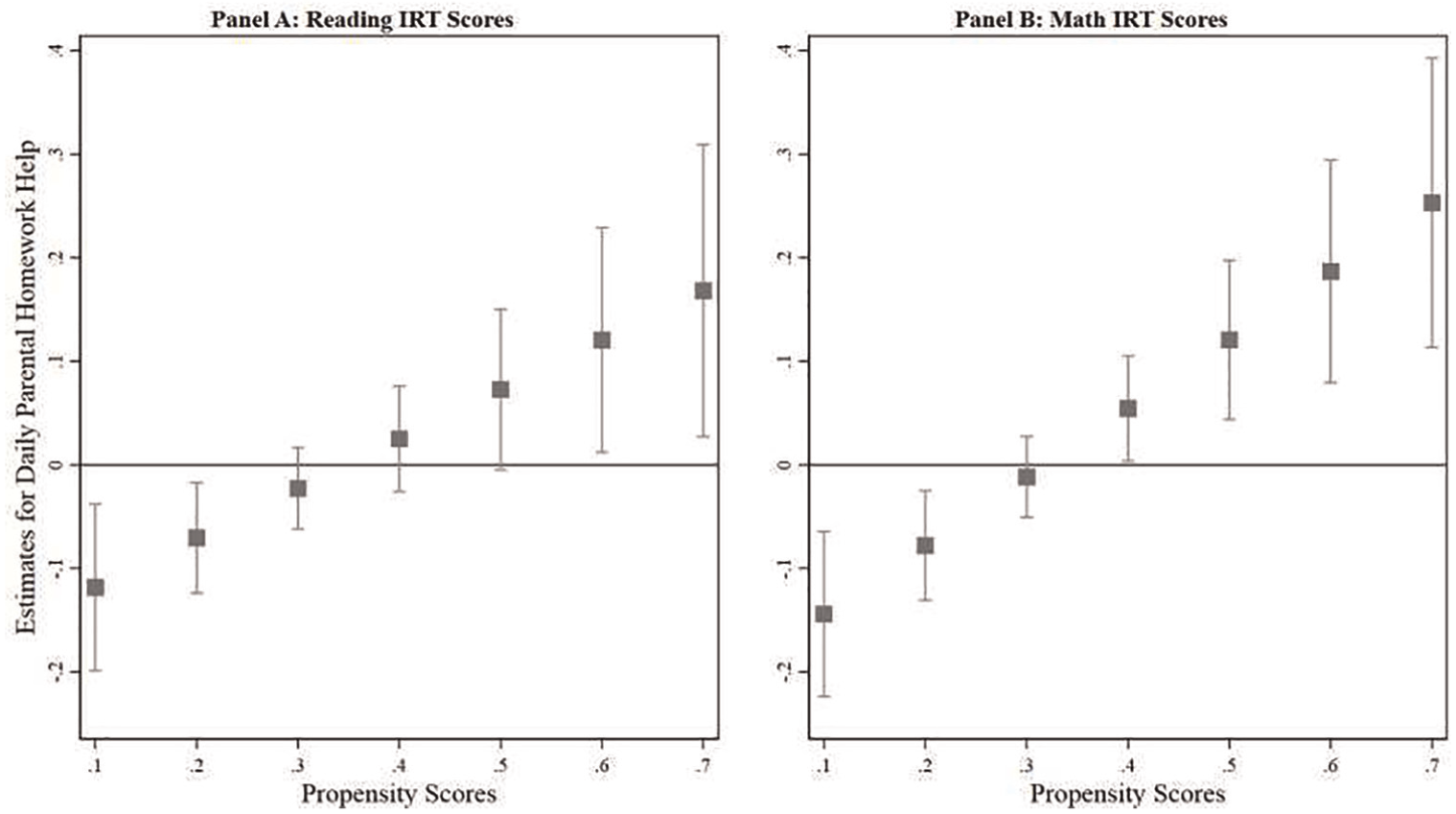
The Relationship between Daily Parental Homework Help in First Grade and Reading and Math Achievement in Third Grade by Varying Propensities to Provide Daily Homework Help.
Conclusions
Education policies promote parental involvement as a lever for raising student achievement (Epstein 2001, 2005; Henderson and Mapp 2002). In the case of parental homework help, however, observational studies using national datasets report either a negative or null relationship between parental homework help and student achievement (Hill and Tyson 2009; Moroni et al. 2015; Robinson and Harris 2014). Yet this prior work tends to overlook possible heterogeneity in this relationship based on parents’ propensity to provide homework help. To address this gap in the literature, this study used a propensity score–based approach. Statistical patterns indicate that socioeconomic disadvantage, minority status, and low academic achievement are associated with a high propensity to provide daily homework help, net of other background factors. Furthermore, the relationship between daily parental homework help and academic achievement is positive for children whose parents have a high propensity to provide daily help. These patterns remained consistent across a number of supplementary analyses.
Socioeconomic disadvantage, minority status, and low achievement appear to be important factors underlying the provision of daily parental homework help. Our finding of high reported rates of daily homework help among socioeconomically disadvantaged minority families of children with low achievement aligns with patterns observed in prior scholarship (Lee and Bowen 2006; Robinson and Harris 2014; Roksa and Potter 2011). Previous literature offers insight into contextual conditions that may be behind these patterns. Chin and Phillips (2004), for example, find that low-income minority parents may become active participants in their children’s education when activities are relevant and do not require substantial social, cultural, or economic capital. By potentially requiring less social, cultural, and economic capital, homework help may be an accessible form of parental involvement. Low-income minority children also have a comparatively high likelihood of attending low-performing schools, which might lead their parents to intervene more regularly at home to counter a perceived lack of quality education at school (Brock and Edmunds 2010; Buckley and Schneider 2009). In this respect, parental homework help may be part of a logical decision-making process as parents whose children have low achievement may attempt to address immediate academic concerns by helping with homework.
Our results indicate that the factors underlying a high propensity to provide daily homework help may be connected to improved academic achievement. When children are struggling during early elementary school, daily parental homework help may cultivate positive routines, learning behaviors, and parent-child relationships (Drummond and Stipek 2004; Hoover-Dempsey et al. 2001). Along with low achievement, socioeconomically disadvantaged children are also more likely to attend underperforming schools, which could amplify the importance of parents’ routine assistance with academic material (Jeynes 2011; Quadlin 2015). Our findings offer some support for the idea that children with low achievement in socioeconomically disadvantaged contexts may benefit from intensive academic support from their parents (see Callahan et al. 1998; Cheadle 2009; Covay and Carbonaro 2010; Domina 2005; Jeynes 2011). Propensity score–based estimates indicate that the benefits of daily parental homework help could have a small compensatory role for children between first and third grade. Therefore, broad assumptions based on negative correlations observed in national data that parental homework help is a waste of time or even harmful may be unwarranted (Robinson and Harris 2014). At the policy level, such a message could be harmful if parents change their behavior and stop helping their children with homework. Small improvements in student achievement derived from parental help with homework during early elementary school may even accrue over time, leading to greater long-term benefits (Lee and Bowen 2006).
Calls to cease helping with homework may be unjustified, but an emphasis on simply increasing the frequency of parental help with homework may also be unwarranted. Schools should also communicate effective strategies for parents to use when assisting with homework (Dumont et al. 2014; Jeynes 2018; Mapp et al. 2008). In addition, it remains unclear whether daily parental homework help is beneficial for all children. Although not the focus of this study, socioeconomically advantaged white parents whose children had relatively high achievement had a low propensity to provide homework help, and we found a negative association between daily parental homework help and academic achievement when parents had a low propensity to provide daily help. Children from affluent families may respond negatively to daily parental homework help—a possible symptom of parental over-involvement whereby a child’s self-efficacy and independent learning behaviors may be stymied (Hays 1996; Kohn 2007; Rosenfeld and Wise 2001; Thompson and Barker 2005).
In this study, the propensity score–based analysis offers a nuanced approach to examining the relationship between parental homework help and student achievement in national data. Nevertheless, several limitations must be noted. First, parents may overestimate how often they help with homework. If systematic group heterogeneity exists in this respect, estimates may be biased. Second, because the self-selection process behind daily homework help is not randomized, heterogenous associations between daily parental homework help and reading and math achievement may be tainted by an inability to control for unobserved confounders (Heckman 2005; Morgan and Winship 2007). If unobserved intangibles, such as love, emotional support, and commitment, are positively associated with academic achievement and daily homework help, analyses may overestimate the positive relationship between daily parental homework help and student achievement for groups with a high propensity to provide daily homework help. Third, this study investigates daily homework help, placing an analytic focus on the frequency of homework help. Yet the quality of parental homework help could be more valuable than the frequency with which it is provided (Dumont et al. 2014; Moroni et al. 2015). If parents who provide more effective homework help tend to do so less frequently, our analyses could underestimate the relationship between parental help with homework and student achievement. Taken together, these limitations underscore a need for cautious interpretation of this study’s results.
Despite these caveats, this study contributes to the literature by showing that the propensity to provide daily parental homework help is a complex process, whereby low achievement, minority status, and low socioeconomic status are associated with an increased likelihood of providing daily homework help. This work further suggests that children of parents with a high propensity to provide daily homework help benefit academically from daily homework help. To build on this study, future research could examine the contextual circumstances driving other forms of parental involvement and determine whether the influence of other parental involvement activities on academic achievement varies based on the propensity to undertake particular forms of involvement.
Supplemental Material
DS_10.1177_0038040719867598 – Supplemental material for Is Daily Parental Help with Homework Helpful? Reanalyzing National Data Using a Propensity Score–Based Approach
Supplemental material, DS_10.1177_0038040719867598 for Is Daily Parental Help with Homework Helpful? Reanalyzing National Data Using a Propensity Score–Based Approach by Angran Li and Daniel Hamlin in Sociology of Education
Footnotes
Appendix
Description of Variables of Analysis, Early Childhood Longitudinal Study–Kindergarten Class of 2000–2002.

| Variables | Descriptions/Question Wording/Coding |
|---|---|
| Reading item response theory (IRT) scores | Child’s composite IRT reading score in third grade |
| Math IRT scores | Child’s composite IRT math score in third grade |
| Daily parental help with homework | During the spring of the first-grade school year, did parents help child with homework five or more times a week? (1 = yes; 0 = no) |
| Prior academic achievement | |
| Prior reading IRT scores | Child’s composite IRT reading score in first grade |
| Prior math IRT scores | Child’s composite IRT math score in first grade |
| Sociodemographic background | |
| Female child | 1 = female child; 0 = male child |
| Child’s race | White child is the reference group; four dummy variables for Black child, Hispanic child, Asian child, and other race child |
| Parents’ age | Average age in years of the residential mother and/or father |
| Parents’ SES | Constructed by National Center for Education Statistics, composite scale of parents’ socioeconomic characteristics (e.g., parental education, income, and occupation) |
| Family structure | Two-parent biological family is the reference group; three dummy variables for two-parent other family, single-parent family, and other family type |
| Number of siblings | Number of siblings (excluding the child) |
| Other covariates | |
| Parents’ educational expectations | How far in school do parents expect the child to go? Responses are coded as years of education, ranging from 8 (less than a high school diploma) to 23 (finish a PhD, MD, or other advanced degree). |
| Home educational activities | z-score measure; Composite variable based on the following items (α = 0.70): In a typical week, how often do parents do the following with the child? (1) tell stories; (2) sing songs with child; (3) help with arts and crafts; (4) play games or do puzzles; (5) talk about nature or do science projects; (6) practice reading, writing, or working with numbers; (7) read books to child (1 = not at all; 4 = everyday). |
| Parents’ school involvement | IRT score measure of seven items: During the school year, have parents ever (1) attended an open house or back-to-school night; (2) attended a meeting of a PTA, PTO, or parent-teacher organization; (3) gone to a regularly scheduled parent-teacher conference; (4) attended a school or class event, such as a play, sports event, or science fair; (5) volunteered at the school or served on a committee, (6) participated in fundraising for child’s school (1 = yes, 0 = no). |
| Extracurricular activities | Number of extracurricular activities: Outside of school hours, has child ever participated in (1) dance lessons? (2) organized athletic activities? (3) organized clubs or recreational programs? (4) music lessons? (5) art classes or lessons? (6) organized performing arts programs? (1 = yes, 0 = no) |
| Parents’ communication | z-score measure; Composite variable based on the following items (α = 0.77): (1) Even if I am really busy, I make time to listen to child; (2) I encourage child to talk about his/her troubles; (3) I encourage child to tell me about his/her friends and activities; (4) I encourage child to express his/her opinions (1 = never, 4 = very often). |
| Parents’ belief on academic performance | z-score measure; Composite variable based on the following items (α = 0.72): Compared to other children in the class, how well do parents think their child is doing in school this semester in (1) reading/language arts and (2) math (1 = much worse; 5 = much better). |
| Approaches to learning | Composite variable, including items that rate the child’s attentiveness, task persistence, eagerness to learn, learning independence, flexibility, and organization. |
| Internalizing problems | Composite variable of the presence of anxiety, loneliness, low self-esteem, and sadness. |
| Externalizing problems | Composite variable of the frequency with which a child argues, fights, gets angry, acts impulsively, and disturbs ongoing school activities. |
| Attending private school | 1 = yes; 0 = no |
| Region | Northeast is the reference group; three dummy variables for Midwest, South, and West |
| Residential area | Large and midsize urban area is the reference group; two dummy variables for suburban/large town and small town/rural area |
Acknowledgements
We thank Simon Cheng, Jennie Brand, Scott Davies, and Mengchen Liu for their helpful feedback on the early versions of the paper. We also thank the editor Linda Renzulli and the anonymous reviewers for their comments on improving this article.
Research Ethics
The presented research was conducted using publicly available data from the Early Childhood Longitudinal Study, Kindergarten Class (ECLS-K). All human subjects gave their informed consent prior to their participation in the ECLS-K data collection, and adequate steps were taken by National Center for Education Statistics (NCES) to protect participants’ confidentiality. Thus, it was not subject to review by the institutional review board for the protection of human subjects.

Supplemental Material
The supplemental material is available in the online version of the journal.
Notes
Author Biographies
References
Supplementary Material
Please find the following supplemental material available below.
For Open Access articles published under a Creative Commons License, all supplemental material carries the same license as the article it is associated with.
For non-Open Access articles published, all supplemental material carries a non-exclusive license, and permission requests for re-use of supplemental material or any part of supplemental material shall be sent directly to the copyright owner as specified in the copyright notice associated with the article.
