







Abstract
Past work and college–access programs often treat college knowledge as discrete pieces of information and focus on the amount of available college information. I use ethnographic and multiwave interview data to compare college–aspiring working- and middle–class black 9th and 11th graders across almost two years in high school along with their post–high school updates. Respondents were exposed to college–going messages but faced racial constraints and unclear expectations for college preparation and help seeking. Working-class respondents drew on hopeful uncertainty—a repertoire of hope for college admissions but uncertainty in the specifics—and they waited for assistance. Twelfth-grade working–class respondents experienced the effects of counseling problems and frustrations near application time. Middle-class and some working–class respondents used a repertoire of competitive groundwork to improve their competitiveness for four–year admissions, targeting their help seeking to navigate impending deadlines and late–stage counseling problems. My findings point to the timing and process of activating repertoires of college knowledge within a high school counseling field, suggesting the need to reconceptualize college knowledge in research on racial and class inequality in college access.
Keywords
Despite widespread four–year college aspirations, black students and students from non–college–educated households remain underrepresented in four–year colleges and less likely than their more privileged peers to apply to selective institutions (Redford and Hoyer 2017; Schneider and Saw 2016). Past work suggests unequal access to college information, in part, explains these disparities in higher education (Ehlert et al. 2017; Holzman, Klasik, and Baker 2019). For example, research highlights racial and socioeconomic disparities in high school counseling and in the quantity and quality of college information reported by students and parents (McDonough 1997; Petts et al. 2020; Roderick, Coca, and Nagaoka 2011; Tierney and Venegas 2009). Other work suggests improved access to college information, such as for understanding financial aid and college payoffs, can increase the likelihood of low–socioeconomic status (SES) students applying to four–year colleges, controlling for other factors (Bryan et al. 2017; Ehlert et al. 2017).
Many college–access programs also focus on improving the amount of available college information (Dávila, García Pérez, and Vargas 2020; Perna, Walsh, and Fester 2011). In doing so, these programs typically conceptualize college knowledge as the possession of discrete pieces of information for making “college choices” (Conley 2005; Perna 2006). Such a focus obscures the diverse ways students make sense of college information and messaging, especially in the current college–for–all era, when students are bombarded with college attainment messages (M. Holland 2019; Ovink 2017). Additionally, we know little about how students activate interpretations of college information at different points in their high school counseling relations. Using theories of cultural repertoires, capital, and fields of power relations (Bourdieu 1986; Bourdieu and Wacquant 1992; Swidler 1986), I argue that college knowledge is not static information acquired through reading or conversing at single time points. Rather, it is part of evolving cultural repertoires or “tool kits” of knowledge, ideas, and rituals related to four–year admissions preparations and shaping sequences of action that “might allow one to reach several different life goals” (Swidler 1986:277).
I use ethnographic and multiwave interview data to compare the accounts, experiences, and strategies of college–aspiring working- and middle–class black 9th and 11th graders across two years at Hillside, a public California high school, along with post–high school updates. I contribute to past research by examining the following questions: What college preparation knowledge, ideas, and rituals do working- and middle–class black students draw on during early (9th/10th grade) high school? What are the accounts and experiences of older (11th/12th grade) working- and middle–class black students related to college knowledge, preparations, and counseling? What are the implications for racial and class inequality? Using data on younger and older black students’ discussions and deployment of “college knowledge” across time, I connect cultural repertoires to a high school counseling field where informal “rules” for engagement are both general and dependent on time–specific circumstances in admissions and counseling cycles. I show how field struggles are amplified during a specific time: fall of 12th grade. I highlight the timing and process of deploying repertoires of college knowledge, suggesting the need to reconceptualize college knowledge in research on racial and class inequality in college access.
I demonstrate how respondents were exposed to college–going messages but faced unclear expectations for college preparation and counseling relations at Hillside. Most working–class 9th and 10th graders drew on hopeful uncertainty—a repertoire of hope for their success in college admissions preparations but uncertainty in the timing and specifics. With hopeful uncertainty, most 11th- and 12th-grade working–class respondents waited for guidance and focused on passing or improving grades, but they experienced problems and frustrations near application time. In contrast, middle–class and some working–class 9th and 10th graders used a repertoire of competitive groundwork to improve their competitiveness for four–year admissions. Their older counterparts deployed early knowledge and preparations that helped them navigate time–specific tasks and counseling problems near application time.
Cultural Repertoires, Field Theory, and Capital
Culture theorists suggest individuals activate available repertoires of knowledge, ideas, and rituals when navigating ambiguous, complicated, or shifting institutional expectations (Calarco 2014; Swidler 1986). For example, Calarco (2014) demonstrates how elementary–age students respond to shifting teacher expectations based on their class–based help-seeking repertoires. Other studies show how middle–class parents use deep knowledge reserves when managing school admissions bureaucracies or how first–generation college students (FGCS) utilize high school repertoires when confronting complicated college–level coursework (Garza and Van Delinder 2020; Lareau, Adia Evans, and Yee 2016; Yee 2016). Thus, individuals activate cultural repertoires in response to institutional expectations and experiences. Specific cultural repertoires operate as capital based on the norms and standards imposed by the dominant group within a “field” of power relations (Bourdieu 1986).
A field is a “configuration of relations between positions . . . objectively defined, in their existence and in the determinations they impose upon the occupants, agents or institutions” (Bourdieu and Wacquant 1992:97). These relations involve exchanges and struggles that define the “rules” or “regularities of the game” for institutional systems, like college admissions and counseling (Bourdieu and Wacquant 1992). In today’s college–for–all era, when a bachelor’s degree has become a ubiquitous goal, college–aspiring students must navigate the four–year admissions field, or the context of colleges/universities and their formal and informal admissions criteria and expectations. California, the nation’s largest public higher–education system, includes four–year University of California (UC) and California State University (CSU) campuses and two–year community colleges. During my study period, for UC/CSU eligibility, residents had to meet 15-year-long “A-G” course requirements (beyond high school graduation requirements) with C-or-above grades (UCs expect higher grade point averages [GPAs]) along with specific SAT or ACT requirements involving deadlines between October and early December. 1 Online websites and guides, including Hillside’s, recommend additional courses for “competitive candidates.” Fewer than half of California’s seniors complete A-G requirements, and black and Latinx students have the lowest completion rates (Gao and Johnson 2017). Although UCs no longer require SATs or ACTs, they still accept scores for course placements and satisfying A-G requirements. UC applications also ask for extracurricular activities, honors/awards, and personal essays/responses as part of selective universities’ evolving expectations for “competitive” applicants (Stevens 2009).
Nonwealthy applicants must also navigate lengthy, bureaucratic steps, such as Free Application for Federal Student Aid (FAFSA), scholarship, loan, and fee–waiver forms. Scholarship applications also typically require essays and letters of recommendation. Research suggests the complexities of FAFSA and other procedures create barriers for low-SES students (Bettinger et al. 2012; Tierney and Venegas 2009). Students applying to community colleges also confront financial–aid and placement–test deadlines and forms. Beyond formal requirements, implicit “rules” for navigating complex deadlines and payment and admissions procedures benefit white, upper- and middle–class families with extensive cultural and social capital (M. Holland 2019; Weis, Cipollone, and Jenkins 2014; Wolniak et al. 2016). Thus, given that “knowledge, skills, and tastes are not inherently valuable,” college entrance fields shape the value of college–related repertoires (Yee 2016:834).
Field struggles also exist in schools due to “open-door” policies, or a lack of clear expectations for help seeking—expectations that implicitly place heavy responsibilities on students (Calarco 2014). When facing their own responsibilities and pressures, educators may not make concerted efforts to address racial and class inequality, unintentionally advantaging privileged students who have been coached to proactively request and secure assistance (Calarco 2018; Jack 2016; Lewis and Diamond 2015). In schools with limited counseling resources, such as Hillside, students compete for the time and support of overworked staff. I use field theory to explain why certain repertoires are activated and valued at specific points in time within Hillside’s college–counseling field, providing insights on inequality in college access.
Activation of College Knowledge
Using Hossler and Gallagher’s (1987) college–choice model, past research tends to narrow college information gathering and preparations to three linear stages: (1) aspiration, (2) search, and (3) choice (Bell, Rowan-Kenyon, and Perna 2009; Hossler, Vesper, and Schmit 1999). As students acquire more college information, they move to the next stage. The aspiration stage occurs near 9th and 10th grades, when students “aspire” to attend college. Usually around junior year, students “search” for colleges, develop an application list, and engage in college preparations. Finally, students “choose” a college during 12th grade. Other work highlights the layered school/community, higher–education, and societal/policy contexts surrounding students’ decisions, but this research still concentrates on the accuracy and quantity of college information for “college choices” (Perna 2006).
Focusing on information gathering obscures differences in how students deploy college knowledge and the power relations shaping when forms of knowledge retain value given the institutional “rules of the game.” Research on “funds of knowledge” demonstrates how students of color, often FGCS, utilize support from outreach programs, parents, siblings, and other family members in ways overlooked by educators and policy makers (Ceja 2006; N. Holland 2017; Kiyama 2011). These support systems are important college motivators and help mitigate the exclusionary forces that affect students of color and FGCS (Farmer-Hinton 2008; Mitchall and Jaeger 2018). Other research suggests today’s public school students are exposed to multiple, often mixed, college admissions information, creating diverse interpretations and responses (Shamsuddin 2016). This research shifts attention from the “accuracy” and “quantity” of college information to how students of color and FGCS interpret and deploy their funds of knowledge during college transitions. However, we know less about how students of color and FGCS interpret and deploy college knowledge when seeking school–based guidance.
When students deploy college knowledge is also important given the ebb and flow of college counseling and the stepwise nature of college admissions procedures. For example, middle-/upper-middle-class parents often engage in early college planning, encouraging their children to do so before high school (Hillman, Gast, and George-Jackson 2015; Weis et al. 2014). High-SES parents enroll their elementary and middle school children in talented/gifted programs, honor societies, and extracurriculars to enhance future “college dossiers” and ensure Honors/Advanced Placement (AP) course placement. Such actions can facilitate advantaged high school students’ “college enhancement strategies,” including AP and SAT exam preparations (Espenshade, Radford, and Chung 2009; Wolniak et al. 2016). Given the stepwise nature of application components, early planning facilitates success in later steps (Klasik 2012). Furthermore, advantaged students learn to approach college admissions as a competition, where students hone academic edges to improve admissions chances at selective universities (Silva and Snellman 2018). When advantaged students learn early messages about college competitiveness and the necessity of preparatory work, this could affect how and when they deploy college preparation repertoires in high school. Given that repertoires shape “sequences of action,” it is important to examine how repertoires interact with the counseling field across time but also during the crucial period of fall of 12th grade.
Race, Class, and the High School Counseling Field
When educators and institutions consistently respond to the strategies of dominance of white middle-/upper-middle-class students and parents, such interactions configure future “rules of the game” (Calarco 2018; Lewis and Diamond 2015). Research on counseling suggests middle–class students benefit from prior college preparations when approaching counselors (Hardie 2018; Holland 2019); however, few studies concentrate on intersections of race and class and the timing of counseling perceptions and experiences. Quantitative cross–sectional college-counseling studies also have not analyzed how student negotiations and experiences progress in high school (Belasco 2013; Robinson and Roksa 2016).
Quantitative studies do reveal racial and class disparities in associations between counseling and college applications, recommending equitable and early counseling for low-SES and black students (Belasco 2013; Petts et al. 2020; Robinson and Roksa 2016). However, past research typically does not explicate how race and class intersect in black students’ counseling and college preparation negotiations (see, however, Carey 2019; Farmer-Hinton 2008). Given implicit, contextual expectations for help seeking in schools, we must examine how black students navigate counseling expectations and the evolving power dynamics. Furthermore, low-SES black public school students experience multiple forms of disempowerment within educator relations dominated by white, middle–class ideologies and standards (Gast 2018; Jack 2016). I contribute to this literature by analyzing how black students’ college preparation repertories translate to disempowerment or empowerment in a college–counseling field.
Data and Methods
Research Site: Hillside High
Hillside is a medium–to–large school in a diverse, public California district. 2 One-third of students receive free or reduced–price lunch, and a majority are racial–minority students; there are about 40 percent black and 20 percent white students, with smaller percentages of Asian, Latinx, and multiracial/other populations (based on state data). Hillside draws from segregated neighborhoods: a majority–white, middle-class suburb and a city with predominantly low–income, racial-minority populations. Half of Hillside’s seniors, mainly white and Asian American students, attend four–year colleges. Hillside has mainly white staff: two part–time white counselors, a few white college/career-center staff, and two full–time white counselors—each serves more than 500 students. Before the part–time counselor appointments, the two full–time counselors served roughly 1,000 students each. Black students (predominantly FGCS) have the highest disciplinary rates and lowest average grades, A-G completions, and Honors/AP class enrollments compared with other groups; thus, black student–educator relations exist within this context of racial/class stratification (see Gast 2018). During my study period, 55 to 65 percent of seniors took the SAT. The school did not provide racial demographics of SAT takers, but district data show black students average the lowest SAT scores of any group.
Multiple and Multiwave Interviews and Fieldwork
Over three years, I conducted three interview waves and short updates near or after graduation with self–identified black 9th and 11th graders, which I call the “core group.” 3 First, in winter/spring 2007, I observed and surveyed students in 9th- and 11th-grade classes to develop rapport, observe educator–student relations, and collect demographic and college aspirations information. Among the 79 surveyed black students, I selected 9th and 11th graders who planned to attend college (an aspiration shared by most), averaged C-or-above grades, and turned in consent forms, resulting in 44 initial spring 2007 interviews.
From the 44 black students, I selected the core group of 25 students for fall 2007 (wave 2) and Spring 2008 (wave 3) interviews using social–class categories reflecting parental education and occupation statuses within the U.S. class hierarchy and, for 11th graders, using curricular track (Lareau and Horvat 1999; McDonough 1997). Curricular tracking did not exist yet for 9th graders. I sought general–education and Honors/AP 11th graders across social–class background, but I ended up with very few working–class Honors/AP and middle–class non-Honors students given Hillside’s stratified curricular system (see Table 1 and Gast 2018). Seven “middle-class” (three 9th-grade/four 11th-grade) students had at least one parent/guardian with a bachelor’s degree or higher and a professional/managerial occupation (e.g., engineer or lawyer). Ten “working-class” (five 9th-grade/five 11th-grade) students had one or more (half with single) parents/guardians in blue–collar positions, including medical assistants and police officers, with no bachelor’s degree but possibly an associate’s degree. Seven “lower-working-class” (three 9th-grade/four 11th-grade) students had one or more (mainly single) parents/guardians with no more than a high school diploma and a low–wage position (e.g., construction worker or bus driver). The sample had more girls than boys (16 vs. 9). I did not find significant differences between working–class and lower–working–class students on the themes discussed here, so I combined them and noted exceptions.
Interviews.
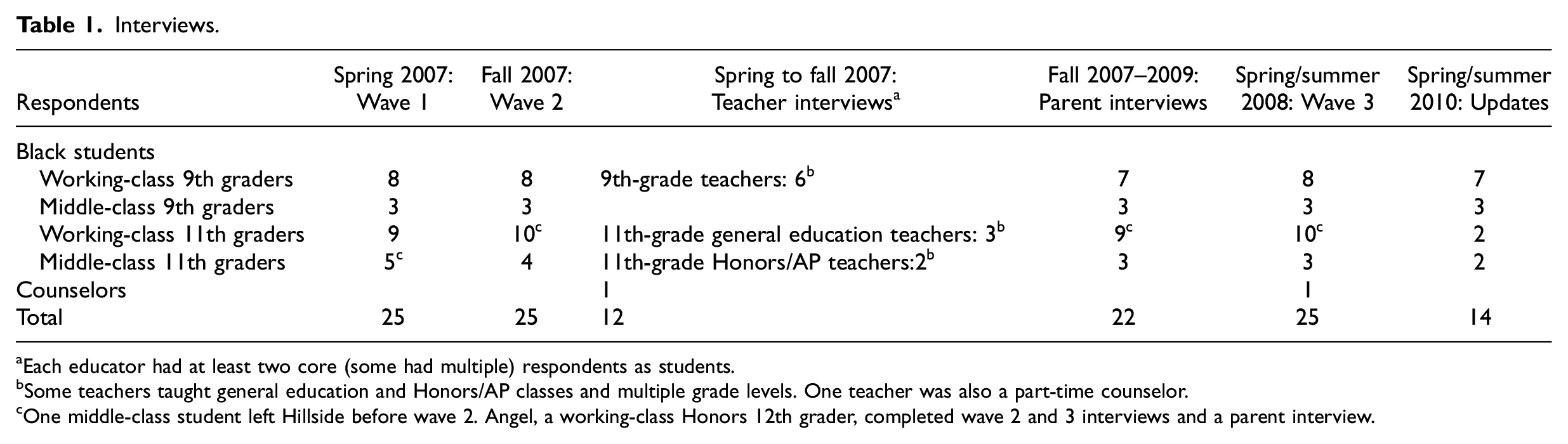
Each educator had at least two core (some had multiple) respondents as students.
Some teachers taught general education and Honors/AP classes and multiple grade levels. One teacher was also a part–time counselor.
One middle–class student left Hillside before wave 2. Angel, a working–class Honors 12th grader, completed wave 2 and 3 interviews and a parent interview.
I followed the core group between and after classes, obtained their transcripts, and conducted wave 2 interviews and interviews with one parent/guardian (for 22 students), mainly during fall of 10th or 12th grade. I added an Honors/AP working–class 12th grader (a friend of respondents) during wave 2. I conducted wave 3 interviews (24) when respondents were completing 10th or 12th grade (see Table 1). Two years later (spring/summer 2010), I received short updates by phone, email, or messaging from 14 core respondents. Student interviews involved questions on perceptions of educators; barriers affecting African American students; contact with and help from educators; college and course–scheduling information, preparations, and aspirations; and other questions about academic achievement. For later interviews, I adapted questions to reflect information from prior interviews and accommodate changing student experiences. With parents, I asked about perceptions of and contact with educators and counseling systems, barriers affecting African American students, and college information, expectations, and concerns.
I also interviewed the core group’s teachers (11; mainly during students’ 9th or 11th grade), one counselor, and a career–center counselor (during students’ 10th or 12th grade). One interviewed teacher also served as a part–time counselor. Thus, I interviewed almost all of Hillside’s counselors. In teacher/counselor interviews, I asked about student contact and relationships (when possible, about core respondents), ideal types of college–counseling relationships, racial and class–related factors, and the provision of college information and guidance. All in–person interviews used in–depth, semistructured protocols and were recorded and transcribed, except for one interview where I wrote/transcribed notes. Supplementary data include deidentified schoolwide data on parental education from students’ information cards, school observations (e.g., during college and financial–aid presentations), informal conversations, and schoolwide counseling–office emails and documents.
As a young–looking Asian American woman, my race, gender, and university connection likely affected my interactions and how others perceived my position as a “college student” (Gast 2018). Many identified me as a student intern or a college tutor, and some mistook me for a high school student. I wore a staff ID card required by the school district but dressed in casual attire and had students call me by my first name. I did not share a white identity with most teachers, and my “college student identity” facilitated some discussions about college but limited others. My prolonged presence at Hillside and youthful identity did appear to ease comfort levels and informal conversations.
Data Analysis
Using ATLAS.ti, I systematically read through all transcripts and field notes, focusing on the topics of educator–student relations, counseling, and college information and preparations (e.g., types of family- and school–based information). I then created more focused codes and memos representing themes like timing of and responses to college information, approaches to college preparations, and counseling sources, experiences, problems, and frustrations. I summarized these data using tables organized by each core–group student, grade level, and class, paying attention to counseling perceptions and experiences at different time periods. Using those tables and code reports, I compared patterns within and across grades and class categories, developed and revised memos, incorporated notes from literature, and noted confirming and disconfirming evidence (Charmaz 2006). Overall, this included a series of back–and–forth and sequential steps with coding, memoing, summarizing, tabulating, and rereading notes, reports, and transcripts (Emerson, Fretz, and Shaw 1995).
Findings
“College Admissions Is a Family Affair”: Hillside’s College-Counseling Field
Busy educators, mass messages, and vague expectations
Like many public schools, Hillside promoted four–year college aspirations for all students through classroom posters (e.g., “You Can Go to College! A-G Requirements”), gym information nights, and loudspeaker and email announcements (see also Gast 2016; M. Holland 2019; Monaghan, Hawkins, and Hernandez 2020). Almost half of schoolwide emails mentioned four–year colleges, including university representatives and deadlines. University flags covered walls and ceilings, symbolizing Hillside’s four–year–college emphasis. However, with high counselor–student and teacher–student ratios, educators placed responsibilities on students and parents to proactively research colleges and their requirements. Emails, guides, and announcements frequently stated, “College Admissions is a Family Affair!” and “DO YOUR RESEARCH.” Hillside’s student handbook included similar phrases with long tables of A-G and SAT/ACT information, “useful websites” lists, and footnotes annotating A-G stipulations.
Hillside counselors faced bureaucratic and immediate tasks (e.g., course scheduling, college entrance/exit and standardized tests, and letters of recommendations; see also Blake 2020), especially each fall near application deadlines. Except for one half–hour 10th grader–counselor meeting mandated by California Senate Bill 813, Hillside lacked individual guidance opportunities, especially for 9th and 10th graders. Counselors wanted to advise 9th and 10th graders, but they lacked follow–up time and capacity. Ms. Colton (white counselor) thus looked to other adults: “That’s where teachers and parents come in to reinforce . . . what they need to do to go to college.”
Yet, teachers were overworked and focused on curriculum, testing, and other tasks. Teachers indicated their role in helping students “think about college,” but they relied on counselors and parents to assist students. Teachers brought in counselors for short classroom presentations, such as one titled “4-Year High School Plan,” where a counselor emphasized but rushed through A-G courses without further guidance: “There are two ways to go through high school: Take the A-G classes and, by taking those classes, you can go to a four–year college. Or, if your parents will support you, you can stay home and do nothing.” Other than during counselor presentations, I rarely observed or heard of 9th- and 10th-grade discussions of requirements and steps for college entrance. College-related conversations by 9th- and 10th-grade teachers were unplanned, sometimes involving their alma mater or the necessity of independent–study skills in college. Overall, educators promoted four–year college going but, with constraints, provided mass, sometimes vague, messages on how to prepare for college entrance.
Hillside assumptions and expectations normalizing inequality
Expectations for help seeking occurred through mass classroom messaging and informal conversations. During a counselor presentation, Mr. Paulsen, a black 11th-grade teacher, noted his availability during lunch. He later told me he wanted students to “independently” conduct college research: Students should “be informative, let me know how they’re doing and what they need.” Although Mr. Paulsen shared these expectations with me, I did not observe him explain to students what “independently” conducting research meant. During that same presentation, the counselor urged students to “start thinking now about which teachers to ask” for recommendation letters (not specifying that letters are private or program–specific requirements). When students started asking Mr. Paulsen for letters, he simply answered “Sure” and ended the conversation. Eleventh- and 12th-grade teachers and counselors also promoted the career center and “drop-in office hours” or appointments for college and other advising, inviting students to come with “any questions” (see also Monaghan et al. 2020). When Keesha, a working–class respondent, approached an 11th-/12th-grade Honors/AP teacher about adding a course, he responded, “Come to me during my office hours; it’s like office hours that professors have in college.” Teachers of 9th and 10th graders were less explicit, as they did not hold office hours for assistance. Thus, educators made subtle references to the benefits of preparedness and initiating counseling relations, but they did not explicitly inform students of these expectations or the “rules of the game” for acquiring college assistance (see also Calarco 2018).
Because 9th- and 10th-grade teachers rarely discussed, and did not explain steps for, college entrance advising, students were left to assess when, how, and whom to approach. Outside of 10th-grade-mandated counseling meetings, one–on–one college–counseling interactions were typically initiated by students or parents. For example, one early fall day, Celina, a middle–class 10th-grade respondent, wanted to add a class. When counselors were unavailable, she entered the main office, where the principal was talking to staff. Staff introduced Celina to the principal, and Celina mentioned her interest in adding a course to help with “UC admissions.” He was impressed by her proactiveness and responded, “Oh yeah, I like the way you going!” Celina followed him to his office with another administrator and later reported, “They made sure I was doing my A-G requirements, planned my 11th- and 12th-grade course schedules—all semesters.” As I will discuss, middle- and some working–class respondents benefited from early selective–university knowledge and engagement in approaching educators.
Educators implicitly expected proactiveness among all students, but they also normalized middle–class white students’ college preparedness, given that most white students had college–educated parents and most black students did not (based on school data). Seventy-five percent of white seniors met the A-G requirements, compared with 29 percent of black seniors. Counselors, like Ms. Colton, linked parental education to college knowledge: “We do know the parents with the experience in education ask the more sophisticated questions. It’s not like, ‘Are we going to college?’ It’s ‘Which one is more prestigious?’” Yet, Ms. Colton then indicated that families had equal opportunity to access college information by describing an involved low–income, homeless parent: “She comes in with her daughter to make sure that they know everything and have everything that they need for her to go to college, and they are homeless.” Such assumptions indicate educators’ lack of focus on addressing racial and class–related barriers given the diverse school population.
While sifting through forms, Ms. Gordon (white, career–center staff) lamented the small percentage of 11th graders completing SAT fee–waiver forms: “They just don’t want to take responsibility; they don’t want to become adults.” Ms. Gordon also referenced the hundred or so incomplete financial–aid GPA verification forms, noting that Janice, a middle–class respondent who was “on track for college” with “a lawyer mom,” was someone who completed forms. The work of following up with low–income students facilitated Ms. Gordon’s appreciation for “on-top-of-it students,” in this case, defined through Janice’s middle–class, “on-track-for-college” status. Similarly, Ms. Oakley (white, career–center counselor) reported that black families were continually absent from college workshops, even after advertising in urban black churches. Shaking her head, Ms. Oakley said, “How do you bong them on the head and say, ‘Hey! Here’s something that . . . will help you!’ . . . They have to make it.” Educators invoked meritocratic language while implicitly linking the “imputed cultural choices” of low–income people of color to student and parent engagement (Bonilla-Silva 2017; Cobb 2017).
Hillside provided encouragement, guides (mainly for 11th and 12th graders), and 10th-grade meetings on A-G and other requirements, but Hillside placed responsibility on students to understand specificities in college entrance procedures and enhancing competitiveness through their own “research.” One day in the career center, staff discussed parents using private counselors, and I asked how nonwealthy families obtained college application assistance. Ms. Oakley replied, “Parents have to know how to do it.” During an interview, a middle–class father stated, “Most of the responsibility lies on the shoulders of the parents to create the right environment, motivation, and to work together with students.” However, educators did not fully instruct students and parents on the “right” preparatory work expected of them, especially for 9th and 10th graders. Additionally, class- and color–blind assumptions legitimated educators’ implicit expectations for proactiveness in help seeking and their lack of attention to racial and class inequality. In this counseling field, early preparation with outside guidance became valuable. I also discuss the counseling field for 12th graders as they approached application deadlines.
Working-Class Black Students in 9th and 10th Grades: Hopeful Uncertainty
Some black students had individual relationships with teachers, but across class and grades, black students recognized the busyness of educators, their mass counseling strategies, and the limited college counseling. A working–class 12th grader declared that counselors “just turn in kids’ class schedules” and never “really talked” about college. Similarly, a middle–class 12th grader described counselors as “for scheduling classes” and unavailable for college guidance. Others referenced A-G courses posters or counselor presentations but not one–on–one college conversations. Some also mentioned educator discrimination, such as a working–class 9th grader who stated how teachers “help other [nonblack] students” or another who described counselors’ low expectations for black students (see also Gast 2018). For various reasons, respondents repeatedly recognized a difficult counseling environment.
Most working–class black 9th and 10th graders were hopeful about college but largely unaware of what Bourdieu (Bourdieu and Wacquant 1992) calls the “rules of the game,” in this case, expectations that students should proactively “research” prior to seeking guidance for college preparations. Furthermore, these students were unfamiliar with competitive admissions processes and the specificities of preparatory steps, despite some students reporting selective–university aspirations. These students conveyed hopeful uncertainty—a repertoire of ideas and interpretations indicating the hope they would be admitted to college but uncertainty in the timing and specifics surrounding four–year preparations. This repertoire translated to waiting for assistance and focusing on immediate coursework and other concerns.
As 9th graders, all but one held four–year aspirations. Five aspired to attend selective universities, including Wesley, who sought a football scholarship at University of Southern California (USC). As a 10th grader with C+ grades, Wesley needed to enhance his A-G course grades, college entrance exam scores, and other requirements to pursue traditional USC admissions. However, he confused messages from teachers about needing “to get a C or higher in [his] junior and senior year” with the idea that he could wait to improve his grades. He did not feel comfortable approaching teachers and focused on football his sophomore year rather than college admissions preparatory strategies. When I interviewed Alfred, Wesley’s father, during Wesley’s 11th-grade year, Alfred acknowledged Wesley’s USC aspirations, but he knew little about USC admissions. Alfred, a single father who worked two jobs, said he would “wait and see” and hoped for counselor assistance: “I would like to see [college] happen. But, you know, whatever the circumstances are . . . then we’ll have to deal with that for college.”
Interviews with other working–class parents indicated their reliance on Hillside, given material and time constraints and unfamiliarity with complicated four–year structures. Their prior schooling and two-year/online-program experiences did not expose them to four–year structures. Rhonda, the mother of 10th grader Joelle, stated, “Honestly . . . I have no idea about what’s going on today! It’s hard because I do my things [classes] online.” She hoped Joelle would obtain assistance from Hillside for four–year preparations. Similarly, Sharise, the mother of 10th grader Summer, was hopeful but uncertain about college preparation specificities: “I don’t know. . . . I’m starting this just like she is. I’ve never had a teenager kid before. So, I’m just going to cross the bridge when I get to it.” Sharise also waited for Hillside’s guidance but was unsure of the timing: I’m hoping they can provide us with as much information, but I don’t know if, the teachers do that? Do they provide information about college? . . . Are they supposed to? . . . I don’t know, I haven’t been in high school for years. So, I don’t know how that works.
Influenced by parental “wait-and-see” uncertainties and Hillside’s messaging, working–class 9th and 10th graders waited for assistance. They aspired to four–year, often selective, universities, but they entered 11th grade without a clear understanding of and preparation for admissions steps. Calvin (9th grader) had UC aspirations based on football advertising—aspirations reinforced by teachers’ vague but encouraging messages: “Keep grades up and . . . stay focused.” During 10th grade, Calvin was unaware of UC GPA requirements and maintained a C average, below UC requirements. Like Wesley, Calvin noted, “It’s just my sophomore year,” believing he could begin preparatory work later. Latoya (during 10th grade) explained how she could not ask for college guidance because she felt teachers and counselors provided “typical” or general information, such as on A-G requirements, without further advising: “They give the typical answers . . . ‘You must take this. . . . You have to take Spanish two times in order to pass high school, but the four–year colleges prefer three, and blah, blah, blah, so on.’” Still, Latoya remained unclear about the necessary steps to meet those requirements.
Similarly, Kiara (10th grader) aspired to a UC but, other than competing classwork, waited to initiate college preparations and heard vague encouragements: “‘Make sure you get As and you’re gonna go.’ That’s it.” Kiara did not have counseling assistance and mistook the PSATs and high school exit exams for college entrance requirements, stating she did not need additional college entrance exams. Kiara was not alone: As 10th graders, other working–class students confused the SATs with district/state standardized tests or were unclear about other four–year requirements. Hillside educators’ college–for–all encouragements meant working–class black 9th and 10th graders received general information and messages like “stay focused” but not individualized assistance for four–year–admissions preparations. These students followed their parents’ hope for educator guidance but remained unclear on crucial steps, like A-G courses and SATs/ACTs.
Working-Class Black Students in 11th and 12th Grades: Compounding Problems and Frustrations
Working-class 11th-grade black students (eight respondents) conveyed hope but a lack of clarity in preparing for four–year–college admissions. These students provided accounts of hopeful uncertainty: They hoped educators would assist with college preparations but were unclear on Hillside’s expectations for help seeking. Seven aspired to attend a four–year college. Although some studied for SATs/ACTs and searched for colleges and scholarships online, most focused on immediate schoolwork and could have benefited from assistance, indicating how hopeful uncertainty translated to a sequence of waiting for assistance in Hillside’s counseling field.
As 12th graders, five respondents were still pursuing four–year colleges. Four of those four–year aspirants did not initiate crucial application components (like taking SATs/ACTs) and conversations with educators until 12th grade. Additionally, they struggled with navigating CSU versus UC requirements and financial–aid systems, and they faced complicating conditions, like low grades (they averaged 2.7 GPA), missing A-G requirements, or disciplinary actions, facilitating feelings of frustration and marginalization relative to educators. All reported not receiving or waiting for educator assistance while confronting immediate and compounding problems. By graduation time, four respondents planned to enroll in four–year universities, mainly CSUs, but one subsequently left that plan.
The five four–year aspirants encountered immediate problems with upcoming application deadlines, exhibiting frustrations and realizing they had received inadequate assistance from Hillside teachers and staff. For example, as a 12th grader, Cristina realized too late that her counselor had not informed her of a crucial requirement—the foreign–language A-G requirement for public universities: “I was just waiting for them to tell me when to take it [Spanish] and then it came around like senior year.” Cristina felt stressed by this inadequate assistance: “I just been doing all this on my own . . . because nobody’s really told me anything.”
Four of these five four–year–aspirants entered 12th grade without SAT/ACT scores and scrambled when deadlines approached. Four-year applicants needed to submit entrance exam scores by December (October was recommended), and as a result, these 12th graders had limited opportunities to improve their scores. Keesha took the SAT late in September during her 12th-grade year, but she took the wrong test: an SATII Subject Test, required for UCs rather than for CSUs. She blamed the lack of counseling guidance for the mistake: They should’ve checked my . . . registration paper. . . . Honestly, I don’t know too much about the SAT. I only know I was about to go in there and take it. And I was gonna take the test over again in December. . . . I was like, “Are you telling me I was sitting here the whole time taking a test I do not need ’cause I do not plan on going to no UC? And you didn’t check my paper like you were supposed to?”
With a 2.9 GPA, Keesha knew she needed to obtain high entrance exam scores for CSUs, but she now had only one chance to take the SAT, close to application deadlines: “To get into a state college, I gotta do pretty damn good on that test because my grades!” When interviewed close to graduation, Keesha had been admitted to a CSU, but she was frustrated because although she eventually met UC requirements, she had not applied to UCs because she had missed the deadlines and had no help with the personal essay. In senior–year conversations, Keesha described feeling rebuffed by educators who “don’t really care about how you do” and counselors who disregard “us minor people” during college application time, signifying the multitude of constraints affecting her relations with educators. That same year, Keesha’s counselor told me she wished Keesha would visit her office, further indicating the disconnection in Keesha’s counseling relationships.
Working-class parents, interviewed during fall of their children’s 12th-grade year, revealed feelings of disempowerment but still looked to Hillside for assistance. Shonta (guardian of Cristina) was wary of potential discrimination—“They think all black kids don’t want to go to college!”—and described family discussions of strategies to mitigate racism by educators. She encouraged Cristina to “work hard” and talk to other educators, given Shonta’s constraints and unfamiliarity with application processes: “I’m always working, so I’m barely home. I haven’t sat down. But I told her before she graduates, she gotta go see a counselor to talk about what she wants to major in and what she needs to do.” Parents of 12th-grade working–class students hoped Hillside would provide college assistance, not realizing the short time before deadlines for four–year universities.
In 12th grade, four–year aspirants scrambled to meet basic requirements and impending deadlines, needed assistance, and confronted difficult situations and complicated forms and procedures. Some benefited from guidance from outreach or community programs, but they were still frustrated with Hillside’s counseling. Some mentioned marginalization in counseling based on racial position. Respondents applying to two–year colleges also faced difficulties, especially with financial–aid forms, as they had parents/guardians in jail, separated, unemployed, or working multiple jobs. These students deployed college knowledge, often researching and completing applications on their own. Some sought out educator assistance, but the timing of impending deadlines, educators’ busy schedules during the fall, and the complexity of issues magnified their feelings of disempowerment in Hillside counseling. All working–class 12th graders felt overwhelmed near deadlines given bureaucratic and time–based requirements and complicated situations (Cox 2016), indicating a change from hopeful uncertainty to disempowerment and frustration.
Middle-Class and Some Working-Class Black Students in 9th and 10th Grades: Family Guidance and Competitive Groundwork
Middle-class black parents had firsthand knowledge from their own admissions experiences and ties to college–educated friends, family, and coworkers who repeatedly discussed four–year universities. All but one of the middle–class black respondents obtained early, specific four–year admissions information from parents/guardians as well as siblings, cousins, aunts, and uncles, many of whom had selective–university experience from UCs, historically black colleges and universities, or private universities. Middle-class respondents in all grades remembered family college conversations and behaviors when they were 9th graders or younger, which helped them understand university requirements and strategies to bolster competitiveness, especially for selective universities. These students demonstrated competitive groundwork—a focus on early preparatory steps to improve competitiveness for four–year admissions.
Rayna, an 11th grader, referenced her mother’s UC graduation when Rayna finished 6th grade and subsequent discussions about college admissions: Ever since middle school, probably 7th or 8th grade, she’s been telling me that I should think about college and where I want to go and what I need to do. Now that it’s here, she’s helping me even more, like going over all the things I need to do.
Rayna also noted how, when she was a 9th grader, her mother provided “extra information” about college entrance exams: “What she knew she shared it with me. . . . Like, how I had to take the SATs/ACTs.” Like other middle–class students, this early information helped Rayna become familiar with college requirements, and she thus knew 9th grade was the time to start preparations, like SAT/ACT studying.
Utilizing competitive groundwork and family guidance, middle–class 9th and 10th graders interpreted Hillside’s four–year messages as calls for engaging in early preparations. In 9th grade, Celina acknowledged the necessity of competitive groundwork: “I’m only a freshman, but . . . I want to have all my stuff down by my junior year, well, by the end of next year. . . . [Judy, her guardian] told me to talk to the people around me who have been to college, who can help me.” With knowledge of the multiple steps and competitiveness surrounding four–year admissions, Celina already felt behind in her SAT/ACT studying and other preparations: “I’m like, ‘Hold on, I should have [done] this!’ That’s why I’m starting really early, just got into high school and already getting ready.” During 9th and 10th grades, like other middle–class students, Celina understood the exigency and requisites for preparatory work. As noted earlier, I observed her questions and visits to educators that focused on course–scheduling and other application–planning steps.
Judy, Celina’s guardian (interviewed during 10th-grade year), worked in finance and had several college–educated friends and family. Judy emphasized the importance of early planning to Celina because the “college entrance process is pretty intense.” When I asked how Judy learned about four–year requirements, she responded matter–of–factly, “I already knew from my experience,” also detailing conversations with family and friends. During Celina’s middle school years, they ritually attended college expos, and when Celina entered Hillside, Judy placed an A-G requirements poster in Celina’s bedroom to remind Celina daily. Other ritualistic behaviors with Celina included checking progress report cards and grades with A-G requirements.
For 9th-/10th-grade middle–class students, older siblings, cousins, or other family with selective–university experience provided crucial early guidance and strategies to support competitive groundwork, including for Honors/AP courses and tests, the weighting of Honors/AP grades to improve GPA, studying and enrolling for SAT/ACTs, and SATIIs for UC admissions. Amber, a 9th grader, lived with her college–educated mother, aunt, and uncle, and an 11th-grade cousin preparing for Ivy League colleges. During middle school, Amber’s aunt and uncle regularly discussed A-G and Honors/AP courses and the need “to study before 9th grade and 10th grade” for the PSAT and SAT. As a 10th grader, Amber followed her cousin’s preparation for selective universities: “I’m taking all the classes that he took last year, basically.” By following her cousin’s schedule, Amber had confidence in her progress toward meeting A-G requirements and could focus on enhancing other admissions components, such as extracurriculars, grades, and SAT/ACT preparation.
Three working–class students (one 9th/10th grader and two 11th/12th graders) had family with selective–university application experience and displayed knowledge and strategies indicating competitive groundwork. Sue, Lamar’s mother (interviewed during Lamar’s 10th-grade year), had an associate’s degree and did “a lot of research” when her oldest daughter applied to selective universities a few years earlier. Because of this experience, Sue taught Lamar as a 9th grader to “be thinking about [at] least three colleges” to improve admissions chances. Sue also knew the importance of early planning, keeping track of information, and regularly contacting counselors. During Lamar’s 10th-grade year, Sue pushed him to prepare for the PSAT and SAT: I get the emails. And I know when the meetings are going to be, when it’s time for the testing. And I look at the seniors, what all they have to do and stuff. I keep updated on that because I know, eventually, I’m going to have to be going through these things.
Both Sue and Lamar communicated with educators about Lamar’s four–year interests. By 10th grade, Lamar had taken the PSAT, obtained SAT-prep books, and met with his counselor about future Honors/AP classes.
Like most middle–class respondents, these three working–class students had family connections and experience to draw on in building competitive groundwork. For instance, Angel, a working–class 11th grader with college–educated grandparents, said she regularly spoke with counselors as a 10th grader to ensure she met A-G requirements: “I used to always go and add classes, like my required classes and see if I was on the right track for my A-G course requirements.” Noting that counselors were busy, Angel said she went to career–center counselors to plan her Honors/AP classes and extracurriculars for college applications as a 10th grader, a strategy she learned from her grandfather: “He’s always talking to [the career–center counselor]. I think he probably told her to keep a special eye on me. He’s focused and asking questions.” These middle- and working–class students proactively visited offices and talked with educators to cultivate competitiveness for four–year colleges.
Middle-Class and Some Working-Class Black Students in 11th and 12th Grades: Specific College-Application Tasks and Enhancement Strategies
All but one of the middle- and working–class black 11th graders with four–year–knowledgeable family engaged in SAT/ACT studying and other preparations prior to 11th grade. These five older students whose families had experience with four–year universities averaged 2.89 GPAs and described building competitive groundwork, which supported enhancement strategies, like taking Honors/AP classes and multiple entrance exams and approaching educators for guidance on extracurriculars and improving college essays. Given the utility of prior preparations for managing deadlines, taking SATs/ACTs multiple times, and polishing college essays, competitive groundwork facilitated not only these students’ preparations but also their ability to approach busy educators with specific admissions–related questions and tasks. Ultimately, these five middle- and working–class 11th graders with college–educated family members enrolled in UCs and other four–year universities.
Janice, a middle–class 11th grader, described early ritualistic conversations with her college–educated siblings and parents: “College [is] kind of just part of everyday, you know, here and there, hearing what my sisters have done. . . . It’s just normal; it’s part of how I was brought up.” Janice said she went to the career center “all the time” during 9th and 10th grades because she knew Ms. Oakley, the center’s counselor, through her father and her involvement in a teaching internship. Although Janice approached teachers and staff for help, she repeatedly acknowledged difficulties with having mainly white educators: “You won’t find too many black teachers, and yeah it affects, like . . . this is going to be hard because, have they been in my shoes?” As a 12th grader, Janice did not want to approach her busy counselor, yet she knew to ask career–center staff and Honors/AP teachers to “read every [college essay] draft.” I regularly observed Janice in the career center that fall, which Janice acknowledged was a strategy not shared by her peers: “If I was not connected like that then I wouldn’t go in there [the career center]. . . . I don’t think people utilize the career center.” Janice utilized her prior relationship and preparations, but she recognized the significance of race in counseling relationships: “When you go into the career center and there’s only Caucasian people providing you with information . . . it’s what you see.”
Similarly, Jacob, a middle–class 11th grader, said that with the help of his Honors/AP teacher and his college–educated siblings and parents, he planned to take the SAT and SATII at least two times—an action shared by other middle–class students. Jacob was initially surprised about the SATII and anxious about his scores, but by fall of 12th grade, Jacob had multiple SAT/SATII scores and generally felt confident due to prior planning and support systems: I had started looking at it [the UC application] over the summer. . . . Honestly, I overestimated the whole thing. I thought it would be ridiculously hard and I’d have to be up seven nights with no sleep or something like that. . . . It wasn’t that bad. If you get some help with it, you should be fine.
As a 12th grader, with family and Honors/AP teacher assistance, Jacob focused on application enhancement strategies, like the SATII, leadership activities, and editing college essays for selective universities. When he needed assistance with a college essay and one Honors English teacher was too busy to help, Jacob approached another teacher with his draft. His early preparations made it easier to approach educators with concrete tasks in mind and to feel comfortable managing problems along the way.
As prior work notes, socioeconomically advantaged students benefit from their ties to multiple college–guidance sources, especially in schools where counselors have high caseloads (M. Holland 2019). My findings suggest competitive groundwork strengthens how middle–class and some working–class black students navigate the counseling field through tailored questions and tasks during 11th and 12th grades. Angel, the working–class 11th grader with college–educated grandparents, described her competitive groundwork during 10th grade. Her 10th-grade understanding of A-G requirements and competitive admissions processes facilitated her regular visits to multiple counselors, which helped her future counseling relations. As a 12th grader, Angel explained that previous preparations and counseling relations eased discomfort in “bugging” her counselor with questions near college deadlines. For students like Angel, a repertoire of competitive groundwork during 9th and 10th grades helped sequence specific forms of help seeking that were particularly beneficial in 12th grade.
Discussion and Conclusion
Drawing from theories on cultural repertories, capital, and fields of power relations (Bourdieu 1986; Bourdieu and Wacquant 1992; Swidler 1986), I conceptualize college knowledge beyond static facts and information acquired through the college–choice process to include cultural repertoires of ideas, approaches, and rituals situated within educational fields, including college counseling. Past research suggests that improving access to college information helps reduce disparities in college application rates (Bell et al. 2009; Ehlert et al. 2017; Klasik 2012). Yet, as Cox (2016:23) writes, past work typically relies on the three–stage college-choice model, which attributes disparities in college enrollment outcomes “to the individual, in the form of unrealistic expectations or the lack of ‘college knowledge’ required to realize those expectations” and fails to consider the uneven structural constraints of marginalized youth. Treating college knowledge as discrete pieces of information obscures the reality I found at Hillside High: Black students make sense of and activate college information in diverse ways within educational fields, like college counseling.
At Hillside, working–class black 9th and 10th graders had limited school–based counseling but still learned about improving grades and going to college. They drew on “Go to College!” messages and hoped to attend four–year universities. Hillside’s mass messaging and unclear “rules of the game” without early, individualized assistance perhaps helped fuel their hopeful uncertainty and sequence their waiting for assistance. Working-class respondents in 11th and 12th grades also referenced hopeful uncertainty; however, by 12th grade, these students felt overwhelmed and faced numerous constraints and problems, especially near application time. Within Hillside’s college–counseling field where busy (mainly white) educators expected proactive students, 11th- and 12th-grade working–class respondents were disadvantaged. While waiting for educators to reach out, they struggled with complex requirements and felt the intersections of multiple forms of disempowerment and frustration.
In contrast, middle- and some working–class 11th and 12th graders provided accounts of competitive groundwork, or early knowledge, plans, and ritualistic conversations and preparations to lay the groundwork for competitive applications. Past research indicates a positive relationship between counselor–student relations and college preparations (Robinson and Roksa 2016), but I show how certain forms of college knowledge and preparations represent repertoires that hold value as capital in Hillside’s college–counseling field. Middle- and some working–class 12th graders benefited from competitive groundwork, as they approached educators with specific questions and tasks, making it easier to manage problems and obtain focused, helpful assistance during application time.
Overworked educators drew on class- and color–blind ideas and maintained “open-door” policies for help seeking, meaning students and parents across diverse backgrounds were largely responsible for initiating college–counseling interactions (see also Monaghan et al. 2020). Unintentionally, the school imposed heavy expectations, especially for younger students and their families, to initiate college preparations and seek out assistance. Such expectations affected how older students’ cultural repertoires were activated and converted to capital. Busy educators were not necessarily aware of differences in how 12th-grade black students felt frustrated or empowered near college application time. In this context, middle- and some working–class black students could utilize competitive groundwork to work through feelings of disempowerment or frustration within the counseling field.
This is not to say middle- and working–class black 12th graders with college–experienced family members had an easy time or received automatic benefits within Hillside’s counseling field. Across class, respondents recognized racism or disempowerment due to racial position and detailed stresses, anxieties, and frustrations, including with busy educators. Yet, respondents drawing on competitive groundwork could mitigate feelings of disempowerment through prior planning and specific questions to various educators, which was valuable in Hillside’s counseling field. This field–specific approach illuminates the compounding challenges and marginalization faced especially by working–class black seniors and how race and class structure their counseling relations.
Despite widespread college aspirations, low-SES and racial–minority students experience difficulties in cultivating the institutionalized guidance necessary for navigating the complex field of college admissions (Hardie 2018; M. Holland 2019; McDonough 1997; Reynolds and Johnson 2011). However, less research examines the timing and process of students’ interpretations of college information and guidance, especially when navigating counseling. Hillside educators’ outreach focused mainly on 11th and 12th graders, but educators were swamped each fall (and late spring) with time–specific forms and tasks, placing working–class black 12th graders at a disadvantage when they needed individualized guidance and experienced time–specific problems. The stepwise and complicated nature of four–year admissions requirements exacerbated these issues (Klasik 2012). My findings demonstrate how field struggles reflect both evolving and time–specific conflicts with the “rules of the game” for college admissions and counseling systems. Competitive groundwork translated to profits from enhancement–focused help seeking during 12th grade due to Hillside’s general expectations for preparation and proactiveness, which were amplified fall of 12th grade by upcoming deadlines and busy educators.
My findings suggest early guidance for college preparation and targeted assistance before application deadlines are necessary beyond increasing access to college information. Educators could cater guides to 9th and 10th graders and survey younger students about existing college goals, knowledge, preparations, and guidance networks, facilitating more equitable and tailored early guidance. Schools should connect to marginalized communities and create conditions to enhance early one–on–one counseling relationships, which are useful for students who rely on institutionalized assistance but feel disempowered in those relationships (Hardie 2018; M. Holland 2019). Schools could work to understand, prioritize, and cater to low-SES and black students’ concerns and demystify educators’ implicit expectations for college preparation and help seeking (Calarco 2018).
I draw on the “funds of knowledge” literature, which highlights the valuable information and support within the family, friend, and community networks of black and Latinx students (Ceja 2006; N. Holland 2017; Kiyama 2011). College-aspiring black respondents used a variety of information sources that helped maintain their hope and aspirations when facing obstacles, such as busy, hard–to–reach educators. However, middle–class and some working–class black students with college–educated family benefited from competitive groundwork, because Hillside’s counseling field entailed implicit expectations of students’ proactive preparations and help seeking. As others have noted, we must pay greater attention to how institutional interactions accumulate to shape the “rules of the game,” enabling specific knowledge or repertoires to hold power in field–specific relationships (Lareau et al. 2016). Yet, scholars studying college access often assume that increased access to college information translates to “improved” college knowledge, rather than examining the deployment and value of knowledge within field settings.
My study provides a dynamic understanding of college knowledge and the field–specific environments in which college knowledge is constructed and valued. Future research could analyze field- and time–specific counseling relationships within and beyond high school and students’ views at different time points. Inequality within the high school counseling field has implications for counseling relationships and college persistence after high school, given bureaucratic higher–education structures and college faculty’s “open office hours” policies (Cox 2016; Jack 2016; Richards 2020). Expanded notions of college knowledge, with a focus on institutional expectations and regularities, can aid higher–education policy makers and practitioners hoping to effectively disseminate crucial and timely college guidance. Ultimately, educators, administrators, and policy makers should look to the institutions structuring college counseling and admissions systems rather than place individual responsibility on students and families for college knowledge and preparations.
Footnotes
Acknowledgements
I thank Sarah Ovink, Simone Ispa-Landa, Courtney Irby, and Todd Fuist for their comments on previous paper versions. I also thank Linda Renzulli and the anonymous reviewers for their thoughtful and constructive feedback, and I thank Hillside staff, students, and parents for their time and sharing their voices and experiences.
Research Ethics
The research protocol was approved by the University of California, Davis, Institutional Review Board. Participants gave their informed consent prior to participation and adequate steps were taken to protect participants’ confidentiality.
Funding
The author disclosed receipt of the following financial support for the research, authorship, and/or publication of this article: This research was supported by the University of California Office of the President and the University of California All Campus Consortium on Research for Diversity.

Notes
Author Biography
References
Supplementary Material
Please find the following supplemental material available below.
For Open Access articles published under a Creative Commons License, all supplemental material carries the same license as the article it is associated with.
For non-Open Access articles published, all supplemental material carries a non-exclusive license, and permission requests for re-use of supplemental material or any part of supplemental material shall be sent directly to the copyright owner as specified in the copyright notice associated with the article.
