






Abstract
This study evaluates the effects of intensive music education on disadvantaged children in the northern suburbs of Paris, using a quasi-experimental design with entropy balancing. We focus on a four-year compulsory violin program delivered during school hours to children ages four to seven. Data were collected between 2020 and 2024 from academic assessments and national standardized tests across 57 schools. We investigate whether intensive music training improves cognitive and academic outcomes and how these effects vary by socioeconomic background. Preliminary findings reveal short-term gains in writing, numeracy, and syllabic skills—particularly among socially disadvantaged preschoolers—but these benefits diminish over time. By the end of second grade, negative effects appear in language skills, notably for lower socioeconomic status students. These patterns may result from reduced instructional time in core subjects and unequal compensatory support at home. The study underscores the risks of embedding intensive extracurricular programs within school hours and cautions against relying solely on academic outcomes to justify arts education.
Introduction
There is a widespread belief in music education's benefits. Specifically, learning music is commonly associated with enhanced cognitive outcomes and academic achievement. Observational studies have found that musicians outperform nonmusicians on various cognitive tests, notably assessing memory (Talamini et al. 2017) and executive functions (Zuk et al. 2014). Such correlational evidence has led some to argue that music education causes this cognitive progress. However, the causal nature of this link is highly controversial. Some recent reviews and meta-analyses have identified a small positive effect of music education on cognitive performance (Bigand and Tillmann 2022; Román-Caballero et al. 2020), but others attribute these alleged effects to methodological weaknesses, as well as selection and survivor biases (Cooper 2020; Sala and Gobet 2020; Schellenberg and Lima 2024). The central question thus remains: Do musicians develop high cognitive abilities as a result of their musical training, or are individuals with higher cognitive abilities more likely to engage in and persist with music education?
Due to its purported cognitive benefits, music education—and arts education more broadly—is often viewed as a potential lever for reducing socio-educational inequalities. According to this compensatory hypothesis (Downey and Condron 2016), enhancing disadvantaged students’ cultural capital could help them narrow the attainment gap with their more advantaged peers.
In any case, the overall effect of music education on children's cognitive and academic development depends on how it is integrated into their daily lives—and what activity it displaces. Replacing passive screen time with extracurricular music lessons may yield positive academic effects, but incorporating additional music instruction within the school schedule could have unintended consequences by reducing the time allocated to other subjects. Notably, the extent to which students are affected by this reallocation of learning time varies according to their social and familial environment, which may be unequally equipped to compensate for reductions in core academic training. Building on these considerations, this article examines whether musical training influences children's development. Specifically, we address the following research questions:
To investigate these questions, we conducted a quasi-experimental study between 2020 and 2024, involving over 1,800 children from 57 schools in disadvantaged areas of the northern suburbs of Paris. Our evaluation focused on a music program called “Un violon dans mon école,” which we translate to “A Violin in My School” (AVIMS). We assessed the academic effects of this mandatory and intensive violin training program, which took place during standard school hours, comparing the performance of students in participating schools (the test group) with their peers in similar schools that did not implement the program (the control group). Although the program was implemented in particularly disadvantaged areas of the northern Paris suburbs, it involves children from diverse enough backgrounds to measure its socially differentiated effects.
The Effects of Music Education on School Inequalities
Transfer to Cognitive and Noncognitive Skills
Both public and scientific discourses on music education tend to extol its nonartistic benefits, commonly referred to as “extrinsic effects” (Winner, Goldstein, and Vincent-Lancrin 2013). Among these, there is a specific focus on cognitive outcomes. Studies have examined the effects of music education on IQ (Kaviani et al. 2014; Schellenberg 2004), overall academic results (Baker, Hallam, and Rogers 2023; Guhn, Emerson, and Gouzouasis 2020; Holochwost et al. 2017), and specific sets of skills, such as reading proficiency (Gordon, Fehd, and McCandliss 2015) and executive skills (Rodríguez-Gómez and Talero-Gutiérrez 2022). Other studies have focused on psychosocial skills and behaviors that are deemed prerequisites for or facilitators of increased academic performance, such as self-control (Bone et al. 2022), self-confidence (Degé and Schwarzer 2018), social skills (Schellenberg et al. 2015), and school attendance (Thomas, Singh, and Klopfenstein 2015). Although individual studies on the extrinsic effects of music education frequently report positive findings, meta-analytic evidence indicates the indirect effects of music training on nonmusical domains are either minimal or nonexistent (Bigand and Tillmann 2022; Cooper 2020; Román-Caballero et al. 2020; Sala and Gobet 2020).
All these studies on the extrinsic effects of music education rely on the cognitive transfer paradigm, which posits that knowledge and skills developed through repeated training in a specific task can later be applied in other contexts (Salomon and Perkins 1989; Thorndike and Woodworth 1901). The literature in educational psychology and cognitive sciences traditionally distinguishes between near transfer and far transfer (Barnett and Ceci 2002). Near transfer refers to the transposition of learning from one context to another closely related situation. For example, near cognitive transfer occurs when a student understands the algorithm to solve divisions and then successfully applies this knowledge to mathematical word problems. Far transfer entails applying knowledge or skills to contexts that are more distant or dissimilar from the original learning context. Continuing with the division example, if this student subsequently demonstrates a better understanding of the general algorithm concept, leading to greater ease of learning computer programming, this would constitute a far transfer.
However, the distance between contexts is not easily quantifiable, and there is no universally agreed-on limit for determining when a transposition of knowledge falls within far transfer rather than near transfer. 1 Therefore, we position potential transfers on a continuum between near and far transfer, which allows us to think of transfer as more or less probable. The further the target skill is from the skill being directly trained, the further the transfer and thus, the less likely its occurrence. In this case, a causal effect of music education on academic performance would unquestionably constitute far transfer—an occurrence shown to be exceedingly rare.
The Compensatory Potential of Music Education
Family cultural resources have long been identified as a key determinant of educational inequalities given that many school situations implicitly value and reward the cultural capital of upper-class students, thereby disadvantaging children from more disadvantaged backgrounds (Bourdieu and Passeron 1977). This well-documented observation has motivated efforts to incorporate the transfer of cultural resources into the school curriculum through arts education.
Consequently, prior work has suggested that students from disadvantaged backgrounds may gain more from the cultural capital acquired at school (DiMaggio 1982) because it can help compensate for the lack of socioeconomic resources that high socioeconomic status (SES) students rely on to maintain their social position (De Graaf, De Graaf, and Kraaykamp 2000). Additional research on parental reading habits and book ownership supports this argument, showing that such cultural resources yield stronger educational benefits for disadvantaged students (Evans et al. 2010; Evans, Kelley, and Sikora 2014; Kelley et al. 2015; Sikora, Evans, and Kelley 2019). Andersen and Jæger (2015) similarly find that returns to cultural capital are higher in low-achieving than in high-achieving educational environments. The compensatory potential of arts and cultural education may also result from a ceiling effect: Students from high-SES backgrounds, already endowed with substantial cultural capital, have limited room for further accumulation in the school context (Brossard, Lewenstein, and Bonney 2005; Stake and Mares 2001).
However, existing empirical studies yield mixed findings. While some research suggests the effect of cultural capital does not vary by social background (Blaskó 2003), other work emphasizes the socially heterogeneous effects of different forms of cultural capital (Jæger 2011) or finds that low-SES students tend to receive lower educational returns from their cultural capital than do their white and higher-SES counterparts (Aschaffenburg and Maas 1997; Lareau 2015; Roscigno and Ainsworth-Darnell 1999).
The Opportunity Cost of School Time
Prior work shows a broad consensus on the positive correlation between school time and academic performance (Coleman 1968; Kraft and Novicoff 2024; Patall, Cooper, and Batts Allen 2010), but the effect of the distribution of instructional time across subjects remains relatively underexplored (Cattaneo, Oggenfuss, and Wolter 2017; Lavy 2020). If total school time is fixed, increasing instructional time for one subject inevitably reduces time available for others (Morlaix 2006; Taylor 2014). In practice, expanding the time allocated to fundamental subjects such as mathematics and language often comes at the expense of disciplines perceived as less essential, including physical education and the arts (Taylor 2014). Conversely, an increase in time spent on subjects typically considered peripheral—such as art, music, or physical education—will reduce exposure to core academic content.
The effect of instructional time variation is likely not uniform across students, and research in this area presents conflicting evidence. In the Swiss high school context, Cattaneo et al. (2017) argue that increased instructional time benefits the highest achieving students the most. In contrast, Morlaix’s (2000, 2006) findings on French primary and middle school students suggest that additional instructional time in language and mathematics is particularly advantageous for lower achieving students.
These considerations raise an important question for the present study: If violin instruction replaces time that could have been devoted to mathematics or language, why might one nonetheless expect improvements in these areas? Proponents of integrating intensive music programs during school hours generally assume the presence of far transfer mechanisms. For instance, prior work posits that certain components of musical training (e.g., rhythmic work or the manipulation of temporal structures) may indirectly strengthen children's understanding of quantitative or fractional concepts (Azaryahu et al. 2020; Courey et al. 2012). In this view, time spent in music is not simply time taken away from mathematics but an alternative pathway for engaging with foundational cognitive processes relevant to mathematical reasoning. Some scholars also argue that the discipline required for instrumental practice enhances executive functions (e.g., attention and inhibition control, or working memory), which could increase students’ overall learning efficiency and translate into improved performance across academic domains (Degé and Frischen 2022; Rodríguez-Gómez and Talero-Gutiérrez 2022). Thus, while the reallocation of school time raises legitimate concerns, advocates of the AVIMS program contend that the potential benefits of intensive music education may offset or even outweigh reductions in direct exposure to core subjects.
Data, Method, and Hypotheses
The data analyzed in this article come from a quasi-experiment conducted between 2020 and 2024 in 57 schools in the northern suburbs of Paris. Of these schools, 39 participated in a music education program, 18 did not, and all belonged to the priority education network (Réseau d’Éducation Prioritaire [REP]). 2 We compare the outcomes of the treatment and control groups at multiple time points using ad hoc cognitive tests and standardized academic evaluations. As shown in Figure 1, both control and test schools had significantly lower average social position index scores (indice de position sociale [IPS]). 3 The IPS, based on parents’ socio-professional categories, summarizes several dimensions (social, economic, academic, and cultural) in a single quantitative variable (Le Donné and Rocher 2010; Rocher 2016). The higher this index is, the greater the likelihood of academic success is. Despite their substantial average disadvantage, families in both the test and control groups displayed considerable social heterogeneity, as reflected in the distribution of their IPS, ranging from an average value of 58 in the first tertile, 79 in the middle one, and 120 in the highest. This gradient is reflected in parental occupations. In the lowest IPS tertile, 45 percent of fathers are manual workers, and none are senior or middle managers, compared with 40 percent holding such positions in the highest tertile. We see similar patterns among mothers: 59 percent of those in the lowest tertile are not economically active, and none are senior or middle managers, compared with 43 percent in the highest tertile. Educational attainment also varies markedly, with most fathers in the highest tertile holding an upper-tertiary degree, compared with nearly half in the lowest tertile holding only a primary degree. 4
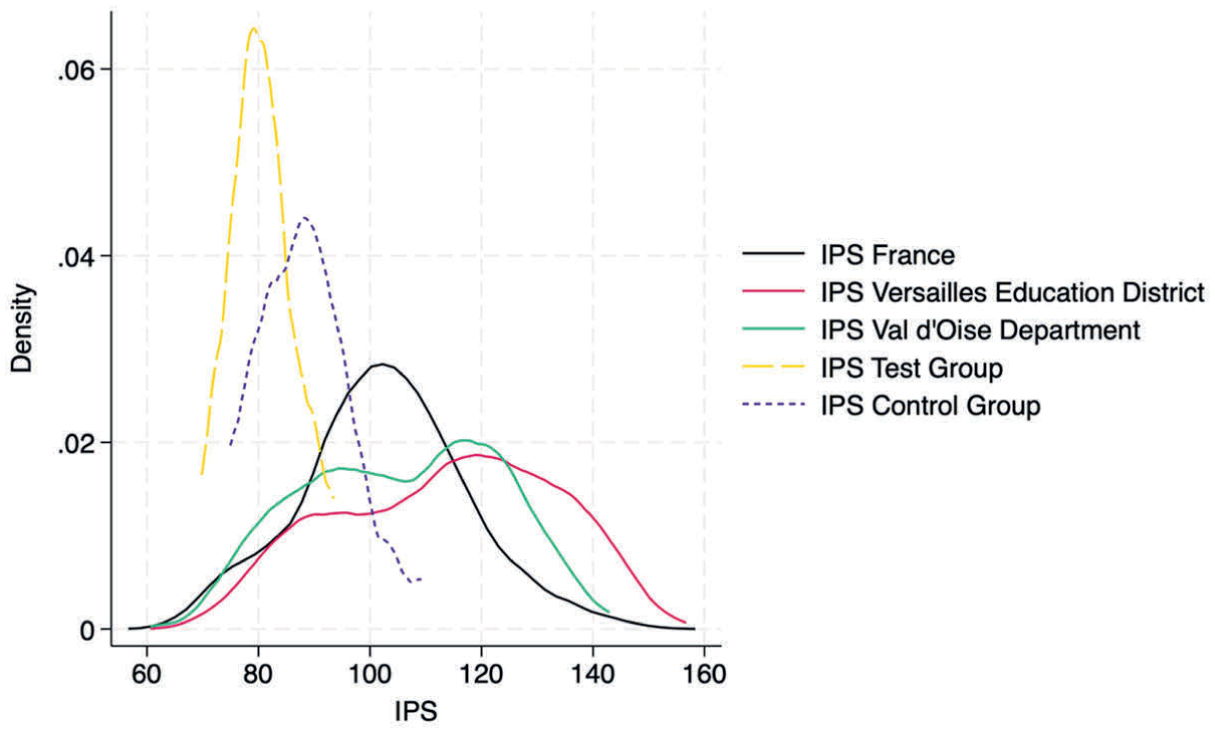
Distribution of schools’ average social position index (indice de position sociale [IPS]).
This program combines three characteristics that make it of particular scientific interest. First, it is long, intensive, and targets a high number of very young, disadvantaged children. This offers a great opportunity to observe the positive side effects of instrumental music education if there are any. Second, there is no self-selection into the program because participation is mandatory for all students of a given grade in the participating schools. Third, attrition was almost entirely due to children moving to other catchment areas 5 or being absent on test days and was not differential with respect to gender, social background, or initial cognitive performance. This ensures that if effects are observed, they would not be artefacts of selection or survivor biases.
AVIMS offers students a musical education experience that differs substantially from what children typically encounter in school. First, the weekly 1 hour and 45 minutes devoted to AVIMS exceeds the typical duration of school music education. In pre-elementary school, the amount of time dedicated to music varies by teacher and is not governed by strict guidelines. At the elementary level, music is included within the “Arts” curriculum, for which 2 weekly hours are shared between music and visual arts, with the actual distribution depending on teachers. By comparison, the curriculum allocates approximately 10 hours per week to language instruction and 5 hours to mathematics. Second, school-based music education generally emphasizes listening, vocal exploration, sound discovery, and self-expression and does not involve instrumental practice. AVIMS, in contrast, focuses on the technical requirements of violin playing and introduces more formal musical theory. Finally, whereas music education in schools is typically delivered by the classroom teacher, AVIMS is taught by professional violinists.
A Quasi-experiment on the Effects of a Demanding Long-Term Musical Education Program
AVIMS is a four-year program targeted at young, disadvantaged children in the northern suburbs of Paris. This program, funded by a private foundation, integrates two to three weekly violin lessons into the regular school schedule over four years. During the first year, which is designed as an introductory phase, children participate in one 45-minute lesson in large groups and one 30-minute session in small groups each week. For the subsequent three years, an additional 30-minute small-group session is added, bringing the total weekly violin instruction to three classes of 1 hour and 45 minutes. The explicit goal of the philanthropists who started AVIMS was to enhance disadvantaged children's school performance, but the program is nonetheless grounded in highbrow classical music, long recognized as a key marker of elite cultural practices. The proliferation of such initiatives, particularly those aimed at disadvantaged children, is largely due to the widespread acclaim enjoyed by El Sistema, a program operating in Venezuela since the 1970s that is frequently referenced by its proponents as a benchmark (Baker 2014). These initiatives are often based on the idea that providing disadvantaged children with access to classical music (and more broadly, Western highbrow culture) has an emancipatory effect (Bull 2019), including educational, professional, and social opportunities; promoting social cohesion; and combating poverty and crime. The extent to which AVIMS meets these expectations is not fully addressed by the available impact evaluation data, but the social confidence in the emancipatory power of the acculturation of disadvantaged children to elite culture is worth mentioning.
Our impact evaluation of AVIMS was constrained by the fact that the program was designed and implemented before our study began. Indeed, the 39 test schools had already been selected by the philanthropists from a pool of voluntary schools, making randomization impossible. To establish a control group, we had to recruit comparable schools—located in the same area and part of the priority education network—that did not participate in the program. This proved challenging, and we were able to enroll only 18 control schools, which, on average, were slightly less disadvantaged than the test schools. We therefore opted for a quasi-experimental approach based on entropy balancing to improve comparability between these two groups (Hainmueller 2012).
Entropy balancing is a data preprocessing method that aims to balance observed baseline covariates in observational studies with binary treatments. In contrast to other matching and weighting methods, such as propensity score matching, entropy balancing goes beyond mean balancing of covariates and achieves a more refined distributional balance by equalizing a set of moments (e.g., mean, variance, skewness) between the treated and control groups. There are only two steps in implementing entropy balancing. First, researchers must choose a set of relevant covariates and a set of moments to balance, taking into account the trade-off between including as many relevant covariates as possible and reducing the sample size due to missing values. Then, if there is a set of weights that balances the two groups in terms of the selected covariates and moments, the entropy balancing algorithm will find it. Thus, another advantage of entropy balancing is that it is a noniterative method of matching. This means there is no need to check that the covariates are correctly balanced because they are by design. 6 Finally, entropy balancing, which allows matching on numerous covariates (provided missing values are limited) while retaining all observations, shows promise for causal inference using observational data, with several studies showing cases where it outperforms alternative methods (Amusa, Zewotir, and North 2019; Marcus 2013; Matschinger, Heider, and König 2020).
Data: Cognitive and Academic Tests
From December 2020 to June 2024, cognitive and academic skills were measured in students from the 57 schools participating in the study. Figure 2 provides the timeline of the evaluation. At T0, we administered ad hoc tests directly to 1,874 children in their second year of pre-primary school (mean age = 4.5 years old). 7 These tests come from the BMT-i (La Batterie Modulable de tests informatisée) battery, which was developed by a pediatric neurologist for speech therapists (Thiébaut, Gassama, and Billard 2019). This set of tests was calibrated on neurotypical children. Most tests available for this age group are designed to detect disorders, potentially leading to a ceiling effect and limiting the ability to capture subtle differences in children's development. We selected four tests from this battery: two assessing numeracy, another evaluating oral understanding, and the last one measuring logical skills. 8
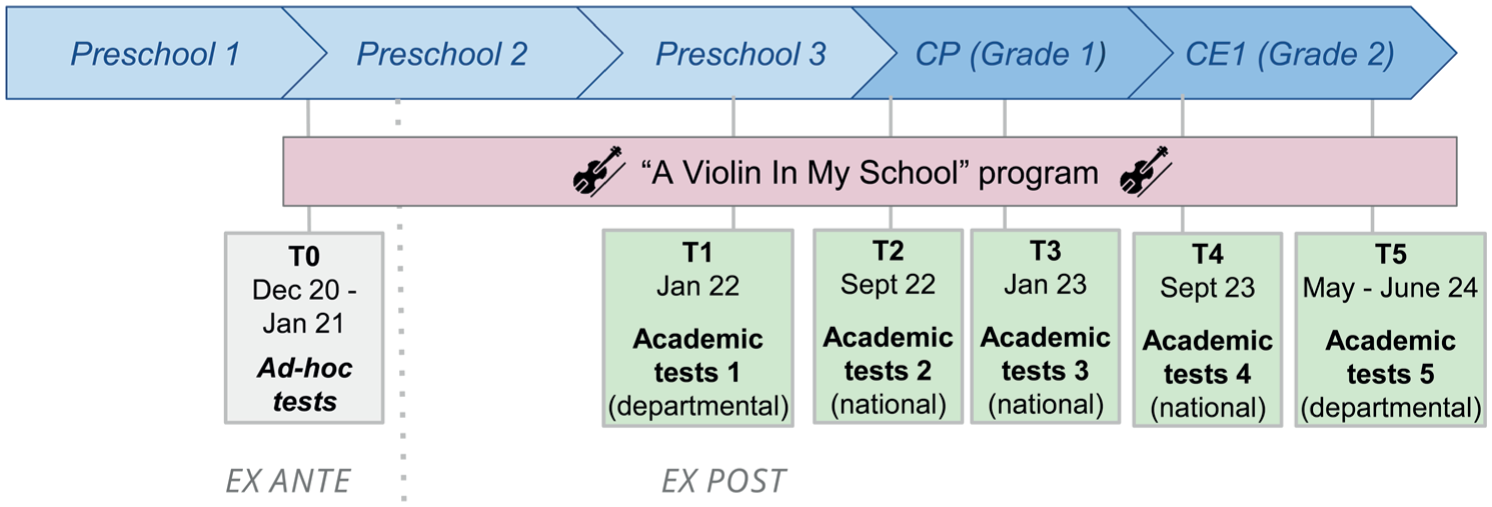
Timeline of the evaluation of “A Violin in My School” (AVIMS).
After this initial measure, we relied on five waves of academic standardized tests that were organized by the administration and administered by teachers to assess students’ skills in math and language. Most of the attrition occurred between preschool and primary school, either because children moved or could not be traced in the administrative data. Additional attrition took place at T5, largely due to the fact that the tests were not mandatory and some teachers chose not to administer them. In both cases, attrition rates were similar across treatment and control groups and were not different with respect to gender, SES, or initial cognitive performance. Tests at T1 and T5 were organized by the Direction of Departmental Services of National Education of Val d’Oise. Tests at T2, T3, and T4 were organized at the national level by the Directorate for Evaluation, Forecasting, and Performance of the Ministry of Education. The domains covered by these tests are presented in Tables S1 to S4 in the online supplement.
Throughout the study period, we also collected measures of socio-emotional and musical skills to document a broader range of potential program effects. This decision was motivated by the substantial body of literature on the effects of leisure activities in general (Kreutz, Feldhaus, and Saarikallio 2023) and playing musical instruments in particular (Ritchie and Williamon 2011) on developing self-efficacy. However, we did not detect statistically significant effects of AVIMS in these domains (for more details, see Pereira 2025). Therefore, these additional measures are not analyzed further here.
Finally, information about students’ sociodemographic characteristics was collected through questionnaires distributed to families. In the remainder of this article, we concentrate on students’ academic skills measured through standardized tests. The initial ad hoc tests and sociodemographic characteristics are only used as baseline covariates to be equalized between both groups by entropy balancing.
Analytic Strategy
As mentioned earlier, we used entropy balancing as a data preprocessing method to make the control group more comparable to the test group before estimating the program's effects. In subsequent analyses, we include the following variables in the calculation of the entropy balancing score: gender, quarter of birth, social position index (IPS), disability, 9 allophone status, 10 and each of the four baseline cognitive scores. The first three moments (mean, variance, and skewness) are balanced for each variable. We then run linear regressions using the following model:

where
To account for the correlations among children within the same group, we clustered standard errors at the class level. The class level is where most peer and teacher effects are concentrated, making it the most relevant level of analysis for these dynamics. Clustering at the school level is more conservative and accounts for potential spillover effects, but it greatly reduces statistical power given the limited number of schools in the data set. Thus, we opted for clustering at the class level as a practical balance between statistical rigor and practicality. 12
Hypotheses
In line with the prevailing literature and the objectives set by the program's initiators, we formulated three hypotheses to be tested in the following sections. First, given that the program is motivated by the belief in its broad influence on various aspects of school learning, we examine the hypothesis that AVIMS has a positive effect not only on skills closely related to violin playing (near transfer) but also on more general cognitive and academic abilities (far transfer). This first hypothesis can be broken down as follows:
Second, the expansion of arts education—particularly in programs such as AVIMS, which target disadvantaged students—is often framed as a mechanism for social and cultural compensation. If this compensatory mechanism holds, any positive effect of the program should primarily benefit students with fewer cultural resources at home. This leads to the following hypothesis:
Third, in contrast to the majority of analogous initiatives, the AVIMS program is conducted during standard school hours. This may lead to concerns regarding its potential effect on students’ skills and educational outcomes due to the opportunity cost of school time if the program does not offset its compensatory benefits:
Results
We present the effects of the AVIMS program on standardized academic test results at the following points: T1 (January 2022, halfway through the final year of preschool), T2 (September 2022, beginning of Grade 1), T3 (January 2023, halfway through Grade 1), T4 (September 2023, beginning of Grade 2), and T5 (June 2024, end of Grade 2). We begin by presenting an overview of the results for the entire sample before examining the program's differential effects based on students’ social backgrounds. Figure 3 and Table 1 show the effects of AVIMS on math skills; Figure 4 and Table 2 present the effects on language skills.
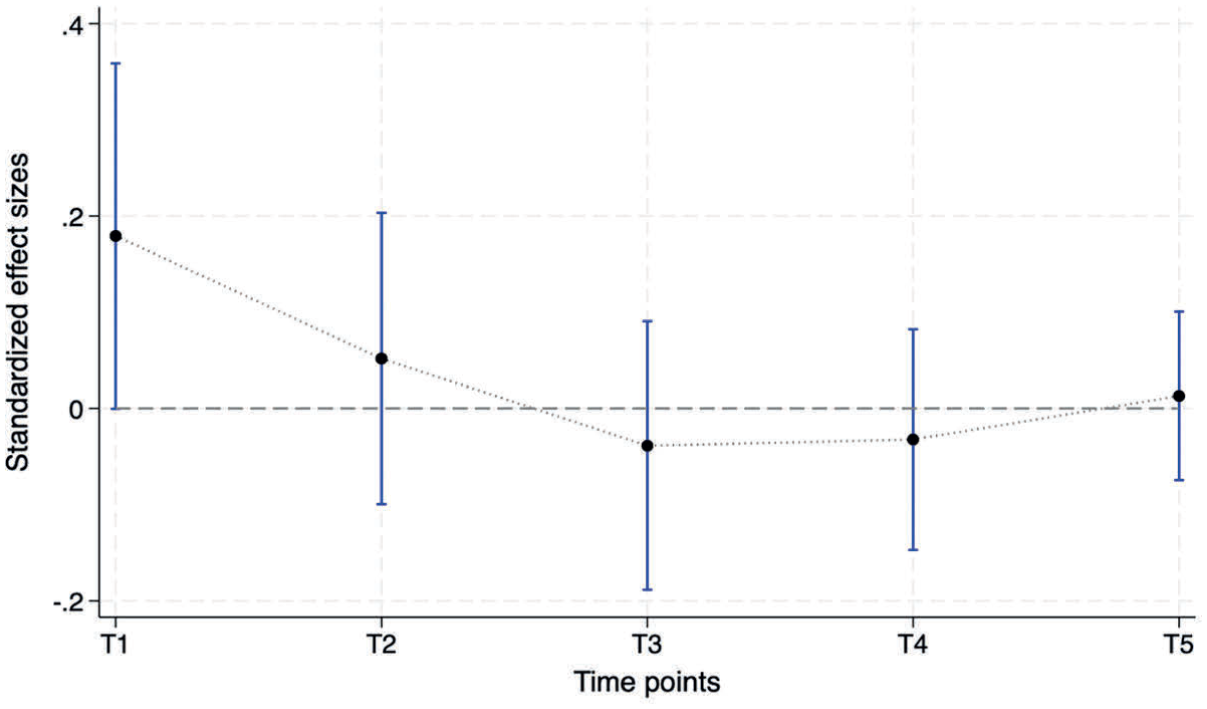
Standardized effect sizes of “A Violin in My School” (AVIMS) on math skills, 95 percent confidence intervals.
Detailed Results of the Regression Models for Math Skills.
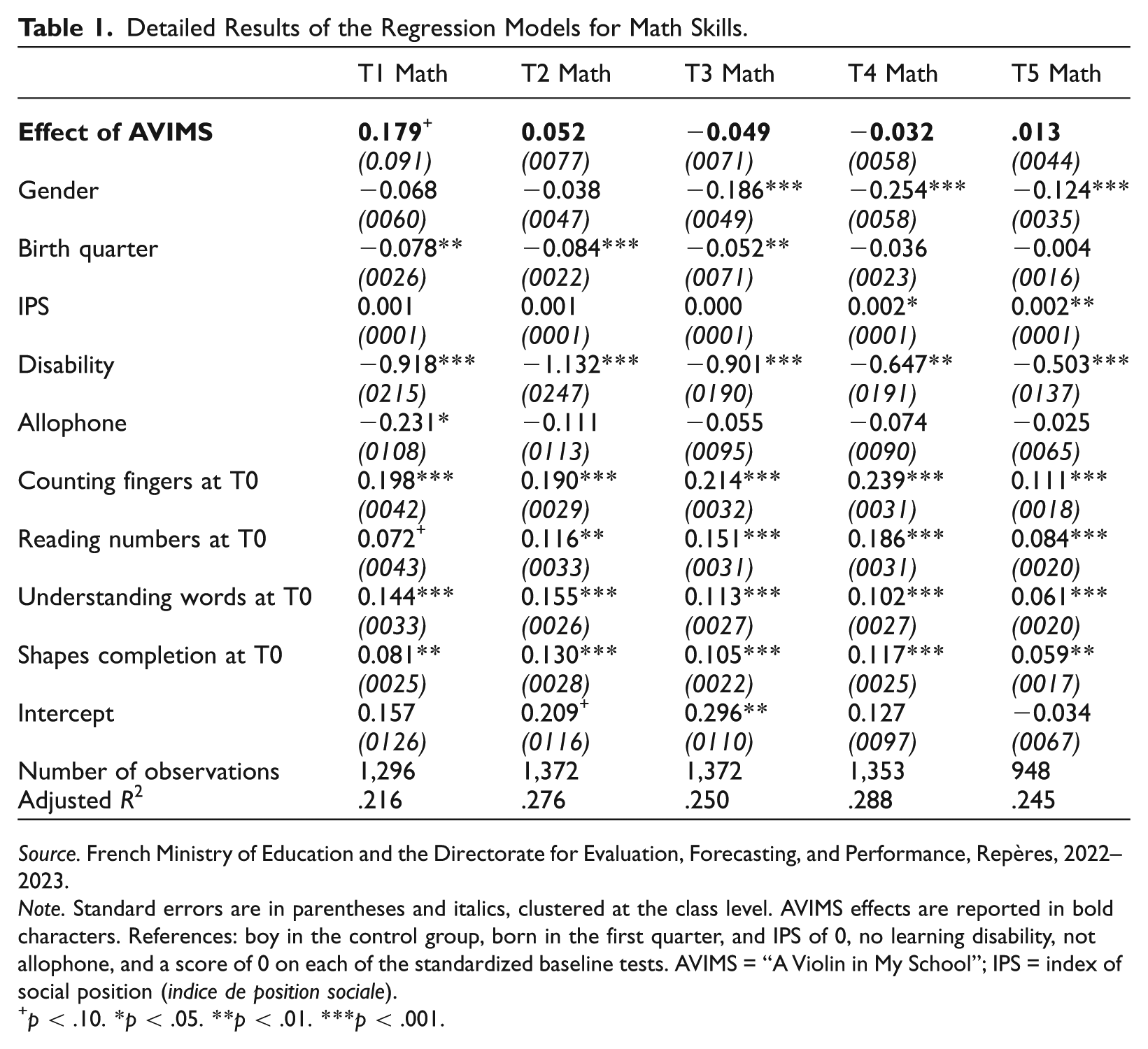
Source. French Ministry of Education and the Directorate for Evaluation, Forecasting, and Performance, Repères, 2022–2023.
Note. Standard errors are in parentheses and italics, clustered at the class level. AVIMS effects are reported in bold characters. References: boy in the control group, born in the first quarter, and IPS of 0, no learning disability, not allophone, and a score of 0 on each of the standardized baseline tests. AVIMS = “A Violin in My School”; IPS = index of social position (indice de position sociale).
p < .10. *p < .05. **p < .01. ***p < .001.
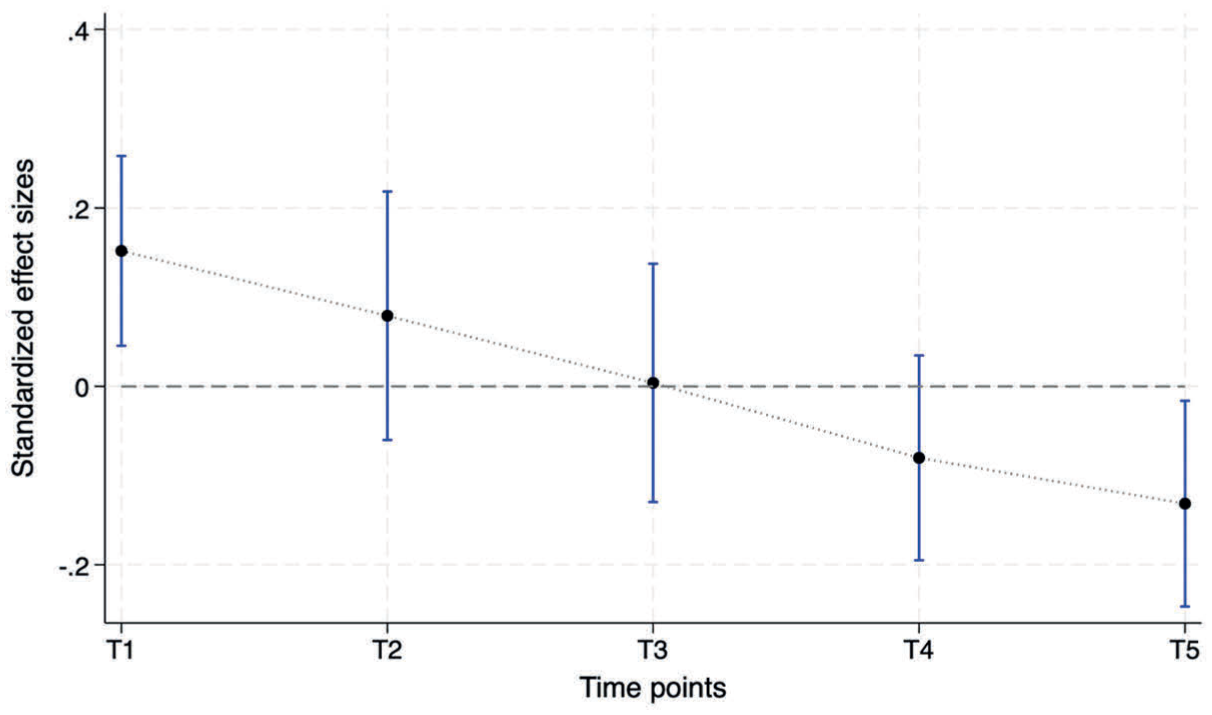
Standardized effect sizes of “A Violin in My School” (AVIMS) on language skills, 95 percent confidence intervals.
Detailed Results of the Regression Models for Language Skills.
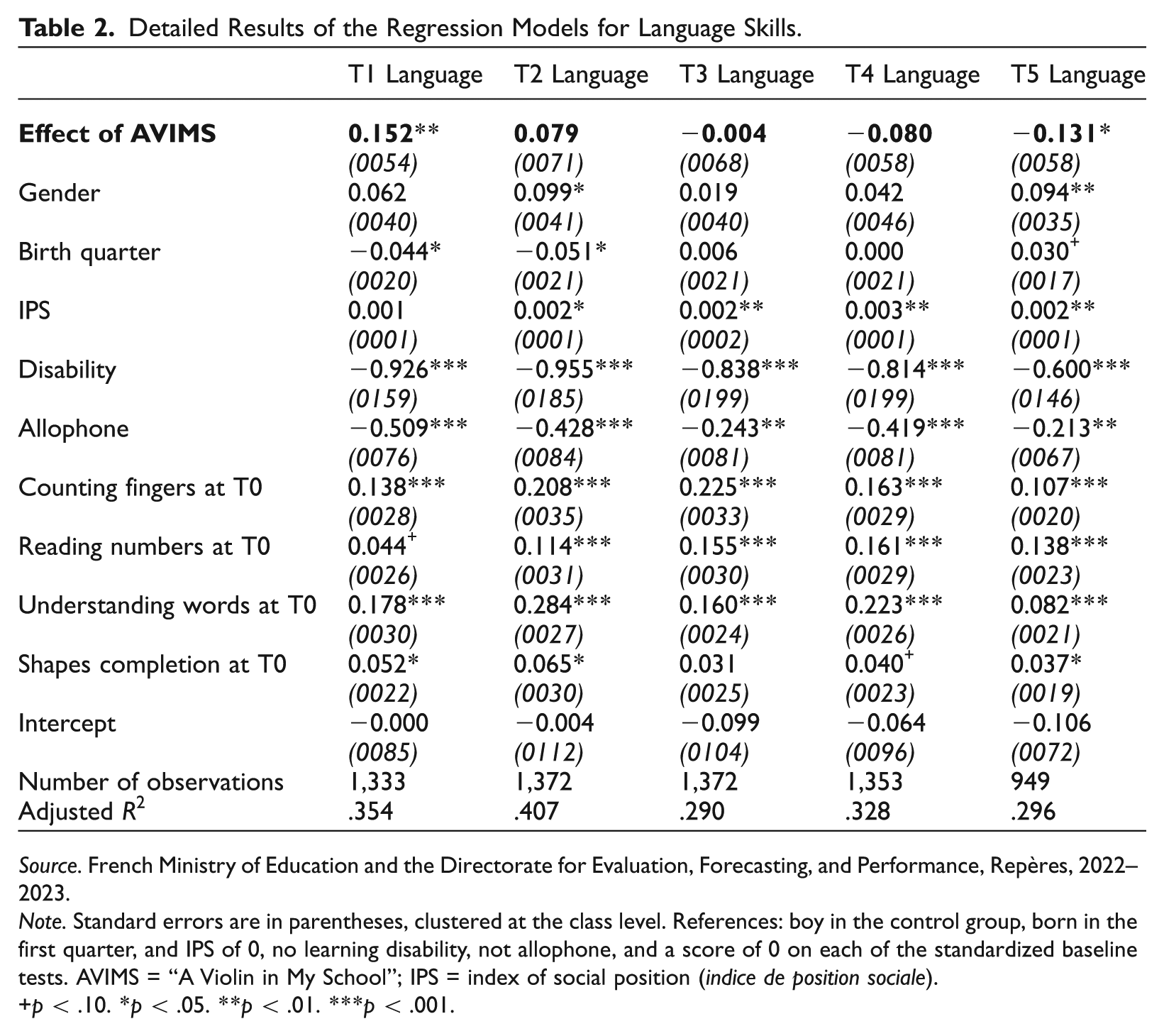
Source. French Ministry of Education and the Directorate for Evaluation, Forecasting, and Performance, Repères, 2022–2023.
Note. Standard errors are in parentheses, clustered at the class level. References: boy in the control group, born in the first quarter, and IPS of 0, no learning disability, not allophone, and a score of 0 on each of the standardized baseline tests. AVIMS = “A Violin in My School”; IPS = index of social position (indice de position sociale).
p < .10. *p < .05. **p < .01. ***p < .001.
From Promise to Pitfall: The Shifting Effect of AVIMS
At T1 (January 2022), children in the test group had been receiving violin lessons through AVIMS for over a year. At this point, we measure a positive effect of the program on children's academic performance: Their math skills increased by 17.9 percent of a standard deviation, although this result only approaches statistical significance (p < .1). Students’ language skills increased by 15.2 percent of a standard deviation, reaching the 99 percent confidence level. A closer examination of the four language subdomains 13 reveals this positive effect is primarily driven by writing skills (d = 0.317, p < .01) and to a lesser extent, syllabic breakdown skills (d = 0.161, p < .05).
Several mechanisms may account for this substantial improvement. First, the physical manipulation of the violin—especially the intricate work with the strings and bow—provides intensive training in fine motor skills, which are crucial for learning to hold a pen and write. This suggests a likely instance of near transfer: The apprentice violinists had more fine motor training, which appears to have enhanced their writing abilities. Second, the AVIMS program introduces children to written language codes. In this program, each violin string is associated with a specific color, linking a sound with a visual symbol. This association mirrors the foundational principles of reading. The skills developed in AVIMS might thus transfer to learning the alphabet and understanding written concepts, making acquiring these new skills easier and quicker. Similar hypotheses can be formulated for the other domains. For example, the AVIMS program frequently prompts children to count—whether counting the number of strings on the violin, the repetitions of a musical note, or the intervals of silence before a note. These experiences might serve as alternative numeracy training, resulting in improved mathematics performance. Additionally, syllabic breakdown skills could have been enhanced by frequent rhythmic activities, such as hand-clapping to the beat while singing.
By T2 (September 2022), as children began first grade, the previously observed positive effects on math and language skills were no longer statistically significant. These findings suggest the gains observed at T1 may not have been sustained over time, particularly in the absence of continued intervention during the summer break. This finding is further substantiated by subsequent evaluations, conducted 6 months later at T3 (January 2023), where the program's effect turns slightly negative, albeit remaining statistically insignificant. These results indicate the initial benefits observed during preschool may have been offset by negative effects emerging between T2 and T3, leading to an overall neutral effect across the period.
The next assessment of academic performance took place in September 2023, as children entered second grade (T4). Again, this evaluation followed the two-month summer break, during which the children had neither school nor violin lessons. At this stage, the AVIMS program exhibited a small but nonsignificant negative effect on language skills (d = −0.080, p > .1), and we saw no significant effect for math skills.
Finally, by the end of second grade (T5), the effect of AVIMS on children's language skills had worsened compared to what was observed at the beginning of the school year (T4). At T5, this negative effect is more pronounced and becomes statistically significant (d = −0.131, p < .05). In contrast, the results for math skills remained consistent with T4, showing no significant effect.
Stronger Effects for the Most Deprived Students in Both Directions
Having established the program's effects on the overall sample, we now turn to the possible heterogeneity of these effects depending on children's socioeconomic background. 14 It is important to note that an effect perceived as null for the entire sample could mask a negative effect on one subgroup offset by a positive effect on another. We preface the upcoming analyses by acknowledging that causal analyses at the subgroup level are inherently limited by smaller sample sizes, which reduce the statistical power and provide less precise estimates. Consequently, because most confidence intervals overlap, we can only suggest broad trends by comparing subgroups.
Based on the data from the family sociodemographic questionnaire on parental occupation, we calculated the IPS mentioned earlier, which is commonly used in French education statistics. We then divided the IPS distribution into tertiles and applied three separate entropy balancing procedures 15 to ensure comparability between the control and test groups within each IPS tertile. Finally, we conducted the previously described regression analyses on the three resulting subgroups.
The regression coefficients plotted in Figure 5 for each subgroup suggest a somewhat socially redistributive effect of the program: Children from the lowest IPS tertile appear to benefit more from AVIMS than do their counterparts from higher IPS tertiles. A few months later, at the beginning of first grade (T2), when the positive effect of the program observed at T1 is no longer visible at the whole sample level, the aforementioned socially redistributive pattern is no longer clearly identifiable (see Figure 6). At T3, the null effect of AVIMS on language skills remains consistent across all social backgrounds. However, in math skills, the most socially advantaged students (top IPS tertile) appear to be shielded from the small, albeit statistically nonsignificant, negative effect of the AVIMS program (see Figure 7).
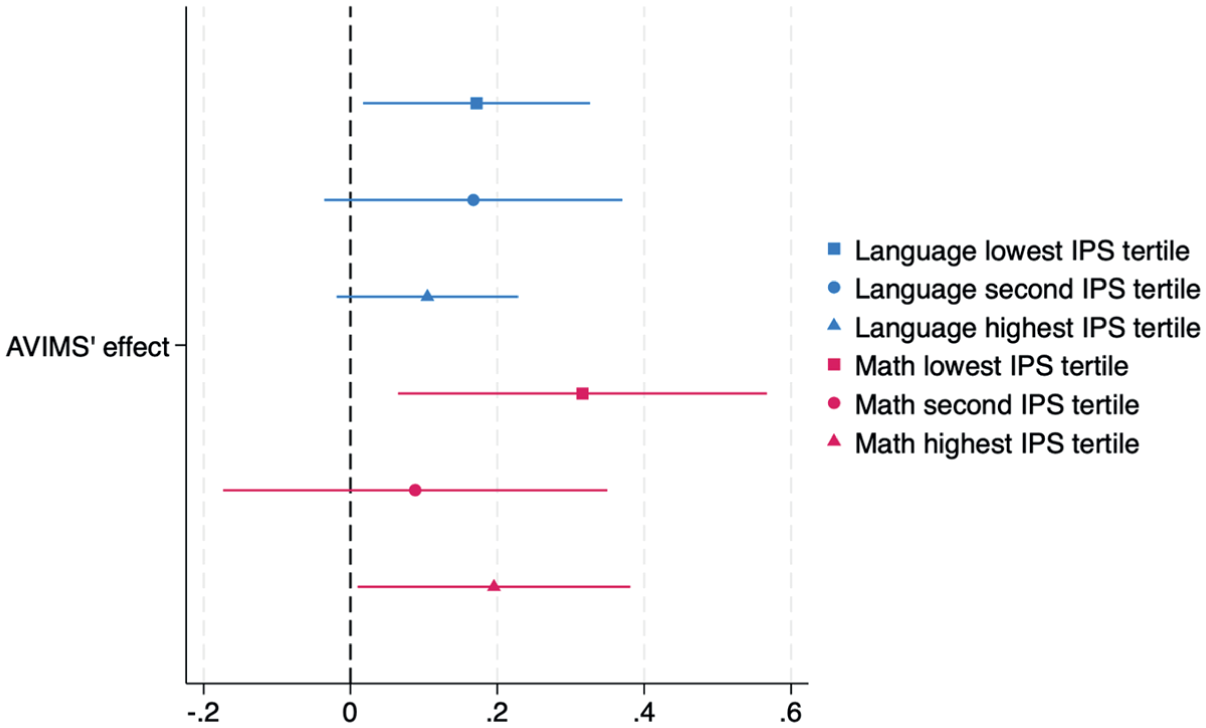
Standardized effect sizes of “A Violin in My School” (AVIMS) at T1, by indice de position sociale (IPS; social position index) tertiles, 95 percent confidence intervals.
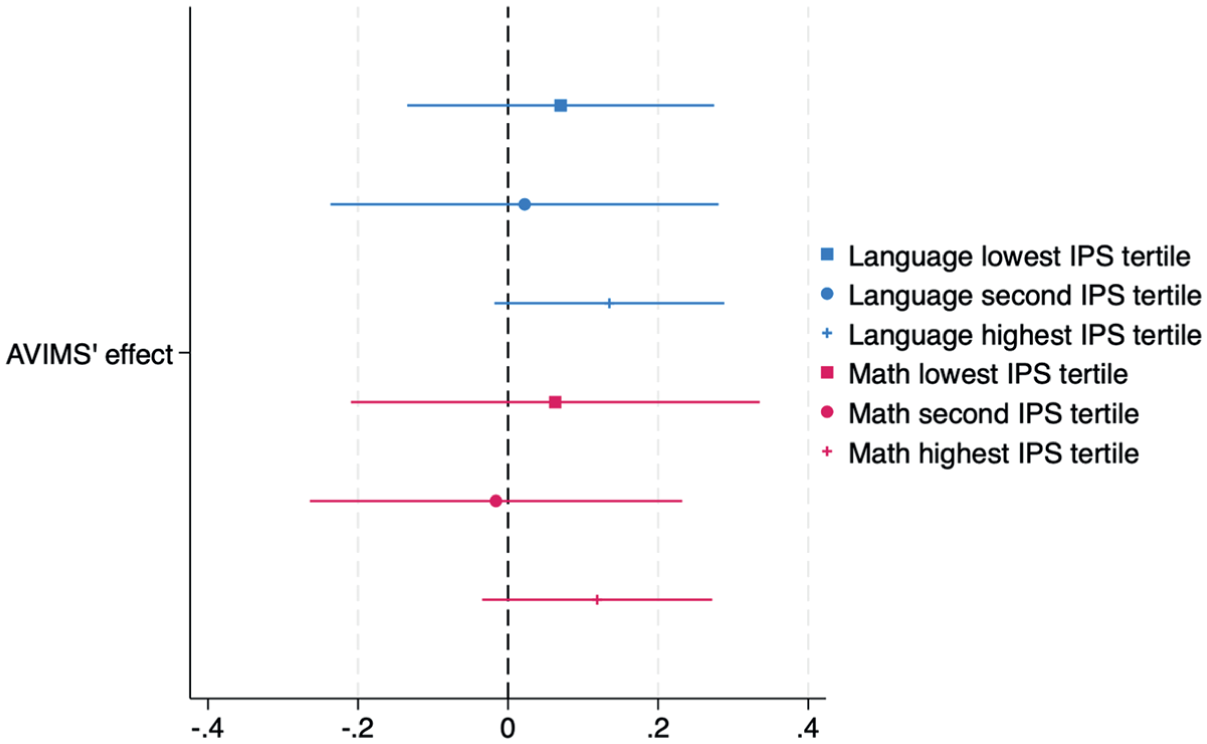
Standardized effect sizes of “A Violin in My School” (AVIMS) at T2, by indice de position sociale (IPS; social position index) tertiles, 95 percent confidence intervals.
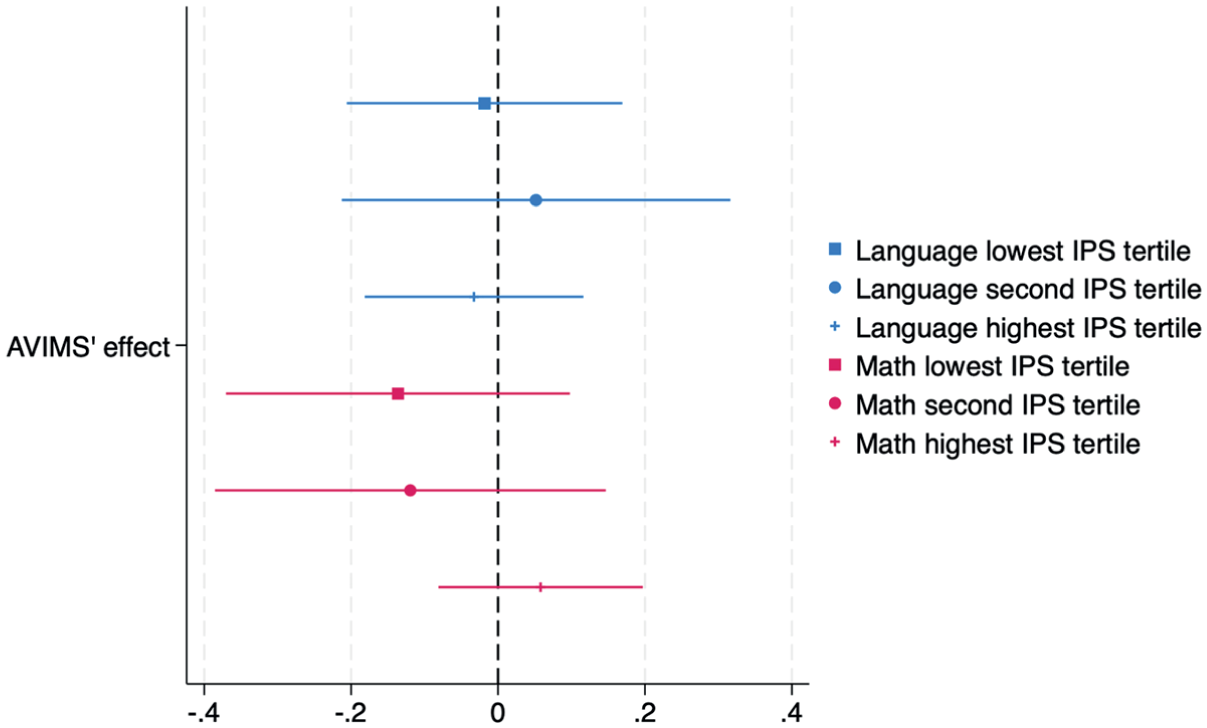
Standardized effect sizes of “A Violin in My School” (AVIMS) at T3, by indice de position sociale (IPS; social position index) tertiles, 95 percent confidence intervals.
This reversal of the socially redistributive pattern observed at T1 becomes more pronounced by second grade (Figures 8 and 9), where the negative effect of the program appears to be concentrated among students in the two lowest IPS tertiles and those in the top tertile remain unaffected. This trend persists by the end of second grade (T5), when the negative effect of AVIMS on language skills becomes statistically significant only for children in the lower IPS tertiles. A similar anti-redistributive pattern emerges in math, although the program's effect remains statistically nonsignificant across all levels of the IPS distribution.
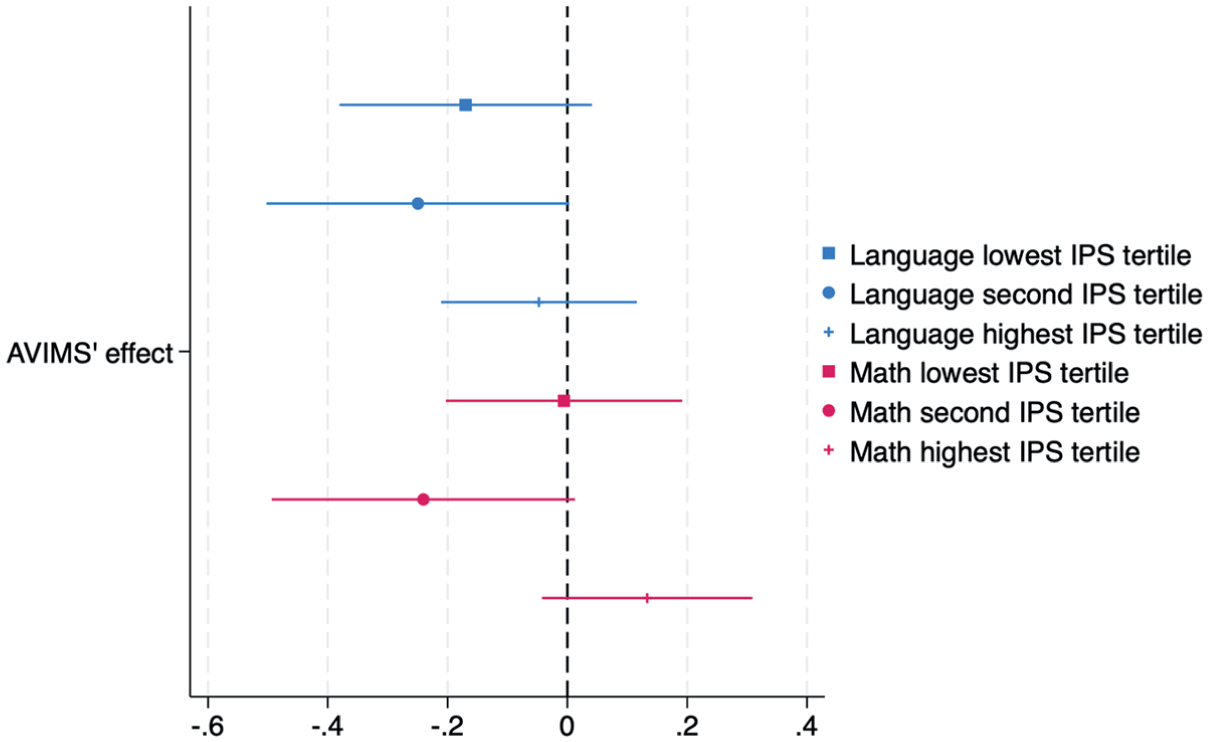
Standardized effect sizes of “A Violin in My School” (AVIMS) at T4, by indice de position sociale (IPS; social position index) tertiles, 95 percent confidence intervals.
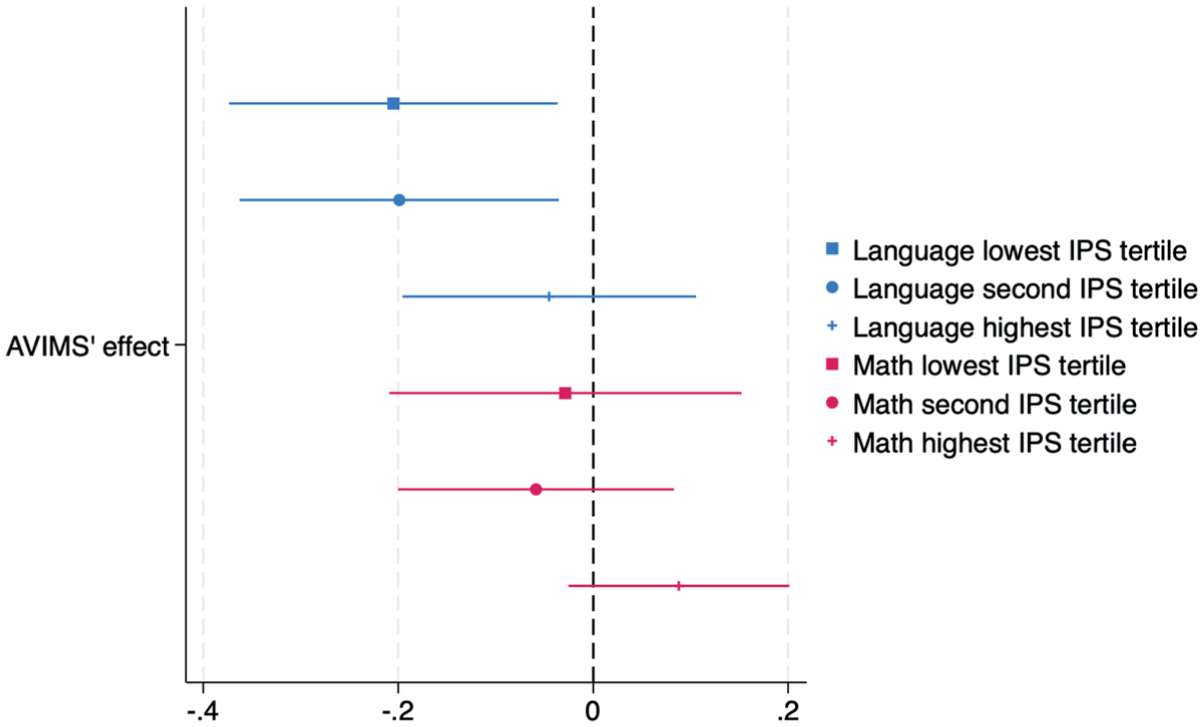
Standardized effect sizes of “A Violin in My School” (AVIMS) at T5, by indice de position sociale (IPS; social position index) tertiles, 95 percent confidence intervals.
Discussion
The analyses presented in the previous section yielded two key findings. First, the program initially had a positive and partly socially redistributive effect on at least some academic skills, as observed midway through the final year of preschool (T1). Second, a turning point emerged during first grade, marked by a declining and eventually negative effect of AVIMS on academic skills alongside an increasingly anti-redistributive pattern. This trend became even more pronounced in second grade, particularly in language skills. These findings provide partial support for Hypothesis 1. However, the program's effects were limited to a few operational skills—notably in writing, numeracy, and syllabic breakdown skills—with no significant effect on broader skills, such as comprehension and expression. This pattern is more consistent with near transfer (Hypothesis 1b) rather than far transfer (Hypothesis 1a).
Our findings also partially corroborate the hypothesis that the program's effect varies with students’ social backgrounds. The positive effect observed in preschool, which is slightly more pronounced among the most disadvantaged students, partially supports the compensation hypothesis (Hypothesis 2). However, the reversal of this effect in primary school, where the effect remains stronger for socially disadvantaged children but turns negative, challenges this perspective. In any event, it remains challenging to assess variations in the program's effects based on students’ social backgrounds due to the limited statistical power of the subgroups.
One possible explanation for the shift observed in primary school is that the opportunity cost of school time increases as children progress through primary school. As the skills developed during violin lessons become less aligned with the academic curriculum, the time devoted to these lessons may come at the expense of core subjects, such as language and mathematics 16 (Hypothesis 3). The reversal of the observed effect lends support to the implementation of this type of program in preschool, when academic learning is less specific than it is in primary school. At this stage, the program's benefits to cognitive learning and fine motor skills are less likely to imply losses in other learning areas. However, caution is warranted when implementing this program in primary school because our results suggest these adverse effects are more likely to occur then.
Additionally, AVIMS's time constraints seem to undermine its initially intended socially redistributive benefits given that the negative effect observed at T5 is most pronounced among the most disadvantaged children. As the program's time demands increasingly interfere with core educational activities, particularly in mathematics and language, children from more privileged backgrounds may compensate for these educational losses through resources available in their family environment, such as parents’ time availability and resources in assistance with homework, provision of out-of-school opportunities for educational enrichment, and awareness of and confidence in their cultural capital (Kimelberg 2014). Less privileged children may lack these compensatory mechanisms, further reinforcing existing educational inequalities. This social gap may also be understood as a classical cumulative (dis)advantage mechanism, resulting from the interaction between participation in the program and students’ unequal prior access to legitimate cultural capital such that the program has a greater adverse effect on students from less privileged backgrounds than on students from more privileged backgrounds (DiPrete and Eirich 2006).
In addition, we should remember that the program's focus on learning the violin is deeply rooted in highbrow upper-class culture. Consequently, beyond its explicit goals of musical training and cognitive skill development, the program can be viewed as encouraging working-class children, including those from ethnic minorities, to acknowledge the cultural norms of the majority population's upper classes (Baker 2014; Bull 2019). This aligns with a broader social function of schools, as demonstrated by the teaching of dominant “soft skills” related to everyday interactions (Harvey 2022), or the transmission of the compliance with feeling rules typically observed among white, upper-middle-class individuals to students from ethnic minorities or disadvantaged backgrounds (Cox 2016). One might consider whether administrators’ confidence in such a program is primarily concerned with the redistribution of useful cultural resources to the most disadvantaged or whether it is primarily rooted in a belief in the inherent benefits of acculturation and the recognition of dominant cultural norms.
Finally, reducing the assessment of the program's effects to cognitive and academic achievements alone reflects a utilitarian view of arts education, which confines it to an instrumental role in the service of academic performance. Such an approach is not only reductive, but it also obscures essential goals: the development of critical thinking, cultural enrichment, and the cultivation of aesthetic sensitivity, which are intrinsic objectives whose value cannot be subordinated to academic success (Ibrahim et al. 2022; Lampert 2011). The evaluation of the program's impact is constrained by its founders’ objectives, which prioritize the anticipated benefits of exposure to violin lessons on students’ generic skills. As previously stated, both academics and program funders tend to emphasize the extrinsic benefits of arts education. According to earlier studies, exposure to arts in school exerts a significant influence on the development of cultural capital and habitus, with notable redistributive effects—that is, children from less exposed environments tend to derive greater benefits from arts education programs (Kisida, Greene, and Bowen 2014). That said, our efforts to measure the impact of AVIMS on children's socioemotional and musical skills did not yield any statistically significant effects (for further details, see Pereira 2025).
Conclusions
The impact evaluation of the AVIMS program yielded mixed findings regarding its effectiveness. The initial gains observed in certain academic skills during preschool did not persist over time. Likewise, the program's socially redistributive effects, which initially benefited the most disadvantaged children, diminished as the program progressed. In fact, as the overall impact declined and turned negative, this reversal was most pronounced among the most disadvantaged children.
However, these results must be interpreted within their contextual limitations. First, our impact evaluation was not based on a randomized experiment; this was not feasible given that the program had already been implemented when the evaluation was commissioned. The findings from the quasi-experimental approach presented in this study would benefit from validation through a large-scale randomized trial. Additionally, larger sample sizes and greater social diversity would be necessary to draw more robust conclusions regarding the heterogeneity of the program's impact across different social backgrounds. Moreover, the measurement of impact is inherently shaped by the choice of indicators, which, in our case, primarily assess academic transfer effects in mathematics and language learning, in line with the objectives set by the program's designers. While we did not detect significant effects on the selection of socioemotional and musical skills we measured, it would have been valuable to examine whether the program influenced a broader set of outcomes, notably, self-confidence, persistence, and sense of belonging at school, which might translate into improved academic performance at later stages.
Another drawback of focusing on the cognitive benefits of arts education, particularly music education, is that its intrinsic benefits may be overlooked. These benefits are more difficult to quantify, particularly within the relatively short-term framework of a typical impact evaluation. As such, these benefits are more challenging to use when justifying the merits of arts or music education, which by no means diminishes their intrinsic value.
Finally, our findings raise two broader considerations regarding the uncertainty surrounding the effects of arts education in general and music education in particular. First, while arts programs may offer cognitive and academic benefits, these must be weighed against the opportunity cost of the activities they replace. In the case of AVIMS, the potential cognitive gains from learning the violin appear to be outweighed by those derived from traditional classroom instruction, particularly as the skills developed through violin training become increasingly distant from those emphasized and assessed in school. In other words, the academic effectiveness of arts education programs depends on the strength and scope of their transfer effects. The greater the distance between the skills learned in the program and those required in academic contexts is, the less likely transfer is to occur, and the less justifiable such interventions become in relation to their intended objectives. While a theater program could plausibly enhance students’ oral skills through near transfer, it is far less likely that a violin intervention would yield the same effect (far transfer)—at least not beyond what could be achieved through regular classroom instruction. More broadly, the uncertainty regarding the direction and strength of the effects of this kind of program highlights the trade-offs involved in incorporating new subjects, which may come at the expense of other learning priorities. In the French context, schools are increasingly expected to offer a more holistic education, addressing a growing array of cultural and societal challenges with no additional time. This challenge is particularly significant because the inclusion of more and more content into the same school time does not affect all students equally. More privileged children often have access to external support (e.g., family assistance or private tutoring) that can compensate for reduced instructional time in core subjects. However, this is not the case for all students, exacerbating existing educational inequalities. It is worth highlighting that our conclusions do not apply to other intensive music initiatives, including El Sistema-inspired models, that operate as extracurricular activities. While far transfer to academic outcomes remains uncertain, we hypothesize that after-school music programs do not risk hindering academic performance.
Second, the effectiveness of such interventions in reducing social inequalities—a goal often associated with programs like AVIMS—depends largely on the value placed on arts education. If, as in the case of AVIMS, arts education is understood as education through the arts, its extrinsic effectiveness hinges on its capacity to reduce educational inequalities through cognitive or noncognitive transfer. Conversely, if arts education is conceived as education to the arts, its intrinsic effectiveness is measured by its ability to foster artistic knowledge and appreciation among students from diverse social and cultural backgrounds. However, the predominance of extrinsic justifications—rooted in a strong belief in the transformative power of the arts despite limited empirical substantiation—may ultimately be misleading. This emphasis on instrumental benefits risks overshadowing the intrinsic value of arts education itself, relegating support for the arts as an end in themselves to the background.
Supplemental Material
sj-docx-1-soe-10.1177_00380407261452622 – Supplemental material for From Bow to Brain: Reducing Educational Inequalities through Music Education? Evidence from a Quasi-Experiment on a Violin Program for Young, Disadvantaged Children
Supplemental material, sj-docx-1-soe-10.1177_00380407261452622 for From Bow to Brain: Reducing Educational Inequalities through Music Education? Evidence from a Quasi-Experiment on a Violin Program for Young, Disadvantaged Children by Julie Pereira and Philippe Coulangeon in Sociology of Education
Supplemental Material
sj-jpg-2-soe-10.1177_00380407261452622 – Supplemental material for From Bow to Brain: Reducing Educational Inequalities through Music Education? Evidence from a Quasi-Experiment on a Violin Program for Young, Disadvantaged Children
Supplemental material, sj-jpg-2-soe-10.1177_00380407261452622 for From Bow to Brain: Reducing Educational Inequalities through Music Education? Evidence from a Quasi-Experiment on a Violin Program for Young, Disadvantaged Children by Julie Pereira and Philippe Coulangeon in Sociology of Education
Footnotes

Ethical Considerations
This research project received a favorable opinion from the research ethics committee of the Institut d’Études Politiques de Paris (reference: 2021-027). In accordance with French law, parents were informed of their children's participation in ad hoc academic tests and had the opportunity to opt out at any point. In addition, children were asked for their consent before every test. The analyses were performed on an anonymous data set within the Ministry of Education office.
Funding
The authors disclosed receipt of the following financial support for the research, authorship, and/or publication of this article: This project received funds from Sciences Po and the CNRS. The Vareille Foundation provided financial support for the collection of ad hoc data in preschools.
Declaration of Conflicting Interests
The authors declared no potential conflicts of interest with respect to the research, authorship, and/or publication of this article.
Data Availability Statement
Access to data from the Ministry of Education and the Directorate for Evaluation, Forecasting, and Performance was facilitated through the Innovations, Data, and Experiments in Education project, funded by the National Research Agency as part of the Investissements d’Avenir program (reference: ANR-21-ESRE-0034). This convention included a no-disclosure agreement and did not involve financial compensation. The use and analysis of these data are the sole responsibility of the authors.
Supplemental Material
Supplemental material for this article is available online.
Notes
Author Biographies
References
Supplementary Material
Please find the following supplemental material available below.
For Open Access articles published under a Creative Commons License, all supplemental material carries the same license as the article it is associated with.
For non-Open Access articles published, all supplemental material carries a non-exclusive license, and permission requests for re-use of supplemental material or any part of supplemental material shall be sent directly to the copyright owner as specified in the copyright notice associated with the article.

