






Abstract
Research shows a link between wealth and educational attainment, but little work has examined wealth relationships from high school degree through graduate degree completion. We use data from the National Longitudinal Survey of Youth 1997 to study when and how wealth may advantage students along their entire educational trajectory. Using sequential logistic regression models (“Mare models”), we find that across transitions, wealth relationships are separate from income and parental education relationships. As observed for other socioeconomic dimensions, wealth relationships decrease at the transition to graduate school entry. However, we show that the wealth relationship substantially increases at the graduate degree completion transition, running counter to the waning pattern found for family income and parental education. We also reveal that, like other socioeconomic dimensions, these wealth relationships partially attenuate when we include early indicators of academic performance differentials. Our findings thus shed new light on the nature of wealth-based educational inequality in the United States.
Introduction
Scholars are increasingly aware that wealth is a basis of stratification and one of the principal dimensions of socioeconomic background (Hällsten and Thaning 2021; Killewald, Pfeffer, and Schachner 2017; Oliver and Shapiro 2006; Spilerman 2000). As wealth inequality continues to rise in the United States, better understanding the link between family wealth and educational stratification grows in importance (Keister and Moller 2000; Pfeffer 2011; Saez and Zucman 2016). Nascent literature has shown that wealth is predictive of educational attainment (Conley 2001; Pfeffer 2018), yet the field knows relatively little about when and how much wealth may advantage students along the full trajectory from high school through graduate school completion.
Since Mare’s (1980, 1981) pioneering work, sociologists have studied the link between socioeconomic background and stratified educational transitions. The educational transitions framework provides a structural lens for understanding how the relationship between socioeconomic background and educational continuation evolves as students progress through schooling. By isolating each transition as its own location in a pipeline leading to ultimate educational attainment, the “Mare model” offers a way to quantify and compare each socioeconomic factor's relationship to educational continuation across transitions (Lucas 2023). Prior research has examined these relationships vis-à-vis parental income, education, and occupation (e.g., Lucas 1996; Mare 1980, 1981; Müller and Karle 1993; Shavit and Blossfeld 1993; Smith, Grodsky, and Warren 2019), but wealth is not yet fully integrated into the U.S. educational transitions literature (for an example from Germany, see Dräger 2022).
In this study, we apply Mare's approach to quantify the relationship between wealth and educational continuation across schooling transitions in the United States. We use the National Longitudinal Survey of Youth 1997, the most recent nationally representative cohort for which we have data long enough into adulthood to examine graduate degree completion. We aim to (1) examine wealth relationships from high school through graduate school completion and (2) compare the magnitude and change of wealth relationships across transitions. Throughout, we write “wealth relationships” as shorthand for “conditional associations between wealth and the completion of discrete educational transitions.” 1
As such, our analyses represent the most comprehensive examination of wealth relationships across educational transitions in the United States. This study is also the first to estimate wealth's relationship with graduate degree completion—this is important as stratification processes increasingly operate via postbaccalaureate credentials (Posselt and Grodsky 2017; Wakeling and Laurison 2017)—and to include early indicators of academic performance differentials. In showing substantial wealth relationships at college entry, bachelor's degree completion, and graduate degree completion, our results suggest that policy efforts aimed at later educational transitions need to consider family wealth's independent association with these transitions.
Background
Adding Wealth to Research on Educational Transitions
Stratification scholars have a long-standing interest in socioeconomic inequalities in educational attainment (Blau and Duncan 1967; Boudon 1974). Early work by Mare (1980, 1981) introduced a novel way of conceptualizing and modeling the attainment process. Rather than treating educational attainment as a singular outcome, he viewed it as the cumulative result of progression through a series of educational transitions where schooling could be continued or ended. Mare (1980, 1981) developed an innovative sequential logistic regression model that predicts the odds of making a given transition conditional on successfully passing through all previous transitions. This methodological approach shifted focus to when and how socioeconomic background relates to educational progression at critical junctures (Buis 2017; Lucas 2023).
To date, educational transitions research has focused on family income, parental education, and parental occupation relationships, with family wealth largely unexamined. This oversight is unfortunate; as Pfeffer (2018:1034) explains, “[f]amily wealth is empirically and conceptually distinct from more commonly used socioeconomic indicators, and it contributes unique predictive power to assessments of children's educational outcomes” (see also Hällsten and Thaning 2021; Killewald et al. 2017; Pfeffer 2011; Pfeffer and Killewald 2018). One common measure of wealth is net worth: the assets possessed by families—including savings, investments, property, real estate, and businesses—minus outstanding debts.
Prior knowledge of wealth's link to educational attainment largely hinges on just two studies. Conley (2001) used data for U.S. young adults born to Panel Study of Income Dynamics (PSID) households in the 1960s and 1970s to illustrate that wealth is a highly significant predictor of college enrollment but only a marginally significant predictor of college completion. Pfeffer (2018) documented a sizable and increasing wealth gap in college attainment in the United States between offspring of PSID households born in the 1970s versus the 1980s. He found that wealth is an independent and significant predictor of high school graduation, college attendance, and bachelor's degree completion. Neither study included the latest educational transition of graduate school completion, which sociologists increasingly recognize as a crucial transition in the U.S. stratification order (Oh and Kim 2020; Posselt and Grodsky 2017; Torche 2011).
Although previous work has highlighted the significance of wealth across several transitions (Conley 2001; Pfeffer 2011, 2018; Sanchez et al. 2024), researchers have yet to quantify wealth relationships from high school through graduate school completion. We examine the full range of schooling using nationally representative data from the 1980s birth cohort, comparing across transitions to provide a comprehensive picture of wealth's relationship to educational attainment. This innovation is essential given dramatic changes directly affecting students born in or after the 1980s.
Wealth inequality in the United States has sharply increased since 1978 (Saez and Zucman 2016), making it a more critical factor for families financing higher education around the turn of the twenty-first century. Average college costs began to climb in the mid-1980s, with steep inclines in the 1990s (Hanson 2026). After the 1992 reauthorization of the Higher Education Act, student loan debt in the United States dramatically increased (Eaton 2022). Witteveen (2022) argues that a “spillover” effect of having undergraduate loans on advanced degree attainment is first visible from the 2000s onward, right as many of the 1980s cohort entered graduate school. In short, the potential for family wealth to shape the entire academic trajectory warrants fresh attention.
Looking across educational transitions also helps us understand when wealth may be particularly important. Relationships for other socioeconomic dimensions are not consistent across all transitions. The general finding is a waning pattern whereby socioeconomic background relationships are greater at earlier transitions compared to later ones (Mare 1980, 1981; Müller and Karle 1993; Shavit and Blossfeld 1993; Stolzenberg 1994). For example, while parental income relationships typically, but not always, show a monotonic waning across educational transitions (Lucas 1996; Smith et al. 2019), a result that persistently replicates is the lack of a statistically significant, positive relationship between family income and graduate school outcomes (Conley 2001; Mare 1980; Smith et al. 2019). Smith and colleagues (2019) find a statistically insignificant relationship between family income and graduate school entry and graduate school completion, contrasting with statistically significant and larger relationships in the case of high school completion and college entry. Parental education similarly demonstrates a waning pattern, with diminished effects as students move through the academic trajectory (Mare 1980, 1981; Sewell and Shah 1968); however, evidence suggests parental education still matters across all transitions (Bryer 2025; Lor 2023; Mullen, Goyette, and Soares 2003).
Scholars have argued that selective attrition partially accounts for the waning pattern. Selective attrition occurs because the schooling system selects on alignment with dominant forms of capital, more commonly rewarding students from socioeconomically advantaged backgrounds regardless of students’ academic orientations (Bourdieu and Passeron 1977; Hamilton and Armstrong 2021). Given little alignment between class resources and the structures of schooling in the United States, socioeconomically disadvantaged students who remain at later transitions are a less common subset among their peers; many of those who share their background are sorted out before these transitions, and those who remain have atypical tendencies to complete the next transition. Selective attrition can thus artificially make socioeconomic background appear less relevant at later transitions.
We are the first to comprehensively assess whether this waning pattern holds for wealth. Do wealth relationships wane late in the educational career, similar to patterns of other socioeconomic dimensions? Interpreting our results relies, in part, on understanding the ways wealth may be related to educational transitions.
Conceptual Framework
Figure 1 offers a conceptual framework for understanding wealth relationships across educational transitions, synthesizing a robust literature that identifies four general mechanisms linking socioeconomic background to educational attainment. Student performance in school has been consistently associated with both parental education and income and shown to contribute to educational attainment (Boudon 1974; Sirin 2005). Parents’ socioeconomic status also shapes cultural and social elements associated with attainment, such as educational aspirations, expectations, and dispositions (Bourdieu and Passeron 1973; Sewell and Shah 1968). Hamilton and Armstrong (2021:102) argue that these elements are encapsulated by the concept of “class projects,” or “multigenerational approaches to obtaining desired and imaginable economic circumstances” associated with families of different socioeconomic origin. The class projects of privileged families often rely on high-status institutional channels (Kerckhoff 1993; Khan 2010). Finally, financial components of social class have long been viewed as supportive of educational attainment (Blau and Duncan 1967). These mechanisms can shape each other; for example, strong performance can drive educational aspirations, which may motivate greater financial investments from parents, supporting access to elite institutions.
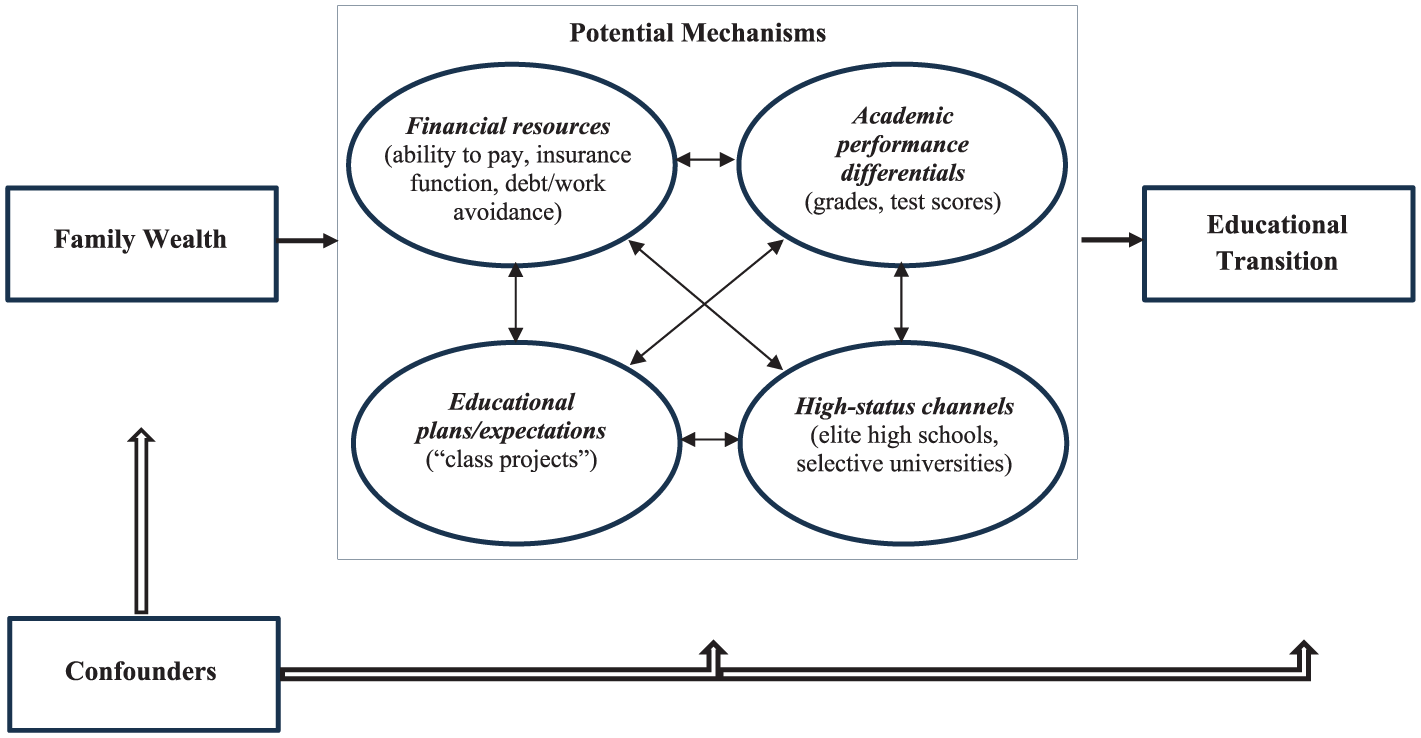
Conceptual framework of wealth relationships with educational transitions.
Notably, this framework does not identify all potential mechanisms that could lie behind the relationship between wealth and educational attainment. Some contributing factors may go unmeasured. For instance, existing evidence shows that a portion of the relationship between parental income or parental wealth and bachelor's degree completion is explained by mothers’ academic performance, self-concept, self-esteem, and locus of control (Doren and Grodsky 2016).
Wealth has some unique features, relative to other socioeconomic dimensions, that could lead it to operate in slightly different ways. Wealth, compared to income, is much more unequally distributed across households (Keister and Moller 2000; Saez and Zucman 2020) and is a more accurate indicator of a family's long-term economic position (Spilerman 2000). Moreover, wealth can be directly transferred across generations, making it a uniquely multigenerational resource (Killewald et al. 2017; Piketty and Saez 2013). Wealth can also be protective, buffering against loss (Oliver and Shapiro 2006; Pfeffer 2011) and reducing the likelihood of substantial student loan debt acquisition (Smith, Hamilton, and Eaton 2025).
These financial aspects, in turn, likely have cultural and social implications as well. Because wealth can be directly transmitted across generations, it may reduce the economic need to pursue certain levels of schooling or lessen the perceived benefit to obtaining educational credentials. For instance, wealthier students may be able to pursue alternative labor market opportunities via elite social networks, or they could rely on direct family transfers (Mills 1956; Ostrander 1984). Put another way, the class projects of those with substantial wealth do not require education in the same way as the projects associated with other locations in the class structure, leading to different sets of educational aspirations and expectations; this unique orientation to schooling can show up in educational performance as well, with less need for high academic performance to drive class reproduction (Hamilton and Armstrong 2021).
The unique nature of wealth may lead these well-established processes to manifest differently across the educational trajectory. In the following, we first highlight existing research on wealth relationships through college completion, including our additional attention here to the associate's degree. Then, we discuss how the direct transmission of wealth and its role in shaping class projects may distinguish wealth from other socioeconomic dimensions at the level of advanced schooling.
Wealth Relationships through College Completion
At the earliest levels of schooling, we might expect wealth to operate similarly to income. The financial mechanisms associated with both wealth and income include access to top elementary and secondary schools via residential location (Khan 2010; Pfeffer 2011), access to educational materials and certain cultural experiences, and private schooling (Diemer, Marchand, and Mistry 2020; Yeung and Conley 2008). Few studies have examined wealth's relationship with high school degree completion (cf. Pfeffer 2018), but a growing body of work highlights the independent strength of wealth in predicting college entry (Conley 2001; Hotz et al. 2023; Pfeffer 2018). Such research suggests possible explanations that go beyond only financial concerns; for instance, differential educational expectations for college completion contribute to wealth's relationship with college enrollment (Jez 2014).
Among individuals who enter college, wealth is related to bachelor's degree completion (Hotz et al. 2023; Pfeffer 2018). This relationship is in part a function of finances: Family wealth provides a way to fund postsecondary expenses above and beyond that of parental income (Hotz et al. 2023; Pfeffer 2011; Rauscher 2016). As net cost of attendance has remained near the high levels of the early 2000s (Ma, Pender, and Oster 2024), wealth apart from income could be increasingly tied to college completion (Voss, Hout, and George 2024). Wealth may allow students from higher socioeconomic origins to avoid taking on substantial debt (Smith et al. 2025) or having to work during their time in college, both of which lower the odds of degree completion (Baker, Andrews, and McDaniel 2017; Logan, Hughes, and Logan 2016).
The distinct cultural and social features of wealth may also push toward bachelor's degree completion. Wealth may serve an “insurance function” by providing both a financial and psychological safety net, allowing students to take more risks and more confidently persist through postsecondary schooling (Friedman and Laurison 2020; Pfeffer 2011). Additionally, as the aggregate stock of economic resources accumulates across generations (Kalsi and Ward 2025; Pfeffer and Killewald 2018), family wealth becomes a multigenerational legacy that may be more closely tied to the reproduction of high status. For example, high-wealth families are significantly overrepresented at selective colleges (Chetty et al. 2020) and have been for much of the past century (Abramitzky et al. 2024). This unequal sorting could independently help foster degree completion among more advantaged students (Melguizo 2008; Shamsuddin 2016).
We would not, however, necessarily expect wealth to support associate's degree attainment as an outcome. This degree is largely missing from the educational transitions literature, likely due to a mix of methodological constraints (Buis 2017) and the relatively more recent rise of the two-year sector in the United States (Brint and Karabel 1989). Certainly, wealth might predict take-up of the two-year degree as there is an economic payoff relative to just a high school diploma, albeit less than a four-year degree (National Center for Education Statistics 2023). However, the largely vocational nature of the associate's degree could lead it to be viewed as lower status (Goyette and Mullen 2006; Wright, Roscigno, and Quadlin 2023) or otherwise unnecessary to either maintain a certain standard of living or to enter the kinds of work privileged individuals aim to pursue.
Wealth Relationships in Advanced Schooling
The bachelor's degree is often treated as the “finish line” of the educational trajectory (Bowen, Chingos, and McPherson 2009). However, the number of people with graduate degrees has grown sharply over the past quarter century (Sarrico 2022; U.S. Census Bureau 2019), reflecting a changing endpoint for many people. Research has not yet caught up, as most studies stop at four-year degree completion, fewer at graduate enrollment (cf. Brighouse Glueck 2025; Conley 2001), and even fewer at graduate degree completion (cf. Smith et al. 2019).
There is some prior evidence that wealth aligns with income in having null or negative relationships with graduate school enrollment overall (Conley 2001). This may occur because wealth, especially, provides a pathway into the upper and upper-middle classes that does not depend on graduate academic credentials and thus reduces the economic incentives to enroll (Hamilton and Armstrong 2021; Mills 1956; Ostrander 1984). Similarly, in light of the extended length of time and highly competitive nature of progression beyond the bachelor's degree in the United States (Turner 1960), students with other means of achieving high economic positions in the labor market may decide to opt out of graduate schooling. However, this work has not considered what might be the final transition in an educational sequence—the completion of a graduate degree.
Wealth may increasingly relate to whether one finishes a postbaccalaureate degree among those who do enroll, potentially running counter to the typical waning pattern observed for other dimensions of socioeconomic background across transitions (Smith et al. 2019). This could occur in part due to unequal financial resources and constraints (Wright 1964). Direct graduate degree costs in tuition and fees more than tripled from 2000 to 2020 (Gulish et al. 2024), and increases in housing and living costs could be even more substantial (Ma et al. 2024). Access to family wealth may be increasingly useful for those who enter graduate school, helping students persist, without substantial student debt, through a course of study that may be long and involve unexpected expenses (Friedman and Laurison 2020; Pyne and Grodsky 2019). Qualitative evidence further illuminates how family wealth may come into play after graduate enrollment. Bryer (2022a:857) describes middle- and upper-middle-class parents’ role in students’ graduate education as a “dance” that involves substantial financial support that is “evolving” and “responsive to changing conditions,” such as unanticipated expenses after students have started their program. Other qualitative accounts demonstrate how graduate students leverage intergenerational wealth resources, including inheritances, to fund their expenses (Bryer 2022b).
Diminishing Returns to Wealth
Scholars have argued that wealth relationships are usually nonlinear, in that households at the upper end of the distribution may receive smaller returns for each unit increase in wealth (Dräger, Pforr, and Müller 2023). For example, research in the United Kingdom suggests parental wealth's relationship with educational attainment at age 25 may be strongest for those outside the top of the wealth distribution (Karagiannaki 2017). We suspect that for most values of wealth, each additional unit increase will be associated with a corresponding increase in the probability of making a given transition. However, for families in the notably long right-tail of the wealth distribution (Congressional Budget Office 2024), the rate of increase will likely plateau and potentially even decrease.
At very high levels of wealth, any educational benefits to additional economic resources could reach a saturation point. A pattern of diminishing returns may occur as costs for tuition and fees, housing, cultural activities, travel, and other educational opportunities are met and exceeded. Moreover, the reliance of the wealthy on the educational system may be reduced, given a more direct means of class reproduction—namely, the intergenerational transmission of wealth (Hamilton and Armstrong 2021; Mills 1956; Ostrander 1984; Piketty and Saez 2013). For these reasons, additional wealth may not relate to educational attainment to the same degree at very high levels of economic resources.
Data and Methods
Data
This study draws on data from the National Longitudinal Survey of Youth 1997 (NLSY97) cohort. NLSY97 is a nationally representative sample of U.S. youth born between 1980 and 1984. Data collection included information on respondents’ family background as well as their educational enrollment and degree attainments over time. As such, this data set provides a rich set of measures from which to analyze how socioeconomic background shapes educational transitions in the United States. Moreover, it is the most recent nationally representative data for which there is a long enough time frame to examine graduate degree completion credibly. Because the latest round of data collection was in 2021 to 2022, the study provides information on educational attainments to age 40 for most respondents.
Our analytic sample excludes respondents with missing outcome data (Von Hippel 2007), but we handle missingness on the predictor variables using multiple imputation in Stata, with 10 imputed data sets. Because this analysis relies on a set of sequential logistic regressions, the sample size for each successive model varies as follows: 8,976 at baseline, 8,110 when restricting to those who completed high school, 5,755 when restricting to those who entered college, 2,684 when restricting to those who completed college, and 1,237 when restricting to those who entered graduate or professional school. Table 1 provides details on the variables used in the analyses and descriptive information on the sample.
Descriptive Statistics.
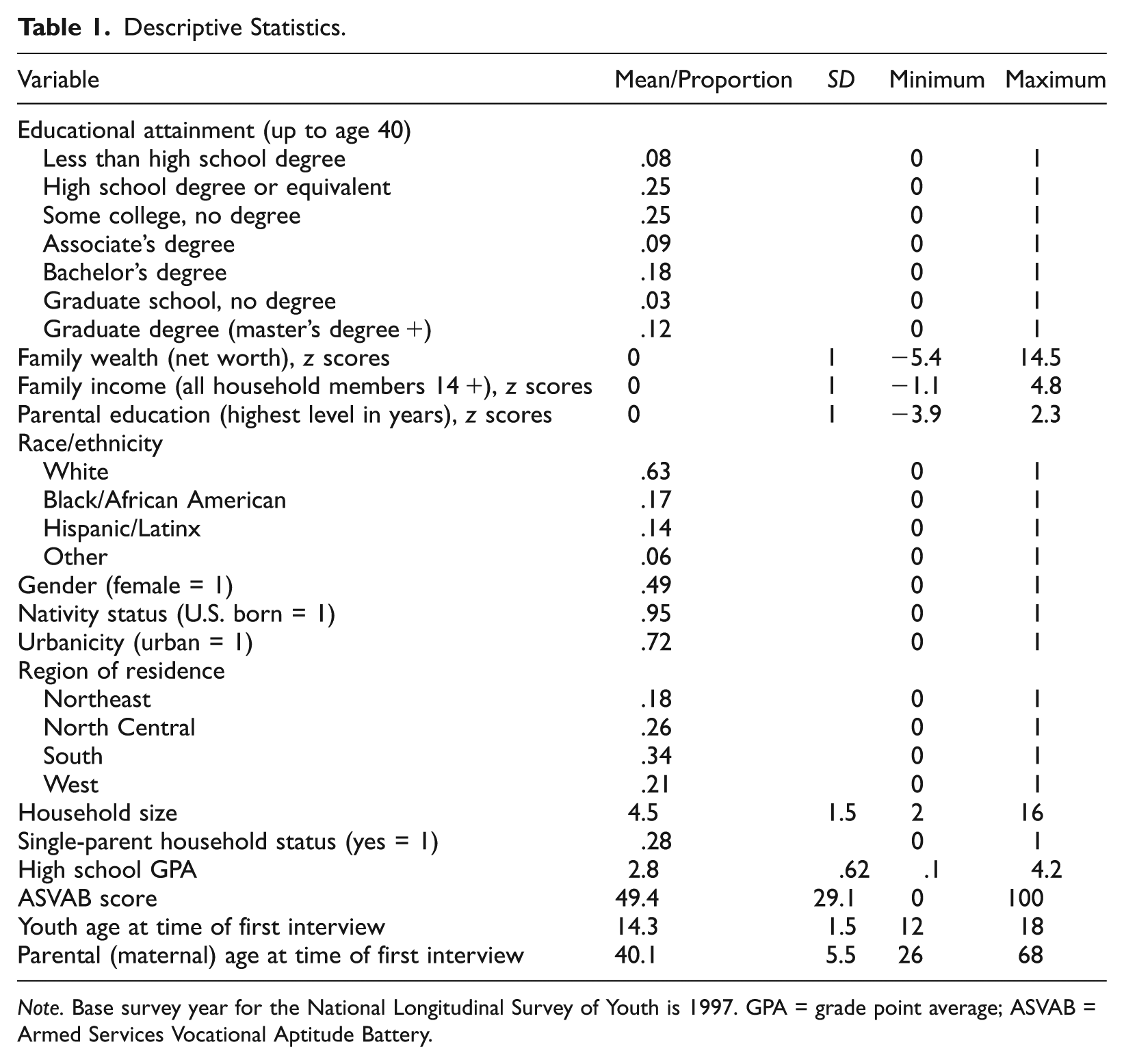
Note. Base survey year for the National Longitudinal Survey of Youth is 1997. GPA = grade point average; ASVAB = Armed Services Vocational Aptitude Battery.
Dependent Variable
Educational transitions
Following the Mare model, we measure educational attainment as the cumulative progression of successive transitions through the educational system, including (1) high school degree completion, among all respondents; (2) college entry, among high school graduates; (3a) associate's degree completion, among those who enter college; (3b) bachelor's degree completion, among those who enter college; (4) graduate school entry, among four-year college graduates; and (5) graduate degree completion, among those who enter graduate school (see Figure S1 in the online supplement). Data for this measure combine self-reported information gathered through surveys with college transcript data collected in 2012 to 2013 (see NLSY97 for details). Because survey measures were collected through 2022, the outcome measure corresponds with the highest degree attained up to age 40.
Independent Variables
Our socioeconomic background measures are family wealth, family income, and parental education. We cannot analyze parental occupation because the NLSY 1997 did not collect this variable.
Family wealth
We measure family wealth in terms of net worth, or the sum of household assets minus household debts. In the base survey year, the parents (or guardians) of respondents were asked about their total wealth, including assets and debts. As such, household net worth includes the following categories of assets: property value (ranch, mobile home, or house); value of business, partnership, or professional practice; value of second home, real estate, or partnership; value of educational IRA accounts or other prepaid tuition savings accounts; value of retirement or pension plans, such as 401(k)s; value of other savings in investment trusts; value of other savings in certificates of deposit, Treasury bills, or bonds; value of other savings in mutual funds; current market value of vehicles; value of furniture; and the value of any other assets owed to the household by others. The following categories of debts are included in net worth: mortgage or land contract, second mortgages, amount owed on vehicles, educational loans, and other debts.
To capture diminishing returns to wealth, we include a quadratic term. We expect the base wealth relationship will be positive, but the squared term will be negative, to capture a relationship that is initially positive but eventually plateaus and could even become negative. We rely on a quadratic model in our main analyses, but we also estimate several alternative transformations (see Table S1 in the online supplement). We utilize the quadratic functional form specification as a flexible way to model the wealth relationship, and supplementary analyses reveal this approach produces the greatest model fit according to the Akaike information criterion and Bayesian information criterion (see Table S2 in the online supplement).
Family income
We draw on a measure of total family income that includes total annual cash receipts before taxes from all sources, as recorded in the base survey year. This variable incorporates information on total wages; interest earned; receipt of Aid to Families with Dependent Children or Aid to Dependent Children; food stamps collected; Supplemental Security Income received; child support received; rental income; workers’ compensation benefits, welfare, and unemployment benefits; and other income from any family member older than 14. As with wealth, income may exhibit a nonlinear relationship with diminishing returns in the upper tail, and thus we include a quadratic term.
Parental education
Finally, we include a measure for highest parental education, or the highest total years of formal schooling completed from 1 to 20 reported by any parent or guardian in the household. 2
Standardization
We convert family wealth, family income, and parental education to z scores. Doing so allows a unit increase on each variable to be interpreted as a 1 SD increase, thereby aiding interpretation. For family wealth and family income, we perform the quadratic transformation after z-scoring.
Academic performance differentials
We also include two early indicators of academic performance differentials: high school grade point average (GPA) and performance on the Armed Services Vocational Aptitude Battery (ASVAB). The ASVAB score represents a standardized measure of students’ knowledge and skills in various areas: mathematical knowledge, arithmetic reasoning, word knowledge, and paragraph comprehension. These measures are inappropriate when the goal is to estimate the relationship between socioeconomic background and the completion of one transition in isolation; because high school GPA and ASVAB score are, in part, functions of family wealth rather than the reverse, including them likely underestimates the relationship due to overcontrol bias.
However, high school GPA and ASVAB score arguably are useful controls when the goal is to compare family wealth's relative role across transitions. As frequently illustrated (e.g., Lucas, Fucella, and Berends 2011; Smith et al. 2019), controlling for high school GPA and test scores can help address selective attrition bias by adjusting for differences in academic preparation and performance prior to the decision to enroll in college. Because of the nature of selection into higher education, the distribution of prior performance is more likely to be skewed upward among socioeconomically disadvantaged students relative to their advantaged counterparts (Mare 1980). In adding these measures, we attempt to make students more comparable across transitions irrespective of their prior performance. Therefore, one can view the inclusion of these factors either as a strategy to address selective attrition bias (as described in the present paragraph) or as a strategy to assess the factors’ role as a mediator (as described in the prior paragraph). We present estimates both with and without these measures.
Control Variables
We include the following set of sociodemographic covariates that are available in the NLSY97: race/ethnicity (White, Black/African American, Hispanic/Latine, other), gender (female = 1; male = 0), nativity status (U.S. born = 1; foreign born = 0), urbanicity (urban = 1; nonurban = 0), region of residence (Northeast, North Central, South, West), household size, and single-parent household status (yes = 1; no = 0). These covariates allow us to compute associations net of observed, potentially confounding factors. However, we acknowledge that other factors unmeasured in the NLSY97 might represent additional confounders—for example, the academic performance of parents (Doren and Grodsky 2016) and grandparents (Modin, Erikson, and Vågerö 2013). As such, coefficients presented later should not be interpreted as unbiased estimates of causal effects.
Analytic Strategy
Following Mare (1980), our main analysis examines four of the five transitions using a set of sequential logistic regression models. We estimate a Mare model of the form

where pij is the probability that person i will make transition j given they have made transition j–1, Sik is the value of the kth socioeconomic factor for person i, Xil represents the lth control variable for person i, ϵ ij is an individual error term, and α, β, and γ are parameters to be estimated.
For the transition from college entry to degree attainment, we estimate a multinomial logistic regression to account for the possibility of multiple outcomes (see Figure S1 in the online supplement). As such, the model for this transition takes the form
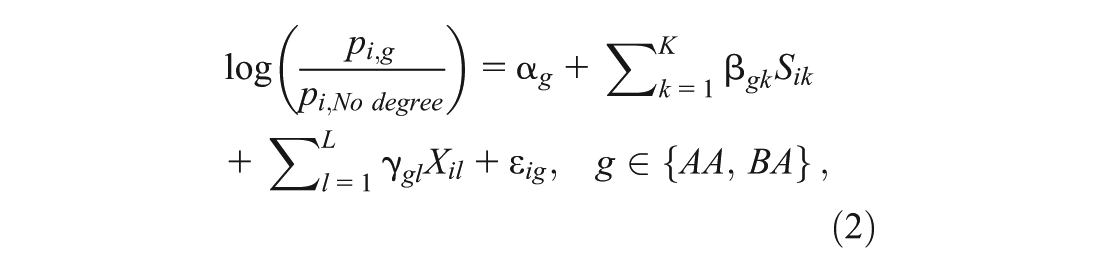
where pi,g is the probability that person i will attain degree g given they entered college and pi,No degree is the probability of not completing a degree, which serves as the reference category. As before, Sik is the value of the kth socioeconomic factor for person i, Xil represents the lth control variable for person i, ϵ ig is an individual error term, and α, β, and γ are parameters to be estimated.
For each transition, we estimate three nested models. Model 1 represents the baseline model and includes only the main socioeconomic background dimensions. Because we include these three dimensions together, the coefficients represent individual relationships net of one another. Model 2 adds covariates to the analysis to account for other related factors. Finally, Model 3 adds high school GPA and ASVAB score. We estimate each model with robust standard errors and apply probability weights to account for the NLSY's complex sampling design. In many cases, we report relationships as log-odds.
We perform two follow-up analyses to better understand wealth relationships across educational transitions and to compare them to family income and parental education. First, we estimate the average marginal effect (AME) of each socioeconomic background measure on educational transitions in models with and without high school GPA and ASVAB score. AMEs measure the average change in the predicted probability of making a specific educational transition in response to a unit increase in an independent variable. AMEs average over all observations in the sample while keeping other variables at their observed values (Cameron and Trivedi 2005). AMEs are appealing for two reasons. First, they communicate relationships in terms of probabilities, which are easier to make sense of relative to log-odds, and second, comparing AMEs across models is more statistically sound than comparing logit coefficients across models (Mood 2010). To aid interpretation further, we estimate top decile–bottom decile gaps in the predicted probabilities of making each educational transition by wealth background with and without high school GPA and ASVAB score for comparison.
Results
Figure 2 depicts differential pathways by family wealth based on proportions observed in the data. The Sankey plot shows the transitions and destinations of 1,000 (hypothetical) students from the top wealth decile (pink flows) and 1,000 (hypothetical) students from the bottom wealth decile (blue flows). The plot highlights where major disparities in the educational pipeline emerge. Namely, low-wealth students are much more likely to exit schooling without a high school degree, without entering college, or without a college degree. In contrast, high-wealth students are much more likely to obtain a bachelor's degree, enter graduate school, or attain a graduate degree. We turn next to the sequential logistic regression models to quantify wealth relationships, along with income and education, across transitions.
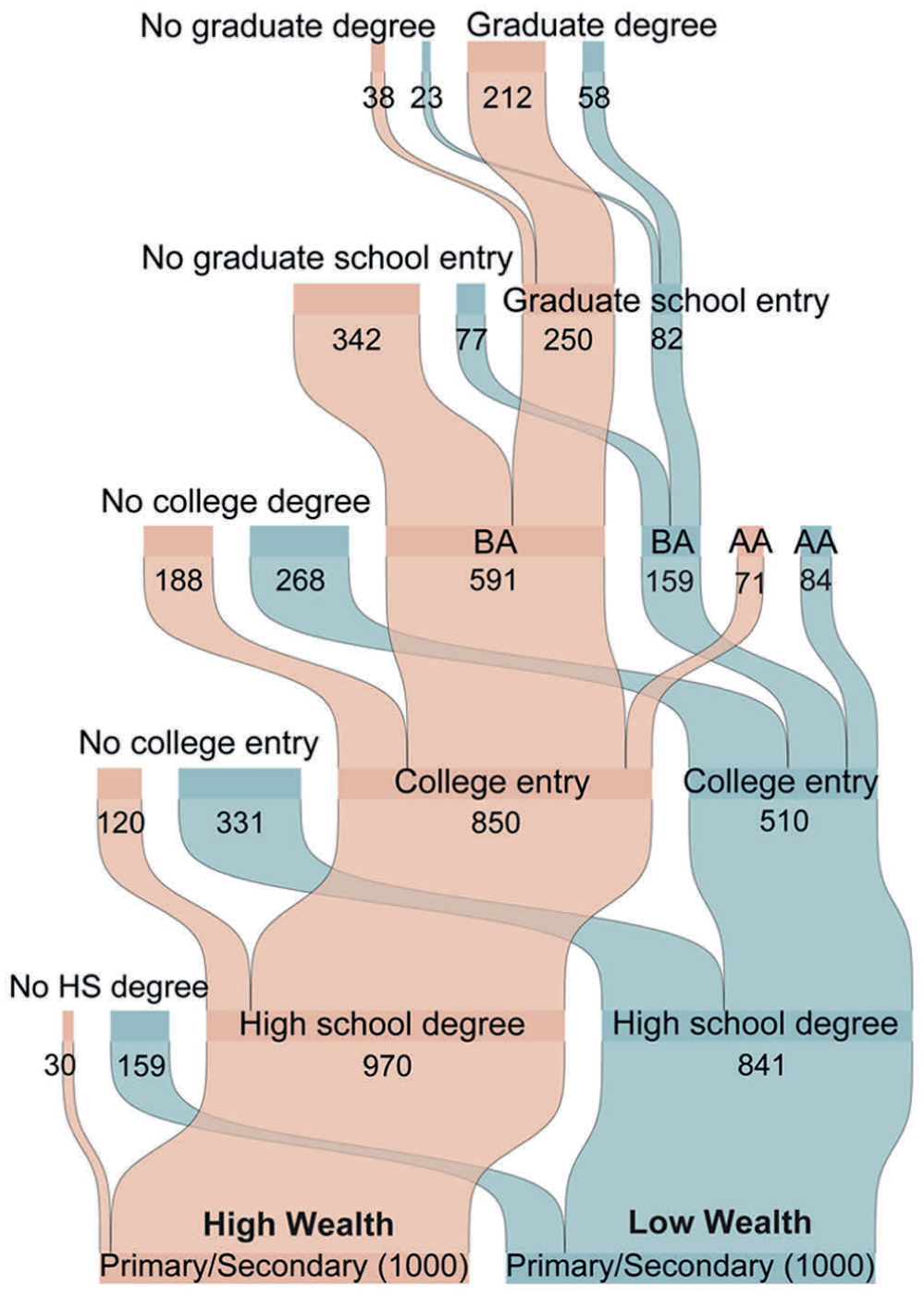
Educational transitions by students from top and bottom wealth deciles.
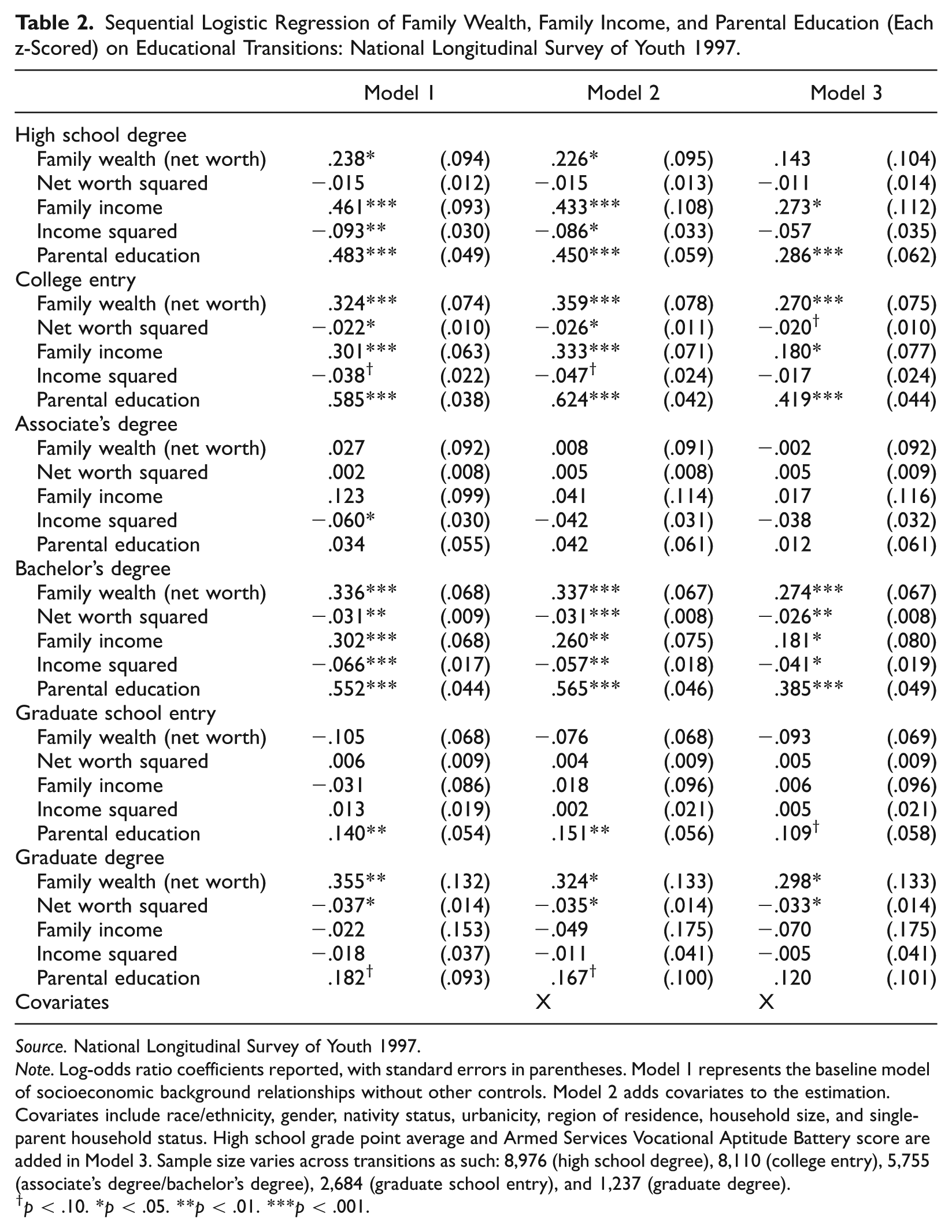
Table 2 shows how socioeconomic background is related to the likelihood of making different educational transitions, conditional on completing the prior transition. Overall, Model 1 reveals that while all socioeconomic background relationships are statistically significant at lower educational transitions—except associate's degree attainment—fewer remain so at the graduate level. Additionally, the mostly negative squared terms highlight diminishing returns, as predicted. Next, Model 2 demonstrates that even after adding important covariates, all the main socioeconomic background relationships remain statistically significant. Finally, Model 3 shows that most statistically significant relationships remain so after accounting for academic performance differentials, with the exception that the net wealth relationship is no longer statistically significant for high school degree completion (p > .10). Because we cannot directly compare log-odds coefficients across models (Mood 2010), we turn next to estimates of AMEs to examine socioeconomic background relationships with and without the inclusion of academic performance differentials.
Sequential Logistic Regression of Family Wealth, Family Income, and Parental Education (Each z-Scored) on Educational Transitions: National Longitudinal Survey of Youth 1997.
Source. National Longitudinal Survey of Youth 1997.
Note. Log-odds ratio coefficients reported, with standard errors in parentheses. Model 1 represents the baseline model of socioeconomic background relationships without other controls. Model 2 adds covariates to the estimation. Covariates include race/ethnicity, gender, nativity status, urbanicity, region of residence, household size, and single-parent household status. High school grade point average and Armed Services Vocational Aptitude Battery score are added in Model 3. Sample size varies across transitions as such: 8,976 (high school degree), 8,110 (college entry), 5,755 (associate’s degree/bachelor’s degree), 2,684 (graduate school entry), and 1,237 (graduate degree).
p < .10. *p < .05. **p < .01. ***p < .001.
Figure 3 highlights the relative magnitude of socioeconomic background relationships as well as their change across transitions (see Table S4 in the online supplement for full results). In terms of magnitude, we find that socioeconomic background relationships tend to get smaller once we account for high school GPA and ASVAB score, underscoring the role of academic performance differentials in shaping class-based disparities in educational attainment. However, the level of attenuation varies across transitions and by socioeconomic factor. For example, Figure 3 shows that background relationships attenuate the most at college entry and bachelor's degree completion, with less change at the graduate level. In general, the extent of attenuation is relatively larger for parental education and family income and smaller in terms of family wealth.
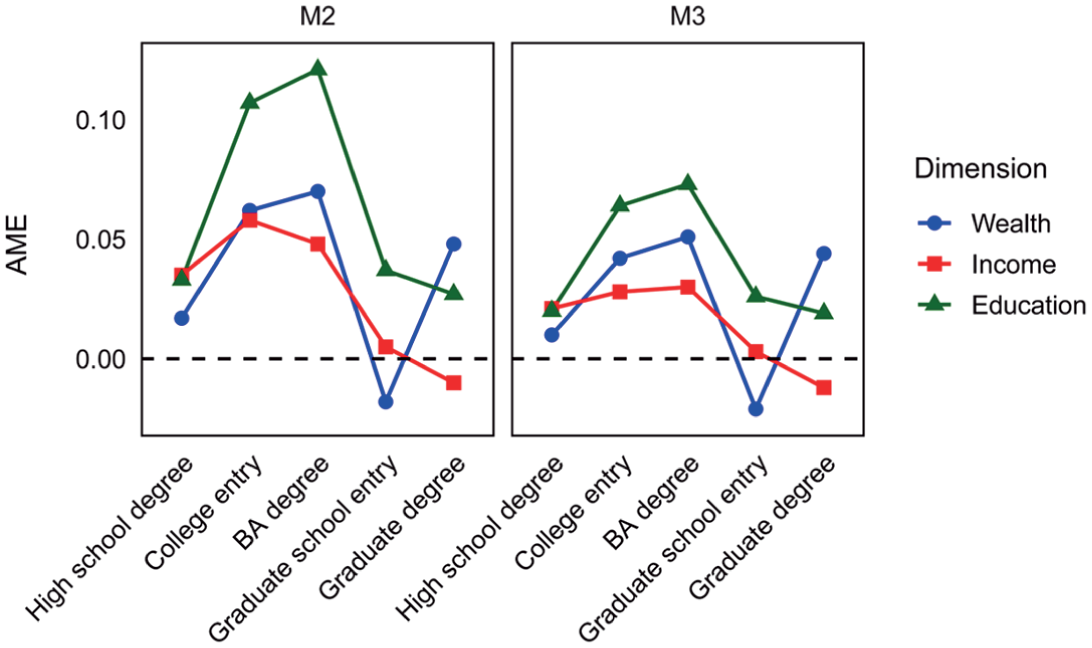
Average marginal effects (AMEs) of socioeconomic background on educational transitions.
Turning to the pattern of change across transitions, AMEs show some variation by socioeconomic dimension as well. For instance, family income relationships most closely display a pattern of waning across educational transitions; other than an increase from high school completion transition to college entry transition, income relationships monotonically wane across transitions. In contrast, wealth and parental education relationships show much steeper increases at college entry and bachelor's degree completion, followed by much steeper decreases at graduate school entry, compared to income. Wealth is the only dimension to see a rise in the relationship between graduate school entry and completion. This rise stems from two features of the wealth relationship: first, the particularly precipitous decrease between bachelor's completion and graduate entry and second, the comparability between the relationships at bachelor's completion and graduate completion, which contrasts with other socioeconomic dimensions’ patterns, where the relationship is much greater at bachelor's degree attainment than graduate degree attainment.
More than any other of our findings, this large wealth relationship at the latest transition is the most inconsistent with the widespread notion of waning socioeconomic background relationships. Accordingly, the finding demonstrates the utility of (1) considering family wealth as a socioeconomic dimension and (2) estimating socioeconomic background relationships all the way to the final transition—two extensions of Mare's approach that have been rare independently and have not previously been applied at once. The family wealth AME on graduate entry is the only family wealth AME that differs at a statistically significant level from the family wealth AME on graduate completion. In this case, the AME is significantly greater at the later transition, which is at odds with the notion of a waning relationship. Family income and parental education display a more typical pattern of waning after the bachelor's degree. We note, however, that while less wealthy students tend to complete their graduate degrees at a lower rate relative to their more advantaged counterparts, most students of all backgrounds who enroll in graduate school tend to finish their degree.
As a final step, Figure 4 provides estimates of the percentage-point gap in the predicted probability of making a given transition between students from the top and bottom wealth deciles. For each estimate, we hold other factors at their mean values. Figure 4 shows that gaps between top and bottom wealth deciles are largest at bachelor's degree completion (15 percentage points), followed by graduate degree attainment (9.5 percentage points) and college entry (9.5 percentage points), and lastly, high school degree completion (2 percentage points). Although not statistically significant, we once again see wealth-based disparities in the opposite direction with respect to associate's degree attainment (–4 percentage points) and graduate school entry (–5.5 percentage points). These negative relationships contrast with the positive wealth relationships seen at most transitions. Figure 4 also highlights the general similarity of overarching patterns with and without the inclusion of high school GPA and ASVAB score.
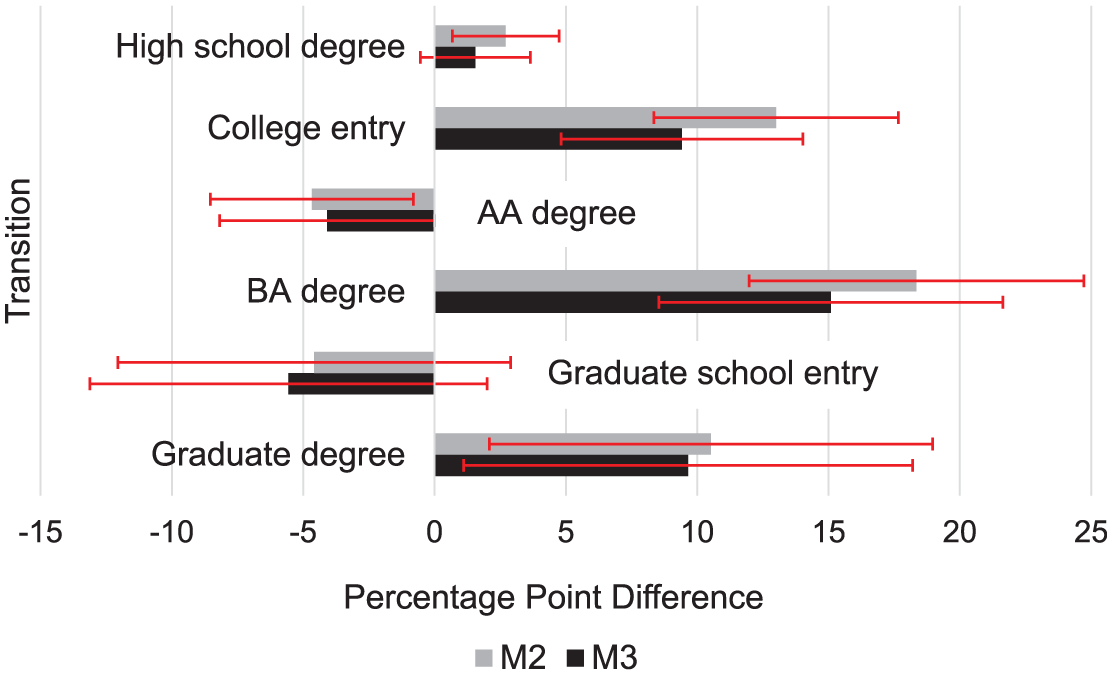
Gaps in the predicted probability of making educational transitions between students from the top and bottom wealth deciles.
Robustness Checks
Table 3 provides the family wealth AMEs across transitions for a series of robustness checks, as detailed in the following.
Average Marginal Effects of Wealth across Transitions and Robustness Checks.
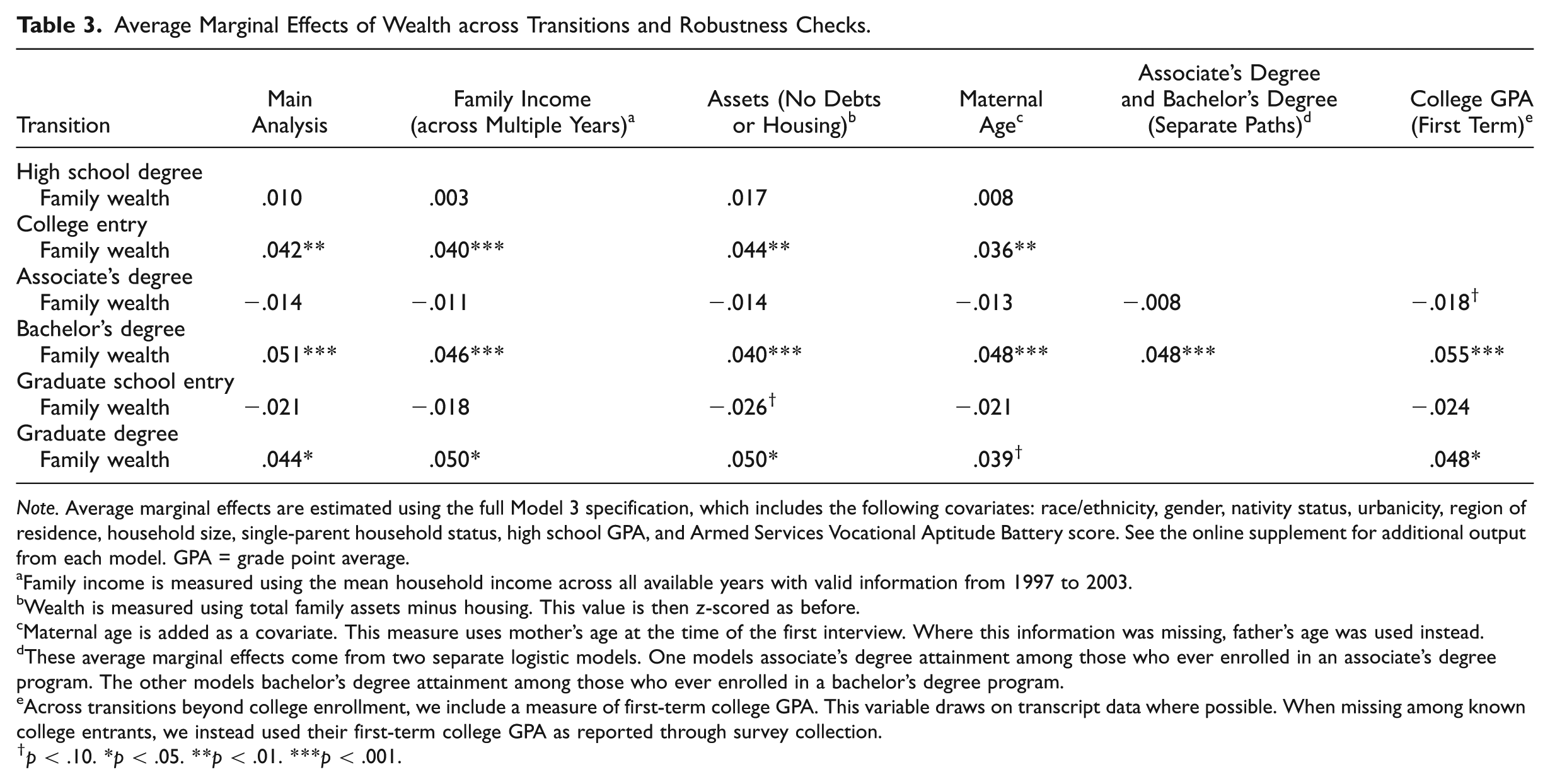
Note. Average marginal effects are estimated using the full Model 3 specification, which includes the following covariates: race/ethnicity, gender, nativity status, urbanicity, region of residence, household size, single-parent household status, high school GPA, and Armed Services Vocational Aptitude Battery score. See the online supplement for additional output from each model. GPA = grade point average.
Family income is measured using the mean household income across all available years with valid information from 1997 to 2003.
Wealth is measured using total family assets minus housing. This value is then z-scored as before.
Maternal age is added as a covariate. This measure uses mother's age at the time of the first interview. Where this information was missing, father's age was used instead.
These average marginal effects come from two separate logistic models. One models associate's degree attainment among those who ever enrolled in an associate's degree program. The other models bachelor's degree attainment among those who ever enrolled in a bachelor's degree program.
Across transitions beyond college enrollment, we include a measure of first-term college GPA. This variable draws on transcript data where possible. When missing among known college entrants, we instead used their first-term college GPA as reported through survey collection.
p < .10. *p < .05. **p < .01. ***p < .001.
Income from multiple years
Family income is more likely than family wealth to fluctuate from year to year (Dynan, Elmendorf, and Sichel 2012). However, our main analyses only include the base survey year measure of family income. Errors in the measurement of income, specifically, failing to capture permanent income (i.e., measures of income over a longer period), may bias our estimates of wealth relationships. Thus, we generate an alternative family income measure using mean household income over all years where valid information was available from the 1997 to 2003 survey waves. The family wealth AMEs (Table 3, column 3) show a very similar pattern across transitions relative to the AMEs of the main analysis (Table 3, column 2). It is important to note, however, that there were changes across waves in who was administered a survey as well as the nature of the survey instrument itself that limit both for whom additional family income data are available and the nature of those data. More details are available in Table S5 in the online supplement.
Alternative measures of family wealth
We estimated additional models to examine the robustness of our results to alternative measures of family wealth. Our main analyses draw on net worth as our measure of wealth; here, we consider other measures that only incorporate household assets. In his analysis of the PSID, Pfeffer (2018) showed that home values are a good proxy for wealth. Because different wealth components may correspond to different reasons for wealth relationships, we calculate a version of assets with and without housing value. Column 4 of Table 3 includes AMEs across transitions for a measure of assets without housing value. The results are very similar whether using net worth or assets with or without housing (see Table S6 in the online supplement). Thus, while housing value may represent the main asset component for many households, the wealth relationships across transitions presented here are robust to whether or not we include housing value in the measure and whether or not debts (e.g., mortgages) are included.
Maternal age
Delaying parenthood can provide more time to increase income, accumulate wealth, and obtain education. Scholars have argued that increasing parental age (often measured as maternal age) is thus associated with the transmission of greater resources to offspring, providing an educational advantage (Powell, Steelman, and Carini 2006). However, there is increasing debate around the causal link between parental age and children's educational attainment (Grätz et al. 2025) as selection into classed patterns of fertility is likely to be the primary driver of this association (Fishman and Min 2018). In column 5 of Table 3, we incorporate a measure of mother's age at the time of first interview. Family wealth AMEs remain consistent with the main analyses but with some reduction in magnitude. Table S7 in the online supplement provides full results.
Associate’s and bachelor's degree entry
Prior research focuses primarily on the collegiate transition to bachelor's degree completion; we expand this focus to also consider associate's degree completion. Previously, we assessed associate's and bachelor's degree completion together for the subset of students who enter college of any kind. Alternatively, one could consider these transitions separately, only for students who enroll in an associate's granting or bachelor's granting institution. Column 6 of Table 3 shows that results remain largely unchanged. Family wealth is still not associated with associate's degree completion—and neither are parental income or education (see the full results in Table S8 in the online supplement). At the bachelor's degree level, a significant family wealth AME of roughly the same magnitude remains.
College GPA
Because accounting for differences in academic preparation and performance prior to a particular transition can help address selective attrition bias, our main analyses included high school GPA and ASVAB score (Lucas et al. 2011; Smith et al. 2019). In this robustness check, we also include first-term college GPA for all transitions after college entry. As noted earlier, not accounting for selective attrition can result in underestimation of socioeconomic relationships. We see evidence of this in column 7 of Table 3. For associate's degree, we see a slightly larger and for the first time, marginally significant negative AME. At bachelor's degree and graduate degree transitions, the family wealth AME grows in magnitude. Table S9 in the online supplement provides full results.
Discussion
Wealth inequality in schooling has been largely overlooked because family wealth is seldom incorporated into research on educational transitions. This gap reflects broader tendencies in U.S. stratification research. These factors include greater attention to “labor market rewards (occupational status and earnings)” obtained by individuals in families rather than equally acknowledging resources collectively passed across generations—what Spilerman (2000:497) describes as key to “consumption potential, essentially the capacity of a family to maintain a particular standard of living.”
Amid rising wealth inequality in the United States, scholars have documented wealth's independent association with educational attainment (Conley 2001; Orr 2003; Pfeffer 2018). However, scholarship has not yet examined when and how wealth relationships appear across the full range of educational transitions—from high school degree completion through graduate degree completion. Our study fully integrates wealth into the Mare (1980, 1981) educational transitions literature, providing insight into the magnitude and change of wealth relationships across levels of schooling, including the little studied graduate degree completion transition. This investigation is of particular import for cohorts of students entering higher education after the 1992 reauthorization of the Higher Education Act; these students face new levels of student debt acquisition that have affected advanced degree attainment (Eaton 2022; Witteveen 2022).
Our use of the transitions approach and a longer lens reveal what prior wealth research on educational attainment missed: Wealth is related to transitions across the educational trajectory. Wealth relationships, net of family income and parental education, are positive and highly statistically significant for most educational transitions, with the exceptions of associate's degree attainment and graduate school entry. In fact, wealth's relationship to graduate degree completion is almost the same magnitude as it is for college entry and bachelor's degree completion. By contrast, neither income nor education are significantly associated with graduate school completion once we account for academic performance differentials.
Our findings indicate that the often replicated conclusion of waning socioeconomic background relationships with successive educational transitions may warrant a qualifier: Past studies have almost always measured socioeconomic background with family income, parental education, and/or parental occupation and may thus have missed nonwaning patterns in the case of family wealth. This qualification aligns with recent calls to acknowledge family wealth as an independently important dimension of socioeconomic advantage that may relate to life chances via distinct processes (Hällsten and Thaning 2021; Killewald et al. 2017; Pfeffer 2018). As such, scholars should not assume that family wealth relates to educational attainment beyond a bachelor's degree in the same way as other dimensions of socioeconomic background.
Across most transitions, the factors explaining wealth's relationship to educational attainment may well parallel those for other socioeconomic components. However, specific features of wealth also make it distinct. Wealth is a multigenerational financial resource directly transmitted to offspring from parents, grandparents, and even further generations (Killewald et al. 2017). Wealth provides ready support for students through expensive courses of study that can exceed funds available through annual income (Jez 2014; Pfeffer 2018). The insurance function of wealth protects against events like parental job loss or family income volatility, smooths consumption over time, and creates space to take educational or career risks that may not have immediate economic payoff (Friedman and Laurison 2020; Pfeffer 2011). Yet wealth does not depend on the educational system for the next generation's class privilege in the same way as parental education or income. The class projects of the wealthy often involve educational institutions, but only up to a point (Hamilton and Armstrong 2021; Mills 1956; Ostrander 1984). Wealth also appears less tied to academic performance differentials when compared to parental education and income (see Table S4 in the online supplement).
Importantly, the particular explanations for wealth relationships likely vary across time and with the transition. With the right longitudinal data, scholars might assess the dynamic ways that financial resources, educational aspirations and expectations, academic performance differentials, high-status channels, and confounding variables each help to explain the wealth relationship across schooling. Assessing these explanations is beyond the scope of our study. However, we suspect different explanations are likely more salient at different points along the educational trajectory.
For instance, the financial aspect of wealth may be related to why we see pronounced wealth relationships at college entry, bachelor's degree completion, and graduate school completion, but associate's completion and graduate school entry may be shaped by the more cultural and social aspect that manifests in educational aspirations and expectations. Although an associate's degree is correlated with increased earnings in the labor market, the more applied or vocational nature of the credential could lead it to be viewed as lower status compared to a bachelor's degree in the United States (Goyette and Mullen 2006; Hout 2012; Wright et al. 2023). This may be, in part, because a four-year degree is linked to even higher economic returns (Ma and Pender 2023) and can provide a particular kind of cultural and residential experience that a two-year degree does not (Armstrong and Hamilton 2013).
At the graduate level, our results are suggestive of how the same wealth processes might work in different directions. For students who have committed to graduate study, the financial resources that come with wealth may be highly facilitative. However, having access to directly transmitted financial resources that do not require the pursuit of advanced credentials may eliminate economic pressure to enroll in graduate school and shape educational expectations, potentially resulting in no wealth relationship at this transition.
The data and methods utilized in this analysis allowed us to add important insight to our understanding of wealth and educational transitions in the United States, but several limitations of the data constrain our study. First, the NLSY97 data set only collects wealth-related information on family background at one point in time. Ideally, we would have measures of wealth across multiple years to adjust for the variability of wealth background and to estimate relationships using a more accurate value at different transitions. Second, NLSY97 did not collect data on parental occupation, preventing us from assessing whether parental occupation drives a portion of the observed wealth relationships. In addition, as the higher education landscape continues to change, additional work is needed to assess wealth and attainment for the 1990s birth cohorts and beyond. Future research would also benefit from a more detailed analysis of potential variation in wealth relationships across graduate degree type/level (e.g., master's, professional, doctoral).
One contribution of this study lies in demonstrating the wealth relationship with graduate school completion. As our data suggest, socioeconomic inequality at this final educational transition may appear muted if one looks only at parental education and income. The assumption of a dominant waning pattern may have led scholars not to view attrition at the graduate level as a function of class stratification. However, as graduate school access in the United States has increased, graduate debt has sharply risen, and this debt is largely carried by socioeconomically disadvantaged students (Pyne and Grodsky 2019). We currently do not know enough about what predicts graduation among those who enroll in advanced degree programs or the extent to which student loans and other forms of debt acquisition may play a role. Graduate degree completion, after the choice to enroll, may be a “new frontier” for social stratification (Wakeling and Laurison 2017), but it is one about which the field would benefit from knowing more.
Supplemental Material
sj-docx-1-soe-10.1177_00380407261457391 – Supplemental material for Hidden Advantage along the Pipeline: Family Wealth and Educational Transitions from High School through Graduate School
Supplemental material, sj-docx-1-soe-10.1177_00380407261457391 for Hidden Advantage along the Pipeline: Family Wealth and Educational Transitions from High School through Graduate School by Wesley Jeffrey, Christian Michael Smith and Laura T. Hamilton in Sociology of Education
Footnotes

Ethical Considerations
This study utilizes secondary data from publicly available sources.
Funding
The authors disclosed receipt of the following financial support for the research, authorship, and/or publication of this article: This research was supported by Arnold Ventures, Joyce Foundation, Lumina Foundation, and Strada Education Foundation. The content is solely the responsibility of the authors and does not necessarily represent the official views of any funding agency.
Declaration of Conflicting Interests
The authors declared no potential conflicts of interest with respect to the research, authorship, and/or publication of this article.
Supplemental Material
Supplemental material for this article is available online.
Notes
Author Biographies
References
Supplementary Material
Please find the following supplemental material available below.
For Open Access articles published under a Creative Commons License, all supplemental material carries the same license as the article it is associated with.
For non-Open Access articles published, all supplemental material carries a non-exclusive license, and permission requests for re-use of supplemental material or any part of supplemental material shall be sent directly to the copyright owner as specified in the copyright notice associated with the article.
