







Abstract

Professional journals are an integral component of information dissemination and professional development in the field of special education. Peer review of manuscripts submitted for consideration for publication in journals is the cornerstone of the professional review process, providing editors with advice about the value of the information presented and feedback to authors to guide them in making revisions when needed. However, reviews for manuscripts submitted to scholarly journals for practitioners are different from reviews for research journals, given that reviewers must also judge the usefulness and readability of the content. This article describes how the review process for TEACHING Exceptional Children is conducted and what experts, practitioners, and students need to do to conduct and prepare a thoughtful review for this and other journals for practitioners.
Publications for practitioners are one of the primary ways in which professional disciplines share new evidence-based practices with their members. Along with conferences, workshops, and seminars, they provide a forum for experts, researchers, and other practitioners with innovative information and practices to disseminate suggestions and resources to a broad audience through individual subscriptions and library access. TEACHING Exceptional Children (TEC) was created in the 1960s as a resource for practitioners; today, it remains unique among journals in that it is both practical and scholarly. This journal is dedicated to application, offering new and easy-to-use information for prospective and practicing teachers, other service providers, and families. But it is also committed to scholarship, requiring authors to document that the strategies they suggest are supported by a current research base in the professional literature. To make sure that each issue of the journal not only offers useful ideas but also is based on sound evidence, practitioners and scholars are both asked to review each manuscript’s content to confirm that it is both practical and scholarly. The guidelines presented here offer information to assist prospective reviewers in completing thoughtful reviews for TEC as well as other practitioner journals.
What Is Peer Review, and Why Is It Needed?
Peer review is the process by which a manuscript submitted to a professional journal is assessed by others in the field to determine whether it should be published. This review (a) allows for assessment of a manuscript’s value by those with specialized expertise related to its content (American Psychological Association, 2010), (b) ensures a manuscript’s suitability for a specific purpose and audience (Rocco, Hatcher, & Creswell, 2011), and (c) promotes quality control over what appears in the professional literature (Belcher, 2009). In the case of a scholarly journal for practitioners such as TEC, peer reviewers must assess whether the manuscript offers new information that is accurate and evidence based as well easily understood and applied by readers (Edyburn, Spooner, Algozzine, & Obiakor, 2010). Clearly, peer review is a critical component of the publication process.
Peer review is usually conducted as a blind (or masked) review, where reviewers have no knowledge of an author’s name and affiliation. Although there is no research to confirm that blind reviews reduce bias (Newcombe & Bouton, 2009), most well respected journals follow this process. The anonymity of blind review is thought to enable reviewers to be more objective in their assessment and to ensure that they will judge a manuscript’s content on its own merits rather than on the author’s name recognition or professional role. Manuscripts submitted to a journal are considered to be privileged so that only editors and reviewers can access them, as well as confidential such that author privacy must be maintained at all times (American Psychological Association, 2010). Reviewers cannot discuss the contents, recommendations, and comments, or the decision outcome with anyone except members of the editorial team.
Most professional journals, including TEC, rely on a double-blind peer review process. A review is considered double-blind when not only the reviewers cannot know who the author is but also the author cannot know who the reviewers are (Warren, 2000). Double-blind reviews protect reviewers from any attempt by authors to coax or intimidate them into making a favorable recommendation. This approach also prevents authors from engaging in any act of retaliation against reviewers who fail to recommend publication of their work. Editors can further reduce the possibility of unfair reviews by selecting reviewers who have no bias or conflict of interest related to a specific topic (Sternberg, 2000). Today’s online manuscript review systems make it easy for the names and other identifying information for all authors to be separated from the manuscript and for the reviewers’ names to be concealed from the author, guaranteeing a secure double-blind review process.
Each new TEC editor identifies and selects a team of one or more associate editors to assist in the review process. When defining the roles and responsibilities of the associate editors, the editor decides whether she or he or an associate editor will conduct the initial assessment of each manuscript and select reviewers. The editor also assembles a pool of reviewers who will serve during the years of his or her editorship, adding new members to the pool as needed to address unique or emerging topics and issues. The names and affiliations of all reviewers are made public on the journal website or in the print journal. When individuals are invited to serve as reviewers, they are asked to indicate their role in the field (e.g., teacher, related services specialist, administrator teacher educator, researcher) and to select special areas of expertise, including categories of exceptionality, age or grade levels, developmental areas, academic content, aspects of behavior, or a range of specific interventions (e.g., instructional or assistive technology, tiered intervention models, positive behavior supports. This information is stored in a reviewer database to identify reviewers who are uniquely qualified to read and assess the content of a specific manuscript.
As soon as a manuscript is submitted and determined to be suitable to the purpose of and audience for TEC, the editor or associate editor selects three individuals from the reviewer database to conduct the review. The editor examines the content of the manuscript to identify the key topics that must be considered during the review process and then chooses reviewers who have complementary areas of expertise. For example, a manuscript that addresses augmentative communication for students with autism in inclusive classrooms will need reviewers who have expertise in one or more of those topics, whereas a manuscript that addresses interdisciplinary collaboration for planning transition to postsecondary education will need reviewers whose combined expertise addresses special education, secondary programs, and college disability support services. Because TEC is a scholarly journal for practitioners, the editor or associate editor also typically assigns (a) review teams by roles to solicit multiple perspectives from experts who have the knowledge to determine whether the information is innovative and reflects the current research literature, as well as (b) practitioners who have the experience to determine whether the strategies and resources will be useful in classrooms and schools.
What Is the Review Process for TEC Manuscripts?
TEC receives around 200 manuscript submissions per year and maintains a reviewer pool of approximately 100 reviewers. Each reviewer typically is asked to review four to six manuscripts per year, generally once every two to three months, but if there are more submissions in a given period, the editor or associate editor may request reviews more often. The online system contains data for each reviewer, showing when an invitation was sent, if a review is in progress, how many days since the last review, and the number of reviews within a given period. This information helps the editor or associate editor know which individuals are available to review at a given point in time. To maintain a reasonable review timeline for all manuscripts submitted to TEC, it is important for each reviewer to respond to invitations to promptly review and submit the review by the due date, generally three to four weeks. Once reviewers are selected, the online review system sends each reviewer an invitation for review and monitors when reviews have been submitted so that the editor or associate editor knows when all reviews are complete and when it is time to make decision about the manuscript.
Responding to a Request to Review
You may be asked to join the reviewer pool, to serve as a guest reviewer, or to assist another reviewer in writing a review (e.g., a graduate faculty advisor or senior colleague). When the editor or associate editor selects you as a reviewer, the online review system will send you an e-mail inviting you to review a specific manuscript. This invitation will include the manuscript’s title and an abstract of its content, a link to access the complete manuscript (so that you can read it to determine if you feel qualified to judge its value), and a deadline by which you will be expected to complete the review. You also will be asked to indicate whether you agree to review the manuscript by the stated deadline or whether you need to decline the invitation. The most common reasons for declining to review are that you cannot make the timeline (e.g., schedule is already too busy, you have a personal or family emergency or illness) or you will be unavailable during the period (e.g., sabbatical, international travel). If you fail to respond to one or more invitations to review, decline several invitations in a row, or fail to submit reviews after committing to do them, the editor may revoke your reviewer status and remove you from the database, and you will no longer be able to review manuscripts for the journal. If you are unable to review manuscripts for a specific period owing to competing responsibilities or emergency situations, you should notify the editor as soon as possible with a date when you can resume reviewing. At that point, the editor will add a note to the reviewer pool database indicating the date after which you are available to review.
Conducting an Initial Review
When a manuscript is first submitted, it is sent to reviewers for an initial review. During this review, each reviewer is asked to judge the suitability of the manuscript’s content for TEC’s purpose and audience and offer a recommendation about whether the manuscript merits publication in a prestigious national scholarly journal for practitioners. Once you are sent the request to review a manuscript, you will follow a set of guidelines for completing the review, which may include a rating scale of critical indicators, a section for general comments about strengths and weaknesses, and a set of possible recommendations, such as accept with revisions, invite to revise and resubmit, or reject. In general, if you find that a manuscript offers innovative ideas, presents a sound current evidence base, and includes specific and detailed guidelines, examples, and resources to allow application by other practitioners, you should recommend that it be accepted, but you may recommend specific changes to improve its usefulness and readability. If you find that the manuscript has some value but many flaws, you may recommend that it be revised and resubmitted, and you may provide detailed suggestions for changes. If you find that the manuscript has content that is outdated or inaccurate, does not reflect evidence-based practice, or is not appropriate for the journal’s readers, you must recommend that it be rejected. Figure 1 offers questions to consider in judging the value of a manuscript, whereas Figure 2 outlines steps in preparing and submitting a review.
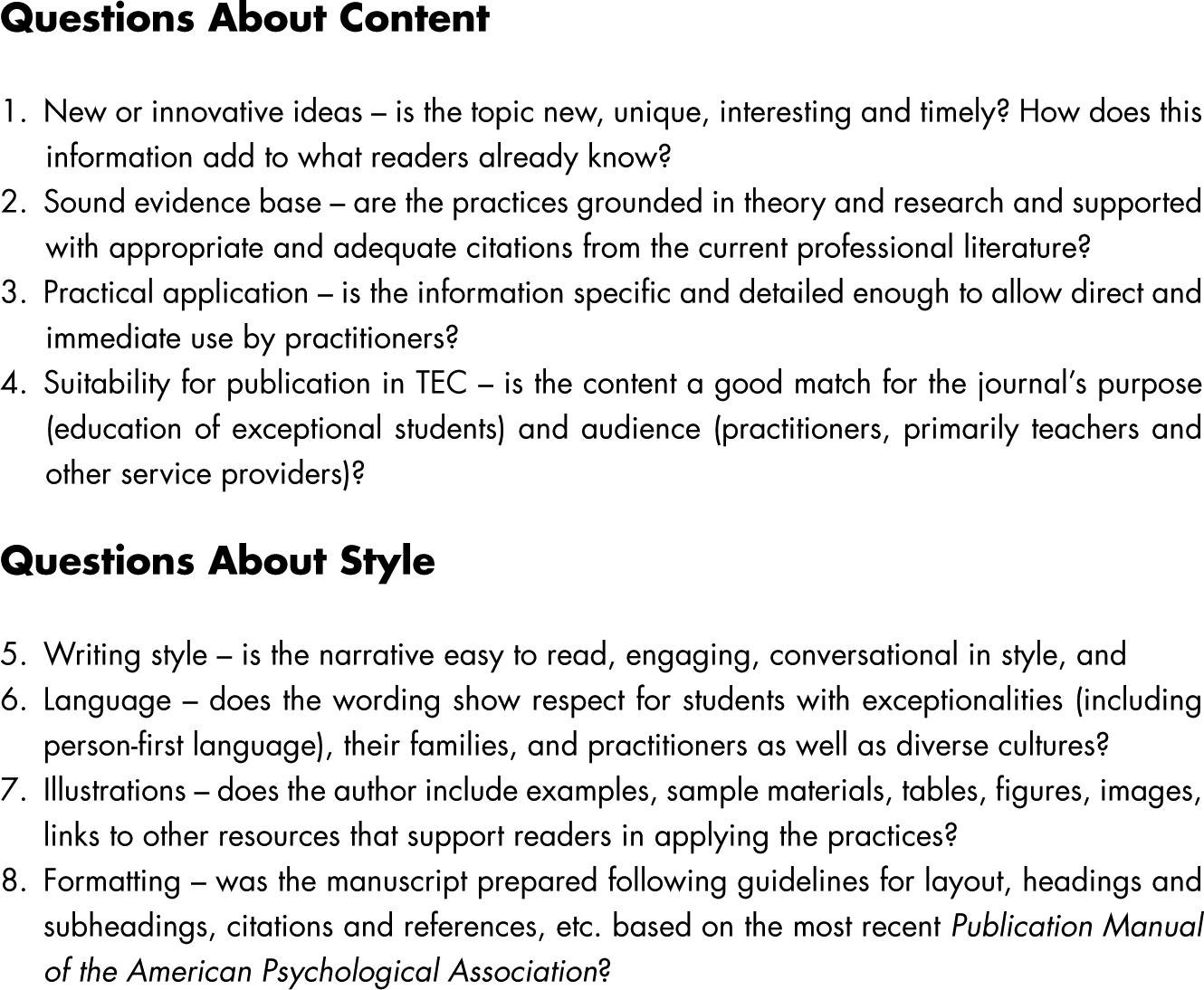
Questions to Address When Reviewing a Manuscript for TEACHING Exceptional Children
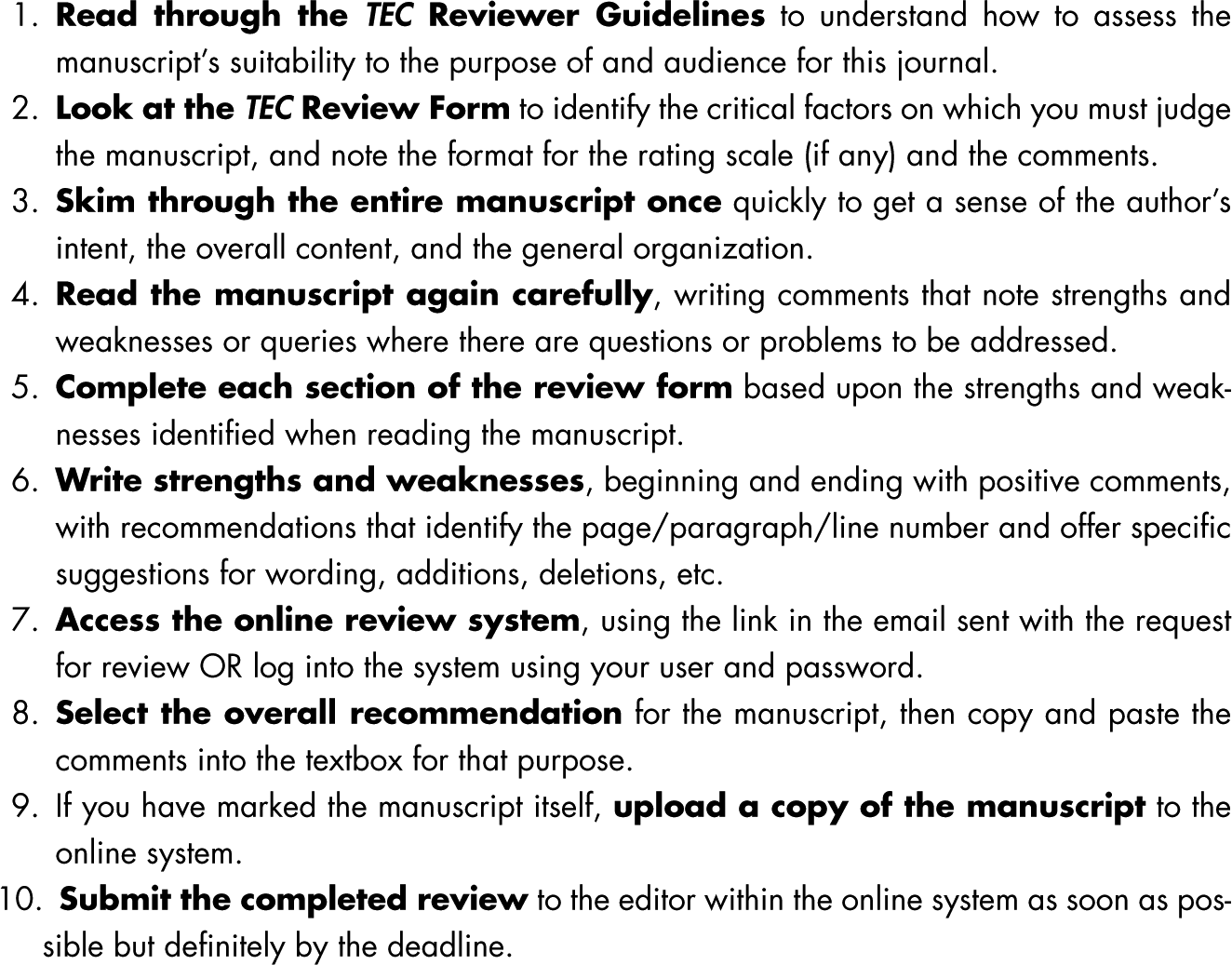
Ten Steps to Prepare a TEACHING Exceptional Children Manuscript Review
When all reviews have been submitted, the editor or associate editor reads them and rereads the manuscript, then makes a decision about the manuscript’s disposition. The decision letter summarizes the reviewer comments and suggestions for revision (if any) as well as the editorial concerns and requirements (if any) for revision and informs the author whether the manuscript is publishable or not. When the online system sends the decision message and reviewer comments to the author, you and other reviewers will receive a blind copy so that you can see whether there was consistency between your comments and those of the other reviewers and the editor. If the decision is accept with minor revisions or reject, you will not see the manuscript again. If the decision is revise and resubmit, you should keep a copy of your review (and perhaps also the decision letter) so that you can compare it to the revised manuscript if and when that becomes necessary.
Conducting a Rereview
When a manuscript has been resubmitted after being invited to revise and resubmit, the editor or associate editor will send the revised document for rereview to the same reviewers who completed the initial review. During a rereview, you should focus on determining whether or not the author addressed the problems that you noted and made the changes that you requested during the initial review. You should read your initial review (and the decision letter), then read the revised manuscript to determine if the concerns that you raised were addressed adequately and the suggestions that you made were followed appropriately. You will not rate the manuscript again, but you need to identify any continuing concerns or additional changes and offer a new recommendation for acceptance, resubmission, or rejection.
When the rereviews have been submitted, the editor or associate editor will again make a decision about its suitability for publication. If the manuscript is significantly improved and determined to be a good match for TEC’s purpose and audience, it will be accepted, perhaps with some minor revisions. In some cases, when a manuscript is significantly improved or even just somewhat improved but on a truly important topic, the decision may be to invite the author to revise and resubmit the manuscript a second or (in rare instances) third time. If you felt that your concerns and suggestions were not addressed in the revision or if you raised new or additional concerns, you may be asked to review another revision, so you again should keep a copy of your review and the decision letter for future use. If the revised manuscript is rejected, there will be no need for you to review it again.
Writing a Helpful Review
The editor or associate editor considers every reviewer’s comments in reaching a decision and recommending changes, and he or she charges the author to address all comments in revising the manuscript; so, reviews should be written carefully. To paraphrase Goldilocks, some reviews are too long, some are too short, and some are just right. A “just right” review is about a page or two in length and says much more than “This is a manuscript I think readers would enjoy” or “This manuscript does not seem to be a fit for the journal.” You should keep in mind that when a manuscript has been sent out for review, it has already been screened by the editor or associate editor, who has determined that it may have the potential to make a contribution to the professional literature. However, sending it out for review does not mean that it is worthy of publication—just that it is deserving of review. Your job as a reviewer is to assist the editorial team in making a sound and fair decision about the manuscript and to help the author improve or enhance the manuscript if it is accepted for publication. An ambiguous recommendation or vague feedback from reviewers does not inform the decision, especially when the reviews are mixed. If reviewers disagree, the editor may ask other members of the editorial team to read a manuscript and offer their opinions before making a final decision.
When you review for a practitioner journal, you will see many manuscripts that are submitted by graduate students, beginning teachers, or new faculty with little experience in publishing, so always start by being kind. Reviewers should maintain a professional demeanor when reviewing a manuscript and should avoid making statements that belittle or criticize the author. Strong negative comments are never appropriate—for instance, “This article is not and never will be worthy of a publication,” “This article is obviously a masters thesis and is not at a level of rigor for publication,” and “Even a preservice student would know more about the topic than this author.” Such mean-spirited comments can dishearten a beginning author or offend a veteran author, and they have no place in the professional review process. Keep in mind that you may submit a manuscript some day, so when writing a review, think about how you would like your reviewers to treat your work.
Begin each review with a compliment about the importance of the topic, the reader-friendly language, the up-to-date literature review, the clear and logical organization, the usefulness of the application—basically anything that you believe is a strength of the manuscript. Then, if you find major problems, one of two approaches may be helpful: (a) Offer specific feedback to help the author shape the manuscript (e.g., references that would bolster the evidence base, illustrations to make it more practical, ways to make procedures less confusing or unclear), or (b) offer detailed feedback to assist the editor in explaining why the manuscript is not appropriate (information is outdated, practices are not accurately presented, similar ideas were recently published in this or another journal, topic is not relevant to special education, Even when you think that a manuscript is not a good fit for TEC, such specific feedback is helpful. If the decision is revise and resubmit, the author will be expected to respond to your concerns. If the manuscript is rejected, the author may use your comments to revise the document before submitting it elsewhere. Figure 3 provides examples of helpful and unhelpful reviewer comments.
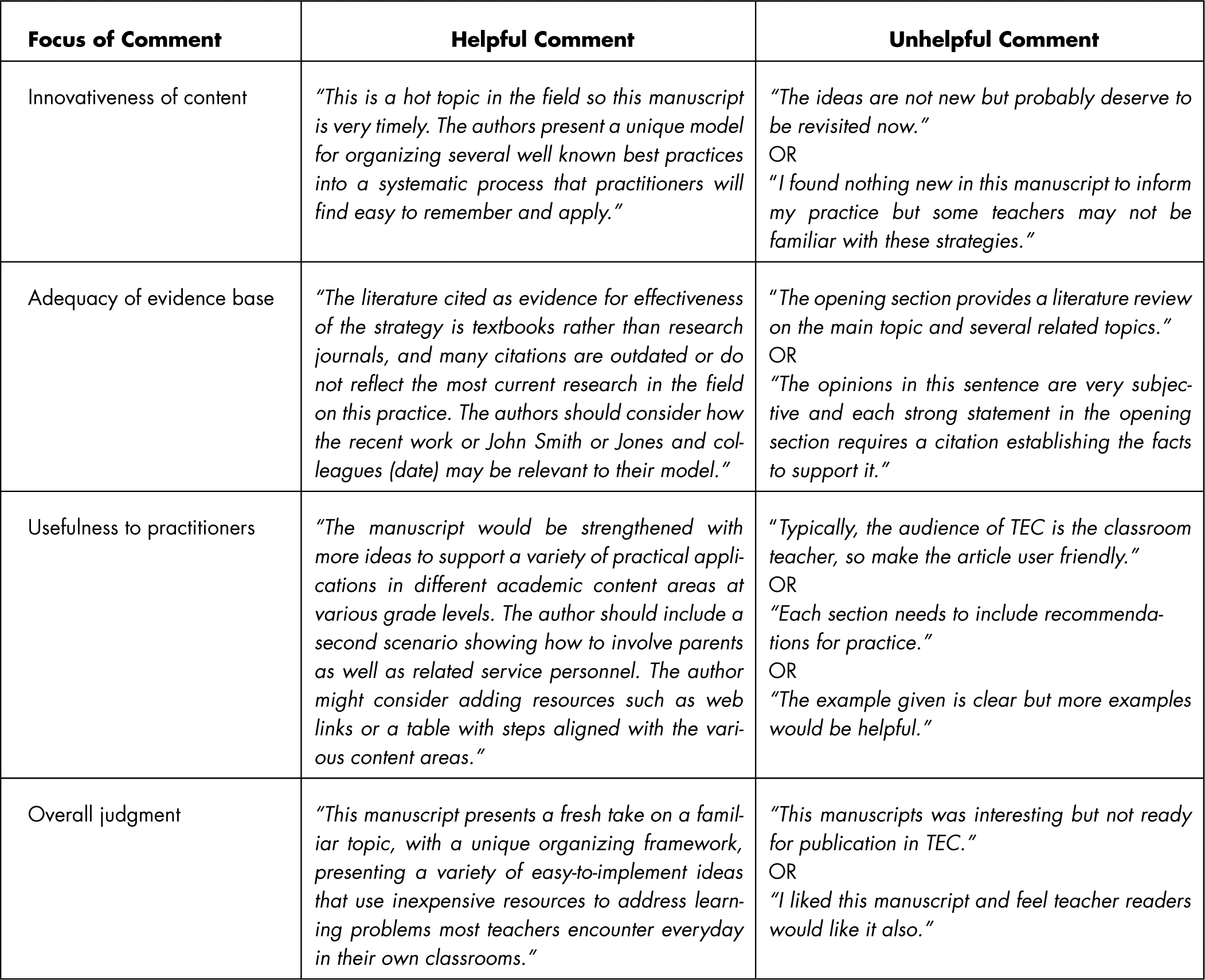
Examples of Helpful and Unhelpful Reviewer Comments
Why and How Does Someone Become a Reviewer?
Why should someone become a reviewer for a scholarly journal for practitioners? Reviewers support a journal’s editorial team in selecting the best new ideas for publication and helping authors shape their manuscripts so that they are highly practical and easy to read. Reviewing manuscripts is yet another way that you can share your knowledge with colleagues and provide important service to the field of special education. You will even have the opportunity to stay informed on important issues and trends in the field and learn firsthand about new and emerging best practices that you can use in your own work. If you have significant expertise or experience related to current evidence-based practice in the education of students with exceptionalities, you should definitely consider becoming a reviewer for a scholarly journal for practitioners such as TEC.
Editors identify reviewers for journals in several different ways: They may contact people whom they know through professional organizations or other work-related activities; they may ask colleagues (especially current reviewers) to recommend individuals to be considered for the review team; they may allow reviewers to include students or colleagues as guest reviewers; or they may announce a call for reviewers in the journal, through digital or print newsletters or via organization e-mail lists. If you are interested in reviewing for a specific journal, you should watch the journal and the organization’s newsletter or announcements for notice of a call for reviewers. If you know someone who serves on the journal’s review board, you might ask that person if she or he can allow you to serve as a guest review on a new manuscript or can recommend you as a reviewer to the editor. Another option that may be more successful with some journals than others is to send the editor a request to be considered, with a resume that outlines your training and experience and any accomplishments related to the review process (especially prior publications or review activities).
If you are interested in becoming a reviewer of manuscripts for professional publications, you will find a variety of opportunities for this important service to the field. The Council for Exceptional Children publishes TEC in six issues per year, and it is read by many thousands of individual subscribers as well as those who access it in school, college, and university libraries. In addition, several Council for Exceptional Children special interest divisions publish scholarly journals specifically for practitioners, such as Young Exceptional Children (Division for Early Childhood) and Beyond Behavior (Council for Children with Behavioral Disorders). Other professional organizations publish practitioner journals, such as The Reading Teacher (International Reading Association) and Mathematics Teacher (National Council of Teachers of Mathematics). Many additional journals in the field publish a mix of research and practice articles and may need reviewers who can provide the practitioner perspective on scholarly manuscripts for practitioners as well.
Practitioners do not often feel qualified to serve as a reviewer, but, in fact, they bring an important perspective to the peer review process for scholarly journals for practitioners. TEC has a number of well qualified practitioner reviewers who offer critical judgments and insightful comments that assist in making a decision about manuscripts that will appeal to the journal’s readers and make a contribution to the professional literature. Who else has firsthand knowledge of what practices are likely to be worth trying, what is likely to work in a classroom or other program setting, and what examples and resources will be most useful in helping readers understand how to implement the practice? If you are a practitioner, please do not be shy about your own expertise, hesitate to accept an invitation to serve as a reviewer, or feel that you should not respond to a call for reviewers. TEC and other scholarly journals for practitioners need practitioner reviewers, too!