







Abstract

Mr. Martinez, a kindergarten teacher in a large, suburban school district, is preparing to teach a reading lesson from his core reading program. His state has adopted the Common Core State Standards (CCSS; National Governors Association Center for Best Practices, Council of Chief State School Officers, 2010), and he knows he will need to address the English language arts standards in his instruction and ensure that all students in his class are ready for first grade and beyond. Mr. Martinez is worried about how to address the CCSS in a class wherein more than 50% of his students are English learners, approximately 20% of students are at risk or have been identified with a learning disability, and most of the students have very low language and vocabulary knowledge, given the school’s location in a high-poverty neighborhood where 90% of the students are eligible for free and reduced lunch services. Mr. Martinez has received professional development on how to implement the CCSS in general, but it is still not clear to him how he can follow the CCSS and at the same time address the needs of his students in the area of vocabulary and language development. Moreover, Mr. Martinez knows that word knowledge is critical for addressing the vocabulary and reading comprehension standards of the CCSS, and he appropriately believes that improving his students’ vocabulary will be a very important goal toward improving their reading comprehension. He sees how word knowledge can build thinking skills (Block, Gambrell, & Pressley, 2002), and it can determine how students understand texts, define themselves for others, and frame the way they see the world (Pinker, 2007). However, Mr. Martinez also knows what it feels like to read a story aloud and have several students struggle with vocabulary and the background knowledge required to understand the story. He remembers the countless times spent explaining abstract vocabulary and backtracking to help his students fill in vocabulary gaps. Finally, although Mr. Martinez wants to teach vocabulary effectively and efficiently, he has enough experience teaching to know that planning and integrating vocabulary instruction into lessons from his core reading program can be time-consuming. His teaching day is short, the demands from implementing the CCSS are high, and his students need substantial support. Mr. Martinez is not alone in his concerns; many other teachers and schools do not have much time to address all the CCSS, particularly those standards that are related to vocabulary (Cuticelli, Coyne, Ware, Oldham, & Rattan, 2014; Nelson, Dole, & Hosp, 2012). As Mr. Martinez flips through the pages of his lesson guide, he tries to connect what he has learned about the CCSS to his reading program. Figure 1 illustrates the type of questions Mr. Martinez still has.
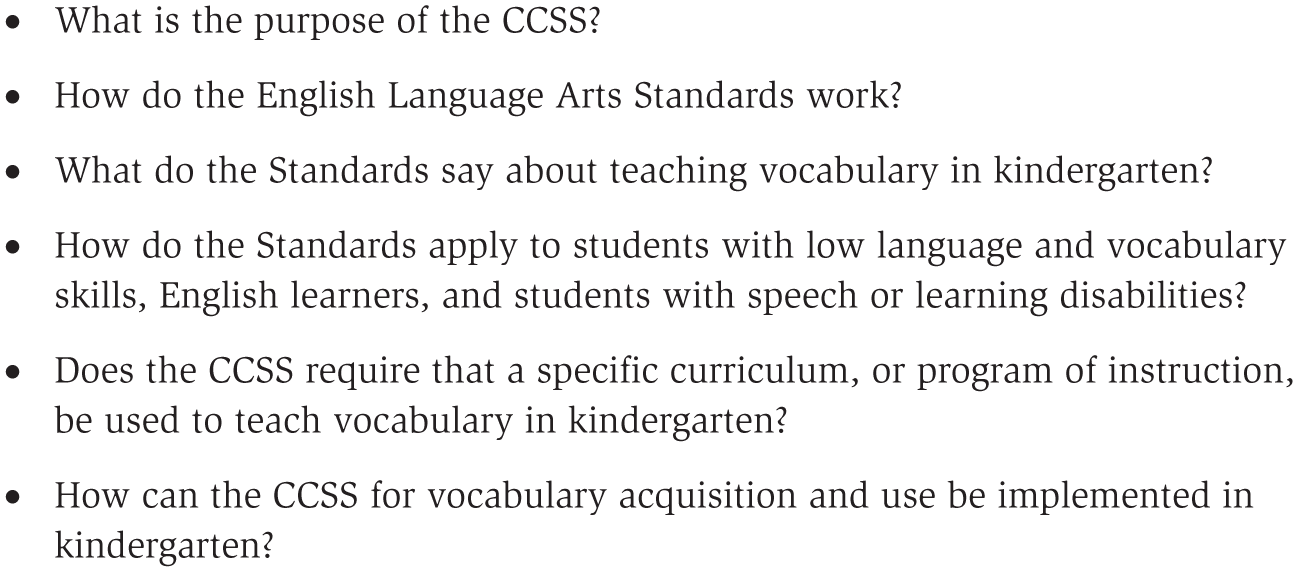
Common Core State Standards Questions From Mr. Martinez
The purpose of the CCSS is to increase academic rigor and prepare students for college and career readiness (National Governors Association Center for Best Practices, Council of Chief State School Officers, 2010). The College and Career Readiness (CCR) anchor standards, the “backbone” of the CCSS, describe the literacy skills all students need when they graduate. The grade-specific standards describe the literacy skills that all students need when they finish each grade and that correspond to the CCR anchor standards. Keeping the college and career focus at the forefront of kindergarten through Grade 12 implementation is critical; that is why the CCR anchor standards are placed before the grade-specific standards in the CCSS. In addition, the CCSS is specified by a unique backward design (Wiggins & McTighe, 2005). Backward design considers the end result first (i.e., what do we want all students to do when they graduate?) followed by the delineation of the knowledge and skills needed to achieve that end goal to be assessed. Activities are then planned according to the desired results.
English Language Arts Standards
The CCSS for English Language Arts (ELA; National Governors Association Center for Best Practices, Council of Chief State School Officers, 2010) contain standards focused on reading literature, reading informational text, foundational skills, writing, speaking, listening, and language development. Even though language standards and speaking and listening standards are independent strands in the CCSS, the intent is not for these strands to be isolated. Language should be incorporated into reading, writing, speaking, and listening instruction. Speaking and listening should also be incorporated into reading and writing instruction and viewed within the context of language. For example, for a teacher to know how students are interpreting the text (a standard in the reading strand), he or she will need to ask students, either in writing or orally, to explain their interpretation of the words and phrases contained in the text. Similarly, in the writing strand, students will need to know semantics (i.e., the ways in which language conveys meaning) and the structure of English to express their ideas clearly and accurately. In other words, each strand is part of an integrated model of literacy, and it is cross-referenced across the other strands so they can be clustered for instruction. The essential idea is that knowledge builds on knowledge. The integrated approach to literacy addresses the need for students to be able to understand complex information text in a variety of content areas in order to be college and career ready (Pritchard, Wilson, & Yamnitz, 2007).
CCSS and Vocabulary Instruction in Kindergarten
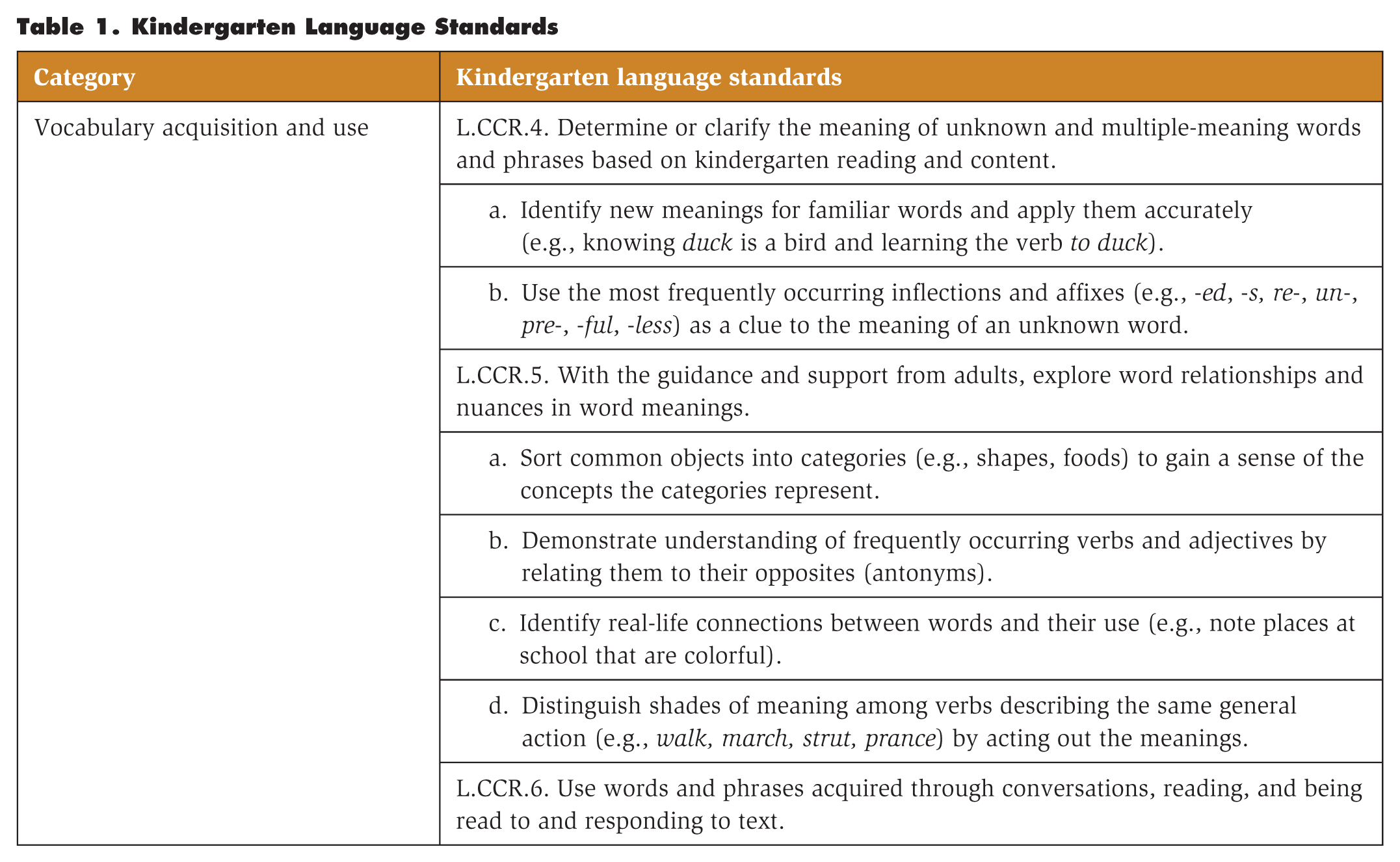
Vocabulary is specifically emphasized in the language strand and is addressed in three of the six ELA standards for Grades K–5. Standards 4, 5, and 6 focus on “vocabulary acquisition and use.” Table 1 presents the three language standards for vocabulary acquisition and use in kindergarten. When reviewing the CCSS, note the emphasis on expressive vocabulary use. That is, students need to not just recognize words and know word meanings and definitions; they are also expected to use words accurately, demonstrate their understanding of words, and be able to analyze words. For example, to determine or clarify the meaning of an unknown word, students should identify new meanings of familiar words, apply them accurately, and use the most frequently occurring inflections and affixes to determine the meaning of an unknown word. Moreover, kindergarten students are expected to use words and phrases acquired through conversations, reading, and being read to and to respond to texts as outlined in L.CCR.6 in Table 1. In other words, the CCSS promotes a deep understanding of words. Skills listed in Standard 4 represent depth of vocabulary acquisition and use through instructional activities that require sorting, relating common verbs and adjectives to their opposites, making real-life connections, and distinguishing the meaning of a set of verbs that describe a similar action (e.g., walk, march, strut, prance).
Kindergarten Language Standards
How the CCSS Applies to All Kindergarten Students
All is used frequently throughout the CCSS introductory materials to indicate an emphasis on the common core, or common set, of the CCSS for all K–5 students, including students with identified disabilities who are receiving special education services and English learners (National Governors Association Center for Best Practices, Council of Chief State School Officers, n.d.-a, n.d.-b). For example, given that in Mr. Martinez’s class, 50% of his students are English learners, it is important that when he plans his vocabulary lessons, he takes into account the fact that English learners experience the double demands of understanding content and also understanding the language (Gersten & Baker, 2000). In addition, he also needs to take into account the needs of his students with identified disabilities or at risk for learning disabilities—some of whom may also be English learners.
Emerging evidence indicates that although the vocabulary needs of students who are English learners are different from students with learning disabilities, the following evidence-based practices to teach vocabulary appear to be effective for all students: (a) use of consistent and clear instructional routines; (b) provision of additional time to complete tasks; (c) scaffolded activities based on student prior experiences and background knowledge; (d) explanation of common words with multiple meanings, such as can or tip; and (e) use of visuals and gestures to illustrate the nuances among words (e.g., teachers can show students the difference among toss, throw, and hurl using physical movement in addition to pictures). Moreover, providing students with low vocabulary additional time in small groups would provide them with more opportunities to say, hear, and practice using the words in isolation or in meaningful sentences (Baker, Al Otaiba, Ortiz, Correa, & Cole, 2014; Coyne, Kame’enui, & Carnine, 2011; Cuticelli et al., 2014). In summary, teachers can differentiate instruction for students with learning disabilities or who are English learners without having to simplify the content of the lessons.
Curriculum Materials to Teach Vocabulary in Kindergarten That Align With the CCSS
The CCSS does not require the use of a specific curriculum or articulate exactly how standards should be addressed. In other words, the CCSS does not prescribe or provide scripted lessons, nor does it tell teachers which specific texts to use to address the CCSS. More important, the CCSS is not considered a federal initiative or national curriculum (Rothman, 2011). The CCSS, however, does articulate a framework of what types of words should be taught with clear learning goals of what students need to know at the end of each academic year (International Reading Association CCSS Committee, 2012; Rothman, 2011). Table 2 includes examples of the types of words that could be selected for use in kindergarten classrooms.
Examples of Vocabulary Words Appropriate for Kindergarten
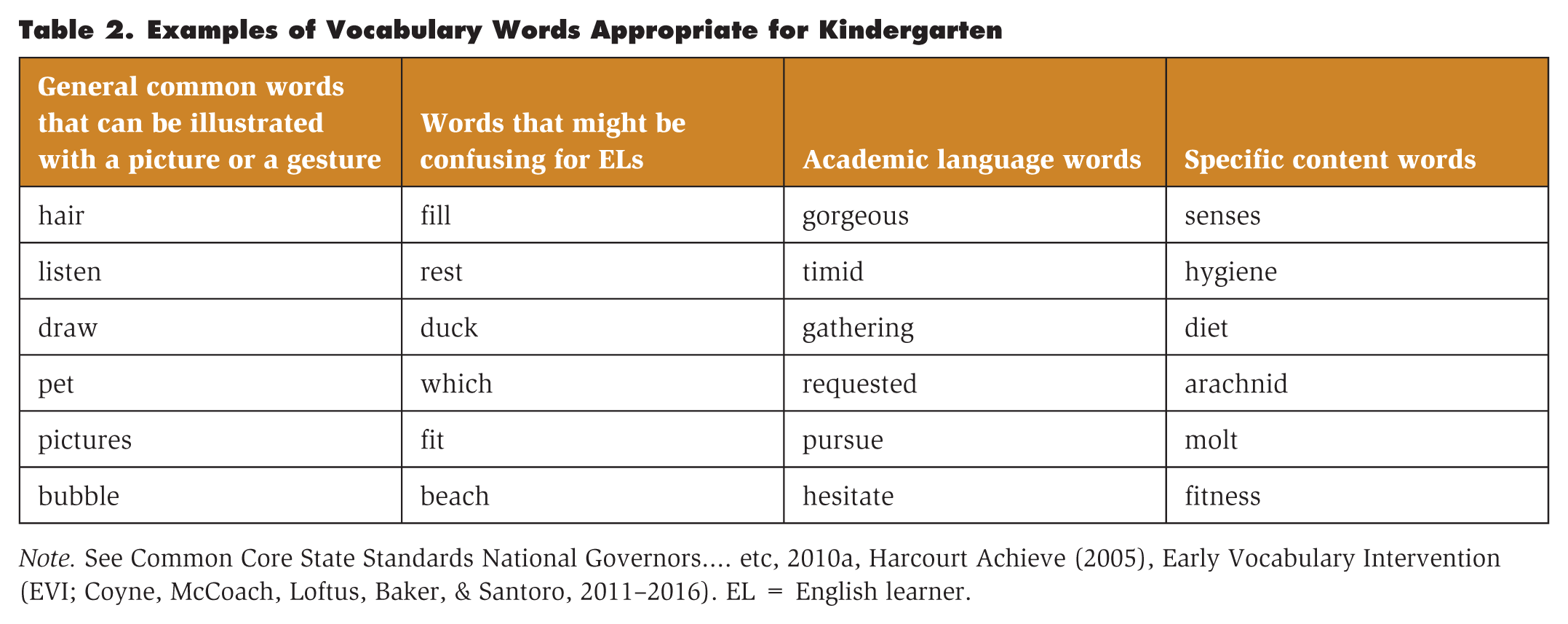
Note. See Common Core State Standards National Governors…. etc, 2010a, Harcourt Achieve (2005), Early Vocabulary Intervention (EVI; Coyne, McCoach, Loftus, Baker, & Santoro, 2011–2016). EL = English learner.
Implementing the Vocabulary CCSS in Kindergarten
As illustrated by Mr. Martinez, determining the best way to address the CCSS on a daily basis is challenging and can be very time-consuming. Activities developed as part of Project Early Vocabulary Instruction and Intervention (Project EVI), a program of research funded by the Institute of Education Sciences (Coyne, McCoach, Loftus-Rattan, Baker, & Santoro, 2011; Coyne, McCoach, Loftus-rattan, Zipoli, Ruby, Crevecoeur, & Kapp (2010)), can provide guidance for teachers looking to improve the quality of vocabulary instruction. The EVI activities illustrate how the vocabulary and language CCSS can support students with diverse needs (e.g., students with identified disabilities or at risk for learning disabilities, English learners). In the following section, we describe four specific activities developed and evaluated in Project EVI and discuss how these activities address Standard 5 (i.e., providing different ways for students to explore word relationships and nuances in word meanings with the guidance and support of the teacher). These activities are (a) example versus non-example, (b) picture-sort game, (c) making connections–word web, and (d) cumulative review.
EVI activities introduce and extend vocabulary instruction through discussions about pictures that visually display the range of a word’s meaning and word games where various forms of each word (i.e., tenses, prefixes, suffixes) are used. Figure 2 presents the daily vocabulary routines. All words in EVI are considered either academic vocabulary (Marzano, 2004) or “Tier 2” vocabulary words (Beck, McKeown, & Kucan, 2002), such as comforting, peculiar, frantic, hesitate, stumble, amble, and timid. Tier 2 refers to words that are understandable to the targeted students and that have extended use across themes and subjects. The concept of Tier 2 words originally used by Beck et al. (2002) is sometimes confusing for schools currently implementing response-to-intervention models or multitiered systems of support for instructional delivery. Thus, we will use the term academic vocabulary to refer to the type of words Beck et al. have traditionally referred to as Tier 2.
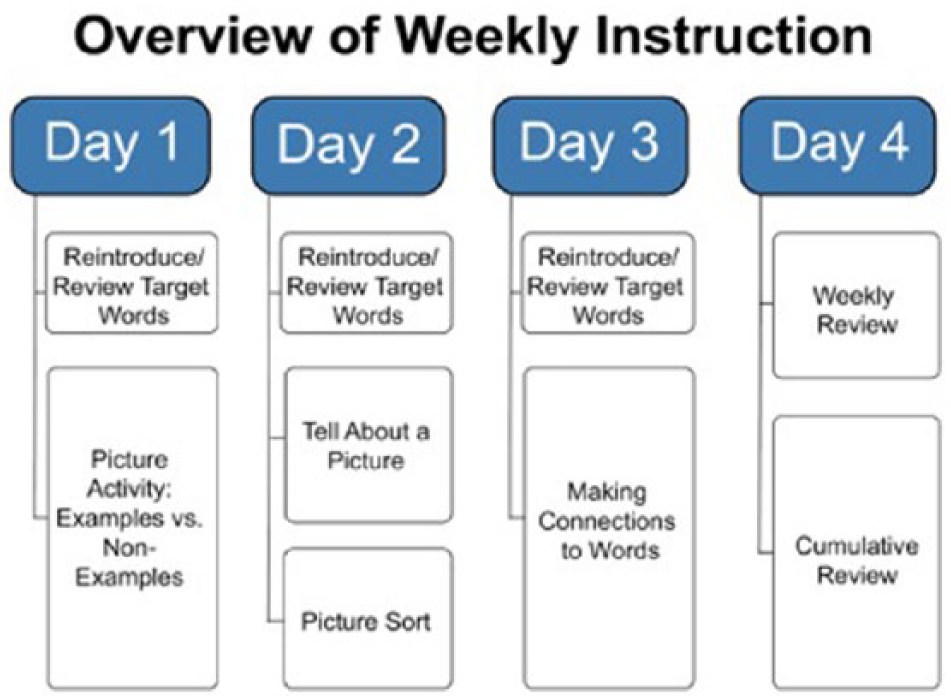
Overview of the Weekly Instruction
Word Selection
Prior to engaging in the activities, however, teachers need to carefully select appropriate vocabulary words. One of the challenges of vocabulary instruction Mr. Martinez and other teachers like him face is to determine which words require explicit, rich, and varied instruction and which words can be learned incidentally through deliberate reading or listening activities (i.e., do not require explicit instruction). Experts suggest that selecting words for explicit instruction should be based on (a) the word’s utility (e.g., how frequently students encounter the word in print), (b) whether students should be able to use the word in their own conversations and in writing, and (c) the word’s connection to themes or concepts that are central to the curriculum (Carnine, Silbert, Kame’enui, & Tarver, 2004; Hiebert & Kamil, 2005; S. Stahl & Nagy, 2006). Table 2 provides examples of academic language words that could be taught in depth in kindergarten, words that could be taught through a picture or a gesture, polysemus words that might be confusing for English learners, and content-specific words that are mainly used in a specific domain, such as science or social studies.
Example Versus Non-Example Activities
Teachers can use example versus non-example activities to help students demonstrate their understanding of the target words by relating them to their opposites or to other examples of words that have minimal differences with the target word. First, the teacher reminds students about the definition of each target word. Next, the teacher shows students a variety of picture cards that can be classified as an example of the target word (by signaling thumbs-up) or a non-example (by signaling thumbs-down). Throughout the discussion of examples and non-examples, the teacher encourages students to provide more details about the word through the use of prompts.
For example, if the student categorizes the picture card correctly, the teacher might say, “Yes, that’s right! Why does this picture show an example of our key word idle?” If the student is unable to distinguish between an example and a non-example, the teacher says, “This picture does not show someone idle, because it shows children moving around or doing something. Let’s try again. Does this picture show something or someone idle?” Asking students to classify pictures into examples and non-examples teaches students to think about antonyms. For instance, students may determine whether a picture of a newly built home represents something ancient. In summary, the example and non-example activity builds student knowledge of how antonyms are opposites of synonyms. Figure 3 illustrates how teachers can encourage students to provide additional examples of active and not active.
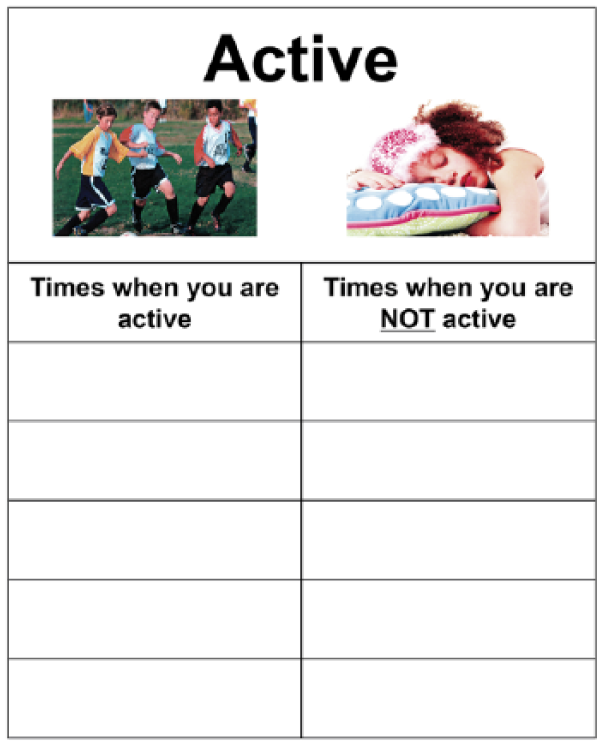
Example Versus Non-Example: Active
Picture-Sort Game
For the picture-sort game, students sort picture cards into categories to gain a sense of concepts that the categories represent. Semantic sorting helps students improve vocabulary knowledge by emphasizing how words and concepts relate or do not relate to one another (e.g., Johnson & Pearson, 1984; K. Stahl & Stahl, 2012; S. Stahl & Vancil, 1986). To play the game, the teacher places the anchor pictures (picture cards that visually display the definition of each target word, such as a picture of a teddy bear for the word comforting, a picture of children running fast for the word fleet, and a picture of diamonds for the word glimmer) on the table where all students can see them. The teacher reminds students which target word is associated with which picture card. Next, the teacher mixes up additional pictures (three examples for each target word) in a pile. Finally, the teacher calls on individual students in a random order to choose a picture from the pile and place it next to the anchor picture that shows the same target word. Students are also prompted to explain why they categorize the pictures the way they did when the teacher prompts, “Yes, that’s right! Why do these pictures go together?” If the student gives an incorrect response, the teacher scaffolds learning by stating the correct response in an explicit manner by saying, “This picture of a teddy bear shows something that is comforting because a teddy bear can make us feel better.” In addition, the teacher asks the student the same question as before, “Why do these pictures go together?” to give him or her an opportunity to answer the question correctly the second time (teachers would expect students to say something like, “Both pictures show something that is comforting or makes us feel better”).
Semantic sorting helps students improve their vocabulary knowledge by emphasizing how words and concepts relate or do not relate to one another.
Asking students to sort picture cards into categories helps them make nuanced distinctions between word meanings. For example, when sorting pictures for the words discouraged, hesitate, and desire, students are expected to know that hesitate is the action of stopping a little because one is unsure, that discouraged is the feeling that comes with thinking one is doing something that is not working, and that desire is the action of really wanting something. In summary, the picture-sorting game provides an opportunity for students to fine-tune their understanding of the target words. Figure 4 provides an illustration of the anchor pictures that are used for the words discouraged, hesitate, and desire.
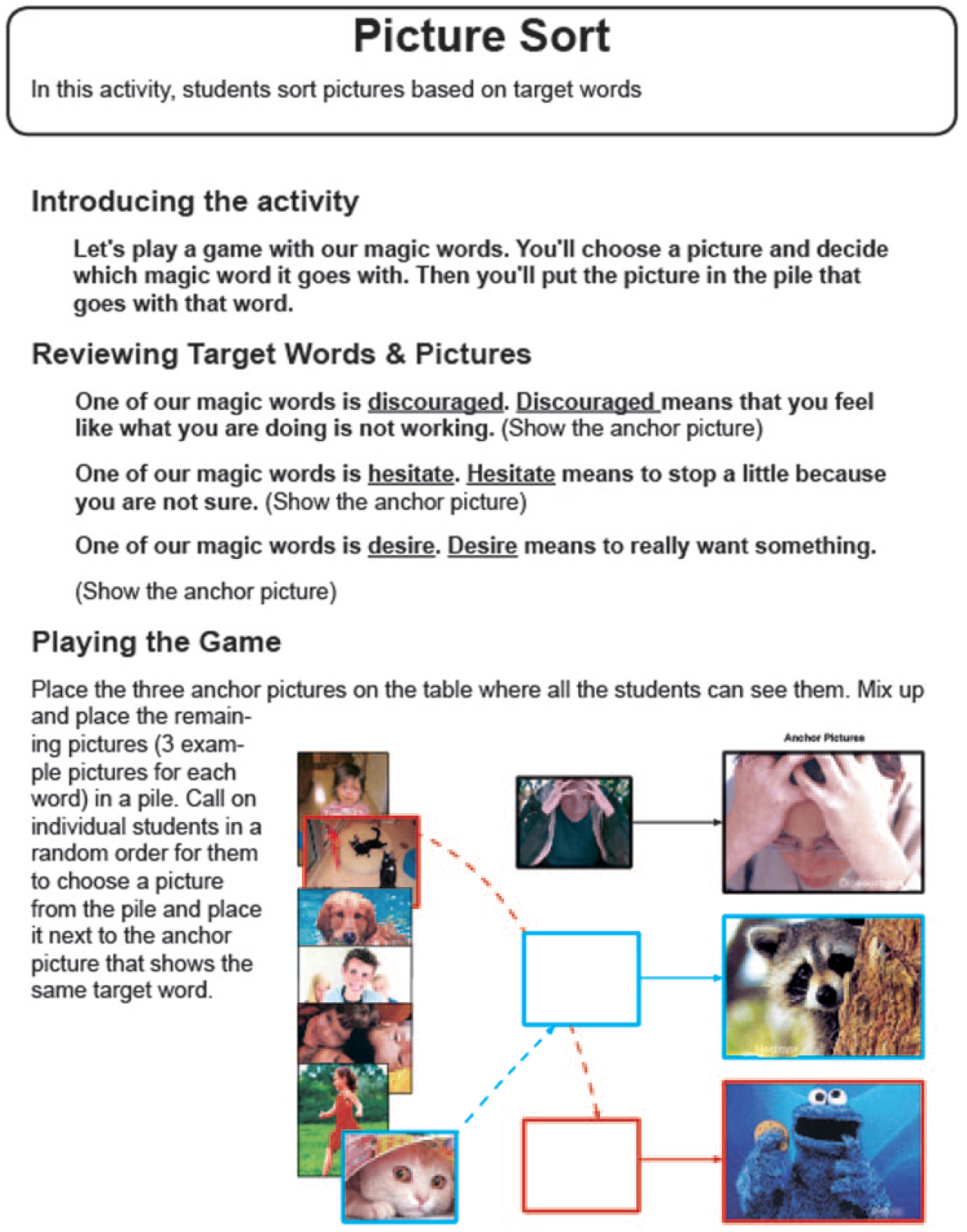
Picture-Sort Game: Discourage/Hesitate/Desire
Making Connections–Word Web
For the making connections–word web activity, students create word webs (i.e., semantic networks) to help them identify real-life connections between the vocabulary words and how the word is used in a variety of semantic contexts, such as types or categories of words (e.g., “do” words, “feel” words) or examples of contexts when words might be used. To start, the teacher shares the student-friendly definition and models the correct answer or provides an example of a word or picture that can be added to the word web. After the teacher models a correct response, students provide examples to complete the rest of the word web. Finally, the teacher provides feedback using the target word to affirm or correct each student’s response. For example, if a student added a correct example to the semantic network for the word gorgeous, the teacher would say, “Great job! A flower is gorgeous because it is very beautiful. Everyone, let’s all say, ‘A flower is gorgeous.’” By creating semantic networks, students have an opportunity to identify real-life connections for key vocabulary words. Figure 5 illustrates the graphic organizer used for this game for the word gorgeous.
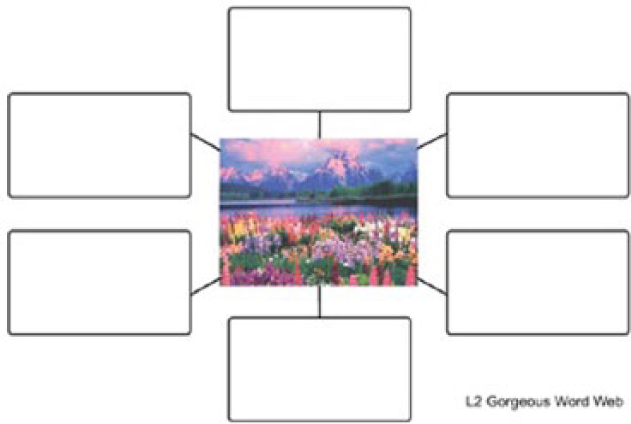
Making Connections–Word Web: Gorgeous
Cumulative Review
An important component of an academic vocabulary program is the cumulative review. Consistently scheduled, systematic review helps students solidify the learning that occurs during the past weeks (Coyne et al., 2007). Review activities are not meant to be a reteaching of the words learned, but rather extensions of the information students learned about a word. It is also an opportunity for students to distinguish shades of meaning among words described by the same general action. These activities would address Standards 4a and 5d. For example, when conducting a review activity, the teacher can show two anchor pictures to students representing words students learned during the previous weeks.
When showing the two anchor pictures, the teacher asks students to point to the picture they are describing using the target word. In a review session, students are shown the picture of a cheetah (anchor picture for fleet, or moving fast) and the picture of an eagle in the sky (anchor picture representing soar, that is, to fly high and fast). The teacher asks, “Which one of these pictures shows soar?” If the student points to the picture of an eagle, the teacher will say, “Yes, good job! The word soar is for the picture of the eagle. Tell me what soar means.” If the student responds incorrectly, the teacher provides the definition of the target word and asks the student to repeat the definition. For instance, for the word soar, the teacher would say, “To soar means to fly high and fast. Let’s try that again. Tell me what soar means.”
The teacher can also review the definition of fleet following the same procedure as for the word soar. It is not necessary for students to remember the name of the animal on the anchor card that is fleet or that soars because the focus of the activity is on the words fleet and soar, not on the name of the animal. Once students have reviewed the definitions, the teacher can help students make connections between the words learned. For example, teachers can use similar nouns to illustrate the words fleet and soar. We used an airplane as an example for the word soar and jets as an example for the word fleet. In this case, students can extend their knowledge of the two words by learning that airplanes and jets can soar and also be fleet.
Another cumulative review activity to practice the learned words is to present them in a different context and to ask students to raise their hand when they hear the target words. For example, the teacher reads a story about a girl, Alicia, who goes on a journey (a word that was previously taught in depth) on an airplane. Alicia had always dreamed what it would be like to soar through the clouds. Then, in the summer, she went on a journey with her parents, and she actually experienced flying in an airplane that was very fleet. This was the best experience of her life. Students raise their hand when they hear the target words and say them one more time for review.
Conclusion
Teachers, like Mr. Martinez, may feel uncertain about how to ensure that all his students, including students with identified disabilities or at risk for learning disabilities and English learners, achieve the CCSS in vocabulary. At the same time, Mr. Martinez is also searching for practical, concrete ideas for incorporating the CCSS in the classroom and for using parent volunteers or instructional assistants to provide additional support to these students. In this article, we describe four activities that include language-rich interactions and that can be implemented to support vocabulary acquisition. Across several studies, these types of activities resulted in improved outcomes of all students, including students with reading or language disabilities (Coyne, Capazzoli, Ware, & Loftus, 2010; Cuticcelli et al., 2014). A checklist is provided in Figure 6 that teachers, like Mr. Martinez, can use to identify and address the vocabulary needs of students with identified disabilities or at risk for learning disabilities and English learners. Although we have provided examples only for kindergarten vocabulary activities, we recommend that consistent vocabulary instruction occur across all grades to ensure students’ reading success beyond the elementary grades. Finally, even though substantial research evidence indicates that low vocabulary skills need to be addressed early, few programs address this need. Moreover, language in the CCSS is a key component to develop student reading and writing skills. Thus, providing teachers with evidence-based activities that can improve the quality of vocabulary and language instruction can potentially ensure that all students attain vocabulary knowledge identified in the CCSS.
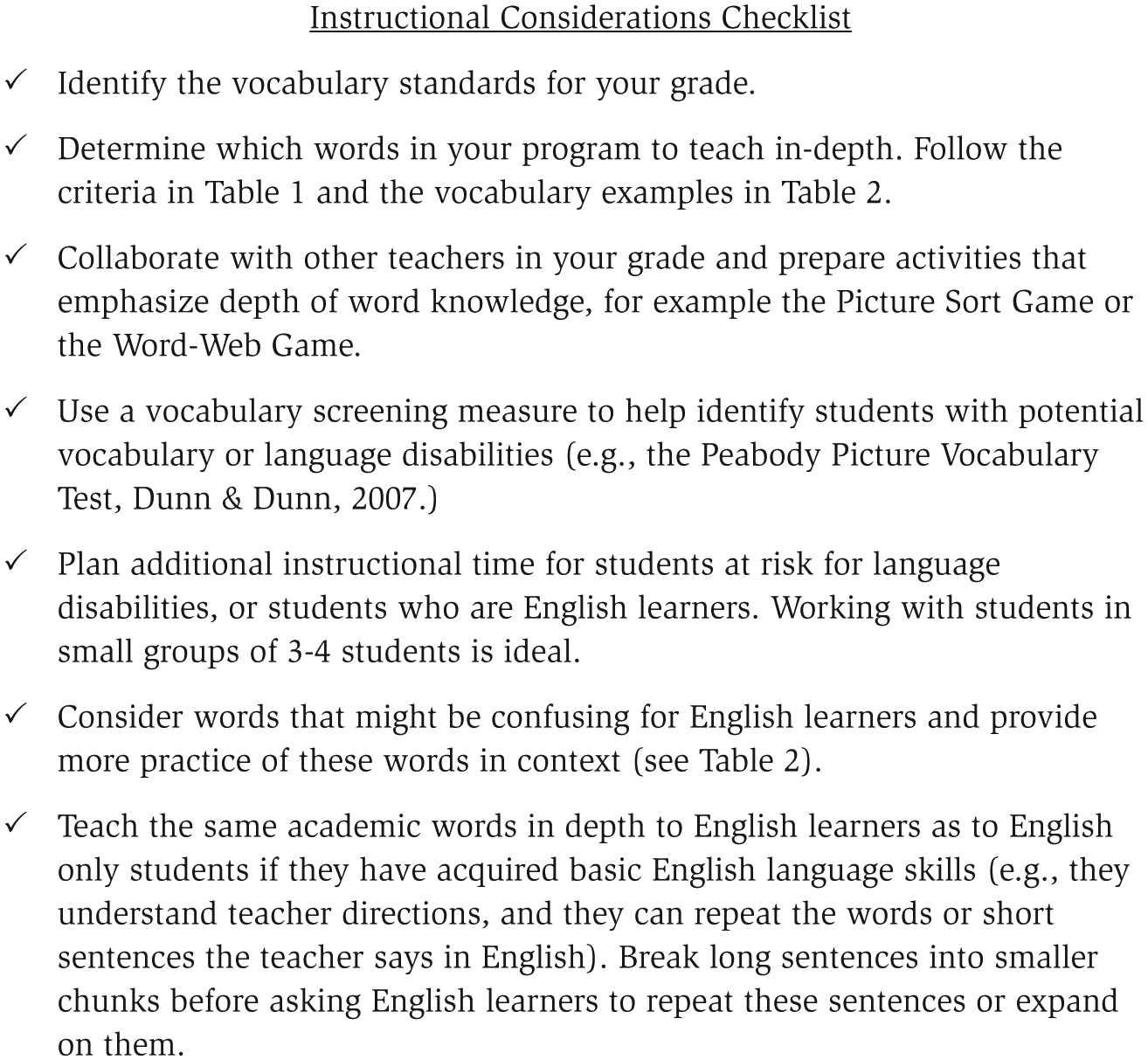
Instructional Considerations Checklist

Footnotes
The research reported here was supported by the Institute of Education Sciences, U.S. Department of Education, through Grant R324A110135 to the University of Connecticut. The opinions expressed are those of the authors and do not represent views of the Institute or the U.S. Department of Education. The authors would also like to thank Susanna Williams and Eugenia Coronado for their support in the preparation of this manuscript.