







Abstract

Although standards-based reform has been evolving over a period of 40 years, it is relatively new to the field of special education (Browder et al., 2012). The purpose of standards-based reform is to better align special education programs and policies with larger national school improvement efforts (Nolet & McLaughlin, 2000). For only the last decade, special educators have been feeling the impact of this reform. The No Child Left Behind Act of 2001 and, more recently, the proposed reauthorization of the Elementary and Secondary Education Act (ESEA) have reinforced the standards-based reform for students with disabilities. Included in the Obama Adminstration’s recommendations for reauthorizing the ESEA are incentives for states to adopt academic standards that prepare students to succeed in postsecondary education and the workplace. The document asserts that “every student should graduate from high school ready for college and a career. Every student should have meaningful opportunities to choose from upon graduation from high school” (U.S. Department of Education, 2010a, p. 7).
This standards-based reform has become known as the college and career readiness movement. The focus on college and career readiness has been a result of (a) four out of every 10 college students, including those at 2-year institutions, needing to take remedial courses in college and (b) many employers commenting on the inadequate preparation of high school graduates (U.S. Department of Education, 2010b). To help achieve the stated goal of college and career readiness, the proposed reauthorization of ESEA calls for raising standards for all students in English language arts (ELA) and mathematics, developing better assessments aligned with college and career-ready standards, and implementing a complete education through improved professional development and evidence-based instructional models and supports.
To address these issues, in June 2010, the National Governors Association Center for Best Practices (NGACBP) and the Council of Chief State School Officers (CCSSO) released final versions of the Common Core State Standards (CCSS) for ELA and mathematics. The CCSS describe the knowledge and skills in ELA and mathematics that students will need when they graduate, whatever their choice of college or career. These sets of standards define the knowledge and skills that students need to succeed in entry-level, credit-bearing academic college courses, as well as in workforce training programs. Together, the CCSS initiative and the proposed ESEA reauthorization recommendations have implications for curricula, instruction, and assessment that are relevant for all students, including students with disabilities at the secondary level.
Although academic standards define learning targets for all students, teachers use a variety of curriculum materials and instructional strategies to help students reach those targets. For students with disabilities, teachers tailor the curriculum and use instructional strategies to meet individual learning needs (Hess, 2012). According to the NGACBP and the CCSSO (2010), these standards provide a “historic opportunity to improve access to rigorous academic content standards for students with disabilities” (“Application to Students With Disabilities,” p. 1). To be successful in the general curriculum, students with disabilities should be provided additional supports and services, such as (a) instructional supports for learning based on the principles of universal design for learning, (b) instructional accommodations that include changes in materials or procedures but not changes to the standards, and (c) assistive technology and services.
The CCSS provide educators with standards for academic knowledge and skills in both ELA and mathematics. Conley (2012) suggested that there are four keys to college and career readiness: (a) key cognitive strategies, such as interpretation; (b) key content knowledge; (c) key learning skills and techniques, including persistence and self-awareness; and (d) key transition knowledge and skills, including planning for postsecondary education and careers. Despite improving trends in postschool outcomes for individuals with disabilities, outcomes in education, employment, and independent living remain at unsatisfactory levels (Newman et al., 2011). Students with disabilities are more likely than their peers without disabilities to experience unemployment or underemployment, lower pay, and job dissatisfaction (Dunn, 1996; Newman et al., 2011). In January 2013, the percentage of people with disabilities in the labor force was 20.8%; by comparison, the percentage of persons with no disability in the labor force was 68.9% (U.S. Department of Labor, 2013). To improve postschool outcomes for students with disabilities, secondary transition skills must be aligned with the standards, curriculum, instruction, and service delivery.
Aligning the CCSS With Secondary Transition
Although legislation has mandated that all students learn academic skills, students with disabilities continue to need instruction in secondary transition skills. These skills may include daily living skills, employment skills, and self-determination skills (Test et al., 2009). Educators agree that teaching both academics and transition skills are important (Wehmeyer, Agran, & Hughes, 2000), but it is possible that transition skills are being eliminated from students’ educational programming due to lack of time to teach both. Research has indicated, however, that students are able to learn both academic and secondary transition skills simultaneously (see Table 1).
Although legislation has mandated that all students learn academic skills, students with disabilities continue to need instruction in secondary transition skills. These skills may include daily living skills, employment skills, and self-determination skills.
Snapshot of Research Examining the Effects of Teaching Academic and Secondary Transition Skills
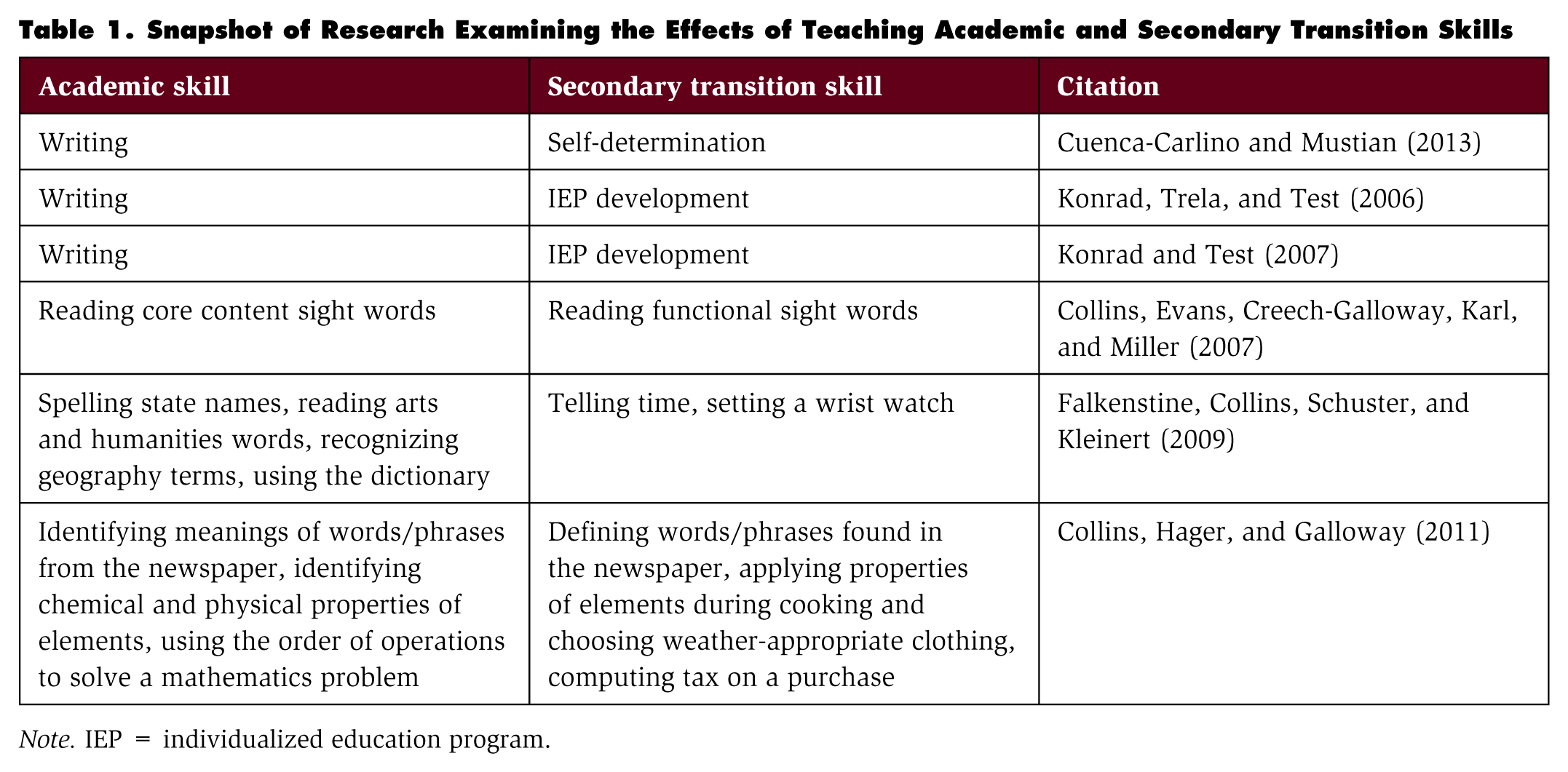
Note. IEP = individualized education program.
Aligning the CCSS With Secondary Transition Skills in the Classroom
Ms. Perez, a high school special education teacher, attended a 6-hour training on the CCSS and how to realign and improve her academic instruction to these new standards. However, the training provided little insight on connecting CCSS-aligned academic content to secondary transition skills that her students also needed to learn. She felt quite stressed about not having sufficient time to teach it all and did not even know where to begin.
After considering several options, she decided on two approaches to teach academic and transition content simultaneously. Using the first approach, teachers begin by identifying target academic skills and then expand the scope of the lesson to include secondary transition skills. In the second approach, teachers begin with the target secondary transition skill, then expand the scope of the lesson to include relevant academic skills. Depending on the classroom situation and student learning goals, Ms. Perez decides which approach works better for her instructional planning.
Approach 1: Start With the Academic Skill
The first approach involves identifying the CCSS and then extending this focus to include relevant secondary transition skills. Ms. Perez co-teaches ELA with a secondary English teacher, Ms. Hughes. Ms. Perez and Ms. Hughes are instructing their students on the CCSS anchor skill “Read closely to determine what the text says explicitly and to make logical inferences from it; cite specific textual evidence when writing or speaking to support conclusions from the text” (CCSS.ELA Literacy.CCRA.R.1, using Of Mice and Men (Steinbeck, 1937) as the text. In her role as the co-teacher, Ms. Hughes provides direct instruction to students on (a) how to determine what the text said, to make logical inferences, and (b) how to cite specific textual evidence when writing or speaking, to support conclusions. To extend this standard into secondary transition skills, Ms. Perez identifies transition skills related to the content of the book or the actual standard itself. For example, one possible skill illustrated in the text is conflict resolution, which is a social skill. In their lesson, Ms. Perez and Ms. Hughes use an interactive journal activity requiring students to reflect on the conflicts that arise between George and Lennie and to require students to cite specific textual evidence to support their writing. The students then compare those conflicts to their own lives and how they have managed and resolved conflicts in the past. Ms. Perez responds to the student through the journal and provides feedback and instruction on appropriate conflict resolution skills, such as how to appropriately deal with being teased. Finally, Ms. Perez asks guiding questions to help students make logical inferences using the text. Accommodations for this activity include graphic organizers, peer support, and assistive technology (e.g., speech-to-text software, word prediction). Figure 1 illustrates how Ms. Perez and Ms. Hughes deliver this instruction.
The first approach involves identifying the CCSS and then extending this focus to include relevant secondary transition skills.
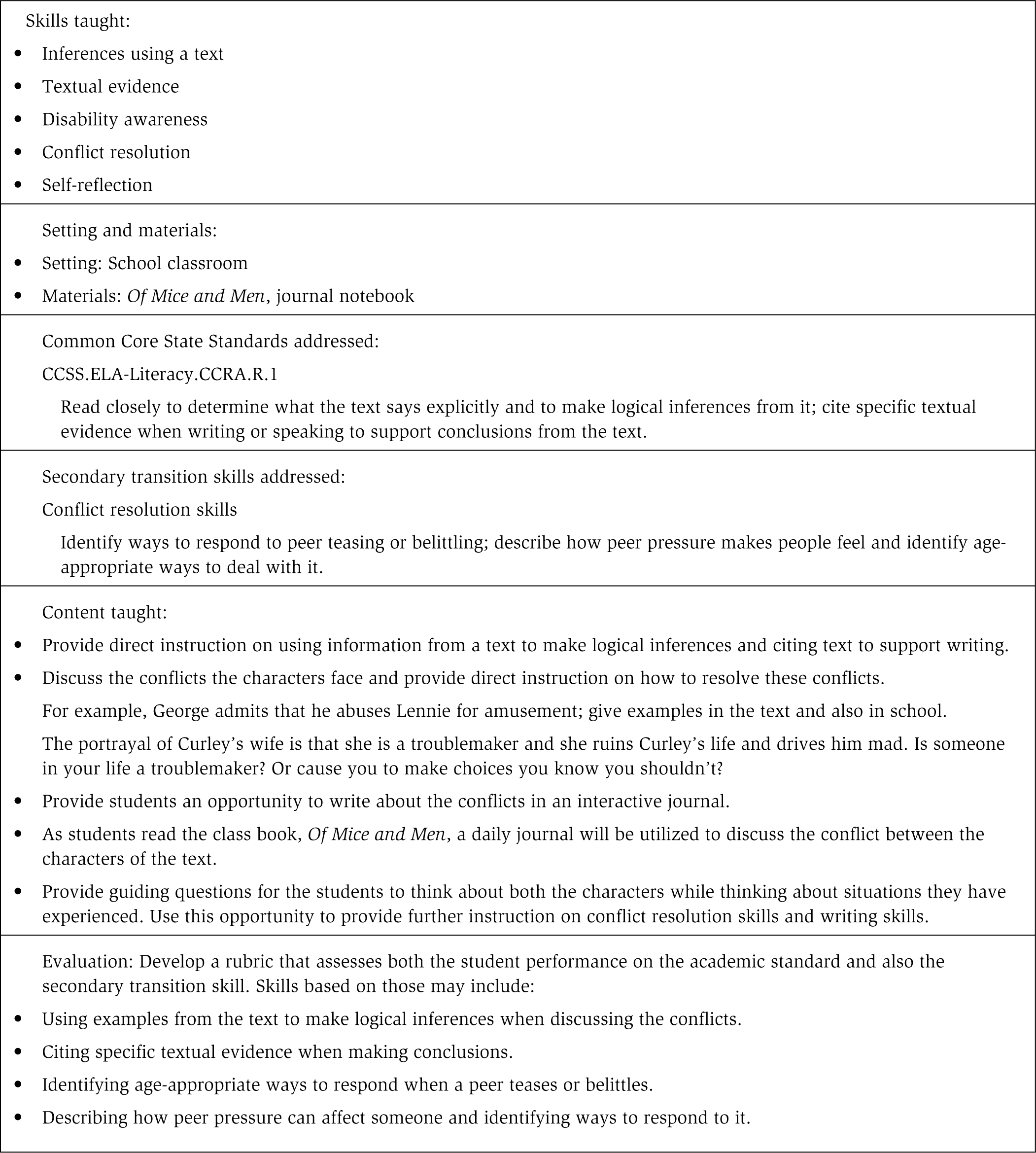
Using Of Mice and Men to teach conflict resolution skills.
Ms. Perez and Ms. Hughes also extend this method with a writing activity. An anchor writing standard from the CCSS requires students to produce “clear and coherent writing in which the development, organization, and style are appropriate to task, purpose, and audience” (CCSS.ELA Literacy.W.4). Ms. Hughes suggests that she and Ms. Perez teach this standard by requiring students to write a cover letter for a job opportunity. Ms. Hughes first provides students, including those with disabilities, with instruction on writing skills specific to the standard (i.e., development, organization, style, and appropriate content based on audience) through a variety of sample topics, including cover letters. Students are provided with an opportunity to engage in the writing process, including brainstorming as the first step (Kwon, 2013). Students work in small groups are guided through brainstorming content to include in the writing. Ms. Perez provides targeted instruction to a small group of students with disabilities who are working on the cover letter. She discusses giving details strengths and how the position matches with personal qualifications. As students draft and edit their writing, accommodations may include graphic organizers, peer support, and assistive technology (e.g., speech-to-text software, word prediction).
Ms. Perez overhears Mr. Withrow, a special education algebra teacher, stating that he does not have time to teach both the CCSS and the transition skills. He has specific benchmarks to meet each 9 weeks and has already determined which standard to teach each 9 weeks. Ms. Perez shares her method of integrating transition skills into the CCSS and suggests that he begin with the standard that he had already planned to teach. The next week, Mr. Withrow focuses on the CCSS “Create equations in two or more variables to represent relationships between quantities; graph equations on coordinate axes with labels and scales” (CCSS.Math.Content.HSA.CED.A2). Mr. Withrow decides to apply this standard to a real-life situation. The students are required to compare the cost of college through the use of an equation and visual display on a graph. Mr. Withrow provides direct instruction on using variables within an equation to represent different relationships. The students are provided with instruction on how to graph the information and make a visual analysis. Once all students master this skill, they apply it to their own lives through the comparison of college costs. This instruction can be modified to eliminate the need to apply the standard to a wide variety of examples and include only a cost analysis. Accommodations that Mr. Withrow may use include the use of manipulatives, graphing software, and a step-by-step checklist of the steps to complete the activity.
After successfully including transition skills into CCSS, Mr. Withrow thinks of additional transition skills that he would like to teach his class, but he is not sure where these skills fit into the CCSS. This leads him to a second approach.
Approach 2: Start With the Transition Skill
The second approach to aligning academic and secondary transition skills is to start with the secondary transition skill first, then extend the lesson to include relevant academic skills. This approach (see Figure 2) may be best for students whose educational programming has a primary emphasis on secondary transition and is applicable to a variety of settings, including general education and the community.
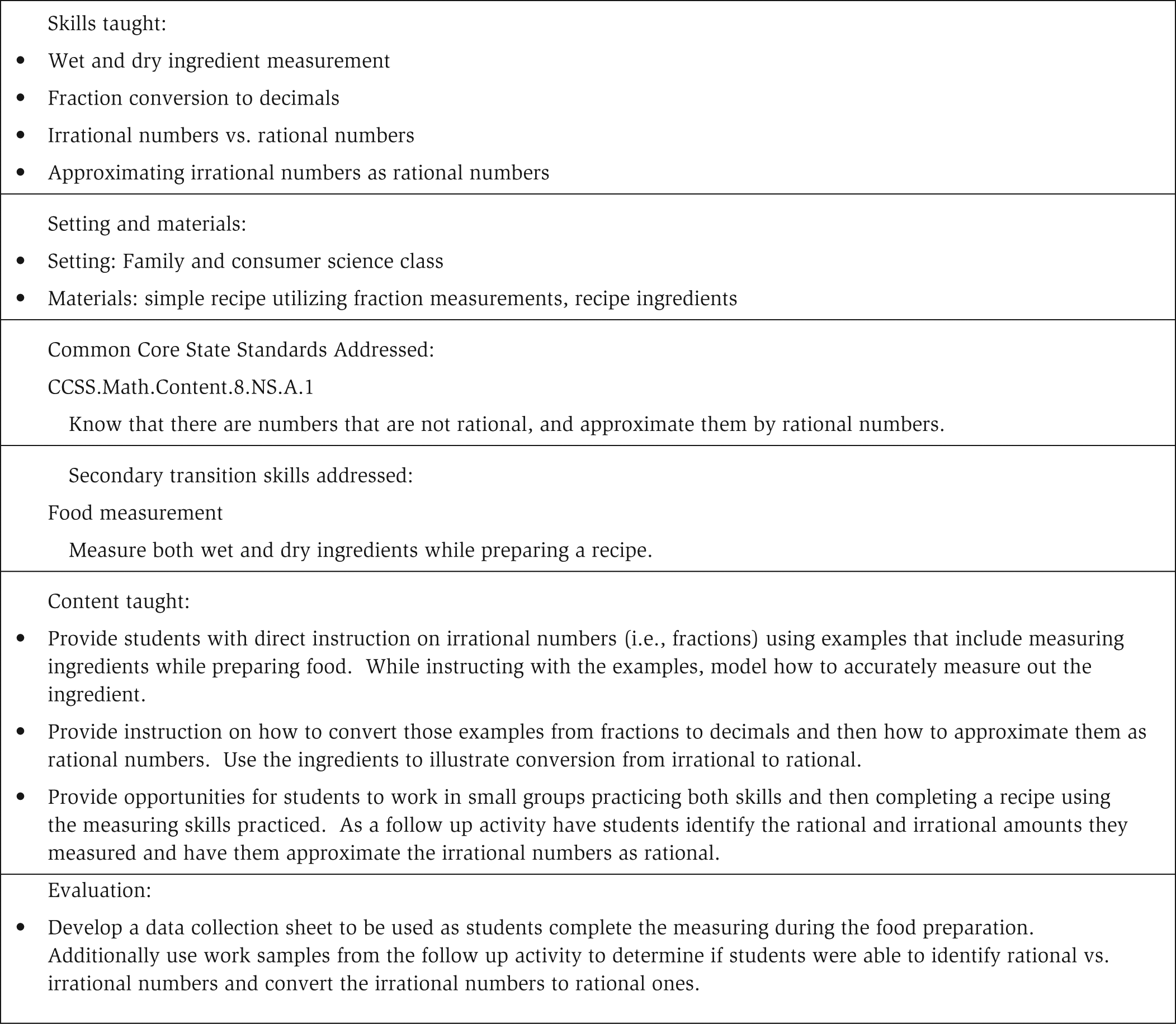
Using food preparation to teach irrational numbers
Mr. Withrow knows how important living skills such as cooking are for students with disabilities, and many of his students also have difficulty grasping an understanding of fractions. Mr. Withrow decides to team up with the family and consumer science teacher, Ms. Davila, and use her classroom to teach food preparation and incorporate a fraction lesson. The initial goal of this instruction is to teach cooking skills that students can use in current and future living environments. In this particular unit, students are learning measuring skills through several recipes. Mr. Withrow then identifies relevant academic standards aligned with this instruction. One eighth-grade mathematics standard that may be applied to a cooking activity involving fractions is “Know that there are numbers that are not rational, and approximate them by rational numbers” (CCSS.Math.Content.8.NS.A.1).
The second approach to aligning academic and secondary transition skills is to start with the secondary transition skill first, then extend the lesson to include relevant academic skills.
To provide instruction including both the secondary transition skill and the academic skill, Mr. Withrow provides direct instruction on fractions using measurements while cooking (e.g., one-half, two-thirds). The cooking instruction also includes how to convert to decimals and how to approximate those numbers as rational numbers in a real-life context. Students then make recipes in their family and consumer science class, including fraction measurements, and Mr. Withrow follows up with instruction on converting those fractions into decimals and approximating them as rational numbers. While students accurately measure dry and wet ingredients, they also apply rational and irrational number instruction. Accommodations for this activity include picture recipes, a narrow focus on specific irrational numbers, a step-by-step checklist for conversion, and a step-by-step checklist with visuals on how to accurately measure wet and dry ingredients. A lesson plan starter is provided in Figure 2.
Ms. Perez decides to use this approach to teach communication and social skills. Many of her students have needs in the area of social skills, including interactions with peers, teachers, and community members. The CCSS in ELA include anchor standards for speaking and listening: “Prepare for and participate effectively in a range of conversations and collaborations with diverse partners, building on others’ ideas and expressing their own clearly and persuasively” (CCSS.ELA Literacy.CCRA.SL.1). Ms. Perez develops instruction on communication and the speaking and listening standard. She provides direct instruction to her students and then provides opportunities to apply what they learned in role-playing activities. Ms. Perez is also able to extend this communication instruction to include an additional ELA standard: “Adapt speech to a variety of contexts and tasks, demonstrating a command of formal English when indicated or appropriate” (CCSS.ELA Literacy.SL.11-12.6). Once her students master the targeted communication and social skills, Ms. Perez then teaches her students how to adapt their communication to conversations with different partners, such as coworkers and supervisors.
Although the college and career readiness movement has propelled schools to further include all students into academic-based courses, students with disabilities continue to need instruction in skills needed for successful post school life.
Figure 3 provides a snapshot of the resources that are available from the National Secondary Transition Technical Assistance Center. Curriculum developers and teachers can use these resources to guide their integration of secondary transition practices with the CCSS.
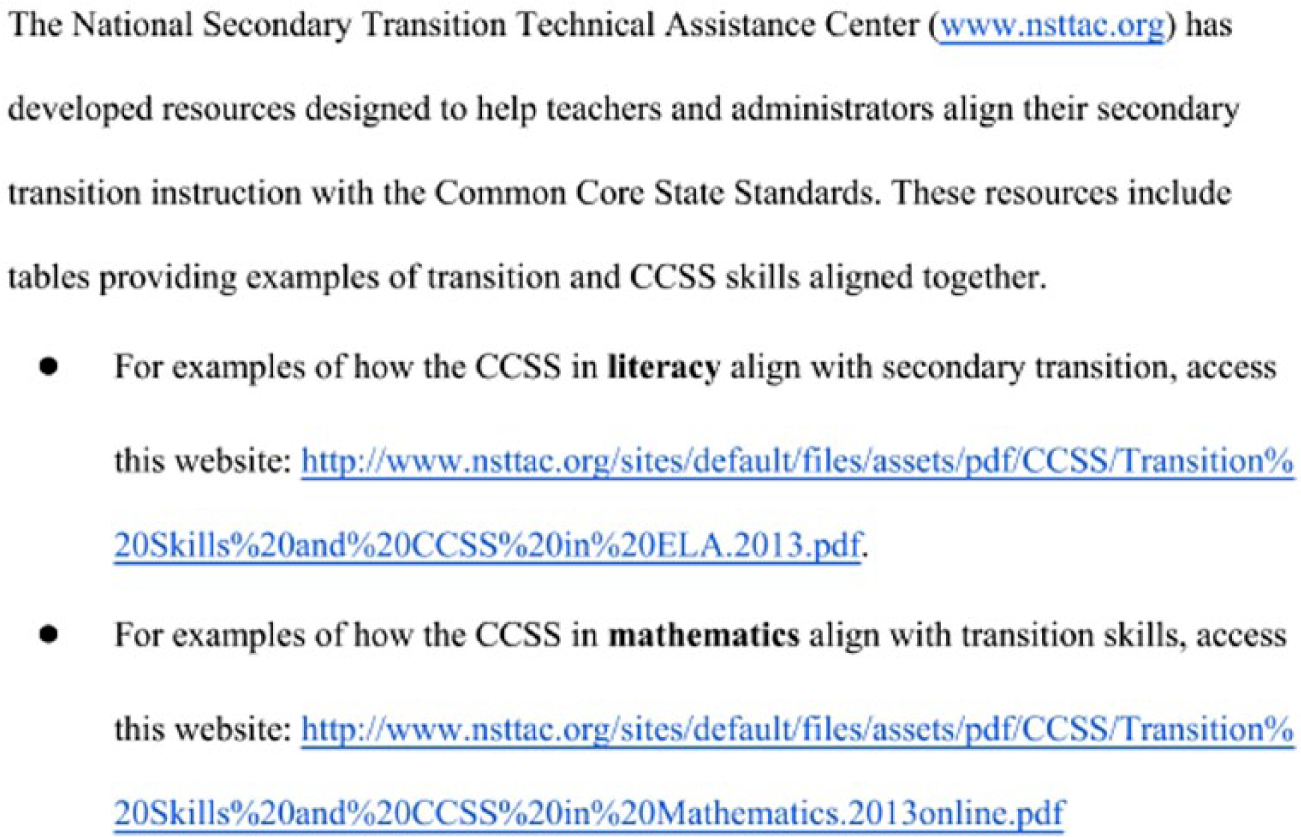
Resources from the National Secondary Transition Technical Assistance Center
Conclusion
Although the college and career readiness movement has propelled schools to further include all students into academic-based courses, students with disabilities continue to need instruction in skills needed for postschool successful life (College and Career Readiness Success Center, 2013). Research has indicated that it is possible to design instruction to help students acquire skills in both academics and secondary transition areas of life (Collins, Hager, & Galloway, 2011). The two approaches described provide teachers with a starting point on how to do this for a wide range of student needs.