







Abstract

Alex is a new second-grade teacher whose classroom includes students both with and without emotional and behavioral disorders (EBD). She began her career feeling confident but has encountered difficulty with Chad, a student who frequently exhibits noncompliance and tantrums when he is unable to get his way. Although many experienced teachers have suggested Alex use positive attending to encourage Chad’s appropriate behavior, she is embarrassed to admit that she never received specific training in this strategy and is unsure what to do; she suspects just saying “Good job” isn’t enough. Although Alex realizes that Chad (and others in her class) would benefit from her using positive attending, she is unsure how to effectively use the technique.
A teacher serves many important roles within a classroom, including an educator and a manager of child behavior. Despite their best efforts, teachers quite frequently observe students becoming off task or exhibiting disruptive behavior (e.g., calling out, arguing, noncompliance, tantrums). Specifically, inattention, overactivity, and noncompliance have long been cited as some of the most common areas of reported difficulty for schools (Axelrod & Zank, 2012; Goldstein, 1995). Research has concluded that children who demonstrate disruptive behaviors (e.g., students with EBD or attention deficit hyperactivity disorder) require the most positive reinforcement to remain appropriately behaved; however, they commonly receive the least (Barbetta, Norona, & Bicard, 2005). Of particular importance, a single student’s off-task and disruptive behavior may affect not only his or her own learning but that of other children in the class. The evidence-based practice of positive attending (i.e., strategic use of labeled praise) has garnered what some believe is the strongest and most enduring evidence base to encourage and maintain positive classroom behavior (e.g., Simonsen, Fairbanks, Briesch, Myers, & Sugai, 2008). For example, Sutherland, Wehby, and Copeland (2000) demonstrated that students’ on-task behaviors improved when the teacher’s behavior-specific positive attending increased, with subsequent student-related declines in positive behavior when the teacher decreased the attending. Such findings have been replicated and expanded upon by other works, with increases in teacher-provided positive attending being associated with increases in on-task behavior and numeracy enjoyment (Chalk & Bizo, 2004) as well as decreases in aggressive responding (Moffat, 2011).
Positive attending has garnered what some believe as the strongest and most enduring evidence base to encourage and maintain positive classroom behavior.
As based on behavioral theory, delivering contingent positive attending (i.e., positive reinforcement in response to specific actions) when students engage in desired behaviors can lead to an increased likelihood that they will exhibit similar positive behaviors in the future (Kern & Clemens, 2007). Unfortunately, positive attending is infrequently taught as part of a teacher’s training, which may be particularly problematic for newer teachers (Briere, Simonsen, Sugai, & Myers, 2015). Further, despite some resources discussing the subject matter in brief or in the context of larger school-based programs, the use of positive attending remains underutilized within classrooms (Sutherland, Wehby, & Yoder, 2002). Teachers and other educators or managers of child behavior need to be aware of evidence- and experience-based recommendations for effective implementation of positive attending. Although this article focuses on on-task and appropriate performance for students who exhibit disruptive behaviors as a result of their EBD, the practice may be applied to a variety of other EBD-related behaviors (e.g., may be used to emphasize improved social interactions and interpretation of social cues for students with interpersonal difficulties, behavioral control for students with emotional regulation challenges, brave behavior for students experiencing anxiety, happy or prosocial behavior for students experiencing mood difficulties) as well as with children without EBD as a general management strategy (Briere et al., 2015).
Components of Effective Positive Attending
Teachers implementing positive attending in their classrooms should strive to be specific, immediate, consistent, frequent, and preventative. They should avoid criticism, derogatory feedback, and any student ability-focused attending in favor of positive and performance-centered attending (Table 1).
Components of Positive Attending

Be Specific
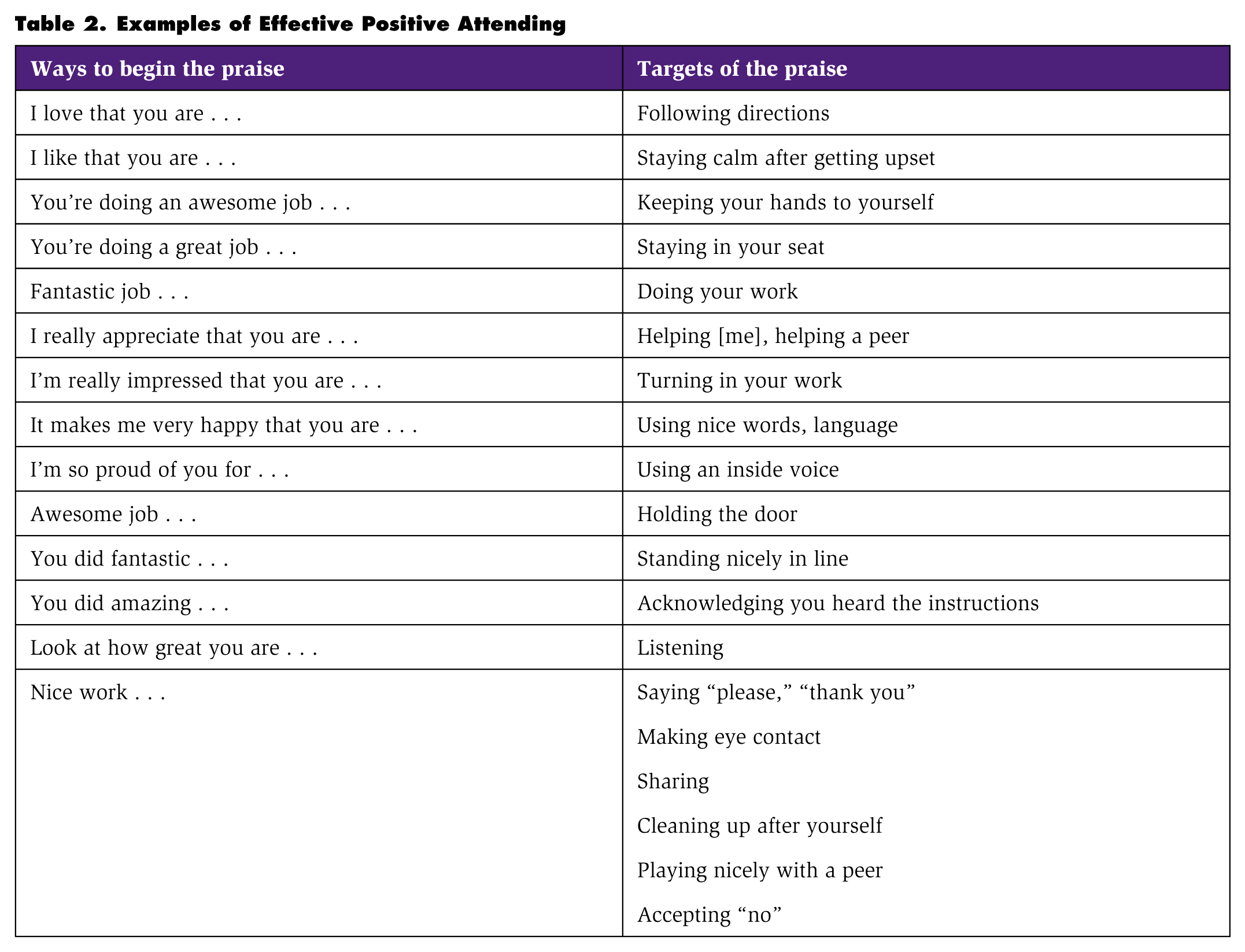
Although many teachers praise their students, research has suggested that such positive attending is often nonspecific and vague (e.g., “good job”; Brophy, 1981). Unfortunately, vague feedback does not inform the child of the behaviors that the teacher wishes to see more of, limiting efficacy. The effective use of a teacher’s attention involves very concrete and specific instances of positive attending (Conroy, Sutherland, Snyder, & Marsh, 2008; Simonsen et al., 2008; see Table 2). In doing so, students are told exactly what they did correctly, providing incentive to engage in similar behaviors in the future. Each instance of positive attending should be realistic and not overly flattering so that the student believes the teacher is being genuine (McMahon & Forehand, 2005). For example, if a teacher wants students to take out their books when instructed, as soon as a child begins the action, the teacher can respond by stating, “Great job taking out your book and following my direction.” Because there is significant variability in students’ behavior, a simple guiding principle is to ask oneself, “Do I want to see this behavior both now and in other settings?” If the answer is yes, this information helps to gauge when to positively attend (e.g., “Do I want to see students raise their hands both in my classroom and in other settings?”). Teachers who find themselves providing a lot of vague, nonspecific attending, like “Good job,” should ask themselves either “Good job doing what?” or “What more do I want the student to do?” in order to improve specificity.
Examples of Effective Positive Attending
Be Immediate
Teachers can maximize the impact of positive attending by providing it immediately following students’ engagement in desired behaviors (Barbetta et al., 2005; Regan & Michaud, 2011). Immediacy allows children to tie together the positive feedback with the behavior they just completed. The more immediate a teacher can be, the more the student will associate the events. As an example, if students are instructed to take out their books, the teacher should immediately positively attend to those who comply before moving on to another task. If too much time passes between the student’s behavior and the subsequent attending from the teacher, students may not draw as large an association between the action and the reinforcement, limiting the impact (Hester, Hendrickson, & Gable, 2009). Immediacy and emphasizing positive behaviors at the time of performance may prove especially helpful for children who are fast moving or exhibit attention-related difficulties (Antshel & Barkley, 2008).
Be Consistent and Frequent
Although teachers do not want to be perceived as drill sergeants, positive attending is most effective when it is consistent and happens at a high enough frequency to foster repeated student practice of positive behaviors (Kapalka, 2009; Regan & Michaud, 2011). If a behavior is important (e.g., staying on task, following directions, remaining calm), students should know how much the teacher appreciates their demonstration of it through the recurrent attending over the course of the day. As with immediacy, students who exhibit attention-related difficulties–who may not hear or internalize the information the first time a teacher says it–may especially benefit from the strategy. There are no universal guidelines for how frequently to attend to each student; teachers may need to adjust their use of the strategy based on specific students’ need or overall behavior. For example, if a student can go for 10 minutes before becoming off task or seeking attention, then initially attending at least once every 7 to 9 minutes may foster improved on-task behavior until the frequency of reinforcement can be reduced following repeated successes.
Be Preventative
Because they are occupied with managing multiple aspects of the classroom, some teachers may inadvertently overlook positive student behaviors until significant difficulties arise and prompt intervention. However, not attending to a student until problems occur runs the risk of not reinforcing students for the times they do engage in positive behavior, limiting a teacher’s ability to prevent the difficulties. Prevention has been described as both the most effective form of behavior management and the most efficient way of eliminating misbehaviors (Barbetta et al., 2005). Antecedent intervention, or structuring the environment to prevent problems and enhance motivation, holds multiple advantages as compared to waiting or “fixing” arising difficulties. In addition to preventing possible escalation of a student’s disruptive behavior, antecedent interventions are quick acting, allowing for correction of an environment that is contributing to the problematic behavior, and can improve the instructional environment (Kern & Clemens, 2007). As part of the process, a teacher may strive to “catch students being good” to encourage spontaneous positive student behavior as it occurs (Conroy et al., 2008). If a student is naturally engaging in positive behavior, it is paramount that the teacher encourages these actions with specific and immediate positive attending. Failure to reinforce may result in the student’s not recognizing that the teacher appreciates it and may lead to the student’s not freely demonstrating similar behaviors in the future.

Think About the Opposite
Positive attending can be utilized as a teaching opportunity by providing it in response to specific behaviors (Simonsen et al., 2008). Instead of telling students what not to do, and leaving a window for them to potentially engage in subsequent disruptive behavior (e.g., telling a student not to hit a student, in effect prompting kicking), teachers should be direct and specify what they would like students to do. Identifying positive behaviors means thinking of the opposite of the disruptive behavior. For example, for a student who frequently calls out without raising his hand, the opposite could be waiting his turn to speak or raising his hand; another teacher might positively attend to a student for using an inside voice if she is prone to yelling, praise a student for keeping hands to himself if he is prone to touching others or objects, or compliment staying in her seat if the student frequently leaves her seat.
Avoid Criticism or Derogatory Comments
It is not uncommon for teachers to regress to derogatory talk and reprimands in response to student disruptive behavior (Hester et al., 2009). Unfortunately, it is often easy to underappreciate a student’s ability to gauge a teacher’s level of stress. This may be especially true for children with EBD (e.g., oppositional behavior), when a frustrated teacher exhibiting derogatory body language, voice volume, and speech may elicit further difficulties from the child (Kapalka, 2009). To encourage appropriate behavior, it is helpful for teachers to attempt to remain calm, in control, and positive, especially in times of high agitation. How a teacher responds in time of stress may dictate either alleviation or exacerbation of ongoing student-based concerns. A teacher remaining calm and telling a student, “When you finish your math work, then you can play with the blocks for 5 minutes” may motivate the student, whereas aggressively saying, “If you don’t finish your math work, then you won’t play with blocks” may lead to an outburst due to the student’s feeling of being punished. As a guiding principle, teachers should strive to achieve a 4:1 ratio of positive to negative statements in their classroom for maximum benefit (Lewis & Sugai, 1999).
Use of positive attending can and should transcend one specific room or teacher and be utilized across settings.
Focus on the Student’s Performance
When providing positive attending, it is important for teachers to consider which aspects of the child they are attending to. Teachers should avoid providing a lot of person-centered attending (e.g., “You’re so smart,” “You’re a great speller”) in favor of more performance- or process-centered attending (e.g., “You did a great job on that assignment,” “I like how you tried very hard on that test”; Corpus & Lepper, 2007). Specifically focusing on the performance or process encourages a range of student behaviors (e.g., working carefully, working quietly, working well with others, performing well on a specific task) by providing positive feedback about competencies and successful strategies that can then be applied to future tasks (Corpus & Lepper, 2007). Person-centered positive attending could possibly harm students’ self-worth because it is based on their abilities (i.e., factors that may be beyond his or her control, such as intelligence). Providing ongoing person-centered positive attending in which the student experiences only success can create feelings of incompetence, inadequacy, and lowered self-worth when the child ultimately experiences a failure (Corpus & Lepper, 2007; Dweck, 2007).
Where Should I Use This?
As with other types of behavioral support, positive attending can and should transcend one specific room or teacher and be utilized across settings (Sugai & Horner, 2002), such as the playground, in the lunch room, and in other areas of the school where students frequently exhibit difficulties (e.g., situations with lower amounts of adult supervision). The more consistent the use is across settings and situations, the more students will understand what is expected, the faster they can adapt, and the less the direct positive attending may be needed in the future (Lewis & Sugai, 1999). To improve consistency, the primary teacher should coordinate with other staff members who manage specific students in different settings. For example, a music teacher who has a separate classroom may consult with the primary teacher to ensure that they are both utilizing positive attending in a similar manner. They also can collaboratively identify students who require more positive attending to remain on task, to improve students’ behaviors in both settings.
Active Ignoring
Teachers often indicate an inability to ignore disruptive behavior within the classroom when a student’s disruptive behavior distracts others or leads to escalation (e.g., Kounin, 1970). However, it should be recognized that positive attending often works most efficiently when paired with active ignoring to deliver what is termed differential attention. Active ignoring occurs when a teacher systematically withholds attention from a student when that student engages in an undesired attention-seeking behavior that is ignorable (i.e., not a safety concern or property damage; Simonsen et al., 2008). Active ignoring should be used only when the function of the student’s behavior is attention or tangible seeking and is not to escape a situation (Iwata, Pace, Cowdery, & Miltenberger, 1994).
Similar to positive attending, active ignoring should be immediate (i.e., as soon as the child engages in an undesired behavior that the teacher does not wish to encourage), specific, brief (e.g., 2 to 5 seconds), and overt (i.e., “black and white”; Hester et al., 2009). For example, a teacher who is ignoring a student whining may turn her head or back to explicitly demonstrate that she will not attend to the student. As soon as the student begins to exhibit the opposite of the disruptive behavior (e.g., speaking nicely or respectfully instead of whining), the teacher immediately positively attends to the student for utilizing appropriate behavior. Teachers who are attempting to ignore disruptive behavior should provide no reinforcement—including not looking at or talking to the student, not talking about the student, and not responding (e.g., laughing, sighing, smiling) to any inappropriate attention-seeking behaviors.
It should be noted that ignoring attention-seeking behavior can result in an extinction burst (Lerman & Iwata, 1995), wherein a child escalates in the intensity, frequency, or duration of the ignored behavior before it ultimately diminishes as a result of learning that the behavior will no longer get a desired response (e.g., teacher attention). Although this can be frustrating for teachers, few students (or adults) give up a previously effective strategy without trying it again. Teachers can shorten or reduce an extinction burst by finding small windows of appropriate behavior to positively attend to in the middle of the student’s disruptive behavior (e.g., the student is whining at the teacher but not at others). This can serve to provide the sought-after attention, but only once the student begins demonstrating desirable behavior. A teacher may tell a child, “I like that you’re calming down. Now I can help you,” during the 2-second window when the student begins taking breaths before whining again. Should the student begin whining again, the teacher should return to ignoring (or attending to other students) before the next window of appropriate behavior arises. The more “black and white” the positive attending and active ignoring is, the faster children will adapt. See Barbetta and colleagues (2005) and Hester and colleagues (2009) for more on active ignoring and differential attention.
Evaluating the Use of Positive Attending
Teachers can evaluate both the degree of use of positive attending and the effectiveness of the use. Evaluation may involve an observer, who codes the frequency of or adherence to evidence-based principles of using positive attending and provides feedback (Sutherland, Copeland, & Wehby, 2001), having students rate their perception of the teacher’s use (Metzler, Biglan, Rusby, & Sprague, 2001), self-monitoring through the use of a handheld clicker to quantify how often positive attending is provided to certain children (or the entire class; Kalis, Vannest, & Parker, 2007), or reviewing audio- or videotaped classroom sessions (Keller, Brady, & Taylor, 2005).
To determine the effectiveness of the strategy, teachers can monitor either the elicitation of student’s positive behaviors and rewards or the need for discipline (Metzler et al., 2001). For the former, a teacher can define positively framed behavioral targets (e.g., raising hand, complying with instructions) or outcomes (rewards earned) to compare student performance from baseline (i.e., before implementation of positive attending) to post-use. Each behavior can be monitored and tracked through either live tracking (e.g., a tally sheet of each time a student exhibits specific behaviors) or taped observations. Data can then be graphed to show a visual representation of gains (Moffat, 2011). Alternatively, a teacher may define behavioral challenges (e.g., number of times a student calls out, exhibits an outburst, becomes off task, calls out, receives an office referral) to evaluate the reduction of disruptive behaviors.
Strategies to Improve Skill Use
Similar strategies as those used to evaluate may also help teachers improve their utilization of positive attending. For example, Kalis and colleagues (2007); Duncan, Dufrene, Sterling, and Tingstrom (2013); and Simonsen, MacSuga, Fallon, and Sugai (2012) suggested using goal setting and self-monitoring techniques. Specifically, setting personal goals, monitoring the progress towards each goal, and self-prompting each day (e.g., set a goal of praising once every 10 minutes and using a timer or phone-vibrate feature as a reminder; creating a visual prompt such a sign saying “PRAISE!” on the board or desk) may prove especially helpful for motivated teachers. Simonsen and colleagues (2012) concluded that teachers preferred a handheld counter to provide them with a quantitative measure of how they were doing (i.e., amount of praises for student target behaviors). This method of self-monitoring can also allow for a daily baseline to either match or beat the amount of positive attending used for subsequent days. Additional strategies may include dynamic role-play with other teachers, prompting or coaching from a paraprofessional or other staff member in the classroom, and reviewing audio- or videotaped sessions (Duchaine, Jolivette, & Fredrick, 2011; Gable, Hester, Rock, & Hughes, 2009).
After practicing the use of positive attending with a colleague who pretended to exhibit similar behaviors as Chad, Alex focuses her energy on the student himself. First, through observation and monitoring, she determines that Chad exhibits off-task and disruptive behavior once every 20 minutes. Alex uses that information to set a personal goal of positively attending at least once every 15 minutes to prevent Chad from exhibiting such problematic behaviors. To monitor her performance day to day, she uses a handheld clicker that she clicks each time she positively attends to Chad for his positive behavior (e.g., following directions, working quietly, raising his hand). Because she is also busy with other students, Alex writes PRAISE! on the board and sets her smartphone to vibrate once every 15 minutes. This strategy allows for both visual and tactile prompts. Finally, to evaluate her performance, Alex gets permission from both the school and parents to video record her classroom. She reviews each recording to find additional opportunities to attend not only to Chad but to other students who may benefit.
Factors for Consideration
As with any intervention, there are considerations regarding students’ age, gender, culture, and overall function of the disruptive behaviors that must be considered to ensure proper utilization and modification (Bernal, Jimenez-Chafey, & Domenech Rodriguez, 2009; Hanley, Iwata, & McCord, 2003). For example, although research suggests that positive attending can be helpful for many, evaluation of the behavioral function may prove especially important for those children not driven by teacher attention (e.g., motivated by work avoidance) and who may require more specific interventions beyond positive attending alone (Germer et al., 2011). In addition, the age and culture of the student may dictate how the teacher modifies language when addressing the student in order to ensure a developmentally and culturally sensitive approach. As Brophy (1981) suggested, older students may exhibit different preferences for the types of teacher attention received as compared to younger students (e.g., more “matter-of-fact” and less childlike language).
Finally, the amount of public attention should also be considered. Burnett (2001) provided support for the idea that positive attending delivered publicly by a teacher, although desired by some students, may be perceived as a punishment by others. As such, a teacher would be wise to determine the student’s preferences (i.e., use knowledge of the student, ask the student) for public versus private positive attending prior to implementing the skill.
Common Reactions, Questions, and Concerns
How Can I Focus on Just One Student When I Have So Many?
Although positive attending can be beneficial for a target student with EBD, its usefulness is maximized when it is not restricted to one or two students but rather used with the whole class (Kern & Clemens, 2007). If positive attending is conducted effectively, having more on-task students may lead to less frustration and a higher amount of teacher energy to work more with those requiring additional support. Classroomwide use may also help with peer modeling, where the actions of others serve as a social prompt for the target student (Schunk, 1987). For example, if Chad is calling out while Kevin and Kelly are raising their hands, the teacher can positively attend to Kevin and Kelly for raising their hands and provide a prompt for Chad by stating, “Kevin and Kelly are doing a great job raising their hands to answer. I know others are going to try hard to raise their hand and wait their turn too.” As soon as Chad appropriately participates, he too can receive the positive feedback.
I Already Praise!
Although teachers commonly utilize basic praise, as previously discussed, that praise is often not provided in an optimal manner. Positive attending can enhance the positive foundations that teachers already employ. Essentially, it is not that teachers attend but how they attend that is important. For many students with EBD, basic or infrequent attending may not be enough to instill meaningful effect (Barbetta et al., 2005). By making minor adjustments to their use of praise, teachers may be able to further improve students’ behavior.
Won’t This Take a Lot of Time?
One concern teachers have regarding the use of positive attending is that it may take additional time and effort to implement. Although no known work has quantified such an effect, experience (e.g., teacher feedback) has suggested that positive attending may have the opposite outcome and can improve time management. Providing a labeled praise and patting a student on the back (e.g., a teacher may include physical touch, such as a pat on the back, high-five, or fist bump, in combination with the positive attending to improve potency of the positive attending; Little & Akin-Little, 2008) take mere seconds each time they are used. Ultimately, a teacher spending a combined few minutes each day (e.g., a few seconds each time) may be more beneficial than having to spend multiple minutes each time students becomes off-task in order to redirect them and those influenced.
Only Praise?
Teachers can vary their use of positive attending by integrating other strategies. Similar to clinic- and classroom-based child-focused programs (e.g., Teacher-Child Interaction Therapy, McIntosh, Rizza, & Bliss, 2000; Teacher-Child Interaction Training, Lyon et al., 2009; Parent-Child Interaction Therapy, Brinkmeyer & Eyberg, 2003), additional techniques may include reflections (e.g., if a student proclaims, “I got an A!,” the teacher can reflect, “You got an A!”), imitations (e.g., if a student raises his hand, the teacher can also raise her hand and smile to mimic), and descriptions (e.g., if a student takes out a book independently, the teacher may nod and state, “You took out the book and started reading without me even having to tell you to do it”; Brinkmeyer & Eyberg, 2003). In supplementing labeled praise, use of these strategies can also demonstrate teacher approval of student behavior in order to encourage future use of the same behavior.
Conclusion
Positive attending is a technique that requires minimal time, needs no preparation, costs nothing, and promotes learning (Lampi, Fenty, & Beaunae, 2005). Although the strategy may not be the only management tool a teacher uses, and there are some limitations (see Henderlong & Lepper, 2002), positive attending can be powerful for a range of students across ages and presenting concerns, as well as a vital component of many clinic- and school-based behavioral treatment programs for off-task and disruptive behaviors (e.g., Parent-Child Interaction Therapy, Brinkmeyer & Eyberg, 2003).
For additional resources on general classroom management, teachers may explore such books as Strategies for Addressing Behavior Problems in the Classroom (Kerr & Nelson, 2010) and Eight Steps to Classroom Management Success: A Guide for Teachers of Challenging Students (Kapalka, 2009), as well as online materials from the American Psychological Association (Kratochwill, DeRoos, & Blair, 2016; http://www.apa.org/education/k12/classroom-mgmt.aspx) and the Institute for Education Sciences (Epstein, Atkins, Cullinan, Kutash, & Weaver, 2008; http://ies.ed.gov/ncee/wwc/pdf/practice_guides/behavior_pg_092308.pdf).