







Abstract

Carolina is a special education teacher at Lakeside Elementary School. Among the different mathematics groups that she teaches, she is most concerned about her five second-grade students with mathematics learning disabilities (MLD). Specifically, Carolina is concerned that these students are struggling to develop proficiency in solving problems that require the foundational concepts and skills of measurement. The mathematics program that she uses with her second-grade group focuses on whole number concepts and does not devote instructional time to the domain of measurement. Knowing that all students, including those with MLD, are expected to develop proficiency across multiple domains of mathematics, Carolina wants to ensure that her students develop a deep conceptual understanding of measurement with procedural knowledge necessary for real-world problem solving.
Carolina decides to plan a series of lessons that embed concepts of linear measurement in the context of solving word problems (Common Core State Standards; National Governors Association Center for Best Practices & Council of Chief State School Officers, 2010). Although her students have developed a fairly strong understanding of different word problem types, Carolina wants her students to generalize this knowledge to measurement contexts. How can Carolina ensure that her students develop foundational measurement skills that allow them to generalize to solving more advanced mathematics problems such as word problems?
Importance of Measurement to Students’ Mathematical Learning
Measurement holds significant value in our everyday lives. To engage in daily activities, students need to be able to measure time, temperature, distance, speed, and weight. For example, when preparing even a simple meal, individuals monitor speed on the drive to the grocery store, measure the ingredients needed for cooking, and gauge the oven temperature and time. Strong measurement skills are vital for employees in the STEM fields (science, technology, engineering, and mathematics). Civil engineers, for example, use measurement to obtain precise estimates of mass and strain needed for large-scale construction and building maintenance. Measurement skills are also needed in professions beyond the STEM field, as in the work of chefs, hairdressers, and electricians.
“Academically, the measurement domain serves as an ideal platform for young students to apply problem-solving skills to situations that are relevant to their everyday lives.
Academically, the measurement domain serves as an ideal platform for young students to apply problem-solving skills to situations that are relevant to their everyday lives. When students work to solve such contextualized measurement problems, they have an opportunity to combine measurement and problem solving with whole number skills. For example, a teacher might enlist second-grade students to figure out whether they are tall enough to ride a rollercoaster by measuring their own height and comparing it with the rollercoaster height requirement. This task, though seemingly simple, involves a variety of skills, including conceptual and procedural understanding of measurement. For example, to measure height, students must understand how to line up a ruler or tape measure appropriately and the meaning of the hash marks on the measuring tool. Students may also have to iterate—or lay down multiple copies of a measurement tool—if the tool is shorter than the student. To complete this task, students must understand important mathematical concepts, such as height, taller, inches, or centimeters. Finally, students must be able to plan and work through the steps of solving a word problem and possess the whole number skills required to perform the computation (e.g., solving a compare problem to determine how much taller a student needs to grow to be tall enough to ride the rollercoaster, such as finding the difference between 42 and 48 inches).
Over the past decade, the percentage of students reaching proficient levels in the measurement domain of mathematics has increased only slightly (National Assessment of Educational Progress, 2019). A closer look, however, reveals that these increases are not uniform, and mounting evidence from the most recent National Assessment of Educational Progress report indicates that the mathematics achievement gap in measurement is quite pronounced for students with or at risk for MLD. Strong foundational measurement skills are important not only to develop skills at grade level but also because measurement understanding links to more complex mathematical concepts, such as understanding fractions (Fuchs et al., 2013). Given the applicability of measurement to real-world problem solving and the importance of measurement understanding to accessing more advanced mathematics, improving instruction on foundational measurement skills for struggling learners is crucial.
Evidence-Based Recommendations for Teaching Measurement
Although interventions targeting measurement have a smaller research base than other areas of mathematics, such as whole numbers (Doabler et al., 2019), teachers may draw from the larger research base on effective mathematics instruction to teach the critical concepts and skills of linear measurement. This article provides six evidence-based recommendations for supporting students with MLD to develop conceptual understanding and procedural skills in linear measurement, followed by brief vignettes to illustrate how teachers can enact each recommendation.
Recommendation 1: Teach the Big Ideas of Linear Measurement
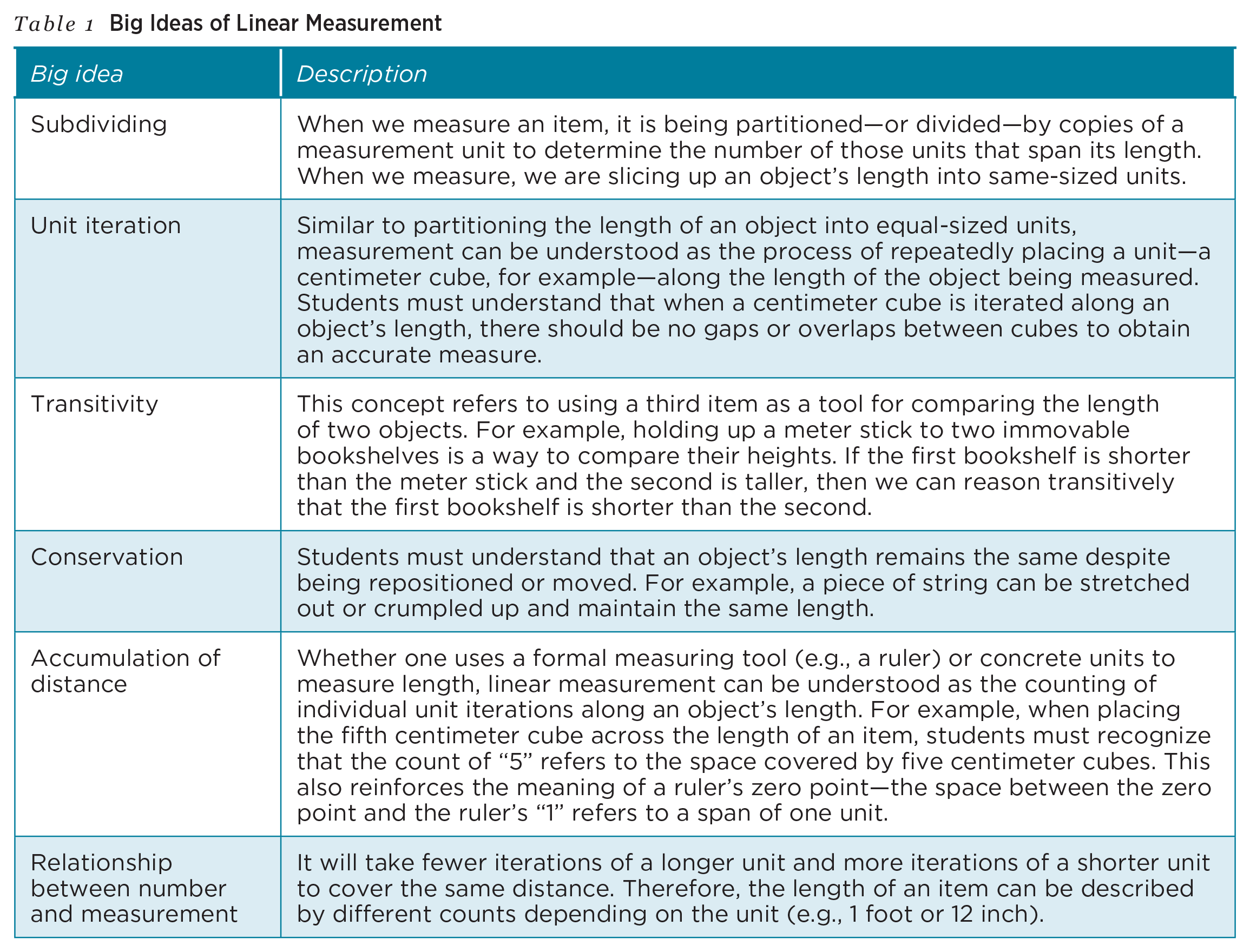
Linear measurement is defined as the measurement of length, or the distance between an object’s two end points (Reys et al., 2014). The big ideas in linear measurement—or any mathematical domain—include the concepts and skills that are essential for students’ mathematical proficiency (Coyne et al., 2011). In measurement, these include several ideas, outlined in Table 1, that are central to students’ conceptual understanding (Cross et al., 2009; Stephan & Clements, 2003). Teachers should ensure that they have a solid understanding of these big ideas and then strategically provide explicit instruction and varied practice opportunities related to each idea to ensure that students develop requisite understanding of these important measurement concepts. For an in-depth discussion of these big ideas, see Stephan and Clements (2003).
“Given the applicability of measurement to real-world problem solving and the importance of measurement understanding to accessing more advanced mathematics, improving instruction on foundational measurement skills for struggling learners is crucial.
Big Ideas of Linear Measurement
After reviewing the big ideas and discussing them with her paraprofessionals to build their own content knowledge for teaching linear measurement, Carolina plans explicit teaching and practice opportunities across the measurement unit, placing special emphasis on the big ideas of linear measurement. For example, to teach unit iteration, she has students create their own centimeter rulers. She purposefully builds up to ruler creation across a week of instruction, beginning by having students measure items using centimeter cubes—emphasizing through exploration and discussion how students must line up cubes in a straight row, with no gaps, to obtain an accurate measure. In her planning, she writes out multiple examples and a few nonexamples that she will use to clarify this point. After students demonstrate a solid understanding of measuring with concrete units (e.g., “9 centimeters” means that 9 centimeter cubes cover the distance between the item’s end points), she progresses to having students measure items using a single centimeter cube. She uses this experience to teach students that they can iterate the cube across an item’s length and that doing so provides the count of the total cubes that span the item’s length. As students iterate the single cube, Carolina has them mark each point at which they iterate the cube. When they demonstrate understanding, Carolina connects those markings to the creation of rulers, emphasizing that the ruler’s hash marks represent those unit iterations.
Recommendation 2: Explicitly Teach Key Measurement Vocabulary
When teaching measurement, teachers must be aware that many key vocabulary terms may be unfamiliar to students. For example, students may not be familiar with precise measurement vocabulary such as unit, end point, zero point, estimate, height, and length. Understanding these terms is essential for students to successfully engage in measurement activities (e.g., measuring the height vs. the width of an object), understand teacher directions (e.g., estimating the length of the whiteboard in inches), and use correct procedural strategies to measure (i.e., measuring from end point to end point). A portion of each lesson should be dedicated to explicitly teaching key measurement vocabulary and reviewing previously taught terms. Words can be taught with vocabulary cards to help students remember the term with a visual representation, which is also an effective strategy for English learners and students with reading difficulties (see Figure 1 for vocabulary card examples). Vocabulary words should be taught across multiple days, with different types of instructional activities and examples to build understanding (Pullen et al., 2010).
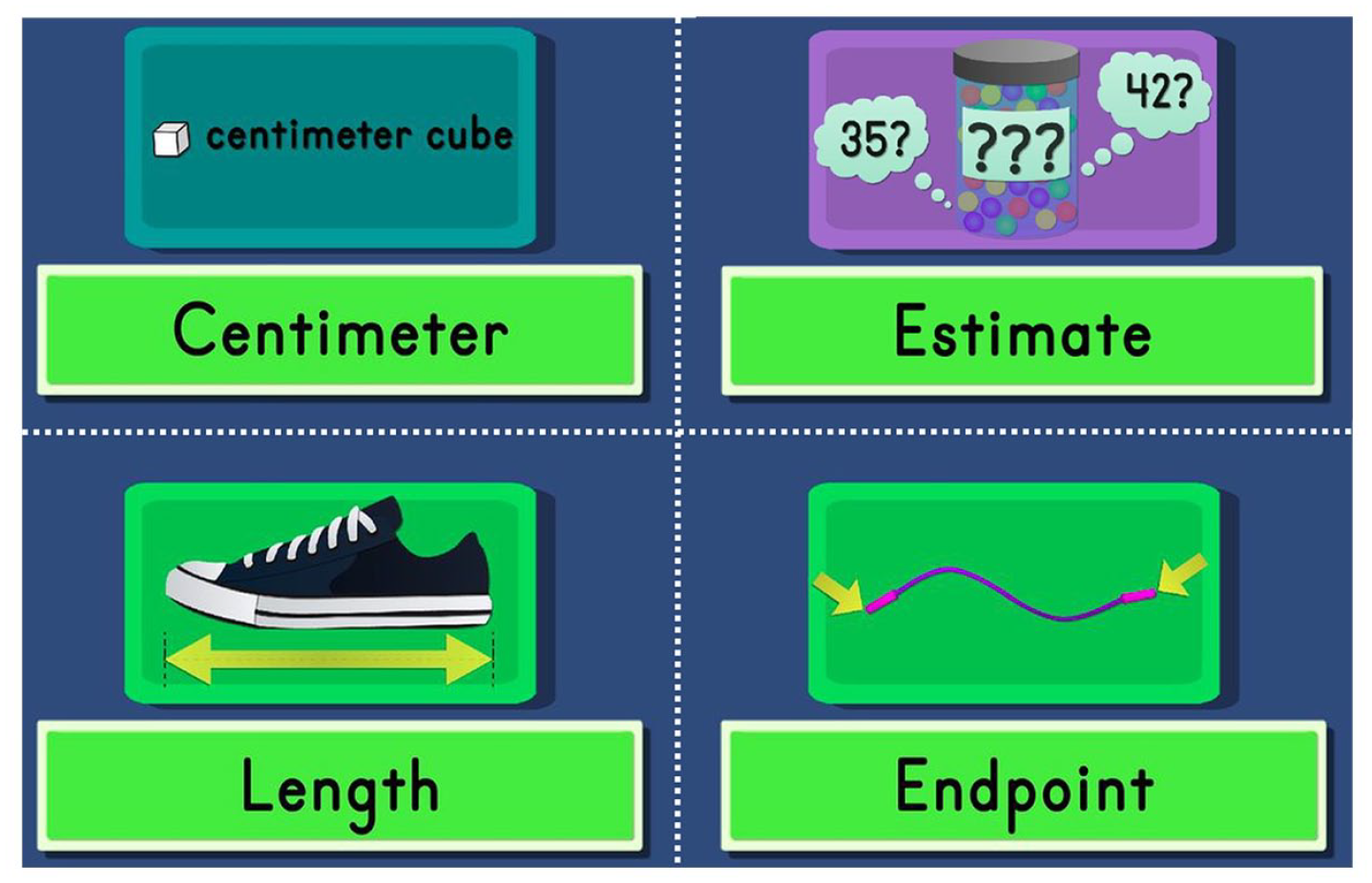
Examples of linear measurement vocabulary cards
When introducing new vocabulary terms, teachers should provide student-friendly yet precise definitions as well as examples and a few nonexamples. For example, a teacher might provide the following examples and nonexamples when introducing centimeter as a vocabulary word. He might hold up a centimeter cube and say, “This is a centimeter.” He could hold his fingers approximately 1 centimeter apart and repeat, “This is a centimeter,” and then hold his fingers much farther apart and say, “This is not a centimeter.” The teacher could also ask students to show what a centimeter looks like using their own fingers and verify each student’s response by placing a centimeter cube between their fingers.
Beyond explicit vocabulary instruction, teachers should continue to use precise and consistent measurement vocabulary to minimize confusion for students with MLD and to support understanding for English learners (Garet et al., 2016). For example, instead of directing students to “measure the pencil,” teachers should use specific and precise language: “measure the length of the pencil from endpoint to endpoint.” Increasing student response opportunities also provides increased practice with precise mathematics vocabulary (Powell & Driver, 2015).
“When teaching measurement, teachers must be aware that many key vocabulary terms may be unfamiliar to students.
Carolina introduces the word “estimate” using a precise, student-friendly definition. She pairs the word with a vocabulary card to provide a visual cue for helping students understand the word. Notice how Carolina has her students repeat the word and definition and that she provides examples and nonexamples in her instruction.
“This word is estimate. What word, everyone?”
“Estimate.”
“Estimate means a good guess about how much or how many. What does estimate mean, everyone?”
“A good guess about how much or how many.”
“I am going to estimate, or make a good guess, about how many cubes are here. Because I am estimating, I won’t count the cubes, but instead I will make a good guess about how many I think there are. I might not guess the real number, but I will try to be close. I know there are a lot more than five and probably more than 10. I estimate that there are 20 cubes.”
Carolina has her students take a turn estimating how many cubes are on the table. She has them use the sentence frame: “I estimate that there are ______ cubes.” She then has them count the cubes to determine the total amount. Carolina emphasizes that an estimate is a good guess and that it is not necessary to change an estimate after learning the real amount.
Recommendation 3: Introduce Formal Measurement Tools Using the Concrete-Representational-Abstract Sequence
After students have developed conceptual understanding of linear measurement, teachers should explicitly introduce formal measurement tools. There is some controversy in the field regarding the most appropriate time to introduce tools such as rulers, but the general consensus is that measurement tools can be introduced early, as long as they are explicitly tied to the big ideas of linear measurement (Cross et al., 2009). As in other mathematics domains, using a concrete-representational-abstract instructional sequence (Agrawal & Morin, 2016; Gersten et al., 2009) ensures that students develop conceptual understanding prior to using measurement tools. Conceptual understanding of the underlying logic of a measurement tool (e.g., why we line up the ruler at the zero point, how each numeral or hash mark represents an additional unit) ensures that students use measurement tools accurately.
Using the concrete-representational-abstract sequence to teach a concept means that teachers start by introducing concrete models, such as inch tiles or centimeter cubes, to demonstrate how to measure the length of an object (see Figure 2). Teachers should then explicitly model how to iterate a unit along the length of the object, placing units with no gaps or overlaps between the two end points (Cross et al., 2009). Examples and a few nonexamples should be modeled with opportunities for students to verbalize why the technique was correct or incorrect (Archer & Hughes, 2010). After students have had ample practice measuring with concrete manipulatives, teachers should introduce representational models, such as pictorial representations of objects being measured with units. Only after these steps should teachers introduce measurement tools with numerals (i.e., the abstract representation of units) and explicitly demonstrate the link between concrete models and abstract measurement tools. For example, a teacher might demonstrate that each hash mark on a ruler represents 1 inch, by lining up inch tiles along the length of the ruler corresponding with the hash marks. During guided practice, teachers might pair up students and direct one student to measure an object with inch tiles and the other to measure the same object using an inch ruler and then have students compare their measurements. This type of instructional scaffolding can help decrease student error rates and set up students for academic success (Allsopp et al., 2017).
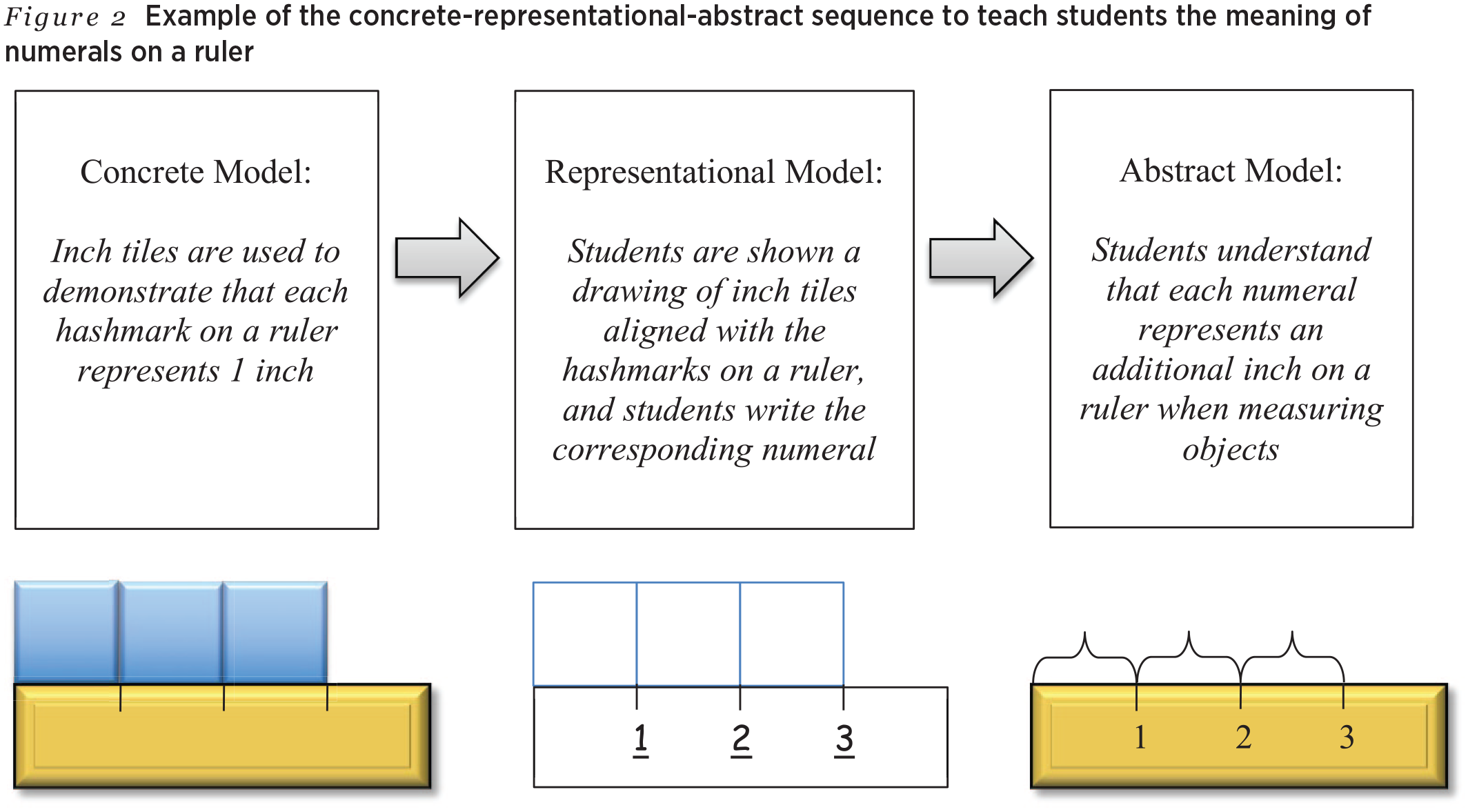
Example of the concrete-representational-abstract sequence to teach students the meaning of numerals on a ruler
Looking back at the lesson in which she has students create their own rulers using centimeter cubes, Carolina uses this as an opportunity for students make the connection between using concrete manipulatives and abstract measurement tools. Notice how Carolina emphasizes the distance between hash marks on the ruler as 1 centimeter and then verifies with a centimeter cube before leading students in guided practice:
“Watch as I label the distance between the hash marks. One endpoint of a ruler is called the zero point. That’s because we start measuring from zero to the first hash mark, which is 1 centimeter. The distance between two hash marks is 1 centimeter. I can verify the distance by lining up my centimeter cube.” Carolina demonstrates how a centimeter cube perfectly fits between the zero point and the first hash mark.
“I am going to start at the endpoint and label the first hash mark with the numeral 1. This 1 means that the distance from the endpoint to the first hash mark is 1 centimeter.” Carolina models labeling the next hash mark with the numeral 2 and the next with the numeral 3. Then she leads students to verify the distance between hash marks using their own centimeter cubes and to label the first three hash marks. Throughout guided practice, Carolina monitors student work and provides feedback to ensure that students are developing the conceptual understanding that the distance between any two hash marks is 1 centimeter.
Recommendation 4: Facilitate Meaningful Practice Opportunities for Students
One cornerstone of instructional design for students with MLD is building in frequent and meaningful practice opportunities (Archer & Hughes, 2010; Hudson & Miller, 2006). In the area of whole number and operations, increased opportunities for students to practice verbalizing their mathematical thinking and reasoning are linked to improved mathematics outcomes (Doabler et al., 2015; Gersten et al., 2009). The same guidelines apply when teaching measurement. Teachers should provide frequent opportunities for students to discuss measurement concepts and to explain their reasoning for using measurement strategies. For example, teachers might ask students to explain why leaving gaps when iterating an inch tile will result in an inaccurate measurement or why they found different counts when measuring with different units (e.g., when measuring the length of a pencil in inches, the measurement is a smaller number than when it is measured in centimeters because an inch unit is longer than a centimeter unit).
“One cornerstone of instructional design for students with MLD is building in frequent and meaningful practice opportunities.
To facilitate meaningful opportunities for students to explain mathematical thinking and reasoning, teachers should invest time in establishing a partner-discussion routine. Teachers can strategically pair students based on skill level and talkativeness (e.g., pairing a high-needs student with the teacher, pairing more vocal students together). With partner routines, each partner is given a label, such as Partner 1 and Partner 2, salt and pepper, or chips and salsa. Following a question, the teacher teaches the routine of the first partner sharing with the second and then the second partner sharing what the first partner said with the group. This is an instructional routine that can be drawn on repeatedly throughout lessons to keep students engaged with the material. Finally, meaningful practice should include frequent cumulative review of previously mastered measurement concepts. Particularly for students with MLD, using delayed review—in which the teacher revisits a topic on at least two separate, spaced-out occasions—increases the amount of information that students can recall (Pashler et al., 2007).
Carolina has just led her students through making a ruler with centimeter cubes. She has explicitly taught her students the term “zero point” and has explained why it is important to start measuring at that point when using measurement tools. Now that students have created their own rulers, she revisits this concept and provides students with opportunities to explain why starting to measure at the zero point is important. Note how Carolina uses a partner routine to allow all students to explain:
“Look at the centimeter ruler you just created. Point to where you would start measuring on the ruler.” Carolina waits for all students to point to the zero point. “What did you point to, everyone?”
“The zero point.”
“Yes, when we measure using a ruler, we start at the zero point. Keeping your voice off, think about why it is important to start measuring at the zero point.” Carolina pauses a few seconds to let students silently think, before prompting the partner routine: “Partner 2s, tell Partner 1s why it is important to start measuring at the zero point. Partner 1s, listen carefully because you will be sharing your partner’s answer with the group.” Carolina waits as Partner 2s share with Partner 1s. She monitors student responses and helps students elaborate on their answers.
“Why is it important to start measuring at the zero point?” Carolina calls on each Partner 2 to share the answer and confirms and expands on students’ answers to develop their mathematical reasoning. Some ideas might include the following:
We need to include the first centimeter, which is between the zero point and one.
If we start measuring at one, we will get the wrong measurement.
The distance between any two hash marks is 1 centimeter, and so we need to include the distance between the zero point and the first hash mark when we measure.
Recommendation 5: Provide Immediate, Specific Academic Feedback
Providing immediate and specific feedback to students is a vital part of maximizing practice (Hattie & Timperley, 2007). In measurement instruction, teacher feedback is especially important because students engage in many novel hands-on activities that may be challenging (e.g., iterating units, lining up the zero point of the ruler to measure length), and they may struggle with precise mathematical language (e.g., length, end point). Depending on the accuracy of a student’s response, meaningful feedback is either confirmative, specifying exactly what makes a student’s response correct, or corrective, clarifying areas of confusion and providing additional support so that a student can provide a correct response. Both types of feedback should be delivered immediately to clarify understanding and prevent students from practicing an incorrect strategy multiple times.
“Particularly for students with MLD, using delayed review—in which the teacher revisits a topic on at least two separate, spaced-out occasions—increases the amount of information that students can recall.
With prompt delivery, teacher feedback should be specific in relation to the student’s response. If confirmatory, teachers should repeat the student’s correct answer and expand on it when appropriate. For example, if a student measured the length of a pencil in inches and said, “It’s six!” the teacher could respond, “Yes, the pencil is 6 inches long,” and have the student restate the answer to include the correct unit. By both confirming and expanding on students’ answers, teachers reinforce accuracy and introduce more advanced ways of thinking about mathematical content. Teachers can build on corrective feedback by having students repeat the correct answer immediately following corrective feedback. This step is important because it provides successful student practice opportunities. Ideally, the question is repeated a second time after a delay to check that students have updated the related strategy based teacher feedback.
After students have identified why it is important to start measuring at the ruler’s zero point, Carolina has them measure various distances that are marked with masking tape around the classroom. After students have recorded their measurements, they regroup to discuss their findings:
“Everyone, how long was the distance from the door to the table?”
“Six feet.”
Carolina confirms that all students are able to answer the question accurately and that their recordings reflect this. Given that she evaluates all student responses as correct, she provides immediate confirmatory feedback: “Yes, the distance from the door to the table is 6 feet.”
Carolina asks the next question: “Everyone, how long was the distance from one end of the table to the other?”
The students respond with varying answers.
“Let’s recheck our work to find the right answer.” Carolina guides the group to accurately line up their rulers across the span of the table. “Let’s count together, everyone.”
“One, two, three, four, five.”
“How long is the table everyone?”
“Five feet.”
“Yes, the table is 5 feet long. Nice work.”
Recommendation 6: Integrate Concepts of Measurement Into Solving Word Problems
Students with MLD often have significant challenges solving word problems (Powell, 2011). Thus, teachers should embed measurement in the context of word problems to apply students’ measurement skills to a variety of contexts. Second-grade students are expected to solve word problems within 100 with an unknown quantity in all positions for three problem types: add to/take from, put together/take apart, and compare (National Governors Association Center for Best Practices & Council of Chief State School Officers, 2010; see Table 2 for problem types and definitions). Students should learn the underlying structures of these problem types to become independent problem solvers. Schemas or diagrams are helpful tools to support students in identifying problem types and choosing appropriate solution strategies (Jitendra et al., 2013).
Word Problem Types, Definitions, and Examples Related to Measurement Contexts
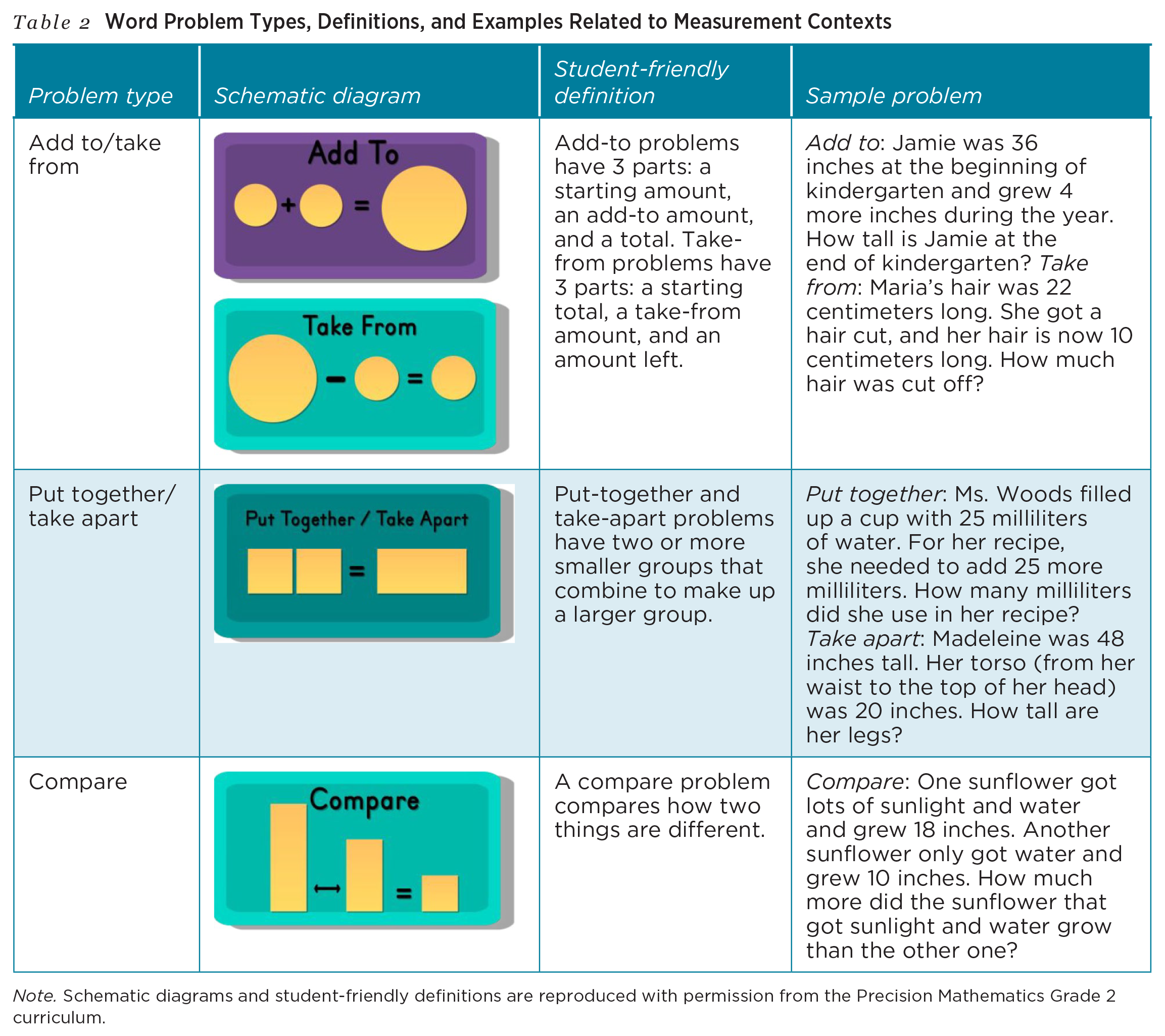
Note. Schematic diagrams and student-friendly definitions are reproduced with permission from the Precision Mathematics Grade 2 curriculum.
In the context of measurement, add-to/take-from problems can show an increase or decrease in height or length over time. For example, “A daisy was 15 inches tall. Over a week, it got lots of sunlight and water, and it grew to be 18 inches tall. How many inches did the daisy grow across the week?” Students are given the starting and ending amounts and must solve to find the add-to amount. Similarly, students can be presented with take-from problems, in which a measurement decreases over time, such as when a rock is weathered by wind or water. As shown in Table 1, other word problem types lend themselves to measurement contexts. Using real-world measurement examples can solidify students’ understanding of measurement and provide enriched opportunities for problem-solving practice.
The following is an excerpt from a lesson in which Carolina introduces compare problems. She presents the following problem: “How much farther did the big squirrel carry the acorn than the baby squirrel?” In introducing the problem type, note how Carolina emphasizes the underlying structure of a compare problem by using a clear definition and accompanying visual.
“This is a special kind of problem. This type of problem is called a compare problem. What type of problem is it, everyone?”
“A compare problem.”
“In a compare problem, we measure two things and compare how they are different.” Carolina shows schematic diagram of a compare problem (see Table 2). “Have we measured two things?”
“Yes.”
: “What are the two things that we have measured?”
“The two squirrels’ paths.”
“Yes, we measured the two squirrels’ paths, and now we are going to compare how they are different.”
Carolina then models how to solve compare problems, connecting each step to the problem’s underlying structure. Moving forward, she provides students with opportunities to distinguish compare problems from other problem types and to practice solving them. Carolina also provides students with multiple models of worked problems interspersed with examples, which she helps them work through to further support student learning (Pashler et al., 2007).
Conclusion
These six instructional strategies can be used across general and special education contexts to support students struggling with measurement. It is paramount that students be introduced to the big ideas of linear measurement and then given supported opportunities to solve measurement problems in various contexts, including different types of word problems. Formal measurement tools should be introduced gradually, with conceptual understanding established prior to engaging students in procedural measurement activities (e.g., using a ruler to measure length). Teachers should also explicitly teach key measurement vocabulary, providing examples and nonexamples to facilitate understanding for all learners. Effective instruction in early measurement skills can build a foundation for students with MLD to access higher-level mathematics and can set up students for success when encountering real-world measurement problems.
Footnotes
Funding
This project is funded by a National Science Foundation grant (1503161) to the Center on Teaching and Learning at the University of Oregon and The Meadows Center for Preventing Educational Risk at The University of Texas at Austin. Any opinions, findings, conclusions, or recommendations expressed in these materials are those of the authors and do not necessarily reflect the views of the National Science Foundation.
