







Abstract


Ms. Crawford, a special education teacher, provides Tier 2 small-group intervention to fourth- and fifth-grade students with reading disabilities. Ms. Crawford uses informational, science, and social studies texts to build students’ background knowledge and support content area learning. As with many fourth and fifth graders with reading disabilities, her students struggle to understand what they read. Ms. Crawford uses a research-based main idea practice called Get the Gist to teach students how to generate main idea statements (Klingner et al., 1998). During Get the Gist, students engage in three steps: (1) What is the most important ‘who’ or ‘what’? (2) Tell the most important idea about the ‘who’ or ‘what’, and (3) Combine answers to Steps 1 and 2 to write the gist. However, Ms. Crawford’s students are still having difficulty, particularly with Step 2. Instead of providing the most important information about the ‘who’ or ‘what’, the students provide a detail. What else can she do? She knows that in middle school, students will be asked to write summaries about entire texts, and she worries students won’t succeed if they can’t write the main idea of a paragraph or smaller section of text.
“Students with reading disabilities have difficulty distinguishing between a less important fact or detail and the most important information in the text.
The Institute for Education Sciences identifies main idea and summarization instruction as effective practices for improving adolescent students’ reading comprehension (i.e., readers in Grades 4 through 12; Kamil et al., 2008). Main idea generation is a higher-level comprehension skill that requires students to read the text, connect information across the paragraph or section, determine the most important information, and put that information into their own words. Stopping to identify the most important information after reading a brief section of text supports monitoring for understanding. It also helps students to remember the key information and to integrate that information across longer sections of text. As a result, generating main ideas is an important subskill for summary writing and helps students understand and learn from text (Kintsch & van Dijk, 1978).
Upper-elementary high-stakes assessments include items that address main idea and summarizing (e.g., New York State Testing Program Grades 4 and 5 Common Core English language arts tests, the Virginia Standards of Learning Grades 4 and 5 reading tests, Partnership for Assessment of Readiness for College and Careers Grades 4 and 5 literary and informational text sets, and State of Texas Assessments of Academic Readiness Grades 4 and 5 reading tests). An informal review of released test items from the aforementioned national and state assessments included the following questions:
How does the information in paragraphs 4 and 5 support a main idea of the article?
Which sentence from the text BEST summarizes a main idea of the article?
What is the main idea of paragraph 6?
Which sentence best summarizes the passage?
Which detail best reflects the main goal of the project?
Which sentence best supports the main idea of paragraphs 3 through 5?
The main idea of the article is that . . .
Despite the importance of main ideas generation for understanding text, Ms. Crawford’s difficulties teaching students to generate main ideas is not uncommon. In fact, many students struggle to generate main ideas while reading because students must actively engage in thinking about the text while reading (i.e., monitoring for meaning), determine the most important information, and eliminate irrelevant information or details (Duke & Pearson, 2008; Jitendra et al., 2001). Students with reading disabilities have difficulty distinguishing between a less important fact or detail and the most important information in the text (Williams, 2006). Students with reading disabilities also have difficulty actively processing the meaning of the text when they read (Kamil et al., 2008). Limited working memory may further complicate the task because it impacts the reader’s integration of main ideas across sections of text (Compton et al., 2012). Considering only 30% of students read at a basic level (National Center for Education Statistics, 2019), effective instruction in evidence-based main idea instruction supports students’ reading for understanding, and it may improve preparedness to read and understand grade-level text beyond a basic level for students with disabilities.
Students need proficiency in generating main ideas for smaller sections of text in order to summarize the text as a whole. For this reason, we focus on supporting students with reading disabilities with main idea generation.
Why Is Main Idea Instruction Challenging for Teachers?
Like Ms. Crawford, most teachers are aware that main idea instruction is important, but they may not know the best way to teach main idea. Consequently, instruction may consist of telling students to “find the main idea” rather than showing students how to do so (Williams, 2006). Other teachers may rely on tricks or rules (e.g., the main idea is in the first sentence or the concluding sentence of the paragraph) that initially seem helpful but ultimately do not work, especially as students advance through more challenging texts where the main idea is not explicitly stated.
Fortunately, teachers can access evidence-based practices for main idea writing and paraphrasing. One such practice is Get the Gist (Klingner et al., 1998), where students are provided three steps for writing main idea statements. Overall, Get the Gist teaches students to think about the information presented in the paragraph and how the ideas connect, determine the most important information, and state that information in a succinct way in their own words. Yet, even when using a research-based practice like Get the Gist, some students may still struggle and require additional support. Students find Step 2 (i.e., determining the most important information about the who or what) to be particularly difficult. How do teachers guide students with determining the most important information and distinguishing between details and key information? And finally, how do teachers support students when they get stuck? One solution is teaching students to utilize text structure during a paraphrasing practice like Get the Gist. Teachers teach students that texts are organized in particular ways (i.e., text structure), and students can utilize text structure awareness to identify the most important information in the text (Step 2 of Get the Gist).
“How do teachers guide students with determining the most important information and distinguishing between details and key information?
Defining Paraphrasing and Text Structure Instruction
During paraphrasing, students read brief sections of text (i.e., one or two paragraphs), stop to consider the most important information, write the important information in their own words, and then continue reading. Paraphrasing supports reading comprehension because it helps students to monitor for meaning, provides a process for students to follow, and assists students with identifying the most important information (Stevens, Park, et al., 2019; Stevens, Vaughn, et al., 2019). Rather than telling students to “find the main idea,” teachers show students how to identify the main idea using the paraphrasing steps. In the paraphrasing process Get the Gist (Klingner et al., 1998), students complete the following steps: (1) Tell the most important who or what, (2) Tell the most important idea about the who or what, and (3) Combine the answers to Steps 1 and 2 to write the gist. Students identify the main topic in Step 1 and the most important information about the topic in Step 2. Last, students combine their answers to Steps 1 and 2 to write the main idea, or gist, in their own words.
Text structure instruction teaches readers about expository text patterns (e.g., compare and contrast, description) and the organizational features of each pattern. Meyer and Freedle (1984) identified the following structures for informational texts: (a) description (e.g., an animal’s adaptations that allow it to survive), (b) sequence (e.g., steps to prepare a recipe), (c) compare–contrast (e.g., the similarities and differences between the way of life of Native Americans and early colonists), (d) problem–solution (e.g., ways to address the depletion of nonrenewable resources), and (e) cause–effect (e.g., the causes of the American Revolution). Students usually acquire knowledge of narrative text structure (i.e., characters, setting, problem, events, solution) by the upper-elementary grades because teachers and parents use narrative texts often in school and home settings; however, students encounter fewer expository texts in school and may have less familiarity with these structures.
How Do These Practices Work Together to Support Main Idea Generation?
Combining these practices addresses current challenges many students have with main idea (Figure 1; Stevens, Vaughn, et al., 2019). Paraphrasing provides a set of steps for students to follow, breaking the process into more manageable parts rather than simply telling students to “find the main idea.” Paraphrasing can be flexibly applied to different text types and supports connecting ideas across sentences and paragraphs. Second, text structure awareness provides a top-down framework about the text’s organization and overarching main idea. Text structure instruction supports students with Step 2 of Get the Gist, determining the most important information rather than details or extraneous information. The main idea of an expository text aligns with its text structure (e.g., the main idea for a problem–solution text tells the problem and the solution). Students with an awareness of text structure are better able to generate the main idea because text structure awareness guides the reader’s goals, selection and chunking of information, and subsequent main idea generation; the reader uses knowledge of a particular structure to integrate information into that preexisting structure and extract the gist.
“Paraphrasing provides a set of steps for students to follow, breaking the process into more manageable parts rather than simply telling students to “find the main idea.̕̕
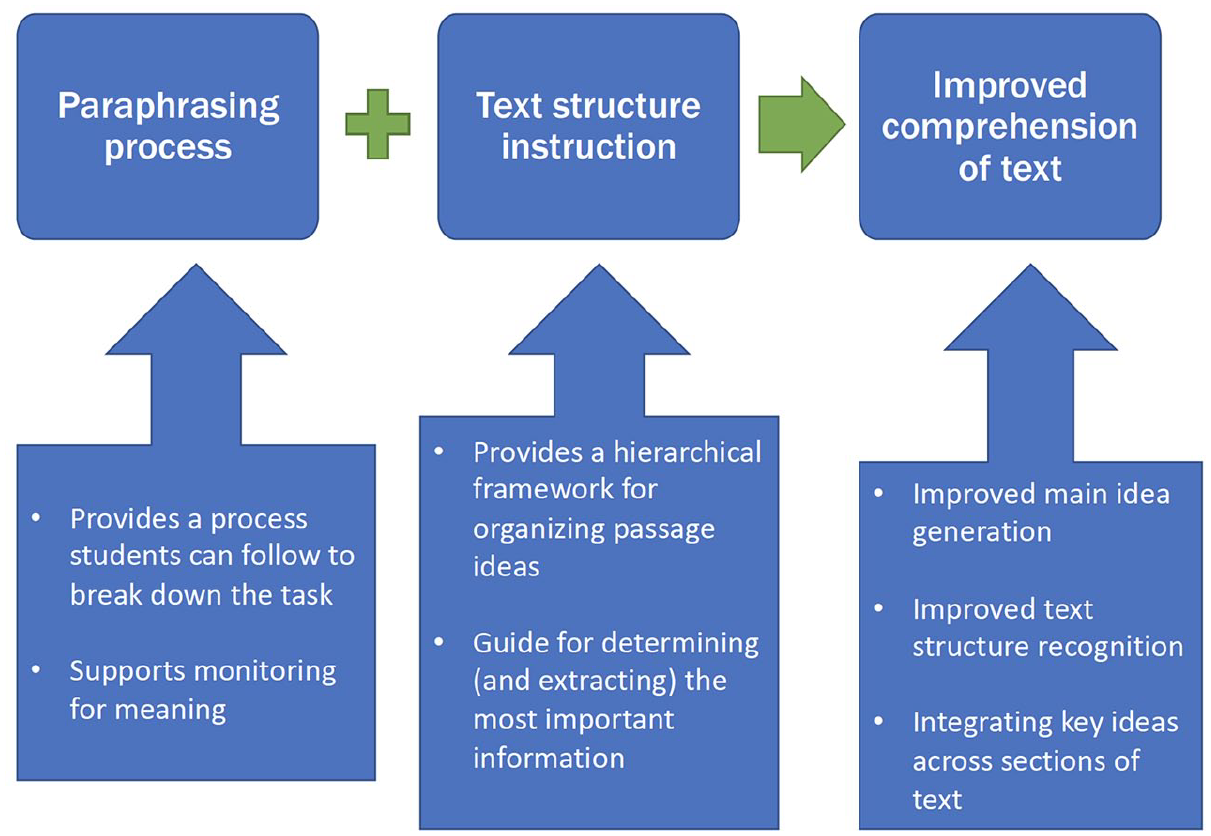
How paraphrasing and text structure instruction work together to support main idea generation
Research has demonstrated that combining paraphrasing and text structure instruction is effective in teaching students to generate main ideas; utilizing text structure organization during the paraphrasing process supports students with identifying the most important information in the text (Step 2 of Get the Gist; Stevens, Vaughn, et al., 2019). The next section describes how to implement paraphrasing and text structure instruction with upper-elementary students with reading disabilities. Get the Gist is a well-established practice, and there are many supporting resources available. Because of this, we provide a brief overview on how to teach Get the Gist and focus instead on providing a model lesson for embedding text structure instruction within Get the Gist.
“Text structure instruction supports students with Step 2 of Get the Gist, determining the most important information rather than details or extraneous information.
Teaching the Practices
When teaching students to generate main ideas, teachers model the process for students (I do), provide opportunities for students to practice with guidance and feedback (we do), and provide opportunities for students to practice independently with feedback (you do). Students initially learn the paraphrasing steps in Get the Gist and practice applying Get the Gist while reading short passages. Then the teacher introduces the application of fix-up practices, a set of tools students use when they encounter difficulty with Steps 1 or 2 of Get the Gist, such as rereading the text and checking the headings. Students use an anchor chart to select and use various fix-up practices during main idea generation. As students make progress in generating main ideas, they learn specific text structures (e.g., description, problem–solution, compare–contrast, sequence, cause–effect). Students return to reading texts and using Get the Gist to identify main ideas, but now they use text structure as a fix-up practice to inform main idea generation (this process is explained fully in the next section). Initially, we recommend teachers introduce two text structures (e.g., description, problem–solution); once students demonstrate knowledge of those structures, teachers introduce additional structures (Stevens, Vaughn, et al., 2019). A suggested sequence for instruction is provided later. In the following section, we provide sample teacher scripting for teaching students to use the text structure as a fix-up practice during the paraphrasing process.
Step 1: Teach Students to Paraphrase Using Get the Gist
Before teaching Get the Gist, identify brief expository texts (i.e., one or two paragraphs) that are easy to understand and represent students’ independent reading level (see Swanson & Wexler, 2017, for additional information on selecting appropriate text). When you initially introduce the practice, you want students to focus on learning the paraphrasing steps without struggling to understand the content or to decode the words. Plan the target gists ahead of time so that you are well prepared to model the process for students. Read the text aloud, showing students how to follow the steps to write a gist for each section of text: (1) Tell the most important who or what. (2) Tell the most important idea about the who or what. (3) Write the gist. Provide scaffolding and support as students learn the process, but gradually release responsibility to students as they became more proficient with the steps. There are several ways that you can scaffold Get the Gist: (a) teach the process initially with photographs; (b) teach Step 1 first, then add step 2 once students demonstrate accuracy identifying the main who or what; (c) provide an anchor chart or cue card to remind students of the paraphrasing steps; and (d) use a graphic organizer or log where students can write their gist statements (Figure 2). In Figure 2, the first log is a generic Get the Gist log for teacher use, and the second log includes cues for students to consider the text structure (description [D], problem–solution [PS], and compare–contrast [CC]) when identifying the most important information in the text (Step 2 of Get the Gist). Additional resources for teaching Get the Gist are available on the following websites: www.meadowscenter.org, greatmiddleschools.org, and iris.peabody.vanderbilt.edu.

Sample gist logs for teacher use
Step 2: Teach Students to Use Fix-Up Practices When They Encounter Difficulty
As students practice with more challenging text, show students how to use fix-up practices when they encounter difficulty (Figure 3). A fix-up practice is an action or tool students can use when they get stuck, particularly with Step 2 of Get the Gist (i.e., Tell the most important information about the who or what.). For example, if students have difficulty with Step 1 or 2 of Get the Gist, tell students to reread the text. Another fix-up practice is to check the headings as this may provide a clue about the who or what or the most important information about the who or what. Once students demonstrate understanding of the Get the Gist steps as well as the initial fix-up practices (i.e., reread and check the headings), students learn to use text structure to identify the most important information in the text.
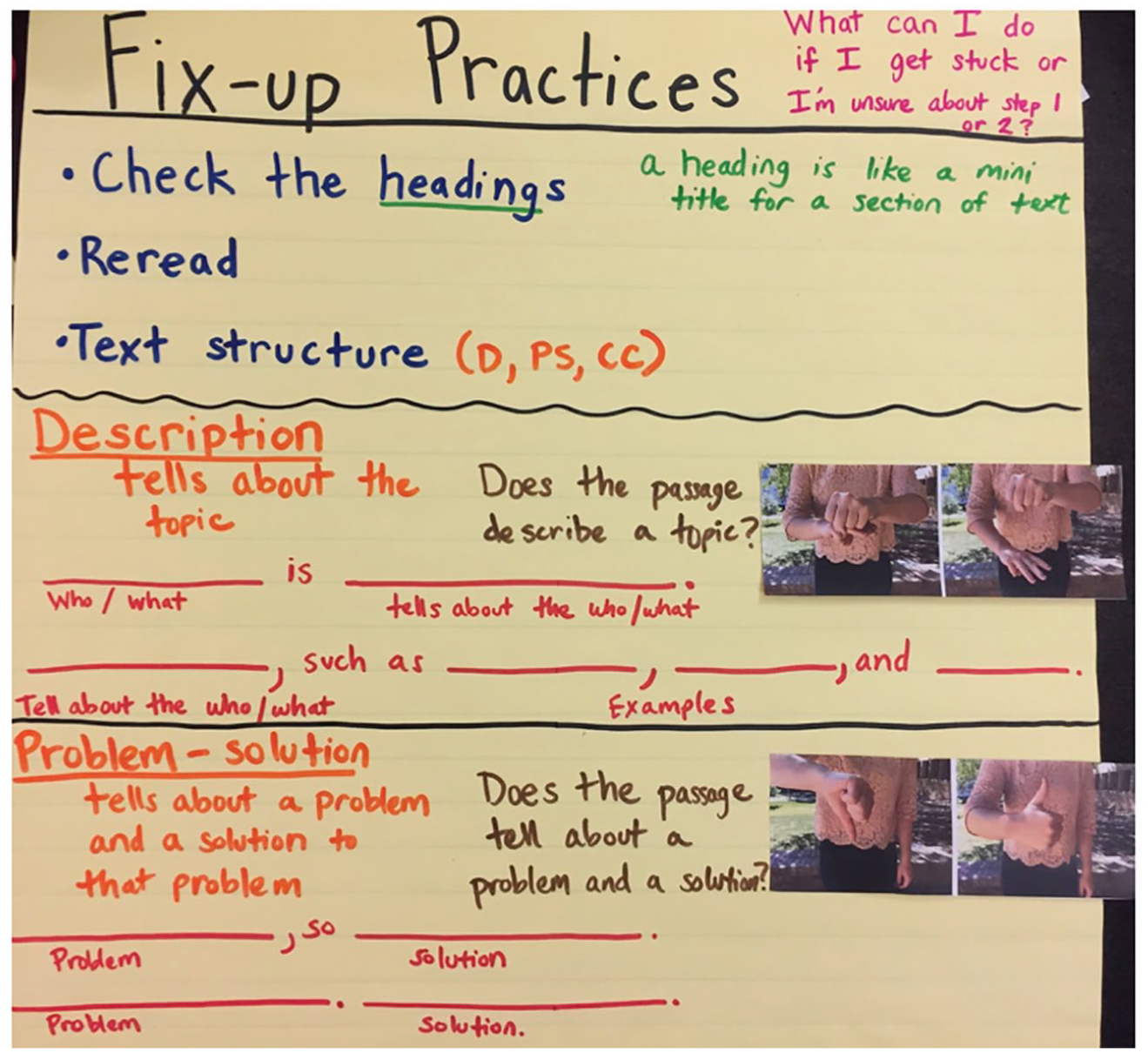
Sample fix-up practices chart
Step 3: Teach Problem–Solution and Description Text Structures
Before showing students how to use the text structure to inform their main idea statements, students need to learn that texts are organized in specific ways. Teaching students to recognize a specific text structure includes the following steps: (1) give a brief explanation of the structure, (2) post a guiding question that students can ask to help identify if a text aligns with this structure, (3) model a gesture to help students remember how information is organized for this structure, and (4) present sentence frames that students can use to write main idea statements aligned with a particular text structure. Let’s see how this works (we use italicized text to represent a teacher think-aloud).
Explain texts are organized in specific structures
One way to help you identify the main idea is to think about how the information is organized. A text’s organization is also called the text structure. When we read, passages also have specific structures. For example, a passage might describe an animal, such as the alligator. It might compare and contrast two animals, such as the alligator and the crocodile, or it might tell about a problem related to the alligators and a possible solution. It’s important and helpful to think about the way the information is organized because it will often help you to figure out the main idea, or the most important information about that passage. We’re going to learn two text structures: description and problem–solution. Let’s talk about the description structure first.
Explain the description text structure and guiding question
A description passage describes the ‘who’ or the ‘what’. That means a description passage tells about the topic, or the ‘who’ or ‘what’. You will often read description passages in your textbooks, in the newspaper, or even on the tests that you take in class. I’m going to add “Description” to our fix-up practices chart and write that a description passage “tells about the topic.” A helpful question you can ask is, “Does the passage describe a topic?” If the answer is yes, it’s most likely a description passage.
Explain the description gesture and sentence frames
We’re going to use a special hand signal for description passages; it looks like this. (Model the gesture while stating, “Description.”) This symbol will help you remember that a description passage describes, or tells about, the topic. I’m also going to add the symbol to our chart. (Paste a photograph or visual of the gesture card on the anchor chart; see Figure 3.) Let’s practice this symbol together; be sure to say “description” as you make the hand signal.
Knowing that a passage is a description passage will help you to figure out the main idea. We can use sentence frames to help us fill in the main idea during Get the Gist. A sentence frame provides part of the sentence, but you need to fill in the rest of the sentence. These are the sentence frames that we’ll use with description passages to help us think about the ‘who’ or ‘what’ and the most important idea about the ‘who’ or ‘what’. (Write sentence frames on anchor chart; see Figure 3.)
_____________ is (or another verb) ____________.
Who/What tells about the who/what
____________, such as ______, ______, and ______.
Tell about the Who/What examples
Explain the problem–solution text structure and guiding question
After introducing the description structure, teach the problem–solution text structure in the same way.
Have you and your friends ever talked about a problem? For example, maybe you lost your homework, or maybe you had a disagreement with a friend. What are some ways to fix those problems? (Discuss solutions.) Can someone share other problems you’ve encountered? (Discuss problems and solutions.) Sometimes we read about a problem and a solution in text, too. A problem–solution passage tells about a problem and a solution to that problem. I’m going to add the problem–solution text structure to our fix-up practices chart and write that a problem–solution structure “tells about a problem and a solution to that problem.” A helpful question you can ask is, “Does the passage tell about a problem and a solution?” Again, if the answer is yes, it’s most likely a problem–solution passage.
Explain the problem–solution gesture and sentence frames
The symbol for a problem–solution passage is thumbs-down, thumbs-up. (Model the gesture while stating, “Problem–solution.”) This symbol will help you remember that a problem–solution passage tells about a problem and a solution. I’m also going to add the symbol to our chart. (Paste gesture card on anchor chart.) Let’s practice this symbol together; be sure to say “problem–solution” as you make the hand signal.
Knowing that a passage is a problem–solution passage will help you to figure out the main idea. This is the sentence frame that we’ll use with problem–solution passages to help us think about the who or what and the most important idea about the who or what. (Write sentence frames on anchor chart.)
___________________, so* ____________________.
Problem solution
__________ is (or another verb) _______________.
Problem solution
*Add other words to the chart throughout the intervention (e.g., “but”).
Provide opportunities for students to practice reading texts and identifying the text structure and corresponding gesture before integrating text structure into the Get the Gist process. It is important for students to identify the structures correctly prior to utilizing this information to inform their main idea statements.
Step 4: Teach Students to Use Text Structure as a Fix-Up Practice During Get the Gist
Once students learn the description and problem–solution structures, text structure awareness becomes another fix-up practice to use when students have difficulty with Step 2 of Get the Gist (i.e., determining the most important information in the text). “Text structure” is added to the fix-up practices chart (i.e., along with “Reread” and “Check the headings”) and integrated within the paraphrasing process (Figure 3). For example, if the student has difficulty identifying the most important information about the who or what (Step 2 of Get the Gist), cue the student to ask the guiding questions: Does this passage describe the who or what? Does the passage tell about a problem and a solution? If the answer to one of these questions is yes, the student uses their knowledge of that structure and the sentence frame to extract the most important information from the text (e.g., identify the problem and the solution) and complete Step 2 of Get the Gist. Once students have sufficient practice with the initial two structures, teach additional structures (e.g., compare–contrast; see Figure 4 for a sample scope and sequence for instruction).
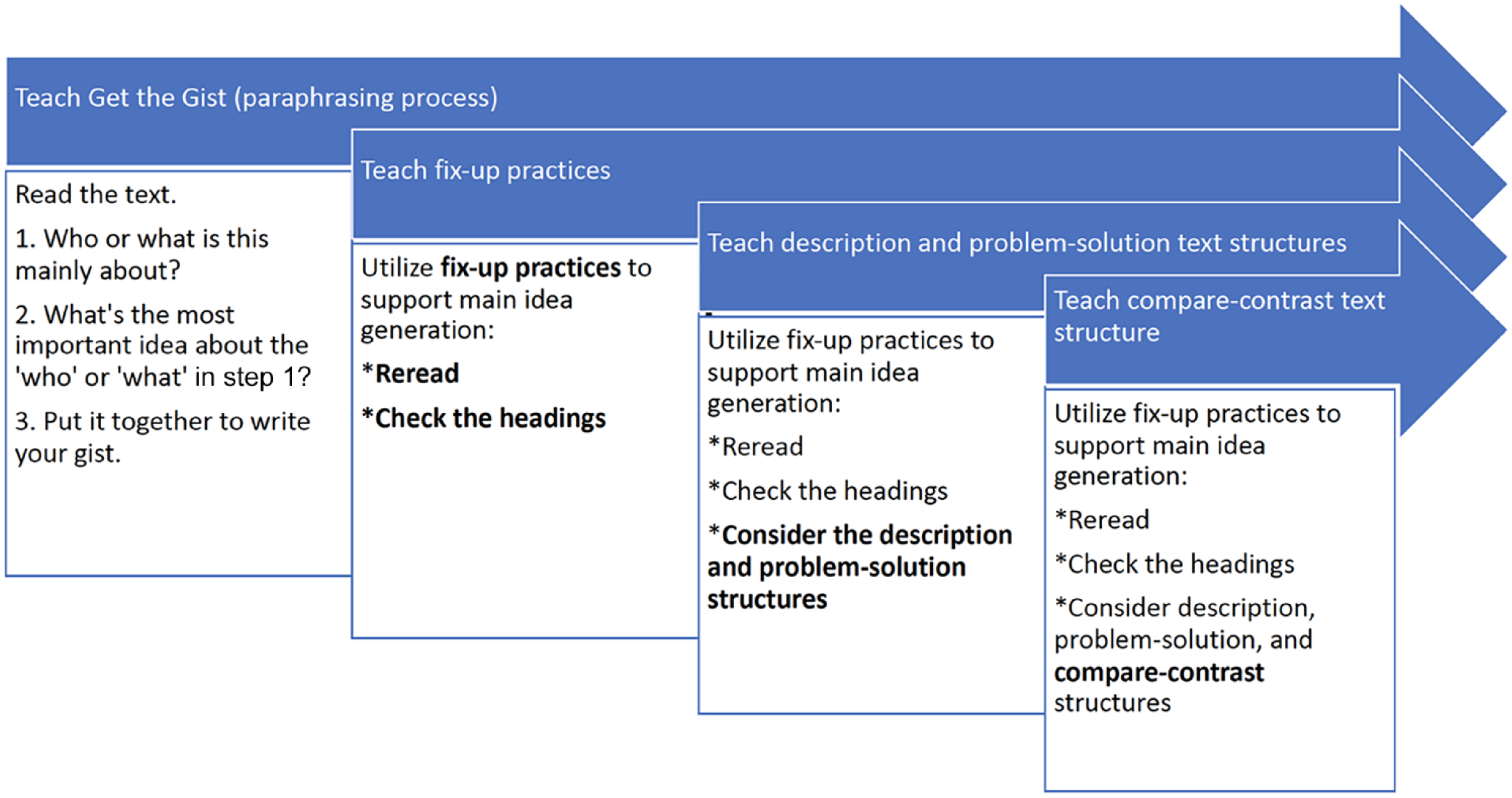
Recommended scope and sequence
Putting It All Together
Next, we provide examples of using the text structure as a fix-up practice during Get the Gist for description and problem–solution passages.
Model Using the Description Text Structure as a Fix-Up Practice
Who remembers the two fix-up practices we’ve learned so far? (Refer to the chart if needed; reread and check the headings.) What are the two text structures we’ve learned so far? (Reinforce gestures as students name each structure: problem–solution and description.) Today I’m going to show you how to use the text structure as a fix-up practice to help you figure out the most important information. You’ve probably heard of Christopher Columbus, right? Many people think he was the first person to discover, or find, America. The truth is, he wasn’t the first person to discover and to live in America. Let’s read more about this. (Read text aloud.)
Often, European explorers are said to have discovered America. These explorers came from Spain, Portugal, and England. They were searching for riches. They also wanted new lands to claim as their own. But was America really a new land?
There were people living in America long before the European explorers were even born. They came thousands and thousands of years ago. At that time, America was connected to Asia by a land bridge. The land bridge ran between Russia and Alaska. These ancient people walked across the land bridge. Once they arrived, they slowly spread out. Eventually, they settled all over North and South America.
Christopher Columbus is often called the first person to discover America. However, we now know that Vikings from Scandinavia settled in North America long before Columbus. But did the Vikings or Columbus really discover America? Aren’t the real discoverers those ancient people who crossed that land bridge long ago? (From “Native Americans: Who Discovered America?” by ReadWorks, 2012, https://www.readworks.org/article/Native-Americans–Who-Discovered-America/e39218e8-fb01-441e-aeb7-c66a3492072b#!articleTab:content/. © 2012 ReadWorks®, Inc. All rights reserved; used with permission.)
Think aloud to find the main idea
First, I ask myself, “‘Who’ or ‘what’ is this about?” This is tricky because the passage talks about several ‘who’s’ the European explorers, Christopher Columbus, and the ancient people that came to America across the land bridge. All of these people came to America, but I think the most important ‘who’ is the first group of people to discover and live in America. I can also check the title, and it talks about who discovered America. I’m going to write “First people to discover America” on my gist log. (Model writing this on the gist log for students; see Figure 5.)
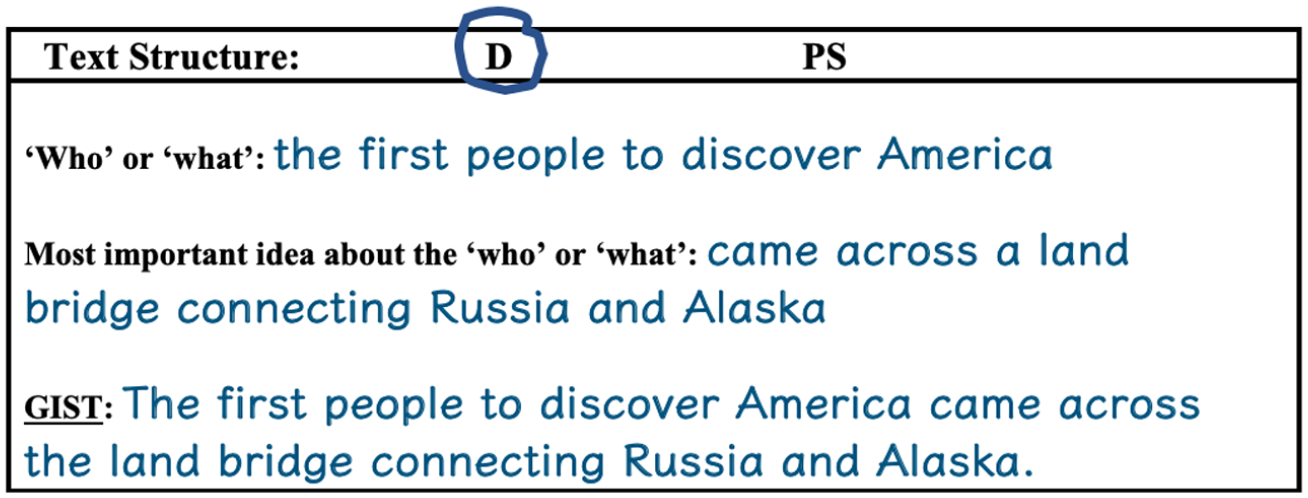
Completed gist log for the description passage
Next, I ask myself, “What’s the most important idea about the first people who discovered America?” I’m going to think about the text structure to help me figure out the most important idea. Does the passage tell about the first people who discovered America, or does it tell about a problem and a solution about the first people who discovered America? (“Describes the first people who discovered America.”) That’s right. This passage tells about the very first people to discover and live in America—even before Christopher Columbus and other European explorers. How did the very first people come here a long, long time ago? (“They came across the land bridge that connected Russia and Alaska.”) Let’s write the most important idea about the first people to discover America in your log: came across the land bridge between Russia and Alaska.
Last, I’ll put the information together to write the gist: The first people to discover America came across the land bridge connecting Russia and Alaska. (Model writing this on the gist log for students; Figure 5.)
Model Using the Problem–Solution Text Structure as a Fix-Up Practice
Let’s try this again with a different passage. Germs are very tiny organisms, or bacteria, that live all around us. There are germs on your hands, on this table, on your desk, on the door handles, all over! We cannot see germs; they can only be seen with a microscope, but they are there! Let’s read about germs at school. (Read text aloud.)
Yuck! A health and safety group recently tested school surfaces for germs and found millions! Drinking fountains had the most germs. A cafeteria tray had more germs than a toilet seat! The testers also found germs lurking on desks and computer keyboards. Kids miss 22 million days of school each year because of colds caught from germs. That number would be much lower if kids would just wash their hands, say health experts. Not all germs are harmful, but some can make kids sick. “When you share things in a classroom, you increase the chance that you might get sick,” the health and safety group’s spokesperson, Jerry Bowman, told Weekly Reader. “Since we are right in the middle of cold and flu season, we have to be extra careful to wash our hands and cover up [our] coughs.” (Adapted from “Germs Go to School!” by ReadWorks, 2005, https://www.readworks.org/article/Germs-Go-to-School!/389be0db-a229-4755-967c-311dbd1212e6#!articleTab:content/. (Adapted from ReadWorks.org © 2005 Weekly Reader Corporation. All rights reserved; used with permission))
Think aloud to find the main idea
First, I ask myself who or what this is about. I think the ‘what’ is germs. The passage talks about kids, a person named Jerry, and health experts, but it talks mostly about ‘germs.’ I also see that ‘germs’ is in the title. I’m going to write “germs” on my gist log. (Model writing this on the gist log for students; Figure 6.)
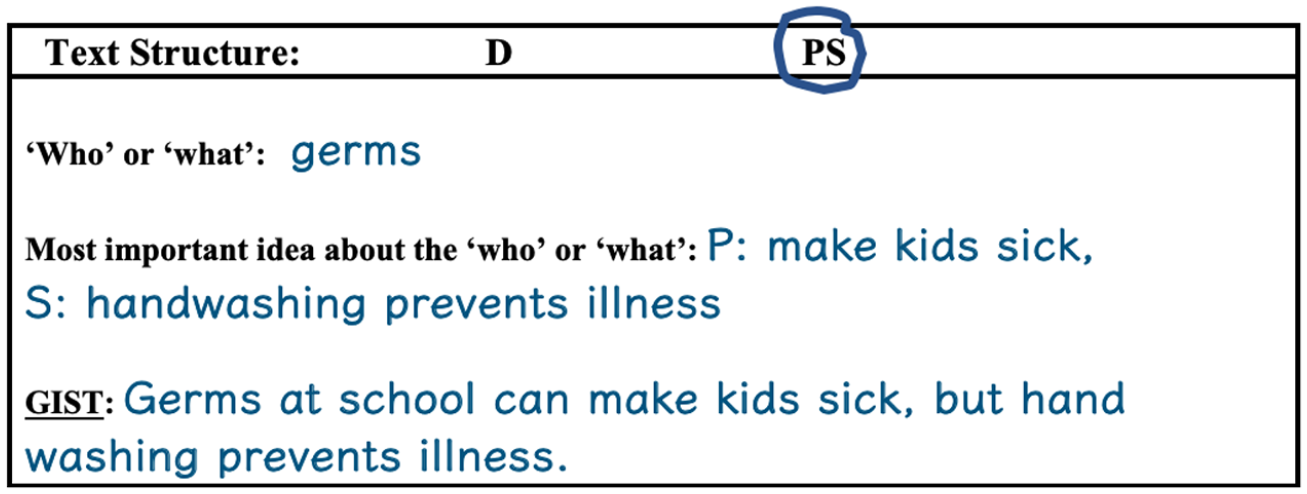
Completed gist log for the problem–solution passage
Next, I ask myself, “What’s the most important idea about germs?” This is a bit trickier. I’m going to think about the text structure to help me figure out the most important idea about germs. First, I’ll reread, and then I’ll think about the text structure. (Reread the text aloud for students.) Does the passage describe germs? Well, it tells a little bit about germs when it describes all the places they are found in schools. Does it tell a problem and a solution related to germs? Yes, most of the passage talks about how germs make kids sick. The problem is that germs make kids sick. What’s the solution? The solution is washing hands. So, I think the most important idea tells the problem and the solution about germs: Germs make kids sick; handwashing prevents sickness. (Write this on the gist log for students; Figure 6.) Last, I’ll put the information together: Germs at school can make kids sick, but handwashing prevents illness. (Model writing this on the gist log for students.)
Facilitate Guided and Independent Practice
After modeling, it is important for students to have opportunities to generate gists through guided (we do) and independent (you do) practice. In the modeling lesson described previously, the teacher uses a think-aloud to show students each step in the process. During guided practice, the teacher uses a think-aloud but guides students through the process. The teacher and the students complete the steps together to generate a gist, and the teacher provides support as needed (e.g., reminding students of the steps in Get the Gist, referring students to the anchor chart, cueing students to consider the text structure or to use a fix-up practice). The teacher might ask students to recall each step in the process (e.g., “What’s the first step in Get the Gist? What’s the second step? What do you do next to write your gist?”) and prompt students to think about the text structure organization when determining the most important information about the who or what (e.g., “Is this a problem–solution or a description passage?”).
During independent practice, the students generate gists without teacher support. Teachers explain to students that they will complete the practice opportunity on their own and remind them to follow the steps and utilize their fix-up tools. It is important that teachers plan ahead for these practice opportunities, having a target gist in mind for each section of text. This allows teachers to easily compare students’ gists with the target gist for accuracy. Students’ gists may not match the teacher’s target gist word for word; however, the main who or what and the most important information (even if phrased a bit differently) should correspond. The teacher confirms correct responses and provides immediate corrective feedback as needed. Corrective feedback may be product specific, explaining what is incorrect about the gist (e.g., “You provided a detail instead of telling the most important information about the who or what”) or process specific, explaining what actions the student can take to improve the gist (e.g., “Go back and reread the paragraph to find the main who or what”).
Keep in mind that generating main ideas is challenging for students with reading disabilities. Making meaningful progress in main idea generation will take time and practice; we encourage teachers to refrain from feeling discouraged if students do not master this process after a few attempts. Instead, expect that main idea generation will be challenging, and utilize the explicit instruction framework to provide additional modeling and guided practice as needed across texts of different types and complexities. Teachers may need to spend a considerable amount of time modeling the process with different text types. If students do not succeed in generating gists successfully during independent practice, teachers may need to provide additional modeling and opportunities for guided practice.
Summary
Determining the main idea of informational texts is challenging for students with reading disabilities because they have difficulty monitoring for meaning, remembering what they have read, and identifying the most important information. This impacts students’ summarization because students need to be able to identify main ideas in order to integrate those ideas across longer sections of text. Like Ms. Crawford, many special education teachers struggle with how to best teach students to generate main ideas while reading. Main idea generation is a higher-level comprehension skill with no one-size-fits-all approach, so some teachers rely on rules (e.g., the main idea is in the first sentence) to teach this skill. Unfortunately, these rules don’t work for every text, nor do they support students’ flexible application of reading comprehension practices across different text types. Teachers may not know how to (a) break the main idea process into steps, (b) support students with determining the most important information in the text, and (c) support students when they encounter difficulty.
Teaching students to paraphrase using Get the Gist provides students with a process to follow; it breaks the skill into manageable steps (i.e., first, identify the main top; next, identify the most important information about that topic; last, combine the information to write a gist). When students encounter difficulty with the process, utilizing fix-up practices, such as rereading and checking the headings, supports students with Steps 1 and 2 of Get the Gist. Text structure awareness can also be used as a fix-up practice, particularly to support students with determining the most important information (Step 2). Ms. Crawford and other educators can promote reading comprehension for students with reading disabilities through instruction aimed at generating high-quality main idea statements. Using guidelines from this article, teachers may have improved confidence teaching students to write main idea statements using paraphrasing (Get the Gist) and text structure knowledge. Integrating Get the Gist with text structure establishes a strong, evidence-based approach for improving students’ reading comprehension.
Footnotes
Declaration of Conflicting Interests
The author(s) declared no potential conflicts of interest with respect to the research, authorship, and/or publication of this article.
Funding
The author(s) disclosed receipt of the following financial support for the research, authorship, and/or publication of this article: This research was supported by the Institute of Education Sciences (IES), U.S. Department of Education, through Grant R305A170556 to the University of Texas at Austin. The opinions expressed are those of the authors and do not represent views of the IES or the U.S. Department of Education.
